Markets
News
Analysis
User
24/7
Economic Calendar
Education
Data
- Names
- Latest
- Prev


Signal Accounts for Members
All Signal Accounts
All Contests


U.K. Trade Balance Non-EU (SA) (Oct)A:--
F: --
P: --
U.K. Trade Balance (Oct)A:--
F: --
P: --
U.K. Services Index MoMA:--
F: --
P: --
U.K. Construction Output MoM (SA) (Oct)A:--
F: --
P: --
U.K. Industrial Output YoY (Oct)A:--
F: --
P: --
U.K. Trade Balance (SA) (Oct)A:--
F: --
P: --
U.K. Trade Balance EU (SA) (Oct)A:--
F: --
P: --
U.K. Manufacturing Output YoY (Oct)A:--
F: --
P: --
U.K. GDP MoM (Oct)A:--
F: --
P: --
U.K. GDP YoY (SA) (Oct)A:--
F: --
P: --
U.K. Industrial Output MoM (Oct)A:--
F: --
P: --
U.K. Construction Output YoY (Oct)A:--
F: --
P: --
France HICP Final MoM (Nov)A:--
F: --
P: --
China, Mainland Outstanding Loans Growth YoY (Nov)A:--
F: --
P: --
China, Mainland M2 Money Supply YoY (Nov)A:--
F: --
P: --
China, Mainland M0 Money Supply YoY (Nov)A:--
F: --
P: --
China, Mainland M1 Money Supply YoY (Nov)A:--
F: --
P: --
India CPI YoY (Nov)A:--
F: --
P: --
India Deposit Gowth YoYA:--
F: --
P: --
Brazil Services Growth YoY (Oct)A:--
F: --
P: --
Mexico Industrial Output YoY (Oct)A:--
F: --
P: --
Russia Trade Balance (Oct)A:--
F: --
P: --
Philadelphia Fed President Henry Paulson delivers a speech
Canada Building Permits MoM (SA) (Oct)A:--
F: --
P: --
Canada Wholesale Sales YoY (Oct)A:--
F: --
P: --
Canada Wholesale Inventory MoM (Oct)A:--
F: --
P: --
Canada Wholesale Inventory YoY (Oct)A:--
F: --
P: --
Canada Wholesale Sales MoM (SA) (Oct)A:--
F: --
P: --
Germany Current Account (Not SA) (Oct)A:--
F: --
P: --
U.S. Weekly Total Rig CountA:--
F: --
P: --
U.S. Weekly Total Oil Rig CountA:--
F: --
P: --
Japan Tankan Large Non-Manufacturing Diffusion Index (Q4)--
F: --
P: --
Japan Tankan Small Manufacturing Outlook Index (Q4)--
F: --
P: --
Japan Tankan Large Non-Manufacturing Outlook Index (Q4)--
F: --
P: --
Japan Tankan Large Manufacturing Outlook Index (Q4)--
F: --
P: --
Japan Tankan Small Manufacturing Diffusion Index (Q4)--
F: --
P: --
Japan Tankan Large Manufacturing Diffusion Index (Q4)--
F: --
P: --
Japan Tankan Large-Enterprise Capital Expenditure YoY (Q4)--
F: --
P: --
U.K. Rightmove House Price Index YoY (Dec)--
F: --
P: --
China, Mainland Industrial Output YoY (YTD) (Nov)--
F: --
P: --
China, Mainland Urban Area Unemployment Rate (Nov)--
F: --
P: --
Saudi Arabia CPI YoY (Nov)--
F: --
P: --
Euro Zone Industrial Output YoY (Oct)--
F: --
P: --
Euro Zone Industrial Output MoM (Oct)--
F: --
P: --
Canada Existing Home Sales MoM (Nov)--
F: --
P: --
Euro Zone Total Reserve Assets (Nov)--
F: --
P: --
U.K. Inflation Rate Expectations--
F: --
P: --
Canada National Economic Confidence Index--
F: --
P: --
Canada New Housing Starts (Nov)--
F: --
P: --
U.S. NY Fed Manufacturing Employment Index (Dec)--
F: --
P: --
U.S. NY Fed Manufacturing Index (Dec)--
F: --
P: --
Canada Core CPI YoY (Nov)--
F: --
P: --
Canada Manufacturing Unfilled Orders MoM (Oct)--
F: --
P: --
Canada Manufacturing New Orders MoM (Oct)--
F: --
P: --
Canada Core CPI MoM (Nov)--
F: --
P: --
Canada Manufacturing Inventory MoM (Oct)--
F: --
P: --
Canada CPI YoY (Nov)--
F: --
P: --
Canada CPI MoM (Nov)--
F: --
P: --
Canada CPI YoY (SA) (Nov)--
F: --
P: --
Canada Core CPI MoM (SA) (Nov)--
F: --
P: --


No matching data
Latest Views
Latest Views
Trending Topics
Top Columnists
Latest Update
White Label
Data API
Web Plug-ins
Affiliate Program
View All

No data
The oil market is pushing its luck. For two years, it’s weathered unthinkable events, including volleys of direct attacks and counterattacks between Israel and Iran.
The oil market is pushing its luck. For two years, it’s weathered unthinkable events, including volleys of direct attacks and counterattacks between Israel and Iran. Yet not a single barrel of production has been lost. With hindsight, every oil-price rally has proven to be an opportunity to sell. It required nerves of steel, but shorting crude while bombs and the missiles were flying was the winning trade.The situation appears the same today after Israel launched a wide-scale attack against Iran, including its nuclear facilities, and Tehran warned of a “harsh” retaliation. Amid the chaos, the barrels are still flowing. Everywhere in the Middle East, oilfields were buzzing and tankers were loading on Friday. If anything, there’s still too much oil in the physical market, and prices, based solely on today’s supply and demand fundamentals, should retreat. But familiarity breeds contempt: the threat of a major oil Middle East shock is alarmingly high.Real-time knowledge of the exact level of global supply and demand is impossible. But there’s a telltale: global inventories. And, for several months, those had been rising above seasonal norms, a sure indication of oversupply.With Saudi Arabia pushing the OPEC+ cartel to boost production faster than previously expected and oil demand growth slowing, the imbalance was set to increase as the year progressed. The Northern hemisphere summer, which provides a seasonal lift to demand, is the last obstacle before an oil glut becomes plainly obvious. The Israeli attack hasn’t changed those supply and demand realities. Fatih Birol, the head of the International Energy Agency, spoke bluntly hours after the attacks: “Markets are well supplied today.”
If anything, the oversupply could worsen. On the demand side, geopolitical chaos is bad for business, so oil demand growth could slow even further. On the supply side, the current price rally – oil rose almost 10% in the initial hours after Israel launched its assault — is handing US shale producers an unexpected opportunity to lock-in forward prices, helping them to keep drilling higher than otherwise.The biggest risk is sleepwalking into believing that just because two years of violence hasn’t disrupted flows, the physical market would never be disrupted. Particularly in the Middle East, it’s always the last straw that breaks the camel’s back. The global oil market looked well oversupplied in late July 1990; a week later, Saddam Hussein’s Iraq had invaded Kuwait, and the global economy was weathering a large oil shock. On Friday, the energy market reaction has split between its two-year-old sense of we-have-been-here-before-and-nothing-happened and genuine alarm. In the initial hours, Brent rallied to almost $80 a barrel as every bearish position got covered. But it later pared its gains to trade around $75 a barrel as braver traders used the rally as a sell opportunity. Still, in the options market, where traders buy and sell insurance against sharp price moves, many were buying contracts that will make money if oil prices surge past $100 a barrel.
Israel hasn’t yet targeted Iranian oil installations so perhaps the biggest risk of supply losses can be averted. But the important word here is “yet.” President Donald Trump is allergic to high energy prices, which will probably restrain Israel Prime Minister Benjamin Netanyahu who would otherwise love to blow up the oilfields that fund the Iranian nuclear program. On Thursday, hours before the attack, Trump spoke publicly about his unhappiness with the recent move above $70 a barrel. In a public event, he rhetorically asked Secretary of Energy Chris Wright: “Are we OK? Nothing wrong? Right? It’s going to keep going down, right? Because we have inflation under control.” Well, not any longer. Tehran hasn’t yet threatened to return to its old playbook of showering fire over the Saudi oilfields and close the Strait of Hormuz, the shipping chokepoint for 20% of the world’s oil supply. But here again, the key word is “yet.” To understand how risky the situation is, listen to everyone around Iran. Saudi Arabia and its neighbors are trying very hard not to give Tehran a pretext to attack them. Hence why Riyadh — and several others in the region — quickly condemned the Israeli attack. Don’t misunderstand the Arab condemnation as sympathy toward Tehran — it’s all about minimizing blowback. The two biggest risks for the oil market stem from Iranian weakness. First, if Tehran concludes that the only way to restore deterrence against Israel is to accelerate its efforts to build a nuclear bomb, sanctions are likely to follow. The Islamic Republic perhaps could withdraw from the 1968 nuclear non-proliferation treaty, but that would probably prompt United Nations sanctions that would make Chinese purchases of Iranian oil, running at more than 1.5 million barrels a day, more difficult, if not impossible. Second, as more Jewish bombs rain on the Islamic Republic, the sense that Ayatollah Ali Khamenei isn’t just fighting to keep his nuclear program but to preserve his own regime is rising. If Tehran concludes it’s defenseless and is fighting a war for survival, it’s likely to conclude that triggering economic upheaval via the oil market is a useful card to play.
So even though there’s plenty of crude and oversupply is evident, it will take nerves of steel to short the oil market.
Israel’s strikes on Iran on Friday have raised the prospect of global oil prices hitting $100 a barrel. If Tehran seeks to escalate the conflict by retaliating beyond Israeli borders, it could seek to choke off the Strait of Hormuz, the world’s most important gateway for oil shipping.
Israel launched a wave of strikes on Iran’s nuclear facilities, ballistic missile factories and military commanders, prompting Iran to launch drones against Israel. It is likely the two archenemies will continue to exchange blows in the coming days.
Oil prices soared by more than 8% to $75 a barrel on Friday on the news.
The United States has sought to distance itself from the Israeli strikes while President Donald Trump urged Iran to return to their bilateral nuclear talks.
While Tehran may strike Israel with additional drones or ballistic missiles, it could also opt to target the Middle East military facilities or strategic infrastructure of the United States and its allies such as Saudi Arabia and the United Arab Emirates. This could include oil and gas fields and ports.
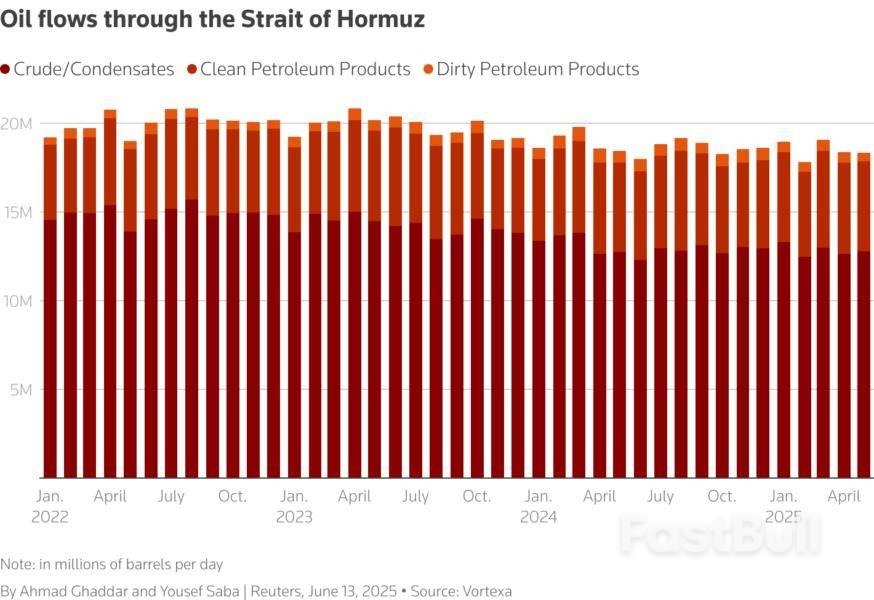
Of course, the most sensitive point Tehran could target is the Strait of Hormuz, a narrow shipping lane between Iran and Oman. About a fifth of the world's total oil consumption passes through the strait, or roughly 20 million barrels per day (bpd) of oil, condensate and fuel.
If that scenario played out, it would likely push oil prices sharply higher, very possibly into triple-digit territory, as OPEC members Saudi Arabia, Iran, the United Arab Emirates, Kuwait and Iraq export most of their crude via the strait, mainly to Asia.
To be sure, an Iranian strike in the Gulf risks drawing a response from the United States and its regional allies, dramatically escalating the conflict and stretching Iran's military capabilities. But Iran has been heavily weakened over the past year, particularly following Israel’s successful campaign against Hezbollah, the Iranian-backed militants in Lebanon.
With its back to the wall, Tehran could see an attack now as a deterrent.
The U.S. military and its regional allies will obviously seek to protect the Strait of Hormuz against an Iranian attack. But Iran could use small speed boats to block or seize tankers and other vessels going through the narrow shipping lane. Iran's Revolutionary Guards have seized several western tankers in that area in recent years, including a British-flagged oil tanker in July 2024.
However, any Iranian efforts to block the strait, or even delay transport through it, could spook energy markets and lead to disruptions in global oil and gas supply.

Saudi Arabia and the UAE have sought in the past to find ways to bypass the Strait of Hormuz, including by building more oil pipelines.
Saudi Arabia, the world's largest oil exporter, sends some of its crude through the Red Sea pipeline that runs from the Abqaiq oilfield in the east into the Red Sea port city of Yanbu in the west.
The Saudi Aramco-operated pipeline has a capacity of 5 million bpd and was able to temporarily expand its capacity by another 2 million bpd in 2019.
It is used mostly to supply Aramco’s west coast refineries. Saudi Arabia also exported 1.5 million bpd of oil from its west coast ports in 2024, including 839,000 bpd of crude, according to data from analytics firm Kpler.
The UAE, which produced 3.3 million bpd of crude oil in April, has a 1.5 million bpd pipeline linking its onshore oilfields to the Fujairah oil terminal that is east of the Strait of Hormuz.
But even the western route could be exposed to attacks from the Iran-backed Houthis in Yemen, who have severely disrupted shipping through the Suez Canal in recent years.
Diverting oil away from the Strait of Hormuz would be more difficult for Iraq and Kuwait, which only have coastlines on the Gulf.
One factor that could keep a lid on crude prices, however, is that these heightened Middle East tensions come at a time of ample global oil supply.
Rising production in the United States, Brazil, Canada, Argentina and other non-OPEC countries has reduced the global market share of the Middle East in recent years. This could help mitigate if not fully offset any supply disruption.
Additionally, any serious disruption to oil supplies in the Middle East would also likely prompt the International Energy Agency to trigger the release of strategic reserves.
Investors have often shrugged off Middle East tensions in recent years, believing that the potential for a truly regional clash is limited. They may do so again, particularly if this strike pushes Iran back to the negotiating table with the U.S. over Tehran’s nuclear program.
But crude prices are apt to be volatile in the coming days as traders seek to get a handle on where this conflict is heading.
U.S. President Donald Trump praised Israel's strike on Iran, describing it as "very outstanding," according to reports from sources on June 13, 2025. The statement has sparked international concern, highlighting potential increases in geopolitical tensions in the region.
U.S. President Trump has commended Israel’s recent military action against Iran. The praise has raised alarm among various international diplomatic circles who are weighing the potential for escalated Middle Eastern tensions. Reported by ChainCatcher, these events have not yet shown a direct impact on the global financial markets linked to cryptocurrency.
The U.S. President's approval has been met with mixed responses across the international community. Many political analysts warn that such comments might lead to heightened regional conflict, although current market trends indicate stability within crypto trading volumes.
Diplomatic leaders from across the globe have expressed concerns about Trump's statement’s impact, although no major cryptocurrency markets have shown fluctuations correlating to this geopolitical development. The lack of direct economic disruption suggests limited immediate repercussions in the blockchain sector.
Did you know? Historically, major geopolitical tensions have not always equated to immediate cryptocurrency market volatility, although they often influence long-term investment strategies.
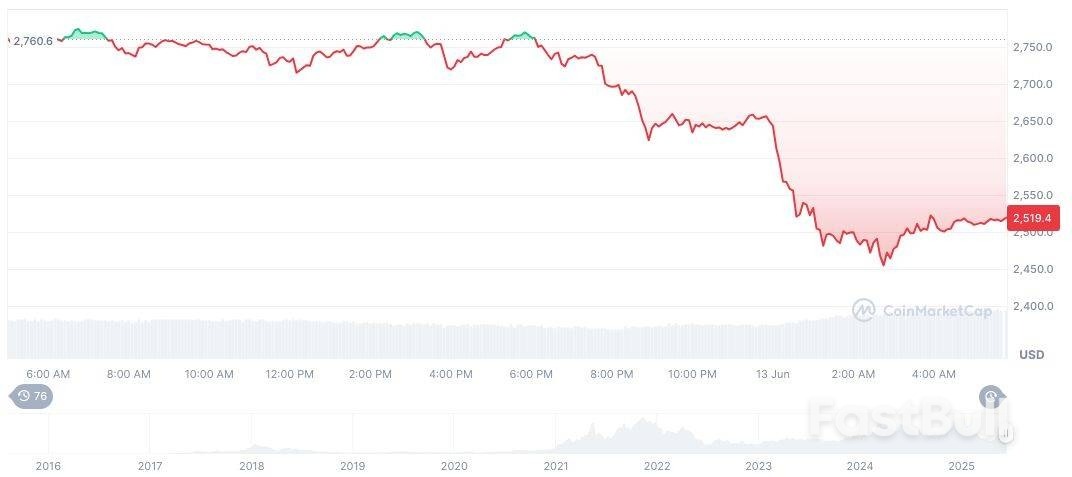
Ethereum (ETH) currently trades at $2,532.42 with a market cap of DeepBrainChain, marking a 7.38% decrease over 24 hours, according to CoinMarketCap. The 24-hour trading volume surged by 36.37% to $40,011,974,417, reflecting market participants’ cautious positioning. The cryptocurrency holds a 9.38% market dominance while exhibiting a mixed performance trend in recent weeks.
Ethereum(ETH), daily chart, screenshot on CoinMarketCap at 11:44 UTC on June 13, 2025. Source: CoinMarketCapBreaking news from the Middle East indicates a significant development: the Israeli Air Force has reportedly conducted a strike within Iran. This action, reported by Axios and shared widely via platforms like X by figures such as Walter Bloomberg, marks a critical moment in the ongoing regional tensions. For those following global events and their potential ripple effects on financial markets, including the often-sensitive cryptocurrency space, understanding the nuances of this situation is paramount. This event injects a new level of Geopolitical Risk into an already volatile global landscape.
The report of an Iran Israel Strike follows a period of heightened direct confrontation between the two nations. For years, the conflict has primarily unfolded through proxies and covert operations. However, recent events saw Iran launch an unprecedented direct missile and drone attack on Israel, which Iran stated was in retaliation for a strike on its consulate in Damascus. Israel had vowed to respond to Iran’s direct attack. The reported strike in Iran appears to be that response, bringing the long-simmering conflict into a more overt phase.
While details are still emerging, initial reports suggest the strike targeted specific locations within Iran. The nature and extent of the damage, as well as Iran’s official response, are key factors that will determine the immediate trajectory of the situation. The world watches closely, assessing the potential for further escalation.
Major geopolitical events inherently introduce uncertainty, which financial markets dislike. An increase in Geopolitical Risk can trigger significant reactions across various asset classes. Historically, conflicts in the Middle East, a region central to global energy supplies, have had pronounced effects on oil prices. Rising oil prices can contribute to inflation, impacting monetary policy decisions by central banks worldwide. This, in turn, influences everything from bond yields to stock valuations.
Beyond energy, heightened tensions can disrupt supply chains, affect international trade, and dampen investor confidence. In times of uncertainty, investors often move towards assets traditionally considered ‘safe havens,’ such as gold or certain government bonds. However, the definition of a safe haven can shift, and the interconnectedness of modern markets means that even traditional safe havens can experience volatility during extreme stress events.
Here are some potential ways geopolitical risk can ripple through markets:
The current Middle East Tensions between Iran and Israel are particularly concerning due to the potential for a wider regional conflict involving other state and non-state actors. The involvement of proxies, the strategic importance of the region, and the complex web of alliances make de-escalation challenging. Any miscalculation could have severe consequences, extending beyond the immediate combatants.
Understanding the historical context is crucial. The animosity between Iran and Israel dates back decades, rooted in political, religious, and strategic disagreements. Iran’s support for groups hostile to Israel and its nuclear program are central points of contention. Israel views Iran as an existential threat. This latest direct exchange marks a dangerous evolution in their rivalry.
International reactions play a key role in shaping the narrative and potential outcomes. Calls for restraint from global powers are common, but the effectiveness of such calls depends on the willingness of the parties involved to step back. The position of major global players like the United States, European Union nations, Russia, and China will be critical in diplomatic efforts, or lack thereof.
The immediate Global Market Impact of the reported strike is likely to manifest as increased volatility. Futures markets often react quickly to such news, and the start of trading sessions will reveal how this development is being priced in by investors worldwide. Sectors most directly affected might include energy, defense, and potentially technology, given the reliance on global supply chains.
However, the longer-term impact depends heavily on whether this event leads to further escalation or if diplomatic efforts manage to contain the situation. A prolonged or expanded conflict would likely have a more sustained negative impact on global economic growth prospects and market stability. Conversely, a swift de-escalation could see markets recover relatively quickly, having priced in the initial shock.
Market participants will be closely monitoring official statements from Iran and Israel, as well as reactions from major international bodies and governments. The language used and the actions taken in the coming hours and days will be critical indicators of the potential trajectory of the conflict and, consequently, the markets.
The relationship between geopolitical events and the cryptocurrency market is complex and not always straightforward. While Bitcoin was envisioned by some as a non-sovereign store of value, potentially acting as a safe haven during traditional financial system stress, its price often behaves like a risk asset, correlating with technology stocks.
Crypto Volatility is already a defining characteristic of the market. Geopolitical events can exacerbate this volatility, though the direction isn’t always predictable. In some instances, initial news of conflict might lead to a sell-off in risk assets, including crypto. However, if the event is perceived as weakening traditional financial systems or increasing inflation fears (due to rising commodity prices, for example), some investors might theoretically turn to Bitcoin or other cryptocurrencies as an alternative store of value, potentially driving prices up.
The crypto market is also influenced by global liquidity and macroeconomic factors, which are indirectly affected by geopolitical stability. Increased global uncertainty can lead to tighter financial conditions, which typically pressure risk assets like cryptocurrencies. Conversely, if central banks were to react to a geopolitical crisis with more accommodative monetary policy (though this is not the current trend), it could potentially provide tailwinds for crypto.
Here’s a look at potential, though not guaranteed, impacts on crypto:
For cryptocurrency holders and traders, this period calls for increased vigilance. Monitoring global news alongside market data is essential. Understanding that external, non-crypto specific events can significantly impact digital asset prices is a crucial part of navigating this market.
Predicting the future in geopolitical situations is impossible, but analysts are considering several potential scenarios following the reported Iran Israel Strike:
The actions and rhetoric of leaders in Tehran, Tel Aviv, Washington D.C., and other capitals will provide clues about which path is most likely being taken. Diplomatic efforts, back-channel communications, and public statements will all be scrutinized.
Given the unfolding situation and its potential Global Market Impact, what should readers, especially those with exposure to volatile assets like cryptocurrencies, consider?
While it’s impossible to perfectly predict how Middle East Tensions will specifically affect Crypto Volatility in the short term, being prepared for potential market reactions is prudent. This involves understanding the underlying factors at play and maintaining a rational approach to investing during uncertain times.
The reported Iran Israel Strike marks a significant escalation in long-standing Middle East Tensions. This event immediately heightens Geopolitical Risk, with potentially far-reaching consequences for regional stability and the global economy. The Global Market Impact is likely to be characterized by increased uncertainty and Crypto Volatility, at least in the short term. While the exact trajectory of events remains uncertain, the coming days will be critical in determining whether this leads to further conflict or a path towards de-escalation. For investors and global citizens alike, staying informed and understanding the potential implications of this developing situation is essential.
White Label
Data API
Web Plug-ins
Poster Maker
Affiliate Program
The risk of loss in trading financial instruments such as stocks, FX, commodities, futures, bonds, ETFs and crypto can be substantial. You may sustain a total loss of the funds that you deposit with your broker. Therefore, you should carefully consider whether such trading is suitable for you in light of your circumstances and financial resources.
No decision to invest should be made without thoroughly conducting due diligence by yourself or consulting with your financial advisors. Our web content might not suit you since we don't know your financial conditions and investment needs. Our financial information might have latency or contain inaccuracy, so you should be fully responsible for any of your trading and investment decisions. The company will not be responsible for your capital loss.
Without getting permission from the website, you are not allowed to copy the website's graphics, texts, or trademarks. Intellectual property rights in the content or data incorporated into this website belong to its providers and exchange merchants.
Not Logged In
Log in to access more features

FastBull Membership
Not yet
Purchase
Log In
Sign Up