• Trade
  • Markets
  • Copy
  • Contests
  • News
  • 24/7
  • Calendar
  • Q&A
  • Chats
Trending
Screeners
SYMBOL
LAST
BID
ASK
HIGH
LOW
NET CHG.
%CHG.
SPREAD
SPX
S&P 500 Index
6846.50
6846.50
6846.50
6878.28
6827.18
-23.90
-0.35%
--
DJI
Dow Jones Industrial Average
47739.31
47739.31
47739.31
47971.51
47611.93
-215.67
-0.45%
--
IXIC
NASDAQ Composite Index
23545.89
23545.89
23545.89
23698.93
23455.05
-32.22
-0.14%
--
USDX
US Dollar Index
99.000
99.080
99.000
99.000
99.000
+0.050
+ 0.05%
--
EURUSD
Euro / US Dollar
1.16388
1.16396
1.16388
1.16388
1.16322
+0.00024
+ 0.02%
--
GBPUSD
Pound Sterling / US Dollar
1.33237
1.33248
1.33237
1.33237
1.33140
+0.00032
+ 0.02%
--
XAUUSD
Gold / US Dollar
4193.00
4193.44
4193.00
4193.80
4189.64
+3.30
+ 0.08%
--
WTI
Light Sweet Crude Oil
58.650
58.692
58.650
58.676
58.543
+0.095
+ 0.16%
--

Community Accounts

Signal Accounts
--
Profit Accounts
--
Loss Accounts
--
View More

Become a signal provider

Sell trading signals to earn additional income

View More

Guide to Copy Trading

Get started with ease and confidence

View More

Signal Accounts for Members

All Signal Accounts

Best Return
  • Best Return
  • Best P/L
  • Best MDD
Past 1W
  • Past 1W
  • Past 1M
  • Past 1Y

All Contests

  • All
  • Trump Updates
  • Recommend
  • Stocks
  • Cryptocurrencies
  • Central Banks
  • Featured News
Top News Only
Share

KCNA: North Korea's Supreme Leader Kim Jong UN Sends Condolences To Russian Embassy For Ambassador's Death

Share

Japan Prime Minister Takaichi: 30 Injuries Reported So Far From Monday Earthquake

Share

USA Senate Committee Votes To Advance Nomination Of Jared Isaacman To Head Nasa

Share

Singapore Post - New Rate For Standard Regular Mail & Standard Large Mail Will Be S$0.62 And S$0.90 Respectively

Share

Australia's S&P/ASX 200 Index Down 0.27% At 8601.10 Points In Early Trade

Share

Trump: The USA Needs Mexico To Release 200000 Acre-Feet Of Water Before December 31St, And The Rest Must Come Soon After

Share

Trump: I Have Authorized Documentation To Impose A 5% Tariff On Mexico If This Water Isn't Released

Share

Brazil's Sao Paulo State Governor Tarcisio De Freitas Says Flavio Bolsonaro Will Have His Support - Cnn Brasil

Share

Ukraine's Security Must Be Guaranteed, In The Long Term, As A First Line Of Defence For Our Union, Says European Commission President

Share

Ukraine's Sovereignty Must Be Respected, Says European Commission President

Share

The Goal Is A Strong Ukraine, On The Battlefield And At The Negotiating Table, Says European Commission President

Share

As Peace Talks Are Ongoing, The EU Remains Ironclad In Its Support For Ukraine, Says European Commission President

Share

Pepsico: Asking USA-Based Pepna Employees As Well As Pbus Division Offices And Pfus Region Offices To Work Remotely This Week

Share

A U.S. Judge Ruled That President Trump’s Ban On Several Wind Power Projects Was Illegal

Share

Senior USA Administration Official: We Continue To Monitor Drc-Rwanda Situation Closely, Continue To Work With All Sides To Ensure Commitments Are Honored

Share

Israeli Military Says It Has Struck Infrastructure Belonging To Hezbollah In Several Areas In Southern Lebanon

Share

SPDR Gold Holdings Down 0.11%, Or 1.14 Tonnes

Share

On Monday (December 8), In Late New York Trading, S&P 500 Futures Fell 0.21%, Dow Jones Futures Fell 0.43%, NASDAQ 100 Futures Fell 0.08%, And Russell 2000 Futures Fell 0.04%

Share

Morgan Stanley: Data Center ABS Spreads Are Expected To Widen In 2026

Share

(US Stocks) The Philadelphia Gold And Silver Index Closed Down 2.34% At 311.01 Points. (Global Session) The NYSE Arca Gold Miners Index Closed Down 2.17%, Hitting A Daily Low Of 2235.45 Points; US Stocks Remained Slightly Down Before The Opening Bell—holding Steady Around 2280 Points—before Briefly Rising Slightly

TIME
ACT
FCST
PREV
France Trade Balance (SA) (Oct)

A:--

F: --

P: --
Euro Zone Employment YoY (SA) (Q3)

A:--

F: --

P: --
Canada Part-Time Employment (SA) (Nov)

A:--

F: --

P: --

Canada Unemployment Rate (SA) (Nov)

A:--

F: --

P: --

Canada Full-time Employment (SA) (Nov)

A:--

F: --

P: --

Canada Labor Force Participation Rate (SA) (Nov)

A:--

F: --

P: --

Canada Employment (SA) (Nov)

A:--

F: --

P: --

U.S. PCE Price Index MoM (Sept)

A:--

F: --

P: --

U.S. Personal Income MoM (Sept)

A:--

F: --

P: --

U.S. Core PCE Price Index MoM (Sept)

A:--

F: --

P: --

U.S. PCE Price Index YoY (SA) (Sept)

A:--

F: --

P: --

U.S. Core PCE Price Index YoY (Sept)

A:--

F: --

P: --

U.S. Personal Outlays MoM (SA) (Sept)

A:--

F: --

P: --
U.S. 5-10 Year-Ahead Inflation Expectations (Dec)

A:--

F: --

P: --

U.S. Real Personal Consumption Expenditures MoM (Sept)

A:--

F: --

P: --
U.S. Weekly Total Rig Count

A:--

F: --

P: --

U.S. Weekly Total Oil Rig Count

A:--

F: --

P: --

U.S. Consumer Credit (SA) (Oct)

A:--

F: --

P: --
China, Mainland Foreign Exchange Reserves (Nov)

A:--

F: --

P: --

Japan Trade Balance (Oct)

A:--

F: --

P: --

Japan Nominal GDP Revised QoQ (Q3)

A:--

F: --

P: --

China, Mainland Imports YoY (CNH) (Nov)

A:--

F: --

P: --

China, Mainland Exports (Nov)

A:--

F: --

P: --

China, Mainland Imports (CNH) (Nov)

A:--

F: --

P: --

China, Mainland Trade Balance (CNH) (Nov)

A:--

F: --

P: --

China, Mainland Exports YoY (USD) (Nov)

A:--

F: --

P: --

China, Mainland Imports YoY (USD) (Nov)

A:--

F: --

P: --

Germany Industrial Output MoM (SA) (Oct)

A:--

F: --

P: --
Euro Zone Sentix Investor Confidence Index (Dec)

A:--

F: --

P: --

Canada National Economic Confidence Index

A:--

F: --

P: --

U.K. BRC Like-For-Like Retail Sales YoY (Nov)

--

F: --

P: --

U.K. BRC Overall Retail Sales YoY (Nov)

--

F: --

P: --

Australia Overnight (Borrowing) Key Rate

--

F: --

P: --

RBA Rate Statement
RBA Press Conference
Germany Exports MoM (SA) (Oct)

--

F: --

P: --

U.S. NFIB Small Business Optimism Index (SA) (Nov)

--

F: --

P: --

Mexico 12-Month Inflation (CPI) (Nov)

--

F: --

P: --

Mexico Core CPI YoY (Nov)

--

F: --

P: --

Mexico PPI YoY (Nov)

--

F: --

P: --

U.S. Weekly Redbook Index YoY

--

F: --

P: --

U.S. JOLTS Job Openings (SA) (Oct)

--

F: --

P: --

China, Mainland M1 Money Supply YoY (Nov)

--

F: --

P: --

China, Mainland M0 Money Supply YoY (Nov)

--

F: --

P: --

China, Mainland M2 Money Supply YoY (Nov)

--

F: --

P: --

U.S. EIA Short-Term Crude Production Forecast For The Year (Dec)

--

F: --

P: --

U.S. EIA Natural Gas Production Forecast For The Next Year (Dec)

--

F: --

P: --

U.S. EIA Short-Term Crude Production Forecast For The Next Year (Dec)

--

F: --

P: --

EIA Monthly Short-Term Energy Outlook
U.S. API Weekly Gasoline Stocks

--

F: --

P: --

U.S. API Weekly Cushing Crude Oil Stocks

--

F: --

P: --

U.S. API Weekly Crude Oil Stocks

--

F: --

P: --

U.S. API Weekly Refined Oil Stocks

--

F: --

P: --

South Korea Unemployment Rate (SA) (Nov)

--

F: --

P: --

Japan Reuters Tankan Non-Manufacturers Index (Dec)

--

F: --

P: --

Japan Reuters Tankan Manufacturers Index (Dec)

--

F: --

P: --

Japan Domestic Enterprise Commodity Price Index MoM (Nov)

--

F: --

P: --

Japan Domestic Enterprise Commodity Price Index YoY (Nov)

--

F: --

P: --

China, Mainland PPI YoY (Nov)

--

F: --

P: --

China, Mainland CPI MoM (Nov)

--

F: --

P: --

Italy Industrial Output YoY (SA) (Oct)

--

F: --

P: --

Q&A with Experts
    • All
    • Chatrooms
    • Groups
    • Friends
    Connecting
    .
    .
    .
    Type here...
    Add Symbol or Code

      No matching data

      All
      Trump Updates
      Recommend
      Stocks
      Cryptocurrencies
      Central Banks
      Featured News
      • All
      • Russia-Ukraine Conflict
      • Middle East Flashpoint
      • All
      • Russia-Ukraine Conflict
      • Middle East Flashpoint
      Search
      Products

      Charts Free Forever

      Chats Q&A with Experts
      Screeners Economic Calendar Data Tools
      Membership Features
      Data Warehouse Market Trends Institutional Data Policy Rates Macro

      Market Trends

      Market Sentiment Order Book Forex Correlations

      Top Indicators

      Charts Free Forever
      Markets

      News

      News Analysis 24/7 Columns Education
      From Institutions From Analysts
      Topics Columnists

      Latest Views

      Latest Views

      Trending Topics

      Top Columnists

      Latest Update

      Signals

      Copy Rankings Latest Signals Become a signal provider AI Rating
      Contests
      Brokers

      Overview Brokers Assessment Rankings Regulators News Claims
      Broker listing Forex Brokers Comparison Tool Live Spread Comparison Scam
      Q&A Complaint Scam Alert Videos Tips to Detect Scam
      More

      Business
      Events
      Careers About Us Advertising Help Center

      White Label

      Data API

      Web Plug-ins

      Affiliate Program

      Awards Institution Evaluation IB Seminar Salon Event Exhibition
      Vietnam Thailand Singapore Dubai
      Fans Party Investment Sharing Session
      FastBull Summit BrokersView Expo
      Recent Searches
        Top Searches
          Markets
          News
          Analysis
          User
          24/7
          Economic Calendar
          Education
          Data
          • Names
          • Latest
          • Prev

          View All

          No data

          Scan to Download

          Faster Charts, Chat Faster!

          Download App
          English
          • English
          • Español
          • العربية
          • Bahasa Indonesia
          • Bahasa Melayu
          • Tiếng Việt
          • ภาษาไทย
          • Français
          • Italiano
          • Türkçe
          • Русский язык
          • 简中
          • 繁中
          Open Account
          Search
          Products
          Charts Free Forever
          Markets
          News
          Signals

          Copy Rankings Latest Signals Become a signal provider AI Rating
          Contests
          Brokers

          Overview Brokers Assessment Rankings Regulators News Claims
          Broker listing Forex Brokers Comparison Tool Live Spread Comparison Scam
          Q&A Complaint Scam Alert Videos Tips to Detect Scam
          More

          Business
          Events
          Careers About Us Advertising Help Center

          White Label

          Data API

          Web Plug-ins

          Affiliate Program

          Awards Institution Evaluation IB Seminar Salon Event Exhibition
          Vietnam Thailand Singapore Dubai
          Fans Party Investment Sharing Session
          FastBull Summit BrokersView Expo

          10 Surprising Stock Picks for 2024

          Glendon

          Economic

          Summary:

          Forget the usual suspects! This exploration dives into 10 surprising stocks with the potential to become breakout stars in 2024.

          Predicting the stock market's future winners is no easy feat. However, by analyzing industry trends, company fundamentals, and under-the-radar potential, we can uncover some surprising stocks poised for a breakout year in 2024. Here are 10 such stocks that might surprise you with their growth potential:
          Green Giant (NYSE: GGN): While "Big Food" giants might seem like a tired bet, Green Giant, known for its canned and frozen vegetables, is undergoing a quiet revolution. They're emphasizing organic and plant-based options, aligning perfectly with the growing consumer demand for healthier and sustainable food choices. Additionally, their focus on convenience and affordability positions them well in an inflationary environment.
          HP Inc. (NYSE: HPQ): Yes, the computer hardware company. HP has been quietly transforming itself, moving beyond just PCs and printers. They're making significant strides in the high-growth cloud computing and gaming peripherals market. Their focus on business solutions and ongoing hardware innovation could propel them forward in 2024.
          Etsy (NASDAQ: ETSY): The online marketplace for handmade and vintage goods might seem like a niche player. However, Etsy has been expanding its reach, attracting younger demographics and growing its international presence. With the increasing popularity of personalized and unique items, Etsy stands to benefit from the growing consumer desire to move away from mass-produced goods.
          Church & Dwight Co. (NYSE: CHD): The maker of Arm & Hammer baking soda and Trojan condoms might not be on your typical growth stock radar. However, CHD boasts a consistent record of revenue and earnings growth. Their strong brand recognition, portfolio of essential household products, and focus on organic options position them for continued stability and potential upside in 2024.
          Dollar General (NYSE: DG): Discount retailers might seem pedestrian, but Dollar General has been a champion of affordability during inflationary times. Their convenient locations, focus on essential goods, and everyday low prices resonate with budget-conscious consumers. Dollar General's strong track record and potential for continued store expansion make it a surprising contender in 2024.
          MPLX LP (NYSE: MPLX): This pipeline company might seem like a dry investment, but MPLX plays a vital role in the energy sector, transporting oil and gas across the United States. With ongoing energy market volatility and a potential focus on domestic production, MPLX could benefit from increased pipeline utilization and rising energy prices.
          Sociedad Quimica y Minera de Chile S.A. (NYSE: SQM): This Chilean company, the world's largest producer of lithium, might seem like an obscure choice. However, lithium is a critical component of electric vehicle batteries, and demand is expected to soar in the coming years. SQM is well-positioned to capitalize on this long-term trend, making it a potential hidden gem in 2024.
          Zoom Video Communications (NASDAQ: ZM): While the video conferencing giant might seem like a post-pandemic play, Zoom is actively developing new features and expanding into the telehealth and hybrid work communication space. As businesses adapt to a more distributed workforce, Zoom's solutions could remain relevant, offering surprising growth potential in 2024.
          The Home Depot (NYSE: HD): The home improvement giant might seem like a mature company. However, Home Depot is benefiting from the ongoing housing market trends and the do-it-yourself (DIY) movement. As people spend more time at home and invest in renovations, Home Depot is well-positioned to capture a larger share of the home improvement spending in 2024.
          Moderna (NASDAQ: MRNA): While Moderna might seem like a one-trick pony with its success in the COVID-19 vaccine market, they are actively developing mRNA vaccines for other diseases like influenza and HIV. Additionally, their investments in personalized medicine hold promise for the future. Moderna's focus on innovation could lead to surprising breakthroughs and stock price growth in 2024.
          To stay updated on all economic events of today, please check out our Economic calendar
          Risk Warnings and Disclaimers
          You understand and acknowledge that there is a high degree of risk involved in trading. Following any strategies or investment methods may lead to potential losses. The content on the site is provided by our contributors and analysts for information purposes only. You are solely responsible for determining whether any trading assets, securities, strategy, or any other product is suitable for investing based on your own investment objectives and financial situation.
          Add to Favorites
          Share

          Tighter Fundamentals and Geopolitics Are Pushing Commodities Higher

          ING

          Commodity

          Oil market tightens as geopolitical risks grow

          Oil prices have seen significant strength through March and early April. ICE Brent broke above US$90/bbl, trading at its highest level since October. Growing tension in the Middle East is obviously one reason for the boost. However, that increased geopolitical risk comes at a time when the oil market was already set to tighten.
          The oil market has been pushed into deficit after a handful of OPEC+ members announced they would roll over their additional voluntary cuts, amounting to 2.2 million barrels a day (b/d) from the first to the second quarter of 2024. Our numbers suggest this will leave the market in a deficit of around 1 million b/d this quarter.
          The scale of the deficit suggests that oil prices remain well supported over the coming months and as we enter the summer driving season through the third quarter. As a result, we expect ICE Brent to average $88/bbl over the second and third quarters.
          OPEC+ will be key to the outlook for the second half of the year. Additional voluntary cuts are set to expire towards the end of June. As a result, the market is set to be in a small surplus over the second half of 2024. However, the key upside risk is if OPEC+ decides on a further rollover, which would tighten the market still further. If that happens, we'll be looking to revise our forecasts higher still.

          Europe exits winter with record gas storage

          Europe has exited the 2023/24 heating season with record natural gas storage. It was 58% full at the end of March, above the 56% we saw last year and well above the 5-year average of 41%. Comfortable storage has kept the market from moving significantly higher. Gas flows into Europe have been stable through most of the winter, while we have had some milder weather through February and much of March.
          We expect prices to remain under pressure through the injection season. With storage likely to be full once again ahead of next winter, we could see prices coming under further pressure later in the third quarter. We expect TTF to average EUR25/MWh over 2Q24 and 3Q24.
          There are some further signs of gas demand recovering in Europe, with some Year-on-Year increases in gas consumption in recent months. However, demand remains well below pre-Ukraine war levels. Our gas balance suggests that European gas demand in 2024 could increase 9% YoY, and Europe would still manage to hit the European Commission's target of having storage 90% full by 1 November.
          As we approach the end of this year, a concern for the market is what happens to Russian pipeline flows to Europe via Ukraine. Ukraine has made it clear that it has no plans to extend the transit deal with Gazprom, which expires at the end of December. This puts roughly 40mcm/day of Russian pipeline flows at risk. We believe that Europe will be able to find an alternative supply if this volume is lost. However, the market is still likely to react to such a development.

          Precious metals defy higher rates

          Spot gold prices have hit record highs, trading above $2,350/oz, and the market is up around 13% since the beginning of the year. The precious metal has had a record-breaking run since mid-February, boosted by expectations for US rate cuts, geopolitical tensions, and China's economic woes.
          US Federal Reserve policy is gold's main driver. There's optimism it'll soon cut rates, but it wants to see more evidence that inflation is a tamed beast. We're expecting interest rate cuts this year, but if it continues its cautious approach, gold prices risk pulling back.
          The key driver for the outlook of gold prices for the past year has been the Federal Reserve policy with optimism that the Fed is getting closer to the much-anticipated pivot fuelling the precious metal's rally. The Federal Reserve is expected to cut this year but still needs to see more evidence that inflation is easing first. If the US Fed continues its cautious approach to easing, gold prices risk a pullback.
          The prospect of the Fed's monetary easing has also benefited silver, which has surged along with gold, up 16% since January to its highest levels since 2021. Silver's advance has come with an increase in ETF holdings. That contrasts gold, which is yet to see a rebound in ETF demand. Investor holdings in gold and silver ETFs generally rise when prices gain, and vice versa. There is plenty of room for investors to buy the gold market, but maybe we need to wait for the Fed to start cutting rates before investors jump fully into the market.
          We expect gold prices to trade higher this year as safe-haven demand continues to be supportive amid geopolitical uncertainty with the ongoing wars and the upcoming US election. We have revised our 2024 gold forecast higher, and we now expect prices to peak in the fourth quarter, averaging $2,300/oz. We expect an average of $2,206/oz in 2024, assuming that the Fed starts cutting rates in the second half of the year, along with weakness in the dollar and treasury yields, while geopolitical risks continue to linger.

          Tight concentrate market drives copper prices higher

          Copper is trading at its highest since the middle of 2022, up 10% so far this year, fuelled by supply risks and improving demand prospects for metals used in the green energy transition. The main catalyst for copper's rally is the unexpected tightening in the global mine supply, most notably First Quantum's mine in Panama, which has removed around 4000,000 tonnes of the metal from the world's annual supply.
          Copper smelters in China have pledged to curb output in response to a tightening copper ore market and following a collapse in spot treatment and refining charges to record lows. The global refined copper market was expected to be fairly balanced this year, but the shortfall in mine supply now means that the market is likely to be in a deficit.
          At the same time, demand uncertainties remain. China's property market has been a major headwind for copper demand, and a continued slowdown in the sector is the main downside risk.
          In the short term, the upside to copper prices might be capped by macro drivers, including ongoing demand concerns in China and lingering uncertainty over US monetary policy. However, micro dynamics are starting to look more constructive for the metal amid a tightening supply outlook. We see copper prices rising in the second quarter, traditionally its strongest season for demand, to $9,050/t on average from an average of $8,539/t in the first.
          We see prices peaking in the fourth quarter at $9,100/t. They will, however, remain volatile as the market continues to respond to macro drivers, including the path of US interest rates and Chinese policies.

          Cocoa deficit concerns intensify

          The cocoa market continues to defy gravity, with London cocoa surging through GPB8,000/t to a record high of GBP8,690/t in early April. Prices have rallied in the region of 140% this year after rising 70% in 2023.
          The key growing region of West Africa is the cocoa market's biggest concern. Disease-plagued crops have been met with dry weather, which has weighed heavily on supply. Ivory Coast, the largest producer, has seen farmers deliver around 1.3mt of cocoa to ports so far in the 2023/24 season, down from around 1.8mt over the same period last year.
          Crop shortfalls not only mean that the global market will see its third consecutive deficit. But at around 400kt, the 2023/24 season will see the largest deficit in more than half a century.
          Given there's no quick supply response for cocoa, demand will have to do the work to try to balance the market. We will need to see prices stay higher for longer to ensure adequate demand destruction. In 2023, demand was weaker, with grindings in Europe, Asia and North America down around 4% YoY. Many chocolate producers would have had hedges in place, helping to shield consumers from higher prices. Eventually, however, chocolate producers will need to pass on higher costs, which should hit demand more aggressively. Grinding data for the first quarter of this year for key regions will only be available over the second half of April, and that will shed some light on whether we are seeing more aggressive demand destruction due to the high-price environment.
          Risk Warnings and Disclaimers
          You understand and acknowledge that there is a high degree of risk involved in trading. Following any strategies or investment methods may lead to potential losses. The content on the site is provided by our contributors and analysts for information purposes only. You are solely responsible for determining whether any trading assets, securities, strategy, or any other product is suitable for investing based on your own investment objectives and financial situation.
          Add to Favorites
          Share

          Week Ahead – More Inflation Data on the Way as Rate Cut Bets Thrown into Disarray

          XM

          Economic

          Central Bank

          CPI figures to headline UK data flurry

          After yet another hot CPI report in the United States, inflation data will remain at the forefront of the upcoming week’s releases, including in the United Kingdom. But first up on the UK agenda will be the February employment report on Tuesday.
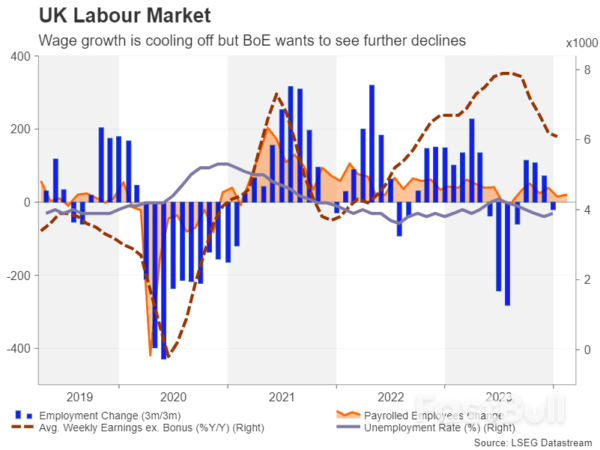
          Employment declined in the three months to January, pushing up the jobless rate to 3.9%. The UK labour market has slowed down substantially over the past year amid a slight contraction in GDP. The economy appears to be rebounding but jobs growth could remain weak for some time yet. From a wage inflation perspective, a cooling labour market can only be good news.
          Week Ahead – More Inflation Data on the Way as Rate Cut Bets Thrown into Disarray_1
          Growth in average weekly earnings excluding bonuses has moderated from a peak of 8.9% y/y last summer to 6.1% in January. A further deceleration is likely in February – a trend underscored by a Bank of England survey showing that wage growth expectations have fallen to the lowest in two years.
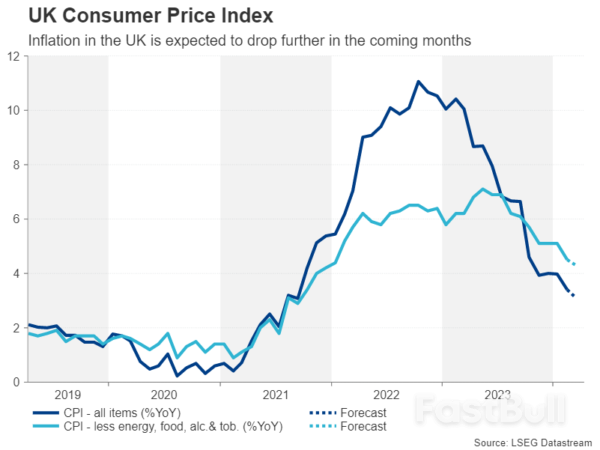
          However, softer wage growth won’t be the whole story for sterling next week as investors will also be dissecting the latest CPI readings on Wednesday. UK inflation fell to 3.4% in February and another drop is expected for March to 3.1%. The core figure is also forecast to decline again.
          Week Ahead – More Inflation Data on the Way as Rate Cut Bets Thrown into Disarray_2
          Finally, on Friday, retail sales numbers for March will be watched for clues on whether consumer spending is picking up or not.
          Cable is currently testing the floor of the sideways range it’s been trading in since December and the incoming data pose a downside risk should they suggest that the Bank of England is still on track to start cutting rates in August, while the Fed’s timeline has started to shift to September.
          If the UK’s inflation outlook continues to improve, the pound might struggle to hold above $1.25 and traders will either want to see Britain’s economy recovering more strongly or US growth losing steam to defend that key level.

          Euro to take backseat after ECB

          Across the channel, it’s going to be a fairly quiet week for the euro in the aftermath of the ECB decision, with only the final estimate of March CPI and second-tier releases to keep traders busy.
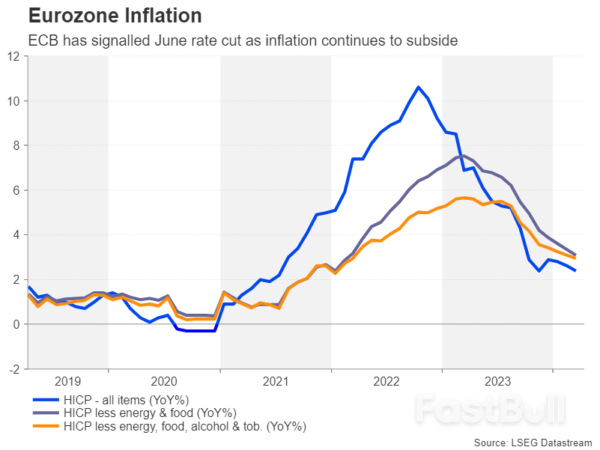
          The European Central Bank left interest rates unchanged as expected at its April policy meeting while signalling that a rate cut could be on the cards at its next gathering in June. Inflation in the Eurozone has been much more tamed than in the US this year. Coupled with a weaker economy, the ECB can afford to gradually start loosening its restrictive stance.
          The headline rate of the consumer price index eased to 2.4% in March and no revisions are expected in the final estimate due on Wednesday.
          Week Ahead – More Inflation Data on the Way as Rate Cut Bets Thrown into Disarray_3
          Earlier in the week, industrial production numbers might attract some attention on Monday, while the ZEW economic sentiment out of Germany comes out Tuesday.
          Barring any surprise upward revisions to the CPI prints, the euro will likely stay on the backfoot against the US dollar over the next few days.

          Can Japanese CPI lift the downtrodden yen?

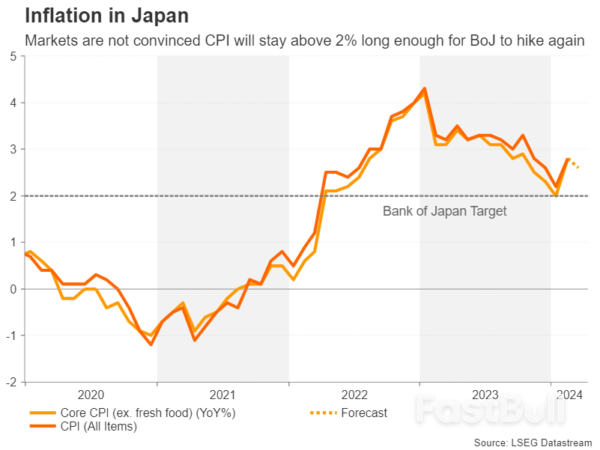
          Inflation in Japan edged up sharply in February after a year-long decline. Core CPI that excludes fresh food prices and which the Bank of Japan targets for achieving 2% inflation rose to 2.8% from 2.0%. However, whilst there was probably a further modest uptick in overall CPI, the core figure, out on Friday, is forecast to have eased to 2.6%.
          Week Ahead – More Inflation Data on the Way as Rate Cut Bets Thrown into Disarray_4
          Nevertheless, investors are questioning whether inflationary pressures in Japan can re-accelerate much from hereon and thus, expectations for additional rate hikes remain muted – something that has been weighing heavily on the yen.
          Yet, the Bank of Japan seems to be subtly paving the way for a second rate hike towards the end of the year and Governor Ueda has hinted as much. There are also reports that the bank will revise up its inflation forecasts at its next meeting on April 26. Policymakers are hopeful that bumper pay deals in this year’s spring wage negotiations and an end to energy subsidies at the end of May will keep inflation above 2% in the medium-term horizon.
          But until this is reflected in the CPI data, the yen is unlikely to find much love.

          A mixed picture for China’s economy

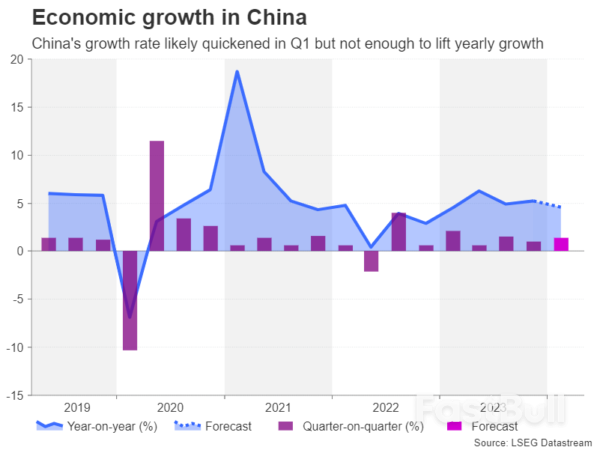
          China is set to publish GDP estimates on Tuesday as optimism about its economic recovery improves. The world’s second largest economy probably expanded by 1.4% quarter-on-quarter in the three months to March, quickening from a 1% pace in the prior quarter. However, markets might focus more on the annual rate that’s expected to have slowed from 5.2% to 4.6%.
          Week Ahead – More Inflation Data on the Way as Rate Cut Bets Thrown into Disarray_5
          The March figures for industrial output and retail sales could also leave investors unimpressed as both are anticipated to have eased year-on-year compared to February.
          Any disappointment from the GDP stats could add to the aussie’s and kiwi’s woes, which have been swimming in choppy waters lately amid the constant swings in Fed rate cut bets. For the Australian dollar, traders will also be keeping an eye on domestic jobs numbers on Thursday, while for the New Zealand dollar, Wednesday’s CPI prints will be crucial.
          The Reserve Bank of New Zealand maintained a very neutral stance at its April policy meeting, signalling that a rate cut is some time away. But should CPI rise by less than the expected rate of 4.1% y/y in the first quarter, investors might become more confident about an August cut.

          Canadian inflation eyed

          Another country reporting CPI data next week is Canada, due Tuesday. A June rate cut is still in play for the Bank of Canada despite heightened caution globally about sticky inflation. Canada’s headline CPI rate eased to 2.8% in February and underlying measures fell too.
          A continuation of that trend in March could boost the odds of a rate cut in June, which currently stand at less than 50%, piling more pressure on the Canadian dollar.
          The loonie has already shed about 3.5% against the US dollar this year so any further signs of a possible divergence in monetary policy between the Fed and the BoC could increase those losses.

          Retail sales only threat for dollar bulls

          South of the border, the US schedule is looking relatively light, with Monday’s retail sales numbers being the top release.
          The latest NFP and CPI reports both dented expectations of a summer rate cut by the Fed so investors will be hoping for some softer data next, and they could well get that.
          Week Ahead – More Inflation Data on the Way as Rate Cut Bets Thrown into Disarray_6
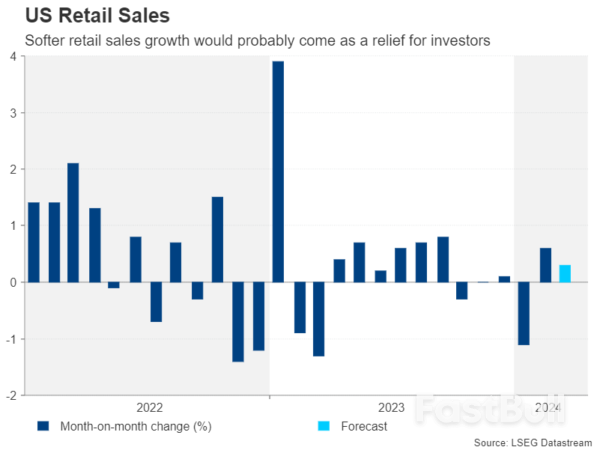
          Retail sales are forecast to have risen by 0.3% m/m in March, slowing from the prior 0.6% rate. Other indicators to watch out of the US are the Empire State Manufacturing index, also on Monday, building permits and housing starts along with industrial production on Tuesday, to be followed by the Philly Fed manufacturing index and existing home sales on Thursday.
          With markets still reeling from the setback to early rate cut hopes, the dollar will likely hold firm. But shares on Wall Street stand a chance of staging a rebound if the Q1 earnings season gets off to a strong start. The spotlight next week will fall on Netflix, which announces its results on Thursday.

          Source:XM

          To stay updated on all economic events of today, please check out our Economic calendar
          Risk Warnings and Disclaimers
          You understand and acknowledge that there is a high degree of risk involved in trading. Following any strategies or investment methods may lead to potential losses. The content on the site is provided by our contributors and analysts for information purposes only. You are solely responsible for determining whether any trading assets, securities, strategy, or any other product is suitable for investing based on your own investment objectives and financial situation.
          Add to Favorites
          Share

          Is Shell Trying to Kill the London Stock Market?

          Cohen

          Economic

          Stocks

          Last July, Wael Sawan, the chief executive of Shell, told the BBC about the terrific time he had on a visit to the New York stock exchange. The welcome was "exemplary", he enthused, and the locals even flew the Shell flag next to their own. "They [the NYSE officials] said we continue to value a company that provides us the energy we desperately need," he continued, adding that he wouldn't rule out moving Shell's stock market listing to the US in time, an inflammatory suggestion given the general angst over the state of the London market.
          Now he's at it again. In remarks to Bloomberg published this week, he said Shell had "a location" – meaning London – "that clearly seems to be undervalued". His beef is the perceived undervaluation of Shell's shares versus those of New York-listed rivals Chevron and ExxonMobil. If the valuation gap doesn't close, "we have to look at all options. All options," he emphasised.
          For good measure, his predecessor as chief executive, Ben van Beurden, joined the grumbling, telling an FT conference this week that Shell is "massively undervalued" in London and that deeper pools of capital in the US, higher valuations and the "more positive" attitudes of investors "conspire" against all European energy companies. "Something will have to give," opined Van Beurden.
          This is starting to sound like a campaign to create an air of inevitability around a switch to the US. Or, if it isn't that, Shell's top operatives seem transfixed by the notion that a relisting will cure all their troubles. It's their job to fret about the share price, but it's hard to overstate how detrimental this is for the London Stock Exchange. The biggest company on the market is openly threatening to leave. That is a different order of seriousness than seeing Flutter, Ferguson and CRH flee to the US. If Shell goes, who's next? Glencore? Even BP?
          But here's one basic question about Sawan's thesis: is it even correct? Does the undervaluation, in terms of earnings and cashflow multiples, exist solely by virtue of the fact that Shell is listed in London? One doubts the story is as simple as that.
          It's not as if US investors currently have any difficulty buying shares in Shell, whether directly or through American depositary receipts. On the company's own numbers, 45% of its institutional register is already American versus 29% from the UK. Unlike Ferguson or CRH, there seems to be no difficulty getting noticed by American money. That is hardly surprising: we are talking here about a £180bn company. It seems unlikely the market would leave a 25% discount, which seems to be Shell's rough current analysis, on the table unless other factors were at work.
          The real explanation, perhaps, is that the stock market (sadly) is deeply sceptical about the pace of energy transition and the returns on capital in renewables. Thus, the most oily firms, such the two US titans, are prized over those with a sideline in renewables, such as Shell, which in turn is valued more highly than those with a slightly greener hue, such as BP. This price signal is terrifying from a climate perspective, but the point is that a mere relisting of Shell's shares wouldn't change the make-up of its assets.
          Maybe Sawan would like to water down further Shell's emission-reduction targets and thinks it would be easier to do so from the US. But if that's the case, he should say so openly. There is a strong whiff here that what Shell and Sawan really dislike is the climate policies of European governments. That is a separate argument to the questionable claim that the same earnings are valued wildly differently in different markets.
          The London Stock Exchange gets a lot of flak, including from this column, for its seeming lack of concern about departees and the lack of new arrivals. But on this occasion, one can feel some sympathy. Shell – possibly the most liquid, deeply researched and widely owned stock in town – seems to have alighted on the "undervaluation" theme without showing evidence that location is the problem in its case. In the LSE's shoes, you'd be furious. Shell's loose "maybe we will, maybe we won't" talk is seriously damaging.

          Source: The Guardian

          To stay updated on all economic events of today, please check out our Economic calendar
          Risk Warnings and Disclaimers
          You understand and acknowledge that there is a high degree of risk involved in trading. Following any strategies or investment methods may lead to potential losses. The content on the site is provided by our contributors and analysts for information purposes only. You are solely responsible for determining whether any trading assets, securities, strategy, or any other product is suitable for investing based on your own investment objectives and financial situation.
          Add to Favorites
          Share

          ETFs vs. Mutual Funds

          Glendon

          Economic

          For beginning investors, the world of investment vehicles can be overwhelming. Two popular choices, mutual funds and exchange-traded funds (ETFs), offer a way to diversify holdings and potentially grow wealth. But with seemingly similar goals, how do you decide which is right for you? Let's break down the key benefits of each and dispel some myths to help you make an informed choice.

          Tradability: Flexibility vs. Convenience

          Mutual funds can only be bought and sold at the end of each trading day at the Net Asset Value (NAV), which reflects the underlying holdings' value. This provides convenience but limits flexibility. ETFs, on the other hand, trade throughout the day like stocks, allowing you to react to market fluctuations and potentially snag better prices with limit orders or stop orders. This flexibility is particularly attractive to active traders.

          Tax Efficiency: Keeping More of Your Money

          While both ETFs and mutual funds can be tax-efficient, ETFs generally hold an edge. Their structure allows for in-kind creations and redemptions, minimizing capital gains distributions that can trigger tax liabilities for mutual fund investors. This is especially true for passively managed index funds. However, actively managed ETFs that trade holdings frequently can negate this benefit.

          Transparency: Knowing What You Own

          Mutual funds typically disclose their holdings quarterly, which can create a lag in understanding your fund's composition. ETFs, on the other hand, often disclose holdings daily. This transparency allows for a more precise understanding of your investment's risk profile and alignment with your goals.

          Accessibility: Minimums and Investment Options

          Mutual funds often have minimum investment requirements, which can be a barrier for new investors. ETFs typically have lower or no minimums, making them more accessible for those starting with smaller portfolios. Additionally, ETFs offer a wider range of investment options, including niche sectors and commodities, that might not be readily available in mutual funds.

          Fees: A Key Long-Term Consideration

          Both ETFs and mutual funds charge fees, but expense ratios, which are a percentage of assets taken for management, can differ. ETFs tend to have lower expense ratios due to their passive management style. However, some actively managed ETFs can have higher fees. Be sure to compare expense ratios between similar fund types before investing.

          Beyond the Headlines: Dispelling Myths

          While ETFs often get the spotlight for their perceived benefits, it's important to address some misconceptions.
          Myth: ETFs Are Always Better: While ETFs offer advantages in tradability, tax efficiency, and transparency, mutual funds can still be a good choice. Investors seeking professional management or specific investment goals like retirement planning with automatic investment features might find mutual funds more suitable.
          Myth: All ETFs are Tax-Efficient: This is especially true for actively managed ETFs that trade holdings frequently, potentially triggering capital gains events.
          Myth: ETFs are Risk-Free: Both ETFs and mutual funds carry inherent market risks. Diversification is key, regardless of the chosen vehicle.

          The Bottom Line: Choosing What's Right for You

          The decision between ETFs and mutual funds comes down to your individual investing style and goals. Consider your:
          Investing Time Horizon: For long-term investors, the tax benefits of ETFs might be more impactful.
          Trading Activity: Active traders will appreciate the flexibility ETFs offer.
          Investment Goals: If professional management or specific features like automatic investing are important, mutual funds might be a better fit.
          Cost Sensitivity: Expense ratios can significantly impact returns over time. Ultimately, both ETFs and mutual funds can be valuable tools for building wealth. By understanding the key benefits and how they align with your investment strategy, you can make an informed decision and reach your financial goals.
          Remember, consulting with a financial advisor can provide personalized guidance based on your specific circumstances.
          To stay updated on all economic events of today, please check out our Economic calendar
          Risk Warnings and Disclaimers
          You understand and acknowledge that there is a high degree of risk involved in trading. Following any strategies or investment methods may lead to potential losses. The content on the site is provided by our contributors and analysts for information purposes only. You are solely responsible for determining whether any trading assets, securities, strategy, or any other product is suitable for investing based on your own investment objectives and financial situation.
          Add to Favorites
          Share

          Solo-Minded ECB May Find Itself Singing from Fed's Hymn Sheet After All

          Devin

          Economic

          Central Bank

          The European Central Bank may protest it is not "Fed-dependent" but it will likely find itself singing from a hymn sheet largely written by the U.S. Federal Reserve whether it wants to or not.
          The ECB is sticking to plans to reduce interest rates from record highs, likely at its next meeting in June, in light of a continued fall in inflation in the 20 countries that share the euro.
          This is in contrast to U.S. price growth, which has beaten analyst expectations for three months straight, and is now expected to keep the Fed from lowering its own borrowing costs until September.
          ECB President Christine Lagarde insisted her institution was "data-dependent, not Fed-dependent" on Thursday. But analysts and policymakers said high U.S. inflation and interest rates were bound to have an impact on the ECB's plans via financial markets and trade.
          "While we continue to believe that the ECB will be the first central bank to start cutting rates this year, the path beyond that will remain dictated by Fed action," Max Stainton, a senior global macro strategist at Fidelity International, said.
          In a sign of how closely interrelated central banks are at present, Sweden's Riksbank said on Thursday the main threat to a May interest rate cut would come from the postponement of the Fed's and the ECB's own easing cycles.
          Sources told Reuters after Thursday's meeting that ECB policymakers still expected to cut interest rates in June but some thought the case for pausing at their following meeting was becoming stronger given U.S. inflation.
          They argue the euro zone's central bank could skip a mid-summer rate reduction until it was comfortable with the path for U.S. borrowing costs.

          Exchange Rate

          This is because lower interest rates in the euro zone than in the United States were bound to depress the euro's exchange rate, mechanically increasing the price of some goods priced in U.S. dollars, such as crude oil.
          This has already started to happen, with the euro down 1.3% against the U.S. dollar since the U.S. inflation reading on Wednesday to the lowest level since February.
          "We continue to think that the ECB will likely end up cutting rates ahead of the Fed, although the number of cuts will be restrained somewhat by the currency effect via a vis dollar," Andrew Lake, head of fixed income at Mirabaud Asset Management, said.
          Money markets price in three interest rate cuts by the ECB by December versus four only a few weeks ago.
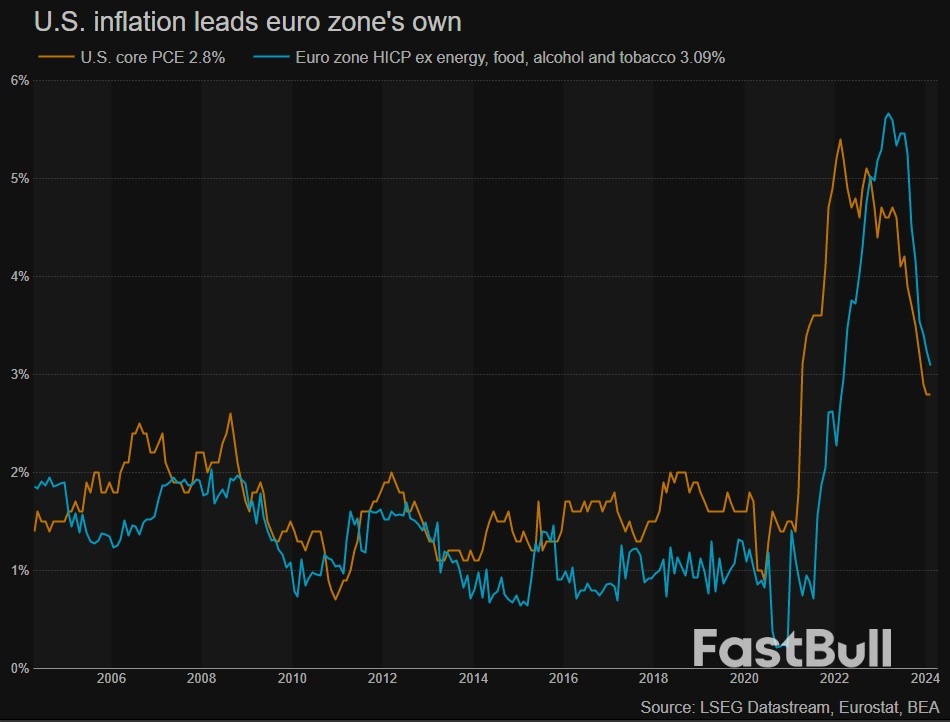
          In addition, U.S. inflation has led that of the euro zone by a few months in this last cycle with surprising precision.
          While the reason for the price increases might have been different - with demand in the United States playing a much stronger role than in the euro zone, where higher fuel costs were the key driver - some still see scope for contagion given the regions' close financial and trade ties.
          "The ECB is independent of the Fed," Mohit Kumar, chief European economist at Jefferies, said. "But the Fed is also data dependent and if U.S. data continues to be strong, it may have an impact on European data as well."
          Some analysts cautioned the impact might be more mixed.
          The euro zone's own bond yields were likely to rise in tandem with their U.S. counterparts, tightening financial conditions and perhaps even requiring the ECB to cut its own interest rates even more.
          "It is not clear that the net effect would be a loosening of financial conditions that reduces the ECB’s appetite for rate cuts," Marco Valli, global head of research at UniCredit, said.

          Solo-Minded ECB May Find Itself Singing from Fed's Hymn Sheet After All_1Source: Reuters

          To stay updated on all economic events of today, please check out our Economic calendar
          Risk Warnings and Disclaimers
          You understand and acknowledge that there is a high degree of risk involved in trading. Following any strategies or investment methods may lead to potential losses. The content on the site is provided by our contributors and analysts for information purposes only. You are solely responsible for determining whether any trading assets, securities, strategy, or any other product is suitable for investing based on your own investment objectives and financial situation.
          Add to Favorites
          Share

          New Zealand, US Pledge Closer Ties Amid China Tension in Pacific

          Cohen

          Political

          Economic

          New Zealand and the US have pledged to work more closely together on common challenges, in a further sign that Wellington is re-aligning itself with traditional western partners as China becomes more assertive in the Pacific.
          In a joint declaration signed Thursday in Washington, New Zealand Foreign Minister Winston Peters and US Secretary of State Antony Blinken recommitted to the “historic partnership” between the two nations and the principles that underpin it, including the rule of law, democracy and human rights.
          “The strategic environment that New Zealand and the United States face is considerably more challenging now than even a decade ago and demands that we work together more urgently and concertedly,” Peters said in a statement. “As we face a range of common challenges, globally and in the Indo-Pacific region, it’s more important than ever that New Zealand and the United States find common cause in defense of shared values and interests.”
          New Zealand’s new center-right government, which took office late last year, is seeking to deepen its ties with like-minded western nations such as Australia, the US and UK amid concerns about Beijing’s growing ambitions in the Pacific. In doing so it runs the risk of antagonizing China, its biggest trading partner, which could retaliate by curbing purchases of New Zealand goods — a strategy it has used against Australia.
          Wellington is exploring joining Pillar Two of the Aukus security pact between Australia, the US and UK, and last week said it is also working on a new partnership with NATO.
          “China is clearly the target of all this cooperation,” said Geoffrey Miller, a geopolitical analyst at the Democracy Project in Wellington. “I think that New Zealand could be taught a lesson by Beijing if it flies too close to the sun and keeps signing up to these kinds of things.”
          The joint declaration noted New Zealand and US membership of the Five Eyes intelligence-sharing group and lauded both countries’ “deep ties with — and commitment to — the Pacific Islands.”
          “Our countries are united by our enduring stake in an open, stable, and prosperous Indo-Pacific,” it said. “We are resolved to uphold the conditions that have seen the region thrive, including freedom of navigation, the peaceful settlement of disputes, and respect for sovereignty and internationally agreed-upon rules and norms.”
          New Zealand, Australia and the US were shocked when the Solomon Islands announced in early 2022 that it had signed a security agreement with Beijing. In response, Washington, Canberra and Wellington have dramatically increased their engagement with Pacific nations.
          Peters and Blinken said they will now seek to meet annually as “the most challenging strategic environment in decades requires us to do more together.”

          Source:Bloomberg

          To stay updated on all economic events of today, please check out our Economic calendar
          Risk Warnings and Disclaimers
          You understand and acknowledge that there is a high degree of risk involved in trading. Following any strategies or investment methods may lead to potential losses. The content on the site is provided by our contributors and analysts for information purposes only. You are solely responsible for determining whether any trading assets, securities, strategy, or any other product is suitable for investing based on your own investment objectives and financial situation.
          Add to Favorites
          Share
          FastBull
          Copyright © 2025 FastBull Ltd

          728 RM B 7/F GEE LOK IND BLDG NO 34 HUNG TO RD KWUN TONG KLN HONG KONG

          TelegramInstagramTwitterfacebooklinkedin
          App Store Google Play Google Play
          Products
          Charts

          Chats

          Q&A with Experts
          Screeners
          Economic Calendar
          Data
          Tools
          Membership
          Features
          Function
          Markets
          Copy Trading
          Latest Signals
          Contests
          News
          Analysis
          24/7
          Columns
          Education
          Company
          Careers
          About Us
          Contact Us
          Advertising
          Help Center
          Feedback
          User Agreement
          Privacy Policy
          Business

          White Label

          Data API

          Web Plug-ins

          Poster Maker

          Affiliate Program

          Risk Disclosure

          The risk of loss in trading financial instruments such as stocks, FX, commodities, futures, bonds, ETFs and crypto can be substantial. You may sustain a total loss of the funds that you deposit with your broker. Therefore, you should carefully consider whether such trading is suitable for you in light of your circumstances and financial resources.

          No decision to invest should be made without thoroughly conducting due diligence by yourself or consulting with your financial advisors. Our web content might not suit you since we don't know your financial conditions and investment needs. Our financial information might have latency or contain inaccuracy, so you should be fully responsible for any of your trading and investment decisions. The company will not be responsible for your capital loss.

          Without getting permission from the website, you are not allowed to copy the website's graphics, texts, or trademarks. Intellectual property rights in the content or data incorporated into this website belong to its providers and exchange merchants.

          Not Logged In

          Log in to access more features

          FastBull Membership

          Not yet

          Purchase

          Become a signal provider
          Help Center
          Customer Service
          Dark Mode
          Price Up/Down Colors

          Log In

          Sign Up

          Position
          Layout
          Fullscreen
          Default to Chart
          The chart page opens by default when you visit fastbull.com