• Trade
  • Markets
  • Copy
  • Contests
  • News
  • 24/7
  • Calendar
  • Q&A
  • Chats
Trending
Screeners
SYMBOL
LAST
BID
ASK
HIGH
LOW
NET CHG.
%CHG.
SPREAD
SPX
S&P 500 Index
6827.42
6827.42
6827.42
6899.86
6801.80
-73.58
-1.07%
--
DJI
Dow Jones Industrial Average
48458.04
48458.04
48458.04
48886.86
48334.10
-245.98
-0.51%
--
IXIC
NASDAQ Composite Index
23195.16
23195.16
23195.16
23554.89
23094.51
-398.69
-1.69%
--
USDX
US Dollar Index
97.980
98.060
97.980
98.070
97.920
+0.030
+ 0.03%
--
EURUSD
Euro / US Dollar
1.17315
1.17322
1.17315
1.17447
1.17262
-0.00079
-0.07%
--
GBPUSD
Pound Sterling / US Dollar
1.33679
1.33686
1.33679
1.33740
1.33546
-0.00028
-0.02%
--
XAUUSD
Gold / US Dollar
4345.75
4346.18
4345.75
4348.78
4294.68
+46.36
+ 1.08%
--
WTI
Light Sweet Crude Oil
57.385
57.415
57.385
57.601
57.194
+0.152
+ 0.27%
--

Community Accounts

Signal Accounts
--
Profit Accounts
--
Loss Accounts
--
View More

Become a signal provider

Sell trading signals to earn additional income

View More

Guide to Copy Trading

Get started with ease and confidence

View More

Signal Accounts for Members

All Signal Accounts

Best Return
  • Best Return
  • Best P/L
  • Best MDD
Past 1W
  • Past 1W
  • Past 1M
  • Past 1Y

All Contests

  • All
  • Trump Updates
  • Recommend
  • Stocks
  • Cryptocurrencies
  • Central Banks
  • Featured News
Top News Only
Share

Poland's January-October Trade Balance At -5.1 Billion Euros

Share

Poland's January-October Export Up 2.8% To 304.3 Billion Euros

Share

Ceasefire Negotiations Between Ukraine And US Representatives In Berlin To Continue Monday Morning - German Source Familiar With The Schedule

Share

Spain's IBEX Hits Fresh Record High, Up Over 1%

Share

Spot Silver Rises Nearly 3% To $63.82/Oz

Share

Philippine Maritime Council: Expresses Alarm Over Recent Harassment Of Filipino Fishermen In South China Sea Shoal

Share

France's Foreign Minister Says He Suggesd To EU's Kallas That US Representatives Brief EU Foreign Ministers On Gaza Peace Plan During Their Meeting

Share

India Trade Secretary: Prime Facie Don't See A Case Of Rice Dumping To USA And There Is No Active Investigation On That

Share

India Trade Secretary: India's Rice Exported To USA Largely Limited To Basmati And At Price Higher Than General Price Of Rice

Share

India Trade Secretary: India Can Raise Shipments To Russia In Sectors Like Automobiles And Pharmaceuticals

Share

India Trade Secretary:India-Oman Trade Deal Completed And Will Be Signed Soon

Share

Burberry Shares Top FTSE Gainer, Up 3.5% In Positive European Luxury Sector

Share

India Trade Secretary: India-US Close To A “Framework” Deal But Won't Give A Timeline

Share

Yemen's Southern Transitional Council (Stc) Launches Military Operation In Abyan

Share

India Trade Official: As Mexico Has Raised Tariffs On Mfn Basis, We Don't See A Recourse In WTO

Share

India Trade Official: India Has Proposed A “Preferential Trade Agreement” With Mexico

Share

India Trade Official: Mexico's Primary Target Is Not To Hit Indian Exports

Share

India Trade Official: India, Mexico Have Agreed To Pursue A Trade Agreement To Mitigate The Impact Promptly

Share

N26: In Close And Constructive Communication With The Supervisory Authorities As Well As The Appointed Special Representative

Share

India Trade Official: Preliminary Estimates Suggest India Exports Worth $2 Billion To Mexico Will Be Impacted Due To High Tariffs

TIME
ACT
FCST
PREV
France HICP Final MoM (Nov)

A:--

F: --

P: --

China, Mainland Outstanding Loans Growth YoY (Nov)

A:--

F: --

P: --

China, Mainland M2 Money Supply YoY (Nov)

A:--

F: --

P: --

China, Mainland M0 Money Supply YoY (Nov)

A:--

F: --

P: --

China, Mainland M1 Money Supply YoY (Nov)

A:--

F: --

P: --

India CPI YoY (Nov)

A:--

F: --

P: --

India Deposit Gowth YoY

A:--

F: --

P: --

Brazil Services Growth YoY (Oct)

A:--

F: --

P: --

Mexico Industrial Output YoY (Oct)

A:--

F: --

P: --

Russia Trade Balance (Oct)

A:--

F: --

P: --

Philadelphia Fed President Henry Paulson delivers a speech
Canada Building Permits MoM (SA) (Oct)

A:--

F: --

P: --

Canada Wholesale Sales YoY (Oct)

A:--

F: --

P: --

Canada Wholesale Inventory MoM (Oct)

A:--

F: --

P: --

Canada Wholesale Inventory YoY (Oct)

A:--

F: --

P: --

Canada Wholesale Sales MoM (SA) (Oct)

A:--

F: --

P: --

Germany Current Account (Not SA) (Oct)

A:--

F: --

P: --

U.S. Weekly Total Rig Count

A:--

F: --

P: --

U.S. Weekly Total Oil Rig Count

A:--

F: --

P: --

Japan Tankan Small Manufacturing Outlook Index (Q4)

A:--

F: --

P: --

Japan Tankan Large Non-Manufacturing Diffusion Index (Q4)

A:--

F: --

P: --

Japan Tankan Large Non-Manufacturing Outlook Index (Q4)

A:--

F: --

P: --

Japan Tankan Large Manufacturing Outlook Index (Q4)

A:--

F: --

P: --

Japan Tankan Small Manufacturing Diffusion Index (Q4)

A:--

F: --

P: --

Japan Tankan Large Manufacturing Diffusion Index (Q4)

A:--

F: --

P: --

Japan Tankan Large-Enterprise Capital Expenditure YoY (Q4)

A:--

F: --

P: --

U.K. Rightmove House Price Index YoY (Dec)

A:--

F: --

P: --

China, Mainland Industrial Output YoY (YTD) (Nov)

A:--

F: --

P: --

China, Mainland Urban Area Unemployment Rate (Nov)

A:--

F: --

P: --

Saudi Arabia CPI YoY (Nov)

A:--

F: --

P: --

Euro Zone Industrial Output YoY (Oct)

--

F: --

P: --

Euro Zone Industrial Output MoM (Oct)

--

F: --

P: --

Canada Existing Home Sales MoM (Nov)

--

F: --

P: --

Euro Zone Total Reserve Assets (Nov)

--

F: --

P: --

U.K. Inflation Rate Expectations

--

F: --

P: --

Canada National Economic Confidence Index

--

F: --

P: --

Canada New Housing Starts (Nov)

--

F: --

P: --

U.S. NY Fed Manufacturing Employment Index (Dec)

--

F: --

P: --

U.S. NY Fed Manufacturing Index (Dec)

--

F: --

P: --

Canada Core CPI YoY (Nov)

--

F: --

P: --

Canada Manufacturing Unfilled Orders MoM (Oct)

--

F: --

P: --

U.S. NY Fed Manufacturing Prices Received Index (Dec)

--

F: --

P: --

U.S. NY Fed Manufacturing New Orders Index (Dec)

--

F: --

P: --

Canada Manufacturing New Orders MoM (Oct)

--

F: --

P: --

Canada Core CPI MoM (Nov)

--

F: --

P: --

Canada Trimmed CPI YoY (SA) (Nov)

--

F: --

P: --

Canada Manufacturing Inventory MoM (Oct)

--

F: --

P: --

Canada CPI YoY (Nov)

--

F: --

P: --

Canada CPI MoM (Nov)

--

F: --

P: --

Canada CPI YoY (SA) (Nov)

--

F: --

P: --

Canada Core CPI MoM (SA) (Nov)

--

F: --

P: --

Canada CPI MoM (SA) (Nov)

--

F: --

P: --

Federal Reserve Board Governor Milan delivered a speech
U.S. NAHB Housing Market Index (Dec)

--

F: --

P: --

Australia Composite PMI Prelim (Dec)

--

F: --

P: --

Australia Services PMI Prelim (Dec)

--

F: --

P: --

Australia Manufacturing PMI Prelim (Dec)

--

F: --

P: --

Japan Manufacturing PMI Prelim (SA) (Dec)

--

F: --

P: --

U.K. Unemployment Claimant Count (Nov)

--

F: --

P: --

U.K. Unemployment Rate (Nov)

--

F: --

P: --

U.K. 3-Month ILO Unemployment Rate (Oct)

--

F: --

P: --

Q&A with Experts
    • All
    • Chatrooms
    • Groups
    • Friends
    Connecting
    .
    .
    .
    Type here...
    Add Symbol or Code

      No matching data

      All
      Trump Updates
      Recommend
      Stocks
      Cryptocurrencies
      Central Banks
      Featured News
      • All
      • Russia-Ukraine Conflict
      • Middle East Flashpoint
      • All
      • Russia-Ukraine Conflict
      • Middle East Flashpoint

      Search
      Products

      Charts Free Forever

      Chats Q&A with Experts
      Screeners Economic Calendar Data Tools
      Membership Features
      Data Warehouse Market Trends Institutional Data Policy Rates Macro

      Market Trends

      Market Sentiment Order Book Forex Correlations

      Top Indicators

      Charts Free Forever
      Markets

      News

      News Analysis 24/7 Columns Education
      From Institutions From Analysts
      Topics Columnists

      Latest Views

      Latest Views

      Trending Topics

      Top Columnists

      Latest Update

      Signals

      Copy Rankings Latest Signals Become a signal provider AI Rating
      Contests
      Brokers

      Overview Brokers Assessment Rankings Regulators News Claims
      Broker listing Forex Brokers Comparison Tool Live Spread Comparison Scam
      Q&A Complaint Scam Alert Videos Tips to Detect Scam
      More

      Business
      Events
      Careers About Us Advertising Help Center

      White Label

      Data API

      Web Plug-ins

      Affiliate Program

      Awards Institution Evaluation IB Seminar Salon Event Exhibition
      Vietnam Thailand Singapore Dubai
      Fans Party Investment Sharing Session
      FastBull Summit BrokersView Expo
      Recent Searches
        Top Searches
          Markets
          News
          Analysis
          User
          24/7
          Economic Calendar
          Education
          Data
          • Names
          • Latest
          • Prev

          View All

          No data

          Scan to Download

          Faster Charts, Chat Faster!

          Download App
          English
          • English
          • Español
          • العربية
          • Bahasa Indonesia
          • Bahasa Melayu
          • Tiếng Việt
          • ภาษาไทย
          • Français
          • Italiano
          • Türkçe
          • Русский язык
          • 简中
          • 繁中
          Open Account
          Search
          Products
          Charts Free Forever
          Markets
          News
          Signals

          Copy Rankings Latest Signals Become a signal provider AI Rating
          Contests
          Brokers

          Overview Brokers Assessment Rankings Regulators News Claims
          Broker listing Forex Brokers Comparison Tool Live Spread Comparison Scam
          Q&A Complaint Scam Alert Videos Tips to Detect Scam
          More

          Business
          Events
          Careers About Us Advertising Help Center

          White Label

          Data API

          Web Plug-ins

          Affiliate Program

          Awards Institution Evaluation IB Seminar Salon Event Exhibition
          Vietnam Thailand Singapore Dubai
          Fans Party Investment Sharing Session
          FastBull Summit BrokersView Expo

          Will the U.S. Economy Avoid a Recession Next Year?

          JPMorgan

          Economic

          Summary:

          It is still a close call on whether the economy will enter a recession or not, but we do believe slow growth is the most likely outcome, while risks for a mild recession remain.

          Will the U.S. Economy Avoid a Recession Next Year?_1
          As the U.S. economy enters the fourth quarter, economists will begin penning their outlooks and suggested portfolio allocations for 2024. It appears there are still two consensus projections for economic growth next year: soft landing or recession. To be clear, we are biased to the former over the latter, but remain close to strategic portfolio allocations and well-diversified across geographies and risk given the amount of uncertainty.
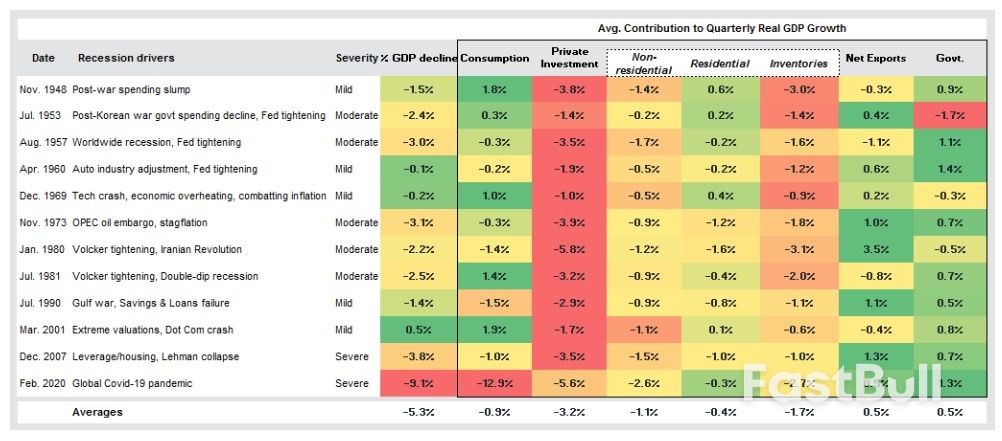
          While no two recessions are the same, looking at previous recessions could help inform growth forecasts. Per the recession heatmap, there are several interesting takeaways:
          Consumption: While consumption accounts for roughly two-thirds of economic activity and typically contracts during recessions, investors may be surprised to see that there have been mild to moderate recessions where consumption remained positive.
          Private Investment: Capital spending tends to correct materially during recessions likely driven by the very cyclical nature of inventories and business fixed investment. Housing, on the other hand, tends to be stable with the sector showing modest declines on average.
          Net exports: The change in the U.S. trade balance has historically been a positive to growth during recessions. Exports outpacing imports could be a sign that foreign economies are stronger than the domestic economy increasing the demand for U.S. goods. However, the U.S. trade deficit tends to worsen when the economy is growing strongly and therefore the more likely reason may be the decline in domestic demand curtails imports to a greater degree than exports.
          Government spending: Fiscal support and thereby deficits tend to increase during recessions to offset a weakening economy.
          Looking ahead to 2024, we are cautious on consumption given higher interest rates, depleted savings, higher credit card balances, softening labor markets impacting incomes and potentially higher gasoline prices souring consumer confidence. That said, consumers have been resilient all year and given consumer balance sheets have been largely catered to low interest rates, absent a significant rise in unemployment, consumption could slow but remain positive.
          Within private fixed investment, subsidies and grants via the Inflation Reduction Act and CHIPS and Science Act and enthusiasm around generative AI could keep capital spending on equipment and structures and intellectual property rights on solid footing, even under higher interest rates. Residential housing may finally stabilize at 7% mortgage rates given a chronic shortage of inventory incentivizing a modest uptick in construction activity. Inventories remain a wild card, but we don’t see signs of an excessive buildup—or “boom”—in inventories through year-end that would cause a recessionary “bust” next year.
          We suspect net exports won’t materially impact the growth outlook next year but could be net positive for exporters if the dollar declines as the rest of the world recovers while growth in the U.S. slows. Should Congress successfully approve FY 2024 appropriation bills, government spending is likely to continue its trend as a “boost” to GDP given deficits are expected to rise in the years ahead.
          In general, there are several offsetting factors that will impact the economy next year. Suffice it to say, it is still a close call on whether the economy will enter a recession or not, but we do believe slow growth is the most likely outcome, while risks for a mild recession remain.
          Will the U.S. Economy Avoid a Recession Next Year?_2

          Source: BEA, FactSet, J.P. Morgan Asset Management.

          To stay updated on all economic events of today, please check out our Economic calendar
          Risk Warnings and Disclaimers
          You understand and acknowledge that there is a high degree of risk involved in trading. Following any strategies or investment methods may lead to potential losses. The content on the site is provided by our contributors and analysts for information purposes only. You are solely responsible for determining whether any trading assets, securities, strategy, or any other product is suitable for investing based on your own investment objectives and financial situation.
          Comments
          Add to Favorites
          Share

          Macro Monthly: A little bit softer now

          UBS

          Economic

          The story of the third quarter has been that good news for the economy has not been good news for financial assets.
          10-year US Treasury yields surged nearly 75 basis points over the course of the quarter to their highest level since 2007. Robust domestic data and policy rate projections from the Federal Reserve are signaling the economy can handle high interest rates, so calls for an imminent recession continue to be premature – in line with our longstanding view.
          That is the good news. The bad news is that sharp rises in interest rates can weigh on equity valuations as the yield available on these safer assets creep closer to the earnings growth expected to be delivered by publicly traded corporations. Some non-economic considerations for rising yields, most notably the increase in Treasury bond issuance, added to the pressure on stocks. What's more, the jump in oil prices – primarily attributable to Saudi Arabia's prolonged production cuts – is a negative stagflationary force for financial assets.
          Our view is that these two big headwinds for risk assets – rapidly ascending yields and oil prices – should lessen in intensity in the fourth quarter. Risks to the economic expansion are still two-sided, but investors now appear more concerned about the challenges associated with a “no landing” outcome rather than a “hard landing” scenario. This change in the market's assessment of the balance of risks is coming at a time when the US growth rate is likely to moderate from here.
          In our view, consolidation in oil prices and bond yields should provide relief for stocks. We remain overweight equities as investors refocus on the significant improvement in core inflation and an economy that becomes a little less hot.
          Macro Monthly: A little bit softer now_1

          Q4 outlook

          US inflation outcomes have evolved in a manner increasingly consistent with a soft landing, and we expect that growth data will come off the boil as well.
          The three-month annualized rate of core PCE inflation has decelerated to 2.2% as of August, its slowest pace since 2020. Core price pressures will undershoot the Federal Reserve's 2023 target unless core PCE inflation runs well above its year-to-date pace. This is unlikely, in our view, due to the continued scope for shelter disinflation and general slowing in US labor income growth. As such, the recent evolution of core inflation has increased the likelihood that the Federal Reserve's tightening cycle is over.
          Macro Monthly: A little bit softer now_2
          A dominant market theme of the past four months has been US growth accelerating and surprising to the upside, contributing to the rise in bond yields and renewed strength in the US dollar. While US activity may continue to exceed rather depressed economic expectations for the fourth quarter, it is highly likely that the pace of growth will slow.
          The United Auto Workers strike and start of student loan repayments are contributing to a loss of momentum as we move into the final three months of the year. Recently passed legislation to fund the US government through mid-November reduces the number of negative catalysts for the economy in Q4, reinforcing our view that this will be a gentle cooling of activity. As activity in the US moderates – largely a function of these temporary factors – we expect other major regions to stabilize, providing some cushion for the step-down in the near-term US outlook.
          Chinese economic data broadly exceeded expectations for August, with higher than anticipated credit growth as well as industrial production and retail sales posting a faster pace of annual growth. While risks linked to property sector retrenchment continue to linger, higher frequency macro data for September point to a modest increase in Chinese economic momentum. In September, China's official and private purchasing managers' indexes showed both the manufacturing and non-manufacturing sectors were above 50 (which separates expansion from contraction) for the first time since March. Given depressed sentiment, the measured policy support to date, and likely further incremental steps to support growth, we believe China's economy has more scope to surprise to the upside than the downside in the near term.
          There have been few signs of a broad pick-up in global manufacturing activity. This continues to be a more acute drag on European growth than the US, given the former is more levered to factory activity. However, we are seeing some signs of improvement in services purchasing managers' indexes in Europe. The same mechanism supporting US consumption – inflation falling faster than nominal income growth while labor markets stay tight – also applies to the euro area as well. As such, we do not see meaningful downside risk to consumer spending across the continent in spite of the ongoing manufacturing malaise.
          Macro Monthly: A little bit softer now_3

          Asset allocation

          In our view, a stabilization in bond yields is all that is needed for the stock market to better reflect the steady improvement in fundamentals and decrease in inflation risk. Twelve-month forward earnings per share estimates for the S&P 500 are up more than 3% since the stock market peaked at the end of July, and we anticipate continued increases given our view that recession risk is low. However, we acknowledge that the range of outcomes has widened given the magnitude of the rise in yields, the solid economic backdrop, still-elevated inflation, and relatively expensive valuations in some pockets of the equity market as well as high yield.
          In Q4 we will be more selective in our equity exposures in light of the market's enhanced faith in the durability of the US expansion, which has left cyclically-oriented expressions more vulnerable in the event that recession fears reemerge. However, there is a lot of scope for US activity to cool without raising risks of a growth scare, in our view. Labor markets remain tight, with initial jobless claims near historical lows, and positive inflation-adjusted income growth should allow for increases in real consumer spending.
          We retain a neutral stance on government bonds. Sovereign debt has become more attractive on a fundamental basis following the surge in yields, as we have seen meaningful progress on inflation cooling and anticipate US activity data to come off the boil. However, there is a wide range of outcomes on bonds due to the immense uncertainty as to how much the term premium (that is, the extra compensation investors demand for taking on duration risk) ought to rise in a world in which yield curves are still quite inverted and the issuance of Treasuries is moving higher. We would likely need to see the substantial negative momentum in fixed income stabilize before becoming more constructive on bonds.
          We remain neutral credit and prefer shifting up in quality as this ‘long late cycle' progresses. As of now there is insufficient evidence to suggest growth is set to deteriorate sharply, but we are keeping a close eye on bank balance sheets, consumer delinquencies and small business health to gauge if downside risks are growing. We retain exposure to the US dollar, which has been a useful hedge during periods in which stocks and bonds sell off in tandem.

          Asset Class Views

          The chart below shows the views of our Asset Allocation team on overall asset class attractiveness as of 1 October 2023. The colored squares on the left provide our overall signal for global equities, rates, and credit. The rest of the ratings pertain to the relative attractiveness of certain regions within the asset classes of equities, rates, credit and currencies. Because the ACA does not include all asset classes, the net overall signal may be somewhat negative or positive.
          Macro Monthly: A little bit softer now_4
          To stay updated on all economic events of today, please check out our Economic calendar
          Risk Warnings and Disclaimers
          You understand and acknowledge that there is a high degree of risk involved in trading. Following any strategies or investment methods may lead to potential losses. The content on the site is provided by our contributors and analysts for information purposes only. You are solely responsible for determining whether any trading assets, securities, strategy, or any other product is suitable for investing based on your own investment objectives and financial situation.
          Comments
          Add to Favorites
          Share

          The Fed, China and the Green Transition in the Spotlight

          Cohen

          Commodity

          Central Bank

          As the metals markets enter the last quarter of another turbulent year, the industry prepares to gather in London for a week of meetings and contract negotiations against a backdrop of a flagging Chinese economic recovery, slowing global growth and high interest rate environment. The uncertainty in the metals markets is far from over. Here's what we expect people to be talking about.The Fed, China and the Green Transition in the Spotlight _1
          Have US interest rates peaked?
          At the September FOMC meeting, the Federal Reserve left the door open to a further rate rise while signalling it saw less chance of interest rate cuts next year, given that inflation remains above target, the jobs market is tight and activity has proven to be surprisingly resilient.
          However, our US economist believes that the Fed is done hiking rates with cuts starting from spring 2024 as challenges continue to mount with real household disposable income slowing, student loan repayments restarting, credit availability drying up and pandemic-era accrued savings being exhausted for many households. With inflation looking less threatening and the economic outlook looking increasingly challenging, our US economist doubts that the Fed will carry through with another interest rate increase.
          But if US rates stay higher for longer, this would lead to a stronger US dollar and weaker investor sentiment, which in turn would translate to lower metals prices.
          When will we see a sustainable recovery in Chinese demand?
          China, the world's biggest consumer of metals, was anticipated to be a bright spot for metals demand after last year's stringent lockdowns, but so far it has struggled to revive its ailing economy.
          An official gauge of manufacturing activity only just returned to growth for the first time in six months in September. However, all things related to the property market continue to struggle.
          Renewed concerns over the fate of China Evergrande have surfaced following the detention of its chairman. And there are still questions looming over the economy's largest developer, Country Garden, which faces $14.9bn in further maturing debt next year, amid plunging unit sales, even as it has so far managed to avoid any default.
          Over the last couple of months, the Chinese government has moved forward with a series of stimulus measures designed to turn around the flagging economy and its ailing property sector, which accounts for more than a quarter of China's economic activity. Included in these measures was the decision to cut down payments and lower rates on existing mortgages.
          However, these measures are yet to have a meaningful impact on industrial metals demand.
          China's recovery is still uncertain, and metals are likely to see some continued volatility for a while – at least in the near term. For the remainder of this year, the key factor for the direction of metals prices will be whether China is able to stabilise its property market. Until the market sees signs of a sustainable recovery and economic growth in China, we will struggle to see a long-term move higher for industrial metals.
          We believe the short-term outlook remains bearish for metals demand and we do not foresee a substantial recovery before next year. Metals prices should continue to trade under pressure in the fourth quarter with the only upside risk being if Chinese demand recovers faster than anticipated.
          Can we expect energy prices to stabilise going into 2024?
          Despite supply disruptions from Norway due to extended maintenance and Australian LNG supply risks, Europe is still set to go into the upcoming winter in a very comfortable situation. Storage will basically be full ahead of the start of the heating season. This suggests in the very short term we could see a pullback in prices - given that LNG will need to be redirected away from Europe to other regions in the short term.
          European gas prices are down 88% from the high in August last year. Despite gas prices trading significantly lower than last year's peak, we are still not seeing a very strong demand response.
          There are a number of reasons for this including fuel switching, weak downstream demand, permanent capacity closure of energy-intensive industries, and the uncertainty over the price outlook, which is likely making some hesitant to restart capacity.
          While we see weaker prices in the very short term, once winter gets underway and we start drawing down inventories this should see storage levels at the end of the heating season more aligned with the five-year average. We are assuming a normal winter, which would mean we see a much larger drawdown of storage compared to last year. This means prices should be better supported once we get into the winter and refilling storage next summer will be a more arduous task.
          We expect TTF to average EUR50/MWh over the fourth quarter as the market starts to draw down storage over the winter. Europe will still be vulnerable over 2024 given the lack of new LNG capacity coming onto the market, which suggests that prices are likely to remain well supported through next year with 1Q24 averaging EUR55/MWh. Much will also depend on the weather through the 2023/24 winter.
          Is the energy transition enough to boost the need for green metals?
          Industrial metals like copper, aluminium and nickel are battling disappointing economic activity which is weighing on demand on one side, and the energy transition, which is boosting demand in certain sectors on the other.
          While demand for metals in traditional industrial sectors has weakened, governments' decarbonisation efforts around the world are boosting the need for metals that are key to renewable energy-related manufacturing from electric vehicles to solar panels.
          Metals including lithium, nickel and cobalt, provide electric vehicle batteries with the power to store and release energy. Meanwhile, copper is essential in all aspects of the energy transition, from EVs to charging infrastructure to solar photovoltaics (PV).
          For aluminium, the highest growth in terms of demand will come from the transportation sector amid the shift to EVs.
          Global EV sales exceeded 10 million last year alone – and this level of growth isn't expected to slow any time soon, with almost one in five new cars sold worldwide this year set to be electric.
          And as the demand for EVs rises rapidly, so does the demand for the metals inside their batteries.
          If we see governments introducing even firmer policies to fight climate change, this will lead to an even faster adoption of EVs and green energy-related infrastructure, which will, in turn, boost the need for green metals.
          We expect green energy to drive metals like aluminium and copper in the longer term, with their role in the energy transition appealing to investors, but in the short term, we don't believe it to be sufficient to drive prices higher.
          Meanwhile, the growing decarbonisation focus in the metals industry is only likely to increase further with the implementation of the European Carbon Border Adjustment Mechanism's (CBAM) transitional phase starting this month.

          Source: ING

          Risk Warnings and Disclaimers
          You understand and acknowledge that there is a high degree of risk involved in trading. Following any strategies or investment methods may lead to potential losses. The content on the site is provided by our contributors and analysts for information purposes only. You are solely responsible for determining whether any trading assets, securities, strategy, or any other product is suitable for investing based on your own investment objectives and financial situation.
          Comments
          Add to Favorites
          Share

          The Future of Money

          Deutsche

          Economic

          Cryptocurrency

          The past decade has challenged our understanding of money as payment alternatives and new forms of currency entered our everyday lives. Digital assets such as Bitcoin have captured the spotlight, but we believe it will be central bank digital currencies (CBDCs) that will prevail. And yet, even as the transition to digital payments continues, cash does not face extinction.
          CBDCs look set to become a conventional payment method. Our proprietary survey revealed that a fifth of consumers think CBDCs will be mainstream. It would seem that it is no longer a question of if but when the CBDC economic rocket takes off. Emerging economies are leading the way, with four live CBDCs already in operation. Advanced economies are also making progress. Indeed, the European Central Bank will decide whether to proceed with a digital euro pilot scheme next month, which could set the tone for other developed nations.
          Cryptocurrencies. Bitcoin and Ethereum have outperformed traditional assets this year, despite setbacks over the past 18 months. Bitcoin’s value has risen and fallen, and will probably continue to do so, depending on what people believe it is worth. This has been described as 'the Tinkerbell effect’, as belief shapes reality or, in this case, value.
          Last year's collapse of stablecoin TerraUSD and crypto exchange FTX highlighted the structural issues within the crypto ecosystem, namely, insufficient reserves, conflict of interests, and a lack of regulation. Faith was lost, and the crypto market contracted from $2.9trn in November 2021 to $830bn by December 2022. The Tinkerbell effect has now returned, and the market has recovered to $1.1trn. New institutional players have also entered the market, including BlackRock and Deutsche Bank.
          The Future of Money_1
          Cash remains king but the rising trend of digital payments was accelerated by four to five years due to the covid pandemic. Even cash-loving countries are joining in. Japan's currency in circulation declined 2.9% over the first two quarters of 2023. Despite this, cash continues to play an essential role as an anonymous, secure, and convenient payment method. Over 58% of individuals in our proprietary survey believe cash will always be around. It may be a dinosaur, but cash does not face extinction.
          The Future of Money_2
          To stay updated on all economic events of today, please check out our Economic calendar
          Risk Warnings and Disclaimers
          You understand and acknowledge that there is a high degree of risk involved in trading. Following any strategies or investment methods may lead to potential losses. The content on the site is provided by our contributors and analysts for information purposes only. You are solely responsible for determining whether any trading assets, securities, strategy, or any other product is suitable for investing based on your own investment objectives and financial situation.
          Comments
          Add to Favorites
          Share

          Global Economic Growth to Slow Down to 2.4% in 2023

          Thomas

          Economic

          World economic growth is forecast to decelerate to 2.4 per cent this year – marking recession in the global economy – from 3 per cent in 2022 as deepening inequalities, mounting debt and uneven post-Covid recovery take hold.
          All regions, except for east and central Asia, are expected to post slower growth this year compared to 2022, with Europe registering the largest drop, the UN Conference on Trade and Development (Unctad) said on Wednesday in its report.
          The projection for modest growth of 2.5 per cent next year depends on the eurozone's recovery and the avoidance of adverse shocks by other leading economies, it said in the report titled Growth, Debt, and Climate: Realigning the Global Financial Architecture.
          Global economic growth is unlikely to rebound sufficiently to pre-pandemic levels, which means urgent needs such as food security, social protection and climate change are at risk of being shelved, the UN body warned.
          Growing inequalities within countries are weakening global demand, holding back investment and limiting growth, it said.
          "There is no clear driving force to propel the world economy on to a robust and sustainable recovery track," Unctad said.
          "Without decisive action, the fragility of the global economy and an array of diverse shocks risk evolving into systemic crises. Policymakers must navigate these challenges on multiple fronts to chart a more robust and resilient trajectory for the future."
          Decelerating economic growth in 2023 and 2024, which is set to fall below the average for the five-year pre-pandemic period in all regions except Latin America, is "of particular concern" given the ambitious development and climate targets set by the international community with a 2030 delivery date, Unctad said.
          Global trade in goods and services is forecast to grow about 1 per cent in 2023, significantly below world economic output growth, according to the report.
          This is also lower than the average growth registered during the past decade, itself the slowest average growth period for global trade since the end of the Second World War.
          "A significant reshaping of world trade, including the restructuring of global supply chains, is under way. Navigating this transformation poses major challenges to most developing economies at a time when their prospects for economic growth are deteriorating, the investment climate is worsening and financial stresses are mounting," Unctad said.
          Many developing countries could become caught in the crossfire of trade disputes or face growing pressure to take sides in economic conflicts they neither want nor need, the UN body warned.
          The rise of protectionist unilateral trade measures can also hit developing economies’ exports and hinder their prospects for structural transformation.
          Another major concern is the debt burden weighing on developing countries.
          Low or lower middle-income "frontier economies" have been hit hardest, Unctad said.
          External public and publicly guaranteed (PPG) debt in these economies has tripled in the past decade, straining public finances and diverting resources from critical development goals, a trend worsened by the shocks of the pandemic and climate change.
          The PPG debt service surged for these countries from nearly 6 per cent to 16 per cent of government revenue in the decade following the global financial crisis.
          Nearly a third of frontier economies are on the precipice of debt distress and urgent measures are needed to prevent more countries from reaching the brink of financial distress or tipping into default.
          Unctad called for a reduction in inequality between countries and for major central banks to play a bigger role in creating stability in the global economy.
          "We need a balanced policy mix of fiscal, monetary and supply-side measures to achieve financial sustainability, boost productive investment and create better jobs," Unctad's secretary general Rebeca Grynspan said.
          "Regulation needs to address the deepening asymmetries of the international trading and financial system."
          Unctad urged policymakers to adopt a policy mix prioritising the delivery of sustainable, investment-led growth and development.
          Unctad recommended that central banks strengthen international co-ordination with a greater focus on long-term financial sustainability for the private and public sectors, and not just on price stability.
          Investment in the energy transition in developing countries must be actively pursued, by making technology and finance available and affordable, it said. This requires stronger multilateral co-operation and appropriate agreements in the World Trade Organisation, the International Monetary Fund and the World Bank.
          "In light of growing interdependencies in the global economy, central bankers should assume a wider stabilising function, which would help balance the priorities of monetary stability with long-term financial sustainability," Unctad said.

          Source: The National News

          To stay updated on all economic events of today, please check out our Economic calendar
          Risk Warnings and Disclaimers
          You understand and acknowledge that there is a high degree of risk involved in trading. Following any strategies or investment methods may lead to potential losses. The content on the site is provided by our contributors and analysts for information purposes only. You are solely responsible for determining whether any trading assets, securities, strategy, or any other product is suitable for investing based on your own investment objectives and financial situation.
          Comments
          Add to Favorites
          Share

          China Economic Road Ahead: Clear as Mud

          TD Securities

          Central Bank

          Economic

          China Economic Road Ahead: Clear as Mud_1

          Peak Pessimism

          As seen in recent better-than-expected economic data, China's economic growth engine is firing up again. Retail sales handily beat expectations in August, while industrial production growth edged higher as well. More importantly, credit extension from banks to households and firms has recovered, quelling concerns that firms & households are shying away from credit. Trade, on the other hand, a driver of growth during the lockdowns last year, remained under pressure in August as the global manufacturing sector stalls.
          Recent data outturns suggest that the recent policy tweaks in both monetary policy and in the property sector have stabilised economic activity, after the slump in Q2 and in July. However, the lack of broader fiscal stimulus raises doubt on the sustainability of this improvement, and the economy could turn south again in short order if the property sector fails to improve and the slowdown in the global economy turns more severe.
          Policy support measures thus far (listed below) have failed to convince investors that the authorities are taking decisive action to boost growth. This has been reflected via a weaker yuan and capital outflows as a streak of disappointing data heightened bearish sentiment on China's economy. Nevertheless, officials did ramp up their efforts to prop up capital markets after the heavy outflows by tweaking the fastest levers (i.e., monetary and property policies), and addressed hidden local government debt financing vehicle problems through debt swaps.

          Timeline of Policy Support Announcements since July 2023 Politburo

          July 31: NORD publishes a wide-ranging policy document, focusing on removing government restrictions on consumption such as car purchase limits, improving infrastructure and holding promotional events
          August 2: PBoC vows to reduce interest rate and downpayment for new mortgage and lower existing mortgage interest rate
          August 2: China tells local government to sell all new special bonds by end of Q3
          August 2: Tax-exemption to SMEs/preferential income tax for VCs/startups
          August 4: PBoC vows funding support for the private sector
          August 10: China lifts ban on group tours to U.S. and other countries in boost to global travel Industry
          August 11: China allows provincial-level governments to sell U$139B in bonds to repay LGFV debt
          August 15: Cut 1Y MLF by 15bps to 2.5% and 7D RR Rate by 10bps to 1.8%
          August 21: 1Y LPR lowered by 10bps, 5Y LPR unchanged.
          August 25: China rolls out major mortgage easing for homebuyer support
          August 27: China cuts stamp duty, increases margin financing to boost equity market
          September 14: China cuts banks' RRR by 25bps for 2nd time this year
          From the lack of action on the fiscal front, our main takeaway is that authorities are steering away from a focus on growth targets and toward addressing the structural problems in the economy (e.g., leverage, property sector). Consequently, we now re-assess our view of Chinese fiscal stimulus (we had earlier expected a sizeable fiscal package) and look instead for authorities to provide only an extra CY500B in special local government bond quotas this year.
          Authorities are likely cognizant that the absence of strong fiscal inputs implies GDP growth this year and next could be below its historical average but appear unfazed. Perhaps policymakers are shedding their singular growth pursuit mindset and instead prioritising economic reforms to ensure long-term sustainable economic growth after the ensuing debt problems from legacy economic policies. As such, we expect GDP growth for 2023 to be 4.8% (below the official growth target of 5%), though the big uncertainty is on our 2024 growth projection of 4.4%. Our forecasts are a touch below the Bloomberg consensus of 5.1% for 2023 and 4.5% for 2024 as most analysts agree that the lack of clear fiscal support is a headwind to economic growth next year.
          As we approach year-end, the window is narrowing to put stimulus to work to jumpstart the economy, while the poor economic performance in Q2 and July argues that officials can't step back from policy support. To meet our GDP growth forecasts, we expect the following from China officials:
          One RRR cut in Q4 and one LPR cut in Q4.
          Central Government tops up special local government bond quotas by CY500B.
          Officials put budgeted funds to work more quickly after the lagged fiscal implementation thus far, and fiscal drag turns into a driver. There is room for CY4.4T in spending to be put to work between August to December this year.

          A Bet That Rollback in Property Restrictions Will Suffice

          Policymakers are betting that a loosening in property sector restrictions (e.g., broadening the definition of first-home mortgages) will have powerful ramifications for the economy through the housing and consumption channels. Unquestionably, the rollback in restrictions in Tier 1 cities by local officials such as Guangzhou, Beijing and Shanghai were more aggressive than most expected initially. This sent a strong signal to local officials in other Tier 2/3 cities to cut restrictions, as the central government appears willing to stomach increased property-market speculation now to anchor sales.
          At a national level, the PBoC and the National Administration of Financial Regulation allowed borrowers to negotiate a lower mortgage rate for existing first-home mortgage loans. The rate cut to existing mortgage loans should boost consumption to a certain extent as borrowers on average may register a ~80bps reduction in the loan rate. The total annual interest payment savings may amount to CY200B/year, around 0.5% of total annual retail sales.

          Tight Fiscal Balance to Dissipate? More "Forceful" Monetary Easing?

          Fiscal policy drag has also likely compounded China's poor economic performance on top of the weakness in the property sector and downbeat sentiment. By our estimates, China's fiscal stance is tighter by almost 2% in the first 7 months of 2023: the fiscal deficit stands at -2.3% of GDP YTD (as of July 2023) in contrast to -4.3% of GDP over the same period last year.
          On the monetary policy front, we expect one more RRR cut in Q4 to free up cash from banks for onshore investors to absorb the upcoming special local government bond issuance. The new PBoC Governor Pan also appears decisive in supporting the economy through monetary easing, following closely to the guidance at the July Politburo meeting, and we expect one more LPR cut in Q4.
          Even as the economy recovers, it is likely to be a gradual one fraught with headwinds due to the beleaguered property sector situation and the slowdown in the global economy. Major Chinese developers are still plagued by financial troubles, fighting to avoid bond defaults while developers' financing has failed to register any marked improvement. Factoring in our nowcast estimate of Q3 GDP of 4.5% y/y, we now expect 2023 GDP growth to be 4.8%, though the big uncertainty is on 2024 growth of 4.4% given the lack of fiscal support to date.
          In summary, if upcoming economic data (especially retail sales and property sales) still disappoint authorities' expectations, we expect the Chinese leadership to have a lengthy discussion on the pulse of the economy. This could take place at the upcoming 3rd Plenum of the 20th Central Committee which could be held as soon as next month and typically lays out the key planned economic reforms for the next five years.
          To stay updated on all economic events of today, please check out our Economic calendar
          Risk Warnings and Disclaimers
          You understand and acknowledge that there is a high degree of risk involved in trading. Following any strategies or investment methods may lead to potential losses. The content on the site is provided by our contributors and analysts for information purposes only. You are solely responsible for determining whether any trading assets, securities, strategy, or any other product is suitable for investing based on your own investment objectives and financial situation.
          Comments
          Add to Favorites
          Share

          Squaring the Circle of the EU's Fiscal Rules

          Devin

          Political

          For more than three years now, all the basic rules of budgetary responsibility in the European Union have been effectively switched off.
          In March 2020, at the beginning of the Covid-19 pandemic, the EU activated the so-called general escape clause from the application of budgetary rules. But let us not be fooled. It has been years since the basic canons of responsible fiscal management have been applied and enforced. And, at least until the end of this year, nothing will change.
          Right now, the question is what happens next. What kind of fiscal rules will we wake up to on January 1, 2024? Will we return to the existing rules or create new ones?
          For an unprecedentedly long period of time, all the common European principles of sound fiscal policy have been virtually nonexistent, and yet there is no major political debate about it. No one is criticizing their switch-off and calling for a return to responsibility, and the fact that many of the more enlightened commentators have not even noticed the shift says a lot about the budgetary rules themselves. They were soft from the start and have been further softened by long-term use. Why?
          First, a bit of history. As I have explained elsewhere, at the beginning of deeper European economic and monetary integration, the prospective members of the single European currency area adopted a set of principles designed to curb the budgetary profligacy and irresponsibility of national politicians. Discipline was supposed to be ensured by upper limits on annual public budget deficits (3 percent) and maximum levels of public debt (60 percent). It was also stipulated that a country exceeding these levels for at least three consecutive years must make corrections and could be fined up to 0.5 percent of gross domestic product (GDP). These relatively simple rules were laid out in 1997 and have been fully operational since 1999, the year the euro was launched. They are called the Stability and Growth Pact and are an integral part of the European legal order.
          Their main purpose was to ensure the dominance of monetary policy: a situation in which decisions on interest rates or exchange rates by the central bank are not hostage to irresponsible budget management by governments. In such a situation, debt problems in one part of the EU do not prevent stabilization in another part, and do not spill over to neighboring countries. In short, the rules were meant to be a barrier to simple cross-border free riding, where irresponsibility in one state becomes a financial problem for all the others.
          The evolution of the Stability and Growth Pact
          Right from the start, however, the Pact seemed to be failing. For how to enforce such strict and highly restrictive policies among sovereign countries? In hindsight, rather disheartening analyses from EU core institutions show that compliance with the budgetary rules between 1998 and 2019 occurred only about half the time.
          The big blow came in 2003, when France and Germany, two key EU countries, both broke the rules but were not punished. Unlike earlier cases involving smaller countries, Paris and Berlin were not even threatened with sanctions. The European Commission did not have the courage to punish two large EU countries at once. Everyone else, however, interpreted this to mean that the rules are both unfair (because they do not apply evenly to big and small) and unenforceable, because even a small country cannot be threatened with an armed intervention to revert fiscal discipline.
          All that is left now is the obligation for each country to submit the parameters of its budget in the spring of each year to the European Commission for evaluation and recommendations, which are then generally ignored.
          Over time, the rules have thus become general theoretical guidelines, and have been further modified and made more complex. In 2005, for example, the so-called medium-term objective (MTO) rule was added. In order to allow budgetary policy to take into account the business cycle, the so-called “cyclically adjusted deficit” should not exceed one percent of GDP in the medium term. Simply put, in bad times the deficit could be higher and in good times it should be lower. Again, there are corrective measures in the event of a series of noncompliance with this rule and a mandatory return trajectory. The problem from the outset has been that this rule is based on a marker called potential output, which cannot be directly measured, only estimated. To make things worse, estimates can change significantly over time. How do you design a good forward-looking policy when you are aiming at a moving target?
          After the eurozone fiscal crisis in 2009 – a result of disrespect for the rules mentioned above – further adjustments and modifications were made. In 2011, the so-called six-pack reform was adopted, which was meant to address not only budgetary irresponsibility, but generally all macroeconomic imbalances in EU member states, such as real estate bubbles or large surpluses or deficits in foreign trade. It has not succeeded. The subsequent two-pack reform, applied exclusively to the euro area, was in turn supposed to put more control on the growth rate of public spending. The most recent reform, in 2015, then gave the European Commission the power to assess and recommend structural changes in individual countries more rigorously. The goal was to ensure their return to sustainable levels.
          The whole series of adjustments, flattening and decluttering was really just an admission of the obvious: a common monetary policy without a single fiscal policy is difficult by definition. (The rules of sustainable fiscal management apply of course to all EU countries, even those that do not pay the euro; every EU country can theoretically adopt the euro at some point, and economic policy is a matter of common interest for all members.) Some pipe construction and design faults cannot be repaired even by very determined plumbers. This was rightly feared by many of the eurozone's architects, especially in northern countries.
          Enforcement challenges
          So what are the end results of more than 20 years of EU and eurozone life with fiscal rules? A sobering summary is provided by the chart below.
          Squaring the Circle of the EU's Fiscal Rules_1The rules are more complex and opaque than ever, while governments continue, with honorable exceptions, to accumulate new debt. Debt-to-GDP levels are higher today than they were when the euro project was launched. And, paradoxically, it is euro countries that have, on average, higher debt levels than those that have retained their own currency.
          The euro area, for which the rules were primarily designed, has a long-term debt-to-GDP ratio above the 60 percent ceiling set in the Stability and Growth Pact. It is therefore confirmed that a national currency can be a stronger shield against profligacy and overspending, as it does not allow easy free riding and transferring the costs of irresponsible policy across borders.
          Except for a small group of countries such as Bulgaria, Denmark, Sweden or Malta, EU states are generally more indebted today than they were in 1999. And it seems that life in the EU, especially since the great financial crisis of 2008, has become an endless series of successive crises that always provide a good rationale for why the rules do not have to be respected.
          Upcoming proposal
          In this dismal situation, the EU has recently begun to debate how to reform and change the fiscal and economic rules again. In April this year, after a lengthy debate, the European Commission published a set of proposals for a major reform of the Stability and Growth Pact. The reform is intended to change both the rules for preventing fiscal crises and the ways in which past breaches are corrected. At the same time, they are to increase the weight and power of the so-called Independent Fiscal Institutions (IFIs), which are independent public bodies in each country that provide a politically unencumbered picture of the state of public finances and their longer outlook (the author of this text leads just such an institution in Czechia).
          According to the new proposal, member states should regularly submit national medium-term plans based on a single indicator, namely the limit for net spending. This refers to the total amount that a government can spend in each period to achieve the planned objectives. In simple terms, the plan should ensure that debt is on a downward trajectory over the next four to seven years and the deficit is below 3 percent of GDP. Deviations from the planned net expenditure will then be assessed each year. Member states will effectively be redefining the rules on their own to achieve the fiscal sustainability objective. This would shift the focus from the short to the medium term and strengthen national ownership of stability. It would entail a fair acknowledgment of the fact that previous enforcement of the rules has failed, because the substantive decisions on budgets are made at the national level anyway.
          The new rules are still being cooked and seasoned, so there are still many uncertainties. For example, under what conditions will a member country be able to request that the correction period of its budget exceed the basic four years? And also, how exactly will net expenditure be defined, meaning which expenditure will not count toward the limit? (Decarbonization costs, or one-off expenditure on defense?) The scope for budgetary creativity could be large.
          However, the basic lesson remains the same. In principle, the rules of budgetary policy, which underpin any national political process, cannot be effectively enforced among sovereigns. There is no substitute for a country consciously pursuing fiscal responsibility at the national level. Nor will the creation of new institutions bring about better public finances. Genuine fiscal rectitude is the greatest virtue in a club that shares a currency and an economic destiny. But that is exactly what is critically lacking in the EU these days.

          Source: GIS

          Risk Warnings and Disclaimers
          You understand and acknowledge that there is a high degree of risk involved in trading. Following any strategies or investment methods may lead to potential losses. The content on the site is provided by our contributors and analysts for information purposes only. You are solely responsible for determining whether any trading assets, securities, strategy, or any other product is suitable for investing based on your own investment objectives and financial situation.
          Comments
          Add to Favorites
          Share
          FastBull
          Copyright © 2025 FastBull Ltd

          728 RM B 7/F GEE LOK IND BLDG NO 34 HUNG TO RD KWUN TONG KLN HONG KONG

          TelegramInstagramTwitterfacebooklinkedin
          App Store Google Play Google Play
          Products
          Charts

          Chats

          Q&A with Experts
          Screeners
          Economic Calendar
          Data
          Tools
          Membership
          Features
          Function
          Markets
          Copy Trading
          Latest Signals
          Contests
          News
          Analysis
          24/7
          Columns
          Education
          Company
          Careers
          About Us
          Contact Us
          Advertising
          Help Center
          Feedback
          User Agreement
          Privacy Policy
          Business

          White Label

          Data API

          Web Plug-ins

          Poster Maker

          Affiliate Program

          Risk Disclosure

          The risk of loss in trading financial instruments such as stocks, FX, commodities, futures, bonds, ETFs and crypto can be substantial. You may sustain a total loss of the funds that you deposit with your broker. Therefore, you should carefully consider whether such trading is suitable for you in light of your circumstances and financial resources.

          No decision to invest should be made without thoroughly conducting due diligence by yourself or consulting with your financial advisors. Our web content might not suit you since we don't know your financial conditions and investment needs. Our financial information might have latency or contain inaccuracy, so you should be fully responsible for any of your trading and investment decisions. The company will not be responsible for your capital loss.

          Without getting permission from the website, you are not allowed to copy the website's graphics, texts, or trademarks. Intellectual property rights in the content or data incorporated into this website belong to its providers and exchange merchants.

          Not Logged In

          Log in to access more features

          FastBull Membership

          Not yet

          Purchase

          Become a signal provider
          Help Center
          Customer Service
          Dark Mode
          Price Up/Down Colors

          Log In

          Sign Up

          Position
          Layout
          Fullscreen
          Default to Chart
          The chart page opens by default when you visit fastbull.com
