• Trade
  • Markets
  • Copy
  • Contests
  • News
  • 24/7
  • Calendar
  • Q&A
  • Chats
Trending
Screeners
SYMBOL
LAST
BID
ASK
HIGH
LOW
NET CHG.
%CHG.
SPREAD
SPX
S&P 500 Index
6827.42
6827.42
6827.42
6899.86
6801.80
-73.58
-1.07%
--
DJI
Dow Jones Industrial Average
48458.04
48458.04
48458.04
48886.86
48334.10
-245.98
-0.51%
--
IXIC
NASDAQ Composite Index
23195.16
23195.16
23195.16
23554.89
23094.51
-398.69
-1.69%
--
USDX
US Dollar Index
97.900
97.980
97.900
98.070
97.810
-0.050
-0.05%
--
EURUSD
Euro / US Dollar
1.17480
1.17487
1.17480
1.17596
1.17262
+0.00086
+ 0.07%
--
GBPUSD
Pound Sterling / US Dollar
1.33869
1.33879
1.33869
1.33961
1.33546
+0.00162
+ 0.12%
--
XAUUSD
Gold / US Dollar
4337.03
4337.37
4337.03
4350.16
4294.68
+37.64
+ 0.88%
--
WTI
Light Sweet Crude Oil
56.849
56.879
56.849
57.601
56.789
-0.384
-0.67%
--

Community Accounts

Signal Accounts
--
Profit Accounts
--
Loss Accounts
--
View More

Become a signal provider

Sell trading signals to earn additional income

View More

Guide to Copy Trading

Get started with ease and confidence

View More

Signal Accounts for Members

All Signal Accounts

Best Return
  • Best Return
  • Best P/L
  • Best MDD
Past 1W
  • Past 1W
  • Past 1M
  • Past 1Y

All Contests

  • All
  • Trump Updates
  • Recommend
  • Stocks
  • Cryptocurrencies
  • Central Banks
  • Featured News
Top News Only
Share

Blackrock: Kerry White Will Become Head Of Citi Investment Management At Citi Wealth

Share

Blackrock: Rob Jasminski, Head Of Citi Investment Management, Has Joined With Team

Share

Blackrock: Effective Dec 15, Citi Investment Management Employees Will Join Blackrock

Share

Blackrock: Formally Launch Citi Portfolio Solutions Powered By Blackrock

Share

According To Data From The Federal Reserve Bank Of New York, The Secured Overnight Funding Rate (Sofr) Was 3.67% On The Previous Trading Day (December 15), Compared To 3.66% The Day Before

Share

Peru Energy And Mines Ministry: Copper Production Up 4.8% Year-On-Year In October To 248192 Metric Tons

Share

Security Source: Ukrainian Drones Hits Russian Oil Infrastructure In Caspian Sea For Third Time

Share

Spot Palladium Extends Gains, Last Up 5% To $1562.7/Oz

Share

Mexico's Economy Ministry Announces Start Of Anti-Dumping Investigation And Anti-Subsidy Investigations Into USA Pork Imports

Share

Canada Nov CPI Common +2.8%, CPI Median +2.8%, CPI Trim +2.8% On Year

Share

NY Fed's Empire State Prices Paid Index +37.6 In December Versus+49.0 In November

Share

Canada Nov Consumer Prices +0.1% On Month, +2.2% On Year

Share

Canada Nov CPI Core -0.1% On Month, +2.9% On Year

Share

Canada Nov Core CPI, Seasonally Adjusted +0.2% On Month, Oct +0.3% (Unrevised)

Share

UK Health Minister Streeting On Doctors' Strike: Vote To Go Ahead Reveals The Bma's Shocking Disregard For Patient Safety

Share

Venezuelan State Oil Company Pdvsa Says Was Subject To Cyber Attack But Operations Unaffected

Share

Russia Central Bank Says January-October Current Account Surplus At $37.1 Billion

Share

Polish Current Account Balance At +1924 Million Euros In October Versus+130 Million Euros Seen In Reuters Poll

Share

Statement: Germany, Ukraine Propose 10-Point Plan To Strengthen Armament Cooperation

Share

London Metal Exchange Three Month Copper Falls More Than 3% To $11541.50 A Metric Ton

TIME
ACT
FCST
PREV
Japan Tankan Small Manufacturing Outlook Index (Q4)

A:--

F: --

P: --

Japan Tankan Large Non-Manufacturing Outlook Index (Q4)

A:--

F: --

P: --

Japan Tankan Large Manufacturing Outlook Index (Q4)

A:--

F: --

P: --

Japan Tankan Small Manufacturing Diffusion Index (Q4)

A:--

F: --

P: --

Japan Tankan Large Manufacturing Diffusion Index (Q4)

A:--

F: --

P: --

Japan Tankan Large-Enterprise Capital Expenditure YoY (Q4)

A:--

F: --

P: --

U.K. Rightmove House Price Index YoY (Dec)

A:--

F: --

P: --

China, Mainland Industrial Output YoY (YTD) (Nov)

A:--

F: --

P: --

China, Mainland Urban Area Unemployment Rate (Nov)

A:--

F: --

P: --

Saudi Arabia CPI YoY (Nov)

A:--

F: --

P: --

Euro Zone Industrial Output YoY (Oct)

A:--

F: --

P: --

Euro Zone Industrial Output MoM (Oct)

A:--

F: --

P: --

Canada Existing Home Sales MoM (Nov)

A:--

F: --

P: --

Canada National Economic Confidence Index

A:--

F: --

P: --

Canada New Housing Starts (Nov)

A:--

F: --

P: --
U.S. NY Fed Manufacturing Employment Index (Dec)

A:--

F: --

P: --

U.S. NY Fed Manufacturing Index (Dec)

A:--

F: --

P: --

Canada Core CPI YoY (Nov)

A:--

F: --

P: --

Canada Manufacturing Unfilled Orders MoM (Oct)

A:--

F: --

P: --

U.S. NY Fed Manufacturing Prices Received Index (Dec)

A:--

F: --

P: --

U.S. NY Fed Manufacturing New Orders Index (Dec)

A:--

F: --

P: --

Canada Manufacturing New Orders MoM (Oct)

A:--

F: --

P: --

Canada Core CPI MoM (Nov)

A:--

F: --

P: --

Canada Trimmed CPI YoY (SA) (Nov)

A:--

F: --

P: --

Canada Manufacturing Inventory MoM (Oct)

A:--

F: --

P: --

Canada CPI YoY (Nov)

A:--

F: --

P: --

Canada CPI MoM (Nov)

A:--

F: --

P: --

Canada CPI YoY (SA) (Nov)

A:--

F: --

P: --

Canada Core CPI MoM (SA) (Nov)

A:--

F: --

P: --

Canada CPI MoM (SA) (Nov)

A:--

F: --

P: --

Federal Reserve Board Governor Milan delivered a speech
U.S. NAHB Housing Market Index (Dec)

--

F: --

P: --

Australia Composite PMI Prelim (Dec)

--

F: --

P: --

Australia Services PMI Prelim (Dec)

--

F: --

P: --

Australia Manufacturing PMI Prelim (Dec)

--

F: --

P: --

Japan Manufacturing PMI Prelim (SA) (Dec)

--

F: --

P: --

U.K. 3-Month ILO Employment Change (Oct)

--

F: --

P: --

U.K. Unemployment Claimant Count (Nov)

--

F: --

P: --

U.K. Unemployment Rate (Nov)

--

F: --

P: --

U.K. 3-Month ILO Unemployment Rate (Oct)

--

F: --

P: --

U.K. Average Weekly Earnings (3-Month Average, Including Bonuses) YoY (Oct)

--

F: --

P: --

U.K. Average Weekly Earnings (3-Month Average, Excluding Bonuses) YoY (Oct)

--

F: --

P: --

France Services PMI Prelim (Dec)

--

F: --

P: --

France Composite PMI Prelim (SA) (Dec)

--

F: --

P: --

France Manufacturing PMI Prelim (Dec)

--

F: --

P: --

Germany Services PMI Prelim (SA) (Dec)

--

F: --

P: --

Q&A with Experts
    • All
    • Chatrooms
    • Groups
    • Friends
    Connecting
    .
    .
    .
    Type here...
    Add Symbol or Code

      No matching data

      All
      Trump Updates
      Recommend
      Stocks
      Cryptocurrencies
      Central Banks
      Featured News
      • All
      • Russia-Ukraine Conflict
      • Middle East Flashpoint
      • All
      • Russia-Ukraine Conflict
      • Middle East Flashpoint

      Search
      Products

      Charts Free Forever

      Chats Q&A with Experts
      Screeners Economic Calendar Data Tools
      Membership Features
      Data Warehouse Market Trends Institutional Data Policy Rates Macro

      Market Trends

      Market Sentiment Order Book Forex Correlations

      Top Indicators

      Charts Free Forever
      Markets

      News

      News Analysis 24/7 Columns Education
      From Institutions From Analysts
      Topics Columnists

      Latest Views

      Latest Views

      Trending Topics

      Top Columnists

      Latest Update

      Signals

      Copy Rankings Latest Signals Become a signal provider AI Rating
      Contests
      Brokers

      Overview Brokers Assessment Rankings Regulators News Claims
      Broker listing Forex Brokers Comparison Tool Live Spread Comparison Scam
      Q&A Complaint Scam Alert Videos Tips to Detect Scam
      More

      Business
      Events
      Careers About Us Advertising Help Center

      White Label

      Data API

      Web Plug-ins

      Affiliate Program

      Awards Institution Evaluation IB Seminar Salon Event Exhibition
      Vietnam Thailand Singapore Dubai
      Fans Party Investment Sharing Session
      FastBull Summit BrokersView Expo
      Recent Searches
        Top Searches
          Markets
          News
          Analysis
          User
          24/7
          Economic Calendar
          Education
          Data
          • Names
          • Latest
          • Prev

          View All

          No data

          Scan to Download

          Faster Charts, Chat Faster!

          Download App
          English
          • English
          • Español
          • العربية
          • Bahasa Indonesia
          • Bahasa Melayu
          • Tiếng Việt
          • ภาษาไทย
          • Français
          • Italiano
          • Türkçe
          • Русский язык
          • 简中
          • 繁中
          Open Account
          Search
          Products
          Charts Free Forever
          Markets
          News
          Signals

          Copy Rankings Latest Signals Become a signal provider AI Rating
          Contests
          Brokers

          Overview Brokers Assessment Rankings Regulators News Claims
          Broker listing Forex Brokers Comparison Tool Live Spread Comparison Scam
          Q&A Complaint Scam Alert Videos Tips to Detect Scam
          More

          Business
          Events
          Careers About Us Advertising Help Center

          White Label

          Data API

          Web Plug-ins

          Affiliate Program

          Awards Institution Evaluation IB Seminar Salon Event Exhibition
          Vietnam Thailand Singapore Dubai
          Fans Party Investment Sharing Session
          FastBull Summit BrokersView Expo

          Where Are Mortgage Rates Headed?

          JPMorgan

          Economic

          Summary:

          We do see scope for mortgage rates to decline modestly from ~7% to 6-6.5% over the next 12-24 months, however, it’s unlikely we will see mortgage rates below 5%.
          The residential housing market may never experience a boom quite like it did during the pandemic driven by a lack of housing supply after over a decade of under-building relative to population growth, strong demand across consumers thanks to fiscal support and the desire for more living space, and rock bottom interest rates. Since then, and as highlighted in a recent post, the rise in mortgage rates and home prices has crushed housing affordability, making achieving the American dream of home ownership unattainable for many people.
          While we don’t expect home prices to decline materially from here given structural dynamics, Americans that have been sidelined from being able to purchase a home over the past couple of years are perhaps hoping and waiting for at least one area of reprieve: lower mortgage rates. We do see scope for mortgage rates to decline modestly from ~7% to 6-6.5% over the next 12-24 months, however, it’s unlikely we will see mortgage rates below 5%.
          Mortgage rates are closely tied to long-term interest rates, in particular, the rate on the U.S. 10-year Treasury note. Given long term Treasury rates are primarily driven by growth, inflation, and expectations for policy rates in the long run, a cooling inflation and growth backdrop in the quarters ahead are likely to put modest downward pressure on long-term interest rates and contribute to some declines in mortgage rates. That said, increasing Treasury supply and rising neutral policy rate expectations are likely to limit any substantial fall in either Treasury or mortgage rates.
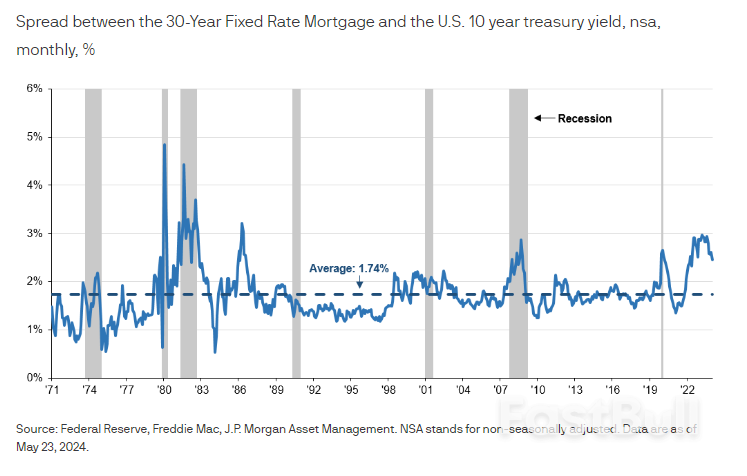
          Mortgages rates are also influenced by the mortgage spread – the 30-year fixed rate minus the 10Y Treasury rate – and the factors that affect this spread. On average, the 30-year mortgage rate has been 1.7% higher than the US 10-year, but periods of economic stress (recessions), and changes in Federal Reserve (Fed) asset purchases of Treasuries and agency mortgage-backed securities (MBS) in recent decades have impacted this spread dynamic. On the former, its clear recessions and periods of economic uncertainty lead to spikes in mortgage spreads. This is consistent with an increase in market and interest volatility during periods of economic stress.
          On the latter, the Fed began purchasing agency MBS following the Global Financial Crisis to help mitigate the volatility in the mortgage market. The impact of Fed purchases on mortgage spreads is clear; in December of 2008, the mortgage spread peaked at 2.9%. The Fed began MBS purchases from Jan. 2009 to March 2010, forcing that spread to tighten to 1.2% over that period. Similarly, the first experiment of quantitative tightening (QT) from 2017-2019 caused mortgage spreads to widen from 1.4% to 2.6%.
          In summary, gradual declines in Treasury rates may be offset by wider mortgage spreads as the Fed continues to embrace QT in its MBS portfolio, likely keeping mortgage rates in the high 6% to low-7% range. That said, should mortgage spreads tighten to historical norms and long run Treasury yields decline to 3.5-4% by the end of 2025, we could see mortgage rates fall to 5.25%-5.75%, however we don’t foresee an environment where mortgage rates fall below that range, unless a recession occurs.
          Crucially, declining mortgage rates are likely to be met with still strong demand for housing, keeping a floor on home prices and potentially allow home prices to continue rising. This suggests that even a decline in mortgage rates won’t dramatically improve housing affordability in the years ahead.
          We do see scope for mortgage rates to decline modestly from ~7% to 6-6.5% over the next 12-24 months, however, it’s unlikely we will see mortgage rates below 5%.
          The residential housing market may never experience a boom quite like it did during the pandemic driven by a lack of housing supply after over a decade of under-building relative to population growth, strong demand across consumers thanks to fiscal support and the desire for more living space, and rock bottom interest rates. Since then, and as highlighted in a recent post, the rise in mortgage rates and home prices has crushed housing affordability, making achieving the American dream of home ownership unattainable for many people.
          While we don’t expect home prices to decline materially from here given structural dynamics, Americans that have been sidelined from being able to purchase a home over the past couple of years are perhaps hoping and waiting for at least one area of reprieve: lower mortgage rates. We do see scope for mortgage rates to decline modestly from ~7% to 6-6.5% over the next 12-24 months, however, it’s unlikely we will see mortgage rates below 5%.
          Mortgage rates are closely tied to long-term interest rates, in particular, the rate on the U.S. 10-year Treasury note. Given long term Treasury rates are primarily driven by growth, inflation, and expectations for policy rates in the long run, a cooling inflation and growth backdrop in the quarters ahead are likely to put modest downward pressure on long-term interest rates and contribute to some declines in mortgage rates. That said, increasing Treasury supply and rising neutral policy rate expectations are likely to limit any substantial fall in either Treasury or mortgage rates.
          Mortgages rates are also influenced by the mortgage spread – the 30-year fixed rate minus the 10Y Treasury rate – and the factors that affect this spread. On average, the 30-year mortgage rate has been 1.7% higher than the US 10-year, but periods of economic stress (recessions), and changes in Federal Reserve (Fed) asset purchases of Treasuries and agency mortgage-backed securities (MBS) in recent decades have impacted this spread dynamic. On the former, its clear recessions and periods of economic uncertainty lead to spikes in mortgage spreads. This is consistent with an increase in market and interest volatility during periods of economic stress.
          On the latter, the Fed began purchasing agency MBS following the Global Financial Crisis to help mitigate the volatility in the mortgage market. The impact of Fed purchases on mortgage spreads is clear; in December of 2008, the mortgage spread peaked at 2.9%. The Fed began MBS purchases from Jan. 2009 to March 2010, forcing that spread to tighten to 1.2% over that period. Similarly, the first experiment of quantitative tightening (QT) from 2017-2019 caused mortgage spreads to widen from 1.4% to 2.6%.
          In summary, gradual declines in Treasury rates may be offset by wider mortgage spreads as the Fed continues to embrace QT in its MBS portfolio, likely keeping mortgage rates in the high 6% to low-7% range. That said, should mortgage spreads tighten to historical norms and long run Treasury yields decline to 3.5-4% by the end of 2025, we could see mortgage rates fall to 5.25%-5.75%, however we don’t foresee an environment where mortgage rates fall below that range, unless a recession occurs.
          Crucially, declining mortgage rates are likely to be met with still strong demand for housing, keeping a floor on home prices and potentially allow home prices to continue rising. This suggests that even a decline in mortgage rates won’t dramatically improve housing affordability in the years ahead.

          While long Treasury rates and mortgage rates move together, at times, the spread between the two can be volatile

          Where Are Mortgage Rates Headed?_1
          To stay updated on all economic events of today, please check out our Economic calendar
          Risk Warnings and Disclaimers
          You understand and acknowledge that there is a high degree of risk involved in trading. Following any strategies or investment methods may lead to potential losses. The content on the site is provided by our contributors and analysts for information purposes only. You are solely responsible for determining whether any trading assets, securities, strategy, or any other product is suitable for investing based on your own investment objectives and financial situation.
          Add to Favorites
          Share

          Natural Gas and Oil Forecast: Strong U.S. Fuel Demand, Oil Up Over 0.25%

          Owen Li

          Economic

          Commodity

          Market Overview

          Oil prices increased in Asian trade on Tuesday, continuing gains from Monday, driven by expectations of strong U.S. fuel demand during the summer and the upcoming OPEC+ meeting on June 2. Oil prices rose over 1% on Monday, despite subdued trading due to holidays in the U.S. and Britain.
          Rising air travel further supports this trend. Meanwhile, the potential extension of OPEC+ output cuts and a weaker U.S. dollar contribute to a positive oil and natural gas outlook.

          Natural Gas Price Forecast

          Natural Gas and Oil Forecast: Strong U.S. Fuel Demand, Oil Up Over 0.25%_1
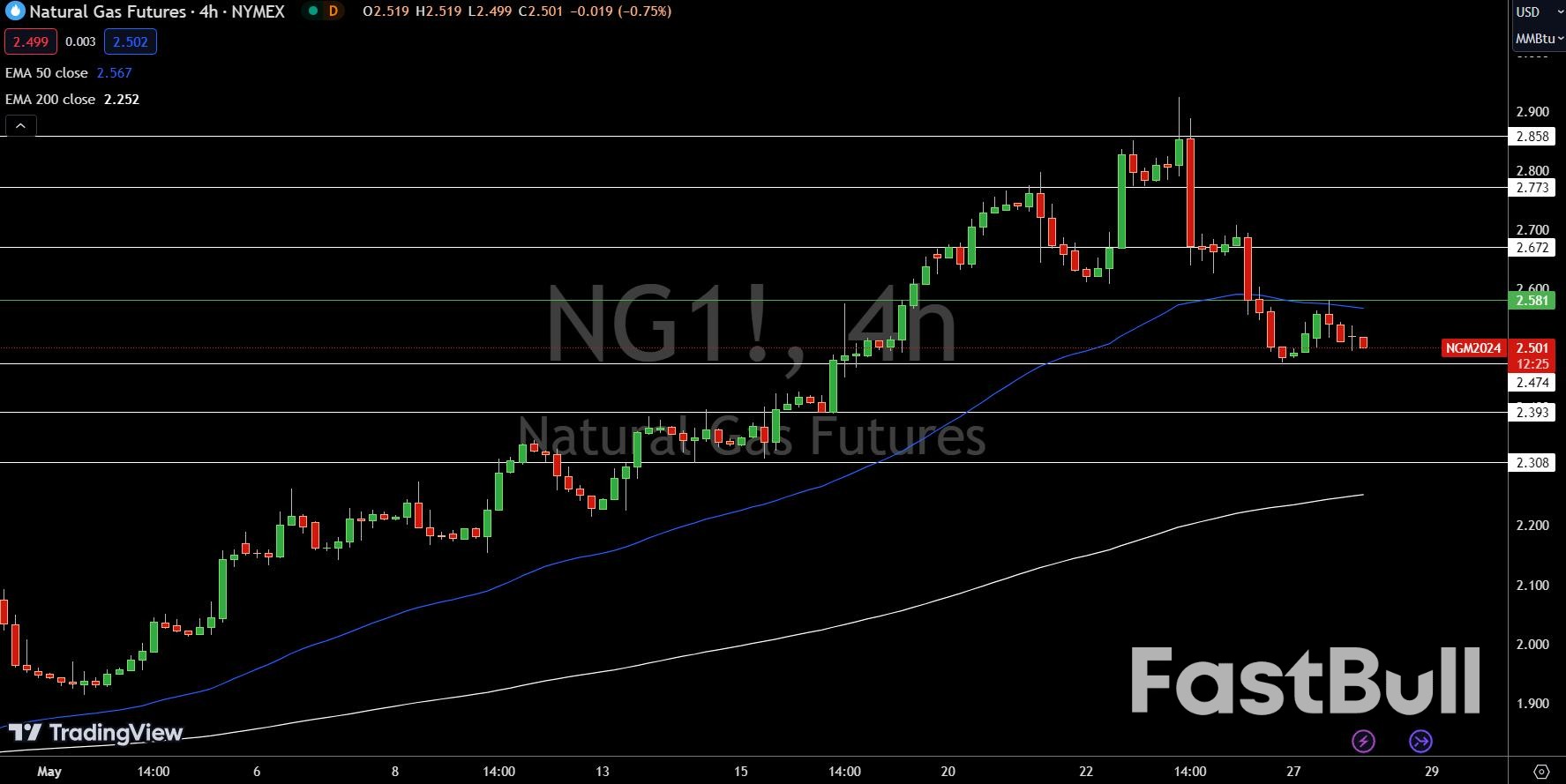
          Natural Gas (NG) is trading at $2.50, down 0.98% on the 4-hour chart. The pivot point, marked at $2.58, is critical for determining market direction. Immediate resistance levels are at $2.67, $2.77, and $2.86. On the downside, immediate support is at $2.47, followed by $2.39 and $2.31.
          The 50-day Exponential Moving Average (EMA) is positioned at $2.57, indicating potential short-term resistance, while the 200-day EMA is at $2.25, suggesting stronger support. The outlook remains bearish below $2.58, with a break above this level potentially shifting sentiment to a more bullish stance.

          WTI Oil Price ForecastNatural Gas and Oil Forecast: Strong U.S. Fuel Demand, Oil Up Over 0.25%_2

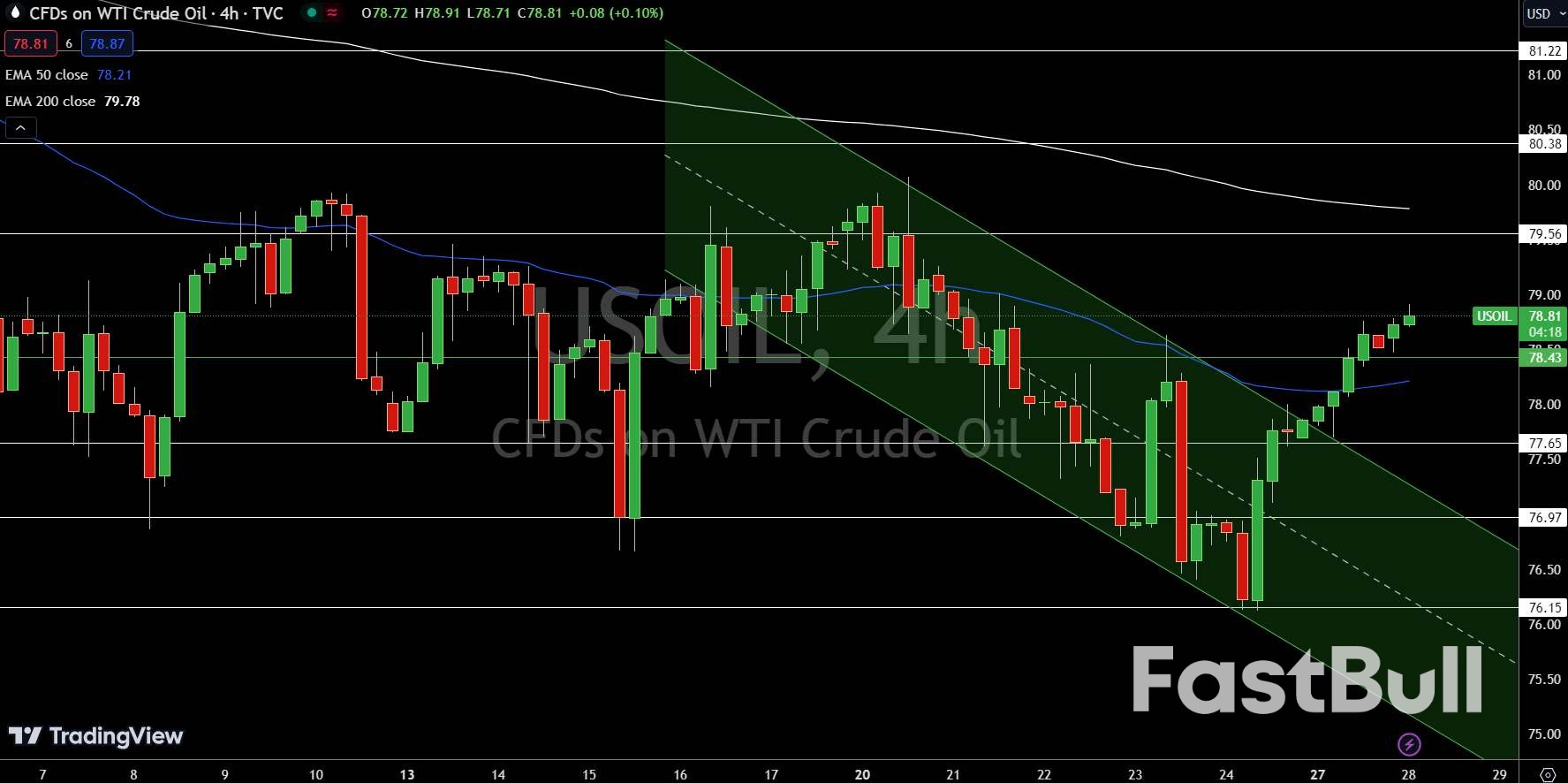
          USOIL is trading at $78.81, reflecting a 0.39% increase on the 4-hour chart. The pivot point, marked by the green line at $78.43, is crucial for determining market direction. Immediate resistance levels are $79.56, $80.38, and $81.22. On the downside, immediate support is identified at $77.56, followed by $76.97 and $76.15.
          The 50-day Exponential Moving Average (EMA) is at $78.21, indicating short-term bullish momentum. The 200-day EMA is at $79.78, providing long-term resistance. Maintaining a bullish outlook above $78.43 is recommended, with a break below this level potentially triggering a sharp selling trend.

          Brent Oil Price Forecast

          Natural Gas and Oil Forecast: Strong U.S. Fuel Demand, Oil Up Over 0.25%_3
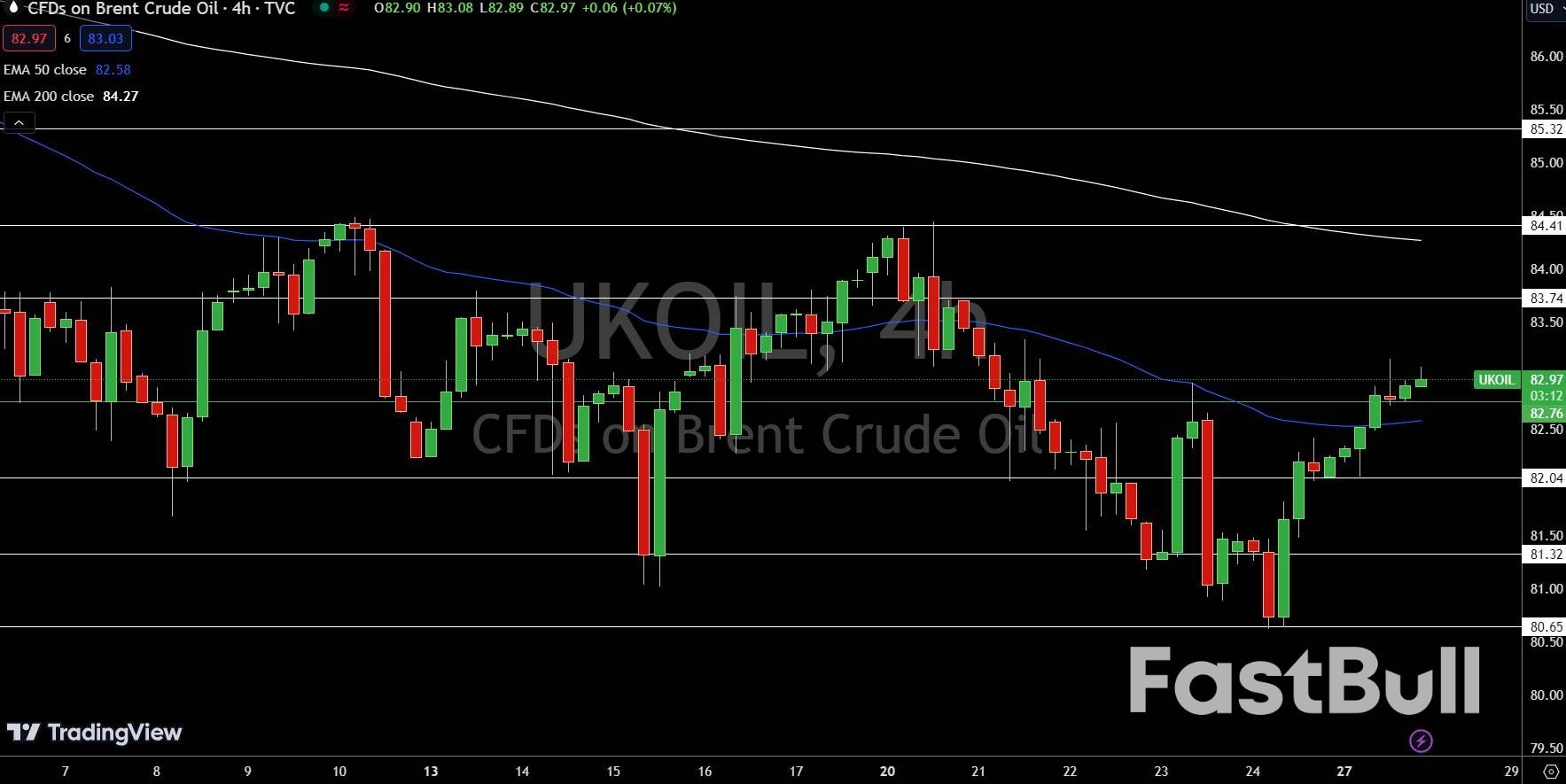
          UKOIL is trading at $82.97, reflecting a 0.28% increase on the 4-hour chart. The pivot point, marked by the green line at $82.76, is essential for determining market direction. Immediate resistance levels are $83.74, $84.41, and $85.32. On the downside, immediate support is found at $82.04, followed by $81.32 and $80.65.
          The 50-day Exponential Moving Average (EMA) is at $82.58, indicating short-term bullish momentum, while the 200-day EMA is at $84.27, acting as long-term resistance. Maintaining a bullish outlook above $82.76 is recommended, with a break below this level potentially triggering a sharp selling trend.
          For a look at all of today's economic events, check out our economic calendar.

          Source: FX Empire

          To stay updated on all economic events of today, please check out our Economic calendar
          Risk Warnings and Disclaimers
          You understand and acknowledge that there is a high degree of risk involved in trading. Following any strategies or investment methods may lead to potential losses. The content on the site is provided by our contributors and analysts for information purposes only. You are solely responsible for determining whether any trading assets, securities, strategy, or any other product is suitable for investing based on your own investment objectives and financial situation.
          Add to Favorites
          Share

          Indian Stocks Treading Cautiously As Lok Sabha Results Near

          Samantha Luan

          Economic

          Stocks

          After a stellar rally over the past few weeks, markets faced some resistance over the past couple of sessions. At Tuesday opening bell, indices Sensex and Nifty traded marginally higher with a downside bias. At the time of filing this report, Sensex and Nifty were largely steady.
          It is now expected that further up moves will depend on the cues from the various macroeconomic data that are scheduled later during the week, Q4 India GDP and US inflation data. On Monday, the benchmark indices ended marginally lower. The decline could be partly attributable to investors booking profit at higher levels to avoid any potential risks in the market ahead of the Lok Sabha election results, said Vinod Nair, Head of Research, Geojit Financial Services.
          "investors start(ed) booking profit at higher levels to avoid any knee jerk reaction in the market ahead of the election result. Better earnings growth, the expectation of a revival in private capex, and a moderation in FIIs selling intensity are the key positive triggers in the market," Nair said. "The release of India's Q4 GDP and US inflation figures this week will also influence investors to get a direction in the near term," Nair said.
          India's GDP grew at a massive 8.4 per cent during the October-December quarter of the financial year 2023-24, and the country continued to remain the fastest-growing major economy. India's economy grew 7.2 per cent in 2022-23 and 8.7 per cent in 2021-22, respectively. Lately, barring one odd session, Indian stock indices continued their rally, reaching fresh lifetime highs, tracking strong global market cues, hopes of Prime Minister Narendra Modi's comfortable return to office, besides other strong macroeconomic fundamentals.
          With the six phases of elections now behind us, it is widely expected by investors that the Narendra Modi-led government will come back to office with a comfortable margin for his third term. This also likely triggered fresh stock buying. In the past two weeks, Sensex jumped over 3,600 points, on a cumulative basis.
          Overseas investors have been remaining net sellers of Indian equities for the past several sessions. Interestingly, domestic institutional investors during the same period stayed net buyers, largely making up for the outflows by the foreign investors. Going ahead, the market will also actively track exit poll prediction.
          "As we approach the election results a bit of nervousness is visible in the market. The sharp correction in Nifty in the afternoon yesterday indicates this nervousness. This uncertainty-led nervousness is likely to continue," said VK Vijayakumar, Chief Investment Strategist, Geojit Financial Services. "A high possibility is the market getting a clue of the election results earlier than June 4th. This can happen any time and can trigger a big move in the market," said Vijayakumar.
          "We may see further consolidation in the index ahead, so participants should focus on careful stock selection and effective trade management," said Ajit Mishra - SVP, Research, Religare Broking.

          Source:ANI

          To stay updated on all economic events of today, please check out our Economic calendar
          Risk Warnings and Disclaimers
          You understand and acknowledge that there is a high degree of risk involved in trading. Following any strategies or investment methods may lead to potential losses. The content on the site is provided by our contributors and analysts for information purposes only. You are solely responsible for determining whether any trading assets, securities, strategy, or any other product is suitable for investing based on your own investment objectives and financial situation.
          Add to Favorites
          Share

          Fed's Bowman: Would Have Backed Waiting to Taper Balance Sheet Run-Off

          Kevin Du

          Economic

          Central Bank

          Bowman, in remarks prepared for delivery to a Bank of Japan conference in Tokyo, said she believes commercial bank reserve levels at the Fed remain abundant, giving officials more time to proceed with the $95 billion-a-month run-off target that has been in place since mid-2022.
          "While it is important to slow the pace of balance sheet runoff as reserves approach ample levels, in my view we are not yet at that point," she said, especially with still-sizable take-up at the Fed's overnight reverse repo facility, or ON-RRP.
          The level of reserves that banks hold at the Fed is a key consideration for determining the overall size of the central bank balance sheet, which has shrunk from around $9 trillion in 2022 to about $7.4 trillion now through a process commonly known as quantitative tightening. Officials do not want to see a repeat of what occurred in September 2019, when they reduced the balance sheet too much and triggered a bout of volatility in short-term funding markets.
          On May 1, the Fed announced it would start slowing the pace of reduction of its balance sheet. At present, the Fed is allowing up to $60 billion a month of Treasuries and $35 billion of mortgage-backed securities to mature from its bond portfolio without being replaced. Under the plan due to begin next month, the cap for Treasuries would drop to $25 billion, while the MBS maturity limit would remain as is.
          Minutes released last week of the April 30-May 1 meeting at which the decision was reached showed not all Fed officials favored making that shift now, and Bowman's remarks indicate she was among the "few participants" who would have preferred to wait.
          "In my view, it is important to continue to reduce the size of the balance sheet to reach ample reserves as soon as possible and while the economy is still strong," Bowman said. "Doing so will allow the Federal Reserve to more effectively and credibly use its balance sheet to respond to future economic and financial shocks."
          Bowman also said it is important that Fed officials communicate effectively that any change in the balance sheet run-off does not reflect a change in monetary policy, including interest rates.
          The Fed has held its benchmark interest rate in a range of 5.25% to 5.50% since last July, and officials recently have indicated they are in no rush to begin rate cuts because inflation has proven stickier than they had estimated.
          On other balance sheet considerations for the longer term, Bowman said she favors a portfolio composed primarily of Treasuries and one that is "tilted slightly" toward shorter-dated maturities, which would offer the Fed more flexibility.

          Source: Reuters

          To stay updated on all economic events of today, please check out our Economic calendar
          Risk Warnings and Disclaimers
          You understand and acknowledge that there is a high degree of risk involved in trading. Following any strategies or investment methods may lead to potential losses. The content on the site is provided by our contributors and analysts for information purposes only. You are solely responsible for determining whether any trading assets, securities, strategy, or any other product is suitable for investing based on your own investment objectives and financial situation.
          Add to Favorites
          Share

          Iron Ore Prices Lack Conviction Despite China Stimulus Moves

          Owen Li

          Commodity

          The balance of risks for iron ore prices are tilted to the downside despite top buyer China's most recent steps to boost its struggling property sector.
          A series of stimulus measures announced earlier this month will see up to 1 trillion yuan ($138 billion) in new property funding, an easing of mortgage rules and allowing local governments to buy some apartments in order to clear overhangs.
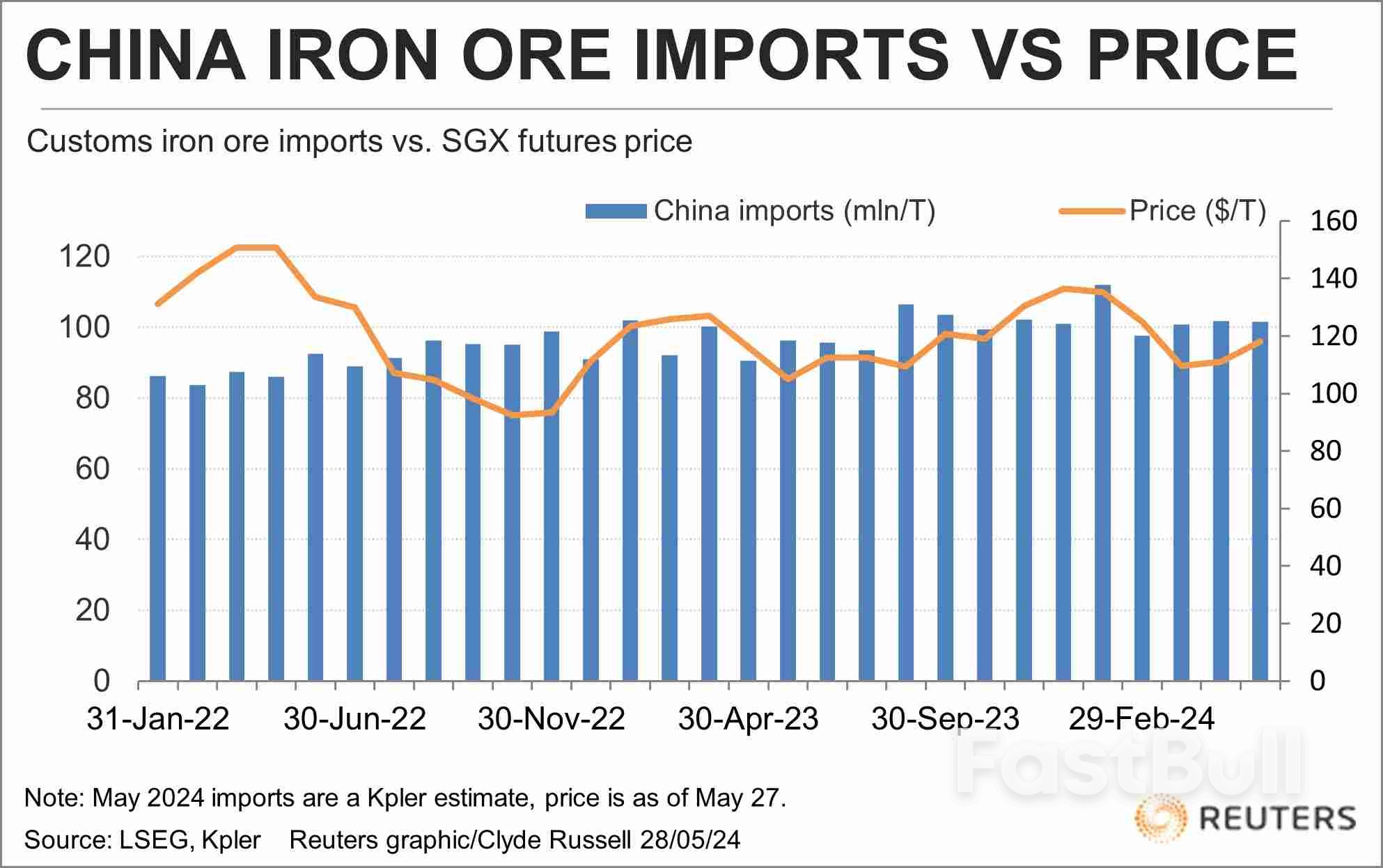
          The spot price of iron ore was initially boosted by the policy support for housing, with Singapore-traded futures gaining nearly 2% to reach a two-week high of $119.20 a metric ton in the three trading sessions after the May 17 announcement.
          But the contract has since meandered and ended at $118.04 a ton on Monday.
          The issue for the market is how quickly does the extra support for the property sector translate into higher steel demand, and thus demand for iron ore, the key raw material.
          The concern is that even if the new measures are successful in reviving a sector that at one stage accounted for a quarter of China's gross domestic product, it will take at least several months, and likely far longer, for new construction to meaningfully boost steel demand.
          This means demand for iron ore in China, which buys almost 75% of global seaborne volumes, will stay largely dependent on other sectors, such as manufacturing and infrastructure.
          Here the news is mixed, with some parts of the world's second-biggest economy performing well, and others continuing to struggle.
          Industrial profits returned to growth in April, rising 4.0% after declining 3.5% in March, leaving them 4.3% higher over the first four months of 2024 compared to the same period a year earlier.
          The rising profits came as industrial output grew 6.7% year-on-year in April, largely as a result of strong exports.
          However, retail sales remained soft, gaining just 2.3% in April, the lowest since December, while credit growth fell more than expected to 730 billion yuan in April, down from 3.09 trillion yuan in March.Iron Ore Prices Lack Conviction Despite China Stimulus Moves_1

          Fundamentals Ease

          The uncertain economic signals mean that iron ore is likely to take more direction from fundamentals, and the picture is far from bullish.
          China's imports of iron ore are likely to be steady in May from April, with commodity analysts Kpler estimating arrivals of 101.48 million tons, compared to the official figure of 101.82 million for April.
          However, within that largely steady volume there are some bearish signals, with iron ore inventories at Chinese ports rising, with consultants SteelHome saying they reached 144.65 million tons in the week to May 24.
          This was up from 144.50 million the previous week and close to the two-year high of 145.15 million reached in the week to May 10.
          It's worth noting that the usual seasonal pattern for iron ore stockpiles is that they decline in the second quarter as steel mills normally ramp up output ahead of the peak summer construction period.
          But steel production has been soft, with crude steel output dropping to 85.94 million tons in April, down 2.6% from march and 7.2% from April 2023.
          For the first four months of the year China produced 343.67 million tons of steel, down 3% from the same period in 2023.
          It's likely that May will see a recovery in steel production as mills ramp up output in the expectation of stronger summer demand, but whether this will be enough to spark renewed optimism in iron ore remains in doubt.

          Source: Reuters

          Risk Warnings and Disclaimers
          You understand and acknowledge that there is a high degree of risk involved in trading. Following any strategies or investment methods may lead to potential losses. The content on the site is provided by our contributors and analysts for information purposes only. You are solely responsible for determining whether any trading assets, securities, strategy, or any other product is suitable for investing based on your own investment objectives and financial situation.
          Add to Favorites
          Share

          USD on Track to Snap 4-Month Winning Streak, EUR/USD Bulls Eye 1.09

          FOREX.com

          Economic

          Forex

          The US dollar index is currently down -1.7% in May, which has effectively seen it wipe off April's gains and snap a 4-month rally. The last time the dollar rose for four months was just ahead of the 2022 high, and if history were to repeat it points to another couple of months of the dollar's decline and for bearish momentum to accelerate.
          As things stand, the USD index is close to confirming a dark-cloud cover on the monthly chart, which itself is a higher low relative to the 2023 high. And should the Fed throw in the towel and begin signalling a rate cut, we could be looking at a quick break below 104. I'm just not convinced we're there yet.
          USD on Track to Snap 4-Month Winning Streak, EUR/USD Bulls Eye 1.09_1
          Besides, the daily chart shows the USD index is close to retest the December trendline and Q3 open price. And traders clearly want to test it, given it now trades lower for a third consecutive day. Although trading volumes remain very thin, but are expected to pickup with the return of European and US trade desks after the long weekend.
          Also note that the highest daily volume coincided with the 2-bar reversal on May 2nd, and volume shave been trending lower since. This is not what I'd expect to see on a convincing bearish trend, so I remain on guard for another leg higher. Over the near-term, I am equally open to some messy price action around the trendine or 104 handle as much as I am to a simply rally from current levels. I just do not think the dollar is ready to completely roll over yet.

          EUR/USD technical analysis:

          The euro is trying to carve out a third bullish day, and the MTD high and 1.09 handle are within a couple of days' trade. Assuming we see the inevitable attack on the USD index trendline and lunge for the 104 handle, then EUR/USD could well reach 1.09. But as mentioned above, I remain unconvinced by these moves – even if they show the potential to extend.
          USD on Track to Snap 4-Month Winning Streak, EUR/USD Bulls Eye 1.09_2
          The 1-hour chart shows a relatively straight move towards the weekly S1 pivot and 1.0885 high, and it would almost be rude not to test it. But note the declining volumes on this timeframe, then I cannot help but suspect EUR/USD will try to carve out a top soon.
          Bears could seek to fade into rallies up to resistance levels. Should bearish momentum return, a move bac to 1.0850 seems feasible, which is just above the weekly point and high-volume node.
          To stay updated on all economic events of today, please check out our Economic calendar
          Risk Warnings and Disclaimers
          You understand and acknowledge that there is a high degree of risk involved in trading. Following any strategies or investment methods may lead to potential losses. The content on the site is provided by our contributors and analysts for information purposes only. You are solely responsible for determining whether any trading assets, securities, strategy, or any other product is suitable for investing based on your own investment objectives and financial situation.
          Add to Favorites
          Share

          OPEC Remains Optimistic About Global Oil Demand

          Alex

          Economic

          Commodity

          The global economy has been relatively resilient in recent months, which has led OPEC to continue to anticipate robust oil demand growth this year and next, OPEC Secretary General Haitham Al Ghais said on Monday.
          “For 2024, oil demand growth is at 2.2 mb/d, with total global demand anticipated to average 104.5 mb/d,” Al Ghais told the Special Session of the 141st Meeting of OPEC’s Economic Commission Board.
          Next year, the global oil demand growth forecast shows a further robust expansion of 1.8 million barrels per day year-over-year, averaging 106.3 million bpd, OPEC’s secretary general added.
          The head of the organization – which is currently restricting supply to the market in the OPEC+ deal coordinated with several non-OPEC producers led by Russia – echoed the projections of OPEC in the latest Monthly Oil Market Report (MOMR).
          OPEC continues to strike an optimistic view of global oil demand despite market concerns about wobbling demand and the prospect of higher-for-longer interest rates that could hurt oil consumption.
          Earlier this month, OPEC said in its monthly report that a resilient global economy early this year has additional upside potential in the second half with the possible easing of monetary policies.
          OPEC estimates that global oil demand rose by 2.4 million bpd in the first quarter of 2024. For the full year, total world oil demand is anticipated to reach 104.5 million bpd, driven by “strong air travel demand and healthy road mobility, including trucking, as well as industrial, construction, and agricultural activities in non-OECD countries.”
          Regarding the world economy, OPEC said “Despite certain downside risks, the continued momentum observed since the start of the year could create additional upside potential for global economic growth in 2024 and beyond.”
          All eyes are now on OPEC and OPEC+ as they meet this coming weekend to decide how to proceed with the current production cuts in the second half of the year. With oil’s recent slide, most analysts expect OPEC+ to keep the cuts as-is for the rest of the year.

          Source:Oilprice

          To stay updated on all economic events of today, please check out our Economic calendar
          Risk Warnings and Disclaimers
          You understand and acknowledge that there is a high degree of risk involved in trading. Following any strategies or investment methods may lead to potential losses. The content on the site is provided by our contributors and analysts for information purposes only. You are solely responsible for determining whether any trading assets, securities, strategy, or any other product is suitable for investing based on your own investment objectives and financial situation.
          Add to Favorites
          Share
          FastBull
          Copyright © 2025 FastBull Ltd

          728 RM B 7/F GEE LOK IND BLDG NO 34 HUNG TO RD KWUN TONG KLN HONG KONG

          TelegramInstagramTwitterfacebooklinkedin
          App Store Google Play Google Play
          Products
          Charts

          Chats

          Q&A with Experts
          Screeners
          Economic Calendar
          Data
          Tools
          Membership
          Features
          Function
          Markets
          Copy Trading
          Latest Signals
          Contests
          News
          Analysis
          24/7
          Columns
          Education
          Company
          Careers
          About Us
          Contact Us
          Advertising
          Help Center
          Feedback
          User Agreement
          Privacy Policy
          Business

          White Label

          Data API

          Web Plug-ins

          Poster Maker

          Affiliate Program

          Risk Disclosure

          The risk of loss in trading financial instruments such as stocks, FX, commodities, futures, bonds, ETFs and crypto can be substantial. You may sustain a total loss of the funds that you deposit with your broker. Therefore, you should carefully consider whether such trading is suitable for you in light of your circumstances and financial resources.

          No decision to invest should be made without thoroughly conducting due diligence by yourself or consulting with your financial advisors. Our web content might not suit you since we don't know your financial conditions and investment needs. Our financial information might have latency or contain inaccuracy, so you should be fully responsible for any of your trading and investment decisions. The company will not be responsible for your capital loss.

          Without getting permission from the website, you are not allowed to copy the website's graphics, texts, or trademarks. Intellectual property rights in the content or data incorporated into this website belong to its providers and exchange merchants.

          Not Logged In

          Log in to access more features

          FastBull Membership

          Not yet

          Purchase

          Become a signal provider
          Help Center
          Customer Service
          Dark Mode
          Price Up/Down Colors

          Log In

          Sign Up

          Position
          Layout
          Fullscreen
          Default to Chart
          The chart page opens by default when you visit fastbull.com