Markets
News
Analysis
User
24/7
Economic Calendar
Education
Data
- Names
- Latest
- Prev


Signal Accounts for Members
All Signal Accounts
All Contests


Turkey Trade BalanceA:--
F: --
P: --
Germany Construction PMI (SA) (Nov)A:--
F: --
P: --
Euro Zone IHS Markit Construction PMI (Nov)A:--
F: --
P: --
Italy IHS Markit Construction PMI (Nov)A:--
F: --
P: --
U.K. Markit/CIPS Construction PMI (Nov)A:--
F: --
P: --
France 10-Year OAT Auction Avg. YieldA:--
F: --
P: --
Euro Zone Retail Sales MoM (Oct)A:--
F: --
P: --
Euro Zone Retail Sales YoY (Oct)A:--
F: --
P: --
Brazil GDP YoY (Q3)A:--
F: --
P: --
U.S. Challenger Job Cuts (Nov)A:--
F: --
P: --
U.S. Challenger Job Cuts MoM (Nov)A:--
F: --
P: --
U.S. Challenger Job Cuts YoY (Nov)A:--
F: --
P: --
U.S. Initial Jobless Claims 4-Week Avg. (SA)A:--
F: --
P: --
U.S. Weekly Initial Jobless Claims (SA)A:--
F: --
P: --
U.S. Weekly Continued Jobless Claims (SA)A:--
F: --
P: --
Canada Ivey PMI (SA) (Nov)A:--
F: --
P: --
Canada Ivey PMI (Not SA) (Nov)A:--
F: --
P: --
U.S. Non-Defense Capital Durable Goods Orders Revised MoM (Excl. Aircraft) (SA) (Sept)A:--
F: --
U.S. Factory Orders MoM (Excl. Transport) (Sept)A:--
F: --
P: --
U.S. Factory Orders MoM (Sept)A:--
F: --
P: --
U.S. Factory Orders MoM (Excl. Defense) (Sept)A:--
F: --
P: --
U.S. EIA Weekly Natural Gas Stocks ChangeA:--
F: --
P: --
Saudi Arabia Crude Oil ProductionA:--
F: --
P: --
U.S. Weekly Treasuries Held by Foreign Central BanksA:--
F: --
P: --
Japan Foreign Exchange Reserves (Nov)A:--
F: --
P: --
India Repo RateA:--
F: --
P: --
India Benchmark Interest RateA:--
F: --
P: --
India Reverse Repo RateA:--
F: --
P: --
India Cash Reserve RatioA:--
F: --
P: --
Japan Leading Indicators Prelim (Oct)A:--
F: --
P: --
U.K. Halifax House Price Index YoY (SA) (Nov)--
F: --
P: --
U.K. Halifax House Price Index MoM (SA) (Nov)--
F: --
P: --
France Current Account (Not SA) (Oct)--
F: --
P: --
France Trade Balance (SA) (Oct)--
F: --
P: --
France Industrial Output MoM (SA) (Oct)--
F: --
P: --
Italy Retail Sales MoM (SA) (Oct)--
F: --
P: --
Euro Zone Employment YoY (SA) (Q3)--
F: --
P: --
Euro Zone GDP Final YoY (Q3)--
F: --
P: --
Euro Zone GDP Final QoQ (Q3)--
F: --
P: --
Euro Zone Employment Final QoQ (SA) (Q3)--
F: --
P: --
Euro Zone Employment Final (SA) (Q3)--
F: --
Brazil PPI MoM (Oct)--
F: --
P: --
Mexico Consumer Confidence Index (Nov)--
F: --
P: --
Canada Unemployment Rate (SA) (Nov)--
F: --
P: --
Canada Labor Force Participation Rate (SA) (Nov)--
F: --
P: --
Canada Employment (SA) (Nov)--
F: --
P: --
Canada Part-Time Employment (SA) (Nov)--
F: --
P: --
Canada Full-time Employment (SA) (Nov)--
F: --
P: --
U.S. Dallas Fed PCE Price Index YoY (Sept)--
F: --
P: --
U.S. PCE Price Index YoY (SA) (Sept)--
F: --
P: --
U.S. PCE Price Index MoM (Sept)--
F: --
P: --
U.S. Personal Outlays MoM (SA) (Sept)--
F: --
P: --
U.S. Core PCE Price Index MoM (Sept)--
F: --
P: --
U.S. UMich 5-Year-Ahead Inflation Expectations Prelim YoY (Dec)--
F: --
P: --
U.S. Core PCE Price Index YoY (Sept)--
F: --
P: --
U.S. 5-10 Year-Ahead Inflation Expectations (Dec)--
F: --
P: --
U.S. UMich Current Economic Conditions Index Prelim (Dec)--
F: --
P: --
U.S. UMich Consumer Sentiment Index Prelim (Dec)--
F: --
P: --
U.S. UMich 1-Year-Ahead Inflation Expectations Prelim (Dec)--
F: --
P: --
U.S. UMich Consumer Expectations Index Prelim (Dec)--
F: --
P: --


No matching data
Latest Views
Latest Views
Trending Topics
Top Columnists
Latest Update
White Label
Data API
Web Plug-ins
Affiliate Program
View All

No data
EUR/USD is attempting a recovery wave from the 1.1500 zone. USD/CHF climbed higher above 0.8050 and might correct some gains.
On the hourly chart of EUR/USD at FXOpen, the pair extended the decline below 1.1550. The Euro even declined below 1.1520 before the bulls appeared against the US Dollar.
The pair tested 1.1490 and recently started a recovery wave. There was a move above 1.1520 and 1.1550. The pair climbed above the 50% Fib retracement level of the downward move from the 1.1653 swing high to the 1.1491 low.
More importantly, there was a break above a major bearish trend line with resistance at 1.1530. The pair is now trading above 1.1575 and the 50-hour simple moving average. Immediate hurdle on the EUR/USD chart is near the 61.8% Fib retracement at 1.1590.
The first key breakout zone sits at 1.1615. An upside break above 1.1615 might send the pair toward 1.1655. Any more gains might open the doors for a move toward the 1.1700 zone. If there is a fresh decline, the pair might find bids near 1.1550.
The next major support is 1.1540. A downside break below 1.1540 could send the pair toward 1.1510. Any more losses might send the pair to 1.1490.
On the hourly chart of USD/CHF at FXOpen, the pair started a decent increase from 0.7940. The US Dollar climbed above the 0.8000 handle against the Swiss Franc.
The bulls were able to pump the pair above the 50-hour simple moving average and 0.8050. Finally, the pair tested 0.8100. A high was formed near 0.8101 and the pair is now consolidating gains. The pair dipped below the 23.6% Fib retracement level of the upward move from the 0.7937 swing low to the 0.8101 high.
Besides, there was a break below a bullish trend line at 0.8085. On the downside, immediate support on the USD/CHF chart is near 0.8040. The first key area of interest might be near the 50% Fib retracement at 0.8020.
A downside break below 0.8020 might call for a drop to 0.7975. Any more losses may possibly open the doors for a move toward 0.7940.
On the upside, the pair could struggle near 0.8080. The first major barrier for bulls is 0.8100. If there is a clear break above 0.8100 and the RSI climbs above 50, the pair could start another increase. In the stated case, it could test 0.8150.
The race among Chinese manufacturers to build ever-larger wind turbines is expected to slow due to technical hurdles in the coming years, according to industry executives.
"The average wind turbine capacity will not see a significant increase in 2026 based on our general data, which indicates a slowdown in the trend to develop larger machines," said Wei Min, deputy chief executive officer of Windey Energy Technology Group Co. He spoke at the BloombergNEF conference in Shanghai on Wednesday.
Chinese wind manufacturers, which dominate the global industry, have spent the last few years one-upping each other with large turbines. But issues are emerging, like insufficient data and testing time for new machines, according to Wei. Transporting blades, which can be more than 100 meters (328 feet) long, is another issue.
China adopted a new power pricing policy for renewable sources this year, which has threatened the profitability of wind and solar farms. It has forced manufacturers to find new ways of reducing costs for their clients by developing different approaches in turbine size.
Goldwind International Holdings' Vice President Wu Kai also believes turbine size will plateau in the next few years. "Onshore wind turbines will not become larger" even as we approach the end of the decade, he said.
There is some decent drama unfolding among the Big Tech bros this week — and Google and Nvidia are right in the middle of it. The former victim in the AI race, Google, which only months ago looked like it could be eaten alive by OpenAI's next-gen AI chatbot, is suddenly storming back and, in a twist, pushing Nvidia dangerously close to the cliff as it takes the lead in a way few saw coming.
To put things rapidly into context: the past two years haven't been rosy for Google. Gemini took time to lift off, hallucinated and became a punchline in its early days. The model quietly improved its way through end users until Gemini 3 hit hard last week. Google eventually got its AI model right and moved aggressively into 3D reasoning, agentic coding and "vibe coding" — the kinds of end-products that could mint billions in revenue.
But that's not where the story ends.
It's where it begins.
As AI chatbots seep into everyday life, demand for inference is exploding. Inference is when AI takes your request and figures out an answer. And with it, the cost of inference — the cost of running a trained model every time someone queries it — is exploding too. For OpenAI, that bill for 2024 is projected to hit around $2.3 billion, roughly 15× its training costs.
And here comes the plot twist: Meta and OpenAI are reportedly moving toward Google's TPUs — Google's homegrown chips — to run their own models because they are cheaper to operate while offering comparable performance. Both Meta and OpenAI are said to be seeking up to 4× better performance-per-dollar on inference workloads.
And inference is the next big thing because it never stops: every time you chat with a bot, the cost accumulates. Inference costs are projected to make up almost three-quarters of total AI computing costs by 2030.
So the world's biggest AI players could be shifting toward Google's TPUs — cheaper, more tailored to AI workloads — and potentially replacing Nvidia.Read that again.
That's a real risk for Nvidia, whose client base is nearly half made up of these same Big Tech giants. This is why — on top of the accounting drama that hit the company last week — the stock shed another 2.60% yesterday, while Google rallied to a fresh ATH.
In the meantime, Meta boosted its ad revenue thanks to AI, but its long-term business model is unclear. Meta is spending billions to transform its social media platforms into AI-content platform — a direction that risks disengaging users. Its Llama model is rarely mentioned in enterprise-grade discussions, and its oversized compute spending could backfire. Unlike Google, which can simply rent excess compute through its existing cloud offering, Meta must actually build that business from scratch.
Outside the US, Alibaba's AI efforts may be paying off. The company announced a stronger-than-expected 34% growth in its cloud business, that helped counterweigh their spending on consumer subsidies and AI investments. But the numbers couldn't bring investors on board. The share price is struggling to a reverse October – November softness.
In summary, Nvidia is being broadly questioned, Meta may be hitting its potential, while Amazon is the one Big Tech name that could benefit meaningfully from robotics when the time is right.
But right now, Google suddenly seems to have it all: the data, the data centres, the chips, the AI model and the interface. It might well be the next $5 trillion beast. And if you think about it, Alibaba also has many of these assets. It's got the data, the data centres, its own chips, its AI model, its e-commerce empire, and incredible reach within China and beyond. So if you believe the future is "everything under one roof," Alibaba is – has always been – a strong candidate.
What about Nvidia? Nvidia has been struggling since its latest earnings blew up in its hands as investors focused on swelling inventories and deferred payments. The company has been compared to Enron, booed because of the Google-TPU news, and are now defending themselves by saying "we're not Enron" and "we are happy for Google." Their main argument is that Google's TPUs are designed for one specific function, whereas Nvidia's GPUs are compatible with every AI model. But will that matter if companies simply want chips that do the job cheaply and efficiently?
So, the moment has come ladies and gentlemen: competition for Nvidia is arriving from an unexpected direction. That could eat into its revenue potential and market share. Everyone is waiting to see how Nvidia will respond — by expanding customers beyond Big Tech, rolling out more inference-friendly GPUs, or pushing deeper into cost-competitive partnerships. We'll soon find out.
Meanwhile, US consumer sentiment is waning. More than half of the strong US GDP this year came from massive AI investment. Yesterday's retail sales and PPI came in soft — softer than expected — although major retailers upgraded their annual forecasts and said the holiday season should look fine.
And if not, the Fed will be there to save the day. The probability of a 25bp cut rose to around 85% after the latest data. The US dollar slipped below its 200-DMA, helping the EURUSD break above the September–November bearish consolidation trend.
Cable also extended gains into today's Budget announcement— an announcement that might bite. There have been plenty of leaks about where Rachel Reeves will squeeze out £30bn to get the numbers right and keep both markets and households happy. Ultimately, no one will be fully satisfied.
The good news is that stress in gilt markets has been contained over the past few days. The bad news is that yields are near the levels reached during the Liz Truss mini-budget crisis three years ago, and Reeves has the smallest fiscal headroom on record — giving her zero margin for error. After today's Budget, we'll have a clearer view on whether the measures will be enough to keep gilt markets tidy and whether they are deflationary enough to convince the Bank of England to cut rates in December — which I think they will be. If so, current levels look appetizing for GBP sellers.
There was action on all fronts yesterday. Let's start with geopolitics. Ukrainian President Zelensky said that negotiations on a truce remained ongoing after headlines that Ukraine agreed to the US-brokered peace deal. Markets nevertheless reacted positively (equity, EUR, CE FX up; gas/oil down), embracing the progress made since high-level Geneva talks over the weekend. The past two days, the US was also involved with Russian officials in Abu Dhabi, working to a meeting between US chief negotiator Witkoff and his team and Russian President Putin in Moscow likely next week.
The Ukraine-Russia situation was one of the topics touched on during a phone call between US President Trump and his Chinese counterpart Xi Jinping who seem back on speaking terms after extending the trade truce by a year at the end of October. Next came (US) eco data with delayed September retail sales and producer prices and up-to-date November Richmond Fed manufacturing index (-15 from -4 vs -5 expected) and consumer confidence. Data disappointed apart from in line with consensus US PPI. Headline retail sales growth slowed from a strong 0.6% M/M in August to 0.2% (vs 0.4% consensus) with all core categories weaker than expected as well.
Despite the lower September numbers, real consumer spending was robust over Q3, expected at 3.2% annualized (vs +2.5% Q/Qa in Q2). November consumer confidence crashed from 95.5 to 88.7, the lowest outcome since the Covid-pandemic with the exception of April of this year (Liberation Day). There was an obvious setback in the present situation gauge given the US government shutdown, but the expectations comments fell even further back. The eco numbers put an extra burden on the dollar intraday while pushing US yields lower a first time.
A third topic added to those moves: headlines that Kevin Hassett was seen as frontrunner to replace Fed Chair Powell next year. From the remaining shortlist of 5 candidates (Waller, Bowman, Warsh and Rieder), Hassett has the most dovish profile. He advocates aggressive rate cuts, prioritizing growth of inflation control.
The bar to reverting to QE under his watch is probably lowest as he closely aligns with Trump's agenda. Hassett nevertheless stresses the importance of a fully independent central bank. US yields eventually closed around 3 bps lower across the curve with EUR/USD rising from 1.1521 to 1.1570. The short term faith of the US stock market was the final talking point. Key indices tested the October low/100d mavg recently.
Dip buyers showed up last Friday and gained strength on Monday and also yesterday despite a negative open (-1% and more for Nasdaq). Main indices eventually ended +0.67% (Nasdaq) to 1.4% (Dow) higher. The S&P 500 tested last week's high. Taking that out would put fears to bed of a sell-on-ticks pattern being established.
Today's eco calendar is less exciting. Keep in mind that US markets are closed tomorrow for Thanksgiving and that traded volumes are traditionally lower on (Black) Friday. Attention will shift to the UK with the long-awaited 2026 Autumn Budget. UK assets are extremely sensitive to the topic. From a risk point of view, a lot can go wrong/be considered as insufficient to address the public finances situation.
The Reserve Bank of New Zealand cut its policy rate by another 25 bps to 2.25% in a 5-1 vote. (one vote for unchanged). In explaining its current and future actions/intentions, the RBNZ admits that CPI inflation has increased to the top of the 1%-3% target range in Q3, but given spare capacity in the economy it is expected to return to 2% by mid-2026. Economic activity was weak in mid-2025, but the RBNZ sees it picking up.
Lower interest rates are supporting household spending and the labour market is stabilizing. A weaker exchange rate is supporting exporters' income. The RBNZ now sees risks to the inflation outlook as broadly balanced. In its updated forecast, the central bank now expects the policy rate at 2.2% in the first three quarters of next year. The bar for further easing looks very high. The 2-y NZ government bond yield rises by 7.5 bps this morning (2.66%). The kiwi dollar jumps sharply from the 0.5625 area to currently 0.5695.
Australian October CPI rose from 3.6% Y/Y to 3.8% Y/Y. The largest contributor to annual inflation was housing (5.9%), followed by food and non-alcohol beverages and recreation and culture, both rising 3.2%. Underlying inflation accelerated from 3.2% Y/Y to 3.3% Y/Y. Annual services inflation was 3.9%, up from 3.5%. Inflation rising further above the 2-3% RBA target range leaves the central bank no room to cut the policy rate any further. Markets now even ponder the chances of a rate hike end 2026. The 3-y Australia government bond yield jumps 14 bps (3.88%). The Aussie dollar jumps from the AUD/USD 0.647 area to currently trade near 0.6505.
China "firmly opposes" zero or negative processing fees for copper smelters and is urging the global industry to confront a "structural contradiction" that has upended the market for the industrial metal.
Treatment and refining charges — the fees earned by smelters for processing ore into metal — have plunged to record lows this year due to a scarcity of raw materials. Rapid growth in China's smelting capacity, by far the world's largest, has collided with a series of mine outages around the world.
A negative TC/RC effectively means that a smelter is paying to process copper concentrate — a highly unusual situation that has called into question the long-standing industry pricing benchmark. Spot charges have fallen as low as minus US$60 per tonne this year.
"Such practices severely undermine the interests of the global copper smelting industry, including China," Chen Xuesen, vice-president of the China Nonferrous Metals Industry Association, said in a presentation to an industry conference in Shanghai on Wednesday.
"CNIA firmly opposes any zero or negative TC/RCs in processing of copper concentrate," he said. "We urge the global copper industry to confront this unsustainable structural contradiction and foster collaboration among relevant nations and stakeholders."
The low fees have impacted copper smelters worldwide. Japan's JX Advanced Metals Co this year announced an output cut running into the tens of thousands of tonnes, while Glencore Plc received a government bailout to keep its Mount Isa smelter and refinery in Australia running for another three years.
Chinese smelters also suffer from low TC/RCs — but they benefit from their ownership of some mines, as well as the surging price of refined copper and sulfuric acid, a byproduct. Copper prices rose to a record high above US$11,200 in late October.
China is taking steps to manage its copper smelting capacity, drawing on its similar experiences with aluminum, Chen said. The country has already curbed over-expansion by halting some two million tonnes of illegal capacity that was either under construction or in planning, he said.
In the coming years, China will also favour new smelting capacity that would run on scrap rather than imported copper concentrate. "We will be able to see the effects from the copper supply-side reform in two to three years," Chen said.
Here is a detailed daily technical analysis and forecast for EURUSD, USDJPY, GBPUSD, AUDUSD, USDCAD, XAUUSD and Brent for 26 November 2025.
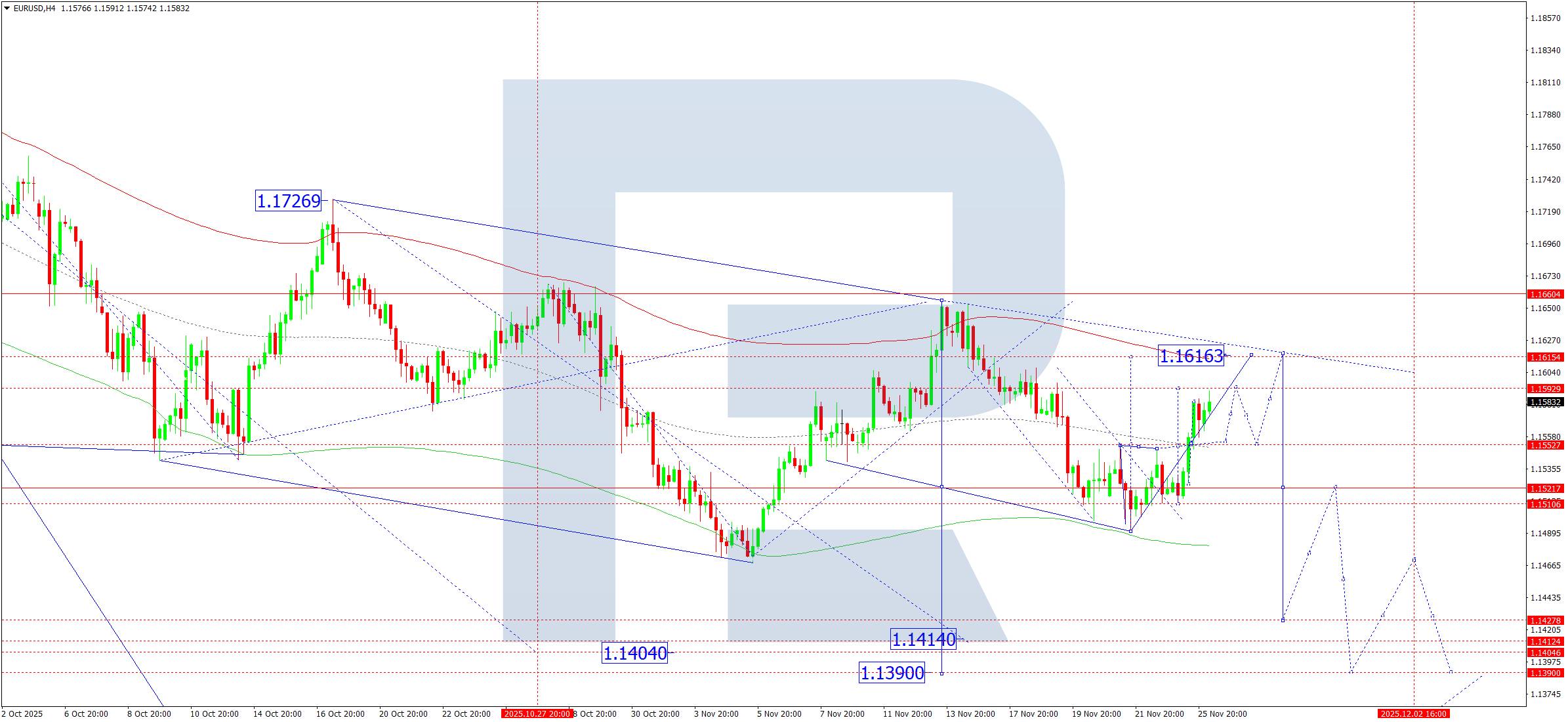
On the H4 chart of EURUSD, the market found support at 1.1515 and formed an upward wave towards 1.1553. A compact consolidation range has formed around this level and, after breaking upwards, the market continues to build the third wave in the correction, with the target at 1.1593. On 26 November 2025, after the price reaches this target, the market may form a downward leg towards 1.1553 (testing from above). Afterwards, the next corrective wave towards 1.1616 becomes possible, marking the final corrective move. Once the correction ends, the downtrend will resume, with the next downside target at 1.1430 at a minimum.
The Elliott wave structure and the downward wave matrix with a pivot point at 1.1660 confirm this scenario and remain the key elements of the EURUSD wave structure. At the moment, the market forms an upward wave towards the upper boundary of the Price Envelope at 1.1616. Today's relevant scenario includes the end of this corrective wave and the start of a decline towards its central line at 1.1553 at a minimum. A continuation towards its lower boundary at 1.1430 remains possible.
Technical indicators for today's EURUSD forecast suggest the correction may end at 1.1616.

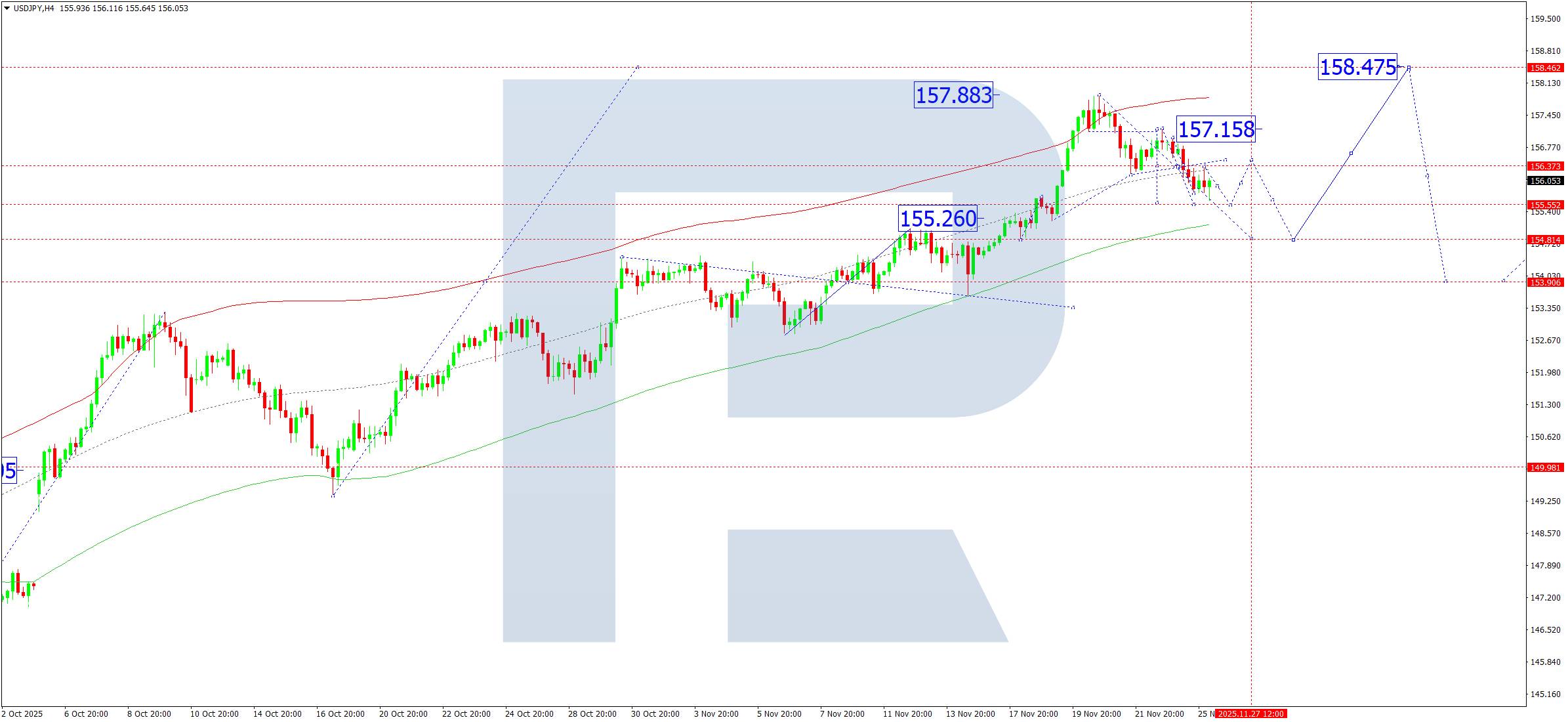
On the H4 chart of USDJPY, the market broke below 156.36 and continues to develop a correction towards 155.55. On 26 November 2025, after reaching this target, the market may begin a rise towards 156.36 (testing from below). Afterwards, another downward wave towards 154.82 becomes possible. This movement will complete the correction. Once the correction ends, a new upward wave towards 158.47 at a minimum will become relevant.
The Elliott wave structure and the upward wave matrix with a pivot point at 153.90 confirm this scenario and act as the key framework in this wave structure. At the moment, the market forms a corrective wave towards the lower boundary of the Price Envelope at 154.82. Afterwards, a rise towards its central line at 156.36 remains possible.
Technical indicators for today's USDJPY forecast suggest a correction towards 154.82.

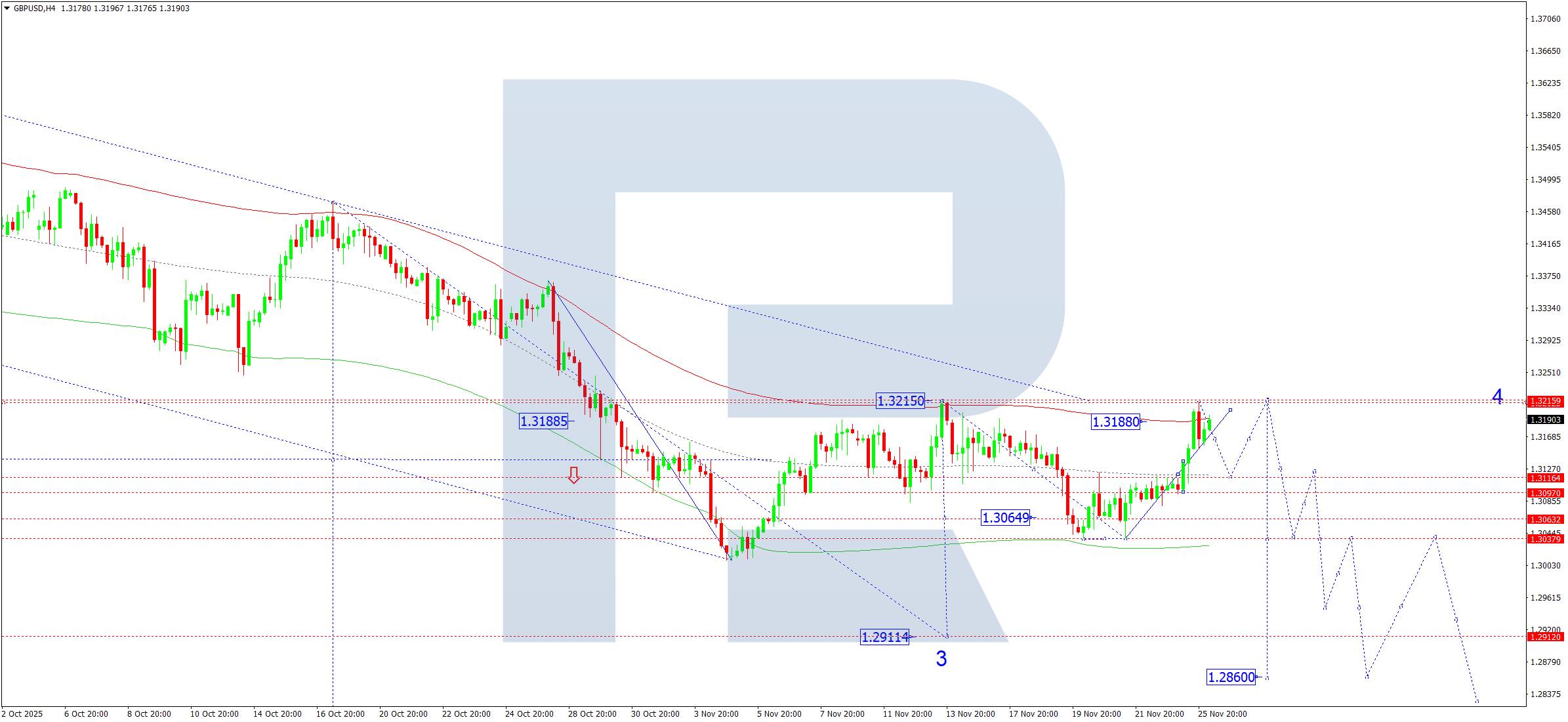
On the H4 chart of GBPUSD, the market formed a consolidation range around 1.3116 and, after breaking upwards, reached the local correction target at 1.3213. On 26 November 2025, the pair is expected to decline to 1.3116 before rising to 1.3215. This movement will complete the correction. After the correction ends, the downtrend will continue, with the next target at 1.3030 and the potential to extend the wave towards 1.2911 at a minimum.
The Elliott wave structure and the downward wave matrix with a pivot point at 1.3188 confirm this scenario and remain the key elements in this wave structure. Today, the corrective wave could continue towards the upper boundary of the Price Envelope at 1.3215. After this wave completes, a decline towards its lower boundary at 1.3030 may begin.
Technical indicators for today's GBPUSD forecast suggest a continued rise towards 1.3215 and the start of a downward wave towards 1.3030.

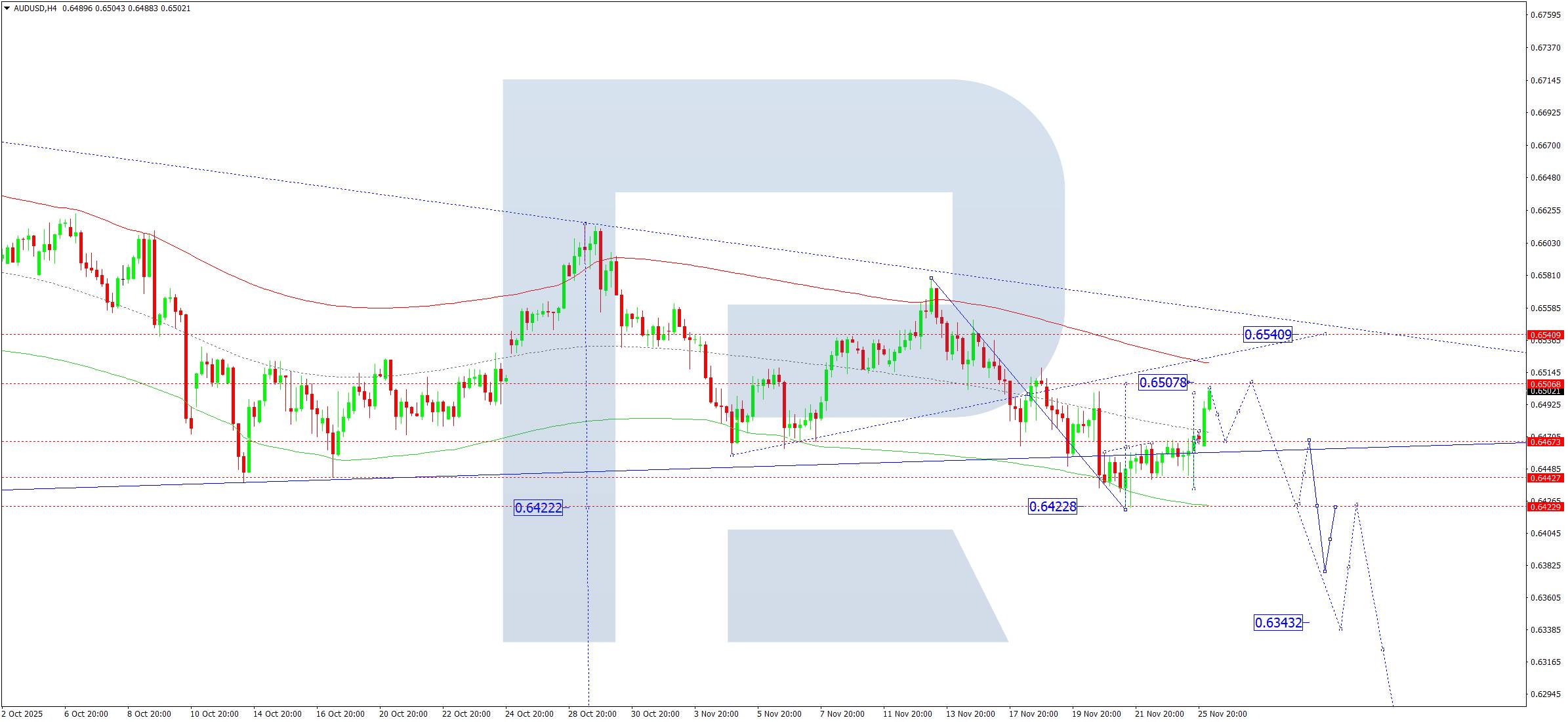
On the H4 chart of AUDUSD, the market formed an upward wave towards 0.6500. On 26 November 2025, a downward move towards 0.6464 (testing from above) is expected. Afterwards, the market may continue the correction towards 0.6515. Once the correction completes, a new downward wave towards 0.6420 may follow, with the downtrend possibly extending towards 0.6343.
The Elliott wave structure and the downward wave matrix in AUDUSD with a pivot point at 0.6505 confirm this scenario and form the key elements of this wave structure. At the moment, the market is undergoing a correction towards the upper boundary of the Price Envelope at 0.6515. Today's expectation includes the completion of this correction and the start of a downward wave towards its lower boundary at 0.6420.
Technical indicators for today's AUDUSD forecast suggest a correction towards 0.6515, followed by a decline towards 0.6420.

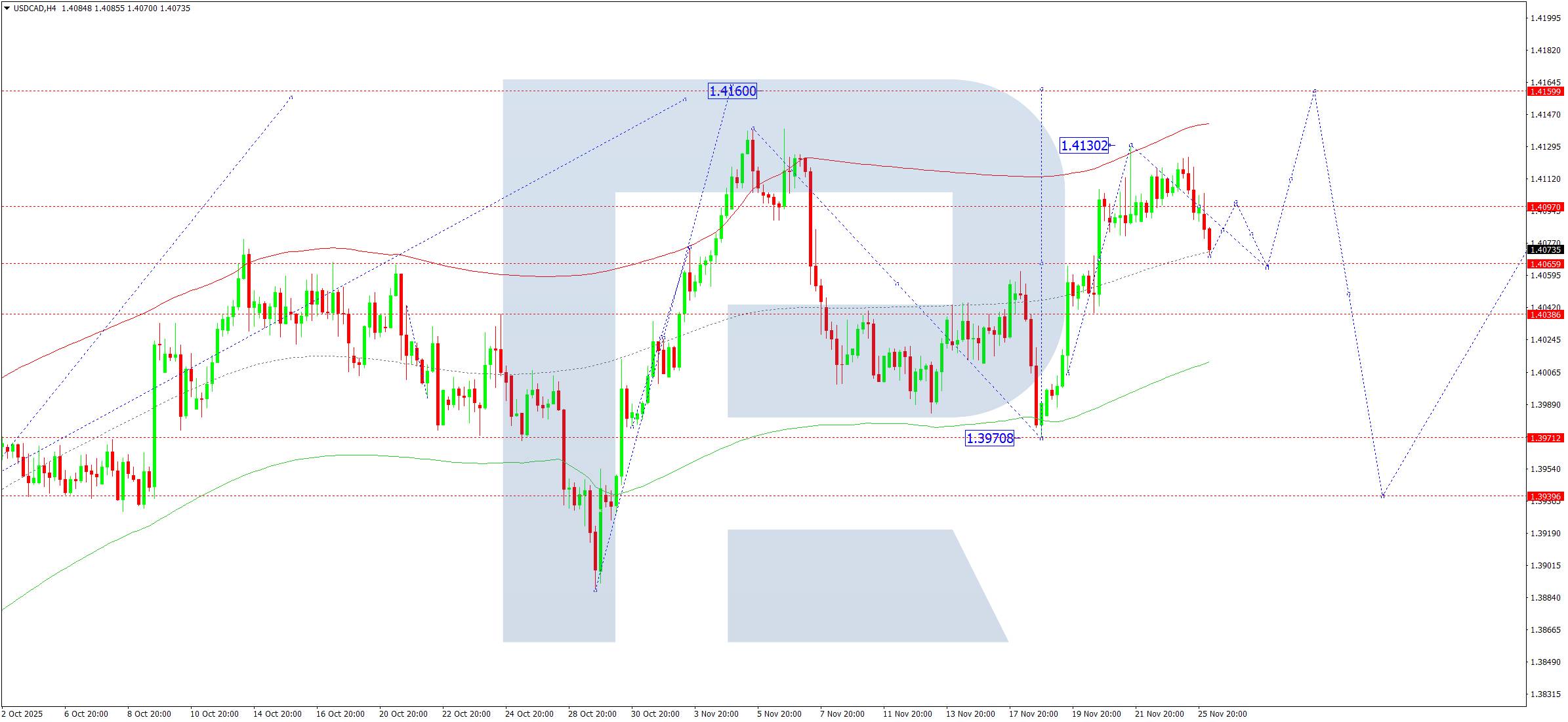
On the H4 chart of USDCAD, the market continues a correction towards 1.4066. On 26 November 2025, after this correction completes, the market may start a new upward wave towards 1.4160 as a local target.
The Elliott wave structure and the upward wave matrix with a pivot point at 1.3939 confirm this scenario and remain the key elements for USDCAD in this wave structure. At the moment, the market is undergoing a correction towards the central line of the Price Envelope at 1.4066. After the correction completes, a new upward wave towards its upper boundary at 1.4160 becomes possible.
Technical indicators for today's USDCAD forecast suggest a correction towards 1.4066, followed by continued upward movement towards 1.4160.

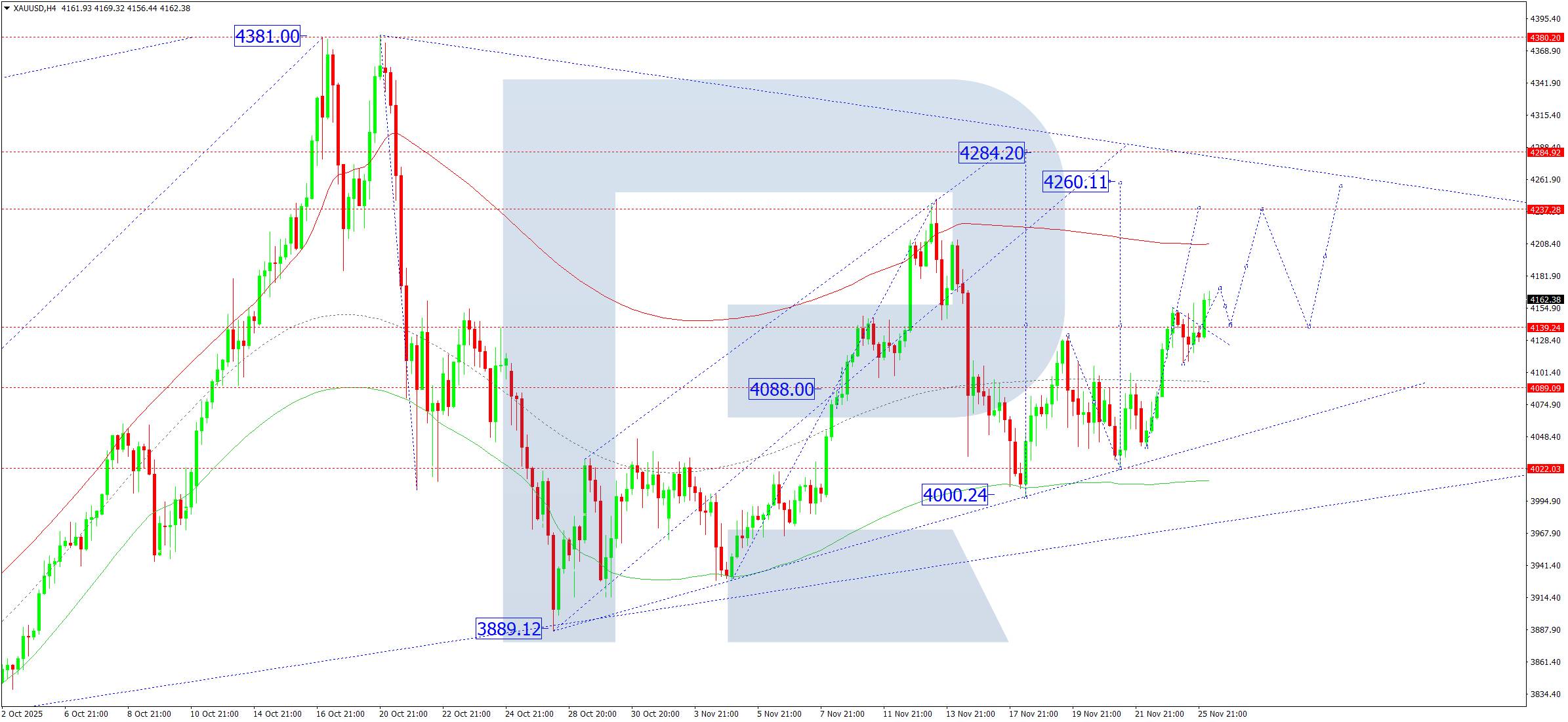
On the H4 chart of XAUUSD, the market is forming a consolidation range around 4,141. On 26 November 2025, an upward breakout from this range becomes possible with a target at 4,260. Afterwards, a correction towards 4,141 (testing from above) may form, followed by a rise towards 4,285.
The Elliott wave structure and the upward wave matrix with a pivot point at 4,088 confirm this scenario and remain the key elements in this wave structure. At the moment, the market continues to develop the fifth upward wave towards the upper boundary of the Price Envelope at 4,260. Once this level is reached, the market may begin a correction towards its central line at 4,141.
Technical indicators for today's XAUUSD forecast suggest a possible rise towards 4,260.

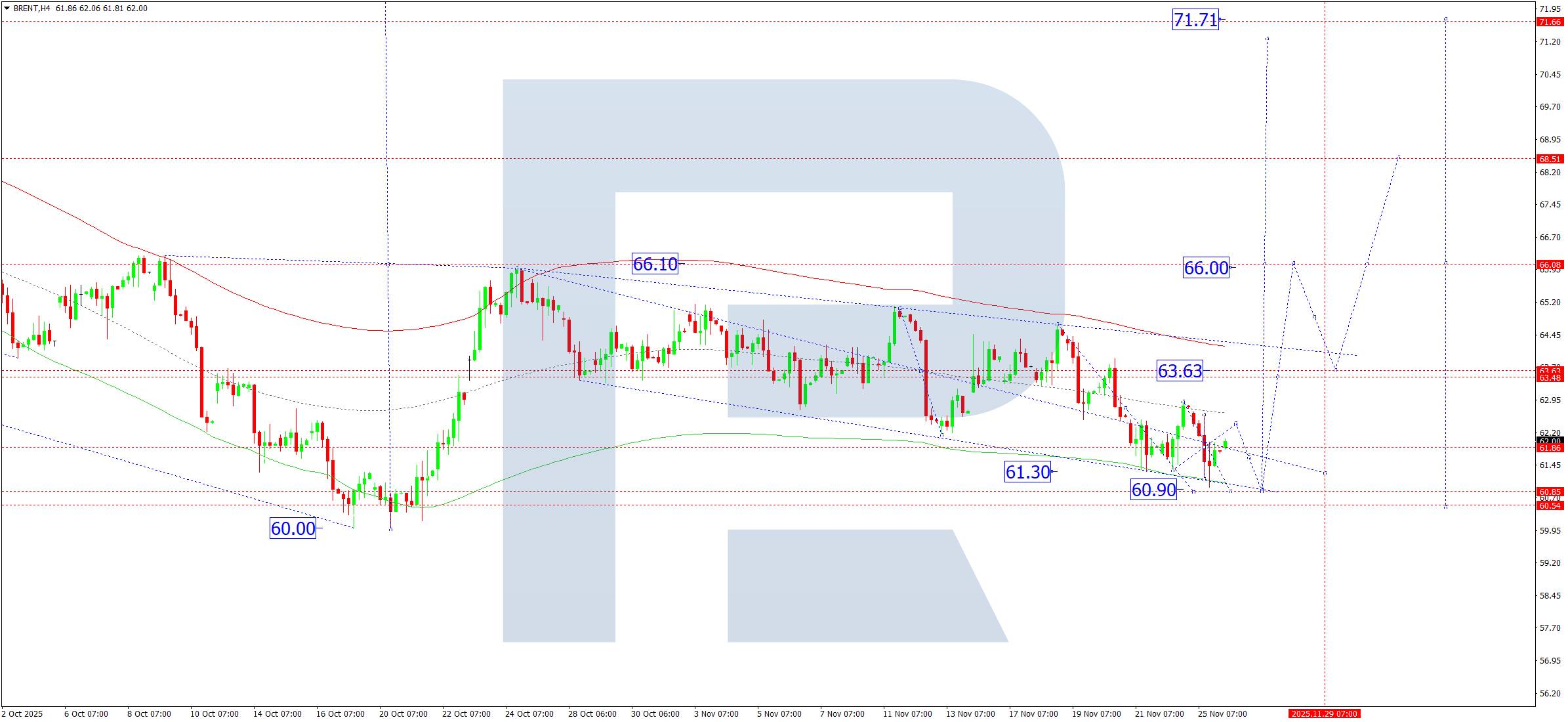
On the H4 chart of Brent crude, the market is forming a consolidation range around 61.86. On 26 November 2025, if prices break upwards from this range, the market may continue the upward wave towards 66.00, with the potential to extend the move towards 71.71. Conversely, a downward breakout could trigger another corrective wave towards 60.90. After this correction completes, a rise towards 65.00 may follow.
The Elliott wave structure and the upward wave matrix with a pivot point at 64.00 confirm this scenario and act as the key elements in this wave structure. At the moment, the market is consolidating within a range above the lower boundary of the Price Envelope around 61.86. If prices break downwards, the wave may stretch towards its lower boundary at 60.90. An upward breakout would open the door to an upward wave towards its upper boundary at 65.00.
Technical indicators for today's Brent forecast suggest a rise towards 63.00 and 65.00.

White Label
Data API
Web Plug-ins
Poster Maker
Affiliate Program
The risk of loss in trading financial instruments such as stocks, FX, commodities, futures, bonds, ETFs and crypto can be substantial. You may sustain a total loss of the funds that you deposit with your broker. Therefore, you should carefully consider whether such trading is suitable for you in light of your circumstances and financial resources.
No decision to invest should be made without thoroughly conducting due diligence by yourself or consulting with your financial advisors. Our web content might not suit you since we don't know your financial conditions and investment needs. Our financial information might have latency or contain inaccuracy, so you should be fully responsible for any of your trading and investment decisions. The company will not be responsible for your capital loss.
Without getting permission from the website, you are not allowed to copy the website's graphics, texts, or trademarks. Intellectual property rights in the content or data incorporated into this website belong to its providers and exchange merchants.
Not Logged In
Log in to access more features

FastBull Membership
Not yet
Purchase
Log In
Sign Up