• Trade
  • Markets
  • Copy
  • Contests
  • News
  • 24/7
  • Calendar
  • Q&A
  • Chats
Trending
Screeners
SYMBOL
LAST
BID
ASK
HIGH
LOW
NET CHG.
%CHG.
SPREAD
SPX
S&P 500 Index
6827.42
6827.42
6827.42
6899.86
6801.80
-73.58
-1.07%
--
DJI
Dow Jones Industrial Average
48458.04
48458.04
48458.04
48886.86
48334.10
-245.98
-0.51%
--
IXIC
NASDAQ Composite Index
23195.16
23195.16
23195.16
23554.89
23094.51
-398.69
-1.69%
--
USDX
US Dollar Index
97.950
98.030
97.950
98.500
97.950
-0.370
-0.38%
--
EURUSD
Euro / US Dollar
1.17394
1.17409
1.17394
1.17496
1.17192
+0.00011
+ 0.01%
--
GBPUSD
Pound Sterling / US Dollar
1.33707
1.33732
1.33707
1.33997
1.33419
-0.00148
-0.11%
--
XAUUSD
Gold / US Dollar
4299.39
4299.39
4299.39
4353.41
4257.10
+20.10
+ 0.47%
--
WTI
Light Sweet Crude Oil
57.233
57.485
57.233
58.011
56.969
-0.408
-0.71%
--

Community Accounts

Signal Accounts
--
Profit Accounts
--
Loss Accounts
--
View More

Become a signal provider

Sell trading signals to earn additional income

View More

Guide to Copy Trading

Get started with ease and confidence

View More

Signal Accounts for Members

All Signal Accounts

Best Return
  • Best Return
  • Best P/L
  • Best MDD
Past 1W
  • Past 1W
  • Past 1M
  • Past 1Y

All Contests

  • All
  • Trump Updates
  • Recommend
  • Stocks
  • Cryptocurrencies
  • Central Banks
  • Featured News
Top News Only
Share

Ukraine Says It Received 114 Prisoners From Belarus

Share

USA Embassy In Lithuania: Maria Kalesnikava Is Not Going To Vilnius

Share

USA Embassy In Lithuania: Other Prisoners Are Being Sent From Belarus To Ukraine

Share

Ukraine President Zelenskiy: Five Ukrainians Released By Belarus In US-Brokered Deal

Share

USA Vilnius Embassy: USA Stands Ready For "Additional Engagement With Belarus That Advances USA Interests"

Share

USA Vilnius Embassy: Belarus, USA, Other Citizens Among The Prisoners Released Into Lithuania

Share

USA Vilnius Embassy: USA Will Continue Diplomatic Efforts To Free The Remaining Political Prisoners In Belarus

Share

USA Vilnius Embassy: Belarus Releases 123 Prisoners Following Meeting Of President Trump's Envoy Coale And Belarus President Lukashenko

Share

USA Vilnius Embassy: Masatoshi Nakanishi, Aliaksandr Syrytsa Are Among The Prisoners Released By Belarus

Share

USA Vilnius Embassy: Maria Kalesnikava And Viktor Babaryka Are Among The Prisoners Released By Belarus

Share

USA Vilnius Embassy: Nobel Peace Prize Laureate Ales Bialiatski Is Among The Prisoners Released By Belarus

Share

Belarusian Presidential Administration Telegram Channel: Lukashenko Has Pardoned 123 Prisoners As Part Of Deal With US

Share

Two Local Syrian Officials: Joint US-Syrian Military Patrol In Central Syria Came Under Fire From Unknown Assailants

Share

Israeli Military Says It Targeted 'Key Hamas Terrorist' In Gaza City

Share

Rwanda's Actions In Eastern Drc Are A Clear Violation Of Washington Accords Signed By President Trump - Secretary Of State Rubio

Share

Israeli Military Issues Evacuation Warning In Southern Lebanon Village Ahead Of Strike - Spokesperson On X

Share

Belarusian State Media Cites US Envoy Coale As Saying He Discussed Ukraine And Venezuela With Lukashenko

Share

Belarusian State Media Cites US Envoy Coale As Saying That US Removes Sanctions On Belarusian Potassium

Share

Thai Prime Minister: No Ceasefire Agreement With Cambodia

Share

US, Ukraine To Discuss Ceasefire In Berlin Ahead Of European Summit

TIME
ACT
FCST
PREV
U.K. Trade Balance Non-EU (SA) (Oct)

A:--

F: --

P: --

U.K. Trade Balance (Oct)

A:--

F: --

P: --

U.K. Services Index MoM

A:--

F: --

P: --

U.K. Construction Output MoM (SA) (Oct)

A:--

F: --

P: --

U.K. Industrial Output YoY (Oct)

A:--

F: --

P: --

U.K. Trade Balance (SA) (Oct)

A:--

F: --

P: --

U.K. Trade Balance EU (SA) (Oct)

A:--

F: --

P: --

U.K. Manufacturing Output YoY (Oct)

A:--

F: --

P: --

U.K. GDP MoM (Oct)

A:--

F: --

P: --

U.K. GDP YoY (SA) (Oct)

A:--

F: --

P: --

U.K. Industrial Output MoM (Oct)

A:--

F: --

P: --

U.K. Construction Output YoY (Oct)

A:--

F: --

P: --

France HICP Final MoM (Nov)

A:--

F: --

P: --

China, Mainland Outstanding Loans Growth YoY (Nov)

A:--

F: --

P: --

China, Mainland M2 Money Supply YoY (Nov)

A:--

F: --

P: --

China, Mainland M0 Money Supply YoY (Nov)

A:--

F: --

P: --

China, Mainland M1 Money Supply YoY (Nov)

A:--

F: --

P: --

India CPI YoY (Nov)

A:--

F: --

P: --

India Deposit Gowth YoY

A:--

F: --

P: --

Brazil Services Growth YoY (Oct)

A:--

F: --

P: --

Mexico Industrial Output YoY (Oct)

A:--

F: --

P: --

Russia Trade Balance (Oct)

A:--

F: --

P: --

Philadelphia Fed President Henry Paulson delivers a speech
Canada Building Permits MoM (SA) (Oct)

A:--

F: --

P: --

Canada Wholesale Sales YoY (Oct)

A:--

F: --

P: --

Canada Wholesale Inventory MoM (Oct)

A:--

F: --

P: --

Canada Wholesale Inventory YoY (Oct)

A:--

F: --

P: --

Canada Wholesale Sales MoM (SA) (Oct)

A:--

F: --

P: --

Germany Current Account (Not SA) (Oct)

A:--

F: --

P: --

U.S. Weekly Total Rig Count

A:--

F: --

P: --

U.S. Weekly Total Oil Rig Count

A:--

F: --

P: --

Japan Tankan Large Non-Manufacturing Diffusion Index (Q4)

--

F: --

P: --

Japan Tankan Small Manufacturing Outlook Index (Q4)

--

F: --

P: --

Japan Tankan Large Non-Manufacturing Outlook Index (Q4)

--

F: --

P: --

Japan Tankan Large Manufacturing Outlook Index (Q4)

--

F: --

P: --

Japan Tankan Small Manufacturing Diffusion Index (Q4)

--

F: --

P: --

Japan Tankan Large Manufacturing Diffusion Index (Q4)

--

F: --

P: --

Japan Tankan Large-Enterprise Capital Expenditure YoY (Q4)

--

F: --

P: --

U.K. Rightmove House Price Index YoY (Dec)

--

F: --

P: --

China, Mainland Industrial Output YoY (YTD) (Nov)

--

F: --

P: --

China, Mainland Urban Area Unemployment Rate (Nov)

--

F: --

P: --

Saudi Arabia CPI YoY (Nov)

--

F: --

P: --

Euro Zone Industrial Output YoY (Oct)

--

F: --

P: --

Euro Zone Industrial Output MoM (Oct)

--

F: --

P: --

Canada Existing Home Sales MoM (Nov)

--

F: --

P: --

Euro Zone Total Reserve Assets (Nov)

--

F: --

P: --

U.K. Inflation Rate Expectations

--

F: --

P: --

Canada National Economic Confidence Index

--

F: --

P: --

Canada New Housing Starts (Nov)

--

F: --

P: --

U.S. NY Fed Manufacturing Employment Index (Dec)

--

F: --

P: --

U.S. NY Fed Manufacturing Index (Dec)

--

F: --

P: --

Canada Core CPI YoY (Nov)

--

F: --

P: --

Canada Manufacturing Unfilled Orders MoM (Oct)

--

F: --

P: --

Canada Manufacturing New Orders MoM (Oct)

--

F: --

P: --

Canada Core CPI MoM (Nov)

--

F: --

P: --

Canada Manufacturing Inventory MoM (Oct)

--

F: --

P: --

Canada CPI YoY (Nov)

--

F: --

P: --

Canada CPI MoM (Nov)

--

F: --

P: --

Canada CPI YoY (SA) (Nov)

--

F: --

P: --

Canada Core CPI MoM (SA) (Nov)

--

F: --

P: --

Q&A with Experts
    • All
    • Chatrooms
    • Groups
    • Friends
    Connecting
    .
    .
    .
    Type here...
    Add Symbol or Code

      No matching data

      All
      Trump Updates
      Recommend
      Stocks
      Cryptocurrencies
      Central Banks
      Featured News
      • All
      • Russia-Ukraine Conflict
      • Middle East Flashpoint
      • All
      • Russia-Ukraine Conflict
      • Middle East Flashpoint
      Search
      Products

      Charts Free Forever

      Chats Q&A with Experts
      Screeners Economic Calendar Data Tools
      Membership Features
      Data Warehouse Market Trends Institutional Data Policy Rates Macro

      Market Trends

      Market Sentiment Order Book Forex Correlations

      Top Indicators

      Charts Free Forever
      Markets

      News

      News Analysis 24/7 Columns Education
      From Institutions From Analysts
      Topics Columnists

      Latest Views

      Latest Views

      Trending Topics

      Top Columnists

      Latest Update

      Signals

      Copy Rankings Latest Signals Become a signal provider AI Rating
      Contests
      Brokers

      Overview Brokers Assessment Rankings Regulators News Claims
      Broker listing Forex Brokers Comparison Tool Live Spread Comparison Scam
      Q&A Complaint Scam Alert Videos Tips to Detect Scam
      More

      Business
      Events
      Careers About Us Advertising Help Center

      White Label

      Data API

      Web Plug-ins

      Affiliate Program

      Awards Institution Evaluation IB Seminar Salon Event Exhibition
      Vietnam Thailand Singapore Dubai
      Fans Party Investment Sharing Session
      FastBull Summit BrokersView Expo
      Recent Searches
        Top Searches
          Markets
          News
          Analysis
          User
          24/7
          Economic Calendar
          Education
          Data
          • Names
          • Latest
          • Prev

          View All

          No data

          Scan to Download

          Faster Charts, Chat Faster!

          Download App
          English
          • English
          • Español
          • العربية
          • Bahasa Indonesia
          • Bahasa Melayu
          • Tiếng Việt
          • ภาษาไทย
          • Français
          • Italiano
          • Türkçe
          • Русский язык
          • 简中
          • 繁中
          Open Account
          Search
          Products
          Charts Free Forever
          Markets
          News
          Signals

          Copy Rankings Latest Signals Become a signal provider AI Rating
          Contests
          Brokers

          Overview Brokers Assessment Rankings Regulators News Claims
          Broker listing Forex Brokers Comparison Tool Live Spread Comparison Scam
          Q&A Complaint Scam Alert Videos Tips to Detect Scam
          More

          Business
          Events
          Careers About Us Advertising Help Center

          White Label

          Data API

          Web Plug-ins

          Affiliate Program

          Awards Institution Evaluation IB Seminar Salon Event Exhibition
          Vietnam Thailand Singapore Dubai
          Fans Party Investment Sharing Session
          FastBull Summit BrokersView Expo

          September 22th Financial News

          FastBull Featured

          Daily News

          Summary:

          Swiss National Bank and Bank of England unexpectedly pause rate hikes; Russia banned gasoline and diesel exports to most countries from Sept. 21; U.S. initial jobless claims hit a nearly 8-month low last week but could rebound in coming weeks...

          [Quick Facts]

          1. Swiss National Bank and Bank of England unexpectedly pause rate hikes.
          2. Russia banned gasoline and diesel exports to most countries from Sept. 21.
          3. "Bond King" Gross warns U.S. bond investors that pain isn't over yet.
          4. Japan's core CPI has been above the BOJ target for the 17th consecutive month.
          5. U.S. initial jobless claims hit a new low in nearly 8 months last week.

          [News Details]

          Swiss National Bank and Bank of England unexpectedly pause rate hikes
          The Bank of England (BOE) kept interest rates unchanged on Thursday local time, which was the first time in nearly two years that it had chosen not to raise interest rates in fight against the stubbornly high inflation. In a statement, BOE Governor Andrew Bailey said inflation had fallen sharply in recent months and that would continue. "But there's no room for complacency," he said. According to the minutes of the policy meeting, interest rates would need to remain "sufficiently restrictive for a sufficiently long period" to bring inflation back to the central bank's 2% target, while it also downgraded the economic outlook. Prior to that, the Swiss National Bank (SNB) also unexpectedly announced a pause in interest rate hikes and would expand liquidity supply to banks, but SNB governor Thomas Jordan said if the inflation outlook worsens, interest rates will be raised again.
          Russia banned gasoline and diesel exports to most countries from Sept. 21
          The Russian government said it would impose a ban on gasoline and diesel exports from Sept. 21 for an unknown length of time, with the scale of exports of the two types of energy at about 1 million barrels per day (bpd). According to people familiar with the matter, Russia exported an average of about 63,000 tons of diesel and 8,000 tons of gasoline per day in the first 13 days of September, 31% lower than the average daily diesel exports compared with the first 30 days of August, as refineries were undergoing seasonal maintenance. Moreover, Russian government's efforts to curb rising domestic fuel prices has prompted producers to divert more fuel to the domestic market. Russia's temporary export ban on the fuel could exacerbate the current shortages in the global oil market as the two OPEC+ leaders, Saudi Arabia and Russia, are restricting crude supplies.
          "Bond King" Gross warns U.S. bond investors that pain isn't over yet
          Bond investors' pain isn't over yet, even though the Federal Reserve is done raising interest rates, said Bill Gross, former Pacific Investment Management Company (PIMCO) CEO. Gross wrote in his latest investment outlook that the bond market will suffer record losses for a third year due to sticky inflation and widening deficits. He likened the government's fiscal stimulus to "throwing money out of a helicopter." Gross urged investors to reduce holdings of U.S. Treasuries and corporate bonds as 10-year U.S. Treasury bonds are overvalued.
          Japan's core CPI has been above the BOJ target for the 17th consecutive month
          Japan's core inflation held steady at 3.1% in August and was above the central bank's 2% target for the 17th month in a row, data released on Friday showed. This is a sign of widening price pressures that could strengthen the case for an exit from its ultra-loose monetary policy. While the Bank of Japan (BOJ) is widely expected to leave its ultra-loose monetary policy unchanged, market attention is centered on any hints from BOJ governor Kazuo Ueda on how quickly the central bank may phase out stimulus. There is speculation that the BOJ will soon end negative interest rates as well as its target of keeping the 10-year JGB yield at around 0% in response to widening inflationary pressures.
          U.S. initial jobless claims hit a new low in nearly 8 months last week
          U.S. initial jobless claims fell unexpectedly last week. The U.S. Department of Labor data show that initial jobless claims for the week ended Sept. 16 recorded 201,000, a new low since the week ended January 28, indicating that the job market is still tight. The weekly initial jobless claims this year ranged between 194,000 and 265,000. But it could rebound in the coming weeks as the United Auto Workers' (UAW) partial strike will lead to a shortage of some production materials, forcing automakers to temporarily lay off workers. Ford last Friday furloughed 600 workers who were not on strike, while GM said it expected to halt operations at its Kansas car plant, affecting 2,000 workers. Chrysler-parent Stellantis said it would temporarily lay off 68 employees in Ohio and expected to furlough another 300 workers in Indiana. The strike is unlikely to have an impact on nonfarm payrolls, though, as it began near the end of the nonfarm payroll survey week.

          [Focus of the Day]

          UTC+8 07:30 Japan Core CPI YoY (Aug)
          UTC+8 11:00 The Bank of Japan announces its interest rate decision
          UTC+8 14:00 U.K. Retail Sales MoM (Aug)
          UTC+8 14:30 Bank of Japan Governor Kazuo Ueda holds a monetary policy press conference
          UTC+8 15:15 France Manufacturing PMI Prelim (Sept)
          UTC+8 15:30 Germany Manufacturing PMI Prelim (SA) (Sept)
          UTC+8 16:00 Eurozone Manufacturing PMI Prelim (SA) (Sept)
          UTC+8 16:30 U.K. Manufacturing & Services PMI Prelim (Sept)
          UTC+8 20:30 Canada Retail Sales MoM (SA) (Jul)
          UTC+8 20:50 Federal Reserve Governor Lisa Cook speaks
          UTC+8 21:45 U.S. IHS Markit Manufacturing & Services PMI Prelim (SA) (Sept)
          UTC+8 01:00 Next Day: San Francisco Fed President Mary Daly speaks
          UTC+8 01:00 Next Day: Minneapolis Fed President Kashkari delivers a speech
          Risk Warnings and Disclaimers
          You understand and acknowledge that there is a high degree of risk involved in trading. Following any strategies or investment methods may lead to potential losses. The content on the site is provided by our contributors and analysts for information purposes only. You are solely responsible for determining whether any trading assets, securities, strategy, or any other product is suitable for investing based on your own investment objectives and financial situation.
          Comments
          Add to Favorites
          Share

          U.S. Housing Feels the Squeeze from High Mortgage Rates

          Damon

          Economic

          Market acknowledges the risk of a final hike, but it will depend on the data
          The Fed's messaging of higher for longer interest rates has been taken on board by financial markets, with the dollar strengthening and the yield curve shifting higher in the wake of yesterday's decision. Nonetheless, the market remains somewhat sceptical on the prospect of the final 25bp interest rate rise that the Fed's forecasts signalled for this year, with the pricing for November's FOMC meeting only being 8bp with 13bp priced by the time of the December meeting.
          The jobs market remains tight, as highlighted by low jobless claims numbers today, but we continue to believe that core inflation pressures will slow meaningfully, the economic outlook will soften, and the Fed won't end up carrying through. The jobs market is always the last thing to turn lower in a downturn and there are areas of more obvious weakness.
          For example, U.S. existing home sales fell 0.7% MoM in August to a level of 4.04mn rather than rising the 0.7% MoM as the market expected. This is due not only to weakness in demand but also a complete collapse in properties available for purchase. The affordability issue is front and centre here, with prices having risen nearly 50% nationally during the pandemic, but demand has obviously been crushed by the fact that mortgage rates have tripled since the Federal Reserve started hiking interest rates. But this surge in borrowing costs is constraining the supply of homes for sale as well - people who are locked in at 2.5-3.5% mortgage rates cannot afford to give them up. They can't take the mortgage with them when they move home, so even if you downsize to a smaller, cheaper property, you are, in all likelihood, going to end up paying a higher monthly dollar mortgage payment.
          Consequently, we are in a crazy-sounding position whereby the number of housing transactions is on a par with the lows seen during the global financial crisis, yet home prices are rising. This should be a boon for home builders, but note the big drop in sentiment and housing starts seen earlier in the week. The drop-off in prospective buyer traffic is making builders cautious. Mortgage rates at 7%+ will obviously do that over time, but it may be another sign of the household sector starting to pull back at the margin now that the Fed believes pandemic-era savings are close to being exhausted.U.S. Housing Feels the Squeeze from High Mortgage Rates_1
          Leading index still indicates recession can't be ruled out
          Meanwhile, the U.S. leading economic indicator, which combines a range of other numbers, including jobless claims, orders, average work week, the yield curve and credit conditions, posted its 17th straight monthly decline. As the chart below shows, the index at these sorts of levels has been a clear recession indicator in the past, but for now, GDP growth is strong.U.S. Housing Feels the Squeeze from High Mortgage Rates_2
          Our view remains that this strength in activity has been caused primarily by households running down pandemic-era accrued savings aggressively and borrowing more on credit cards. But with savings obviously being finite - note the Fed's Beige Book citing evidence of the "exhaustion" of these savings - and consumer credit harder to come by and certainly less affordable than it was, the cashflow required to finance ongoing increases in spending will have to increasingly come from rising real income growth. Rising gasoline prices will erode spending power while student loan repayments, strikes and the prospect of a government shutdown will add to the financial stresses on millions of households, so we will need to see substantial wage increases for everyone - not just auto workers - to keep this growth engine firing.
          Given this situation, we not only think the Fed will leave rates at their current levels, we also see the potential for more rate cuts next year than the 50bp currently being signalled by the Federal Reserve.

          Source: ING

          To stay updated on all economic events of today, please check out our Economic calendar
          Risk Warnings and Disclaimers
          You understand and acknowledge that there is a high degree of risk involved in trading. Following any strategies or investment methods may lead to potential losses. The content on the site is provided by our contributors and analysts for information purposes only. You are solely responsible for determining whether any trading assets, securities, strategy, or any other product is suitable for investing based on your own investment objectives and financial situation.
          Comments
          Add to Favorites
          Share

          Risk-Off Sentiments in Place, BoJ Meeting on the Radar Ahead

          IG

          Economic

          Central Bank

          Stocks

          Forex

          Market Recap
          Market sentiments continue to reel in from the post-Federal Reserve (Fed) meeting jitters (DJIA -1.08%; S&P 500 -1.64%; Nasdaq -1.82%), as the US 10-year Treasury yields rose to another fresh 17-year high near the 4.50% handle amid a high-for-longer rate outlook. Some resilience in the US labour market, reflected from lower-than-expected read out of US jobless claims overnight, just provided more room for the Fed to retain its hawkish stance further.
          For now, while Fed funds rate futures continue to reflect some doubts that the Fed may not follow through with its final rate hike this year, the timeline for rate cuts are now pushed back to a later timeline of 2H 2024. The US dollar saw some slight profit-taking (-0.1%) overnight, while gold prices remain weighed (-1.3%). On the other hand, crude oil prices have managed to eke out slight gains after a short blip from oversold technical conditions.
          Major US indices are finding themselves at a critical juncture, with the S&P 500 back to retest a key support at the 4,330 level. Similarly, the Nasdaq 100 faces a key test for dip-buyers at the 14,680 level. Rate-sensitive growth sectors have been bearing a greater brunt of the sell-off lately, with the SPDR S&P Semiconductor ETF seemingly breaking below its neckline of a head-and-shoulder formation on the daily chart. There is still the potential for a bullish divergence to be formed on the daily relative strength index (RSI), provided that the index turned higher over coming days, but the neckline resistance will have to be reclaimed. Failure to do so may leave the May 2023 low on watch for a retest at the 174.00 level.Risk-Off Sentiments in Place, BoJ Meeting on the Radar Ahead_1

          Asia Open

          Asian stocks look set for a downbeat open, with Nikkei -1.16%, ASX -1.13% and KOSPI -0.90% at the time of writing, largely following through with the negative handover from Wall Street. The key focus today will be on the Bank of Japan (BoJ) meeting. With the BoJ Governor Kazuo Ueda floating the idea that the central bank could have enough data by year-end to determine whether to end negative rates, markets seem to perceive it as an imminent rate hike into early-2024. Therefore, all eyes will be on the Governor's communications at the press conference for any slightest signs of hawkishness to validate such timeline.
          The USD/JPY has touched a new year-to-date high this week, with the pair still trading above the 145.00-145.80 range, where the BoJ had intervened with US$19.7 billion of yen-buying back in September 2022. With that, focus at the upcoming BoJ meeting will also be on how policymakers may address the weak yen and their willingness to tolerate a pull-ahead in the Japanese 10-year bond yields to levels last seen in 2013.
          A bearish divergence on the daily RSI points to some near-term exhaustion for now, but staying above its Ichimoku cloud pattern and various moving averages (MA) on the daily chart still leaves an upward trend intact for the pair. Rising yield differentials between the US and Japan government bond yields have touched a new 10-month high, which may still provide some upward bias for the pair.Risk-Off Sentiments in Place, BoJ Meeting on the Radar Ahead_2

          On the watchlist: Silver prices attempt to stay supported with some dip-buying

          Silver prices have been resilient lately, with a post-Fed sell-off on Thursday met with some dip-buying overnight, as seen by the formation of a bullish pin bar on the daily chart. Thus far, prices have been edging higher upon a retest of an upward trendline support in place since August 2022, with higher lows on Moving Average Convergence/Divergence (MACD) pointing to some upward momentum.
          Further upside may leave the US$24.50 level on watch for a retest, where the upper edge of its months-long consolidation pattern resides. Whereas on the downside, the upward trendline support will be an immediate support to defend by the bulls.Risk-Off Sentiments in Place, BoJ Meeting on the Radar Ahead_3
          Thursday: DJIA -1.08%; S&P 500 -1.64%; Nasdaq -1.82%, DAX -1.33%, FTSE -0.69%
          To stay updated on all economic events of today, please check out our Economic calendar
          Risk Warnings and Disclaimers
          You understand and acknowledge that there is a high degree of risk involved in trading. Following any strategies or investment methods may lead to potential losses. The content on the site is provided by our contributors and analysts for information purposes only. You are solely responsible for determining whether any trading assets, securities, strategy, or any other product is suitable for investing based on your own investment objectives and financial situation.
          Comments
          Add to Favorites
          Share

          Fed Fallout; Growth Tech Stocks in Focus; Strikes Set to Continue; FedEx

          IG

          Economic

          Fed fallout and wilting growth stocks
          Hello, I'm Angeline Long, and welcome to Beat the Street, the show that gives you all the tradable news and data that you need to know ahead of the Wall Street open. Coming up, Federal Reserve fallout, growth stocks wilt as the Fed keeps the door open to yet another hype. Plus, going the distance, how far are strikers willing to go?
          US automakers face the threat of lengthy strikes. More details in a moment. And on the corporate front, FedEx in focus after its cost-cut payoff, and it gains on the pain of its rivals.
          Now, good afternoon and a very warm welcome to you on this new edition of Beat the Street. Not long now before Wall Street starts trading; let's have a look at how equity markets are looking on the IG platform.
          Decline evident on US Tech 100
          Let's start with the US Tech 100 first. As you can see here, this is a one-hour chart, and we are seeing somewhat of a decline indicator there. Let's have a look at Wall Street as well; similar picture there.
          However, it has to be said that many of the moves that we're seeing post-Fed are to do with rate-sensitive stocks, including Apple, Meta, Alphabet and NVIDIA. They all fell after the Fed kept the door open to one more hike potentially ahead, two-year and 10-year Treasury yields, meanwhile scaled multi-year highs.
          Just checking on some breaking news now as we speak, just getting them through. Initial jobless claims for the week ending 16 September 2023: we were expecting 225,000. We got 201,000 instead. That was a surprise on the downside, and perhaps this mirrors the continually robust picture being painted on the US economy.
          Labout market strong in the face of cost-of-living crisis
          Despite the cost-of-living crisis, despite the headwinds, the higher interest rates, its labour market continues to show signs of resilience.
          The US dollar, meanwhile, rose after Jerome Powell delivered a firm hawkish stance. Higher for longer was the message, and updated quarterly projections show that the central bank may still lift rates one more time this year to a peak of 5.5 to 5.75% range. Fed received half a percentage cut in 2024.
          As a view, Fed officials had expected to cut rates by a full percentage point next year. Meanwhile, policymakers now see the fight against inflation lasting into 2026 and believe they can succeed without damaging the US economy.
          Now, as we are on central bank watch, not too long ago, the Bank of England (BoE) kept rates on hold. The previous 14 times the bank made a decision prior to this, it opted to boost the rates starting at the end of 2021.
          Warren Venketas has been tracking the pound's reaction after today's results. Much mixed messaging from BoE officials. Looking at the voter split from the previous meeting, we saw seven members in favor of a rate hike versus two in favor of a pause, and I think that will obviously be more divided going into this particular rate announcement.
          I just wanted to touch on a bit of the pound price action. I do have the daily cable chart on screen. We can see the pound being sold off quite drastically, particularly after that Fed rate pause, which included a very hawkish message of higher for longer. I think we could see a bit of that in the BoE's messaging as well today…
          To stay updated on all economic events of today, please check out our Economic calendar
          Risk Warnings and Disclaimers
          You understand and acknowledge that there is a high degree of risk involved in trading. Following any strategies or investment methods may lead to potential losses. The content on the site is provided by our contributors and analysts for information purposes only. You are solely responsible for determining whether any trading assets, securities, strategy, or any other product is suitable for investing based on your own investment objectives and financial situation.
          Comments
          Add to Favorites
          Share

          One Year Later: How Proof of Stake Has Changed Ethereum

          SAXO

          Cryptocurrency

          On September 15, 2022, Ethereum successfully changed its consensus mechanism by its transition away from proof of work to proof of stake. This transition was known as the merge. The latter was a goodbye to miners in verifying transactions but a welcome to stakers. Ethereum has now been running on proof of stake for about a year, so in this piece, we look back at tangible factors brought forward by the merge rather than describing the transition in detail. If you are interested in learning more about the transition, you can find a more in-depth analysis here, published a few months prior to the merge.
          A financially sustainable cryptocurrency
          During the proof of work era, Ethereum issued about 5.4mn new Ether yearly to reward miners for validating transactions. This is also known as the security cost, as it ensures sufficient security by a cost funded by inflation in the native cryptocurrency. To fund this security cost, Ethereum had a yearly inflation of about 3 - 4%. However, any cryptocurrency derives much greater security at a much lower cost by proof of stake compared to proof of work. This has allowed Ethereum to slash its yearly issuance to 816,000 Ether at the current staking ratio. As the latter is set to increase, Ethereum is likely to hit a yearly issuance of 1,000,000 Ether at some point, but that is still significantly below the pre-merge issuance of about 5.4mn yearly.
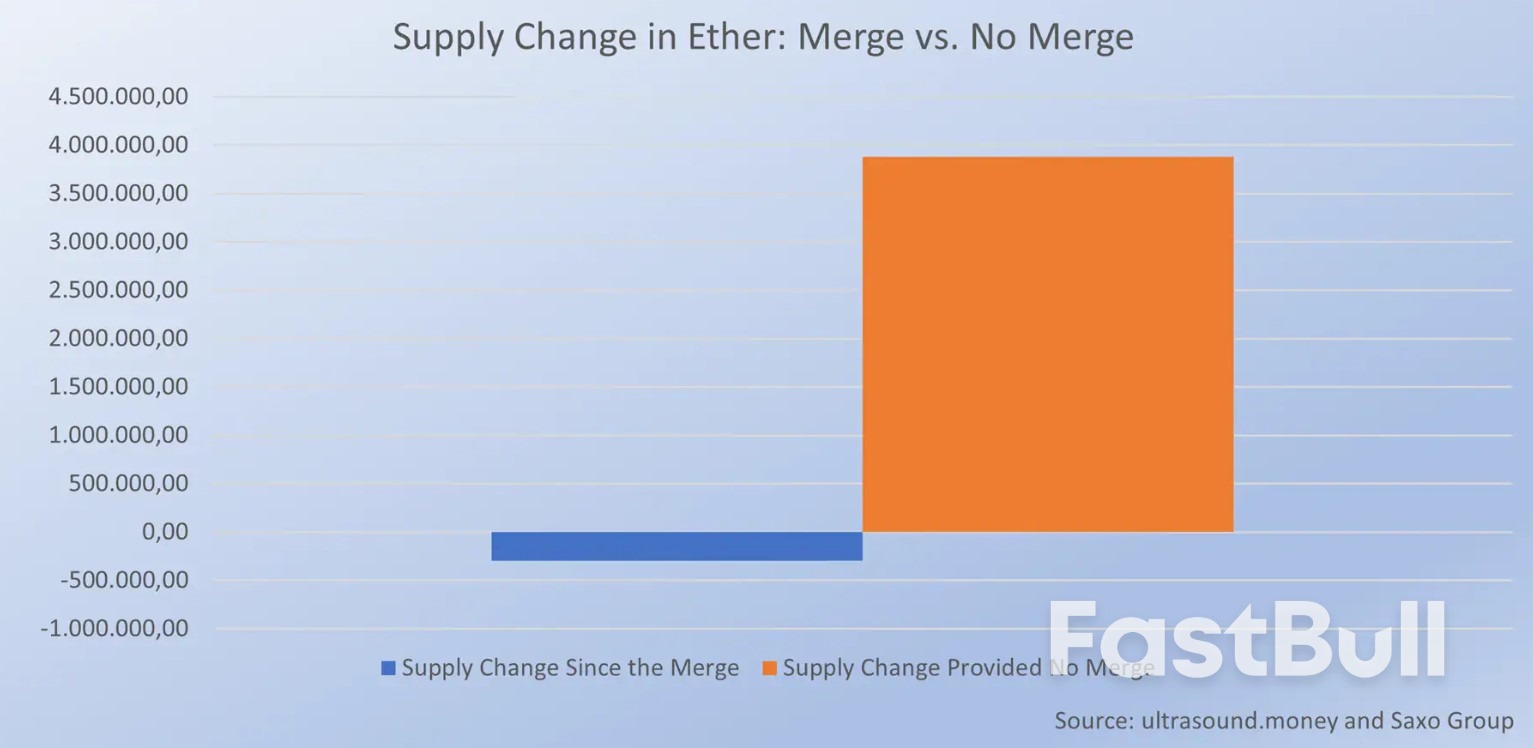
          As the majority of Ether paid in transaction fees are burned, hence removed from the supply, Ethereum has seen a nearly 300,000 Ether reduction in its supply since the merge. This is in stark contrast to a supply increase of nearly 3.9mn Ether in the past year provided that the merge had not occurred. Not only has Ethereum been deflationary since the merge, but its issuance has also been rewarded to holders of Ether if staked rather than miners with no duty to hold Ether. This means that Ethereum has truly turned into a financially sustainable cryptocurrency, rewarding holders with a negative supply change, and staking rewards if they choose to stake. Barely any cryptocurrency can brag about this, particularly none even close to the size of Ethereum.One Year Later: How Proof of Stake Has Changed Ethereum_1
          Energy consumption has been reduced by 99.95%
          In proof of work, miners participated in a never-ending rivalry to be the ones to process a block. This rivalry was about computing a string below a target set by the network. The latter was computed using a mathematical function to mostly go through trial and error. This called for immense computational power, in Ethereum's case, GPUs, using a great amount of electricity. Now, the network randomly chooses a validator every 12 seconds to process a block, so there are no battles for the blocks. The bottom line is that Ethereum has reduced its energy consumption by about 99.95%. This great reduction makes Ethereum much more appealing in a never-satisfied ESG world.
          Another advantage of proof of stake is the consistency of 12-second blocks, so they do not fluctuate similar to during Ethereum's proof of work era. This makes the network more predictable and easier to utilize for various protocols. The shift from average blocks of 13 seconds during proof of work to consistent 12-second blocks has also made Ethereum slightly more scalable, as block sizes have stayed the same.
          Is Ethereum now more centralized?
          This is a discussion largely beyond the scope of this piece; however, we will shortly touch upon the most critical considerations. Leaving the matter of decentralization aside for a second, Ethereum has certainly archived greater security by proof of stake. The network now reaches block finalization about 15 minutes after a block has been proposed. This is an extra layer of security not found in proof of work. It says that for a block to be altered or removed after reaching finalization at least 33% of the total staked Ether must be burned, effectively imposing a cost of at least $13bn for doing that. On top of that, the network can slash validators by burning some of their Ether in case they behave dishonestly or against the objectives of the network. In other words, by having collateral in something of great value from validators, in this case, Ether, the network can enforce much stricter rules for strong security.
          Decentralization is another matter. This highly depends on who you ask. In our view, it is roughly the same as before the merge, as it is now. The challenge of the present staking distribution is that the largest staker is the liquid-staking provider Lido with around 32.5% network penetration, but still growing slowly. The Ether staked by Lido belongs to thousands of holders and is spread across 31 independent validators by smart contracts, so it is considerably better than if it was a single entity. The challenge, however, is that Lido may capture the consensus layer of Ethereum if it continues to grow, so the governance token of Lido suddenly decides much of the future of Ethereum. You had a somewhat similar situation during proof of work, as miners mingled their computational power to form so-called mining pools to enhance their chances of creating a block.
          In both instances, the market operates with strong economies of scale. For mining pools, there are scale economies, as the capital flows to few but large mining pools to boost the chances of proposing a block. In proof of stake, there are no such advantages, but instead, large liquid-staking providers attain an upper hand in terms of liquidity. This enhances the ability of users to buy and sell the given liquid staking token without much price impact. The fear is that if Lido is not limited sooner rather than later, then it will continue to devour Ethereum with ever-increasing advantages for users by choosing Lido over other much smaller liquid staking providers.
          Another challenge facing Ethereum in proof of stake is that its staking ratio continues to rise, meaning more and more Ether is staked. Most critically, this may lead to fewer Ether than optimal to be left to be paid in transaction fees to maintain the ecosystem, while liquid-staking providers, particularly Lido, archive damaging network penetration. Ethereum's core developers decided last week to slow down the acceptance of new validators in Ethereum's next upgrade to allow the community more time to figure out a proper solution.One Year Later: How Proof of Stake Has Changed Ethereum_2
          Risk Warnings and Disclaimers
          You understand and acknowledge that there is a high degree of risk involved in trading. Following any strategies or investment methods may lead to potential losses. The content on the site is provided by our contributors and analysts for information purposes only. You are solely responsible for determining whether any trading assets, securities, strategy, or any other product is suitable for investing based on your own investment objectives and financial situation.
          Comments
          Add to Favorites
          Share

          Japan Rounds Off Tumultuous Central Bank Week

          Damon

          Economic

          Central Bank

          Stocks

          Bond

          The Bank of Japan on Friday rounds off one of the most intense weeks in recent memory for central bank policy decisions, with global markets still reverberating from the shockwaves that have followed the Federal Reserve's 'hawkish pause' on Wednesday.
          World stocks and risk assets tumbled for a second day on Thursday and U.S. bond yields soared to fresh multi-year highs, as investors adjusted to the Fed's revised rate outlook that hammered home its 'higher for longer' stance on interest rates.
          MSCI's World Index plunged 1.5% for its biggest fall in six weeks, and its fifth decline in a row marked its worst run since March. MSCI's Asia ex-Japan index also had its worst day since early August, and Wall Street slumped to a three-month low.
          In a sign of how much the landscape is shifting HSBC's fixed income research team led by Steven Major - one of the strongest advocates of a 'lower for longer' view on rates and yields - raised its U.S. Treasury yield forecasts on Thursday.
          Further complicating the picture for investors, however, were the surprisingly dovish decisions from the Bank of England and Swiss National Bank. Both kept rates on hold on Thursday, confounding expectations they would both hike.
          All eyes now turn to the BOJ.
          None of the 26 economists polled by Reuters expect any change to its easy stance on Friday but nearly 80% of them said the central bank will also abolish the 10-year yield control scheme by the end of 2024. More than half reckon negative interest rate policy will end next year too.
          The fog of uncertainty, and pull of opposing domestic and global forces, continue to hold sway over Japanese assets.
          The 10-year Japanese Government Bond yield hit a 10-year high of 0.75% on Thursday, and while the yen rebounded too, it did so from a new 2023 low of 148.45 per dollar earlier in the day.
          Speculation that Tokyo will intervene in the FX market to support the yen is unlikely to cool. Prime Minister Fumio Kishida said on Thursday that no option is ruled out in addressing "excessive volatility", adding that "authorities are in close communication internationally."
          While the BOJ's meeting is the marquee event in Asia on Friday, there is a raft of other indicators that could give local markets a steer, including the latest inflation data from Japan and Malaysia, and New Zealand trade figures.
          The first purchasing managers index reports for September begin filtering out on Friday, starting with Australia and Japan, then Germany, France and Britain later in the day.
          Here are key developments that could provide more direction to markets on Friday:
          - Bank of Japan policy meeting
          - Japan inflation (August)
          - Japan, Australia PMIs (September)

          Source: Yahoo

          To stay updated on all economic events of today, please check out our Economic calendar
          Risk Warnings and Disclaimers
          You understand and acknowledge that there is a high degree of risk involved in trading. Following any strategies or investment methods may lead to potential losses. The content on the site is provided by our contributors and analysts for information purposes only. You are solely responsible for determining whether any trading assets, securities, strategy, or any other product is suitable for investing based on your own investment objectives and financial situation.
          Comments
          Add to Favorites
          Share

          SEK's Struggle: Has the Riksbank Fallen Behind the Curve?

          Warren Takunda

          Forex

          Sweden's central bank, the Riksbank, recently implemented a 25-basis point interest rate hike in a bid to curb persistently high inflation. However, rather than strengthening, the Swedish Krona (SEK) faced depreciation, leaving analysts to question whether the central bank has fallen behind in addressing the nation's economic hurdles.
          Riksbank's Interest Rate Hike
          The Riksbank's decision to raise interest rates sent a clear signal that it was committed to tackling inflation. The central bank even hinted at the possibility of another rate hike in November, emphasizing its determination to control rising price levels.
          Currency Valuation Concerns
          In a surprising turn, the Riksbank expressed frustration over the SEK's undervaluation. The central bank suggested that speculative behavior by investors contributed to this undervaluation and indicated its expectations for an SEK appreciation in the near future.
          SEK ReactionSEK's Struggle: Has the Riksbank Fallen Behind the Curve?_1
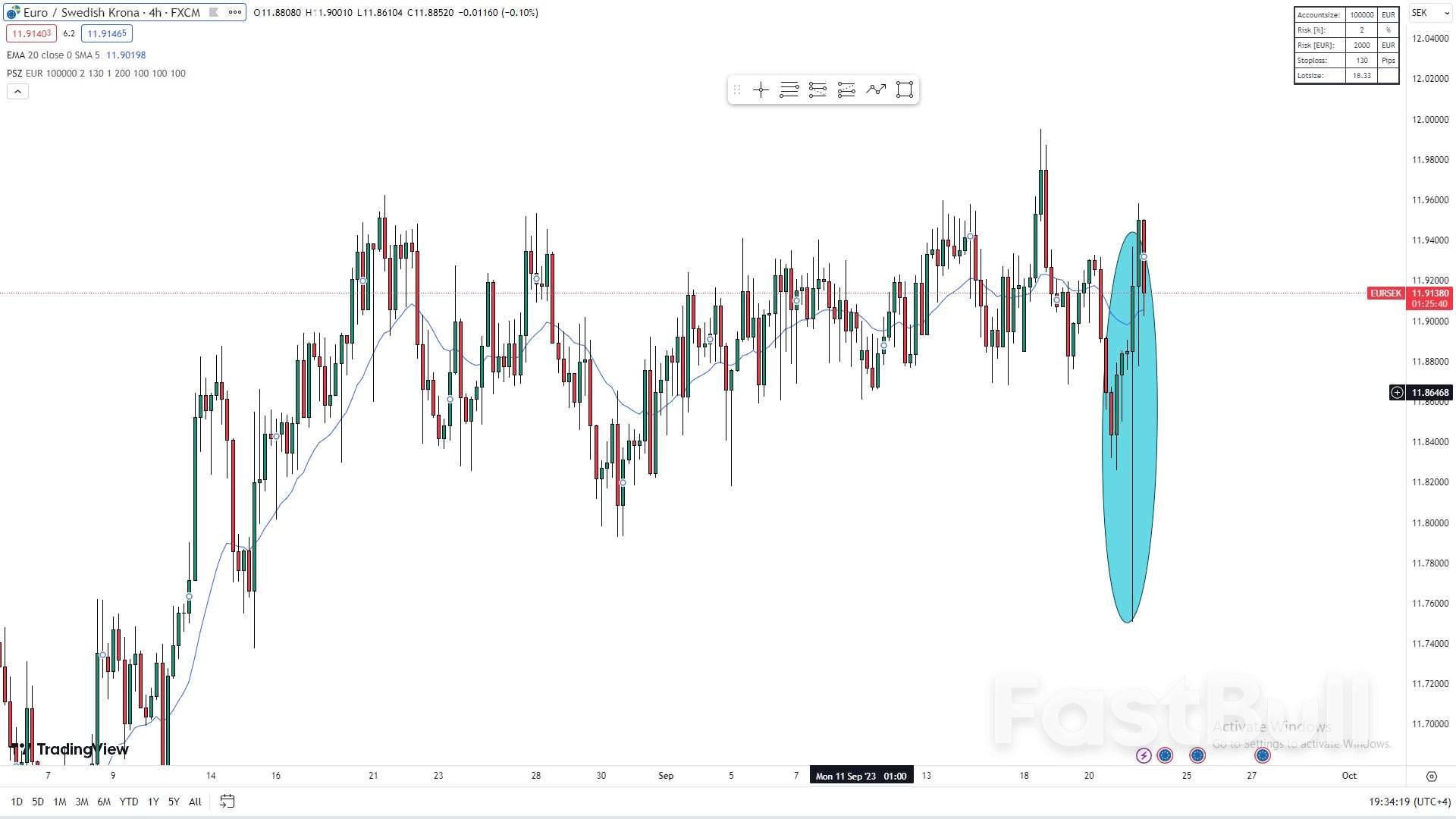
          Following the Riksbank's decision, the SEK initially strengthened against major currencies. For instance, the Euro to Krona (EUR/SEK) dipped before regaining pre-decision levels, indicating market uncertainty regarding the central bank's ability to influence the SEK's value.
          Policy Rate Path
          Magnusson highlights a potentially dovish signal in the Riksbank's policy rate path projections. These projections suggest only a 10-basis point rate increase by Q2 of the following year after the recent 25-basis point hike, fueling concerns that the central bank might not be keeping pace with inflationary pressures.
          Challenging Outlook
          The Riksbank faces a complex scenario as it may need to further increase interest rates while grappling with deteriorating macroeconomic data. Recent unemployment figures in Sweden exceeded expectations, signaling potential economic challenges ahead. A combination of rate hikes and economic downturn could lead to a flatter yield curve for Sweden, posing additional policy challenges.
          In the face of these complexities, the Riksbank will need to strike a delicate balance between addressing inflation and fostering economic growth, all while navigating the uncertain waters of global financial markets.
          Risk Warnings and Disclaimers
          You understand and acknowledge that there is a high degree of risk involved in trading. Following any strategies or investment methods may lead to potential losses. The content on the site is provided by our contributors and analysts for information purposes only. You are solely responsible for determining whether any trading assets, securities, strategy, or any other product is suitable for investing based on your own investment objectives and financial situation.
          Comments
          Add to Favorites
          Share
          FastBull
          Copyright © 2025 FastBull Ltd

          728 RM B 7/F GEE LOK IND BLDG NO 34 HUNG TO RD KWUN TONG KLN HONG KONG

          TelegramInstagramTwitterfacebooklinkedin
          App Store Google Play Google Play
          Products
          Charts

          Chats

          Q&A with Experts
          Screeners
          Economic Calendar
          Data
          Tools
          Membership
          Features
          Function
          Markets
          Copy Trading
          Latest Signals
          Contests
          News
          Analysis
          24/7
          Columns
          Education
          Company
          Careers
          About Us
          Contact Us
          Advertising
          Help Center
          Feedback
          User Agreement
          Privacy Policy
          Business

          White Label

          Data API

          Web Plug-ins

          Poster Maker

          Affiliate Program

          Risk Disclosure

          The risk of loss in trading financial instruments such as stocks, FX, commodities, futures, bonds, ETFs and crypto can be substantial. You may sustain a total loss of the funds that you deposit with your broker. Therefore, you should carefully consider whether such trading is suitable for you in light of your circumstances and financial resources.

          No decision to invest should be made without thoroughly conducting due diligence by yourself or consulting with your financial advisors. Our web content might not suit you since we don't know your financial conditions and investment needs. Our financial information might have latency or contain inaccuracy, so you should be fully responsible for any of your trading and investment decisions. The company will not be responsible for your capital loss.

          Without getting permission from the website, you are not allowed to copy the website's graphics, texts, or trademarks. Intellectual property rights in the content or data incorporated into this website belong to its providers and exchange merchants.

          Not Logged In

          Log in to access more features

          FastBull Membership

          Not yet

          Purchase

          Become a signal provider
          Help Center
          Customer Service
          Dark Mode
          Price Up/Down Colors

          Log In

          Sign Up

          Position
          Layout
          Fullscreen
          Default to Chart
          The chart page opens by default when you visit fastbull.com