• Trade
  • Markets
  • Copy
  • Contests
  • News
  • 24/7
  • Calendar
  • Q&A
  • Chats
Trending
Screeners
SYMBOL
LAST
BID
ASK
HIGH
LOW
NET CHG.
%CHG.
SPREAD
SPX
S&P 500 Index
6827.42
6827.42
6827.42
6899.86
6801.80
-73.58
-1.07%
--
DJI
Dow Jones Industrial Average
48458.04
48458.04
48458.04
48886.86
48334.10
-245.98
-0.51%
--
IXIC
NASDAQ Composite Index
23195.16
23195.16
23195.16
23554.89
23094.51
-398.69
-1.69%
--
USDX
US Dollar Index
97.950
98.030
97.950
98.500
97.950
-0.370
-0.38%
--
EURUSD
Euro / US Dollar
1.17394
1.17409
1.17394
1.17496
1.17192
+0.00011
+ 0.01%
--
GBPUSD
Pound Sterling / US Dollar
1.33707
1.33732
1.33707
1.33997
1.33419
-0.00148
-0.11%
--
XAUUSD
Gold / US Dollar
4299.39
4299.39
4299.39
4353.41
4257.10
+20.10
+ 0.47%
--
WTI
Light Sweet Crude Oil
57.233
57.485
57.233
58.011
56.969
-0.408
-0.71%
--

Community Accounts

Signal Accounts
--
Profit Accounts
--
Loss Accounts
--
View More

Become a signal provider

Sell trading signals to earn additional income

View More

Guide to Copy Trading

Get started with ease and confidence

View More

Signal Accounts for Members

All Signal Accounts

Best Return
  • Best Return
  • Best P/L
  • Best MDD
Past 1W
  • Past 1W
  • Past 1M
  • Past 1Y

All Contests

  • All
  • Trump Updates
  • Recommend
  • Stocks
  • Cryptocurrencies
  • Central Banks
  • Featured News
Top News Only
Share

USA Embassy In Lithuania: Maria Kalesnikava Is Not Going To Vilnius

Share

USA Embassy In Lithuania: Other Prisoners Are Being Sent From Belarus To Ukraine

Share

Ukraine President Zelenskiy: Five Ukrainians Released By Belarus In US-Brokered Deal

Share

USA Vilnius Embassy: USA Stands Ready For "Additional Engagement With Belarus That Advances USA Interests"

Share

USA Vilnius Embassy: Belarus, USA, Other Citizens Among The Prisoners Released Into Lithuania

Share

USA Vilnius Embassy: USA Will Continue Diplomatic Efforts To Free The Remaining Political Prisoners In Belarus

Share

USA Vilnius Embassy: Belarus Releases 123 Prisoners Following Meeting Of President Trump's Envoy Coale And Belarus President Lukashenko

Share

USA Vilnius Embassy: Masatoshi Nakanishi, Aliaksandr Syrytsa Are Among The Prisoners Released By Belarus

Share

USA Vilnius Embassy: Maria Kalesnikava And Viktor Babaryka Are Among The Prisoners Released By Belarus

Share

USA Vilnius Embassy: Nobel Peace Prize Laureate Ales Bialiatski Is Among The Prisoners Released By Belarus

Share

Belarusian Presidential Administration Telegram Channel: Lukashenko Has Pardoned 123 Prisoners As Part Of Deal With US

Share

Two Local Syrian Officials: Joint US-Syrian Military Patrol In Central Syria Came Under Fire From Unknown Assailants

Share

Israeli Military Says It Targeted 'Key Hamas Terrorist' In Gaza City

Share

Rwanda's Actions In Eastern Drc Are A Clear Violation Of Washington Accords Signed By President Trump - Secretary Of State Rubio

Share

Israeli Military Issues Evacuation Warning In Southern Lebanon Village Ahead Of Strike - Spokesperson On X

Share

Belarusian State Media Cites US Envoy Coale As Saying He Discussed Ukraine And Venezuela With Lukashenko

Share

Belarusian State Media Cites US Envoy Coale As Saying That US Removes Sanctions On Belarusian Potassium

Share

Thai Prime Minister: No Ceasefire Agreement With Cambodia

Share

US, Ukraine To Discuss Ceasefire In Berlin Ahead Of European Summit

Share

Incoming Czech Prime Minister Babis: Czech Republic Will Not Take On Guarantees For Ukraine Financing, European Commission Must Find Alternatives

TIME
ACT
FCST
PREV
U.K. Trade Balance Non-EU (SA) (Oct)

A:--

F: --

P: --

U.K. Trade Balance (Oct)

A:--

F: --

P: --

U.K. Services Index MoM

A:--

F: --

P: --

U.K. Construction Output MoM (SA) (Oct)

A:--

F: --

P: --

U.K. Industrial Output YoY (Oct)

A:--

F: --

P: --

U.K. Trade Balance (SA) (Oct)

A:--

F: --

P: --

U.K. Trade Balance EU (SA) (Oct)

A:--

F: --

P: --

U.K. Manufacturing Output YoY (Oct)

A:--

F: --

P: --

U.K. GDP MoM (Oct)

A:--

F: --

P: --

U.K. GDP YoY (SA) (Oct)

A:--

F: --

P: --

U.K. Industrial Output MoM (Oct)

A:--

F: --

P: --

U.K. Construction Output YoY (Oct)

A:--

F: --

P: --

France HICP Final MoM (Nov)

A:--

F: --

P: --

China, Mainland Outstanding Loans Growth YoY (Nov)

A:--

F: --

P: --

China, Mainland M2 Money Supply YoY (Nov)

A:--

F: --

P: --

China, Mainland M0 Money Supply YoY (Nov)

A:--

F: --

P: --

China, Mainland M1 Money Supply YoY (Nov)

A:--

F: --

P: --

India CPI YoY (Nov)

A:--

F: --

P: --

India Deposit Gowth YoY

A:--

F: --

P: --

Brazil Services Growth YoY (Oct)

A:--

F: --

P: --

Mexico Industrial Output YoY (Oct)

A:--

F: --

P: --

Russia Trade Balance (Oct)

A:--

F: --

P: --

Philadelphia Fed President Henry Paulson delivers a speech
Canada Building Permits MoM (SA) (Oct)

A:--

F: --

P: --

Canada Wholesale Sales YoY (Oct)

A:--

F: --

P: --

Canada Wholesale Inventory MoM (Oct)

A:--

F: --

P: --

Canada Wholesale Inventory YoY (Oct)

A:--

F: --

P: --

Canada Wholesale Sales MoM (SA) (Oct)

A:--

F: --

P: --

Germany Current Account (Not SA) (Oct)

A:--

F: --

P: --

U.S. Weekly Total Rig Count

A:--

F: --

P: --

U.S. Weekly Total Oil Rig Count

A:--

F: --

P: --

Japan Tankan Large Non-Manufacturing Diffusion Index (Q4)

--

F: --

P: --

Japan Tankan Small Manufacturing Outlook Index (Q4)

--

F: --

P: --

Japan Tankan Large Non-Manufacturing Outlook Index (Q4)

--

F: --

P: --

Japan Tankan Large Manufacturing Outlook Index (Q4)

--

F: --

P: --

Japan Tankan Small Manufacturing Diffusion Index (Q4)

--

F: --

P: --

Japan Tankan Large Manufacturing Diffusion Index (Q4)

--

F: --

P: --

Japan Tankan Large-Enterprise Capital Expenditure YoY (Q4)

--

F: --

P: --

U.K. Rightmove House Price Index YoY (Dec)

--

F: --

P: --

China, Mainland Industrial Output YoY (YTD) (Nov)

--

F: --

P: --

China, Mainland Urban Area Unemployment Rate (Nov)

--

F: --

P: --

Saudi Arabia CPI YoY (Nov)

--

F: --

P: --

Euro Zone Industrial Output YoY (Oct)

--

F: --

P: --

Euro Zone Industrial Output MoM (Oct)

--

F: --

P: --

Canada Existing Home Sales MoM (Nov)

--

F: --

P: --

Euro Zone Total Reserve Assets (Nov)

--

F: --

P: --

U.K. Inflation Rate Expectations

--

F: --

P: --

Canada National Economic Confidence Index

--

F: --

P: --

Canada New Housing Starts (Nov)

--

F: --

P: --

U.S. NY Fed Manufacturing Employment Index (Dec)

--

F: --

P: --

U.S. NY Fed Manufacturing Index (Dec)

--

F: --

P: --

Canada Core CPI YoY (Nov)

--

F: --

P: --

Canada Manufacturing Unfilled Orders MoM (Oct)

--

F: --

P: --

Canada Manufacturing New Orders MoM (Oct)

--

F: --

P: --

Canada Core CPI MoM (Nov)

--

F: --

P: --

Canada Manufacturing Inventory MoM (Oct)

--

F: --

P: --

Canada CPI YoY (Nov)

--

F: --

P: --

Canada CPI MoM (Nov)

--

F: --

P: --

Canada CPI YoY (SA) (Nov)

--

F: --

P: --

Canada Core CPI MoM (SA) (Nov)

--

F: --

P: --

Q&A with Experts
    • All
    • Chatrooms
    • Groups
    • Friends
    Connecting
    .
    .
    .
    Type here...
    Add Symbol or Code

      No matching data

      All
      Trump Updates
      Recommend
      Stocks
      Cryptocurrencies
      Central Banks
      Featured News
      • All
      • Russia-Ukraine Conflict
      • Middle East Flashpoint
      • All
      • Russia-Ukraine Conflict
      • Middle East Flashpoint
      Search
      Products

      Charts Free Forever

      Chats Q&A with Experts
      Screeners Economic Calendar Data Tools
      Membership Features
      Data Warehouse Market Trends Institutional Data Policy Rates Macro

      Market Trends

      Market Sentiment Order Book Forex Correlations

      Top Indicators

      Charts Free Forever
      Markets

      News

      News Analysis 24/7 Columns Education
      From Institutions From Analysts
      Topics Columnists

      Latest Views

      Latest Views

      Trending Topics

      Top Columnists

      Latest Update

      Signals

      Copy Rankings Latest Signals Become a signal provider AI Rating
      Contests
      Brokers

      Overview Brokers Assessment Rankings Regulators News Claims
      Broker listing Forex Brokers Comparison Tool Live Spread Comparison Scam
      Q&A Complaint Scam Alert Videos Tips to Detect Scam
      More

      Business
      Events
      Careers About Us Advertising Help Center

      White Label

      Data API

      Web Plug-ins

      Affiliate Program

      Awards Institution Evaluation IB Seminar Salon Event Exhibition
      Vietnam Thailand Singapore Dubai
      Fans Party Investment Sharing Session
      FastBull Summit BrokersView Expo
      Recent Searches
        Top Searches
          Markets
          News
          Analysis
          User
          24/7
          Economic Calendar
          Education
          Data
          • Names
          • Latest
          • Prev

          View All

          No data

          Scan to Download

          Faster Charts, Chat Faster!

          Download App
          English
          • English
          • Español
          • العربية
          • Bahasa Indonesia
          • Bahasa Melayu
          • Tiếng Việt
          • ภาษาไทย
          • Français
          • Italiano
          • Türkçe
          • Русский язык
          • 简中
          • 繁中
          Open Account
          Search
          Products
          Charts Free Forever
          Markets
          News
          Signals

          Copy Rankings Latest Signals Become a signal provider AI Rating
          Contests
          Brokers

          Overview Brokers Assessment Rankings Regulators News Claims
          Broker listing Forex Brokers Comparison Tool Live Spread Comparison Scam
          Q&A Complaint Scam Alert Videos Tips to Detect Scam
          More

          Business
          Events
          Careers About Us Advertising Help Center

          White Label

          Data API

          Web Plug-ins

          Affiliate Program

          Awards Institution Evaluation IB Seminar Salon Event Exhibition
          Vietnam Thailand Singapore Dubai
          Fans Party Investment Sharing Session
          FastBull Summit BrokersView Expo

          March 24th Financial News

          FastBull Featured

          Daily News

          Summary:

          The Bank of England (BoE) raised interest rates for the 11th time in a row; More than 1 million people marched in France; The market bets that the Fed has ended its rate hike cycle...

          【Quick Facts】

          1. BoE raises interest rates for the 11th consecutive time.
          2. France broke out a march involving millions of people.
          3. The market bets that the Fed has ended the rate hike cycle.
          4. The Fed's expansion of the table again shows a different image.
          5. Panetta: Continue to assess the combined effect of interest rate hikes and tapering.

          【News Details】

          1. BoE raises interest rates for the 11th consecutive time.
          The BoE voted 7-2 on Thursday to raise interest rates by 25 bps to 4.25%, also the 11th consecutive rate hike, but said an unexpected rebound in inflation could fade quickly, prompting speculation about whether it has ended its rate hike cycle.
          The statement showed that the Monetary Policy Committee will continue to closely monitor signs of persistent inflationary pressures, including labor market tightness and wage growth and services inflation. If there is evidence of more persistent pressures, then further tightening of monetary policy will be needed.
          Asked about the most recent rate hike, Bank of England Governor Bailey said, "We don't know if this is the peak. What I can tell you is that we've seen signs of inflation really peaking. But of course, it's too high .... We need to see it start to come back down gradually and get back to target."
          2. France broke out a march involving millions of people.
          French unions plan new protests against pension reforms, calling for new national strikes and protests next week. In total, more than one million people protested across France on Thursday, local time. The march in the French capital Paris, which was held up by violent (law enforcement) actions, was 119,000 strong. Polls show that most French people oppose President Macron's bill to raise the retirement age from 62 to 64, which Macron says is necessary to keep the system running.
          3. The market bets that the Fed has ended the rate hike cycle.
          Currently, some investors are betting that the Fed's rate hike this week will be its last action to curb inflation, with the bankruptcy of two U.S. regional banks and a bailout agreement for Credit Suisse helping the Fed to complete its mission to tighten the financial environment and put pressure on borrowers. While the market does not rule out the possibility of another 25 bps rate hike in May, for now it seems the most likely scenario for the Fed to leave rates unchanged and then make a series of rate cuts later in the year.
          4. The Fed's expansion of the table again shows a different image.
          The just-released latest Fed H.4.1 report shows that the Fed's FIMA Repo Facility was used on a $60 billion scale (as of Wednesday's level), with average weekly usage also rising. This is the first time since it was converted to a standing facility used on a large scale.
          The FIMA Repo Facility has a per-counterparty limit of $60 billion, and this week's announced usage was exactly $60 billion. It is uncertain whether the $60 billion was borrowed from the Fed by the same central bank.
          In addition, the probability of using FIMA is smaller in developed economy countries that have the right to use the Fed's foreign exchange swap, because the interest rate cost paid for the foreign exchange swap is lower.
          In short, the $60 billion scale is not a small amount, enough to show that the current dollar liquidity environment is tight, even some monetary authorities / sovereign accounts to the Fed to call the emergency liquidity facilities.
          5. Panetta: Continue to assess the combined effect of interest rate hikes and tapering.
          ECB Executive Committee member Fabio Panetta said in a speech Wednesday that the global economy has experienced a series of shocks over the past three years - pandemics, supply chain bottlenecks, wars, energy crises, and now banking problems. While the effects of some of these shocks are beginning to recede, it will take time for the volatility of economic activity and prices to level off and form a new equilibrium. In the face of an exceptionally complex economic situation, the combined effects of different policy instruments, the risk of non-linear effects, and the spillover effects of policies in other regions need to be continuously assessed. The combined effect of interest rate hikes and tapering should be continuously assessed.

          【Focus of the Day】

          UTC+8 15:00 UK Retail Sales (Feb)
          UTC+8 17:00 Eurozone Markit Manufacturing PMI Preliminary Value (Mar)
          UTC+8 17:15 ECB Governing Council member Nagel to speak
          UTC+8 17:30 UK Markit Services PMI Preliminary Value (Mar)
          UTC+8 19:00 ECB Governing Council member Centeno to speak
          UTC+8 20:30 Canada's Monthly Retail Sales Rate (Jan)
          UTC+8 00:00 BoE monetary policy member Mann to speak
          Risk Warnings and Disclaimers
          You understand and acknowledge that there is a high degree of risk involved in trading. Following any strategies or investment methods may lead to potential losses. The content on the site is provided by our contributors and analysts for information purposes only. You are solely responsible for determining whether any trading assets, securities, strategy, or any other product is suitable for investing based on your own investment objectives and financial situation.
          Comments
          Add to Favorites
          Share

          Yellen, Caught Between Markets and US Congress, Tweaks Bank Safety Message

          Owen Li

          Economic

          For the fourth time in a week, U.S. Treasury Secretary Janet Yellen took a microphone on Thursday aiming to reassure Americans that the U.S. banking system is safe, each time with a subtle shift in message.
          But bankers and Wall Street never heard what they fervently wanted: That the government would guarantee all $19.2 trillion in U.S. bank deposits until the banking crisis that erupted two weeks ago calms down.
          Yellen is the face of the U.S. government on the issue, and her public comments have sent markets on a roller coaster ride.
          Becoming more explicit each time she has spoken, Yellen has repeatedly said the U.S. will safeguard deposits but has stopped short of a blanket guarantee, which would insure account balances of any size, including those above the current limit of $250,000.
          Her comments on Thursday more clearly indicated than previously that further guarantees for uninsured deposits would come in the form of rescues for depositors of individual failing banks where problems threaten to spark runs on other banks.
          She told U.S. lawmakers that bank regulators and the Treasury were prepared to make comprehensive deposit guarantees at other banks as they did at failed Silicon Valley Bank and Signature Bank.
          "These are tools we could use again, for an institution of any size, if we judge that its failure would pose a contagion risk," she told a U.S. House of Representatives Appropriations subcommittee hearing.
          The comments helped lift broad stock indexes. But regional bank shares including those of struggling First Republic Bank continued to slide.
          Yellen on Wednesday told a Senate subcommittee that she was not considering a move to circumvent Congress and grant "blanket insurance" on all U.S. bank deposits.
          Congress' Clout
          That's a step that the government and regulators took unilaterally in the 2008 global financial crisis, but the Biden administration would now have to get approval from Congress under 2010 reforms.
          Hardline Republicans oppose any increase in the current $250,000 Federal Deposit Insurance Corp limit, making it unlikely that Yellen could hastily arrange such a backstop even if the crisis worsens.
          Banks and markets have found Yellen's comments unsettling at times. On March 16, she told a told a Senate hearing that banks had to pose a systemic risk to win a deposit guarantee, a comment interpreted as leaving small community banks to fend for themselves.
          But at a bank conference on Tuesday, she said that similar actions to the SVB guarantee "could be warranted if smaller institutions suffer deposit runs," reassuring those institutions.
          Yellen's reluctance to endorse a universal backstop has drawn criticism from investors including hedge fund manager Bill Ackman. They argue that a universal guarantee is needed to prevent depositors at small and mid-size banks from fleeing for perceived safety at large banks viewed as "too big to fail."

          Source: Yahoo

          To stay updated on all economic events of today, please check out our Economic calendar
          Risk Warnings and Disclaimers
          You understand and acknowledge that there is a high degree of risk involved in trading. Following any strategies or investment methods may lead to potential losses. The content on the site is provided by our contributors and analysts for information purposes only. You are solely responsible for determining whether any trading assets, securities, strategy, or any other product is suitable for investing based on your own investment objectives and financial situation.
          Comments
          Add to Favorites
          Share

          End of Central Bank Rate Hikes Now Firmly on The Horizon

          Alex

          Central Bank

          Having raised interest rates at the fastest pace on record to tame inflation, the world's top central banks are openly contemplating an early end to their rate hikes, not least because of financial turmoil in recent weeks.
          The U.S. Federal Reserve, the European Central Bank and the Bank of England all raised rates as expected in the last week, but each of them signalled caution about their next move, leaving investors unsure where borrowing costs are going.
          The Fed indicated it was on the verge of pausing, the ECB said it would no longer provide guidance and instead decide meeting-by-meeting, while the BoE said it expected the surge in inflation to cool faster than previously predicted.
          Central banks have already done much of the legwork in raising rates, and inflation is well off its highs, even if there are lingering questions about just how stubborn price growth will prove to be on the way down.
          But until the recent bout of financial sector volatility, the expectation had been that both the Fed and the ECB still had some way to go.
          That all changed in a matter of a weeks.
          Although bank shares have rebounded since the collapse of Silicon Valley Bank and the UBS-led rescue of Credit Suisse, the stress is far from over.
          Central banks are concerned that the market ructions could translate into higher funding costs for lenders, which in turn would slow borrowing, thwart credit growth, weigh on economic growth and ultimately dampen inflation.
          "The turmoil might lead to some additional tightening of financing conditions not triggered by monetary policy, in which case maybe we have to do less," Dutch central bank chief Klaas Knot told Reuters.
          Fed Chair Jerome Powell had a similar warning on Wednesday, noting that more expensive funding had broader ramifications for growth, borrowing and investments.
          "Events in the banking system over the past two weeks are likely to result in tighter credit conditions for households and businesses, which would in turn affect economic outcomes," Powell said.
          The Bank of England said on Thursday policymakers would "monitor closely any effect on the credit conditions faced by households and businesses" and what that means for the economy.
          Interconnected
          The interconnected nature of the financial system means that what happens in the United States - particularly Fed policy - has ramifications for everyone.
          It was the Fed's rapid rate hikes that created much of the stress on Silicon Valley Bank's balance sheet, souring sentiment towards regional U.S. banks and providing the impetus for the sell-off in Credit Suisse.
          "This is the kind of thing economics students discuss in late-night bars, rather than being relevant for markets, but the speed with which the U.S. regional banking crisis spread to a major Swiss bank, and the speed with which global monetary policy expectations adjusted, highlights how joined-up the global financial cycle is," Societe Generale currency strategist Kit Juckes said.
          Central banks have also been quick. The Fed raised interest rates by 475 basis points in nine successive meetings, the ECB by 350 basis points over six meetings and the Bank of England by 415 basis points in 11 sessions.
          This is lightning-fast by central banking standards and ECB's Knot said policymakers needed to have a deeper look at how it is affecting lenders.
          "Interest rate risk in the banking book deserves a more prominent treatment and a more prominent discussion among banking supervisors," Knot argued.
          Another issue is inflation. It is now well off its multi-decade highs, and while disinflation is likely to be bumpy, with continued pressure from wages on both sides of the Atlantic, the slope is clearly downwards.
          Combined, these factors suggest that big central banks are nearly done, and that upcoming rate moves may be their last.
          For the Fed, markets see a 50% probability of just one more hike in May, having priced out an entire increase since the start of the turmoil. At the ECB, investors see only 50 basis points of moves left, less than half of what they predicted just two weeks ago, while just one more 25-basis-point hike by the BoE is priced in for May or June.
          "The U.S. economy may see tighter lending standards than what could be explained by macroeconomic fundamentals. If so, our view is that it could indeed substitute for further rate hikes," Michael Gapen at Bank of America said.

          Source: Yahoo

          Risk Warnings and Disclaimers
          You understand and acknowledge that there is a high degree of risk involved in trading. Following any strategies or investment methods may lead to potential losses. The content on the site is provided by our contributors and analysts for information purposes only. You are solely responsible for determining whether any trading assets, securities, strategy, or any other product is suitable for investing based on your own investment objectives and financial situation.
          Comments
          Add to Favorites
          Share

          Japan CPI A Distraction Amid Thickening Global Fog

          Owen Li

          Economic

          Asian markets round off the week with Japanese inflation and PMI data likely to be the main local drivers on Friday, offering direction that is unlikely to come from yet another choppy day in U.S. markets on Thursday.
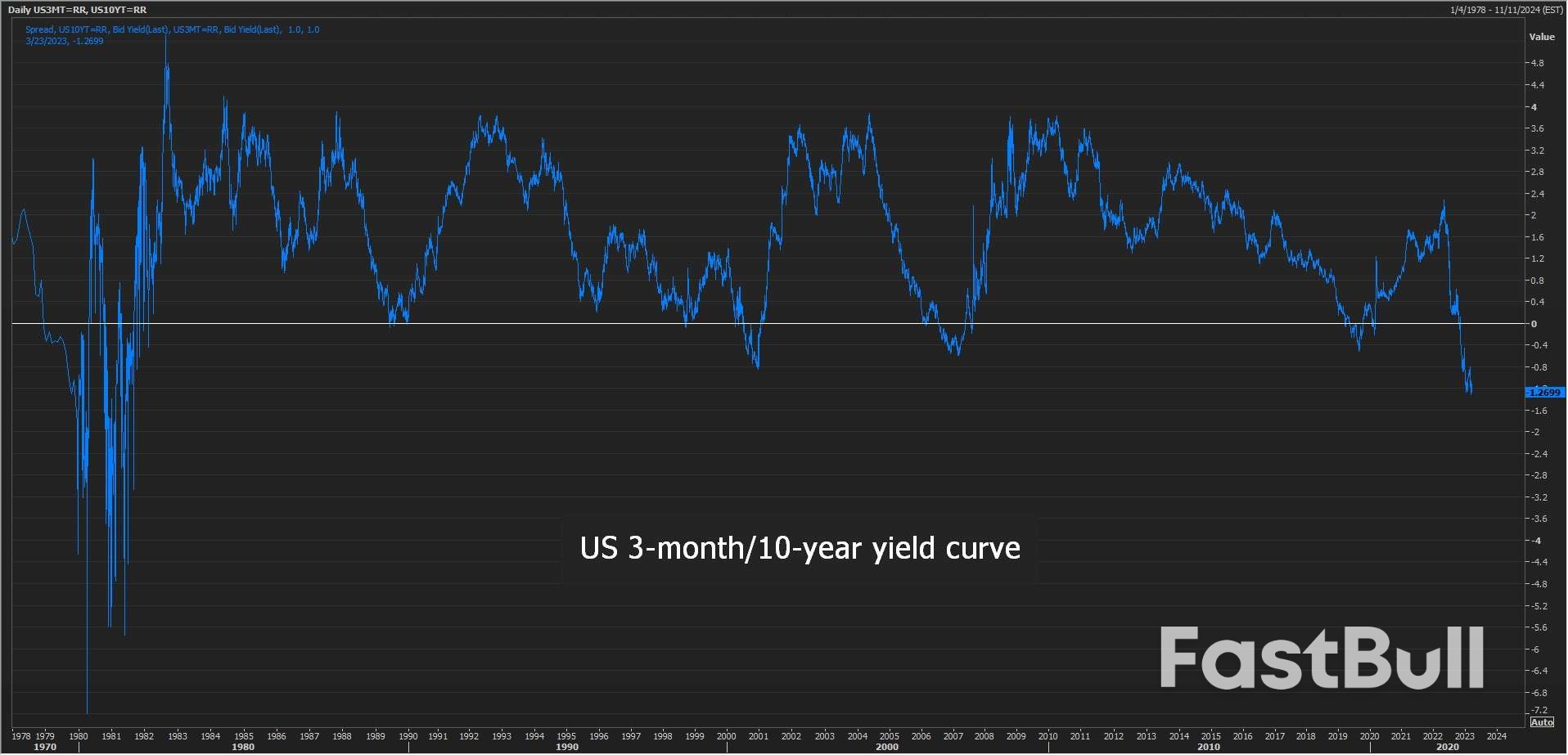
          Wall Street rose - although ended up off its highs - but bank stocks slumped to the lowest since 2020; key parts of the U.S. yield curve steepened, but the three month/10-year segment is its flattest and most inverted since 1981; market-based inflation expectations fell, but so did Fed rate expectations.
          Japan CPI A Distraction Amid Thickening Global Fog_1Rates markets are now pricing in around 100 basis points of Fed easing this year, something Fed Chair Jerome Powell said on Wednesday is definitely not the central bank's base case scenario.
          The uncertainty is rooted in what impact the banking crisis will have on U.S. credit conditions in the coming months, and by extension on economic activity and inflation. As Powell stated baldly on Wednesday: "We simply don't know."
          Treasury Secretary Janet Yellen did know that she had a second chance on Thursday to soothe concerns among investors and the wider public about whether authorities will move towards guaranteeing all bank deposits.
          She told a House committee she is prepared to take further actions to ensure bank deposits are safe, a day after telling a Senate committee blanket insurance was not on the agenda. It might not be on a par with Powell's assurances - bank stocks still fell - but perhaps sentiment will improve on Friday.
          So Asia opens on Friday to firmer world stocks, lower yields, mix U.S. yield curves, higher global rates after the UK and Swiss hikes - but a growing sense that the world policy peak is in sight - a rising dollar, and a notably stronger yen.
          Japan CPI A Distraction Amid Thickening Global Fog_2Japanese annual core inflation in February is expected to have fallen sharply to 3.1% from a 41-year high of 4.2% the month before, thanks to government subsidies for gas and electricity bills to cushion rising living costs.
          But many economists say broader price pressures remain strong throughout the economy, which could force the Bank of Japan to phase out or scrap its yield curve control policy soon.
          Here are three key developments that could provide more direction to markets on Friday:
          - Japan consumer price inflation (February)
          - Japan flash PMIs (March)
          - Australia flash PMIs (March)

          Source: Reuters

          To stay updated on all economic events of today, please check out our Economic calendar
          Risk Warnings and Disclaimers
          You understand and acknowledge that there is a high degree of risk involved in trading. Following any strategies or investment methods may lead to potential losses. The content on the site is provided by our contributors and analysts for information purposes only. You are solely responsible for determining whether any trading assets, securities, strategy, or any other product is suitable for investing based on your own investment objectives and financial situation.
          Comments
          Add to Favorites
          Share

          China Is Putting Its Economy Back on Track

          Justin

          Economic

          Now that the 20th National Congress of the Chinese Communist Party and Chinese People’s Political Consultative Conference have concluded in Beijing with a lot of fanfare, the necessary decisions to boost the economy have been taken. These include spelling out the government’s economic priorities, plans for reforming the administrative structure and changes to leadership.
          This is a welcome confidence boost for China and the world economy. It comes after a dismal economic performance in 2022, zero Covid-19 policy, regulatory crackdown and ideological orientation set during the Congress. It shows that the Chinese leadership has put the welfare of the people above everything else. It was clearly stated that domestic demand, private consumption and employment are top priorities.
          While the service sector has picked up since the end of the zero Covid-19 policy, other components are facing headwinds. Private consumption is one such area as households and small- and medium-sized enterprises reduced their savings cushion during zero covid-19. Income and employment have not picked up either.
          Private investment remains cautious until stronger measures to support private business become apparent. Confidence plummeted last year following repeated lockdowns and the fallout from unpredictable regulatory crackdowns on sectors such as education, entertainment, internet platforms and real estate. It appears that private investors are sitting on the fence.
          Government-funded infrastructure investment is likely to slow. Fiscal support will be restrained, with the target for headline deficit based on a narrow definition of government revenue and spending raised only slightly to 3% of gross domestic product. Local governments are likely to scale back major investments, with a smaller quota for special local bonds used mainly to finance infrastructure projects. Many local governments have reached their debt levels after years of overspending as income from real estate allocation shows no sign of revival.
          Money supply will not follow the quantitative easing of western central banks, but will be ready to support worthwhile projects. However, the increasing need to expand M2 to achieve envisaged growth targets, which has been observed in recent years, is not sustainable.
          Another uncertain growth component is the foreign sector with exports and imports declining at the beginning of 2023. This depends on world demand and geopolitical developments which are beyond the control of China. There are now signs that trade tensions will not disappear any time soon.
          Science and technology were second on the list of government priorities, with officials aiming to coordinate business to achieve breakthroughs in core technology to boost self-reliance and self-strengthening. The government has earmarked vast amounts of money to subsidise the purchase of domestically produced chipmaking equipment. This outlay is in response to the US increasingly tightening curbs on the export of chipmaking technology, which might be used for artificial intelligence and military purposes.
          The planned reform of the administrative structure includes the establishment of a national data centre as well as an overarching financial supervisory authority, comprising banking and insurance but also non-bank financial business – a source of financial instability. Small- and medium-sized banks in particular have become a source of risk. However, reorganising government structures to eliminate financial risk is futile as risk has to be managed rather than eliminated. Risk management starts with each financial player.
          Finally, adding to the uncertainty, there were no insights as to how the government would react to a resurgence of the Covid-19 pandemic or how an escalation of the Ukraine war would affect the economic scenario.

          Source:Herbert Poenisch

          To stay updated on all economic events of today, please check out our Economic calendar
          Risk Warnings and Disclaimers
          You understand and acknowledge that there is a high degree of risk involved in trading. Following any strategies or investment methods may lead to potential losses. The content on the site is provided by our contributors and analysts for information purposes only. You are solely responsible for determining whether any trading assets, securities, strategy, or any other product is suitable for investing based on your own investment objectives and financial situation.
          Comments
          Add to Favorites
          Share

          Bank of England Tightening Likely Done as It Hikes by 25bp

          Justin

          Central Bank

          Economic

          Bank of England keeps its options open on future hikes

          The Bank of England has increased interest rates by 25 basis points, a move that may well be its last. Bank Rate now stands at 4.25%.
          We only get a statement this time around (no press conference), and an initial flick-through shows that it reads as fairly balanced. Growth and employment look stronger, it says, but services inflation - which has been volatile so far this year- is seen as in line with expectations, and nominal wage growth weaker.
          In short, the Bank is keeping its options open. Like last month, it has indicated it could hike again if inflation is continuing to show signs of “persistence”. Our read of that phrasing is that officials are less beholden to month-to-month swings in the data than perhaps the Federal Reserve/European Central Bank and are trying to take a more top-level look at pricing-setting behaviour. It’s this that will determine whether the Bank hikes again in May - and for now we think it won’t, though another 25bp move is possible if the inflation data turns more hawkish.

          If improvements in broad inflation picture continue, expect a May pause

          Indeed, recent trends in inflation have looked more encouraging. The Bank’s own survey of businesses suggests price-setting behaviour is becoming less aggressive, while as the BoE acknowledges, wage growth tentatively appears to have peaked on a three-month annualised basis. Services inflation should start to come down in time, with lower gas prices. When asked about recent price hikes by the ONS, service-sector firms more commonly cited energy prices than labour costs as the driver of these changes - and the same should be true in reverse.
          Assuming these trends continue then we think a pause in May is likely. That’s also partly dependent on banking sector stability and like its peers overseas, the BoE will keep reiterating that it has separate tools that are better suited to maintaining financial stability.
          We’re also likely to see the committee become more divided. There were no massive fireworks in the vote split on this latest decision - seven members voted for the 25bp hike, and as at the past two meetings, Silvana Tenreyro and Swati Dhingra voted for no change. Both have, however, hinted it might not be long before they consider voting for cuts.

          Gilts in the long pause

          Gilts, like other bond markets, now have to reflect a new phase of this cycle where central banks are at, or near, their policy rate peak. Two conclusions should ensue. Firstly, stability in policy rates means lower volatility in front-end yields, if the BoE can stick to its message of patience.
          Progressively, this volatility will be displaced to the longer end, especially if a resilient economy pushes the inflation premium higher.
          The second conclusion is that the yield curve now stands a better chance of re-steepening, as the front-end upside is now limited and as the inflation premium is no longer suppressed by a hiking central bank. We continue to think yields are skewed lower with 10Y headed to 3% by year-end. This is unlikely to be in a straight line however, and we have growing confidence in our call for a steeper curve.

          Source:ING

          To stay updated on all economic events of today, please check out our Economic calendar
          Risk Warnings and Disclaimers
          You understand and acknowledge that there is a high degree of risk involved in trading. Following any strategies or investment methods may lead to potential losses. The content on the site is provided by our contributors and analysts for information purposes only. You are solely responsible for determining whether any trading assets, securities, strategy, or any other product is suitable for investing based on your own investment objectives and financial situation.
          Comments
          Add to Favorites
          Share

          China's New Coal Plants Set to Become a Costly Second Fiddle to Renewables

          Alex

          Energy

          China's plans for some 100 new coal-fired power plants to back up wind and solar capacity have sparked warnings that the world's second-biggest economy is likely to end up lumbered with even more loss-making power assets.
          Analysts question the logic of policies that intend to reduce the role of the dirtiest fossil fuel but at the same time require more coal-fired power plants to be built - especially given that only a small number of older plants are typically retired each year.
          The plans also highlight how local government interests have impeded the development of an effective nationwide power market that would allow surplus power to be delivered to regions that need it, they add.
          "The reality is that China has more coal power capacity than it needs," said Zhang Shuwei, director at Draworld Energy Research Centre. "It doesn't make sense to give more incentives for more coal-fired power investments."
          China is the world's largest and fastest-growing producer of renewable energy, which is expected to account for a third of all power supplied to its grid by 2025, up from 28.8% in 2020.
          But it was scarred by a record drought last year that slashed hydropower output, forcing factories throughout the southwest to shut down and raising concerns that power shortages could undermine its post-COVID economic recovery. The experience increased its determination not to be too reliant on the intermittent nature of wind and solar power and has made China the only major economy building new coal-powered plants.
          The construction of 106 gigawatts of coal-fired power was approved last year - four times more than in 2021 and the highest amount since 2015, according to research published last month by the Centre for Research on Energy and Clean Air (CREA) and Global Energy Monitor (GEM).
          That's equivalent to about a hundred large coal-fired plants and enough to supply the whole of Britain. At least 50 GW of that capacity began construction in 2022, the report said.
          China's National Development and Reform Commission (NDRC) has also flagged that at least 200 GW of coal capacity is expected to be deployed to support renewable power.
          China's big jump in coal power approvals has sparked fears that there will be backsliding on its climate goals.
          The CREA-GEM report says it won't necessarily mean the sector's coal use or carbon emissions will climb. But for China to make good on its goals - namely a peak in emissions before 2030 and becoming carbon neutral by 2060 - the loss-making sector's plant utilisation rates will probably have to slide further.
          The NDRC's National Energy Administration did not respond to a request for comment.
          Loss-Making, Under-Utilised
          Coal accounted for 58.4% of China's total power generation last year, but high prices have meant many plants have suffered losses for years. More than half of the country's large coal power firms were loss-making in the first half of 2022, according to the China Electricity Council.
          And even though many plants were producing more last year to compensate for the decline in hydropower output, the average utilisation rate inched down to 52.4%.
          China's New Coal Plants Set to Become a Costly Second Fiddle to Renewables_1Analysts note existing coal plants could provide sufficient backup for renewables if they were plugged into a nationwide market, but China's power sector remains fragmented.
          Historically, power plants have been built to support local industry and local GDP growth rather than national power supplies, with provinces reluctant to rely on other provinces for their needs.
          Power plants are also not motivated to maximise power output because prices are fixed for residential users while price hikes for business users are limited to 20% of the fixed tariff.
          The NDRC has been working on capacity payment mechanisms that compensate coal power plants for the decline in earnings as they adjust to their new role as backup suppliers.
          The drought-prone southwestern province of Yunnan, which depends on hydropower for most of its electricity, recently set up a capacity market in which coal plants are paid to be available to fulfil supply shortfalls. Other regions are also involved in pilot schemes.
          "I think the expectation of these capacity payments is one motivation for coal power groups to pursue new projects despite the fact that power generation from coal is unprofitable at the moment," said Lauri Myllyvirta, lead analyst at CREA.
          It is also unclear who will be paying for the subsidies, said Zhang at Draworld Energy, adding it would be "terrible news" if the costs were to be shouldered by renewable power generators.
          Yunnan's provincial planning agency did not respond to a request for comment.
          Instead of building expensive new plants, China could instead encourage existing plants with surplus capacity to deliver electricity to regions that need it the most, said Matt Gray, chief executive of think tank TransitionZero.
          "It would be far cheaper... to incentivise provincial trading than incentivising new loss-making coal," he said.

          Source: ET

          Risk Warnings and Disclaimers
          You understand and acknowledge that there is a high degree of risk involved in trading. Following any strategies or investment methods may lead to potential losses. The content on the site is provided by our contributors and analysts for information purposes only. You are solely responsible for determining whether any trading assets, securities, strategy, or any other product is suitable for investing based on your own investment objectives and financial situation.
          Comments
          Add to Favorites
          Share
          FastBull
          Copyright © 2025 FastBull Ltd

          728 RM B 7/F GEE LOK IND BLDG NO 34 HUNG TO RD KWUN TONG KLN HONG KONG

          TelegramInstagramTwitterfacebooklinkedin
          App Store Google Play Google Play
          Products
          Charts

          Chats

          Q&A with Experts
          Screeners
          Economic Calendar
          Data
          Tools
          Membership
          Features
          Function
          Markets
          Copy Trading
          Latest Signals
          Contests
          News
          Analysis
          24/7
          Columns
          Education
          Company
          Careers
          About Us
          Contact Us
          Advertising
          Help Center
          Feedback
          User Agreement
          Privacy Policy
          Business

          White Label

          Data API

          Web Plug-ins

          Poster Maker

          Affiliate Program

          Risk Disclosure

          The risk of loss in trading financial instruments such as stocks, FX, commodities, futures, bonds, ETFs and crypto can be substantial. You may sustain a total loss of the funds that you deposit with your broker. Therefore, you should carefully consider whether such trading is suitable for you in light of your circumstances and financial resources.

          No decision to invest should be made without thoroughly conducting due diligence by yourself or consulting with your financial advisors. Our web content might not suit you since we don't know your financial conditions and investment needs. Our financial information might have latency or contain inaccuracy, so you should be fully responsible for any of your trading and investment decisions. The company will not be responsible for your capital loss.

          Without getting permission from the website, you are not allowed to copy the website's graphics, texts, or trademarks. Intellectual property rights in the content or data incorporated into this website belong to its providers and exchange merchants.

          Not Logged In

          Log in to access more features

          FastBull Membership

          Not yet

          Purchase

          Become a signal provider
          Help Center
          Customer Service
          Dark Mode
          Price Up/Down Colors

          Log In

          Sign Up

          Position
          Layout
          Fullscreen
          Default to Chart
          The chart page opens by default when you visit fastbull.com