• Trade
  • Markets
  • Copy
  • Contests
  • News
  • 24/7
  • Calendar
  • Q&A
  • Chats
Trending
Screeners
SYMBOL
LAST
BID
ASK
HIGH
LOW
NET CHG.
%CHG.
SPREAD
SPX
S&P 500 Index
6846.50
6846.50
6846.50
6878.28
6827.18
-23.90
-0.35%
--
DJI
Dow Jones Industrial Average
47739.31
47739.31
47739.31
47971.51
47611.93
-215.67
-0.45%
--
IXIC
NASDAQ Composite Index
23545.89
23545.89
23545.89
23698.93
23455.05
-32.22
-0.14%
--
USDX
US Dollar Index
99.000
99.080
99.000
99.000
99.000
+0.050
+ 0.05%
--
EURUSD
Euro / US Dollar
1.16364
1.16387
1.16364
1.16364
1.16322
0.00000
0.00%
--
GBPUSD
Pound Sterling / US Dollar
1.33168
1.33292
1.33168
1.33178
1.33140
-0.00037
-0.03%
--
XAUUSD
Gold / US Dollar
4189.70
4190.14
4189.70
4218.85
4175.92
-8.21
-0.20%
--
WTI
Light Sweet Crude Oil
58.555
58.807
58.555
60.084
58.495
-1.254
-2.10%
--

Community Accounts

Signal Accounts
--
Profit Accounts
--
Loss Accounts
--
View More

Become a signal provider

Sell trading signals to earn additional income

View More

Guide to Copy Trading

Get started with ease and confidence

View More

Signal Accounts for Members

All Signal Accounts

Best Return
  • Best Return
  • Best P/L
  • Best MDD
Past 1W
  • Past 1W
  • Past 1M
  • Past 1Y

All Contests

  • All
  • Trump Updates
  • Recommend
  • Stocks
  • Cryptocurrencies
  • Central Banks
  • Featured News
Top News Only
Share

SPDR Gold Holdings Down 0.11%, Or 1.14 Tonnes

Share

On Monday (December 8), In Late New York Trading, S&P 500 Futures Fell 0.21%, Dow Jones Futures Fell 0.43%, NASDAQ 100 Futures Fell 0.08%, And Russell 2000 Futures Fell 0.04%

Share

Morgan Stanley: Data Center ABS Spreads Are Expected To Widen In 2026

Share

(US Stocks) The Philadelphia Gold And Silver Index Closed Down 2.34% At 311.01 Points. (Global Session) The NYSE Arca Gold Miners Index Closed Down 2.17%, Hitting A Daily Low Of 2235.45 Points; US Stocks Remained Slightly Down Before The Opening Bell—holding Steady Around 2280 Points—before Briefly Rising Slightly

Share

IMF: IMF Executive Board Approves Extension Of The Extended Credit Facility Arrangement With Nepal

Share

Trump: Same Approach Will Apply To Amd, Intel, And Other Great American Companies

Share

Trump: Department Of Commerce Is Finalizing Details

Share

Trump: $25% Will Be Paid To United States Of America

Share

Trump: President Xi Responded Positively

Share

[Consumer Discretionary ETFs Fell Over 1.4%, Leading The Decline Among US Sector ETFs; Semiconductor ETFs Rose Over 1.1%] On Monday (December 8), The Consumer Discretionary ETF Fell 1.45%, The Energy ETF Fell 1.09%, The Internet ETF Fell 0.18%, The Regional Banks ETF Rose 0.34%, The Technology ETF Rose 0.70%, The Global Technology ETF Rose 0.93%, And The Semiconductor ETF Rose 1.13%

Share

Trump: I Have Informed President Xi, Of China, That United States Will Allow Nvidia To Ship Its H200 Products To Approved Customers In China

Share

Argentina's Merval Index Closed Up 0.02% At 3.047 Million Points. It Rose To A New Daily High Of 3.165 Million Points In Early Trading In Buenos Aires Before Gradually Giving Back Its Gains

Share

US Stock Market Closing Report | On Monday (December 8), The Magnificent 7 Index Fell 0.20% To 208.33 Points. The "mega-cap" Tech Stock Index Fell 0.33% To 405.00 Points

Share

Pentagon - USA State Dept Approves Potential Sale Of Hellfire Missiles To Belgium For An Estimated $79 Million

Share

Toronto Stock Index .GSPTSE Unofficially Closes Down 141.44 Points, Or 0.45 Percent, At 31169.97

Share

The Nasdaq Golden Dragon China Index Closed Up Less Than 0.1%. Nxtt Rose 21%, Microalgo Rose 7%, Daqo New Energy Rose 4.3%, And 21Vianet, Baidu, And Miniso All Rose More Than 3%

Share

The S&P 500 Initially Closed Down More Than 0.4%, With The Telecom Sector Down 1.9%, And Materials, Consumer Discretionary, Utilities, Healthcare, And Energy Sectors Down By As Much As 1.6%, While The Technology Sector Rose 0.7%. The NASDAQ 100 Initially Closed Down 0.3%, With Marvell Technology Down 7%, Fortinet Down 4%, And Netflix And Tesla Down 3.4%

Share

IMF: Review Pakistan Authorities To Draw The Equivalent Of About US$1 Billion

Share

President Trump Is Committed To The Continued Cessation Of Violence And Expects The Governments Of Cambodia And Thailand To Fully Honor Their Commitments To End This Conflict - Senior White House Official

Share

[Water Overflows From Spent Fuel Pool At Japanese Nuclear Facility] According To Japan's Nuclear Waste Management Company, Following A Strong Earthquake Off The Coast Of Aomori Prefecture Late On December 8th, Workers At The Nuclear Waste Treatment Plant In Rokkasho Village, Aomori Prefecture, Discovered "at Least 100 Liters Of Water" On The Ground Around The Spent Fuel Pool During An Inspection. Analysis Suggests This Water "may Have Overflowed Due To The Earthquake's Shaking." However, It Is Reported That The Overflowed Water "remains Inside The Building And Has Not Affected The External Environment."

TIME
ACT
FCST
PREV
France Trade Balance (SA) (Oct)

A:--

F: --

P: --
Euro Zone Employment YoY (SA) (Q3)

A:--

F: --

P: --
Canada Part-Time Employment (SA) (Nov)

A:--

F: --

P: --

Canada Unemployment Rate (SA) (Nov)

A:--

F: --

P: --

Canada Full-time Employment (SA) (Nov)

A:--

F: --

P: --

Canada Labor Force Participation Rate (SA) (Nov)

A:--

F: --

P: --

Canada Employment (SA) (Nov)

A:--

F: --

P: --

U.S. PCE Price Index MoM (Sept)

A:--

F: --

P: --

U.S. Personal Income MoM (Sept)

A:--

F: --

P: --

U.S. Core PCE Price Index MoM (Sept)

A:--

F: --

P: --

U.S. PCE Price Index YoY (SA) (Sept)

A:--

F: --

P: --

U.S. Core PCE Price Index YoY (Sept)

A:--

F: --

P: --

U.S. Personal Outlays MoM (SA) (Sept)

A:--

F: --

P: --
U.S. 5-10 Year-Ahead Inflation Expectations (Dec)

A:--

F: --

P: --

U.S. Real Personal Consumption Expenditures MoM (Sept)

A:--

F: --

P: --
U.S. Weekly Total Rig Count

A:--

F: --

P: --

U.S. Weekly Total Oil Rig Count

A:--

F: --

P: --

U.S. Consumer Credit (SA) (Oct)

A:--

F: --

P: --
China, Mainland Foreign Exchange Reserves (Nov)

A:--

F: --

P: --

Japan Trade Balance (Oct)

A:--

F: --

P: --

Japan Nominal GDP Revised QoQ (Q3)

A:--

F: --

P: --

China, Mainland Imports YoY (CNH) (Nov)

A:--

F: --

P: --

China, Mainland Exports (Nov)

A:--

F: --

P: --

China, Mainland Imports (CNH) (Nov)

A:--

F: --

P: --

China, Mainland Trade Balance (CNH) (Nov)

A:--

F: --

P: --

China, Mainland Exports YoY (USD) (Nov)

A:--

F: --

P: --

China, Mainland Imports YoY (USD) (Nov)

A:--

F: --

P: --

Germany Industrial Output MoM (SA) (Oct)

A:--

F: --

P: --
Euro Zone Sentix Investor Confidence Index (Dec)

A:--

F: --

P: --

Canada National Economic Confidence Index

A:--

F: --

P: --

U.K. BRC Like-For-Like Retail Sales YoY (Nov)

--

F: --

P: --

U.K. BRC Overall Retail Sales YoY (Nov)

--

F: --

P: --

Australia Overnight (Borrowing) Key Rate

--

F: --

P: --

RBA Rate Statement
RBA Press Conference
Germany Exports MoM (SA) (Oct)

--

F: --

P: --

U.S. NFIB Small Business Optimism Index (SA) (Nov)

--

F: --

P: --

Mexico 12-Month Inflation (CPI) (Nov)

--

F: --

P: --

Mexico Core CPI YoY (Nov)

--

F: --

P: --

Mexico PPI YoY (Nov)

--

F: --

P: --

U.S. Weekly Redbook Index YoY

--

F: --

P: --

U.S. JOLTS Job Openings (SA) (Oct)

--

F: --

P: --

China, Mainland M1 Money Supply YoY (Nov)

--

F: --

P: --

China, Mainland M0 Money Supply YoY (Nov)

--

F: --

P: --

China, Mainland M2 Money Supply YoY (Nov)

--

F: --

P: --

U.S. EIA Short-Term Crude Production Forecast For The Year (Dec)

--

F: --

P: --

U.S. EIA Natural Gas Production Forecast For The Next Year (Dec)

--

F: --

P: --

U.S. EIA Short-Term Crude Production Forecast For The Next Year (Dec)

--

F: --

P: --

EIA Monthly Short-Term Energy Outlook
U.S. API Weekly Gasoline Stocks

--

F: --

P: --

U.S. API Weekly Cushing Crude Oil Stocks

--

F: --

P: --

U.S. API Weekly Crude Oil Stocks

--

F: --

P: --

U.S. API Weekly Refined Oil Stocks

--

F: --

P: --

South Korea Unemployment Rate (SA) (Nov)

--

F: --

P: --

Japan Reuters Tankan Non-Manufacturers Index (Dec)

--

F: --

P: --

Japan Reuters Tankan Manufacturers Index (Dec)

--

F: --

P: --

Japan Domestic Enterprise Commodity Price Index MoM (Nov)

--

F: --

P: --

Japan Domestic Enterprise Commodity Price Index YoY (Nov)

--

F: --

P: --

China, Mainland PPI YoY (Nov)

--

F: --

P: --

China, Mainland CPI MoM (Nov)

--

F: --

P: --

Italy Industrial Output YoY (SA) (Oct)

--

F: --

P: --

Q&A with Experts
    • All
    • Chatrooms
    • Groups
    • Friends
    Connecting
    .
    .
    .
    Type here...
    Add Symbol or Code

      No matching data

      All
      Trump Updates
      Recommend
      Stocks
      Cryptocurrencies
      Central Banks
      Featured News
      • All
      • Russia-Ukraine Conflict
      • Middle East Flashpoint
      • All
      • Russia-Ukraine Conflict
      • Middle East Flashpoint
      Search
      Products

      Charts Free Forever

      Chats Q&A with Experts
      Screeners Economic Calendar Data Tools
      Membership Features
      Data Warehouse Market Trends Institutional Data Policy Rates Macro

      Market Trends

      Market Sentiment Order Book Forex Correlations

      Top Indicators

      Charts Free Forever
      Markets

      News

      News Analysis 24/7 Columns Education
      From Institutions From Analysts
      Topics Columnists

      Latest Views

      Latest Views

      Trending Topics

      Top Columnists

      Latest Update

      Signals

      Copy Rankings Latest Signals Become a signal provider AI Rating
      Contests
      Brokers

      Overview Brokers Assessment Rankings Regulators News Claims
      Broker listing Forex Brokers Comparison Tool Live Spread Comparison Scam
      Q&A Complaint Scam Alert Videos Tips to Detect Scam
      More

      Business
      Events
      Careers About Us Advertising Help Center

      White Label

      Data API

      Web Plug-ins

      Affiliate Program

      Awards Institution Evaluation IB Seminar Salon Event Exhibition
      Vietnam Thailand Singapore Dubai
      Fans Party Investment Sharing Session
      FastBull Summit BrokersView Expo
      Recent Searches
        Top Searches
          Markets
          News
          Analysis
          User
          24/7
          Economic Calendar
          Education
          Data
          • Names
          • Latest
          • Prev

          View All

          No data

          Scan to Download

          Faster Charts, Chat Faster!

          Download App
          English
          • English
          • Español
          • العربية
          • Bahasa Indonesia
          • Bahasa Melayu
          • Tiếng Việt
          • ภาษาไทย
          • Français
          • Italiano
          • Türkçe
          • Русский язык
          • 简中
          • 繁中
          Open Account
          Search
          Products
          Charts Free Forever
          Markets
          News
          Signals

          Copy Rankings Latest Signals Become a signal provider AI Rating
          Contests
          Brokers

          Overview Brokers Assessment Rankings Regulators News Claims
          Broker listing Forex Brokers Comparison Tool Live Spread Comparison Scam
          Q&A Complaint Scam Alert Videos Tips to Detect Scam
          More

          Business
          Events
          Careers About Us Advertising Help Center

          White Label

          Data API

          Web Plug-ins

          Affiliate Program

          Awards Institution Evaluation IB Seminar Salon Event Exhibition
          Vietnam Thailand Singapore Dubai
          Fans Party Investment Sharing Session
          FastBull Summit BrokersView Expo

          Zelenskiy Warns Ukraine May Lose US as Trump Pushes for Deal

          Manuel

          Political

          Commodity

          Summary:

          Zelenskiy said in a social media post later Friday that he spoke with US Vice President JD Vance and Army Secretary Dan Driscoll, who traveled to Kyiv to discuss the issue, for almost an hour.

          President Volodymyr Zelenskiy said Ukraine risks losing its key partner after the US threatened to cut off support unless Kyiv agrees to a peace deal that would force it to cede territory to Russia, cap the size of its military and pledge never to join NATO.
          “Now it’s one of the most difficult moments in our history,” Zelenskiy said in a video address to the nation on Friday after he was presented with a 28-point peace plan drafted by the US and Russia. “Ukraine may face a hard choice — either the loss of our dignity or the loss of our key partner.”
          Kyiv’s biggest European allies have lined up with Zelenskiy to push back against elements of the plan, which would force Ukraine to give up large chunks of territory taken by Russia, acceding to many of President Vladimir Putin’s wartime demands.
          The US increased pressure on Zelenskiy to agree to the deal with a threat to stop intelligence-sharing and weapons supplies to Ukraine unless Kyiv agrees to the peace plan by next Thursday, according to people familiar with the matter.
          President Donald Trump, speaking Friday to Fox News Radio, said Ukraine is losing land and the US just wants “the killing to stop.” He declined to characterize the timeframe as a deadline and said the US had no plans to lift sanctions against Russia for now.
          “I’ve had a lot of deadlines, but if things are working well, you tend to extend the deadlines,” he said. “Thursday is, we think, an appropriate time.”
          The scope for Zelenskiy to avoid making major concessions to Moscow is narrowing as his country faces deadly Russian air strikes on energy infrastructure ahead of winter and uncertainty over continued western support.
          At the same time, the dramatic acceleration in the US push to cut a deal with Moscow has left Kyiv’s European allies scrambling for a response. The European Union has been struggling to agree on a mechanism that would unlock about €140 billion ($160 billion) to sustain the Ukrainian war effort as the US dials back its support for Kyiv.
          Zelenskiy said in a social media post later Friday that he spoke with US Vice President JD Vance and Army Secretary Dan Driscoll, who traveled to Kyiv to discuss the issue, for almost an hour.
          “We managed to cover a lot of details of the American side’s proposals for ending the war, and we’re working to make the path forward dignified and truly effective for achieving a lasting peace,” Zelenskiy wrote. “We agreed to work together with the U.S. and Europe at the level of national security advisors to make the path to peace truly doable.”
          German Chancellor Friedrich Merz, France’s Emmanuel Macron and Keir Starmer of the UK agreed on a call with Zelenskiy on Friday that Ukraine’s armed forces must remain capable of defending its sovereignty and that the current line of contact should be the starting point for any peace talks, according to a statement from the German government.
          Putin also weighed in Friday, again accusing Kyiv of being the obstacle to peace and suggesting that it was the US and not Russia that had proposed the latest agreement.
          “We received it through existing channels of communication with the American administration,” Putin said. “I believe it could also form the basis for a final peace settlement, but this text hasn’t been discussed in detail with us.”
          Under the plan, a copy of which was seen by Bloomberg News, the Ukrainian regions of Crimea, Luhansk and Donetsk would be “recognized as de facto Russian, including by the United States,” Ukraine would also be required to hold elections in 100 days, give up any hope of NATO membership and slash the size of its armed forces.
          European leaders will now meet on the sidelines of the Group of 20 conference in South Africa on Saturday to map out the next steps, according to a person familiar with matter. Finnish President Alexander Stubb, who’s earned the reputation of having the ear of Donald Trump, is also expected to join, according to a person briefed on the plans, who asked not to named because the talks are private.
          There are doubts among European leaders about the status and legitimacy of the plan, one official said. They also characterized it as tantamount to a capitulation by Ukraine with Russia getting what it wants, the official added, requesting anonymity to talk freely on the matter.
          The plan appears to maximize the potential for future Russian hybrid and false-flag operations that would see Moscow claim Ukraine breached the terms and then re-invade, a senior European official said. The official added that it resembled Russia’s demands at previous talks and was unacceptable to Europe and Ukraine.
          “It’s about a just and lasting peace, and we consider elements of this plan to be effective towards this goal,” German government spokesman Stefan Kornelius told reporters in Berlin on Friday. “We want to participate constructively in guiding this into a dynamic that will bring us closer to our goal of a lasting peace in Ukraine.”
          Many details of the plan are proposals that have been rejected by Ukraine and its allies in the past. NATO member states may also object, given that the plan would curtail the defense alliance’s ability to admit new applicants as it sees fit. Such a move would need the buy-in of all 32 of its members.
          The plan entails Ukraine receiving a US security guarantee — albeit one that Washington would be compensated for. The US would also get 50% of profits to rebuild and invest in Ukraine, and enter an economic partnership with Russia once sanctions are lifted.
          The latest proposal was worked out between Trump’s envoy Steve Witkoff and Putin’s representative Kirill Dmitriev, according to people familiar with the matter. It follows past Witkoff efforts that Ukraine has been wary of and faced almost immediate opposition from Europe.

          Source: Bloomberg

          Risk Warnings and Disclaimers
          You understand and acknowledge that there is a high degree of risk involved in trading. Following any strategies or investment methods may lead to potential losses. The content on the site is provided by our contributors and analysts for information purposes only. You are solely responsible for determining whether any trading assets, securities, strategy, or any other product is suitable for investing based on your own investment objectives and financial situation.
          Add to Favorites
          Share

          US Inflation Traders To Use Untested Fallbacks For Missing CPI

          Justin

          Economic

          The $7 trillion market for securities linked to US inflation will employ fallback mechanisms for the first time after the longest government shutdown in history derailed economic data collection.

          The nation's Bureau of Labor Statistics said it was cancelling its October consumer price index report, saying it was unable to retroactively collect some data. The inflation-protected segment of the US Treasury bond market and US inflation derivatives both use the CPI to determine how much investors get paid.

          The lack of official data will trigger contingency plans written into legal documentation decades ago, with the added wrinkle that the bond and derivatives markets use different fallbacks.

          The he cancellation was widely anticipated. White House officials Oct. 24 said October inflation data probably wouldn't be released, and the BLS said Wednesday that the October unemployment rate wouldn't be calculated because of the Oct. 1 to Nov. 12 shutdown.

          "Even before the announcement, it was general consensus that the fallback would be activated for October, so the market had largely already priced this in," said Jon Hill, head of US inflation strategy at Barclays Capital Inc.

          While past shutdowns delayed publication of economic data, until now the BLS hasn't failed to produce a major report.

          The lack of data is a headache for investors in general at a time when US inflation — despite having receded from the generational highs reached in 2022 amid pandemic-related supply-chain disruptions — continues to exceed the Federal Reserve's 2% target. As a result, several Fed policymakers are opposed to lowering interest rates further after two cuts this year in response to signs of job-market stress.

          That's increased the power of inflation data to move markets, and some Fed officials have said the lack of data is a justification for pausing rate cuts at their next meeting scheduled for Dec. 9-10.

          The BLS said it will publish November CPI data on Dec. 18, meaning the latest official inflation data available to the rate-setting committee will be from September.

          The BLS typically gathers pricing information from roughly 80,000 items across the country, mostly in-person. While the agency recalled staff to prepare the September CPI report — which was needed for US Social Security to calculate its annual cost-of-living adjustment — October data weren't collected.

          The agency said it can acquire most of the non-survey data for October and "where possible" will publish such values in the November release.

          For Treasury Inflation-Protected Securities, or TIPS, monthly CPI values are used to interpolate daily index ratios that determine — with a time lag — accrued interest, which is due to the seller of a bond by its buyer. The October CPI would be used to interpolate values for Dec. 2 to Jan. 1, 2026.

          In the absence of a published CPI value, regulations for TIPS call for a synthetic number "based on the last available twelve-month change in the CPI," in this case from September 2024 to September 2025.

          Inflation derivatives use a different fallback, creating a divergence between TIPS, a $2 trillion market, and swaps.

          Standard inflation swap contracts — with a notional value outstanding of about $4.5 trillion at LCH, the clearinghouse unit of London Stock Exchange Group — employ International Swaps and Derivatives Association rules. If the derivative is not linked to a specific bond, ISDA's fallback calculation applies the September 2025 year-on-year change to the October 2024 level.

          The difference in methodology leads to diverging payouts. For October, the TIPS fallback would produce an index reading of 325.604, while the swaps fallback would be 325.174, according to Bloomberg calculations.

          TIPS maturing in January 2026 greatly outperformed inflation swaps in recent weeks, "reflecting the market pricing in a meaningful probability of the fallback being activated," Barclays' Hill said.

          Earlier this month, ISDA issued guidance on how the swap fallbacks would be triggered "in the interest of mitigating market risk and the promotion of orderly valuation and settlement of positions by market participants."

          Source: Bloomberg Europe

          To stay updated on all economic events of today, please check out our Economic calendar
          Risk Warnings and Disclaimers
          You understand and acknowledge that there is a high degree of risk involved in trading. Following any strategies or investment methods may lead to potential losses. The content on the site is provided by our contributors and analysts for information purposes only. You are solely responsible for determining whether any trading assets, securities, strategy, or any other product is suitable for investing based on your own investment objectives and financial situation.
          Add to Favorites
          Share

          U.S. CPI Report Delayed Amid Government Shutdown

          Justin

          Economic

          The U.S. Labor Department will not release the October Consumer Price Index (CPI) due to a government shutdown, rescheduling the November report for December 18, 2025, as stated by Jin10 data.

          This delay affects market volatility, influencing cryptocurrencies such as BTC and ETH, as U.S. CPI figures guide interest rate expectations and monetary policies.

          Government Shutdown Delays CPI Report, Markets React

          The U.S. Labor Department cites the government shutdown as the reason behind the absence of the October CPI report. BLS leadership faces capacity challenges due to vacant positions, and essential staff are affected by ongoing hiring freezes. The immediate impact on financial markets is notable, given the relevance of CPI data to interest rate expectations and monetary policy decisions. Analysts anticipate a significant reaction in the prices of key cryptocurrencies, particularly those sensitive to U.S. economic indicators.

          To date, no government officials have publicly commented on this specific report cancellation. However, the lack of critical economic data prompts discussions in financial sectors about its wider implications.

          "The BLS calendar contains publication dates for most news releases scheduled to be issued by the BLS national office in upcoming months. ... The calendar is updated as needed with additional news releases, usually at least a week before their scheduled publication date." — U.S. Bureau of Labor Statistics, Official Entity, BLS

          Source: CryptoSlate

          To stay updated on all economic events of today, please check out our Economic calendar
          Risk Warnings and Disclaimers
          You understand and acknowledge that there is a high degree of risk involved in trading. Following any strategies or investment methods may lead to potential losses. The content on the site is provided by our contributors and analysts for information purposes only. You are solely responsible for determining whether any trading assets, securities, strategy, or any other product is suitable for investing based on your own investment objectives and financial situation.
          Add to Favorites
          Share

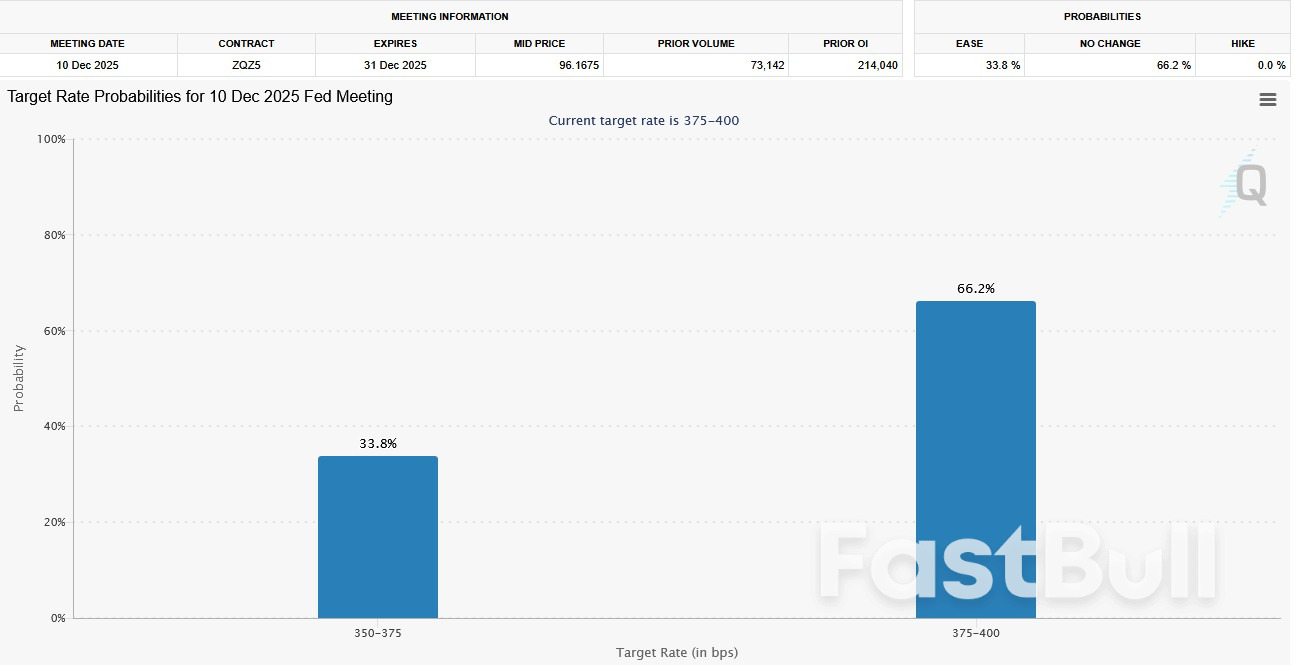
          Rate Cut Odds Slip Due to Lack of Data

          Adam

          Economic

          As we share below, the odds of a Fed Funds rate cut at the December FOMC meeting are down to 33%. On Wednesday, there was an abrupt repricing of rate cut odds after the BLS cancelled the October employment report and delayed the November data until December 19th. Furthermore, the BLS JOLTS report for September has been canceled, and the data for October will be released on December 9th.
          For reference, the FOMC meeting is on December 10th, so they will lack meaningful employment data when deciding whether to cut rates. The weakening labor market is the predominant reason the Fed cut rates by 25 bps at each of its last two meetings.
          Despite the absence of recent employment data, Fed officials will argue that they can still assess the labor market using alternative data sources. Markets do not agree, as judged by the downgrade in rate-cutting odds. For what it’s worth, the last two weekly ADP employment change reports show a decline of 11,250 jobs in the last week of October, and another loss of 2,500 jobs in the first week of November.
          In other Fed news, the minutes from the FOMC’s October meeting, released on Wednesday, show a deep divide over whether to cut interest rates at the December meeting. Several officials noted that progress in lowering inflation has “stalled” and cautioned that further rate cuts could risk entrenching higher inflation and undermining the Fed’s credibility regarding its 2% inflation target.
          However, another group argued that further cuts are necessary to guard against rising unemployment and some signs of weakening economic growth. Per the minutes:
          “Participants generally judged that upside risks to inflation remained elevated and that downside risks to employment were elevated and had increased since the first half of the year.”
          Rate Cut Odds Slip Due to Lack of Data_1

          Nvidia Hits Another Home Run

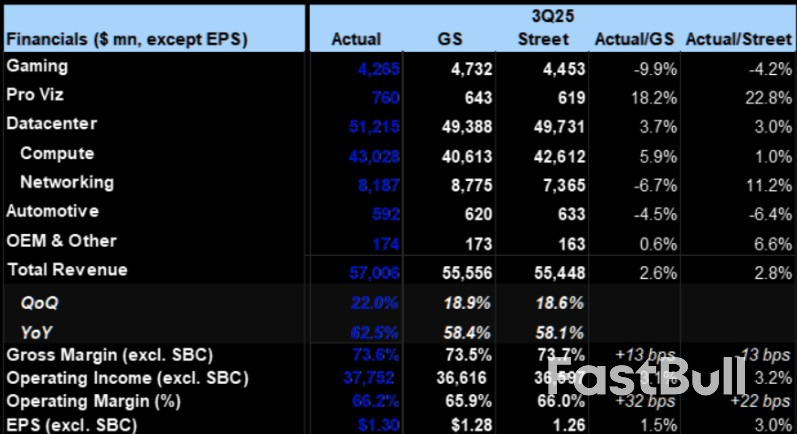
          Once again, NVIDIA (NASDAQ:NVDA) reported stellar quarterly earnings. For the third quarter, the company reported revenue of $57.0 billion, surpassing analyst expectations of $55.4 billion. The increase represents a 62% year-over-year rise and a 22% increase compared to the prior quarter. Not surprisingly, their data center segment accounted for a significant portion of the revenue ($51.2 billion). Adjusted earnings per diluted share came in at $1.30, beating Wall Street’s $1.26 forecast. Per Nvidia’s CEO Jensen Huang,
          Blackwell sales are off the charts, and cloud GPUs are sold out. Compute demand keeps accelerating and compounding across training and inference — each growing exponentially. AI is going everywhere, doing everything, all at once.
          It’s not just the sales and earnings growth that make Nvidia’s story bullish; its gross margins were little changed at a whopping 73.4% on a GAAP basis. Furthermore, as in prior reports, they continue to provide forecasts that exceed Wall Street’s expectations. The initial market reaction was positive, with the stock gaining about 5%.
          Rate Cut Odds Slip Due to Lack of Data_2
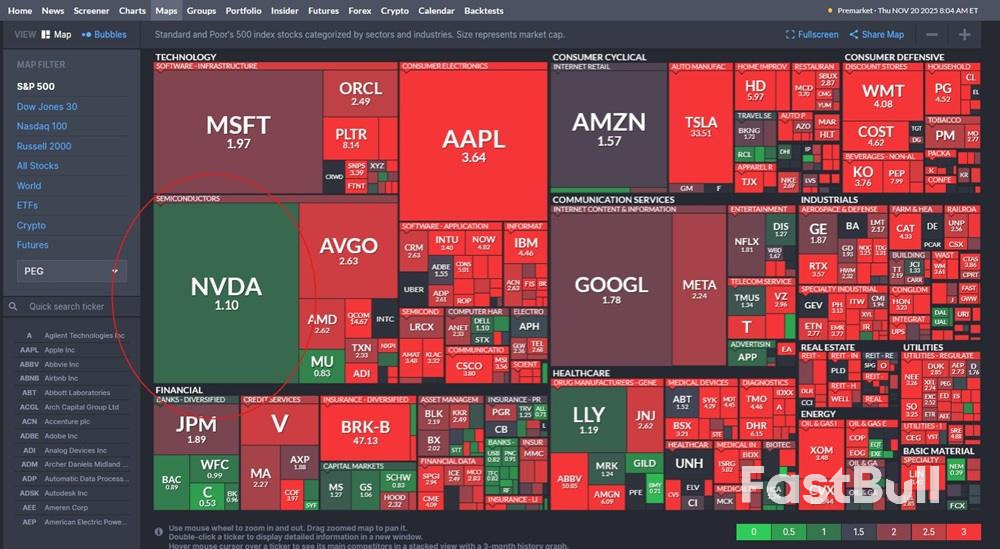
          The screenshot below, courtesy of FinViz, shows that with the new earnings data, Nvidia has a PEG ratio of 1.10. That is cheaper than the S&P 500 and well below some of its technology-sector competitors. The PEG ratio below assumes a P/E ratio of 48 and a five-year future EPS growth rate of 44%. While such growth is a tall order, it is a good bit slower than their 65% EPS growth over the last year. This leaves us with two questions to ponder:
          Is Nvidia’s earnings report enough to alleviate recent fears of a bubble in the AI industry?
          Might Nvidia be a value stock?
          Rate Cut Odds Slip Due to Lack of Data_3

          Nvidia: The Bearish Take

          The prior section spoke highly of Nvidia’s earnings announcement. We thought it would also be helpful to point out some aspects of the report that some claim are not so positive.
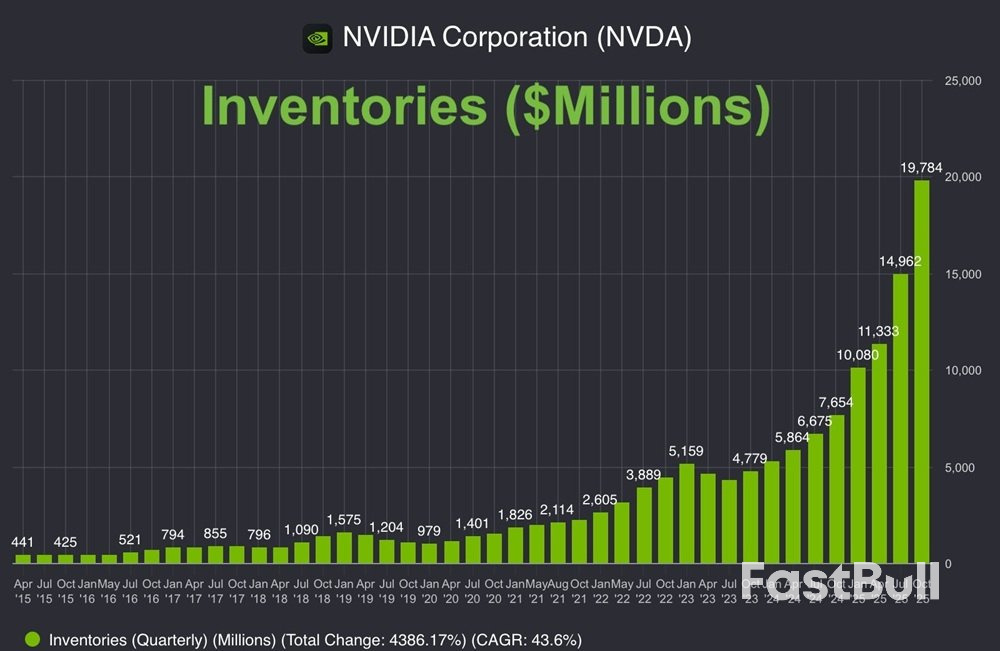
          The first graph below shows that inventories are up 32% quarter over quarter. If their GPUs are sold out, why is the inventory increasing rapidly?
          Accounts Receivable grew by $5.58B in the last quarter. Take away growth in accounts receivable and revenue missed expectations by $3.49 billion.
          A significant discrepancy between the net income declared of nearly $32B and the operating cash flow of $24B. Some claim this is due to creative accounting.
          The second graphic below is a tweet from Michael Burry. He has recently claimed that companies are using depreciation schedules for Nvidia chips that exceed the chips’ useful lives. Doing so props up earnings by reducing expenses. Accordingly, better-perceived financial health allows companies to finance CAPEX, which ultimately flows to Nvidia.
          Rate Cut Odds Slip Due to Lack of Data_4

          Source:investing

          To stay updated on all economic events of today, please check out our Economic calendar
          Risk Warnings and Disclaimers
          You understand and acknowledge that there is a high degree of risk involved in trading. Following any strategies or investment methods may lead to potential losses. The content on the site is provided by our contributors and analysts for information purposes only. You are solely responsible for determining whether any trading assets, securities, strategy, or any other product is suitable for investing based on your own investment objectives and financial situation.
          Add to Favorites
          Share

          Jitters over AI spending set to grow as US tech giants flood bond market ​

          Adam

          Economic

          Investors are growing uneasy that the rapid rise in public debt used to bankroll AI investments could strain the U.S. corporate bond market and eventually dampen the appeal of tech stocks, despite leverage across most major companies remaining low for now.
          Big tech firms are turning aggressively to the debt markets in their race to build AI-ready data centers, a shift for Silicon Valley firms that typically relied on cash to fund their investments.
          Since September, public bond issuance by four of the major cloud computing and AI platform companies known as "hyperscalers" has hit nearly $90 billion, with Google owner Alphabet (GOOGL.O) selling $25 billion in bonds, Meta (META.O) $30 billion, Oracle (ORCL.N) $18 billion, and Amazon (AMZN.O), the most recent, $15 billion, according to Reuters calculations of publicly available data. Only Microsoft (MSFT.O), the fifth one, has not tapped the debt market in recent weeks.
          Investors say that, so far, they are not overly concerned about the impact on stock valuations because of the recent fundraising, since these companies remain lightly leveraged relative to their scale.
          But the sudden pickup in public debt issuance has raised questions about the market’s ability to absorb the surge in supply and is feeding into growing worries over AI-related spending that have helped trigger a sharp pullback in U.S. stocks this month after six months of gains. The S&P 500 is still up 11% this year, with tech stocks among the main contributors to gains.
          "You have all these hyperscaler issuance coming out, and I think the market woke up to the fact that it's not going to be private credit markets that are going to fund AI, it's not going to be free cash flow. It's going to have to come from the public bond markets," said Brij Khurana, portfolio manager at Wellington Management Company.
          "You need capital to come from somewhere to finance this," he said. "What's happening is a recognition that you need money almost coming out of stocks into bonds."
          Including a $27 billion financing deal Meta struck with Blue Owl Capital in October to fund its biggest data center project, hyperscaler debt issuance has jumped to over $120 billion this year from an average of $28 billion over the past five years, analysts at BofA Securities said in a recent note.
          Rising debt at tech companies adds a new layer of concern to a market that, despite being fueled by the promise of high AI returns, remains wary that the technology has yet to deliver the profits needed to justify such large capital spending.
          "There are doubts that have emerged in the last few weeks around the AI spend story that are related to ... the need for firms to be able to finance that, and that includes through debt finance," said Larry Hatheway, global investment strategist for Franklin Templeton Institute.
          AI capital expenditure is projected to increase to $600 billion by 2027, up from over $200 billion in 2024 and just under $400 billion in 2025, and net debt issuance is expected to reach $100 billion in 2026, Sage Advisory, an investment management firm, said in a recent note.
          While hyperscalers have been ramping up borrowing, Nvidia (NVDA.O), a major supplier of computing power to them, has trimmed its long-term debt from $8.5 billion in January to $7.5 billion by the end of the third quarter. Credit ratings agency S&P Global Ratings last month revised its outlook on the company to "positive" from "stable," citing revenue growth and robust cash flow.
          Microsoft and Oracle declined to comment. An Amazon spokesperson said proceeds from its recent bond sale will fund business investments, future capex, and repay upcoming debt maturities, noting that such financing decisions are part of routine planning. Alphabet and Meta did not immediately comment.
          MARKET CONSTRAINTS
          Demand for recent tech bond deals has been strong, but investors demanded sizeable new issue premiums to absorb some of the new securities. Alphabet and Meta paid about 10-15 basis points over the companies' existing debt with their most recent debt issues, said Janus Henderson in a note.
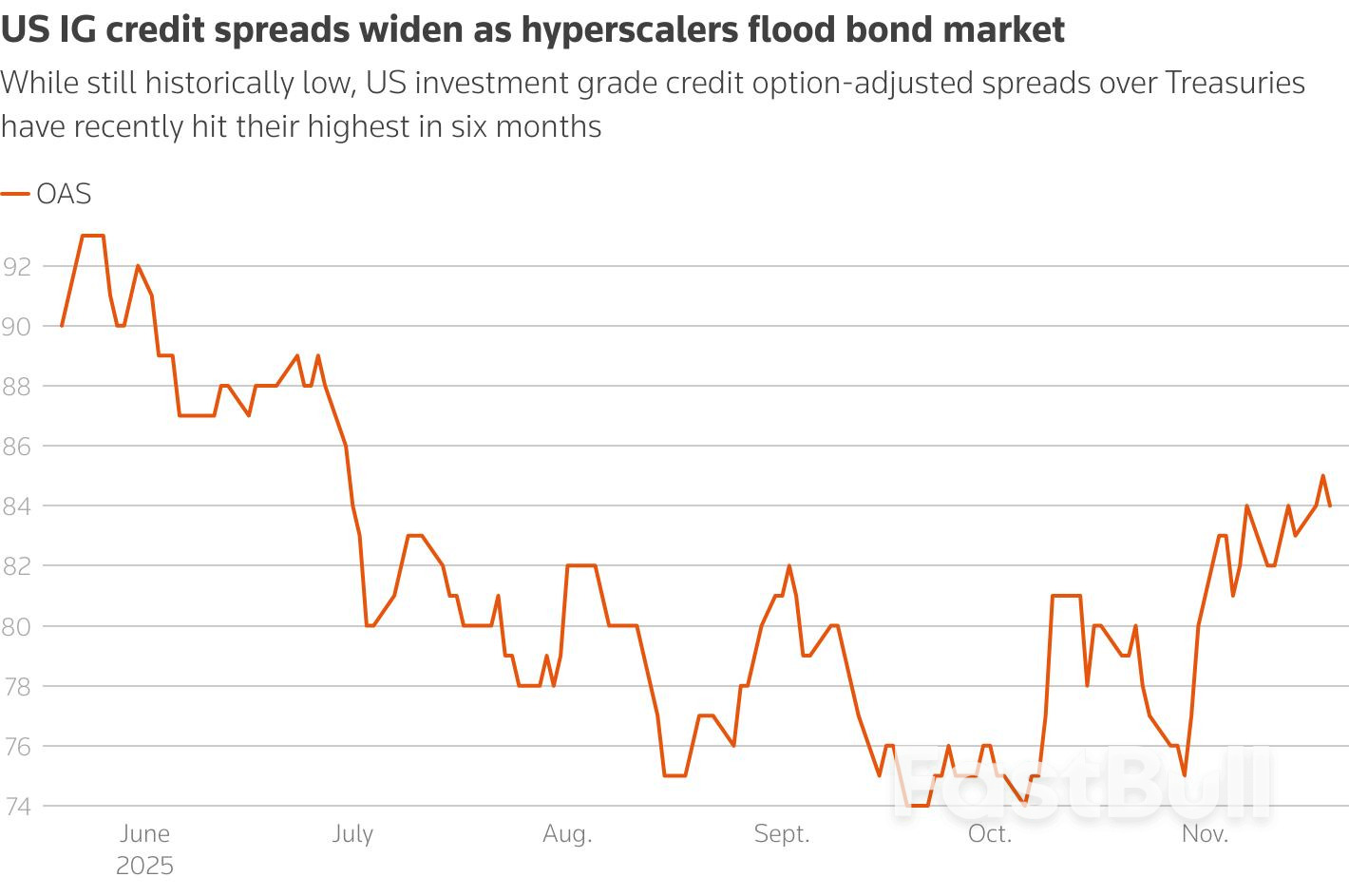
          While U.S. investment grade credit spreads - which indicate the premium highly rated companies pay over Treasuries to attract investor demand - remain historically low, they have ticked up in recent weeks, partly reflecting concerns over the new wave of bond supply hitting the markets.
          Jitters over AI spending set to grow as US tech giants flood bond market ​_1

          Chart shows that US investment grade credit option-adjusted spreads over Treasuries have recently hit their highest in six months

          "For much of the year, credit spreads have been grinding tighter ... But the recent deluge of supply – particularly from tech – may have changed the game," said Janus Henderson.
          To be sure, the shift to debt is expected to remain a small portion of total AI spending by large tech companies, with UBS recently estimating that about 80-90% of their planned capital expenditure still comes from cash flows. Sage Advisory's research said the top hyperscalers are expected to move from having more cash than debt to just modest levels of borrowing, still keeping leverage below 1×, meaning their total debt would be less than what they earn.
          "Supply bottlenecks or investor appetite are more likely to act as constraints on near-term capex than cash flows or balance sheet capacity," analysts at Goldman Sachs said in a note this week.
          Excluding Oracle, hyperscalers could absorb up to $700 billion in additional debt and still be viewed as safe, keeping leverage below that of the typical A+ rated firm, they said.
          "These companies still have very solid business lines that are just spinning off tons of cash," said Garrett Melson, portfolio strategist at Natixis Investment Managers Solutions.

          Source: reuters

          To stay updated on all economic events of today, please check out our Economic calendar
          Risk Warnings and Disclaimers
          You understand and acknowledge that there is a high degree of risk involved in trading. Following any strategies or investment methods may lead to potential losses. The content on the site is provided by our contributors and analysts for information purposes only. You are solely responsible for determining whether any trading assets, securities, strategy, or any other product is suitable for investing based on your own investment objectives and financial situation.
          Add to Favorites
          Share

          UMich Consumer Expectations Hit A Record (48 Year) Low

          Devin

          Economic

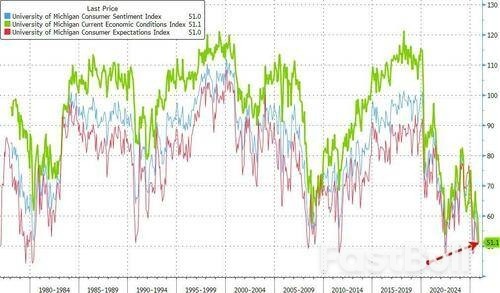
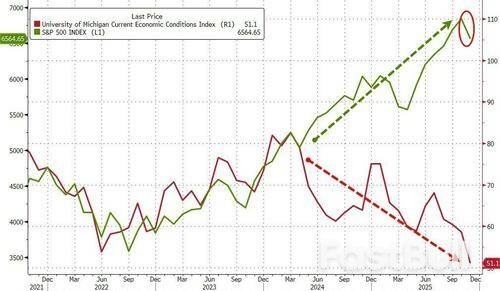
          The weakness from the preliminary UMich data for November has been confirmed with the final sentiment print confirmed the so-called 'K-shaped' economy as sentiment slumps with stocks near record highs.

          However, the small silver lining with today's UMich data was an improvement intra-month from 50.3 to 51.0 for the headline (but still at its lowest since June 2022).

          After the federal shutdown ended, UMich Director Joanne Hsu notes that sentiment lifted slightly from its mid-month reading.

          However, consumers remain frustrated about the persistence of high prices and weakening incomes.

          Under the hood, Expectations picked up modestly from 50.3 to 51.0, just off record lows, while Consumer Expectations plunged to 51.1 - the lowest in the survey's history going back to 1977...

          Source: Bloomberg

          Who the hell are they surveying?

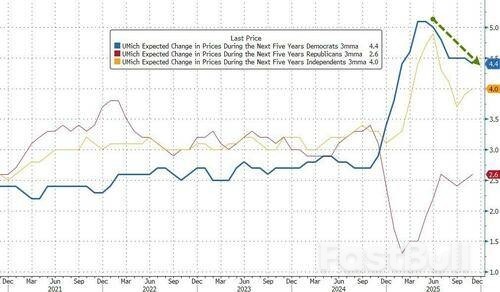
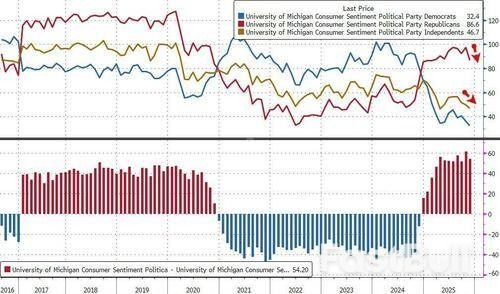
          Interestingly, while Democrat's confidence remains vastly worse than the rest of the political cohorts, November saw Republicans and Independents lose some faith too...

          Source: Bloomberg

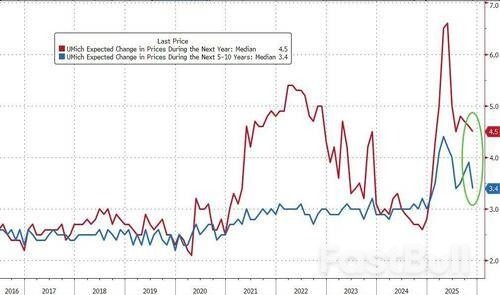
          On the bright side, inflation expectations tumbled. After four months of sharp increases to start 2025, long-run expectations fell for three consecutive months through July, followed by three more months of small increases. Long-run expectations softened considerably this month. The November reading is well below peaks in monthly readings from June 2022 and April 2025, but still above 2024 readings.

          Source: Bloomberg

          Expectations exhibit substantial uncertainty, particularly in light of ongoing developments with economic policy and concerns that impacts on inflation are still to come.

          Democrats continue to lead the fear of inflation (though dropped to January lows this month)...

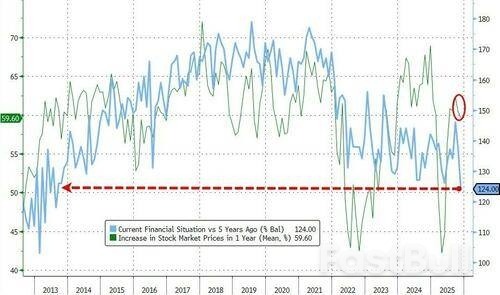
          However, this month, current personal finances and buying conditions for durables both plunged more than 10%...

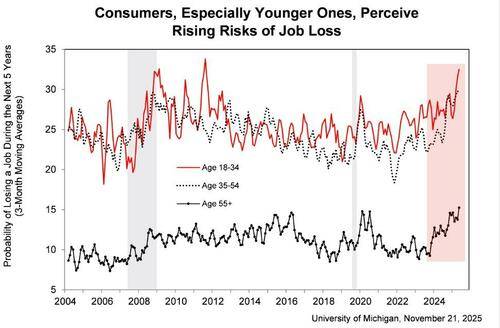
          and young and old alike are worried about their jobs...

          By the end of the month, sentiment for consumers with the largest stock holdings lost the gains seen at the preliminary reading.

          This group's sentiment dropped about 2 index points from October, likely a consequence of the stock market declines seen over the past two weeks.

          Source: Zero Hedge

          To stay updated on all economic events of today, please check out our Economic calendar
          Risk Warnings and Disclaimers
          You understand and acknowledge that there is a high degree of risk involved in trading. Following any strategies or investment methods may lead to potential losses. The content on the site is provided by our contributors and analysts for information purposes only. You are solely responsible for determining whether any trading assets, securities, strategy, or any other product is suitable for investing based on your own investment objectives and financial situation.
          Add to Favorites
          Share

          Crypto's Connections To The Rest Of The Financial System

          Winkelmann

          Forex

          Cryptocurrency

          Key points:

          · Soaring crypto markets highlight mainstream finance links
          · Regulators worry run on stablecoins could hit stability
          · Stock market, bank exposure to crypto small but growing

          Cryptocurrency markets have surged in recent years, in part fuelled by the Trump administration's pro-crypto stance which has encouraged wider acceptance among financial institutions.

          With a total value of $3.2 trillion and around $197 billion of trading volume per day, cryptocurrencies represent a small part of global markets, crypto tracker CoinGecko estimates.

          But regulators and investors are still worried about whether any problems in the lightly regulated crypto world could spill over into the wider financial system.

          The biggest cryptocurrency, bitcoin, fell below $90,000 for the first time since April this week, and some $1.2 trillion has been wiped off the value of all cryptocurrencies in six weeks.

          Bitcoin, generally moves in line with broader risk appetite. Its correlation with the S&P 500 on a one-month rolling basis this week was 0.84, its strongest in six weeks, LSEG data shows. Correlation is measured from -1 to 1.

          Here's where crypto and mainstream markets intersect.

          STABLECOIN RESERVES

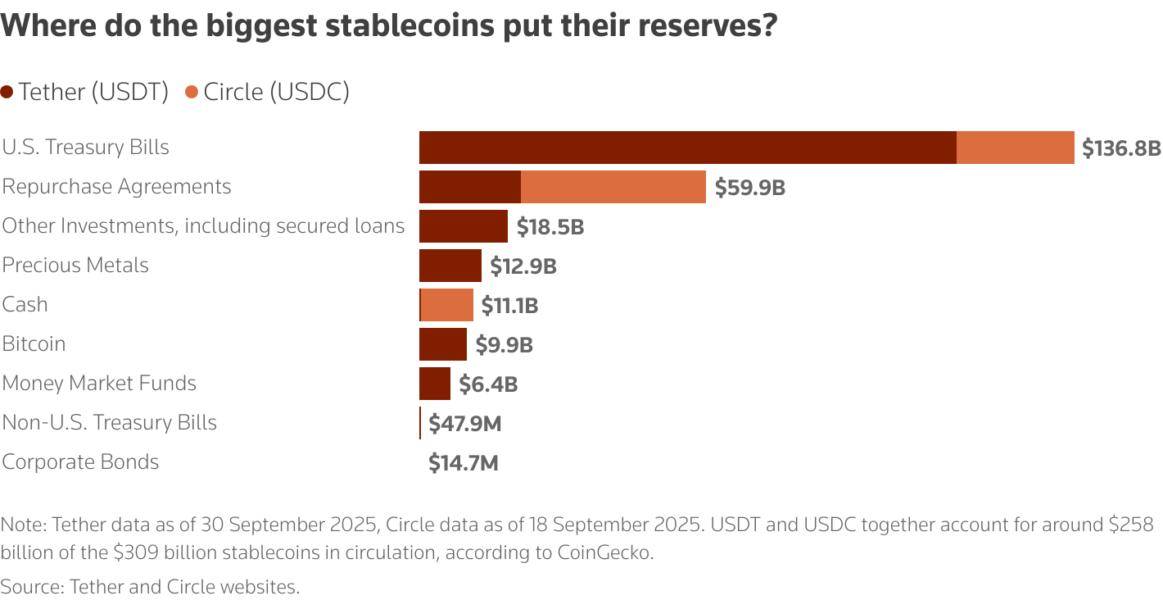
          Stablecoins are cryptocurrencies pegged to a real-world currency, usually the U.S. dollar. Stablecoin issuers hold reserves to match the number of tokens they have created, and say that token-holders can swap their stablecoins back into dollars on demand.

          Financial stability experts warn that a rush of redemption requests would cause a run on these reserves, affecting banks where cash is deposited, or even the assets that the reserves are invested in.

          The stablecoin market is dominated by El Salvador-based Tether, which has around $181 billion in reserves, of which $112 billion is held in U.S. Treasuries. Rival Circle holds $24 billion in U.S. Treasuries.

          Thomson ReutersWhere do the biggest stablecoins put their reserves?

          CRYPTO-RELATED STOCKS

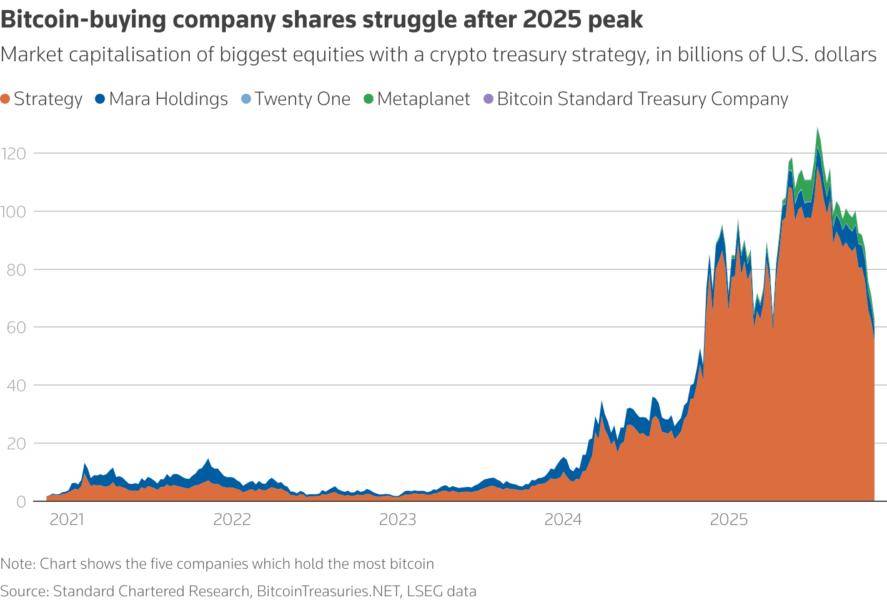
          Crypto stocks have soared in 2025, and more crypto companies have gone public. But pure players remain a tiny part of the overall market.

          The market cap of stocks in the "blockchain and cryptocurrency" and "cryptocurrency mining" category is $225 billion, just 1.8% of the global equities market, LSEG data shows.

          This excludes so-called crypto treasury companies, whose business model is to buy and hold crypto. While the bitcoin buyers include major players like Strategy, dozens of penny stocks have this year been taken over by crypto enthusiasts to bet on rising prices.

          Standard Chartered estimates that a bitcoin price below $90,000 leaves half of these companies' corporate treasuries holding bitcoin worth less than they paid for it.

          Four of the 173 new U.S. public listings in 2025 have been crypto companies, raising a combined $1.2 billion, around 3.3% of the total funds raised from U.S. IPOs, LSEG said.

          Thomson ReutersBitcoin-buying company shares struggle after 2025 peak

          BANK EXPOSURE TO CRYPTO

          Banks gain exposure to the crypto world by taking on crypto-linked clients, holding stablecoin reserves, or offering crypto-related services such as asset custody.

          Some small banks specialise in crypto, concentrating the risk, as seen in 2023 when crypto-focused U.S. bank Silvergate Capital collapsed after customers pulled deposits.

          U.S. regulators this year made it easier for banks to engage with crypto-related activities, pressuring regulators elsewhere to rethink their approach.

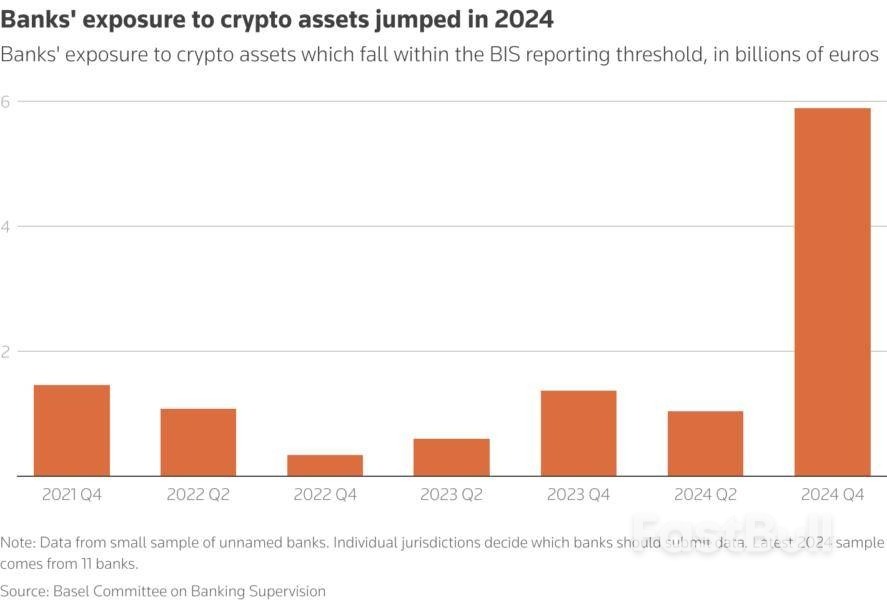
          Data on banks' exposure is hard to find, but what is available suggests it is small but growing.

          The European Central Bank said in a May review that significant institutions in the euro zone provided 4.7 billion euros worth of crypto asset custody services in 2024, up from 400 million euros in 2023.

          Basel Committee on Banking Supervision data shows 5.9 billion euros worth of prudential exposure to crypto in the second half of 2024, among banks from countries which volunteered data.

          Thomson ReutersBanks' exposure to crypto assets jumped in 2024

          CRYPTO INVESTMENT FUNDS

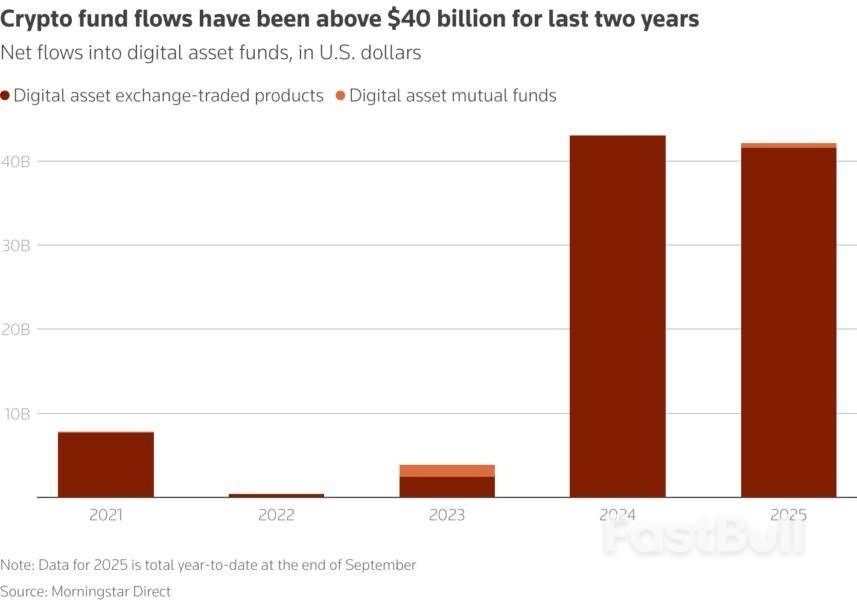
          The January 2024 decision by U.S. regulators to allow bitcoin exchange-traded funds unleashed a new wave of buyers, including institutional investors such as sovereign wealth funds and pension funds pouring money into crypto.

          The number of digital asset exchange-traded products worldwide has surged to 367 in 2025, up from 104 in 2021, according to Morningstar Direct data.

          Still, with $222.3 billion in assets under management, crypto ETPs are tiny compared to the $17.4 trillion managed by the world's non-crypto ETPs, Morningstar estimates.

          Thomson ReutersCrypto fund flows have been above $40 billion for last two years

          Source: TradingView

          Risk Warnings and Disclaimers
          You understand and acknowledge that there is a high degree of risk involved in trading. Following any strategies or investment methods may lead to potential losses. The content on the site is provided by our contributors and analysts for information purposes only. You are solely responsible for determining whether any trading assets, securities, strategy, or any other product is suitable for investing based on your own investment objectives and financial situation.
          Add to Favorites
          Share
          FastBull
          Copyright © 2025 FastBull Ltd

          728 RM B 7/F GEE LOK IND BLDG NO 34 HUNG TO RD KWUN TONG KLN HONG KONG

          TelegramInstagramTwitterfacebooklinkedin
          App Store Google Play Google Play
          Products
          Charts

          Chats

          Q&A with Experts
          Screeners
          Economic Calendar
          Data
          Tools
          Membership
          Features
          Function
          Markets
          Copy Trading
          Latest Signals
          Contests
          News
          Analysis
          24/7
          Columns
          Education
          Company
          Careers
          About Us
          Contact Us
          Advertising
          Help Center
          Feedback
          User Agreement
          Privacy Policy
          Business

          White Label

          Data API

          Web Plug-ins

          Poster Maker

          Affiliate Program

          Risk Disclosure

          The risk of loss in trading financial instruments such as stocks, FX, commodities, futures, bonds, ETFs and crypto can be substantial. You may sustain a total loss of the funds that you deposit with your broker. Therefore, you should carefully consider whether such trading is suitable for you in light of your circumstances and financial resources.

          No decision to invest should be made without thoroughly conducting due diligence by yourself or consulting with your financial advisors. Our web content might not suit you since we don't know your financial conditions and investment needs. Our financial information might have latency or contain inaccuracy, so you should be fully responsible for any of your trading and investment decisions. The company will not be responsible for your capital loss.

          Without getting permission from the website, you are not allowed to copy the website's graphics, texts, or trademarks. Intellectual property rights in the content or data incorporated into this website belong to its providers and exchange merchants.

          Not Logged In

          Log in to access more features

          FastBull Membership

          Not yet

          Purchase

          Become a signal provider
          Help Center
          Customer Service
          Dark Mode
          Price Up/Down Colors

          Log In

          Sign Up
          Position
          Layout
          Fullscreen
          Default to Chart
          The chart page opens by default when you visit fastbull.com