• Trade
  • Markets
  • Copy
  • Contests
  • News
  • 24/7
  • Calendar
  • Q&A
  • Chats
Trending
Screeners
SYMBOL
LAST
BID
ASK
HIGH
LOW
NET CHG.
%CHG.
SPREAD
SPX
S&P 500 Index
6870.39
6870.39
6870.39
6895.79
6858.28
+13.27
+ 0.19%
--
DJI
Dow Jones Industrial Average
47954.98
47954.98
47954.98
48133.54
47871.51
+104.05
+ 0.22%
--
IXIC
NASDAQ Composite Index
23578.12
23578.12
23578.12
23680.03
23506.00
+72.99
+ 0.31%
--
USDX
US Dollar Index
98.880
98.960
98.880
98.960
98.730
-0.070
-0.07%
--
EURUSD
Euro / US Dollar
1.16523
1.16530
1.16523
1.16717
1.16341
+0.00097
+ 0.08%
--
GBPUSD
Pound Sterling / US Dollar
1.33264
1.33273
1.33264
1.33462
1.33136
-0.00048
-0.04%
--
XAUUSD
Gold / US Dollar
4206.21
4206.62
4206.21
4218.85
4190.61
+8.30
+ 0.20%
--
WTI
Light Sweet Crude Oil
59.274
59.304
59.274
60.084
59.265
-0.535
-0.89%
--

Community Accounts

Signal Accounts
--
Profit Accounts
--
Loss Accounts
--
View More

Become a signal provider

Sell trading signals to earn additional income

View More

Guide to Copy Trading

Get started with ease and confidence

View More

Signal Accounts for Members

All Signal Accounts

Best Return
  • Best Return
  • Best P/L
  • Best MDD
Past 1W
  • Past 1W
  • Past 1M
  • Past 1Y

All Contests

  • All
  • Trump Updates
  • Recommend
  • Stocks
  • Cryptocurrencies
  • Central Banks
  • Featured News
Top News Only
Share

German Government Spokesperson: We Reject Criticism Of Europe In New US National Security Strategy

Share

Ivory Coast 2025/26 Cocoa Arrivals Reached 803000 T By December 7 Versus 820000 T A Year Ago - Exporters' Estimate

Share

EU To Delay Proposals For Automotive Sector, Including Co2 Emissions, To Dec 16, Draft EU Commission Document Shows

Share

Kremlin: India Buys Energy Where It Is Profitable To And As Far As We Understand They Will Continue To Do That

Share

Turkey's Main Banking Index Up 2.5%

Share

Turkey's Main BIST-100 Index Up 1.9%

Share

Hungary's Preliminary November Budget Balance Huf -403 Billion

Share

Indian Rupee Down 0.1% At 90.07 Per USA Dollar As Of 3:30 P.M. Ist, Previous Close 89.98

Share

India's Nifty 50 Index Provisionally Ends 0.96% Lower

Share

[JPMorgan: US Stock Rally May Stagnate Following Fed Rate Cut] JPMorgan Strategists Say The Recent Rally In US Stocks May Stall As Investors Take Profits Following The Anticipated Fed Rate Cut. The Market Currently Predicts A 92% Probability Of The Fed Lowering Borrowing Costs On Wednesday. Expectations Of A Rate Cut Have Continued To Rise, Fueled By Positive Signals From Policymakers In Recent Weeks. "Investors May Be More Inclined To Lock In Gains At The End Of The Year Rather Than Increase Directional Exposure," Mislav Matejka's Team Wrote In A Report

Share

Russian Defence Ministry: Russian Forces Take Control Of Novodanylivka In Ukraine's Zaporizhzhia Region

Share

Russian Defence Ministry: Russian Forces Take Control Of Chervone In Ukraine's Donetsk Region

Share

French Finance Ministry: Government Started Process To Block Temporarily Shein Platform

Share

Finance Minister: Indonesia To Impose Coal Export Tax Of Up To 5% Next Year

Share

[Trump Considering Fired Homeland Security Secretary Noem? White House Denies] According To Reports From US Media Outlets Such As The Daily Beast And The UK's Independent, The White House Has Denied Reports That US President Trump Is Considering Firing Homeland Security Secretary Noem. White House Spokesperson Abigail Jackson Posted On Social Media On The 7th Local Time, Calling The Claims "fake News" And Stating That "Secretary Noem Has Done An Excellent Job Implementing The President's Agenda And 'making America Safe Again'."

Share

HKEX: Standard Chartered Bought Back 571604 Total Shares On Other Exchanges For Gbp9.5 Million On Dec 5

Share

Morgan Stanley Reiterates Bullish Outlook On US Stocks Due To Fed Rate Cut Expectations. Morgan Stanley Strategists Believe That The US Stock Market Faces A "bullish Outlook" Given Improved Earnings Expectations And Anticipated Fed Rate Cuts. They Expect Strong Corporate Earnings By 2026, And Anticipate The Fed Will Cut Rates Based On Lagging Or Mildly Weak Labor Markets. They Expect The US Consumer Discretionary Sector And Small-cap Stocks To Continue To Outperform

Share

China's National Development And Reform Commission Announced That Starting From 24:00 On December 8, The Retail Price Limit For Gasoline And Diesel In China Will Be Reduced By 55 Yuan Per Ton, Which Translates To A Reduction Of 0.04 Yuan Per Liter For 92-octane Gasoline, 0.05 Yuan Per Liter For 95-octane Gasoline, And 0.05 Yuan Per Liter For 0# Diesel

Share

Tkms CEO: US Security Strategy Highlights Need For Europe To Take Care Of Its Own Defences

Share

USA S&P 500 E-Mini Futures Up 0.1%, NASDAQ 100 Futures Up 0.18%, Dow Futures Down 0.02%

TIME
ACT
FCST
PREV
France Industrial Output MoM (SA) (Oct)

A:--

F: --

P: --
France Trade Balance (SA) (Oct)

A:--

F: --

P: --
Euro Zone Employment YoY (SA) (Q3)

A:--

F: --

P: --
Canada Part-Time Employment (SA) (Nov)

A:--

F: --

P: --

Canada Unemployment Rate (SA) (Nov)

A:--

F: --

P: --

Canada Full-time Employment (SA) (Nov)

A:--

F: --

P: --

Canada Labor Force Participation Rate (SA) (Nov)

A:--

F: --

P: --

Canada Employment (SA) (Nov)

A:--

F: --

P: --

U.S. PCE Price Index MoM (Sept)

A:--

F: --

P: --

U.S. Personal Income MoM (Sept)

A:--

F: --

P: --

U.S. Core PCE Price Index MoM (Sept)

A:--

F: --

P: --

U.S. PCE Price Index YoY (SA) (Sept)

A:--

F: --

P: --

U.S. Core PCE Price Index YoY (Sept)

A:--

F: --

P: --

U.S. Personal Outlays MoM (SA) (Sept)

A:--

F: --

P: --
U.S. 5-10 Year-Ahead Inflation Expectations (Dec)

A:--

F: --

P: --

U.S. Real Personal Consumption Expenditures MoM (Sept)

A:--

F: --

P: --
U.S. Weekly Total Rig Count

A:--

F: --

P: --

U.S. Weekly Total Oil Rig Count

A:--

F: --

P: --

U.S. Consumer Credit (SA) (Oct)

A:--

F: --

P: --
China, Mainland Foreign Exchange Reserves (Nov)

A:--

F: --

P: --

Japan Trade Balance (Oct)

A:--

F: --

P: --

Japan Nominal GDP Revised QoQ (Q3)

A:--

F: --

P: --

China, Mainland Imports YoY (CNH) (Nov)

A:--

F: --

P: --

China, Mainland Exports (Nov)

A:--

F: --

P: --

China, Mainland Imports (CNH) (Nov)

A:--

F: --

P: --

China, Mainland Trade Balance (CNH) (Nov)

A:--

F: --

P: --

China, Mainland Exports YoY (USD) (Nov)

A:--

F: --

P: --

China, Mainland Imports YoY (USD) (Nov)

A:--

F: --

P: --

Germany Industrial Output MoM (SA) (Oct)

A:--

F: --

P: --
Euro Zone Sentix Investor Confidence Index (Dec)

A:--

F: --

P: --

Canada National Economic Confidence Index

--

F: --

P: --

U.K. BRC Like-For-Like Retail Sales YoY (Nov)

--

F: --

P: --

U.K. BRC Overall Retail Sales YoY (Nov)

--

F: --

P: --

Australia Overnight (Borrowing) Key Rate

--

F: --

P: --

RBA Rate Statement
RBA Press Conference
Germany Exports MoM (SA) (Oct)

--

F: --

P: --

U.S. NFIB Small Business Optimism Index (SA) (Nov)

--

F: --

P: --

Mexico 12-Month Inflation (CPI) (Nov)

--

F: --

P: --

Mexico Core CPI YoY (Nov)

--

F: --

P: --

Mexico PPI YoY (Nov)

--

F: --

P: --

U.S. Weekly Redbook Index YoY

--

F: --

P: --

U.S. JOLTS Job Openings (SA) (Oct)

--

F: --

P: --

China, Mainland M1 Money Supply YoY (Nov)

--

F: --

P: --

China, Mainland M0 Money Supply YoY (Nov)

--

F: --

P: --

China, Mainland M2 Money Supply YoY (Nov)

--

F: --

P: --

U.S. EIA Short-Term Crude Production Forecast For The Year (Dec)

--

F: --

P: --

U.S. EIA Natural Gas Production Forecast For The Next Year (Dec)

--

F: --

P: --

U.S. EIA Short-Term Crude Production Forecast For The Next Year (Dec)

--

F: --

P: --

EIA Monthly Short-Term Energy Outlook
U.S. API Weekly Gasoline Stocks

--

F: --

P: --

U.S. API Weekly Cushing Crude Oil Stocks

--

F: --

P: --

U.S. API Weekly Crude Oil Stocks

--

F: --

P: --

U.S. API Weekly Refined Oil Stocks

--

F: --

P: --

South Korea Unemployment Rate (SA) (Nov)

--

F: --

P: --

Japan Reuters Tankan Non-Manufacturers Index (Dec)

--

F: --

P: --

Japan Reuters Tankan Manufacturers Index (Dec)

--

F: --

P: --

Japan Domestic Enterprise Commodity Price Index MoM (Nov)

--

F: --

P: --

Japan Domestic Enterprise Commodity Price Index YoY (Nov)

--

F: --

P: --

China, Mainland PPI YoY (Nov)

--

F: --

P: --

Q&A with Experts
    • All
    • Chatrooms
    • Groups
    • Friends
    Connecting
    .
    .
    .
    Type here...
    Add Symbol or Code

      No matching data

      All
      Trump Updates
      Recommend
      Stocks
      Cryptocurrencies
      Central Banks
      Featured News
      • All
      • Russia-Ukraine Conflict
      • Middle East Flashpoint
      • All
      • Russia-Ukraine Conflict
      • Middle East Flashpoint
      Search
      Products

      Charts Free Forever

      Chats Q&A with Experts
      Screeners Economic Calendar Data Tools
      Membership Features
      Data Warehouse Market Trends Institutional Data Policy Rates Macro

      Market Trends

      Market Sentiment Order Book Forex Correlations

      Top Indicators

      Charts Free Forever
      Markets

      News

      News Analysis 24/7 Columns Education
      From Institutions From Analysts
      Topics Columnists

      Latest Views

      Latest Views

      Trending Topics

      Top Columnists

      Latest Update

      Signals

      Copy Rankings Latest Signals Become a signal provider AI Rating
      Contests
      Brokers

      Overview Brokers Assessment Rankings Regulators News Claims
      Broker listing Forex Brokers Comparison Tool Live Spread Comparison Scam
      Q&A Complaint Scam Alert Videos Tips to Detect Scam
      More

      Business
      Events
      Careers About Us Advertising Help Center

      White Label

      Data API

      Web Plug-ins

      Affiliate Program

      Awards Institution Evaluation IB Seminar Salon Event Exhibition
      Vietnam Thailand Singapore Dubai
      Fans Party Investment Sharing Session
      FastBull Summit BrokersView Expo
      Recent Searches
        Top Searches
          Markets
          News
          Analysis
          User
          24/7
          Economic Calendar
          Education
          Data
          • Names
          • Latest
          • Prev

          View All

          No data

          Scan to Download

          Faster Charts, Chat Faster!

          Download App
          English
          • English
          • Español
          • العربية
          • Bahasa Indonesia
          • Bahasa Melayu
          • Tiếng Việt
          • ภาษาไทย
          • Français
          • Italiano
          • Türkçe
          • Русский язык
          • 简中
          • 繁中
          Open Account
          Search
          Products
          Charts Free Forever
          Markets
          News
          Signals

          Copy Rankings Latest Signals Become a signal provider AI Rating
          Contests
          Brokers

          Overview Brokers Assessment Rankings Regulators News Claims
          Broker listing Forex Brokers Comparison Tool Live Spread Comparison Scam
          Q&A Complaint Scam Alert Videos Tips to Detect Scam
          More

          Business
          Events
          Careers About Us Advertising Help Center

          White Label

          Data API

          Web Plug-ins

          Affiliate Program

          Awards Institution Evaluation IB Seminar Salon Event Exhibition
          Vietnam Thailand Singapore Dubai
          Fans Party Investment Sharing Session
          FastBull Summit BrokersView Expo

          Why Texas is Buying Bitcoin From BlackRock Before Building a Real Reserve

          Manuel

          Cryptocurrency

          Political

          Summary:

          Operational challenges prompt Texas's strategic use of an ETF as a temporary measure while building sovereign-grade custody.
          Texas has taken the first formal step toward becoming the first US state to hold Bitcoin as a strategic reserve asset.
          On Nov. 25, Lee Bratcher, president of the Texas Blockchain Council, reported that the world’s eighth-largest economy, valued at $2.7 trillion, purchased $5 million worth of BlackRock’s spot Bitcoin ETF, IBIT.
          He added that a second $5 million allocation is already lined up for direct Bitcoin acquisition once the state finalizes a custody and liquidity framework required under a new reserve law.
          The two tranches create a bridge between today’s institutional rails and a future in which governments do not just buy Bitcoin but hold it.

          Texas builds the first state-level blueprint

          The initial exposure did not go directly on-chain. Instead, Texas entered via IBIT, which has become the default wrapper for large allocators seeking Bitcoin access within familiar regulatory and operational infrastructure.
          This purchase was enabled by Senate Bill 21, a law signed by Governor Greg Abbott in June that established the Texas Strategic Bitcoin Reserve.
          The framework allows the state Comptroller to accumulate Bitcoin so long as the asset maintains a 24-month average market capitalization above $500 billion. Bitcoin is the only cryptocurrency that meets the threshold.
          The structure places the reserve outside the state treasury, sets governance channels for how the assets are held, and introduces an advisory committee to monitor risk and oversight.
          Meanwhile, the first $5 million is small relative to the scale of state finances, but the mechanics matter more than the number.
          Texas is testing whether Bitcoin can be formalized as a public reserve instrument within a state-level financial system that already manages hundreds of billions of dollars across different pools.
          Once the operational processes are in place, the second tranche will involve self-custodied Bitcoin, which introduces very different implications for liquidity, transparency, and audit practices.
          The state is designing procedures that resemble sovereign-grade custody rather than institutional brokerage. The reserve will require a qualified custodian, cold-storage capacity, key management protocols, independent audits, and reporting schedules.
          These are the building blocks of a repeatable template that other states could adopt without reinventing the governance architecture.

          Why BlackRock’s IBIT comes first

          The decision to enter through IBIT was not a signal of preference for ETFs over native Bitcoin. It was an operational workaround.
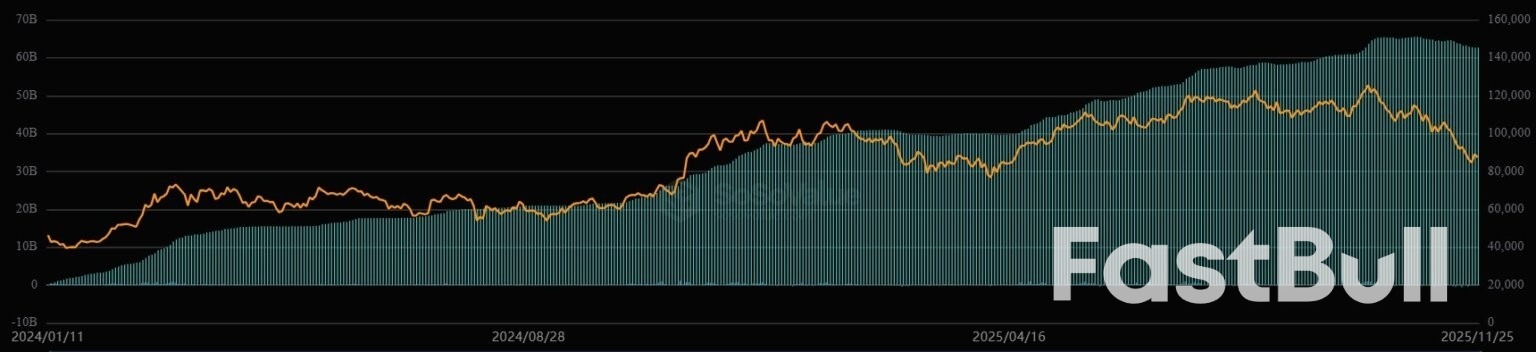
          IBIT is only in its second year, yet it has emerged as the most widely held Bitcoin ETF among major institutions. The fund is the largest Bitcoin ETF product, with cumulative net inflows of more than $62 billion.Why Texas is Buying Bitcoin From BlackRock Before Building a Real Reserve_1
          Moreover, the apparatus for public-sector self-custody does not exist in most jurisdictions, and creating that infrastructure requires procurement, security modeling, and political signoff. So, the state used IBIT as a placeholder, a temporary facility that allows it to express exposure while finalizing the permanent structure.
          This detour is instructive because it mirrors the trajectory of other large allocators.
          Harvard University disclosed that IBIT became one of its largest US equity holdings in the third quarter. Abu Dhabi Investment Council tripled its IBIT exposure over the same period, reaching roughly eight million shares. Wisconsin’s pension system disclosed more than $160 million across spot Bitcoin ETFs earlier this year, also routed through IBIT.
          The pattern is clear. Large institutions with different mandates, geographies, and risk frameworks are gravitating toward the same instrument. IBIT offers custody through a known intermediary, simplified reporting lines, and a clean accounting presentation under the new fair-value rules that took effect in 2025.
          These conveniences have turned the ETF into a de facto entry point for public and quasi-public entities. Texas is unique only in the fact that its IBIT exposure is meant to be temporary.

          What happens if others follow?

          The broader question is whether Texas becomes an anomaly or a blueprint.
          Bitcoin analyst Shanaka Anslem Perera said: “The cascade is mathematical. Four to eight states are positioned to follow within eighteen months, collectively commanding over $1.2 trillion in reserves. Institutional inflows projected between $300 million to $1.5 billion in near-term mimicry. This is not speculation. This is game theory in motion.”
          Already, politically aligned states like New Hampshire and Arizona also have Bitcoin reserve laws because they view the top crypto as a strategic hedge to the global financial system.
          More states could follow, as they could use their structural surpluses to allocate to Bitcoin for diversification, especially under the new accounting standards that neutralize earlier mark-to-market penalties.
          Moreover, the implications of state-level involvement extend beyond symbolism. ETF purchases do not alter the circulating supply because the trust structure issues and redeems shares without removing coins from liquid markets.
          Self-custody does the opposite. Once coins are purchased for cold storage, they leave the tradable float, reducing the supply available to exchanges and market makers.
          This distinction matters if Texas scales the reserve beyond its initial $10 million. Even modest state-level demand introduces a new type of buy-side participant, one that behaves countercyclically to noise traders and does not churn positions.
          The effect resembles a stabilizing anchor rather than a source of volatility. If other states adopt similar policies, the Bitcoin supply curve becomes more inelastic, increasing price sensitivity.

          Source: Cryptoslate

          Risk Warnings and Disclaimers
          You understand and acknowledge that there is a high degree of risk involved in trading. Following any strategies or investment methods may lead to potential losses. The content on the site is provided by our contributors and analysts for information purposes only. You are solely responsible for determining whether any trading assets, securities, strategy, or any other product is suitable for investing based on your own investment objectives and financial situation.
          Add to Favorites
          Share

          Alibaba Q2 FY2026 earnings: revenue beats estimates despite 71% profit decline

          Adam

          Economic

          Key financial metrics

          Alibaba reported RMB247.8 billion in revenue (versus consensus estimate of RMB242.7 billion) for the second quarter of fiscal year 2026, representing a 5% year-on-year (YoY) increase whilst remaining flat quarter-on-quarter. However, non-GAAP diluted earnings declined 71% year-on-year to RMB4.36 per American Depositary Share (ADS), approximately 20% below analyst expectations. This substantial contraction in profitability reflects the company's aggressive capital allocation towards strategic growth initiatives.

          Cloud business exceeds expectation

          The Cloud Intelligence Group sustained its position as the primary revenue growth driver, advancing 34% YoY to RMB39.8 billion during the quarter. AI-related products demonstrated triple-digit growth for the ninth consecutive quarter, underscoring sustained momentum in this critical segment.
          Chief Executive Officer Eddie Wu addressed market concerns regarding an AI bubble during yesterday's earnings call, indicating the company maintains confidence in the sector’s prospects in the next three years. He articulated Alibaba's strategic commitment to expanding AI infrastructure capabilities to accommodate surging market demand and navigate intensifying competitive pressures within the rapidly evolving technology landscape.
          The company is positioning itself to establish leadership within China's consumer AI applications sector, particularly given the absence of Google's Gemini and OpenAI's ChatGPT in the domestic market. Alibaba's proprietary AI application Qwen achieved over 10 million downloads within four days of launch this month, surpassing the initial adoption trajectory of DeepSeek upon its market entry.

          Core retail business demonstrates resilience

          Supported by government consumption stimulus measures and enhanced marketing expenditure, Alibaba's local e-commerce segment recorded 16% revenue growth – the fastest expansion rate since 2021. The company prioritised operational efficiency improvements within its quick commerce operations, yielding enhanced customer retention metrics and elevated average order values.
          The Singles' Day Shopping Festival successfully generated double-digit consumer growth YoY on the Taobao platform, substantially supported through promotional discounts underwritten by the retailer. These outcomes will be reflected in third quarter financial results.

          Marketing spend and AI investment constrain profitability

          However, the robust revenue growth trajectory came at considerable cost. Sales and marketing expenses more than doubled to RMB66 billion as the company competes for market share against rival quick commerce platforms including JD.com and Meituan. Adjusted EBITDA for the China E-commerce Group contracted 76% YoY. We anticipate marketing expenses will remain elevated in the near term.
          Alibaba's balance sheet position has deteriorated, reflecting a net cash flow outflow of RMB21.8 billion last quarter. An 80% YoY increase in capital expenditure served as the primary driver, as the company pursues aggressive investment in AI infrastructure development.

          Share price analysis

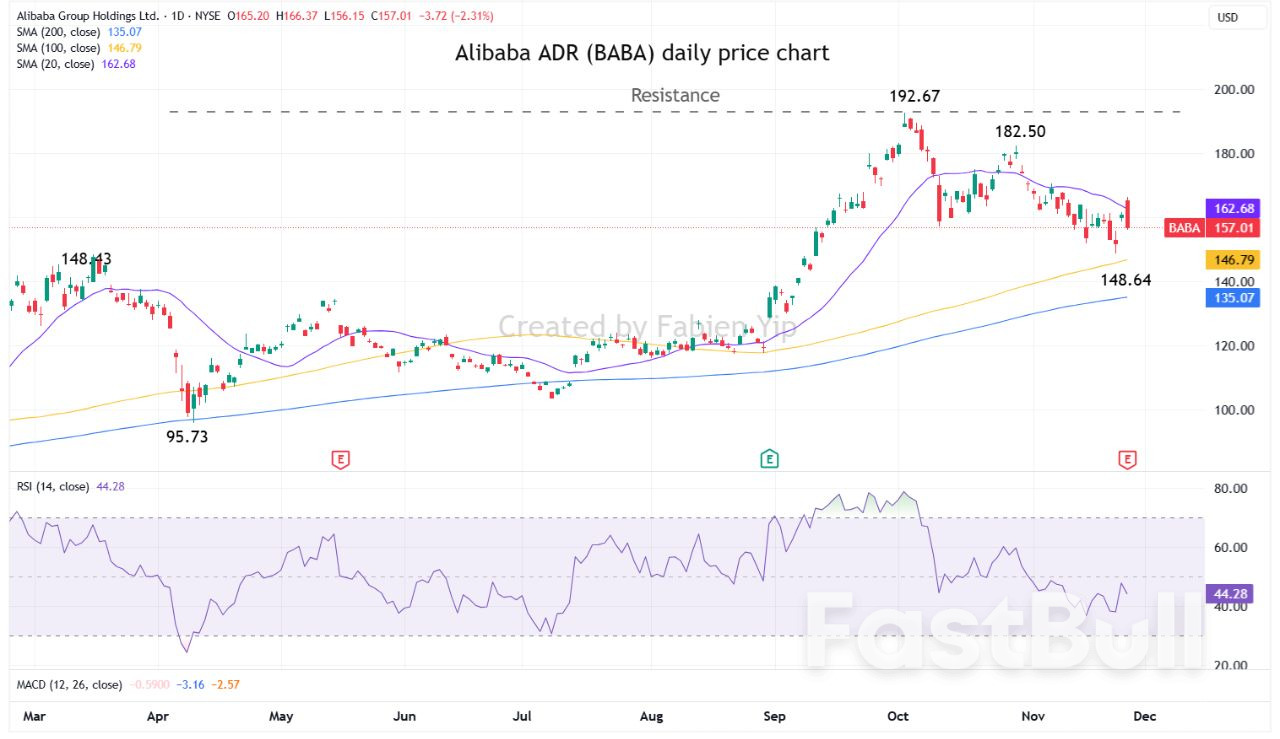
          Alibaba's ADR initially advanced approximately 3% during US pre-market trading following the results, though this optimism swiftly reversed as investor concerns regarding AI expenditure and margin compression intensified. Hong Kong-listed shares also opened lower today. Despite closing 2.3% lower in US markets yesterday, the security has delivered 86% year-to-date gains, significantly outperforming the MSCI China Index.
          From a fundamental analysis perspective, the stock's 12-month forward price-to-earnings ratio has expanded considerably from 12 times to 18 times over the past six months. As market participants increasingly focus on profit-taking ahead of year-end, a retracement following the sustained rally since April appears unsurprising.
          From a technical analysis standpoint, the share price has rebounded from $148.6, approximately a 50% Fibonacci retracement level from the recent upward wave. The recovery trajectory will encounter resistance around $182.5. Maintaining support above the 200-day moving average at $135.1 remains critical for sustaining the ascending medium-term trend. Failure to hold this level may trigger further downside towards the $115–$120 range.
          Figure 1: Alibaba daily price chart

          Alibaba Q2 FY2026 earnings: revenue beats estimates despite 71% profit decline_1as of 26 November 2025. Past performance is not a reliable indicator of future performance.

          Source: ig

          To stay updated on all economic events of today, please check out our Economic calendar
          Risk Warnings and Disclaimers
          You understand and acknowledge that there is a high degree of risk involved in trading. Following any strategies or investment methods may lead to potential losses. The content on the site is provided by our contributors and analysts for information purposes only. You are solely responsible for determining whether any trading assets, securities, strategy, or any other product is suitable for investing based on your own investment objectives and financial situation.
          Add to Favorites
          Share

          Mortgage Rates Dropped This Week Amid Fresh Signs of Job Market Weakness

          Manuel

          Bond

          Central Bank

          Mortgage rates dropped slightly this week amid new signals that the labor market is weakening and the Federal Reserve will cut interest rates again next month.
          The average 30-year mortgage rate was 6.23% through Tuesday, according to Freddie Mac data, down from 6.26% a week earlier. The average 15-year mortgage rate was 5.51%, from 5.54%.
          The 10-year Treasury yield, which mortgage rates closely track, has been falling as odds of a benchmark rate cut in December are on the rise. In recent days, New York Fed president John Williams, San Francisco Federal Reserve president Mary Daly, and Federal Reserve Governor Christopher Waller have all signaled in interviews or speeches that they would support cutting next month.
          Consensus about a December rate cut is growing as new data suggests the labor market continues to weaken. This month, job losses at private employers sped up, according to data released on Tuesday by payroll processor ADP.
          Traders now see an 83% chance of a 25-basis point cut at the Fed’s Dec. 9-10 meeting, according to CME FedWatch. Although mortgage rates aren’t directly controlled by the Fed, they do move based on expectations about future Fed interest rate policy.
          Another cut "could bring mortgage rates near 2025-lows just as the year comes to a close," Jake Krimmel, Realtor.com senior economist, said in a statement.
          "This would give homebuyers something to be thankful for heading into 2026, while potentially buoying a housing market which has seen some light tailwinds of late," he added.
          Treasury yields and mortgage rates also moved lower on Tuesday after Bloomberg News reported that White House National Economic Council Director Kevin Hassett, a close ally of President Trump and a supporter of lower rates, is seen as the likely frontrunner to succeed Jerome Powell as Fed Chair.
          Mortgage rates have been hovering around year-to-date lows of 6.2% to 6.3% for most of this fall, bringing some buyers back into the market. Contract signings jumped 1.9% in October from a month earlier, new National Association of Realtors data showed. Applications to purchase a home were up 8% through Friday compared to a week earlier, according to the Mortgage Bankers Association.

          Source: Yahoo Finance

          Risk Warnings and Disclaimers
          You understand and acknowledge that there is a high degree of risk involved in trading. Following any strategies or investment methods may lead to potential losses. The content on the site is provided by our contributors and analysts for information purposes only. You are solely responsible for determining whether any trading assets, securities, strategy, or any other product is suitable for investing based on your own investment objectives and financial situation.
          Add to Favorites
          Share

          US Supreme Court Postpones Decision On Trump Bid To Oust Top Copyright Official

          Justin

          Economic

          The U.S. Supreme Court postponed on Wednesday a decision on whether to let Donald Trump remove the government's top copyright official in the latest battle over the Republican president's targeting of federal officials.

          The action by the justices temporarily leaves in place Shira Perlmutter as the U.S. register of copyrights and director of the U.S. Copyright Office after a lower court blocked Trump's firing of her while her legal challenge to her removal proceeds.

          The Supreme Court's order indicated that it would issue a decision on Perlmutter's case after it hears arguments that have already been set in two other cases involving Trump's firing of a Democratic member of the Federal Trade Commission and his attempt to fire Federal Reserve Governor Lisa Cook.

          Perlmutter was notified on May 10 by a Trump administration official that she had been fired. Her duties as the government's top copyright official have included serving as the primary adviser for Congress on copyright issues.

          Trump's move to terminate Perlmutter came a day after her office circulated a report finding that some unauthorized uses of copyrighted works carried out by tech firms to train generative artificial intelligence systems may be unlawful. Her lawyers have said in legal papers that Trump sought to remove her from her job because he disagreed with the report's findings on AI.

          Trump in mid-May also fired Librarian of Congress Carla Hayden, who has not challenged her removal. The president then moved to replace Hayden with Todd Blanche, his former criminal defense attorney and current deputy attorney general, the No. 2 role at the Justice Department.

          Blanche, in his capacity as acting head of the Library of Congress, which oversees the U.S. Copyright Office, purported to ratify Trump's decision to remove Perlmutter.

          Perlmutter on May 22 sued to block her firing. She argued among other things that Trump lacked the authority to appoint Blanche as acting Librarian of Congress because that office is not an executive branch agency, but rather is part of the legislative branch.

          The U.S. Constitution divides the powers of the U.S. government among the executive, legislative and judicial branches.

          Washington-based U.S. District Judge Timothy Kelly, a Trump appointee, in July rejected Perlmutter's request to preliminarily block her firing, finding she had not suffered "irreparable harm" that would justify reinstating her.

          On appeal, a divided three-judge panel of the U.S. Court of Appeals for the District of Columbia Circuit in September embraced Perlmutter's argument and reinstated her while her case continued to play out.

          Judge Florence Pan, an appointee of Democratic former President Joe Biden, wrote that Trump's purported ouster of Perlmutter amounted to an "attempt to reach into the Legislative Branch to fire an official that he has no statutory authority to either appoint or remove."

          "The president's purported removal of the Legislative Branch's chief adviser on copyright matters, based on the advice that she provided to Congress, is akin to the president trying to fire a federal judge's law clerk," wrote Pan, joined by J. Michelle Childs, a fellow Biden appointee.

          The D.C. Circuit's ruling prompted Trump's filing to the Supreme Court. Lawyers for the administration argued in court papers that Trump's appointment of Blanche as acting Librarian of Congress was authorized by federal law. They also argued that Trump's power under the Constitution's Article II, which delineates presidential authority, permitted him to fire Perlmutter directly because her office is part of the executive branch.

          The administration has repeatedly asked the justices this year to allow the implementation of Trump policies impeded by lower courts. The Supreme Court, which has a 6-3 conservative majority, has sided with the administration in almost every case that it has been called upon to review since Trump returned to the presidency in January.

          The court has in a series of decisions in recent months allowed Trump to remove various officials. It has scheduled arguments in two cases involving presidential powers to remove certain types of officials, including his moves to fire Federal Reserve Governor Lisa Cook and Federal Trade Commission member Rebecca Slaughter.

          Source: Investing

          To stay updated on all economic events of today, please check out our Economic calendar
          Risk Warnings and Disclaimers
          You understand and acknowledge that there is a high degree of risk involved in trading. Following any strategies or investment methods may lead to potential losses. The content on the site is provided by our contributors and analysts for information purposes only. You are solely responsible for determining whether any trading assets, securities, strategy, or any other product is suitable for investing based on your own investment objectives and financial situation.
          Add to Favorites
          Share

          Will the S&P 500 Rally in December? These 3 Signals Point to a Big Move Ahead

          Adam

          Economic

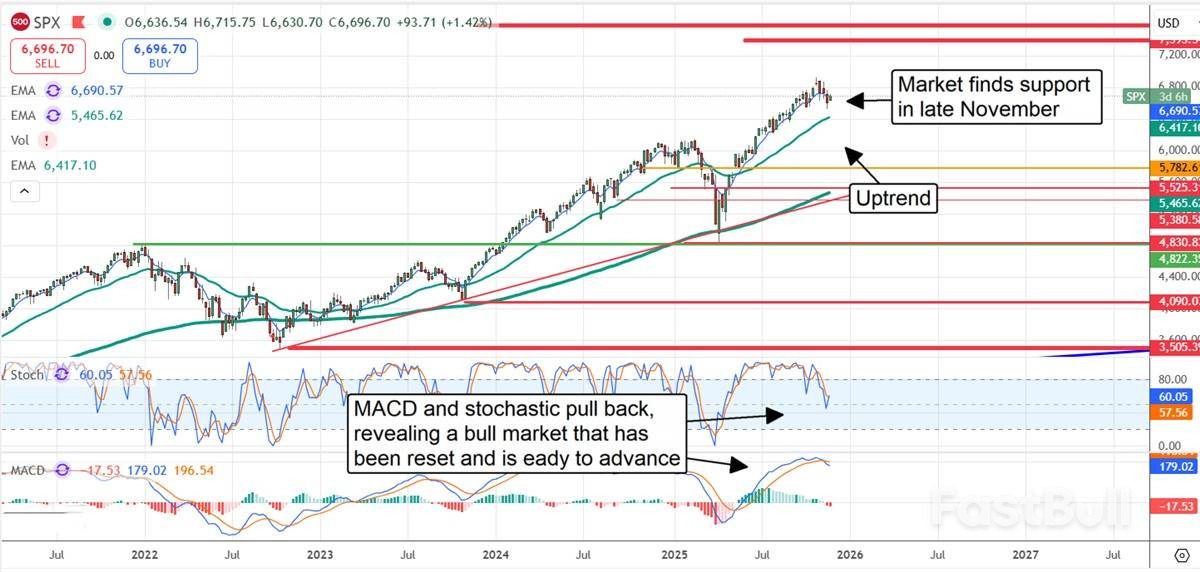
          Risks remain, but the S&P 500’s (SPY) uptrend is intact. The November correction was more of a broad-market consolidation, setting the market up for another leg of the rally, likely to unfold in December. This is an examination of three major themes driving S&P 500 price action and why it’s set up to advance to new highs before year-end.
          Will the S&P 500 Rally in December? These 3 Signals Point to a Big Move Ahead_1

          Macro-Economic Headwinds Ease

          Macroeconomic uncertainty has been causing significant concern among investors throughout the year. Uncertainty is linked to trade relations, tariff impacts, and, more recently, the government shutdown. The story for December is that the government shutdown is over, trade relations aren’t deteriorating, and there has been some relief regarding tariffs.
          Primarily, the impact of tariffs on Q3 results was far less than expected. The average S&P 500 company outperformed its consensus estimate by more than 600 basis points, which is well above average, and the Q4 season is likely to follow a similar trend.
          While the Q3 results outperformed, and most companies improved their guidance, the Q4 consensus forecast remained unchanged. The likely outcome is that Q4 results will outperform by a similarly large margin.
          Meanwhile, the FOMC remains on track to cut rates in 2026. The outlook for cuts has dimmed, but there is still an expectation of another two to three 25-basis-point cuts by next summer. The odds for a cut in December are also significantly high and may increase as the month progresses.
          With the government shutdown over, government-collected data is being released, and it aligns with healthy, albeit cooler, economic conditions compared to the previous year.

          Retail Earnings Were Good, Guidance Was Increased

          There were some areas of weakness in the retail sector’s earnings data, but the overall trend was bullish. Most retailers grew revenue and earnings, produced solid margins, and provided favorable guidance. The takeaway is that Black Friday and Cyber Monday sales events mark the beginning of the holiday shopping season and are likely to exceed forecasts.
          As it stands, holiday spending is expected to increase by 3% to 3.5% with strength centered in eCommerce. Deals and value will be a driver, positioning off-price retailers and Walmart as winners. Among the critical factors for investors is that retail leaders like Walmart (NYSE:WMT) and TJX Companies (NYSE:TJX) have solid cash flow, pay attractive dividends, and repurchase shares, sometimes aggressively.
          The next visible catalyst is the Q4 reporting cycle in January. Still, analysts could drive this sector higher before then with revenue, earnings, and stock price target revisions linked to Q3 results and early holiday spending data.

          The AI Trade Is Reignited

          Fears of an AI bubble bursting were laid to rest by NVIDIA’s (NASDAQ:NVDA) Q3 results, which showed stronger-than-expected growth, and by subsequent news that Amazon (NASDAQ:AMZN) plans to invest up to $50 billion in AI infrastructure for U.S. government contracts. Together, these developments reinforce the durability of AI demand across both commercial and public sectors.
          The NVIDIA release confirms that its AI business is larger than initially thought, growing faster than anticipated, and accelerating in the second half of the year. This has it set up to outperform in the current and following quarters and to sustain strength long into the future.
          The S&P 500 remains on course to hit the 7,300 mark soon. The move may not occur before the year’s end, but the rebound is likely to start by then, and new highs will quickly follow. Notable technical indicators include the stochastic oscillator, which has retreated to the middle of its range, indicating a market that has rebalanced itself and has ample room to move higher.

          Source: investing

          To stay updated on all economic events of today, please check out our Economic calendar
          Risk Warnings and Disclaimers
          You understand and acknowledge that there is a high degree of risk involved in trading. Following any strategies or investment methods may lead to potential losses. The content on the site is provided by our contributors and analysts for information purposes only. You are solely responsible for determining whether any trading assets, securities, strategy, or any other product is suitable for investing based on your own investment objectives and financial situation.
          Add to Favorites
          Share

          Tesla is falling everywhere… except on the stockmarket

          Adam

          Economic

          Sales are dropping across the world's three biggest markets: Europe, China and the US. In Europe, yesterday the ACEA announced that Tesla registrations fell by 48.5% y-o-y in October. Since the start of the year, they are down 30%, even with the electric-vehicle market having grown by 26%. In October, the American group's market share slipped to 0.6%, with under 7,000 Teslas sold across Europe (EU, EFTA, UK).
          Global Tesla sales are expected to decline by 7% in 2025, after an initial 1% drop in 2024, according to Visible Alpha - and this is despite a record Q3, boosted by a rush of US buyers ahead of the expiry of a tax credit. In Europe, sales are still suffering from calls for a boycott that erupted at the end of 2024 after Musk publicly backed far-right figures. Even though he has kept a lower profile since then, a rebound has yet to materialise. Analysts point to an ageing line-up facing a broader, often cheaper, competitive offering.

          An ageing line-up

          The situation in Europe is critical. Over a dozen electric models there sell for under $30,000, while Chinese brands are pouring in with boldly designed vehicles and a wide range of options. Tesla only offers two mass-market models in the region: the Model 3 and Model Y. An entry-level Model Y was launched to revive sales, with little effect. In October, China's BYD sold more than twice as many vehicles as Tesla. Volkswagen, which has long struggled to keep up, has seen its EV sales soar 78.2% this year to 522,600 units, three times Tesla's total (180,688). "The problem for Elon Musk is not just his cars or the Chinese brands," sums up Ferdinand Dudenhoeffer of the University of Duisburg-Essen. "The problem is that Europeans have caught up".
          In China, Tesla's sales fell 35.8% in October and are down 8.4% for the year. The market is awash with fast-moving local brands such as Chery or Xiaomi, whose YU7 is overshadowing Model Y. In the US, after a peak in September (+18%), sales plunged 24% in October. With some rivals such as General Motors, Ford or Honda slowing their electric investments, Tesla could well benefit. The launch of cheaper versions of the Model 3 and Y could also help it defend its market share. However, with no new model on the horizon, as instead Musk focuses on robotaxis and humanoid robots, the outlook remains uncertain.

          A stock trading at 327 times 2025 earnings

          For now, investors are clinging to the idea that cars are not necessarily Tesla's future - at least not its main one. The share price is still up 4% this year. This is less than the broader market (15% for the S&P 500 and 19% for the Nasdaq 100), although is striking given the company's poor commercial performance and weakening results. The company's P/E multiple climbed from 34x in 2022 to 198x in 2023. It is expected to rise to 327x this year, and to fall only to 221x in 2026 and 148x in 2027, according to analysts. Such multiples would be justified only by strong growth - something hard to imagine in the current environment.

          Source: marketscreener

          To stay updated on all economic events of today, please check out our Economic calendar
          Risk Warnings and Disclaimers
          You understand and acknowledge that there is a high degree of risk involved in trading. Following any strategies or investment methods may lead to potential losses. The content on the site is provided by our contributors and analysts for information purposes only. You are solely responsible for determining whether any trading assets, securities, strategy, or any other product is suitable for investing based on your own investment objectives and financial situation.
          Add to Favorites
          Share

          Tether’s gold purchases could support prices for years - Jefferies

          Adam

          Commodity

          Central bank gold purchases and investment demand have been two key factors driving gold prices to record highs this year, but one investment firm is looking at another segment of the gold market that is starting to attract significant attention.
          For years, many analysts have expected tokenized gold to be the next evolution in the precious metals space, and it appears its time has come, as Tether Limited, the leader in cryptocurrency stablecoins, has become a major player in the sector.
          Fahad Tariq and Andrew Moss, equity analysts at Jefferies, recently published a report on Tether’s growing influence in the gold market and the transformative impact this demand could have on gold and the mining industry.
          “We believe Tether could remain a significant buyer of gold, supporting gold prices going forward,” the analysts said.
          Highlighting Tether’s growing interest in the precious metals space, the analysts noted that representatives of the stablecoin issuer attended this year’s Mining Forum Americas Conference in Denver, Colorado.
          “Investors shared with us that Tether intended to buy ~100t of physical gold in 2025, in addition to investing across gold royalty/streaming companies and the gold supply chain,” the analysts said.
          While the cryptocurrency company has been buying gold to back its gold token, Tether Gold (XAU₮), Jefferies said the company’s demand goes much deeper than a single investment product. Citing company records, Jefferies noted that as of the third quarter, Tether holds about 116 tonnes of gold valued at $14 billion, of which only 12 tonnes back XAU₮ tokens.
          Gold currently represents 7% of the holdings that back Tether’s stablecoin, USD₮.
          “This means Tether is the largest holder of gold outside central banks, and its holdings are roughly equal to smaller central banks such as Korea, Hungary, and Greece,” the analysts said.
          Tariq and Moss also said the published reserves represent only the minimum amount of gold the company holds, as it is unclear how much Tether maintains on its own balance sheet.
          While the company’s gold reserves are impressive, Jefferies said it still has significant growth potential.
          “Given's Tether's profitability (~$15B estimated for 2025), potential supply growth of USDT and XAUt, and management's positive comments about gold ("natural Bitcoin"), we believe Tether could remain a significant buyer of gold, supporting gold prices going forward,” the analysts said. “If Tether deployed 50% of annual profits into gold, it could theoretically purchase ~15t per quarter, or ~58t annually at spot gold. This is simply an estimate to provide an idea of the incremental demand that didn't exist previously. Also, if USDT continues to grow, the interest income and capital available to deploy into gold will grow as well. In other words, our estimate could prove conservative.”
          In addition to buying gold, Jefferies noted that the company has also invested about $300 million in several precious metals streaming companies. Tether owns stakes in Elemental Altus Royalties, Gold Royalty Corp, Metalla Royalty & Streaming, and Versamet Royalties.
          Some analysts note that digital gold could potentially revolutionize the precious metals market, as investors are able to buy fractionalized amounts of physical gold.
          “In contrast to the drawbacks of ETFs, futures and physical gold, tokenized physical gold provides direct gold exposure, 24/7 real-time settlement, no management fees and no storage or insurance costs,” Jefferies said. “Low minimum investments increases accessibility and fractionalization enables the transfer of physical gold ownership and value that was not previously possible. Tokenizing gold may increase liquidity and the ability to rebalance portfolios quickly and efficiently.”

          Source: kitco

          Risk Warnings and Disclaimers
          You understand and acknowledge that there is a high degree of risk involved in trading. Following any strategies or investment methods may lead to potential losses. The content on the site is provided by our contributors and analysts for information purposes only. You are solely responsible for determining whether any trading assets, securities, strategy, or any other product is suitable for investing based on your own investment objectives and financial situation.
          Add to Favorites
          Share
          FastBull
          Copyright © 2025 FastBull Ltd

          728 RM B 7/F GEE LOK IND BLDG NO 34 HUNG TO RD KWUN TONG KLN HONG KONG

          TelegramInstagramTwitterfacebooklinkedin
          App Store Google Play Google Play
          Products
          Charts

          Chats

          Q&A with Experts
          Screeners
          Economic Calendar
          Data
          Tools
          Membership
          Features
          Function
          Markets
          Copy Trading
          Latest Signals
          Contests
          News
          Analysis
          24/7
          Columns
          Education
          Company
          Careers
          About Us
          Contact Us
          Advertising
          Help Center
          Feedback
          User Agreement
          Privacy Policy
          Business

          White Label

          Data API

          Web Plug-ins

          Poster Maker

          Affiliate Program

          Risk Disclosure

          The risk of loss in trading financial instruments such as stocks, FX, commodities, futures, bonds, ETFs and crypto can be substantial. You may sustain a total loss of the funds that you deposit with your broker. Therefore, you should carefully consider whether such trading is suitable for you in light of your circumstances and financial resources.

          No decision to invest should be made without thoroughly conducting due diligence by yourself or consulting with your financial advisors. Our web content might not suit you since we don't know your financial conditions and investment needs. Our financial information might have latency or contain inaccuracy, so you should be fully responsible for any of your trading and investment decisions. The company will not be responsible for your capital loss.

          Without getting permission from the website, you are not allowed to copy the website's graphics, texts, or trademarks. Intellectual property rights in the content or data incorporated into this website belong to its providers and exchange merchants.

          Not Logged In

          Log in to access more features

          FastBull Membership

          Not yet

          Purchase

          Become a signal provider
          Help Center
          Customer Service
          Dark Mode
          Price Up/Down Colors

          Log In

          Sign Up

          Position
          Layout
          Fullscreen
          Default to Chart
          The chart page opens by default when you visit fastbull.com