Markets
News
Analysis
User
24/7
Economic Calendar
Education
Data
- Names
- Latest
- Prev


Signal Accounts for Members
All Signal Accounts
All Contests


Turkey Trade BalanceA:--
F: --
P: --
Germany Construction PMI (SA) (Nov)A:--
F: --
P: --
Euro Zone IHS Markit Construction PMI (Nov)A:--
F: --
P: --
Italy IHS Markit Construction PMI (Nov)A:--
F: --
P: --
U.K. Markit/CIPS Construction PMI (Nov)A:--
F: --
P: --
France 10-Year OAT Auction Avg. YieldA:--
F: --
P: --
Euro Zone Retail Sales MoM (Oct)A:--
F: --
P: --
Euro Zone Retail Sales YoY (Oct)A:--
F: --
P: --
Brazil GDP YoY (Q3)A:--
F: --
P: --
U.S. Challenger Job Cuts (Nov)A:--
F: --
P: --
U.S. Challenger Job Cuts MoM (Nov)A:--
F: --
P: --
U.S. Challenger Job Cuts YoY (Nov)A:--
F: --
P: --
U.S. Initial Jobless Claims 4-Week Avg. (SA)A:--
F: --
P: --
U.S. Weekly Initial Jobless Claims (SA)A:--
F: --
P: --
U.S. Weekly Continued Jobless Claims (SA)A:--
F: --
P: --
Canada Ivey PMI (SA) (Nov)A:--
F: --
P: --
Canada Ivey PMI (Not SA) (Nov)A:--
F: --
P: --
U.S. Non-Defense Capital Durable Goods Orders Revised MoM (Excl. Aircraft) (SA) (Sept)A:--
F: --
U.S. Factory Orders MoM (Excl. Transport) (Sept)A:--
F: --
P: --
U.S. Factory Orders MoM (Sept)A:--
F: --
P: --
U.S. Factory Orders MoM (Excl. Defense) (Sept)A:--
F: --
P: --
U.S. EIA Weekly Natural Gas Stocks ChangeA:--
F: --
P: --
Saudi Arabia Crude Oil ProductionA:--
F: --
P: --
U.S. Weekly Treasuries Held by Foreign Central BanksA:--
F: --
P: --
Japan Foreign Exchange Reserves (Nov)A:--
F: --
P: --
India Repo RateA:--
F: --
P: --
India Benchmark Interest RateA:--
F: --
P: --
India Reverse Repo RateA:--
F: --
P: --
India Cash Reserve RatioA:--
F: --
P: --
Japan Leading Indicators Prelim (Oct)A:--
F: --
P: --
U.K. Halifax House Price Index YoY (SA) (Nov)--
F: --
P: --
U.K. Halifax House Price Index MoM (SA) (Nov)--
F: --
P: --
France Current Account (Not SA) (Oct)--
F: --
P: --
France Trade Balance (SA) (Oct)--
F: --
P: --
France Industrial Output MoM (SA) (Oct)--
F: --
P: --
Italy Retail Sales MoM (SA) (Oct)--
F: --
P: --
Euro Zone Employment YoY (SA) (Q3)--
F: --
P: --
Euro Zone GDP Final YoY (Q3)--
F: --
P: --
Euro Zone GDP Final QoQ (Q3)--
F: --
P: --
Euro Zone Employment Final QoQ (SA) (Q3)--
F: --
P: --
Euro Zone Employment Final (SA) (Q3)--
F: --
Brazil PPI MoM (Oct)--
F: --
P: --
Mexico Consumer Confidence Index (Nov)--
F: --
P: --
Canada Unemployment Rate (SA) (Nov)--
F: --
P: --
Canada Labor Force Participation Rate (SA) (Nov)--
F: --
P: --
Canada Employment (SA) (Nov)--
F: --
P: --
Canada Part-Time Employment (SA) (Nov)--
F: --
P: --
Canada Full-time Employment (SA) (Nov)--
F: --
P: --
U.S. Dallas Fed PCE Price Index YoY (Sept)--
F: --
P: --
U.S. PCE Price Index YoY (SA) (Sept)--
F: --
P: --
U.S. PCE Price Index MoM (Sept)--
F: --
P: --
U.S. Personal Outlays MoM (SA) (Sept)--
F: --
P: --
U.S. Core PCE Price Index MoM (Sept)--
F: --
P: --
U.S. UMich 5-Year-Ahead Inflation Expectations Prelim YoY (Dec)--
F: --
P: --
U.S. Core PCE Price Index YoY (Sept)--
F: --
P: --
U.S. 5-10 Year-Ahead Inflation Expectations (Dec)--
F: --
P: --
U.S. UMich Current Economic Conditions Index Prelim (Dec)--
F: --
P: --
U.S. UMich Consumer Sentiment Index Prelim (Dec)--
F: --
P: --
U.S. UMich 1-Year-Ahead Inflation Expectations Prelim (Dec)--
F: --
P: --
U.S. UMich Consumer Expectations Index Prelim (Dec)--
F: --
P: --


No matching data
Latest Views
Latest Views
Trending Topics
Top Columnists
Latest Update
White Label
Data API
Web Plug-ins
Affiliate Program
View All

No data
The Bureau of Labor Statistics is likely to skip a month of data collection for the Consumer Price Index for the first time in its history because of the ongoing government shutdown.
The White House said October's inflation report is unlikely to be released.
The ongoing government shutdown has closed the government's statistical agencies, leaving critical economic data unreported.
The Bureau of Labor Statistics is likely to skip a month of data collection for the Consumer Price Index for the first time in its history because of the ongoing government shutdown.The Consumer Price Index, a widely watched gauge of inflation, is unlikely to be released for October, the White House said on Friday. The CPI is based on prices collected by an army of surveyors, who are currently on furlough and not working because of the government shutdown."Because surveyors cannot deploy to the field, the White House has learned there will likely NOT be an inflation release next month for the first time in history—depriving policymakers and markets of critical data and risking economic calamity," the White House said in a statement.
Investors, government officials, and businesspeople rely on government data to assess the health of the economy. Those decision makers could be left in the dark about important economic trends as the government shutdown drags on.
If October's data collection is skipped, it would create a remarkable gap in a dataset that spans more than a century. The BLS first published data for a national Consumer Price Index in 1921, including estimates for the national inflation rate dating back to 1913.The CPI report is one of many pieces of economic data going unreported as the government's statistical agencies remain closed. Republican and Democratic lawmakers have voted down one another's bills to fund the government amid a dispute over health care policy. The White House statement deepened concerns among economists that the government will have to skip many of the monthly economic reports scheduled for release in October.
The ongoing data blackout is especially problematic for officials at the Federal Reserve who set the nation's monetary policy with the aim of keeping employment high and inflation low. Although private companies, universities, and other groups produce their own measures of the economy's health, the federal government's statistics, based on extensive surveys, are considered by economists to be the most comprehensive and reliable.The White House announcement occurred shortly after the BLS released its CPI report for September, showing price increases accelerated less than forecasters anticipated, although remaining well above the Federal Reserve's target of a 2% annual rate. The BLS brought back some employees during the shutdown to publish the September CPI report since it is used to calculate Social Security annual cost-of-living adjustments to benefits.
President Donald Trump is rattling his saber against Colombian President Gustavo Petro to punish him for accusing the US government of murdering Venezuelan fishermen. Trump has boasted of the killings by the US military but claims all the targets were drug smugglers. He has threatened to suspend all US government handouts for the Colombian government. Trump warned Petro that he "better close up" cocaine production "or the United States will close them up for him, and it won't be done nicely."Tapping his own psychiatric expertise, Trump proclaimed that Colombia has "the worst president they've ever had – a lunatic with serious mental problems." Is anyone in the Trump White House aware of the long history of U.S. failure in that part of the world? In 1989, President George H.W. Bush warned Colombian drug dealers that they were "no match for an angry America." But Colombia remains the world's largest cocaine producer despite billions of dollars of US government anti-drug aid to the Colombian government.
The Bill Clinton administration made Colombia its top target in its international war on drugs. Clinton drug warriors deluged the Colombian government with U.S. tax dollars as they literally deluged Colombia with toxic spray. The New York Times reported that U.S.-financed planes repeatedly sprayed pesticides onto schoolchildren, making many of them ill. Colombian environmental minister Juan Mayr publicly declared last year that the crop spraying program has been a failure and warned, "We can't permanently fumigate the country."

As I wrote in The American Spectator in 1999:
"Colombia has received almost a billion dollars of anti-narcotics aid since 1990. Coca production is skyrocketing–doubling since 1996 and, according to the General Accounting Office, expected to increase another 50 percent in the next two years. Colombia now supplies roughly three-quarters of the heroin and almost all the cocaine consumed in the United States."
The Clinton administration responded to the failure of its drug war by championing a far more destructive solution. As I noted in the Las Vegas Review Journal, Clinton officials "intensely pressured the Colombian government to allow a much more toxic chemical (tebuthiuron, known as SPIKE 20) to be dumped across the land, which would permit the planes to fly at much higher altitudes, Kosovo-style. Environmentalists warned that SPIKE 20 could poison ground water and permanently ruin the land for agriculture. Even as the Clinton administration decreed clean-air standards severely curtailing Americans' exposure to chemicals that pose little or no health threat, it sought to deluge a foreign land with a toxic chemical in a way that would be forbidden in the United States." Dow Chemical, the product's inventor, protested strongly that SPIKE 20 was not safe for use in the Andes and surrounding areas. Didn't matter.
Colombia at that time was wracked by a civil war—a fight between a corrupt government and corrupt leftist guerillas. The Dallas Morning News noted reports that "tens of millions of taxpayer dollars are going into covert operations across southern Colombia employing, among others, U.S. Special Forces, former Green Berets, Gulf War veterans and even a few figures from covert CIA-backed operations in Central America during the 1980's."Like Trump's attacks on Venezuelan boats, Clinton's aid for Colombia was lawless. Congress in 1996 prohibited any U.S. foreign aid to military organizations with a penchant for atrocities. The Colombian army had a poor human rights record but almost nobody in Congress gave a damn. Democrats winked at illicit conduct by their president and Republicans didn't care about any crimes committed in the name of eradicating drugs.
In a Baltimore Sun piece in June 2000, I observed, "The war on drugs is as unwinnable in Colombia as it is in the hills of Kentucky, where natives continue growing marijuana despite endless raids by police and the National Guard." I whacked the Clinton administration for "bumbling into a civil war." Colombia's ambassador to the United States vehemently attacked my piece, claiming that the Clinton administration aid package was carefully targeted to "strengthen law enforcement institutions and help protect human rights." Alas, U.S. aid was diverted to "carry out spying operations and smear campaigns against Supreme Court justices," The Washington Post reported, crippling the nation's judiciary.
At the same time that the Clinton administration was sacrificing the health of Colombian children in its quixotic anti-drug crusade, top U.S. antidrug officials made a mockery of the entire mission. Laurie Hiett, the wife of Colonel James Hiett, the top American military commander in Colombia, exploited U.S. embassy diplomatic pouches to ship fifteen pounds of heroin and cocaine to New York. She pocketed tens of thousands of dollars in narcotic profits.After she was caught and convicted, she received far more lenient treatment than most drug offenders—only five years in prison, "the same sentence a small-time dealer would get if he were caught with five grams of crack in his pocket," I noted in Playboy. Her husband—ridiculed as the "Coke Colonel" in the New York Post—received only six months in prison for laundering drug proceeds and concealing his wife's crimes.
Eric Sterling, president of the Criminal Justice Policy Foundation, explained the double standard:
"If Colonel Hiett had been Mr. Hiett, he would have been charged with conspiracy to traffic in more than a kilogram of heroin, with a mandatory minimum sentence of 10 years. He would possibly face life without parole…Mr. Hiett would, at a minimum, have been charged with aiding and abetting his wife's money laundering, facing 20 years."Most drug warriors pretended either that the Hiett case had never happened or that it didn't matter. Drug Czar Barry McCaffrey shrugged off the scandal:"What a tragedy…There are 3.6 million chronic cocaine addicts in America and every one of them produces that kind of criminality and tragedy."
"But when any of those 3.6 million is caught, they don't get coddled," as I wrote in Playboy.Donald Trump's victory in the 2024 presidential election did not entitle him to micromanage every acre of land in this hemisphere. The U.S. war on drugs has dismally failed in Colombia for more than a third of a century. There is no excuse for Trump or any other U.S. government official to burn American tax dollars by perpetuating Colombian pratfalls.

The U.S. dollar was almost flat on Friday after dipping following fresh inflation data that showed that U.S. consumer prices increased less than expected in September, keeping the Federal Reserve on track to cut interest rates again next week.
The Consumer Price Index rose 0.3% last month and 3.0% in the 12 months through September. Economists polled by Reuters had forecast the CPI increasing by 0.4% for the month and rising 3.1% year-on-year.The Reuters Daily Briefing newsletter provides all the news you need to start your day. Sign up here.The U.S. dollar index was last down 0.003% at 98.934, after earlier falling as much as 0.2%.
"The headline was a bit softer than expected," said Marc Chandler, chief market strategist at Bannockburn Capital Markets. "The dollar was sold on the news, even though the market had nearly 100% confidence before the report that the Fed would cut rates, not only next week, but in December."
The CPI report was published despite an economic data blackout because of the government shutdown. The figure, used by the Social Security Administration to calculate its cost-of-living adjustment for millions of retirees and other benefits recipients, was initially due on October 15.
The euro rose and was last up 0.06% at $1.163. Business activity in the euro zone grew at a faster pace than expected in October, led by the bloc's services industry, a survey showed on Friday.
Trade war worries were back on the agenda after U.S. President Donald Trump said all trade talks with Canada were terminated over an advertisement by the province of Ontario which featured a recording of former President Ronald Reagan speaking negatively about tariffs.
The Canadian dollar was last weaker at 1.403 per U.S. dollar, but market reaction overall was fairly subdued. Investors' focus remained on the looming meeting between Trump and Chinese President Xi Jinping next week.
The proposed Trump-Xi meeting in South Korea has spurred some expectations of a resolution to the on-again-off-again trade war between the world's top two economies.
"I think expectations are quite high for the Trump-Xi meeting, with the upside risk of a significant de-escalation following the face-to-face meeting," said Ben Bennett, head of investment strategy for Asia at L&G Asset Management.
New U.S. sanctions on Russian suppliers Rosneft (ROSN.MM), and Lukoil (LKOH.MM), over Russia's war in Ukraine pushed up oil prices.
That weighed on currencies tied to oil imports, including the yen. The yen's performance is also linked to the policies of Japan's new Prime Minister Sanae Takaichi, widely viewed as a fiscal and monetary dove.
The yen weakened to a two-week low and last fetched 152.87 per U.S. dollar. Data earlier on Friday showed Japan's core consumer prices stayed above the central bank's 2% target, keeping alive expectations of a near-term rate hike.
Takaichi is preparing an economic stimulus package that is likely to exceed last year's $92 billion to help households tackle inflation, government sources familiar with the plan told Reuters on Wednesday.
Sterling was up 0.08% at $1.334, after stronger-than-expected retail sales that were boosted by demand for gold from online jewellers. It was down about 1% this week after soft inflation data had investors adding to expectations for a rate cut from the Bank of England this year.

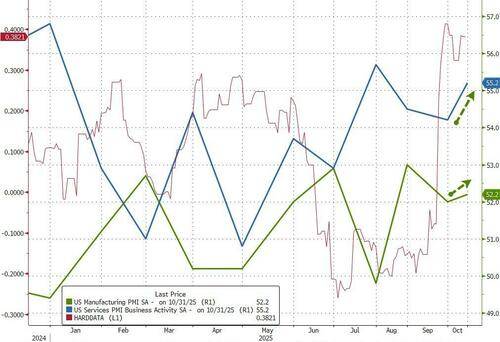
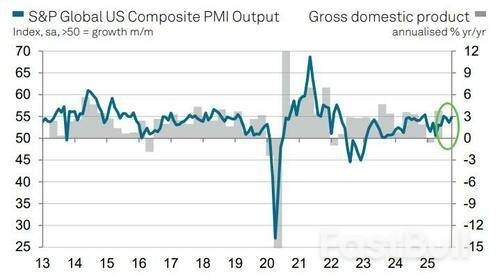
US business activity growth accelerated in October to the second-fastest so far this year, according to early 'flash' PMI data, accompanied by the largest rise in new business seen in 2025 to date.
Both Services and Manufacturing surveys increased more than expected in the preliminary October data (with Services continuing to lead)...
"October's flash PMI data point to sustained strong economic growth at the start of the fourth quarter," according to Chris Williamson, Chief Business Economist at S&P Global Market Intelligence, "with business activity picking up momentum across both manufacturing and services despite some reports of businesses being adversely impacted by the government shutdown."
The survey data are consistent with the economy expanding at a 2.5% annualized rate in October after a similar rise was signalled for the third quarter.
But it wasn't all unicorns and fairytales:
"However, business confidence in the outlook for the coming year has deteriorated further, and is at one of the lowest levels seen over the past three years as companies worry about the impact of policies, most notably tariffs.
Companies are also concerned over disappointing export sales, especially in manufacturing, and factories are seeing an unprecedented rise in unsold stock.
Having bought excess inputs earlier in the year to front-run tariffs, producers are making more goods to use up these inputs but are often struggling to sell the end product to customers."
Finally, Williamson notes that there has been no pass-through of tariff-induced inflation to consumers
"Hence, although input costs continued to rise sharply again in October, principally reflecting the pass-through of tariffs, average selling price inflation has cooled to the lowest since April as firms compete on price to win sales."
Solid 'soft' data amid a vacuum of 'hard' data dude to the govt shutdown.
White Label
Data API
Web Plug-ins
Poster Maker
Affiliate Program
The risk of loss in trading financial instruments such as stocks, FX, commodities, futures, bonds, ETFs and crypto can be substantial. You may sustain a total loss of the funds that you deposit with your broker. Therefore, you should carefully consider whether such trading is suitable for you in light of your circumstances and financial resources.
No decision to invest should be made without thoroughly conducting due diligence by yourself or consulting with your financial advisors. Our web content might not suit you since we don't know your financial conditions and investment needs. Our financial information might have latency or contain inaccuracy, so you should be fully responsible for any of your trading and investment decisions. The company will not be responsible for your capital loss.
Without getting permission from the website, you are not allowed to copy the website's graphics, texts, or trademarks. Intellectual property rights in the content or data incorporated into this website belong to its providers and exchange merchants.
Not Logged In
Log in to access more features

FastBull Membership
Not yet
Purchase
Log In
Sign Up