• Trade
  • Markets
  • Copy
  • Contests
  • News
  • 24/7
  • Calendar
  • Q&A
  • Chats
Trending
Screeners
SYMBOL
LAST
BID
ASK
HIGH
LOW
NET CHG.
%CHG.
SPREAD
SPX
S&P 500 Index
6853.30
6853.30
6853.30
6861.30
6847.07
+25.89
+ 0.38%
--
DJI
Dow Jones Industrial Average
48582.05
48582.05
48582.05
48679.14
48557.21
+124.01
+ 0.26%
--
IXIC
NASDAQ Composite Index
23297.50
23297.50
23297.50
23345.56
23265.18
+102.34
+ 0.44%
--
USDX
US Dollar Index
97.850
97.930
97.850
98.070
97.810
-0.100
-0.10%
--
EURUSD
Euro / US Dollar
1.17533
1.17540
1.17533
1.17596
1.17262
+0.00139
+ 0.12%
--
GBPUSD
Pound Sterling / US Dollar
1.33915
1.33924
1.33915
1.33961
1.33546
+0.00208
+ 0.16%
--
XAUUSD
Gold / US Dollar
4327.42
4327.76
4327.42
4350.16
4294.68
+28.03
+ 0.65%
--
WTI
Light Sweet Crude Oil
56.881
56.911
56.881
57.601
56.789
-0.352
-0.62%
--

Community Accounts

Signal Accounts
--
Profit Accounts
--
Loss Accounts
--
View More

Become a signal provider

Sell trading signals to earn additional income

View More

Guide to Copy Trading

Get started with ease and confidence

View More

Signal Accounts for Members

All Signal Accounts

Best Return
  • Best Return
  • Best P/L
  • Best MDD
Past 1W
  • Past 1W
  • Past 1M
  • Past 1Y

All Contests

  • All
  • Trump Updates
  • Recommend
  • Stocks
  • Cryptocurrencies
  • Central Banks
  • Featured News
Top News Only
Share

The Nasdaq Golden Dragon China Index Fell 0.9% In Early Trading

Share

The S&P 500 Opened 32.78 Points Higher, Or 0.48%, At 6860.19; The Dow Jones Industrial Average Opened 136.31 Points Higher, Or 0.28%, At 48594.36; And The Nasdaq Composite Opened 134.87 Points Higher, Or 0.58%, At 23330.04

Share

Miran: Goods Inflation Could Be Settling In At A Higher Level Than Was Normal Before The Pandemic, But That Will Be More Than Offset By Housing Disinflation

Share

Miran, Who Dissented In Favor Of A Larger Cut At Last Fed Meeting, Repeats Keeping Policy Too Tight Will Lead To Job Losses

Share

Miran: Does Not Think Higher Goods Inflation Is Mostly From Tariffs, But Acknowledges Does Not Have A Full Explanation For It

Share

Toronto Stock Index .GSPTSE Rises 67.16 Points, Or 0.21 Percent, To 31594.55 At Open

Share

Miran: Excluding Housing And Non-Market Based Items, Core Pce Inflation May Be Below 2.3%, “Within Noise” Of The Fed's 2% Target

Share

Polish State Assets Minister Balczun Says Jsw Needs Over USD 830 Million Financing To Keep Liquidity For A Year

Share

Miran: Prices Are “Once Again Stable” And Monetary Policy Should Reflect That

Share

Fed's Miran: Current Excess Inflation Is Not Reflective Of Underlying Supply And Demand In The Economy

Share

Portugal Treasury Puts 2026 Net Financing Needs At 13 Billion Euros, Up From 10.8 Billion In 2025

Share

Portugal Treasury Expects 2026 Net Financing Needs At 29.4 Billion Euros, Up From 25.8 Billion In 2025

Share

Bank Of America Says With Indonesia's Smelter Now Ramping Up, It Expects Aluminium Supply Growth To Accelerate To 2.6% Year On Year In 2026

Share

Bank Of America Expects A Deficit In Aluminium Next Year And Sees Prices Pushing Above $3000/T

Share

Fed Data - USA Effective Federal Funds Rate At 3.64 Percent On 12 December On $102 Billion In Trades Versus 3.64 Percent On $99 Billion On 11 December

Share

Brazil's Petrobras Says No Impact Seen On Oil, Petroleum Products Output As Workers Start Planned Strike

Share

Statement: US Travel Group Warns New Proposed Trump Administration Requirements For Foreign Tourists To Provide Social Media Histories Could Mean Millions Of People Opting Not To Visit

Share

Blackrock: Kerry White Will Become Head Of Citi Investment Management At Citi Wealth

Share

Blackrock: Rob Jasminski, Head Of Citi Investment Management, Has Joined With Team

Share

Blackrock: Effective Dec 15, Citi Investment Management Employees Will Join Blackrock

TIME
ACT
FCST
PREV
Japan Tankan Small Manufacturing Outlook Index (Q4)

A:--

F: --

P: --

Japan Tankan Large Non-Manufacturing Outlook Index (Q4)

A:--

F: --

P: --

Japan Tankan Large Manufacturing Outlook Index (Q4)

A:--

F: --

P: --

Japan Tankan Small Manufacturing Diffusion Index (Q4)

A:--

F: --

P: --

Japan Tankan Large Manufacturing Diffusion Index (Q4)

A:--

F: --

P: --

Japan Tankan Large-Enterprise Capital Expenditure YoY (Q4)

A:--

F: --

P: --

U.K. Rightmove House Price Index YoY (Dec)

A:--

F: --

P: --

China, Mainland Industrial Output YoY (YTD) (Nov)

A:--

F: --

P: --

China, Mainland Urban Area Unemployment Rate (Nov)

A:--

F: --

P: --

Saudi Arabia CPI YoY (Nov)

A:--

F: --

P: --

Euro Zone Industrial Output YoY (Oct)

A:--

F: --

P: --

Euro Zone Industrial Output MoM (Oct)

A:--

F: --

P: --

Canada Existing Home Sales MoM (Nov)

A:--

F: --

P: --

Canada National Economic Confidence Index

A:--

F: --

P: --

Canada New Housing Starts (Nov)

A:--

F: --

P: --
U.S. NY Fed Manufacturing Employment Index (Dec)

A:--

F: --

P: --

U.S. NY Fed Manufacturing Index (Dec)

A:--

F: --

P: --

Canada Core CPI YoY (Nov)

A:--

F: --

P: --

Canada Manufacturing Unfilled Orders MoM (Oct)

A:--

F: --

P: --

U.S. NY Fed Manufacturing Prices Received Index (Dec)

A:--

F: --

P: --

U.S. NY Fed Manufacturing New Orders Index (Dec)

A:--

F: --

P: --

Canada Manufacturing New Orders MoM (Oct)

A:--

F: --

P: --

Canada Core CPI MoM (Nov)

A:--

F: --

P: --

Canada Trimmed CPI YoY (SA) (Nov)

A:--

F: --

P: --

Canada Manufacturing Inventory MoM (Oct)

A:--

F: --

P: --

Canada CPI YoY (Nov)

A:--

F: --

P: --

Canada CPI MoM (Nov)

A:--

F: --

P: --

Canada CPI YoY (SA) (Nov)

A:--

F: --

P: --

Canada Core CPI MoM (SA) (Nov)

A:--

F: --

P: --

Canada CPI MoM (SA) (Nov)

A:--

F: --

P: --

Federal Reserve Board Governor Milan delivered a speech
U.S. NAHB Housing Market Index (Dec)

--

F: --

P: --

Australia Composite PMI Prelim (Dec)

--

F: --

P: --

Australia Services PMI Prelim (Dec)

--

F: --

P: --

Australia Manufacturing PMI Prelim (Dec)

--

F: --

P: --

Japan Manufacturing PMI Prelim (SA) (Dec)

--

F: --

P: --

U.K. 3-Month ILO Employment Change (Oct)

--

F: --

P: --

U.K. Unemployment Claimant Count (Nov)

--

F: --

P: --

U.K. Unemployment Rate (Nov)

--

F: --

P: --

U.K. 3-Month ILO Unemployment Rate (Oct)

--

F: --

P: --

U.K. Average Weekly Earnings (3-Month Average, Including Bonuses) YoY (Oct)

--

F: --

P: --

U.K. Average Weekly Earnings (3-Month Average, Excluding Bonuses) YoY (Oct)

--

F: --

P: --

France Services PMI Prelim (Dec)

--

F: --

P: --

France Composite PMI Prelim (SA) (Dec)

--

F: --

P: --

France Manufacturing PMI Prelim (Dec)

--

F: --

P: --

Germany Services PMI Prelim (SA) (Dec)

--

F: --

P: --

Germany Manufacturing PMI Prelim (SA) (Dec)

--

F: --

P: --

Germany Composite PMI Prelim (SA) (Dec)

--

F: --

P: --

Euro Zone Composite PMI Prelim (SA) (Dec)

--

F: --

P: --

Euro Zone Services PMI Prelim (SA) (Dec)

--

F: --

P: --

Euro Zone Manufacturing PMI Prelim (SA) (Dec)

--

F: --

P: --

U.K. Services PMI Prelim (Dec)

--

F: --

P: --

U.K. Manufacturing PMI Prelim (Dec)

--

F: --

P: --

U.K. Composite PMI Prelim (Dec)

--

F: --

P: --

Euro Zone ZEW Economic Sentiment Index (Dec)

--

F: --

P: --

Germany ZEW Current Conditions Index (Dec)

--

F: --

P: --

Germany ZEW Economic Sentiment Index (Dec)

--

F: --

P: --

Euro Zone Trade Balance (Not SA) (Oct)

--

F: --

P: --

Euro Zone ZEW Current Conditions Index (Dec)

--

F: --

P: --

Euro Zone Trade Balance (SA) (Oct)

--

F: --

P: --

U.S. Retail Sales MoM (Excl. Automobile) (SA) (Oct)

--

F: --

P: --

Q&A with Experts
    • All
    • Chatrooms
    • Groups
    • Friends
    Connecting
    .
    .
    .
    Type here...
    Add Symbol or Code

      No matching data

      All
      Trump Updates
      Recommend
      Stocks
      Cryptocurrencies
      Central Banks
      Featured News
      • All
      • Russia-Ukraine Conflict
      • Middle East Flashpoint
      • All
      • Russia-Ukraine Conflict
      • Middle East Flashpoint
      Search
      Products

      Charts Free Forever

      Chats Q&A with Experts
      Screeners Economic Calendar Data Tools
      Membership Features
      Data Warehouse Market Trends Institutional Data Policy Rates Macro

      Market Trends

      Market Sentiment Order Book Forex Correlations

      Top Indicators

      Charts Free Forever
      Markets

      News

      News Analysis 24/7 Columns Education
      From Institutions From Analysts
      Topics Columnists

      Latest Views

      Latest Views

      Trending Topics

      Top Columnists

      Latest Update

      Signals

      Copy Rankings Latest Signals Become a signal provider AI Rating
      Contests
      Brokers

      Overview Brokers Assessment Rankings Regulators News Claims
      Broker listing Forex Brokers Comparison Tool Live Spread Comparison Scam
      Q&A Complaint Scam Alert Videos Tips to Detect Scam
      More

      Business
      Events
      Careers About Us Advertising Help Center

      White Label

      Data API

      Web Plug-ins

      Affiliate Program

      Awards Institution Evaluation IB Seminar Salon Event Exhibition
      Vietnam Thailand Singapore Dubai
      Fans Party Investment Sharing Session
      FastBull Summit BrokersView Expo
      Recent Searches
        Top Searches
          Markets
          News
          Analysis
          User
          24/7
          Economic Calendar
          Education
          Data
          • Names
          • Latest
          • Prev

          View All

          No data

          Scan to Download

          Faster Charts, Chat Faster!

          Download App
          English
          • English
          • Español
          • العربية
          • Bahasa Indonesia
          • Bahasa Melayu
          • Tiếng Việt
          • ภาษาไทย
          • Français
          • Italiano
          • Türkçe
          • Русский язык
          • 简中
          • 繁中
          Open Account
          Search
          Products
          Charts Free Forever
          Markets
          News
          Signals

          Copy Rankings Latest Signals Become a signal provider AI Rating
          Contests
          Brokers

          Overview Brokers Assessment Rankings Regulators News Claims
          Broker listing Forex Brokers Comparison Tool Live Spread Comparison Scam
          Q&A Complaint Scam Alert Videos Tips to Detect Scam
          More

          Business
          Events
          Careers About Us Advertising Help Center

          White Label

          Data API

          Web Plug-ins

          Affiliate Program

          Awards Institution Evaluation IB Seminar Salon Event Exhibition
          Vietnam Thailand Singapore Dubai
          Fans Party Investment Sharing Session
          FastBull Summit BrokersView Expo

          US Services Growth Cools as Price Gauge Drops to Four-Year Low

          Zi Cheng

          Economic

          Summary:

          ISM services PMI declined 1.2 points in March to 51.4.

          Growth in the US services sector eased in March for a second month while a gauge of input costs slumped to a four-year low.
          The Institute for Supply Management’s composite gauge of services fell 1.2 points to 51.4, largely reflecting a drop in the supplier deliveries index to a record low. Readings above 50 indicate expansion, and the March figure was lower than all but one estimate in a Bloomberg survey of economists.
          The index of prices paid for materials and services decreased more than 5 points to 53.4, the lowest since March 2020, according to the report issued Wednesday.

          US Services Growth Cools as Price Gauge Drops to Four-Year Low_1Source: Insitute for Supply Management

          That stands in stark contrast to ISM data earlier week showing a manufacturing input-cost gauge climbed to the highest level since July 2022, suggesting the pace of goods disinflation is leveling off.
          The services price data may temper concerns that the Federal Reserve’s progress on inflation is at risk of stalling. Policymakers are tracking developments in the services sector, the largest part of the economy, for signs of easing price pressures as they debate when to reduce interest rates.
          “The plunge in the prices paid index to the lowest level since the pandemic began implies that core services ex-housing inflation, aka supercore, will resume falling back toward its pre-pandemic normal rate,” Stephen Brown, deputy chief North America economist at Capital Economics, said in a note.
          With the decline in March, ISM’s gauge of prices paid by services dipped below the manufacturing input-cost measure for the first time since May 2022.
          Still, service-industry respondents noted “that even with some prices stabilizing, inflation is still a concern,” Anthony Nieves, chair of the ISM Services Business Survey Committee, said in a statement.
          Nieves said on a call with reporters that because fuel costs are rising again, he doesn’t anticipate input costs for services to continue falling.
          The overall services index was depressed by the gauge of delivery times, which dropped 3.5 points to the lowest in ISM data back to 1997. Signs of improving supply chains help explain why order backlogs at service providers shrank at the fastest pace since August.
          Twelve services industries reported growth in March, led by accommodation and food services. Four indicated a decrease in activity.
          The ISM new orders gauge fell to a three-month low, though remained consistent with resilient demand.
          The group’s business activity index — which parallels its factory output gauge — showed the strongest growth since September.
          The measure of services employment ticked up slightly but remained in contraction territory.
          Meanwhile, an index of inventories at service providers retreated to the lowest level since the end of 2022. A gauge of sentiment about inventories, while still indicating companies see stockpiles as too high, fell for the second straight month.

          Source: Bloomberg

          To stay updated on all economic events of today, please check out our Economic calendar
          Risk Warnings and Disclaimers
          You understand and acknowledge that there is a high degree of risk involved in trading. Following any strategies or investment methods may lead to potential losses. The content on the site is provided by our contributors and analysts for information purposes only. You are solely responsible for determining whether any trading assets, securities, strategy, or any other product is suitable for investing based on your own investment objectives and financial situation.
          Add to Favorites
          Share

          Powell Says Fed Has Time to Assess Data Before Deciding to Cut

          Zi Cheng

          Economic

          Federal Reserve Chair Jerome Powell signaled policymakers will wait for clearer signs of lower inflation before cutting interest rates, even though a recent bump in prices didn’t alter their broader trajectory.
          Powell said recent inflation figures — though higher than expected — did not “materially change” the overall picture. He reiterated his expectation that it will likely be appropriate to begin lowering rates “at some point this year.”
          “On inflation, it is too soon to say whether the recent readings represent more than just a bump,” Powell said Wednesday in the text of a speech at Stanford University in California. “We do not expect that it will be appropriate to lower our policy rate until we have greater confidence that inflation is moving sustainably down toward 2%.”
          The Federal Open Market Committee held interest rates steady last month. Officials narrowly maintained their outlook for three interest-rate cuts this year, even as key inflation metrics have picked up in 2024. Powell and other Fed officials have repeatedly said they are in no hurry to cut rates, and that their moves will depend on incoming data.
          Following the release of Powell’s prepared remarks, Treasury yields remained higher as did the S&P 500. Investors are putting roughly even odds on an initial cut in June, and pricing suggests they see a chance of fewer than three reductions this year, according to futures.
          “Given the strength of the economy and progress on inflation so far, we have time to let the incoming data guide our decisions on policy,” Powell said in the opening remarks ahead of a fireside chat. “If the economy evolves broadly as we expect, most FOMC participants see it as likely to be appropriate to begin lowering the policy rate at some point this year.”
          Powell’s prepared remarks reinforce those he’s made following the March meeting. They also suggest that the Fed is unlikely to reduce rates at their next gathering taking place April 30-May 1.

          Inflation Gauge

          The Fed’s preferred gauge of underlying inflation cooled in February after an even larger increase than previously reported in January, government data released Friday showed. Even so, the back-to-back increases in the core personal consumption expenditures price index — which excludes volatile food and energy costs — were the biggest in a year.
          Powell said last month that an unexpected weakening in the labor market could warrant a policy response from Fed officials. The Fed will get another update on the health of the job market Friday with the release of the monthly employment report, which is expected to show a gain of 213,000 jobs in March.
          Fed officials in March were split on how aggressive rate cuts will be this year. The central bank’s “dot plot” showed 10 officials forecast three or more quarter-point cuts this year, while nine anticipated two or fewer.
          The Fed chair also used part of his speech to emphasize that the central bank makes its decisions independent from politics. Powell added that he feels it is improper for him to weigh in on other public policy issues, like climate change policies.
          “Our analysis is free from any personal or political bias, in service to the public,” he said. “We will not always get it right — no one does. But our decisions will always reflect our painstaking assessment of what is best for our economy in the medium and longer term — and nothing else.”

          Source: Bloomberg

          To stay updated on all economic events of today, please check out our Economic calendar
          Risk Warnings and Disclaimers
          You understand and acknowledge that there is a high degree of risk involved in trading. Following any strategies or investment methods may lead to potential losses. The content on the site is provided by our contributors and analysts for information purposes only. You are solely responsible for determining whether any trading assets, securities, strategy, or any other product is suitable for investing based on your own investment objectives and financial situation.
          Add to Favorites
          Share

          World Labor Markets Defy Odds And Force A Reset Of Rate-Cut Bets

          Alex

          Economic

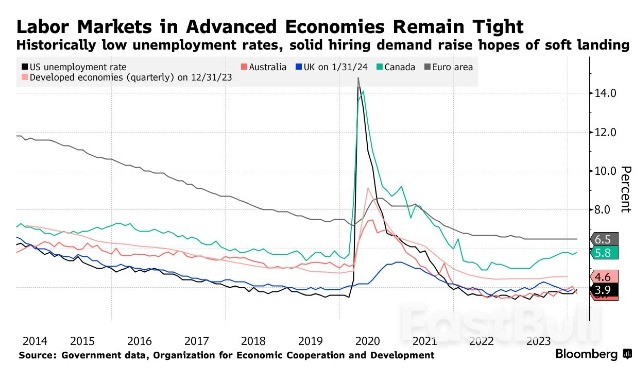
          Labor markets across most of the developed world just keep on beating expectations, pushing back bets on interest-rate cuts as hopes grow that central banks can pull off a soft landing after all.
          The reasons for the high demand for workers — an aging workforce, lack of skilled labor and companies hoarding staff — are holding firm even as economies start to slow.
          In all, the unemployment rate in developed economies remains near a record-low, according to quarterly data from the OECD. The consequences of that resilience for borrowing costs triggered a selloff in stocks and bonds this week.World Labor Markets Defy Odds And Force A Reset Of Rate-Cut Bets_1
          While demand for workers may have waned from the initial post-pandemic surge, it’s still much higher than experts forecast it would be by now. In the US, for instance, the Congressional Budget Office last year forecast the US unemployment rate would hit 5.1% by now; it remains at 3.9% today.
          Data due Friday is set to show the US economy added more than 200,000 payrolls in March, double the level that Federal Reserve Chair Jerome Powell has said is sustainable.
          As a result, markets continue to recast their pricing for Fed rate cuts — the odds for a move in June have slipped to around 59% — and those forecasts could be pushed out again. They slipped below 50% briefly this week after strong US factory data.
          The S&P 500 saw its worst day in almost a month on Tuesday and the US 10-year yield touched its highest level since November as investors started to come to terms with that shift.
          Economists at Goldman Sachs Group Inc. estimate it would take an increase of 0.2 to 0.3 percentage points to the US unemployment rate to justify three consecutive Fed cuts this year.
          It’s a similar story elsewhere, even in economies that are slowing.
          In Europe, where inflation has cooled in recent months, European Central Bank President Christine Lagarde has cited pay increases as one of three main factors officials are watching. Investors have pushed back expectations for a first interest rate cut to June, while at the end of 2023 their bets pointed to a 50% chance of a move in March and certainty the ECB would have eased by its April meeting.
          In Canada, where the population soared by the most in more than 60 years in 2023, the jobless rate has barely budged as employers soaked up the new workers. In New Zealand — which entered a double-dip recession — unemployment has only just reached 4% and in Australia, a surprise surge in employment in February pushed the unemployment rate back down to 3.7%.
          Central banks have consistently cited tight labor markets as an inflationary force and one of their top considerations when deciding interest rates. Powell last week said the strong job conditions give officials more time to consider when to cut.
          “The fact that the US economy is growing at such a solid pace, the fact that the labor market is still very, very strong, gives us the chance to just be a little more confident about inflation coming down before we take the important step of cutting rates,” Powell said at an event at the San Francisco Fed.
          To be clear, inflation remains the north star for central banks and the primary driver of policy. Powell has also said recently that strong hiring on its own wouldn’t be a reason to avoid cutting rates.

          Lagging Indicator

          To be sure, jobs tend to be a lagging indicator with monetary policy taking about 18 months to filter through into the economy, so higher rates may yet take a toll. The UK in January registered its first increase in unemployment since July, but the rate remained below 4%.
          As consumer price pressures moderate back toward central banks’ comfort zones, forecasts that mass unemployment would be needed to get inflation down now look misplaced.
          Usually during an extended period of high interest rates, companies cut back on expansions. Not so this time. If anything, the jobs picture could remain tighter for longer as business sentiment and planned investment remain healthy.
          “Many firms are likely engaged in labor hoarding,” said Citigroup Inc. senior global economist Robert Sockin. “Firms know how difficult it is to find and train workers, and likely do not want to go through the same process in several quarters time when demand is stronger.”
          The JPMorgan/S&P Global manufacturing index expanded again in March with the highest reading since July 2022 as companies worldwide broadly saw higher orders and output. Business Roundtable’s CEO Index rose to the highest level since 2022 in the first quarter on higher capital spending, employment and sales expectations.
          “Higher interest rates appear only to have destroyed demand for jobs that never existed, i.e. vacancies,” said Freya Beamish, chief economist at TS Lombard.

          Source:Bloomberg

          To stay updated on all economic events of today, please check out our Economic calendar
          Risk Warnings and Disclaimers
          You understand and acknowledge that there is a high degree of risk involved in trading. Following any strategies or investment methods may lead to potential losses. The content on the site is provided by our contributors and analysts for information purposes only. You are solely responsible for determining whether any trading assets, securities, strategy, or any other product is suitable for investing based on your own investment objectives and financial situation.
          Add to Favorites
          Share

          Euro-Area Inflation Inches Toward 2% With Focus On June Cut

          Samantha Luan

          Economic

          Central Bank

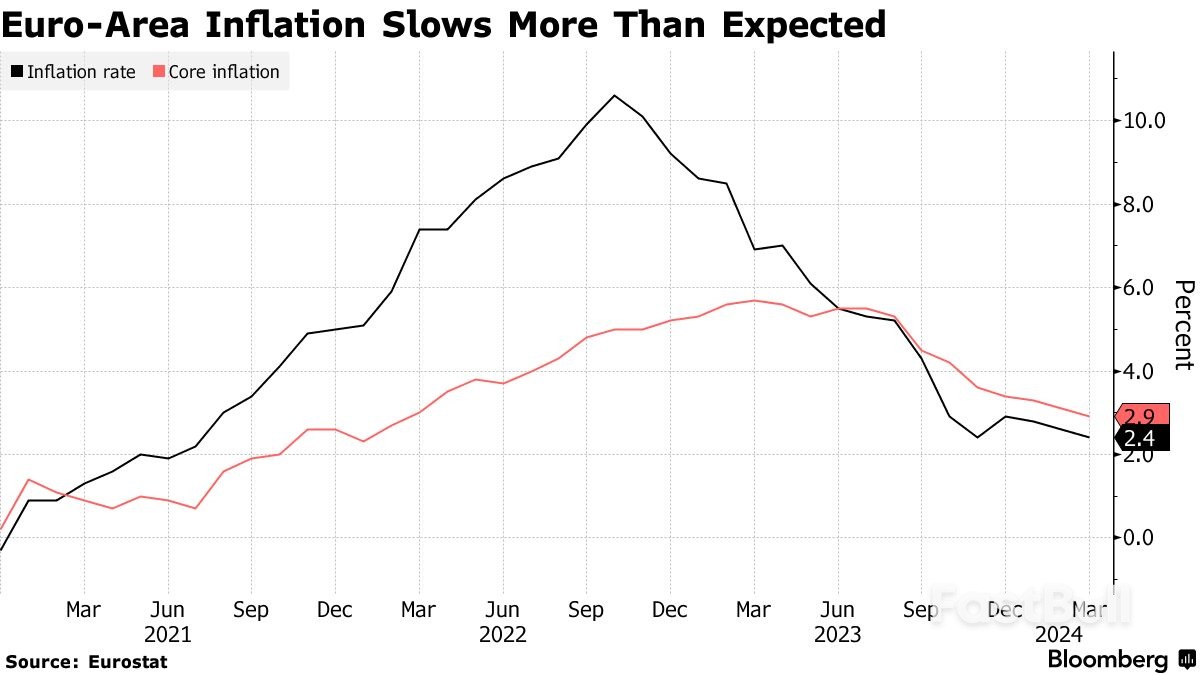
          Euro-area inflation slowed more than expected, cementing prospects for an interest-rate cut by the European Central Bank in June.
          Consumer prices rose an annual 2.4% last month, down from 2.6% in February, in line with a Bloomberg Economics Nowcast model. Analysts predicted an increase of 2.5%. A measure excluding volatile items such as food and energy also eased more than anticipated, to 2.9%.Euro-Area Inflation Inches Toward 2% With Focus On June Cut_1
          The report adds to evidence that policymakers are on track to return inflation to the 2% target, allowing them to soon dial back some of the restriction needed after price gains surged into double digits. President Christine Lagarde has signaled a first cut in June — informed by fresh forecasts and an update on wage growth in the early months of the year.
          Most of the Governing Council — including officials from Germany, France and Spain — have signed up to that timeline, with few clinging to hopes of an earlier move. Economists and money markets are equally aligned, suggesting it would take a big shock to change course.
          Traders held wagers on the scope for rate cuts this year after the report, pricing three quarter-point reductions starting in June with the chance of a fourth at around 60%. That compares to as many as four cuts priced ahead of last month’s monetary-policy decision.
          While shipping disruptions in the Middle East haven’t affected inflation in Europe much and last week’s collapse of a bridge in Baltimore — a key port for carmakers and other manufacturers — is also unlikely to do so, rising pay within the 20-nation euro zone may yet stoke prices.
          Euro-Area Inflation Inches Toward 2% With Focus On June Cut_2
          Chief Economist Philip Lane insists wage increases must continue to retreat for him to consider reversing some of the ECB’s past hikes.
          While a key compensation gauge showed some moderation at the end of 2023, salaries continue to expand by more than 4%. That’s sustaining price pressures in services, where labor has an outsized impact on final costs.
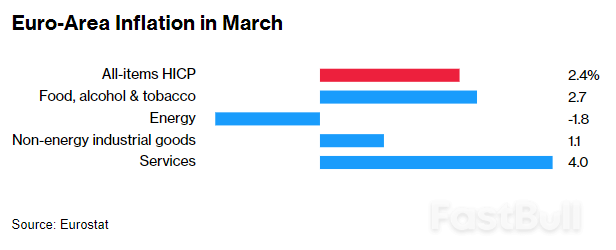
          Inflation in that sector remained at 4% in March, while the rate for non-energy industrial goods fell to 1.1%.Euro-Area Inflation Inches Toward 2% With Focus On June Cut_3
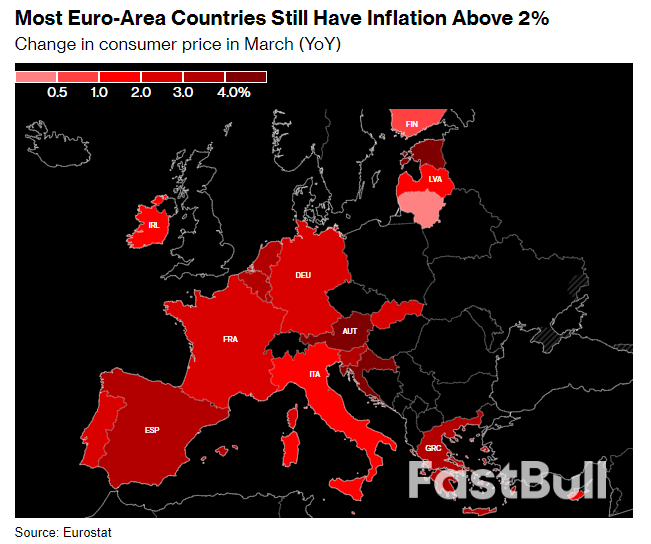
          Across the region, trends also diverge. Spanish inflation accelerated after the government removed some of the support put in place to keep a lid on energy costs, and Italy also saw an uptick. Meanwhile, German and French readings both showed that inflation eased for a third month.
          Such trends make it harder to determine the optimal path following the ECB’s initial cut. Policymakers have already shifted some attention to discussing the pace of later steps, though insist that ultimately economic data will decide.
          Lagarde, too, says the ECB will respond to new information as it comes in. “This implies,” she said last month, “that, even after the first rate cut, we cannot pre-commit to a particular rate path.”

          Source:Bloomberg

          To stay updated on all economic events of today, please check out our Economic calendar
          Risk Warnings and Disclaimers
          You understand and acknowledge that there is a high degree of risk involved in trading. Following any strategies or investment methods may lead to potential losses. The content on the site is provided by our contributors and analysts for information purposes only. You are solely responsible for determining whether any trading assets, securities, strategy, or any other product is suitable for investing based on your own investment objectives and financial situation.
          Add to Favorites
          Share

          Brent Oil Futures Rise Toward $90 as Supply Risks Intensify

          Warren Takunda

          Economic

          Commodity

          Oil prices extended gains on Wednesday, as investors mulled supply risks stemming from Ukrainian attacks on Russian refineries and the potential for escalation in the Middle East conflict, while OPEC+ ministers made no changes to current output cuts in a meeting.
          Brent crude futures for June rose 75 cents, or 0.84%, to $89.67 per barrel at 1130 GMT, while U.S. West Texas Intermediate crude futures for May gained 73 cents, or 0.86%, to $85.88 a barrel.
          OPEC+ ministers made no fresh policy recommendations in a meeting on Wednesday, two sources said, after the group already decided to extend current production cuts until June last month.
          Oil futures compounded Tuesday's gains, when both Brent and WTI climbed 1.7% to their highest since October.
          Prices jumped higher on Tuesday after a fresh round of Ukrainian drone attacks on Russian refineries threatened to take even more of the country's processing capacity offline.
          Investors were also concerned that conflict in the Middle East could spread, after Iran vowed revenge against Israel for an attack on Monday that killed high-ranking military personnel.
          A wider conflict in the Middle East involving more oil-producing nations could cause supply disruptions. Iran, which provides support for the Hamas militia fighting Israel in Gaza, is the third-largest producer in the Organization of the Petroleum Exporting Countries (OPEC).
          "The rise in hostilities in both hotspots pushed the price of the two crude oil futures contracts to their highest levels this year," PVM analyst Tamas Varga said of Tuesday's rise.
          Bank of America Global Research raised its 2024 Brent and WTI forecasts to $86 and $81 a barrel respectively, it said in a note on Wednesday, on firming demand and escalating political tensions.
          "Geopolitical turmoil has also boosted oil demand via longer trade routes and impacted supply by reducing refining capacity via attacks on Russian energy infrastructure." the bank said.
          Elsewhere on Wednesday, Taiwan's strongest earthquake in at least 25 years briefly caused Formosa Petrochemical to halt operations at its Mailiao refinery as a precautionary measure, but works have since restarted.
          The U.S. Energy Information Administration (EIA) will also release oil inventory data later on Wednesday. Data from the American Petroleum Institute reported crude inventories fell by 2.3 million barrels last week, traders said on Tuesday.

          Source: Reuters

          To stay updated on all economic events of today, please check out our Economic calendar
          Risk Warnings and Disclaimers
          You understand and acknowledge that there is a high degree of risk involved in trading. Following any strategies or investment methods may lead to potential losses. The content on the site is provided by our contributors and analysts for information purposes only. You are solely responsible for determining whether any trading assets, securities, strategy, or any other product is suitable for investing based on your own investment objectives and financial situation.
          Add to Favorites
          Share

          Rates Spark: Presumption Of Resilience

          ING

          Economic

          Markets question the Fed June cut and overall easing to be delivered

          US yields continued their move up on Tuesday and the 10-year US Treasury yield has now hit 4.36%, a level last seen in 2023. The move upwards started on Monday when European markets were still on their Easter break. Good Friday had shown us a 0.3% PCE deflator – well flagged but still hot – and a Chairman Jerome Powell who signalled a Fed in no rush to cut. Monday then brought a strong manufacturing ISM reading. Before these events markets seemed dedicated to a Fed cut in June, but now that conviction is down to a 60% probability.
          Monday had seen yields rise more uniformly across the curve, but Tuesday’s price action was marked by a noticeable bear steepening. One way to interpret this is that speculation about the endpoint of Fed cuts took the foreground. Tuesday’s data added to the notion that the economy keeps cruising forward with JOLTS job openings (despite some weakness beyond the headline figure) and factory orders still not conveying a material slowdown. Investors will start to question not only when but also how much the Fed will need to cut.
          While there are indications that point to pockets of weakness, official data that the Fed relies on has kept up. But crucially, (core) inflation will have to come down again to the 0.2% month-on-month readings that would give the Fed room to finally cut rates. We still expect this to happen – a June cut is still our base case for now, meaning also lower market rates ahead. In the near term, we don’t dismiss UST 10-year yields staying in elevated ranges on the presumption of macro resilience – until proven otherwise. But we have earlier also flagged the broader 4.25-4.50% range as an area where market participants could begin to think about getting long the market more strategically.

          EUR rates dragged higher, but conviction for a June ECB cut is unfazed

          Eurozone yields had some catching up to do on Tuesday. Also here yields were pushed up starting from the back end, albeit the UST-Bund 10y spread still widened overall by 5bp since last week to 196bp, the widest level year to date. US yields are the clear driver here since the eurozone data does not show the same strength that would argue for a revaluation of long run rates. Spanish and French PMI numbers may have exceeded expectations, but the overall picture for the eurozone remains one of stagnation with only careful signs of a recovery. If anything, German CPI coming in below expectations at 2.3% would have had a dampening effect on yields.
          Whether those higher eurozone yields can withstand today’s eurozone CPI release will be the next question. Headline inflation is expected to come down to 2.5% and core still a bit sticky at 3.0%. We think the ECB will start cutting in June, at a steady pace, and for a total of three cuts this year. If core comes in below the symbolic 3.0% markets may get excited and price in more than this. However, we don’t think the ECB will be in a rush to cut faster given a recession does not seem imminent and rushing could convey a sense of panic.
          To stay updated on all economic events of today, please check out our Economic calendar
          Risk Warnings and Disclaimers
          You understand and acknowledge that there is a high degree of risk involved in trading. Following any strategies or investment methods may lead to potential losses. The content on the site is provided by our contributors and analysts for information purposes only. You are solely responsible for determining whether any trading assets, securities, strategy, or any other product is suitable for investing based on your own investment objectives and financial situation.
          Add to Favorites
          Share

          ‘Accounts For The Bulk Of South Asia’s Economy’: World Bank Projects India’s Growth At 7.5 For 2024

          Alex

          Economic

          The Indian economy is projected to grow at a robust 7.5 per cent in 2024, stated the World Bank, that credited India for a bulk of the growth in the South Asian economy. The report stated that South Asia’s prospects remain bright in the short term but there still are concerns in the horizon.
          “In India, which accounts for the bulk of the region’s economy, output growth is expected to reach 7.5 per cent in FY23/24 before returning to 6.6 per cent over the medium term, with activity in services and industry expected to remain robust,” state the World Bank report. “In India, output growth is projected to reach 7.5 per cent in FY2023/24 on the back of robust growth in Q3 of FY2023/24. Growth is expected to moderate to 6.6 per cent in FY2024/25 before picking up in subsequent years as a decade of robust public investment yields growth dividends. +e expected slowdown in growth between FY2023/24 and FY2024/25 mainly reflects a deceleration in investment from its elevated pace in the previous year. Growth in services and industry is expected to remain robust, the latter aided by strong construction and real estate activity. Inflationary pressures are expected to subside, creating more policy space for easing financial conditions. Over the medium term, the fiscal deficit and government debt are projected to decline, supported by robust output growth and consolidation efforts by the central government,” the World Bank report stated.
          This comes after India’s manufacturing PMI for the month of March was reported to have reached a 16-year high at 59.1, according to HSBC final India Manufacturing Purchasing Managers' Index, compiled by S&P Global. Hiring increased at the strongest rate in six months, new order exports increased to the highest since May 2020, and manufacturing output rose for the 33rd month in March. As per S&P, the outlook for the upcoming year was optimistic.
          “South Asia is expected to continue to be the fastest-growing emerging market and developing economy (EMDE) region over the next two years. This is largely thanks to robust growth in India, but growth is also expected to pick up in most other South Asian economies. However, growth in the near term is more reliant on the public sector than elsewhere, whereas private investment, in particular, continues to be weak,” the report stated.
          The World Bank, in its report added that overall in South Asia, the growth is expected to be strong at 6.0-6.1 per cent in 2024. This growth is driven by the recoveries of Pakistan and Sri Lanka economies, and the strong growth in India.
          The bank said that while the rest of the region is picking up, it is expected to remain below pre-pandemic averages.
          “South Asia’s growth outlook is somewhat stronger than in the previous edition of this report, by 0.4 percentage points for 2024 and 0.3 percentage points for 2025. +is primarily reflects upward revisions to investment growth in India and somewhat faster-than-anticipated rebounds from last year’s recessions in Pakistan and Sri Lanka,” it added.
          India’s inflation remained within the Reserve Bank of India’s 2-6 per cent target range since a spike in the mid-2023, stated the report. The policy rate has remained unchanged since February 2023. Food price inflation has been elevated, partly reflecting a weak harvest due to El Niño, the bank said.
          According to a recent State Bank of India report, RBI is not likely to alter the rates this upcoming Monetary Policy Committee meeting, scheduled from April 3-5. According to the SBI, RBI is expected to cut rates only in the third quarter of FY25.
          Net portfolio rebounded in India, the World Bank report added. Government revenues are expected to increase on the back of continued efforts to broaden the tax base and improve tax administration, and current expenditures are likely to decrease as pandemic-related measures are wound down, it said.
          “South Asia’s growth prospects remain bright in the short run, but fragile fiscal positions and increasing climate shocks are dark clouds on the horizon. To make growth more resilient, countries need to adopt policies to boost private investment and strengthen employment growth,” said Martin Raiser, World Bank Vice President for South Asia.

          Source:BusinessToday

          To stay updated on all economic events of today, please check out our Economic calendar
          Risk Warnings and Disclaimers
          You understand and acknowledge that there is a high degree of risk involved in trading. Following any strategies or investment methods may lead to potential losses. The content on the site is provided by our contributors and analysts for information purposes only. You are solely responsible for determining whether any trading assets, securities, strategy, or any other product is suitable for investing based on your own investment objectives and financial situation.
          Add to Favorites
          Share
          FastBull
          Copyright © 2025 FastBull Ltd

          728 RM B 7/F GEE LOK IND BLDG NO 34 HUNG TO RD KWUN TONG KLN HONG KONG

          TelegramInstagramTwitterfacebooklinkedin
          App Store Google Play Google Play
          Products
          Charts

          Chats

          Q&A with Experts
          Screeners
          Economic Calendar
          Data
          Tools
          Membership
          Features
          Function
          Markets
          Copy Trading
          Latest Signals
          Contests
          News
          Analysis
          24/7
          Columns
          Education
          Company
          Careers
          About Us
          Contact Us
          Advertising
          Help Center
          Feedback
          User Agreement
          Privacy Policy
          Business

          White Label

          Data API

          Web Plug-ins

          Poster Maker

          Affiliate Program

          Risk Disclosure

          The risk of loss in trading financial instruments such as stocks, FX, commodities, futures, bonds, ETFs and crypto can be substantial. You may sustain a total loss of the funds that you deposit with your broker. Therefore, you should carefully consider whether such trading is suitable for you in light of your circumstances and financial resources.

          No decision to invest should be made without thoroughly conducting due diligence by yourself or consulting with your financial advisors. Our web content might not suit you since we don't know your financial conditions and investment needs. Our financial information might have latency or contain inaccuracy, so you should be fully responsible for any of your trading and investment decisions. The company will not be responsible for your capital loss.

          Without getting permission from the website, you are not allowed to copy the website's graphics, texts, or trademarks. Intellectual property rights in the content or data incorporated into this website belong to its providers and exchange merchants.

          Not Logged In

          Log in to access more features

          FastBull Membership

          Not yet

          Purchase

          Become a signal provider
          Help Center
          Customer Service
          Dark Mode
          Price Up/Down Colors

          Log In

          Sign Up

          Position
          Layout
          Fullscreen
          Default to Chart
          The chart page opens by default when you visit fastbull.com