• Trade
  • Markets
  • Copy
  • Contests
  • News
  • 24/7
  • Calendar
  • Q&A
  • Chats
Trending
Screeners
SYMBOL
LAST
BID
ASK
HIGH
LOW
NET CHG.
%CHG.
SPREAD
SPX
S&P 500 Index
6870.39
6870.39
6870.39
6895.79
6858.28
+13.27
+ 0.19%
--
DJI
Dow Jones Industrial Average
47954.98
47954.98
47954.98
48133.54
47871.51
+104.05
+ 0.22%
--
IXIC
NASDAQ Composite Index
23578.12
23578.12
23578.12
23680.03
23506.00
+72.99
+ 0.31%
--
USDX
US Dollar Index
98.880
98.960
98.880
98.960
98.730
-0.070
-0.07%
--
EURUSD
Euro / US Dollar
1.16521
1.16528
1.16521
1.16717
1.16341
+0.00095
+ 0.08%
--
GBPUSD
Pound Sterling / US Dollar
1.33265
1.33272
1.33265
1.33462
1.33136
-0.00047
-0.04%
--
XAUUSD
Gold / US Dollar
4205.97
4206.31
4205.97
4218.85
4190.61
+8.06
+ 0.19%
--
WTI
Light Sweet Crude Oil
59.159
59.189
59.159
60.084
58.980
-0.650
-1.09%
--

Community Accounts

Signal Accounts
--
Profit Accounts
--
Loss Accounts
--
View More

Become a signal provider

Sell trading signals to earn additional income

View More

Guide to Copy Trading

Get started with ease and confidence

View More

Signal Accounts for Members

All Signal Accounts

Best Return
  • Best Return
  • Best P/L
  • Best MDD
Past 1W
  • Past 1W
  • Past 1M
  • Past 1Y

All Contests

  • All
  • Trump Updates
  • Recommend
  • Stocks
  • Cryptocurrencies
  • Central Banks
  • Featured News
Top News Only
Share

White House Economic Adviser Hassett On Trump's Ai 'One Rule': Order Should Help Ai Companies Understand What The Rules Are

Share

German Chancellor Merz: Sceptical About Some Of The Details In Documents Coming From The United States

Share

White House Economic Adviser Hassett On Aca Subsidies: There Is Room For Negotiation

Share

French President Macron: Russia Economy Is Starting To Suffer After Latest Sanctions

Share

Ukraine President Zelenskiy: Unity Between Europe, Ukraine And Unites States Is Important

Share

UK Labour Party Leader Starmer: Matters For Ukraine Are For Ukraine

Share

China's Commerce Minister: China Has Already Implemented Export License Exemptions For Nexperia Chips

Share

China's Commerce Minister: China Is Gradually Applying A General Licensing System In Areas Such As Rare Earths

Share

China's Commerce Minister: China Attaches Importance To Germany's Concerns Regarding Export Controls And Nexperia

Share

Trump: I Will Be Doing A One Rule Executive Order This Week On Ai

Share

China's Commerce Minister: Hopese German Government To Create Fair, Open Environment For Chinese Firms

Share

White House National Economic Council Director Hassett: Powell May Also Believe That A Rate Cut Is Prudent. Regarding The Magnitude Of The Rate Cut, He Said That We Must Pay Attention To The Data. It Is Irresponsible To Commit To The Interest Rate Path For The Next Six Months In Advance

Share

White House Economic Adviser Hassett: Bond Market Is Fluctuating In Part Perhaps Over Fed Uncertainty

Share

China's Commerce Minister: Meets German Foreign Minister

Share

White House Economic Adviser Hassett On Fed: Trump Has Lots Of Good Choices

Share

White House Economic Adviser Hassett On Fed: We Should Continue To Get The Rate Down Some

Share

Argus: Ukraine Wheat Crop Could Rise To 23.9 Million T Next Year

Share

Argus Media Forecasts Ukraine's 2026/27 Wheat Production At 23.9 Million T, Up From 23.0 Million T In 2025/26

Share

Standard Chartered Expects US Fed To Cut Interest Rates By 25 Bps In December Versus Prior Forecast Of No Rate Cut

Share

Morgan Stanley Sees Upside Risks To Copper Price Forecast (2026 Base Case $10650/T, Bull Case $12780/T)

TIME
ACT
FCST
PREV
France Trade Balance (SA) (Oct)

A:--

F: --

P: --
Euro Zone Employment YoY (SA) (Q3)

A:--

F: --

P: --
Canada Part-Time Employment (SA) (Nov)

A:--

F: --

P: --

Canada Unemployment Rate (SA) (Nov)

A:--

F: --

P: --

Canada Full-time Employment (SA) (Nov)

A:--

F: --

P: --

Canada Labor Force Participation Rate (SA) (Nov)

A:--

F: --

P: --

Canada Employment (SA) (Nov)

A:--

F: --

P: --

U.S. PCE Price Index MoM (Sept)

A:--

F: --

P: --

U.S. Personal Income MoM (Sept)

A:--

F: --

P: --

U.S. Core PCE Price Index MoM (Sept)

A:--

F: --

P: --

U.S. PCE Price Index YoY (SA) (Sept)

A:--

F: --

P: --

U.S. Core PCE Price Index YoY (Sept)

A:--

F: --

P: --

U.S. Personal Outlays MoM (SA) (Sept)

A:--

F: --

P: --
U.S. 5-10 Year-Ahead Inflation Expectations (Dec)

A:--

F: --

P: --

U.S. Real Personal Consumption Expenditures MoM (Sept)

A:--

F: --

P: --
U.S. Weekly Total Rig Count

A:--

F: --

P: --

U.S. Weekly Total Oil Rig Count

A:--

F: --

P: --

U.S. Consumer Credit (SA) (Oct)

A:--

F: --

P: --
China, Mainland Foreign Exchange Reserves (Nov)

A:--

F: --

P: --

Japan Trade Balance (Oct)

A:--

F: --

P: --

Japan Nominal GDP Revised QoQ (Q3)

A:--

F: --

P: --

China, Mainland Imports YoY (CNH) (Nov)

A:--

F: --

P: --

China, Mainland Exports (Nov)

A:--

F: --

P: --

China, Mainland Imports (CNH) (Nov)

A:--

F: --

P: --

China, Mainland Trade Balance (CNH) (Nov)

A:--

F: --

P: --

China, Mainland Exports YoY (USD) (Nov)

A:--

F: --

P: --

China, Mainland Imports YoY (USD) (Nov)

A:--

F: --

P: --

Germany Industrial Output MoM (SA) (Oct)

A:--

F: --

P: --
Euro Zone Sentix Investor Confidence Index (Dec)

A:--

F: --

P: --

Canada National Economic Confidence Index

A:--

F: --

P: --

U.K. BRC Like-For-Like Retail Sales YoY (Nov)

--

F: --

P: --

U.K. BRC Overall Retail Sales YoY (Nov)

--

F: --

P: --

Australia Overnight (Borrowing) Key Rate

--

F: --

P: --

RBA Rate Statement
RBA Press Conference
Germany Exports MoM (SA) (Oct)

--

F: --

P: --

U.S. NFIB Small Business Optimism Index (SA) (Nov)

--

F: --

P: --

Mexico 12-Month Inflation (CPI) (Nov)

--

F: --

P: --

Mexico Core CPI YoY (Nov)

--

F: --

P: --

Mexico PPI YoY (Nov)

--

F: --

P: --

U.S. Weekly Redbook Index YoY

--

F: --

P: --

U.S. JOLTS Job Openings (SA) (Oct)

--

F: --

P: --

China, Mainland M1 Money Supply YoY (Nov)

--

F: --

P: --

China, Mainland M0 Money Supply YoY (Nov)

--

F: --

P: --

China, Mainland M2 Money Supply YoY (Nov)

--

F: --

P: --

U.S. EIA Short-Term Crude Production Forecast For The Year (Dec)

--

F: --

P: --

U.S. EIA Natural Gas Production Forecast For The Next Year (Dec)

--

F: --

P: --

U.S. EIA Short-Term Crude Production Forecast For The Next Year (Dec)

--

F: --

P: --

EIA Monthly Short-Term Energy Outlook
U.S. API Weekly Gasoline Stocks

--

F: --

P: --

U.S. API Weekly Cushing Crude Oil Stocks

--

F: --

P: --

U.S. API Weekly Crude Oil Stocks

--

F: --

P: --

U.S. API Weekly Refined Oil Stocks

--

F: --

P: --

South Korea Unemployment Rate (SA) (Nov)

--

F: --

P: --

Japan Reuters Tankan Non-Manufacturers Index (Dec)

--

F: --

P: --

Japan Reuters Tankan Manufacturers Index (Dec)

--

F: --

P: --

Japan Domestic Enterprise Commodity Price Index MoM (Nov)

--

F: --

P: --

Japan Domestic Enterprise Commodity Price Index YoY (Nov)

--

F: --

P: --

China, Mainland PPI YoY (Nov)

--

F: --

P: --

China, Mainland CPI MoM (Nov)

--

F: --

P: --

Q&A with Experts
    • All
    • Chatrooms
    • Groups
    • Friends
    Connecting
    .
    .
    .
    Type here...
    Add Symbol or Code

      No matching data

      All
      Trump Updates
      Recommend
      Stocks
      Cryptocurrencies
      Central Banks
      Featured News
      • All
      • Russia-Ukraine Conflict
      • Middle East Flashpoint
      • All
      • Russia-Ukraine Conflict
      • Middle East Flashpoint
      Search
      Products

      Charts Free Forever

      Chats Q&A with Experts
      Screeners Economic Calendar Data Tools
      Membership Features
      Data Warehouse Market Trends Institutional Data Policy Rates Macro

      Market Trends

      Market Sentiment Order Book Forex Correlations

      Top Indicators

      Charts Free Forever
      Markets

      News

      News Analysis 24/7 Columns Education
      From Institutions From Analysts
      Topics Columnists

      Latest Views

      Latest Views

      Trending Topics

      Top Columnists

      Latest Update

      Signals

      Copy Rankings Latest Signals Become a signal provider AI Rating
      Contests
      Brokers

      Overview Brokers Assessment Rankings Regulators News Claims
      Broker listing Forex Brokers Comparison Tool Live Spread Comparison Scam
      Q&A Complaint Scam Alert Videos Tips to Detect Scam
      More

      Business
      Events
      Careers About Us Advertising Help Center

      White Label

      Data API

      Web Plug-ins

      Affiliate Program

      Awards Institution Evaluation IB Seminar Salon Event Exhibition
      Vietnam Thailand Singapore Dubai
      Fans Party Investment Sharing Session
      FastBull Summit BrokersView Expo
      Recent Searches
        Top Searches
          Markets
          News
          Analysis
          User
          24/7
          Economic Calendar
          Education
          Data
          • Names
          • Latest
          • Prev

          View All

          No data

          Scan to Download

          Faster Charts, Chat Faster!

          Download App
          English
          • English
          • Español
          • العربية
          • Bahasa Indonesia
          • Bahasa Melayu
          • Tiếng Việt
          • ภาษาไทย
          • Français
          • Italiano
          • Türkçe
          • Русский язык
          • 简中
          • 繁中
          Open Account
          Search
          Products
          Charts Free Forever
          Markets
          News
          Signals

          Copy Rankings Latest Signals Become a signal provider AI Rating
          Contests
          Brokers

          Overview Brokers Assessment Rankings Regulators News Claims
          Broker listing Forex Brokers Comparison Tool Live Spread Comparison Scam
          Q&A Complaint Scam Alert Videos Tips to Detect Scam
          More

          Business
          Events
          Careers About Us Advertising Help Center

          White Label

          Data API

          Web Plug-ins

          Affiliate Program

          Awards Institution Evaluation IB Seminar Salon Event Exhibition
          Vietnam Thailand Singapore Dubai
          Fans Party Investment Sharing Session
          FastBull Summit BrokersView Expo

          US Home Builder Sentiment Subdued In November Amid Labor Market Worries

          Devin

          Economic

          Summary:

          U.S. homebuilder sentiment remained subdued in November as concerns about the labor market and household finances weighed on demand, contributing to a surge in the share of builders slashing prices to reduce new housing inventory.

          U.S. homebuilder sentiment remained subdued in November as concerns about the labor market and household finances weighed on demand, contributing to a surge in the share of builders slashing prices to reduce new housing inventory.

          The National Association of Home Builders/Wells Fargo Housing Market index edged up one point to 38 this month. It remained below the 50 breakeven point for the 19th straight month. Economists polled by Reuters had forecast the index unchanged at 37.

          The small uptick could reflect a decrease in mortgage rates when the Federal Reserve resumed its interest rate cuts. But mortgage rates have halted their decline, data from mortgage finance agency Freddie Mac showed, as U.S. central bank officials signaled a reluctance to lower rates again next month.

          Labor market stagnation is sidelining potential homebuyers, and new housing inventory was elevated in August, limiting the scope for builders to break ground on new projects.

          "We continue to see demand-side weakness as a softening labor market and stretched consumer finances are contributing to a difficult sales environment," said NAHB chief economist Robert Dietz.

          Lack of affordable housing has become a political hot-button issue. President Donald Trump this month floated a 50-year mortgage to make housing affordable, an idea that was panned by some of his supporters and housing market experts who argued it would result in homeowners paying more in interest and taking longer to build equity.

          The National Association of Realtors this month estimated the median age of first-time buyers was 40 years. In the 1980s the typical home buyer was in their late 20s, the NAR said.

          The survey's measure of current sales conditions increased two points to 41 this month, while its gauge of future sales fell three points to 51. A measure of prospective buyer traffic gained one point to 26.

          The share of builders reporting cutting prices increased to 41%, the highest since May 2020. The average price reduction was unchanged at 6%, while the share using incentives was 65%, holding steady since September.

          "More builders are using incentives to get deals closed, including lowering prices, but many potential buyers still remain on the fence," said NAHB chairman Buddy Hughes.

          Source: TradingView

          To stay updated on all economic events of today, please check out our Economic calendar
          Risk Warnings and Disclaimers
          You understand and acknowledge that there is a high degree of risk involved in trading. Following any strategies or investment methods may lead to potential losses. The content on the site is provided by our contributors and analysts for information purposes only. You are solely responsible for determining whether any trading assets, securities, strategy, or any other product is suitable for investing based on your own investment objectives and financial situation.
          Add to Favorites
          Share

          Larry Summers Says He's Stepping Back From Public Commitments After Epstein Emails

          Justin

          Political

          Former U.S. Treasury Secretary Larry Summers said on Monday he will step back from all public commitments, days after PresidentDonald Trumpordered the Justice Department to investigate his and other prominent Democrats' ties to convicted sex offender Jeffrey Epstein.

          Summers, a former president of Harvard University, where he is a professor, told the university's student newspaper that the move was to allow him "to rebuild trust and repair relationships with the people closest to me."

          The announcement came after the House Oversight Committee released thousands of files related to Epstein last week, including documents that showed personal correspondence between Summers and Epstein.

          "I am deeply ashamed of my actions and recognize the pain they have caused. I take full responsibility for my misguided decision to continue communicating with Mr. Epstein," Summers told The Crimson.

          "While continuing to fulfill my teaching obligations, I will be stepping back from public commitments as one part of my broader effort," Summers added.

          Summers, a Democrat, served as former President Bill Clinton's Treasury Secretary and former President Barack Obama's National Economic Council director. He currently serves on the board of OpenAI and as a director of the Harvard Kennedy School's Mossavar-Rahmani Center for Business and Government.

          OpenAI and Harvard did not immediately respond to requests for comments. Summers also did not immediately respond.

          The Epstein scandal has been a political thorn in Trump's side for months, partly because he amplified conspiracy theories about Epstein to his own supporters.

          Many Trump voters believe Bondi and other Trump officials have covered up Epstein's ties to powerful figures and obscured details surrounding his death by suicide in a Manhattan jail in 2019.

          The U.S. House of Representatives will vote on Tuesday on forcing the release of investigative Epstein files after Trump, who had initially opposed the vote, called on fellow Republicans to support it.

          Source: TradingView

          Risk Warnings and Disclaimers
          You understand and acknowledge that there is a high degree of risk involved in trading. Following any strategies or investment methods may lead to potential losses. The content on the site is provided by our contributors and analysts for information purposes only. You are solely responsible for determining whether any trading assets, securities, strategy, or any other product is suitable for investing based on your own investment objectives and financial situation.
          Add to Favorites
          Share

          AI’s Reckoning to Define Investing in 2026 — and It Starts Now

          Adam

          Economic

          The past four trading sessions have delivered a stark message that investors can no longer ignore.
          Heavy selling across global indices, the Nikkei’s 3% slide, and the broad retreat across US benchmarks show a decisive shift in the psychology that has shaped markets for two years. The AI-driven rally that powered an extraordinary run in equities has reached a point where momentum is no longer a substitute for proof.
          This moment has arrived faster than many expected, and it carries far-reaching implications for how investors position themselves for 2026. AI has remained the central engine of market performance, but the foundation beneath it is entering a defining test.
          The catalyst is Nvidia’s (NASDAQ:NVDA) earnings report on Wednesday, which has become more than another corporate update. It is now a gauge of whether the most powerful force in the market still commands the conviction that pushed valuations to historic extremes.
          I see investors reassessing their assumptions with a level of precision that has been missing during the past two years of relentless enthusiasm.
          The world has moved through a phase in which the scale of AI investment mattered more than the financial outcome. That period is ending. Markets now demand visibility, consistency and accountability. The companies offering that clarity will secure capital next year, while those relying on distant projections will find conditions far more challenging.
          The latest earnings cycle laid the groundwork for this shift. Results from major technology firms showed a widening gap between businesses that can convert AI infrastructure into measurable gains and those still relying on promise-driven stories.
          Alphabet (NASDAQ:GOOGL) and Amazon (NASDAQ:AMZN) demonstrated how disciplined investment linked to identifiable monetisation can outperform even in an environment crowded with competing narratives. In contrast, Meta and Microsoft met immediate resistance when spending rose ahead of revenue potential. Tesla’s (NASDAQ:TSLA) soft margins intensified the sense that the industry is confronting rising costs and slower demand at the same time.
          This divergence matters because it is shaping how investors appraise every part of the AI ecosystem. Market participants are watching strategy execution in real time. They are scrutinising operating efficiency with a sharper lens.
          They want to see how companies justify their investment intensity when funding becomes more selective. Margin strength, not headline revenue growth, is becoming the measure that determines whether a business has a future at the core of the AI economy.
          Nvidia’s upcoming numbers carry outsized weight because they anchor global expectations. Forecasts for another powerful jump in revenue and earnings have pushed the valuation into territory that tolerates no hesitation. Any sign of slowing customer absorption, weaker Blackwell momentum, softer hyperscaler orders, or pressure created by export restrictions will immediately influence market direction.
          Investors want assurance that profitability is expanding at a pace that matches the scale of spending. Without that alignment, the assumptions attached to the entire AI complex will come under review.
          This reassessment is unfolding alongside an important geopolitical backdrop. President Donald Trump’s tech and industrial priorities are driving companies to rethink their global exposure, supply-chain design and capital-allocation plans. Washington’s export controls are reshaping the competitive environment for advanced computing in China.
          At the same time, sovereign AI ambitions are accelerating in regions seeking strategic autonomy. These forces are reshaping demand patterns, risk considerations, and long-term planning across the industry. Nvidia’s guidance will influence how investors interpret these currents through next year.
          The pullback across global equities during the past several days is a reminder that markets remain vulnerable to concentration. Gains built on a narrow group of leaders can reverse quickly when confidence wavers. The S&P 500 closing below a key level on Monday reinforced the idea that investors are rediscovering the importance of diversification, valuation discipline, and cash-flow durability.
          But this moment is not a setback for AI. It is an essential recalibration of expectations that have reached levels impossible to maintain without consistent evidence. The technology remains transformative. Adoption continues across every sector. Productivity gains are accelerating, not fading.
          What is changing is the threshold investors apply when assessing which companies will dominate the next stage of this transition.
          As I look ahead to 2026, I expect a market defined by sharper selection. Capital will concentrate in businesses that can demonstrate earnings power tied directly to AI deployment. Investors who focus on durability instead of size, and on monetisation instead of scale, will be best placed for the opportunities emerging from this global adjustment.
          The reckoning has arrived. It is not a pause in progress. It is the point at which performance, discipline, and strategic clarity determine the winners of the next phase of the AI era.

          Source: investing

          To stay updated on all economic events of today, please check out our Economic calendar
          Risk Warnings and Disclaimers
          You understand and acknowledge that there is a high degree of risk involved in trading. Following any strategies or investment methods may lead to potential losses. The content on the site is provided by our contributors and analysts for information purposes only. You are solely responsible for determining whether any trading assets, securities, strategy, or any other product is suitable for investing based on your own investment objectives and financial situation.
          Add to Favorites
          Share

          BOE’s Pill Says Headline UK Inflation Overstates Price Pressures

          James Whitman

          Central Bank

          Economic

          Bank of England Chief Economist Huw Pill said that UK price pressures are not as strong as headline inflation estimates suggest, though signaled policymakers should not cut interest rates again just yet.

          Pill said on Tuesday that a raft of one-off impacts on inflation will likely be temporary but also reiterated concerns that a series of economics shocks to households and firms may have changed price and wage-setting behavior.

          "I think underlying inflationary dynamics in the UK are probably not as strong as current spot headline inflation suggests, but that doesn't mean I think that I embrace that story completely," he said in a fireside chat hosted by Natixis Corporate and Investment Banking. He said that the current momentum in domestic prices and wages is "not fully compatible with the inflation target," adding that "there's still work to do."

          Pill's comments came ahead of inflation figures on Wednesday that could be crucial in determining whether the BOE resumes cutting interest rates in December. Economists expect the data to show inflation cooling to 3.5% in October, the lowest in five months, after hitting almost double the BOE's 2% target over the summer.

          Recent data showing price pressures weaker than thought and the economy softening have fueled expectations of a rate reduction in December. Markets put the chances of a move next month at around 80%.

          However, it is expected to be a tight decision with the government's budget looming on Nov. 26. Pill was part of the 5-4 majority that voted to keep rates at 4% earlier this month, slowing the pace of the BOE's easing cycle. He said on Tuesday his views had not changed much since then.

          While Pill highlighted that temporary factors such as tax changes and good bills are pushing up inflation, he also remained worried over structural shifts in the economy that could mean price pressures persist.

          "That accumulation of structural shocks to the economy could certainly plausibly have had an impact on the structure of price setting and wage setting," he said. "Now that's a view probably I'm more associated with... I think there is some evidence for that view."

          Pill played down divisions on the MPC and said Governor Andrew Bailey sits "in between" the two broad camps on the panel, with signs of slack opening in the labor market pitted against concerns about above-target inflation. Policymakers are in a series of "finely balanced" decisions, he said.

          He also pushed back against claims he is the most hawkish member of the MPC and said he prefers a gradualist approach to policy over an activist stance that advocates more aggressive moves in rates.

          Source: Bloomberg

          To stay updated on all economic events of today, please check out our Economic calendar
          Risk Warnings and Disclaimers
          You understand and acknowledge that there is a high degree of risk involved in trading. Following any strategies or investment methods may lead to potential losses. The content on the site is provided by our contributors and analysts for information purposes only. You are solely responsible for determining whether any trading assets, securities, strategy, or any other product is suitable for investing based on your own investment objectives and financial situation.
          Add to Favorites
          Share

          Why some elite investors are turning on the darling of the AI rally

          Adam

          Stocks

          Economic

          Three prominent investors with almost nothing in common are dumping their shares of Nvidia, the computer chip juggernaut that went from relative obscurity to the world’s first $5 trillion valuation in just three years.
          It’s hard to overstate Nvidia’s superlatives. On its own it makes up 8% of the total value of the S&P 500. Its annual net income grew more than 580% between 2023 and 2024. It’s become almost a joke on Wall Street that the company consistently blows past expectations, notching quarter after quarter of financial gains, thanks to seemingly bottomless demand for Nvidia’s sophisticated chips, which are key to building artificial intelligence models like OpenAI’s ChatGPT or Anthropic’s Claude.
          So why sell now? Isn’t betting against Nvidia now a bit like betting against the 1995 Bulls? (As in, you’d be out of your mind to do so)?
          Maybe not. There are any number of reasons why investors would sell Nvidia, but the timing of these recent moves is fueling concerns that the company — and by extension, the entire AI industry — is part of a speculative bubble that’s bound to burst.
          On Monday, a regulatory filing showed tech billionaire Peter Thiel’s hedge fund had, sometime in the three months ending in September, sold its entire stake in Nvidia — all 537,742 shares, which would be worth about $100 million as of September 30, the last day of the quarter. The disclosure, three days ahead of Nvidia’s upcoming earnings release, rattled investors, who are already nervous about when, or whether, they’ll see a return on their AI investments.
          Thiel’s revelation came days after Japanese conglomerate SoftBank said it had sold all of its Nvidia holdings for $5.8 billion. And earlier this month, Michael Burry — the “Big Short” investor who anticipated the housing market’s collapse in 2008 — disclosed that his hedge fund had bought more than $1 billion in “put” options against Nvidia and Palantir, another AI darling, essentially wagering that their stocks will fall.
          What do Thiel, Burry and SoftBank know about Nvidia that the rest of us don’t? What are they seeing that the rest of Wall Street can’t (or doesn’t want to) see?
          To be sure, these folks all had their reasons, and not all of them are directly betting against Nvidia or AI.
          SoftBank and its CEO, Masayoshi Son, remain fully aboard the AI hype wagon. But they also needed to gin up a bunch of cash soon to complete a nearly $23 billion investment in OpenAI, prompting them to take their Nvidia profits.
          Burry’s position is a much more skeptical one. In a post on X, Burry wrote that he believes Big Tech companies are “understating depreciation” around Nvidia’s core product — essentially, they’ll soon be sitting on a bunch of equipment that’s obsolete, and they’re undervaluing how much that will hurt their bottom line.
          Representatives for Thiel, a co-founder of surveillance software giant Palantir and a guy who reportedly believes that strictly regulating AI tech will hasten the arrival of the Antichrist, did not respond to a request for comment. Thiel has previously staked out a fairly conservative position on AI, telling the New York Times’ Ross Douthat that the technology is “more than a nothing burger” but “less than the total transformation of our society.”
          The timing of these moves — coming the same quarter that Nvidia hit $5 trillion in market value (it’s now back down to a measly $4.5 trillion) — may be purely coincidental. But they’re not helping soothe any nerves on Wall Street.
          “I don’t read a lot into people’s timing with respect to this stuff,” Paul Kedrosky, a partner at SK Ventures, told CNN. “But I do think that there’s been a kind of Gestalt shift in terms of how people think about this entire area and what are reasonable assumptions about future growth.”
          Nvidia sank 2% Monday, even as analysts expected the company to once again deliver a solid earnings report on Wednesday. Other tech stocks and crypto followed, dragging the broader market down. Wall Street’s fear gauge, the VIX, jumped 13%. CNN’s Fear and Greed index traded in “extreme fear” and hit its lowest level since early April.
          “I think we’re at a tipping point of this bubble,” Mike O’Rourke, chief market atrategist at JonesTrading, told CNN Monday. “And then you have all these other things that were just massively speculative this year,” he added, citing the crypto rally and the expansion of digital asset treasury companies. “Now you’ve seen that very speculative aspect start to unwind, and I wouldn’t be surprised if it bleeds over and people get a little more cautious.”

          Source: cnn

          To stay updated on all economic events of today, please check out our Economic calendar
          Risk Warnings and Disclaimers
          You understand and acknowledge that there is a high degree of risk involved in trading. Following any strategies or investment methods may lead to potential losses. The content on the site is provided by our contributors and analysts for information purposes only. You are solely responsible for determining whether any trading assets, securities, strategy, or any other product is suitable for investing based on your own investment objectives and financial situation.
          Add to Favorites
          Share

          Bitcoin Whales Switch to Buying Amid ‘Extreme Fear’

          Warren Takunda

          Cryptocurrency

          The number of Bitcoin whale wallets has spiked as the crypto markets struggled this week, with Bitcoin sinking as low as $89,550 on Tuesday.
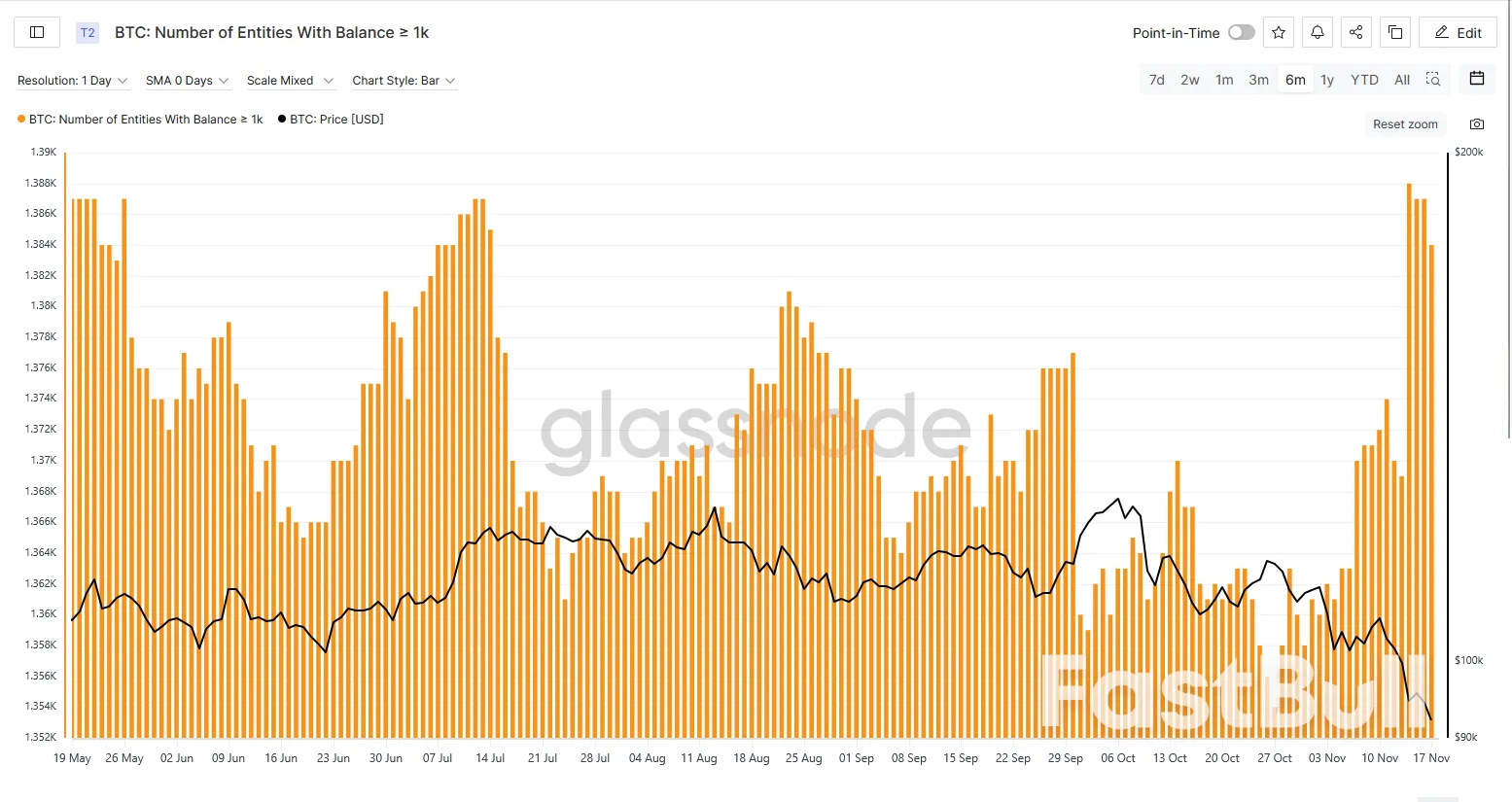
          Data from the crypto analytics platform Glassnode shows that whales have been accumulating since late October, with a notable spike in the number of Bitcoin whale wallets holding above 1,000 BTC starting Friday.
          Whale wallets’ numbers fell to a yearly low of 1,354 on Oct. 27 — when BTC was trading at around $114,000 — but as of Monday, this number has spiked 2.2% to sit at 1,384, in levels not seen in four months.Bitcoin Whales Switch to Buying Amid ‘Extreme Fear’_1

          Source: Glassnode

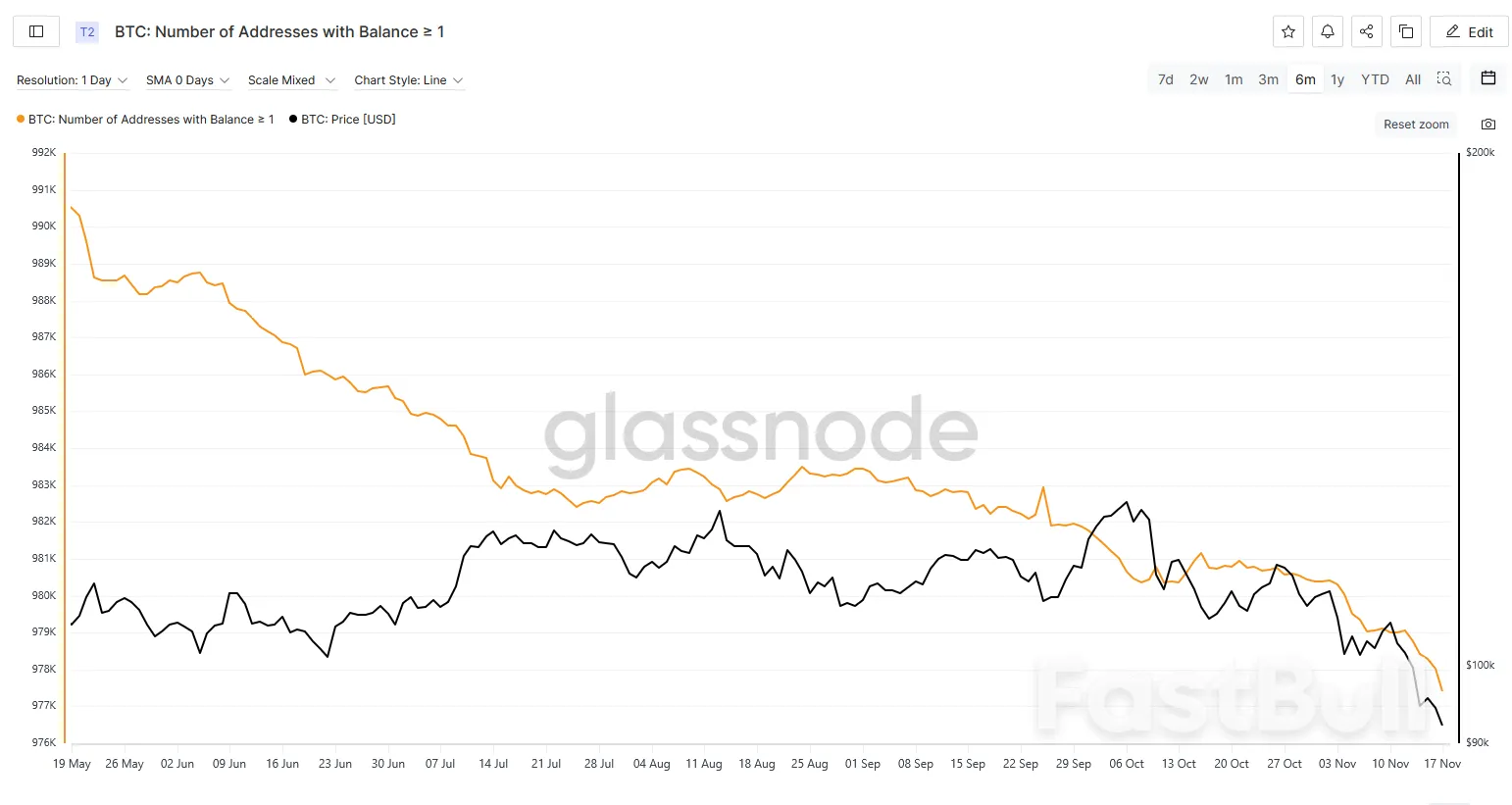
          At the same time, Glassnode data indicate that holders with 1 BTC or more have been feeling the pressure of the recent price slump.
          The total number of these wallets has decreased from 980,577 on Oct. 27 to hit a yearly low of 977,420 on Nov. 17. Bitcoin Whales Switch to Buying Amid ‘Extreme Fear’_2

          Wallets with 1 BTC or more have tanked in 2025. Source: Glassnode

          This data contradicts a recent narrative around “OG dumping,” which argues that older investors have been driving the price of Bitcoin down lately by taking profits.Commenting on these dynamics, 10X Research‘s Markus Thielen told Cointelegraph that there is some whale selling still going on, as he stressed that Oct. 29 FOMC meeting from the US Federal Reserve has had a huge impact on what we are seeing now.
          “His message decisively broke the fragile balance that had existed between market sellers and buyers – between the OG mega whale sellers (1,000-10,000 BTC) and the whale buyers (100-1,000 BTC).”
          “Super-whales and mega-whales are absorbing some of the whale selling, but the 30-day net-flow ratio between these cohorts still shows decisive net selling,” he added.

          Bitcoin drops below $90K

          Bitcoin dipped below a crucial psychological level on Monday, and is currently trading at around $89,900. This has seen the Crypto Fear & Greed Index drop down to the “extreme-fear” zone with a score of 11 out of 100.
          While some may be feeling the pressure, executives from firms such as Bitwise and BitMine have tipped BTC selling pressure to subside and hit a bottom this week.
          Speaking with CNBC on Monday, Bitwise Asset Management chief investment officer Matt Hougan argued that current price levels are a “generational opportunity.”
          “I think we’re nearing a bottom. I look at this as a great buying opportunity for long-term investors. Bitcoin was the first thing to turn over before this broader market pullback. It was sort of the canary in the coal mine signaling that there was some risk in all sorts of risk-on assets,” Hougan said.
          Elsewhere, while “working at McDonald’s” memes are making a comeback on X, execs like Gemini crypto exchange co-founder Cameron Winklevoss have taken a more positive spin, posting that this “is the last time you’ll ever be able to buy Bitcoin below $90k!”
          Another crypto analyst on X, including TheCryptoDog, has also argued that BTC is due “for a bounce soon” given current metrics.
          “If things play out clear and simple, $BTC tags ~87.7k - Some high TF MA support & horizontal support from previous resistance (the break of which triggered a rally in May),” they wrote.

          Source: Cointelegraph

          Risk Warnings and Disclaimers
          You understand and acknowledge that there is a high degree of risk involved in trading. Following any strategies or investment methods may lead to potential losses. The content on the site is provided by our contributors and analysts for information purposes only. You are solely responsible for determining whether any trading assets, securities, strategy, or any other product is suitable for investing based on your own investment objectives and financial situation.
          Add to Favorites
          Share

          S&P 500: Bears Emerge as Funding Stress and Credit Risks Deepen

          Adam

          Economic

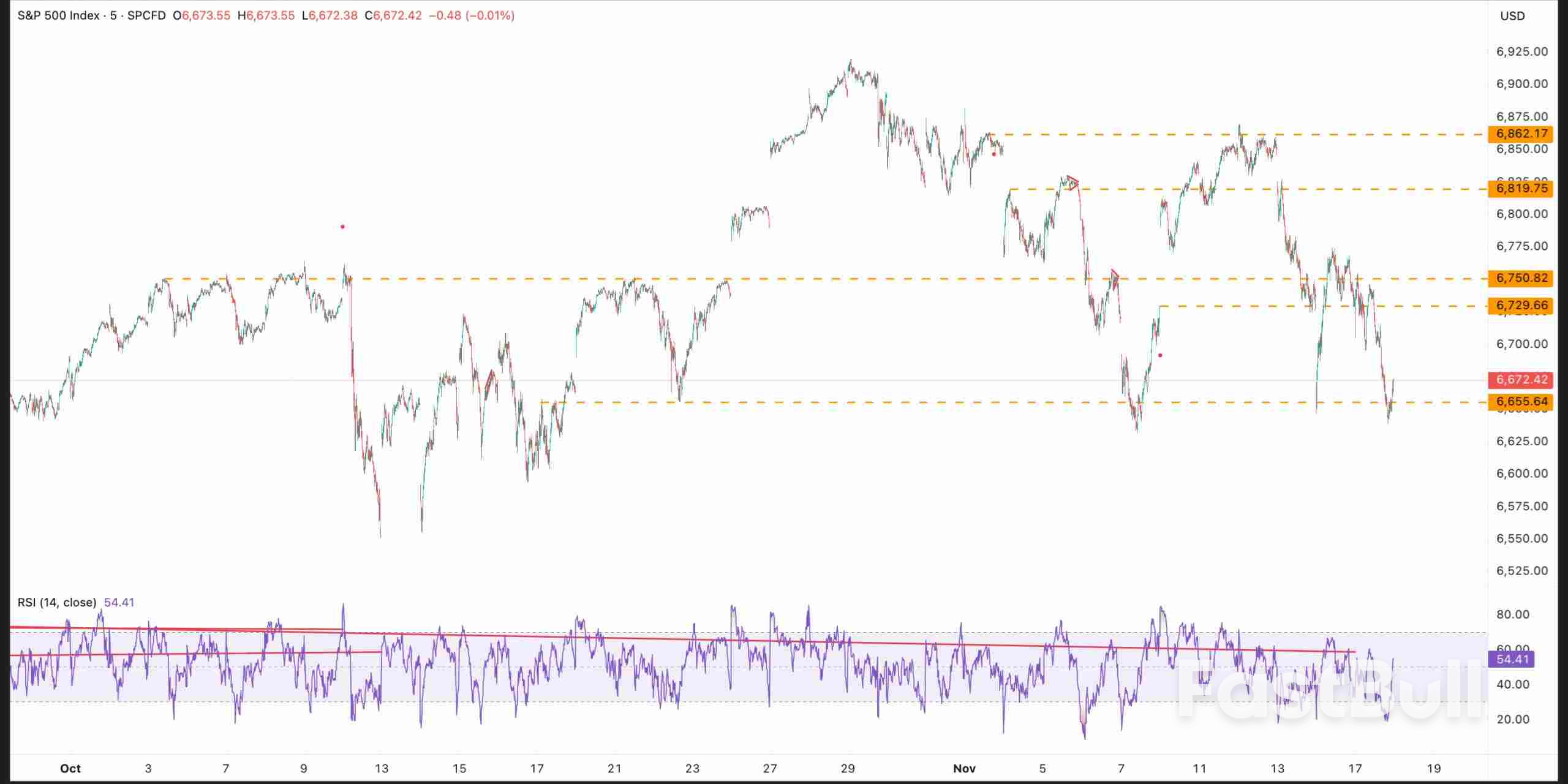
          The S&P 500 fell by about 1% on the day, reversing the recent string of Monday rallies. Not surprisingly, the index attempted to rally in the mid-morning as volatility declined. However, the market had already opened lower, and while we saw a brief rebound around 10 a.m., those gains faded quickly, as Monday was a Treasury settlement date.
          Today is also a Treasury settlement date, and we’re already seeing repo rates move back above 4% for Monday. For now, the S&P 500 continues to hold around 6,750, which remains the key sticking point. Every time the index gets there, it bounces off that level or near it, but at some point, that region is likely to break.
          Given the small end-of-day surge, it wouldn’t be surprising if we gap lower today, undercut the 6,640 low, and continue to see pressure throughout the day—potentially even testing 6,600 or moving below it.
          S&P 500: Bears Emerge as Funding Stress and Credit Risks Deepen_1
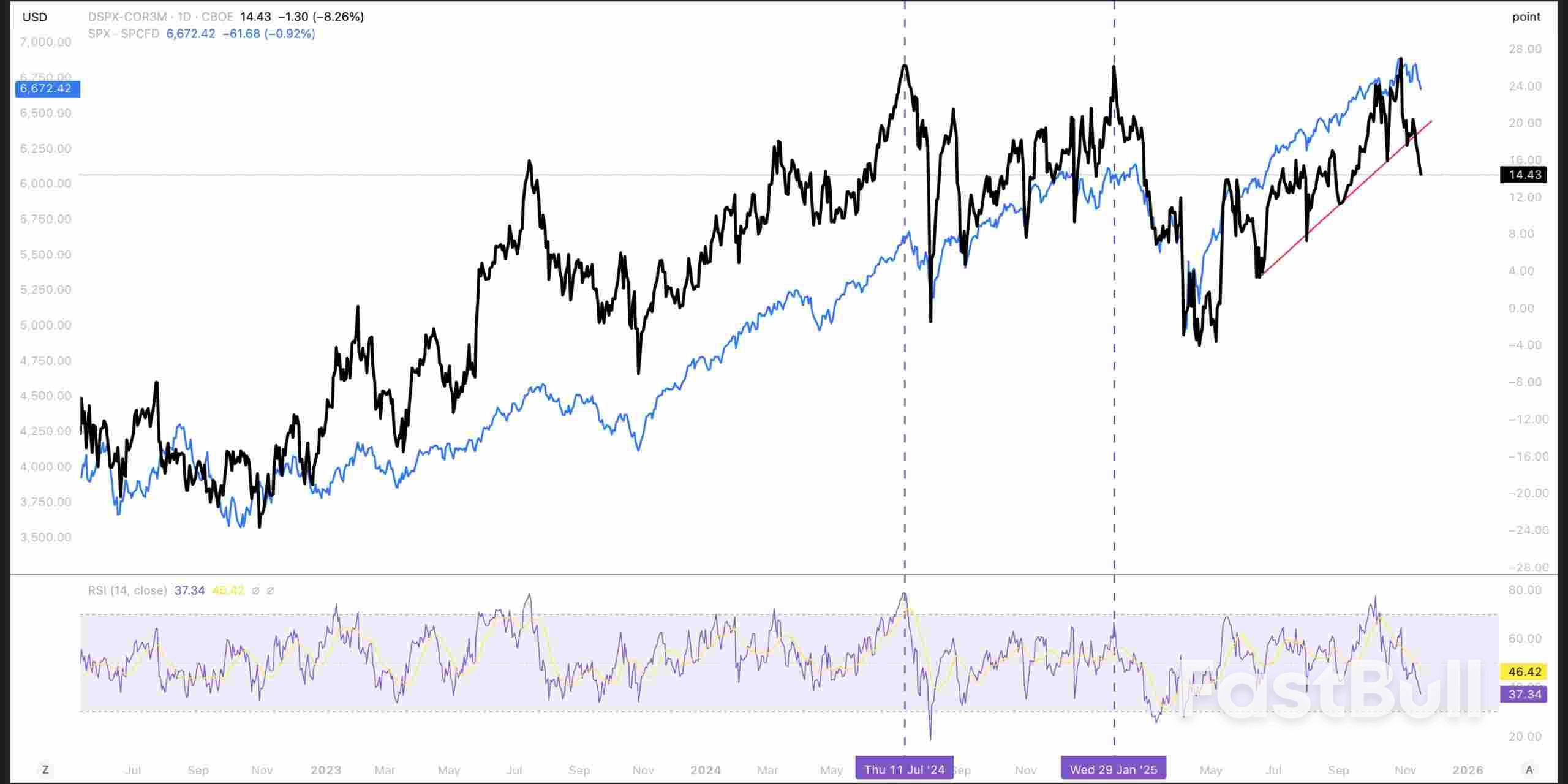
          Also, we’ve seen the dispersion trade continue to unwind, with three-month implied correlations rising faster than the dispersion index on Monday, further narrowing that spread. This unwind should only grow strong after Nvidia (NASDAQ:NVDA) reports.
          S&P 500: Bears Emerge as Funding Stress and Credit Risks Deepen_2
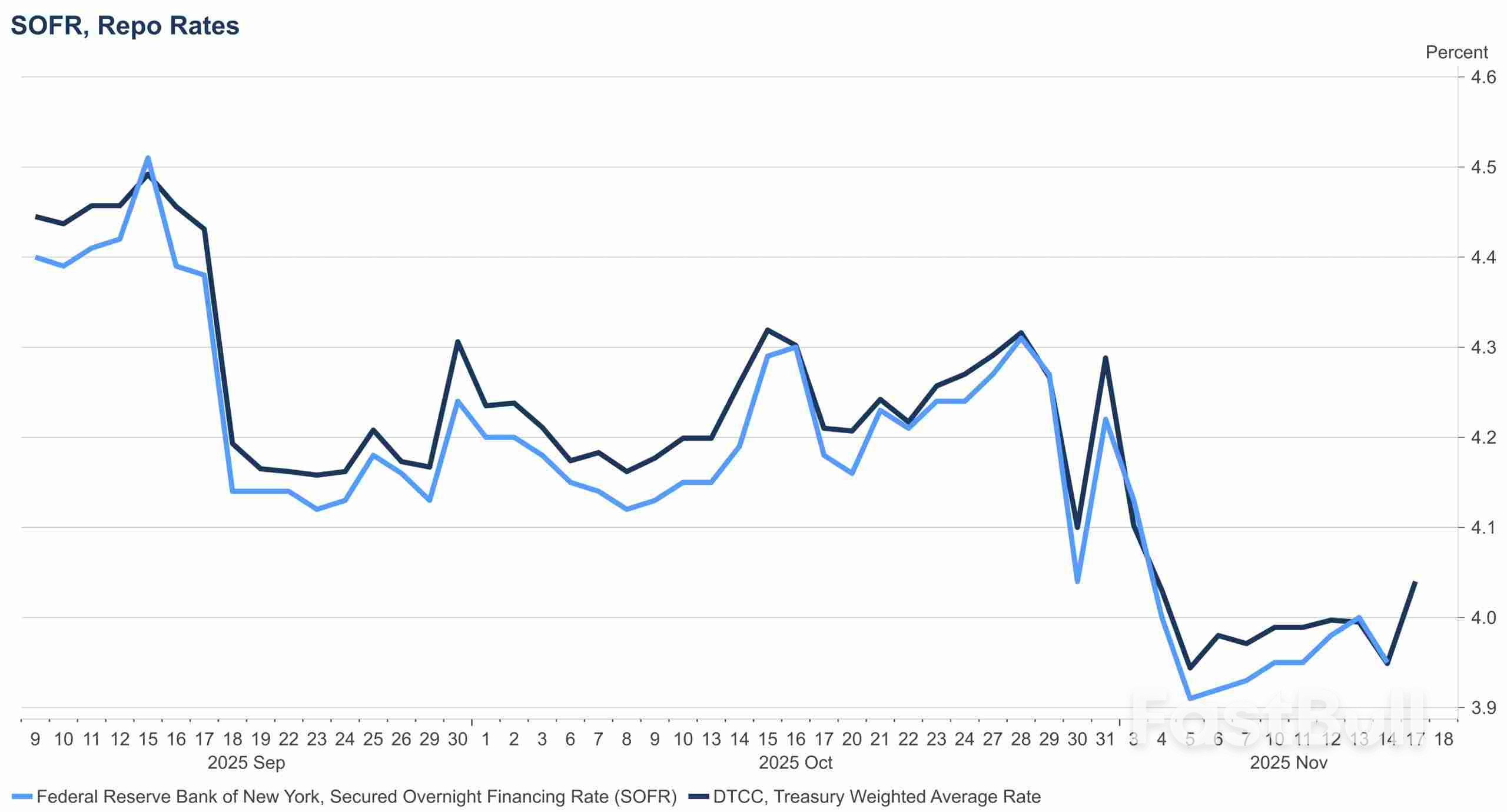
          The average repo rate at DTC on Monday was around 4.04%, suggesting we’ll see SOFR push above 4% today as well. With another settlement date today, there’s a chance funding conditions will tighten further and those rates move even higher.
          Wednesday should bring some relief since there are no settlements, and midweek typically sees a bit of easing. But by Thursday, I would expect rates to tighten again, with repo potentially pushing back toward that 4% corridor. That would also put upward pressure on usage of the Standing Repo Facility.
          S&P 500: Bears Emerge as Funding Stress and Credit Risks Deepen_3
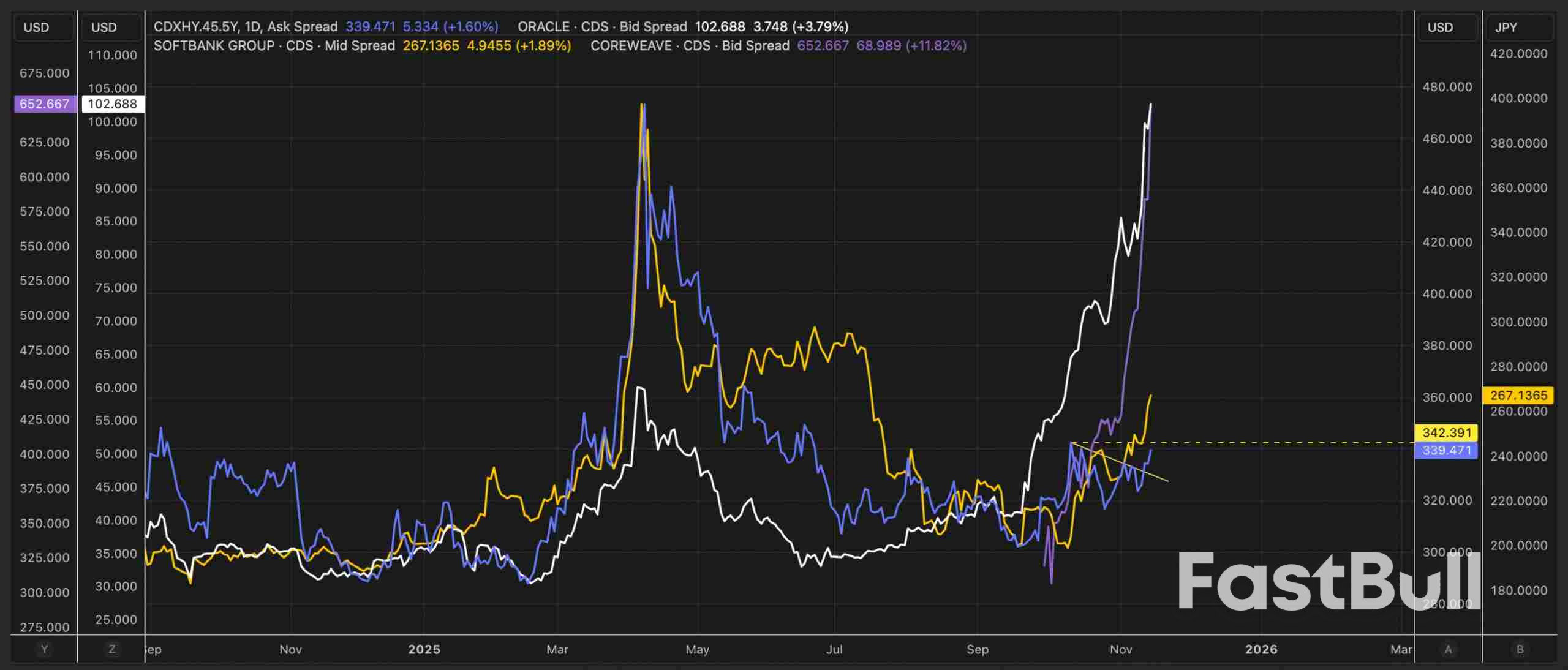
          The CDX High Yield credit spread index also moved higher on Monday and appears to have broken a downtrend. It’s now approaching a resistance level around 342, which was last seen in mid-October.
          A breakout above 342 would likely signal even wider spreads ahead, and that wouldn’t be surprising given the rise we’re already seeing in CDS spreads for companies like Oracle (NYSE:ORCL), Meta (NASDAQ:META), and CrowdStrike (NASDAQ:CRWD). We’re even seeing similar moves in names like SoftBank in Japan.
          So it wouldn’t be surprising at all to see credit spreads widen more broadly across the market—and that would clearly be negative for equities overall.
          S&P 500: Bears Emerge as Funding Stress and Credit Risks Deepen_4
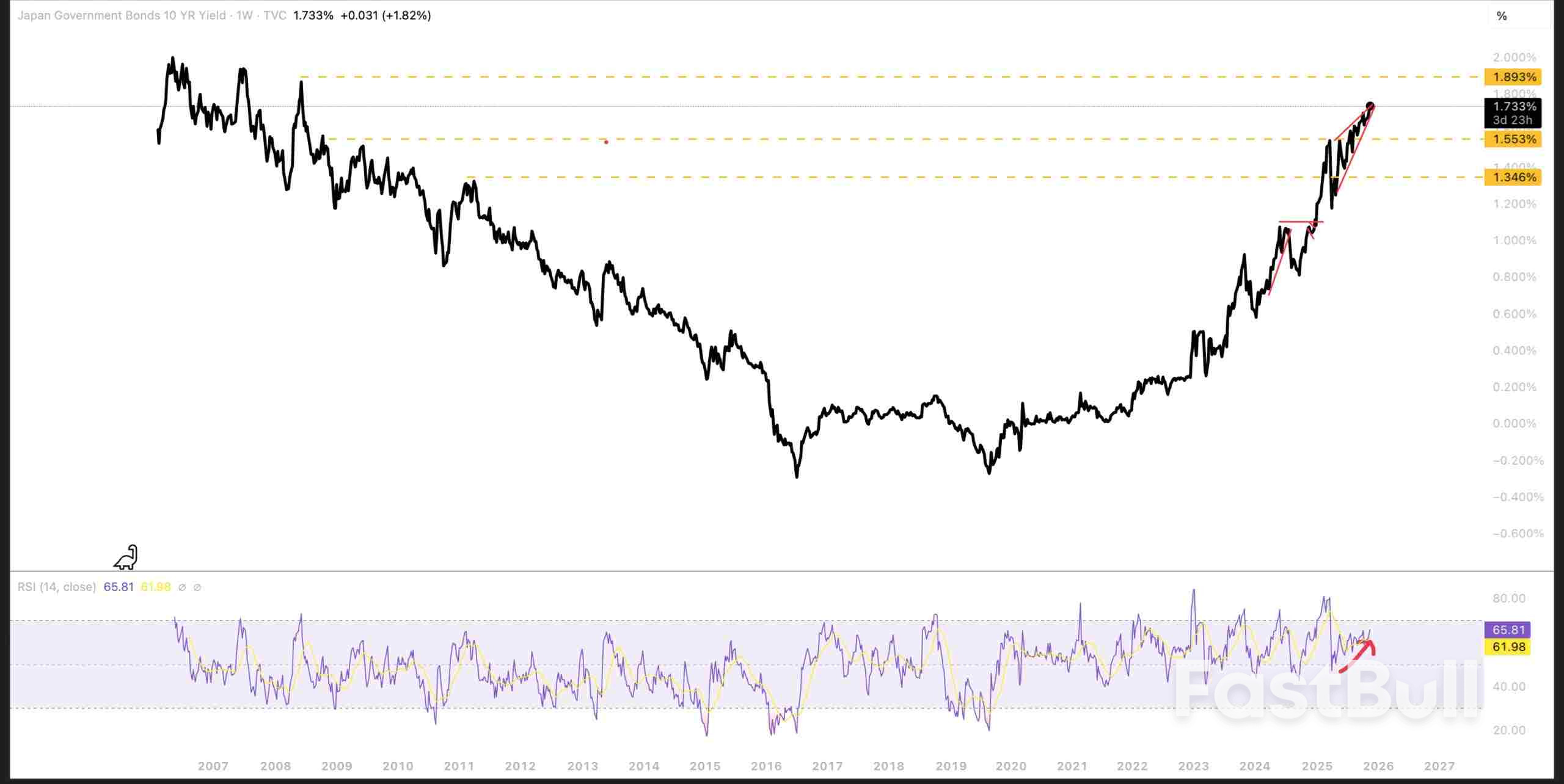
          The final piece of the puzzle may actually be coming from Japan, where rates are rising rapidly amid concerns over new stimulus proposals, making markets increasingly nervous. This has pushed yields sharply higher across the curve, with the 10-year rising to 1.73%—the highest level since 2008. More importantly, there appears to be room for yields to move even higher in the near term, with the next potential resistance level likely somewhere around 1.90%.
          S&P 500: Bears Emerge as Funding Stress and Credit Risks Deepen_5
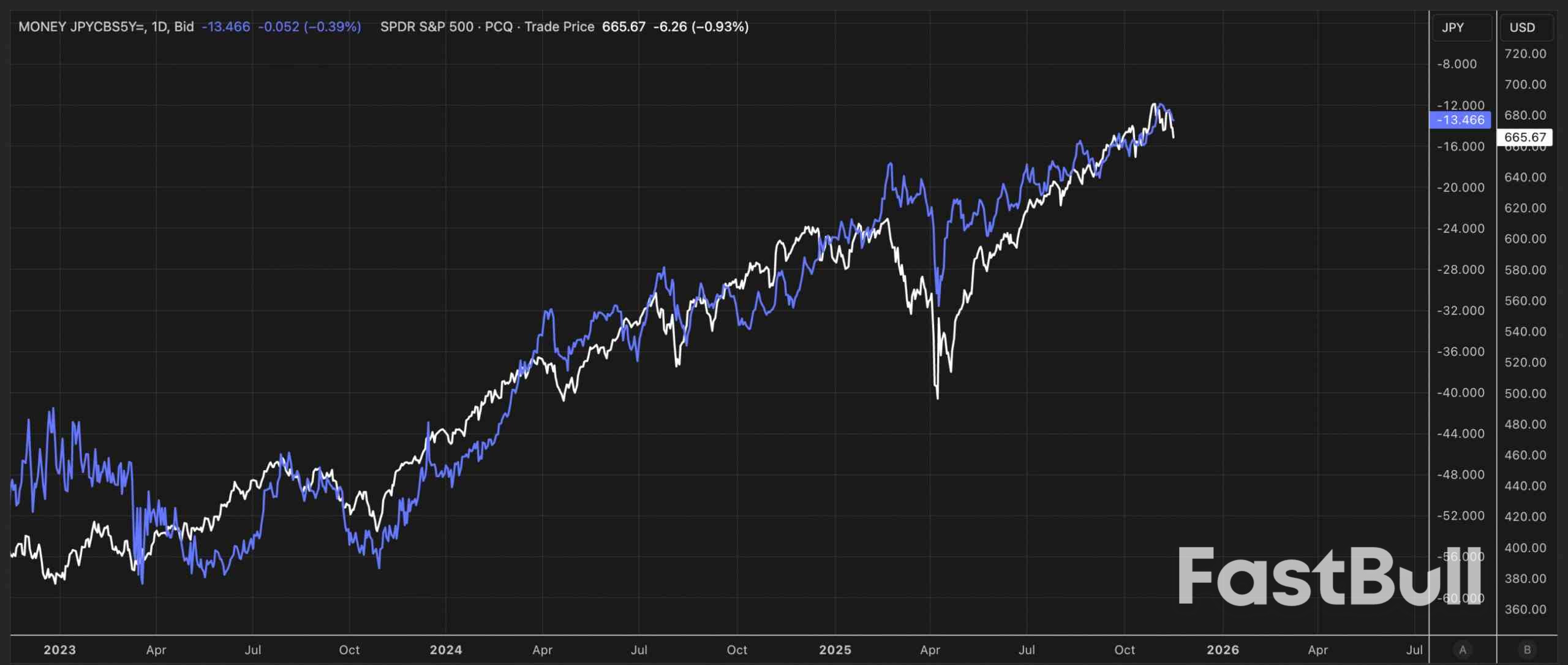
          If concerns over the government’s spending plan persist and Japanese rates continue to rise while the yen weakens, it could trigger a flight to safety into the dollar. That would likely lead to a materially stronger dollar against the yen and to higher dollar funding costs. In that scenario, the Japanese yen five-year cross-currency basis swap would move lower—becoming more negative—widening the spread and making it more costly for Japanese investors to fund U.S. dollar trades.
          This would obviously suck even more liquidity out of the market.
          S&P 500: Bears Emerge as Funding Stress and Credit Risks Deepen_6
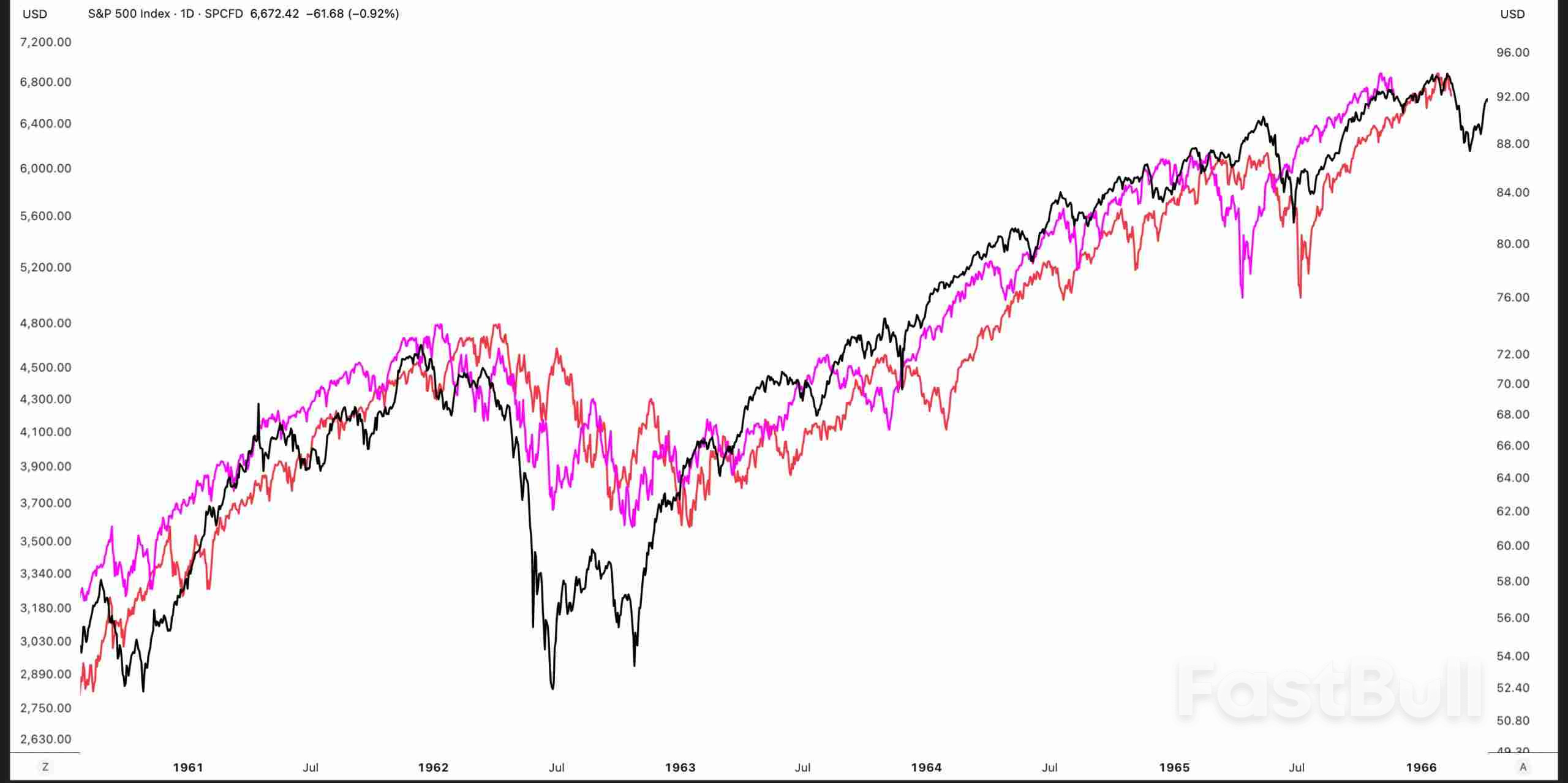
          Finally, the 1966 analogue continues to track the S&P 500’s present moves. For whatever it is worth.
          S&P 500: Bears Emerge as Funding Stress and Credit Risks Deepen_7

          Source: investing

          To stay updated on all economic events of today, please check out our Economic calendar
          Risk Warnings and Disclaimers
          You understand and acknowledge that there is a high degree of risk involved in trading. Following any strategies or investment methods may lead to potential losses. The content on the site is provided by our contributors and analysts for information purposes only. You are solely responsible for determining whether any trading assets, securities, strategy, or any other product is suitable for investing based on your own investment objectives and financial situation.
          Add to Favorites
          Share
          FastBull
          Copyright © 2025 FastBull Ltd

          728 RM B 7/F GEE LOK IND BLDG NO 34 HUNG TO RD KWUN TONG KLN HONG KONG

          TelegramInstagramTwitterfacebooklinkedin
          App Store Google Play Google Play
          Products
          Charts

          Chats

          Q&A with Experts
          Screeners
          Economic Calendar
          Data
          Tools
          Membership
          Features
          Function
          Markets
          Copy Trading
          Latest Signals
          Contests
          News
          Analysis
          24/7
          Columns
          Education
          Company
          Careers
          About Us
          Contact Us
          Advertising
          Help Center
          Feedback
          User Agreement
          Privacy Policy
          Business

          White Label

          Data API

          Web Plug-ins

          Poster Maker

          Affiliate Program

          Risk Disclosure

          The risk of loss in trading financial instruments such as stocks, FX, commodities, futures, bonds, ETFs and crypto can be substantial. You may sustain a total loss of the funds that you deposit with your broker. Therefore, you should carefully consider whether such trading is suitable for you in light of your circumstances and financial resources.

          No decision to invest should be made without thoroughly conducting due diligence by yourself or consulting with your financial advisors. Our web content might not suit you since we don't know your financial conditions and investment needs. Our financial information might have latency or contain inaccuracy, so you should be fully responsible for any of your trading and investment decisions. The company will not be responsible for your capital loss.

          Without getting permission from the website, you are not allowed to copy the website's graphics, texts, or trademarks. Intellectual property rights in the content or data incorporated into this website belong to its providers and exchange merchants.

          Not Logged In

          Log in to access more features

          FastBull Membership

          Not yet

          Purchase

          Become a signal provider
          Help Center
          Customer Service
          Dark Mode
          Price Up/Down Colors

          Log In

          Sign Up
          Position
          Layout
          Fullscreen
          Default to Chart
          The chart page opens by default when you visit fastbull.com