Markets
News
Analysis
User
24/7
Economic Calendar
Education
Data
- Names
- Latest
- Prev


Signal Accounts for Members
All Signal Accounts
All Contests


France Trade Balance (SA) (Oct)A:--
F: --
Euro Zone Employment YoY (SA) (Q3)A:--
F: --
Canada Part-Time Employment (SA) (Nov)A:--
F: --
P: --
Canada Unemployment Rate (SA) (Nov)A:--
F: --
P: --
Canada Full-time Employment (SA) (Nov)A:--
F: --
P: --
Canada Labor Force Participation Rate (SA) (Nov)A:--
F: --
P: --
Canada Employment (SA) (Nov)A:--
F: --
P: --
U.S. PCE Price Index MoM (Sept)A:--
F: --
P: --
U.S. Personal Income MoM (Sept)A:--
F: --
P: --
U.S. Core PCE Price Index MoM (Sept)A:--
F: --
P: --
U.S. PCE Price Index YoY (SA) (Sept)A:--
F: --
P: --
U.S. Core PCE Price Index YoY (Sept)A:--
F: --
P: --
U.S. Personal Outlays MoM (SA) (Sept)A:--
F: --
U.S. 5-10 Year-Ahead Inflation Expectations (Dec)A:--
F: --
P: --
U.S. Real Personal Consumption Expenditures MoM (Sept)A:--
F: --
U.S. Weekly Total Rig CountA:--
F: --
P: --
U.S. Weekly Total Oil Rig CountA:--
F: --
P: --
U.S. Consumer Credit (SA) (Oct)A:--
F: --
China, Mainland Foreign Exchange Reserves (Nov)A:--
F: --
P: --
Japan Trade Balance (Oct)A:--
F: --
P: --
Japan Nominal GDP Revised QoQ (Q3)A:--
F: --
P: --
China, Mainland Imports YoY (CNH) (Nov)A:--
F: --
P: --
China, Mainland Exports (Nov)A:--
F: --
P: --
China, Mainland Imports (CNH) (Nov)A:--
F: --
P: --
China, Mainland Trade Balance (CNH) (Nov)A:--
F: --
P: --
China, Mainland Exports YoY (USD) (Nov)A:--
F: --
P: --
China, Mainland Imports YoY (USD) (Nov)A:--
F: --
P: --
Germany Industrial Output MoM (SA) (Oct)A:--
F: --
Euro Zone Sentix Investor Confidence Index (Dec)A:--
F: --
P: --
Canada National Economic Confidence IndexA:--
F: --
P: --
U.K. BRC Like-For-Like Retail Sales YoY (Nov)--
F: --
P: --
U.K. BRC Overall Retail Sales YoY (Nov)--
F: --
P: --
Australia Overnight (Borrowing) Key Rate--
F: --
P: --
RBA Rate Statement
RBA Press Conference
Germany Exports MoM (SA) (Oct)--
F: --
P: --
U.S. NFIB Small Business Optimism Index (SA) (Nov)--
F: --
P: --
Mexico 12-Month Inflation (CPI) (Nov)--
F: --
P: --
Mexico Core CPI YoY (Nov)--
F: --
P: --
Mexico PPI YoY (Nov)--
F: --
P: --
U.S. Weekly Redbook Index YoY--
F: --
P: --
U.S. JOLTS Job Openings (SA) (Oct)--
F: --
P: --
China, Mainland M1 Money Supply YoY (Nov)--
F: --
P: --
China, Mainland M0 Money Supply YoY (Nov)--
F: --
P: --
China, Mainland M2 Money Supply YoY (Nov)--
F: --
P: --
U.S. EIA Short-Term Crude Production Forecast For The Year (Dec)--
F: --
P: --
U.S. EIA Natural Gas Production Forecast For The Next Year (Dec)--
F: --
P: --
U.S. EIA Short-Term Crude Production Forecast For The Next Year (Dec)--
F: --
P: --
EIA Monthly Short-Term Energy Outlook
U.S. API Weekly Gasoline Stocks--
F: --
P: --
U.S. API Weekly Cushing Crude Oil Stocks--
F: --
P: --
U.S. API Weekly Crude Oil Stocks--
F: --
P: --
U.S. API Weekly Refined Oil Stocks--
F: --
P: --
South Korea Unemployment Rate (SA) (Nov)--
F: --
P: --
Japan Reuters Tankan Non-Manufacturers Index (Dec)--
F: --
P: --
Japan Reuters Tankan Manufacturers Index (Dec)--
F: --
P: --
Japan Domestic Enterprise Commodity Price Index MoM (Nov)--
F: --
P: --
Japan Domestic Enterprise Commodity Price Index YoY (Nov)--
F: --
P: --
China, Mainland PPI YoY (Nov)--
F: --
P: --
China, Mainland CPI MoM (Nov)--
F: --
P: --
Italy Industrial Output YoY (SA) (Oct)--
F: --
P: --


No matching data
Latest Views
Latest Views
Trending Topics
Top Columnists
Latest Update
White Label
Data API
Web Plug-ins
Affiliate Program
View All

No data
The U.S. Dollar Index fell after April inflation came in below expectations and a U.S.-China tariff truce boosted risk sentiment, reducing demand for the dollar and weakening Fed rate cut urgency.
Daily GBP/USD
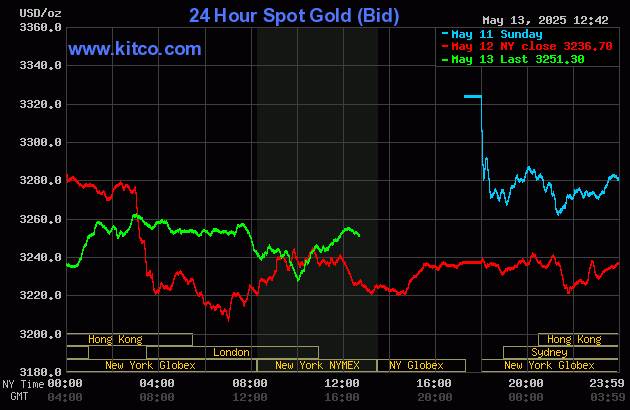
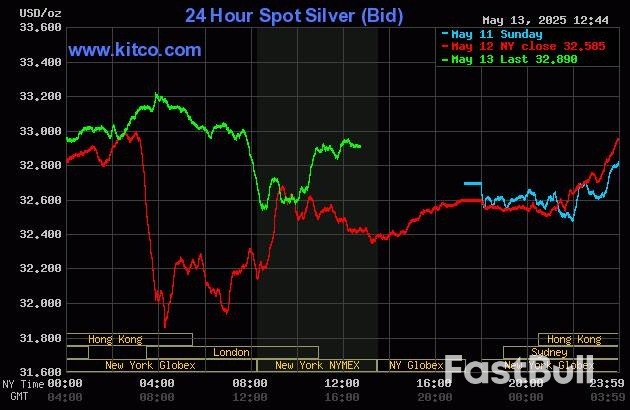
Daily US Dollar Index (DXY)Gold prices are solidly up in midday U.S. trading Tuesday and have extended modest earlier corrective gains following Monday’s big downdraft. Silver prices are also good gains. A lower U.S. dollar index and solidly higher crude oil prices on this day are friendly outside-market elements for the two precious metals. June gold was last up $31.40 at $3,259.20. July silver prices were last up $0.521 at $33.145.
The U.S. data point of the day saw the consumer price index report for April come in at up 2.3%, year-on-year, slightly down from up 2.4% in the March report. The core CPI (excluding food and energy) came in at up 2.8%, year-on-year, also unchanged from the March report and in line with market expectations. The marketplace showed no major reactions to the data but the U.S. stock indexes did up-tick slightly. The report does lean slightly friendly for the precious metals markets because it’s not a problematic inflation report that would give the Federal Reserve pause on cutting interest rates.
U.S. stock indexes are mostly higher at midday. Risk appetite has improved early this week on signs of a thawing in the U.S. China cold war on trade.
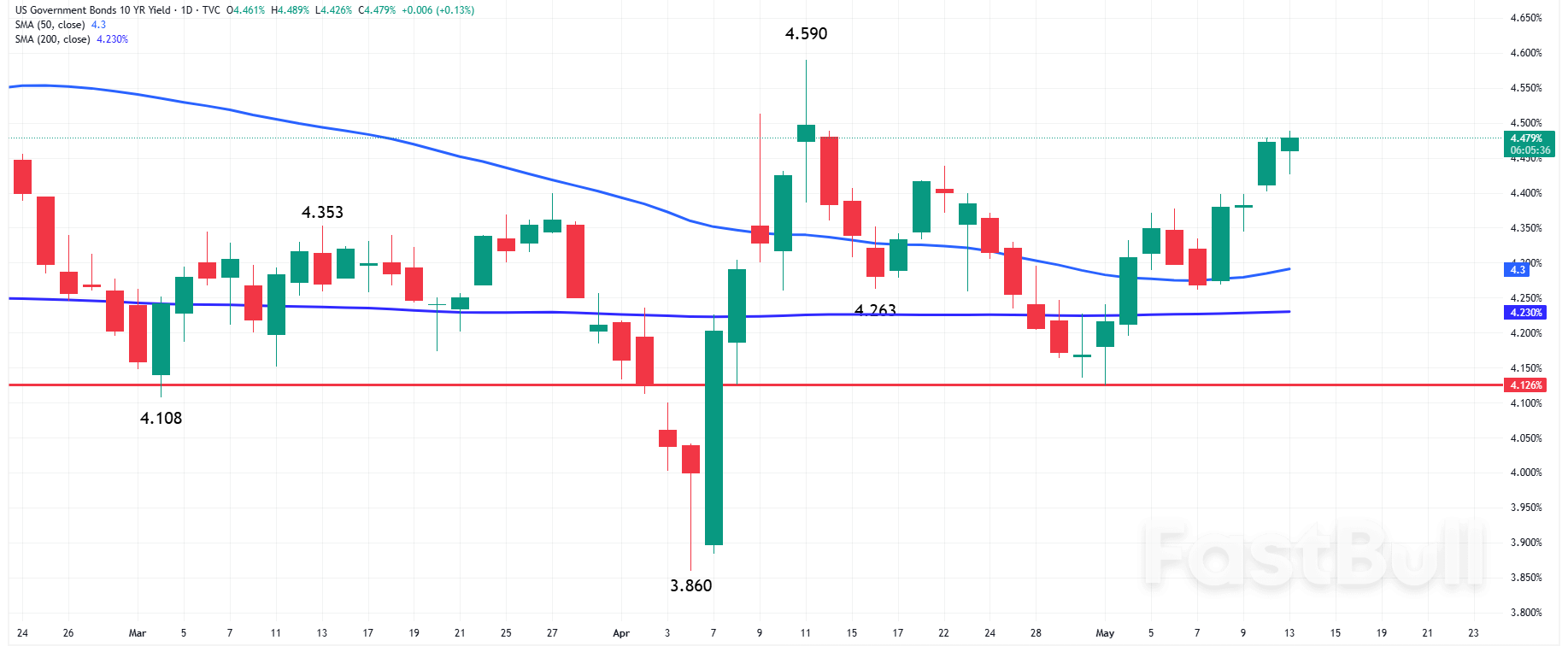
The key outside markets today see the U.S. dollar index weaker after strong gains Monday. Nymex crude oil futures prices are higher and trading around $63.50 a barrel. The yield on the benchmark 10-year U.S. Treasury note is presently around 4.45%.

Technically, June gold futures bulls and bears are on a level overall near-term technical playing field. Bulls’ next upside price objective is to produce a close above solid resistance at $3,350.00. Bears' next near-term downside price objective is pushing futures prices below solid technical support at $3,200.00. First resistance is seen at the overnight high of $3,270.40 and then at $3,300.00. First support is seen at $3,250.00 and then at the May low of $3,209.40.

July silver futures bulls have the slight overall near-term technical advantage. Silver bulls' next upside price objective is closing prices above solid technical resistance at $34.015. The next downside price objective for the bears is closing prices below solid support at $31.00. First resistance is seen at last week’s high of $33.48 and then at $34.00. Next support is seen at $32.50 and then at $32.00.
President Donald Trump may have dialed back his tariff experiment just in time — at least if the April economic data is any indication.
A report Tuesday showed that the consumer price index rose just 2.3% in April from a year earlier, less than economists had expected and the coolest year-over-year pace since early 2021. That added to labor market data showing that firms have mostly refrained from large-scale layoffs in the face of the tariff threat, even though hiring has been anemic. In essence, Trump reversed course on his destructive tariff policy before it demonstrably upset the apple cart.
It is early to breath a sigh of relief, but you can’t blame forward-looking financial markets for tepidly doing so. The S&P 500 Index rose another 0.8% on Tuesday and, at the time of writing, was just about 4.2% below its all-time high.
First, consider the inflation outlook. Excluding volatile food and energy prices, the CPI rose just 0.2% in April from the previous month, an objectively decent figure. Bloomberg Economics estimates that the data in hand will translate into a 0.16% increase in the all-important core personal consumption expenditures deflator, which the Federal Reserve monitors closely in the setting of monetary policy.
If you pick apart the report, you’ll find scattered evidence of potential tariff impacts in furniture, sporting goods and audio equipment, among other things. That was more than offset by deflation in some services categories, including travel. Many economists see the tariff impacts becoming more pronounced in the months to come, but so far so good.
The key risk always concerned inflation expectations, and Tuesday’s report might help in that department as well. Tariffs constitute a supply shock that you’d expect to drive up prices on a one-time basis, but they needn’t necessarily set loose persistent inflation, provided expectations remain anchored. Economists tend to believe that inflation expectations are a self-fulfilling prophecy, and our inflationary psychologies felt uniquely vulnerable in early 2025 following the fast pace of price increases in the previous years.
The good news is that supermarket and motor fuel prices — the sorts of things that tend to have an outsized impact on the formation of consumer inflation outlooks — have been under control. In the CPI, motor fuel was down slightly on a seasonally adjusted basis, and food at home fell 0.4% month-on-month, helped by pork and eggs. High-frequency data suggest that pump prices may continue to help the inflation statistics in May.
Second, all of this is happening in an environment of still-resilient labor markets. April’s unemployment rate stood at a still-low 4.2%, and initial jobless claims are running around 227,000 on average over the past four weeks — hardly a sign that a wave of mass layoffs is upon us. While consumer sentiment has been dented and economists expect retail sales to be roughly flat this month, the labor market continues to provide ballast for households. Few people are getting hired, but no one is getting fired either, and the economy won’t fall out of bed under those circumstances.
None of this is to say that the tariff salvo has been innocuous or that the risks have completely faded. Even after recent changes, implemented tariffs leave the effective rate around 13%, and no one knows what will happen at the end of 90-day reprieves granted to China and the rest of the world. Additional threatened tariffs could still bring all-in levies back close to 20%, near the infamous Smoot-Hawley era of the early 1930s.
The whiplash has certainly left economic actors feeling unsettled. Small business sentiment in the US fell in April to the weakest since October, according to a report Tuesday from the National Federal of Independent Businesses, whose survey famously tends to portray Republican administrations in a favorable light. The outlooks for sales and capital outlays slipped. Business and consumer surveys show what could have happened had President Trump barreled ahead with the highest tariffs in a century. Weakened confidence will likely still slow the economy, but a temporary US-China trade truce has prompted economists to at least cut the odds of a recession. It’s still possible, of course, that trade tensions flair up again when the parties get together to hash out the very difficult details of a sustainable detente.
Fortunately, the developments announced this week suggest that Trump is at least heading in the direction of potential off-ramps. That it’s happening before the economic data began to sour is clearly good news.More From Bloomberg Opinion:

India officially told the World Trade Organization (WTO) that it plans to increase tariffs on goods made in the United States as a direct response to the Trump administration’s decision to impose high duties on steel and aluminum.
This is India’s first trade retaliation against the U.S. during Donald Trump’s second term as president, even though both countries are still working to finalize a broader trade agreement that they hope to finalize in the coming months.
India submitted a detailed notification to WTO on Monday explaining how the U.S government’s decision to impose high duties on steel and aluminum has hurt the country’s trade. As a result, it plans to raise tariffs on various goods imported from the United States.
Furthermore, India argued that the U.S. tariffs break global trade rules and that their excuse of “national security” to introduce these duties was more of “safeguard measures” or emergency trade restrictions countries can respond to under WTO regulations.
The U.S. announced in March that the tariffs would add a 25% duty on all steel imports and similar levies on aluminum as part of President Trump’s efforts to change how the country trades with the world and improve national security.
India has responded, claiming that the tariffs have affected $7.6 billion worth of its exports and will force U.S. importers to pay an extra $1.91 billion in duties on Indian goods, which makes the products more expensive but less competitive in the American market.
India will raise tariffs on a similar amount of U.S. goods to make the total cost of duties equal on both sides as a countermeasure in line with WTO regulations that allow a country to suspend its trade promises when another nation’s actions cause unfair damage.
India avoided reacting strongly to Trump’s trade actions during most of his second term. New Delhi did not respond immediately, even after the U.S slapped heavy tariffs on Indian steel and aluminum exports earlier this year. Instead, it hoped that cooperation and diplomacy would lead to better results for both sides and, therefore, continued the talks to finalize a bilateral trade agreement.
In addition, India lowered import duties on American goods like Harley-Davidson motorcycles and bourbon whiskey to help both countries move closer to a trade deal and because President Trump has personally criticized the country over these goods.
The country didn’t stop there; it also overhauled its tariff system by cutting import duties on over 8,500 industrial products to reduce barriers and express its willingness to cooperate.
However, the recent filing shows that India isn’t willing to wait for diplomacy alone to solve its trade issues and is now ready to stand up for its economic interests by taking strong steps within the rules of WTO.
India’s decision to file a WTO notification while still in trade talks with the U.S. could make the negotiations difficult, and experts warn that this action might cast a shadow over the final stages of the deal.
New Delhi previously offered to reduce two-thirds of its tariff gap with the U.S. to help close the distance between the two sides. Still, Washington took a tougher stance and recently threatened to slap a 26% torrid on Indian exports, which could escalate the tensions further if talks fall apart.
President Trump also made comments that linked the trade between the U.S and India to Kashmir ceasefire negotiations between India and Pakistan, which made matters even more politically sensitive.
“If you stop it, we’re doing trade. If you don’t stop it, we’re not going to do any trade.” Trump said.
However, government sources who spoke anonymously claimed that trade negotiations had nothing to do with political or military matters and that India never used it as a bargaining chip in discussions with the U.S.
This tension comes as India imposed a temporary 12% import duty on steel from countries like China to prevent a flood of cheap metal from hurting local producers as a way to protect its domestic industries while also using global trade regulations to assert itself intentionally.
Canadian Prime Minister Mark Carney unveiled Tuesday a new cabinet weeks following his election victory, leaning on newcomers and key officials working on U.S.-Canada relations to rebuild a weakened economy exposed by President Trump's tariff policy.
Carney is keeping François-Philippe Champagne as Finance Minister. Champagne faces two big immediate tasks: host his Group of Seven peers next week in Banff, Alberta in a three-day gathering likely to be dominated by trade; and present a budget plan, likely next month, to outline spending and tax-cut plans as promised during the spring election campaign.
The majority of the 28-member cabinet are either newly elected or are serving in cabinet for the first time, as Carney tries to further distance his administration from the previous government of former prime minister Justin Trudeau. Carney, a former central banker, won the election on April 28, arguing he has the economic acumen and policymaking mettle to lead Canada in this period of economic turmoil.
The new cabinet "is built to deliver the change Canadians want and deserve," Carney said. "Everyone is expected and empowered to show leadership - to bring new ideas, a clear focus, and decisive action to their work."
Before taking over as Liberal Party leader, he said the Trudeau government didn't pay sufficient attention to the economy, and acknowledged it was in a feeble state prior to Trump unveiling tariffs of up to 25% of key Canadian imports, such as automobiles, steel and aluminum.
Among the notable moves is shifting Anita Anand as Canada's Foreign Minister. Melanie Joly, formerly the foreign minister and part of Carney's inner circle on dealing with the Trump White House, moves to the industry portfolio, while Dominic LeBlanc retains responsibility for trade between the U.S. and Canada. LeBlanc and Joly traveled to the White House last week with Carney to speak with Trump.
Carney has also appointed a former Goldman Sachs executive, Tim Hodgson, to be Canada's Energy Minister. Carney has promised to accelerate the construction of certain energy projects, like a cross-country pipeline connecting the west to the east. The oil-rich province of Alberta has warned it could hold a referendum next year on separating from Canada due to frustration over the federal environmental policy.
Hodgson once advised Carney — also part of the Goldman Sachs alumni — when Carney served as Bank of Canada governor.
BRUSSELS (May 13): The easing of trade tensions between the United States and China is a step in the right direction and helps reduce European fears of being flooded with Chinese goods redirected from the US market, European Economic Commissioner Valdis Dombrovskis said.
Speaking to reporters after a meeting of European Union finance ministers on Tuesday, Dombrovskis noted, however, that the reduction of tariffs after weekend talks in Switzerland was for 90 days and the tariff rates that remained were still high.
"Obviously this easing of trade tensions between the US and China is heading in the right direction but it is worth noting that the 30% tariffs which the US would continue to apply to Chinese goods, also in this 90-day period, is still quite a high tariff level and correspondingly trade distortive," he said.
"But of course it may ease somewhat the trade diversion concerns we had," Dombrovskis told a news conference.
The president of the European Commission, Ursula von der Leyen, urged China on April 8 to ensure that goods that could no longer enter the US because of prohibitively high tariffs were not redirected to the EU.
On Monday, Washington also announced that the US would cut the "de minimis" tariff for low-value items imported from China, further de-escalating a potentially damaging trade war between the world's two largest economies.
White Label
Data API
Web Plug-ins
Poster Maker
Affiliate Program
The risk of loss in trading financial instruments such as stocks, FX, commodities, futures, bonds, ETFs and crypto can be substantial. You may sustain a total loss of the funds that you deposit with your broker. Therefore, you should carefully consider whether such trading is suitable for you in light of your circumstances and financial resources.
No decision to invest should be made without thoroughly conducting due diligence by yourself or consulting with your financial advisors. Our web content might not suit you since we don't know your financial conditions and investment needs. Our financial information might have latency or contain inaccuracy, so you should be fully responsible for any of your trading and investment decisions. The company will not be responsible for your capital loss.
Without getting permission from the website, you are not allowed to copy the website's graphics, texts, or trademarks. Intellectual property rights in the content or data incorporated into this website belong to its providers and exchange merchants.
Not Logged In
Log in to access more features

FastBull Membership
Not yet
Purchase
Log In
Sign Up