• Trade
  • Markets
  • Copy
  • Contests
  • News
  • 24/7
  • Calendar
  • Q&A
  • Chats
Trending
Screeners
SYMBOL
LAST
BID
ASK
HIGH
LOW
NET CHG.
%CHG.
SPREAD
SPX
S&P 500 Index
6840.50
6840.50
6840.50
6864.93
6837.42
-6.01
-0.09%
--
DJI
Dow Jones Industrial Average
47560.28
47560.28
47560.28
47957.79
47533.60
-179.03
-0.38%
--
IXIC
NASDAQ Composite Index
23576.48
23576.48
23576.48
23616.46
23449.73
+30.58
+ 0.13%
--
USDX
US Dollar Index
99.160
99.240
99.160
99.210
99.150
-0.020
-0.02%
--
EURUSD
Euro / US Dollar
1.16270
1.16277
1.16270
1.16286
1.16215
+0.00013
+ 0.01%
--
GBPUSD
Pound Sterling / US Dollar
1.33041
1.33050
1.33041
1.33048
1.32894
+0.00090
+ 0.07%
--
XAUUSD
Gold / US Dollar
4206.07
4206.45
4206.07
4218.67
4203.58
-1.10
-0.03%
--
WTI
Light Sweet Crude Oil
58.200
58.237
58.200
58.288
58.128
+0.045
+ 0.08%
--

Community Accounts

Signal Accounts
--
Profit Accounts
--
Loss Accounts
--
View More

Become a signal provider

Sell trading signals to earn additional income

View More

Guide to Copy Trading

Get started with ease and confidence

View More

Signal Accounts for Members

All Signal Accounts

Best Return
  • Best Return
  • Best P/L
  • Best MDD
Past 1W
  • Past 1W
  • Past 1M
  • Past 1Y

All Contests

  • All
  • Trump Updates
  • Recommend
  • Stocks
  • Cryptocurrencies
  • Central Banks
  • Featured News
Top News Only
Share

Malaysia October Unemployment Rate Remains Steady At Decade-Low 3%, Labor Force Expands

Share

Harmonisation Of Semantic Languages Is Required On The Agreement Of Reciprocal Tariffs -Indonesia's Government Source

Share

Indonesia Tariff Negotiation With The USA Is On Track As Per Leaders' Joint Statement -Indonesia's Government Source

Share

India's Nifty 50 Index Up 0.09% In Pre-Open Trade

Share

Indian Rupee Opens Down 0.17% At 90.03 Per USA Dollar, Versus 89.8750 Previous Close

Share

China's Vice Premier Met WTO Chief In Beijing

Share

Gpca '25: GCC To Expand Intermediates, Non-Asian Export Growth To 2030 - Gpca Chief

Share

Japan Prime Minister Takaichi Says Weak Yen Has Both Merits And Demerits

Share

Japan Econ Minister Kiuchi: Forex Moves Determined By Various Factors

Share

Japan Prime Minister Takaichi: Will Take Appropriate Action For Excessive, Disorderly Forex Moves

Share

Japan Prime Minister Takaichi: Won't Comment On Forex Levels

Share

Japan Prime Minister Takaichi Says Closely Wathing Market Moves, When Asked About Rising Yields

Share

Australia Says It Will Meet 'Challenges' Of AUKUS Nuclear Submarine Timeline

Share

Indonesia's Benchmark Stock Index Rises 0.7% To 8714.991 Points In Early Trade

Share

Indonesian Rupiah Last Down 0.15% At 16670 Per Dollar

Share

Singapore's Benchmark Stock Index Falls As Much As 0.4% To 4496.54 Points, Lowest Since November 25

Share

China's CSI Ai Index Down 2.7%

Share

China's CSI Semiconductor Index Down 2%

Share

Trump: Tomorrow I'Ll Have To Make A Phone Call About Thailand, Cambodia

Share

South Korea Prime Minister Says Government To Take Stern Action Against Any Legal Breach By Coupang

TIME
ACT
FCST
PREV
RBA Rate Statement
RBA Press Conference
Germany Exports MoM (SA) (Oct)

A:--

F: --

P: --

U.S. NFIB Small Business Optimism Index (SA) (Nov)

A:--

F: --

P: --

Mexico 12-Month Inflation (CPI) (Nov)

A:--

F: --

P: --

Mexico Core CPI YoY (Nov)

A:--

F: --

P: --

Mexico PPI YoY (Nov)

A:--

F: --

P: --

U.S. Weekly Redbook Index YoY

A:--

F: --

P: --

U.S. JOLTS Job Openings (SA) (Oct)

A:--

F: --

P: --

China, Mainland M1 Money Supply YoY (Nov)

--

F: --

P: --

China, Mainland M0 Money Supply YoY (Nov)

--

F: --

P: --

China, Mainland M2 Money Supply YoY (Nov)

--

F: --

P: --

U.S. EIA Short-Term Crude Production Forecast For The Year (Dec)

A:--

F: --

P: --

U.S. EIA Natural Gas Production Forecast For The Next Year (Dec)

A:--

F: --

P: --

U.S. EIA Short-Term Crude Production Forecast For The Next Year (Dec)

A:--

F: --

P: --

EIA Monthly Short-Term Energy Outlook
U.S. 10-Year Note Auction Avg. Yield

A:--

F: --

P: --

U.S. API Weekly Gasoline Stocks

A:--

F: --

P: --

U.S. API Weekly Cushing Crude Oil Stocks

A:--

F: --

P: --

U.S. API Weekly Crude Oil Stocks

A:--

F: --

P: --

U.S. API Weekly Refined Oil Stocks

A:--

F: --

P: --

South Korea Unemployment Rate (SA) (Nov)

A:--

F: --

P: --

Japan Reuters Tankan Non-Manufacturers Index (Dec)

A:--

F: --

P: --

Japan Reuters Tankan Manufacturers Index (Dec)

A:--

F: --

P: --

Japan PPI MoM (Nov)

A:--

F: --

P: --

Japan Domestic Enterprise Commodity Price Index MoM (Nov)

A:--

F: --

P: --

Japan Domestic Enterprise Commodity Price Index YoY (Nov)

A:--

F: --

P: --

China, Mainland CPI YoY (Nov)

A:--

F: --

P: --

China, Mainland PPI YoY (Nov)

A:--

F: --

P: --

China, Mainland CPI MoM (Nov)

A:--

F: --

P: --

Indonesia Retail Sales YoY (Oct)

A:--

F: --

P: --

Italy Industrial Output YoY (SA) (Oct)

--

F: --

P: --

Italy 12-Month BOT Auction Avg. Yield

--

F: --

P: --

BOE Gov Bailey Speaks
ECB President Lagarde Speaks
South Africa Retail Sales YoY (Oct)

--

F: --

P: --

Brazil IPCA Inflation Index YoY (Nov)

--

F: --

P: --

Brazil CPI YoY (Nov)

--

F: --

P: --

U.S. MBA Mortgage Application Activity Index WoW

--

F: --

P: --

U.S. Labor Cost Index QoQ (Q3)

--

F: --

P: --

Canada Overnight Target Rate

--

F: --

P: --

BOC Monetary Policy Report
U.S. EIA Weekly Gasoline Stocks Change

--

F: --

P: --

U.S. EIA Weekly Crude Demand Projected by Production

--

F: --

P: --

U.S. EIA Weekly Cushing, Oklahoma Crude Oil Stocks Change

--

F: --

P: --

U.S. EIA Weekly Crude Stocks Change

--

F: --

P: --

U.S. EIA Weekly Crude Oil Imports Changes

--

F: --

P: --

U.S. EIA Weekly Heating Oil Stock Changes

--

F: --

P: --

U.S. Federal Funds Rate Projections-Longer Run (Q4)

--

F: --

P: --

U.S. Federal Funds Rate Projections-1st Year (Q4)

--

F: --

P: --

U.S. Federal Funds Rate Projections-2nd Year (Q4)

--

F: --

P: --

U.S. Target Federal Funds Rate Lower Limit (Overnight Reverse Repo Rate)

--

F: --

P: --

U.S. Budget Balance (Nov)

--

F: --

P: --

U.S. Target Federal Funds Rate Upper Limit (Excess Reserves Ratio)

--

F: --

P: --

U.S. Interest Rate On Reserve Balances

--

F: --

P: --

U.S. Federal Funds Rate Projections-Current (Q4)

--

F: --

P: --

U.S. Federal Funds Rate Target

--

F: --

P: --

U.S. Federal Funds Rate Projections-3rd Year (Q4)

--

F: --

P: --

FOMC Statement
FOMC Press Conference
Brazil Selic Interest Rate

--

F: --

P: --

Q&A with Experts
    • All
    • Chatrooms
    • Groups
    • Friends
    Connecting
    .
    .
    .
    Type here...
    Add Symbol or Code

      No matching data

      All
      Trump Updates
      Recommend
      Stocks
      Cryptocurrencies
      Central Banks
      Featured News
      • All
      • Russia-Ukraine Conflict
      • Middle East Flashpoint
      • All
      • Russia-Ukraine Conflict
      • Middle East Flashpoint
      Search
      Products

      Charts Free Forever

      Chats Q&A with Experts
      Screeners Economic Calendar Data Tools
      Membership Features
      Data Warehouse Market Trends Institutional Data Policy Rates Macro

      Market Trends

      Market Sentiment Order Book Forex Correlations

      Top Indicators

      Charts Free Forever
      Markets

      News

      News Analysis 24/7 Columns Education
      From Institutions From Analysts
      Topics Columnists

      Latest Views

      Latest Views

      Trending Topics

      Top Columnists

      Latest Update

      Signals

      Copy Rankings Latest Signals Become a signal provider AI Rating
      Contests
      Brokers

      Overview Brokers Assessment Rankings Regulators News Claims
      Broker listing Forex Brokers Comparison Tool Live Spread Comparison Scam
      Q&A Complaint Scam Alert Videos Tips to Detect Scam
      More

      Business
      Events
      Careers About Us Advertising Help Center

      White Label

      Data API

      Web Plug-ins

      Affiliate Program

      Awards Institution Evaluation IB Seminar Salon Event Exhibition
      Vietnam Thailand Singapore Dubai
      Fans Party Investment Sharing Session
      FastBull Summit BrokersView Expo
      Recent Searches
        Top Searches
          Markets
          News
          Analysis
          User
          24/7
          Economic Calendar
          Education
          Data
          • Names
          • Latest
          • Prev

          View All

          No data

          Scan to Download

          Faster Charts, Chat Faster!

          Download App
          English
          • English
          • Español
          • العربية
          • Bahasa Indonesia
          • Bahasa Melayu
          • Tiếng Việt
          • ภาษาไทย
          • Français
          • Italiano
          • Türkçe
          • Русский язык
          • 简中
          • 繁中
          Open Account
          Search
          Products
          Charts Free Forever
          Markets
          News
          Signals

          Copy Rankings Latest Signals Become a signal provider AI Rating
          Contests
          Brokers

          Overview Brokers Assessment Rankings Regulators News Claims
          Broker listing Forex Brokers Comparison Tool Live Spread Comparison Scam
          Q&A Complaint Scam Alert Videos Tips to Detect Scam
          More

          Business
          Events
          Careers About Us Advertising Help Center

          White Label

          Data API

          Web Plug-ins

          Affiliate Program

          Awards Institution Evaluation IB Seminar Salon Event Exhibition
          Vietnam Thailand Singapore Dubai
          Fans Party Investment Sharing Session
          FastBull Summit BrokersView Expo

          US Bank Executives say AI Will Boost Productivity, Cut Jobs

          Manuel

          Stocks

          Economic

          Summary:

          Operation specialists' productivity is expected to grow by 40% to 50%, Lake said. The higher ‌productivity means less impact jobs on a net basis, she said.

          U.S. banks including JPMorgan Chase and Wells Fargo said artificial intelligence will boost productivity at their companies and likely cause job losses.
          JPMorgan Chase's consumer ​and community banking chief Marianne Lake said at the Goldman Sachs financial services conference the bank has doubled ‌productivity to 6% with AI, from a previous 3% without it.
          Operation specialists' productivity is expected to grow by 40% to 50%, Lake said. The higher ‌productivity means less impact jobs on a net basis, she said.
          AI represents the biggest technological upheaval to the world economy since the rise of the internet.
          It has brought trillions of dollars of investment and dizzying stock-market gains, but also a shortage of memory chips, regulatory scrutiny, and rising anxiety about job displacement.
          Wells Fargo CEO Charlie Scharf said the bank has not reduced the number of ⁠people, but added "we're getting a lot more ‌done" because of AI.
          "There are other places out there where we're gonna be able to look at and figure out, how are we able to do more with less people," he said.
          "It's ‍not going to totally replace humans, but does create an opportunity to do things significantly different."
          PNC Financial CEO Bill Demchak said the bank's head count is the same as it was 10 years ago when the bank was a third of the size - all through the ​process of automation and branch optimization.
          "You know, the big buzz right now is it's going to continue because AI is ‌going to drive it. But we've been on a journey of automation for years, and AI may well be an accelerant," he said.
          "It will most definitely be an accelerant in our tech headcount."
          Citigroup's incoming CFO Gonzalo Luchetti said the bank has seen a 9% productivity increase on the coding front.
          "Not only can we increase the self-service ratio, which we're already seeing and doing with our Gen AI, but in addition we're able to assist real time those calls that end up with ⁠a human and they can be more productive," Luchetti said, referring to ​the U.S. Personal Banking unit.
          In October, Goldman Sachs informed employees of potential ​job cuts and a hiring slowdown through the end of the year, according to an internal memo seen by Reuters, as the Wall Street giant aims to use AI to enhance productivity.
          Calling the ‍initiative "OneGS 3.0", the memo said some ⁠of the priorities for its AI initiative are sales and client on-boarding process, as well as other critical areas such as lending processes, regulatory reporting, and vendor management.
          Bank of America plans to spend billions of dollars on ⁠technologies Such as artificial intelligenceto boost bankers' productivity and bring in more revenue, its chief technology and information officer told Reuters last month.

          Source: Reuters

          To stay updated on all economic events of today, please check out our Economic calendar
          Risk Warnings and Disclaimers
          You understand and acknowledge that there is a high degree of risk involved in trading. Following any strategies or investment methods may lead to potential losses. The content on the site is provided by our contributors and analysts for information purposes only. You are solely responsible for determining whether any trading assets, securities, strategy, or any other product is suitable for investing based on your own investment objectives and financial situation.
          Add to Favorites
          Share

          Oil Drops for Second Straight Session With Supply Glut in Focus

          Manuel

          Commodity

          Oil declined for a second day, dragged lower by weakness in refined products, as traders await data expected to shed light on the extent of crude surpluses.
          West Texas Intermediate dipped 1.1% to settle near $58 a barrel, pressured by routs in diesel, gasoline and other products. The difference between the price of US gasoline and crude oil, known as a crack spread, fell to the weakest since February, while a comparable gauge for diesel also slid.
          Refined products had been one of few tailwinds for crude this year, and the recent demand-driven weakness is exacerbating a sense of bearish gloom ahead of a widely telegraphed glut.Oil Drops for Second Straight Session With Supply Glut in Focus_1
          Some trend-following commodity trading advisers were selling positions in the products, according to data from Bridgeton Research Group. Such market participants can intensify price momentum.
          Traders are looking ahead to a slew of reports from the International Energy Agency and OPEC set to be published this week, as well as a Wednesday decision on monetary policy from the Federal Reserve. US crude output is expected to hit a record 13.61 million barrels a day this year, according to the Energy Information Administration’s Short-Term Energy Outlook released Tuesday, adding to short-term oversupply concerns.
          The IEA has predicted a record oil surplus next year, and the volume of crude crossing oceans is rising. Fuel prices have softened in recent days, removing one factor that had supported crude during the past few weeks. Still, the US oil benchmark remains in the tight $4-a-barrel range it has traded in since the start of November.
          “Eventually, the current huge blob of oil at sea will move onshore where the sensation of rising crude oil stocks will be more tangible,” said Bjarne Schieldrop, chief commodities analyst at SEB AB. “The only reason why Brent crude hasn’t fallen faster and deeper is because of the US sanctions related to Rosneft and Lukoil,” he said in reference to the blacklisting of the Russian oil giants.

          Source: Bloomberg

          Risk Warnings and Disclaimers
          You understand and acknowledge that there is a high degree of risk involved in trading. Following any strategies or investment methods may lead to potential losses. The content on the site is provided by our contributors and analysts for information purposes only. You are solely responsible for determining whether any trading assets, securities, strategy, or any other product is suitable for investing based on your own investment objectives and financial situation.
          Add to Favorites
          Share

          Gold Rises Ahead of Fed Rate cut Decision, Silver Hits $60/oz Milestone

          Manuel

          Commodity

          Central Bank

          Gold gained on Tuesday as traders remained optimistic ahead of the U.S. Federal Reserve's interest rate decision, while silver rose to hit an unprecedented $60 per ounce milestone amid supply constraints.
          Spot gold rose 0.6% to $4,211.77 per ounce by 03:21 p.m. ET (2021 GMT). U.S. gold futures for February delivery settled 0.4% higher at $4,236.2 per ounce.
          Spot silver climbed 4.3% to $60.74 per ounce, hitting an all-time high.
          "People are anticipating that there's going to be strong industrial demand for silver for years to come, which is why it's been bid up, the silver price," said Fawad Razaqzada, market analyst at City Index and FOREX.com, adding that the buying momentum is strong at the moment.
          Sectors including solar energy, electric vehicles and their infrastructure, and data centers and artificial intelligence will drive industrial demand higher through 2030, the Silver Institute industry association said in a research report.
          Silver prices have also been supported by persistently low supplies and dwindling global inventories, expectations of the Fed easing interest rates, as well as its recent addition to the U.S. critical minerals list.
          "Metals are volatile by nature, but unless we fix the deficit, silver only has one way to go, and that is up," said Maria Smirnova, senior portfolio manager and chief investment officer at Sprott Asset Management.
          On the U.S. policy front, the Fed's two-day meeting ends with a decision on Wednesday. Traders now see an 87.4% chance of a 25-basis-point cut this week.
          "The move in gold right now is attributed to the big spike in silver and the high expectations for another quarter-point cut," said RJO Futures senior market strategist Bob Haberkorn.
          Meanwhile, the U.S. Labor Department's JOLTS report showed job openings rose to 7.67 million in October, beating forecasts of 7.15 million, indicating a strong labor market.
          Gold has shrugged off the jobs report, Haberkorn said, adding "we could see silver trade over $70 an ounce in the first half of 2026, and gold is on a path towards $5,000 an ounce."
          Platinum gained 2.8% to $1,688.39/oz, while palladium rose 2.6% to $1,503.74/oz.

          Source: Reuters

          Risk Warnings and Disclaimers
          You understand and acknowledge that there is a high degree of risk involved in trading. Following any strategies or investment methods may lead to potential losses. The content on the site is provided by our contributors and analysts for information purposes only. You are solely responsible for determining whether any trading assets, securities, strategy, or any other product is suitable for investing based on your own investment objectives and financial situation.
          Add to Favorites
          Share

          US Senate to Vote Thursday on Republican Healthcare Plan

          Manuel

          Political

          The U.S. Senate will vote on Thursday on a Republican-proposed healthcare plan, Senate Majority Leader John Thune said on Tuesday, as Democrats continued to push for a three-year extension of expiring Affordable Care Act subsidies.
          The COVID-era subsidies, which help offset premium costs for the plans, also known as Obamacare, are set to expire at year end, which could affect up to 24 million people who rely on the program.
          Late on Monday, Republican Senators Bill Cassidy of Louisiana and Mike Crapo of Idaho, who chair two committees with oversight of healthcare, unveiled legislation they are seeking as an alternative to the Democrats' plan.
          "It actually does make health insurance premiums more affordable," Thune said as he announced that the Senate would vote on the Republicans' plan.
          The plan would direct up to $1,500 into health savings accounts for individuals earning less than 700% of the federal poverty level. It also would bar the funds from being used for abortion or "gender transition services," according to a summary released by the two senators.
          They said the measure also would contain a provision to lower insurance premiums by 11% in 2027 and would reduce federal Medicaid funding to states that provide healthcare coverage to "illegal immigrants."
          Democratic Majority Leader Chuck Schumer told reporters on Tuesday the Republican bill is "dead on arrival" and called it “junk insurance.”
          A vote on Democrats' proposal to extend the subsidies will also be held on Thursday, although the measure is unlikely to pass due to insufficient Republican support.

          Source: Reuters

          Risk Warnings and Disclaimers
          You understand and acknowledge that there is a high degree of risk involved in trading. Following any strategies or investment methods may lead to potential losses. The content on the site is provided by our contributors and analysts for information purposes only. You are solely responsible for determining whether any trading assets, securities, strategy, or any other product is suitable for investing based on your own investment objectives and financial situation.
          Add to Favorites
          Share

          Oracle's OpenAI Reliance Faces Scrutiny as Debt-Fueled AI Buildout Raises Worries

          Manuel

          Stocks

          Months after Oracle's (ORCL) $400 billion-plus contract backlog ignited a stock-market frenzy, the enthusiasm has given way to doubts about its reliance on OpenAI and debt-fueled datacenter buildout, which will dominate its earnings on Wednesday.
          A smaller player ​in the cloud market for a long time, Oracle this year staked claim as one of the bigger providers of the rented ‌computing power essential for generative AI thanks to its tie-up with ChatGPT-creator OpenAI.
          It is vying with industry giants Amazon.com, Microsoft and Google for a piece of the lucrative market ‌as companies adopt AI and startups developing the technology rush to secure access to capacity.
          Oracle along with other big cloud players is expected to spend more than $400 billion on AI infrastructure this year.
          Analysts have said a big portion of Oracle's capital expenditure is tied to OpenAI-related datacenters. That has sparked investor worries as details are scarce on how OpenAI - valued at $500 billion but still unprofitable - plans to fund its spending, which total more than $1 trillion by 2030.
          Concerns ⁠have also mounted that the AI boom driving ‌up valuations is turning into a bubble amid a lack of real-world adoption for the technology, sparking a selloff in Oracle's shares and bonds.

          STOCK SELLOFF

          Its stock has eroded all the gains from a stunning 36% jump on September ‍10 after it announced the backlog at its last earnings, even as shares remain higher by nearly a third for the year.
          Meanwhile, its five-year credit default swaps, which offer bondholders a hedge against default, have shot to record highs as it borrows heavily for the datacenter buildout.
          "While the setup for the quarter is good, ​investors are likely to be more focused on the fundamentals of the AI build-out and its financial implications," Bernstein analyst Mark Moerdler said ‌in a note for the fiscal second-quarter results.
          The $300 billion OpenAI data-center contract gives Oracle "unprecedented single customer revenue exposure", he said.
          To allay some of the concerns, Oracle had said in October it expects cloud infrastructure revenue to grow to $166 billion in fiscal 2030 and that fresh bookings were coming in from a range of customers, not just OpenAI. It also touted a $20 billion new deal with Meta Platforms.

          UPBEAT EARNINGS EXPECTED

          For now, AI is expected to drive strong growth at Oracle, with cloud infrastructure revenue expected to surge 71.3% in the September-November period, faster than the 55% growth seen in ⁠the prior quarter, according to data from Visible Alpha.
          That would mirror the strong ​growth reported by cloud giants Amazon.com, Microsoft and Alphabet-owned Google Cloud in their latest earnings ​reports.
          Overall, Oracle's revenue is expected to rise 15.3% to $16.21 billion, which would mark the fastest pace in more than two years, according to data compiled by LSEG. Net profit is expected to increase 13.3%.
          After a report raised questions about ‍its margins from cloud deals, Oracle had ⁠said it expected to achieve adjusted gross margins of between 30% and 40% for delivering AI cloud computing infrastructure, while other segments such as more cloud software and infrastructure for business customers would have margins of between 65% and 80%.
          If OpenAI fails and the ⁠contract goes away, Oracle would need to scale back the build out, write off some contracts and start working down the debt, but it would not default, said Gil ‌Luria, analyst at D.A. Davidson.
          If "OpenAI achieves super-intelligence, spends $1.4 trillion, none of us have to ever work again, and Oracle is ‌fine", he said.

          Source: Reuters

          Risk Warnings and Disclaimers
          You understand and acknowledge that there is a high degree of risk involved in trading. Following any strategies or investment methods may lead to potential losses. The content on the site is provided by our contributors and analysts for information purposes only. You are solely responsible for determining whether any trading assets, securities, strategy, or any other product is suitable for investing based on your own investment objectives and financial situation.
          Add to Favorites
          Share

          China’s $71 Billion Treasury Dump Exposes a Critical gap Between Bitcoin’s Narrative and Central Bank Reality

          Manuel

          Cryptocurrency

          The BRICS bloc now counts 11 members, and several of the largest holders have trimmed their US Treasury positions over the past year.
          China cut its stake by $71.5 billion between September 2024 and September 2025, dropping from $772 billion to $700.5 billion. India reduced holdings by $44.5 billion, Brazil by $61.9 billion, and Saudi Arabia by $9.6 billion, per the US Treasury’s TIC Major Foreign Holders table.
          The moves are real, measurable, and concentrated among the bloc’s heaviest official-sector players.
          But total foreign holdings of Treasuries rose over the same span, climbing from roughly $8.77 trillion to about $9.25 trillion.
          The broader market absorbed the official-sector selling without stress, as net foreign private inflows in August and September offset net foreign official outflows, according to the Treasury’s November 18 TIC statement.
          The story is less “the world dumps US debt,” and more “some large emerging-market central banks diversify while other buyers, often private, step in.”
          The question for crypto markets is whether that marginal rebalancing, combined with currency and real-yield moves, strengthens the case for Bitcoin as a hedge against monetary instability.

          The de-dollar narrative meets exchange-rate reality

          The IMF’s second-quarter COFER data shows the dollar share of allocated global reserves at 56.32%, down from earlier quarters.
          But the IMF’s accompanying blog stresses that currency moves explained about 92% of the decline during the period, tied to the sharp first-half drop in the DXY.
          Exchange-rate effects, not a sudden shift in central bank preferences, drove most of the headline erosion.
          That distinction matters when assessing how much reserve managers are actually rotating out of dollars versus how much the numbers reflect mark-to-market moves in a basket of assets.
          Gold offers a clearer signal. Central-bank gold demand remained at record highs in 2024, accounting for more than one-fifth of global gold demand, according to the ECB’s 2025 analysis, driven by diversification and hedging geopolitical risk.
          The World Gold Council’s 2025 survey found that many reserve managers expect lower dollar holdings over the next five years and higher shares for gold and nontraditional currencies.
          Gold’s appeal as a zero-counterparty reserve asset makes it a natural first stop for official diversification.
          Bitcoin’s case rests on whether the same macro anxieties, such as fiscal trajectory, geopolitical risk, and a softer dollar, also feed private-market appetite for a harder, non-sovereign asset, even if the empirical link between Treasury selling and BTC flows remains unstable.
          Real yields and the hedge logic
          Higher real yields typically tighten financial conditions and pressure long-duration and speculative assets, while easing real yields can be supportive. The 10-year TIPS real yield serves as a barometer for macro desks assessing BTC risk appetite and hedge narratives by indicating whether it is more attractive to hold non-yielding assets like Bitcoin versus yield-bearing alternatives.
          When real yields compress, holding zero-yield assets like Bitcoin becomes relatively less costly, which can reinforce its appeal as a hedge against currency debasement. Conversely, when real yields rise, that hedge logic weakens because yield-bearing assets become more attractive.
          The recent period of elevated real yields has coincided with volatility in crypto risk assets, but the relationship is not mechanical.
          The hedge story for Bitcoin depends on whether market participants interpret rising yields as a sign of inflation-driven stress, which is often BTC-positive, or as tightening liquidity, which is typically BTC-negative. Thus, the impact of Bitcoin as a hedge against macro risks is shaped by prevailing market perceptions.
          The same dynamic applies to BRICS Treasury sales.
          If those sales reflect concerns about US fiscal sustainability or currency debasement, they feed the narrative that Bitcoin offers protection from fiat instability. If they reflect routine portfolio rebalancing or a hunt for higher yields elsewhere, the implications for BTC are weaker.
          The Treasury flow data alone cannot distinguish between these motives. But the broader context of record central-bank gold demand, persistent fiscal deficits, and a gradual decline in the dollar’s share of reserves suggests that some of the official-sector diversification is driven by long-term hedging considerations rather than just tactical asset allocation.

          State adoption remains a high bar

          Private and corporate Bitcoin narratives have evolved faster than state-level adoption. The Swiss National Bank chair rejected Bitcoin as a reserve asset in April 2025, citing volatility and liquidity criteria.
          Central banks prioritize stability, deep markets, and the ability to deploy reserves in crisis without moving prices.
          Bitcoin does not yet meet those standards for most official-sector managers, even as individual firms and allocators treat it as a macro hedge. The disconnect between private enthusiasm and official caution defines the current phase of the BTC reserve debate.
          Bringing the discussion full circle, while BRICS Treasury trimming is real, it is incremental and coexists with rising total foreign holdings.
          The de-dollar drift is measurable but slow, driven more by exchange-rate effects and gold demand than by a coordinated exit from US debt. Bitcoin’s role in this rebalancing is speculative rather than structural.
          Macro forces like reserve diversification, fiscal risk, geopolitics, and currency uncertainty also fuel the BTC-hedge narrative. Still, the connection remains one of narrative resonance rather than direct capital flows.
          Whether that narrative hardens into a durable bid depends on how much weight private markets assign to the idea that a non-sovereign, hard-cap asset belongs in a diversified portfolio when fiat alternatives feel less stable.
          The data show the drift, and the market will decide whether Bitcoin captures it.

          Source: Cryptoslate

          Risk Warnings and Disclaimers
          You understand and acknowledge that there is a high degree of risk involved in trading. Following any strategies or investment methods may lead to potential losses. The content on the site is provided by our contributors and analysts for information purposes only. You are solely responsible for determining whether any trading assets, securities, strategy, or any other product is suitable for investing based on your own investment objectives and financial situation.
          Add to Favorites
          Share

          US Job Openings Rise Slightly After Surging In September; Fewer Workers Quitting Their Jobs

          Justin

          U.S. job openings increased marginally in October after surging in September, but subdued hiring and the lowest level of resignations in five years underscored the economic uncertainty that economists have largely blamed on tariffs.

          The Labor Department's monthly Job Openings and Labor Turnover Survey, or JOLTS report, was released on Tuesday as Federal Reserve officials started a two-day policy meeting. Financial markets expect the U.S. central bank will cut its benchmark overnight interest rate by another 25 basis points to the 3.50%-3.75% range on Wednesday out of concern for the labor market. The Fed has lowered borrowing costs twice this year.

          "The job market isn't collapsing but it is certainly losing steam," said Oren Klachkin, financial markets economist at Nationwide. "We anticipate Fed officials will try to get ahead of labor market weakness with another 25 basis points rate cut tomorrow even as inflation remains above the 2% goal."

          Job openings, a measure of labor demand, were up 12,000 to 7.670 million by the last day of October, the Labor Department's Bureau of Labor Statistics said. Economists polled by Reuters had forecast 7.150 million unfilled jobs. The report incorporated data for September, whose release was canceled because of the 43-day federal government shutdown.

          Vacancies soared 431,000, the most in nearly a year, to 7.658 million in September. The BLS said it had "temporarily suspended use of the monthly alignment methodology for October preliminary estimates," adding that "use of this methodology will resume with the publication of October final estimates."

          The bulk of the job openings in October were in the trade, transportation and utilities sector, with 239,000 vacancies, mostly at retailers. There were 114,000 fewer open positions in the professional and business services industry. Job openings in the accommodation and food services sector fell 33,000. The federal government had 25,000 fewer vacancies.

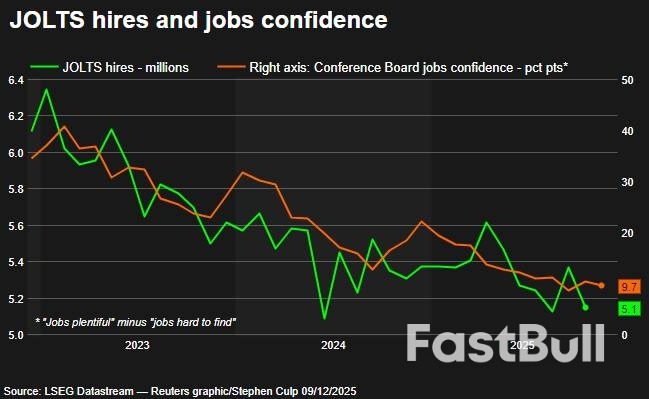
          The job vacancies rate was unchanged at 4.6%. Hiring dropped by 218,000 to 5.149 million in October, with most of the declines in construction, professional and business services, healthcare and social assistance as well as accommodation and food services industries. The hires rate slipped to 3.2% from 3.4% in September. There were 5.367 million hires in September.

          Layoffs crept up 73,000 to a still-low 1.854 million, concentrated in the accommodation and food services sector. The layoffs rate rose to 1.2% from 1.1% in September.

          Stocks on Wall Street were mixed. The dollar gained versus a basket of currencies. U.S. Treasury yields were mostly higher.

          JOLTS hires and jobs confidence

          "NO HIRE, NO FIRE" LABOR MARKET

          The combined September and October reports suggested the labor market remained in what economists and policymakers call a "no-hire, no-fire" state.

          Labor market stagnation has been blamed on reduced labor supply amid a reduction in immigration that started during the final year of former President Joe Biden's term and accelerated under President Donald Trump's second administration. The adoption of artificial intelligence for some job roles is also reducing labor demand, especially for entry-level positions.

          The unemployment rate rose to a four-year high of 4.4% in September. The BLS canceled October's employment report and will not be publishing the unemployment rate for that month as the longest shutdown on record prevented the collection of data for the household survey from which the jobless rate is calculated.

          November's delayed employment report, now due next Tuesday, will include October's nonfarm payrolls data.

          With the labor market wobbly, fewer workers are job hopping in search of greener pastures, pointing to benign wage inflation. The number of people quitting their jobs dropped 187,000, the largest decline since June 2023, to 2.941 million. That was the lowest level since August 2020 when the labor market was recovering from the first wave of the pandemic.

          The quits rate, viewed by policymakers as a gauge of labor market confidence, slipped to 1.8%. That was the lowest reading since May 2020, and was down from 2.0% in September. Lower wages because fewer workers are changing jobs could, however, hurt consumer spending.

          "This (quits rate) is a pretty 'cold' reading that has historically been consistent with wage growth of just 2.5% year-on-year," said James Knightley, chief international economist at ING. "That's not good news for consumption, but given in a service-sector economy, such as the U.S., the biggest cost input is the cost of your workforce, this suggests medium- to longer-term inflation will be on a downward trajectory."

          Source: Reuters

          Risk Warnings and Disclaimers
          You understand and acknowledge that there is a high degree of risk involved in trading. Following any strategies or investment methods may lead to potential losses. The content on the site is provided by our contributors and analysts for information purposes only. You are solely responsible for determining whether any trading assets, securities, strategy, or any other product is suitable for investing based on your own investment objectives and financial situation.
          Add to Favorites
          Share
          FastBull
          Copyright © 2025 FastBull Ltd

          728 RM B 7/F GEE LOK IND BLDG NO 34 HUNG TO RD KWUN TONG KLN HONG KONG

          TelegramInstagramTwitterfacebooklinkedin
          App Store Google Play Google Play
          Products
          Charts

          Chats

          Q&A with Experts
          Screeners
          Economic Calendar
          Data
          Tools
          Membership
          Features
          Function
          Markets
          Copy Trading
          Latest Signals
          Contests
          News
          Analysis
          24/7
          Columns
          Education
          Company
          Careers
          About Us
          Contact Us
          Advertising
          Help Center
          Feedback
          User Agreement
          Privacy Policy
          Business

          White Label

          Data API

          Web Plug-ins

          Poster Maker

          Affiliate Program

          Risk Disclosure

          The risk of loss in trading financial instruments such as stocks, FX, commodities, futures, bonds, ETFs and crypto can be substantial. You may sustain a total loss of the funds that you deposit with your broker. Therefore, you should carefully consider whether such trading is suitable for you in light of your circumstances and financial resources.

          No decision to invest should be made without thoroughly conducting due diligence by yourself or consulting with your financial advisors. Our web content might not suit you since we don't know your financial conditions and investment needs. Our financial information might have latency or contain inaccuracy, so you should be fully responsible for any of your trading and investment decisions. The company will not be responsible for your capital loss.

          Without getting permission from the website, you are not allowed to copy the website's graphics, texts, or trademarks. Intellectual property rights in the content or data incorporated into this website belong to its providers and exchange merchants.

          Not Logged In

          Log in to access more features

          FastBull Membership

          Not yet

          Purchase

          Become a signal provider
          Help Center
          Customer Service
          Dark Mode
          Price Up/Down Colors

          Log In

          Sign Up

          Position
          Layout
          Fullscreen
          Default to Chart
          The chart page opens by default when you visit fastbull.com