• Trade
  • Markets
  • Copy
  • Contests
  • News
  • 24/7
  • Calendar
  • Q&A
  • Chats
Screeners
SYMBOL
LAST
ASK
BID
HIGH
LOW
NET CHG.
%CHG.
SPREAD
SPX
S&P 500 Index
6915.62
6915.62
6915.62
6932.95
6895.49
+2.26
+ 0.03%
--
DJI
Dow Jones Industrial Average
49098.70
49098.70
49098.70
49265.46
48963.05
-285.30
-0.58%
--
IXIC
NASDAQ Composite Index
23501.23
23501.23
23501.23
23610.74
23374.26
+65.22
+ 0.28%
--
USDX
US Dollar Index
97.230
97.310
97.230
98.250
97.200
-0.820
-0.84%
--
EURUSD
Euro / US Dollar
1.18281
1.18301
1.18281
1.18334
1.17280
+0.00736
+ 0.63%
--
GBPUSD
Pound Sterling / US Dollar
1.36430
1.36467
1.36430
1.36452
1.34817
+0.01433
+ 1.06%
--
XAUUSD
Gold / US Dollar
4986.45
4986.45
4986.45
4990.01
4899.61
+50.62
+ 1.03%
--
WTI
Light Sweet Crude Oil
61.105
61.357
61.105
61.253
59.453
+1.510
+ 2.53%
--

Community Accounts

Signal Accounts
--
Profit Accounts
--
Loss Accounts
--
View More

Become a signal provider

Sell trading signals to earn additional income

View More

Guide to Copy Trading

Get started with ease and confidence

View More

Signal Accounts for Members

All Signal Accounts

Best Return
  • Best Return
  • Best P/L
  • Best MDD
Past 1W
  • Past 1W
  • Past 1M
  • Past 1Y

All Contests

  • All
  • Trump Updates
  • Recommend
  • Stocks
  • Cryptocurrencies
  • Central Banks
  • Featured News
Top News Only
Share

Senate Majority Leader Chuck Schumer Informed Republicans That He Is Urging Them (supported By President Trump's Republican Party) To Amend The Draft Legislation Regarding The Department Of Homeland Security's (DHS) Budget. Democrats Do Not Want To Advance The Current DHS Funding Bill. Schumer Is Demanding That Republicans Move Forward With The Five-cent Appropriation Bill Before The Deadline

Share

Israeli Fire Kills Three In Gaza, Medics Say, As US Pushes Deal

Share

Dollar/Yen Dips, Down 0.47% At 155.00 Yen

Share

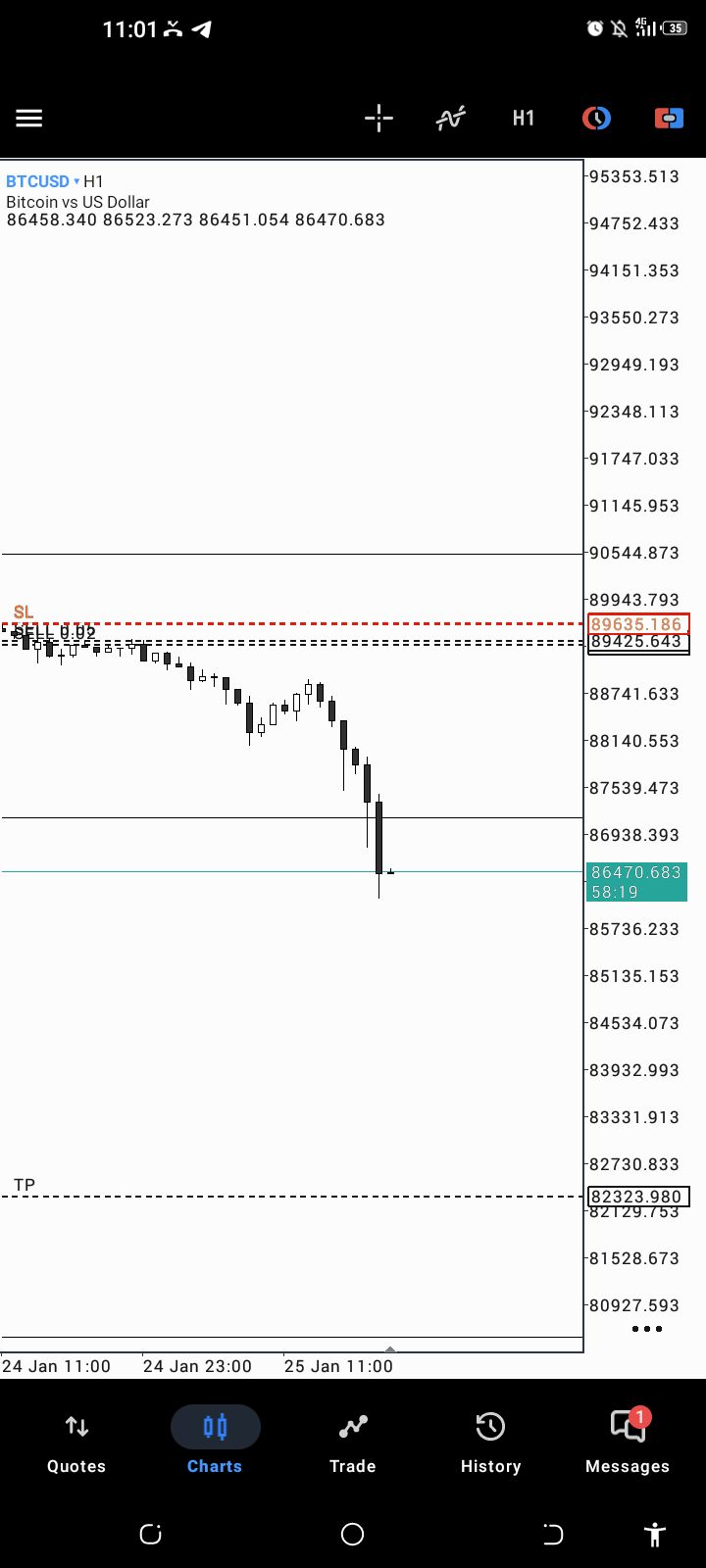
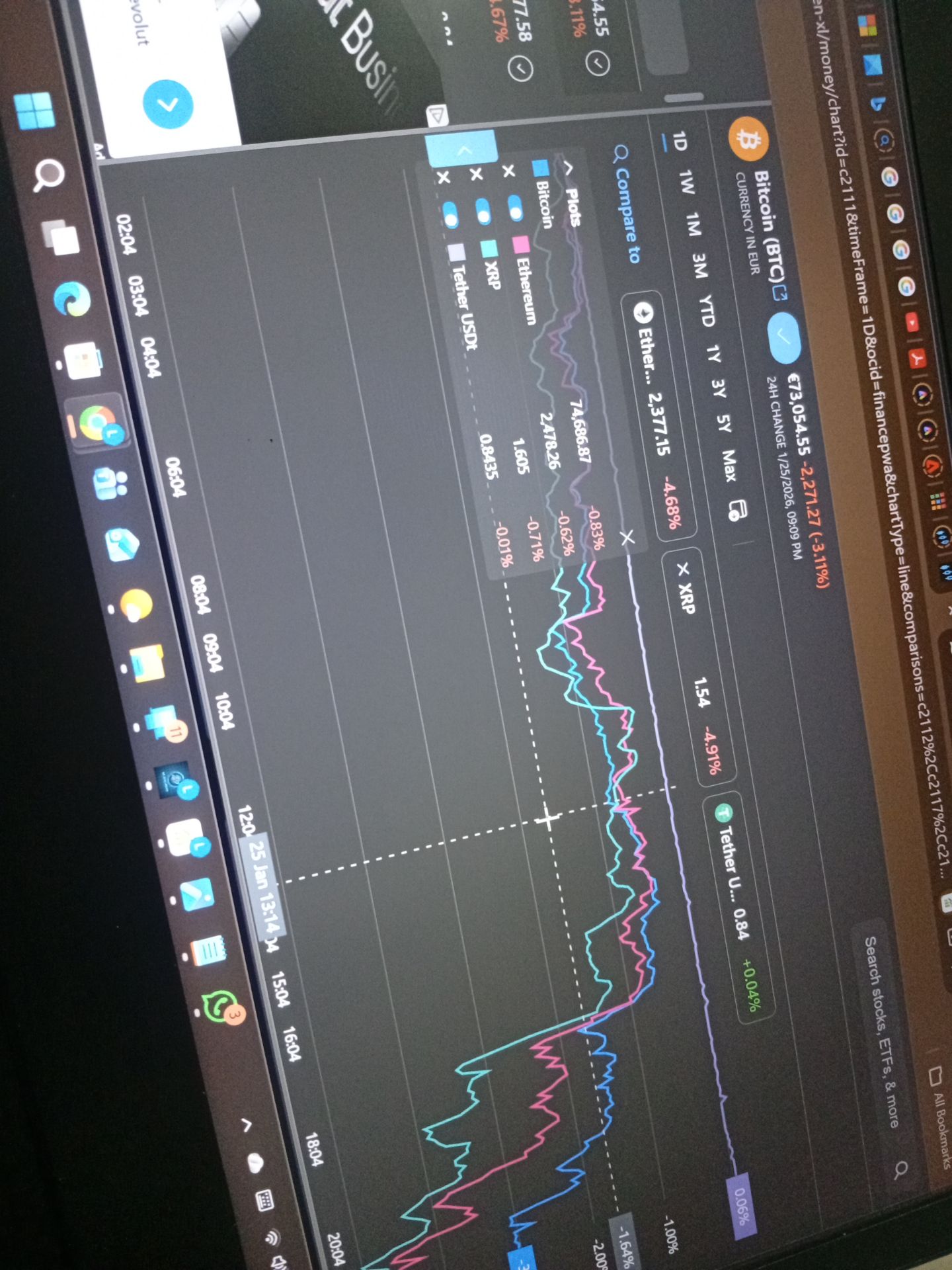
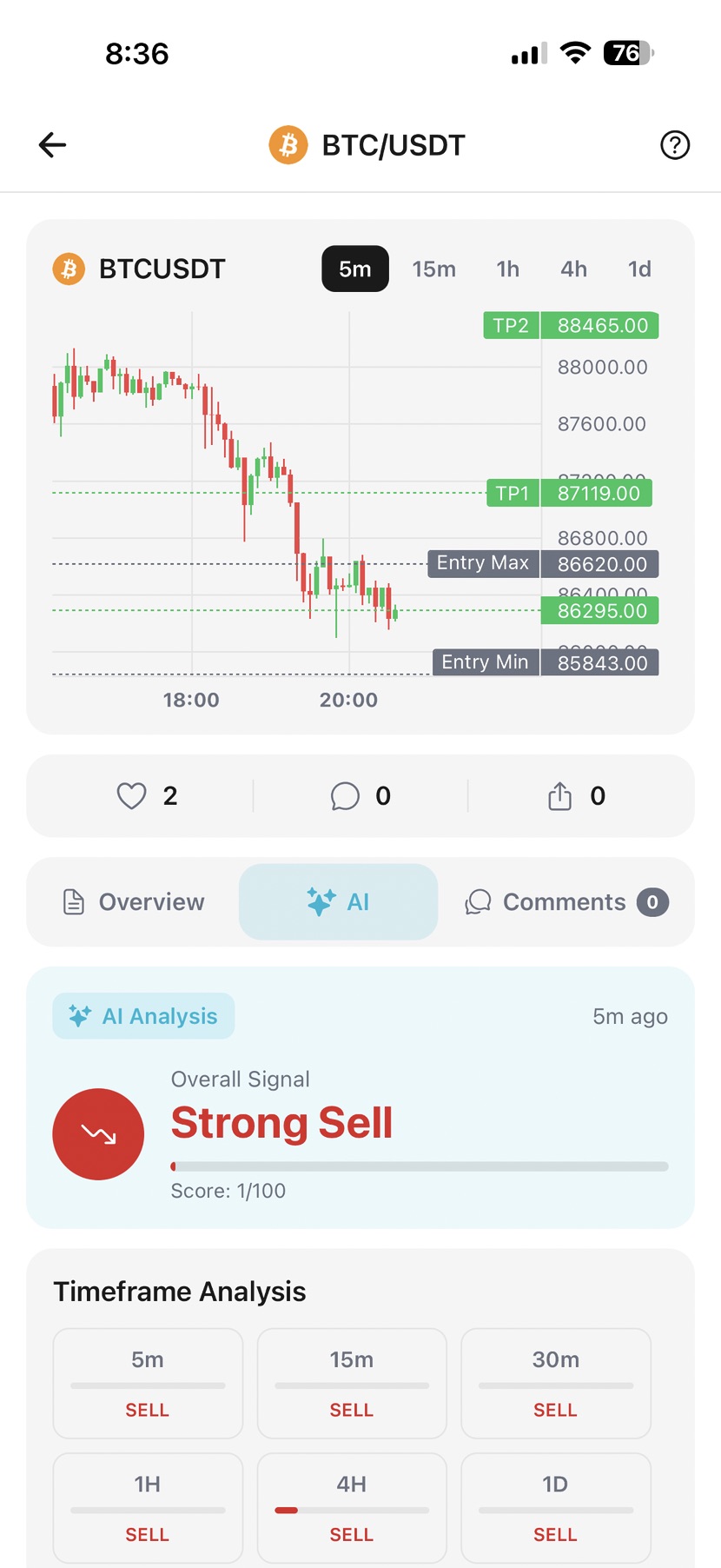
[Bitcoin Dips Below $88,000, 24-Hour Change -1.47%] January 26Th, According To Htx Market Data, Bitcoin Fell Below $88,000, With A 24-Hour Decrease Of 1.47%

Share

Ukraine President Zelenskiy: Documenт Of Safety Guarantees From USA Is 100% Ready

Share

Ukraine President Zelenskiy: Russia Is Avoiding Committing To A Lasting And Just Peace And Is Not Accepting A Ceasefire As A Prelude

Share

CEO: Volkswagen Ag May Pull Plans For US Audi Plant Absent Tariff Cuts

Share

Canada Has No Intention Of Making Free Trade Deal With China- Prime Minister Mark Carney

Share

Canada Respects Our Commitments Under Usma- Prime Minister Mark Carney

Share

Trump Envoy Witkoff: USA Talks With Israeli Prime Minister Netanyahu On Peace Board Were Constructive, Positive

Share

102918 Number Of Power Outage Reported In Louisiana As Of 8:09 Am Et - Poweroutage.US Website

Share

523067 Number Of Power Outage Reported In US As Of 7:22 Am Et - Poweroutage.US Website

Share

107295 Number Of Power Outage Reported In Mississippi As Of 6:34 Am Et - Poweroutage.US Website

Share

Oil Ministry - Iraq's Total Oil Exports For December At 107.651 Million Barrels

Share

Airbus CEO Says Company Faced Significant Collateral Damage From Trade Tensions In 2025

Share

Kremlin: Russian Military Will Attentively Monitor US Plans For Golden Dome - Including In Context Of Greenland

Share

100765 Number Of Power Outages Reported In Texas As Of 6 Am Et - Poweroutage.US Website

Share

Russia Will Never Discuss Anything With EU's Kallas, Will Just Wait For Her To Leave Her Post - Interfax Cites Kremlin

Share

Statistics Bureau - Israel's Industrial Production 6.3% Seasonally Adjusted In November Versus 1.5% In October

Share

Israel Raised 207 Billion Shekels In Debt In 2025

TIME
ACT
FCST
PREV
U.K. Retail Sales MoM (SA) (Dec)

A:--

F: --

P: --

France Manufacturing PMI Prelim (Jan)

A:--

F: --

P: --

France Services PMI Prelim (Jan)

A:--

F: --

P: --

France Composite PMI Prelim (SA) (Jan)

A:--

F: --

P: --

Germany Manufacturing PMI Prelim (SA) (Jan)

A:--

F: --

P: --

Germany Services PMI Prelim (SA) (Jan)

A:--

F: --

P: --

Germany Composite PMI Prelim (SA) (Jan)

A:--

F: --

P: --

Euro Zone Composite PMI Prelim (SA) (Jan)

A:--

F: --

P: --

Euro Zone Manufacturing PMI Prelim (SA) (Jan)

A:--

F: --

P: --

Euro Zone Services PMI Prelim (SA) (Jan)

A:--

F: --

P: --

U.K. Composite PMI Prelim (Jan)

A:--

F: --

P: --

U.K. Manufacturing PMI Prelim (Jan)

A:--

F: --

P: --

U.K. Services PMI Prelim (Jan)

A:--

F: --

P: --

Mexico Economic Activity Index YoY (Nov)

A:--

F: --

P: --

Russia Trade Balance (Nov)

A:--

F: --

P: --

Canada Core Retail Sales MoM (SA) (Nov)

A:--

F: --

P: --

Canada Retail Sales MoM (SA) (Nov)

A:--

F: --

P: --
U.S. IHS Markit Manufacturing PMI Prelim (SA) (Jan)

A:--

F: --

P: --

U.S. IHS Markit Services PMI Prelim (SA) (Jan)

A:--

F: --

P: --

U.S. IHS Markit Composite PMI Prelim (SA) (Jan)

A:--

F: --

P: --

U.S. UMich Consumer Sentiment Index Final (Jan)

A:--

F: --

P: --

U.S. UMich Current Economic Conditions Index Final (Jan)

A:--

F: --

P: --

U.S. UMich Consumer Expectations Index Final (Jan)

A:--

F: --

P: --

U.S. Conference Board Leading Economic Index MoM (Nov)

A:--

F: --

P: --

U.S. Conference Board Coincident Economic Index MoM (Nov)

A:--

F: --

P: --

U.S. Conference Board Lagging Economic Index MoM (Nov)

A:--

F: --

P: --

U.S. UMich 1-Year-Ahead Inflation Expectations Final (Jan)

A:--

F: --

P: --

U.S. Conference Board Leading Economic Index (Nov)

A:--

F: --

P: --

U.S. Weekly Total Rig Count

A:--

F: --

P: --

U.S. Weekly Total Oil Rig Count

A:--

F: --

P: --

Germany Ifo Business Expectations Index (SA) (Jan)

--

F: --

P: --

Germany IFO Business Climate Index (SA) (Jan)

--

F: --

P: --

Germany Ifo Current Business Situation Index (SA) (Jan)

--

F: --

P: --

U.S. Dallas Fed PCE Price Index YoY (Nov)

--

F: --

P: --

Brazil Current Account (Dec)

--

F: --

P: --

Mexico Unemployment Rate (Not SA) (Dec)

A:--

F: --

P: --

Canada National Economic Confidence Index

--

F: --

P: --

U.S. Non-Defense Capital Durable Goods Orders MoM (Excl. Aircraft) (Nov)

--

F: --

P: --

U.S. Durable Goods Orders MoM (Excl. Defense) (SA) (Nov)

--

F: --

P: --

U.S. Durable Goods Orders MoM (Excl.Transport) (Nov)

--

F: --

P: --

U.S. Durable Goods Orders MoM (Nov)

--

F: --

P: --

U.S. Chicago Fed National Activity Index (Nov)

--

F: --

P: --

U.S. Dallas Fed New Orders Index (Jan)

--

F: --

P: --

U.S. Dallas Fed General Business Activity Index (Jan)

--

F: --

P: --

U.K. BRC Shop Price Index YoY (Jan)

--

F: --

P: --

China, Mainland Industrial Profit YoY (YTD) (Dec)

--

F: --

P: --

Mexico Trade Balance (Dec)

--

F: --

P: --

U.S. S&P/CS 20-City Home Price Index YoY (Not SA) (Nov)

--

F: --

P: --

U.S. S&P/CS 20-City Home Price Index MoM (SA) (Nov)

--

F: --

P: --

U.S. FHFA House Price Index MoM (Nov)

--

F: --

P: --

U.S. FHFA House Price Index (Nov)

--

F: --

P: --

U.S. Richmond Fed Manufacturing Composite Index (Jan)

--

F: --

P: --

U.S. Conference Board Present Situation Index (Jan)

--

F: --

P: --

U.S. Conference Board Consumer Expectations Index (Jan)

--

F: --

P: --

U.S. Richmond Fed Manufacturing Shipments Index (Jan)

--

F: --

P: --

U.S. Richmond Fed Services Revenue Index (Jan)

--

F: --

P: --

U.S. Conference Board Consumer Confidence Index (Jan)

--

F: --

P: --

Australia RBA Trimmed Mean CPI YoY (Q4)

--

F: --

P: --

Australia CPI YoY (Q4)

--

F: --

P: --

Australia CPI QoQ (Q4)

--

F: --

P: --

Q&A with Experts
    • All
    • Chatrooms
    • Groups
    • Friends
    Jon Jony flag
    It's strange that BTC is dumped on Sundays before the market opens.
    Brandon Ki flag
    Jon Jony
    It's strange that BTC is dumped on Sundays before the market opens.
    @Jon Jonylikely to continue longing Gold to new ATH, but look this crazy crash on Sunday could be a warning
    Eurusdonly flag
    Eurusdonly flag
    Eurusdonly flag
    Eurusdonly
    i have been holding Shorts on Btcusd
    Eurusdonly flag
    Eurusdonly
    who got this ?
    Jon Jony flag
    Sundays and such obemas are sold, small ones are unlikely to make such discoveries next year if the whales don't buy it, then this will be a signal
    FORMFOREXL flag
    Brandon Ki flag
    Jon Jony
    Sundays and such obemas are sold, small ones are unlikely to make such discoveries next year if the whales don't buy it, then this will be a signal
    @Jon Jonysomething crazy is cooking
    Jon Jony flag
    How I love these moments like watching a movie
    "Jon Jony" recalled a message
    "Jon Jony" recalled a message
    "Jon Jony" recalled a message
    Eurusdonly flag
    Eurusdonly
    i love this drop on btcusd
    Eurusdonly flag
    83000 target 🎯
    Imran ahma flag
    Jon Jony flag
    Jon Jony flag
    The turning point should be at this moment, we'll see what the whales decide.
    Jon Jony flag
    gripping blockbuster
    Jon Jony flag
    are they really buying it out?
    Type here...
    Add Symbol or Code

      No matching data

      All
      Trump Updates
      Recommend
      Stocks
      Cryptocurrencies
      Central Banks
      Featured News
      • All
      • Russia-Ukraine Conflict
      • Middle East Flashpoint
      • All
      • Russia-Ukraine Conflict
      • Middle East Flashpoint
      Search
      Products

      Charts Free Forever

      Chats Q&A with Experts
      Screeners Economic Calendar Data Tools
      Membership Features
      Data Warehouse Market Trends Institutional Data Policy Rates Macro

      Market Trends

      Market Sentiment Order Book Forex Correlations

      Top Indicators

      Charts Free Forever
      Markets

      News

      News Analysis 24/7 Columns Education
      From Institutions From Analysts
      Topics Columnists

      Latest Views

      Latest Views

      Trending Topics

      Top Columnists

      Latest Update

      Signals

      Copy Rankings Latest Signals Become a signal provider AI Rating
      Contests
      Brokers

      Overview Brokers Assessment Rankings Regulators News Claims
      Broker listing Forex Brokers Comparison Tool Live Spread Comparison Scam
      Q&A Complaint Scam Alert Videos Tips to Detect Scam
      More

      Business
      Events
      Careers About Us Advertising Help Center

      White Label

      Data API

      Web Plug-ins

      Affiliate Program

      Awards Institution Evaluation IB Seminar Salon Event Exhibition
      Vietnam Thailand Singapore Dubai
      Fans Party Investment Sharing Session
      FastBull Summit BrokersView Expo
      Recent Searches
        Top Searches
          Markets
          News
          Analysis
          User
          24/7
          Economic Calendar
          Education
          Data
          • Names
          • Latest
          • Prev

          View All

          No data

          Scan to Download

          Faster Charts, Chat Faster!

          Download App
          English
          • English
          • Español
          • العربية
          • Bahasa Indonesia
          • Bahasa Melayu
          • Tiếng Việt
          • ภาษาไทย
          • Français
          • Italiano
          • Türkçe
          • Русский язык
          • 简中
          • 繁中
          Open Account
          Search
          Products
          Charts Free Forever
          Markets
          News
          Signals

          Copy Rankings Latest Signals Become a signal provider AI Rating
          Contests
          Brokers

          Overview Brokers Assessment Rankings Regulators News Claims
          Broker listing Forex Brokers Comparison Tool Live Spread Comparison Scam
          Q&A Complaint Scam Alert Videos Tips to Detect Scam
          More

          Business
          Events
          Careers About Us Advertising Help Center

          White Label

          Data API

          Web Plug-ins

          Affiliate Program

          Awards Institution Evaluation IB Seminar Salon Event Exhibition
          Vietnam Thailand Singapore Dubai
          Fans Party Investment Sharing Session
          FastBull Summit BrokersView Expo

          Trump Threatens 100% Tariffs as Canada–China Trade Ties Raise Alarm in Washington

          Gerik

          Economic

          Political

          Summary:

          President Donald Trump warned that the United States could impose punitive tariffs of up to 100 percent on Canadian goods if Ottawa proceeds with deeper trade arrangements with China...

          Tariffs As A Tool Of Strategic Pressure

          U.S. President Donald Trump has issued one of his strongest trade warnings yet, threatening to impose tariffs of up to 100 percent on Canadian exports should Canada move forward with a trade agreement with China. Speaking via social media, Trump framed the issue not merely as a commercial dispute but as a strategic and societal risk, arguing that closer economic ties with Beijing could undermine Canada’s economic structure and social fabric.
          The threat reflects Washington’s growing concern that Canada could become a conduit for Chinese goods seeking to bypass U.S. trade barriers. This concern is causal rather than rhetorical, as U.S. trade policy under Trump increasingly links tariffs to supply chain control and geopolitical alignment rather than traditional balance-of-trade considerations.

          Canada Caught Between Its Two Largest Partners

          Canada’s position is particularly sensitive given its economic dependence on the United States. The U.S. remains Canada’s largest export destination, with deeply intertwined supply chains across manufacturing, automotive, metals, and machinery sectors under the United States–Mexico–Canada Agreement framework. A 100 percent tariff would dramatically raise costs for Canadian exporters and disrupt production networks on both sides of the border.
          Canadian Prime Minister Mark Carney has avoided directly confronting Trump’s tariff threat. Instead, he has emphasized economic resilience and domestic demand, urging Canadians to prioritize locally produced goods. This response suggests a strategic choice to de-escalate rhetorically while reinforcing internal economic stability, rather than challenging Washington head-on.

          From Diplomatic Opening To Abrupt Reversal

          Trump’s warning follows Carney’s recent visit to China, which aimed to stabilize and partially reset Canada–China economic relations after years of tension. That visit resulted in several trade-related understandings with China, now Canada’s second-largest trading partner after the United States.
          Notably, Trump’s stance represents a sharp reversal. Only days earlier, he had publicly suggested that it would be beneficial for Canada to secure trade deals with China if possible. The subsequent deterioration in political relations between the two leaders appears to have shifted Washington’s posture from tolerance to explicit deterrence, highlighting the high degree of policy volatility currently shaping North American trade relations.

          Ottawa Moves To Contain The Fallout

          In response to the escalating rhetoric, Canadian officials have sought to narrow the scope of the issue. Trade Minister Dominic LeBlanc clarified that Canada is not pursuing a comprehensive free trade agreement with China, but rather addressing specific tariff-related issues. This clarification aims to reduce the perception that Ottawa is realigning its trade strategy away from the United States.
          Meanwhile, China’s embassy in Canada signaled Beijing’s willingness to continue implementing bilateral understandings reached by the two governments, indicating that China views the relationship as stabilizing rather than confrontational. This divergence in tone between Washington and Beijing places Canada in an increasingly narrow diplomatic corridor.

          Economic Risks And Strategic Implications

          If implemented, a 100 percent U.S. tariff on Canadian goods would represent an extreme escalation, with immediate consequences for export volumes, corporate margins, and employment in key industrial sectors. The relationship between tariffs and economic damage in this case is directly causal, given the scale of cross-border trade and the limited ability of firms to rapidly reconfigure supply chains.
          Beyond economics, the episode underscores a broader strategic shift. U.S. trade policy is increasingly being used as an instrument to enforce geopolitical boundaries, particularly in relation to China. For Canada, the challenge lies in maintaining diversified economic relationships while avoiding actions that Washington could interpret as enabling circumvention of U.S. trade defenses.

          A Stress Test For North American Integration

          The dispute highlights the fragility of North American economic integration under conditions of geopolitical competition. While the United States, Canada, and Mexico remain bound by formal trade agreements, political trust has become a critical variable influencing how those agreements are applied in practice.
          For now, Trump’s tariff threat remains a warning rather than an enacted policy. Yet its mere articulation has already introduced uncertainty into markets and policy planning. Whether this episode escalates or de-escalates will depend less on formal trade rules and more on political calculations in Washington and Ottawa, reinforcing the reality that trade policy has become inseparable from power politics in the current global environment.
          To stay updated on all economic events of today, please check out our Economic calendar
          Risk Warnings and Disclaimers
          You understand and acknowledge that there is a high degree of risk involved in trading. Following any strategies or investment methods may lead to potential losses. The content on the site is provided by our contributors and analysts for information purposes only. You are solely responsible for determining whether any trading assets, securities, strategy, or any other product is suitable for investing based on your own investment objectives and financial situation.
          Add to Favorites
          Share

          US 'Rate Check' Signals Intervention to Bolster Yen

          Alice Winters

          Central Bank

          Remarks of Officials

          Bond

          Political

          Economic

          Forex

          Treasury Signals Support for Plunging Yen

          On Friday, the U.S. Treasury took a decisive step to halt the Japanese yen's sharp decline against the dollar. Treasury Secretary Scott Bessent initiated a "rate check," a clear signal that the U.S. government is preparing to intervene in currency markets.

          The move came as turmoil in the Japanese bond market began to affect U.S. Treasury yields. Acting as the Treasury's agent, the New York Fed contacted its primary dealers to ask what exchange rates they could offer if it were to begin purchasing yen.

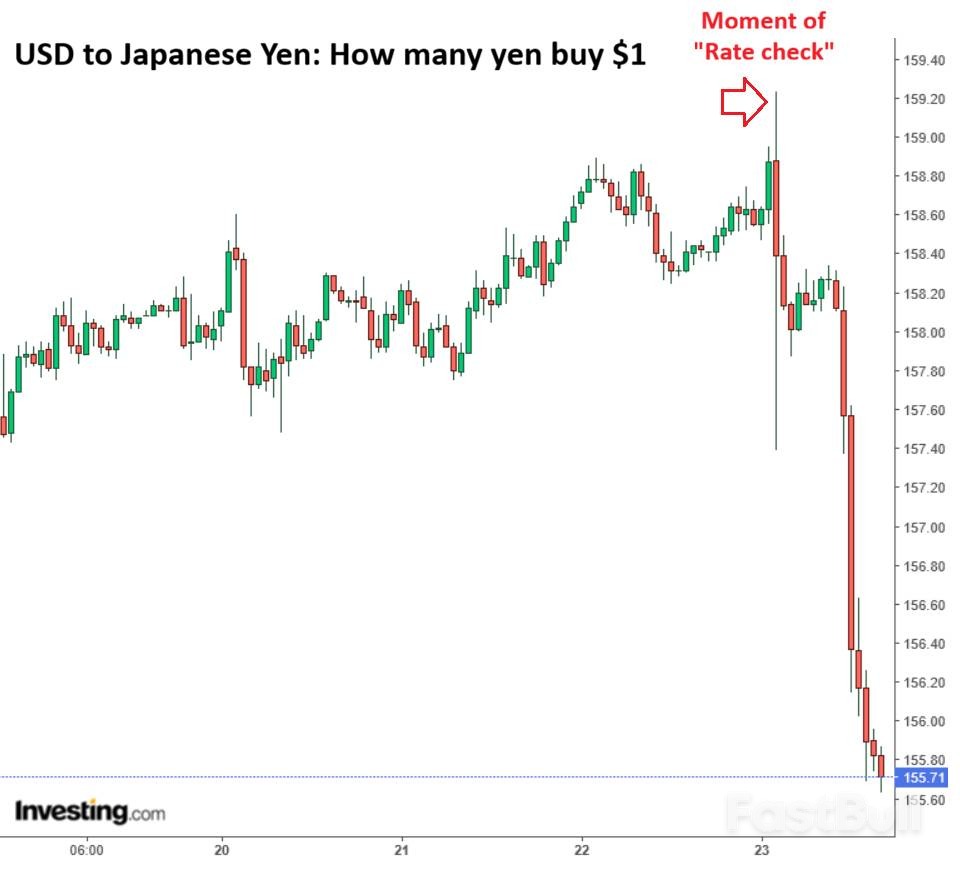
          The market reacted instantly. The signal of potential intervention caused the U.S. dollar to fall sharply against the yen. The exchange rate, which had hit 159.2 yen per dollar, reversed course, strengthening the yen to 155.7 by Friday evening.

          This chart of the USD/JPY exchange rate shows the yen strengthening significantly after the U.S. Treasury's "rate check" was announced, dropping from nearly 159 to below 156 yen per dollar.

          Japanese Bond Market Meltdown Sparks Contagion

          The yen's weakness was rooted in Japan's domestic bond market, which experienced a meltdown earlier in the week. The trigger was Prime Minister Sanae Takaichi's call for increased government spending combined with tax cuts.

          This announcement spooked investors, leading to a rapid sell-off in Japanese Government Bonds (JGBs).

          • The 30-year JGB yield spiked by 42 basis points in just two days, reaching 3.91%—its highest level since its introduction in 1999.

          • The key 10-year JGB yield surged by 15 basis points over the same period.

          This instability in Japan quickly spilled over into U.S. markets. On Wednesday, Bessent directly blamed the Japanese bond crisis for the surge in long-term U.S. Treasury yields.

          Impact on U.S. Yields and Mortgage Rates

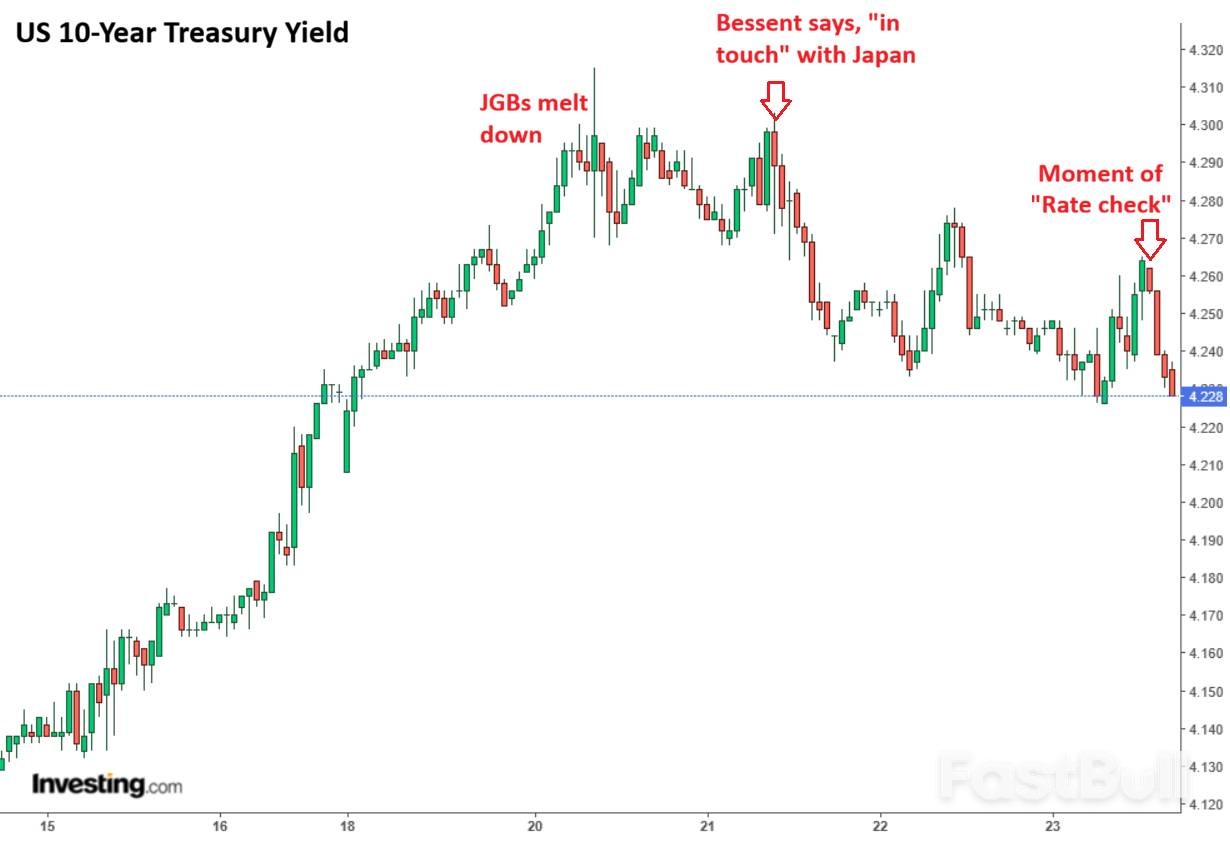
          The 10-year U.S. Treasury yield had climbed to 4.30% by Wednesday morning, an increase of 17 basis points in a week. This rise complicated the Trump administration's efforts to lower mortgage rates, which typically track the 10-year yield.

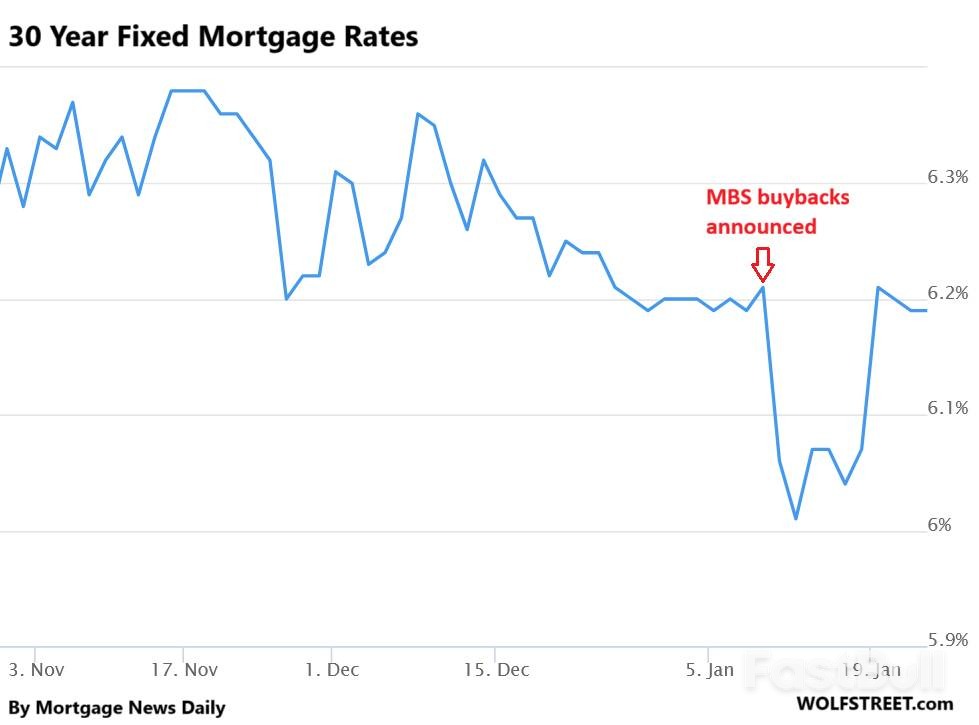
          As a result, 30-year fixed mortgage rates, which had recently fallen, jumped back to 6.20% from 6.01%, according to Mortgage News Daily.

          Bessent addressed the issue on Fox News, stating, "It's very difficult to disaggregate the market reaction from what's going on endogenously in Japan." He noted that he had contacted Japanese officials and was confident they would take steps to calm their markets.

          This jawboning, combined with Friday's "rate check," successfully pushed the 10-year U.S. Treasury yield down from its peak of 4.30% to 4.23%.

          The 10-year U.S. Treasury yield is shown spiking after the JGB meltdown before declining in response to Secretary Bessent's comments and the "rate check" signal.

          A Short-Lived Fix for Mortgage Rates

          Separately, the administration has been trying to directly influence mortgage rates. In a move that began in 2025, government-sponsored enterprises Fannie Mae and Freddie Mac started buying back mortgage-backed securities (MBS) they had issued.

          On January 8, President Trump directed them to buy back $200 billion in MBS, the maximum allowed under current law. However, the plan faced a practical hurdle: Fannie and Freddie lack the available cash for such a large purchase and would likely need to issue new bonds, which could add more pressure to the bond market.

          Despite this, the announcement provided a temporary boost. Mortgage rates plunged by a combined 20 basis points on January 9 and 12. The effect was fleeting. By January 20, rates had returned to their January 8 levels, completing a U-shaped pattern on the chart.

          This chart illustrates how 30-year fixed mortgage rates dropped sharply following the announcement of MBS buybacks in mid-January, only to rebound soon after.

          Are Underlying Economic Pressures Being Ignored?

          While Bessent pointed to Japan, his jawboning conveniently sidesteps pressing domestic issues that are weighing on the bond market. The ballooning U.S. deficit requires a constant flood of new bonds that investors must absorb. At the same time, inflation continues to accelerate, worrying investors who see it eroding the purchasing power of their bond holdings.

          Bond yields are meant to compensate investors for this loss of purchasing power, but current long-term yields appear too low to cover the risk of hotter inflation ahead. Government policies of high deficit spending, coupled with pressure on the Fed to cut short-term interest rates, are creating an environment where inflation can thrive.

          For now, the bond market remains surprisingly calm despite these ripples. But market confidence built on official statements rather than economic fundamentals may not last long.

          To stay updated on all economic events of today, please check out our Economic calendar
          Risk Warnings and Disclaimers
          You understand and acknowledge that there is a high degree of risk involved in trading. Following any strategies or investment methods may lead to potential losses. The content on the site is provided by our contributors and analysts for information purposes only. You are solely responsible for determining whether any trading assets, securities, strategy, or any other product is suitable for investing based on your own investment objectives and financial situation.
          Add to Favorites
          Share

          Davos 2026 And The Cracks In The Global Order

          Gerik

          Economic

          Washington As The Central Source Of Uncertainty

          The 2026 Annual Meeting of the World Economic Forum concluded amid unusually tense discussions, with Washington dominating nearly every agenda item. From macroeconomic stability to defense and geopolitics, the policy direction of the United States emerged as the single most influential variable shaping global expectations.
          On the eve of the summit, the U.S. administration reignited transatlantic tensions by threatening tariffs against European allies over resistance to Donald Trump’s ambitions regarding Greenland. This episode reinforced concerns among European leaders and corporate executives that reliance on the United States as a predictable partner could no longer be taken for granted. The resulting atmosphere at Davos reflected not a sudden shock, but an accumulation of unresolved strategic doubts.

          Macroeconomics And Markets Under Policy Volatility

          Macroeconomic discussions at Davos were overshadowed by fears that aggressive and unpredictable U.S. trade policies could undermine global market stability. Financial institutions expressed cautious optimism for business activity in 2026, yet repeatedly stressed that policy risk, rather than demand conditions, represented the primary threat to investment planning.
          Executives emphasized that stability, predictability, and respect for the rule of law were becoming increasingly scarce. This perception has strengthened calls for trade diversification and reduced exposure to any single market perceived as moving toward protectionism. The relationship here is largely causal, as policy uncertainty directly increases risk premiums and discourages long-term capital allocation.
          Within the financial sector, debate also intensified over proposed U.S. regulatory measures. Jamie Dimon warned that capping credit card interest rates could trigger severe economic disruption, while other banks acknowledged efforts to influence policymakers to consider consumer affordability. These exchanges highlighted how domestic U.S. policy debates are increasingly spilling over into global financial sentiment.

          Energy Policy Reversals And Strategic Tensions

          Energy returned to center stage at Davos following a year of decisive policy shifts under the Trump administration. The U.S. government halted new wind power projects and urged domestic and international firms to expand oil production, marking a sharp departure from the energy transition narratives of previous forums.
          U.S. Energy Secretary Chris Wright argued that global oil output would need to more than double to meet rising energy demand, directly contradicting widely held assumptions that oil demand could peak within the next two decades. He criticized Europe and California for allocating excessive resources to green energy investments, framing such spending as economically inefficient.
          While many oil and gas executives welcomed this rhetorical shift, the consensus quickly fractured. Elon Musk publicly challenged the administration’s stance, asserting that solar power alone could meet total U.S. electricity demand, including surging consumption from data centers. Musk argued that high tariffs were artificially inflating solar deployment costs, revealing a clear divide between fossil fuel expansion narratives and renewable-driven visions of energy security.

          Artificial Intelligence As Opportunity And Disruption

          Artificial intelligence remained one of the most prominent themes at Davos 2026, with the presence of figures such as Jensen Huang underscoring continued confidence in the sector’s growth potential. Technology leaders broadly agreed that the AI cycle remains in an early stage, with significant room for expansion despite earlier concerns over inflated valuations.
          Startups such as Anthropic actively targeted enterprise adoption, signaling a strategic shift from experimentation toward commercialization. At the same time, AI’s labor market impact generated persistent controversy. While business leaders acknowledged that some jobs would disappear, several argued that AI often serves as a justification for layoffs rather than their true cause.
          Labor unions and civil society groups countered that AI risks exacerbating inequality unless accompanied by stronger regulation and large-scale reskilling efforts. The relationship between AI deployment and labor outcomes thus remains contested, with correlation evident but causality still debated.

          Geopolitics And The Erosion Of Trust

          Geopolitical discussions revealed a deep reassessment of alliances, particularly in Europe. U.S. demands concerning Greenland were widely perceived as crossing a sovereignty red line, compelling European governments to adopt firmer positions. Although Washington later signaled partial retreat, trust damage had already occurred.
          European officials openly admitted that internal decision-making processes may be too slow for an increasingly volatile world. This acknowledgment reflects a growing belief that strategic autonomy is no longer optional but necessary for long-term stability.
          Ukraine briefly receded from focus before returning sharply to the agenda when Volodymyr Zelenskiy arrived at Davos for urgent talks. Despite references to progress, substantive peace remained elusive due to unresolved territorial disputes. Meanwhile, the appearance of Kirill Dmitriev marked the first participation of a senior Russian official since 2022, signaling tentative diplomatic re-engagement amid ongoing conflict.

          Defense And Strategic Signaling

          Defense discussions intensified following Trump’s statement that he was not seeking a military solution over Greenland, providing temporary relief to markets and governments. Nonetheless, expectations of higher defense spending in both Europe and the United States fueled optimism among contractors and infrastructure firms.
          Trump further stirred controversy by referencing a “secret sonic weapon” allegedly used in the arrest of Venezuelan President Nicolás Maduro. While the claim lacked verification, it prompted responses from Moscow and Beijing, illustrating how strategic signaling alone can reshape security calculations.

          A Fragmenting Global Landscape

          Taken together, Davos 2026 painted a picture of a world entering a new phase of unpredictability. Economic policy, geopolitics, technology, and security are increasingly intertwined, reducing the effectiveness of siloed decision-making. Rather than offering clear answers, the forum highlighted unresolved tensions and emerging fault lines that may define the global order in the years ahead.
          The dominant takeaway from Davos was not crisis, but fragility. As trust erodes and dependencies are reassessed, global actors face a future where resilience and adaptability may matter more than scale or speed alone.
          To stay updated on all economic events of today, please check out our Economic calendar
          Risk Warnings and Disclaimers
          You understand and acknowledge that there is a high degree of risk involved in trading. Following any strategies or investment methods may lead to potential losses. The content on the site is provided by our contributors and analysts for information purposes only. You are solely responsible for determining whether any trading assets, securities, strategy, or any other product is suitable for investing based on your own investment objectives and financial situation.
          Add to Favorites
          Share

          Venezuela Pushes Major Oil Sector Reforms to Lift Output in 2026

          Gerik

          Economic

          Commodity

          Reform Goals Amid Long-Term Decline

          Venezuela’s oil production has suffered a dramatic downturn over the past two decades, falling from over 3 million barrels per day (bpd) in the early 2000s to roughly 1.2 million bpd today due to mismanagement, underinvestment, and sanctions.In response, the acting government is pursuing substantial legal reforms aimed at reversing this trend and revitalizing the industry.
          Under these changes, the country’s Petróleos de Venezuela, S.A. the state oil company and the government hope to expand output by about 18 percent in 2026 compared with current levels, an ambitious target that reflects both the scale of production decline and the urgency to attract capital.

          Opening the Industry to Private Investment

          At the heart of the reform is a shift from strict state control toward broader private sector participation. The draft amendments to Venezuela’s Hydrocarbons Law propose opening the sector to private companies based in Venezuela, allowing them to sign contracts for oil exploration and extraction. This represents a departure from historical policy, in which the state or state-dominated joint ventures held almost exclusive operational control.
          Lawmakers have already approved the reform in its first parliamentary reading, and full approval is expected soon. The legal overhaul aims to provide clearer legal certainty for investors, a key concern for companies wary of Venezuela’s past expropriations and regulatory unpredictability.

          Modernizing Regulation to Attract Capital

          Analysts note that much of Venezuela’s existing oil legislation is outdated and poorly aligned with current global energy industry standards. The proposed reforms include provisions to update the regulatory environment, reduce operational barriers, and potentially adjust fiscal terms such as royalties and taxes to improve project viability. By doing so, Venezuela hopes to lure both domestic and foreign capital back into its vast resource base, which includes one of the largest proven oil reserves in the world.
          Even as Venezuela moves toward opening the sector, the state aims to maintain a significant role in core activities. Latest reform drafts reportedly preserve majority state participation in many cases, while offering room for private and foreign companies to operate under contractual arrangements that share output or profits.
          This hybrid model reflects a broader effort to balance the need for fresh investment with political sensitivities around sovereign control of natural resources.

          Broader Context and Challenges

          The push for oil reform comes amid broader geopolitical tensions and pressure from international actors, including the United States, which has a strategic interest in Venezuela’s energy sector. However, attracting long-term investment will depend on Venezuela’s ability to stabilize its political environment, reestablish investor confidence, and adjust punitive sanctions that have hindered foreign participation.
          In the near term, the legal changes and the renewed focus on private sector involvement may help stem the long decline in output and lay the groundwork for gradual recovery, though reaching Venezuela’s former production heights could remain a long-term challenge.
          To stay updated on all economic events of today, please check out our Economic calendar
          Risk Warnings and Disclaimers
          You understand and acknowledge that there is a high degree of risk involved in trading. Following any strategies or investment methods may lead to potential losses. The content on the site is provided by our contributors and analysts for information purposes only. You are solely responsible for determining whether any trading assets, securities, strategy, or any other product is suitable for investing based on your own investment objectives and financial situation.
          Add to Favorites
          Share

          EU And ASEAN Anchor Vietnam’s Record-Breaking Coffee Export Growth

          Gerik

          Economic

          Commodity

          A Record Year For Vietnam’s Coffee Exports

          According to the Import and Export Department under the Ministry of Industry and Trade, Vietnam’s coffee export value surged to a record 8.9 billion USD in 2025. This milestone reflects not only favorable global market conditions but also structural improvements across Vietnam’s coffee sector, particularly in quality upgrading, supply chain management, and trade facilitation.
          The sharp rise in export value indicates more than a volume-driven expansion. Instead, it signals a shift toward higher unit prices and improved market positioning, especially in destinations with strict standards and strong purchasing power.

          European Union As The Primary Growth Engine

          The European Union remained Vietnam’s largest coffee export destination, accounting for 40.7 percent of total export turnover. In absolute terms, shipments to the EU exceeded 666,000 tons, generating 3.63 billion USD in export revenue. Compared with the previous year, export volume increased by 26 percent while export value surged by 68.3 percent, highlighting a significant improvement in price realization rather than purely quantity expansion.
          Major EU markets such as Germany, Italy, Spain, and the Netherlands all recorded strong growth. This performance reflects a clear correlation between Vietnam’s progress in meeting stringent EU requirements and its ability to access higher-value market segments. Enhanced compliance with quality standards, traceability regulations, and sustainability criteria has strengthened buyer confidence and expanded Vietnam’s presence in premium distribution channels.
          Importantly, the faster growth in export value relative to volume suggests that Vietnamese coffee is increasingly being positioned beyond bulk commodity status, capturing more value within the EU market.

          ASEAN Emerges As A Strategic Regional Market

          Alongside the EU, the Association of Southeast Asian Nations has become an increasingly important destination for Vietnamese coffee exports. In 2025, export turnover to ASEAN surpassed 1 billion USD, underscoring the region’s growing demand, particularly for Robusta coffee.
          This trend reflects a structural alignment between Vietnam’s production strengths and ASEAN consumption patterns. Robusta, which dominates Vietnam’s output, is well suited to instant coffee, ready-to-drink beverages, and blended products that are expanding rapidly across Southeast Asia. The relationship here is largely causal, as rising urbanization and changing consumption habits within ASEAN are directly driving higher import demand for competitively priced, reliable coffee supplies.
          The ASEAN market also offers opportunities for value-added products, providing Vietnamese exporters with a testing ground for brand development and downstream processing before targeting more demanding global markets.

          Trade Agreements As A Key Enabler

          A major driver behind the strong export performance is Vietnam’s effective use of tariff preferences under multiple free trade agreements. In a year marked by global trade uncertainty, Vietnamese coffee exporters were able to reduce costs and enhance competitiveness by leveraging preferential access.
          In 2025, coffee exports accompanied by certificates of origin reached an estimated 5 billion USD, accounting for a substantial share of total sector exports. This indicates a high degree of utilization of trade agreements and reflects improved administrative capacity among exporters to comply with origin and documentation requirements.
          The relationship between trade facilitation and export growth is clearly causal in this context. Lower tariff barriers and clearer market access conditions directly improved profitability and expanded market reach for Vietnamese coffee producers and traders.

          Structural Implications For The Coffee Sector

          Taken together, the dominance of the EU and the rapid rise of ASEAN as key markets suggest that Vietnam’s coffee export strategy is becoming more diversified and resilient. The EU provides scale, high standards, and premium pricing, while ASEAN offers regional proximity, growing demand, and opportunities for product innovation.
          The record export value of 2025 therefore reflects not only favorable prices but also a gradual transformation of Vietnam’s coffee sector toward higher quality, better compliance, and more strategic market positioning. If these trends continue, the EU and ASEAN are likely to remain the twin pillars supporting Vietnam’s coffee export growth in the years ahead.
          To stay updated on all economic events of today, please check out our Economic calendar
          Risk Warnings and Disclaimers
          You understand and acknowledge that there is a high degree of risk involved in trading. Following any strategies or investment methods may lead to potential losses. The content on the site is provided by our contributors and analysts for information purposes only. You are solely responsible for determining whether any trading assets, securities, strategy, or any other product is suitable for investing based on your own investment objectives and financial situation.
          Add to Favorites
          Share

          Can Vietnam Sustain A 10% Growth Path? A Chinese Expert’s Strategic Assessment

          Gerik

          Economic

          Growth Target Under Global Downturn Pressure

          In an environment marked by global economic slowdown, Vietnam’s target of maintaining average annual GDP growth of approximately 10 percent in the 2026–2030 period represents a significant challenge. However, according to Liu Ying, Research Fellow at the Chongyang Institute for Financial Studies under Renmin University of China, this objective remains realistic when assessed against Vietnam’s current economic fundamentals and policy orientation. Her assessment was shared in discussions surrounding Vietnam’s development goals outlined at the 14th National Congress of the Communist Party of Vietnam.
          From a structural perspective, the growth target is not viewed as aspirational rhetoric but as a conditional outcome that depends on Vietnam’s ability to implement systemic reforms while accelerating infrastructure development. The causal link, in this case, lies between productivity-enhancing reforms and the economy’s long-term growth capacity, rather than short-term stimulus measures.

          Infrastructure Bottlenecks And Logistics Costs

          A central constraint highlighted in Liu Ying’s analysis is Vietnam’s high logistics cost, estimated at 16–18 percent of GDP. This figure significantly exceeds the global average of 10.7 percent and remains higher than that of several ASEAN economies, directly weakening the competitiveness of Vietnamese firms. The relationship here is causal, as elevated logistics costs translate into higher production expenses and lower export margins.
          To address this issue, she emphasizes the importance of accelerating the National Master Plan for 2021–2030 with a vision toward 2050. Priority areas include expressway networks, high-speed rail, and seamless multimodal transport linking rail and maritime routes. Such investments are expected to reduce transportation time and costs, thereby improving supply chain efficiency and supporting export-oriented growth.

          Financing Infrastructure And Mobilizing Long-Term Capital

          Beyond physical construction, the effectiveness of infrastructure expansion depends on financing mechanisms. Liu Ying stresses the need to broaden public–private partnership frameworks and explore the creation of a national-level special infrastructure fund. This approach is designed to attract sovereign wealth funds and long-term institutional capital, establishing a stable financing base for large-scale projects.
          Strategic corridors connecting northern industrial hubs such as Hanoi–Hai Phong with southern economic centers including Ho Chi Minh City, Dong Nai, and Binh Duong are identified as priority investment zones. Improved connectivity along these axes is correlated with enhanced regional integration and more resilient national supply chains.

          Financial Reform And Green Capital Allocation

          Infrastructure alone is insufficient without parallel reform of the financial system. Liu Ying points to the importance of upgrading Vietnam’s capital markets while expanding green finance incentives. Notably, outstanding green credit in Vietnam has been growing faster than overall credit, indicating rising demand for sustainable investment instruments.
          She argues that extending the 2 percent interest rate subsidy for green projects would help channel capital into renewable energy and circular economy initiatives. This policy direction also supports the development of carbon credit trading mechanisms, reinforcing the link between financial reform and sustainable growth rather than treating environmental goals as a separate policy track.

          International Financial Centers And Capital Attraction

          Liu Ying also views Vietnam’s push to develop international financial centers as a strategic lever for growth. With international financial center functions emerging in Ho Chi Minh City and Da Nang, the next phase should focus on operational depth. This includes enabling international credit rating agencies, cross-border payment systems, and transparent licensing frameworks for foreign financial institutions.
          The economic logic here is correlational rather than immediate causation. While financial centers alone do not generate growth, they enhance Vietnam’s ability to mobilize regional and global capital, supporting long-term investment and economic resilience.

          Human Capital And Balanced Regional Development

          Sustaining high growth over multiple years requires parallel investment in human capital. Liu Ying underscores the need for a comprehensive workforce development system that enhances labor adaptability while supporting more balanced regional development. This approach mitigates the risk of growth concentration and social imbalance, which could otherwise undermine long-term economic stability.
          Assessing bilateral relations, Liu Ying notes that China and Vietnam are jointly building a strategic community with shared future interests. This framework opens opportunities for deeper economic cooperation across four pillars: balanced trade, infrastructure connectivity, financial coordination, and collaboration in emerging sectors.
          She highlights infrastructure connectivity as the backbone of bilateral cooperation, particularly through rail projects such as the Hanoi–Hai Phong–Lao Cai corridor. These initiatives are aligned with the “Two Corridors, One Belt” framework and China’s Belt and Road Initiative, reinforcing a causal link between cross-border infrastructure and trade expansion.

          Toward New Growth Drivers

          Liu Ying concludes that deeper financial cooperation, including greater use of local currencies and potential bilateral currency swap arrangements, could further stabilize trade and investment flows. At the same time, she emphasizes the importance of creating new cooperation highlights in emerging industries and advancing what she describes as “new quality productive forces.”
          In this context, Vietnam’s 10 percent growth ambition is neither guaranteed nor unrealistic. Its feasibility depends on coherent execution across infrastructure, finance, human capital, and regional cooperation. If these elements move in alignment, Vietnam’s growth target could shift from an aspirational benchmark to a structurally supported outcome over the coming decade.
          To stay updated on all economic events of today, please check out our Economic calendar
          Risk Warnings and Disclaimers
          You understand and acknowledge that there is a high degree of risk involved in trading. Following any strategies or investment methods may lead to potential losses. The content on the site is provided by our contributors and analysts for information purposes only. You are solely responsible for determining whether any trading assets, securities, strategy, or any other product is suitable for investing based on your own investment objectives and financial situation.
          Add to Favorites
          Share

          Europe Confronts A Technology Dependence Nightmare Scenario With The United States

          Gerik

          Economic

          A Hypothetical Risk That Is No Longer Dismissed

          For years, the idea that Europe might be abruptly cut off from essential U.S. digital services was widely considered unrealistic. Yet recent political signals from Donald Trump, including explicit threats and references to coercive measures against allies, have fundamentally altered risk perceptions in Brussels. European officials are now openly planning for scenarios once regarded as implausible, including the possibility of executive actions in Washington that could limit European access to cloud computing, email systems, and critical enterprise software.
          Such services underpin not only Europe’s private sector but also its public administration. The prospect of external control over these digital foundations has transformed technological dependence from a theoretical concern into a concrete strategic vulnerability.

          Economic Exposure Reveals Structural Dependence

          The scale of Europe’s reliance on American technology firms is substantial. According to data from International Data Corporation, European customers spent nearly 25 billion U.S. dollars in 2024 on infrastructure services provided by the five largest U.S. technology companies, accounting for 83 percent of the regional market. This concentration creates a strong correlation between Europe’s digital resilience and policy decisions made outside the continent.
          At the same time, U.S. firms exported more than 360 billion dollars’ worth of digital services to Europe in 2024, spanning online advertising, cloud computing, and artificial intelligence. This mutual exposure underscores the depth of integration but also magnifies the consequences of political disruption.

          Technology Sovereignty Moves From Concept To Policy

          As concerns intensified, the European Parliament adopted a resolution emphasizing technological sovereignty, encouraging public procurement to prioritize European solutions and calling for new legislation to support domestic cloud providers. The European Commission is now drafting a legal framework aimed at reducing external dependency and strengthening control over data governance.
          Only months ago, openly framing U.S. technology as a security risk was politically sensitive. Today, European officials increasingly acknowledge that external control over critical data and infrastructure constitutes a non-negligible threat to economic and institutional autonomy.

          France And Germany Drive National Initiatives

          Europe’s two largest economies have taken the lead in translating strategic concerns into concrete initiatives. Emmanuel Macron has elevated the creation of European technology champions to a central policy priority, actively supporting Mistral AI as one of the continent’s few globally competitive AI firms. France has also promoted its nuclear energy capacity as a strategic advantage for attracting data center investment.
          In Germany, Friedrich Merz has convened a digital sovereignty summit, advocating regulatory flexibility and preferential treatment for European technology in public procurement. Germany’s digital ministry has begun testing openDesk, an open-source alternative to Microsoft’s office software, across federal government systems. These initiatives reflect a causal relationship between geopolitical uncertainty and policy-driven efforts to localize digital infrastructure.

          U.S. Tech Firms Adapt To Preserve Market Access

          American technology giants are acutely aware of the risk of losing their dominant position in Europe. Companies such as Google, Amazon, and Microsoft have adjusted their strategies by expanding data center investments within the EU, establishing European-managed subsidiaries, and forming joint ventures with local partners to deliver so-called sovereign cloud services.
          Amazon recently launched a cloud service in Germany operated exclusively by EU citizens. Microsoft has deepened cooperation with Delos Cloud, a subsidiary of SAP, to provide domestically controlled cloud services. Google has established a joint venture in France designed to shield European clients from extraterritorial data access requests. These moves signal recognition that regulatory trust and data control are becoming decisive competitive factors.

          Control Rather Than Full Decoupling

          Despite heightened rhetoric, European governments are not yet pursuing a complete technological separation from the United States. Former Google Europe executive Matt Brittin has noted that European policymakers are primarily seeking stronger control and security guarantees rather than outright decoupling.
          The emerging European strategy therefore reflects a nuanced balance. The objective is not to dismantle transatlantic technological ties but to reduce asymmetrical dependence and ensure that Europe retains the capacity to function independently in a crisis. As political uncertainty persists, technological sovereignty has shifted from an abstract ambition to a central pillar of Europe’s long-term strategic planning.
          To stay updated on all economic events of today, please check out our Economic calendar
          Risk Warnings and Disclaimers
          You understand and acknowledge that there is a high degree of risk involved in trading. Following any strategies or investment methods may lead to potential losses. The content on the site is provided by our contributors and analysts for information purposes only. You are solely responsible for determining whether any trading assets, securities, strategy, or any other product is suitable for investing based on your own investment objectives and financial situation.
          Add to Favorites
          Share
          FastBull
          Copyright © 2026 FastBull Ltd

          728 RM B 7/F GEE LOK IND BLDG NO 34 HUNG TO RD KWUN TONG KLN HONG KONG

          TelegramInstagramTwitterfacebooklinkedin
          App Store Google Play Google Play
          Products
          Charts

          Chats

          Q&A with Experts
          Screeners
          Economic Calendar
          Data
          Tools
          Membership
          Features
          Function
          Markets
          Copy Trading
          Latest Signals
          Contests
          News
          Analysis
          24/7
          Columns
          Education
          Company
          Careers
          About Us
          Contact Us
          Advertising
          Help Center
          Feedback
          User Agreement
          Privacy Policy
          Personal Information Protection Statement
          Business

          White Label

          Data API

          Web Plug-ins

          Poster Maker

          Affiliate Program

          Risk Disclosure

          The risk of loss in trading financial instruments such as stocks, FX, commodities, futures, bonds, ETFs and crypto can be substantial. You may sustain a total loss of the funds that you deposit with your broker. Therefore, you should carefully consider whether such trading is suitable for you in light of your circumstances and financial resources.

          No decision to invest should be made without thoroughly conducting due diligence by yourself or consulting with your financial advisors. Our web content might not suit you since we don't know your financial conditions and investment needs. Our financial information might have latency or contain inaccuracy, so you should be fully responsible for any of your trading and investment decisions. The company will not be responsible for your capital loss.

          Without getting permission from the website, you are not allowed to copy the website's graphics, texts, or trademarks. Intellectual property rights in the content or data incorporated into this website belong to its providers and exchange merchants.

          Not Logged In

          Log in to access more features

          Connect Broker
          Become a signal provider
          Help Center
          Customer Service
          Dark Mode
          Price Up/Down Colors

          Log In

          Sign Up

          Position
          Layout
          Fullscreen
          Default to Chart
          The chart page opens by default when you visit fastbull.com