• Trade
  • Markets
  • Copy
  • Contests
  • News
  • 24/7
  • Calendar
  • Q&A
  • Chats
Trending
Screeners
SYMBOL
LAST
BID
ASK
HIGH
LOW
NET CHG.
%CHG.
SPREAD
SPX
S&P 500 Index
6857.13
6857.13
6857.13
6865.94
6827.13
+7.41
+ 0.11%
--
DJI
Dow Jones Industrial Average
47850.93
47850.93
47850.93
48049.72
47692.96
-31.96
-0.07%
--
IXIC
NASDAQ Composite Index
23505.13
23505.13
23505.13
23528.53
23372.33
+51.04
+ 0.22%
--
USDX
US Dollar Index
98.930
99.010
98.930
98.980
98.740
-0.050
-0.05%
--
EURUSD
Euro / US Dollar
1.16488
1.16495
1.16488
1.16715
1.16408
+0.00043
+ 0.04%
--
GBPUSD
Pound Sterling / US Dollar
1.33396
1.33405
1.33396
1.33622
1.33165
+0.00125
+ 0.09%
--
XAUUSD
Gold / US Dollar
4223.70
4224.13
4223.70
4230.62
4194.54
+16.53
+ 0.39%
--
WTI
Light Sweet Crude Oil
59.348
59.378
59.348
59.543
59.187
-0.035
-0.06%
--

Community Accounts

Signal Accounts
--
Profit Accounts
--
Loss Accounts
--
View More

Become a signal provider

Sell trading signals to earn additional income

View More

Guide to Copy Trading

Get started with ease and confidence

View More

Signal Accounts for Members

All Signal Accounts

Best Return
  • Best Return
  • Best P/L
  • Best MDD
Past 1W
  • Past 1W
  • Past 1M
  • Past 1Y

All Contests

  • All
  • Trump Updates
  • Recommend
  • Stocks
  • Cryptocurrencies
  • Central Banks
  • Featured News
Top News Only
Share

Citigroup Expects European Central Bank To Hold Interest Rates At 2.0% At Least Until End-Of-2027 Versus Prior Forecast Of Cuts To 1.5% By March 2026

Share

Japan Economy Minister Kiuchi: Hope Bank Of Japan Guides Appropriate Monetary Policy To Stably Achieve 2% Inflation Target, Working Closely With Government In Line With Principles Stipulated In Government-Bank Of Japan Joint Agreement

Share

Japan Economy Minister Kiuchi: Specific Monetary Policy Means Up To Bank Of Japan To Decide, Government Won't Comment

Share

Japan Economy Minister Kiuchi: Government Will Watch Market Moves With High Sense Of Urgency

Share

Japan Economy Minister Kiuchi: Important For Stock, Forex, Bond Markets To Move Stably Reflecting Fundamentals

Share

Norway Government: Will Order 2 More German-Made Submarines, Taking Total To 6 Submarines, Increasing Planned Spending By Nok 46 Billion

Share

Norway Government: Plans To Buy Long-Range Artillery Weapons For Nok 19 Billion, With Strike Distance Of Up To 500 Km

Share

Japan Economy Minister Kiuchi: Inflationary Impact Of Stimulus Package Likely Limited

Share

BP : BofA Global Research Cuts To Underperform From Neutral, Cuts Price Objective To 375P From 440P

Share

Shell : BofA Global Research Cuts To Neutral From Buy, Cuts Price Objective To 3100P From 3200P

Share

Russia Plans To Supply 5-5.5 Million Tons Of Fertilizers To India In 2025

Share

Euro Zone Q3 Employment Revised To 0.6% Year-On-Year

Share

Rheinmetall Ag : BofA Global Research Cuts Price Objective To EUR 2215 From EUR 2540

Share

China's Commerce Minister: Will Eliminate Restrictive Measures

Share

Russia - India Statement Says Defence Partnership Is Responding To India's Aspirations For Self-Reliance

Share

Russia - India Statement Says Defence Ties Being Reoriented Towards Joint R&D And Production Of Advanced Defence Platforms

Share

Russia And India Express Interest In Deepening Cooperation In Exploration, Processing And Refining Technologies For Critical Minerals And Rare Earth Elements

Share

Eurostat - Euro Zone Q3 Employment +0.6% Year-On-Year (Reuters Poll +0.5%)

Share

Eurostat - Euro Zone Q3 Employment +0.2% Quarter-On-Quarter (Reuters Poll +0.1%)

Share

Indian Rupee At 89.98 Per USA Dollar As Of 3:30 P.M. Ist, Nearly Unchanged Form 89.9750 Previous Close

TIME
ACT
FCST
PREV
U.S. Challenger Job Cuts MoM (Nov)

A:--

F: --

P: --

U.S. Initial Jobless Claims 4-Week Avg. (SA)

A:--

F: --

P: --

U.S. Weekly Initial Jobless Claims (SA)

A:--

F: --

P: --

U.S. Weekly Continued Jobless Claims (SA)

A:--

F: --

P: --

Canada Ivey PMI (SA) (Nov)

A:--

F: --

P: --

Canada Ivey PMI (Not SA) (Nov)

A:--

F: --

P: --

U.S. Non-Defense Capital Durable Goods Orders Revised MoM (Excl. Aircraft) (SA) (Sept)

A:--

F: --

P: --
U.S. Factory Orders MoM (Excl. Transport) (Sept)

A:--

F: --

P: --

U.S. Factory Orders MoM (Sept)

A:--

F: --

P: --

U.S. Factory Orders MoM (Excl. Defense) (Sept)

A:--

F: --

P: --

U.S. EIA Weekly Natural Gas Stocks Change

A:--

F: --

P: --

Saudi Arabia Crude Oil Production

A:--

F: --

P: --

U.S. Weekly Treasuries Held by Foreign Central Banks

A:--

F: --

P: --

Japan Foreign Exchange Reserves (Nov)

A:--

F: --

P: --

India Repo Rate

A:--

F: --

P: --

India Benchmark Interest Rate

A:--

F: --

P: --

India Reverse Repo Rate

A:--

F: --

P: --

India Cash Reserve Ratio

A:--

F: --

P: --

Japan Leading Indicators Prelim (Oct)

A:--

F: --

P: --

U.K. Halifax House Price Index YoY (SA) (Nov)

A:--

F: --

P: --

U.K. Halifax House Price Index MoM (SA) (Nov)

A:--

F: --

P: --

France Current Account (Not SA) (Oct)

A:--

F: --

P: --

France Trade Balance (SA) (Oct)

A:--

F: --

P: --

France Industrial Output MoM (SA) (Oct)

A:--

F: --

P: --

Italy Retail Sales MoM (SA) (Oct)

A:--

F: --

P: --

Euro Zone Employment YoY (SA) (Q3)

A:--

F: --

P: --

Euro Zone GDP Final YoY (Q3)

A:--

F: --

P: --

Euro Zone GDP Final QoQ (Q3)

A:--

F: --

P: --

Euro Zone Employment Final QoQ (SA) (Q3)

A:--

F: --

P: --

Euro Zone Employment Final (SA) (Q3)

A:--

F: --

P: --
Brazil PPI MoM (Oct)

--

F: --

P: --

Mexico Consumer Confidence Index (Nov)

--

F: --

P: --

Canada Unemployment Rate (SA) (Nov)

--

F: --

P: --

Canada Labor Force Participation Rate (SA) (Nov)

--

F: --

P: --

Canada Employment (SA) (Nov)

--

F: --

P: --

Canada Part-Time Employment (SA) (Nov)

--

F: --

P: --

Canada Full-time Employment (SA) (Nov)

--

F: --

P: --

U.S. Personal Income MoM (Sept)

--

F: --

P: --

U.S. Dallas Fed PCE Price Index YoY (Sept)

--

F: --

P: --

U.S. PCE Price Index YoY (SA) (Sept)

--

F: --

P: --

U.S. PCE Price Index MoM (Sept)

--

F: --

P: --

U.S. Personal Outlays MoM (SA) (Sept)

--

F: --

P: --

U.S. Core PCE Price Index MoM (Sept)

--

F: --

P: --

U.S. UMich 5-Year-Ahead Inflation Expectations Prelim YoY (Dec)

--

F: --

P: --

U.S. Core PCE Price Index YoY (Sept)

--

F: --

P: --

U.S. Real Personal Consumption Expenditures MoM (Sept)

--

F: --

P: --

U.S. 5-10 Year-Ahead Inflation Expectations (Dec)

--

F: --

P: --

U.S. UMich Current Economic Conditions Index Prelim (Dec)

--

F: --

P: --

U.S. UMich Consumer Sentiment Index Prelim (Dec)

--

F: --

P: --

U.S. UMich 1-Year-Ahead Inflation Expectations Prelim (Dec)

--

F: --

P: --

U.S. UMich Consumer Expectations Index Prelim (Dec)

--

F: --

P: --

U.S. Weekly Total Rig Count

--

F: --

P: --

U.S. Weekly Total Oil Rig Count

--

F: --

P: --

U.S. Consumer Credit (SA) (Oct)

--

F: --

P: --

China, Mainland Foreign Exchange Reserves (Nov)

--

F: --

P: --

China, Mainland Exports YoY (USD) (Nov)

--

F: --

P: --

Q&A with Experts
    • All
    • Chatrooms
    • Groups
    • Friends
    Connecting
    .
    .
    .
    Type here...
    Add Symbol or Code

      No matching data

      All
      Trump Updates
      Recommend
      Stocks
      Cryptocurrencies
      Central Banks
      Featured News
      • All
      • Russia-Ukraine Conflict
      • Middle East Flashpoint
      • All
      • Russia-Ukraine Conflict
      • Middle East Flashpoint
      Search
      Products

      Charts Free Forever

      Chats Q&A with Experts
      Screeners Economic Calendar Data Tools
      Membership Features
      Data Warehouse Market Trends Institutional Data Policy Rates Macro

      Market Trends

      Market Sentiment Order Book Forex Correlations

      Top Indicators

      Charts Free Forever
      Markets

      News

      News Analysis 24/7 Columns Education
      From Institutions From Analysts
      Topics Columnists

      Latest Views

      Latest Views

      Trending Topics

      Top Columnists

      Latest Update

      Signals

      Copy Rankings Latest Signals Become a signal provider AI Rating
      Contests
      Brokers

      Overview Brokers Assessment Rankings Regulators News Claims
      Broker listing Forex Brokers Comparison Tool Live Spread Comparison Scam
      Q&A Complaint Scam Alert Videos Tips to Detect Scam
      More

      Business
      Events
      Careers About Us Advertising Help Center

      White Label

      Data API

      Web Plug-ins

      Affiliate Program

      Awards Institution Evaluation IB Seminar Salon Event Exhibition
      Vietnam Thailand Singapore Dubai
      Fans Party Investment Sharing Session
      FastBull Summit BrokersView Expo
      Recent Searches
        Top Searches
          Markets
          News
          Analysis
          User
          24/7
          Economic Calendar
          Education
          Data
          • Names
          • Latest
          • Prev

          View All

          No data

          Scan to Download

          Faster Charts, Chat Faster!

          Download App
          English
          • English
          • Español
          • العربية
          • Bahasa Indonesia
          • Bahasa Melayu
          • Tiếng Việt
          • ภาษาไทย
          • Français
          • Italiano
          • Türkçe
          • Русский язык
          • 简中
          • 繁中
          Open Account
          Search
          Products
          Charts Free Forever
          Markets
          News
          Signals

          Copy Rankings Latest Signals Become a signal provider AI Rating
          Contests
          Brokers

          Overview Brokers Assessment Rankings Regulators News Claims
          Broker listing Forex Brokers Comparison Tool Live Spread Comparison Scam
          Q&A Complaint Scam Alert Videos Tips to Detect Scam
          More

          Business
          Events
          Careers About Us Advertising Help Center

          White Label

          Data API

          Web Plug-ins

          Affiliate Program

          Awards Institution Evaluation IB Seminar Salon Event Exhibition
          Vietnam Thailand Singapore Dubai
          Fans Party Investment Sharing Session
          FastBull Summit BrokersView Expo

          Trump Says He’ll Visit China; Xi Presses US Leader on Taiwan

          Manuel

          China–U.S. Trade War

          Political

          Summary:

          The two nations aim to agree on terms for “general licenses” that China pledged to offer for US-bound exports of rare earths and critical minerals by month’s end.

          US President Donald Trump and Chinese President Xi Jinping on Monday held their first talks since agreeing to a tariff truce last month, discussing trade, Taiwan and Russia’s invasion of Ukraine.
          Trump said the telephone call was “very good” and that the leaders spoke about purchases of soybeans and other farm products as well as curbing shipments of illegal fentanyl. The US president said he agreed to visit Beijing in April, and that he had invited Xi for a state visit next year.
          “Our relationship with China is extremely strong!” Trump posted on social media. “There has been significant progress on both sides in keeping our agreements current and accurate. Now we can set our sights on the big picture.”
          Xi told Trump that the return of Taiwan to China is a key part of the post-World War II international order, according to a Chinese Foreign Ministry statement. The Chinese leader also said the two countries should keep the positive momentum generated during their meeting last month in South Korea and expand cooperation, the statement said.
          The leaders also spoke about Russia’s invasion of Ukraine and Xi expressed hope for the two sides to reach a binding peace agreement, the ministry said.
          An ongoing row between Japan and China centered around Taiwan threatens to inject fresh tensions into the Trump-Xi relationship and complicate ties, after the world’s two largest economies reached their trade truce in October. Japan is a key US ally in Asia.
          That deal saw Washington lower fentanyl-related tariffs on Chinese goods and Beijing agree to remove certain restrictions on the export of rare earths. Any flare-up between the US and China could cause further uncertainty for markets and business leaders.
          New Japanese Prime Minister Sanae Takaichi said earlier this month that a hypothetical Chinese attack on Taiwan could result in a military response from Tokyo. Beijing views the island as its own territory and has denounced Takaichi’s remarks, demanding a retraction.
          Since then, China has issued a no-travel advisory for Japan, suspended the screening of some Japanese films and banned the import of Japanese seafood. Both countries have also stepped up military drills, with China announcing patrols in the East China Sea and Japan announcing plans to deploy missiles to an area near Taiwan.
          Trump said in a Nov. 2 interview with CBS News’ that Xi “understands the answer to that” when asked if US forces would come to the defense of Taiwan in the event of a Chinese attack. The US leader said the subject did not come up during their meeting last month.

          Trade Terms

          The US and China are still negotiating key details over how Beijing will free up sales of rare earths, according to people familiar with the matter. The two nations aim to agree on terms for “general licenses” that China pledged to offer for US-bound exports of rare earths and critical minerals by month’s end.
          Despite ongoing talks over the materials, which are critical to the manufacture of high-tech electronics, remaining in limbo, the US already moved to roll back tariffs and national security measures. Shortfalls in rare-earth supplies have left global industries including autos, consumer goods and robotics at risk of disruptions.
          The discussion also comes as the Trump administration is again weighing whether to allow the sale of more advanced artificial intelligence chips to Beijing. Trump had floated the possibility before his October meeting with Xi, but ultimately the two leaders did not discuss the issue. Some Trump advisers have warned that potential sales risk ceding the US’s advantage in the emerging technology.
          The president is hearing from “lots of different advisers” in deciding whether to approve future exports, Commerce Secretary Howard Lutnick said Monday in a Bloomberg Television interview.
          “That kind of decision sits right on the desk of Donald Trump,” Lutnick said. “He will decide whether we go forward with that or not.”
          Trump also said on Nov. 14 that the US was talking to the Chinese government about increasing purchases of American soybeans, another provision of the agreement.
          “They’re in the process of doing it,” Trump said. “We spoke to them today. They’re in the process. We’re doing not only a little bit, but they’ll be doing a lot of soybean purchase.”

          Source: Bloomberg

          Risk Warnings and Disclaimers
          You understand and acknowledge that there is a high degree of risk involved in trading. Following any strategies or investment methods may lead to potential losses. The content on the site is provided by our contributors and analysts for information purposes only. You are solely responsible for determining whether any trading assets, securities, strategy, or any other product is suitable for investing based on your own investment objectives and financial situation.
          Add to Favorites
          Share

          Oil Rises as Prospects for Ukraine Peace Deal Dominate Market

          Manuel

          Commodity

          Russia-Ukraine Conflict

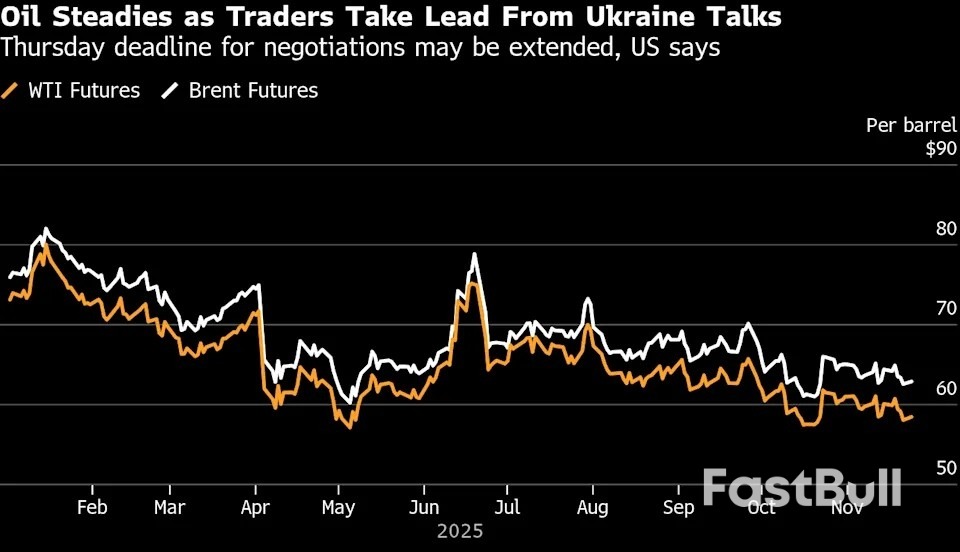
          Oil pushed higher as equities rose and traders weighed the prospect of a Ukraine-Russia peace deal that could deflate political risk from an already well-supplied market.
          West Texas Intermediate was trading under $59, ticking up following its biggest weekly loss since early October.
          While oil followed other risk assets higher, traders awaited further news after Ukraine and its European allies signaled that key sticking points remained in US-brokered peace talks to end Russia’s invasion, even as senior officials hailed progress in winning more favorable terms for Kyiv.
          “Something good just may be happening,” President Donald Trump wrote in a Truth Social post about the talks.Oil Rises as Prospects for Ukraine Peace Deal Dominate Market_1
          Refined products like diesel and gasoline — which have risen in recent weeks — were down on Monday. The difference between the price of gasoline or diesel and crude oil, known as crack spreads, continued to decline. Some trend-following commodity trading advisers were selling positions in the products though most stood their ground, according to data from Bridgeton Research Group.
          Crude has slumped this year, with futures on course for a fourth monthly loss in November, in what would be the longest losing run since 2023. The decline has been driven by expanded global output, including from OPEC+, with the International Energy Agency forecasting a record surplus for 2026. Traders are monitoring whether a deal on Ukraine will materialize, and if sanctions on Russia will be lifted — developments that could inject more supply.
          “We should expect a nervous oil market ahead of Thanksgiving on Thursday,” said Arne Lohmann Rasmussen, chief analyst at A/S Global Risk Management. “Several factors point to a peace agreement or possibly a ceasefire moving closer over the weekend, which supports further price declines this week.”
          Ukraine President Volodymyr Zelenskiy said Monday that talks had reached a “critical moment” as he indicated that discussions over territory and sovereignty would prove difficult.

          Source: Bloomberg

          Risk Warnings and Disclaimers
          You understand and acknowledge that there is a high degree of risk involved in trading. Following any strategies or investment methods may lead to potential losses. The content on the site is provided by our contributors and analysts for information purposes only. You are solely responsible for determining whether any trading assets, securities, strategy, or any other product is suitable for investing based on your own investment objectives and financial situation.
          Add to Favorites
          Share

          Bitcoin Weakness Persists as Crypto Steadies After Bruising Week

          Manuel

          Cryptocurrency

          Bitcoin (BTC-USD) failed to match the strength of Monday’s stock market rebound, extending a stretch of weak trading that’s left bullish sentiment in short supply. While equities pushed higher to start the week, the cryptocurrency stayed range-bound, struggling to shake off last week’s losses.
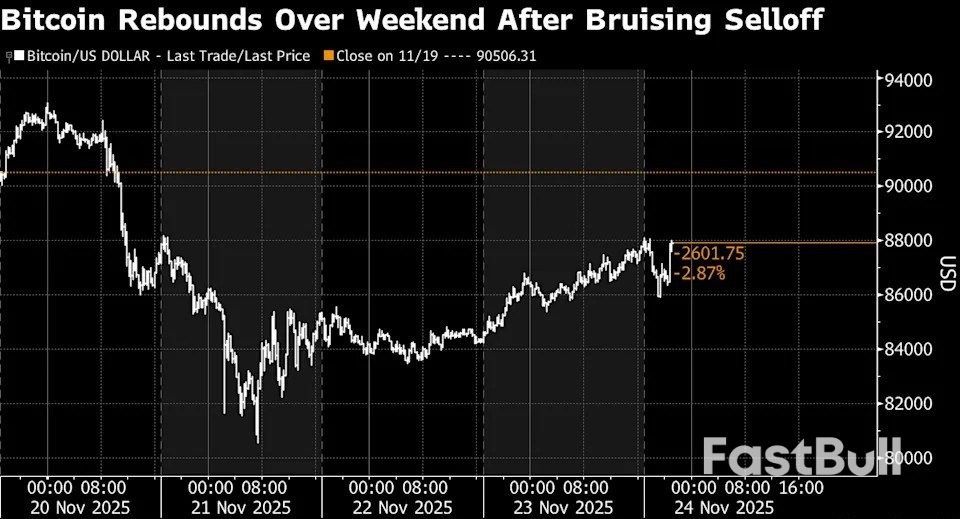
          After regaining some ground over the weekend, the original cryptocurrency fell as much as 3.1% to dip below $86,000 on Monday, before paring the loss to trade little changed. Other smaller, more volatile tokens increased, with XRP jumping about 5% and Solana about 2.5% higher.
          While Bitcoin’s price is higher than the Friday lows of $80,553, traders see little cause for celebration. The wider crypto market is in a pronounced slump despite surging institutional adoption and a series of policy wins pushed for by US President Donald Trump, who has embraced the industry.
          “The lack of a broader ‘alt season’ in crypto and waning liquidity and underperformance relative to equity markets has made it more difficult to deploy meaningful capital into liquid strategies purely in crypto markets,” said Shiliang Tang, managing director of Monarq Asset Management.Bitcoin Weakness Persists as Crypto Steadies After Bruising Week_1
          In the crypto options market, traders are building downside protection at lower levels even with Bitcoin prices having seen a slight rebound in the last 24 hours. Demand for put options at the strike of $80,000 has surpassed those at $85,000, becoming the most popular contracts, according to Coinbase-owned crypto exchange Deribit.
          Meanwhile, the Bitcoin funding rate - a key measure of crypto market sentiment - has turned negative in the last few days, according to CryptoQuant, meaning there is more demand for bearish bets in the perpetual futures market than bullish positions. That figure had been persistently positive even amid the market rout in recent weeks. The flip points to signs of deepening slump in digital assets as more traders bet against the largest cryptocurrency.
          Without a turnaround, November will become Bitcoin’s worst month since a string of corporate collapses rocked the crypto market in 2022, a wipeout that culminated in the downfall of Sam Bankman-Fried’s FTX exchange.
          Traders are watching $85,200 as a key support level after last week’s breakdown, said Rachael Lucas, analyst at BTC Markets.“Technicals and macro headwinds are dominating over fundamentals right now, but history shows these liquidation flurries often precede bounces if no new shocks hit,” she added.
          Despite a weekend rebound, Bitcoin remains about 30% below its record high last month, and it’s unclear how long the recovery will hold without stronger tailwinds. Open interest in perpetual futures has yet to bounce back, lingering 36% below its October peak of $94 billion.
          Investors have withdrawn more than $3.5 billion from a group of US-listed Bitcoin exchange-traded funds, vehicles that have emerged as a major driver of the token’s price since their debut. A sustained reversal of those outflows has yet to emerge.
          “Unlike prior crashes driven primarily by retail speculation, this year’s downturn has unfolded amid substantial institutional participation, policy shifts, and broader macroeconomic headwinds,” Deutsche Bank AG analysts wrote in a note Monday.
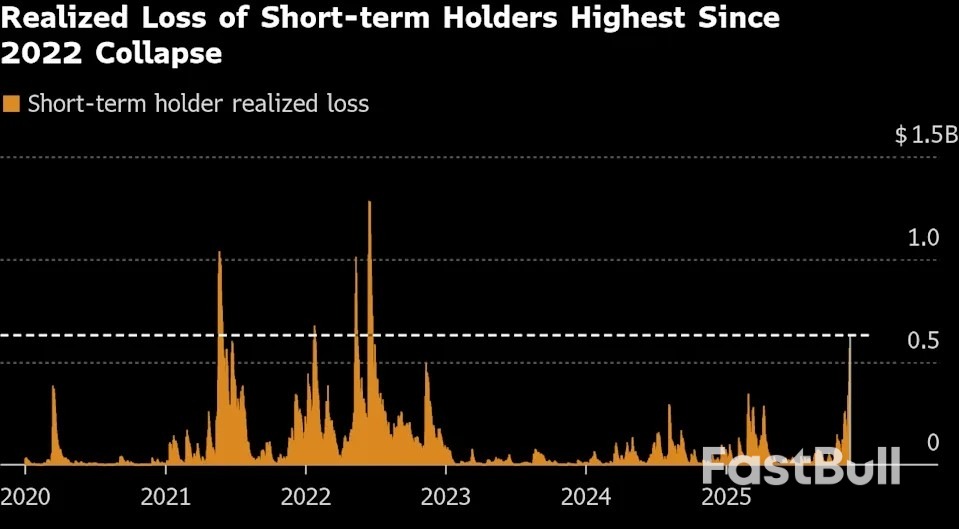
          A recovery may also be restrained by the pressure on investors who entered the market at higher levels. Realized losses among short-term holders — wallets that have held Bitcoin for less than 155 days — have climbed to $630 million per day, the highest since the June 2022 meltdown, according to Glassnode.Bitcoin Weakness Persists as Crypto Steadies After Bruising Week_2
          “Such elevated loss realization highlights the heavier top structure built between $106,000–$118,000, far denser than previous cycle peaks,” analysts at Glassnode said in a research note. “Either stronger demand must emerge to absorb distressed sellers, or the market will require a longer, deeper accumulation phase before regaining equilibrium.”

          Source: Bloomberg

          Risk Warnings and Disclaimers
          You understand and acknowledge that there is a high degree of risk involved in trading. Following any strategies or investment methods may lead to potential losses. The content on the site is provided by our contributors and analysts for information purposes only. You are solely responsible for determining whether any trading assets, securities, strategy, or any other product is suitable for investing based on your own investment objectives and financial situation.
          Add to Favorites
          Share

          Trump Spoke With Chinese President Xi, White House Says

          Justin

          Political

          President Donald Trump spoke on the phone with Chinese President Xi Jinping on Monday morning, a White House official confirmed to CNBC.

          Specifics about the call, including why it was scheduled or who requested it, were not immediately clear. The White House did not provide details about what was discussed.

          But China's Foreign Ministry, in a statement, said, "Both sides are fully implementing the important consensus" they reached when the two leaders met in Busan, South Korea, late last month.

          That consensus involved the United States agreeing to lower tariffs on Chinese goods, and China agreeing to pause new export controls on rare earth minerals, among other stipulations that lowered the temperature in their ongoing trade war.

          "China-US relations have generally remained stable and improved" since the Busan meeting, Beijing said in the statement on Monday.

          Trump and Xi also discussed Ukraine, which is currently in talks with the U.S. over a peace plan that the Trump administration wants Kyiv to agree to by Thanksgiving.

          Xi "emphasized that China supports all efforts committed to peace," according to Beijing's readout of the call.

          The Chinese leader also reiterated his country's view that Taiwan should "return to China."

          Trump said that the U.S. "understands the importance of the Taiwan issue to China," the foreign ministry's statement said.

          Trump also "stated that President Xi Jinping is a great leader," according to the ministry.

          Source: CNBC

          Risk Warnings and Disclaimers
          You understand and acknowledge that there is a high degree of risk involved in trading. Following any strategies or investment methods may lead to potential losses. The content on the site is provided by our contributors and analysts for information purposes only. You are solely responsible for determining whether any trading assets, securities, strategy, or any other product is suitable for investing based on your own investment objectives and financial situation.
          Add to Favorites
          Share

          ECB Flags Rising Stablecoin Risks Amid Surging Market Growth

          Devin

          Cryptocurrency

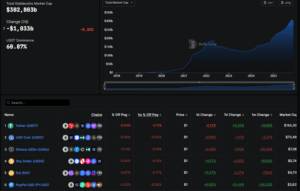
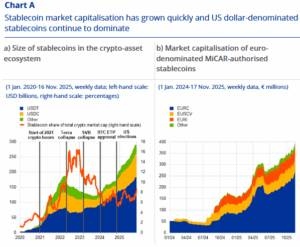
          Their market value has climbed to new record highs, crossing 300 billion dollars and capturing around 8% of the entire crypto market. This rapid rise has brought excitement as well as concern.

          Investors see stablecoins as useful tools for trading, payments and moving money quickly, but regulators worry that their fast growth and growing links to traditional finance could increase financial risks. As the market expands, the question becomes whether stablecoins can scale safely or whether their own weak spots could lead to trouble.

          Why Stablecoins Matter More Than Ever

          Stablecoins are tokens designed to keep a steady price, usually tied to a major currency like the US dollar. This simple idea has made them essential to the crypto world. Today, about 80% of trading on major crypto platforms involves stablecoins because traders use them to move in and out of positions without returning to a bank for money every time. Two names dominate this space.

          Tether holds 184 billion dollars in value, and USD Coin holds 75 billion dollars. Together, they represent almost all stablecoin supply. A big trend pushing growth is new regulatory clarity. The European Union launched its MiCAR rulebook last year, giving issuers clear obligations, while the United States recently passed the GENIUS Act. Hong Kong has put rules in place as well. This wave of regulation has helped investors feel more comfortable, lifting demand around the world.

          Source: DeFillama

          While people often mention cross-border payments and inflation protection as stablecoin use cases, real data tells a different story. Only a small share of activity comes from everyday users. One study shows that less than 1% of stablecoin volume comes from retail-sized transfers. For now, stablecoins remain tools built mainly for traders rather than the general public.

          Source: ecb.europa.eu

          Where the Risks Begin to Surface

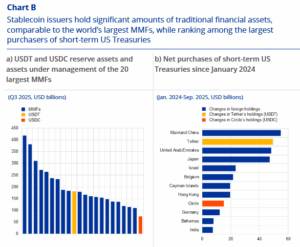
          Rapid growth comes with challenges. A stablecoin must always be redeemable at the price it promises. If users lose trust, they may all rush to withdraw at once, leading to a run and breaking the coin's price. This has happened before in crypto and can shake markets quickly. The biggest risk comes from the fact that leading stablecoins hold huge piles of assets in traditional financial markets.

          Tether and USDC together rank among the largest buyers of US Treasury bills. If either one faced a run, they might need to sell these assets quickly, which could hurt wider markets. Some analysts even project that stablecoins could reach two trillion dollars in size by 2028, which would increase the stakes.

          Source: CryptoSlate

          Risk Warnings and Disclaimers
          You understand and acknowledge that there is a high degree of risk involved in trading. Following any strategies or investment methods may lead to potential losses. The content on the site is provided by our contributors and analysts for information purposes only. You are solely responsible for determining whether any trading assets, securities, strategy, or any other product is suitable for investing based on your own investment objectives and financial situation.
          Add to Favorites
          Share

          Explaining Nvidia, Bitcoin and the Stock Market

          Adam

          Cryptocurrency

          Stocks

          Economic

          There was a lot of investor hand-wringing and head-scratching experienced this past week. On Wednesday night, NVDA announced its earnings. And, not only were its earnings exceptionally strong, beating Wall Street’s expectations for both revenue and earnings per share, but they also provided strong forward-looking guidance.
          At the time, the pundits claimed that this eased investor concern about a potential "AI bubble." So, Wednesday night and Thursday morning provided us with a gap higher in the stock price. As the day progressed, not only did the entire gap-up dissolve, but the stock ended the day in the red by almost 3%, approaching its lowest levels over the last month. And, again, to belabor the point, NVDA struck the lowest price for the stock over the last month on a day when it reported outstanding earnings and forward-looking guidance.
          How could this even be possible? By every metric known to the mass investor community, this stock should have soared on Thursday and held a strong bullish move into the close. Well, by every metric other than the one that really matters - investor sentiment.
          You see, earnings or forecasts do not drive stock prices, despite the erroneous belief held by the common investor. In fact, one of my long-term clients once noted:
          “Having worked for many listed companies and regarded as an insider with access to company confidential information, I have sometimes struggled to understand the correlation between business results and the share price.”
          I have outlined the reasons for this in detail in an article I penned a number of years ago, and I strongly urge you to read it here
          So, I am not going to go into detail regarding my perspective again. But, I will point out something else I have discussed over the years.
          Until the times of R.N. Elliott (the creator of Elliott Wave analysis), the world applied the Newtonian laws of physics as the analysis tool for the stock markets. Basically, these laws provide that movement in the universe is caused by outside forces. Newton formulated these laws of external causality into his three laws of motion: 1 – a body at rest remains at rest unless acted upon by an external force; 2 – a body in motion remains in motion in a straight line unless acted upon by an external force; and 3 – for every action, there is an equal and opposite reaction.
          But, as Einstein stated:
          “During the second half of the nineteenth century new and revolutionary ideas were introduced into physics; they opened the way to a new philosophical view, differing from the mechanical one.”
          Yet, even though physics has moved away from the Newtonian viewpoint, financial market analysis has not.
          “Many services and financial commentators in newspapers persist in discussing current events as causes of advances and declines. They have available the daily news and market behavior. It is therefore a simple matter to fit one to the other. When news is absent and the market fluctuates, they say its behavior is “technical.” Every now and then, some important event occurs. If London declines and New York advances, or vice versa, the commentators are befuddled. Mr. Bernard Baruch recently said that prosperity will be with us for several years “regardless of what is done or not done.” - R.N. Elliott
          In the dark ages, the world was supposed to be flat. We persist in perpetuating similar delusions.” - R. N. Elliott
          To explain this another way, taking a mechanical view of market dynamics is not the appropriate approach to profit in the market. You see, external events affect the markets only insofar as they are interpreted by the market participants. Yet, such interpretation is guided by the prevalent social mood. Therefore, the important factor to understand is not the social event itself, but rather the underlying social mood, which will provide the “spin” on that external event.
          So, while an event, earnings or economic report can act as a catalyst for a stock or market move, the substance of that event, earnings or economic report will not necessarily be indicative as to the direction of the move. That is why we so often see markets and stocks moving in the opposite direction we normally expect based upon the substance of the event, earnings or economic report. The more important and driving factor is where we are in the market sentiment cycle, which will provide the spin as to how market participants will interpret the event, earnings or report with their buying or selling.
          In our case, NVDA topped with a spike high at the end of October, completing an Elliott Wave 5th wave in its sentiment cycle. Therefore, the rally we saw this past week was simply part of a corrective rally, which ultimately led to lower levels, which, again, was within our expectations. This is a much more reasonable, understandable, consistent, and intellectually honest explanation as to what occurred after the earnings announcement, especially as compared to the mental gymnastics you likely heard as strained explanations from the pundits.
          And, speaking of mental gymnastics, the decline we have seen this past week in the equity market seems to have taken many by surprise. But, the mental gymnastics that were on display as the media tried to explain the decline have been nothing short of perfect Olympic 10 score movement.
          Many analysts and pundits in the media went on and on about how Bitcoin seemingly caused the equity market decline seen this past week. And, after I finished chuckling at the absurdity of this perspective, as they truly had to stretch for this “reason,” I saw they were all silent as Bitcoin continued lower during the middle of week whereas the stock market rallied.
          At some point, you, as an investor, must seek out intellectual honesty and consistency in the analysis you choose to follow rather than superficial excuses that are completely ignored hours later.
          Clearly, the media is only able to provide a very superficial and mechanical perspective of how the market works. This is how they try to satisfy the common investor’s need for control. From a psychological perspective, investors feel as though they are in control if they can understand the reason why a market move occurs. And, it seems that they will accept any reason whatsoever, no matter how absurd or stretched the logic behind it presents.
          But, I have a secret for you. Investors are not in control of the market no matter how much they believe they “know” the reasons for a market move. In fact, no one is.
          If investors are being honest with themselves, they would track these reasons over time, which will then, no doubt, lead them to recognize that these pundits and analysts will often provide to you the exact same reason for a market decline as they do for a market rally at times. I have actually seen it myself wherein they provided the exact same reason for a decline as for a rally all within one 24-hour period. Yes, my friends, intellectual honesty is not going to be found in the media amongst the pundits and analysts alike. “Reasons” will not help you in increasing your profitability in the market, and will often detract from it.
          This leads me to again present a quote from Robert Prechter’s seminal book, The Socionomic Theory of Finance (which I strongly suggest to each and every investor):
          “Observers’ job, as they see it, is simply to identify which external events caused whatever price changes occur. When news seems to coincide sensibly with market movement, they presume a causal relationship. When news doesn’t fit, they attempt to devise a cause-and-effect structure to make it fit. When they cannot even devise a plausible way to twist the news into justifying market action, they chalk up the market moves to “psychology,” which means that, despite a plethora of news and numerous inventive ways to interpret it, their imaginations aren’t prodigious enough to concoct a credible causal story.
          Most of the time it is easy for observers to believe in news causality. Financial markets fluctuate constantly, and news comes out constantly, and sometimes the two elements coincide well enough to reinforce commentators’ mental bias towards mechanical cause and effect. When news and the market fail to coincide, they shrug and disregard the inconsistency. Those operating under the mechanics paradigm in finance never seem to see or care that these glaring anomalies exist.”
          So, are you going to ignore the action you saw with your own eyes this past week? Are you going to shrug and disregard the inconsistency between the earnings, guidance and stock price? Are you going to ignore the glaring anomalies you witnessed yourself? Only you are responsible for growing and protecting your investment account. The question you need to honestly ask yourself is if you are using the proper tools in doing so?

          Source: investing

          To stay updated on all economic events of today, please check out our Economic calendar
          Risk Warnings and Disclaimers
          You understand and acknowledge that there is a high degree of risk involved in trading. Following any strategies or investment methods may lead to potential losses. The content on the site is provided by our contributors and analysts for information purposes only. You are solely responsible for determining whether any trading assets, securities, strategy, or any other product is suitable for investing based on your own investment objectives and financial situation.
          Add to Favorites
          Share

          An unusual trend in the economy is worrying the Fed

          Adam

          Economic

          Something in the US economy isn’t adding up, and it’s rattling the people charged with wrangling inflation and keeping the labor market intact.
          US companies have sharply slowed their hiring this year, hesitant to invest without knowing the full effects of President Donald Trump’s sweeping economic policies. The economy lost jobs in June and August, and the average pace of job gains for the three months ending in September was only around 62,000, according to the Labor Department.
          Yet workers’ productivity, a key driver of economic output, remains high. And gross domestic product, which captures all the goods and services produced in the economy, has stayed robust.
          That dichotomy of an expanding economy and a softening labor market presents a conundrum for policymakers at the Federal Reserve, complicating their efforts to determine whether the economy needs cooling or boosting.
          “The divergence between solid economic growth and weak job creation created a particularly challenging environment for policy decisions,” Fed officials noted in their October meeting, according to minutes released Thursday.
          A growing economy, boosted by resilient consumers and massive investments in AI, should be spurring hiring, especially now that the Fed has started lowering borrowing costs. But that hasn’t happened, and there are fears it won’t.
          “When it comes to monetary policy, the narrative next year is going to be about how to handle a jobless expansion,” Ryan Sweet, chief US economist at Oxford Economics, told CNN. “How do you try to get businesses to hire more?”
          Why GDP has been strong but not job growth
          The recent string of record highs in the stock market suggests that many American businesses are optimistic about the value of AI. However, that confidence has so far not translated into an expansion of their workforce.
          Business spending on information processing equipment and software accounted for 4.4% of GDP in the second quarter, according to Commerce Department data, slightly below a peak reached in 2000 when businesses ramped up similar investments during the dot-com boom. Solid consumer spending this year has also kept company profits afloat.
          “Firms are investing a lot in this new technology, but sometimes that means reducing other expenditures, such as hiring,” said Eugenio Alemán, chief economist at Raymond James. He added that strong AI investment likely persisted in the third quarter and should peak sometime next year.
          The government shutdown likely dented GDP in the current quarter that stretches from October through December, but the US economy is widely expected to recoup most of those losses early next year.
          Meanwhile, the US labor market has been stymied by Trump’s significant policy changes since the beginning of the year.
          “It’s been a challenging year for employment precisely because of the changes in trade and immigration policy affecting both labor supply and demand,” said James Ragan, director of wealth management research at DA Davidson.
          It’s unclear whether rate cuts can eventually counteract the corrosive effects of major policy changes that have stoked uncertainty to bolster hiring, economists say.
          “Fortunately, we’re not seeing a lot of layoffs, because that’s how you turn a jobless expansion into a recession,” Sweet said. “The economy can grow without creating a lot of jobs, but productivity growth has to be decent.”
          Fed officials are expected to deliver a few more rate cuts through 2026, according to their latest economic projections from September.
          The problem with a jobless expansion
          A jobless expansion could quickly translate into a recession.
          “You’re very vulnerable to anything that goes wrong,” Sweet said. “The labor market is your line of defense, and if that starts to fray, then it’s game over.”
          It also raises the risk the Fed commits a policy mistake.
          In a speech last month, Fed Governor Christopher Waller described the divergence between GDP and job growth as a “conflict” that should work itself out — for better or worse.
          “Something’s gotta give — either economic growth softens to match a soft labor market, or the labor market rebounds to match stronger economic growth,” he said.
          And if job growth remains inconsistent with GDP, that puts the US economy in a precarious position.
          Persistently strong economic growth also makes Fed officials less confident that they should be lowering interest rates, and there’s already plenty of hesitance to continue with rate cuts within the central bank’s rate-setting committee.
          “With two rate cuts now in place, I’d find it difficult to cut rates again in December unless there is clear evidence that inflation will fall faster than expected or that the labor market will cool more rapidly,” Dallas Fed President Lorie Logan said Friday at an event in Zurich, adding that there are signs that “policy most likely isn’t very restrictive.”

          Source: finance.yahoo

          To stay updated on all economic events of today, please check out our Economic calendar
          Risk Warnings and Disclaimers
          You understand and acknowledge that there is a high degree of risk involved in trading. Following any strategies or investment methods may lead to potential losses. The content on the site is provided by our contributors and analysts for information purposes only. You are solely responsible for determining whether any trading assets, securities, strategy, or any other product is suitable for investing based on your own investment objectives and financial situation.
          Add to Favorites
          Share
          FastBull
          Copyright © 2025 FastBull Ltd

          728 RM B 7/F GEE LOK IND BLDG NO 34 HUNG TO RD KWUN TONG KLN HONG KONG

          TelegramInstagramTwitterfacebooklinkedin
          App Store Google Play Google Play
          Products
          Charts

          Chats

          Q&A with Experts
          Screeners
          Economic Calendar
          Data
          Tools
          Membership
          Features
          Function
          Markets
          Copy Trading
          Latest Signals
          Contests
          News
          Analysis
          24/7
          Columns
          Education
          Company
          Careers
          About Us
          Contact Us
          Advertising
          Help Center
          Feedback
          User Agreement
          Privacy Policy
          Business

          White Label

          Data API

          Web Plug-ins

          Poster Maker

          Affiliate Program

          Risk Disclosure

          The risk of loss in trading financial instruments such as stocks, FX, commodities, futures, bonds, ETFs and crypto can be substantial. You may sustain a total loss of the funds that you deposit with your broker. Therefore, you should carefully consider whether such trading is suitable for you in light of your circumstances and financial resources.

          No decision to invest should be made without thoroughly conducting due diligence by yourself or consulting with your financial advisors. Our web content might not suit you since we don't know your financial conditions and investment needs. Our financial information might have latency or contain inaccuracy, so you should be fully responsible for any of your trading and investment decisions. The company will not be responsible for your capital loss.

          Without getting permission from the website, you are not allowed to copy the website's graphics, texts, or trademarks. Intellectual property rights in the content or data incorporated into this website belong to its providers and exchange merchants.

          Not Logged In

          Log in to access more features

          FastBull Membership

          Not yet

          Purchase

          Become a signal provider
          Help Center
          Customer Service
          Dark Mode
          Price Up/Down Colors

          Log In

          Sign Up
          Position
          Layout
          Fullscreen
          Default to Chart
          The chart page opens by default when you visit fastbull.com