• Trade
  • Markets
  • Copy
  • Contests
  • News
  • 24/7
  • Calendar
  • Q&A
  • Chats
Trending
Screeners
SYMBOL
LAST
BID
ASK
HIGH
LOW
NET CHG.
%CHG.
SPREAD
SPX
S&P 500 Index
6827.42
6827.42
6827.42
6899.86
6801.80
-73.58
-1.07%
--
DJI
Dow Jones Industrial Average
48458.04
48458.04
48458.04
48886.86
48334.10
-245.98
-0.51%
--
IXIC
NASDAQ Composite Index
23195.16
23195.16
23195.16
23554.89
23094.51
-398.69
-1.69%
--
USDX
US Dollar Index
97.990
98.070
97.990
98.070
97.920
+0.040
+ 0.04%
--
EURUSD
Euro / US Dollar
1.17340
1.17347
1.17340
1.17447
1.17283
-0.00054
-0.05%
--
GBPUSD
Pound Sterling / US Dollar
1.33565
1.33573
1.33565
1.33740
1.33549
-0.00142
-0.11%
--
XAUUSD
Gold / US Dollar
4326.96
4327.34
4326.96
4329.64
4294.68
+27.57
+ 0.64%
--
WTI
Light Sweet Crude Oil
57.537
57.574
57.537
57.601
57.194
+0.304
+ 0.53%
--

Community Accounts

Signal Accounts
--
Profit Accounts
--
Loss Accounts
--
View More

Become a signal provider

Sell trading signals to earn additional income

View More

Guide to Copy Trading

Get started with ease and confidence

View More

Signal Accounts for Members

All Signal Accounts

Best Return
  • Best Return
  • Best P/L
  • Best MDD
Past 1W
  • Past 1W
  • Past 1M
  • Past 1Y

All Contests

  • All
  • Trump Updates
  • Recommend
  • Stocks
  • Cryptocurrencies
  • Central Banks
  • Featured News
Top News Only
Share

Reuters Poll - Bank Of Thailand To Lower Key Policy Rate To 1.00% In Q1 Of 2026, Said A Majority Of Economists

Share

Reuters Poll - Bank Of Thailand To Cut Its Key Interest Rate To 1.25% On December 17, Said 26 Of 27 Economists

Share

Thai Finance Minister: Earlier Stimulus Measures To Shore Up Economy

Share

Thai Finance Minister: Strong Baht Driven By Capital Inflows

Share

Thai Finance Minister: Has Discussed With Central Bank To Handle Baht

Share

India's Nifty Bank Futures Down 0.1% In Pre-Open Trade

Share

India's Nifty 50 Futures Down 0.3% In Pre-Open Trade

Share

India's Nifty 50 Index Down 0.45% In Pre-Open Trade

Share

Indian Rupee Weakens Past 90.55 Versus USA Dollar To All-Time Low

Share

China's Fossil-Fuelled Power Generation Falls 4.2% Year-On-Year In November

Share

Indian Rupee Opens Down 0.1% At 90.5450 Per USA Dollar, Versus 90.4150 Previous Close

Share

Australia Home Minister: Father Involved In Bondi Gun Attack Came To Australia On Student Visa, Son Is An Australian-Born Citizen

Share

Australian Prime Minister Albanese: Stricter Gun Control Laws Will Include Restrictions On The Number Of Guns An Individual Can Own Or License To Use

Share

Australia's Prime Minister Albanese: We Are Considering A Review Of Gun Licenses For Some Time

Share

Australia's Prime Minister Albanese: Government Considering Tougher Gun Laws

Share

China Stats Bureau Spokesperson: Next Year, Adverse Impact Of Protectionism And Unilateralism May Continue

Share

China's Onshore Yuan Strengthens To A High Of 7.0516 Per Dollar, Strongest Level Since Oct 8, 2024

Share

Indonesia's November Refined Tin Exports At 7458.64 Metric Tons

Share

China's National Bureau Of Statistics: In The Next Stage, We Will Continue To Implement The Special Action To Boost Consumption And Focus On Stabilizing Employment And Promoting Income Growth

Share

China Stats Bureau Spokesperson: Household Consumption Capability And Confidence Needs To Be Further Improved

TIME
ACT
FCST
PREV
U.K. Trade Balance (Oct)

A:--

F: --

P: --

France HICP Final MoM (Nov)

A:--

F: --

P: --

China, Mainland Outstanding Loans Growth YoY (Nov)

A:--

F: --

P: --

China, Mainland M2 Money Supply YoY (Nov)

A:--

F: --

P: --

China, Mainland M0 Money Supply YoY (Nov)

A:--

F: --

P: --

China, Mainland M1 Money Supply YoY (Nov)

A:--

F: --

P: --

India CPI YoY (Nov)

A:--

F: --

P: --

India Deposit Gowth YoY

A:--

F: --

P: --

Brazil Services Growth YoY (Oct)

A:--

F: --

P: --

Mexico Industrial Output YoY (Oct)

A:--

F: --

P: --

Russia Trade Balance (Oct)

A:--

F: --

P: --

Philadelphia Fed President Henry Paulson delivers a speech
Canada Building Permits MoM (SA) (Oct)

A:--

F: --

P: --

Canada Wholesale Sales YoY (Oct)

A:--

F: --

P: --

Canada Wholesale Inventory MoM (Oct)

A:--

F: --

P: --

Canada Wholesale Inventory YoY (Oct)

A:--

F: --

P: --

Canada Wholesale Sales MoM (SA) (Oct)

A:--

F: --

P: --

Germany Current Account (Not SA) (Oct)

A:--

F: --

P: --

U.S. Weekly Total Rig Count

A:--

F: --

P: --

U.S. Weekly Total Oil Rig Count

A:--

F: --

P: --

Japan Tankan Small Manufacturing Outlook Index (Q4)

A:--

F: --

P: --

Japan Tankan Large Non-Manufacturing Diffusion Index (Q4)

A:--

F: --

P: --

Japan Tankan Large Non-Manufacturing Outlook Index (Q4)

A:--

F: --

P: --

Japan Tankan Large Manufacturing Outlook Index (Q4)

A:--

F: --

P: --

Japan Tankan Small Manufacturing Diffusion Index (Q4)

A:--

F: --

P: --

Japan Tankan Large Manufacturing Diffusion Index (Q4)

A:--

F: --

P: --

Japan Tankan Large-Enterprise Capital Expenditure YoY (Q4)

A:--

F: --

P: --

U.K. Rightmove House Price Index YoY (Dec)

A:--

F: --

P: --

China, Mainland Industrial Output YoY (YTD) (Nov)

A:--

F: --

P: --

China, Mainland Urban Area Unemployment Rate (Nov)

A:--

F: --

P: --

Saudi Arabia CPI YoY (Nov)

--

F: --

P: --

Euro Zone Industrial Output YoY (Oct)

--

F: --

P: --

Euro Zone Industrial Output MoM (Oct)

--

F: --

P: --

Canada Existing Home Sales MoM (Nov)

--

F: --

P: --

Euro Zone Total Reserve Assets (Nov)

--

F: --

P: --

U.K. Inflation Rate Expectations

--

F: --

P: --

Canada National Economic Confidence Index

--

F: --

P: --

Canada New Housing Starts (Nov)

--

F: --

P: --

U.S. NY Fed Manufacturing Employment Index (Dec)

--

F: --

P: --

U.S. NY Fed Manufacturing Index (Dec)

--

F: --

P: --

Canada Core CPI YoY (Nov)

--

F: --

P: --

Canada Manufacturing Unfilled Orders MoM (Oct)

--

F: --

P: --

U.S. NY Fed Manufacturing Prices Received Index (Dec)

--

F: --

P: --

U.S. NY Fed Manufacturing New Orders Index (Dec)

--

F: --

P: --

Canada Manufacturing New Orders MoM (Oct)

--

F: --

P: --

Canada Core CPI MoM (Nov)

--

F: --

P: --

Canada Trimmed CPI YoY (SA) (Nov)

--

F: --

P: --

Canada Manufacturing Inventory MoM (Oct)

--

F: --

P: --

Canada CPI YoY (Nov)

--

F: --

P: --

Canada CPI MoM (Nov)

--

F: --

P: --

Canada CPI YoY (SA) (Nov)

--

F: --

P: --

Canada Core CPI MoM (SA) (Nov)

--

F: --

P: --

Canada CPI MoM (SA) (Nov)

--

F: --

P: --

Federal Reserve Board Governor Milan delivered a speech
U.S. NAHB Housing Market Index (Dec)

--

F: --

P: --

Australia Composite PMI Prelim (Dec)

--

F: --

P: --

Australia Services PMI Prelim (Dec)

--

F: --

P: --

Australia Manufacturing PMI Prelim (Dec)

--

F: --

P: --

Japan Manufacturing PMI Prelim (SA) (Dec)

--

F: --

P: --

U.K. Unemployment Rate (Nov)

--

F: --

P: --

U.K. 3-Month ILO Unemployment Rate (Oct)

--

F: --

P: --

Q&A with Experts
    • All
    • Chatrooms
    • Groups
    • Friends
    Connecting
    .
    .
    .
    Type here...
    Add Symbol or Code

      No matching data

      All
      Trump Updates
      Recommend
      Stocks
      Cryptocurrencies
      Central Banks
      Featured News
      • All
      • Russia-Ukraine Conflict
      • Middle East Flashpoint
      • All
      • Russia-Ukraine Conflict
      • Middle East Flashpoint
      Search
      Products

      Charts Free Forever

      Chats Q&A with Experts
      Screeners Economic Calendar Data Tools
      Membership Features
      Data Warehouse Market Trends Institutional Data Policy Rates Macro

      Market Trends

      Market Sentiment Order Book Forex Correlations

      Top Indicators

      Charts Free Forever
      Markets

      News

      News Analysis 24/7 Columns Education
      From Institutions From Analysts
      Topics Columnists

      Latest Views

      Latest Views

      Trending Topics

      Top Columnists

      Latest Update

      Signals

      Copy Rankings Latest Signals Become a signal provider AI Rating
      Contests
      Brokers

      Overview Brokers Assessment Rankings Regulators News Claims
      Broker listing Forex Brokers Comparison Tool Live Spread Comparison Scam
      Q&A Complaint Scam Alert Videos Tips to Detect Scam
      More

      Business
      Events
      Careers About Us Advertising Help Center

      White Label

      Data API

      Web Plug-ins

      Affiliate Program

      Awards Institution Evaluation IB Seminar Salon Event Exhibition
      Vietnam Thailand Singapore Dubai
      Fans Party Investment Sharing Session
      FastBull Summit BrokersView Expo
      Recent Searches
        Top Searches
          Markets
          News
          Analysis
          User
          24/7
          Economic Calendar
          Education
          Data
          • Names
          • Latest
          • Prev

          View All

          No data

          Scan to Download

          Faster Charts, Chat Faster!

          Download App
          English
          • English
          • Español
          • العربية
          • Bahasa Indonesia
          • Bahasa Melayu
          • Tiếng Việt
          • ภาษาไทย
          • Français
          • Italiano
          • Türkçe
          • Русский язык
          • 简中
          • 繁中
          Open Account
          Search
          Products
          Charts Free Forever
          Markets
          News
          Signals

          Copy Rankings Latest Signals Become a signal provider AI Rating
          Contests
          Brokers

          Overview Brokers Assessment Rankings Regulators News Claims
          Broker listing Forex Brokers Comparison Tool Live Spread Comparison Scam
          Q&A Complaint Scam Alert Videos Tips to Detect Scam
          More

          Business
          Events
          Careers About Us Advertising Help Center

          White Label

          Data API

          Web Plug-ins

          Affiliate Program

          Awards Institution Evaluation IB Seminar Salon Event Exhibition
          Vietnam Thailand Singapore Dubai
          Fans Party Investment Sharing Session
          FastBull Summit BrokersView Expo

          Tracking Strong Dividend-Increase Trends Amid Macro Uncertainty

          Adam

          Economic

          Summary:

          Despite macro uncertainty, 30% of global companies raised dividends in Q2, while only 9% cut them. Firms like Caterpillar and UnitedHealth signaled confidence with payout hikes despite ongoing challenges.
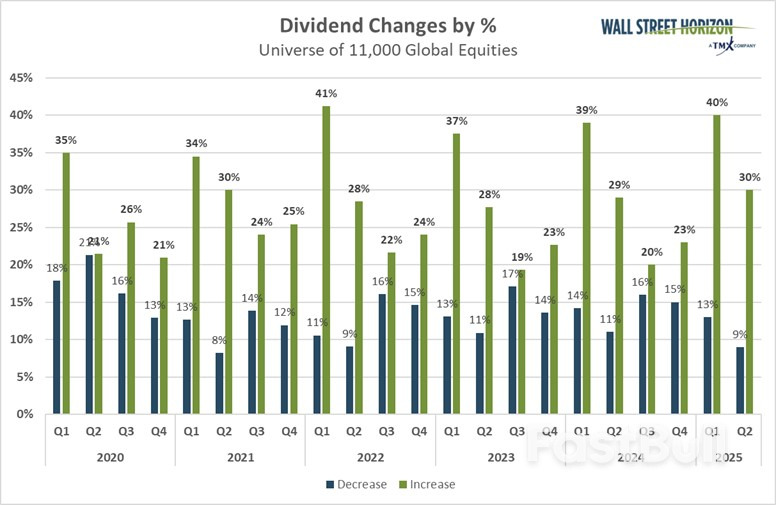
          As we put the finishing touches on a first half that was littered with uncertainty, a small treasure is seen in global dividend trends. Thirty percent of the companies Wall Street Horizon tracks announced shareholder-payout increases in the second quarter—the best Q2 mark going back to 2021. Also, just 9% of companies from around the world slashed their dividend, which was the lowest in three years.

          Healthy Dividend-Hike Rate in Q2

          Tracking Strong Dividend-Increase Trends Amid Macro Uncertainty_1
          These continue strong numbers that we profiled earlier in the year. It also bodes well for the balance of 2025, despite so much macro uncertainty (there’s that word!). Indeed, now more than ever, it’s important to pay attention to and deeply analyze what those in the C-suite are doing versus what they are saying. Investors have heard the constant refrain of “macro headwinds” and “an uncertain economic landscape” ad nauseam, but all the while, corporations continue to churn out profits, buy back shares, and, yes, hike dividends (on net).
          The upshot? Investors must seek signals and dismiss the noise.
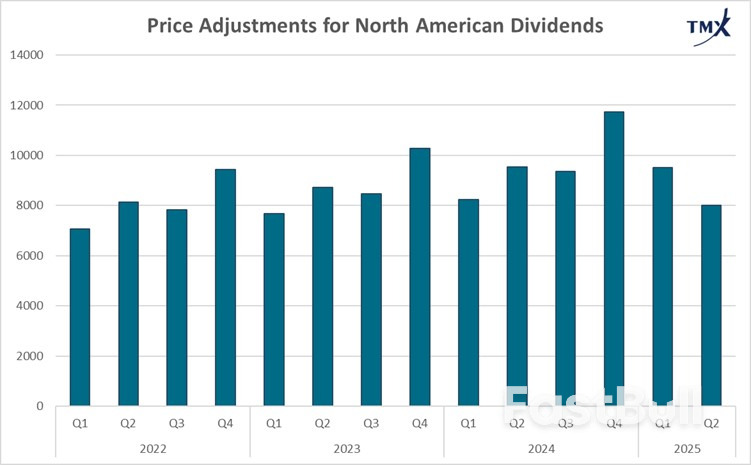
          More dividend payouts mean investment teams need to adjust stock prices to reflect these corporate actions properly in order to conduct time-series analysis. TMX’s Price Adjustment Curve (PAC) provides price adjustments applicable down to tick level prices or even orders, and below you can see the number of recorded adjustments for North American dividends have been steadily increasing. H1 2025 recorded 17,509 such price adjustments (as of June 22, 2025). With one week left in the second quarter that number is on track to match or beat the first half record set in 2024 of 17,771 price adjustments.
          Tracking Strong Dividend-Increase Trends Amid Macro Uncertainty_2
          Accurately tracking and analyzing these crucial corporate actions, such as dividend changes, at scale presents its own set of challenges. For asset management and risk professionals, manual processes and fragmented data systems can obscure insights and increase risk.

          Listen to that Baby Purr! Caterpillar Plowing Ahead in 2025

          Earlier this month, Caterpillar Inc (NYSE:CAT) announced a 7% dividend increase, bringing its quarterly distribution to $1.51. An S&P 500® Dividend Aristocrats Index member (companies that have raised their dividends in each of the past 25 consecutive years), the all-American brand is one of many multinational corporations facing the threat of higher tariffs.
          Shares are merely flat on the year, but gains off the April 8 closing low have been massive, on the order of 30%-plus. The sellside is still gaming out how the future trade landscape will impact CAT. In May, the $168 billion Industrials-sector firm was upgraded to Hold from Sell at UBS amid improving US-China trade talks. Then, on the same day the Texas-based blue chip announced its dividend hike, BMO Capital Markets tagged CAT as a GARP candidate (growth at a reasonable price).
          But the stock is a far cry from its late 2024 all-time high of $419. Resting right now at its flat 200-day moving average, the bears might argue it’s a dead-CAT bounce. Time will tell, but it appears the company’s management team is just fine with where it’s positioned heading into H2 2025.
          Looking ahead, Caterpillar’s Q2 earnings date is Tuesday, August 5, BMO (confirmed).

          UnitedHealth Group: Assessing the Damage

          Turning from Industrials to the Health Care sector, Unitedhealth Group (NYSE:UNH) is battling through what may be the most tumultuous year in its five-decade history. Shares are down 39% year to date, underperforming the S&P 500 by more than 40 percentage points on a total return basis. Before 2025 began, the tragic murder of UnitedHealthcare CEO Brian Thompson last December heightened public and investor scrutiny of the company.
          Then, in its January earnings report, higher-than-expected medical costs, particularly within its Medicare Advantage business, resulted in a soft FY 2025 profit guide.4 Investors didn’t like that—the stock fell 6% in the session that followed the Q4 earnings report. That decline was a paper cut compared to the severe pain shareholders endured three months later.
          UNH plunged by more than 22% after its Q1 earnings release, its worst single-day drop in decades. Near the beginning of the earnings season in April, the company slashed its full-year profit outlook after missing on the top and bottom lines.5 Its medical cost ratio, which is like an inverted profit margin for a health insurance company, was once again above what analysts hoped for. By the time the dust settled, what was once the largest weight in the Dow Jones Industrial Average was among the biggest S&P 500 laggards in 2025.
          The pain wasn’t done, however. Within a month of their Q1 report, a story surfaced that UnitedHealth was the target of a US Department of Justice probe into possible Medicare fraud.6 Another 11% was shed from the stock’s value, dropping it to the No. 10 spot on the DJIA weighting list at the time.
          The good news? On June 6, UNH announced a $2.21 quarterly dividend, a 5.2% increase from the previous $2.10 quarterly payout.7 Shares, so far, have stabilized above $300 after notching an intraday low of $247 on May 15. Once the biggest company by market cap in the Health Care sector, the embattled insurer faces headwinds and public scorn, but the dividend hike news is a welcome relief for its stockholders.
          UNH reports Q2 results on Tuesday, July 29 BMO (confirmed).

          Macro Volatility Catalysts Heading into Q3

          Eyes now turn to the second half. There’s still macro wood to chop to help clear out all this uncertainty being bandied about. We expect developments on the trade front with President Trump’s July 9 reciprocal tariff pause deadline in sight. Moreover, the One Big, Beautiful Bill is still being chiseled in the Senate.
          Higher oil prices due to the Israel-Iran conflict add yet another wildcard into the macro shuffle, too. All the while, it’s clear that Chair Powell and the rest of the Federal Reserve’s Open Market Committee members are standing pat on interest rates.
          Be on the lookout for potential volatility this week on the data front. According to the Economic Calendar, the May Personal Consumption Expenditures Price Index (PCE), the Fed’s preferred inflation gauge, hits the tape this Friday. Market bulls hope for another tame update on consumer prices.

          The Bottom Line

          Economic surprises have turned south, worries grow about the labor market, and there’s increasing conflict in the Middle East. Amid so much angst and a plethora of unknowns, companies signal optimism, at least according to the high percentage of dividend hikers to slashers. Though the summer travel season is in full swing, investors stay on watch as macro and firm-specific volatility catalysts are front and center—and earnings season is just two weeks away!

          Source: investing

          To stay updated on all economic events of today, please check out our Economic calendar
          Risk Warnings and Disclaimers
          You understand and acknowledge that there is a high degree of risk involved in trading. Following any strategies or investment methods may lead to potential losses. The content on the site is provided by our contributors and analysts for information purposes only. You are solely responsible for determining whether any trading assets, securities, strategy, or any other product is suitable for investing based on your own investment objectives and financial situation.
          Add to Favorites
          Share

          Investment Groups Call for Exemption of Passive Income From US tax BilT

          Manuel

          Economic

          Political

          Six investment groups representing sectors including fund managers, venture capital and real estate in a letter to two Senate Republicans over the tax and spending bill now under debate asked that passive investments be exempt from a provision of the bill that targets foreign investors.
          The proposal would allow the imposition of new taxes on residents, businesses and other entities from countries that are found to impose "unfair foreign taxes." It targets, for instance, income from investments, rents and dividends.
          The investment groups said the levy, which includes the possibility of imposing a progressive tax burden of up to 20% on foreign investors' passive income, could spook investments in the U.S.
          The new tax "would significantly disrupt U.S. public and private debt and equity markets," the associations said in the letter, which was sent to Senate Majority Leader John Thune and Senate Finance Committee Chairman Mike Crapo on Monday evening.
          The groups said there would be the risk of investors selling portfolios in advance of the new levy. "This unnecessary sell-off will cause U.S. asset values to fall," they said in the letter.
          Although Senate Republicans proposed changes to the tax and spending bill that the House of Representatives passed last month, the Senate kept the provision of a tax targeting foreign investors. Under the Senate version, however, the tax would take effect in 2027, one year after the House version.
          The letter was jointly submitted by the Managed Funds Association, American Investment Council, Investment Company Institute, Loan Syndications and Trading Association, National Venture Capital Association and the Real Estate Roundtable.
          In notes to clients, many Wall Street analysts have cautioned that the levy could end up weighing on demand for U.S. assets. Multinational companies have said they could shut down operations in the U.S.

          Source: Reuters

          To stay updated on all economic events of today, please check out our Economic calendar
          Risk Warnings and Disclaimers
          You understand and acknowledge that there is a high degree of risk involved in trading. Following any strategies or investment methods may lead to potential losses. The content on the site is provided by our contributors and analysts for information purposes only. You are solely responsible for determining whether any trading assets, securities, strategy, or any other product is suitable for investing based on your own investment objectives and financial situation.
          Add to Favorites
          Share

          Powell Says Higher Inflation Outlook Keeping Fed on Hold for Now

          Adam

          Economic

          Central Bank

          Federal Reserve Chair Jerome Powell told lawmakers the central bank is in no rush to lower interest rates as officials wait for more clarity on the economic impact of President Donald Trump’s tariffs.
          “The effects of tariffs will depend, among other things, on their ultimate level,” Powell said Tuesday in remarks before a congressional panel. “For the time being, we are well positioned to wait to learn more about the likely course of the economy before considering any adjustments to our policy stance.”
          Powell’s remarks before the House Financial Services Committee come on the heels of the Fed’s decision last week to leave interest rates unchanged in a range of 4.25%-4.5%.
          “If it turns out that inflation pressures do remain contained, then we will get to a place where we cut rates, sooner rather than later,” Powell said in response to a question about the possibility of a July rate cut. “But I wouldn’t want to point to a particular meeting. I don’t think we need to be in any rush because the economy is still strong.”
          Fed officials signaled last week they favor two rate cuts by year’s end. Economists surveyed by Bloomberg expect a cut to come by September.
          Powell, however, underscored that uncertainty in the economic outlook meant a wide set of outcomes remained possible. Should inflation come in weaker than expected or the labor market deteriorate, he said, the Fed could cut rates sooner. Equally, he added, higher-than-expected inflation could push the Fed to keep holding.
          “Many paths are possible here,” Powell said.
          He acknowledged that recent data supported a case for lower rates. But, he emphasized, that data was backward-looking, and many economists expect “a meaningful increase in inflation” over the course of this year due to tariffs.
          “At this time, all forecasters are expecting pretty soon that some significant inflation will show up from tariffs,” he said. “We can’t just ignore that.”
          Treasury yields and the dollar declined during Powell’s testimony as traders priced in slightly higher odds of at least two Fed interest-rate cuts by the end of the year. They pointed to his comments on the potential for tariffs to contribute less to inflation than forecasters currently expect. Powell’s appearance coincided with the release of a weaker-than-anticipated consumer confidence gauge for June that also supported those wagers.

          Trump Comments

          The central bank’s on-hold position has angered Trump, who has consistently called for lower rates and argued the Fed is keeping borrowing costs for the US government high by holding rates steady.
          “‘Too Late’ Jerome Powell, of the Fed, will be in Congress today in order to explain, among other things, why he is refusing to lower the Rate,” Trump said on social media early Tuesday. “I hope Congress really works this very dumb, hardheaded person, over. We will be paying for his incompetence for many years to come.”
          Powell and several other policymakers have pointed to increased economic uncertainty stemming from the Trump administration’s stepped up use of tariffs, and other policy changes, to justify leaving rates steady for now. Many forecasters expect the tariffs to put upward pressure on inflation and dent economic growth, although those estimates carry significant uncertainty.
          Trump has frequently shifted on the specifics of his tariff policies, and the administration says it’s working on trade deals that could affect the nature and level of the duties.
          “Expectations of that level, and thus of the related economic effects, reached a peak in April and have since declined,” Powell said in his opening statement, which largely echoed remarks he delivered last week. “Even so, increases in tariffs this year are likely to push up prices and weigh on economic activity.”
          Powell said the tariffs’ impact on inflation could be short-lived or possibly be more persistent.

          Tariff Effect

          Avoiding the latter outcome “will depend on the size of the tariff effects, on how long it takes for them to pass through fully into prices and, ultimately, on keeping longer-term inflation expectations well anchored,” he said.
          Economic data so far has shown limited impact from tariffs. Fed Governors Christopher Waller and Michelle Bowman have pointed to that dynamic, among other factors, in arguing the Fed could cut as soon as its next meeting in July.
          Meanwhile, Powell described the overall economy and labor market as solid. He said inflation had eased significantly from highs reached in mid-2022, but was somewhat elevated above the Fed’s 2% objective. He added that beyond the next year or so, most measures of longer-term expectations remain consistent with the Fed’s inflation goal.

          Source: Bloomberg

          To stay updated on all economic events of today, please check out our Economic calendar
          Risk Warnings and Disclaimers
          You understand and acknowledge that there is a high degree of risk involved in trading. Following any strategies or investment methods may lead to potential losses. The content on the site is provided by our contributors and analysts for information purposes only. You are solely responsible for determining whether any trading assets, securities, strategy, or any other product is suitable for investing based on your own investment objectives and financial situation.
          Add to Favorites
          Share

          Nasdaq 100 and S&P500: Midday Rally Builds as Oil Plunges and Rate Bets Shift

          Adam

          Stocks

          Dow Rallies 500 Points Mid-Session as Oil Collapses on Ceasefire Hopes

          Stocks surged Tuesday midday, with the Dow up more than 500 points, as investors welcomed a steep drop in oil prices and a tentative ceasefire between Israel and Iran. The S&P 500 advanced around 1%, while the Nasdaq outperformed, gaining about 1.4%. A broad risk-on move was underway, supported by easing geopolitical tensions and investor confidence in economic fundamentals.

          How Are Oil Prices and Airlines Responding to Ceasefire Developments?

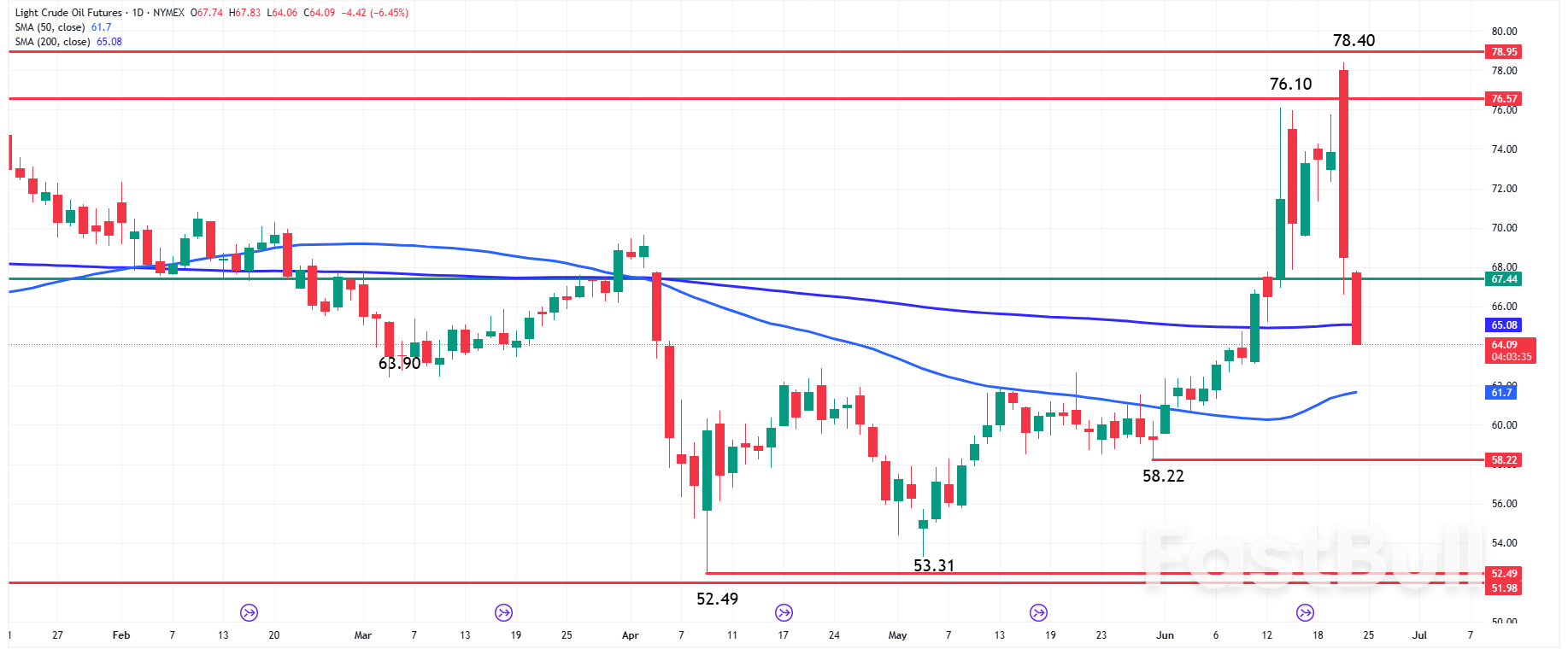
          Nasdaq 100 and S&P500: Midday Rally Builds as Oil Plunges and Rate Bets Shift_1Daily Light Crude Oil Futures

          U.S. crude dropped over 6% midday, extending Monday’s 7% slide and marking a two-day decline of roughly 13%. Brent crude followed suit, hitting fresh session lows.
          Nasdaq 100 and S&P500: Midday Rally Builds as Oil Plunges and Rate Bets Shift_2

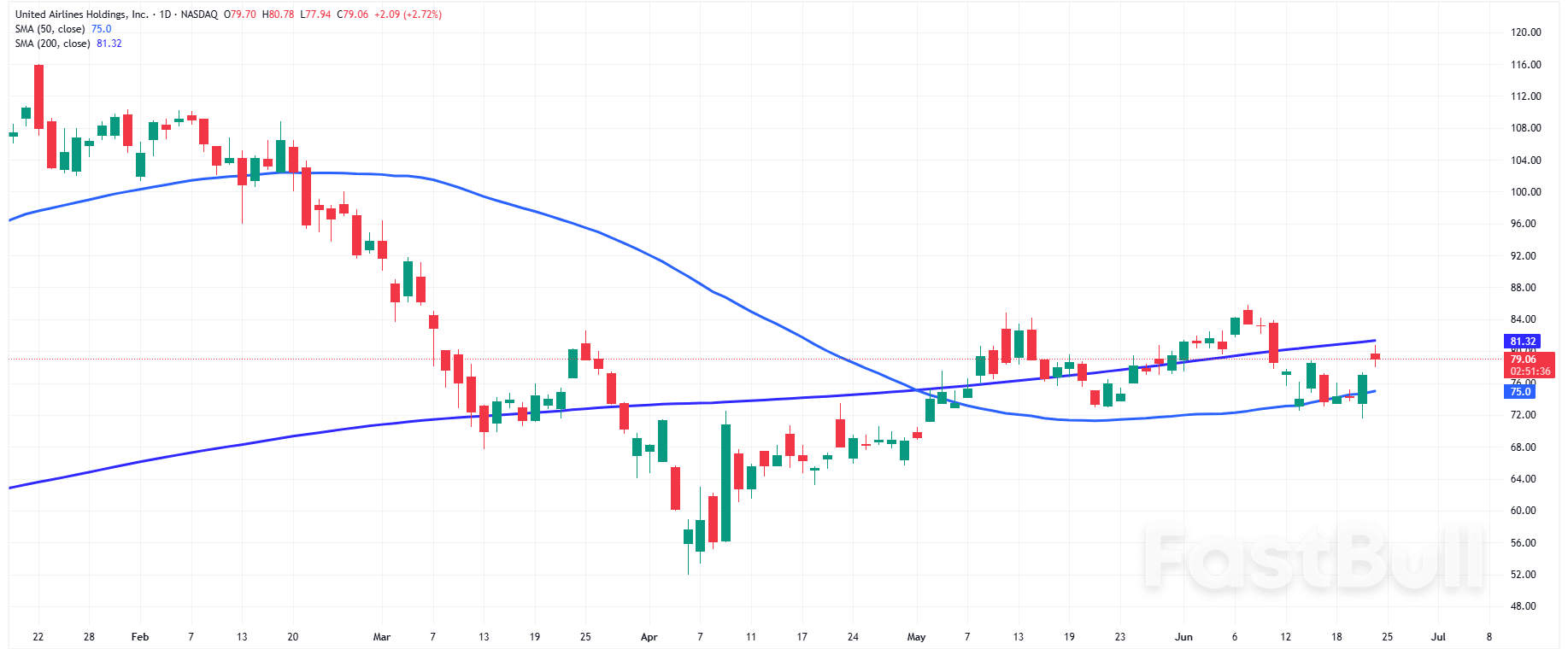
          Daily United Airlines Holdings Inc

          The pullback in energy prices fueled gains across transportation stocks. United Airlines, Frontier, and Delta all rose more than 2%, as traders priced in a drop in jet fuel costs.
          The sharp selloff in oil followed signs of de-escalation in the Middle East. President Donald Trump claimed that “ISRAEL is not going to attack Iran” and insisted the ceasefire remained in place, despite mutual accusations of violations. Israel alleged attacks on radar installations near Tehran, while Iran denied retaliatory missile launches.

          Which Stocks and Sectors Are Leading the Charge?

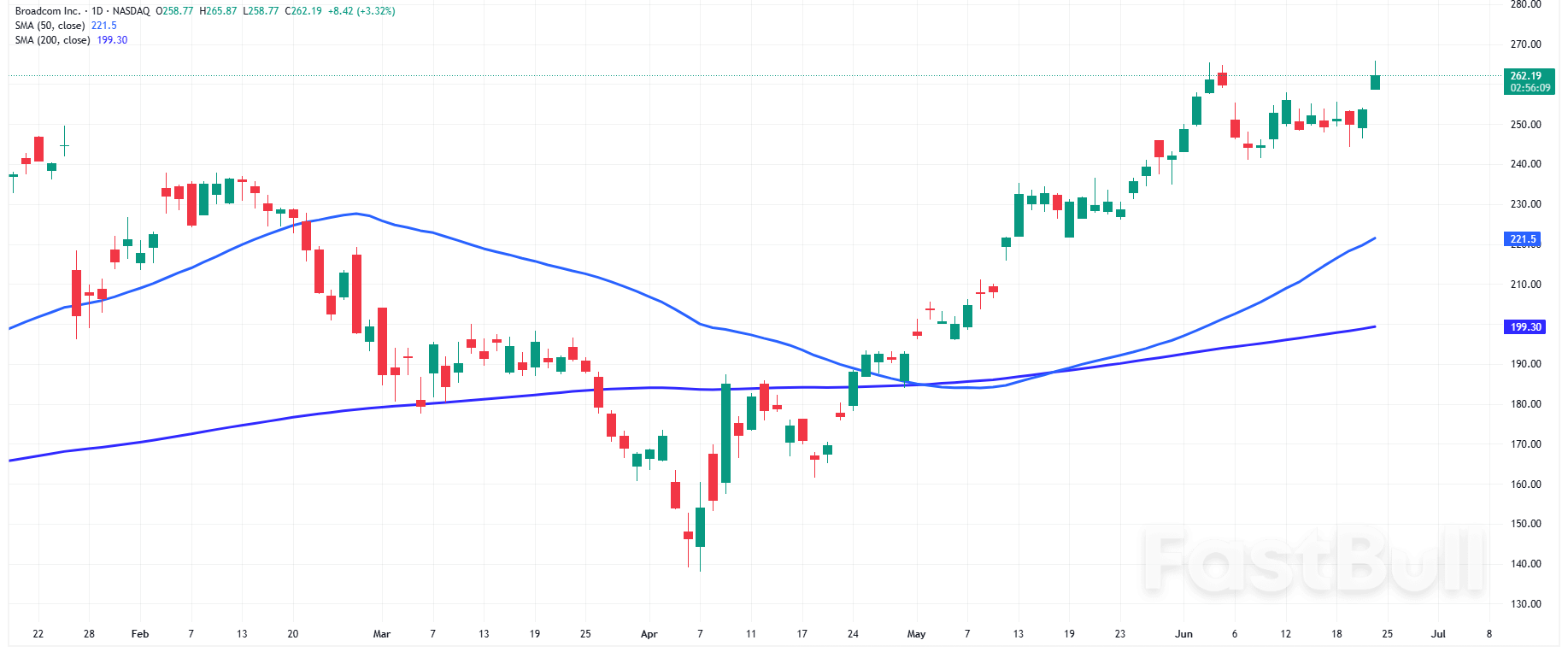
          Nasdaq 100 and S&P500: Midday Rally Builds as Oil Plunges and Rate Bets Shift_3Daily Broadcom Inc

          Risk appetite extended beyond transport. Broadcom gained 3%, continuing its recent momentum in AI infrastructure, while Nvidia rose 2%, supported by sustained strength in semiconductor demand. The gains came as investors brushed off immediate geopolitical risks and rotated into higher-beta names.
          UBS Global Wealth Management’s Solita Marcelli noted that geopolitical shocks tend to have limited market impact, and pointed to strong fundamentals underpinning the equity rally. Tuesday’s advance built on Monday’s solid gains, which came after Qatar said it had intercepted Iranian missiles targeting a U.S. military base.

          What Is the Federal Reserve Signaling on Rates?

          Traders also weighed comments from Fed Chair Jerome Powell, who testified before the House Financial Services Committee. Powell emphasized patience, stating the Fed would wait to assess the economic fallout from new tariffs before adjusting rates. Meanwhile, some Fed officials floated the possibility of easing policy as soon as July, suggesting growing internal debate.

          What’s the Outlook Heading Into the Close?

          With oil off sharply and tech leading gains, sentiment remains bullish so long as geopolitical tensions don’t reignite. Traders are now focused on upcoming inflation data and Fed commentary for clues on policy direction.
          If energy prices stay low and the ceasefire holds, the market could maintain its upward momentum—though volatility may resurface with any policy or geopolitical misstep.

          Source: fxempire

          Risk Warnings and Disclaimers
          You understand and acknowledge that there is a high degree of risk involved in trading. Following any strategies or investment methods may lead to potential losses. The content on the site is provided by our contributors and analysts for information purposes only. You are solely responsible for determining whether any trading assets, securities, strategy, or any other product is suitable for investing based on your own investment objectives and financial situation.
          Add to Favorites
          Share

          US Consumer Confidence Weakens On Job Market Worries

          Owen Li

          Economic

          U.S. consumer confidence unexpectedly deteriorated in June as households increasingly worried about job availability, another indication that labor market conditions were softening against the backdrop of rising economic uncertainty because of the Trump administration's tariffs.

          The ebb in confidence reported by the Conference Board on Tuesday was across all age cohorts and nearly all income groups. It was also across the political spectrum, with the largest decline among Republicans.

          Consumers remained pre-occupied with the import duties and were mostly undecided on big-ticket purchases. There was a decline in the share expecting their incomes to increase, though perceptions of the current financial situation remained solid.

          The share of consumers viewing jobs as plentiful was the smallest since March 2021, aligning with the continued elevation in the number of people collecting unemployment checks as well as a moderation in job growth.

          "Worry over prices in tandem with a diminished share of consumers who expect their household incomes to increase over the next six months points to still-elevated household financial anxieties," said Tim Quinlan, a senior economist at Wells Fargo.

          "Our forecast still calls for a stall in spending in the second half of this year. We have been making the case that what looks like resilience in retail spending in recent months may in fact be an indication of pulled-forward demand ahead of the full price impact of tariffs and that those outlays are apt to be curtailed in coming months."

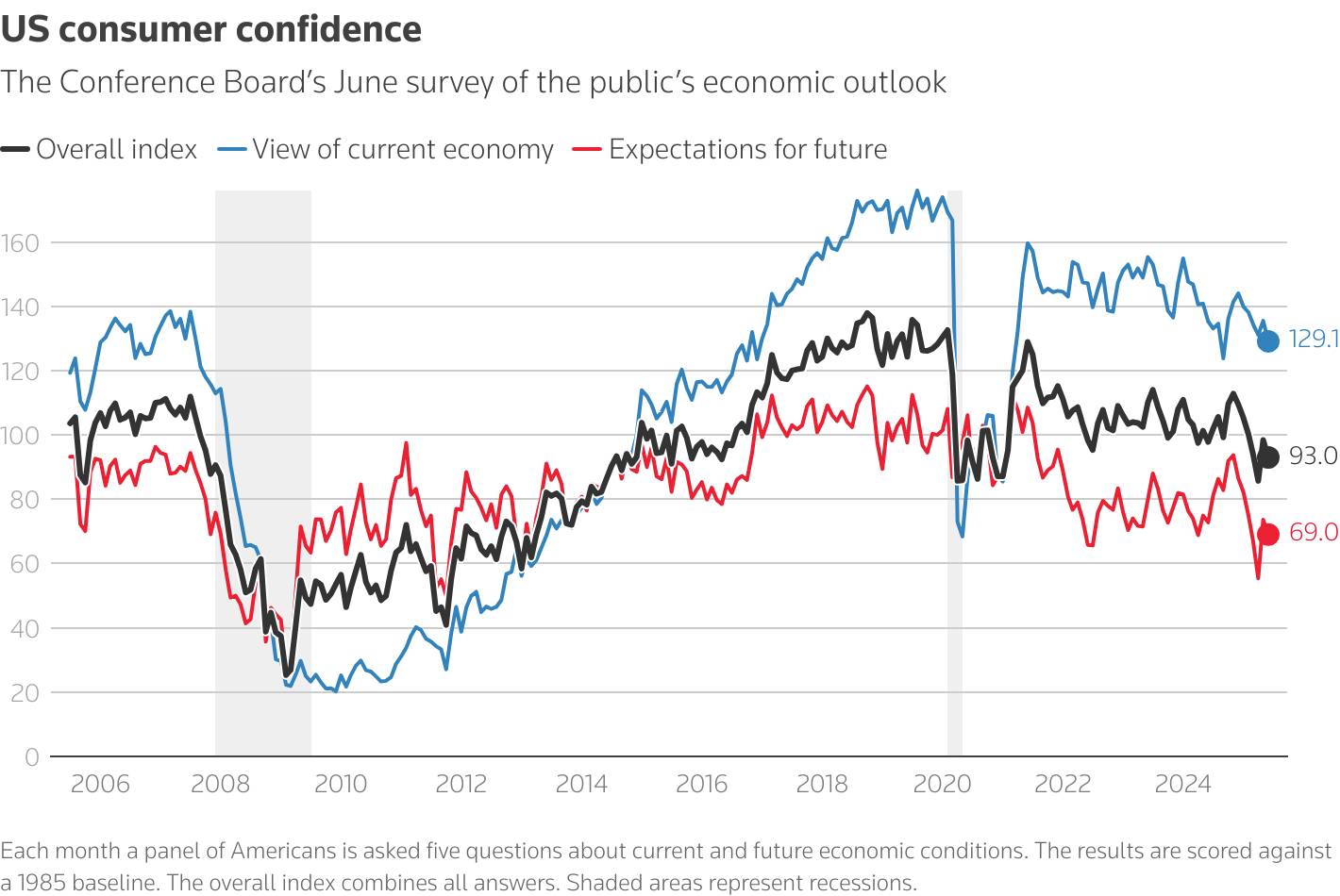
          The Conference Board's consumer confidence index dropped 5.4 points to 93.0 this month, erasing nearly half of the sharp gain in May. Economists polled by Reuters had forecast the index increasing to 100.0.

          The cutoff date for the survey was June 18, before the U.S. joined in the fray between Israel and Iran, by bombing Tehran's nuclear facilities. Trump on Monday announced a ceasefire. The survey noted that "references to geopolitics and social unrest increased slightly from previous months but remained much lower on the list of topics affecting consumers' views."

          The share of consumers who viewed jobs as being "plentiful" dropped to 29.2%, the lowest since March 2021, from 31.1% in May. Some 18.1% of consumers said jobs were "hard to get," down from 18.4% last month.

          The survey's so-called labor market differential, derived from data on respondents' views on whether jobs are plentiful or hard to get, narrowed to a four-year low of 11.1 from 12.7 last month. This measure correlates to the unemployment rate in the Labor Department's monthly employment report.

          Economists said that, combined with high numbers of people on unemployment benefits, raised the risk that the jobless rate could rise to 4.3% in June from 4.2% in May.

          "Given the concurrent rise in continuing jobless claims, it looks increasingly likely that the unemployment rate will rise to 4.3% in next week's employment report," said Abiel Reinhart, an economist at JPMorgan.

          This is a line chart that shows a consumer confidence index over the past 20 years. In the month of June, the overall index was 93.0, the view of the current economy was 129.1 and expectations for the future were 69.0.

          INFLATION EXPECTATIONS EASE

          Though consumers' one-year inflation expectations decreased to 6.0% from 6.4% in May, the share expecting interest rates to rise was the highest since October 2023.

          Federal Reserve Chair Jerome Powell told lawmakers on Tuesday the U.S. central bank needed more time to gauge if tariffs pushed up inflation before considering lowering rates. The Fed last week left its benchmark overnight interest rate in the 4.25%-4.50% range where it has been since December.

          Stocks on Wall Street traded higher. The dollar fell against a basket of currencies. U.S. Treasury yields were lower.

          While consumers were unsure about big-ticket purchases over the next six months, they were less inclined to spend more on services, though spending intentions for dining out, motor vehicle services, visits to museums and historic sites as well as fitness activities rose.

          Vacation plans were unchanged, though more consumers planned to travel abroad. Plans to travel within the United States fell. Fewer consumers intended to buy a home, likely because of higher mortgage rates, which have combined with still-high house prices to reduce affordability.

          But house price inflation is slowing as weak demand boosts the supply of unsold homes on the market.

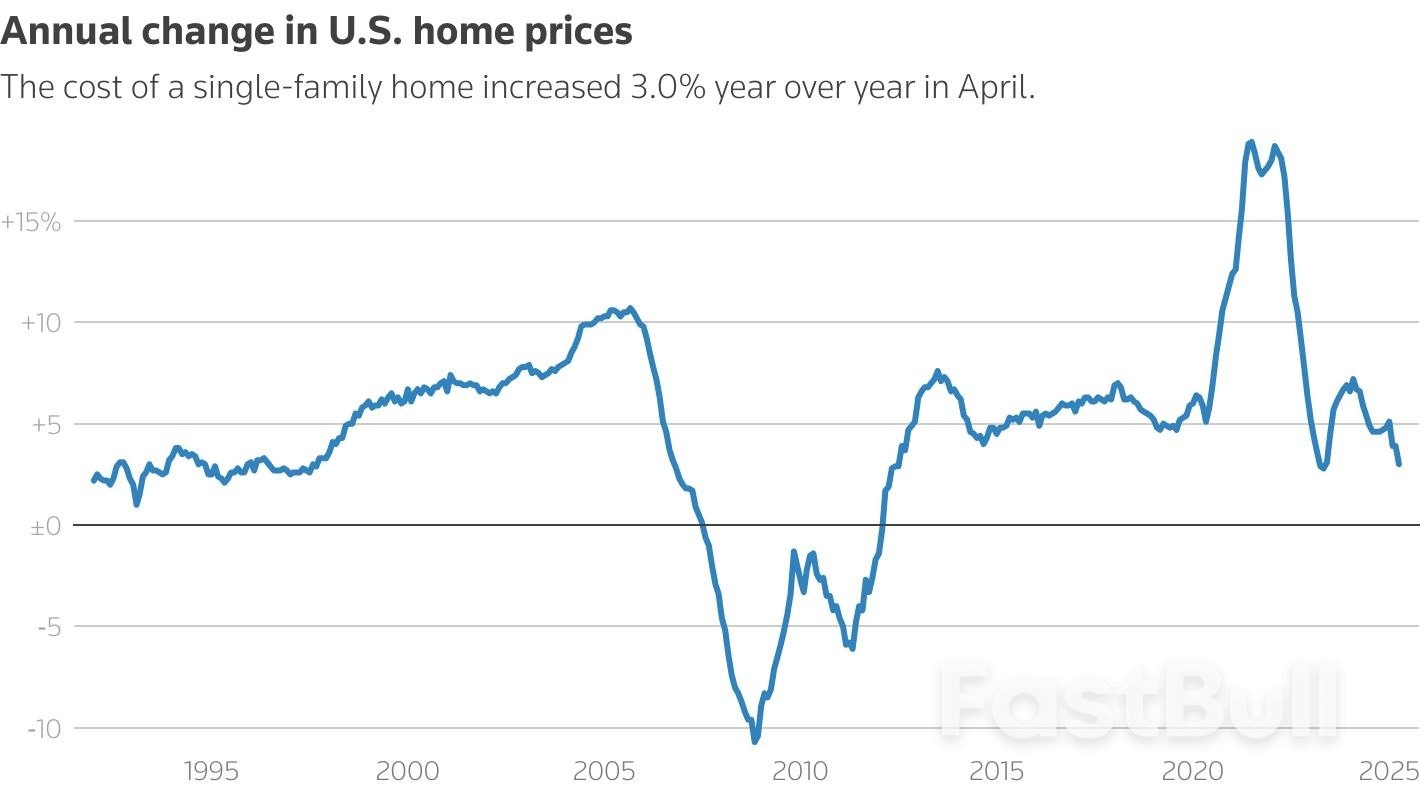
          A separate report from the Federal Housing Finance Agency showed single-family house prices fell 0.4% in April, the first decline since August 2022, after being unchanged in March.

          That lowered the annual increase to 3.0% in April, the smallest rise since May 2023, from 3.9% in March. Economists do not expect an outright decline in house prices at a national level, though some individual markets could see sharp decreases.

          A line chart titled "Annual change in U.S. home prices" that tracks the metric over time

          "While the supply of homes for sale has increased, the housing market continues to suffer from a shortage of supply," said Bernard Yaros, lead U.S. economist at Oxford Economics.

          "However, some regions, mainly those that saw the biggest run-up in prices around the pandemic, may be at risk of a period of negative price growth, something already occurring in parts of Florida."

          Source: Reuters

          To stay updated on all economic events of today, please check out our Economic calendar
          Risk Warnings and Disclaimers
          You understand and acknowledge that there is a high degree of risk involved in trading. Following any strategies or investment methods may lead to potential losses. The content on the site is provided by our contributors and analysts for information purposes only. You are solely responsible for determining whether any trading assets, securities, strategy, or any other product is suitable for investing based on your own investment objectives and financial situation.
          Add to Favorites
          Share

          Oil prices fall more than 5% after Trump says China can continue buying oil from Iran

          Adam

          Commodity

          Oil prices fell sharply Tuesday after President Donald Trump said China can keep buying oil from Iran, a sign that the U.S. is easing its maximum pressure campaign on the Islamic Republic in the wake of a ceasefire with Israel.
          Global benchmark Brent fell $4.06, or 5.68%, to $67.42 per barrel by 12:23 p.m. ET. U.S. crude oil was last down $3.88, or 5.66%, to $64.63 a barrel. Prices closed 7% lower on Monday as the oil market bet that the conflict in the Middle East was winding down.
          “China can now continue to purchase Oil from Iran,” Trump said in a post on his social media platform Truth Social. “Hopefully, they will be purchasing plenty from the U.S., also. It was my Great Honor to make this happen!”
          Trump threatened in May to bar any country buying Iranian oil from doing business with the U.S. China purchases the vast majority of the 1.7 million barrels per day that Iran typically exports, according to data from Kpler.
          “Trump has always seemed loath to remove Iranian supply from the market, given the upward pressure on oil prices it would have,” said Matt Smith, lead oil analyst at Kpler. “Now he has no beef with Iran given its diminished nuclear capabilities — his focus is shifting to getting oil prices back down.”
          Oil prices have tumbled to levels last seen before Israel started bombing Iran on June 13, as investors now believe the risk is low that a major supply disruption will occur in the Middle East.
          The U.S. decision to join Israel’s campaign and bomb three key nuclear sites in Iran over the weekend initially triggered fears that Tehran might try to choke off oil exports from the Persian Gulf in retaliation.
          Instead, Tehran launched a missile attack on a U.S. airbase in Qatar that left no casualties, providing an off-ramp from further escalation. Trump announced a ceasefire agreement between Israel and Iran shortly afterward.
          The ceasefire teetered on the brink of collapse early Tuesday as Trump accused both Iran and Israel of violating the agreement shortly after it went into effect. The president demanded that Jerusalem and Tehran adhere to the ceasefire, reserving unusually harsh words for Israel.
          “I’m not happy with Israel,” Trump told reporters en route to a NATO summit in the Netherlands. “I’m not happy with Iran either but I’m really unhappy if Israel” continues its bombing campaign Tuesday.
          Throughout the conflict, traders feared that Israel might target the 3.3 million bpd of crude oil that Iran produces, or that the Islamic Republic might lash out by targeting energy infrastructure in the Gulf nations, including Iraq.
          Investors also watched if Iran would try to close the Strait of Hormuz linking the Persian Gulf and the Gulf of Oman. The strait, used to transport 20% of the world’s crude, is a key route for Iranian and other Middle Eastern shipments, including Saudi Arabia, the world’s largest oil exporter, the United Arab Emirates, Iraq, Kuwait and Bahrain.

          source : Cnbc

          Risk Warnings and Disclaimers
          You understand and acknowledge that there is a high degree of risk involved in trading. Following any strategies or investment methods may lead to potential losses. The content on the site is provided by our contributors and analysts for information purposes only. You are solely responsible for determining whether any trading assets, securities, strategy, or any other product is suitable for investing based on your own investment objectives and financial situation.
          Add to Favorites
          Share

          NY Fed’s Williams Says Modestly Restrictive Policy Stance ’appropriate’

          Devin

          Central Bank

          New York Fed President John Williams said Tuesday that maintaining a modestly restrictive monetary policy stance is "entirely appropriate" given current economic conditions.

          Speaking at the NY CREATES Albany NanoTech Complex in Albany, New York, Williams emphasized that keeping the federal funds rate at its current level of 4.25% to 4.5% allows time for policymakers to analyze incoming data and evaluate risks.

          Williams’ position contrasts with some other Fed governors who have suggested a potential rate cut in July might be appropriate. However, his comments align with Fed Chairman Jerome Powell, who on Tuesday signaled patience on rate cuts amid economic stability.

          "Given the continued uncertainty, the solid labor market, and inflation still above our 2 percent goal, the FOMC decided at its meeting last week to leave the target range for the federal funds rate unchanged," Williams said in his speech.

          He noted that the Fed continues to reduce its holdings of Treasury securities and agency debt and mortgage-backed securities, adding that "despite market volatility related to trade policy and other developments, that process continues to go very smoothly."

          Williams pointed to mixed economic signals, with survey data showing pessimism and uncertainty about the economic outlook, while hard economic data indicates the U.S. economy "remains in a good place."

          In his outlook, Williams expects real GDP growth to slow to just over 1% this year, with unemployment rising to around 4.5% by year-end. He projects inflation will increase to around 3% in 2025 due to tariffs, before gradually declining to 2% over the following two years.

          The New York Fed president also highlighted findings from a recent survey showing that about three-quarters of manufacturers and service firms in New York and New Jersey have passed along at least some tariff-related cost increases to customers.

          Source: Investing

          Risk Warnings and Disclaimers
          You understand and acknowledge that there is a high degree of risk involved in trading. Following any strategies or investment methods may lead to potential losses. The content on the site is provided by our contributors and analysts for information purposes only. You are solely responsible for determining whether any trading assets, securities, strategy, or any other product is suitable for investing based on your own investment objectives and financial situation.
          Add to Favorites
          Share
          FastBull
          Copyright © 2025 FastBull Ltd

          728 RM B 7/F GEE LOK IND BLDG NO 34 HUNG TO RD KWUN TONG KLN HONG KONG

          TelegramInstagramTwitterfacebooklinkedin
          App Store Google Play Google Play
          Products
          Charts

          Chats

          Q&A with Experts
          Screeners
          Economic Calendar
          Data
          Tools
          Membership
          Features
          Function
          Markets
          Copy Trading
          Latest Signals
          Contests
          News
          Analysis
          24/7
          Columns
          Education
          Company
          Careers
          About Us
          Contact Us
          Advertising
          Help Center
          Feedback
          User Agreement
          Privacy Policy
          Business

          White Label

          Data API

          Web Plug-ins

          Poster Maker

          Affiliate Program

          Risk Disclosure

          The risk of loss in trading financial instruments such as stocks, FX, commodities, futures, bonds, ETFs and crypto can be substantial. You may sustain a total loss of the funds that you deposit with your broker. Therefore, you should carefully consider whether such trading is suitable for you in light of your circumstances and financial resources.

          No decision to invest should be made without thoroughly conducting due diligence by yourself or consulting with your financial advisors. Our web content might not suit you since we don't know your financial conditions and investment needs. Our financial information might have latency or contain inaccuracy, so you should be fully responsible for any of your trading and investment decisions. The company will not be responsible for your capital loss.

          Without getting permission from the website, you are not allowed to copy the website's graphics, texts, or trademarks. Intellectual property rights in the content or data incorporated into this website belong to its providers and exchange merchants.

          Not Logged In

          Log in to access more features

          FastBull Membership

          Not yet

          Purchase

          Become a signal provider
          Help Center
          Customer Service
          Dark Mode
          Price Up/Down Colors

          Log In

          Sign Up

          Position
          Layout
          Fullscreen
          Default to Chart
          The chart page opens by default when you visit fastbull.com