Markets
News
Analysis
User
24/7
Economic Calendar
Education
Data
- Names
- Latest
- Prev


Signal Accounts for Members
All Signal Accounts
All Contests


France Trade Balance (SA) (Oct)A:--
F: --
Euro Zone Employment YoY (SA) (Q3)A:--
F: --
Canada Part-Time Employment (SA) (Nov)A:--
F: --
P: --
Canada Unemployment Rate (SA) (Nov)A:--
F: --
P: --
Canada Full-time Employment (SA) (Nov)A:--
F: --
P: --
Canada Labor Force Participation Rate (SA) (Nov)A:--
F: --
P: --
Canada Employment (SA) (Nov)A:--
F: --
P: --
U.S. PCE Price Index MoM (Sept)A:--
F: --
P: --
U.S. Personal Income MoM (Sept)A:--
F: --
P: --
U.S. Core PCE Price Index MoM (Sept)A:--
F: --
P: --
U.S. PCE Price Index YoY (SA) (Sept)A:--
F: --
P: --
U.S. Core PCE Price Index YoY (Sept)A:--
F: --
P: --
U.S. Personal Outlays MoM (SA) (Sept)A:--
F: --
U.S. 5-10 Year-Ahead Inflation Expectations (Dec)A:--
F: --
P: --
U.S. Real Personal Consumption Expenditures MoM (Sept)A:--
F: --
U.S. Weekly Total Rig CountA:--
F: --
P: --
U.S. Weekly Total Oil Rig CountA:--
F: --
P: --
U.S. Consumer Credit (SA) (Oct)A:--
F: --
China, Mainland Foreign Exchange Reserves (Nov)A:--
F: --
P: --
Japan Trade Balance (Oct)A:--
F: --
P: --
Japan Nominal GDP Revised QoQ (Q3)A:--
F: --
P: --
China, Mainland Imports YoY (CNH) (Nov)A:--
F: --
P: --
China, Mainland Exports (Nov)A:--
F: --
P: --
China, Mainland Imports (CNH) (Nov)A:--
F: --
P: --
China, Mainland Trade Balance (CNH) (Nov)A:--
F: --
P: --
China, Mainland Exports YoY (USD) (Nov)A:--
F: --
P: --
China, Mainland Imports YoY (USD) (Nov)A:--
F: --
P: --
Germany Industrial Output MoM (SA) (Oct)A:--
F: --
Euro Zone Sentix Investor Confidence Index (Dec)A:--
F: --
P: --
Canada National Economic Confidence IndexA:--
F: --
P: --
U.K. BRC Like-For-Like Retail Sales YoY (Nov)--
F: --
P: --
U.K. BRC Overall Retail Sales YoY (Nov)--
F: --
P: --
Australia Overnight (Borrowing) Key Rate--
F: --
P: --
RBA Rate Statement
RBA Press Conference
Germany Exports MoM (SA) (Oct)--
F: --
P: --
U.S. NFIB Small Business Optimism Index (SA) (Nov)--
F: --
P: --
Mexico 12-Month Inflation (CPI) (Nov)--
F: --
P: --
Mexico Core CPI YoY (Nov)--
F: --
P: --
Mexico PPI YoY (Nov)--
F: --
P: --
U.S. Weekly Redbook Index YoY--
F: --
P: --
U.S. JOLTS Job Openings (SA) (Oct)--
F: --
P: --
China, Mainland M1 Money Supply YoY (Nov)--
F: --
P: --
China, Mainland M0 Money Supply YoY (Nov)--
F: --
P: --
China, Mainland M2 Money Supply YoY (Nov)--
F: --
P: --
U.S. EIA Short-Term Crude Production Forecast For The Year (Dec)--
F: --
P: --
U.S. EIA Natural Gas Production Forecast For The Next Year (Dec)--
F: --
P: --
U.S. EIA Short-Term Crude Production Forecast For The Next Year (Dec)--
F: --
P: --
EIA Monthly Short-Term Energy Outlook
U.S. API Weekly Gasoline Stocks--
F: --
P: --
U.S. API Weekly Cushing Crude Oil Stocks--
F: --
P: --
U.S. API Weekly Crude Oil Stocks--
F: --
P: --
U.S. API Weekly Refined Oil Stocks--
F: --
P: --
South Korea Unemployment Rate (SA) (Nov)--
F: --
P: --
Japan Reuters Tankan Non-Manufacturers Index (Dec)--
F: --
P: --
Japan Reuters Tankan Manufacturers Index (Dec)--
F: --
P: --
Japan Domestic Enterprise Commodity Price Index MoM (Nov)--
F: --
P: --
Japan Domestic Enterprise Commodity Price Index YoY (Nov)--
F: --
P: --
China, Mainland PPI YoY (Nov)--
F: --
P: --
China, Mainland CPI MoM (Nov)--
F: --
P: --
Italy Industrial Output YoY (SA) (Oct)--
F: --
P: --


No matching data
Latest Views
Latest Views
Trending Topics
Top Columnists
Latest Update
White Label
Data API
Web Plug-ins
Affiliate Program
View All

No data
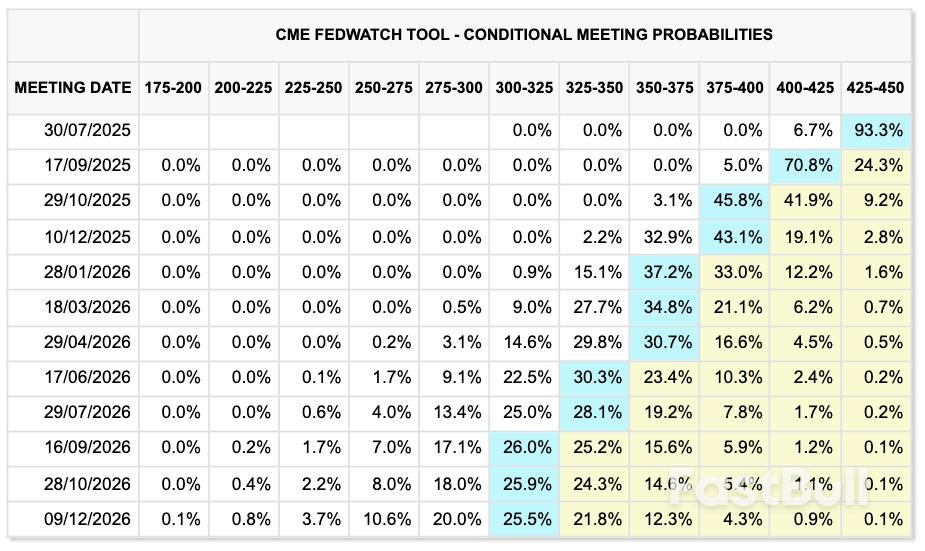
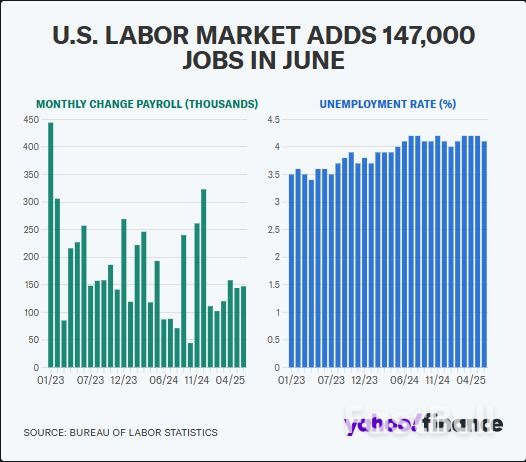
US joblessness remains extraordinarily low, and that’s worth celebrating this Fourth of July. A Bureau of Labor Statistics report on Thursday showed that the unemployment rate slipped to 4.1% in June from 4.2% a month earlier, a number that economists have long considered just about as good as it gets. That’s led investors to cut the likelihood that the Federal Reserve will move to lower policy rates in the coming months.
I’m glad that the labor market is holding up, but this economy still needs a bit of the central bank’s medicine to keep on truckin’ — and it needs it sooner rather than later.
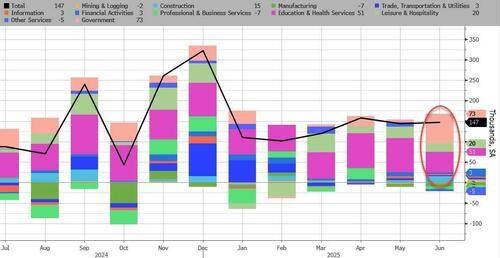
Consider the latest numbers. The so-called establishment survey data showed that the economy added 147,000 jobs in June, but 73,000 of them came from the government (mostly state and local). Among the 74,000 private sector jobs added, most of the growth was in the health care and social assistance category. A job is a job, but that mix isn’t indicative of an economy that’s firing on all cylinders.
The other issue is the step-down in the unemployment rate, which seemed to stem from people leaving the labor force — not usually a good thing. As a quick reminder, the BLS only considers you unemployed if you were available to work and have actively looked for work in the past four weeks. Otherwise, you’re considered “not in the labor force,” a category that includes so-called “discouraged” workers (who want a job but have stopped actively hunting because they don’t believe there are any available to them) and the “marginally attached” (who stopped looking for other reasons). The numbers of such people are trending upward, as are ratios of labor underutilization such as the U-4 metric, which measures the numbers of unemployed plus discouraged workers. (The denominator of this ratio is the sum of the labor force and discouraged workers.)
All in all, this looks like a labor market that’s stuck, lacking the churn and growth opportunities that we expect from the US economy. It’s not collapsing, and that’s wonderful news given the many uncertainties around, but it feels extraordinarily frustrating to some.
Who are all these discouraged and marginally attached workers? First, young recent graduates are notoriously having a hard time finding work. Some observers blame over-hiring during the pandemic years, while others think that artificial intelligence is already allowing companies to do more with less, at least at the margin. Whatever the cause, it’s hard to deny that Generation Z faces unique obstacles when finding its footing in this labor market — a fact that could have long-term ramifications for the economy. If they finish school, start their job search and then stop looking (at least for a while), then they’re probably in the statistical bucket of discouraged workers.
Another hypothesis is related to the recent trend in immigration policy and rhetoric. The Trump administration’s workforce raids and deportation pledges appear to be having a chilling effect both on would-be new immigrants and those who are already here. That includes both the undocumented population and people who had been living in the US under Temporary Protected Status and similar programs that President Donald Trump has sought to change. Legal status isn’t a factor when considering whether someone is “in the labor force” or not, but the threat of immigration raids could conceivably cause an undocumented worker to stay away from work and become a discouraged worker. The confusing policy environment may also be prompting employers to hire fewer immigrants, a related source of potential discouragement.
Of those two hypotheses, the real explanation could be a bit of both. Even more generally, hiring rates are simply bad: Irrespective of age and birthplace, it’s just hard to find a job these days.
To be clear, the past several years have been filled with labor market reports that felt something like this: The headline numbers were pretty good, yet pundits found some under-the-radar wrinkle that allegedly augured a near-term turn for the worse. I’d agree that we shouldn’t look a gift horse in the mouth. An unemployment rate of 4.1% is fantastic! But the economy is still missing something, and I’m hoping that monetary policy will help deliver it later this year (provided the inflation data cooperate). The incredible US labor market is supposed to give us fireworks on the Fourth of July. It’s supposed to be dynamic and ever-changing, and it’s certainly not supposed to feel this discouraging to so many people.


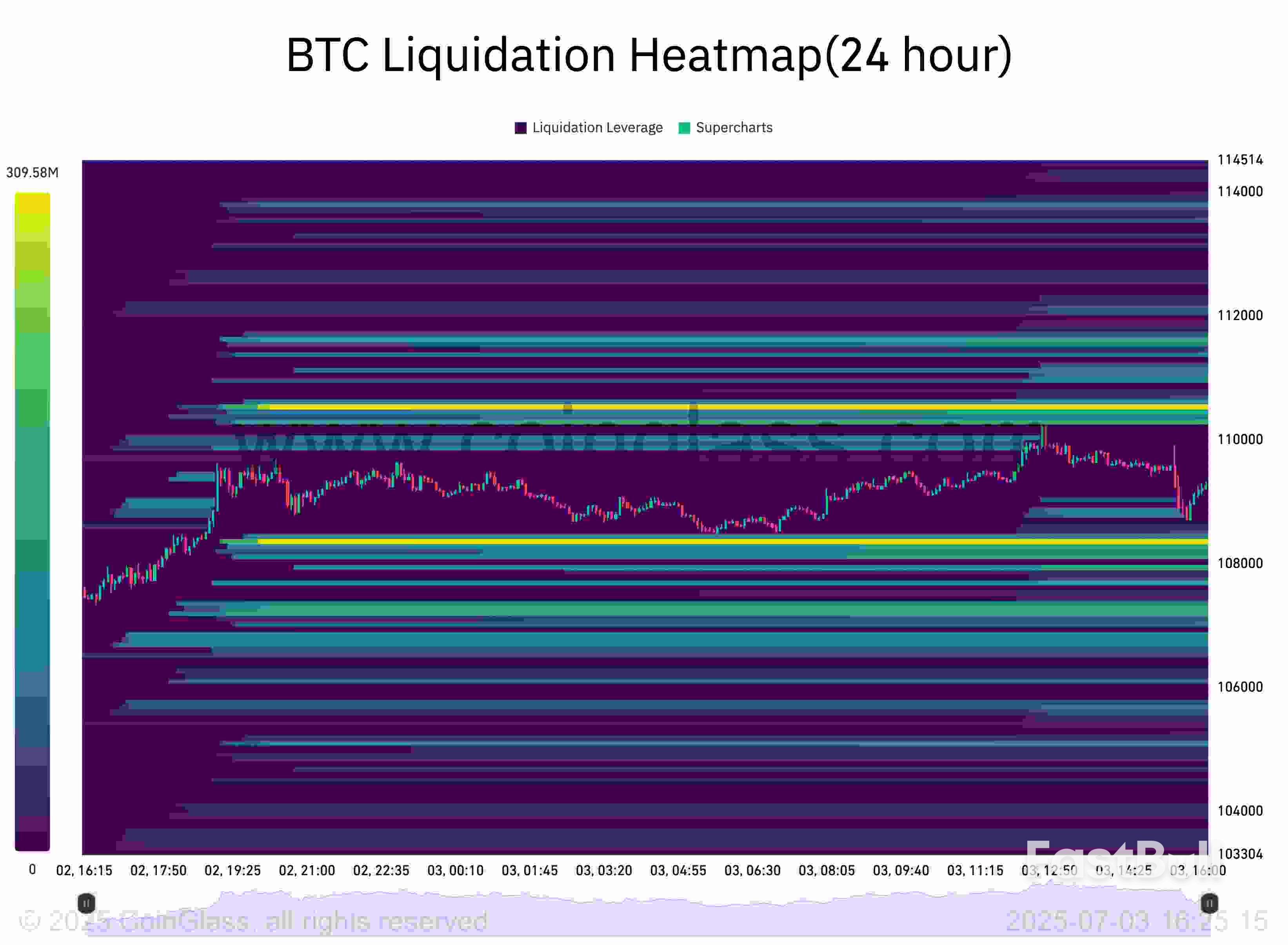
BTC liquidation heatmap. Source: CoinGlassThere were plenty of good details to report in today's jobs report: the unexpected surge in monthly jobs (which came almost above the top of the forecast range), the drop in unemployment, the moderation in hourly earnings, the continued loss of federal workers, the jump in full-time jobs and the drop in part-time jobs.
There were also several not so good aspects: first and foremost, the narrow breadth in hiring, with most job growth in June the result of Education and Health services (+51K), and Government (+73), which are government, or government-linked, sectors.
As Soutbay Research put it, the June Payrolls were derived from two sources: Healthcare (+59K) and Public Schools (+64K).
On the other end, private sector payrolls were soft: excluding healthcare, Southbay says to expect the Private Sector to be flat or possibly negative.
Meanwhile, even though it was not yet captured by the jobs report, there has been plenty of firing, with the best examples being Intel and Microsoft just announcing a combined 18K in layoffs.
As SouthBay concludes, "only another Hail Mary Seasonal Adjustment can prevent a negative print."
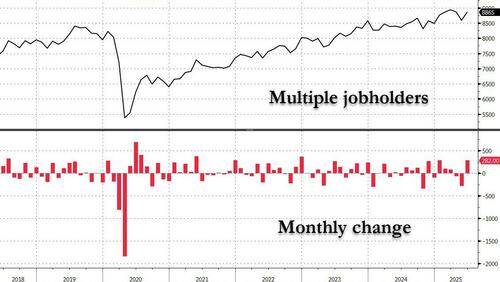
Another less then stellar aspect of today's report is that the number of multiple job holders actually soared by 282K, one of the biggest monthly increases on record, and one which pushed the total just shy of a new all time high.
But while no jobs report is without blemishes, the positives far outweighed the negatives, maybe not so much quantitatively then certainly qualitatively, because as we noted earlier, the most important metric of today's jobs report is arguably what got Trump elected in the first place.
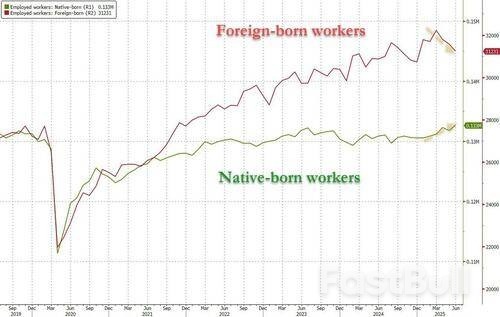
Recall back in January 2024 we first asked how is it not the biggest political talking point that since 2019, the US had only added foreign-born workers (which as we subsequently showed were primarily illegal aliens) while native workers remained flat or declined.
Less than a year later, illegal immigration in general, and its impact on the labor market indeed had become the biggest political talking point and one which one can argue got Trump elected.
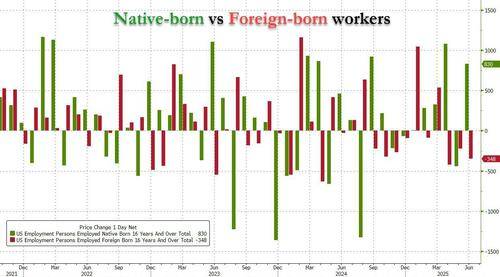
So in retrospect, we can report today that Trump has certainly been working hard to resolve the situation and according to today's job report, the number of native-born workers has taken a decisive step higher, rising to a new all time high while foreign-born workers have been plunging ever since the election.
Here are the details:
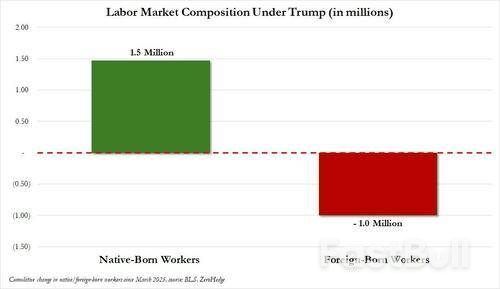
Extending the observation window since the start of Trump's admin (i.e., since March which covers the end of the first full month of the Trump admin), we find an even more impressive result: the number of native born workers has surged by 1.5 million while foreign-born (primarily illegals) have tumbled by 1 million.
So while one can certainly find warts in the broader jobs report - and with the economy 5 years into its post-covid expansion there better be weaknesses - the one thing that matters more than anything to most Americans, not having to compete with illegal aliens for jobs which not only pushes demand higher but also wages, is one where Trump can certainly say mission accomplished, for now.

Crude oil prices fell to a low of $66.54 on Friday, down over 1%, following an Axios report that a White House envoy plans to meet with Iran’s foreign minister in Oslo next week to restart nuclear talks.
The potential diplomatic engagement comes after President Trump ordered military strikes on Iran’s nuclear facilities last month. According to the report, White House envoy Steve Witkoff is expected to meet with Iranian Foreign Minister Abbas Araghchi, though neither country has publicly confirmed the meeting.
Oil markets reacted to the news as renewed nuclear negotiations could eventually lead to the lifting of sanctions on Iranian oil exports, potentially increasing global supply. Iran holds some of the world’s largest proven oil reserves, and any return of Iranian crude to international markets would likely pressure prices.
The reported talks would mark the first direct engagement between the two countries since the recent 12-day conflict between Israel and Iran that ended in a U.S.-brokered ceasefire. Sources cited by Axios indicate that Witkoff and Araghchi have maintained direct contact during and after this conflict.
A key focus of any future negotiations would be Iran’s stockpile of highly enriched uranium, which reportedly includes 400 kilograms enriched to 60% purity. This level of enrichment is close to weapons-grade material, which requires 90% enrichment.
Omani and Qatari officials have reportedly been involved in mediating between the U.S. and Iran, with Iranian officials initially reluctant to engage with the U.S. following the military strikes but gradually softening their position.
White Label
Data API
Web Plug-ins
Poster Maker
Affiliate Program
The risk of loss in trading financial instruments such as stocks, FX, commodities, futures, bonds, ETFs and crypto can be substantial. You may sustain a total loss of the funds that you deposit with your broker. Therefore, you should carefully consider whether such trading is suitable for you in light of your circumstances and financial resources.
No decision to invest should be made without thoroughly conducting due diligence by yourself or consulting with your financial advisors. Our web content might not suit you since we don't know your financial conditions and investment needs. Our financial information might have latency or contain inaccuracy, so you should be fully responsible for any of your trading and investment decisions. The company will not be responsible for your capital loss.
Without getting permission from the website, you are not allowed to copy the website's graphics, texts, or trademarks. Intellectual property rights in the content or data incorporated into this website belong to its providers and exchange merchants.
Not Logged In
Log in to access more features

FastBull Membership
Not yet
Purchase
Log In
Sign Up