• Trade
  • Markets
  • Copy
  • Contests
  • News
  • 24/7
  • Calendar
  • Q&A
  • Chats
Trending
Screeners
SYMBOL
LAST
BID
ASK
HIGH
LOW
NET CHG.
%CHG.
SPREAD
SPX
S&P 500 Index
6827.42
6827.42
6827.42
6899.86
6801.80
-73.58
-1.07%
--
DJI
Dow Jones Industrial Average
48458.04
48458.04
48458.04
48886.86
48334.10
-245.98
-0.51%
--
IXIC
NASDAQ Composite Index
23195.16
23195.16
23195.16
23554.89
23094.51
-398.69
-1.69%
--
USDX
US Dollar Index
97.950
98.030
97.950
98.500
97.950
-0.370
-0.38%
--
EURUSD
Euro / US Dollar
1.17394
1.17409
1.17394
1.17496
1.17192
+0.00011
+ 0.01%
--
GBPUSD
Pound Sterling / US Dollar
1.33707
1.33732
1.33707
1.33997
1.33419
-0.00148
-0.11%
--
XAUUSD
Gold / US Dollar
4299.39
4299.39
4299.39
4353.41
4257.10
+20.10
+ 0.47%
--
WTI
Light Sweet Crude Oil
57.233
57.485
57.233
58.011
56.969
-0.408
-0.71%
--

Community Accounts

Signal Accounts
--
Profit Accounts
--
Loss Accounts
--
View More

Become a signal provider

Sell trading signals to earn additional income

View More

Guide to Copy Trading

Get started with ease and confidence

View More

Signal Accounts for Members

All Signal Accounts

Best Return
  • Best Return
  • Best P/L
  • Best MDD
Past 1W
  • Past 1W
  • Past 1M
  • Past 1Y

All Contests

  • All
  • Trump Updates
  • Recommend
  • Stocks
  • Cryptocurrencies
  • Central Banks
  • Featured News
Top News Only
Share

USA Embassy In Lithuania: Maria Kalesnikava Is Not Going To Vilnius

Share

USA Embassy In Lithuania: Other Prisoners Are Being Sent From Belarus To Ukraine

Share

Ukraine President Zelenskiy: Five Ukrainians Released By Belarus In US-Brokered Deal

Share

USA Vilnius Embassy: USA Stands Ready For "Additional Engagement With Belarus That Advances USA Interests"

Share

USA Vilnius Embassy: Belarus, USA, Other Citizens Among The Prisoners Released Into Lithuania

Share

USA Vilnius Embassy: USA Will Continue Diplomatic Efforts To Free The Remaining Political Prisoners In Belarus

Share

USA Vilnius Embassy: Belarus Releases 123 Prisoners Following Meeting Of President Trump's Envoy Coale And Belarus President Lukashenko

Share

USA Vilnius Embassy: Masatoshi Nakanishi, Aliaksandr Syrytsa Are Among The Prisoners Released By Belarus

Share

USA Vilnius Embassy: Maria Kalesnikava And Viktor Babaryka Are Among The Prisoners Released By Belarus

Share

USA Vilnius Embassy: Nobel Peace Prize Laureate Ales Bialiatski Is Among The Prisoners Released By Belarus

Share

Belarusian Presidential Administration Telegram Channel: Lukashenko Has Pardoned 123 Prisoners As Part Of Deal With US

Share

Two Local Syrian Officials: Joint US-Syrian Military Patrol In Central Syria Came Under Fire From Unknown Assailants

Share

Israeli Military Says It Targeted 'Key Hamas Terrorist' In Gaza City

Share

Rwanda's Actions In Eastern Drc Are A Clear Violation Of Washington Accords Signed By President Trump - Secretary Of State Rubio

Share

Israeli Military Issues Evacuation Warning In Southern Lebanon Village Ahead Of Strike - Spokesperson On X

Share

Belarusian State Media Cites US Envoy Coale As Saying He Discussed Ukraine And Venezuela With Lukashenko

Share

Belarusian State Media Cites US Envoy Coale As Saying That US Removes Sanctions On Belarusian Potassium

Share

Thai Prime Minister: No Ceasefire Agreement With Cambodia

Share

US, Ukraine To Discuss Ceasefire In Berlin Ahead Of European Summit

Share

Incoming Czech Prime Minister Babis: Czech Republic Will Not Take On Guarantees For Ukraine Financing, European Commission Must Find Alternatives

TIME
ACT
FCST
PREV
U.K. Trade Balance Non-EU (SA) (Oct)

A:--

F: --

P: --

U.K. Trade Balance (Oct)

A:--

F: --

P: --

U.K. Services Index MoM

A:--

F: --

P: --

U.K. Construction Output MoM (SA) (Oct)

A:--

F: --

P: --

U.K. Industrial Output YoY (Oct)

A:--

F: --

P: --

U.K. Trade Balance (SA) (Oct)

A:--

F: --

P: --

U.K. Trade Balance EU (SA) (Oct)

A:--

F: --

P: --

U.K. Manufacturing Output YoY (Oct)

A:--

F: --

P: --

U.K. GDP MoM (Oct)

A:--

F: --

P: --

U.K. GDP YoY (SA) (Oct)

A:--

F: --

P: --

U.K. Industrial Output MoM (Oct)

A:--

F: --

P: --

U.K. Construction Output YoY (Oct)

A:--

F: --

P: --

France HICP Final MoM (Nov)

A:--

F: --

P: --

China, Mainland Outstanding Loans Growth YoY (Nov)

A:--

F: --

P: --

China, Mainland M2 Money Supply YoY (Nov)

A:--

F: --

P: --

China, Mainland M0 Money Supply YoY (Nov)

A:--

F: --

P: --

China, Mainland M1 Money Supply YoY (Nov)

A:--

F: --

P: --

India CPI YoY (Nov)

A:--

F: --

P: --

India Deposit Gowth YoY

A:--

F: --

P: --

Brazil Services Growth YoY (Oct)

A:--

F: --

P: --

Mexico Industrial Output YoY (Oct)

A:--

F: --

P: --

Russia Trade Balance (Oct)

A:--

F: --

P: --

Philadelphia Fed President Henry Paulson delivers a speech
Canada Building Permits MoM (SA) (Oct)

A:--

F: --

P: --

Canada Wholesale Sales YoY (Oct)

A:--

F: --

P: --

Canada Wholesale Inventory MoM (Oct)

A:--

F: --

P: --

Canada Wholesale Inventory YoY (Oct)

A:--

F: --

P: --

Canada Wholesale Sales MoM (SA) (Oct)

A:--

F: --

P: --

Germany Current Account (Not SA) (Oct)

A:--

F: --

P: --

U.S. Weekly Total Rig Count

A:--

F: --

P: --

U.S. Weekly Total Oil Rig Count

A:--

F: --

P: --

Japan Tankan Large Non-Manufacturing Diffusion Index (Q4)

--

F: --

P: --

Japan Tankan Small Manufacturing Outlook Index (Q4)

--

F: --

P: --

Japan Tankan Large Non-Manufacturing Outlook Index (Q4)

--

F: --

P: --

Japan Tankan Large Manufacturing Outlook Index (Q4)

--

F: --

P: --

Japan Tankan Small Manufacturing Diffusion Index (Q4)

--

F: --

P: --

Japan Tankan Large Manufacturing Diffusion Index (Q4)

--

F: --

P: --

Japan Tankan Large-Enterprise Capital Expenditure YoY (Q4)

--

F: --

P: --

U.K. Rightmove House Price Index YoY (Dec)

--

F: --

P: --

China, Mainland Industrial Output YoY (YTD) (Nov)

--

F: --

P: --

China, Mainland Urban Area Unemployment Rate (Nov)

--

F: --

P: --

Saudi Arabia CPI YoY (Nov)

--

F: --

P: --

Euro Zone Industrial Output YoY (Oct)

--

F: --

P: --

Euro Zone Industrial Output MoM (Oct)

--

F: --

P: --

Canada Existing Home Sales MoM (Nov)

--

F: --

P: --

Euro Zone Total Reserve Assets (Nov)

--

F: --

P: --

U.K. Inflation Rate Expectations

--

F: --

P: --

Canada National Economic Confidence Index

--

F: --

P: --

Canada New Housing Starts (Nov)

--

F: --

P: --

U.S. NY Fed Manufacturing Employment Index (Dec)

--

F: --

P: --

U.S. NY Fed Manufacturing Index (Dec)

--

F: --

P: --

Canada Core CPI YoY (Nov)

--

F: --

P: --

Canada Manufacturing Unfilled Orders MoM (Oct)

--

F: --

P: --

Canada Manufacturing New Orders MoM (Oct)

--

F: --

P: --

Canada Core CPI MoM (Nov)

--

F: --

P: --

Canada Manufacturing Inventory MoM (Oct)

--

F: --

P: --

Canada CPI YoY (Nov)

--

F: --

P: --

Canada CPI MoM (Nov)

--

F: --

P: --

Canada CPI YoY (SA) (Nov)

--

F: --

P: --

Canada Core CPI MoM (SA) (Nov)

--

F: --

P: --

Q&A with Experts
    • All
    • Chatrooms
    • Groups
    • Friends
    Connecting
    .
    .
    .
    Type here...
    Add Symbol or Code

      No matching data

      All
      Trump Updates
      Recommend
      Stocks
      Cryptocurrencies
      Central Banks
      Featured News
      • All
      • Russia-Ukraine Conflict
      • Middle East Flashpoint
      • All
      • Russia-Ukraine Conflict
      • Middle East Flashpoint
      Search
      Products

      Charts Free Forever

      Chats Q&A with Experts
      Screeners Economic Calendar Data Tools
      Membership Features
      Data Warehouse Market Trends Institutional Data Policy Rates Macro

      Market Trends

      Market Sentiment Order Book Forex Correlations

      Top Indicators

      Charts Free Forever
      Markets

      News

      News Analysis 24/7 Columns Education
      From Institutions From Analysts
      Topics Columnists

      Latest Views

      Latest Views

      Trending Topics

      Top Columnists

      Latest Update

      Signals

      Copy Rankings Latest Signals Become a signal provider AI Rating
      Contests
      Brokers

      Overview Brokers Assessment Rankings Regulators News Claims
      Broker listing Forex Brokers Comparison Tool Live Spread Comparison Scam
      Q&A Complaint Scam Alert Videos Tips to Detect Scam
      More

      Business
      Events
      Careers About Us Advertising Help Center

      White Label

      Data API

      Web Plug-ins

      Affiliate Program

      Awards Institution Evaluation IB Seminar Salon Event Exhibition
      Vietnam Thailand Singapore Dubai
      Fans Party Investment Sharing Session
      FastBull Summit BrokersView Expo
      Recent Searches
        Top Searches
          Markets
          News
          Analysis
          User
          24/7
          Economic Calendar
          Education
          Data
          • Names
          • Latest
          • Prev

          View All

          No data

          Scan to Download

          Faster Charts, Chat Faster!

          Download App
          English
          • English
          • Español
          • العربية
          • Bahasa Indonesia
          • Bahasa Melayu
          • Tiếng Việt
          • ภาษาไทย
          • Français
          • Italiano
          • Türkçe
          • Русский язык
          • 简中
          • 繁中
          Open Account
          Search
          Products
          Charts Free Forever
          Markets
          News
          Signals

          Copy Rankings Latest Signals Become a signal provider AI Rating
          Contests
          Brokers

          Overview Brokers Assessment Rankings Regulators News Claims
          Broker listing Forex Brokers Comparison Tool Live Spread Comparison Scam
          Q&A Complaint Scam Alert Videos Tips to Detect Scam
          More

          Business
          Events
          Careers About Us Advertising Help Center

          White Label

          Data API

          Web Plug-ins

          Affiliate Program

          Awards Institution Evaluation IB Seminar Salon Event Exhibition
          Vietnam Thailand Singapore Dubai
          Fans Party Investment Sharing Session
          FastBull Summit BrokersView Expo

          Thailand Needs Economic Reform, Not Economic Stimulus

          Alex

          Economic

          Summary:

          The Thai government wants to inject more economic stimulus to raise the growth rate. It should tackle productivity-raising long-term economic reform.
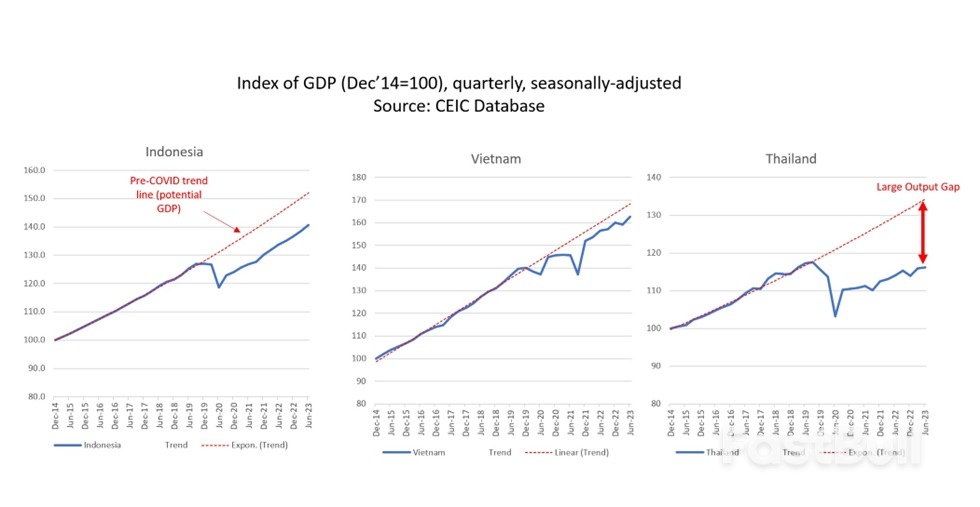
          Following the pandemic-induced economic crisis of 2020-21, the new Thai government is preoccupied with raising the rate of economic growth. The contraction of GDP growth relative to its pre-crisis path was more pronounced in Thailand than in either Indonesia or Vietnam (Figure 1). The main reasons were Thailand's greater export dependence in general and its heavier reliance on income from tourism, in particular. In early April, the World Bank downgraded its growth forecast for 2024 from 3.2 per cent to 2.8 per cent and also reduced its 2025 estimate marginally, to 3.0 per cent. The newly installed coalition government led by the Pheu Thai Party is urgently searching for ways to increase growth.

          Thailand Needs Economic Reform, Not Economic Stimulus_1Figure 1: Economic Contraction and Recovery in Indonesia, Vietnam and Thailand

          Increasing tourist numbers is one such opportunity. Srettha Thavisin, Pheu Thai's Prime Minister since August 2023, has travelled extensively since his appointment, successfully marketing Thailand as a venue for a proposed international electric car rally and other special interest events. The government has also announced its interest in permitting casinos open only to holders of foreign passports and only within selected locations. Of course, this will not address the reported spending outflow from Thais travelling abroad for gambling. These measures are all intended to raise incoming tourist revenues. The government has announced a target of 40 million tourists in 2024, which would restore the number to about its pre-Covid level of 2019.
          The Covid crisis did not merely reduce the number of tourists entering Thailand. Their average spending declined as well. Thailand's balance of payments data reveals that spending per tourist has dropped markedly from pre-Covid levels. In the third quarter of 2019 (2019-Q3), tourists spent 45,700 baht on average. In 2023-Q3, it was 31,700 baht, a contraction of almost one-third, even in purely nominal terms. Restoring tourist numbers to their pre-Covid level will not fully restore income from tourism.
          The recent experience of Japan demonstrates the ineffectiveness of macroeconomic stimulus as a growth-promoting measure.
          The economic contribution of tourism is often exaggerated, with claims that it accounts for as much as 20 per cent of Thailand's GDP. These claims mistakenly treat the total revenue received from tourists as if it were value-added. The value-added of an industry is the total revenue it receives minus the value of all the intermediate inputs it uses. GDP is the sum of the value-added of all industries. The true value-added generated by tourism in Thailand is unknown. It is surely large, but far less than 20 per cent of GDP.
          Thailand's poor growth performance started well before the Covid crisis. For the quarter century between 1970 and 1996 Thailand's average growth rate of real GDP (adjusted for inflation) was above 7 per cent. GDP contracted during the 1997-99 Asian Financial Crisis (AFC), and over the quarter century since the AFC, growth has been around 4 per cent and falling. Soon after taking office, government representatives announced that Thailand was “crying out for economic stimulus” as a means of raising the growth rate. This is a mistake.
          The great economist John Maynard Keynes taught the world that in circumstances where productive capacity is under-utilised, including unemployment of labour and unused plant and equipment, economic stimulus from the government can be an effective means of restoring demand and thereby restoring full employment. That is, for Keynes, fiscal and/or monetary stimulus were temporary stabilisation measures that could restore full employment in circumstances of insufficient demand.
          They were not instruments for raising long-term growth in the context of full employment. The Great Depression of the 1930s was, of course, Keynes' focus at his time of writing, but his policy prescription also applied to the Asian Financial Crisis (AFC) of 1997-1999 and the Covid-19 crisis of 2019-2021. It does not apply in Thailand's current circumstances of full employment. This is reflected in the current unemployment rate of 1.1 per cent, which marks a return to pre-pandemic levels; unemployment rose from 1.0 per cent in 2019 to 1.9 per cent in 2021.
          The recent experience of Japan demonstrates the ineffectiveness of macroeconomic stimulus as a growth-promoting measure. Since the mid-2000s monetary expansion has pushed interest rates to previously unknown negative levels. Deficit spending has raised Japan's government debt from 173 per cent of GDP in 2007 to 252 per cent in 2023. The outcome was an average annual growth rate over that period of 0.4 per cent. The lesson for other countries, including Thailand, is that fiscal and monetary stimulus are ineffective instruments for raising long-term growth.
          Thailand's current government has openly pressed the Bank of Thailand to reduce its policy rate of interest and is optimistic about the benefits of its “digital wallet” spending stimulus to domestic consumption. To its credit, the Bank of Thailand has so far resisted the pressure, and the digital wallet is stalled in legal problems for now. However, Thailand does not need a temporary stimulus to aggregate demand. It needs measures that will raise long-term productivity growth.
          There are three main, inter-dependent reasons for the poor growth performance. First, Thailand has been politically unstable during the quarter century since the AFC. Business people do not like uncertainty about the rules of the game.
          Second, private investment has slowed, partly but not entirely because of political uncertainty. Although foreign investment recovered quickly following the AFC and has remained robust since, investment by Thai firms in their own businesses is the dominant source of total investment in productive plants and equipment. Thai investors have remained cautious.
          Third, long-term economic reform and educational reform have both been neglected. The needed reforms will generate long-term but not short-term economic benefits, net of adjustment costs. They will also produce immediate political problems. This helps explain their unpopularity with successive Thai governments, especially those led by populist political parties like Pheu Thai.
          In addition to reforming the antiquated education system, the needed policy changes include reforming trade policy, where greater openness will contribute to long-term productivity growth, encouraging private investment by reducing the cost to businesses of complying with government regulations, and expanding government investment in the country's congested public infrastructure. Instead of injecting short-term stimulus, the government must find the clarity and will to tackle productivity-raising economic reform.

          Source: FULCRUM

          To stay updated on all economic events of today, please check out our Economic calendar
          Risk Warnings and Disclaimers
          You understand and acknowledge that there is a high degree of risk involved in trading. Following any strategies or investment methods may lead to potential losses. The content on the site is provided by our contributors and analysts for information purposes only. You are solely responsible for determining whether any trading assets, securities, strategy, or any other product is suitable for investing based on your own investment objectives and financial situation.
          Add to Favorites
          Share

          Rotterdam Port Forecasts Slight Recovery in 2024 Cargo Volumes as Inflation Eases

          Cohen

          Economic

          The Port of Rotterdam, Europe's largest, expects a "small" recovery in cargo volumes this year, following a decline in 2023, as global inflation levels continue to ease, according to its chief executive.
          "This year, you will see a small recovery because inflation has reduced to acceptable levels," Boudewijn Siemons told The National on the sidelines of the World Energy Congress this week.
          "Unless some black swan event happens … we expect a slight recovery this year but not a huge one, but an incremental one."
          Last year's total cargo throughput at Rotterdam ended at 438.8 million tonnes, a drop of 6.1 per cent compared to 2022.
          In the first quarter of 2024, total throughput at the port dipped by 1.4 per cent to 110.1 million tonnes compared with the same period a year earlier.
          Mr. Siemons also said he was not concerned about the disruption in the Red Sea or a potential escalation in the Middle East impacting global trade.
          "I'm concerned about it on a humanitarian basis, but logistically, with ships going around the Cape of Good Hope, we can manage those disturbances … [the] supply chain can digest it," he said.
          Several major energy companies and shipping lines have rerouted their vessels around South Africa's Cape of Good Hope to avoid the threat of attacks by Yemen's Houthi militant group in the Red Sea, a vital trade artery.
          Mr. Siemons' remarks come as inflation, which had spiked at the start of the Russia-Ukraine war in February 2022, is forecast to drop this year due to lower energy prices and reduced inflation in consumer goods and food.
          Global headline inflation is forecast to fall to 5.9 per cent this year after 2023's 6.8 per cent average, according to the International Monetary Fund.
          "The global economy has been depressed for two years … we're simply a mirror to the global economy," Mr. Siemons said.

          Hydrogen hub

          The Rotterdam port, the 10th largest in the world, operates and develops the port and an industrial cluster.
          The port is key to the Netherlands' plan to be an importer and transit port for hydrogen within Europe.
          Rotterdam aims to supply 4.6 million tonnes per year of hydrogen to Europe by 2030 from local production and imports.
          "Rotterdam now provides 13 per cent of Europe's energy need … and that's our role in the fossil [fuel] world. We want to maintain that role in the renewable energy world," Mr. Siemons said.
          "That means that we have to actually make sure that everything that happens here is aimed at making that transition and securing that position," he added.
          This year, Spain's Cepsa signed an agreement with three Dutch companies to supply green ammonia to a terminal in the port of Rotterdam.
          Green ammonia, derived from hydrogen generated through renewable energy sources, can in turn contribute to the transport of green hydrogen, offering a solution for decarbonising various industries.
          The Middle East and North Africa are also among the regions from which Rotterdam is looking to receive its hydrogen shipments.
          The port is in discussions with several companies to facilitate imports of hydrogen derivatives, Mr. Siemons said, without disclosing their names.
          "First investments have already been announced to increase the ammonia imports and we are talking to more companies about that possibility, including companies that are active in the Middle East," he added.
          Despite hydrogen's growing potential, critics within the energy industry have underlined its high cost of production and the absence of a well-established market.
          Currently, almost most all hydrogen produced worldwide is "grey", which means it is produced from natural gas.
          Mr. Siemons said there are several subsidies and schemes in the EU to support the switch from grey hydrogen to green hydrogen, adding that hydrogen produced from clean energy already has a significant market in north-west Europe.
          He also emphasised the need to add more blue hydrogen into the mix, as the scaling up of green hydrogen production is expected to take time.
          Blue hydrogen is produced from natural gas, but the carbon-dioxide produced during the process is captured and stored.
          "If you really want to speed up the hydrogen economy, you're going to need more sources than only green because that's going to take some time," Mr. Siemons said.
          "I believe that we need to be practical about it. The aim is to get carbon-dioxide out of the air and blue hydrogen does the job."

          Source: The National News

          To stay updated on all economic events of today, please check out our Economic calendar
          Risk Warnings and Disclaimers
          You understand and acknowledge that there is a high degree of risk involved in trading. Following any strategies or investment methods may lead to potential losses. The content on the site is provided by our contributors and analysts for information purposes only. You are solely responsible for determining whether any trading assets, securities, strategy, or any other product is suitable for investing based on your own investment objectives and financial situation.
          Add to Favorites
          Share

          A New Reality of 7% Mortgage Rates Could Be Setting in, Top Economist Says

          Thomas

          Economic

          It's a far cry from the historically low mortgage rates seen throughout the pandemic and years before. At one point, the average mortgage rate was as low as 2.65%. That might not happen ever again, but it definitely won't happen anytime soon, according to Carl Riccadonna, chief U.S. economist at BNP Paribas.
          “If we look at where a 10-year Treasury yield is trading or settling, that's a key driver of where mortgage rates are going,” Riccadonna said, appearing on CNBC.
          He continued: “I think a new reality is setting in with homebuyers that we're not going to go back to those pandemic lows anytime soon, given the very soft landing in the economy, persistent inflation pressures, which are trending lower but taking some time to move there—and that means elevated mortgage rates with a seven as the first number as opposed to two during the pandemic.”
          Mortgage rates were falling as inflation cooled, but after multiple hotter-than-expected consumer price index reports, and hesitation on interest rate cuts from the Federal Reserve (after it once signaled three this year), mortgage rates are creeping up. Last week, Fed Chair Jerome Powell said: “Given the strength of the labor market and progress on inflation so far, it's appropriate to allow restrictive policy further time to work.” If inflation persists, Powell signaled he'd keep interest rates where they are for as long as needed.
          Riccadonna said disinflation has a three-act structure. “Act two is the shelter inflation story, and we're still in the middle of that,” he noted, adding that his team expects further disinflation in housing to come.
          Still, it's not clear whether mortgage rates will reach 8% again, a more than two-decade high, but what we do know is how unaffordable it's become to buy a home. For one, the cost of owning a home is the highest on record, and the salary needed to buy a starter home has almost doubled since the start of the pandemic. Although it's not all about mortgage rates; home prices rose substantially during the pandemic, so they were already high. But people stopped selling their homes when mortgage rates rose. A lack of sellers coupled with an existing housing shortage have made it so prices can't fall.
          “Affordability, of course, gets squeezed considerably by that,” Riccadonna said, referring to higher mortgage rates. “By some metrics, housing is the least affordable since the early 1980s.” It's not the first time someone's referenced the '80s when discussing the current housing market. The earlier part of that decade was eerily similar to the past couple of years: high inflation and high mortgage rates, as Fortune previously reported.
          Only time will tell how high mortgage rates get this time around, and how long they stay high.

          Source: Fortune

          To stay updated on all economic events of today, please check out our Economic calendar
          Risk Warnings and Disclaimers
          You understand and acknowledge that there is a high degree of risk involved in trading. Following any strategies or investment methods may lead to potential losses. The content on the site is provided by our contributors and analysts for information purposes only. You are solely responsible for determining whether any trading assets, securities, strategy, or any other product is suitable for investing based on your own investment objectives and financial situation.
          Add to Favorites
          Share

          [U.S.] EIA: Crude Oil Inventories Drop Sharply

          FastBull Featured

          Data Interpretation

          On April 24, local time, the U.S. Energy Information Administration (EIA) released its crude oil inventories for the week ending April 19.
          U.S. EIA Crude Oil Inventories for the week ending April 19 decreased by 6.4 million barrels from the previous week, compared to an expected increase of 0.825 million barrels and the previous increase of 2.735 million barrels.
          U.S. crude oil refinery inputs averaged 15.9 million barrels per day for the week ending April 19, 2024, which was down 42,000 barrels per day from the previous week. Gasoline production dropped last week, averaging 9.1 million barrels per day. Distillate fuel production increased last week, averaging 4.8 million barrels per day.
          According to the latest EIA inventory report, U.S. commercial crude oil inventories (excluding those in the Strategic Petroleum Reserve) fell by 6.4 million barrels from the previous week. U.S. crude oil inventories now stand at 453.6 million barrels, about 3% below the 5-year average. Total motor gasoline inventories were down 600,000 barrels from last week and about 4% below the 5-year average. Finished gasoline stocks increased last week while blending components inventories decreased.
          Distillate fuel inventories rose 1.6 million barrels last week and were about 7% below the 5-year average. Inventories of propane/propylene rose by 1 million barrels last week, 14% higher than the 5-year average. Last week, total commercial petroleum inventories dropped 3.8 million barrels.
          U.S. crude oil imports averaged 6.5 million barrels per day last week, up 36,000 barrels from the previous week. Crude oil imports averaged about 6.5 million barrels per day over the past four weeks, slightly above the four-week level of the same period last year.

          EIA Inventory Report 

          Risk Warnings and Disclaimers
          You understand and acknowledge that there is a high degree of risk involved in trading. Following any strategies or investment methods may lead to potential losses. The content on the site is provided by our contributors and analysts for information purposes only. You are solely responsible for determining whether any trading assets, securities, strategy, or any other product is suitable for investing based on your own investment objectives and financial situation.
          Add to Favorites
          Share

          April 25th Financial News

          FastBull Featured

          Daily News

          [Quick Facts]

          1. Israeli warplanes pound northern Gaza Strip for a second day.
          2. U.S. durable goods orders show firms cautious about capital spending.
          3. Yen falls below 155 per dollar, not enough for BOJ to intervene.
          4. Canada's retail sales are flat in the first quarter of 2024.
          5. Biden has no advantage across key swing states.

          [News Details]

          Israeli warplanes pound northern Gaza Strip for a second day
          Israeli warplanes pounded the northern Gaza Strip for a second straight day on Wednesday, breaking weeks of calm. A spokesman for Prime Minister Benjamin Netanyahu's government said Israel was moving ahead with its plans to launch a ground operation in Rafah, without giving a timetable.
          Western countries, including Israel's ally the United States, have called on Israel not to attack Rafah. U.S. national security adviser Jake Sullivan said Washington was still talking with Israel about Rafah and officials from both countries were expected to meet again soon.
          U.S. durable goods orders show firms cautious about capital spending
          Data from the U.S. Commerce Department on Wednesday showed that U.S. durable goods orders rose by 2.6% in March from a month earlier, better than the market's expectations and the previous reading which was revised down from 1.3% to 0.7%. On a year-over-year basis, durable goods orders fell 2.2%, the largest decline since the pandemic.
          U.S. core capital goods orders, i.e. non-defense capital goods orders excluding aircraft, rose by only 0.2% in March from a month earlier, in line with market expectations, after the previous reading was revised down from 0.7% to 0.4%. On a year-over-year basis, they fell 1.2%, the largest YoY decline since the pandemic. Data on core capital goods orders is closely watched by the market as it measures business spending plans.
          The second consecutive year of growth in core capital goods orders suggests some stabilization in equipment investment, which has been a drag on GDP in four of the last five quarters. This suggests that businesses are cautious about capital spending, although some firms are still seeking to increase productivity in the face of rising input costs.
          Yen falls below 155 per dollar, not enough for BOJ to intervene
          The yen fell below the key level of 155 per U.S. dollar for the first time since June 1990, prompting speculation that Japanese officials would intervene in the money market. Japanese officials have said several times that they will take the necessary action to deal with the yen's excessive volatility if necessary.
          Japan's Finance Minister Shunichi Suzuki said on Tuesday that the groundwork has been laid for Tokyo to intervene in the foreign exchange market if necessary. In a joint statement last week, the U.S., Japan, and South Korea said they would continue to consult closely on developments in the foreign exchange market while acknowledging Japan and South Korea's serious concerns about the recent sharp depreciation of their local currencies.
          However, it wasn't enough for the Bank of Japan (BOJ) to move because the 155 level is not that important to the Ministry of Finance and the BOJ though it may be important to options traders. Japanese authorities need to take into account the yen against a basket of currencies, not just against the dollar. In addition, the yen was stable on the day, so the authorities had no incentive to intervene.
          Canada's retail sales are flat in the first quarter of 2024
          Data released by Statistics Canada showed that receipts for retailers were unchanged in March. Considering a 0.3% plunge in January sales, these figures suggest flat sales for the first three months of this year, marking the lowest rate of growth since the second quarter of 2023. The decline in retail sales in February was largely due to a drop in sales at gas stations and a rise in auto sales. Excluding these two segments, core retail sales remained unchanged. All in all, the report shows that consumers are cutting back on spending on non-essential products, including clothing, accessories, and sporting goods.
          Biden has no advantage across key swing states
          Of the seven key swing states, Biden only leads by 2 points in Michigan, while he loses slightly to Trump in Pennsylvania and Wisconsin and trails even more in Georgia, Arizona, Nevada, and North Carolina.
          This means that Biden's recent surging support in key state polls has been largely wiped out. American voters' pessimistic view of the economy has impacted Biden's election. Respondents were pessimistic about the recent economic situation, which has long been a major concern for them. A majority of swing state voters expect economic conditions to deteriorate in the coming months, and fewer than one in five respondents believe inflation and borrowing costs will decline by the end of the year. Despite the resilience of the job market, only 23% of respondents are optimistic that employment will improve over the same period.
          These results suggest that the two candidates are largely back to a situation before Biden's State of the Union address. That strong speech by Biden appears to have helped him achieve his best performance in the March survey since that poll began last October.

          [Focus of the Day]

          UTC+8 14:00 Germany Gfk Consumer Confidence Index (May)
          UTC+8 15:00 ECB Executive Board Member Schnabel Speaks
          UTC+8 20:30 U.S. GDP Prelim (Q1)
          UTC+8 22:00 U.S. Pending Home Sales Index MoM (SA) (Mar)
          UTC+8 01:30 Next Day: ECB Executive Board Member Panetta Speaks
          Risk Warnings and Disclaimers
          You understand and acknowledge that there is a high degree of risk involved in trading. Following any strategies or investment methods may lead to potential losses. The content on the site is provided by our contributors and analysts for information purposes only. You are solely responsible for determining whether any trading assets, securities, strategy, or any other product is suitable for investing based on your own investment objectives and financial situation.
          Add to Favorites
          Share

          Fragile Yen Could Make BOJ's Ueda Tilt More Towards Hawkish Stance

          Thomas

          Forex

          Economic

          Central Bank

          The yen's slide to fresh 34-year lows is likely to force Bank of Japan Governor Kazuo Ueda to walk a delicate line in guiding monetary policy this week as he tries to maintain a calibrated path to exiting ultra-easy rates without upending the currency.
          The BOJ chief will be mindful of avoiding the episode of 2022, when his predecessor's dovish remarks triggered a yen plunge that forced Tokyo to intervene to prop up the currency.
          Ueda has ruled out the chance of aggressive rate hikes due to Japan's fragile economy, which has in part fed expectations of low-for-longer rates and emboldened yen bears.
          In recent comments, however, Ueda has dropped hints the BOJ could raise borrowing costs again later this year, although that has hardly done anything to reverse the yen's inexorable slide over the past few months.
          The BOJ is expected to keep interest rates steady at a two-day meeting ending on Friday, and project inflation to stay near its 2 per cent target in coming years on prospects of steady wage gains.
          The prospect of Japanese rates staying low for an extended period and expectations for a delayed start to U.S. rate cuts have continued to push down the yen despite aggressive jawboning by Japanese authorities.
          The yen fell below 155 to the dollar on Thursday, a level seen as authorities' line in the sand that heightens the chance of currency intervention.
          The dollar rose as high as 155.37 yen on Wednesday, its strongest since mid-1990, before falling back in choppy trading. It was last at 155.29 in Asia on Thursday.
          "There is no change to our stance. We'll watch market moves carefully and respond appropriately," Finance Minister Shunichi Suzuki told parliament on Thursday, when urged by an opposition lawmaker to intervene in the currency market.
          Chief Cabinet Secretary Yoshimasa Hayashi also said Japanese authorities were ready to take action as needed.
          "It's important for currency rates to move stably reflecting fundamentals. Excessive volatility is undesirable," Hayashi told a press conference. He declined to comment on recent yen moves, or on the possibility of currency intervention.
          Markets are focusing on whether BOJ's Ueda will offer a more hawkish tone on prospects of a near-term interest rate hike.
          "The BOJ won't hike rates just for the sake of preventing yen declines," said former BOJ official Nobuyasu Atago.
          "But he may repeat his recent commentary that the BOJ would respond if yen moves have a big impact on the economy and prices. If that keeps markets guessing the timing of a rate hike could be pushed forward, it would be effective jawboning."
          Ueda will hold a press conference after the two-day meeting concludes on Friday.

          Repeat of 2022?

          Some analysts point to the risk of a repeat of September 2022, when Japan intervened to prop up the yen after it plunged on former BOJ Governor Haruhiko Kuroda's post-meeting remarks stressing the bank's resolve to maintain ultra-loose policy.
          In Japan, the Ministry of Finance, not the BOJ, is in charge of deciding when to intervene in the currency market. The decision is highly political and typically reflects the administration's views on whether yen moves warrant action.
          There seems to be no consensus within the ruling Liberal Democratic Party (LDP), however, on whether the time is rife for currency intervention.
          Japan's ruling party is not yet in active discussion on what yen levels would be deemed worth intervening in the market, though the currency's slide towards 160 to the dollar could prod policymakers to act, party executive, Takao Ochi, told Reuters.
          Markets are also focusing on whether the BOJ will leave unchanged guidance it offered in March to keep buying government bonds around the current pace of 6 trillion yen per month.
          A removal or tweak of the guidance could be interpreted by markets as suggesting that the BOJ will soon taper its bond buying to allow bond yields to rise more, analysts say.
          Alternately, the BOJ may announce a modest decline in its bond buying plans for May, which will be released after the policy meeting, some analysts say.
          Speaking at a seminar in Washington, Ueda last week has said the BOJ will eventually start to shrink its balance sheet and roll out the process irrespective of the state of the economy.
          But Ueda has stressed that the BOJ won't dramatically change the pace of bond buying for the time being and won't use the size of its asset purchases as a monetary policy tool.

          Source: Reuters

          To stay updated on all economic events of today, please check out our Economic calendar
          Risk Warnings and Disclaimers
          You understand and acknowledge that there is a high degree of risk involved in trading. Following any strategies or investment methods may lead to potential losses. The content on the site is provided by our contributors and analysts for information purposes only. You are solely responsible for determining whether any trading assets, securities, strategy, or any other product is suitable for investing based on your own investment objectives and financial situation.
          Add to Favorites
          Share

          AUD to USD Forecast: RBA's Next Move Amid US GDP Release

          Owen Li

          Economic

          Central Bank

          Forex

          Aussie Economic Indicators Signal a More Hawkish RBA Rate Path
          Market risk sentiment and US economic indicators from Wednesday will influence the AUD/USD pairing on Thursday, April 25.
          Nevertheless, hotter-than-expected Aussie inflation numbers from Wednesday could cushion the downside. The Australian annual inflation rate eased from 4.1% to 3.6% in Q1 2024. Furthermore, consumer prices advanced by 1.0% in Q1 2024 after rising by 0.6% in Q4 2023.
          Economists forecast an annual inflation rate of 3.4% and a 0.8% quarter-on-quarter rise in consumer prices.
          Aussie private sector PMI numbers for April could also influence the RBA’s outlook on growth and monetary policy. Upward trends in new orders, employment, and input prices could draw the attention of RBA Board members fixated on wage growth and demand-driven inflation.
          In May, the RBA might resume rate hike talks after removing the threat of further interest rate hikes in March. The RBA will deliver its next interest rate decision on May 7, with the press conference likely to draw significant interest.
          There are no economic indicators from Australia for investors to consider on Thursday, April 25. The Aussie markets are closed for ANZAC Day. However, Australian producer price figures for Q1 2024 will warrant investor attention on Friday, April 26.
          Producers lower prices in a lower-demand environment, reducing consumer prices. Economists forecast producer prices to increase 2.6% year-on-year in Q1 2024 after advancing by 4.1% in Q4 2023.
          Hotter-than-expected numbers could greenlight RBA rate hike discussions.

          US Economic Calendar: US GDP and Jobless Claims

          On Thursday, April 25, US GDP numbers for Q1 2024 will garner investor interest. Economists forecast the US economy to expand by 2.5% quarter-on-quarter in the first quarter. The economy grew by 3.4% in Q4 2023. Hotter-than-expected numbers could further reduce investor expectations of a September Fed rate cut.
          Despite softer-than-expected Services PMI numbers, economic indicators continue to signal a robust US economy. A higher-for-longer Fed rate path could impact private consumption and cool the US economy. Private consumption contributes over 60% to the US economy.
          The CME FedWatch Tool reflected the shift in sentiment toward the Fed rate path. On Wednesday, April 24, the chances of the Fed holding interest rates steady stood at 29.6%. On March 22, 2024, the probability of the Fed standing pat in September stood at 2.6%.
          Other stats include pending home sales, trade data, and weekly jobless claims. Barring a spike in US jobless claims, the numbers will likely play second fiddle to the GDP figures.

          Short-Term Forecast

          Near-term AUD/USD trends will hinge on the US GDP data and Personal Income and Outlays Report (Fri). Higher-than-expected US GDP numbers and sticky inflation could further impact investor bets on a September Fed rate cut. Nevertheless, producer price numbers from Australia will influence the RBA rate path and policy divergence.

          AUD/USD Price Action

          Daily Chart
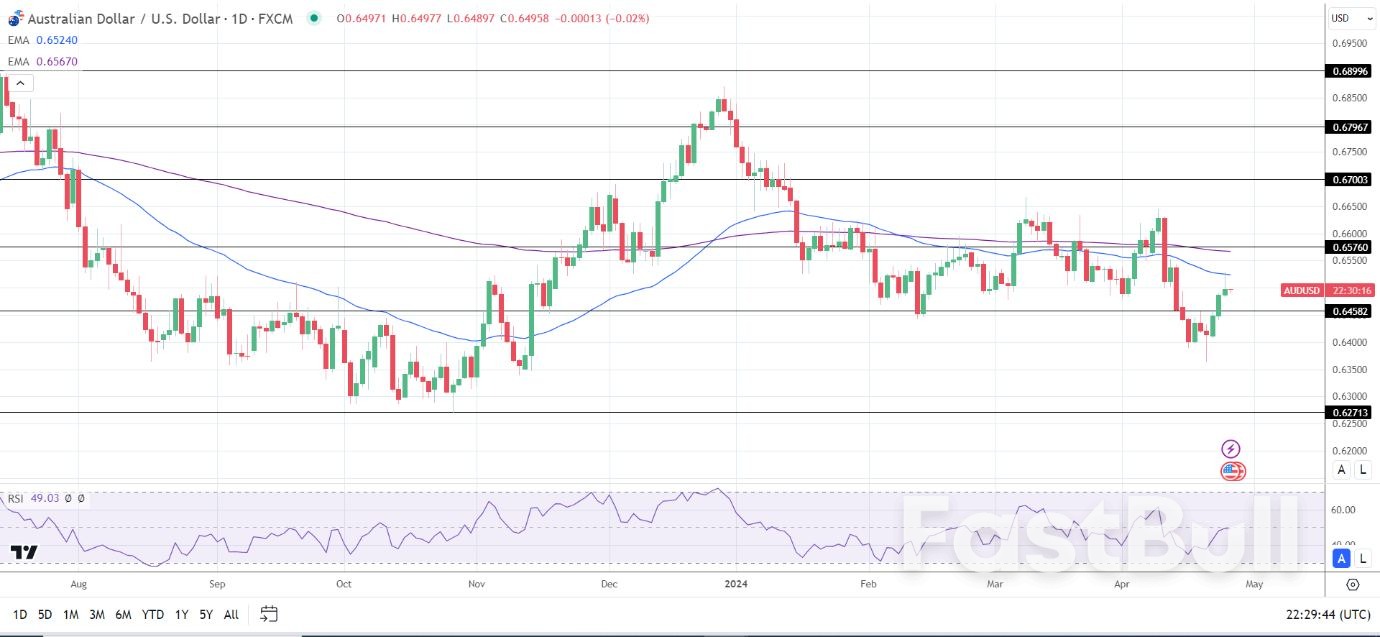
          AUD to USD Forecast: RBA's Next Move Amid US GDP Release_1The AUD/USD remained below the 50-day and 200-day EMAs, affirming the bearish price signals.
          An Aussie dollar move through the 50-day EMA would give the bulls a run at the 200-day EMA and the $0.65760 resistance level. A break above the $0.65760 resistance level would bring the $0.66 handle into play.
          US GDP and jobless claims figures need consideration.
          Conversely, an AUD/USD drop below the $0.64500 handle would bring the $0.64582 support level into play. A fall through the $0.64582 support level could give the bears a run at the $0.62713 support level.
          Given a 14-period Daily RSI reading of 49.03, the AUD/USD could drop to the $0.63500 handle before entering oversold territory.

          Source: FX Empire

          To stay updated on all economic events of today, please check out our Economic calendar
          Risk Warnings and Disclaimers
          You understand and acknowledge that there is a high degree of risk involved in trading. Following any strategies or investment methods may lead to potential losses. The content on the site is provided by our contributors and analysts for information purposes only. You are solely responsible for determining whether any trading assets, securities, strategy, or any other product is suitable for investing based on your own investment objectives and financial situation.
          Add to Favorites
          Share
          FastBull
          Copyright © 2025 FastBull Ltd

          728 RM B 7/F GEE LOK IND BLDG NO 34 HUNG TO RD KWUN TONG KLN HONG KONG

          TelegramInstagramTwitterfacebooklinkedin
          App Store Google Play Google Play
          Products
          Charts

          Chats

          Q&A with Experts
          Screeners
          Economic Calendar
          Data
          Tools
          Membership
          Features
          Function
          Markets
          Copy Trading
          Latest Signals
          Contests
          News
          Analysis
          24/7
          Columns
          Education
          Company
          Careers
          About Us
          Contact Us
          Advertising
          Help Center
          Feedback
          User Agreement
          Privacy Policy
          Business

          White Label

          Data API

          Web Plug-ins

          Poster Maker

          Affiliate Program

          Risk Disclosure

          The risk of loss in trading financial instruments such as stocks, FX, commodities, futures, bonds, ETFs and crypto can be substantial. You may sustain a total loss of the funds that you deposit with your broker. Therefore, you should carefully consider whether such trading is suitable for you in light of your circumstances and financial resources.

          No decision to invest should be made without thoroughly conducting due diligence by yourself or consulting with your financial advisors. Our web content might not suit you since we don't know your financial conditions and investment needs. Our financial information might have latency or contain inaccuracy, so you should be fully responsible for any of your trading and investment decisions. The company will not be responsible for your capital loss.

          Without getting permission from the website, you are not allowed to copy the website's graphics, texts, or trademarks. Intellectual property rights in the content or data incorporated into this website belong to its providers and exchange merchants.

          Not Logged In

          Log in to access more features

          FastBull Membership

          Not yet

          Purchase

          Become a signal provider
          Help Center
          Customer Service
          Dark Mode
          Price Up/Down Colors

          Log In

          Sign Up

          Position
          Layout
          Fullscreen
          Default to Chart
          The chart page opens by default when you visit fastbull.com