• Trade
  • Markets
  • Copy
  • Contests
  • News
  • 24/7
  • Calendar
  • Q&A
  • Chats
Trending
Screeners
SYMBOL
LAST
BID
ASK
HIGH
LOW
NET CHG.
%CHG.
SPREAD
SPX
S&P 500 Index
6870.39
6870.39
6870.39
6895.79
6858.28
+13.27
+ 0.19%
--
DJI
Dow Jones Industrial Average
47954.98
47954.98
47954.98
48133.54
47871.51
+104.05
+ 0.22%
--
IXIC
NASDAQ Composite Index
23578.12
23578.12
23578.12
23680.03
23506.00
+72.99
+ 0.31%
--
USDX
US Dollar Index
98.880
98.960
98.880
98.960
98.730
-0.070
-0.07%
--
EURUSD
Euro / US Dollar
1.16520
1.16527
1.16520
1.16717
1.16341
+0.00094
+ 0.08%
--
GBPUSD
Pound Sterling / US Dollar
1.33277
1.33285
1.33277
1.33462
1.33136
-0.00035
-0.03%
--
XAUUSD
Gold / US Dollar
4207.90
4208.33
4207.90
4218.85
4190.61
+9.99
+ 0.24%
--
WTI
Light Sweet Crude Oil
59.388
59.418
59.388
60.084
59.291
-0.421
-0.70%
--

Community Accounts

Signal Accounts
--
Profit Accounts
--
Loss Accounts
--
View More

Become a signal provider

Sell trading signals to earn additional income

View More

Guide to Copy Trading

Get started with ease and confidence

View More

Signal Accounts for Members

All Signal Accounts

Best Return
  • Best Return
  • Best P/L
  • Best MDD
Past 1W
  • Past 1W
  • Past 1M
  • Past 1Y

All Contests

  • All
  • Trump Updates
  • Recommend
  • Stocks
  • Cryptocurrencies
  • Central Banks
  • Featured News
Top News Only
Share

Kremlin: India Buys Energy Where It Is Profitable To And As Far As We Understand They Will Continue To Do That

Share

Turkey's Main Banking Index Up 2.5%

Share

Turkey's Main BIST-100 Index Up 1.9%

Share

Hungary's Preliminary November Budget Balance Huf -403 Billion

Share

Indian Rupee Down 0.1% At 90.07 Per USA Dollar As Of 3:30 P.M. Ist, Previous Close 89.98

Share

India's Nifty 50 Index Provisionally Ends 0.96% Lower

Share

[JPMorgan: US Stock Rally May Stagnate Following Fed Rate Cut] JPMorgan Strategists Say The Recent Rally In US Stocks May Stall As Investors Take Profits Following The Anticipated Fed Rate Cut. The Market Currently Predicts A 92% Probability Of The Fed Lowering Borrowing Costs On Wednesday. Expectations Of A Rate Cut Have Continued To Rise, Fueled By Positive Signals From Policymakers In Recent Weeks. "Investors May Be More Inclined To Lock In Gains At The End Of The Year Rather Than Increase Directional Exposure," Mislav Matejka's Team Wrote In A Report

Share

Russian Defence Ministry: Russian Forces Take Control Of Novodanylivka In Ukraine's Zaporizhzhia Region

Share

Russian Defence Ministry: Russian Forces Take Control Of Chervone In Ukraine's Donetsk Region

Share

French Finance Ministry: Government Started Process To Block Temporarily Shein Platform

Share

Finance Minister: Indonesia To Impose Coal Export Tax Of Up To 5% Next Year

Share

[Trump Considering Fired Homeland Security Secretary Noem? White House Denies] According To Reports From US Media Outlets Such As The Daily Beast And The UK's Independent, The White House Has Denied Reports That US President Trump Is Considering Firing Homeland Security Secretary Noem. White House Spokesperson Abigail Jackson Posted On Social Media On The 7th Local Time, Calling The Claims "fake News" And Stating That "Secretary Noem Has Done An Excellent Job Implementing The President's Agenda And 'making America Safe Again'."

Share

HKEX: Standard Chartered Bought Back 571604 Total Shares On Other Exchanges For Gbp9.5 Million On Dec 5

Share

Morgan Stanley Reiterates Bullish Outlook On US Stocks Due To Fed Rate Cut Expectations. Morgan Stanley Strategists Believe That The US Stock Market Faces A "bullish Outlook" Given Improved Earnings Expectations And Anticipated Fed Rate Cuts. They Expect Strong Corporate Earnings By 2026, And Anticipate The Fed Will Cut Rates Based On Lagging Or Mildly Weak Labor Markets. They Expect The US Consumer Discretionary Sector And Small-cap Stocks To Continue To Outperform

Share

China's National Development And Reform Commission Announced That Starting From 24:00 On December 8, The Retail Price Limit For Gasoline And Diesel In China Will Be Reduced By 55 Yuan Per Ton, Which Translates To A Reduction Of 0.04 Yuan Per Liter For 92-octane Gasoline, 0.05 Yuan Per Liter For 95-octane Gasoline, And 0.05 Yuan Per Liter For 0# Diesel

Share

Tkms CEO: US Security Strategy Highlights Need For Europe To Take Care Of Its Own Defences

Share

USA S&P 500 E-Mini Futures Up 0.1%, NASDAQ 100 Futures Up 0.18%, Dow Futures Down 0.02%

Share

London Metal Exchange (LME): Copper Inventories Increased By 2,000 Tons, Aluminum Inventories Decreased By 2,500 Tons, Nickel Inventories Increased By 228 Tons, Zinc Inventories Increased By 2,375 Tons, Lead Inventories Decreased By 3,725 Tons, And Tin Inventories Decreased By 10 Tons

Share

Swiss Sight Deposits Of Domestic Banks At 440.519 Billion Sfr In Week Ending December 5 Versus 437.298 Billion Sfr A Week Earlier

Share

Czech November Jobless Rate 4.6% Versus Mkt Fcast 4.7%

TIME
ACT
FCST
PREV
France Industrial Output MoM (SA) (Oct)

A:--

F: --

P: --
France Trade Balance (SA) (Oct)

A:--

F: --

P: --
Euro Zone Employment YoY (SA) (Q3)

A:--

F: --

P: --
Canada Part-Time Employment (SA) (Nov)

A:--

F: --

P: --

Canada Unemployment Rate (SA) (Nov)

A:--

F: --

P: --

Canada Full-time Employment (SA) (Nov)

A:--

F: --

P: --

Canada Labor Force Participation Rate (SA) (Nov)

A:--

F: --

P: --

Canada Employment (SA) (Nov)

A:--

F: --

P: --

U.S. PCE Price Index MoM (Sept)

A:--

F: --

P: --

U.S. Personal Income MoM (Sept)

A:--

F: --

P: --

U.S. Core PCE Price Index MoM (Sept)

A:--

F: --

P: --

U.S. PCE Price Index YoY (SA) (Sept)

A:--

F: --

P: --

U.S. Core PCE Price Index YoY (Sept)

A:--

F: --

P: --

U.S. Personal Outlays MoM (SA) (Sept)

A:--

F: --

P: --
U.S. 5-10 Year-Ahead Inflation Expectations (Dec)

A:--

F: --

P: --

U.S. Real Personal Consumption Expenditures MoM (Sept)

A:--

F: --

P: --
U.S. Weekly Total Rig Count

A:--

F: --

P: --

U.S. Weekly Total Oil Rig Count

A:--

F: --

P: --

U.S. Consumer Credit (SA) (Oct)

A:--

F: --

P: --
China, Mainland Foreign Exchange Reserves (Nov)

A:--

F: --

P: --

Japan Trade Balance (Oct)

A:--

F: --

P: --

Japan Nominal GDP Revised QoQ (Q3)

A:--

F: --

P: --

China, Mainland Imports YoY (CNH) (Nov)

A:--

F: --

P: --

China, Mainland Exports (Nov)

A:--

F: --

P: --

China, Mainland Imports (CNH) (Nov)

A:--

F: --

P: --

China, Mainland Trade Balance (CNH) (Nov)

A:--

F: --

P: --

China, Mainland Exports YoY (USD) (Nov)

A:--

F: --

P: --

China, Mainland Imports YoY (USD) (Nov)

A:--

F: --

P: --

Germany Industrial Output MoM (SA) (Oct)

A:--

F: --

P: --
Euro Zone Sentix Investor Confidence Index (Dec)

A:--

F: --

P: --

Canada National Economic Confidence Index

--

F: --

P: --

U.K. BRC Like-For-Like Retail Sales YoY (Nov)

--

F: --

P: --

U.K. BRC Overall Retail Sales YoY (Nov)

--

F: --

P: --

Australia Overnight (Borrowing) Key Rate

--

F: --

P: --

RBA Rate Statement
RBA Press Conference
Germany Exports MoM (SA) (Oct)

--

F: --

P: --

U.S. NFIB Small Business Optimism Index (SA) (Nov)

--

F: --

P: --

Mexico 12-Month Inflation (CPI) (Nov)

--

F: --

P: --

Mexico Core CPI YoY (Nov)

--

F: --

P: --

Mexico PPI YoY (Nov)

--

F: --

P: --

U.S. Weekly Redbook Index YoY

--

F: --

P: --

U.S. JOLTS Job Openings (SA) (Oct)

--

F: --

P: --

China, Mainland M1 Money Supply YoY (Nov)

--

F: --

P: --

China, Mainland M0 Money Supply YoY (Nov)

--

F: --

P: --

China, Mainland M2 Money Supply YoY (Nov)

--

F: --

P: --

U.S. EIA Short-Term Crude Production Forecast For The Year (Dec)

--

F: --

P: --

U.S. EIA Natural Gas Production Forecast For The Next Year (Dec)

--

F: --

P: --

U.S. EIA Short-Term Crude Production Forecast For The Next Year (Dec)

--

F: --

P: --

EIA Monthly Short-Term Energy Outlook
U.S. API Weekly Gasoline Stocks

--

F: --

P: --

U.S. API Weekly Cushing Crude Oil Stocks

--

F: --

P: --

U.S. API Weekly Crude Oil Stocks

--

F: --

P: --

U.S. API Weekly Refined Oil Stocks

--

F: --

P: --

South Korea Unemployment Rate (SA) (Nov)

--

F: --

P: --

Japan Reuters Tankan Non-Manufacturers Index (Dec)

--

F: --

P: --

Japan Reuters Tankan Manufacturers Index (Dec)

--

F: --

P: --

Japan Domestic Enterprise Commodity Price Index MoM (Nov)

--

F: --

P: --

Japan Domestic Enterprise Commodity Price Index YoY (Nov)

--

F: --

P: --

China, Mainland PPI YoY (Nov)

--

F: --

P: --

Q&A with Experts
    • All
    • Chatrooms
    • Groups
    • Friends
    Connecting
    .
    .
    .
    Type here...
    Add Symbol or Code

      No matching data

      All
      Trump Updates
      Recommend
      Stocks
      Cryptocurrencies
      Central Banks
      Featured News
      • All
      • Russia-Ukraine Conflict
      • Middle East Flashpoint
      • All
      • Russia-Ukraine Conflict
      • Middle East Flashpoint
      Search
      Products

      Charts Free Forever

      Chats Q&A with Experts
      Screeners Economic Calendar Data Tools
      Membership Features
      Data Warehouse Market Trends Institutional Data Policy Rates Macro

      Market Trends

      Market Sentiment Order Book Forex Correlations

      Top Indicators

      Charts Free Forever
      Markets

      News

      News Analysis 24/7 Columns Education
      From Institutions From Analysts
      Topics Columnists

      Latest Views

      Latest Views

      Trending Topics

      Top Columnists

      Latest Update

      Signals

      Copy Rankings Latest Signals Become a signal provider AI Rating
      Contests
      Brokers

      Overview Brokers Assessment Rankings Regulators News Claims
      Broker listing Forex Brokers Comparison Tool Live Spread Comparison Scam
      Q&A Complaint Scam Alert Videos Tips to Detect Scam
      More

      Business
      Events
      Careers About Us Advertising Help Center

      White Label

      Data API

      Web Plug-ins

      Affiliate Program

      Awards Institution Evaluation IB Seminar Salon Event Exhibition
      Vietnam Thailand Singapore Dubai
      Fans Party Investment Sharing Session
      FastBull Summit BrokersView Expo
      Recent Searches
        Top Searches
          Markets
          News
          Analysis
          User
          24/7
          Economic Calendar
          Education
          Data
          • Names
          • Latest
          • Prev

          View All

          No data

          Scan to Download

          Faster Charts, Chat Faster!

          Download App
          English
          • English
          • Español
          • العربية
          • Bahasa Indonesia
          • Bahasa Melayu
          • Tiếng Việt
          • ภาษาไทย
          • Français
          • Italiano
          • Türkçe
          • Русский язык
          • 简中
          • 繁中
          Open Account
          Search
          Products
          Charts Free Forever
          Markets
          News
          Signals

          Copy Rankings Latest Signals Become a signal provider AI Rating
          Contests
          Brokers

          Overview Brokers Assessment Rankings Regulators News Claims
          Broker listing Forex Brokers Comparison Tool Live Spread Comparison Scam
          Q&A Complaint Scam Alert Videos Tips to Detect Scam
          More

          Business
          Events
          Careers About Us Advertising Help Center

          White Label

          Data API

          Web Plug-ins

          Affiliate Program

          Awards Institution Evaluation IB Seminar Salon Event Exhibition
          Vietnam Thailand Singapore Dubai
          Fans Party Investment Sharing Session
          FastBull Summit BrokersView Expo

          Tariff Reversals Signal Economic Reality Check as Tech and Luxury Sectors Regain Traction

          Gerik

          Economic

          Summary:

          Tariff policy returned to center stage as the Trump administration slashed duties on Swiss goods and key food imports, aiming to ease inflationary pressures...

          Tariff strategy pivots amid economic pressure

          In a notable policy shift, the Trump administration announced on Friday a rollback of tariffs on several agricultural goods, including coffee, fruit, and beef products. This marks a reversal from earlier assertions that tariffs wouldn’t raise prices, as inflation data showed U.S. food costs rose 2.7% year-on-year in September. President Trump’s admission that coffee prices were “a little bit high” reflects a pragmatic, if politically motivated, acknowledgment of economic fundamentals.
          Simultaneously, the U.S. struck a major trade deal with Switzerland, reducing tariffs on Swiss imports from 39% to 15%. In exchange, Swiss companies pledged to invest $200 billion in the U.S. by 2028. The move signals a strategic attempt to rebalance trade relations while supporting domestic investment — but also underscores how political maneuvering eventually confronts economic constraints.

          Markets signal stabilization as AI volatility wanes

          U.S. equity markets showed signs of recovery Friday, suggesting that the recent AI-related volatility may be cooling. The Nasdaq Composite climbed 0.13%, halting a three-day slide, while the S&P 500 remained virtually flat and the Dow Jones Industrial Average dipped 0.65%. This shift came after a rough stretch driven by concerns of overvaluation in AI-linked equities.
          The rebound in tech coincided with new confidence-building moves, such as Berkshire Hathaway’s revealed $4.3 billion stake in Alphabet, a decision attributed to the investment team rather than Warren Buffett himself. The position indicates ongoing institutional belief in the long-term strength of major tech players, even amid short-term correction fears.

          Luxury sector regains luster as China reawakens

          While concerns over China’s economic slowdown have weighed heavily on global luxury brands in 2025, new comments from leading executives suggest a turning point may be near. At the JPMorgan Global Luxury and Brands Conference in Paris, CFOs from Prada and other leading houses expressed cautious optimism about shifting Chinese spending behavior. The revival is being driven by urban middle- and upper-class consumers returning to high-end retail after a year of subdued activity.
          However, JPMorgan’s Chiara Battistini warned against overexcitement, noting the recovery is being compared against a particularly weak baseline. The luxury rally, if it sustains, could benefit from not only Chinese demand but also resilient spending patterns in the U.S. and improved trade sentiment following the U.S.-Switzerland deal.
          Despite earlier rhetoric, the Trump administration’s partial retreat from protectionist trade measures highlights the limits of political control over economic dynamics. With inflation pressure on consumers and markets showing signs of repricing tech and luxury valuations, 2025 is shaping into a year of economic reality checks. Investors should watch not only for further trade realignments but also for sustained signals from consumers both in the U.S. and China to gauge the direction of global growth sectors in the final stretch of the year.

          Source: CNBC

          To stay updated on all economic events of today, please check out our Economic calendar
          Risk Warnings and Disclaimers
          You understand and acknowledge that there is a high degree of risk involved in trading. Following any strategies or investment methods may lead to potential losses. The content on the site is provided by our contributors and analysts for information purposes only. You are solely responsible for determining whether any trading assets, securities, strategy, or any other product is suitable for investing based on your own investment objectives and financial situation.
          Add to Favorites
          Share

          BoJ Policy Outlook Shifts, US and European Officials Release Mixed Signals

          FastBull Featured

          Daily News

          [Quick Facts]

          1. Japan's Finance Minister: Stimulus package to exceed $110 billion.
          2. Japan's economy shrinks for the first time in six quarters, adding uncertainty to BoJ's rate hike path.
          3. Iran's Foreign Minister claims uranium enrichment activities have been fully halted nationwide.
          4. Lane: Risks of slowing inflation should not be ignored; the risk of a December rate cut can not be underestimated.
          5. The US Government exempts agricultural products from the "Reciprocal Tariffs" list.
          6. Miran: Data supports rate cuts; Fed should lean more dovish.
          7. Logan: Hard to support December rate cuts.
          8. Schmid: May oppose rate cut again at December meeting.
          9. Greer: The US and Switzerland reach a Trade Deal, cutting tariffs on Swiss goods to 15%.

          [News Details]

          Japan's Finance Minister: Stimulus package to exceed $110 billion
          According to a report by Nikkei on Sunday, Japanese Finance Minister Satsuki Katayama stated after meeting with Prime Minister Shigeru Ishiba that the country’s economic stimulus package would exceed JP¥17 trillion (approximately US$110 billion). Since taking office in October, Sanae has pledged to formulate a large-scale spending plan to mitigate the economic impact of rising living costs and boost investment in growth areas such as AI and semiconductors. The stimulus package is expected to be finalized after approval at a cabinet meeting on November 21st.
          Japan's economy shrinks for the first time in six quarters, adding uncertainty to BoJ's rate hike path
          Based on the preliminary data released on Monday, Japan's real GDP contracted 0.4% quarter-on-quarter in Q3, equivalent to an annualized decline of 1.8%, marking the first negative growth in six quarters. The data revealed that external demand was the primary drag, reducing GDP by 0.2 percentage points, reflecting the impact of higher US tariffs on Japanese exports. Meanwhile, housing investment plunged 9.4%, another major negative factor, though economists attributed this to temporary regulatory changes and expect a gradual recovery.
          This economic contraction is likely to reinforce the Bank of Japan's rationale for delaying further rate hikes. Markets believe weak economic data will support the central bank's stance of maintaining current policies until next year, further complicating the timeline for future rate increases. At a critical juncture where the BoJ is preparing to exit its ultra-loose monetary policy, this economic downturn provides more room for caution in policy adjustments and introduces new uncertainty into the central bank's normalization process.
          Iran's Foreign Minister claims uranium enrichment activities have been fully halted nationwide
          According to the Associated Press, Iranian Foreign Minister Abbas Araghchi stated on Sunday that authorities in Tehran have stopped all uranium enrichment activities across the country. Responding to reporters' questions, Araghchi made the most direct remarks to date on Iran's nuclear program. In June, Israel and the US bombed Iran's uranium enrichment facilities. Araghchi said there are no undeclared uranium enrichment activities in Iran, and all facilities are under IAEA safeguards. Currently, uranium enrichment is not being conducted because the relevant facilities were attacked.
          Lane: Risks of slowing inflation should not be ignored; the risk of a December rate cut can not be underestimated
          In a speech on the 16th, European Central Bank Governing Council member Philip Lane stated that the eurozone economy has shown resilience, with slow but sustained growth. He said the risk of slowing inflation should not be ignored, highlighting that a further interest rate cut in December is a possibility that "cannot be underestimated."
          The Finnish central bank governor pointed to low energy prices, a stronger euro, and declining wage and service inflation as factors that could push overall inflation significantly below the ECB's 2% target. The risk of another rate cut in December should not be underestimated.
          The US Government exempts agricultural products from the "Reciprocal Tariffs" list
          The White House announced the latest executive order signed by President Trump, further adjusting the scope of the "reciprocal tariffs," excluding certain agricultural products from the additional tariffs previously imposed under the Reciprocal Tariffs Executive Order. The order noted that, based on assessments of domestic demand and production capacity for related products, as well as the latest recommendations from government agencies, Trump deemed it necessary to revise the tariff list to address the "national emergency" declared in the original order. The updated tariff exemption list and potential adjustments for "allied partners" will take effect at 00:01 EST on November 13th, 2025. The order also mandates revisions to the Harmonized Tariff Schedule and stipulates the handling of potential tariff refunds.
          Miran: Data supports rate cuts; Fed should lean more dovish
          Federal Reserve Governor Stephen Miran stated in a speech on Friday that recent economic data support the case for Fed rate cuts. Since the September FOMC meeting, he said, all the data points to a dovish stance— inflation data is better than expected, and labor market data is weaker. On the question of further rate cuts, all of this should push the Fed toward a more dovish position, not the opposite.
          Logan: Hard to support December rate cuts
          Dallas Fed President Lorie Logan said in a Friday speech that she is concerned about persistently high and potentially rising inflation, which may take too long to return to the Fed’s 2% target. Unless there is compelling evidence that inflation is falling faster than she expects or that the labor market is cooling more sharply than its current gradual pace, she finds it hard to support another rate cut. Before seeing solid evidence that inflation is steadily moving toward the 2% target, she believes a moderately restrictive policy stance remains appropriate.
          Schmid: May oppose rate cut again at December meeting
          Kansas City Fed President Jeffrey Schmid said on Friday that his concerns about "too hot" inflation go well beyond the narrow effects of tariffs alone. He argued that the current cooling in the US labor market stems primarily from structural changes, not issues that lower interest rates can resolve. Further rate cuts could undermine the Fed's efforts to achieve its 2% inflation target. This suggests he may oppose a rate cut at the December meeting.
          Greer: The US and Switzerland reach a Trade Deal, cutting tariffs on Swiss goods to 15%
          U.S. Trade Representative Jamieson Greer said, "We've essentially reached a deal with Switzerland." Duties will be reduced to 15%, and details will be announced by the White House on Friday. He added that Switzerland might be next; the U.S. actually reached an agreement with Switzerland, and the details will be published on the White House website today. He told reporters that US tariffs on Swiss goods will drop from 39% to 15%, while Switzerland has committed to investing $200 billion in the US. Greer said, "They're going to send a lot of manufacturing here to the United States — pharmaceuticals, gold smelting, railway equipment — so we’re really excited about that deal and what it means for American manufacturing." He added that Switzerland has also pledged to purchase more Boeing aircraft.

          [Today's Focus]

          UTC+8 16:15 ECB Vice President Luis de Guindos Speaks
          UTC+8 21:20 BoE Monetary Policy Committee Member Catherine Mann Speaks
          UTC+8 21:30 Canada October CPI
          UTC+8 22:45 ECB Chief Economist Philip Lane Speaks
          UTC+8 23:00 US August Construction Spending MoM
          Risk Warnings and Disclaimers
          You understand and acknowledge that there is a high degree of risk involved in trading. Following any strategies or investment methods may lead to potential losses. The content on the site is provided by our contributors and analysts for information purposes only. You are solely responsible for determining whether any trading assets, securities, strategy, or any other product is suitable for investing based on your own investment objectives and financial situation.
          Add to Favorites
          Share

          Trump Dismisses Marjorie Taylor Greene’s Claim That His Attacks Put Her In Danger

          Samantha Luan

          Political

          Economic

          U.S. President Donald Trump doubled down on his attacks against Republican lawmaker Marjorie Taylor Greene on Sunday, dismissing her claim that his criticism was endangering her and saying he did not believe anyone was targeting her.

          Greene said on Saturday that Trump's online criticism had unleashed a surge of threats directed at her. On Sunday morning, she told CNN that Trump calling her a traitor was the "most hurtful" part of his remarks.

          Trump repeated the insult hours later. "Marjorie 'Traitor' Greene," he said, referring to the lawmaker. "I don't think her life is in danger...I don't think anybody cares about her," the president told reporters before boarding Air Force One on Sunday night for a return to Washington, D.C. from his Mar-a-Lago social club in Florida.

          Greene, a U.S. House of Representatives member from Georgia who was long known as a Trump loyalist, has recently taken positions at odds with the president. She said on Saturday she has been contacted by private security firms warning about her safety and that harsh attacks against her have previously resulted in death threats.

          She attributed her split with the president to her support for releasing records related to the late financier and sex offender Jeffrey Epstein.

          Trump has dismissed the furor over the Epstein case as a "hoax" pushed by Democrats, but Greene on Wednesday was one of only four House Republicans who joined Democrats in signing a petition to force a vote on releasing the full Justice Department files related to Epstein.

          The dramatic rupture between two longtime allies suggests a deeper fracture within Trump's Republican base and raises questions about the stability of his support on the far right of the ideological spectrum.

          Trump broke with Greene on Friday night in a withering social media post in which he referred to Greene as "Wacky" and a "ranting lunatic" who complained he would not take her calls.

          He continued his criticism of her with more social media posts over the weekend, calling her a "Lightweight Congresswoman," "Traitor" and a "disgrace" to the Republican Party.

          The president also wrote that conservative voters in Greene's district might consider a primary challenger and that he would support the right candidate against her in next year's congressional election.

          Despite his attacks on Greene, Trump on Sunday night wrote on social media that "House Republicans should vote to release the Epstein files, because we have nothing to hide ..."

          Over the weekend, Trump had persistently pushed back against reporters' questions about releasing the Epstein files. Reflecting his often combative relationship with media, at one point he said "quiet, quiet piggy" in response to a question from a female reporter.

          The White House did not respond to requests for comment on the clash between Greene and Trump or his remarks to the reporter.

          Source: Investing

          To stay updated on all economic events of today, please check out our Economic calendar
          Risk Warnings and Disclaimers
          You understand and acknowledge that there is a high degree of risk involved in trading. Following any strategies or investment methods may lead to potential losses. The content on the site is provided by our contributors and analysts for information purposes only. You are solely responsible for determining whether any trading assets, securities, strategy, or any other product is suitable for investing based on your own investment objectives and financial situation.
          Add to Favorites
          Share

          China-Japan Tensions Rattle Tourism Stocks as Asia Markets Trade Mixed

          Gerik

          Economic

          Stocks

          Japan’s tourism sector reels from Beijing’s travel advisory

          Investor sentiment in Asia was shaken Monday as tensions between China and Japan escalated, with Beijing issuing a travel and study advisory warning its citizens about visits to Japan. This move triggered a sell-off in Japan’s tourism-exposed stocks, dragging the Nikkei 225 down by 0.72% to 50,011.53 and the Topix by 0.44%.
          Luxury and leisure brands took the biggest hit. Shiseido, heavily reliant on Chinese consumer spending, plummeted 11%. Department store group Isetan Mitsukoshi Holdings dropped over 10%, while Oriental Land, the operator of Tokyo Disney Resort, shed 4.74%. Shares of ANA Holdings, Japan’s leading airline, fell by 3.48%.
          The travel warning comes at a fragile moment for Japan’s economy, which contracted 0.4% in the third quarter its first shrinkage in six quarters though this was less severe than the 0.6% decline forecast by markets.

          Broader Asian markets reflect divergence in growth outlooks

          Outside of Japan, Asian markets posted varied performances. South Korea’s Kospi index stood out with a 1.78% surge, likely boosted by tech optimism and robust domestic trading. The Kosdaq also edged up 0.68%.
          In contrast, Hong Kong’s Hang Seng Index dropped 0.51% to 26,440.75, as investor caution prevailed, and the mainland’s CSI 300 was flat, reflecting subdued enthusiasm amid persistent economic concerns. The Shanghai Composite also lost ground, slipping 0.36%.
          Australia’s S&P/ASX 200 benchmark closed 0.29% lower at 8,609.10, amid profit-taking and mixed commodity signals. Meanwhile, traders awaited macroeconomic releases such as Thailand’s Q3 GDP and Singapore’s trade balance to gain further regional cues.

          Wall Street recovery offers limited support to Asia

          Friday’s intraday comeback in the U.S. stock market offered only mild relief to Asia. The Nasdaq Composite reversed losses to gain 0.13% to 22,900.59, after a steep tech-led drop earlier in the week. The S&P 500 finished flat at 6,734.11, while the Dow Jones fell 0.65% to 47,147.48 despite recovering from an earlier plunge of nearly 600 points.
          The reversal in U.S. equities, driven by bargain-hunting in tech stocks, indicated investor resilience but failed to fully lift Asian sentiment, especially with geopolitical risks overshadowing fundamentals in parts of the region.
          The mixed performance in Asia reflects a complex mix of geopolitical headwinds, export vulnerabilities, and domestic economic indicators. Japan remains particularly exposed to diplomatic strains with China, given its dependence on tourism and external demand. While South Korea’s tech sector provided a bright spot, the broader Asia-Pacific outlook remains fragile, with traders closely watching upcoming data and any policy signals from China and Japan as tensions continue to evolve.

          Source: CNBC

          To stay updated on all economic events of today, please check out our Economic calendar
          Risk Warnings and Disclaimers
          You understand and acknowledge that there is a high degree of risk involved in trading. Following any strategies or investment methods may lead to potential losses. The content on the site is provided by our contributors and analysts for information purposes only. You are solely responsible for determining whether any trading assets, securities, strategy, or any other product is suitable for investing based on your own investment objectives and financial situation.
          Add to Favorites
          Share

          China’s Trade Clout Can Quicken The Yuan’s Rise

          Samantha Luan

          Forex

          Economic

          A single word often makes a big difference in Chinese policy. In previous five-year economic development plans, for example, Beijing had always reiterated it wants to "prudently promote" yuan internationalisation. In an outline of the next 2026-2030 blueprint unveiled last month, the word "prudently" has been struck out. That signals bolder designs for the renminbi, though progress will be limited so long as economic planners keep tight control over capital flows.

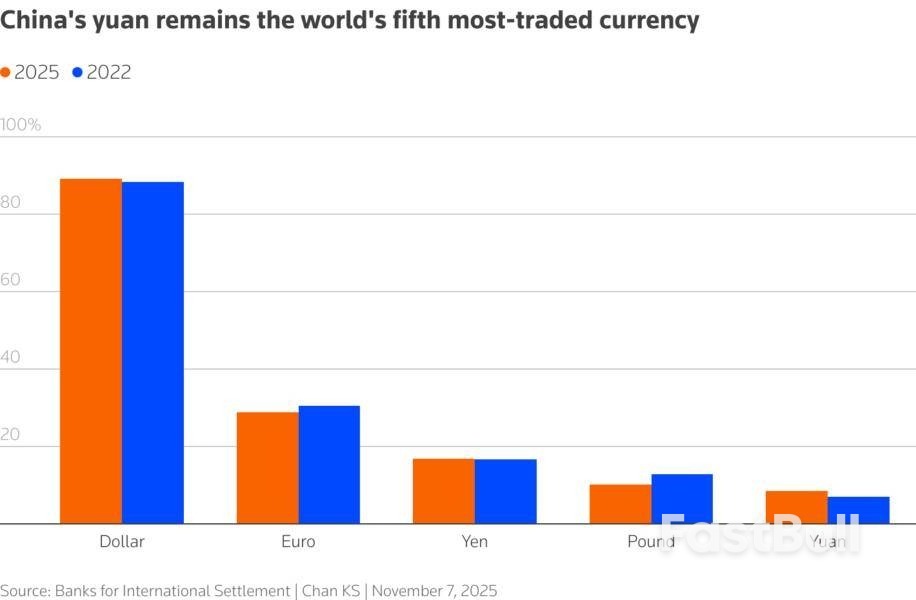
          China's $20 trillion economy may be the second-largest in the world, but its currency was only the fifth most-traded last year, according to a September report from the Bank of International Settlements. Still, thanks to incremental policies, including currency swap deals with other central banks, the yuan now makes up 8.5% of global currency transactions, up from 7% in 2022.

          Thomson ReutersChina's yuan remains the world's fifth most-traded currency

          For Beijing, trade settlement will probably be the next area of focus, given China's 15% share of $33 trillion of global trade by value. Notably, as part of a broader contract dispute, China's steel industry has stopped purchasing dollar-denominated iron ore from Australia's BHPsince October, according to Chinese media, citing sources, and has insisted the mining giant settle 30% of transactions in yuan going forward. Separately, Dutch chipmaker Nexperia's Chinese unit has demanded all transactions be settled in yuan, Reuters reported, citing sources, after The Hague seized control of the company's Netherlands-based parent in September, sparking a broader standoff.

          These moves can have an immediate impact. Up to 12.4 trillion yuan ($1.7 trillion) of trade with China was paid in local currency last year, about 27% of the total, according to the country's central bank's yuan internationalisation report published last week. Settling 30% of imports from BHP can add another $39 billion worth of yuan-denominated transactions annually. And using renminbi will appeal to countries that want to reduce their reliance on the U.S. dollar. That includes Brazil and Russia, which exported $31 billion of soybeans and $50 billion of crude oil, respectively, to the People's Republic last year.

          Chinese planners have long insisted that their plan is not to replace the greenback with a "redback". And it's unlikely they will allow the country's currency to flow freely across its borders. Still, Beijing's trade clout can help it chip away at the dollar's dominance.

          CONTEXT NEWS

          Commodity news portal SteelOrbis reported on October 11 that BHP has agreed with China Mineral Resources Group to switch to yuan settlements for 30% of its spot ore trade with China, citing sources.

          Separately, Dutch chipmaker Nexperia's Chinese unit has resumed supplying semiconductors to local distributors, but all sales to distributors must now be settled in yuan, Reuters reported on October 23, citing two people briefed on the matter.

          Source: TradingView

          To stay updated on all economic events of today, please check out our Economic calendar
          Risk Warnings and Disclaimers
          You understand and acknowledge that there is a high degree of risk involved in trading. Following any strategies or investment methods may lead to potential losses. The content on the site is provided by our contributors and analysts for information purposes only. You are solely responsible for determining whether any trading assets, securities, strategy, or any other product is suitable for investing based on your own investment objectives and financial situation.
          Add to Favorites
          Share

          India's Commercial Tribunal Logjam Locks Up Billions Of Dollars

          Justin

          Political

          Forex

          Economic

          A legal logjam stemming from India's slow-moving judiciary and complex tax system has locked up trillions of rupees within the South Asian nation's system of commercial tribunals, pressuring business cashflow and investment decisions.

          A recent report by the think tank Daksh found that 24.72 trillion rupees ($279 billion) of business transactions remain locked in tax and other disputes in commercial tribunals across the country. These disputes include insolvency cases, debt recovery by banks and financial institutions, corporate litigation and discrepancies over the Goods and Services Tax.

          A lack of technical expertise and a chronic shortage of judges have created a backlog at tribunals equivalent to 7.5% of the country's 330.68 trillion rupee gross domestic product in the fiscal year through March this year, warned Daksh, an independent research institute focused on judicial reform based in Bengaluru.

          The report, published in September, highlighted that a mere 350 tribunal members are charged with handling over 356,000 pending cases involving business disputes.

          "The complexities in the system allow for inefficiency, a lack of the right people and the absence of technology," Surya Prakash, one of the authors of the report, told Nikkei Asia.

          Because of the inefficiency and sluggish resolutions, powerful people can exploit the system -- for example by lodging cases against competitors that are costly to defend.

          "Those who have money get what they want," Prakash said. "To put it bluntly, it's a den of corruption."

          According to the report, which examined 10 key commercial tribunals adjudicating disputes related to tax, customs, company law and the electricity and telecom sectors, some tribunals have introduced limited online filing and digital hearings, but most remain burdened by red tape, overlapping mandates and a lack of specialized knowledge among adjudicators.

          Tribunal members are often retired judges or civil servants who are unfamiliar with the complex financial, technical or tax issues they must decide on.

          The tribunals were intended to ease the burden on regular courts and offer faster resolution. Many of these quasi-judicial bodies, such as the commercial tribunal, operate under the federal government and so are much more easily influenced by the state than the broader judicial system.

          "The main problem is the [commercial] judicial system. Right from the inception to operations to dispute resolution in any business, every step is touched by the judicial system in India. Hence, reforms need to start here," said Prakash.

          The state of the insolvency system is directly linked to the health of the financial sector, a key engine of growth, said Sumant Batra, a veteran insolvency lawyer and former president of INSOL International, a global association of accountants and lawyers specializing in insolvency.

          "Delays in deciding insolvency cases under the IBC (Insolvency and Bankruptcy Code) by the NCLT (National Company Law Tribunal) have been a matter of concern," Batra said. "A distressed asset has a life cycle. Its value gradually declines with time if distress is not addressed in a timely manner. Delays in the resolution of stressed assets have a direct bearing on the ... outcomes of the economy in general and the stakeholders in particular."

          According to Daksh, nearly half the judicial posts in major commercial tribunals are vacant, while the number of pending cases is in the tens of thousands. At several benches, a single judge is handling thousands of matters.

          Shiva Kirti Singh, a former Supreme Court justice who also served as chairman of the telecom disputes panel, said a major change in attitude is required if business-related litigation is to be addressed effectively. "Instead of adjudicating bodies, India should have an ombudsman-like structure to actually settle the disputes," Singh said. He also cautioned that artificial intelligence and technology-related businesses require a "competent regulatory authority" in a fast-changing world.

          "They are likely going to suffer in a big way unless we have a very competent regulatory approach," Singh said.

          The government is promoting India as a destination for global manufacturing and foreign capital investment through its infrastructure and Make in India initiatives. But such investments depend on efficient contract enforcement and dispute resolution, and companies face uncertainty over cash flow and project timelines if vast sums are tied up in litigation.

          In the 2019 edition of the World Bank's Doing Business index, India ranked poorly on enforcing contracts, with an average resolution time of more than 1,400 days. The commercial tribunal system was meant to improve that record, but Daksh's data suggests it has merely shifted the burden.

          Exacerbating the problems is the complexity of the tribunal system. Governance frameworks are inconsistent, appointment procedures differ, case tracking is largely manual and there is no unified digital registry. Appeals of tribunal decisions often end up in higher courts, adding another layer to the already congested judicial hierarchy.

          Legal experts recommend an independent tribunals commission to oversee appointments, monitor performance and standardize procedures. Yet such reforms have made little headway despite repeated recommendations from the state-backed Law Commission and the Supreme Court over the past decade.

          Some of the resistance comes from the bureaucracy, which continues to wield enormous control over staffing, budgets and infrastructure.

          "There is no doubt in anyone's mind that the law in India is quite complex," Prakash said. "Efforts have been made to simplify the law, but it has ended up simplifying the language of the law without trying to simplify the actual complexity of the substantive things.

          "Ease of doing business has come up in many discussions, but it has not really percolated down to the operational level."

          Source: Asia_Nikkei

          To stay updated on all economic events of today, please check out our Economic calendar
          Risk Warnings and Disclaimers
          You understand and acknowledge that there is a high degree of risk involved in trading. Following any strategies or investment methods may lead to potential losses. The content on the site is provided by our contributors and analysts for information purposes only. You are solely responsible for determining whether any trading assets, securities, strategy, or any other product is suitable for investing based on your own investment objectives and financial situation.
          Add to Favorites
          Share

          Japan Eyes Crypto Tax Cuts and Insider Trading Rules in Regulatory Overhaul

          Gerik

          Economic

          Cryptocurrency

          A strategic shift in Japan’s crypto policy

          According to The Asahi Shimbun, Japan’s Financial Services Agency (FSA) is preparing a landmark regulatory reform that could redefine the country’s crypto landscape. The proposed changes would classify cryptocurrencies such as Bitcoin and Ethereum as formal financial products, extending traditional financial oversight mechanisms including insider trading regulations into the digital asset space.
          This reclassification could bring a higher level of transparency and investor protection to Japan’s crypto markets, aligning them more closely with securities regulations applied to stocks and bonds.

          Lower crypto tax rate to stimulate domestic participation

          One of the most significant reforms under consideration is a dramatic reduction in the tax rate on crypto gains. Currently, profits from cryptocurrency transactions can be taxed at rates up to 55% depending on income brackets. Under the new proposal, these would be standardized at a flat 20% rate, the same as capital gains on equities.
          This move is likely aimed at encouraging greater domestic participation in the digital asset market by aligning crypto with traditional investment vehicles, removing a long-standing barrier to broader adoption among retail and institutional investors.

          Banks and insurers may enter the crypto space

          In another bold step, the FSA is reportedly planning to allow banks and insurance companies to offer crypto-related products directly to their customers. Through their securities arms, these institutions would be able to sell crypto assets to depositors and insurance policyholders potentially mainstreaming access to digital assets across Japan’s financial system.
          This integration could significantly expand the crypto user base in Japan and accelerate institutional adoption, particularly if supported by clearer risk disclosures and standardized frameworks for pricing volatility.

          Disclosure and transparency requirements expanded

          Alongside these changes, crypto exchange service providers would face stricter requirements to disclose risks associated with price volatility. This aligns with the broader global push for enhanced transparency in crypto trading and investment platforms, especially in light of recent high-profile exchange failures and fraud scandals worldwide.
          By mandating more detailed risk reporting, the FSA aims to equip investors with better tools to evaluate their exposure, potentially improving trust in Japanese crypto markets.

          Timing and political outlook

          The FSA intends to propose the necessary legislation during Japan’s next ordinary parliamentary session in 2026. While not yet formally confirmed by the agency, the report suggests that these changes could be a cornerstone of Japan’s strategy to remain a leading, innovation-friendly, yet regulated crypto hub in Asia, especially as rivals like Singapore and South Korea refine their own regulatory approaches.
          Japan’s proposed crypto reforms represent a comprehensive strategy to legitimize and normalize digital asset trading within its financial system. By aligning tax policies with equity trading, introducing stronger regulatory oversight, and integrating crypto into mainstream banking and insurance channels, the country is positioning itself at the forefront of regulated crypto innovation. If passed, these measures could have ripple effects across Asia’s regulatory landscape and possibly spark a more investor-friendly phase of global crypto adoption.

          Source: Reuters

          To stay updated on all economic events of today, please check out our Economic calendar
          Risk Warnings and Disclaimers
          You understand and acknowledge that there is a high degree of risk involved in trading. Following any strategies or investment methods may lead to potential losses. The content on the site is provided by our contributors and analysts for information purposes only. You are solely responsible for determining whether any trading assets, securities, strategy, or any other product is suitable for investing based on your own investment objectives and financial situation.
          Add to Favorites
          Share
          FastBull
          Copyright © 2025 FastBull Ltd

          728 RM B 7/F GEE LOK IND BLDG NO 34 HUNG TO RD KWUN TONG KLN HONG KONG

          TelegramInstagramTwitterfacebooklinkedin
          App Store Google Play Google Play
          Products
          Charts

          Chats

          Q&A with Experts
          Screeners
          Economic Calendar
          Data
          Tools
          Membership
          Features
          Function
          Markets
          Copy Trading
          Latest Signals
          Contests
          News
          Analysis
          24/7
          Columns
          Education
          Company
          Careers
          About Us
          Contact Us
          Advertising
          Help Center
          Feedback
          User Agreement
          Privacy Policy
          Business

          White Label

          Data API

          Web Plug-ins

          Poster Maker

          Affiliate Program

          Risk Disclosure

          The risk of loss in trading financial instruments such as stocks, FX, commodities, futures, bonds, ETFs and crypto can be substantial. You may sustain a total loss of the funds that you deposit with your broker. Therefore, you should carefully consider whether such trading is suitable for you in light of your circumstances and financial resources.

          No decision to invest should be made without thoroughly conducting due diligence by yourself or consulting with your financial advisors. Our web content might not suit you since we don't know your financial conditions and investment needs. Our financial information might have latency or contain inaccuracy, so you should be fully responsible for any of your trading and investment decisions. The company will not be responsible for your capital loss.

          Without getting permission from the website, you are not allowed to copy the website's graphics, texts, or trademarks. Intellectual property rights in the content or data incorporated into this website belong to its providers and exchange merchants.

          Not Logged In

          Log in to access more features

          FastBull Membership

          Not yet

          Purchase

          Become a signal provider
          Help Center
          Customer Service
          Dark Mode
          Price Up/Down Colors

          Log In

          Sign Up

          Position
          Layout
          Fullscreen
          Default to Chart
          The chart page opens by default when you visit fastbull.com