• Trade
  • Markets
  • Copy
  • Contests
  • News
  • 24/7
  • Calendar
  • Q&A
  • Chats
Trending
Screeners
SYMBOL
LAST
BID
ASK
HIGH
LOW
NET CHG.
%CHG.
SPREAD
SPX
S&P 500 Index
6862.21
6862.21
6862.21
6878.28
6858.25
-8.19
-0.12%
--
DJI
Dow Jones Industrial Average
47875.56
47875.56
47875.56
47971.51
47771.72
-79.42
-0.17%
--
IXIC
NASDAQ Composite Index
23586.37
23586.37
23586.37
23698.93
23579.88
+8.25
+ 0.04%
--
USDX
US Dollar Index
99.070
99.150
99.070
99.110
98.730
+0.120
+ 0.12%
--
EURUSD
Euro / US Dollar
1.16286
1.16293
1.16286
1.16717
1.16245
-0.00140
-0.12%
--
GBPUSD
Pound Sterling / US Dollar
1.33162
1.33171
1.33162
1.33462
1.33087
-0.00150
-0.11%
--
XAUUSD
Gold / US Dollar
4191.77
4192.18
4191.77
4218.85
4175.92
-6.14
-0.15%
--
WTI
Light Sweet Crude Oil
59.039
59.069
59.039
60.084
58.892
-0.770
-1.29%
--

Community Accounts

Signal Accounts
--
Profit Accounts
--
Loss Accounts
--
View More

Become a signal provider

Sell trading signals to earn additional income

View More

Guide to Copy Trading

Get started with ease and confidence

View More

Signal Accounts for Members

All Signal Accounts

Best Return
  • Best Return
  • Best P/L
  • Best MDD
Past 1W
  • Past 1W
  • Past 1M
  • Past 1Y

All Contests

  • All
  • Trump Updates
  • Recommend
  • Stocks
  • Cryptocurrencies
  • Central Banks
  • Featured News
Top News Only
Share

The S&P 500 Opened 4.80 Points Higher, Or 0.07%, At 6875.20; The Dow Jones Industrial Average Opened 16.52 Points Higher, Or 0.03%, At 47971.51; And The Nasdaq Composite Opened 60.09 Points Higher, Or 0.25%, At 23638.22

Share

Reuters Poll - Swiss National Bank Policy Rate To Be 0.00% At End-2026, Said 21 Of 25 Economists, Four Said It Would Be Cut To -0.25%

Share

USGS - Magnitude 7.6 Earthquake Strikes Misawa, Japan

Share

Reuters Poll - Swiss National Bank To Hold Policy Rate At 0.00% On December 11, Said 38 Of 40 Economists, Two Said Cut To -0.25%

Share

Traders Believe There Is A 20% Chance That The European Central Bank Will Raise Interest Rates Before The End Of 2026

Share

Toronto Stock Index .GSPTSE Rises 11.99 Points, Or 0.04 Percent, To 31323.40 At Open

Share

Japan Meteorological Agency: A Tsunami With A Maximum Height Of Three Meters Is Expected Following The Earthquake In Japan

Share

Japan Meteorological Agency: A 7.2-magnitude Earthquake Struck Off The Coast Of Northern Japan, And A Tsunami Warning Has Been Issued

Share

Japan Finance Minister Katayama: G7 Expected To Hold Another Meeting By The End Of This Year

Share

The Japan Meteorological Agency Reported That An Earthquake Occurred In The Sea Near Aomori

Share

Japan Finance Minister Katayama: The G7 Finance Ministers' Meeting Discussed The Critical Mineral Supply Chain And Support For Ukraine

Share

Japan Finance Minister Katayama: Held Onlinemeeting With G7 Finance Ministers

Share

Fed Data - USA Effective Federal Funds Rate At 3.89 Percent On 05 December On $88 Billion In Trades Versus 3.89 Percent On $87 Billion On 04 December

Share

Chinese Foreign Minister Wang Yi: One-China Principle Is An Important Political Foundation For China-Germany Relations, And There Is No Room For Ambiguity

Share

Chinese Foreign Minister Wang Yi: Hopes Germany To Understand, Support China's Position Regarding Japan Prime Minister's Remark On Taiwan

Share

Chinese Foreign Minister Wang Yi: Hopes Germany Will View China More Objectively And Rationally, Adhere To The Positioning Of China-Germany Partnership

Share

China Foreign Ministry: China's Foreign Minister Wang Yi Meets German Counterpart

Share

Israeli Government Spokesperson: Netanyahu Will Meet Trump On December 29

Share

Stc Did Not Ask Internationally-Government To Leave Aden - Senior Stc Official To Reuters

Share

Members Of Internationally-Recognised Government, Opposed To Northern Houthis, Have Left Aden - Senior Stc Official To Reuters

TIME
ACT
FCST
PREV
France Trade Balance (SA) (Oct)

A:--

F: --

P: --
Euro Zone Employment YoY (SA) (Q3)

A:--

F: --

P: --
Canada Part-Time Employment (SA) (Nov)

A:--

F: --

P: --

Canada Unemployment Rate (SA) (Nov)

A:--

F: --

P: --

Canada Full-time Employment (SA) (Nov)

A:--

F: --

P: --

Canada Labor Force Participation Rate (SA) (Nov)

A:--

F: --

P: --

Canada Employment (SA) (Nov)

A:--

F: --

P: --

U.S. PCE Price Index MoM (Sept)

A:--

F: --

P: --

U.S. Personal Income MoM (Sept)

A:--

F: --

P: --

U.S. Core PCE Price Index MoM (Sept)

A:--

F: --

P: --

U.S. PCE Price Index YoY (SA) (Sept)

A:--

F: --

P: --

U.S. Core PCE Price Index YoY (Sept)

A:--

F: --

P: --

U.S. Personal Outlays MoM (SA) (Sept)

A:--

F: --

P: --
U.S. 5-10 Year-Ahead Inflation Expectations (Dec)

A:--

F: --

P: --

U.S. Real Personal Consumption Expenditures MoM (Sept)

A:--

F: --

P: --
U.S. Weekly Total Rig Count

A:--

F: --

P: --

U.S. Weekly Total Oil Rig Count

A:--

F: --

P: --

U.S. Consumer Credit (SA) (Oct)

A:--

F: --

P: --
China, Mainland Foreign Exchange Reserves (Nov)

A:--

F: --

P: --

Japan Trade Balance (Oct)

A:--

F: --

P: --

Japan Nominal GDP Revised QoQ (Q3)

A:--

F: --

P: --

China, Mainland Imports YoY (CNH) (Nov)

A:--

F: --

P: --

China, Mainland Exports (Nov)

A:--

F: --

P: --

China, Mainland Imports (CNH) (Nov)

A:--

F: --

P: --

China, Mainland Trade Balance (CNH) (Nov)

A:--

F: --

P: --

China, Mainland Exports YoY (USD) (Nov)

A:--

F: --

P: --

China, Mainland Imports YoY (USD) (Nov)

A:--

F: --

P: --

Germany Industrial Output MoM (SA) (Oct)

A:--

F: --

P: --
Euro Zone Sentix Investor Confidence Index (Dec)

A:--

F: --

P: --

Canada National Economic Confidence Index

A:--

F: --

P: --

U.K. BRC Like-For-Like Retail Sales YoY (Nov)

--

F: --

P: --

U.K. BRC Overall Retail Sales YoY (Nov)

--

F: --

P: --

Australia Overnight (Borrowing) Key Rate

--

F: --

P: --

RBA Rate Statement
RBA Press Conference
Germany Exports MoM (SA) (Oct)

--

F: --

P: --

U.S. NFIB Small Business Optimism Index (SA) (Nov)

--

F: --

P: --

Mexico 12-Month Inflation (CPI) (Nov)

--

F: --

P: --

Mexico Core CPI YoY (Nov)

--

F: --

P: --

Mexico PPI YoY (Nov)

--

F: --

P: --

U.S. Weekly Redbook Index YoY

--

F: --

P: --

U.S. JOLTS Job Openings (SA) (Oct)

--

F: --

P: --

China, Mainland M1 Money Supply YoY (Nov)

--

F: --

P: --

China, Mainland M0 Money Supply YoY (Nov)

--

F: --

P: --

China, Mainland M2 Money Supply YoY (Nov)

--

F: --

P: --

U.S. EIA Short-Term Crude Production Forecast For The Year (Dec)

--

F: --

P: --

U.S. EIA Natural Gas Production Forecast For The Next Year (Dec)

--

F: --

P: --

U.S. EIA Short-Term Crude Production Forecast For The Next Year (Dec)

--

F: --

P: --

EIA Monthly Short-Term Energy Outlook
U.S. API Weekly Gasoline Stocks

--

F: --

P: --

U.S. API Weekly Cushing Crude Oil Stocks

--

F: --

P: --

U.S. API Weekly Crude Oil Stocks

--

F: --

P: --

U.S. API Weekly Refined Oil Stocks

--

F: --

P: --

South Korea Unemployment Rate (SA) (Nov)

--

F: --

P: --

Japan Reuters Tankan Non-Manufacturers Index (Dec)

--

F: --

P: --

Japan Reuters Tankan Manufacturers Index (Dec)

--

F: --

P: --

Japan Domestic Enterprise Commodity Price Index MoM (Nov)

--

F: --

P: --

Japan Domestic Enterprise Commodity Price Index YoY (Nov)

--

F: --

P: --

China, Mainland PPI YoY (Nov)

--

F: --

P: --

China, Mainland CPI MoM (Nov)

--

F: --

P: --

Q&A with Experts
    • All
    • Chatrooms
    • Groups
    • Friends
    Connecting
    .
    .
    .
    Type here...
    Add Symbol or Code

      No matching data

      All
      Trump Updates
      Recommend
      Stocks
      Cryptocurrencies
      Central Banks
      Featured News
      • All
      • Russia-Ukraine Conflict
      • Middle East Flashpoint
      • All
      • Russia-Ukraine Conflict
      • Middle East Flashpoint
      Search
      Products

      Charts Free Forever

      Chats Q&A with Experts
      Screeners Economic Calendar Data Tools
      Membership Features
      Data Warehouse Market Trends Institutional Data Policy Rates Macro

      Market Trends

      Market Sentiment Order Book Forex Correlations

      Top Indicators

      Charts Free Forever
      Markets

      News

      News Analysis 24/7 Columns Education
      From Institutions From Analysts
      Topics Columnists

      Latest Views

      Latest Views

      Trending Topics

      Top Columnists

      Latest Update

      Signals

      Copy Rankings Latest Signals Become a signal provider AI Rating
      Contests
      Brokers

      Overview Brokers Assessment Rankings Regulators News Claims
      Broker listing Forex Brokers Comparison Tool Live Spread Comparison Scam
      Q&A Complaint Scam Alert Videos Tips to Detect Scam
      More

      Business
      Events
      Careers About Us Advertising Help Center

      White Label

      Data API

      Web Plug-ins

      Affiliate Program

      Awards Institution Evaluation IB Seminar Salon Event Exhibition
      Vietnam Thailand Singapore Dubai
      Fans Party Investment Sharing Session
      FastBull Summit BrokersView Expo
      Recent Searches
        Top Searches
          Markets
          News
          Analysis
          User
          24/7
          Economic Calendar
          Education
          Data
          • Names
          • Latest
          • Prev

          View All

          No data

          Scan to Download

          Faster Charts, Chat Faster!

          Download App
          English
          • English
          • Español
          • العربية
          • Bahasa Indonesia
          • Bahasa Melayu
          • Tiếng Việt
          • ภาษาไทย
          • Français
          • Italiano
          • Türkçe
          • Русский язык
          • 简中
          • 繁中
          Open Account
          Search
          Products
          Charts Free Forever
          Markets
          News
          Signals

          Copy Rankings Latest Signals Become a signal provider AI Rating
          Contests
          Brokers

          Overview Brokers Assessment Rankings Regulators News Claims
          Broker listing Forex Brokers Comparison Tool Live Spread Comparison Scam
          Q&A Complaint Scam Alert Videos Tips to Detect Scam
          More

          Business
          Events
          Careers About Us Advertising Help Center

          White Label

          Data API

          Web Plug-ins

          Affiliate Program

          Awards Institution Evaluation IB Seminar Salon Event Exhibition
          Vietnam Thailand Singapore Dubai
          Fans Party Investment Sharing Session
          FastBull Summit BrokersView Expo

          Standard Chartered analyst apologizes for $120,000 bitcoin price call, says target ‘may be too low’

          Adam

          Cryptocurrency

          Summary:

          Standard Chartered analyst Geoffrey Kendrick revised his Bitcoin forecast, saying the $120,000 target may be too low, citing strong institutional inflows and shifting investor sentiment as Bitcoin tops $100,000.

          A Standard Chartered analyst who predicted bitcoin
          hitting $120,000 by the second quarter now says his price call is “too low.”
          “I apologise that my USD120k Q2 target may be too low,” Geoffrey Kendrick, head of digital assets at Standard Chartered, said in a tongue-in-cheek comment shared with clients via email Thursday.
          Last month, Kendrick wrote a note saying that he expects bitcoin to reach an all-time high of around $120,000 in the second quarter of 2025 on the back of a “strategic asset reallocation away from US assets” and “accumulation by ‘whales’ (major holders).”
          “We expect these supportive factors to push BTC to a fresh all-time high around USD 120,000 in Q2,” Kendrick said at the time. “We see gains continuing through the summer, taking BTC-USD towards our year-end forecast of 200,000.”
          On Thursday, Kendrick said his $120,000 bitcoin price call now “looks very achievable” and that this may even be too low a target.
          “The dominant story for Bitcoin has changed again,” the Standard Chartered analyst said. “It was correlation to risk assets ... It then became a way to position for strategic asset reallocation out of US assets.”
          “It is now all about flows. And flows are coming in many forms,” he added.
          His comments come as bitcoin once again topped the $100,000 level. The price of the cryptocurrency was last trading up by 4.5% at $$100,511.22, according to Coin Metrics.
          In recent years, analysts have picked up on a pattern that shows bitcoin trading in a similar way to risk assets such as U.S. technology stocks — the rationale being that increased inflows of more institutional capital into bitcoin makes it more prone to the same market risks equity markets face.
          Kendrick — who has long held a bullish position on the cryptocurrency — said that U.S. spot bitcoin exchange-traded funds have seen $5.3 billion of inflows in the past three weeks, suggesting more institutional money is piling in.
          He pointed to several examples of large investors allocating part of their portfolios to bitcoin, including software firm MicroStrategy
          ramping up bitcoin purchases, the Abu Dhbai sovereign wealth fund holding BlackRock’s IBIT bitcoin ETF, and the Swiss National Bank buying shares of MicroStrategy.
          MicroStrategy is widely considered a proxy for bitcoin.

          Source: cnbc

          Risk Warnings and Disclaimers
          You understand and acknowledge that there is a high degree of risk involved in trading. Following any strategies or investment methods may lead to potential losses. The content on the site is provided by our contributors and analysts for information purposes only. You are solely responsible for determining whether any trading assets, securities, strategy, or any other product is suitable for investing based on your own investment objectives and financial situation.
          Add to Favorites
          Share

          Why the Fed Isn’t Ready to Join Other Central Banks in Cutting Rates

          Adam

          Economic

          Central Bank

          Federal Reserve Chair Jerome Powell played down any impressions Wednesday that the central bank was looking ahead to cushion economic weakness from President Trump’s tariffs by cutting rates.
          At a news conference, he used some version of the word “wait” 22 times to underscore how the Fed isn’t in a rush. “The costs of waiting to see further are fairly low, we think, so that’s what we’re doing,” Powell said.
          Powell’s comments, delivered after the Fed agreed to extend its pause on interest rates, laid bare how Trump’s unpredictable and mercurial trade announcements have opened up a divide in monetary policy between the U.S. and its rich-country peers.
          The reason for the divergence is straightforward. Those other economies haven’t imposed large tax increases on imported goods. As a result, they are seeing the effects of softening demand and weaker labor markets but without the effects of higher prices that Fed policymakers could grapple with later this year.
          Moreover, because the economy has just been through a wrenching period of high inflation, Fed officials don’t think they can risk cutting rates pre-emptively to support a slowdown in hiring lest it add to hotter price pressures in the short run.
          That’s different from 2019, when the Fed cut rates three times to shore up the economy from deteriorating sentiment after Trump’s first trade war with China. “It’s not a situation where we can be pre-emptive because we actually don’t know what the right response to the data will be until we see more data,” Powell said Wednesday.
          The upshot is the Fed is in a different position from its peers in Europe, Canada and the U.K. Powell suggested the Fed would cut—potentially quickly—only after it saw evidence that the economy was slowing sharply.
          The Fed cut its benchmark short-term rate by 1 percentage point in the second half of 2024 as inflation declined and the unemployment rate drifted up. It has held the federal-funds rate steady, at around 4.3%, since December.
          The European Central Bank, meanwhile, has cut its benchmark rate seven times in the last year by a combined 1.75 percentage points, to 2.25% last month. The Bank of England on Thursday cut its benchmark rate to 4.25% from 4.5%. It was the bank’s fourth cut since last summer.
          In Europe, “their economy wasn’t particularly strong to start with, so they have even more runway to just worry about the effects on growth,” said Neil Dutta, head of economic research at Renaissance Macro Research.
          Just before last month’s ECB rate cut, Trump sharply criticized Powell for being too slow to cut rates. He said the Fed should follow the example of the ECB.
          Trump’s frustration over differing courses by the Fed and the ECB suggests that “no one has told him that tariffs affect them differently than they do us, because they don’t have to worry about the inflation consequence of the tariff. The Fed does,” Dutta said.
          On Thursday, Trump chided Powell again: “‘Too Late’ Jerome Powell is a FOOL, who doesn’t have a clue. Other than that, I like him very much!”
          Some Fed officials have highlighted concerns that cutting rates to pre-empt economic weakness could amplify price pressures in the short run.
          For the Fed to cut, “we’re just waiting for companies to lay people off,” said Dutta. He said he feared tariff-induced inflation risks had made the Fed too complacent about risks to the labor market.
          Economists at JPMorgan Chase expect the Fed to cut in September. Goldman Sachs thinks the Fed will lower rates three times this year beginning in July. They see the ECB continuing to cut rates in quarter-point increments through September, which would leave its target rate at 1.5%.
          Inflation was 2.2% in April for the euro area. It was 2.3% in the U.S. in March. The ECB and the Fed target 2% inflation.
          Jan Hatzius, Goldman’s chief economist, said it is possible the ECB will cut even more than the bank forecasts because U.S. tariffs on China could lead to a larger glut of exports from China to Europe. That could reduce European core inflation, which excludes volatile food and energy prices, by 0.5 percentage point.
          “That’s a pretty big number because it is sort of the difference between being moderately above 2% and being moderately below 2%,” he said. If inflation in Europe ends up running below 2%, “then you could persuade a lot of the hawkish members of the committee…to deliver more cuts.”

          Source :finance.yahoo

          To stay updated on all economic events of today, please check out our Economic calendar
          Risk Warnings and Disclaimers
          You understand and acknowledge that there is a high degree of risk involved in trading. Following any strategies or investment methods may lead to potential losses. The content on the site is provided by our contributors and analysts for information purposes only. You are solely responsible for determining whether any trading assets, securities, strategy, or any other product is suitable for investing based on your own investment objectives and financial situation.
          Add to Favorites
          Share

          Reports Of Huge India-Pakistan Jet Dogfight; Blackout Across Jammu & Kashmir

          Thomas

          Political

          While there's been no official confirmation, a Pakistani official has described major aerial engagements above Jamu and Kashmir Thursday.

          Some 125 Indian and Pakistani fighter jets battled for over an hour in one of the biggest dogfights in recent history, according to a Pakistani security source quoted by CNN.

          If the numbers of aircraft were confirmed, it would make it one of the largest air battles since World War Two.

          According to more of the unverified claims:

          The "dog fight" between Pakistani and Indian fighter jets, which Pakistani officials say downed five Indian planes, was one of the "largest and longest in recent aviation history," a senior Pakistani security source told CNN. The Pakistani claim has not been corroborated and could not be immediately verified by Newsweek.

          What is certain is that the last 24 hours have seen intense artillery fire exchanges, as well as drone strikes and intercepts, amid a ratcheting situation between the nuclear-armed rivals.

          Purported video footage of Kashmir amid blackout and anti-air fire overhead...

          China, the US and Russia are watching closely, also given the weapons being pitted against each other:

          A top Chinese-made Pakistani fighter shot down at least two Indian military aircraft on Wednesday, two US officials have told the Reuters news agency, marking a major milestone for Beijing’s advanced fighter jet.

          One US official, speaking on condition of anonymity, said there was high confidence that Pakistan had used the Chinese-made J-10 aircraft to launch air-to-air missiles against Indian fighter jets, bringing down at least two.

          In the latest developments along the war-ready Indian-Pakistan border, the Pakistani military says it has downed 25 Indian drones over its territory, while India in in turn is announcing it thwarted a Pakistani drone and missile attack on its military.

          The official Pakistani death toll after the Wednesday missile 'retaliatory' attacks on Punjab province and Pakistan-administered Kashmir yesterday is at least 31 killed and dozens more wounded. Heavy artillery fire across the Line of Control (LOC) has remained steady, but the kind of feared wider and out of control all-out war has yet to be sparked. Islamabad is now claiming to have killed scores of Indian troops.

          On the other side, the last 48 hours of hostilities has resulted in at least 13 people killed in Indian-administered Kashmir, with others wounded due to Pakistani fire.

          India's 'Operation Sindor' to avenge the 26 tourists killed last month's terror attack has been called an 'act of war' by Pakistani leaders. Islamabad has denied any involvement in supporting or harboring the gunmen, amid repeat Indian accusations.

          As for the newest major Indian drone attack, it mainly targeted the second-largest city of Lahore, and India's government hailed that the operation successfully took out air defense radars at several locations. However, Pakistani Defense Minister Khawaja Asif rejected this, saying there was no damage, amid an ongoing fog of war where it's hard for international observers to confirm much.

          But as for a much bigger claim which has yet to be confirmed or substantiated, Al Jazeera reports that "Attaullah Tarar, the Pakistani information minister, has said the country’s armed forces have killed 40 to 50 Indian soldiers in the exchanges along the Line of Control dividing Indian- and Pakistan-administered Kashmir." The assertions were made before legislators in the National Assembly.

          Indian Foreign Secretary Vikram Misri's latest words suggest New Delhi is still seeking to prevent escalation, claiming that all our air strikes were against "carefully selected terror targets" and that Indian drones and shelling have only hit sites connected to "incidents of cross-border terror in India and terrorist infrastructure."

          And provocatively, he alleged that Pakistan has been "using religious sites as a cover to train terrorists" - which strongly suggests India's assaults on Pakistan-administered Kashmir will continue, given the presence of armed Islamist factions. Much of this was directed at rejecting Pakistan's claim that Indian air strikes have damaged the vital Neelam-Jhelum dam.

          But the question of disinformation, and the motive for India's 'counterterror' strikes, have been called "domestic theater" by one regional analyst:

          Yet as tensions between the nuclear-armed neighbors escalate hour by hour, with Pakistan accusing India of launching a wave of drones into its territory on Thursday, military and geopolitical analysts question whether India’s approach serves as a deterrent against armed groups eager to target it. They argue that New Delhi’s actions are more symbolic and aimed at addressing its domestic audience rather than tactical advancement in the so-called “fight against terror”.

          "This is all a domestic theatre," said Ajai Sahni, executive director of South Asia Terrorism Portal (SATP), a platform that tracks and analyses armed attacks in South Asia. "The Indian strikes [in Pakistan] have no deterrent value."

          A steady spread of the border conflict...
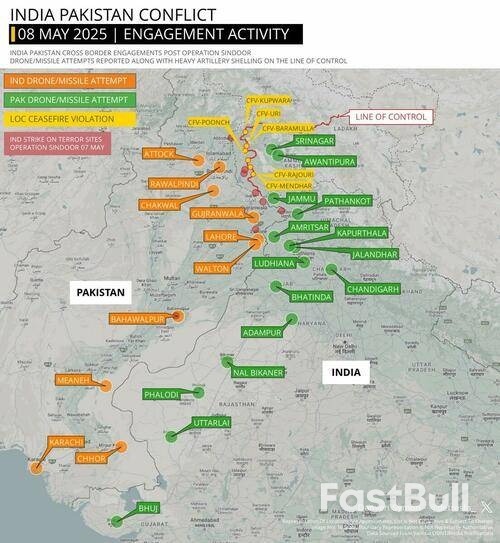
          

          Markets in India and Pakistan have again closed in the red, with India's benchmark stock market indices - the Sensex and Nifty - having fallen around half a percent in trade.

          Pakistan's Karachi Stock Exchange was halted Thursday, with the benchmark KSE100 index losing more than 6% in trade. Amid the deep uncertainty the Indian rupee has slipped more than a percent against the US dollar.

          Source: Zero Hedge

          Risk Warnings and Disclaimers
          You understand and acknowledge that there is a high degree of risk involved in trading. Following any strategies or investment methods may lead to potential losses. The content on the site is provided by our contributors and analysts for information purposes only. You are solely responsible for determining whether any trading assets, securities, strategy, or any other product is suitable for investing based on your own investment objectives and financial situation.
          Add to Favorites
          Share

          China’s latest stimulus measures fail to impress as investors focus on U.S. trade talks

          Adam

          Economic

          China’s latest push to revive growth with broader stimulus measures has failed to cheer its stock market as worries over economic deterioration outweigh policy optimism, with investors focused on trade talks with the U.S.
          The scope of the stimulus package, including interest rate cuts and a major liquidity injection, drew some comparisons to a sweeping policy rollout last September that had fueled a market rally, lifting the CSI 300 index over 32% in a six-day winning streak.
          However, the story did not repeat this time. The benchmark index barely budged on the day of the announcement, adding just 0.61%, and rose by nearly the same Thursday. Hong Kong’s Hang Seng Index gained less than 0.4% over the two days.
          Markets had largely priced in the policies ahead of the briefing, coupled with concerns over the ongoing trade war hurting the world’s second-largest economy, according to analysts.
          People’s Bank of China Governor Pan Gongsheng on Wednesday announced to cut key policy rates by 10 basis points and lower the amount of cash that banks need to hold by 50 basis points. Among a raft of measures, Pan said the central bank will set up low-cost relending facilities for repurchases of tech-related bonds and for investments in elderly care and services consumption.
          The stimulus was largely in line with the economic priorities laid out at last month’s Politburo meeting. It was “nothing but a stopgap instead of a solution,” said Neo Wang, lead China economist and strategist at Evercore ISI.
          The Politburo, China’s second most powerful political body, last month urged local authorities to prepare for “worst-case scenarios” with sufficient planning, calling for an accelerated implementation of proactive fiscal and monetary policies. It also laid out plans to support financing for the technology sector, boost domestic consumption while stabilizing exports.
          Without specific mention of tariffs, the central government acknowledged that “impacts from external shocks” have intensified.
          Unlike last September, when the PBOC explicitly backed the stock markets and provided direct financing for investments and share buybacks, this round of stimulus is more targeted at industrial and social needs, said Eugene Hsiao, head of China equity strategy at Macquarie Capital.
          For a meaningful rally, investors are awaiting more targeted fiscal measures that directly boost consumer sentiment and more effective plans to prop up the real estate sector, said Hsiao.

          Economic strains

          Chinese policymakers, privy to the country’s early economic data, appeared to be ramping up stimulus measures at a time when the economy has started to feel the early strains from tariffs.
          “China is responding to the evident slowdown in economic activity,” said Thierry Wizman, global FX & rates strategist at Macquarie.
          While China’s economy expanded by a better-than-expected 5.4% in the first quarter, it now faces growing headwinds after the tariff conflict with the U.S. intensified last month. In view of the exorbitant tariffs, a slew of major Wall Street banks slashed China’s full-year growth forecasts to around 4%, significantly lower than the official growth target of around 5%.
          Latest economic data out of China has signalled economic deterioration. The manufacturing purchasing managers’ index fell to a 16-month low, sliding into contractionary territory in April, with a gauge on new export orders dropping to its lowest since December 2022. Services activity in the country also slowed in April from the prior month.
          China is set to release its trade data for April on Friday which is likely to reflect the full impact of tariffs on its outbound shipments.
          ANZ’s Yeung estimates export growth to fall by 2.2% in April, a sharp decline compared to a robust 12.4% growth in March as exporters’ front-loading started tapering off. The number of container vessels from China to the U.S. dropped dramatically to 42 by end-April from 71 on April 21, according to his estimates.
          Concerns have been mounting that the fallout would spill over to the labor market. The latest PMI indicated employment fell across the board in April, as manufacturers started to halt production and put workers on paid leave.
          Goldman Sachs estimates that that 16 million jobs — 2% of the country’s labor force — are involved in the production of U.S.-bound goods.
          The recent revocation of the U.S. “de minimis” rule, which exempted low-value goods from tariffs, has also raised employment worries in China’s labor intensive sectors, particularly apparel and consumer electronics.

          Beijing not blinking

          Beijing’s stimulus push came ahead of trade talks between the U.S. and China that have raised hopes of a de-escalation in trade tensions between the two countries.
          “Any measures that could help China’s economy sustain growth in the face of the U.S. import tariffs would increase China’s bargaining power in subsequent negotiations with the U.S.,” said Macquarie’s Wizman.
          China confirmed Wednesday that Vice Premier He Lifeng will meet with U.S. Treasury Secretary Scott Bessent during a visit to Switzerland later this week while claiming it was requested by Washington. Trump disagreed with that characterization.
          The planned meeting would mark the first high-level U.S.-China trade talks since the tariff escalations this year.
          While reaching a comprehensive deal is likely to be complex and time-consuming, a phased rollback of tariffs from both sides is possible, although analysts are split on the pace of such de-escalation.
          Robin Xing, chief economist at Morgan Stanley projects U.S. effective tariffs on Chinese goods could be lowered from the current prohibitive levels to a terminal rate of 45% by year-end.
          However, attempts to achieve a more comprehensive deal, similar to the Phase One deal signed during Trump’s first term, will likely be “lengthy and possibly unproductive,” said Tianchen Xu, senior economist at Economist Intelligence Unit, as both sides have shown little appetite for compromise over respective strategic priorities and economic red lines.
          China failed to fulfill its commitment under the Phase One deal to purchase $200 billion more in U.S. goods and services over two years as the Covid-19 pandemic hit.
          For the upcoming tariff meeting with Bessent, China “doesn’t believe this talk will lead anywhere,” said Wang Dan, China director at risk consultancy firm Eurasia Group. “Things could get worse and that’s why they are saving the big gun for later,” she said, alluding to potential stronger measures to support the Chinese economy.

          source :cnbc

          To stay updated on all economic events of today, please check out our Economic calendar
          Risk Warnings and Disclaimers
          You understand and acknowledge that there is a high degree of risk involved in trading. Following any strategies or investment methods may lead to potential losses. The content on the site is provided by our contributors and analysts for information purposes only. You are solely responsible for determining whether any trading assets, securities, strategy, or any other product is suitable for investing based on your own investment objectives and financial situation.
          Add to Favorites
          Share

          European equities: exposure to the US is no longer paying off

          Adam

          Stocks

          Economic

          For several weeks now, investors have been confronted with a phenomenon that has become rare in recent years: the underperformance of US indices. This is the logical result of the trade war launched by Donald Trump, the most significant effects of which will be felt on the US economy.

          A strength turned into a weakness

          For European companies, this is a real paradigm shift. In recent years, exposure to the US market was a real advantage because the US was the strongest growth area, driven by robust consumer spending. Now, this exposure seems riskier, with the threat of recession on everyone's mind.
          To measure this, the MarketScreener team selected the 20 companies with the highest exposure to the US – based on the share of revenue generated in the US – from among the 300 largest European capitalizations.
          From this selection, we built an equally weighted portfolio of these 20 stocks and compared its performance to that of the Euro Stoxx 50.
          The results are clear. Between the beginning of 2023 and the end of 2024, the performance of this selection of stocks is 39%, compared to 29% for the Euro Stoxx50.
          And in 2025, the balance of power was reversed. The portfolio of stocks rose by only 4%, compared with an 8% gain for the Euro Stoxx 50.

          The impact of exchange rates

          But the US slowdown is not the only headwind. Another factor to consider for European companies is exchange rate movements. Heavy exposure to the US means a lot of revenue in dollars, which then has to be repatriated in euros. However, the euro has risen by 9% since the start of the year.
          In recent weeks, when publishing their first-quarter results, several European companies have alerted investors to the adverse impact of exchange rates on their profits. This is particularly true of SAP, Porsche, Heineken and Schneider Electric.
          This is prompting analysts to revise their earnings expectations downward. HSBC, for example, has reduced its EPS growth forecast for the FTSE Europe to 2.9% in 2025. This will be a drag on the continued outperformance of European equities, while, according to Factset, EPS growth for S&P 500 companies is expected to be 9.5% this year.

          source : marketscreener

          To stay updated on all economic events of today, please check out our Economic calendar
          Risk Warnings and Disclaimers
          You understand and acknowledge that there is a high degree of risk involved in trading. Following any strategies or investment methods may lead to potential losses. The content on the site is provided by our contributors and analysts for information purposes only. You are solely responsible for determining whether any trading assets, securities, strategy, or any other product is suitable for investing based on your own investment objectives and financial situation.
          Add to Favorites
          Share

          GOLD Forecast And Analysis For May 9, 2025

          Golden Gleam

          Commodity

          Economic

          Technical Analysis

          XAU/USD quotes continue to move within the development of the correction and the bullish channel. At the time of publication of the forecast, the price of Gold for today is 3340 Dollars per Troy Ounce. Moving averages indicate the presence of a short-term upward trend. Prices have broken through the area between the signal lines upwards, which indicates pressure from asset buyers and potential continuation of growth from the current levels. At the moment, we should expect an attempt to develop a bearish correction of gold and a test of the support level near the 3320 area. From where we should expect an upward rebound and continued growth in the price of Gold with a potential target above the level of 3525.

          GOLD Forecast and Analysis for May 9, 2025

          An additional signal in favor of the growth of XAU/USD quotes will be a test of the support line on the relative strength indicator (RSI indicator). The second signal will be a rebound from the lower border of the bullish channel. The cancellation of the Gold price increase option on May 9, 2025 will be a fall in prices and a breakout of the 3295 level. This will indicate a breakout of the support area and a continuation of the fall in asset quotes to the area below the 3245 level. It is worth expecting an acceleration of the growth of XAU/USD quotes with a breakout of the resistance area and a price close above the 3425 level.
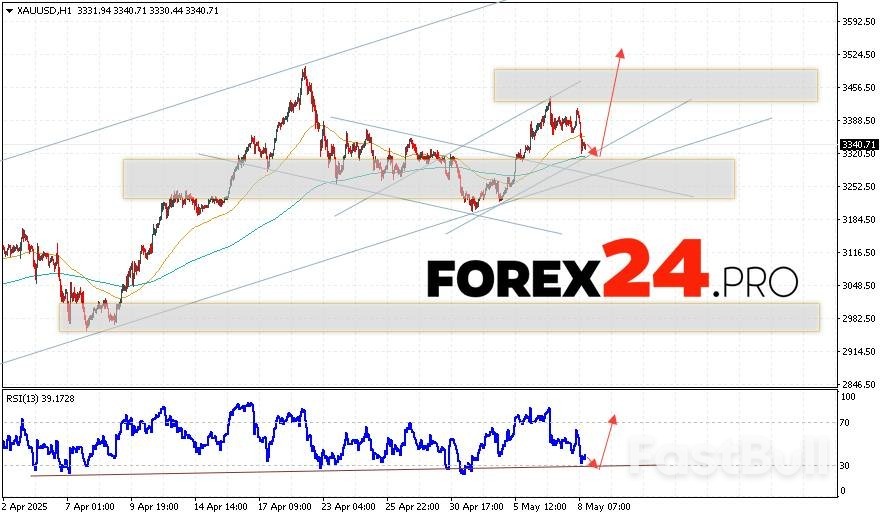
          GOLD Forecast and Analysis for May 9, 2025 suggests an attempt to develop a price decline and test the support area near the 3320 level. Further, the continuation of the growth of non-ferrous metal quotes with a target above the 3525 level. The cancellation of the Gold price increase option will be a fall in the asset value on the markets and a breakout of the 3295 level. This will indicate a continuation of the decline in Gold prices with a potential target below the 3245 mark.

          Source: forex24.pro

          To stay updated on all economic events of today, please check out our Economic calendar
          Risk Warnings and Disclaimers
          You understand and acknowledge that there is a high degree of risk involved in trading. Following any strategies or investment methods may lead to potential losses. The content on the site is provided by our contributors and analysts for information purposes only. You are solely responsible for determining whether any trading assets, securities, strategy, or any other product is suitable for investing based on your own investment objectives and financial situation.
          Add to Favorites
          Share

          Trump calls Fed Chair Jerome Powell a ‘fool’ after central bank keeps rates steady again

          Adam

          Economic

          Central Bank

          President Donald Trump derided Federal Reserve Chairman Jerome Powell once again Thursday, a day after the central bank voted to not lower rates because of economic uncertainty created by tariffs.
          Trump said in a Truth Social post:
          ″‘Too Late’ Jerome Powell is a FOOL, who doesn’t have a clue. Other than that, I like him very much! Oil and Energy way down, almost all costs (groceries and “eggs”) down, virtually NO INFLATION, Tariff Money Pouring Into the U.S. — THE EXACT OPPOSITE OF “TOO LATE!” ENJOY!”
          The Fed on Wednesday voted to keep its benchmark interest rate between 4.25% and 4.5%, where it’s kept the range in the three meetings this year since last cutting in December. This has frustrated the president, who wants the central bank to cut rates to counter a possible slowing economy due to the rollout of his trade policies.
          The Fed said that it was keeping rates the same until the economic outlook becomes a bit clearer and that “the risks of higher unemployment and higher inflation have risen.” The central bank doesn’t want to slash rates if Trump’s tariffs end up sparking inflation.
          Powell addressed Trump’s frequent criticisms and call to lower rates briefly in a news conference that followed the Fed’s decision, saying it would not impact the Fed’s job “at all.”
          “We are always going to do the same thing, which is we are going to use our tools to foster maximum employment and price stability for the benefit of the American people,” Powell said. “We are always going to consider only the economic data, the outlook, the balance of risks and that’s it. That’s all we are going to consider.”
          Trump troubled the markets last month, with investors fearing he would try to fire Powell before his term as chair ends in May 2026, a move that would threaten the independence of the Fed that many deem essential to the proper functioning of the U.S. financial markets. The comments helped fuel a market sell-off that came amid his implementation of tariffs.
          But Trump in late April said he had “no intention” of firing Powell, comforting investors after he had also paused most of the highest “reciprocal” duties.
          Just this past Sunday, Trump ruled out removing Powell when asked about it on NBC’s “Meet the Press.”
          “No, no, no... why would I do that? I get to replace the person in another short period of time,” Trump said.
          However, in the same interview he called Powell a “total stiff.” Trump initially appointed Powell during his first term as president, and former President Joe Biden reappointed Powell in 2022.

          Source: cnbc

          To stay updated on all economic events of today, please check out our Economic calendar
          Risk Warnings and Disclaimers
          You understand and acknowledge that there is a high degree of risk involved in trading. Following any strategies or investment methods may lead to potential losses. The content on the site is provided by our contributors and analysts for information purposes only. You are solely responsible for determining whether any trading assets, securities, strategy, or any other product is suitable for investing based on your own investment objectives and financial situation.
          Add to Favorites
          Share
          FastBull
          Copyright © 2025 FastBull Ltd

          728 RM B 7/F GEE LOK IND BLDG NO 34 HUNG TO RD KWUN TONG KLN HONG KONG

          TelegramInstagramTwitterfacebooklinkedin
          App Store Google Play Google Play
          Products
          Charts

          Chats

          Q&A with Experts
          Screeners
          Economic Calendar
          Data
          Tools
          Membership
          Features
          Function
          Markets
          Copy Trading
          Latest Signals
          Contests
          News
          Analysis
          24/7
          Columns
          Education
          Company
          Careers
          About Us
          Contact Us
          Advertising
          Help Center
          Feedback
          User Agreement
          Privacy Policy
          Business

          White Label

          Data API

          Web Plug-ins

          Poster Maker

          Affiliate Program

          Risk Disclosure

          The risk of loss in trading financial instruments such as stocks, FX, commodities, futures, bonds, ETFs and crypto can be substantial. You may sustain a total loss of the funds that you deposit with your broker. Therefore, you should carefully consider whether such trading is suitable for you in light of your circumstances and financial resources.

          No decision to invest should be made without thoroughly conducting due diligence by yourself or consulting with your financial advisors. Our web content might not suit you since we don't know your financial conditions and investment needs. Our financial information might have latency or contain inaccuracy, so you should be fully responsible for any of your trading and investment decisions. The company will not be responsible for your capital loss.

          Without getting permission from the website, you are not allowed to copy the website's graphics, texts, or trademarks. Intellectual property rights in the content or data incorporated into this website belong to its providers and exchange merchants.

          Not Logged In

          Log in to access more features

          FastBull Membership

          Not yet

          Purchase

          Become a signal provider
          Help Center
          Customer Service
          Dark Mode
          Price Up/Down Colors

          Log In

          Sign Up

          Position
          Layout
          Fullscreen
          Default to Chart
          The chart page opens by default when you visit fastbull.com
