• Trade
  • Markets
  • Copy
  • Contests
  • News
  • 24/7
  • Calendar
  • Q&A
  • Chats
Trending
Screeners
SYMBOL
LAST
BID
ASK
HIGH
LOW
NET CHG.
%CHG.
SPREAD
SPX
S&P 500 Index
6844.68
6844.68
6844.68
6861.30
6844.22
+17.27
+ 0.25%
--
DJI
Dow Jones Industrial Average
48584.30
48584.30
48584.30
48679.14
48557.21
+126.26
+ 0.26%
--
IXIC
NASDAQ Composite Index
23243.00
23243.00
23243.00
23345.56
23243.00
+47.84
+ 0.21%
--
USDX
US Dollar Index
97.830
97.910
97.830
98.070
97.810
-0.120
-0.12%
--
EURUSD
Euro / US Dollar
1.17555
1.17563
1.17555
1.17596
1.17262
+0.00161
+ 0.14%
--
GBPUSD
Pound Sterling / US Dollar
1.33959
1.33967
1.33959
1.33970
1.33546
+0.00252
+ 0.19%
--
XAUUSD
Gold / US Dollar
4330.48
4330.89
4330.48
4350.16
4294.68
+31.09
+ 0.72%
--
WTI
Light Sweet Crude Oil
56.857
56.887
56.857
57.601
56.789
-0.376
-0.66%
--

Community Accounts

Signal Accounts
--
Profit Accounts
--
Loss Accounts
--
View More

Become a signal provider

Sell trading signals to earn additional income

View More

Guide to Copy Trading

Get started with ease and confidence

View More

Signal Accounts for Members

All Signal Accounts

Best Return
  • Best Return
  • Best P/L
  • Best MDD
Past 1W
  • Past 1W
  • Past 1M
  • Past 1Y

All Contests

  • All
  • Trump Updates
  • Recommend
  • Stocks
  • Cryptocurrencies
  • Central Banks
  • Featured News
Top News Only
Share

The Nasdaq Golden Dragon China Index Fell 0.9% In Early Trading

Share

The S&P 500 Opened 32.78 Points Higher, Or 0.48%, At 6860.19; The Dow Jones Industrial Average Opened 136.31 Points Higher, Or 0.28%, At 48594.36; And The Nasdaq Composite Opened 134.87 Points Higher, Or 0.58%, At 23330.04

Share

Miran: Goods Inflation Could Be Settling In At A Higher Level Than Was Normal Before The Pandemic, But That Will Be More Than Offset By Housing Disinflation

Share

Miran, Who Dissented In Favor Of A Larger Cut At Last Fed Meeting, Repeats Keeping Policy Too Tight Will Lead To Job Losses

Share

Miran: Does Not Think Higher Goods Inflation Is Mostly From Tariffs, But Acknowledges Does Not Have A Full Explanation For It

Share

Toronto Stock Index .GSPTSE Rises 67.16 Points, Or 0.21 Percent, To 31594.55 At Open

Share

Miran: Excluding Housing And Non-Market Based Items, Core Pce Inflation May Be Below 2.3%, “Within Noise” Of The Fed's 2% Target

Share

Polish State Assets Minister Balczun Says Jsw Needs Over USD 830 Million Financing To Keep Liquidity For A Year

Share

Miran: Prices Are “Once Again Stable” And Monetary Policy Should Reflect That

Share

Fed's Miran: Current Excess Inflation Is Not Reflective Of Underlying Supply And Demand In The Economy

Share

Portugal Treasury Puts 2026 Net Financing Needs At 13 Billion Euros, Up From 10.8 Billion In 2025

Share

Portugal Treasury Expects 2026 Net Financing Needs At 29.4 Billion Euros, Up From 25.8 Billion In 2025

Share

Bank Of America Says With Indonesia's Smelter Now Ramping Up, It Expects Aluminium Supply Growth To Accelerate To 2.6% Year On Year In 2026

Share

Bank Of America Expects A Deficit In Aluminium Next Year And Sees Prices Pushing Above $3000/T

Share

Fed Data - USA Effective Federal Funds Rate At 3.64 Percent On 12 December On $102 Billion In Trades Versus 3.64 Percent On $99 Billion On 11 December

Share

Brazil's Petrobras Says No Impact Seen On Oil, Petroleum Products Output As Workers Start Planned Strike

Share

Statement: US Travel Group Warns New Proposed Trump Administration Requirements For Foreign Tourists To Provide Social Media Histories Could Mean Millions Of People Opting Not To Visit

Share

Blackrock: Kerry White Will Become Head Of Citi Investment Management At Citi Wealth

Share

Blackrock: Rob Jasminski, Head Of Citi Investment Management, Has Joined With Team

Share

Blackrock: Effective Dec 15, Citi Investment Management Employees Will Join Blackrock

TIME
ACT
FCST
PREV
Japan Tankan Small Manufacturing Outlook Index (Q4)

A:--

F: --

P: --

Japan Tankan Large Non-Manufacturing Outlook Index (Q4)

A:--

F: --

P: --

Japan Tankan Large Manufacturing Outlook Index (Q4)

A:--

F: --

P: --

Japan Tankan Small Manufacturing Diffusion Index (Q4)

A:--

F: --

P: --

Japan Tankan Large Manufacturing Diffusion Index (Q4)

A:--

F: --

P: --

Japan Tankan Large-Enterprise Capital Expenditure YoY (Q4)

A:--

F: --

P: --

U.K. Rightmove House Price Index YoY (Dec)

A:--

F: --

P: --

China, Mainland Industrial Output YoY (YTD) (Nov)

A:--

F: --

P: --

China, Mainland Urban Area Unemployment Rate (Nov)

A:--

F: --

P: --

Saudi Arabia CPI YoY (Nov)

A:--

F: --

P: --

Euro Zone Industrial Output YoY (Oct)

A:--

F: --

P: --

Euro Zone Industrial Output MoM (Oct)

A:--

F: --

P: --

Canada Existing Home Sales MoM (Nov)

A:--

F: --

P: --

Canada National Economic Confidence Index

A:--

F: --

P: --

Canada New Housing Starts (Nov)

A:--

F: --

P: --
U.S. NY Fed Manufacturing Employment Index (Dec)

A:--

F: --

P: --

U.S. NY Fed Manufacturing Index (Dec)

A:--

F: --

P: --

Canada Core CPI YoY (Nov)

A:--

F: --

P: --

Canada Manufacturing Unfilled Orders MoM (Oct)

A:--

F: --

P: --

U.S. NY Fed Manufacturing Prices Received Index (Dec)

A:--

F: --

P: --

U.S. NY Fed Manufacturing New Orders Index (Dec)

A:--

F: --

P: --

Canada Manufacturing New Orders MoM (Oct)

A:--

F: --

P: --

Canada Core CPI MoM (Nov)

A:--

F: --

P: --

Canada Trimmed CPI YoY (SA) (Nov)

A:--

F: --

P: --

Canada Manufacturing Inventory MoM (Oct)

A:--

F: --

P: --

Canada CPI YoY (Nov)

A:--

F: --

P: --

Canada CPI MoM (Nov)

A:--

F: --

P: --

Canada CPI YoY (SA) (Nov)

A:--

F: --

P: --

Canada Core CPI MoM (SA) (Nov)

A:--

F: --

P: --

Canada CPI MoM (SA) (Nov)

A:--

F: --

P: --

Federal Reserve Board Governor Milan delivered a speech
U.S. NAHB Housing Market Index (Dec)

--

F: --

P: --

Australia Composite PMI Prelim (Dec)

--

F: --

P: --

Australia Services PMI Prelim (Dec)

--

F: --

P: --

Australia Manufacturing PMI Prelim (Dec)

--

F: --

P: --

Japan Manufacturing PMI Prelim (SA) (Dec)

--

F: --

P: --

U.K. 3-Month ILO Employment Change (Oct)

--

F: --

P: --

U.K. Unemployment Claimant Count (Nov)

--

F: --

P: --

U.K. Unemployment Rate (Nov)

--

F: --

P: --

U.K. 3-Month ILO Unemployment Rate (Oct)

--

F: --

P: --

U.K. Average Weekly Earnings (3-Month Average, Including Bonuses) YoY (Oct)

--

F: --

P: --

U.K. Average Weekly Earnings (3-Month Average, Excluding Bonuses) YoY (Oct)

--

F: --

P: --

France Services PMI Prelim (Dec)

--

F: --

P: --

France Composite PMI Prelim (SA) (Dec)

--

F: --

P: --

France Manufacturing PMI Prelim (Dec)

--

F: --

P: --

Germany Services PMI Prelim (SA) (Dec)

--

F: --

P: --

Germany Manufacturing PMI Prelim (SA) (Dec)

--

F: --

P: --

Germany Composite PMI Prelim (SA) (Dec)

--

F: --

P: --

Euro Zone Composite PMI Prelim (SA) (Dec)

--

F: --

P: --

Euro Zone Services PMI Prelim (SA) (Dec)

--

F: --

P: --

Euro Zone Manufacturing PMI Prelim (SA) (Dec)

--

F: --

P: --

U.K. Services PMI Prelim (Dec)

--

F: --

P: --

U.K. Manufacturing PMI Prelim (Dec)

--

F: --

P: --

U.K. Composite PMI Prelim (Dec)

--

F: --

P: --

Euro Zone ZEW Economic Sentiment Index (Dec)

--

F: --

P: --

Germany ZEW Current Conditions Index (Dec)

--

F: --

P: --

Germany ZEW Economic Sentiment Index (Dec)

--

F: --

P: --

Euro Zone Trade Balance (Not SA) (Oct)

--

F: --

P: --

Euro Zone ZEW Current Conditions Index (Dec)

--

F: --

P: --

Euro Zone Trade Balance (SA) (Oct)

--

F: --

P: --

U.S. Retail Sales MoM (Excl. Automobile) (SA) (Oct)

--

F: --

P: --

Q&A with Experts
    • All
    • Chatrooms
    • Groups
    • Friends
    Connecting
    .
    .
    .
    Type here...
    Add Symbol or Code

      No matching data

      All
      Trump Updates
      Recommend
      Stocks
      Cryptocurrencies
      Central Banks
      Featured News
      • All
      • Russia-Ukraine Conflict
      • Middle East Flashpoint
      • All
      • Russia-Ukraine Conflict
      • Middle East Flashpoint
      Search
      Products

      Charts Free Forever

      Chats Q&A with Experts
      Screeners Economic Calendar Data Tools
      Membership Features
      Data Warehouse Market Trends Institutional Data Policy Rates Macro

      Market Trends

      Market Sentiment Order Book Forex Correlations

      Top Indicators

      Charts Free Forever
      Markets

      News

      News Analysis 24/7 Columns Education
      From Institutions From Analysts
      Topics Columnists

      Latest Views

      Latest Views

      Trending Topics

      Top Columnists

      Latest Update

      Signals

      Copy Rankings Latest Signals Become a signal provider AI Rating
      Contests
      Brokers

      Overview Brokers Assessment Rankings Regulators News Claims
      Broker listing Forex Brokers Comparison Tool Live Spread Comparison Scam
      Q&A Complaint Scam Alert Videos Tips to Detect Scam
      More

      Business
      Events
      Careers About Us Advertising Help Center

      White Label

      Data API

      Web Plug-ins

      Affiliate Program

      Awards Institution Evaluation IB Seminar Salon Event Exhibition
      Vietnam Thailand Singapore Dubai
      Fans Party Investment Sharing Session
      FastBull Summit BrokersView Expo
      Recent Searches
        Top Searches
          Markets
          News
          Analysis
          User
          24/7
          Economic Calendar
          Education
          Data
          • Names
          • Latest
          • Prev

          View All

          No data

          Scan to Download

          Faster Charts, Chat Faster!

          Download App
          English
          • English
          • Español
          • العربية
          • Bahasa Indonesia
          • Bahasa Melayu
          • Tiếng Việt
          • ภาษาไทย
          • Français
          • Italiano
          • Türkçe
          • Русский язык
          • 简中
          • 繁中
          Open Account
          Search
          Products
          Charts Free Forever
          Markets
          News
          Signals

          Copy Rankings Latest Signals Become a signal provider AI Rating
          Contests
          Brokers

          Overview Brokers Assessment Rankings Regulators News Claims
          Broker listing Forex Brokers Comparison Tool Live Spread Comparison Scam
          Q&A Complaint Scam Alert Videos Tips to Detect Scam
          More

          Business
          Events
          Careers About Us Advertising Help Center

          White Label

          Data API

          Web Plug-ins

          Affiliate Program

          Awards Institution Evaluation IB Seminar Salon Event Exhibition
          Vietnam Thailand Singapore Dubai
          Fans Party Investment Sharing Session
          FastBull Summit BrokersView Expo

          StanChart Says Ethereum Treasury Companies are Undervalued, Revises ETH Forecast to $7,500 by Year-End

          Manuel

          Cryptocurrency

          Summary:

          Treasury firms and exchange-traded funds have absorbed nearly 5% of all Ethereum in circulation since June. Treasury companies bought 2.6%, while ETFs added 2.3%.
          Standard Chartered said Ethereum (ETH) and the companies holding it in their treasuries remain undervalued, even as the second-largest crypto surged to a record $4,955 on Aug. 25.
          Geoffrey Kendrick, the bank’s head of crypto research, said treasury firms and exchange-traded funds have absorbed nearly 5% of all Ethereum in circulation since June. Treasury companies bought 2.6%, while ETFs added 2.3%.
          Combined, that 4.9% stake represents one of the fastest accumulation streaks in crypto history, surpassing the speed at which Bitcoin (BTC) treasuries and ETFs acquired 2% of supply in late 2024.

          Building toward 10%

          Kendrick said the recent buying spree marks the early phase of a broader accumulation cycle. In a July note, he projected that treasury firms could eventually control 10% of all ether outstanding.
          Kendrick argued that with companies such as BitMINE publicly targeting 5% ownership, the goal appears attainable. He noted that this would leave another 7.4% of supply still in play, creating strong tailwinds for Ethereum’s price.
          The sharp pace of accumulation emphasizes the growing role of institutional structures in crypto markets. Kendrick said the alignment of ETF flows with treasury purchases highlights a feedback loop that could tighten supply further and support higher prices.
          Kendrick revised the lender’s previous forecasts and said Ethereum could climb to $7,500 by year-end. He also called the latest pullback a “great entry point” for investors positioning ahead of further inflows.

          Valuation gaps

          While buying pressure has lifted prices, valuations of ether-holding firms have moved in the opposite direction.
          Net asset value (NAV) multiples for SharpLink and BitMINE, the two most established ETH treasury companies, have dropped below those of Strategy, the largest Bitcoin treasury firm.
          Kendrick said the discount is unjustified given that ETH treasuries can capture a 3% staking return, while Strategy generates no such income on its Bitcoin stash.
          He also pointed to SBET’s recent plan to repurchase shares if its NAV multiple falls below 1.0, saying that creates a hard floor for valuations.

          Source: Cryptoslate

          Risk Warnings and Disclaimers
          You understand and acknowledge that there is a high degree of risk involved in trading. Following any strategies or investment methods may lead to potential losses. The content on the site is provided by our contributors and analysts for information purposes only. You are solely responsible for determining whether any trading assets, securities, strategy, or any other product is suitable for investing based on your own investment objectives and financial situation.
          Add to Favorites
          Share

          Fed Governor Cook will sue Trump to keep her job, lawyer says

          Manuel

          Central Bank

          Political

          Federal Reserve Governor Lisa Cook will file a lawsuit to prevent President Donald Trump from firing her, a lawyer for the embattled central bank official said on Tuesday, kicking off what could be a protracted legal fight over the White House's effort to shape U.S. monetary policy.
          "His attempt to fire her, based solely on a referral letter, lacks any factual or legal basis. We will be filing a lawsuit challenging this illegal action," Cook's lawyer, prominent Washington attorney Abbe Lowell, said in a statement.
          The statement was issued a day after Trump said he would fire Cook, the first Black woman to serve on the Fed's governing body, for alleged "deceitful and potential criminal conduct" related to mortgages she took out in 2021.
          "We need people that are 100% above board and it doesn't seem like she was," Trump told reporters at a meeting. He said he had several "good people" in mind to replace Cook but would abide by any court decision that left her in her job.
          Trump's showdown with the nominally independent central bank follows other largely successful efforts to bring other elements of the U.S. government under his direct control. Since returning to office in January, the president has overseen the departure of hundreds of thousands of civil servants, dismantled several agencies and withheld billions of dollars of spending authorized by Congress.
          Trump pressured the Fed to lower interest rates during his first term in the White House and he has escalated that campaign in recent months. The president has demanded that rates be cut by several percentage points and threatened to fire Fed Chair Jerome Powell, although he recently backed away from that saber-rattling.
          Cook's departure would allow Trump to pick a majority of the Fed's seven-member board, including two incumbents and the pending nomination of White House economist Stephen Miran.
          The Fed said in a statement that Cook and other board members serve 14-year tenures and cannot be removed easily from office in order to ensure that monetary policy decisions are based on economic data and "the long-term interests of the American people."
          The attempt to influence U.S. monetary policy has knocked confidence in the dollar and U.S. sovereign debt and sparked fears of global financial turmoil. But market reaction to Trump's latest Fed gambit was tame on Tuesday.
          Wall Street's main equities indexes were largely flat on the day, while the dollar dropped. Yields on 2-year, 5-year and 10-year Treasury notes fell, reflecting higher expectations of a near-term rate cut, and rose on longer-dated bonds, in a sign the Fed's inflation-fighting credentials might weaken.
          Trump said in a letter to Cook on Monday that he had "sufficient cause" to fire her because she had described separate properties in Michigan and Georgia as primary residences on mortgage applications before she joined the Fed in 2022.
          In recent months Trump has fired several Black women who held senior government positions, including the head of the Library of Congress and the chair of the National Labor Relations Board.
          The Trump administration has also targeted other political opponents with similar accusations of mortgage fraud, including New York Attorney General Letitia James, a Black woman who secured a half-billion-dollar civil fraud judgment against Trump last year. A New York appeals court threw out the penalty last week, while preserving the case.

          MORTGAGE QUESTIONS

          William Pulte, a Trump appointee who is director of the Federal Housing Finance Agency, first raised questions about Cook's mortgages last week and referred the matter to U.S. Attorney General Pamela Bondi for investigation. Bondi has yet to say whether the Justice Department will take action.
          Trump accused Cook on Monday of having "deceitful and criminal conduct in a financial matter" and said he did not have confidence in her "integrity."
          Cook took out the two mortgages in question when she was an academic. Loans for primary residences can carry lower rates than mortgages on investment properties, which are considered riskier by banks. Cook listed three mortgages, including two personal residences, on a 2024 financial disclosure form.
          She is due to serve on the Fed board through 2038, but the Federal Reserve Act of 1913 allows removal of a sitting governor "for cause."
          Until now, that power has not been tested by U.S. presidents, who largely have taken a hands-off approach to Fed matters as a way to ensure confidence in U.S. monetary policy.
          Peter Conti-Brown, a scholar of the Fed's history at the University of Pennsylvania's Wharton School, noted that the mortgage transactions preceded her appointment to the Fed and were in the public record when she was vetted and confirmed by the Senate.
          "The idea that you can then reach back, turn the clock backward and say, you know, 'All these things that have happened before now constitute fireable offenses from your official position' is to me incongruous with the entire concept of 'for cause' removal," Conti-Brown said.
          It is unclear how the matter might play out ahead of the Fed's next policy meeting on September 16-17.
          Academic research has consistently found that policymakers who are allowed to manage inflation independent of political meddling generally achieve better outcomes, a principle that may now be tested at the world's most influential central bank.
          "The Fed as an institution escaped harm in the first Trump administration, and will not be so fortunate this time around," said Tim Duy, chief U.S. economist at SGH Macro Advisors.

          Source: Reuters

          Risk Warnings and Disclaimers
          You understand and acknowledge that there is a high degree of risk involved in trading. Following any strategies or investment methods may lead to potential losses. The content on the site is provided by our contributors and analysts for information purposes only. You are solely responsible for determining whether any trading assets, securities, strategy, or any other product is suitable for investing based on your own investment objectives and financial situation.
          Add to Favorites
          Share

          Tariff Clarity Can´t Shore up Falling Ocean Container Rates

          Manuel

          Economic

          China–U.S. Trade War

          Container rates on the all-important Asia-to-U.S. trade routes continue to trend downward following a July surge fueled by shippers frontloading imports ahead of tariff increases.
          Another 90-day extension of the tariff truce between China and the United States into November likely won’t stimulate another import surge, said shipping consultant Freightos, in an update.
          The tariff pause wasn’t driven solely by economic demands; FreightWaves has learned that the information technology systems of U.S. Customs and Border Protection has been unable to keep up pace with the increased data requirements resulting from the on-again, off-again swings in U.S. tariff and trade policies.
          “Tariffs meant to be reduced or removed on many types of goods are still being collected as implementation conditions still need to be fulfilled or details of the deals are still being hammered out,” said Freightos (NYSE: CRGO) research chief Judah Levine, in a note. “These implementation lags mean it will take longer to see if the tariff changes impact freight volumes and rates.”
          Levine said that trans-Pacific container arrivals likely peaked in July, as shippers brought in goods earlier than usual ahead of the China-U.S. tariff deadline in early August.
          “Asia-North America spot rates have fallen 60%-70% in an almost uninterrupted slide since that early rush,” he said. “Rates to the West Coast decreased 10% to $1,744 per forty foot equivalent unit last week – the lowest level for this lane since December 2023. East Coast prices fell 21% to $2,733 per FEU for a 34% slide so far in August.”
          While a top Chinese trade negotiator is set to visit Washington, growing vessel capacity is helping to push rates lower. At the same time, carriers are starting to shift some vessels away from U.S. services in a bid to avoid punitive port fees on China-linked ships which take effect in October.
          The Premier Alliance of Hyundai Merchant Marine, Ocean Network Express (ONE), and Yang Ming is splitting its Mediterranean Pacific South 2 (MS2) pendulum service in two: Asia–Mediterranean (MD2) and Middle East Gulf–U.S. Gulf Pacific South 2 (GS2). The split will take as many as 10 Chinese-built ships out of U.S. service.
          The charges start at $50 per net ton for Chinese-owned and -operated ships, and $18 per ton for non-Chinese operators of Chinese-built ships for each vessel calling at a U.S. port. The charges escalate over time. There are exemptions for empty vessels calling U.S. ports to load agricultural and other bulk exports.
          Freightos found trans-Atlantic rates essentially unchanged at $2,284 per FEU last week.
          “Not much freight impact is expected from the recent US-EU trade deal,” Levine noted, adding that auto tariff reductions have yet to take effect, and alcohol exports will not be exempted.
          Asia-North Europe spot prices fell 6% last week to about $3,100 per FEU, levels last seen in late June. Asia- Mediterranean rates were 1% lower at $3,100 per FEU, the lowest level since late May. “Prices on these lanes are 60% lower than last year, with trans-Pacific prices 70% lower,” said Levine, “reflecting growing overcapacity in the container market even as the new vessel orderbook size recently hit a new record.

          Source: FreightWaves

          To stay updated on all economic events of today, please check out our Economic calendar
          Risk Warnings and Disclaimers
          You understand and acknowledge that there is a high degree of risk involved in trading. Following any strategies or investment methods may lead to potential losses. The content on the site is provided by our contributors and analysts for information purposes only. You are solely responsible for determining whether any trading assets, securities, strategy, or any other product is suitable for investing based on your own investment objectives and financial situation.
          Add to Favorites
          Share

          Small caps are finally getting rate cuts, but they might still be left behind

          Adam

          Stocks

          Small-cap stocks are finally playing catch-up, leaving a market — which has been burned before — wondering if this time is for real.
          Fed Chair Jerome Powell reenergized the stock market on Friday as investors took his Jackson Hole remarks as a wink and a nod that a cut will be coming in September. Not surprisingly, interest rate-sensitive areas surged ahead, putting the small-cap Russell 2000 index up around 4% over the past month.
          The boost is a long time coming. While the S&P 500 (^GSPC), Nasdaq (^IXIC), and even the Dow (^DJI) have enjoyed plenty of record highs recently, the euphoria has not trickled down. The Russell 2000 (^RUT) hasn't seen a record close since 2021, despite nearly making it back to the top last fall before crashing once again as the trade war took off.
          Even as megacap tickers maintain staggering highs, some analysts see this small-cap run as the beginning of a rotation, signaling an end to the longstanding dominance of the tech giants.
          A broadening of the market rally would coincide with the next phase in the economic cycle. And it would allow sky-high valuations to take into account the skepticism of the AI trade, which resurfaced last week amid chatter of corporate restructuring, a lack of return on AI investments, and fear of an AI bubble.
          Small cap has plenty going for it besides rate cuts and AI angst. In a note to clients Monday, Mark Hackett, chief market strategist at Nationwide, pointed to fiscal stimulus, trade deals, and dollar weakness, which would favor cyclicals, small caps, and international equities. He also considered the downstream benefits of AI investments, which the broader market is only beginning to capture, "setting the stage for more balanced leadership," as he wrote in an email Monday.
          But Monday's market action provided the first hint that all that might still not be enough for small caps, as the Russell went back to its lagging ways. While one session alone is hardly proof that the rotation idea is off base, there's a sense that investors betting against Big Tech do so at their peril, especially as Nvidia (NVDA), the most valuable company on Wall Street and the flag bearer of the AI trade, reports on Wednesday.
          Then there's the "be careful what you wish for" of it all, which Lori Calvasina, head of US equity strategy at RBC Capital Markets, pointed out in a note Sunday. Though the small-cap world has yearned for cuts for years, they are definitionally a mixed blessing, as the very thing that prompts them is a flagging economy, under which small-cap stocks historically underperform.
          "We still don’t think cuts alone can bring about a period of sustainable Small Cap outperformance without a stronger economic backdrop than the one currently in place or being forecast by the economic community at large," Calvasina wrote.
          Whether a rotation from big to small happens remains to be seen. But one thing we have seen: Big Tech's knack for making money in any environment, whatever the interest rate.

          Source: finance.yahoo

          Risk Warnings and Disclaimers
          You understand and acknowledge that there is a high degree of risk involved in trading. Following any strategies or investment methods may lead to potential losses. The content on the site is provided by our contributors and analysts for information purposes only. You are solely responsible for determining whether any trading assets, securities, strategy, or any other product is suitable for investing based on your own investment objectives and financial situation.
          Add to Favorites
          Share

          Gold Trades Near Record Highs as Trump's Fed Push Fuels 'Growing Global Investor Unease'

          Manuel

          Central Bank

          Commodity

          Gold (GC=F) prices moved higher Tuesday, inching closer toward record levels after President Trump moved to oust Fed governor Lisa Cook late Monday over alleged mortgage fraud, raising fresh concerns about the central bank's independence.
          Wall Street sees the precious metal's upward movement as far from over, especially if Cook, who has refused to step down, is replaced.
          "We think the episode will add to growing global investor unease over Trump's efforts to influence the independent central bank," UBS chief investment officer Americas and Global Head of Equities Ulrike Hoffmann-Burchardi said.
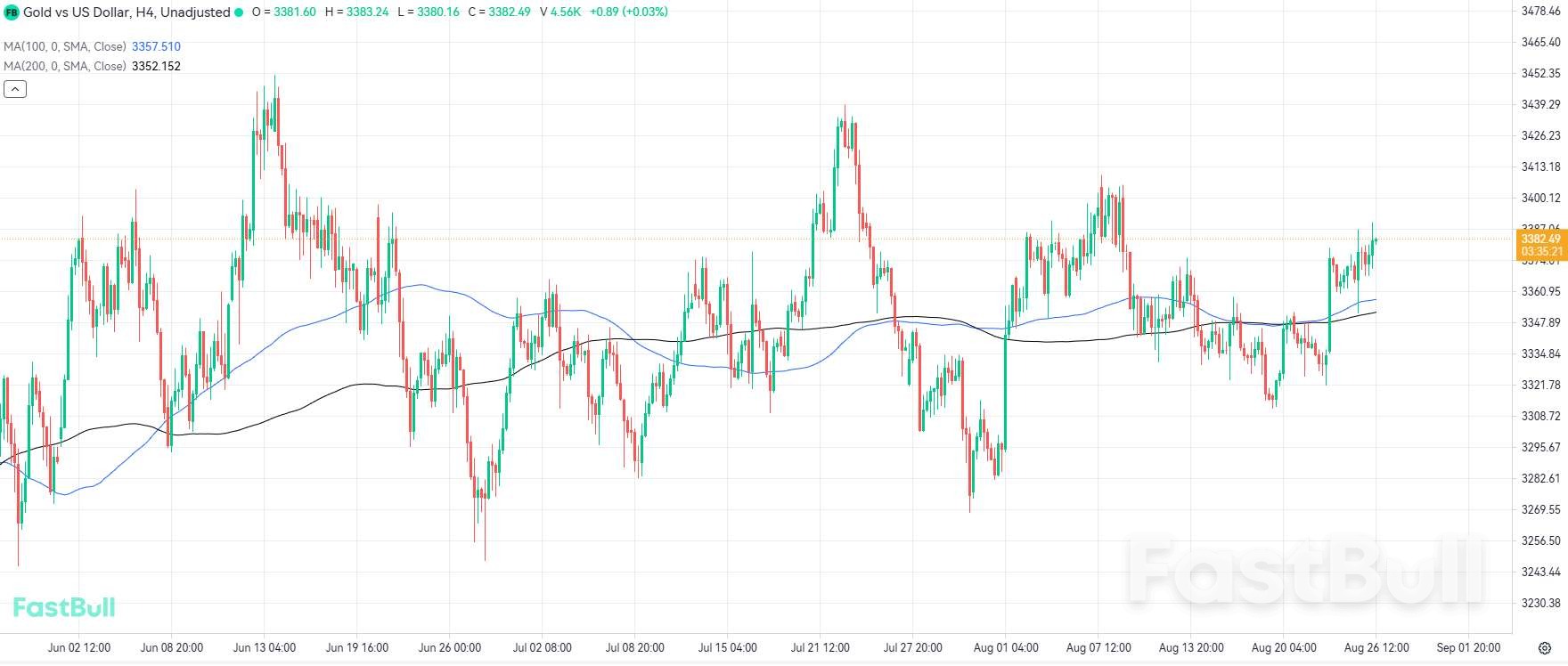
          Gold futures in New York gained 0.3% to hover near $3,430, roughly $100 away from intraday record highs. Spot prices edged 0.4% higher to near $3,380, the highest level since Aug. 11.Gold Trades Near Record Highs as Trump's Fed Push Fuels 'Growing Global Investor Unease'_1
          The US dollar (DX-Y.NYB) also weakened slightly on Tuesday, while the 30-year bond (^TYX) edged higher.
          "The US dollar, already set to weaken further over the next 12 months on Fed easing and fiscal concerns, could take another hit if Fed independence or credibility is eroded," Hoffmann-Burchardi added.
          A lower dollar would benefit gold and lower rates. UBS forecasts gold will rise to $3,700 by the end of June 2026.
          Goldman Sachs sees an even more bullish scenario for the precious metal, noting in a deep dive earlier this year that a less independent Fed "could dent the appeal of the Dollar and USTs, but may make gold shine even brighter."
          Last week, analysts reaffirmed their $4,000 per troy ounce forecast for mid-2026, "driven by structurally strong central bank demand and ETF-inflows" supported by Fed easing.
          There remains considerable uncertainty over Cook's tenure on the board. Cook's lawyer said Tuesday that they plan to file a suit to challenge Trump's decision.
          But if Cook is replaced on the board with another Trump appointment, Paul Wong, market strategist at Sprott, told Yahoo Finance on Tuesday that this would give the White House "de facto control of the Fed board."
          Another Trump appointee, Stephen Miran, is awaiting Senate approval to fill the Board of Governors seat left vacant by Adriana Kugler, who stepped down on Aug. 8.
          "Loss of Fed independence, run-it-hot monetary and fiscal policy, inflation risks, weaker US dollar, it all sums up to eventually a higher gold price," Wong added.
          Gold futures are up 31% year to date, versus an S&P 500 (^GSPC) rise of more than 9% during the same time period.

          Source: Yahoo Finance

          Risk Warnings and Disclaimers
          You understand and acknowledge that there is a high degree of risk involved in trading. Following any strategies or investment methods may lead to potential losses. The content on the site is provided by our contributors and analysts for information purposes only. You are solely responsible for determining whether any trading assets, securities, strategy, or any other product is suitable for investing based on your own investment objectives and financial situation.
          Add to Favorites
          Share

          Crude Oil: Why Model-Based Forecasts Keep Missing the Mark

          Adam

          Commodity

          Last week, oil traders cut their bullish bets on crude to the lowest in 16 years on expectations of a glut. Mostly because many forecasters were reporting a looming glut. Yet the moment something threatens any portion of the world’s oil supply, prices jump. So, where’s the glut?
          Mostly, the glut is in the forecasts published by the International Energy Agency and various net-zero organizations. The problem with these forecasts is that they often ignore data that contradicts their message that the transition to net zero is advancing. Or they use computer models that produce misleading data because they have been fed with inaccurate data, which is what has repeatedly happened with the International Energy Agency.
          Brent crude is trading around $67 per barrel, and West Texas Intermediate is at less than $65—not because the world is consuming less oil than three years ago when crude shot up above $100 per barrel. Oil demand has grown steadily since the 2020 slump caused by the pandemic lockdowns—despite price changes. The only reason all these forecasters, and most notably the International Energy Agency, are predicting a glut is because that’s what fits in with their models.
          It is a fact that the pace of growth in oil demand in the key Asian market, more specifically China, is slowing. China’s oil demand has been growing at insane rates for decades. Assuming it would continue growing at the same rate forever would have been eccentric, to put it mildly, especially as the county sought ways to reduce its dependence on imported energy commodities and found electrification was one way it could do it.
          Yet at the same time China has been putting a lot of effort into developing its domestic oil—and gas—reserves, suggesting that even at a slower rate, its oil demand is still climbing. Meanwhile, so is oil demand in Europe, the flagman of the energy transition, which has a deadline for oil demand growth in the form of a ban on internal combustion engine cars.
          Yet it recently had to rethink that ban because EV sales were not going where the planners in Brussels and national capitals wanted them to go. Now, Europe is facing a potential jet fuel shortage because of healthy demand—despite all the flight shaming that appears to be all the rage on the continent.
          Meanwhile, the U.S. Energy Information Administration is forecasting that global demand for liquid fuels will rise by a rather impressive 1.6 million barrels daily in the current half of the year, compared to the first six months, quite contrary to the predictions of a glut. In that, the EIA has joined OPEC and Standard Chartered as forecasters bucking the trend by basing their forecasts on observed changes in oil’s fundamentals rather than computer models.
          Speaking of OPEC, the group was instrumental in pushing international oil prices lower and motivating traders to cut their bullish positions on the commodity repeatedly by deciding to end its production cuts. Yet prices, predicted by some to slump as far down as $50 and even lower, did not change all that much after the initial shock. That’s because it emerged that not all OPEC members that cut production were able to bring it back as fast as they planned to—which immediately hinted at the possibility of a shortage down the road.
          The fact that prices swing so wildly on a mere hint of tight supply—or new sanctions on Russia that could jeopardize close to 2 million barrels daily in oil trade—suggests that the balance in crude oil’s fundamentals is not at all as tipped towards an oversupply as all those forecasters tend to assume in their model-based reports.
          Last week was a case in point. Prices tanked after the meeting between the presidents of Russia and the United States on Friday, as the two signaled readiness for a peace deal. Then, the EU and Zelensky meeting took place on Monday, and the prospects of a peace deal began to evaporate, to be replaced by the prospect of more sanctions on Moscow’s energy industry. Result: oil prices gained 2.9% over that single week.
          Another case in point is the International Energy Agency. In the spring of 2021, the IEA stated, in all seriousness, that the world would not require any new investments in oil and gas beyond the end of that year. Several months later, it was calling on every oil producer in the world to invest in new production because prices were climbing, and fast.
          Now, the IEA is once again calling for increased investment in oil and gas to secure sufficient supply, despite its prediction that demand growth is expected to peak before the decade is over.
          Oil speculators change their bets on a daily basis. That’s the essence of commodity speculation. It does not, however, necessarily reflect the current state of the physical market—and neither do model-based forecasts. The only reliable indicators of demand and supply are the respective physical data. It is usually after the release of such physical data that the IEA changes its tune on demand projections and starts calling for more oil investments.

          Source: investing

          Risk Warnings and Disclaimers
          You understand and acknowledge that there is a high degree of risk involved in trading. Following any strategies or investment methods may lead to potential losses. The content on the site is provided by our contributors and analysts for information purposes only. You are solely responsible for determining whether any trading assets, securities, strategy, or any other product is suitable for investing based on your own investment objectives and financial situation.
          Add to Favorites
          Share

          The Mar-a-Lago Accord Confirmed: Miran Brings Trump's Reset To The Fed

          Owen Li

          Economic

          Stephen Miran’s appointment to the Federal Reserve isn’t just another personnel move—it’s the placement of Trump’s Reset architect inside the very institution that will help carry out America’s most ambitious economic overhaul in generations.

          If you’re still unfamiliar with what Trump’s Reset entails, I strongly recommend checking out Matt Smith’s comprehensive analysis. He’s done the heavy lifting of connecting dots that were only hinted at in Miran’s original white paper.

          Without getting into the weeds, Miran, the mastermind behind what’s been dubbed the “Mar-a-Lago Accord,” outlined a comprehensive plan to flip the U.S. dollar’s reserve status from a burden into a bargaining chip. To turn America’s towering debt from an embarrassment into leverage. And to reorient the entire global economic structure in Washington’s favor.

          And of course, what makes this especially relevant right now—particularly for anyone with gold exposure—is the timing.

          The yellow metal has been on a relentless march higher throughout 2025, setting multiple all-time highs and blasting past $3,400 an ounce just last month. Now, with Miran’s appointment to the Fed, we’re seeing exactly why smart money has been quietly accumulating the yellow metal all year.

          But anyone thinking Miran’s appointment is simply about giving Trump another dovish vote for rate cuts is missing the much bigger picture. Gold isn’t just rising because of anticipated rate cuts. It’s been rising because informed investors recognized what Trump’s Reset strategy would eventually require: the systematic weakening of dollar dominance and a potential gold revaluation.

          Again, I urge you to check out Matt’s report if you’re unclear on the specifics—he’s laid out the relationships and implications more clearly than anyone I’ve seen attempt it.

          The upshot is that Miran’s appointment is simply the latest confirmation that this plan is moving from theory into practice. (And once you see what that implies for both the dollar and gold, it’s easier to understand why $3,400 gold may be only the beginning.)

          Miran’s Fed Position Is a Game-Changer

          I don’t want to sound like a broken record, but I can’t stress this enough.

          This isn’t just about securing another dovish vote for rate cuts—Trump could have picked any yes-man for that. It’s about placing the architect of America’s monetary reset directly inside the Federal Reserve.

          You see, the Fed doesn’t set tariffs, negotiate trade deals, or sign defense pacts—but it does control the single most important lever in Trump’s Reset: the cost and flow of money.

          From his position as Fed governor, Miran will have a permanent vote on the Federal Open Market Committee (FOMC), giving him direct influence over interest rates, money supply, and crucially, the Fed’s balance sheet operations. But more importantly, he’ll be positioned to coordinate monetary policy with the broader Reset strategy he designed.

          Think about what this means in practical terms—and from Trump’s perspective. The Reset strategy involves coordinated dollar devaluation—but that requires the Fed to be on board. You can’t orchestrate a Plaza Accord (more on it below)-style currency adjustment if your central bank is fighting you every step of the way. With Miran inside the Fed, Trump gets someone who understands both the macroeconomic theory behind dollar devaluation and the practical mechanics of how to execute it through monetary policy.

          Note: The U.S. dollar has already weakened more than 10% over the past six months. To put it in perspective, the last time the dollar fell this much early in the year was 1973—right after the U.S. finalized its break from gold and the fiat era fully took hold.

          Miran’s appointment also signals something even more significant: the institutional capture of monetary policy. When Jerome Powell’s term expires in May 2026, Fed chairs are typically chosen from among existing governors. By installing Miran now, Trump is positioning his Reset architect to potentially lead the entire Federal Reserve system.

          In short, it’s Trump making sure the Fed itself becomes a primary tool for carrying out his Reset. And there’s a very deliberate reason for that.

          Trump’s Reset Needs the Fed on Side

          Now, I brought up the Plaza Accord above because it’s the closest historical precedent to what we’re calling Trump’s Monetary Reset (or the Mar-a-Lago Accord).

          You’ve probably heard of it.

          On September 22, 1985, finance ministers from the world’s largest economies gathered at New York’s Plaza Hotel to coordinate a devaluation of the unnaturally strong U.S. dollar.

          Naturally, outside the U.S., no one wanted a weaker dollar—it would make their exports pricier for American buyers. But, just like today, Washington applied pressure with tariffs, import surcharges, quotas, and pointed accusations of “unfair trade.”

          And guess what? It worked. West Germany and Japan—the economic powerhouses of the day—caved.

          But here’s what made the Plaza Accord actually work: the Federal Reserve was fully on board. Fed Chairman Paul Volcker coordinated closely with Treasury Secretary James Baker to ensure monetary policy backed the dollar devaluation strategy. He cut interest rates from roughly 12% to 6% between late 1984 and late 1986, creating the conditions for the dollar to fall. Without that cooperation, the Plaza Accord probably would have been just another piece of paper.

          This is exactly why Miran’s appointment is so crucial. Trump learned from Reagan’s playbook—to execute coordinated currency devaluation, you better make sure your central bank is pulling in the same direction. By installing the Reset architect inside the Fed, Trump ensures that monetary policy will align with, rather than undermine, his broader economic strategy.

          And what happened to gold in the wake of the Plaza Accord?

          It surged. Take a look at the chart below.
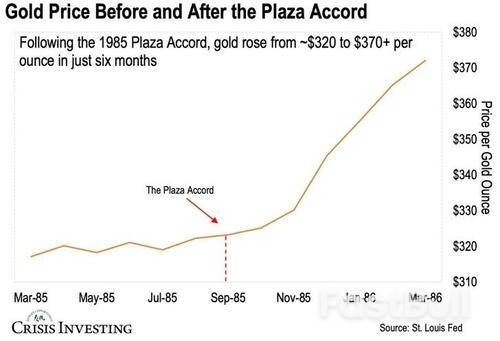
          After the Plaza Accord in 1985, gold jumped from about $320 per ounce to over $370 between September 1985 and March 1986. That’s in just six months.

          Adjusted for today’s prices, that would be like seeing gold leap to roughly $4,000 an ounce.

          But here’s the thing… If Trump’s Reset unfolds the way Matt and I believe it will, it won’t just be a repeat of the Plaza Accord—it’ll be that on steroids.

          In today’s globalized and overleveraged economy, the ripple effects could be enormous. I wouldn’t be surprised to see gold surge to $5,000–$8,000 per ounce as markets scramble to adapt.

          Stephen Miran’s arrival at the Fed isn’t just a policy shift—it’s confirmation that Trump’s Reset strategy is already moving from blueprint to reality. The implications for the dollar, gold, and your personal wealth are enormous. We’ve been tracking the signs of this coming shift for months—the hidden gold run out of London, the quiet buildup of reserves, and now the placement of Trump’s Reset architect inside the Federal Reserve itself. If you’ve been wondering what all this means for your money—and how to prepare before the Reset accelerates—I strongly urge you to read our latest deep-dive: Get Ready for Trump’s Monetary Reset. Inside, you’ll see why central banks are scrambling for gold, how Trump’s team plans to “monetize America’s balance sheet,” and why we believe this could unleash the biggest wealth revaluation in half a century. Most importantly, you’ll learn the practical steps you can take right now to protect your savings—and position yourself to potentially profit. Click here to get the full story before the Reset leaves you behind.

          Source: Zero Hedge

          To stay updated on all economic events of today, please check out our Economic calendar
          Risk Warnings and Disclaimers
          You understand and acknowledge that there is a high degree of risk involved in trading. Following any strategies or investment methods may lead to potential losses. The content on the site is provided by our contributors and analysts for information purposes only. You are solely responsible for determining whether any trading assets, securities, strategy, or any other product is suitable for investing based on your own investment objectives and financial situation.
          Add to Favorites
          Share
          FastBull
          Copyright © 2025 FastBull Ltd

          728 RM B 7/F GEE LOK IND BLDG NO 34 HUNG TO RD KWUN TONG KLN HONG KONG

          TelegramInstagramTwitterfacebooklinkedin
          App Store Google Play Google Play
          Products
          Charts

          Chats

          Q&A with Experts
          Screeners
          Economic Calendar
          Data
          Tools
          Membership
          Features
          Function
          Markets
          Copy Trading
          Latest Signals
          Contests
          News
          Analysis
          24/7
          Columns
          Education
          Company
          Careers
          About Us
          Contact Us
          Advertising
          Help Center
          Feedback
          User Agreement
          Privacy Policy
          Business

          White Label

          Data API

          Web Plug-ins

          Poster Maker

          Affiliate Program

          Risk Disclosure

          The risk of loss in trading financial instruments such as stocks, FX, commodities, futures, bonds, ETFs and crypto can be substantial. You may sustain a total loss of the funds that you deposit with your broker. Therefore, you should carefully consider whether such trading is suitable for you in light of your circumstances and financial resources.

          No decision to invest should be made without thoroughly conducting due diligence by yourself or consulting with your financial advisors. Our web content might not suit you since we don't know your financial conditions and investment needs. Our financial information might have latency or contain inaccuracy, so you should be fully responsible for any of your trading and investment decisions. The company will not be responsible for your capital loss.

          Without getting permission from the website, you are not allowed to copy the website's graphics, texts, or trademarks. Intellectual property rights in the content or data incorporated into this website belong to its providers and exchange merchants.

          Not Logged In

          Log in to access more features

          FastBull Membership

          Not yet

          Purchase

          Become a signal provider
          Help Center
          Customer Service
          Dark Mode
          Price Up/Down Colors

          Log In

          Sign Up

          Position
          Layout
          Fullscreen
          Default to Chart
          The chart page opens by default when you visit fastbull.com
