• Trade
  • Markets
  • Copy
  • Contests
  • News
  • 24/7
  • Calendar
  • Q&A
  • Chats
Trending
Screeners
SYMBOL
LAST
BID
ASK
HIGH
LOW
NET CHG.
%CHG.
SPREAD
SPX
S&P 500 Index
6789.48
6789.48
6789.48
6790.51
6778.05
+68.05
+ 1.01%
--
DJI
Dow Jones Industrial Average
48220.50
48220.50
48220.50
48222.57
48101.18
+334.54
+ 0.70%
--
IXIC
NASDAQ Composite Index
23030.35
23030.35
23030.35
23033.87
23004.96
+337.02
+ 1.49%
--
USDX
US Dollar Index
97.920
98.000
97.920
98.170
97.780
-0.030
-0.03%
--
EURUSD
Euro / US Dollar
1.17394
1.17403
1.17394
1.17626
1.17122
-0.00007
-0.01%
--
GBPUSD
Pound Sterling / US Dollar
1.34199
1.34208
1.34199
1.34461
1.33407
+0.00459
+ 0.34%
--
XAUUSD
Gold / US Dollar
4334.96
4335.37
4334.96
4343.02
4314.53
-3.21
-0.07%
--
WTI
Light Sweet Crude Oil
56.288
56.320
56.288
56.795
55.704
-0.308
-0.54%
--

Community Accounts

Signal Accounts
--
Profit Accounts
--
Loss Accounts
--
View More

Become a signal provider

Sell trading signals to earn additional income

View More

Guide to Copy Trading

Get started with ease and confidence

View More

Signal Accounts for Members

All Signal Accounts

Best Return
  • Best Return
  • Best P/L
  • Best MDD
Past 1W
  • Past 1W
  • Past 1M
  • Past 1Y

All Contests

  • All
  • Trump Updates
  • Recommend
  • Stocks
  • Cryptocurrencies
  • Central Banks
  • Featured News
Top News Only
Share

European Central Bank Governor Lagarde: Too Much Uncertaintyy At Present To Identify Natural Rate Of Interest

Share

Toronto Stock Index .GSPTSE Rises 117.45 Points, Or 0.38 Percent, To 31367.47 At Open

Share

[JPMorgan: Emerging Market Bonds' Boom Is Not Over Yet] Bob Michele Of JPMorgan Asset Management Stated That Investing In Emerging Markets (Em) Remains Their Preferred Strategy As They Head Into 2026, Given The "very High" Real Yields. Driven By A Weaker Dollar And Federal Reserve Rate Cuts, The Bloomberg Emerging Market Local Currency Government Bond Index Has Returned Over 15% This Year. Michele Favors Local Currency Bonds Over Hard Currency Bonds, Specifically Highlighting Brazil, South Africa, And Indonesia As Investment Opportunities

Share

White House Adviser Hassett Welcomes Lower-Than-Expected Inflation Data

Share

ECB President Christine Lagarde: The Digital Euro Is Now An Issue That The European Council And The European Parliament Should Be Concerned About/address

Share

Hassett: Fed Needs To Be 100% More Transparent

Share

European Central Bank Governor Lagarde: Past Determination Is That A Sitting Member Of Executive Board Cannot Be Appointed President But It Needs To Be Looked At Again

Share

[Apple Announces Significant Reduction Of "Apple Tax" In Japan, Opens Third-Party App Store And Payment Channels For IPhone! Experts: China Is Treated Differently, With Commission Rates Higher Than In The US, Europe, Japan, And South Korea] On December 17, Apple Announced On Its Official Website That, In Order To Comply With Japan's "Specific Smartphone Software Competition Promotion Law," It Has Opened Third-party App Stores And External Payment Channels For IPhones In The Japanese Market

Share

Hassett: Will See Big Refunds For Taxpayers

Share

European Central Bank Governor Lagarde: We Anticipate That Wages Will Follow Slightly Declining Trend

Share

European Central Bank Governor Lagarde: Services Balanced Out By Goods

Share

Czech Central Bank Governor Michl: On Rates, All Options Still Open, Equal Chance For Cut Or Hike As Next Move

Share

Hassett: Wages Are Growing Faster Than Prices

Share

Chief Of General Staff Of Russia's Armed Forces Gerasimov: Russia Has Formed Brigade Equipped With Oreshnik Missile System This Year

Share

European Central Bank Governor Lagarde: Wages Have Surprised To Upside

Share

European Central Bank Governor Lagarde: Services Inflation Clearly One Domain We'll Be Attentive To

Share

White House Adviser Hassett: CPI Report Is Astonishingly Good

Share

White House Adviser Hassett: Not Going To Declare Victory Yet On Price Problem

Share

White House Adviser Hassett: Core Inflation Is Only 1.6%

Share

European Central Bank Governor Lagarde: We Look Carefully At Appreciation Of Euro

TIME
ACT
FCST
PREV
U.S. EIA Weekly Crude Stocks Change

A:--

F: --

P: --

U.S. EIA Weekly Heating Oil Stock Changes

A:--

F: --

P: --

U.S. EIA Weekly Gasoline Stocks Change

A:--

F: --

P: --

U.S. EIA Weekly Crude Demand Projected by Production

A:--

F: --

P: --

Russia PPI YoY (Nov)

A:--

F: --

P: --

Russia PPI MoM (Nov)

A:--

F: --

P: --

Australia Consumer Inflation Expectations

A:--

F: --

P: --

South Africa PPI YoY (Nov)

A:--

F: --

P: --

Euro Zone Construction Output MoM (SA) (Oct)

A:--

F: --

P: --
Euro Zone Construction Output YoY (Oct)

A:--

F: --

P: --

U.K. BOE MPC Vote Unchanged (Dec)

A:--

F: --

P: --

Mexico Retail Sales MoM (Oct)

A:--

F: --

P: --

U.K. Benchmark Interest Rate

A:--

F: --

P: --

U.K. BOE MPC Vote Cut (Dec)

A:--

F: --

P: --

U.K. BOE MPC Vote Hike (Dec)

A:--

F: --

P: --

MPC Rate Statement
Euro Zone ECB Deposit Rate

A:--

F: --

P: --

Euro Zone ECB Marginal Lending Rate

A:--

F: --

P: --

Euro Zone ECB Main Refinancing Rate

A:--

F: --

P: --

ECB Monetary Policy Statement
Canada Average Weekly Earnings YoY (Oct)

A:--

F: --

P: --
U.S. Core CPI YoY (Not SA) (Nov)

A:--

F: --

P: --

U.S. Weekly Initial Jobless Claims (SA)

A:--

F: --

P: --
U.S. Weekly Continued Jobless Claims (SA)

A:--

F: --

P: --
U.S. Real Income MoM (SA) (Nov)

--

F: --

P: --

U.S. CPI YoY (Not SA) (Nov)

A:--

F: --

P: --

U.S. Initial Jobless Claims 4-Week Avg. (SA)

A:--

F: --

P: --
U.S. Philadelphia Fed Business Activity Index (SA) (Dec)

A:--

F: --

P: --

U.S. Philadelphia Fed Manufacturing Employment Index (Dec)

A:--

F: --

P: --

U.S. Core CPI (SA) (Nov)

A:--

F: --

P: --

ECB Press Conference
U.S. EIA Weekly Natural Gas Stocks Change

--

F: --

P: --

U.S. Kansas Fed Manufacturing Production Index (Dec)

--

F: --

P: --

U.S. Cleveland Fed CPI MoM (Nov)

--

F: --

P: --

Russia PPI MoM (Nov)

--

F: --

P: --

Russia PPI YoY (Nov)

--

F: --

P: --

U.S. Cleveland Fed CPI MoM (SA) (Nov)

--

F: --

P: --

U.S. Kansas Fed Manufacturing Composite Index (Dec)

--

F: --

P: --

Mexico Policy Interest Rate

--

F: --

P: --

Argentina Trade Balance (Nov)

--

F: --

P: --

Argentina Unemployment Rate (Q3)

--

F: --

P: --

South Korea PPI MoM (Nov)

--

F: --

P: --

U.S. Weekly Treasuries Held by Foreign Central Banks

--

F: --

P: --

Japan National CPI MoM (Not SA) (Nov)

--

F: --

P: --

Japan CPI MoM (Nov)

--

F: --

P: --

Japan National Core CPI YoY (Nov)

--

F: --

P: --

Japan CPI YoY (Excl. Fresh Food & Energy) (Nov)

--

F: --

P: --

Japan National CPI MoM (Excl. Food & Energy) (Nov)

--

F: --

P: --

Japan National CPI YoY (Excl. Food & Energy) (Nov)

--

F: --

P: --

Japan National CPI YoY (Nov)

--

F: --

P: --

Japan National CPI MoM (Nov)

--

F: --

P: --

U.K. GfK Consumer Confidence Index (Dec)

--

F: --

P: --

Japan Benchmark Interest Rate

--

F: --

P: --

BOJ Monetary Policy Statement
Australia Commodity Price YoY

--

F: --

P: --

BOJ Press Conference
Turkey Consumer Confidence Index (Dec)

--

F: --

P: --

U.K. Retail Sales YoY (SA) (Nov)

--

F: --

P: --

U.K. Core Retail Sales YoY (SA) (Nov)

--

F: --

P: --

Germany PPI YoY (Nov)

--

F: --

P: --

Germany PPI MoM (Nov)

--

F: --

P: --

Q&A with Experts
    • All
    • Chatrooms
    • Groups
    • Friends
    Connecting
    .
    .
    .
    Type here...
    Add Symbol or Code

      No matching data

      All
      Trump Updates
      Recommend
      Stocks
      Cryptocurrencies
      Central Banks
      Featured News
      • All
      • Russia-Ukraine Conflict
      • Middle East Flashpoint
      • All
      • Russia-Ukraine Conflict
      • Middle East Flashpoint
      Search
      Products

      Charts Free Forever

      Chats Q&A with Experts
      Screeners Economic Calendar Data Tools
      Membership Features
      Data Warehouse Market Trends Institutional Data Policy Rates Macro

      Market Trends

      Market Sentiment Order Book Forex Correlations

      Top Indicators

      Charts Free Forever
      Markets

      News

      News Analysis 24/7 Columns Education
      From Institutions From Analysts
      Topics Columnists

      Latest Views

      Latest Views

      Trending Topics

      Top Columnists

      Latest Update

      Signals

      Copy Rankings Latest Signals Become a signal provider AI Rating
      Contests
      Brokers

      Overview Brokers Assessment Rankings Regulators News Claims
      Broker listing Forex Brokers Comparison Tool Live Spread Comparison Scam
      Q&A Complaint Scam Alert Videos Tips to Detect Scam
      More

      Business
      Events
      Careers About Us Advertising Help Center

      White Label

      Data API

      Web Plug-ins

      Affiliate Program

      Awards Institution Evaluation IB Seminar Salon Event Exhibition
      Vietnam Thailand Singapore Dubai
      Fans Party Investment Sharing Session
      FastBull Summit BrokersView Expo
      Recent Searches
        Top Searches
          Markets
          News
          Analysis
          User
          24/7
          Economic Calendar
          Education
          Data
          • Names
          • Latest
          • Prev

          View All

          No data

          Scan to Download

          Faster Charts, Chat Faster!

          Download App
          English
          • English
          • Español
          • العربية
          • Bahasa Indonesia
          • Bahasa Melayu
          • Tiếng Việt
          • ภาษาไทย
          • Français
          • Italiano
          • Türkçe
          • Русский язык
          • 简中
          • 繁中
          Open Account
          Search
          Products
          Charts Free Forever
          Markets
          News
          Signals

          Copy Rankings Latest Signals Become a signal provider AI Rating
          Contests
          Brokers

          Overview Brokers Assessment Rankings Regulators News Claims
          Broker listing Forex Brokers Comparison Tool Live Spread Comparison Scam
          Q&A Complaint Scam Alert Videos Tips to Detect Scam
          More

          Business
          Events
          Careers About Us Advertising Help Center

          White Label

          Data API

          Web Plug-ins

          Affiliate Program

          Awards Institution Evaluation IB Seminar Salon Event Exhibition
          Vietnam Thailand Singapore Dubai
          Fans Party Investment Sharing Session
          FastBull Summit BrokersView Expo

          S&P500 And Nasdaq 100: US Stocks Risk Further Selling On AI Spending Doubts

          Samantha Luan

          Stocks

          Summary:

          US stocks slid as AI spending doubts hit tech stocks, pushing the Nasdaq and S&P 500 to three-week lows ahead of key US inflation data.

          Key Points:

          · US stocks closed lower as AI spending doubts hit tech stocks, pushing the Nasdaq and S&P 500 to three-week lows.
          · Heavy selling in chipmakers like Nvidia and Broadcom raised questions about AI returns and balance sheet pressure.
          · Traders trimmed risk rather than buying dips, signaling fading conviction in the crowded AI trade.

          Wall Street Slides as AI Spending Doubts Knock Tech to Three-Week Lows

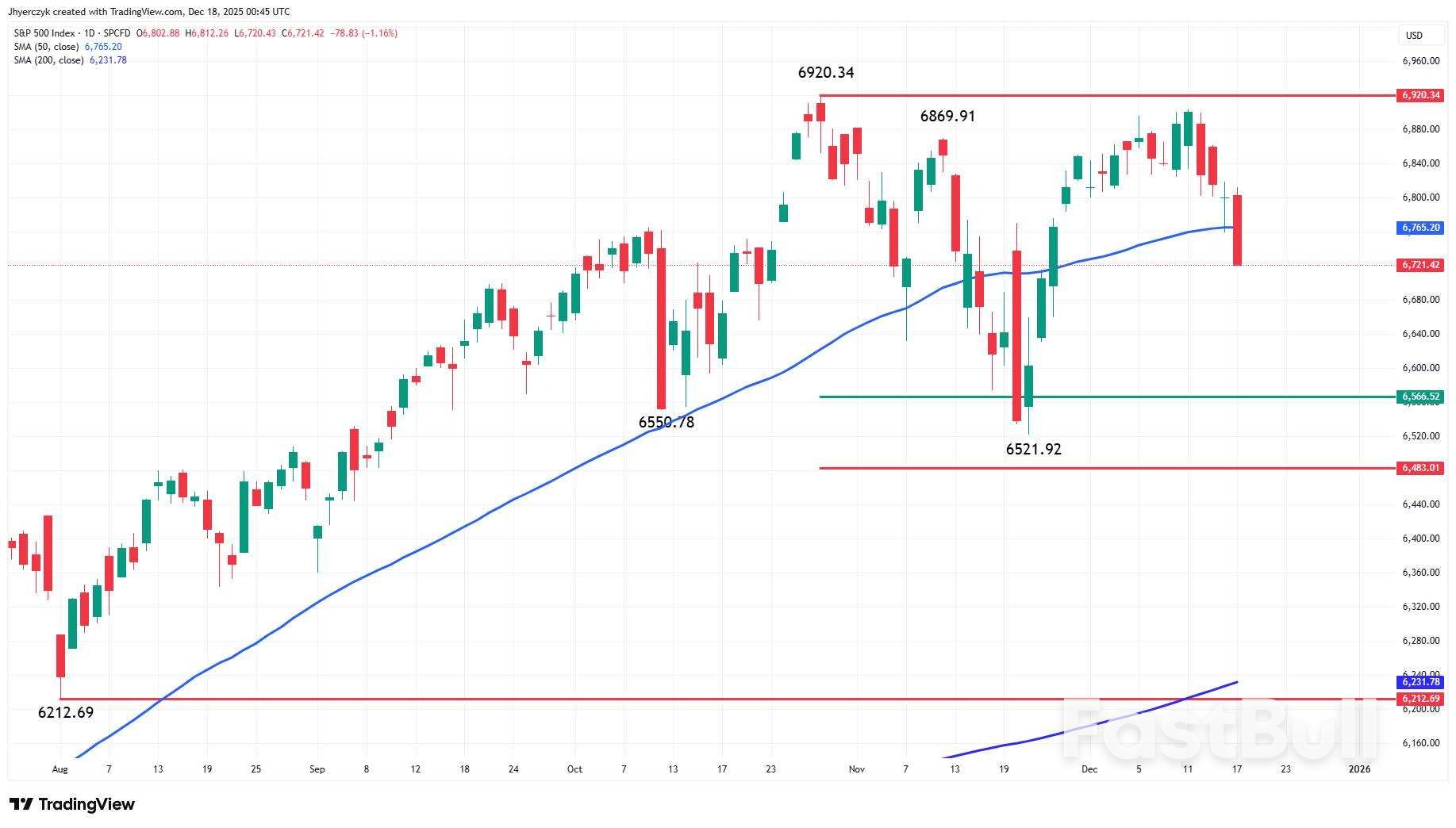
          Daily S&P 500 Index (SPX)

          U.S. stocks finished Wednesday on the back foot, with the S&P 500 and Nasdaq closing at three-week lows as renewed unease around artificial intelligence funding hit big-name tech.
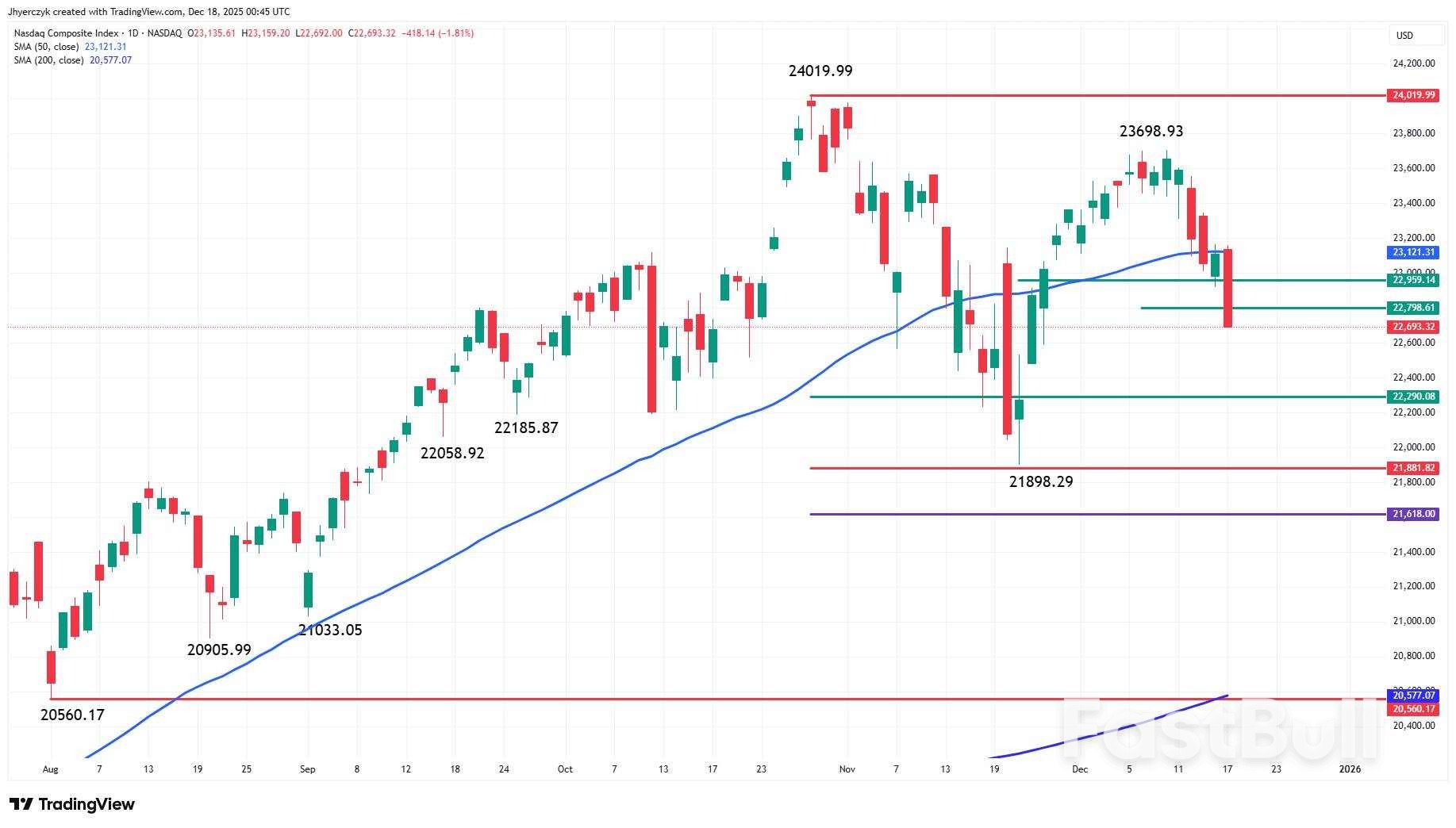
          Daily Nasdaq Composite Index (IXIC)

          The selling wasn't panicky, but it was persistent. Traders trimmed exposure where conviction has thinned, especially across chips and cloud names tied to heavy capital spending.
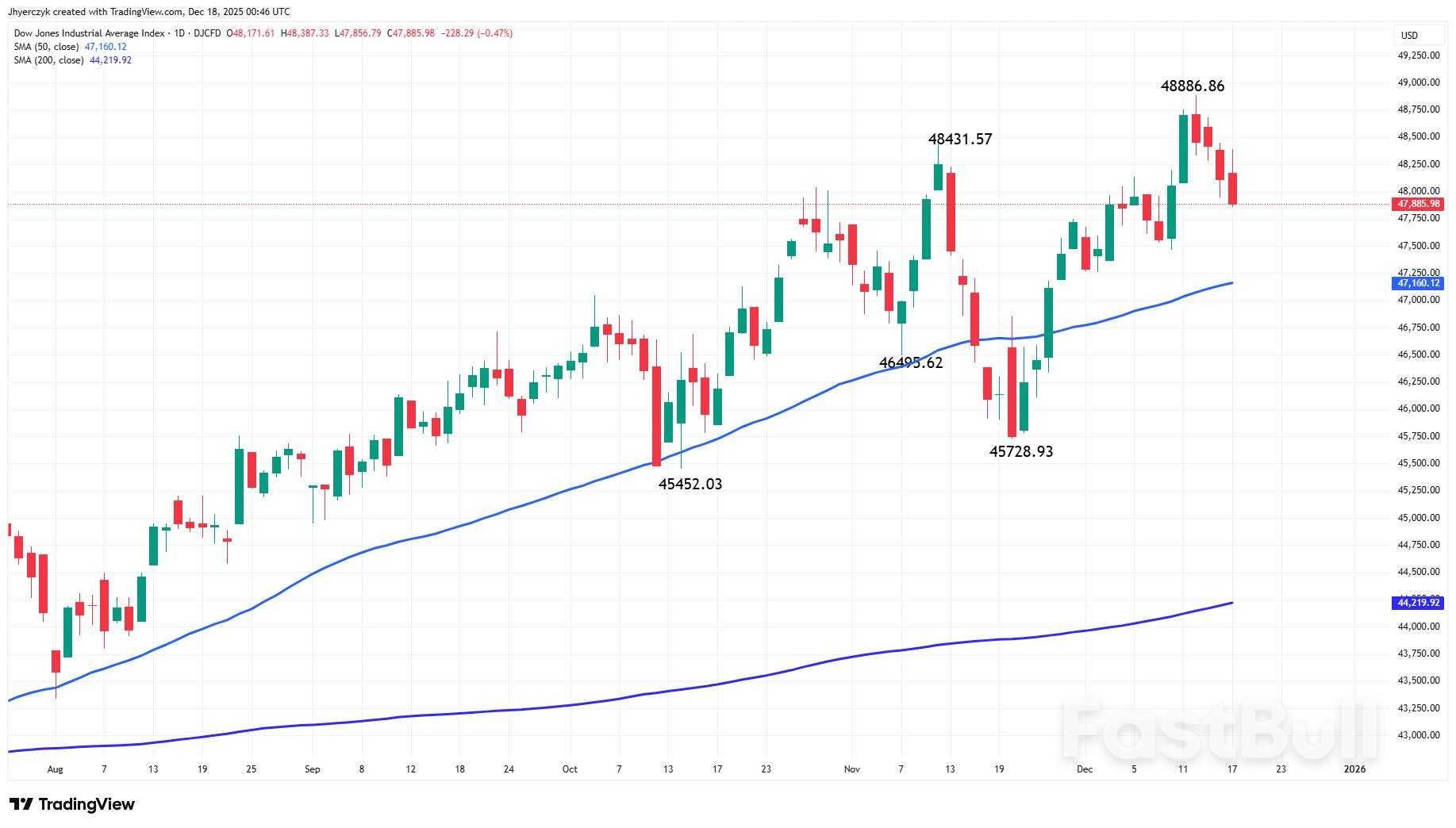
          Daily Dow Jones Industrial Average Index

          The Dow slipped 228 points, while the S&P 500 fell 1.16% and the Nasdaq dropped 1.81%. Breadth leaned defensive, and volume ran slightly above recent averages — a sign this wasn't just passive drift lower.

          Is the AI Trade Losing Its Shine?

          The pressure started in megacap tech. Oracle slid 5.4% after reports that Blue Owl Capital won't back a planned $10 billion data center deal. That hit a nerve. The market has been fine with big AI checks — until it isn't.

          Nvidia fell 3.8% and Broadcom dropped 4.5%, dragging the chip index down nearly 4%. The message was clear: traders are questioning how much balance sheet strain the sector can absorb before returns become harder to justify. There's growing concern that AI spending is feeding back into itself, with OpenAI sitting at the center of the loop.

          Amazon slipped 0.6% after news it's in talks to invest roughly $10 billion in OpenAI. The deal may strengthen its AI position, but the tape treated it as another reminder that the bill is still rising.

          How Are Traders Responding to the Risk?

          They're stepping back rather than chasing dips — at least for now. Decliners outpaced advancers by a wide margin, especially on the Nasdaq. This wasn't indiscriminate selling, but positioning felt lighter as traders reassessed exposure going into year-end.

          Alphabet shares fell 3.2% after reports that Google is working with Meta to challenge Nvidia's software edge. It's ambitious, but the market focused on execution risk and timelines rather than the long-term vision.

          Outside tech, media names were mixed. Netflix edged higher after its bid for Warner Bros Discovery gained board support, while Warner Bros and Paramount slid after rejecting a hostile offer.

          Can Energy and the Fed Offset Tech Weakness?

          Energy stocks provided a pocket of strength. Crude prices climbed after President Trump ordered a blockade of sanctioned oil tankers linked to Venezuela. ConocoPhillips and Occidental both jumped more than 4%, offering some balance to an otherwise tech-heavy selloff.

          Rates also helped steady nerves at the margin. Fed Governor Christopher Waller said the central bank still has room to cut if the labor market softens. That kept yields in check, even if it didn't spark risk-on buying.

          What's the Setup Into Inflation Data?

          The next test is Thursday's consumer inflation report. A softer print could calm nerves around rates, but it won't answer the bigger question hanging over tech: how sustainable all this AI spending really is.

          Bottom line: the market isn't abandoning AI, but it's no longer giving the trade a free pass. Until confidence improves on returns, traders look content to stay selective rather than aggressive.

          Source: FX Empire

          Risk Warnings and Disclaimers
          You understand and acknowledge that there is a high degree of risk involved in trading. Following any strategies or investment methods may lead to potential losses. The content on the site is provided by our contributors and analysts for information purposes only. You are solely responsible for determining whether any trading assets, securities, strategy, or any other product is suitable for investing based on your own investment objectives and financial situation.
          Add to Favorites
          Share

          Bitcoin's Supply Shock: Long-Term Holders Trigger Market Retreat as Demand Weakens

          Gerik

          Economic

          Cryptocurrency

          Steady Liquidation by Veteran Holders Alters Market Structure

          More than two months after reaching a historic peak above $126,000, Bitcoin has entered a pronounced downturn, dropping nearly 30% and struggling to maintain technical support. This downturn is not attributed to speculative blow-offs or panic selling but rather to a measured, prolonged exit by long-standing holders. New data from K33 Research reveals that approximately 1.6 million BTC, or around $140 billion in value, previously dormant for at least two years, has re-entered the market since early 2023.
          This movement is causally linked to the recent price slide. These early adopters often referred to in crypto circles as “OGs” have taken advantage of six-digit prices to realize profits, reducing long-term ownership concentration. Unlike sharp leverage-driven capitulations, the current environment is characterized by a persistent supply increase facing shrinking demand, causing what Chris Newhouse of Ergonia describes as a “slow bleed.”

          Fading Demand from ETFs and Retail Amplifies Imbalance

          During much of 2024 and early 2025, surging interest from U.S. exchange-traded funds and institutional crypto funds provided a counterbalance to selling pressure. However, ETF inflows have now turned negative, and retail enthusiasm has diminished. The derivatives market, which historically absorbs excess volatility, remains subdued. Open interest in Bitcoin options and perpetual futures is notably lower than pre-crash levels, according to Coinglass, highlighting a retreat from leveraged speculation and reducing depth in key liquidity pools.
          This shift does not imply a direct causal effect between ETF flow reversals and price drops, but there is a strong correlation between diminishing buy-side absorption capacity and the speed of the current decline. Notably, the steepest fall came after October 10, when comments by U.S. President Donald Trump regarding tariffs led to $19 billion in liquidations the largest single-day leverage flush in crypto history.

          Market Psychology and Price Action Reflect Fatigue

          Wednesday's brief rally to $90,000, triggered by short squeeze liquidations, quickly reversed, with Bitcoin falling back to $85,278 before recovering slightly above $86,000 in Singapore trading. This kind of whipsaw movement is indicative of a market with low conviction and limited fresh capital.
          Veteran holders' ongoing distribution has proven unusually persistent. According to CryptoQuant, the last 30 days alone witnessed one of the heaviest long-term holder selloffs in more than five years. This extended profit-taking, rather than panic selling, exerts a subtler but more sustained drag on prices, especially in an environment of limited bid support.

          Reactivation Nearing Saturation Point

          Vetle Lunde, Senior Analyst at K33 Research, notes that approximately 20% of Bitcoin’s circulating supply has been reactivated over the past two years. Historically, such waves of reactivation tend to taper off, suggesting that the majority of profit-taking may be behind us. Lunde believes that the market is nearing a saturation point where sell-side pressure from early adopters will diminish, potentially allowing a return to net accumulation in 2026 particularly if institutional integration deepens and demand regains momentum.
          Bitcoin’s current correction, while severe, is rooted not in short-term panic but in a structural reshaping of its ownership base. Long-term holders, emboldened by high prices and access to liquid markets via ETFs, have seized the opportunity to exit. The correlation between diminished demand and reactivated supply has created a delicate market imbalance that is proving difficult to resolve through traditional catalysts. However, if historical patterns hold, this exodus could pave the way for a healthier consolidation phase, resetting ownership and reducing concentration risk as Bitcoin moves toward broader institutional adoption.

          Source: Bloomberg

          To stay updated on all economic events of today, please check out our Economic calendar
          Risk Warnings and Disclaimers
          You understand and acknowledge that there is a high degree of risk involved in trading. Following any strategies or investment methods may lead to potential losses. The content on the site is provided by our contributors and analysts for information purposes only. You are solely responsible for determining whether any trading assets, securities, strategy, or any other product is suitable for investing based on your own investment objectives and financial situation.
          Add to Favorites
          Share

          Tech Jitters Dent Stocks Before Central Banks Take Centre Stage

          Winkelmann

          Commodity

          Stocks

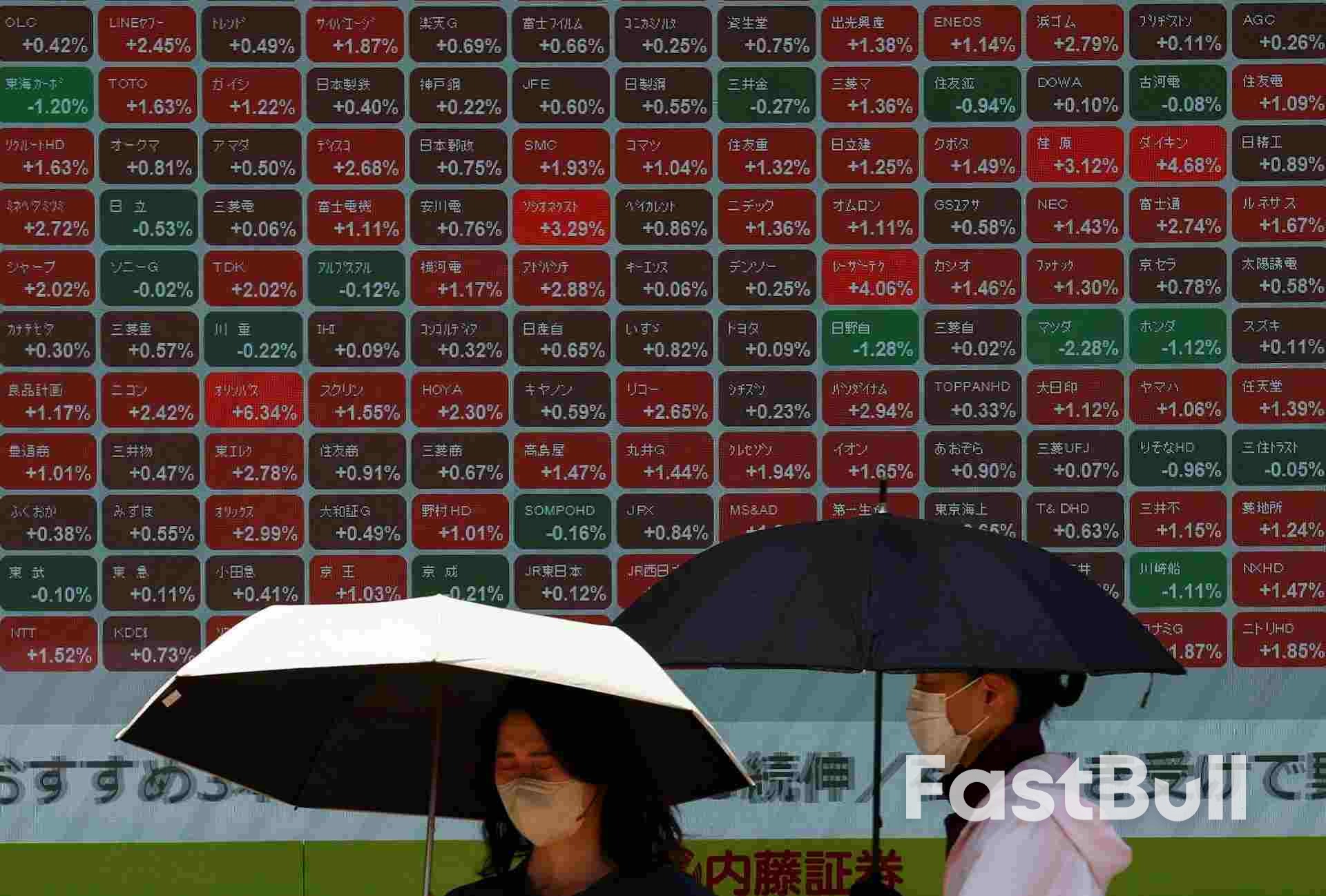
          Women holding umbrellas stand in front of a stock quotation board outside a brokerage in Tokyo, Japan June 30, 2025. REUTERS/Issei Kato

          · Asian shares all in red, with Nikkei down 1.2%
          · Oil up over 1.5% on Trump's Venezuela blockade
          · BOE, ECB, Norges Bank, Riksbank set to decide policy
          · US CPI report for November also due on Thursday

          Asian shares fell on Thursday as the tech sector took a beating on renewed angst about AI spending, while investors braced for a wave of central bank meetings set to underscore policy divergence worldwide.

          Geopolitical tensions are roiling the commodities markets. Oil prices extended a rebound from five-year lows after President Donald Trump ordered a "blockade" of all sanctioned oil tankers entering and leaving Venezuela. Silver hit a new record that helped pull up gold.

          Sterling nursed losses after an unexpected drop in UK inflation all but guaranteed a rate cut from the Bank of England later in the day.

          The European Central Bank, the Norges Bank and Riksbank are also due to deliver their policy decisions on Thursday, with focus squarely on the outlook as all three are widely expected to hold rates steady. In the region, traders are bracing for a rate hike in Japan on Friday though there is less certainty about the pace of tightening next year.

          MSCI's broadest index of Asia-Pacific shares outside Japan (.MIAPJ0000PUS), fell 0.5% as South Korea (.KS11),dropped 1.3% and Hong Kong's Hang Seng index (.HSI),slipped 0.5%. Japan's Nikkei (.N225),was down 1.2%.

          Nasdaq futures gained 0.3% and S&P 500 futures rose 0.2%, after a tech-led selloff on Wall Street as investors grappled with renewed concerns over record AI spending. Shares of AI bellwether Nvidia (NVDA.O), tumbled 3.8%.

          Oracle (ORCL.N),plunged 5.4% after it announced an equity deal to support a data center project would not include a key partner Blue Owl Capital (OWL.N), The stock has shed almost 50% from mid-September when a deal with OpenAI sparked a 35% one-day rally.

          "Oracle remained the primary source of anxiety... This latest setback deepened investor scepticism around Oracle's aggressive AI infrastructure buildout," said Tony Sycamore, analyst at IG, adding that he has now moved to a more neutral stance on the Nasdaq 100.

          "Worries over soaring capex, heavy debt, construction delays, OpenAI's massive cash burn, and mixed Q2 earnings have eroded confidence, positioning Oracle as the poster child of fading AI infrastructure hype."

          INFLATION SURPRISE FIRMS CASE FOR BOE RATE CUT

          On the monetary policy front in the U.S., Federal Reserve Governor Christopher Waller, who is expected to be interviewed by Trump as a candidate for the next Fed chair, said the central bank has room to cut interest rates amid signs of job market weakness.

          Investors are also watching out for a U.S. inflation report for November later in the day that will not include the month-on-month measure since a record government shutdown prevented data collection for October.

          Forecasts are centred on an annual rise of 3% in core inflation last month.

          In the forex markets, sterling held at $1.3374, having slumped to as far as $1.3313 overnight after data showed British inflation fell much more than forecast to 3.2% in November, its lowest since March. That all but cemented the case for a rate cut from the BOE later in the day, which is about 98% priced in.

          The euro was steady at $1.1742, not far from a three-month top of $1.18, ahead of the European Central Bank policy decision where expectations are for no change.

          Treasuries were largely steady. Two-year Treasury yields fell 1 basis point to 3.4725%, having budged little overnight, while the 10-year yield was flat at 4.1431%.

          Oil prices gained for a second day after Trump's announcement of the Venezuela blockade with most exports from the country remaining on hold. U.S. crude rose 1.7% to $56.91 per barrel, while Brent crude futures were up 1.5% at $60.62 a barrel.

          Spot gold prices slipped 0.3% to $4,330 per ounce, while silver also eased 0.2% to $66.17 per ounce but remained just a touch below a record high of $66.88 hit on Wednesday.

          Source: Reuters

          Risk Warnings and Disclaimers
          You understand and acknowledge that there is a high degree of risk involved in trading. Following any strategies or investment methods may lead to potential losses. The content on the site is provided by our contributors and analysts for information purposes only. You are solely responsible for determining whether any trading assets, securities, strategy, or any other product is suitable for investing based on your own investment objectives and financial situation.
          Add to Favorites
          Share

          Moderate GOP Defection Triggers January Obamacare Vote After Internal Rift

          Gerik

          Economic

          Internal Republican Tensions Disrupt Leadership Strategy

          In a notable political shift, moderate Republicans from swing districts have broken ranks with Speaker Mike Johnson, partnering with Democrats to push for a vote on the expiring Affordable Care Act (ACA) subsidies. This rebellion follows Johnson’s refusal to allow a vote on a GOP-backed proposal that would have temporarily extended the subsidies originally boosted during the pandemic while introducing cost-saving reforms to the program.
          The dissident faction, seeking to safeguard constituents in competitive districts, viewed Johnson’s blockade as politically untenable. Their decision to collaborate across the aisle demonstrates growing dissatisfaction within the party’s more centrist ranks and underscores the fragility of GOP unity ahead of the 2026 election cycle.

          Subsidy Extension Delayed Until January Amid Expiration Risks

          The immediate consequence of this internal revolt is the postponement of any ACA subsidy vote until at least January 2026. As a result, enhanced subsidies used by an estimated 22 million Americans are set to expire at year-end. Without Congressional action, many recipients could face steep increases in health insurance premiums starting in January.
          This situation highlights a causal relationship between legislative gridlock and policy discontinuity. The refusal to allow a vote this week directly triggered the expiration risk and compelled moderates to seek alternative procedural pathways.

          Political Implications and Strategic Calculations

          The moderate revolt also reflects a strategic recalibration. By pressing for a bipartisan resolution, swing-district Republicans are signaling to voters that they are willing to prioritize pragmatic governance over party orthodoxy. Meanwhile, Speaker Johnson’s refusal to negotiate appears correlated with increasing pressure from the party’s conservative wing, which remains skeptical of extending ACA provisions without structural reform.
          This intraparty split could shape legislative outcomes beyond healthcare, potentially influencing future budget negotiations and bipartisan coalitions. It also reflects broader tensions between ideological purity and electoral viability a recurring theme in recent legislative sessions.
          The revolt by moderate Republicans represents more than just a policy disagreement; it signals a deeper fracture within the GOP’s legislative strategy. By joining forces with Democrats to secure a January vote on ACA subsidies, these lawmakers are asserting independence in defense of vulnerable constituents, while putting additional pressure on House leadership to find common ground. As healthcare policy becomes a defining issue heading into 2026, this moment marks a critical test of the party’s cohesion and legislative adaptability.

          Source: Bloomberg

          To stay updated on all economic events of today, please check out our Economic calendar
          Risk Warnings and Disclaimers
          You understand and acknowledge that there is a high degree of risk involved in trading. Following any strategies or investment methods may lead to potential losses. The content on the site is provided by our contributors and analysts for information purposes only. You are solely responsible for determining whether any trading assets, securities, strategy, or any other product is suitable for investing based on your own investment objectives and financial situation.
          Add to Favorites
          Share

          Chip Shortage Lingers As Honda To Halt Output In Japan, China

          Winkelmann

          Stocks

          Economic

          Honda Motor Co. will halt production at plants in Japan and China in coming weeks, highlighting the lingering fallout of the global chip shortage.

          The Japanese carmaker will suspend output in Japan on Jan. 5 and Jan. 6, a spokesperson said Thursday, without specifying which plants will be affected. All three of the facilities in its joint venture in China, Guangqi Honda Automobile Co., will be offline from Dec. 29 to Jan. 2.

          The company had said it anticipated getting disrupted production back on track from late November, but the looming suspension of some of its factories indicates ongoing snarls in the supply chain. Honda shares declined 1.5% in Tokyo. Japanese media outlets reported the news earlier.

          Carmakers around the world have had their production plans thrown into disarray in recent months after China blocked Nexperia BV — owned by Chinese company Wingtech Technology Co. — from exporting products made at its local plants.

          Honda has been hit hard, with the chip shortage prompting it to reduce its sales forecast to to 3.34 million units from 3.62 million. It had previously curbed or suspended output at some plants in North American due the issue.

          Nexperia makes semiconductors used in vehicle control systems for functions such as activating windshield wipers and opening a window.

          Source: Bloomberg Europe

          To stay updated on all economic events of today, please check out our Economic calendar
          Risk Warnings and Disclaimers
          You understand and acknowledge that there is a high degree of risk involved in trading. Following any strategies or investment methods may lead to potential losses. The content on the site is provided by our contributors and analysts for information purposes only. You are solely responsible for determining whether any trading assets, securities, strategy, or any other product is suitable for investing based on your own investment objectives and financial situation.
          Add to Favorites
          Share

          The Commodities Feed: Venezuelan And Russian Oil Supply Risks Push Market Higher

          ING

          Commodity

          Forex

          The Commodities Feed: Venezuelan And Russian Oil Supply Risks Push Market Higher_1


          Energy - Oil supply risks grow

          Oil prices rallied yesterday on growing supply risks facing the market. This strength has continued in early-morning trading today.

          There are concerns over Venezuelan oil exports after President Trump announced that the US will impose a blockade on sanctioned oil tankers entering and leaving the country. This puts at risk around 600k b/d of oil exports, the majority of which goes to China. However, flows to the US, currently around 160k b/d, will likely continue. This oil is from Chevron, which previously received a licence from the US government to continue operating in Venezuela. The key questions are, first, how effective this blockade will be, and second, how long it will last. This will be important in determining the impact on the oil market.

          Reports yesterday that the US government is preparing even stricter sanctions on Russia's energy sector pose a larger supply risk to the market -- in case President Putin fails to agree to a peace deal with Ukraine. Given the surplus outlook and Brent trading around $60/bbl, Trump has room to be more aggressive with sanctions.

          Weekly inventory data from the Energy Information Administration (EIA) shows that US crude oil inventories fell by 1.27m barrels over the last week. This was much less than the 9.3m barrel decline the API reported the previous day. The draw was primarily driven by stronger exports over the week, with crude oil exports increasing 655k b/d WoW to 4.66m b/d. Meanwhile, gasoline and distillate fuel oil inventories increased by 4.81m barrels and 1.71m barrels, respectively. These builds in refined-product stocks were supported by refinery runs reaching their highest level since early September.

          European gas prices rallied yesterday, with TTF settling 2.22% higher on the day amid forecasts for colder than usual weather towards the end of the month. Strength in the oil market likely provided some support as well. However, the latest positioning data continues to indicate that speculators are increasingly bearish on the European gas market. Investment funds sold a further 7.9TWh in TTF over the last reporting week, leaving them with a net short of 92.8TWh. This is the largest net short since early 2020. The gross short stands at a record 546TWh, up 18.4TWh over the week. It continues to pose a risk to the market should we see any supply disruptions or demand surges.


          Metals – Gold nears all-time high; silver extends record run

          Gold is trading just shy of its all-time high above $4,381/oz, a level last seen in October, as tensions rise in Venezuela following Trump's blockade order for all sanctioned tankers. The US president is also pressuring Nicolas Maduro amid a regional military buildup.

          The market is awaiting US inflation data on Thursday, which could signal further monetary easing. This follows the Federal Reserve's third consecutive rate cut earlier this month. For now, traders assign a probability of less than 25% of a reduction in January.

          Gold has surged over 60% year-to-date, its strongest annual performance since 1979. The rally is underpinned by robust central bank buying, macro uncertainty, and a structural shift in strategic asset allocation. Geopolitical uncertainty has been a key driver of gold's exceptional rally this year.

          We remain positive on our gold outlook, with macro tailwinds and fundamentals pointing to further upside next year. We expect gold prices to reach new record highs in 2026. The downside should be limited, as any weakness will likely attract renewed interest from both retail and institutional buyers.

          Silver, meanwhile, hit another record high above $66.50/oz. Prices have now more than doubled year-to-date. Investor appetite remains strong, as silver-backed ETFs continue to attract inflows. The outlook remains constructive into 2026, supported by robust industrial demand from solar PV installations and battery technologies, alongside sustained investment flows.


          Agriculture – Soybeans decline on better supply prospects

          CBOT soybean prices yesterday hovered near their lowest level since October, pressured by strong global supply prospects and a lack of fresh Chinese buying. In a recent report, CONAB estimates soybean production in Brazil to reach 177.1mt in 2025/26, up 3.3% from last season. Weather remains a key factor, but crop stress to date has been minimal. China has started selling soybeans from state reserves to clear storage ahead of incoming US shipments. It purchased an additional 198kt of US soybeans, according to recent USDA data, bringing total purchases since October to around 3.7mt. China has increased purchases but must continue to buy steadily to meet commitments under a late-October agreement.

          Data from Ukraine's Ministry of Agriculture indicate that grain and legume exports in 2025/26 declined to approximately 13.8mt tons as of 17 December, representing a year-on-year decline of 29%. Total corn shipments stood at 4.8mt (-40% YoY), while wheat exports fell 17% YoY to 7.6mt.

          Source: ING

          Risk Warnings and Disclaimers
          You understand and acknowledge that there is a high degree of risk involved in trading. Following any strategies or investment methods may lead to potential losses. The content on the site is provided by our contributors and analysts for information purposes only. You are solely responsible for determining whether any trading assets, securities, strategy, or any other product is suitable for investing based on your own investment objectives and financial situation.
          Add to Favorites
          Share

          World-beating 55,000% Surge In India AI Stock Fuels Bubble Fears

          Samantha Luan

          Stocks

          Economic

          The world's best-performing stock is turning into a cautionary tale for investors chasing outsized returns from the artificial-intelligence boom.

          Little-known until recently even within its home market of India, RRP Semiconductor became a social media obsession as its shares surged more than 55,000 per cent in the 20 months through Dec 17 – by far the biggest gain worldwide among companies with a market value above US$1 billion (S$1.3 billion).

          That's despite posting negative revenue in its latest financial results, reporting just two full-time employees in its latest annual report, and boasting only a tenuous link to the semiconductor spending boom after shifting away from real estate in early 2024.

          A mix of online hype, a tiny free float and India's swelling base of retail investors drove 149 straight limit-up sessions, even as exchange officials and the company itself cautioned investors.

          The rally is now showing signs of strain – and regulators are taking a closer look. The Securities and Exchange Board of India (SEBI) has begun examining the surge in RRP Semiconductor's shares for potential wrongdoing, according to a person familiar with the matter. The US$1.7 billion stock, recently restricted by its exchange to trading just once a week, has fallen by 6 per cent from its Nov 7 peak.

          While RRP Semiconductor's trajectory is unlikely to have much bearing on the broader AI rally that has added trillions of dollars in value to global heavyweights such as Nvidia, it highlights how extreme gains have become in pockets of the market – particularly in India, where an absence of listed chipmakers has left retail investors eager for any proxy exposure to the global boom. For some observers, the case also underscores the challenge for regulators seeking to protect retail investors from speculative excess.

          Exchanges and chipmakers in Asia have started to warn investors about the risks of chasing hot AI trades. In Shanghai, Moore Threads Technology – a newly listed AI-chip start-up – saw shares slump 13 per cent on Dec 12 after flagging trading risk, even though the stock remains more than 500 per cent up since its market debut earlier this month. In South Korea, SK Hynix fell after the country's main exchange raised its risk alert on Dec. 11, after the shares more than tripled in 2025.

          RRP Semiconductor's transformation began in early 2024, when RRP Group founder Rajendra Chodankar - whose background includes offering niche products like thermal imaging systems and weapon-drone cameras – struck a deal to take over G D Trading and Agencies by repaying an 80 million-rupee loan owed to its founders for equity.

          On April 23, the board approved selling him and several others shares at 12 rupees each, 40 per cent below market price. The move gave Mr Chodankar 74.5 per cent ownership and reduced the founders' stake to under 2 per cent. The company also agreed to rename itself RRP Semiconductor.

          Two months earlier, Mr Chodankar had incorporated RRP Electronics to build an outsourced semiconductor assembly and testing facility in Maharashtra – a link that may have helped fuel the narrative around the listed company and his private venture.

          At a September 2024 event for RRP Electronics' new unit in Navi Mumbai, Mr Chodankar told a media briefing: "India is going to be a superhuman, it's established beyond doubt." Maharashtra Chief Minister Devendra Fadnavis and cricket legend Sachin Tendulkar were also present, according to YouTube videos posted by RRP.

          RRP Semiconductor lists RRP Electronics as a related party because both are owned by Mr Chodankar, though it does not hold any direct ownership stake, according to exchange filings.

          Still, some investors began viewing RRP Semiconductor as a play on the chip boom. That enthusiasm masked how little of its stock actually trades: about 98 per cent of shares are held by Mr Chodankar and a small circle of associates.

          In April this year, the exchange withdrew approval for the company's share sale, a decision RRP Semiconductor has challenged in an appeals court with the outcome still pending. In October, it cautioned investors a year after placing the stock under its strictest surveillance.

          The rejection followed a September 2024 reminder from SEBI that the company was barred from accessing the securities market because it belonged to the founder group of Shree Vindhya Paper Mills, a firm delisted in 2017 for non-compliance, triggering a 10-year market ban.

          A person familiar with the matter at the BSE said the exchange suffered an "internal lapse" in processing the offering and may seek SEBI's guidance on extending the lock-in on the shares until the appeal is resolved.

          A spokesperson for BSE said in RRP's original application, the company stated the firm, its founders and directors were not barred – directly or indirectly – from accessing the market, and that the exchange's approval was based on this disclosure.

          As the stock took off from 20 rupees in April 2024, the company's biggest shareholder, Mr Chodankar, resigned from the board, and the chief financial officer quit before returning as company secretary. RRP Semiconductor filed a police complaint against a social media influencer over alleged rumour-mongering about its supposed links to cricketer Tendulkar and to state-allotted land for chipmaking.

          In a Nov 3 exchange filing, the company said it "has yet to start any sort of semiconductor manufacturing activities," has made no applications under government programmes, and denied any celebrity association.

          Financials offered little comfort. RRP Semiconductor reported negative revenue of 68.2 million rupees and a net loss of 71.5 million rupees in the quarter ended September.

          The negative revenue is a result of the company reversing sales booked in the three months ended December 2024 from a 4.4-billion-rupee order won in November from Telecrown Infratech. The order was later cancelled over "contractual disagreements," the company said, adding that it also clawed back 80 million rupees of revenue in the March quarter.

          The weak financials come at a delicate time for the stock. With the hype around AI fading and regulatory scrutiny tightening, the downside now sits with investors who piled in – and with Mr Chodankar, who controls nearly the entire float.

          Source: Straitstimes

          To stay updated on all economic events of today, please check out our Economic calendar
          Risk Warnings and Disclaimers
          You understand and acknowledge that there is a high degree of risk involved in trading. Following any strategies or investment methods may lead to potential losses. The content on the site is provided by our contributors and analysts for information purposes only. You are solely responsible for determining whether any trading assets, securities, strategy, or any other product is suitable for investing based on your own investment objectives and financial situation.
          Add to Favorites
          Share
          FastBull
          Copyright © 2025 FastBull Ltd

          728 RM B 7/F GEE LOK IND BLDG NO 34 HUNG TO RD KWUN TONG KLN HONG KONG

          TelegramInstagramTwitterfacebooklinkedin
          App Store Google Play Google Play
          Products
          Charts

          Chats

          Q&A with Experts
          Screeners
          Economic Calendar
          Data
          Tools
          Membership
          Features
          Function
          Markets
          Copy Trading
          Latest Signals
          Contests
          News
          Analysis
          24/7
          Columns
          Education
          Company
          Careers
          About Us
          Contact Us
          Advertising
          Help Center
          Feedback
          User Agreement
          Privacy Policy
          Personal Information Protection Statement
          Business

          White Label

          Data API

          Web Plug-ins

          Poster Maker

          Affiliate Program

          Risk Disclosure

          The risk of loss in trading financial instruments such as stocks, FX, commodities, futures, bonds, ETFs and crypto can be substantial. You may sustain a total loss of the funds that you deposit with your broker. Therefore, you should carefully consider whether such trading is suitable for you in light of your circumstances and financial resources.

          No decision to invest should be made without thoroughly conducting due diligence by yourself or consulting with your financial advisors. Our web content might not suit you since we don't know your financial conditions and investment needs. Our financial information might have latency or contain inaccuracy, so you should be fully responsible for any of your trading and investment decisions. The company will not be responsible for your capital loss.

          Without getting permission from the website, you are not allowed to copy the website's graphics, texts, or trademarks. Intellectual property rights in the content or data incorporated into this website belong to its providers and exchange merchants.

          Not Logged In

          Log in to access more features

          FastBull Membership

          Not yet

          Purchase

          Become a signal provider
          Help Center
          Customer Service
          Dark Mode
          Price Up/Down Colors

          Log In

          Sign Up

          Position
          Layout
          Fullscreen
          Default to Chart
          The chart page opens by default when you visit fastbull.com