• Trade
  • Markets
  • Copy
  • Contests
  • News
  • 24/7
  • Calendar
  • Q&A
  • Chats
Trending
Screeners
SYMBOL
LAST
BID
ASK
HIGH
LOW
NET CHG.
%CHG.
SPREAD
SPX
S&P 500 Index
6827.42
6827.42
6827.42
6899.86
6801.80
-73.58
-1.07%
--
DJI
Dow Jones Industrial Average
48458.04
48458.04
48458.04
48886.86
48334.10
-245.98
-0.51%
--
IXIC
NASDAQ Composite Index
23195.16
23195.16
23195.16
23554.89
23094.51
-398.69
-1.69%
--
USDX
US Dollar Index
97.950
98.030
97.950
98.500
97.950
-0.370
-0.38%
--
EURUSD
Euro / US Dollar
1.17394
1.17409
1.17394
1.17496
1.17192
+0.00011
+ 0.01%
--
GBPUSD
Pound Sterling / US Dollar
1.33707
1.33732
1.33707
1.33997
1.33419
-0.00148
-0.11%
--
XAUUSD
Gold / US Dollar
4299.39
4299.39
4299.39
4353.41
4257.10
+20.10
+ 0.47%
--
WTI
Light Sweet Crude Oil
57.233
57.485
57.233
58.011
56.969
-0.408
-0.71%
--

Community Accounts

Signal Accounts
--
Profit Accounts
--
Loss Accounts
--
View More

Become a signal provider

Sell trading signals to earn additional income

View More

Guide to Copy Trading

Get started with ease and confidence

View More

Signal Accounts for Members

All Signal Accounts

Best Return
  • Best Return
  • Best P/L
  • Best MDD
Past 1W
  • Past 1W
  • Past 1M
  • Past 1Y

All Contests

  • All
  • Trump Updates
  • Recommend
  • Stocks
  • Cryptocurrencies
  • Central Banks
  • Featured News
Top News Only
Share

Norwegian Nobel Committee: Calls On The Belarusian Authorities To Release All Political Prisoners

Share

Norwegian Nobel Committee: His Freedom Is A Deeply Welcome And Long-Awaited Moment

Share

Ukraine Says It Received 114 Prisoners From Belarus

Share

USA Embassy In Lithuania: Maria Kalesnikava Is Not Going To Vilnius

Share

USA Embassy In Lithuania: Other Prisoners Are Being Sent From Belarus To Ukraine

Share

Ukraine President Zelenskiy: Five Ukrainians Released By Belarus In US-Brokered Deal

Share

USA Vilnius Embassy: USA Stands Ready For "Additional Engagement With Belarus That Advances USA Interests"

Share

USA Vilnius Embassy: Belarus, USA, Other Citizens Among The Prisoners Released Into Lithuania

Share

USA Vilnius Embassy: USA Will Continue Diplomatic Efforts To Free The Remaining Political Prisoners In Belarus

Share

USA Vilnius Embassy: Belarus Releases 123 Prisoners Following Meeting Of President Trump's Envoy Coale And Belarus President Lukashenko

Share

USA Vilnius Embassy: Masatoshi Nakanishi, Aliaksandr Syrytsa Are Among The Prisoners Released By Belarus

Share

USA Vilnius Embassy: Maria Kalesnikava And Viktor Babaryka Are Among The Prisoners Released By Belarus

Share

USA Vilnius Embassy: Nobel Peace Prize Laureate Ales Bialiatski Is Among The Prisoners Released By Belarus

Share

Belarusian Presidential Administration Telegram Channel: Lukashenko Has Pardoned 123 Prisoners As Part Of Deal With US

Share

Two Local Syrian Officials: Joint US-Syrian Military Patrol In Central Syria Came Under Fire From Unknown Assailants

Share

Israeli Military Says It Targeted 'Key Hamas Terrorist' In Gaza City

Share

Rwanda's Actions In Eastern Drc Are A Clear Violation Of Washington Accords Signed By President Trump - Secretary Of State Rubio

Share

Israeli Military Issues Evacuation Warning In Southern Lebanon Village Ahead Of Strike - Spokesperson On X

Share

Belarusian State Media Cites US Envoy Coale As Saying He Discussed Ukraine And Venezuela With Lukashenko

Share

Belarusian State Media Cites US Envoy Coale As Saying That US Removes Sanctions On Belarusian Potassium

TIME
ACT
FCST
PREV
U.K. Trade Balance Non-EU (SA) (Oct)

A:--

F: --

P: --

U.K. Trade Balance (Oct)

A:--

F: --

P: --

U.K. Services Index MoM

A:--

F: --

P: --

U.K. Construction Output MoM (SA) (Oct)

A:--

F: --

P: --

U.K. Industrial Output YoY (Oct)

A:--

F: --

P: --

U.K. Trade Balance (SA) (Oct)

A:--

F: --

P: --

U.K. Trade Balance EU (SA) (Oct)

A:--

F: --

P: --

U.K. Manufacturing Output YoY (Oct)

A:--

F: --

P: --

U.K. GDP MoM (Oct)

A:--

F: --

P: --

U.K. GDP YoY (SA) (Oct)

A:--

F: --

P: --

U.K. Industrial Output MoM (Oct)

A:--

F: --

P: --

U.K. Construction Output YoY (Oct)

A:--

F: --

P: --

France HICP Final MoM (Nov)

A:--

F: --

P: --

China, Mainland Outstanding Loans Growth YoY (Nov)

A:--

F: --

P: --

China, Mainland M2 Money Supply YoY (Nov)

A:--

F: --

P: --

China, Mainland M0 Money Supply YoY (Nov)

A:--

F: --

P: --

China, Mainland M1 Money Supply YoY (Nov)

A:--

F: --

P: --

India CPI YoY (Nov)

A:--

F: --

P: --

India Deposit Gowth YoY

A:--

F: --

P: --

Brazil Services Growth YoY (Oct)

A:--

F: --

P: --

Mexico Industrial Output YoY (Oct)

A:--

F: --

P: --

Russia Trade Balance (Oct)

A:--

F: --

P: --

Philadelphia Fed President Henry Paulson delivers a speech
Canada Building Permits MoM (SA) (Oct)

A:--

F: --

P: --

Canada Wholesale Sales YoY (Oct)

A:--

F: --

P: --

Canada Wholesale Inventory MoM (Oct)

A:--

F: --

P: --

Canada Wholesale Inventory YoY (Oct)

A:--

F: --

P: --

Canada Wholesale Sales MoM (SA) (Oct)

A:--

F: --

P: --

Germany Current Account (Not SA) (Oct)

A:--

F: --

P: --

U.S. Weekly Total Rig Count

A:--

F: --

P: --

U.S. Weekly Total Oil Rig Count

A:--

F: --

P: --

Japan Tankan Large Non-Manufacturing Diffusion Index (Q4)

--

F: --

P: --

Japan Tankan Small Manufacturing Outlook Index (Q4)

--

F: --

P: --

Japan Tankan Large Non-Manufacturing Outlook Index (Q4)

--

F: --

P: --

Japan Tankan Large Manufacturing Outlook Index (Q4)

--

F: --

P: --

Japan Tankan Small Manufacturing Diffusion Index (Q4)

--

F: --

P: --

Japan Tankan Large Manufacturing Diffusion Index (Q4)

--

F: --

P: --

Japan Tankan Large-Enterprise Capital Expenditure YoY (Q4)

--

F: --

P: --

U.K. Rightmove House Price Index YoY (Dec)

--

F: --

P: --

China, Mainland Industrial Output YoY (YTD) (Nov)

--

F: --

P: --

China, Mainland Urban Area Unemployment Rate (Nov)

--

F: --

P: --

Saudi Arabia CPI YoY (Nov)

--

F: --

P: --

Euro Zone Industrial Output YoY (Oct)

--

F: --

P: --

Euro Zone Industrial Output MoM (Oct)

--

F: --

P: --

Canada Existing Home Sales MoM (Nov)

--

F: --

P: --

Euro Zone Total Reserve Assets (Nov)

--

F: --

P: --

U.K. Inflation Rate Expectations

--

F: --

P: --

Canada National Economic Confidence Index

--

F: --

P: --

Canada New Housing Starts (Nov)

--

F: --

P: --

U.S. NY Fed Manufacturing Employment Index (Dec)

--

F: --

P: --

U.S. NY Fed Manufacturing Index (Dec)

--

F: --

P: --

Canada Core CPI YoY (Nov)

--

F: --

P: --

Canada Manufacturing Unfilled Orders MoM (Oct)

--

F: --

P: --

Canada Manufacturing New Orders MoM (Oct)

--

F: --

P: --

Canada Core CPI MoM (Nov)

--

F: --

P: --

Canada Manufacturing Inventory MoM (Oct)

--

F: --

P: --

Canada CPI YoY (Nov)

--

F: --

P: --

Canada CPI MoM (Nov)

--

F: --

P: --

Canada CPI YoY (SA) (Nov)

--

F: --

P: --

Canada Core CPI MoM (SA) (Nov)

--

F: --

P: --

Q&A with Experts
    • All
    • Chatrooms
    • Groups
    • Friends
    Connecting
    .
    .
    .
    Type here...
    Add Symbol or Code

      No matching data

      All
      Trump Updates
      Recommend
      Stocks
      Cryptocurrencies
      Central Banks
      Featured News
      • All
      • Russia-Ukraine Conflict
      • Middle East Flashpoint
      • All
      • Russia-Ukraine Conflict
      • Middle East Flashpoint
      Search
      Products

      Charts Free Forever

      Chats Q&A with Experts
      Screeners Economic Calendar Data Tools
      Membership Features
      Data Warehouse Market Trends Institutional Data Policy Rates Macro

      Market Trends

      Market Sentiment Order Book Forex Correlations

      Top Indicators

      Charts Free Forever
      Markets

      News

      News Analysis 24/7 Columns Education
      From Institutions From Analysts
      Topics Columnists

      Latest Views

      Latest Views

      Trending Topics

      Top Columnists

      Latest Update

      Signals

      Copy Rankings Latest Signals Become a signal provider AI Rating
      Contests
      Brokers

      Overview Brokers Assessment Rankings Regulators News Claims
      Broker listing Forex Brokers Comparison Tool Live Spread Comparison Scam
      Q&A Complaint Scam Alert Videos Tips to Detect Scam
      More

      Business
      Events
      Careers About Us Advertising Help Center

      White Label

      Data API

      Web Plug-ins

      Affiliate Program

      Awards Institution Evaluation IB Seminar Salon Event Exhibition
      Vietnam Thailand Singapore Dubai
      Fans Party Investment Sharing Session
      FastBull Summit BrokersView Expo
      Recent Searches
        Top Searches
          Markets
          News
          Analysis
          User
          24/7
          Economic Calendar
          Education
          Data
          • Names
          • Latest
          • Prev

          View All

          No data

          Scan to Download

          Faster Charts, Chat Faster!

          Download App
          English
          • English
          • Español
          • العربية
          • Bahasa Indonesia
          • Bahasa Melayu
          • Tiếng Việt
          • ภาษาไทย
          • Français
          • Italiano
          • Türkçe
          • Русский язык
          • 简中
          • 繁中
          Open Account
          Search
          Products
          Charts Free Forever
          Markets
          News
          Signals

          Copy Rankings Latest Signals Become a signal provider AI Rating
          Contests
          Brokers

          Overview Brokers Assessment Rankings Regulators News Claims
          Broker listing Forex Brokers Comparison Tool Live Spread Comparison Scam
          Q&A Complaint Scam Alert Videos Tips to Detect Scam
          More

          Business
          Events
          Careers About Us Advertising Help Center

          White Label

          Data API

          Web Plug-ins

          Affiliate Program

          Awards Institution Evaluation IB Seminar Salon Event Exhibition
          Vietnam Thailand Singapore Dubai
          Fans Party Investment Sharing Session
          FastBull Summit BrokersView Expo

          Situation tightening up again between China and the US

          Adam

          Economic

          Summary:

          Trump’s tariff threats reignited U.S.-China tensions, sending the S&P 500 down 2.7% and Nasdaq 3.5%. Beijing responded with rare-earth export controls and ship levies as both sides harden positions before the late-October summit.

          Finally, it's down. On Friday, a message from Donald Trump on Truth Social threatening exorbitant tariffs on China sent the indices plummeting. The S&P 500 ended down 2.7% and the Nasdaq down 3.5%.
          Finally, because until now, US indices had been setting record highs (the S&P 500 has set 33 since the beginning of the year), driven by the theme of artificial intelligence. This almost unstoppable momentum can be summed up in one statistic: the S&P 500 has remained within 2.5% of its record highs since June.
          While Donald Trump's threats on Friday may have served as a pretext for a market that was no longer correcting, they nevertheless mark a resurgence of tensions between the world's two leading powers.

          A tour of Europe to relax

          Indeed, after the tariff clash in April, tensions had gradually eased. This was thanks in particular to a series of meetings in several European cities: Geneva in May, London in June, Stockholm in July, and Madrid in September.
          Beyond the extension of the tariff truce, relations seemed to be warming significantly with the agreement on the sale of TikTok's US operations, approved by Donald Trump and Xi Jinping during a telephone conversation on September 19. After this exchange, Donald Trump also confirmed a meeting with Xi Jinping in late October in South Korea, during the APEC summit. He also mentioned a trip to China next year and a visit by Xi Jinping to the United States.
          On the markets, the impact of the tariff saga has gradually diminished. Over the months, agreements have been reached with certain trading partners and tensions with China have eased. So much so that the latest tariff announcements at the end of September barely caused a stir.

          Negotiating position

          But after months of de-escalation, we may now be entering a new phase of escalation, starting with Beijing's announcement on Thursday that it will introduce controls on exports of rare earth technologies.
          On Friday, Donald Trump responded by threatening to impose additional 100% tariffs on China starting November 1, along with new export controls on strategic software. The US president also threatened to impose export controls on Boeing aircraft parts.
          On the same day, the Chinese regulator announced the opening of an antitrust investigation against Qualcomm, following its acquisition in June 2025 of Israeli chip designer Autotalks.
          Finally, China announced the introduction of levies on ships built or registered in the United States (the measure also applies to those owned by companies in which at least 25% of the shares or seats on the board of directors are held by US investment funds). This is a reciprocal measure: in February, the Office of the US Trade Representative (USTR) announced the introduction of fees on ships built abroad. This measure is due to come into force on Wednesday.
          Once all these points of tension have been listed, they must be placed in the context of the meeting scheduled between Xi Jinping and Donald Trump at the end of the month in South Korea: each side is hardening its position ahead of the discussions.
          On Sunday, Donald Trump himself toned down his inflammatory message from Friday: "Don't worry about China, everything will be fine!" The message was received by the markets. European indices are up, while the S&P 500 is up nearly 1.5% in pre-market trading.

          Source: marketscreener

          To stay updated on all economic events of today, please check out our Economic calendar
          Risk Warnings and Disclaimers
          You understand and acknowledge that there is a high degree of risk involved in trading. Following any strategies or investment methods may lead to potential losses. The content on the site is provided by our contributors and analysts for information purposes only. You are solely responsible for determining whether any trading assets, securities, strategy, or any other product is suitable for investing based on your own investment objectives and financial situation.
          Add to Favorites
          Share

          ‘All that glitters is fear’ as $5,000 gold is now ‘increasingly inevitable’ – Societe Generale

          Adam

          Commodity

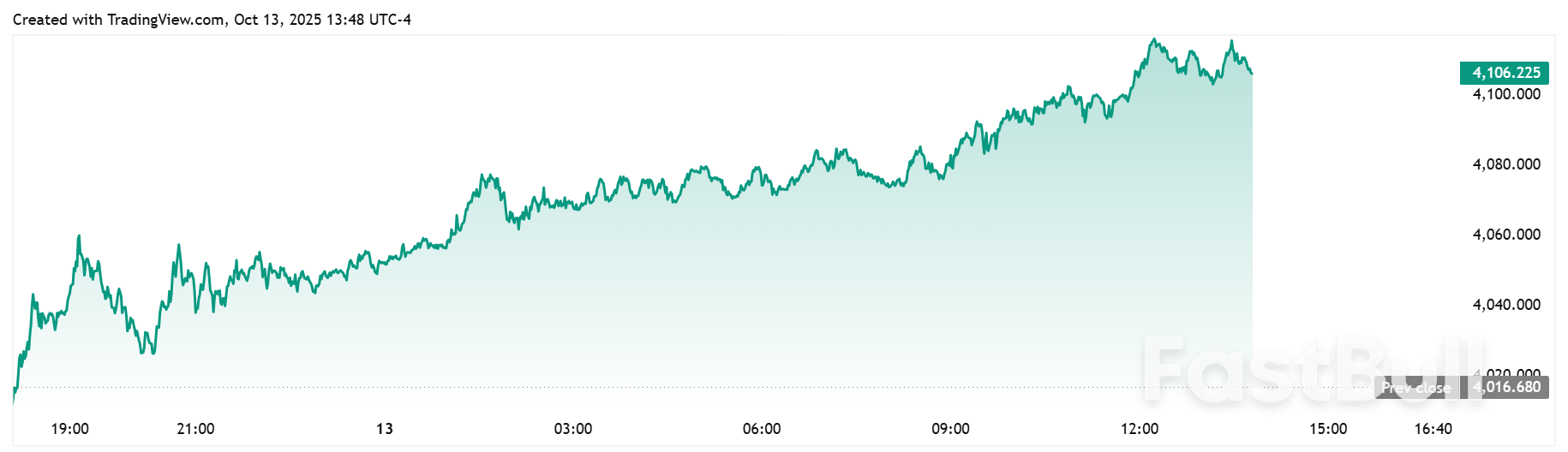
          With gold already trading over $4,100 on Monday afternoon following last week’s unprecedented break above $4,000 per ounce, even a conservative projection of the yellow metal’s medium-term investment demand suggests the price could reach $5,000 per ounce by the end of next year, according to commodity analysts at Societe Generale.
          In the French banking giant’s latest commodity research report published Monday, analysts said that the gold price appears poised to gain another $1,000 in relatively short order.
          “Last week, gold prices reached $4,042/oz, just $276/oz below our bullish $4,318/oz Q426 forecast we published just one month ago,” they wrote. “As of this morning, prices have risen to $4,072/oz. With ETF flows remaining strong, central bank buying expected to be resilient, we feel confident and compelled to update our target prices for gold.”
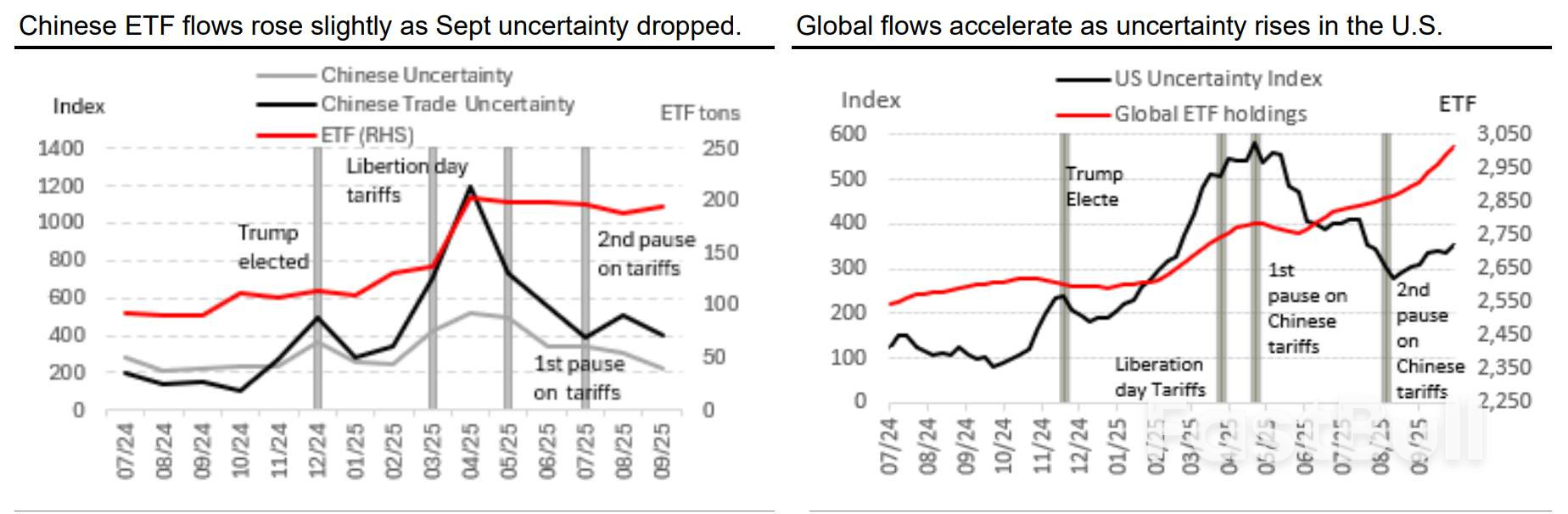
          “We now see prices reaching $5000/oz by the end of 2026, as the rate of flows has surpassed our initial assumptions,” they said. “Despite having no clarity on positioning (flows) of hedge funds, we have observed what can only be described as extremely strong, admittedly higher than we forecasted, positive ETF flows in the last few weeks. Why is this increase in flows happening now? We have previously noted a strong relationship between ETF flows and uncertainty levels since the Trump victory in November 2024 and believe for now, this to be a critical factor in understanding part of the price action.”
          SocGen analysts cautioned that the latest monthly FRED uncertainty indices from September do not take into account China’s sweeping export controls on rare earths on October 9th. “This index would also fail to capture that President Trump then announced, last Friday, to impose additional 100% tariffs on all Chinese goods and almost immediately signal openness to reach a deal to quell trade tensions,” they said. “However, stepping back from these recent events, we do note that in China the general (and trade) uncertainty indices dropped 80 (100) points during the month of September, yet Chinese ETF gold holdings rose to slightly 193t from 189t.
          ‘All that glitters is fear’ as $5,000 gold is now ‘increasingly inevitable’ – Societe Generale_1
          “Meanwhile, using our preferred weekly U.S. uncertainty index, which captures the period when China announced the rare earth export controls and Trump’s response last week, the level of uncertainty jumped to 354 - an increase of 18 points over the week and an increase of 44 points over the month (see upper right graphic),” they noted. “This, 354-level index, is still three times the level witnessed the 5 months prior to the U.S election.”
          The analysts said that under the circumstances, it was not surprising to see global gold ETF flows rise by 23 tonnes over the last week – and by 100 tonnes in the last month alone. “Critically, however, our China economics team highlighted on Sunday there is less than a 30% chance of the new tariffs materializing, but these scenarios, realized or not, seem to cause massive flows into gold ETFs,” they wrote. “We cannot imagine a situation where we return to pre-Trump index uncertainty normalcy over our forecast horizon, so ETF flows are a key component to our price forecasting.”
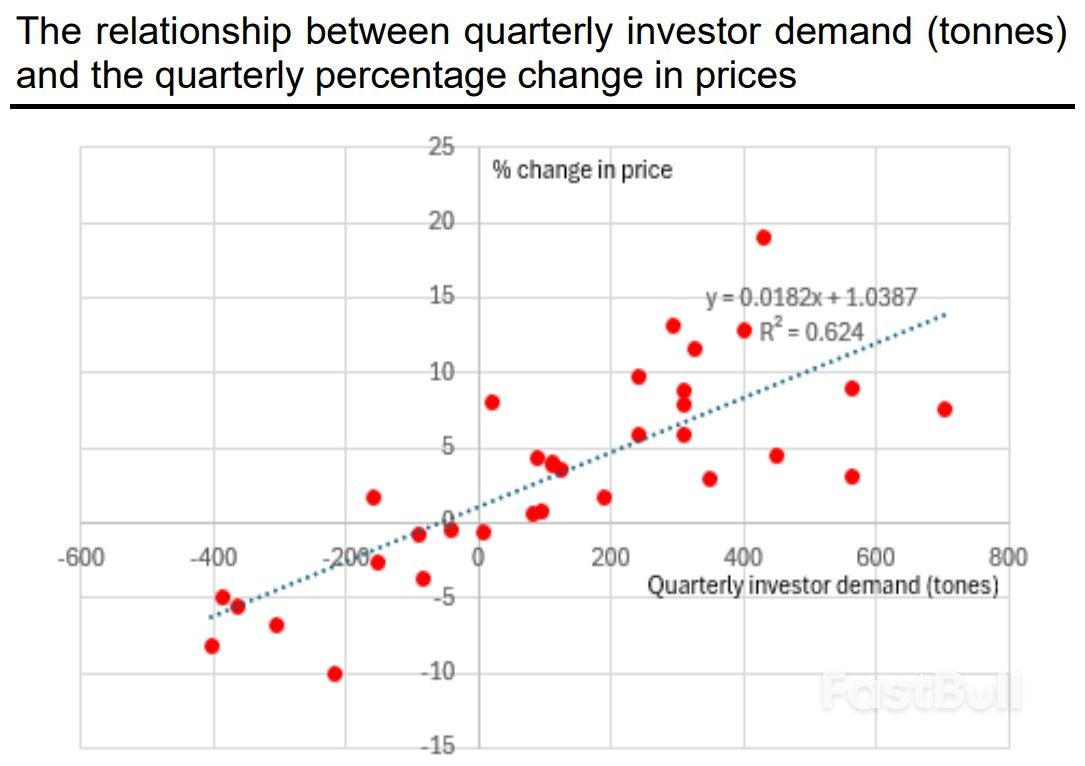
          SocGen said they maintained the core assumptions in their September forecast. “Specifically, in that outlook, we presented the case for extremely resilient gold investor and central bank demand, and we outlined that since 2022, the average quarterly increase in flows has been 72.5t across all managed money, ETFs, central banks and demand for coins and bars,” the analysts said. “For ETFs in particular, (where we can currently observe almost real time transparency on flows), quarterly changes have averaged +31.5t since 2017.”
          They added, however, “a highly significant 100t of flows into global gold ETFs, 69t more than ‘normal’” through the end of Q3. “This flow by itself partially explains the significantly increased gold price over the month of September,” the analysts wrote. “These elevated ETF flows, the highest level we have seen since Q3 2020 (when we witnessed 238t of positive flows) are significantly higher than our original flow assumptions, and explain, according to our framework, roughly $160/oz of the rise in gold prices over the course of the last three months.”
          SocGen analysts said they continue to take “a conservative and cautious approach to flow forecasting and only assume an additional 67t of gold is purchased each quarter above ‘normal’ levels, for all categories of flows” – including central banks and ETFs – across all quarters.
          ‘All that glitters is fear’ as $5,000 gold is now ‘increasingly inevitable’ – Societe Generale_2
          “We do this despite the recent elevated uncertainty but maintain the view that central banks accumulate gold so the percentage is higher in their total reserves,” they said. “Therefore, we continue to add this incremental amount to average demand and use that in the model framework shown in the [above] chart to forecast prices through to the end of 2026 (our forecast horizon). Recalibrating our gold framework to forecast from today’s gold price (i.e., marking to market the base price but leaving assumptions unchanged), the model points to $4,217/oz by the end of 2025 and $5000/oz by the end of 2026, a 14% increase from our $4,300/oz we released in September.”
          “Recognizing our conservative assumptions on ETF and central bank flows, we view the upside risk to our forecast is significantly greater than the downside,” they added.
          Spot gold continues to rise further above the $4,100 per ounce level on Monday after setting a fresh all-time high of $ 4,117.42 just before 1:30 pm EDT.
          ‘All that glitters is fear’ as $5,000 gold is now ‘increasingly inevitable’ – Societe Generale_3
          Spot gold last traded at $4,106.09 for a loss of 2.23% on the session.

          Source: kitco

          Risk Warnings and Disclaimers
          You understand and acknowledge that there is a high degree of risk involved in trading. Following any strategies or investment methods may lead to potential losses. The content on the site is provided by our contributors and analysts for information purposes only. You are solely responsible for determining whether any trading assets, securities, strategy, or any other product is suitable for investing based on your own investment objectives and financial situation.
          Add to Favorites
          Share

          Brazil Lines Up Global Pledge On Quadrupling Clean Fuel At COP30

          Daniel Carter

          Economic

          The country aims to unveil the initiative at the COP30 world leaders summit in Belem on Nov. 6-7 and is currently drawing up a list of potential signatories, according to people familiar with the matter, who requested anonymity to discuss private details. India and Italy have signaled their intention to join, one of the people said.
          Sustainable fuels usually include liquid biofuels, biogases and green hydrogen, along with solutions like e-fuels, which are made using captured carbon dioxide and renewable electricity. An early round of discussions on the plan in Japan last month indicated nations would pledge to lift output from a base year of 2024.
          Brazil's government didn't immediately respond to a request for comment.
          The pledge is designed to address a perceived hole in a landmark deal struck at COP28 to transition away from fossil fuels, which also included promises to triple renewable energy capacity globally and double the average annual rate of energy efficiency improvements by the end of this decade. Sustainable fuels are seen as a key tool to cut emissions in some of the hardest-to-decarbonize sectors, like aviation.
          Accelerating deployment of the technologies could deliver investments of as much as $1.5 trillion between 2024 and 2035 and create 2 million jobs, the International Energy Agency said in an Oct. 13 report.
          Brazil is a biofuels powerhouse. A program started in the wake of the 1973 oil crisis created a domestic ethanol industry, and most cars in the country can now run on gasoline, ethanol or a blend. Brazil is the second-largest ethanol exporter in the world.
          Yet crop-based biofuels in particular are controversial, with environmental activists warning that they can aggravate food and land insecurity, harm biodiversity and actually increase emissions. By comparison, the market for e-fuels, which can in theory be carbon neutral, is nascent and expensive. Critics say that the power generated by wind and solar can be better used elsewhere.
          A global declaration could help spur investments in the technologies, as well as create an international set of standards covering how much CO2 can be emitted during their production and from possible knock-on effects on the food supply and biodiversity, the people said.
          The European Union is weighing whether to sign but has reservations about the role of biofuels, said another of the people. Italy has been pushing to exempt cars running on biofuels from the EU's combustion engine ban that takes effect in 2035.
          Italy and the EU have been contacted for comment. India's government didn't immediately respond to a request for comment made outside usual office hours.
          Brazil is pitching the pledge as a key pillar of its Action Agenda for COP30, as it tries to focus the climate talks on implementation of promises that have already been made. The country is also working on a Carbon Markets Coalition that aims to align standards of different national systems.

          Source: Bloomberg Europe

          To stay updated on all economic events of today, please check out our Economic calendar
          Risk Warnings and Disclaimers
          You understand and acknowledge that there is a high degree of risk involved in trading. Following any strategies or investment methods may lead to potential losses. The content on the site is provided by our contributors and analysts for information purposes only. You are solely responsible for determining whether any trading assets, securities, strategy, or any other product is suitable for investing based on your own investment objectives and financial situation.
          Add to Favorites
          Share

          AI Stocks Are in a Bubble, Most Investors Say in BofA Survey

          Adam

          Stocks

          A record share of global fund managers said artificial intelligence stocks are in a bubble following a torrid rally this year, according to a survey by Bank of America Corp.
          About 54% of participants in the October poll indicated tech stocks were looking too expensive, an about-turn from last month when nearly half had dismissed those concerns. Fears that global stocks were overvalued also hit a peak in the latest survey.
          US stocks have scaled multiple records, driven by enthusiasm around AI spending and related productivity benefits. The tech-heavy Nasdaq 100 has rallied 18% this year, lifting its forward price-to-earnings ratio to nearly 28, above an average of 23 over the past decade.
          That’s led some market participants to question if valuations have overshot the cohort’s earnings outlook, although Goldman Sachs Group Inc. strategists have said it’s too early to be afraid of a tech bubble.
          Fund managers’ equity allocation also reflects some optimism. The BofA survey showed exposure to US stocks rose to the highest in eight months — stretching back to before tariff anxieties took hold. Worries about a recession subsided to the lowest since early 2022.
          Cash holdings declined, but BofA strategist Michael Hartnett said unease over AI as well as concerns around the private credit market were tempering “full-bull” sentiment.
          Renewed worries about a US-China trade war have roiled the mood more broadly in recent days. The Nasdaq 100 has led declines in the US, and futures tracking the benchmark were down about 1% on Tuesday.
          The BofA survey showed an AI bubble was viewed as the biggest tail risk, followed by a resurgence in inflation and worries about the loss of Federal Reserve independence and dollar debasement.
          The poll was conducted between Oct. 3 and Oct. 9, and canvassed 166 participants with $400 billion in assets.

          Source: Bloomberg

          Risk Warnings and Disclaimers
          You understand and acknowledge that there is a high degree of risk involved in trading. Following any strategies or investment methods may lead to potential losses. The content on the site is provided by our contributors and analysts for information purposes only. You are solely responsible for determining whether any trading assets, securities, strategy, or any other product is suitable for investing based on your own investment objectives and financial situation.
          Add to Favorites
          Share

          IMF Warns Of Rising Odds Of A ’disorderly’ Global Market Correction

          Damon

          Economic

          Global markets are getting too comfortable with risks like trade wars, geopolitical tensions and yawning government deficits, which, combined with already overpriced assets, increase the chance of a "disorderly" market correction, the International Monetary Fund said on Tuesday.

          Underscoring the IMF’s warning, President Donald Trump’s revived threats on Friday to hike tariffs on China stoked investor fears of a major asset price correction. The comments sparked a sell-off in U.S. stocks and sent bitcoin tumbling.

          Despite this recent volatility, markets have mostly been resilient since April, when Trump unleashed his trade war, underpinned by expectations of monetary easing in most major advanced economies. However, this market optimism masks the potential damage from tariffs and high government debt. The IMF warned that the close ties between banks and less-regulated financial firms could amplify these risks.

          "Beneath the calm surface, the ground is shifting in several parts of the financial system, giving rise to vulnerabilities," the body wrote in its semiannual Global Financial Stability Report.

          "Valuation models indicate that risk asset prices are well above fundamentals, increasing the probability of disorderly corrections when adverse shocks occur," it wrote.

          Despite some negative economic data, equity and corporate credit valuations are "fairly stretched" as enthusiasm over AI mega-cap stocks drives historic stock market concentration. That creates the risk of a "sudden, sharp correction" if expected returns fail to justify lofty valuations, the IMF said.

          ASSET PRICES SIGNAL DANGEROUS BUBBLE TERRITORY

          Analysis of sovereign bond markets also highlights growing pressure from widening fiscal deficits on market functioning. While bond markets have been mostly stable so far, abrupt jumps in yields could strain bank balance sheets and pressure open-ended funds like mutual funds, the IMF said.

          U.S. bond markets sold off last month as concerns about global fiscal health escalated, although the pain was quickly reversed and bonds rallied on weak economic data.

          The IMF added that central banks should remain alert to tariff-driven inflation risks and take a cautious stance on monetary easing to minimize further valuation spikes in riskier assets. Central bank independence is "critical" for anchoring market expectations and allowing those institutions to fulfill their mandates, it added, without referring to a specific institution.

          Trump’s attacks on Federal Reserve policymakers are emerging as the biggest threat to central bank independence in decades, sparking worries among central bankers worldwide, Reuters reported in August.

          The IMF also called for "urgent fiscal adjustments" to curb deficits and ensure resilient bond markets.

          NONBANK FINANCIAL FIRMS CREATE CONTAGION RISK

          Heightened interconnectedness between banks and the more lightly regulated nonbank sector would amplify any shocks stemming from sectors such as private credit or cryptocurrencies, the IMF said.

          The group for years warned about patchy nonbank oversight but cautioned on Tuesday that the sector - which includes insurers, pension funds and hedge funds - continues to grow and now holds roughly half of the world’s financial assets. In the United States and Europe, many banks have nonbank exposures that exceed their high-quality loss-absorbing capital, the IMF said.

          Roughly 10% of U.S. banks and 30% of European banks would experience a substantial hit to their capital if nonbanks drew down all their credit lines, according to an IMF analysis.

          "Vulnerabilities in the nonbank sector are interconnected," the IMF wrote. "They can quickly transmit to the core banking system, amplifying shocks and complicating crisis management."

          The body urged policymakers to adopt a more comprehensive approach to assessing these less visible risks, particularly around interactions between banks and nonbanks.

          Echoing European policymakers, the IMF also called on governments to adopt a comprehensive policy response to crypto assets, including stablecoins, the adoption of which could weaken a government’s control over its own currency and disrupt the traditional banking system.

          Source: Investing

          To stay updated on all economic events of today, please check out our Economic calendar
          Risk Warnings and Disclaimers
          You understand and acknowledge that there is a high degree of risk involved in trading. Following any strategies or investment methods may lead to potential losses. The content on the site is provided by our contributors and analysts for information purposes only. You are solely responsible for determining whether any trading assets, securities, strategy, or any other product is suitable for investing based on your own investment objectives and financial situation.
          Add to Favorites
          Share

          IDF Vows To Destroy All Hamas 'Terror Tunnels' As Part Of Disarming Gaza

          Samantha Luan

          Economic

          Political

          Forex

          Palestinian-Israeli conflict

          Israeli Defense Minister Israel Katz said on Sunday that the Israeli military would destroy tunnels in Gaza after the remaining Israeli captives are released by Hamas, which has happened on Monday."Israel’s great challenge after the phase of returning the hostages will be the destruction of all of Hamas’s terror tunnels in Gaza, directly by the IDF and through the international mechanism to be established under the leadership and supervision of the United States," Katz wrote on X.

          “This is the primary significance of implementing the agreed-upon principle of demilitarizing Gaza and neutralizing Hamas of its weapons. I have instructed the IDF to prepare for carrying out the mission,” he added.

          According to the outline of the Gaza ceasefire proposal released by the White House, all “military, terror, and offensive infrastructure, including tunnels and weapon production facilities, will be destroyed and not rebuilt,” and there will be a “process of demilitarization of Gaza under the supervision of independent monitors.” But the details of how those steps will be taken, including who will be doing it, are unclear. A senior Hamas official has also said that Hamas won’t disarm unless it can hand its weapons to a Palestinian state.

          So far, Israel and Hamas have just entered the first phase of the ceasefire deal, which involves the release of the Israeli hostages in exchange for thousands of Palestinians held in Israeli jails, the IDF pulling back to an agreed-upon line, and Israel allowing more aid to enter Gaza. Details on implementing the rest of the agreement still need to be worked out in negotiations between Israel and Hamas.Katz’s comments come as many are concerned Israel will restart its brutal war once Hamas releases the Israeli captives. Also on Sunday, Israeli Prime Minister Benjamin Netanyahu said the military “campaign is not over,” though he could be referring to other areas where Israel is at war or potential escalations elsewhere in the region.

          “And I want to say: Everywhere we fought – we won. But in the same breath, I must tell you: The campaign is not over. There are still very great security challenges ahead of us,” Netanyahu said, according to a statement from his office. “Some of our enemies are trying to rebuild themselves to attack us again. And as we say – ‘We’re on it.'”According to a report from Israel Hayom, the US has given Israel a guarantee that it would back Israeli military action if it determined Hamas violated the deal in a way that “poses a security threat.” The report said the understanding “constitutes a side agreement” between the US and Israel.The US gave Israel a similar side deal for the November 2024 Lebanon ceasefire agreement, which Israel continues to violate on a near-daily basis.

          Source: Zero Hedge

          To stay updated on all economic events of today, please check out our Economic calendar
          Risk Warnings and Disclaimers
          You understand and acknowledge that there is a high degree of risk involved in trading. Following any strategies or investment methods may lead to potential losses. The content on the site is provided by our contributors and analysts for information purposes only. You are solely responsible for determining whether any trading assets, securities, strategy, or any other product is suitable for investing based on your own investment objectives and financial situation.
          Add to Favorites
          Share

          Auto sector bankruptcies spark fresh scrutiny of Wall Street credit risks

          Adam

          Economic

          The bankruptcies of automotive-related companies First Brands and Tricolor, along with potential losses at banks and investment funds, are raising new concerns about hidden risks in parts of the credit market — prompting investors to take a closer look at risky debt.
          Auto parts supplier First Brands and subprime lender and dealership Tricolor both filed for bankruptcy protection last month. The two collapses have rattled some stakeholders in Wall Street's multitrillion-dollar credit machinery, from leveraged loans and collateralized loan obligations (CLOs) to trade‑finance funds and subprime auto loans, raising questions about exposure levels of a number of Wall Street fund managers, which pool capital from investors to provide loans to companies.
          "This would serve as a strong precedent for LPs (investors) to question risky offerings," said Zain Bukhari, associate director of risk and valuations at S&P Global. LPs, referring to limited partners, are passive investors that provide capital to a fund.
          Some investors may ask for audited statements or quality of earnings from independent audit firms before investing in unsecured assets, Bukhari added. First Brands had roughly $800 million in unsecured supply chain financing liabilities.
          A sign of such scrutiny appeared in July when First Brands was trying to raise a $6 billion loan to refinance its debt. In August, however, it became clear that potential lenders would require further diligence, including a quality-of-earnings report, according to a document filed by the auto parts company's chief restructuring officer in bankruptcy court.
          Investors and analysts are now assessing the fallout for the individual firms exposed as well as for the broader market. They hope to gain some clarity during the third-quarter earnings season, which kicks off this week.
          "The third quarter earnings become a very interesting litmus test for how this shakes out - people will be very closely following the bank reporting," said Andrew Sheets, global head of corporate credit research at Morgan Stanley. "There will be big questions about where auto loan trends are, (and) other consumer credit charge-off trends are."
          First Brands filed for bankruptcy protection on September 29, listing more than $10 billion in liabilities. Some of the finance industry's most prominent names, including Jefferies and UBS Group (UBSG.S), have since disclosed exposure of more than $1 billion tied to the collapse of the Ohio-based company. Earlier in October, Jefferies said a fund in its asset management division, Leucadia Asset Management, has about $715 million of receivables tied to First Brands. UBS is assessing more than $500 million of exposure across certain funds.
          Some investors have asked Jefferies-linked Point Bonita Capital's fund to return money invested in the fund, a source familiar with the matter told Reuters. On Sunday, Jefferies said its exposure to First Brands Group is limited and that any potential losses would be "readily absorbable." When Jefferies was asked if it will face pressure from investors for more scrutiny on risky investments, a spokesman for the firm declined to comment on Monday.
          Other banks exposed include SouthState Bank and CIT Group, which is now owned by First Citizens. A broad range of funds including Sound Point Capital Management, Benefit Street Partners and Palmer Square Capital Management hold CLOs, which collectively hold hundreds of millions of the $4 billion of first-lien term loans of First Brands, according to court documents. Investment firms with over $100 million CLO exposure each include AGL Credit and PGIM, according to the recent court filings.
          The funds and banks either declined to comment or did not respond to requests for comment. A UBS spokesperson said the bank was "working to determine the potential performance impact on the small number of our affected funds."
          Meanwhile, Tricolor listed over $1 billion in liabilities, with more than 25,000 creditors, according to its bankruptcy petition. Lenders such as JPMorgan (JPM.N) have nearly $200 million of exposure to Tricolor, Reuters has previously reported.
          CREDIT RALLY SPUTTERS
          The credit rally, which got off to a robust start earlier in October, has hit a speed bump in recent days as investors reduced exposure to certain sectors over concerns around weakness in consumer and auto lending, experts said.
          "We now seem to have a catalyst important enough to engender a shade of fear," said Neha Khoda, head of U.S. credit strategy at Bank of America, in a note dated October 10. "Credit investors are questioning if they need to be all-in at super-tight spreads, and they won't get a pushback from us."
          To be sure, the collapse of First Brands is unlikely to cause a widespread global meltdown across credit markets, some experts said.
          "On a deal-by-deal basis, we don't see conditions in the leveraged finance markets as materially different from historical norms," said Logan Nicholson, senior managing director at asset manager Blue Owl Capital.
          In the U.S., the overall exposure of CLOs to First Brands currently stands at 0.21%, according to estimates from Morgan Stanley in a note dated September 26. For the CLO funds currently holding First Brands loans, the exposure levels range between 0.001% and 1.8%.
          Some experts said that a divergence has emerged in the CLO industry between holders of senior and junior loans, as a cohort of companies with weaker credit ratings have been buffeted by slower macroeconomic growth and headwinds from the Trump administration's tariff policy.
          "Probably the larger impact on markets has been on the loan side," said Morgan Stanley's Sheets, adding that the ripple effect from the bankruptcies could impact junior parts of a CLO's capital structure.

          Source: reuters

          To stay updated on all economic events of today, please check out our Economic calendar
          Risk Warnings and Disclaimers
          You understand and acknowledge that there is a high degree of risk involved in trading. Following any strategies or investment methods may lead to potential losses. The content on the site is provided by our contributors and analysts for information purposes only. You are solely responsible for determining whether any trading assets, securities, strategy, or any other product is suitable for investing based on your own investment objectives and financial situation.
          Add to Favorites
          Share
          FastBull
          Copyright © 2025 FastBull Ltd

          728 RM B 7/F GEE LOK IND BLDG NO 34 HUNG TO RD KWUN TONG KLN HONG KONG

          TelegramInstagramTwitterfacebooklinkedin
          App Store Google Play Google Play
          Products
          Charts

          Chats

          Q&A with Experts
          Screeners
          Economic Calendar
          Data
          Tools
          Membership
          Features
          Function
          Markets
          Copy Trading
          Latest Signals
          Contests
          News
          Analysis
          24/7
          Columns
          Education
          Company
          Careers
          About Us
          Contact Us
          Advertising
          Help Center
          Feedback
          User Agreement
          Privacy Policy
          Business

          White Label

          Data API

          Web Plug-ins

          Poster Maker

          Affiliate Program

          Risk Disclosure

          The risk of loss in trading financial instruments such as stocks, FX, commodities, futures, bonds, ETFs and crypto can be substantial. You may sustain a total loss of the funds that you deposit with your broker. Therefore, you should carefully consider whether such trading is suitable for you in light of your circumstances and financial resources.

          No decision to invest should be made without thoroughly conducting due diligence by yourself or consulting with your financial advisors. Our web content might not suit you since we don't know your financial conditions and investment needs. Our financial information might have latency or contain inaccuracy, so you should be fully responsible for any of your trading and investment decisions. The company will not be responsible for your capital loss.

          Without getting permission from the website, you are not allowed to copy the website's graphics, texts, or trademarks. Intellectual property rights in the content or data incorporated into this website belong to its providers and exchange merchants.

          Not Logged In

          Log in to access more features

          FastBull Membership

          Not yet

          Purchase

          Become a signal provider
          Help Center
          Customer Service
          Dark Mode
          Price Up/Down Colors

          Log In

          Sign Up

          Position
          Layout
          Fullscreen
          Default to Chart
          The chart page opens by default when you visit fastbull.com