Markets
News
Analysis
User
24/7
Economic Calendar
Education
Data
- Names
- Latest
- Prev



Signal Accounts for Members
All Signal Accounts
All Contests


Japan Industrial Inventory MoM (Nov)A:--
F: --
P: --
Japan Retail Sales (Nov)A:--
F: --
P: --
Japan Retail Sales YoY (Nov)A:--
F: --
P: --
Russia Retail Sales YoY (Nov)A:--
F: --
P: --
Russia Unemployment Rate (Nov)A:--
F: --
P: --
Argentina Retail Sales YoY (Oct)A:--
F: --
P: --
U.S. Weekly Treasuries Held by Foreign Central Banks--
F: --
P: --
China, Mainland Industrial Profit YoY (YTD) (Nov)A:--
F: --
P: --
India Industrial Production Index YoY (Nov)--
F: --
P: --
India Manufacturing Output MoM (Nov)--
F: --
P: --
US President Trump delivered a speech
Russia IHS Markit Manufacturing PMI (Dec)A:--
F: --
P: --
India Manufacturing Output MoM (Nov)A:--
F: --
P: --
India Industrial Production Index YoY (Nov)A:--
F: --
P: --
France Unemployment Class-A (Nov)A:--
F: --
P: --
Canada National Economic Confidence IndexA:--
F: --
P: --
U.S. Pending Home Sales Index (Nov)A:--
F: --
U.S. Pending Home Sales Index MoM (SA) (Nov)A:--
F: --
U.S. Pending Home Sales Index YoY (Nov)A:--
F: --
P: --
U.S. EIA Weekly Cushing, Oklahoma Crude Oil Stocks Change--
F: --
P: --
U.S. EIA Weekly Crude Demand Projected by Production--
F: --
P: --
U.S. EIA Weekly Gasoline Stocks Change--
F: --
P: --
U.S. Dallas Fed General Business Activity Index (Dec)A:--
F: --
P: --
U.S. EIA Weekly Crude Stocks Change--
F: --
P: --
U.S. Dallas Fed New Orders Index (Dec)A:--
F: --
P: --
U.S. EIA Weekly Natural Gas Stocks ChangeA:--
F: --
P: --
U.S. Weekly Treasuries Held by Foreign Central BanksA:--
F: --
P: --
U.S. EIA Weekly Crude Stocks ChangeA:--
F: --
P: --
U.S. EIA Weekly Crude Demand Projected by Production--
F: --
P: --
U.S. EIA Weekly Cushing, Oklahoma Crude Oil Stocks ChangeA:--
F: --
P: --
U.S. EIA Weekly Gasoline Stocks ChangeA:--
F: --
P: --
South Korea Industrial Output MoM (SA) (Nov)--
F: --
P: --
South Korea Retail Sales MoM (Nov)--
F: --
P: --
South Korea Services Output MoM (Nov)--
F: --
P: --
Russia IHS Markit Services PMI (Dec)--
F: --
P: --
Turkey Economic Sentiment Indicator (Dec)--
F: --
P: --
Euro Zone Total Reserve Assets (Nov)--
F: --
P: --
Brazil Unemployment Rate (Nov)--
F: --
P: --
U.S. Weekly Redbook Index YoY--
F: --
P: --
U.S. S&P/CS 10-City Home Price Index YoY (Oct)--
F: --
P: --
U.S. S&P/CS 10-City Home Price Index MoM (Not SA) (Oct)--
F: --
P: --
U.S. S&P/CS 20-City Home Price Index (Not SA) (Oct)--
F: --
P: --
U.S. S&P/CS 20-City Home Price Index MoM (Not SA) (Oct)--
F: --
P: --
U.S. FHFA House Price Index YoY (Oct)--
F: --
P: --
U.S. S&P/CS 20-City Home Price Index YoY (Not SA) (Oct)--
F: --
P: --
U.S. S&P/CS 20-City Home Price Index MoM (SA) (Oct)--
F: --
P: --
U.S. FHFA House Price Index MoM (Oct)--
F: --
P: --
U.S. FHFA House Price Index (Oct)--
F: --
P: --
U.S. Chicago PMI (Dec)--
F: --
P: --
Brazil CAGED Net Payroll Jobs (Nov)--
F: --
P: --
U.S. Weekly Total Oil Rig Count--
F: --
P: --
U.S. Weekly Total Rig Count--
F: --
P: --
FOMC Meeting Minutes
U.S. API Weekly Refined Oil Stocks--
F: --
P: --
U.S. API Weekly Crude Oil Stocks--
F: --
P: --
U.S. API Weekly Cushing Crude Oil Stocks--
F: --
P: --
U.S. API Weekly Gasoline Stocks--
F: --
P: --
South Korea CPI YoY (Dec)--
F: --
P: --


No matching data
Latest Views
Latest Views
Trending Topics
Top Columnists
Latest Update
White Label
Data API
Web Plug-ins
Affiliate Program
View All

No data
Chairs televised meeting with generals just after Trump-Zelensky summit...
Russian President Vladimir Putin has made clear to both his citizens and to the world that the 'special military operation' in Ukraine will continue on until all goals are achieved, and that his forces are advancing 'confidently'.
He chaired a televised meeting with the country's top military officials, focused on a status update regarding Ukraine, and crucially coming the day after Presidents Trump and Zelensky met in Florida in a failed effort to reach breakthrough on the proposed peace deal. Moscow is pressing ahead with its goal of fully capturing and pacifying the four Ukrainian regions it declared part of the Russian Federation in fall of 2022 via a 'popular referendum'.
"The goal of liberating the Donbas, Zaporizhia and Kherson regions is being carried out in stages, in accordance with the plan of the special military operation," Putin described before underscoring, "The troops are confidently advancing."
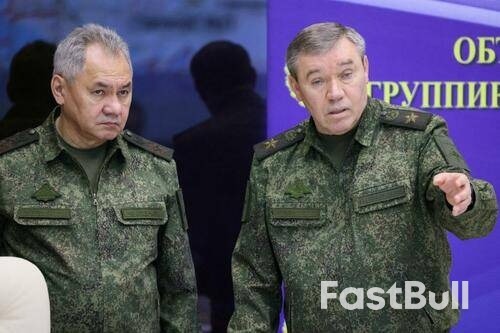
Sputnik/ReutersAt the meeting it was also announced that Russian troops have made more gains in the last 24 hours, especially the capture of Dibrova village in Donetsk region.
According to an update of the meeting via RT translation, battlefield gains of the past month are significant:
In December, Russian forces liberated over 700 square kilometers of territory, taking some 32 settlements under control, Gerasimov said at the meeting. This month, the military has shown the highest rate of progress in the entire outgoing year, he noted, adding that troops are advancing "along virtually the entire frontline."
"The adversary is not undertaking any active offensive actions. They have concentrated their main efforts on strengthening their defenses and are attempting to slow the pace of our advance by conducting counterattacks in isolated areas and using drones en masse," Gerasimov said.
The Kremlin has at the same time reiterated that it is not interested in a 'Plan B or Plan C' in terms of a peace deal, but that it only seeks lasting political settlement. This will of course include international recognition of its territories in the Donbass.
According to highlights the Russian president's speech after his meeting with top defense officials, via a TASS and Al Jazeera compilation:
Putin, surrounded by his generals, is making clear to the world that he remains in the driver's seat - with all the leverage on the field of battle - and that Zelensky has no cards to play.
Mining difficulty for Bitcoin has risen to 148.2 trillion in the latest 2025 difficulty reset, the highest level since miners' and adversarial network forces collided in earnest.
That is a significant jump in general, as the protocol is setting up for one more leg higher into early 2026. What is also increasing, and steadily rising through 2025, is the difficulty of inserting a new block into the Bitcoin ledger.
At the beginning of the year, it was substantially below 110 trillion and rose in tandem with the increasing demand for mining hash power. In competitive situations, some miners increased production to afford the necessary equipment for gains. The current level is roughly 35% above January's baseline, although still shy of the October peak, which was near 156 trillion.
The rising difficulty reflects the overall growth in the network's computational power. Analysts remain uncertain about what this major shift signals for Bitcoin, but it highlights both the resilience and the challenges faced by miners.
More complexity leads to a more secure network, albeit at the expense of smaller miners who run less powerful machines, in part because their profit margins are thin.
The Bitcoin network difficulty is directly proportional to the hashrate and adjusts itself every two weeks (or more precisely, every 2,016 blocks) to find new blocks approximately every 10 minutes.
Bitcoin's mining difficulty rises when blocks are mined too quickly and falls when they're mined too slowly. At the last adjustment, the average time between blocks was roughly 9.95 minutes—slightly slower than the current pace. This acceleration has effectively acted as a difficulty booster. With hash power continuing to climb, analysts project that difficulty could once again reach new highs, potentially surpassing 149 trillion, assuming current conditions persist until the next adjustment, expected around January 8, 2026.
The network's hash rate, which measures the total computational power available to secure the network, continued to increase throughout much of 2025. It reached over 1,150 EH/s at its highest point in October before gradually declining later in the year. Even with that slight dip, hash power is still significantly higher than it was in January.
Big companies and miners with industrial-scale operations have been driving this expansion, thanks to the use of expensive ASIC equipment and inexpensive power sources.
Difficulty serves as Bitcoin's only safety valve at the protocol level. Blocks cannot be added too quickly, which ensures predictable issuance and helps maintain network stability.
The mining challenge is recalibrated every 2,016 blocks, roughly every 10 minutes at the current hash rate. Bitcoin's decentralized consensus not only resists certain attacks but also provides resilience, making the network disaster-tolerant.
Greater difficulty also means that it takes more electricity and computer power to unlock each block. This can be margin-pressured, and with volatile price action on Bitcoin, it's becoming increasingly difficult to support the network as electricity costs rise – a challenge in maintaining network strength amid heightened activity. The network is stabilized with minor oscillations.
Ukraine attempted to attack Russian President Vladimir Putin's state residence in the Novgorod region using 91 drones, according to Russian Foreign Minister Sergei Lavrov.
All drones were destroyed during the attack, Lavrov said, as reported by Russian news agencies TASS and Interfax on Monday.
Following the incident, Lavrov stated that Russia will retaliate, with targets and timing for a counterstrike already determined. Despite the attack, Russia plans to continue negotiations with U.S. and others, but will change its negotiating position.
The Russian foreign minister did not provide specific details about the planned countermeasures.
President Trump on Friday in a radio interview disclosed something which missed the attention of the US and global media. He let slip that a large land site had been knocked out by a strike from US forces in the Caribbean - however without specifying which country was hit (whether Venezuela or perhaps Colombia).
Trump may have actually assumed the attack which he disclosed publicly for the first time was already being reported on, but it had not. He was being interviewed by John Catsimatidis, the Republican billionaire who owns the WABC radio station in New York on his The Cats & Cosby Show, and the two were talking about the Venezuela campaign.
Illustrative: Venezuela coast, Wiki CommonsThe United States had knocked out "a big facility" last week, Trump described somewhat vaguely, in apparent reference to a drug facility on the Latin American coast.
"They have a big plant or a big facility where the ships come from," Trump said, though he did not explicitly identify the exact location or even country attacked. "Two nights ago we knocked that out."
"But every time I knock out a boat, we save 25,000 American lives. It's very simple. And what's happening is they're having a hard time employment-wise, they can't get anybody.
And we just talked out, I don't know if you read or you saw, they [Venezuela] have a big plant or a big facility where the ships come from. Two nights ago, we knocked that out. So we hit them very hard. But drugs are down over 97 percent. Can you believe it?"
Some unnamed American officials suggested to the New York Times that the Commander-in-Chief was referring to a drug facility in Venezuela:
Trump did not name the location of the facility, though American officials told the New York Times that the president was referring to a drug facility in Venezuela that was eliminated. The president's comment is the only report of such an attack. No other Latin American government, including Venezuela, has disclosed a strike of this sort.
But information or confirmation other than that disclosure remains a mystery, as neither the CIA nor Pentagon have commented, as the NY Times notes:
If Mr. Trump's suggestion that the United States had struck a site in the region proves accurate, it would be the first known attack on land since he began his military campaign against Venezuela. U.S. officials declined to specify anything about the site the president said was hit, where it was located, how the attack was carried out or what role the facility played in drug trafficking. There has been no public report of an attack from the Venezuelan government or any other authorities in the region.
Speculation has quickly begun in an effort to identify which facility was hit and what damage was done. Some analysts have highlighted the below explosion reported by local Venezuelans, given the timing fits (Wednesday, Dec. 24).
The local reporter's commentary reads according to (machine) translation, A new large explosion was reported from the Industrial Zone of the San Francisco municipality, Zulia state, in the early morning of this December 24.
This is in Venezuela's second largest city, in the northwest corner of the country, and near the coast.
If the Pentagon did indeed take out a "large facility" on land, as Trump's words indicate, it suggests the US may not initiate a major war in quick 'shock and awe' style, but will opt for sporadic strikes which limit military action to specified targets. So the 'war' might be a slow burn after all - which also means the Pentagon force build-up in the Caribbean is there to stay for a while.
Russia has begun to wind down its provocations in eastern Europe to avoid escalating tensions with NATO, said a top intelligence official from one of the alliance's frontline members which has frequently raised the alarm about threats from Moscow.
"What we're still seeing today is that Russia currently has no intention of attacking any of the Baltic states or NATO more broadly," Estonian foreign intelligence chief Kaupo Rosin told the country's public broadcaster in an interview.
Rosin's words strike a different tone amid more serious warnings from western officials about Russian President Vladimir Putin's intentions. NATO Secretary General Mark Rutte said earlier this month that the alliance must prepare itself to fend off a Russian assault in the next five years, calling on Europeans to recall the scale of destruction caused by World War II.
Rosin said his agency's analysis also shows Russia is not specifically planning a military confrontation with the Baltic countries of Estonia, Latvia and Lithuania. However, he stressed the need for continued vigilance.
"So far, it's still clear that Russia respects NATO and is currently trying to avoid any open conflict," he said.
Earlier this month, Putin said that Russia was "ready for war" if Europe launched an attack, but stressed that Moscow was not planning any such conflict.
Tensions on Europe's eastern flank surged following Russia's full-scale invasion of Ukraine in 2022, prompting governments across the region to ramp up defense spending. The three Baltic nations and Poland, which share borders with Russia and Kremlin-ally Belarus and are staunch supporters of Kyiv, have born the brunt of incursions by Russian military jets and drones.
Russian fighter jets violated Estonian airspace for 12 minutes earlier this year, prompting the Baltic nation to call for an emergency meeting of the alliance.
But Rosin said Moscow has taken a more cautious approach as a result of NATO's forceful response to several such incidents. Russian jets and drones have become more careful with their flight paths over Ukraine and the Baltic Sea, Rosin said.
Eastern European NATO members also face an increasing number of acts of arson, cyberattacks and sabotage, which recently included attempted damage to a key rail line linking Poland to Ukraine. Officials have blamed the Russian intelligence services for those incidents, an accusation which Moscow has dismissed as hysteria.
In the interview, Rosin criticized the widespread description of those incidents as "hybrid attacks." He described that term as an unhelpful euphemism which "softens reality and gives an overly innocent impression of what's actually happening."
"We should call things by their proper names. If it's sabotage, then it's sabotage," said the Baltic nation's intelligence chief.
Rosin also said he believes Western sanctions on Russia — particularly those targeting oil exports and access to financial markets — are starting to pressure Moscow just as US President Donald Trump continues attempts to broker peace in Ukraine.
"Russia is facing more and more problems," Rosin said. "It's not going to collapse in the next few months or even within six months to a year, but the pressure is beginning to take a toll."
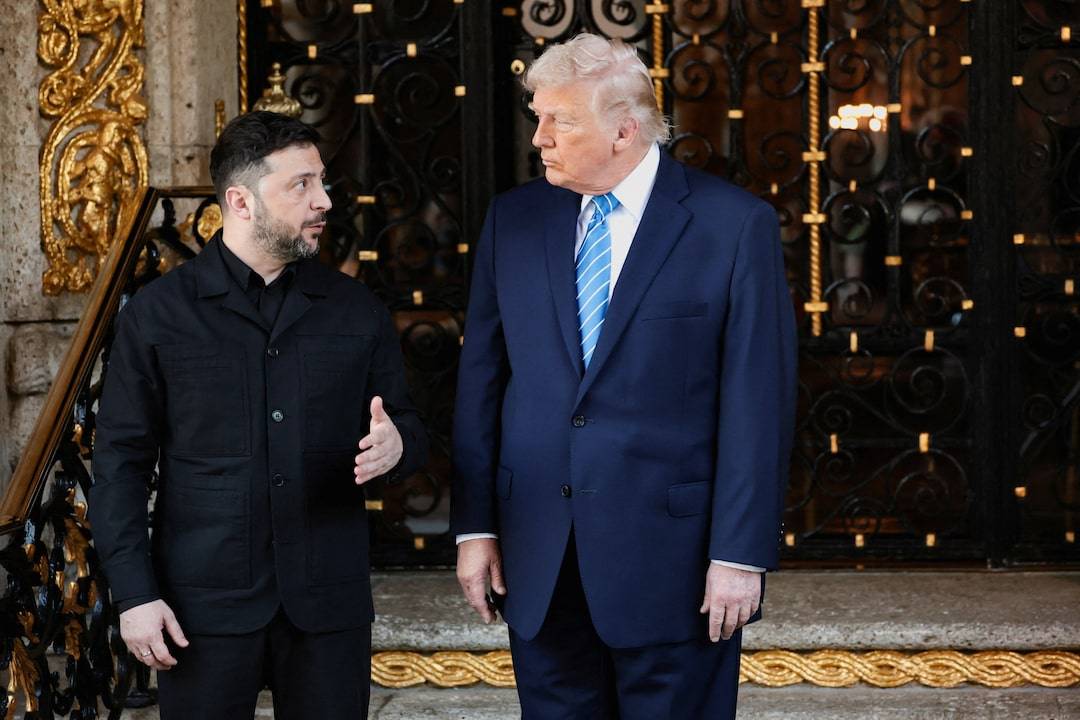
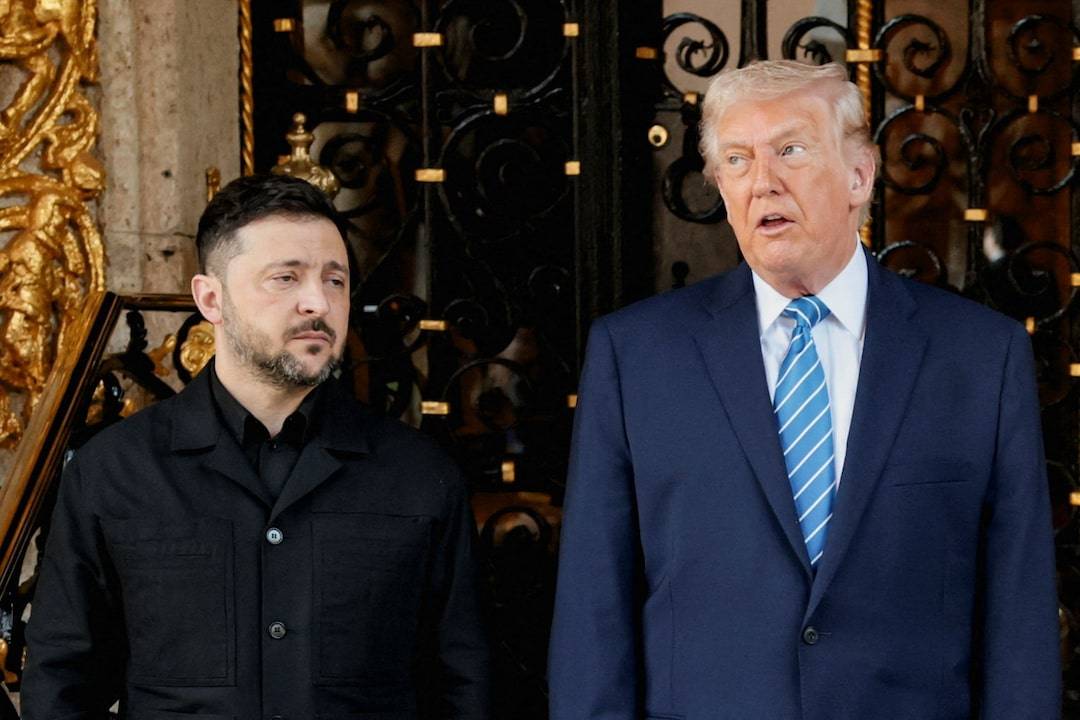
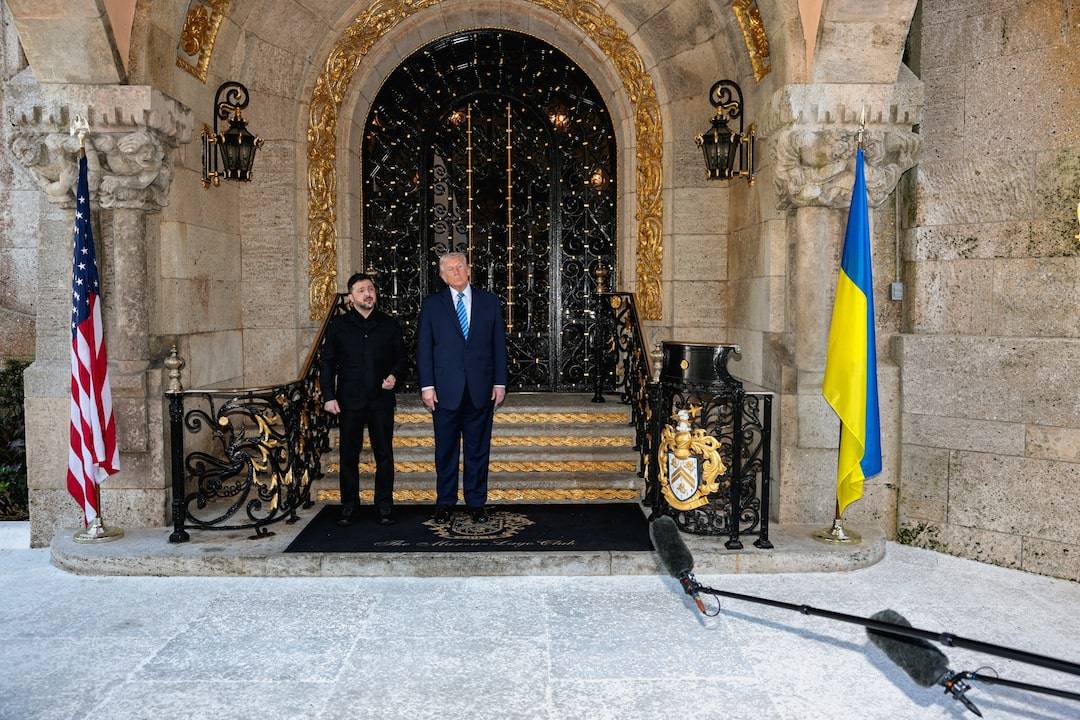
U.S. President Donald Trump said on Sunday that he and Ukrainian President Volodymyr Zelenskiy were "getting a lot closer, maybe very close" to an agreement to end the war in Ukraine, while acknowledging that the fate of the Donbas region remains a key unresolved issue.
The two leaders spoke at a joint news conference after meeting at Trump's Mar-a-Lago resort in Florida on Sunday afternoon. Both leaders reported progress on two of the most contentious issues in peace talks - security guarantees for Ukraine and the division of eastern Ukraine's Donbas region that Russia has sought to capture.
Both Trump and Zelenskiy offered few details and did not provide a deadline for completing a peace deal, although Trump said it will be clear "in a few weeks" whether negotiations to end the war will succeed. He said a few "thorny issues" around territory must be resolved.
Zelenskiy said an agreement on security guarantees for Ukraine has been reached. Trump was slightly more cautious, saying that they were 95% of the way to such an agreement, and that he expected European countries to "take over a big part" of that effort with U.S. backing.
French President Emmanuel Macron, in an X post published after Trump met with Zelenskiy, said progress was made on security guarantees. Macron said countries in the so-called "Coalition of the Willing" would meet in Paris in early January to finalise their "concrete contributions."
Zelenskiy has said previously that he hopes to soften a U.S. proposal for Ukrainian forces to withdraw completely from Donbas, a Russian demand that would mean ceding some territory held by Ukrainian forces. While Moscow insists on getting all of Donbas, Kyiv wants the map frozen at current battle lines.
Both Trump and Zelenskiy said on Sunday the future of the Donbas had not been settled, though the U.S. president said discussions are "moving in the right direction." The United States, seeking a compromise, has proposed a free economic zone if Ukraine leaves the area, although it remains unclear how that zone would function in practical terms.
"It's unresolved, but it's getting a lot closer. That's a very tough issue," Trump said.
Nor did the leaders offer much insight into what agreements they had reached on providing security for Ukraine after the war ends, something Zelenskiy described Sunday as "the key milestone in achieving a lasting peace."
Russia has said any foreign troop deployment in Ukraine is unacceptable.
Zelenskiy said any peace agreement would have to be approved by Ukraine's parliament, or by a referendum. Trump said he would be willing to speak to parliament if that would secure the deal.
Shortly before Zelenskiy and his delegation arrived at Trump's Florida residence, Trump and Russian President Vladimir Putin spoke in a call described as "productive" by the U.S. president and "friendly" by Kremlin foreign policy aide Yuri Ushakov.


Ushakov, in Moscow, said Putin told Trump a 60-day ceasefire proposed by the European Union and Ukraine would prolong the war. The Kremlin aide also said Ukraine needs to make a decision regarding the Donbas "without further delay."
Trump said he and Putin spoke for more than two hours. He said the Russian president pledged to help rebuild Ukraine, including by supplying cheap energy. "Russia wants to see Ukraine succeed," Trump said. "It sounds a little strange."
As Trump praised Putin, Zelenskiy tilted his head and smiled.
Trump said he would call Putin again following the meeting with Zelenskiy.
The Kremlin expressed support for Trump's negotiations.
"The whole world appreciates President Trump and his team's peace efforts," Kirill Dmitriev, Putin's special envoy, posted on X early on Monday after Trump's talks with Zelenskiy.
U.S. negotiators have also proposed shared control over the Zaporizhzhia nuclear plant. Power line repairs have begun there after another local ceasefire brokered by the International Atomic Energy Agency, the agency said on Sunday.
Negotiators, Trump said, have made progress on deciding the fate of the plant, which can "start up almost immediately." The U.S. president said "it's a big step" that Russia had not bombed the facility.
Russia controls all of Crimea, which it annexed in 2014, and since its invasion of Ukraine nearly four years ago has taken control of about 12% of its territory, including about 90% of the Donbas, 75% of the Zaporizhzhia and Kherson regions, and slivers of the Kharkiv, Sumy, Mykolaiv and Dnipropetrovsk regions, according to Russian estimates.
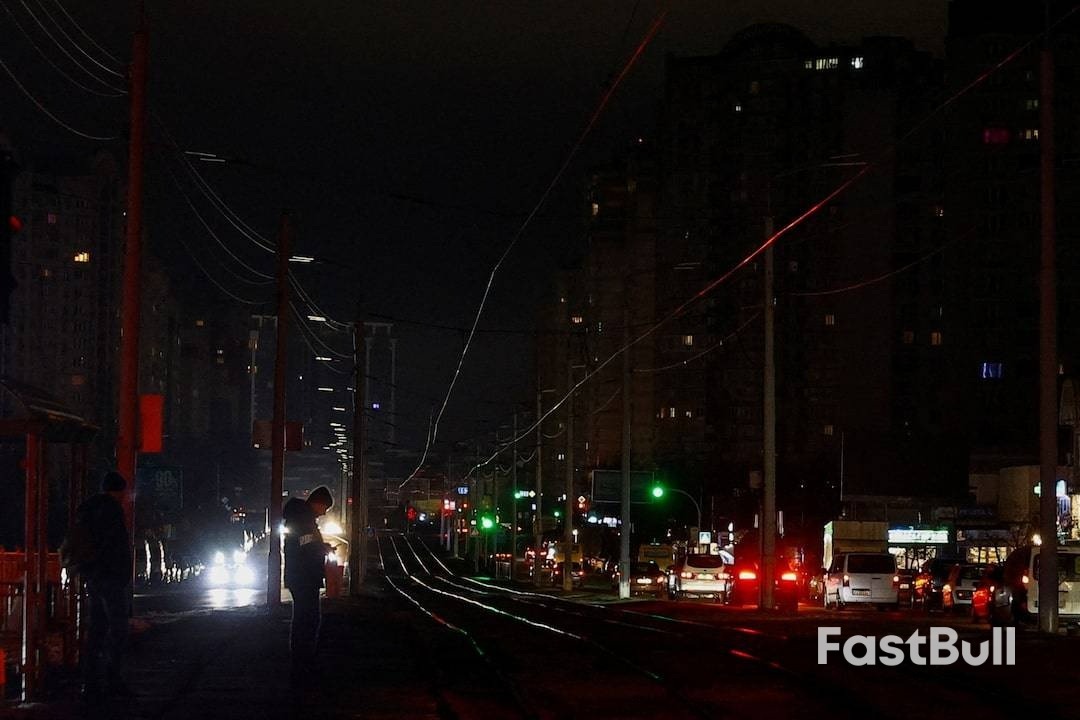
The day before Zelenskiy arrived in Florida to meet with Trump, Russian forces attacked Kyiv and other parts of Ukraine with hundreds of missiles and drones, knocking out power and heat in parts of the Ukrainian capital. Zelenskiy has described the weekend attacks as Russia's response to the U.S.-brokered peace efforts, but Trump on Sunday said he believes Putin and Zelenskiy are serious about peace.
After Saturday's air attacks, Putin said Moscow would continue waging its war if Kyiv did not seek a quick peace. Russia has steadily advanced on the battlefield in recent months, claiming control over several more settlements on Sunday.
European heads of state joined at least part of Sunday's meeting by phone. European Commission President Ursula von der Leyen said on social media site X that "Europe is ready to keep working with Ukraine and our US partners," and added that having ironclad security guarantees will be of "paramount" importance.
A spokesman for U.K. Prime Minister Keir Starmer said European leaders "underlined the importance of robust security guarantees and reaffirmed the urgency of ending this barbaric war as soon as possible."
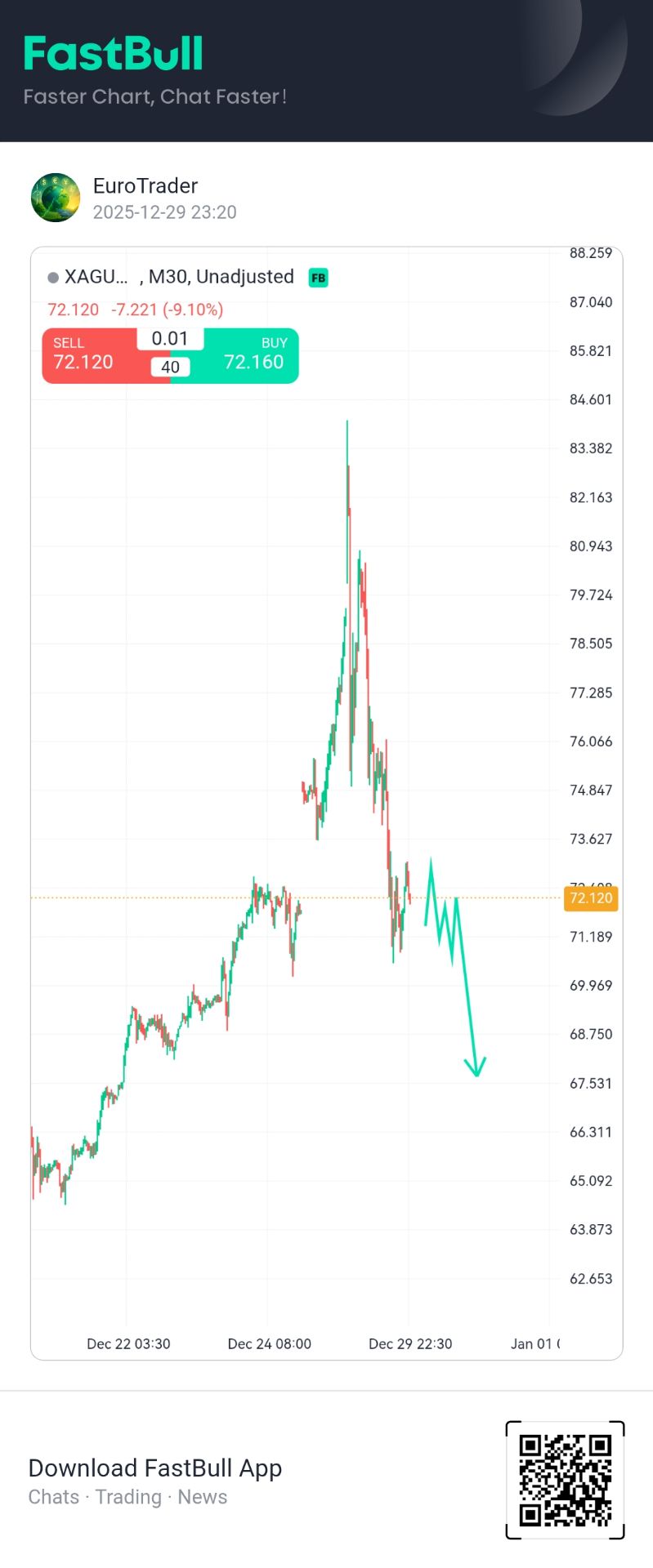
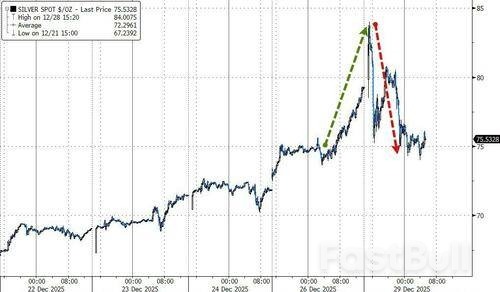
Silver tumbled dramatically overnight after initially smashing through $80 an ounce for the first time (topping $84 at its highs), halting a near vertical recent rise driven by Chinese speculative demand.

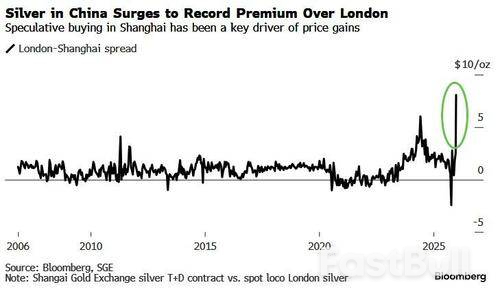
Surging Chinese investment demand has pulled the metal higher, with premiums for spot silver in Shanghai rising above $8 an ounce over London prices, the biggest spread on record...

As Bloomberg reports, the blistering rally has provoked extreme measures in China's investment landscape, with the country's only pure-play silver fund turning away new customers after its repeated risk warnings went unheeded.
The fund's manager announced the unusual step Friday after multiple actions - from tighter trading rules to cautionary advice about "unsustainable" gains - failed to quell an eruption of interest fueled by social media.
However, Goldman Sachs Asia trading desk noted 'no smoking gun' for the reversal:
While there are only 3 days ahead of New Year, China commodities remain volatile. Silver surged 9.25% by lunch break and people are asking what factors investors are pricing for silver.
However, risk off in the afternoon without smoking gun. Precious had significant correction.
Palladium and platinum both ended at limit down and silver's early gain was almost wiped out and ended +0.51% only while gold lost 0.91%.
Open interest across the 4 precious metal contract all declined.
Although they do point out that GFEX tightened measure to curb excessive trading of palladium and platinum a few days ago and investors were leaving the market and prices corrected notably today.
Bloomberg macro strategist Adam Linton agrees with Goldman on 'no smoking gun', but...
"While there was no clear driver for the silver pullback, the low levels of liquidity and silver's parabolic rise means that it is vulnerable to a snap back.
Macro drivers and liquidity remain light, meaning that such erratic price action in the metals space could be a feature of trade for what is left of 2025."
The Chinese measures are effectively a rollover of previous policies and were first announced by the Ministry of Commerce on Oct. 30.
Although the country ranks among the top three global producers of silver - largely as a byproduct of industrial metals - it's also the world's largest consumer and therefore not a major exporter.
"The speculative atmosphere is very strong," said Wang Yanqing, an analyst with China Futures Ltd.
"There's hype around tight spot supply, and it's a bit extreme now."
Additionally, as we warned previously, some exchanges are moving to rein in risk.
The margins for some Comex silver futures contracts will be raised from Monday, according to a statement from CME - a move that Wang said would help reduce speculation.
Arguably, silver's rapid ascent needed a breather - perhaps this is it.
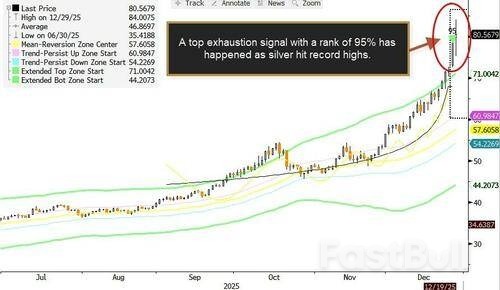
PFR ExtremeHurst, a model for spotting herd behavior that generates a self-reinforcing frenzy, has triggered a top exhaustion signal on silver, echoing a similar alert on gold that preceded its 11% correction in October.

Some attributed the sudden downward shift to comments during the weekend from Elon Musk, who highlighted the growing investor frenzy around precious metals, replying to a tweet on Chinese export restrictions by saying on X:
"This is not good. Silver is needed in many industrial processes."
For now, the decline is stable and hardly indicative of a herd rushing for the exits. But a thin liquidity holiday-shortened week could exacerbate any moves.
White Label
Data API
Web Plug-ins
Poster Maker
Affiliate Program
The risk of loss in trading financial instruments such as stocks, FX, commodities, futures, bonds, ETFs and crypto can be substantial. You may sustain a total loss of the funds that you deposit with your broker. Therefore, you should carefully consider whether such trading is suitable for you in light of your circumstances and financial resources.
No decision to invest should be made without thoroughly conducting due diligence by yourself or consulting with your financial advisors. Our web content might not suit you since we don't know your financial conditions and investment needs. Our financial information might have latency or contain inaccuracy, so you should be fully responsible for any of your trading and investment decisions. The company will not be responsible for your capital loss.
Without getting permission from the website, you are not allowed to copy the website's graphics, texts, or trademarks. Intellectual property rights in the content or data incorporated into this website belong to its providers and exchange merchants.
Not Logged In
Log in to access more features

FastBull Membership
Not yet
Purchase
Log In
Sign Up