• Trade
  • Markets
  • Copy
  • Contests
  • News
  • 24/7
  • Calendar
  • Q&A
  • Chats
Trending
Screeners
SYMBOL
LAST
BID
ASK
HIGH
LOW
NET CHG.
%CHG.
SPREAD
SPX
S&P 500 Index
6817.60
6817.60
6817.60
6861.30
6801.50
-9.81
-0.14%
--
DJI
Dow Jones Industrial Average
48378.34
48378.34
48378.34
48679.14
48285.67
-79.70
-0.16%
--
IXIC
NASDAQ Composite Index
23104.26
23104.26
23104.26
23345.56
23012.00
-90.90
-0.39%
--
USDX
US Dollar Index
97.940
98.020
97.940
98.070
97.740
-0.010
-0.01%
--
EURUSD
Euro / US Dollar
1.17465
1.17474
1.17465
1.17686
1.17262
+0.00071
+ 0.06%
--
GBPUSD
Pound Sterling / US Dollar
1.33733
1.33743
1.33733
1.34014
1.33546
+0.00026
+ 0.02%
--
XAUUSD
Gold / US Dollar
4304.10
4304.51
4304.10
4350.16
4285.08
+4.71
+ 0.11%
--
WTI
Light Sweet Crude Oil
56.326
56.356
56.326
57.601
56.233
-0.907
-1.58%
--

Community Accounts

Signal Accounts
--
Profit Accounts
--
Loss Accounts
--
View More

Become a signal provider

Sell trading signals to earn additional income

View More

Guide to Copy Trading

Get started with ease and confidence

View More

Signal Accounts for Members

All Signal Accounts

Best Return
  • Best Return
  • Best P/L
  • Best MDD
Past 1W
  • Past 1W
  • Past 1M
  • Past 1Y

All Contests

  • All
  • Trump Updates
  • Recommend
  • Stocks
  • Cryptocurrencies
  • Central Banks
  • Featured News
Top News Only
Share

Goldman Sachs Says They Believe That The Copper Price Is Vulnerable To An Ai-Linked Price Correction

Share

Goldman Sachs Upgrades 2026 Copper Price Forecast To $11400 From $10,650

Share

Attempts By Ukrainian Troops To Advance From The South-West To Outskirts Of Kupiansk Are Being Thwarted

Share

Russian Troops Control All Of Kupiansk - IFX Cites Russian Military

Share

On Monday (December 15), The South Korean Won Ultimately Rose 0.60% Against The US Dollar, Closing At 1468.91 Won. The Won Was On An Upward Trend Throughout The Day, Rising Significantly At 17:00 Beijing Time And Reaching A Daily High Of 1463.04 Won At 17:36

Share

Health Ministry: Israeli Forces Kill Palestinian Teen In West Bank

Share

New York Federal Reserve President Williams: Over Time, The Size Of Reserves Could Grow From $2.9 Trillion

Share

New York Fed President Williams: AI Valuations Are High, But There Is A Real Driving Factor

Share

New York Federal Reserve President Williams: The Job Market Is In Very Good Shape

Share

New York Fed President Williams: 'Very Supportive' Of USA Central Bank's Decision To Cut Interest Rates Last Week

Share

New York Fed President Williams: 'Too Early To Say' What Central Bank Should Do At January Meeting

Share

New York Fed President Williams: Strong Markets Part Of Reason Why Economy Will Grow Robustly In 2026

Share

New York Fed President Williams: What Constitutes Ample Reserves Will Change Over Time

Share

New York Fed President Williams: Market Valuations 'Elevated,' But There Are Reasons For Pricing

Share

New York Fed President Williams: Ample Reserves System Working Very Well

Share

New York Fed President Williams: Some Signs That Parts Of Underlying Economy Not As Strong As GDP Data Suggests

Share

New York Fed President Williams: Expects Coming Job Data Will Show Gradual Cooling

Share

Ukraine President Zelenskiy: Monitoring Of Ceasefire Should Be Part Of Security Guarantees

Share

Ukraine President Zelenskiy: Ukraine Needs Clear Understanding On Security Guarantees Before Taking Any Decisions Regarding Frontlines

Share

U.S. Commerce Secretary Rutnick Praised Korea Zinc Co. Ltd., Stating That The United States Will Have Priority Access To The Company's Products In 2026

TIME
ACT
FCST
PREV
Japan Tankan Small Manufacturing Outlook Index (Q4)

A:--

F: --

P: --

Japan Tankan Large Non-Manufacturing Outlook Index (Q4)

A:--

F: --

P: --

Japan Tankan Large Manufacturing Outlook Index (Q4)

A:--

F: --

P: --

Japan Tankan Small Manufacturing Diffusion Index (Q4)

A:--

F: --

P: --

Japan Tankan Large-Enterprise Capital Expenditure YoY (Q4)

A:--

F: --

P: --

U.K. Rightmove House Price Index YoY (Dec)

A:--

F: --

P: --

China, Mainland Industrial Output YoY (YTD) (Nov)

A:--

F: --

P: --

China, Mainland Urban Area Unemployment Rate (Nov)

A:--

F: --

P: --

Saudi Arabia CPI YoY (Nov)

A:--

F: --

P: --

Euro Zone Industrial Output YoY (Oct)

A:--

F: --

P: --

Euro Zone Industrial Output MoM (Oct)

A:--

F: --

P: --

Canada Existing Home Sales MoM (Nov)

A:--

F: --

P: --

Canada National Economic Confidence Index

A:--

F: --

P: --

Canada New Housing Starts (Nov)

A:--

F: --

P: --
U.S. NY Fed Manufacturing Employment Index (Dec)

A:--

F: --

P: --

U.S. NY Fed Manufacturing Index (Dec)

A:--

F: --

P: --

Canada Core CPI YoY (Nov)

A:--

F: --

P: --

Canada Manufacturing Unfilled Orders MoM (Oct)

A:--

F: --

P: --

U.S. NY Fed Manufacturing Prices Received Index (Dec)

A:--

F: --

P: --

U.S. NY Fed Manufacturing New Orders Index (Dec)

A:--

F: --

P: --

Canada Manufacturing New Orders MoM (Oct)

A:--

F: --

P: --

Canada Core CPI MoM (Nov)

A:--

F: --

P: --

Canada Trimmed CPI YoY (SA) (Nov)

A:--

F: --

P: --

Canada Manufacturing Inventory MoM (Oct)

A:--

F: --

P: --

Canada CPI YoY (Nov)

A:--

F: --

P: --

Canada CPI MoM (Nov)

A:--

F: --

P: --

Canada CPI YoY (SA) (Nov)

A:--

F: --

P: --

Canada Core CPI MoM (SA) (Nov)

A:--

F: --

P: --

Canada CPI MoM (SA) (Nov)

A:--

F: --

P: --

Federal Reserve Board Governor Milan delivered a speech
U.S. NAHB Housing Market Index (Dec)

A:--

F: --

P: --

Australia Composite PMI Prelim (Dec)

--

F: --

P: --

Australia Services PMI Prelim (Dec)

--

F: --

P: --

Australia Manufacturing PMI Prelim (Dec)

--

F: --

P: --

Japan Manufacturing PMI Prelim (SA) (Dec)

--

F: --

P: --

U.K. 3-Month ILO Employment Change (Oct)

--

F: --

P: --

U.K. Unemployment Claimant Count (Nov)

--

F: --

P: --

U.K. Unemployment Rate (Nov)

--

F: --

P: --

U.K. 3-Month ILO Unemployment Rate (Oct)

--

F: --

P: --

U.K. Average Weekly Earnings (3-Month Average, Including Bonuses) YoY (Oct)

--

F: --

P: --

U.K. Average Weekly Earnings (3-Month Average, Excluding Bonuses) YoY (Oct)

--

F: --

P: --

France Services PMI Prelim (Dec)

--

F: --

P: --

France Composite PMI Prelim (SA) (Dec)

--

F: --

P: --

France Manufacturing PMI Prelim (Dec)

--

F: --

P: --

Germany Services PMI Prelim (SA) (Dec)

--

F: --

P: --

Germany Manufacturing PMI Prelim (SA) (Dec)

--

F: --

P: --

Germany Composite PMI Prelim (SA) (Dec)

--

F: --

P: --

Euro Zone Composite PMI Prelim (SA) (Dec)

--

F: --

P: --

Euro Zone Services PMI Prelim (SA) (Dec)

--

F: --

P: --

Euro Zone Manufacturing PMI Prelim (SA) (Dec)

--

F: --

P: --

U.K. Services PMI Prelim (Dec)

--

F: --

P: --

U.K. Manufacturing PMI Prelim (Dec)

--

F: --

P: --

U.K. Composite PMI Prelim (Dec)

--

F: --

P: --

Euro Zone ZEW Economic Sentiment Index (Dec)

--

F: --

P: --

Germany ZEW Current Conditions Index (Dec)

--

F: --

P: --

Germany ZEW Economic Sentiment Index (Dec)

--

F: --

P: --

Euro Zone Trade Balance (Not SA) (Oct)

--

F: --

P: --

Euro Zone ZEW Current Conditions Index (Dec)

--

F: --

P: --

Euro Zone Trade Balance (SA) (Oct)

--

F: --

P: --

Euro Zone Total Reserve Assets (Nov)

--

F: --

P: --

U.K. Inflation Rate Expectations

--

F: --

P: --

Q&A with Experts
    • All
    • Chatrooms
    • Groups
    • Friends
    Connecting
    .
    .
    .
    Type here...
    Add Symbol or Code

      No matching data

      All
      Trump Updates
      Recommend
      Stocks
      Cryptocurrencies
      Central Banks
      Featured News
      • All
      • Russia-Ukraine Conflict
      • Middle East Flashpoint
      • All
      • Russia-Ukraine Conflict
      • Middle East Flashpoint
      Search
      Products

      Charts Free Forever

      Chats Q&A with Experts
      Screeners Economic Calendar Data Tools
      Membership Features
      Data Warehouse Market Trends Institutional Data Policy Rates Macro

      Market Trends

      Market Sentiment Order Book Forex Correlations

      Top Indicators

      Charts Free Forever
      Markets

      News

      News Analysis 24/7 Columns Education
      From Institutions From Analysts
      Topics Columnists

      Latest Views

      Latest Views

      Trending Topics

      Top Columnists

      Latest Update

      Signals

      Copy Rankings Latest Signals Become a signal provider AI Rating
      Contests
      Brokers

      Overview Brokers Assessment Rankings Regulators News Claims
      Broker listing Forex Brokers Comparison Tool Live Spread Comparison Scam
      Q&A Complaint Scam Alert Videos Tips to Detect Scam
      More

      Business
      Events
      Careers About Us Advertising Help Center

      White Label

      Data API

      Web Plug-ins

      Affiliate Program

      Awards Institution Evaluation IB Seminar Salon Event Exhibition
      Vietnam Thailand Singapore Dubai
      Fans Party Investment Sharing Session
      FastBull Summit BrokersView Expo
      Recent Searches
        Top Searches
          Markets
          News
          Analysis
          User
          24/7
          Economic Calendar
          Education
          Data
          • Names
          • Latest
          • Prev

          View All

          No data

          Scan to Download

          Faster Charts, Chat Faster!

          Download App
          English
          • English
          • Español
          • العربية
          • Bahasa Indonesia
          • Bahasa Melayu
          • Tiếng Việt
          • ภาษาไทย
          • Français
          • Italiano
          • Türkçe
          • Русский язык
          • 简中
          • 繁中
          Open Account
          Search
          Products
          Charts Free Forever
          Markets
          News
          Signals

          Copy Rankings Latest Signals Become a signal provider AI Rating
          Contests
          Brokers

          Overview Brokers Assessment Rankings Regulators News Claims
          Broker listing Forex Brokers Comparison Tool Live Spread Comparison Scam
          Q&A Complaint Scam Alert Videos Tips to Detect Scam
          More

          Business
          Events
          Careers About Us Advertising Help Center

          White Label

          Data API

          Web Plug-ins

          Affiliate Program

          Awards Institution Evaluation IB Seminar Salon Event Exhibition
          Vietnam Thailand Singapore Dubai
          Fans Party Investment Sharing Session
          FastBull Summit BrokersView Expo

          Recession Fears Ebb as Economists Debate the Size of Rate Cuts

          Cohen

          Economic

          Summary:

          Mentions of 'recession' have been increasing across social media and in financial headlines in recent weeks, but the signals have been mixed, leading to increased volatility across markets...

          Mentions of 'recession' have been increasing across social media and in financial headlines in recent weeks, but the signals have been mixed, leading to increased volatility across markets as investors struggle to make sense of the data and plan accordingly.
          For economists at Goldman Sachs, recent improvements in retail sales and unemployment data suggest that the economy is gaining strength, prompting them to cut their probability of a recession in the U.S. within the next year from 25% to 20%.
          "We have now shaved our probability from 25% to 20%, mainly because the data for July and early August released since August 2 shows no sign of recession," Goldman Sachs chief U.S. economist Jan Hatzius said in a note on Saturday, as reported by Reuters. "Continued expansion would make the U.S. look more similar to other G10 economies, where the Sahm rule has held less than 70% of the time."
          Hatzius added that if the August jobs report set for release on Sept. 6 "looks reasonably good, we would probably cut our recession probability back to 15%, where it stood for almost a year" before a revision on Aug. 2.
          The economists also said they have become "more confident" that the Federal Reserve will cut interest rates by 25 basis points at their September policy meeting, "although another downside jobs surprise on September 6 could still trigger a 50bp move."
          While Goldman sees less chance of a recession, JPMorgan Chief Global Economist Bruce Kasman wrote that "the probability of a U.S. and global recession starting before end-2024" is now at 35%, which increases the likelihood of interest rate cuts, which will lead to a rise in M2. He also noted that the probability of a recession by the end of 2025 now stands at 45%.
          "Important elements of our growth forecast are being challenged. U.S. news hints at a sharper-than-expected weakening in labor demand and early signs of labor shedding," Kasman said. "The latest business surveys also suggest a loss of momentum in global manufacturing. On the other hand, these forces are being tempered by solid continued gains in overall activity, led by the service sector."
          "The modest increase in our assessment of recession risk contrasts with a more substantial reassessment we are making to the interest rate outlook. This is driven by the correlated shifts in growth and inflation risk that are shaking the gradualism narrative in current central bank rate guidance," he explained. "Specifically, there has been a material positive shift in the risk profile on U.S. inflation as strong supply-side performance combines with moderating labor demand to ease labor market pressure."
          "Taken together, these developments warrant a break from gradualism and we expect the Fed to make a level adjustment in its policy stance that lowers rates by at least 100 basis points through year-end," Kasman concluded.
          While Kasman sees multiple rate cuts, Ed Yardeni, the Founder and President of Yardeni Research, told CNBC that he expects the Federal Reserve to implement a 25 basis points rate cut in September, but said that the cut would be "one and done."
          "The markets are very dovish; expectations are 25 to 50 basis points for the September meeting. I think there are expectations we'll have 100 basis points between now and year's end. I think it's going to be 25 bps and I think it's going to be one and done," Yardeni said. "The economy is doing too well. I know people got freaked out by the last employment report, but I think a lot of that was weather, and some of the other indicators that came out confirmed that. Like single-family housing starts took a dive in the south."
          "So If I'm correct about that, they're going to get indicators before the September FOMC meeting that suggest the economy is alive and well, the labor market is doing well, and that inflation is continuing to moderate," he added. "So I think 25 basis points is enough, and I think that's what Powell will probably communicate. It will be dovish, but not as dovish as the market is discounting."
          According to data provided by The Conference Board, the Leading Economic Index (LEI) for the U.S. "fell by 0.6 percent in July 2024 to 100.4 (2016=100), following a decline of 0.2 percent in June. Over the six-month period ending in July 2024, the LEI fell by 2.1 percent, a smaller rate of decline than its −3.1 percent over the six-month period between July 2023 and January 2024."
          "The LEI continues to fall on a month-over-month basis, but the six-month annual growth rate no longer signals recession ahead," said Justyna Zabinska-La Monica, Senior Manager of Business Cycle Indicators at The Conference Board. "In July, weakness was widespread among non-financial components. A sharp deterioration in new orders, persistently weak consumer expectations of business conditions, and softer building permits and hours worked in manufacturing drove the decline, together with the still-negative yield spread."
          As noted by ZeroHedge, aside from the great financial crisis, "this is the worst decline in LEI since the mid-'70s."
          Recession Fears Ebb as Economists Debate the Size of Rate Cuts_1"These data continue to suggest headwinds in economic growth going forward," Zabinska-La Monica said. "The Conference Board expects US real GDP growth to slow over the next few quarters as consumers and businesses continue cutting spending and investments. US real GDP is expected to expand at a pace of 0.6 percent annualized in Q3 2024 and 1 percent annualized in Q4."
          According to the report, "The LEI's annual growth rate has stabilized but remains negative, suggesting downward pressures on economic activity ahead."
          Recession Fears Ebb as Economists Debate the Size of Rate Cuts_2However, despite the expected downward pressure, overall, the Conference Board said, "For the fourth consecutive month, the US LEI has not signaled a recession ahead."
          Recession Fears Ebb as Economists Debate the Size of Rate Cuts_3"And what is behind the 'no recession' call... US equity strength!!," said ZeroHedge. "So, to summarize – almost all the macro data signals weakening growth for years... but because stocks are up (and credit spreads down), there's no recession anywhere on the horizon!!??"
          Amid the mixed messaging on the possibility of a recession, a poll conducted by Reuters found that economists expect the Fed to cut interest rates by 25 basis points at each of the remaining three meetings of 2024 to avoid such a result, leading the economists to say that a recession is unlikely.
          Most economists who participated in the poll said they do not expect a rapid series of rate cuts as recent data, including last week's strong retail sales report, suggests the economy is performing relatively well even as inflation recedes.
          "The U.S. central bank will cut the federal funds rate by 25 basis points in September, November and December taking the range to 4.50%-4.75% by end-2024, according to 54% of those polled, 55 of 101," Reuters journalist Indradip Ghosh wrote. "Markets, which were earlier betting on a half-percentage-point cut in September, are currently pricing around 70% probability of a quarter percentage point cut next month."
          "The basis for the cuts that we have is mostly because inflation is coming down," Jonathan Millar, senior U.S. economist at Barclays, told Reuters. "It's not so much that activity is slowing ... We see a pretty resilient economy that's growing near trend and with that, we think inflation only ebbs gradually."
          "The labor market is hanging in there just fine. It's gradually cooling, but we don't expect it to have really material weakening," he added. "The unemployment rate is maybe going to add another 10th or so from where it is. There's not really any reason for them (the Fed) to panic."
          The economists polled forecast that the unemployment rate will hover around the current 4.3% rate through 2026, and they said inflation will ease "only lightly over the coming two years."
          "All measures of inflation polled - the Consumer Price Index, core CPI, personal consumption expenditures price index and core PCE - are expected to stay above 2% until at least 2026," Ghosh wrote. "Despite recent easing, wage growth has remained above the 3.0%-3.5% range seen as consistent with the Fed's 2% inflation target."
          With the U.S. economy growing at an annualized rate of 2.8% in the second quarter, faster than the 2.0% expected by economists, the poll found that economists see a recession as unlikely.
          "Growth is seen in the poll as averaging 2.5% this year, faster than what Fed officials currently see as the non-inflationary growth rate of 1.8%," the report said. "Two-thirds of common contributors upgraded their 2024 growth outlook from last month. The economy was predicted to grow 1.8% next year."
          "Economists in the poll broadly expect the economy to expand at around its trend growth rate at least until 2027," Gosh said. "The median forecast from a smaller sample who provided a view showed the probability of a recession at just 30% - an outlook which has not changed much since the start of this year."
          "We're not convinced there's a downdraft in activity around the corner that's going to prompt large rate cuts from the Fed," Michael Gapen, chief U.S. economist at Bank of America, told Reuters. "There's reason to believe the July employment report was adversely affected by weather and therefore was a false signal about the health of labor markets and the economy. We're counting on subsequent data validating that story."
          According to Carsten Fritsch, a precious metals analyst at Commerzbank, while base metals and industrial precious metals may struggle in the coming months, Commerzbank expects to see a recovery in 2025 as economic conditions improve, and the bank doesn't see the U.S. economy slipping into a recession this year.
          "There are signs of significant interest rate cuts by the most important central banks," Fritsch said. "This should favor an economic recovery next year. Furthermore, we do not expect the US economy to slide into recession this year. Concerns about this had put commodity prices under significant pressure at the beginning of August. We, therefore, assume that commodity prices will rise again in the coming quarters from their current low level. However, the difficult economic situation in China suggests that the losses will not be recovered quickly."
          For now, market watchers are focused on this week's annual economic symposium in Jackson Hole, Wyoming, and any hints from Fed Chair Jerome Powell regarding the outlook for the economy and the future of interest rates.

          Source: Kitco

          To stay updated on all economic events of today, please check out our Economic calendar
          Risk Warnings and Disclaimers
          You understand and acknowledge that there is a high degree of risk involved in trading. Following any strategies or investment methods may lead to potential losses. The content on the site is provided by our contributors and analysts for information purposes only. You are solely responsible for determining whether any trading assets, securities, strategy, or any other product is suitable for investing based on your own investment objectives and financial situation.
          Add to Favorites
          Share

          Fed Minutes, Job Revisions Add Urgency. Will Powell Cut Rates Amid Inflation Risks?

          Alex

          Economic

          Central Bank

          The Fed's Tightrope Walk: Balancing Labor Market Signals and Monetary Policy

          As the U.S. economy grapples with unexpectedly weak job growth and significant labor market revisions, the Federal Reserve faces a critical decision. With Fed Chair Jerome Powell's upcoming speech at the Jackson Hole economic symposium, the direction of U.S. monetary policy is under intense scrutiny. The latest employment data and recent Federal Reserve minutes, revealing both economic challenges and internal debates, add complexity to an already challenging situation.

          Labor Market Revisions: A Reality Check

          The Bureau of Labor Statistics (BLS) recently revised its employment data, showing 818,000 fewer jobs as of March 2024 than initially reported. This revision, the largest since 2009, suggests that the labor market has been weaker than previously believed. While these revisions don't indicate job losses, they underscore that the economic growth seen over the past year may have been overstated. The downward adjustments, particularly in sectors like professional services, manufacturing, and hospitality, raise concerns about the true strength of the U.S. economy and its implications for monetary policy.

          Fed Minutes: Internal Debate and Growing Pressure

          Recent minutes from the Federal Reserve's July meeting reveal an internal debate over whether to begin cutting interest rates as early as September. While inflation has shown signs of easing, the labor market's unexpected weakness is a growing concern for policymakers. Some members of the Federal Open Market Committee (FOMC) have argued that the recent progress on inflation and the labor market's fragility justify a rate cut soon. However, the committee opted to hold rates steady in July, signaling that any easing would depend on incoming data.
          These minutes have heightened market expectations for a rate cut, with traders increasingly confident that the Fed will ease policy in the near term. However, the Fed must carefully weigh the risks of moving too quickly, which could undermine its efforts to control inflation.

          Forward Guidance: Shaping Market Expectations

          Forward guidance remains a crucial tool for the Fed in managing market expectations. If Powell signals a shift towards a more accommodative policy at Jackson Hole, it could ease concerns about an economic slowdown. However, the Fed must balance this with the need to maintain its credibility in inflation management. A premature rate cut could undo progress in curbing inflation, while delaying action might exacerbate the slowdown.

          A Delicate Balance

          The Fed must recalibrate its approach to address the softening labor market while maintaining its inflation-fighting stance. Powell's speech at Jackson Hole could provide crucial insights into the Fed's next steps, with significant implications for the U.S. economy and global markets. The decisions made in the coming months are critical, and the stakes are high.

          Source: FX Empire

          To stay updated on all economic events of today, please check out our Economic calendar
          Risk Warnings and Disclaimers
          You understand and acknowledge that there is a high degree of risk involved in trading. Following any strategies or investment methods may lead to potential losses. The content on the site is provided by our contributors and analysts for information purposes only. You are solely responsible for determining whether any trading assets, securities, strategy, or any other product is suitable for investing based on your own investment objectives and financial situation.
          Add to Favorites
          Share

          Are Gold Prices Now Too High?

          Owen Li

          Commodity

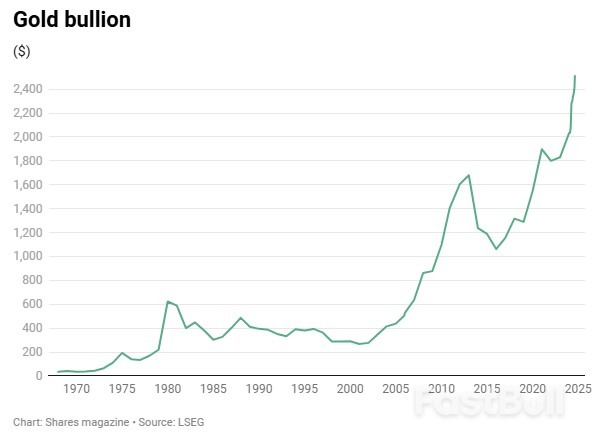
          Are Gold Prices Now Too High?_1Why Has Gold Hit New Highs

          It is not hard to see why investors have flocked to gold due to the crises in the Middle East, the ongoing Russia-Ukraine war, worries about expected interest rate cuts and stock market volatility.
          Gold is often seen by investors as a 'safe haven' asset which can hold its value during periods of volatility and economic downturn.
          According to the World Gold Council's second-quarter gold demand trends report, total global gold demand increased 4% year-on-year to 1,258 tonnes.
          Central banks and official institutions have increased their global gold holdings by 183 tonnes slowing down from the previous quarter but still reflecting a 6% increase year-on-year.
          The World Gold Council remains bullish on the precious metal for the next 12 months as investors strive for portfolio protection and diversification 'in a complex economic and geopolitical environment'. Total demand was supported by healthy OTC (over the counter) transactions, up 53% year-on-year at 329 tonnes.Are Gold Prices Now Too High?_2

          Outlining The Bull Case for Gold

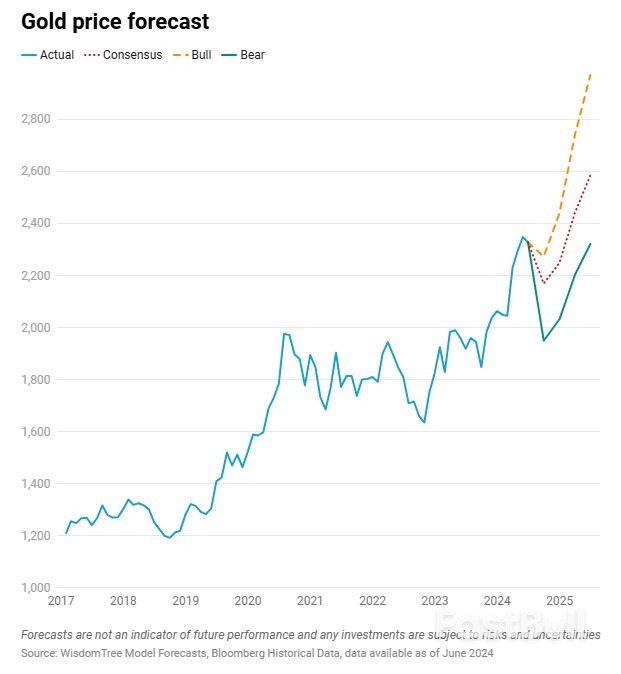
          US investment bank JP Morgan expects gold prices to average $2,500 per ounce in the fourth quarter of 2024 due to heightened geopolitical risks, expectations the Fed will begin lowering interest rates and central bank buying.
          Gregory Shearer, head of base and precious metals strategy at JP Morgan says that gold's resurgence has come earlier than expected as it further decouples from 'real' (inflation-adjusted) yields or interest rates. Typically, gold prices trade in inverse correlation to real rates.
          'We have been structurally bullish gold since the fourth quarter of 2022 and with gold prices surging past $2,400 in April, the rally has come earlier and has been much sharper than expected,' Shearer says.
          'It has been especially surprising given that it has coincided with Fed rate cuts being priced out and US real yields moving higher due to stronger labour and inflation data in the US.'
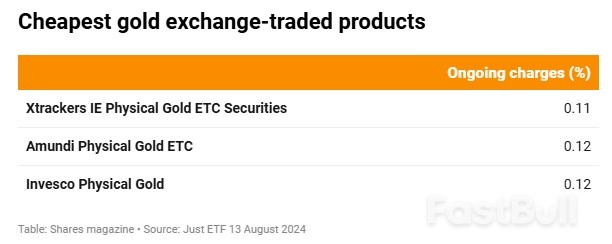
          The cheapest and simplest way for investors to buy gold is through ETPs (exchange-traded products).
          Global gold ETPs experienced their strongest month since April 2022 in July, attracting inflows of $3.7 billion, the third consecutive monthly inflow, according to the World Gold Council. Recent inflows and the rising gold price have pushed global gold ETFs' total AUM (assets under management) to $246 billion.

          Bear Case for Gold

          However, some analysts believe the outlook for gold is not rosy for the rest of the year. RBC Capital Markets analysts have maintained a cautious stance ever since the precious metal hit record highs: 'We think that gold is overvalued from the perspective of a few key macro drivers and that there are some unrealised vulnerabilities to the pillars of gold's rally. While we are cautious, it's more because we do not think gold should be at such high levels just yet.'
          The World Gold Council noted in its recent second-quarter report profit-taking in some markets and lower levels of net demand in Europe and North America.
          RBC also notes that while May and June saw more stable trends for ETPs (gold-backed exchange-traded products), it remains unconvinced that investors are fully committed.
          Investors have sold gold holdings during the price rally, and a sustained return to buying has not yet been observed.'
          Strong demand from global central banks has been a crucial driver of gold's recent rally. However, RBC analysts believe that China's recent pause in gold buying reveals potential vulnerabilities.
          'To be clear, we still think that central bank demand will continue to be strong, but there are reasons to be cautious on the volume at record prices and after such a sustained period of strength.'

          Are Gold Prices Now Too High?_3

          A Long-Term View

          Published in May, a piece of research from former commodity fund manager Claude Erb and Campbell Harvey – a Duke University finance professor – suggests gold will lag US inflation by more than 7% a year over the next decade.
          The authors observe that, historically, a high inflation-adjusted gold price has been associated with low inflation-adjusted returns from the precious metal over the subsequent decade.
          Posing the question: 'Has an influx of gold buying ushered in a new age of permanently higher "this time is different” real gold prices or is this simply the latest "wash, rinse, repeat” cycle setting-up a significant fall in real gold prices?'
          What lends their scepticism about gold some credence is a report they published in 2012 proposing a so-called 'fair value' for gold which suggested gold was heavily overvalued at the time. From its 2012 high gold dropped more than 40% in real terms to its 2015 low.
          Key events in the US political and financial calendar lie ahead including: the Democratic National Convention, the US presidential election and US Federal Reserve meetings which might shape the future price of the precious metal.

          Source: Shares

          Risk Warnings and Disclaimers
          You understand and acknowledge that there is a high degree of risk involved in trading. Following any strategies or investment methods may lead to potential losses. The content on the site is provided by our contributors and analysts for information purposes only. You are solely responsible for determining whether any trading assets, securities, strategy, or any other product is suitable for investing based on your own investment objectives and financial situation.
          Add to Favorites
          Share

          Euro-Dollar Won't Like the Details of this PMI Report

          Warren Takunda

          Economic

          The Euro to Dollar exchange rate (EUR/USD) was surprisingly subdued in the wake of news the Eurozone economy performed better in August than economists expected.
          EUR/USD was quoted at 1.1147 after the Eurozone composite PMI rose to 51.2 in August from 50.2 in July and exceeded estimates of 50.1. The outperformance was driven again by a strong services sector PMI of 53.3, materially higher than July's outturn and the consensus estimate of 51.9.
          France appears to have received an Olympic pump, with a strong services PMI of 55, which was well ahead of the 50.3 expected.
          The Euro's muted reaction to the PMI headlines confirms some disappointing developments were uncovered by these data.
          "At first glance, this looks like a pleasant surprise: activity in the Eurozone picked up in August. But a closer look at the numbers reveals that the underlying fundamentals might be shakier than they appear," says Dr. Cyrus de la Rubia, Chief Economist at Hamburg Commercial Bank.
          Germany was once again the weak spot in the Eurozone, with the composite (48.5), services (51.4) and manufacturing PMIs (42.1) disappointing against expectations and warning of economic contraction.
          In fact, Germany's outturn and an apparent temporary Olympics-linked boost will potentially limit upside enthusiasm in the Euro.
          It was also reported that August data pointed to a fractional reduction in employment in the eurozone’s private sector, thereby ending a seven-month sequence of expansion.
          The second consecutive month of broad stagnation in staffing levels was recorded amid a modest increase in services employment and a solid fall in manufacturing workforce numbers. Staffing levels were down in Germany and France but rose elsewhere.
          Firms also reported waning confidence regarding the future outlook for output. Sentiment dropped to the lowest in 2024 so far and was below the series average. Reduced optimism was widespread, with confidence lower across Germany, France and the rest of the eurozone, as well as in both monitored sectors.
          The pace of inflation meanwhile eased to an eight-month low, with services input prices rising at the softest pace since April 2021, while manufacturing cost inflation was unchanged from the 18-month high seen in July. That said, selling prices increased at the fastest pace in four months and at a stronger pace than the series average.
          Services charges rose at the sharpest pace in three months, while manufacturing output prices increased for the first time since April 2023.
          "The ECB might find some reassurance in the latest price indices. Input costs in the services sector, which are closely watched by monetary authorities due to the significant role wages play, rose at the slowest pace in 40 months. So, even though output prices in the service sector climbed faster than they did in July, the easing of cost pressures strengthens the case for an interest rate cut at the ECB's September meeting," says de la Rubia.

          Source: Poundsterlinglive

          To stay updated on all economic events of today, please check out our Economic calendar
          Risk Warnings and Disclaimers
          You understand and acknowledge that there is a high degree of risk involved in trading. Following any strategies or investment methods may lead to potential losses. The content on the site is provided by our contributors and analysts for information purposes only. You are solely responsible for determining whether any trading assets, securities, strategy, or any other product is suitable for investing based on your own investment objectives and financial situation.
          Add to Favorites
          Share

          Markets Eye ECB Decision as Fed Minutes Reinforce Rate Cut Bets

          Warren Takunda

          Economic

          The Federal Reserve (Fed) minutes for 30-31 July showed that officials shifted their stance towards rate cuts amid cooling inflation and a slowing labour market in the United States.
          Futures markets are fully priced in a cut in September, with a 62% probability of a 25 basis point and 38% of a 50 basis point reduction. The dovish turn of the Fed sent the US dollar index down to a fresh 8-month low, reinforcing the euro surge, with the pair of EUR/USD rising to the highest since July 2023 and up 3% thus far in August.

          Markets eye ECB decision

          Market participants will now closely watch the next rate decision of the European Central Bank (ECB) on 12 September as the Fed's dovish turn may encourage the bank to consider further loosening its monetary policy. The ECB was among the first central banks to commence a rate cut in June, ahead of most other major economies. It halted the rate reduction in July without providing clear signals for its next move, though analysts believe the bank may resume the cycle in August due to risks of slowing economic growth.
          The key concern for the ECB is that it may need to implement deeper cuts if the Fed adopts an aggressive approach to loosening its monetary policy. However, the ECB is widely expected to reduce its benchmark interest rates by 25 basis points in the September meeting, with a deeper rate cut unlikely due to persistent inflation in the Eurozone.
          Consumer prices recorded a 2.6% year-on-year increase in July, up from 2.5% the previous month. Core inflation, which excludes food and energy, remained steady at 2.9%, indicating the stickiness of goods and service prices in the region.

          The Fed could adopt a deeper rate cut

          In contrast, the Fed may need to implement further cuts, as markets believe the central bank may be behind the curve and risk exacerbating a deteriorating labour market. The meeting minutes stated that "a majority of participants remarked that the risks to the employment goal had increased, and many participants noted that the risks to the inflation goal had decreased ... Some participants noted the risk that a further gradual easing in labour market conditions could transition to a more serious deterioration."
          The US nonfarm payroll, one of the critical indicators monitored by the Fed, showed that only 114,000 new jobs were added in July, with the unemployment rate rising to 4.3%, the highest since October 2021. Additionally, inflation rose by 2.9% in the same month, lower than expected and the slowest pace since March 2021.

          The euro surge can be problematic

          Analysts anticipate that the Fed will reduce its policy rate by 100 basis points over the remainder of the year, while the ECB is expected to implement an additional 50 basis point cuts this year, significantly fewer than the Fed. This contrast could further increase upward pressure on the euro against the US dollar.
          The surge in the euro could be problematic, as a stronger currency makes goods and services more expensive for foreign consumers, thereby impacting exports.
          With manufacturing activity having contracted for two years, a higher euro could further weigh on orders and output. As global central banks gradually join the rate-cutting cycle, the progress of these loosening trends could significantly influence the value of their currencies.

          Source: EuroNews

          To stay updated on all economic events of today, please check out our Economic calendar
          Risk Warnings and Disclaimers
          You understand and acknowledge that there is a high degree of risk involved in trading. Following any strategies or investment methods may lead to potential losses. The content on the site is provided by our contributors and analysts for information purposes only. You are solely responsible for determining whether any trading assets, securities, strategy, or any other product is suitable for investing based on your own investment objectives and financial situation.
          Add to Favorites
          Share

          Eurozone Wage Growth Drops Drastically, Paving The Way For A September Cut

          ING

          Economic

          While economic activity has remained sluggish and forecasts have moved in the right direction, the European Central Bank has remained uncomfortable with cutting interest rates while wage growth is elevated. Today’s drop will bring some relief for those looking for a gradual cutting cycle as the 3.6% year-on-year negotiated wage growth is more in line with a benign inflation outlook in the medium term.

          However, it has to be said that wage growth is still too high for the 2% inflation target given weak productivity growth. But forward-looking indicators do still show moderating wage growth over time as more purchasing power is recouped and economic activity is expected to remain moderate. With some productivity pickup to be expected, wage pressures on inflation in the medium term should ease further.

          Still, the road to wage moderation could be bumpy and the second half of 2024 could still bring some upside surprises as unions – most notably in Germany – continue high wage demands at the start of negotiations. While that is great for consumers and would lift the economic outlook somewhat, it could potentially be a curveball for the ECB later in the year.

          But for September, a barrier to another cut seems to have been lifted. ECB President Christine Lagarde already emphasised satisfaction with wage growth expectations and the fact that profits have been absorbing higher wage growth. With today’s numbers showing a drop in wage growth, expectations of a September 25bp cut are growing increasingly firm.

          Source: ING

          To stay updated on all economic events of today, please check out our Economic calendar
          Risk Warnings and Disclaimers
          You understand and acknowledge that there is a high degree of risk involved in trading. Following any strategies or investment methods may lead to potential losses. The content on the site is provided by our contributors and analysts for information purposes only. You are solely responsible for determining whether any trading assets, securities, strategy, or any other product is suitable for investing based on your own investment objectives and financial situation.
          Add to Favorites
          Share

          Eurozone August PMI: Business Activity Rises Strongly, but Manufacturing Continues to Fall

          S&P Global Inc.

          Economic

          Data Interpretation

          On August 22, S&P Global released the Eurozone S&P PMI report for August:
          HCOB Flash Eurozone Manufacturing PMI at 45.6 (July: 45.8). 8-month low.
          HCOB Flash Eurozone Services PMI Business Activity Index at 53.3 (July: 51.9). 4-month high.
          HCOB Flash Eurozone Composite PMI Output Index at 51.2 (July: 50.2). 3-month high.
          HCOB Flash Eurozone Manufacturing PMI Output Index at 45.7 (July: 45.6). 2-month high.
          Data shows that business activity in the eurozone's private sector continued to expand moderately in August. The overall output growth was primarily driven by a steady increase in the services sector, which recorded its highest expansion rate in four months. Meanwhile, the manufacturing sector throughout the eurozone remained in contraction, with production shrinking for the 17th consecutive month, experiencing a decrease similar to that of July.
          While there was a rebound in business activity growth in August, the demand outlook appears bleak. New orders fell for the third consecutive month, with the decline slightly below that of July. The modest increase in new service orders was offset by a significant drop in new manufacturing orders. Business confidence has reached a new low for the year to date.
          At the same time, although input costs continued to rise significantly in August, the rate of input cost inflation decreased to its lowest level in eight months. In contrast, the pace of output price inflation accelerated.
          As for the member states, one of the key factors contributing to the robust growth of eurozone business activity in August was the renewed expansion of the French economy, which achieved its highest output growth in nearly a year and a half, alongside steady growth in output from other eurozone countries. In contrast, Germany continued to remain weak, with economic activity declining significantly for the second consecutive month. Employment levels ended a seven-month growth with a slight decrease; while workforce numbers in Germany and France saw a decline, other countries experienced an increase.
          Overall, eurozone economic activity showed signs of recovery in August. The contributing factors primarily stemmed from a surge in French service sector activity. However, at the same time, the overall growth rate of the German service sector has slowed down, and manufacturing in the eurozone remains in rapid decline. As the temporary boost from the French Olympics fades and signs of weakening confidence in eurozone services emerge, it may only be a matter of time before the struggles in manufacturing begin to impact the service sector.

          Eurozone August PMI

          To stay updated on all economic events of today, please check out our Economic calendar
          Risk Warnings and Disclaimers
          You understand and acknowledge that there is a high degree of risk involved in trading. Following any strategies or investment methods may lead to potential losses. The content on the site is provided by our contributors and analysts for information purposes only. You are solely responsible for determining whether any trading assets, securities, strategy, or any other product is suitable for investing based on your own investment objectives and financial situation.
          Add to Favorites
          Share
          FastBull
          Copyright © 2025 FastBull Ltd

          728 RM B 7/F GEE LOK IND BLDG NO 34 HUNG TO RD KWUN TONG KLN HONG KONG

          TelegramInstagramTwitterfacebooklinkedin
          App Store Google Play Google Play
          Products
          Charts

          Chats

          Q&A with Experts
          Screeners
          Economic Calendar
          Data
          Tools
          Membership
          Features
          Function
          Markets
          Copy Trading
          Latest Signals
          Contests
          News
          Analysis
          24/7
          Columns
          Education
          Company
          Careers
          About Us
          Contact Us
          Advertising
          Help Center
          Feedback
          User Agreement
          Privacy Policy
          Business

          White Label

          Data API

          Web Plug-ins

          Poster Maker

          Affiliate Program

          Risk Disclosure

          The risk of loss in trading financial instruments such as stocks, FX, commodities, futures, bonds, ETFs and crypto can be substantial. You may sustain a total loss of the funds that you deposit with your broker. Therefore, you should carefully consider whether such trading is suitable for you in light of your circumstances and financial resources.

          No decision to invest should be made without thoroughly conducting due diligence by yourself or consulting with your financial advisors. Our web content might not suit you since we don't know your financial conditions and investment needs. Our financial information might have latency or contain inaccuracy, so you should be fully responsible for any of your trading and investment decisions. The company will not be responsible for your capital loss.

          Without getting permission from the website, you are not allowed to copy the website's graphics, texts, or trademarks. Intellectual property rights in the content or data incorporated into this website belong to its providers and exchange merchants.

          Not Logged In

          Log in to access more features

          FastBull Membership

          Not yet

          Purchase

          Become a signal provider
          Help Center
          Customer Service
          Dark Mode
          Price Up/Down Colors

          Log In

          Sign Up

          Position
          Layout
          Fullscreen
          Default to Chart
          The chart page opens by default when you visit fastbull.com