

Markets
News
Analysis
User
24/7
Economic Calendar
Education
Data
- Names
- Latest
- Prev



Signal Accounts for Members
All Signal Accounts
All Contests
 U.K. Trade Balance Non-EU (SA) (Oct)
A:--
F: --
P: --
U.K. Trade Balance (Oct)A:--
F: --
P: --
U.K. Services Index MoMA:--
F: --
P: --
U.K. Construction Output MoM (SA) (Oct)A:--
F: --
P: --
U.K. Industrial Output YoY (Oct)A:--
F: --
P: --
U.K. Trade Balance (SA) (Oct)A:--
F: --
P: --
U.K. Trade Balance EU (SA) (Oct)A:--
F: --
P: --
U.K. Manufacturing Output YoY (Oct)A:--
F: --
P: --
U.K. GDP MoM (Oct)A:--
F: --
P: --
U.K. GDP YoY (SA) (Oct)A:--
F: --
P: --
U.K. Industrial Output MoM (Oct)A:--
F: --
P: --
U.K. Construction Output YoY (Oct)A:--
F: --
P: --
 France HICP Final MoM (Nov)
A:--
F: --
P: --
 China, Mainland Outstanding Loans Growth YoY (Nov)
A:--
F: --
P: --
China, Mainland M2 Money Supply YoY (Nov)A:--
F: --
P: --
China, Mainland M0 Money Supply YoY (Nov)A:--
F: --
P: --
China, Mainland M1 Money Supply YoY (Nov)A:--
F: --
P: --
 India CPI YoY (Nov)
A:--
F: --
P: --
India Deposit Gowth YoYA:--
F: --
P: --
 Brazil Services Growth YoY (Oct)
A:--
F: --
P: --
 Mexico Industrial Output YoY (Oct)
A:--
F: --
P: --
 Russia Trade Balance (Oct)
A:--
F: --
P: --
 Philadelphia Fed President Henry Paulson delivers a speech
 Canada Building Permits MoM (SA) (Oct)
A:--
F: --
P: --
Canada Wholesale Sales YoY (Oct)A:--
F: --
P: --
Canada Wholesale Inventory MoM (Oct)A:--
F: --
P: --
Canada Wholesale Inventory YoY (Oct)A:--
F: --
P: --
Canada Wholesale Sales MoM (SA) (Oct)A:--
F: --
P: --
 Germany Current Account (Not SA) (Oct)
A:--
F: --
P: --
U.S. Weekly Total Rig CountA:--
F: --
P: --
U.S. Weekly Total Oil Rig CountA:--
F: --
P: --
 Japan Tankan Large Non-Manufacturing Diffusion Index (Q4)
--
F: --
P: --
Japan Tankan Small Manufacturing Outlook Index (Q4)--
F: --
P: --
Japan Tankan Large Non-Manufacturing Outlook Index (Q4)--
F: --
P: --
Japan Tankan Large Manufacturing Outlook Index (Q4)--
F: --
P: --
Japan Tankan Small Manufacturing Diffusion Index (Q4)--
F: --
P: --
Japan Tankan Large Manufacturing Diffusion Index (Q4)--
F: --
P: --
Japan Tankan Large-Enterprise Capital Expenditure YoY (Q4)--
F: --
P: --
U.K. Rightmove House Price Index YoY (Dec)--
F: --
P: --
China, Mainland Industrial Output YoY (YTD) (Nov)--
F: --
P: --
China, Mainland Urban Area Unemployment Rate (Nov)--
F: --
P: --
 Saudi Arabia CPI YoY (Nov)
--
F: --
P: --
 Euro Zone Industrial Output YoY (Oct)
--
F: --
P: --
Euro Zone Industrial Output MoM (Oct)--
F: --
P: --
Canada Existing Home Sales MoM (Nov)--
F: --
P: --
Euro Zone Total Reserve Assets (Nov)--
F: --
P: --
U.K. Inflation Rate Expectations--
F: --
P: --
Canada National Economic Confidence Index--
F: --
P: --
Canada New Housing Starts (Nov)--
F: --
P: --
U.S. NY Fed Manufacturing Employment Index (Dec)--
F: --
P: --
U.S. NY Fed Manufacturing Index (Dec)--
F: --
P: --
Canada Core CPI YoY (Nov)--
F: --
P: --
Canada Manufacturing Unfilled Orders MoM (Oct)--
F: --
P: --
Canada Manufacturing New Orders MoM (Oct)--
F: --
P: --
Canada Core CPI MoM (Nov)--
F: --
P: --
Canada Manufacturing Inventory MoM (Oct)--
F: --
P: --
Canada CPI YoY (Nov)--
F: --
P: --
Canada CPI MoM (Nov)--
F: --
P: --
Canada CPI YoY (SA) (Nov)--
F: --
P: --
Canada Core CPI MoM (SA) (Nov)--
F: --
P: --


No matching data

Latest Views
Latest Views
Trending Topics
Top Columnists
Latest Update
White Label
Data API
Web Plug-ins
Affiliate Program
View All
No data
BNP Paribas warns that the popular steepener trade—betting long-term U.S. Treasury yields will rise faster—may backfire, as 30-year bonds already reflect fiscal concerns and could rebound with solid demand.
The share of global emissions covered by carbon taxes and emissions trading systems reached 28% in 2024, compared to 24% the previous year, the bank's annual State and Trends of Carbon Pricing report showed.
The increase was driven by the expansion of China's ETS to industrial sectors. Economies representing nearly two-thirds of global economic output, including around half of global emissions from the power and industrial sectors, are now covered by a carbon price. Coverage in other sectors is lower, with agricultural emissions not yet priced.
Government revenues from carbon pricing mechanisms such as carbon taxes and emission trading schemes dropped to $102 billion in 2024, down 1.9% compared to $104 billion the previous year, according to the report.
"Carbon pricing remains a powerful tool for advancing multiple policy goals," said Axel van Trotsenburg, World Bank senior managing director. "It helps countries cut emissions, raise domestic revenues in tight fiscal environments, and stimulate green growth and job creation."
The annual revenue drop was largely due to lower prices in large ETSs such as those of the European Union and the United Kingdom.
Over half of this revenue was used towards environment, infrastructure, and development projects, slightly increasing compared to previous years.
Last year's carbon revenues were derived from 80 carbon pricing schemes worldwide. Total carbon instruments in operation increased by five compared to 2023.
The report showed that all large middle-income economies have now either implemented or are considering direct carbon pricing, with ETSs accounting for most of the new and planned instruments.
"We've seen a number of important developments over the past 12 months, including the establishment of new taxes in Israel and subnational Mexican states, new ETSs in subnational US jurisdictions," said Joesph Pryor, senior climate change specialist at the World Bank, during the launch event of the report at the Innovate4Climate conference in Seville, Spain June 10.
"But we've also seen the removal of carbon taxes in various jurisdictions, most importantly, in Canada, the removal of the Canadian Federal fuel charter. We've also seen a number of developments that won't actually appear on the map. The passage of legislation in Brazil that establishes its ETS will commence in the next five years. We've also seen regulations in India that would make way for a rate-based emissions trading system, and legislation in Tokyo has been proposed establishing an overarching climate framework, which would make way for its emissions trading system," said Pryor.
Platts, part of S&P Global Commodity Insights, assessed EU Allowances for December 2025 at Eur74.07/mtCO2e ($84.61/mtCO2e) June 9.
Retirements of carbon credits in 2024 increased three times compared to 2023 levels, largely driven by companies looking to meet their multiyear compliance obligations under the California and Quebec ETSs.
Retirements for compliance purposes represented 24% of total credit retirements in 2024, compared to only 9% in 2023.
Meanwhile, growth from voluntary buyers has been negligible. Credit prices continue to vary across credit types, with nature-based removal credits attracting a premium relative to other types of projects, said the World Bank.
Retirements for voluntary purposes represented 76% of the total share in 2024, down from 91% the year before. Demand shifted towards nature-based removals and clean cooking projects, the report showed.
Global credit supply declined slightly, but the pool of unretired carbon credits from independent crediting mechanisms increased to almost 1 billion mt.
Most of these unretired credits are relatively older vintages, issued before 2022, and are from forestry and land use or renewable energy projects.
"We saw that there was an increase in demand for compliance purposes," said Pryor at the Innovate4Climate launch event. "We see an increasing pool of unretired credit globally and, while unclear, a potential reluctance for market participants to use these legacy credits."
Over 10% of total global credit issuance emanated from governmental crediting mechanisms, such as the Australian Carbon Credit Unit Scheme and the Kazakhstan Crediting Mechanism.
While credit prices dropped in 2024, specific project types, such as nature-based removals, carried premiums and high forward prices over other credits available in the market.
A positive correlation is also emerging between prices and carbon credit ratings from proprietary ratings providers, the report further showed.
Furthermore, credits eligible for use in international compliance markets command a price premium compared to credits eligible for use in voluntary markets.
Platts assesses a wide range of voluntary carbon credits that demonstrate additionality, permanence, exclusive claim, and co-benefits.
The value of these credits can vary from nature-based avoidance credits (Platts Nature-Based Avoidance Southeast Asia at $6.45/mtCO2e; Platts Nature-Based Avoidance South America at $5.80) to natural carbon capture (Platts Natural Carbon Capture at $14.90/mtCO2e) and tech carbon capture credits (Biochar US at $140/mtCO2e, Biochar India at $145), Commodity Insights data showed June 9.
Oil prices edged up 1% to a seven-week high on Tuesday on hopes trade talks between the U.S. and China - the world's two biggest economies - will result in a deal that could support global economic growth and boost oil demand.
Brent crude futures rose 81 cents, or 1.2%, to $67.85 a barrel by 11:22 a.m. EDT (1522 GMT), while U.S. West Texas Intermediate crude rose 83 cents, or 1.3%, to $66.12.
Those gains pushed both crude benchmarks into technically overbought territory for the first time since early April and put Brent on track for its highest close since April 17 and WTI on track for its highest close since April 3.
U.S. Commerce Secretary Howard Lutnick said trade talks with China were going well as the two sides met for a second day in London, seeking a breakthrough on export controls that have threatened a fresh rupture between the superpowers.
"There's a sense of optimism around these trade talks; the market is waiting to see what this will produce, and that is supporting prices," said Harry Tchilinguirian, group head of research at Onyx Capital.
On the supply side, allocations to Chinese refiners showed that Saudi Arabia's state oil company Saudi Aramco will ship about 47 million barrels of oil to China in July, 1 million barrels less than June's allotted volume, Reuters reported.
The Saudi allocations could be an early sign that the unwinding of OPEC+ production cuts might not result in much additional supply, Tchilinguirian said.
OPEC+, which pumps about half of the world's oil and includes the Organization of the Petroleum Exporting Countries (OPEC) and allies like Russia, put forward plans for an output increase of 411,000 barrels per day (bpd) for July as it looks to unwind production cuts for a fourth straight month.
A Reuters survey found that OPEC's May increase to oil output was limited, with Iraq, the second biggest OPEC producer behind Saudi Arabia, pumping below target to compensate for earlier overproduction, and Saudi Arabia and the United Arab Emirates making smaller increases than agreed.
Elsewhere, Iran said it would soon make a counter-proposal for a nuclear deal in response to a U.S. offer that Tehran deems "unacceptable", while U.S. President Donald Trump made clear that the two sides remained at odds over whether Tehran would be allowed to continue enriching uranium on Iranian soil.
Iran is the third-largest OPEC producer and any easing of U.S. sanctions on Tehran should allow Iran to export more oil, which should reduce crude prices.
In Europe, meanwhile, the European Commission proposed an 18th package of sanctions against Russia for its invasion of Ukraine, aimed at Moscow's energy revenues, banks and military industry.
Russia was the world's second biggest crude producer in 2024 behind the U.S., and any increase in sanctions will likely keep more of that oil out of global markets, which could support oil prices.
The American Petroleum Institute (API) trade group and the U.S. Energy Information Administration (EIA) are due to release U.S. oil inventory data on Tuesday and Wednesday, respectively. ,
Analysts forecast energy firms added about 0.1 million barrels of oil to U.S. stockpiles during the week ended June 6.
If correct that would be the first storage increase in three weeks and compares with an increase of 3.7 million barrels during the same week last year and an average increase of 2.8 million barrels over the past five years (2020-2024).
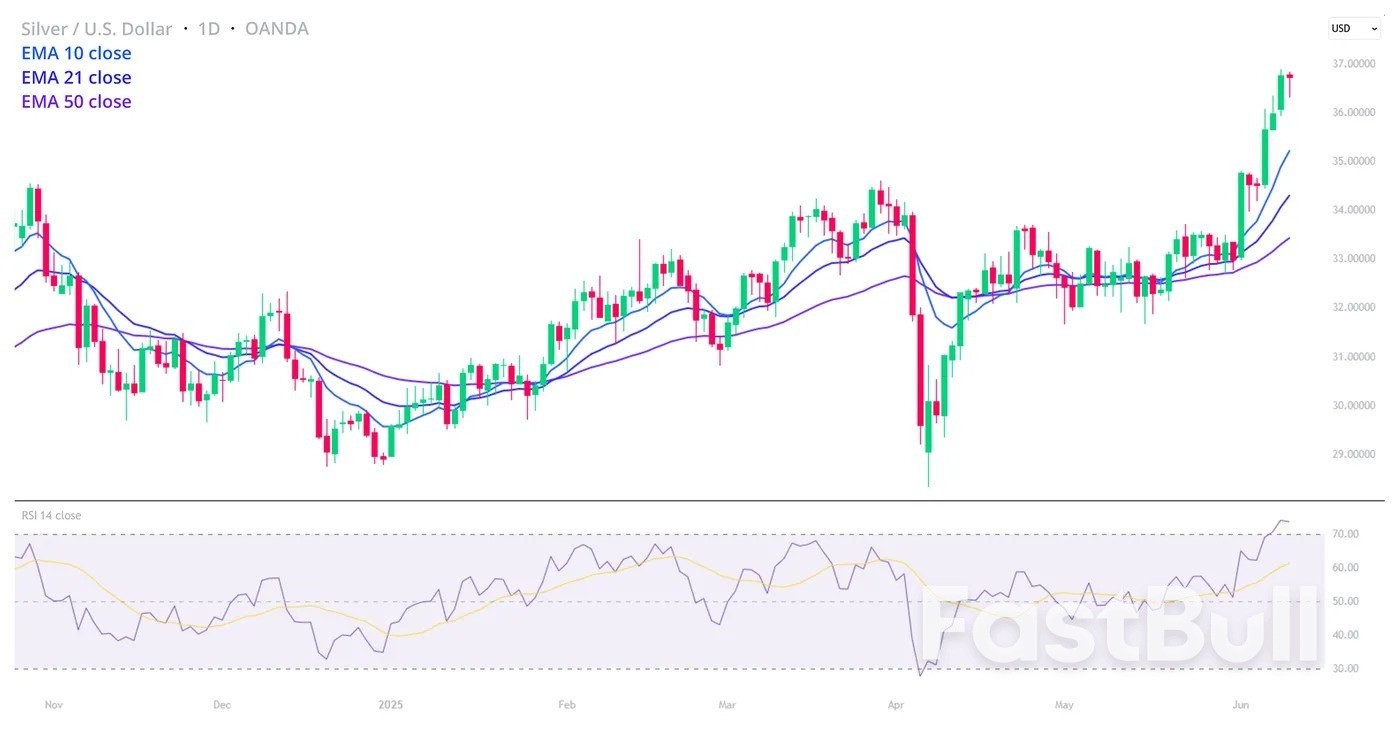 A chart showing the recent price action of XAGUSD
728 RM B 7/F GEE LOK IND BLDG NO 34 HUNG TO RD KWUN TONG KLN HONG KONG


White Label
Data API
Web Plug-ins
Poster Maker
Affiliate Program
The risk of loss in trading financial instruments such as stocks, FX, commodities, futures, bonds, ETFs and crypto can be substantial. You may sustain a total loss of the funds that you deposit with your broker. Therefore, you should carefully consider whether such trading is suitable for you in light of your circumstances and financial resources.
No decision to invest should be made without thoroughly conducting due diligence by yourself or consulting with your financial advisors. Our web content might not suit you since we don't know your financial conditions and investment needs. Our financial information might have latency or contain inaccuracy, so you should be fully responsible for any of your trading and investment decisions. The company will not be responsible for your capital loss.
Without getting permission from the website, you are not allowed to copy the website's graphics, texts, or trademarks. Intellectual property rights in the content or data incorporated into this website belong to its providers and exchange merchants.
Not Logged In
Log in to access more features

FastBull Membership
Not yet
Purchase


Log In
Sign Up


