• Trade
  • Markets
  • Copy
  • Contests
  • News
  • 24/7
  • Calendar
  • Q&A
  • Chats
Trending
Screeners
SYMBOL
LAST
BID
ASK
HIGH
LOW
NET CHG.
%CHG.
SPREAD
SPX
S&P 500 Index
6827.42
6827.42
6827.42
6899.86
6801.80
-73.58
-1.07%
--
DJI
Dow Jones Industrial Average
48458.04
48458.04
48458.04
48886.86
48334.10
-245.98
-0.51%
--
IXIC
NASDAQ Composite Index
23195.16
23195.16
23195.16
23554.89
23094.51
-398.69
-1.69%
--
USDX
US Dollar Index
97.950
98.030
97.950
98.500
97.950
-0.370
-0.38%
--
EURUSD
Euro / US Dollar
1.17394
1.17409
1.17394
1.17496
1.17192
+0.00011
+ 0.01%
--
GBPUSD
Pound Sterling / US Dollar
1.33707
1.33732
1.33707
1.33997
1.33419
-0.00148
-0.11%
--
XAUUSD
Gold / US Dollar
4299.39
4299.39
4299.39
4353.41
4257.10
+20.10
+ 0.47%
--
WTI
Light Sweet Crude Oil
57.233
57.485
57.233
58.011
56.969
-0.408
-0.71%
--

Community Accounts

Signal Accounts
--
Profit Accounts
--
Loss Accounts
--
View More

Become a signal provider

Sell trading signals to earn additional income

View More

Guide to Copy Trading

Get started with ease and confidence

View More

Signal Accounts for Members

All Signal Accounts

Best Return
  • Best Return
  • Best P/L
  • Best MDD
Past 1W
  • Past 1W
  • Past 1M
  • Past 1Y

All Contests

  • All
  • Trump Updates
  • Recommend
  • Stocks
  • Cryptocurrencies
  • Central Banks
  • Featured News
Top News Only
Share

Pentagon Says Two USA Army Soldiers And One Civilian USA Interpreter Were Killed, And Three Were Wounded In Syria

Share

Israel Says It Kills Senior Hamas Commander Raed Saed In Gaza

Share

Ukraine's Navy Says Russian Drone Attack Hit Civilian Turkish Vessel Carrying Sunflower Oil To Egypt On Saturday

Share

Israeli Military Says It Put Planned Strike On South Lebanon Site On Hold After Lebanese Army Requested Access

Share

Norwegian Nobel Committee: Calls On The Belarusian Authorities To Release All Political Prisoners

Share

Norwegian Nobel Committee: His Freedom Is A Deeply Welcome And Long-Awaited Moment

Share

Ukraine Says It Received 114 Prisoners From Belarus

Share

USA Embassy In Lithuania: Maria Kalesnikava Is Not Going To Vilnius

Share

USA Embassy In Lithuania: Other Prisoners Are Being Sent From Belarus To Ukraine

Share

Ukraine President Zelenskiy: Five Ukrainians Released By Belarus In US-Brokered Deal

Share

USA Vilnius Embassy: USA Stands Ready For "Additional Engagement With Belarus That Advances USA Interests"

Share

USA Vilnius Embassy: Belarus, USA, Other Citizens Among The Prisoners Released Into Lithuania

Share

USA Vilnius Embassy: USA Will Continue Diplomatic Efforts To Free The Remaining Political Prisoners In Belarus

Share

USA Vilnius Embassy: Belarus Releases 123 Prisoners Following Meeting Of President Trump's Envoy Coale And Belarus President Lukashenko

Share

USA Vilnius Embassy: Masatoshi Nakanishi, Aliaksandr Syrytsa Are Among The Prisoners Released By Belarus

Share

USA Vilnius Embassy: Maria Kalesnikava And Viktor Babaryka Are Among The Prisoners Released By Belarus

Share

USA Vilnius Embassy: Nobel Peace Prize Laureate Ales Bialiatski Is Among The Prisoners Released By Belarus

Share

Belarusian Presidential Administration Telegram Channel: Lukashenko Has Pardoned 123 Prisoners As Part Of Deal With US

Share

Two Local Syrian Officials: Joint US-Syrian Military Patrol In Central Syria Came Under Fire From Unknown Assailants

Share

Israeli Military Says It Targeted 'Key Hamas Terrorist' In Gaza City

TIME
ACT
FCST
PREV
U.K. Trade Balance Non-EU (SA) (Oct)

A:--

F: --

P: --

U.K. Trade Balance (Oct)

A:--

F: --

P: --

U.K. Services Index MoM

A:--

F: --

P: --

U.K. Construction Output MoM (SA) (Oct)

A:--

F: --

P: --

U.K. Industrial Output YoY (Oct)

A:--

F: --

P: --

U.K. Trade Balance (SA) (Oct)

A:--

F: --

P: --

U.K. Trade Balance EU (SA) (Oct)

A:--

F: --

P: --

U.K. Manufacturing Output YoY (Oct)

A:--

F: --

P: --

U.K. GDP MoM (Oct)

A:--

F: --

P: --

U.K. GDP YoY (SA) (Oct)

A:--

F: --

P: --

U.K. Industrial Output MoM (Oct)

A:--

F: --

P: --

U.K. Construction Output YoY (Oct)

A:--

F: --

P: --

France HICP Final MoM (Nov)

A:--

F: --

P: --

China, Mainland Outstanding Loans Growth YoY (Nov)

A:--

F: --

P: --

China, Mainland M2 Money Supply YoY (Nov)

A:--

F: --

P: --

China, Mainland M0 Money Supply YoY (Nov)

A:--

F: --

P: --

China, Mainland M1 Money Supply YoY (Nov)

A:--

F: --

P: --

India CPI YoY (Nov)

A:--

F: --

P: --

India Deposit Gowth YoY

A:--

F: --

P: --

Brazil Services Growth YoY (Oct)

A:--

F: --

P: --

Mexico Industrial Output YoY (Oct)

A:--

F: --

P: --

Russia Trade Balance (Oct)

A:--

F: --

P: --

Philadelphia Fed President Henry Paulson delivers a speech
Canada Building Permits MoM (SA) (Oct)

A:--

F: --

P: --

Canada Wholesale Sales YoY (Oct)

A:--

F: --

P: --

Canada Wholesale Inventory MoM (Oct)

A:--

F: --

P: --

Canada Wholesale Inventory YoY (Oct)

A:--

F: --

P: --

Canada Wholesale Sales MoM (SA) (Oct)

A:--

F: --

P: --

Germany Current Account (Not SA) (Oct)

A:--

F: --

P: --

U.S. Weekly Total Rig Count

A:--

F: --

P: --

U.S. Weekly Total Oil Rig Count

A:--

F: --

P: --

Japan Tankan Large Non-Manufacturing Diffusion Index (Q4)

--

F: --

P: --

Japan Tankan Small Manufacturing Outlook Index (Q4)

--

F: --

P: --

Japan Tankan Large Non-Manufacturing Outlook Index (Q4)

--

F: --

P: --

Japan Tankan Large Manufacturing Outlook Index (Q4)

--

F: --

P: --

Japan Tankan Small Manufacturing Diffusion Index (Q4)

--

F: --

P: --

Japan Tankan Large Manufacturing Diffusion Index (Q4)

--

F: --

P: --

Japan Tankan Large-Enterprise Capital Expenditure YoY (Q4)

--

F: --

P: --

U.K. Rightmove House Price Index YoY (Dec)

--

F: --

P: --

China, Mainland Industrial Output YoY (YTD) (Nov)

--

F: --

P: --

China, Mainland Urban Area Unemployment Rate (Nov)

--

F: --

P: --

Saudi Arabia CPI YoY (Nov)

--

F: --

P: --

Euro Zone Industrial Output YoY (Oct)

--

F: --

P: --

Euro Zone Industrial Output MoM (Oct)

--

F: --

P: --

Canada Existing Home Sales MoM (Nov)

--

F: --

P: --

Euro Zone Total Reserve Assets (Nov)

--

F: --

P: --

U.K. Inflation Rate Expectations

--

F: --

P: --

Canada National Economic Confidence Index

--

F: --

P: --

Canada New Housing Starts (Nov)

--

F: --

P: --

U.S. NY Fed Manufacturing Employment Index (Dec)

--

F: --

P: --

U.S. NY Fed Manufacturing Index (Dec)

--

F: --

P: --

Canada Core CPI YoY (Nov)

--

F: --

P: --

Canada Manufacturing Unfilled Orders MoM (Oct)

--

F: --

P: --

Canada Manufacturing New Orders MoM (Oct)

--

F: --

P: --

Canada Core CPI MoM (Nov)

--

F: --

P: --

Canada Manufacturing Inventory MoM (Oct)

--

F: --

P: --

Canada CPI YoY (Nov)

--

F: --

P: --

Canada CPI MoM (Nov)

--

F: --

P: --

Canada CPI YoY (SA) (Nov)

--

F: --

P: --

Canada Core CPI MoM (SA) (Nov)

--

F: --

P: --

Q&A with Experts
    • All
    • Chatrooms
    • Groups
    • Friends
    Connecting
    .
    .
    .
    Type here...
    Add Symbol or Code

      No matching data

      All
      Trump Updates
      Recommend
      Stocks
      Cryptocurrencies
      Central Banks
      Featured News
      • All
      • Russia-Ukraine Conflict
      • Middle East Flashpoint
      • All
      • Russia-Ukraine Conflict
      • Middle East Flashpoint
      Search
      Products

      Charts Free Forever

      Chats Q&A with Experts
      Screeners Economic Calendar Data Tools
      Membership Features
      Data Warehouse Market Trends Institutional Data Policy Rates Macro

      Market Trends

      Market Sentiment Order Book Forex Correlations

      Top Indicators

      Charts Free Forever
      Markets

      News

      News Analysis 24/7 Columns Education
      From Institutions From Analysts
      Topics Columnists

      Latest Views

      Latest Views

      Trending Topics

      Top Columnists

      Latest Update

      Signals

      Copy Rankings Latest Signals Become a signal provider AI Rating
      Contests
      Brokers

      Overview Brokers Assessment Rankings Regulators News Claims
      Broker listing Forex Brokers Comparison Tool Live Spread Comparison Scam
      Q&A Complaint Scam Alert Videos Tips to Detect Scam
      More

      Business
      Events
      Careers About Us Advertising Help Center

      White Label

      Data API

      Web Plug-ins

      Affiliate Program

      Awards Institution Evaluation IB Seminar Salon Event Exhibition
      Vietnam Thailand Singapore Dubai
      Fans Party Investment Sharing Session
      FastBull Summit BrokersView Expo
      Recent Searches
        Top Searches
          Markets
          News
          Analysis
          User
          24/7
          Economic Calendar
          Education
          Data
          • Names
          • Latest
          • Prev

          View All

          No data

          Scan to Download

          Faster Charts, Chat Faster!

          Download App
          English
          • English
          • Español
          • العربية
          • Bahasa Indonesia
          • Bahasa Melayu
          • Tiếng Việt
          • ภาษาไทย
          • Français
          • Italiano
          • Türkçe
          • Русский язык
          • 简中
          • 繁中
          Open Account
          Search
          Products
          Charts Free Forever
          Markets
          News
          Signals

          Copy Rankings Latest Signals Become a signal provider AI Rating
          Contests
          Brokers

          Overview Brokers Assessment Rankings Regulators News Claims
          Broker listing Forex Brokers Comparison Tool Live Spread Comparison Scam
          Q&A Complaint Scam Alert Videos Tips to Detect Scam
          More

          Business
          Events
          Careers About Us Advertising Help Center

          White Label

          Data API

          Web Plug-ins

          Affiliate Program

          Awards Institution Evaluation IB Seminar Salon Event Exhibition
          Vietnam Thailand Singapore Dubai
          Fans Party Investment Sharing Session
          FastBull Summit BrokersView Expo

          Oil Spills and Near Misses: More Ghost Tankers Ship Sanctioned Fuel

          Cohen

          Commodity

          Summary:

          An oil tanker runs aground off eastern China, leaking fuel into the water. Another is caught in a collision near Cuba. A third is seized in Spain for drifting out of control.

          An oil tanker runs aground off eastern China, leaking fuel into the water. Another is caught in a collision near Cuba. A third is seized in Spain for drifting out of control.
          These vessels were part of a "shadow" fleet of tankers carrying oil last year from countries hit by Western sanctions, according to a Reuters analysis of ship tracking and accident data and interviews with more than a dozen industry specialists.
          Hundreds of extra ships have joined this opaque parallel trade over the past few years as a result of rising Iranian oil exports as well as restrictions imposed on Russian energy sales over the war in Ukraine, said the industry players, who include commodity traders, shipping companies, insurers and regulators.
          "The risk of having an accident is definitely going up," said Eric Hanell, CEO of tanker operator Stena Bulk. "We might be affected being at a port ... because someone is running into us or loses control, which is a much bigger risk on those kinds of ships because they are older and not as well-maintained."
          Many leading certification providers and engine makers that approve seaworthiness and safety have withdrawn their services from ships carrying oil from sanctioned Iran, Russia and Venezuela, as have a host of insurers, meaning there's less oversight of vessels carrying the flammable cargoes.
          Some industry figures fear this parallel trade carrying tens of millions of barrels of oil around the world could undermine decades-long industry efforts to increase shipping safety following disasters including the 1989 Exxon Valdez spill in Alaska, which caused devastating environmental damage.
          Last year there were at least eight groundings, collisions or near misses involving tankers carrying sanctioned crude or oil products, including the events off China, Cuba and Spain, according to a Reuters analysis based on ship-tracking information and Lloyd's List Intelligence data on vessel incidents.
          That's the same number as the previous three years combined, although still a fraction of the overall 61 incidents recorded across the whole shipping industry in 2022, the analysis found.
          None of the eight incidents caused any injuries or significant pollution. Some executives are worried, though.
          "You have the dark fleet which has not been vetted so much and that is a concern," said Jan Dieleman, president of commodities group Cargill's ocean transportation division. "We do not have visibility on maintenance and safety as no one is really boarding the ships and doing checks - that is missing."
          Government officials from Iran, Venezuela and Russia, which do not recognise Western sanctions, didn't immediately respond to requests for comment for this article.
          Several of the shipping players interviewed said oil producers hit by sanctions had little choice but to use less tightly vetted vessels to keep their exports flowing and shore up their stumbling economies.
          Invisible fleet?
          Estimates of the size of the shadow fleet vary, with industry participants putting the number at anything from more than 400 to north of 600, or roughly a fifth of the overall global crude oil tanker fleet.
          "Our data shows that it has now reached around 650 units," said Andrea Olivi, head of wet freight at commodity trader Trafigura, which estimates that two-thirds of that number are crude tankers.
          The number of tankers transporting Iranian crude and products – excluding the state's own fleet – has risen to above 300 this month from 70 in November 2020, said Claire Jungman, chief of staff at U.S. advocacy group United Against Nuclear Iran (UANI), which tracks Iranian-related tanker traffic via satellite data.
          Iran's oil minister said this month that the country's oil exports had reached their highest level since the reimposition of U.S. sanctions in 2018, with 83 million more barrels exported in the past year versus the year before.
          Meanwhile, economic penalties imposed on Moscow by Washington and other Western capitals over the Ukraine conflict have led to dozens more ships plying the shadow trade, the industry participants said.
          Some cautioned that the size of the shadow fleet was becoming more difficult to gauge given the complex layers of compliance around sanctions on Russian oil, which is banned from many Western ports and subject to a price cap by G7 countries.
          Reuters was unable to independently verify the numbers regarding the size and growth of the shadow fleet.
          The U.S. Treasury didn't immediately respond to a request for comment on ships carrying sanctioned oil. A State Department spokesperson said the U.S. strove to identify sanctions evasion in the shipping sector in an effort to bolster navigation safety and minimize the risk of environmental hazards.
          'Endangered vessels'
          Among the eight incidents identified last year, the Linda I tanker carrying Russian oil was detained at the southern Spanish port of Algeciras in November, according to the Reuters analysis.
          Spain's Merchant Fleet authority confirmed the incident and the cargo, telling Reuters the vessel had been authorized to pick up spare parts outside port limits but was found drifting towards anchored ships due to navigation system faults.
          "The vessel was detained for having endangered the vessels anchored in its vicinity and for a series of deficiencies," said the agency, part of the transport ministry.
          The Linda I was also in contravention of U.N. pollution regulations by not having an exhaust gas cleaning system, or scrubber, while using high-sulphur marine fuel, said the Merchant Fleet, which fined the ship 80,000 euros ($85,800) and detained it from Nov. 2 to Dec. 27 while its faults were fixed.
          The Linda I's owner, Spastic Oceanway, is listed in the Equasis public shipping database as care of Chanocean Management. There was no reference to either company at Chanocean's corporate office listed in downtown Hong Kong when a Reuters reporter visited the building.
          In eastern China, the Arzoyi tanker - which UANI analysis showed was carrying Iranian oil - ran aground while unloading at the Qingdao Haiye Mercuria Terminal on March 23 last year, causing a small oil spill in port waters, according to data from Lloyd's List Intelligence.
          Three days later, the Petion carrying Venezuelan crude from the country's Jose port was involved in a collision with another tanker off the Cuban port of Cienfuegos, although the cause wasn't clear, according to the Reuters analysis.
          Most of Venezuelan's oil exports are subject to U.S. sanctions.
          The Arzoyi's owner, listed as Panama-based owner Vitava Shipping, couldn't be reached for comment, while there are no contact details listed for the Petion.
          Chinese and Cuban maritime authorities didn't immediately respond to requests for comment.
          The potential perils posed by the shadow fleet were shown in 2021 when Israel said a tanker transporting Iranian oil spilled its cargo in the eastern Mediterranean, causing ecological damage to a swathe of coastline.
          Ship-To-Ship Transfers
          Around 774 tankers out of 2,296 in the overall global crude oil fleet are 15 years old or more, according to data provider VesselsValue.
          Although it is not known how many of those older vessels are part of the shadow fleet, the strict vetting policies of oil majors and commodity traders mean they typically use tankers aged under 15 years.
          Some industry participants said ship-to-ship (STS) transfers of oil and other fuel cargoes involving shadow tankers at various locations at sea, outside the oversight of port authorities, posed significant safety and environmental risks.
          In 2019, two tankers caught fire in the Black Sea region while transferring fuel at sea, leaving at least 10 crew dead, after one vessel was barred from using a port due to U.S. sanctions.
          "We are seeing older vessels with unknown technical management companies performing STS in the middle of the Atlantic," Trafigura's Olivi said.
          "The risk of a major pollution incident is very high."
          ($1 = 0.9321 euros)

          Source: ET

          Risk Warnings and Disclaimers
          You understand and acknowledge that there is a high degree of risk involved in trading. Following any strategies or investment methods may lead to potential losses. The content on the site is provided by our contributors and analysts for information purposes only. You are solely responsible for determining whether any trading assets, securities, strategy, or any other product is suitable for investing based on your own investment objectives and financial situation.
          Comments
          Add to Favorites
          Share

          Why Does the UK Have Highest Inflation in G7 and is Brexit A Factor?

          Devin

          Economic

          Britain has the highest inflation rate in the G7, as the only nation in the group of advanced economies with a reading in double digits after last month's shock increase.
          With the UK appearing to be an international outlier, some economists have suggested Brexit is having an impact.
          International comparisons
          On a headline basis, inflation is higher in the UK than elsewhere. In the eurozone, annual inflation slowed to 8.5% in February, down from a peak of 10.6% in October, while US inflation eased to 6% last month, a fall from a high of 9.1% last summer.
          However, it is not an entirely uniform picture. Inflation rose in France and Germany last month, while the rate for the EU27 dipped slightly from 10% to 9.9%. In the eurozone, analysts had forecast a bigger fall from 8.6% in January to 8.2%. However, pressure from rising food prices – the same culprit for the UK's shock rise – led to an unexpectedly small decrease.
          In both the UK and the eurozone, core inflation – used by central bankers because it excludes energy and food, providing a clearer picture of underlying pressures – rose by more than expected: from 5.8% in January to 6.2% in February for the UK, and from 5.3% to 5.6% for the eurozone.
          There are also features of an economy which can cause inflation to rise, or fall, at times that may not be replicated in other nations. The Ofgem price cap in the UK is one example, leading to cliff edges for energy price changes. Economists expect the UK inflation rate to fall sharply in April for this reason, as it is compared against the huge 54% jump in the Ofgem cap 12 months earlier.
          While inflation can bob around from month to month – belying an overall trend, and making it harder to isolate Brexit as a driving force – there are still reasons why the UK could be worse off than other nations.
          Supply chains
          Brexit has added to delivery times and costs for UK imports, a factor likely to be passed on to consumers in the shops.
          Part of the inflation shock in February was due to the rising cost of cucumbers, tomatoes and salad, as prices rose amid severe shortages and rationing across the UK last month. Experts had blamed shortages on unseasonably cold weather in southern Spain and Morocco affecting harvests, although others pointed to Brexit, given the lack of empty shelves in EU nations.
          Justin King, the former Sainsbury's chief executive, said the UK food sector had been "significantly disrupted" by leaving the EU, while producers in the bloc warned Britain had slipped down the pecking order for deliveries when supplies are tight.
          Research from the London School of Economics shows Brexit had added almost £6bn to UK food bills in the two years to the end of 2021.
          However, there are also domestic reasons. Growers blame powerful British supermarkets for driving down the prices they are paid, limiting supply, as well as the government's approach to subsidising food production. Economists also say soaring energy bills are the biggest driver of food costs, given the impact on everything from fertiliser, tractor diesel and lorry shipments, to keeping bakery ovens fired and food factory production lines rolling.
          Worker shortages
          On top of supply chain disruption and energy costs, wages also have an impact. In response to the inflation shock, workers are demanding higher pay settlements from employers, while a lack of available staff in many sectors of the economy is forcing companies to offer higher wages to recruit or retain employees.
          Tougher post-Brexit migration rules could be adding to the problem, especially in typically lower paying, lower-skilled roles in sectors such as hospitality, where employers used to be able to rely more on EU workers coming to Britain.
          Net migration to the UK has continued to rise since to a record level since Brexit, driven by arrivals from non-EU nations making up a reduction in migration from the 27-nation bloc.
          However, research from the Centre for European Reform and UK in a Changing Europe suggests Brexit could still have led to a shortfall of 330,000 people in the UK labour force, after taking into account how the workforce might have looked if Britain had remained in the EU.
          With older workers leaving the labour market altogether, and record levels of long-term sickness among the UK working age population, the lack of available staff to fill near-record job vacancies could force employers to increase wages – with potential to fuel inflation further.

          Source: The Guardian

          To stay updated on all economic events of today, please check out our Economic calendar
          Risk Warnings and Disclaimers
          You understand and acknowledge that there is a high degree of risk involved in trading. Following any strategies or investment methods may lead to potential losses. The content on the site is provided by our contributors and analysts for information purposes only. You are solely responsible for determining whether any trading assets, securities, strategy, or any other product is suitable for investing based on your own investment objectives and financial situation.
          Comments
          Add to Favorites
          Share

          Rates Spark: A Job Nearly Done

          Thomas

          Central Bank

          The Fed lets its facilities do their work, betting for resumed status quo, and system stability

          The Fed hiked 25bp yesterday. The effect has been lower market rates, in particular on the front end as the market takes on board that the Fed seems to be almost done. One theme that we think continues is the dis-inversion of the curve, and we've seen another material move in that direction as a response to the Fed's decision.
          Market rates had been edging higher as we headed into the Federal Open Market Committee meeting, which no doubt helped to embolden the Fed to deliver the 25bp hike that the market had (practically) discounted. The market will also be comforted by the fact that the Fed decided to go ahead and hike, when the alternative could have been to hold and nod towards bank angst as the rationale. There is enough in that combination for market rates to re-nudge higher in the weeks ahead, at least till we get to a point where the disinflation story has become more compelling, notwithstanding the impact effect towards lower market rates.
          Market technicals are in an interesting place right now. The Fed's balance sheet increased by US$40bn last week as a consequence of support being provided to some banks, including Silicon Valley Bank, Signature Bank and First Republic Bank. And indeed the regional Fed breakout of support confirms that the bulk of additional liquidity went through the New York Fed and the San Francisco Fed.
          The consequence of this from a balance sheet perspective is to push against the quantitative tightening policy where US$95bn is being allowed to roll off from the Fed's bond holdings on a monthly basis. This, the Fed argues, is the various mechanisms doing their work. The same logic obtains for the reverse facility, which continued to act to mop up excess liquidity, and has popped higher in the past week, in part a reflection of that. No new angle on this from the Fed today.

          It may well be the Bank of England's final 25bp today

          The upside surprise in yesterday's inflation reading for February was a reminder for the Bank of England that its inflation problem is not fully tackled yet. Given the easing fears of systemic stress, markets are now leaning heavily towards expecting a 25bp hike today – and they do see at least one more 25bp hike by summer.
          Our economist does not think today's decision is as clear cut as the market believes, however. And he also expects that this will become evident in a monetary policy committee remaining heavily divided. Here we could see a vote for a 50bp hike on the one end and votes for no change and perhaps even a cut on the dovish end. The BoE is not focusing on any single inflation indicator, but is focused more on a broader definition of "inflation persistence" and price-setting behaviour where the data has been generally more encouraging over the past month or so. If that continues, our economist still suspects the committee will be comfortable with pausing the tightening cycle in May.
          Today's expected hike, and a generally improving market backdrop could still help markets to retrace more of the recent drop in yields. Overall, though, the recent crisis reinforces our view that 10Y gilt yields are then headed to 3% by late 2023/early 2024.

          Rates Spark: A Job Nearly Done_1The ECB's job could still be more protracted

          Rates have been tentatively moving higher, in the process bear flattening the curves as markets are baking policy tightening back into their outlooks. The big question remains just by how much should policy expectations retrace. From a low of close to 3% the pricing of the terminal rate has moved close to 3.5% again. At its high just before the turmoil it stood just above 4%.
          Amid calmer markets ECB members are now re-focusing on the need to raise policy rates further. Naturally these days, always under the condition that the baseline scenario holds. Even the dovish end of the governing council acknowledges that more tightening would be needed then, if only that the uncertainty warrants taking the decisions meeting by meeting.
          One might think that Belgium's Wunsch has turned dove cautioning that a tightening of financial conditions "could be doing part of the job, and [the ECB] might have to do less". However, his remarks should probably be benchmarked against his prior comments from early March, when he said "looking at rates of 4% would not be excluded".

          Rates Spark: A Job Nearly Done_2Today's events and market view

          Central banks are not distracted from their inflation fight, but there is some acknowledgement that the banking shock and the ensuing financial tightening will do some of the job, the uncertainty being just how much. And clearly some central banks are closer to the end of they hiking cycles, as for instance the BoE which we think may deliver its final hike today. Farthest behind is the ECB, and a stretch of calmer markets could further embolden officials to push the message that more hikes are needed. Although there may be spill over from the late-cycle dynamics beginning to unfold elsewhere, we think the EUR curve stands the greater chances of re-flattening, and underperforming versus its peers.
          Next to the Bank of England, today's main focus will be on the ECB policymakers' comments given another busy slate of speakers. We should hear, among others, from Austria's Holzmann, Estonia's Muller and again from chief economist Lane himself. In data we will get a preliminary eurozone consumer confidence reading for March as well as the weekly initial jobless claims out of the US.

          Source: ING

          Risk Warnings and Disclaimers
          You understand and acknowledge that there is a high degree of risk involved in trading. Following any strategies or investment methods may lead to potential losses. The content on the site is provided by our contributors and analysts for information purposes only. You are solely responsible for determining whether any trading assets, securities, strategy, or any other product is suitable for investing based on your own investment objectives and financial situation.
          Comments
          Add to Favorites
          Share

          FX Daily: A Spoonful of Sugar

          Samantha Luan

          Forex

          USD: Compromise comes at a price
          The well-known verse "a spoonful of sugar helps the medicine go down" might have inspired Jerome Powell yesterday as he and his FOMC colleagues offered markets a few dovish hints while delivering a potentially painful 25bp rate hike. As discussed in our meeting review note, those hints primarily consisted of the view that "some additional policy firming may be appropriate" - not "will be appropriate" as before - and on keeping the median dot plot estimate for 2023 unchanged at 5.1%.
          The statement was paired with a well-telegraphed message of trust in the solidity of the US banking system, and Powell did offer modest pushback against rate cut expectations during the press conference. However, we doubt the dovish market reaction was either a surprise or an unwanted development for the Fed.
          Many had argued that one objective of the Fed yesterday was to avert a major setback in financial market sentiment, the market reaction would suggest this was achieved, and the drop in equities might actually be mostly a function of Secretary Janet Yellen dismissing speculation that the Treasury is planning to provide "blanket" deposit insurance to banks.
          However, that came at a price: a considerably less clear Fed communication. No trade-off between price and financial stability is essentially possible only if financial conditions tighten (due to banking stress) enough to bring down inflation, or if regulators and other institutions effectively manage to restore market confidence without anything more than the financial stability tools offered by the Fed. This second scenario requires indeed that, as Powell stated, the US banking system is very solid. Markets are, so far, not trusting the ability of the Fed to treat inflation and financial stability independently. This looks unlikely to change soon, which means that rate expectations should remain strictly tied to developments in the banking crisis. And this brings us to the FX implications.
          The dollar weakened on the back of the moderate dovish surprise by the Fed yesterday, and reluctance from the Treasury to consider an extension to the deposit insurance. At the same time, a new regional lender, PacWest is facing increasing turmoil on deposit outflows and First Republic's rating was cut from BB to B by Fitch. So, with a market not trusting the more ambiguous Fed communication and the US regional banking crisis far from resolved, it looks like investor bias on the Fed may stay on the dovish side. This should translate into a continued bearish bias for the dollar, primarily against European currencies should the stabilisation in European sentiment continue. Still, we see a high chance of seeing small USD upside corrections on the way, rather than a straight-line USD depreciation.
          EUR: Central bank meetings in Switzerland and Norway
          EUR/USD is now officially eyeing the 1.1000 level. We discussed yesterday how that is a key benchmark level for the pair, and we think a break higher would likely mark a rather strong conviction call from the market that the Credit Suisse shock has been successfully absorbed by European markets. That may be a bit premature, and we flagged in the USD section above how the USD bearish bias surely doesn't prevent EUR/USD corrections on the way. In the current elevated volatility environment, those corrections can be quite pronounced, even if short-lived. Today's eurozone calendar includes consumer confidence data for March as well as a few European Central Bank speakers, although our focus in Europe today will mostly be on central bank meetings in Switzerland and Norway.
          The Swiss National Bank faces a monetary policy decision in a very turbulent time, as it faces the challenging aftermath of the Credit Suisse rescue deal. Originally, this had appeared to be a no-brainer for the SNB – a 50bp rate hike – and consensus expectations are still pointing at such a move. Despite admitting this has become a much closer call recently, we think the past few days of tentative calm in markets will allow the SNB to deliver the half-point increase today. We must remember that policy meetings in Switzerland occur only once a quarter and that the latest inflation readings surprised on the upside.
          We expect a hike in Norway as well, but by 25bp, as previously announced and widely expected. Norges Bank will also publish the updated rate projections, which currently embed only another 10bp worth of tightening. We think NB could revise the peak rate higher on the back of higher inflation and despite the recent turmoil, if nothing else to counter the recent NOK weakness. We expect gains in both the Swiss franc and krone today.
          GBP: BoE to hike
          The ECB and Fed rate hikes mean that the chances of the Bank of England following suit with a 25bp move today are quite high, even more so following the surprisingly high inflation readings published yesterday. Here is our full market guide to today's BoE meeting.
          Markets are now fully pricing in a 25bp scenario and will therefore look for some indications that the further 40bp currently embedded in the GBP OIS curve is warranted. The division within the BoE's MPC may be nothing but exacerbated by the recent market turmoil, the risk is that markets may receive very little guidance on future policy paths. Ultimately, the pound may rapidly default to being driven by external factors: primarily the banking situation and global risk sentiment. A test of 1.25 in cable in the coming days is looking quite likely.
          CEE: Strong euro a welcome boost for region
          Today's calendar in the region is basically empty and hence the main focus will be on the reaction to yesterday's Fed decision. Higher EUR/USD is good news for FX and the CEE region should thus continue to rally. On the other hand, the negative sentiment left by the Fed could put a bit of a damper on the positive push coming from EUR/USD.
          However, today should not be all about the Hungarian forint and the Czech koruna as in the last few days. As we mentioned earlier this week, the Polish zloty and the Romanian leu just needed a stronger euro to strengthen, in our view. Unless negative market sentiment prevails today, the entire region could see decent gains. Still, the previous leaders, the forint and the koruna, should remain at the forefront of the region and move towards 385 EUR/HUF and 23.60 EUR/CZK. The Polish zloty could finally trade out of the March range of 4.680-4.720 EUR/PLN and test lower levels. The Romanian leu could look lower below 4.91 EUR/RON for the first time since the middle of February.

          Source: ING

          Risk Warnings and Disclaimers
          You understand and acknowledge that there is a high degree of risk involved in trading. Following any strategies or investment methods may lead to potential losses. The content on the site is provided by our contributors and analysts for information purposes only. You are solely responsible for determining whether any trading assets, securities, strategy, or any other product is suitable for investing based on your own investment objectives and financial situation.
          Comments
          Add to Favorites
          Share

          China's Current Iron Ore Strength May Be as Good as It Gets for 2023

          Thomas

          Commodity

          The risks to the bullish drivers of the spot iron ore price are rising as the market starts to question the nature and strength of China's economic recovery, while the chances of a global economic hard landing mount.
          Benchmark 62% iron ore for delivery to north China, as assessed by commodity price reporting agency Argus, ended at $121.60 a tonne on Wednesday, a two-month low.
          The price has dropped 8.8% since hitting $133.40 a tonne on March 15, which was the highest since June last year.
          However, despite the recent moderation in the spot price, it's worth noting it's still 54% higher than the 2022 low of $79 a tonne, hit in October.
          Since that low the price has been driven higher mainly by optimism over demand from China, which buys about 70% of global seaborne volumes of the steel raw material.
          The rally accelerated after Beijing abandoned its strict zero-COVID policy towards the end of last year, as optimism mounted over an economic rebound amid stimulus spending and pent-up demand in the world's second-largest economy.
          The iron ore price rally was matched by rising imports by China, with official data showing imports of 194.2 million tonnes in the first two months of the year, up 7.3% from the same period a year earlier.
          It's likely that the pace of imports has been maintained in March, with Refinitiv estimating arrivals of around 103 million tonnes, while Kpler forecasts 102.7 million.
          On a daily basis this equates to about 3.32 million tonnes in March, which would be an acceleration from 3.29 million in the first two months.
          China publishes combined January and February data to smooth out distortions caused by the Lunar New Year holiday, which fell in January this year but was in February in 2022.
          The question becomes what the risks are to the so far bullish start to 2023 for iron ore prices and volumes.
          The chief one is that China's economic recovery focuses more on boosting consumer spending than it does on rebuilding the residential property sector.
          China's economic growth target for 2023 is a relatively low 5%, and it's possible that this could be achieved largely through rising consumer spending, which would support increased demand for energy commodities such as crude oil as demand for transportation increased.
          The struggling residential property sector has shown some signs of improvement in the first two months of the year, but most indicators are still in negative territory, so ultimately it's still a drag on steel demand.
          The first two months of the year saw a 5.7% drop in property investment, although this was an improvement on the decline of 10% for 2022 as a whole. New housing starts declined 9.4%, still negative but better than the 39.4% slump in December.
          Given that construction accounts for nearly a third of China's domestic steel demand, it would mean that the other sectors would have to pick up substantially.
          Vehicle and goods manufacturing offer some hope, but they are also exposed to any sharp slowdown in the rest of the world, given China's status as the world's biggest exporter of manufactured products.
          Steel decline?
          There has also been speculation that China will decide to implement a policy to cut steel output by 2.5% in 2023 from 2022's total of just over 1 billion tonnes.
          If such a policy is adopted, it implies that any strength in the first half of 2023, as is currently being seen, will have to be offset by lower output in the second half.
          China's domestic steel demand may decline to 910 million tonnes in 2023 from 920 million in 2022, Niki Wang, managing editor for iron ore at S&P Global Commodity Insights, told the Global Iron Ore and Steel Forecast Conference in Perth on Thursday.
          While a 10 million tonne drop in China's consumption is relatively small, it still makes it harder to build an overall bullish case for iron ore demand and prices for 2023 as a whole.
          The risk is that iron ore demand is being front-loaded into the first half of the year, and potentially will decline in the second, with the concomitant risk prices will also come under pressure.

          Source: Reuters

          Risk Warnings and Disclaimers
          You understand and acknowledge that there is a high degree of risk involved in trading. Following any strategies or investment methods may lead to potential losses. The content on the site is provided by our contributors and analysts for information purposes only. You are solely responsible for determining whether any trading assets, securities, strategy, or any other product is suitable for investing based on your own investment objectives and financial situation.
          Comments
          Add to Favorites
          Share

          Euro Leads Gains as Dollar Struggles Post-FOMC; BoE and SNB Decisions Take Center Stage

          Devin

          Forex

          Dollar faced broad sell-off overnight after the less hawkish than expected Fed rate hike and press conference, with Euro emerging as the biggest winner against the greenback. Sterling and Swiss Franc followed suit, while Australian and New Zealand dollars also strengthened but lagged on a weekly basis.
          Attention now shifts to BoE and SNB rate decisions. Both are expected to continue their rate hike cycles, but uncertainties remain about the path ahead. Any outcome perceived as less hawkish could push Euro further up, aided by an extended rally in EUR/CHF and a stronger rebound in EUR/GBP.
          Technically, EUR/GBP's break of 0.8842 minor resistance affirm the case that corrective fall from 0.8977 has completed with three waves down to 0.8717, after drawing support from 0.8720. Further break of 0.8924 resistance will send the cross through 0.8977 to resume whole rise from 0.8545 (2022 low).

          Euro Leads Gains as Dollar Struggles Post-FOMC; BoE and SNB Decisions Take Center Stage_1S&P 500 down, reacted more to Yellen than Powell?

          US markets experienced a complex development overnight due to simultaneous reactions to two events. Initially, the markets responded bullishly to the Fed's less hawkish than expected rate hike and press conference. However, just an hour before the close, sellers jumped in, and the three major indexes closed -1.6% lower.
          The selloff might be more attributed to Treasury Secretary Janet Yellen's comments at a Senate committee. She explicitly stated, "I have not considered or discussed anything having to do with blanket insurance or guarantees of deposits."
          Yellen further elaborated, "when a bank failure is deemed to create systemic risk, which I think of as the risk of a contagious bank run…we are likely to invoke the systemic risk exception, which permits the FDIC to protect all depositors, and that would be a case-by-case determination."
          Meanwhile, Asian markets have remained sluggish and mixed today, without any apparent signs of bearishness carried over. It may take some more time to understand the unfolding situation fully.
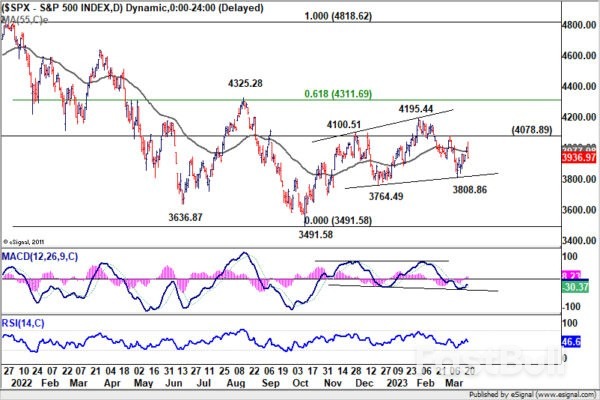
          Technically, near term outlook in S&P 500 isn't too bearish yet given it's holding inside a near term channel. However, break of 3901.27 support will argue that the corrective rebound from 3808.85 has completed at 4039.49, after hitting falling trend line resistance. Deeper selloff would then follow through 3808.86 to resume whole decline from 4195.44.Euro Leads Gains as Dollar Struggles Post-FOMC; BoE and SNB Decisions Take Center Stage_2

          Euro Leads Gains as Dollar Struggles Post-FOMC; BoE and SNB Decisions Take Center Stage_3Fed softened hawkish tone, but not dovish

          In light of the Fed announcement and press conference overnight, it appears that another 25bps rate hike is likely in May, followed by a prolonged pause with no rate cut expected until next year. The overall picture remains hawkish, albeit not as much as after Fed Chair Jerome Powell's earlier testimony this month.
          As anticipated, Fed raised interest rates by 25bps to 4.75-5.00%. While the tightening bias was maintained, the statement softened its tone, stating, "some additional policy firming may be appropriate." Despite recent market turmoil, median projections still indicated an interest rate peak of 5.1% this year, suggesting one more 25bps hike before pausing until next year. The median projection for 2024 interest rate increased from 4.1% to 4.3%, signaling a slower path of rate cuts.
          During the post-meeting press conference, Powell acknowledged that "financial conditions seem to have tightened" recently, adding that if the situation persists, it could "easily have a significant macroeconomic effect, and we would factor that into our policy decisions." While he admitted that a pause was considered during the meeting, he emphasized that a rate cut this year was "not our baseline expectation," stating, "the key is we have to have policies tight enough to bring inflation down to 2%."
          Suggested readings on Fed:
          · FOMC's Fight Against Inflation Finely Balanced
          · FOMC Hikes Rates, But End of Tightening Cycle Coming Into View
          · Suderman Says: Rates Up as Expected, But Peak in Sight?
          · FOMC Hikes Policy Rate by 25 Basis Points, Cautions on Bank Stress
          · Fed hikes 25 bps, terminal rate forecast unchanged at 5.1%
          · (FED) Federal Reserve Issues FOMC Statement

          GBP/CHF extending range trading ahead of BoE and SNB

          BoE and SNB are both expected to raise interest rates today. A 25bps hike by BoE to 4.25% is widely anticipated, though the case for a subsequent pause has been shaken by the reacceleration of consumer inflation in February. The Monetary Policy Committee is known for its divided outlook on the amount of tightening needed, and today's voting should continue to reflect this pattern.
          An explicit indication of a pause could put downward pressure on Sterling, but such a signal is unlikely to emerge. Instead, BoE is more likely to adopt a non-committal stance, waiting for incoming data and the next economic projections in May before making a firm judgment.
          Concurrently, SNB is expected to hike by 50bps to 1.50%. Market expectations suggest a possible 25bps hike in June to a terminal rate of 1.75%, followed by a pause. However, the SNB's comments and projections could reshape these expectations.
          Here are some previews for BoE and SNB:
          · UK Inflation Will Strengthen the Hawks
          · BoE Rate Decision: One Last Hike Before Hitting Pause?
          · BoE Preview: 25 bps Hike and Done?
          · Bank of England Preview – Final Hike in Store
          · Bank of England & Swiss National Bank Both Set to Hike
          · Will the SNB Roil Markets With a Hike Amid Credit Suisse Crisis?
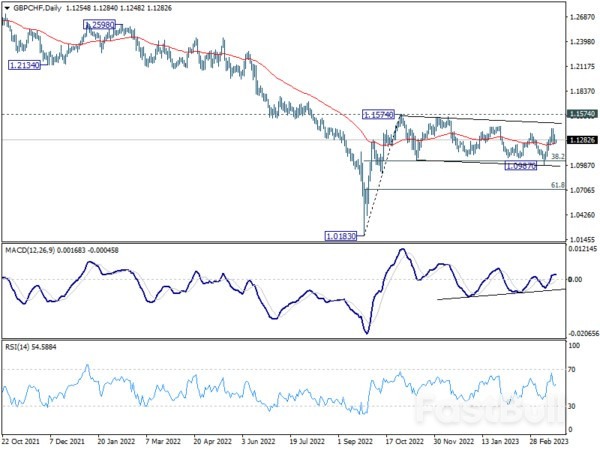
          GBP/CHF is still bounded in medium term sideway consolidation from 1.1574. Outlook is kept bullish as the crosses quickly recovered after breaching 38.2% retracement of 1.0183 to 1.1574 at 1.1043 briefly. A break through 1.1574 resistance to resume the rise form 1.0184 is expected. But that might not happen today, unless there is some drastic surprise from BoE or SNB.Euro Leads Gains as Dollar Struggles Post-FOMC; BoE and SNB Decisions Take Center Stage_4

          EUR/USD Daily Outlook

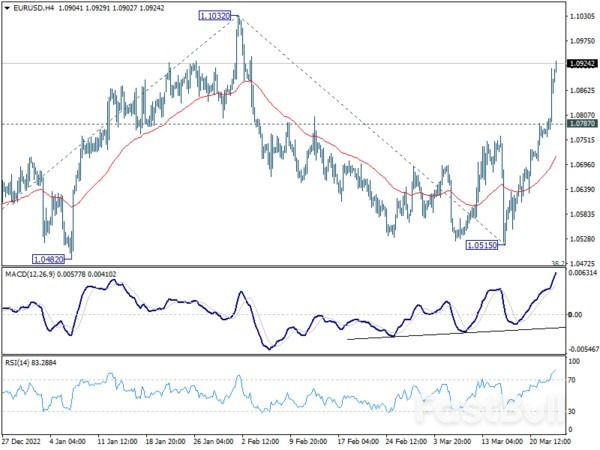
          EUR/USD's rise from 1.0515 accelerates higher and intraday bias stays on the upside for retesting 1.1032 high. Decisive break there will resume whole up trend from 0.9534 and target 1.1273 fibonacci level next. On the downside, below 1.0787 minor support will turn intraday bias neutral and bring consolidations first, before staging another rally.
          Euro Leads Gains as Dollar Struggles Post-FOMC; BoE and SNB Decisions Take Center Stage_5In the bigger picture, rise from 0.9534 (2022 low) is in progress with 38.2% retracement of 0.9534 to 1.1032 at 1.0460 intact. The strong support from 55 week EMA (now at 1.0623) was also a medium term bullish sign. Next target is 61.8% retracement of 1.2348 (2021 high) to 0.9534 at 1.1273. Sustained break there will solidity the case of bullish trend reversal and target 1.2348 resistance next (2021 high).

          Euro Leads Gains as Dollar Struggles Post-FOMC; BoE and SNB Decisions Take Center Stage_6Source: ActionForex.Com

          Risk Warnings and Disclaimers
          You understand and acknowledge that there is a high degree of risk involved in trading. Following any strategies or investment methods may lead to potential losses. The content on the site is provided by our contributors and analysts for information purposes only. You are solely responsible for determining whether any trading assets, securities, strategy, or any other product is suitable for investing based on your own investment objectives and financial situation.
          Comments
          Add to Favorites
          Share

          Bank of England and SNB Set to Follow the Fed by Also Raising Rates

          Samantha Luan

          Forex

          Despite the recent turmoil in the US banking system the Federal Reserve went ahead and raised rates by 25bps at its meeting last night.
          While this was broadly in line with expectations, a tweak to the statement was perceived to be more dovish, moderating the language by removing the reference to "ongoing increases will be appropriate", with "some additional policy firming may be appropriate".
          This helps to give the Fed wriggle room to pause at the next meeting if the data permits, as well as indicating that the end of rate rises could be close.
          This change saw yields, as well as the US dollar fall sharply, however, US markets after initially pushing higher also fell back and closed lower, after comments from US Treasury Secretary Janet Yellen, in separate comments to US lawmakers, said that there was no commitment to extending banking deposit insurance beyond the current $250k cap.
          Powell also admitted that a rate pause was considered due to the banking crisis, while also going on to say that the prospect of rate cuts this year was not being considered. A cursory analysis of the latest dot plot chart confirmed that thought process, even as markets continued to price that very possibility.
          With US markets closing sharply lower after Yellen's comments, European markets look set to pick up on that negative read across, with a similarly weaker open.
          Before yesterday's hotter-than-expected UK CPI number for February, the main question facing UK markets was how close the Bank of England was to its terminal rate, and whether recent events across the banking sector would temper its decision to raise rates today.
          That question got a whole lot more complicated yesterday with a surprise surge in headline CPI in February to 10.4%, driven primarily by food and services prices. What was even more worrying for the central bank was that core prices also surged higher, rising from 5.8% to 6.2%, and undermining the recent narrative from MPC officials that inflation was on its way back down again.
          The MPC has remained split in recent months split with Tenreyro and Dhingra both opposed to further rate hikes even with headline CPI still above 10% and core prices now on the rise again at 6.2%, and wages at 6.5%.
          Back in February Bank of England governor Andrew Bailey insisted that the MPC was seeing "powerful downward forces on inflation now" when he testified to the Treasury Select Committee, saying that "I do think we have turned the corner".
          Those comments haven't aged well even if he did caveat them with concerns about inflation stickiness and serve to give the impression that the Bank of England is almost making it up as it goes along.
          Bailey followed up those February remarks with further comments at the start of this month saying he had not seen any data to justify markets pricing in the prospect of further rate hikes insisting that markets were getting ahead of themselves in pricing a terminal rate of 4.75%.
          Judging by yesterday's jump in core CPI, that is no longer the case showing that markets had a better idea of what might happen to rates than the Bank of England did at the start of the month.
          The splits on the MPC while welcome in the context that there isn't a groupthink consensus also serve to give that impression, especially when you have two policymakers leaning away from hikes, and more towards rate cuts at some point in the future. Earlier this month Swati Dhingra was claiming that there was no evidence of persistent cost-push inflation becoming embedded and that inflation would fall back sharply over the rest of the year. That claim is hard to square with monthly price rises in excess of 1%, on both CPI and RPI inflation measures.
          On the other side of the spectrum, you then have external MPC member Catherine Mann making the case that more hikes are warranted given stickier inflation dismissing the idea of a pivot to a looser policy. She also went on to insist that rates would likely have to stay higher for longer in order for inflation to return to target.
          Mann's stance seems entirely more credible than the dovish stance of Tenreyro and Dhingra given how stickier UK inflation has always tended to be historically. This is mainly down to the transmission mechanism of a weaker pound, which tends to put a floor under prices.
          While some have suggested the Bank of England might pass up on another rate rise today, most sensible people think that at the very least we can expect to see another rate hike of 25bps after yesterday's inflation numbers, although we could well see another split decision. It would be a huge surprise if we got no change and would hammer yet another nail in the central bank's credibility when it comes to its inflation-fighting credentials.
          Before the Bank of England, we have the latest rate decision from the Swiss National Bank, who are expected to raise rates by 50bps to 1.5%, despite the recent turmoil in its own banking backyard with the shotgun marriage of Credit Suisse with UBS. It will be interesting if policymakers there have any postscripts to recent events in terms of their guidance around further rate increases.
          EUR/USD – moved through the 1.0800 area and looks set for a retest of the recent range highs at 1.1030. Support should now come in at the 1.0760 area, with stronger support at the March lows at 1.0520.
          GBP/USD – continues to struggle to push through the 1.2300 area despite a brief push up to 1.2335 yesterday. The pound continues to feel vulnerable to slipping back especially given that the Bank of England tends to lean towards dovish language when it does meet. Currently have support at 1.2170.
          EUR/GBP – feels like we could see a move towards 0.8900 where we have resistance. Still have strong trend line support at 0.8720, from the lows last August. Support also at 0.8780.
          USD/JPY – ran out of steam at the 133.00 area and support at 131.00. Below 130.80 targets a return to the 130.00 area.

          Source: CMC

          Risk Warnings and Disclaimers
          You understand and acknowledge that there is a high degree of risk involved in trading. Following any strategies or investment methods may lead to potential losses. The content on the site is provided by our contributors and analysts for information purposes only. You are solely responsible for determining whether any trading assets, securities, strategy, or any other product is suitable for investing based on your own investment objectives and financial situation.
          Comments
          Add to Favorites
          Share
          FastBull
          Copyright © 2025 FastBull Ltd

          728 RM B 7/F GEE LOK IND BLDG NO 34 HUNG TO RD KWUN TONG KLN HONG KONG

          TelegramInstagramTwitterfacebooklinkedin
          App Store Google Play Google Play
          Products
          Charts

          Chats

          Q&A with Experts
          Screeners
          Economic Calendar
          Data
          Tools
          Membership
          Features
          Function
          Markets
          Copy Trading
          Latest Signals
          Contests
          News
          Analysis
          24/7
          Columns
          Education
          Company
          Careers
          About Us
          Contact Us
          Advertising
          Help Center
          Feedback
          User Agreement
          Privacy Policy
          Business

          White Label

          Data API

          Web Plug-ins

          Poster Maker

          Affiliate Program

          Risk Disclosure

          The risk of loss in trading financial instruments such as stocks, FX, commodities, futures, bonds, ETFs and crypto can be substantial. You may sustain a total loss of the funds that you deposit with your broker. Therefore, you should carefully consider whether such trading is suitable for you in light of your circumstances and financial resources.

          No decision to invest should be made without thoroughly conducting due diligence by yourself or consulting with your financial advisors. Our web content might not suit you since we don't know your financial conditions and investment needs. Our financial information might have latency or contain inaccuracy, so you should be fully responsible for any of your trading and investment decisions. The company will not be responsible for your capital loss.

          Without getting permission from the website, you are not allowed to copy the website's graphics, texts, or trademarks. Intellectual property rights in the content or data incorporated into this website belong to its providers and exchange merchants.

          Not Logged In

          Log in to access more features

          FastBull Membership

          Not yet

          Purchase

          Become a signal provider
          Help Center
          Customer Service
          Dark Mode
          Price Up/Down Colors

          Log In

          Sign Up

          Position
          Layout
          Fullscreen
          Default to Chart
          The chart page opens by default when you visit fastbull.com