• Trade
  • Markets
  • Copy
  • Contests
  • News
  • 24/7
  • Calendar
  • Q&A
  • Chats
Trending
Screeners
SYMBOL
LAST
BID
ASK
HIGH
LOW
NET CHG.
%CHG.
SPREAD
SPX
S&P 500 Index
6888.89
6888.89
6888.89
6893.04
6833.46
+2.21
+ 0.03%
--
DJI
Dow Jones Industrial Average
48671.13
48671.13
48671.13
48722.98
48099.46
+613.39
+ 1.28%
--
IXIC
NASDAQ Composite Index
23520.47
23520.47
23520.47
23543.01
23308.95
-133.68
-0.57%
--
USDX
US Dollar Index
98.180
98.260
98.180
98.720
98.090
-0.410
-0.42%
--
EURUSD
Euro / US Dollar
1.17532
1.17541
1.17532
1.17623
1.16821
+0.00584
+ 0.50%
--
GBPUSD
Pound Sterling / US Dollar
1.34168
1.34177
1.34168
1.34378
1.33543
+0.00371
+ 0.28%
--
XAUUSD
Gold / US Dollar
4278.62
4279.03
4278.62
4285.76
4204.22
+50.40
+ 1.19%
--
WTI
Light Sweet Crude Oil
57.271
57.301
57.271
58.772
56.856
-1.406
-2.40%
--

Community Accounts

Signal Accounts
--
Profit Accounts
--
Loss Accounts
--
View More

Become a signal provider

Sell trading signals to earn additional income

View More

Guide to Copy Trading

Get started with ease and confidence

View More

Signal Accounts for Members

All Signal Accounts

Best Return
  • Best Return
  • Best P/L
  • Best MDD
Past 1W
  • Past 1W
  • Past 1M
  • Past 1Y

All Contests

  • All
  • Trump Updates
  • Recommend
  • Stocks
  • Cryptocurrencies
  • Central Banks
  • Featured News
Top News Only
Share

White House On Fed: Trump Thinks More Should Be Done

Share

USA Action Would Target Tankers That May Have Transported Other Sanctioned Crude Such As Iranian

Share

White House: Trump Is Aware Of Ukraine's Latest Proposal

Share

White House On Ukraine: If Real Chance To Sign A Peace Agreement, We Will Send A Representative For Talks

Share

White House On Ukraine: Trump Administration Continues To Talk With Both Sides

Share

ICE Certified Arabica Stocks Increased By 1094 As Of December 11, 2025

Share

White House On Venezuela: Doj Approved Warrant To Seize Vessel

Share

New York Fed Accepts $2.874 Billion Of $2.874 Billion Submitted To Reverse Repo Facility On Dec 11

Share

Ukraine President Zelenskiy: Holding Elections In Ukraine Would Require Ceasefire

Share

Ukraine President Zelenskiy: He Tells 'Coalition Of The Willing' Security Guarantees Must Contain Element Of European Deterrence Of Russia, With Support From The USA

Share

Fed - USA Non-Seasonally Adjusted Foreign Financial Commercial Paper Outstanding Rises $5.7 Billion In Dec 10 Week

Share

Fed - USA Non-Seasonally Adjusted Commercial Paper Outstanding Rises $25.3 Billion In Dec 10 Week

Share

Fed - USA Seasonally Adjusted Commercial Paper Outstanding Rises $8.1 Billion In Dec 10 Week

Share

[UBS Asset Management's Fund Head Plans To Sell 10-Year US Treasuries Next Year, Betting On Widening Long-Short Yield Spread] Kevin Zhao Of UBS Asset Management Plans To Sell 10-year US Treasuries Next Year, Believing That A Dovish Federal Reserve And President Trump's Efforts To Stimulate Growth Before The Midterm Elections Will Reignite Inflation. Zhao, Who Is In Charge Of Actively Managed Sovereign, Fixed Income, And Foreign Exchange Funds At UBS Asset Management, Said The Market May Begin Pricing In A Fed Rate Hike By The End Of Next Year, Thereby Reducing The Attractiveness Of Longer-term US Treasuries And Pushing The Spread Between Them And Shorter-term Bonds To Its Widest Level Since 2021

Share

Ukrainian Military Says Its Forces Remain In Control Of Frontline City Of Siversk In Eastern Ukraine

Share

Senate Democrats Have Blocked A Republican Healthcare Bill That Aims To Replace The Expiring Obamacare Subsidies

Share

Argentina 2025/26 Wheat Harvest Estimated At Record 27.7 Million T Versus 24.5 Million T Previously Estimated - Rosario Grains Exchange

Share

The U.S. Department Of Energy Restructured A $9.6 Billion Loan For The Joint Venture Between Ford Motor Company And SK

Share

The Republican Healthcare Bill Failed To Garner Enough Votes To Pass The U.S. Senate; Voting Is Still Ongoing

Share

Ukraine President Zelenskiy: Parties Agreed To Continue Talks To Reach Concrete Understanding In Near Future

TIME
ACT
FCST
PREV
U.K. 3-Month RICS House Price Balance (Nov)

A:--

F: --

P: --

Australia Employment (Nov)

A:--

F: --

P: --
Australia Full-time Employment (SA) (Nov)

A:--

F: --

P: --

Australia Unemployment Rate (SA) (Nov)

A:--

F: --

P: --

Australia Labor Force Participation Rate (SA) (Nov)

A:--

F: --

P: --

Turkey Retail Sales YoY (Oct)

A:--

F: --

P: --

South Africa Mining Output YoY (Oct)

A:--

F: --

P: --

South Africa Gold Production YoY (Oct)

A:--

F: --

P: --

Italy Quarterly Unemployment Rate (SA) (Q3)

A:--

F: --

P: --

IEA Oil Market Report
Turkey 1-Week Repo Rate

A:--

F: --

P: --

South Africa Refinitiv/Ipsos Primary Consumer Sentiment Index (PCSI) (Dec)

A:--

F: --

P: --

Turkey Overnight Lending Rate (O/N) (Dec)

A:--

F: --

P: --

Turkey Late Liquidity Window Rate (LON) (Dec)

A:--

F: --

P: --

U.K. Refinitiv/Ipsos Primary Consumer Sentiment Index (PCSI) (Dec)

A:--

F: --

P: --

Brazil Retail Sales MoM (Oct)

A:--

F: --

P: --

U.S. Weekly Continued Jobless Claims (SA)

A:--

F: --

P: --
U.S. Exports (Sept)

A:--

F: --

P: --

U.S. Trade Balance (Sept)

A:--

F: --

P: --
U.S. Weekly Initial Jobless Claims (SA)

A:--

F: --

P: --
Canada Imports (SA) (Sept)

A:--

F: --

P: --
U.S. Initial Jobless Claims 4-Week Avg. (SA)

A:--

F: --

P: --

Canada Trade Balance (SA) (Sept)

A:--

F: --

P: --
Canada Exports (SA) (Sept)

A:--

F: --

P: --
U.S. Wholesale Sales MoM (SA) (Sept)

A:--

F: --

P: --
U.S. EIA Weekly Natural Gas Stocks Change

A:--

F: --

P: --

China, Mainland M1 Money Supply YoY (Nov)

--

F: --

P: --

China, Mainland M0 Money Supply YoY (Nov)

--

F: --

P: --

China, Mainland M2 Money Supply YoY (Nov)

--

F: --

P: --

U.S. 30-Year Bond Auction Avg. Yield

A:--

F: --

P: --

Argentina CPI MoM (Nov)

--

F: --

P: --

Argentina National CPI YoY (Nov)

--

F: --

P: --

Argentina 12-Month CPI (Nov)

--

F: --

P: --

U.S. Weekly Treasuries Held by Foreign Central Banks

--

F: --

P: --

Japan Industrial Output Final MoM (Oct)

--

F: --

P: --

Japan Industrial Output Final YoY (Oct)

--

F: --

P: --

U.K. Services Index MoM (SA) (Oct)

--

F: --

P: --

U.K. Services Index YoY (Oct)

--

F: --

P: --

Germany HICP Final YoY (Nov)

--

F: --

P: --

Germany HICP Final MoM (Nov)

--

F: --

P: --

U.K. Trade Balance Non-EU (SA) (Oct)

--

F: --

P: --

U.K. Trade Balance (Oct)

--

F: --

P: --

U.K. Services Index MoM

--

F: --

P: --

U.K. Construction Output MoM (SA) (Oct)

--

F: --

P: --

U.K. Industrial Output YoY (Oct)

--

F: --

P: --

U.K. Trade Balance (SA) (Oct)

--

F: --

P: --

U.K. Trade Balance EU (SA) (Oct)

--

F: --

P: --

U.K. Manufacturing Output YoY (Oct)

--

F: --

P: --

U.K. GDP MoM (Oct)

--

F: --

P: --

U.K. GDP YoY (SA) (Oct)

--

F: --

P: --

U.K. Industrial Output MoM (Oct)

--

F: --

P: --

U.K. Manufacturing Output MoM (Oct)

--

F: --

P: --

U.K. Monthly GDP 3M/3M Change (Oct)

--

F: --

P: --

Germany CPI Final MoM (Nov)

--

F: --

P: --

Germany CPI Final YoY (Nov)

--

F: --

P: --

U.K. Construction Output YoY (Oct)

--

F: --

P: --

France HICP Final MoM (Nov)

--

F: --

P: --

China, Mainland Outstanding Loans Growth YoY (Nov)

--

F: --

P: --

U.K. Inflation Rate Expectations

--

F: --

P: --

India CPI YoY (Nov)

--

F: --

P: --

Q&A with Experts
    • All
    • Chatrooms
    • Groups
    • Friends
    Connecting
    .
    .
    .
    Type here...
    Add Symbol or Code

      No matching data

      All
      Trump Updates
      Recommend
      Stocks
      Cryptocurrencies
      Central Banks
      Featured News
      • All
      • Russia-Ukraine Conflict
      • Middle East Flashpoint
      • All
      • Russia-Ukraine Conflict
      • Middle East Flashpoint
      Search
      Products

      Charts Free Forever

      Chats Q&A with Experts
      Screeners Economic Calendar Data Tools
      Membership Features
      Data Warehouse Market Trends Institutional Data Policy Rates Macro

      Market Trends

      Market Sentiment Order Book Forex Correlations

      Top Indicators

      Charts Free Forever
      Markets

      News

      News Analysis 24/7 Columns Education
      From Institutions From Analysts
      Topics Columnists

      Latest Views

      Latest Views

      Trending Topics

      Top Columnists

      Latest Update

      Signals

      Copy Rankings Latest Signals Become a signal provider AI Rating
      Contests
      Brokers

      Overview Brokers Assessment Rankings Regulators News Claims
      Broker listing Forex Brokers Comparison Tool Live Spread Comparison Scam
      Q&A Complaint Scam Alert Videos Tips to Detect Scam
      More

      Business
      Events
      Careers About Us Advertising Help Center

      White Label

      Data API

      Web Plug-ins

      Affiliate Program

      Awards Institution Evaluation IB Seminar Salon Event Exhibition
      Vietnam Thailand Singapore Dubai
      Fans Party Investment Sharing Session
      FastBull Summit BrokersView Expo
      Recent Searches
        Top Searches
          Markets
          News
          Analysis
          User
          24/7
          Economic Calendar
          Education
          Data
          • Names
          • Latest
          • Prev

          View All

          No data

          Scan to Download

          Faster Charts, Chat Faster!

          Download App
          English
          • English
          • Español
          • العربية
          • Bahasa Indonesia
          • Bahasa Melayu
          • Tiếng Việt
          • ภาษาไทย
          • Français
          • Italiano
          • Türkçe
          • Русский язык
          • 简中
          • 繁中
          Open Account
          Search
          Products
          Charts Free Forever
          Markets
          News
          Signals

          Copy Rankings Latest Signals Become a signal provider AI Rating
          Contests
          Brokers

          Overview Brokers Assessment Rankings Regulators News Claims
          Broker listing Forex Brokers Comparison Tool Live Spread Comparison Scam
          Q&A Complaint Scam Alert Videos Tips to Detect Scam
          More

          Business
          Events
          Careers About Us Advertising Help Center

          White Label

          Data API

          Web Plug-ins

          Affiliate Program

          Awards Institution Evaluation IB Seminar Salon Event Exhibition
          Vietnam Thailand Singapore Dubai
          Fans Party Investment Sharing Session
          FastBull Summit BrokersView Expo

          Oil Falls to Lowest Since October as Market Sentiment Weakens

          Adam

          Commodity

          Summary:

          Oil slid to its lowest since October as weak earnings and oversupply fears outweighed rising U.S.–Venezuela tensions. Despite IEA trimming its glut forecast, OPEC+ output and muted demand still point to a 2026 surplus.

          Oil retreated to the lowest since October, tracking wider losses in equities and other risk assets.
          Global benchmark Brent fell back below $62 a barrel, reversing an earlier advance of as much as 0.7%. Pressure from disappointing earnings offset the rising risk of escalating tensions between Washington and Caracas.
          US forces intercepted and seized a sanctioned tanker — a very large crude carrier — in a move the Venezuelan government called an “act of piracy.” The OPEC member holds the world’s largest oil reserves and exported around 586,000 barrels a day last month, which mostly went to China.
          The increased tensions come against a bearish backdrop for crude, as more production from OPEC+ and the Americas is set to overwhelm tepid demand growth and lead to a glut. The International Energy Agency offered some respite from the gloom on Thursday, trimming its estimate of a record glut for the first time since May, though it still sees a major oversupply.
          “All in all, for 2026, stockbuilds should be higher than in 2025, though strong China buying and continued geopolitical risks keep the ex-China surplus more modest, helping to replenish still-low inventories,” Citigroup Inc. analysts including Eric Lee wrote.
          Meanwhile, Ukraine attacked a shadow-fleet tanker linked to Russia’s oil trade, even as the US pushes for a ceasefire between the two sides. The latest incident means that since the end of last month there have been at least five attacks on vessels that had ties to Russia.

          Source: Bloomberg

          Risk Warnings and Disclaimers
          You understand and acknowledge that there is a high degree of risk involved in trading. Following any strategies or investment methods may lead to potential losses. The content on the site is provided by our contributors and analysts for information purposes only. You are solely responsible for determining whether any trading assets, securities, strategy, or any other product is suitable for investing based on your own investment objectives and financial situation.
          Add to Favorites
          Share

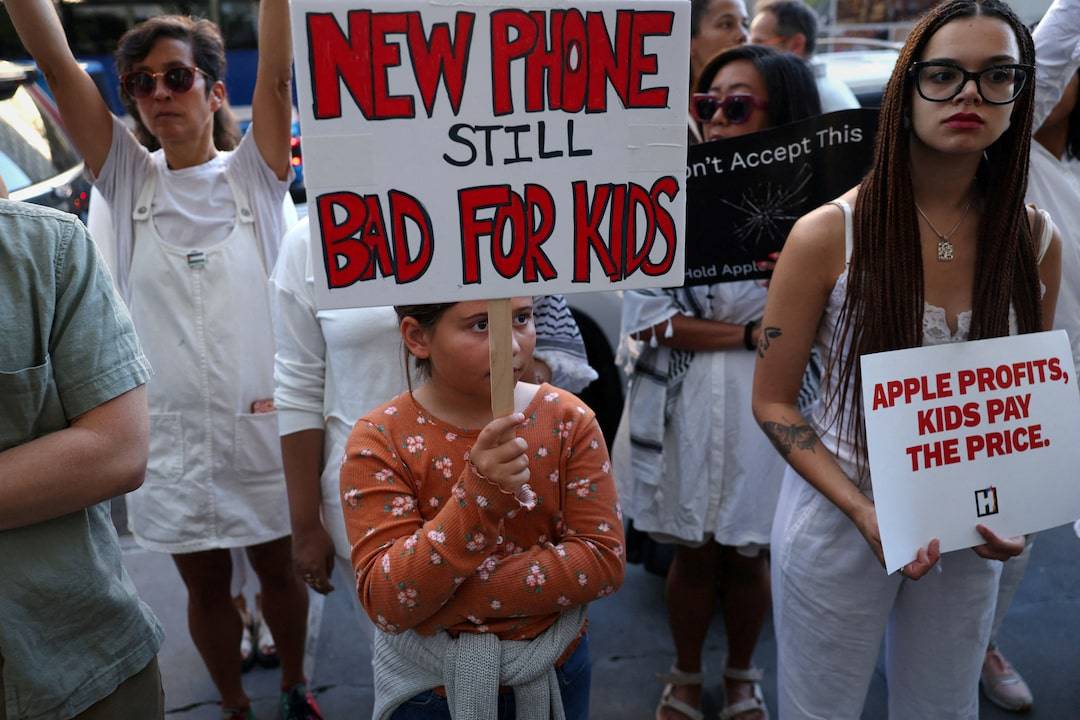
          Apple CEO Pushes For Changes In US Child Online Safety Bill, Citing Privacy Concerns

          Winkelmann

          Political

          Economic

          Stocks

          Apple CEO Tim Cook met U.S. House members on Wednesday to push back against federal legislation that could require the iPhone maker to authenticate users' ages and possibly collect sensitive data on children, lobbying instead to put the onus on parents to decide whether to tell app stores about a child's age.

          The bill, called the App Store Accountability Act, is aimed at making sure that minors are not using harmful content online.

          Texas has already signed a similar bill into law, requiring parental consent to download apps or make in-app purchases for users aged below 18. Utah was the first U.S. state to pass a similar law earlier this year and Australia introduced a nationwide social media ban on under-16s this week.

          While the notion of age limits for online content has broad U.S. public support, legislative efforts have kicked off a behind-the-scenes brawl between Apple and Google and tech rivals such as Meta Platforms. Apple and Google, which own the largest app stores in the world, say verifying the age of minors could entail mass collection of children's birth certificates and other sensitive documents, while Facebook and Instagram owner Meta has argued that requiring app stores to check ages is the only effective way to enforce limits.

          Apple, which has long resisted government interference in data privacy matters, has expressed concerns that the federal U.S. legislation would require it to collect identifying information about virtually every Apple user, including children. Cook met House Energy and Commerce Committee members on Capitol Hill on Wednesday to discuss the concerns, Apple said.

          "Not all legislative proposals are equally protective of privacy or focused on holding all players in the ecosystem accountable," Apple's global head of privacy, Hilary Ware, said in a letter to the committee last week. "Some well-intended proposals for age verification at the app marketplace level ... would require the collection of sensitive information about anyone who wants to download an app, even if it's an app that simply provides weather updates or sports scores."

          A Pew Research poll in 2023 found that 81% of Americans support requiring parental consent for children to create social media accounts and 71% support age verification before using social media.

          Source: Reuters

          To stay updated on all economic events of today, please check out our Economic calendar
          Risk Warnings and Disclaimers
          You understand and acknowledge that there is a high degree of risk involved in trading. Following any strategies or investment methods may lead to potential losses. The content on the site is provided by our contributors and analysts for information purposes only. You are solely responsible for determining whether any trading assets, securities, strategy, or any other product is suitable for investing based on your own investment objectives and financial situation.
          Add to Favorites
          Share

          US Jobless Claims Jump By Most Since 2020 After Holiday Drop

          Michelle

          Forex

          Economic

          Applications for US unemployment benefits rose last week by the most since the onset of the pandemic, after a big drop during the Thanksgiving holiday week.

          Initial claims increased by 44,000 to 236,000 in the week ended Dec. 6, according to Labor Department data released Thursday. That was the biggest jump since March 2020 and followed the lowest level of applications in more than three years in the previous week. The figure exceeded all but one estimate in a Bloomberg survey of economists.

          Weekly initial claims tend to be choppy around the holidays and will likely continue to fluctuate through the end of the year, but Thursday's figures are toward the higher end of readings seen in 2025. Companies like PepsiCo Inc. and HP Inc. have laid out plans to reduce headcount in recent weeks, and nationwide layoffs in October were the highest since early 2023.

          The four-week moving average of new applications, a metric that helps smooth out volatility, ticked up to 216,750 last week.

          Concerns about the labor market have weighed on consumer sentiment in recent months. A majority of respondents in a preliminary December survey by the University of Michigan expect unemployment to rise in the coming year.

          Federal Reserve officials lowered interest rates for a third straight meeting Wednesday to support what Chair Jerome Powell called a "gradually cooling" labor market. While officials didn't project higher unemployment next year compared to their September forecasts, Powell said the job market faces "significant" downside risks.

          Continuing claims, a proxy for the number of people receiving benefits, dropped to 1.84 million in the week ended Nov. 29, which included Thanksgiving.

          Source: Bloomberg Europe

          To stay updated on all economic events of today, please check out our Economic calendar
          Risk Warnings and Disclaimers
          You understand and acknowledge that there is a high degree of risk involved in trading. Following any strategies or investment methods may lead to potential losses. The content on the site is provided by our contributors and analysts for information purposes only. You are solely responsible for determining whether any trading assets, securities, strategy, or any other product is suitable for investing based on your own investment objectives and financial situation.
          Add to Favorites
          Share

          Fed rate outlook; Oracle’s underwhelming guidance - what’s moving markets

          Adam

          Economic

          U.S. stock futures tick down, in a possible reversal from gains logged in the prior session. Analysts are pouring through the implications of a Federal Reserve interest rate cut and attempting to suss out the path ahead for borrowing costs. Cloud-computing giant Oracle’s stock price slumps in extended hours trading following a disappointing current-quarter outlook, while Photoshop-owner Adobe’s annual forecast tops estimates.

          Futures lower

          U.S. stock futures pointed lower on Thursday, as investors assessed both the outlook for interest rates after the Fed slashed borrowing costs for the third time since September and earnings from cloud giant Oracle.
          By 02:04 ET (07:02 GMT), the Dow futures contract had fallen by 213 points, or 0.4%, S&P 500 futures had dipped by 59 points, or 0.9%, and Nasdaq 100 futures had decreased by 308 points, or 1.2%.
          The main averages on Wall Street rose in the prior session, buoyed by the Fed’s decision to lower rates by 25 basis points, while Chair Jerome Powell issued a message in his post-meeting news conference that was more balanced than many had anticipated.
          At the end of trading, the benchmark S&P 500 was up by 0.67% at 6,886.68, close to a record closing high notched in late October. The blue-chip Dow Jones Industrial Average ticked up by 1.05% to 48,057.75 and the Nasdaq Composite gained 0.33% to 23,654.16.

          Dollar slips after Fed decision

          The U.S. dollar remained under some pressure after touching a seven-week low overnight, with Powell flagging that he does not think a “rate hike is anyone’s base case” in the months ahead.
          Interest rate futures were factoring in more rate reductions in 2026, undercutting the greenback. By 03:13 ET, the U.S. dollar index, which tracks the currency against a basket of its global peers, was down by 0.1% at 98.65.
          On Wednesday, the Fed slashed rates by a quarter-point to a range of 3.50% to 3.75%, although members of the central bank showed deep divisions over the move. Policymakers previously rolled out similarly-sized decreases to borrowing costs in September and October.
          Whether a further drawdown lies ahead at the start of next year is seen as unlikely due to a desire among many Fed officials to gauge the direction of both a weakening job market and “somewhat elevated” inflation. Economic projections also indicated that the Fed expects U.S. growth to gather steam in 2026.
          Yet these predictions revealed stark differences in how rate-setters foresee the trajectory of rates during a time when President Donald Trump is pursuing an upheaval of worldwide trade and artificial intelligence has fueled a surge in investment.
          Much attention is now swirling around Trump’s pick to replace Powell after his term at the head of the Fed finishes in May. The frontrunner is reportedly White House economic adviser Kevin Hassett, leading analysts to suggest that he could advocate for the type of aggressive and rapid rate cuts long called for by the president.
          “Current Fed members suggest just one further cut is their 2026 central projection, but with changes coming and the jobs market cooling the risks are skewed towards them cutting by more,” analysts at ING including James Knightley and Padhraic Garvey said in a note.

          Oracle guidance disappoints

          Shares of Oracle tumbled by more than 12% in extended hours trading after the cloud-computing group issued a sales and profit forecast which missed Wall Street expectations.
          The Texas-based company added that spending would also increase by $15 billion versus prior estimates, exacerbating growing worries that massive expenditures on AI may not generate the type of immediate returns hoped for by investors.
          Adjusted profit for the current quarter is seen at $1.64 to $1.68 per share, below analysts’ estimates of $1.72, according to LSEG data cited by Reuters. Revenue for the period is anticipated to rise by between 16% to 18%, slower than expected growth of 19.4%.
          Revenue and adjusted operating income in Oracle’s just-ended fiscal second-quarter, along with a measure of upcoming cloud contracts, were under estimates as well.
          Heading into the results, concerns surrounded the firm’s heavy -- and often debt-driven -- spending on AI. The worries were enough to deflate much of the enthusiasm stemming from its last blockbuster earnings release in September. Oracle’s stock price, which initially surged after those results, have since retreated.
          Adobe outlook tops expectations
          Meanwhile, Adobe issued a better-than-expected annual revenue and profit guidance, in a sign that the Photoshop-maker may be benefiting from a push to monetize its AI-enhanced offerings.
          Full-year revenue is tipped to be between $25.90 billion and $26.10 billion, compared with expectations of $25.87 billion. Adjusted earnings of $23.30 and $23.50 per share are seen as well, topping estimates of $23.34 a share at the midpoint.
          A stalwart with the creative community, Adobe has embarked on a multi-year push to fold AI into more of its suite of tools to help users quickly craft images and videos. Monthly active users for Adobe’s freemium products jumped by 35% versus a year ago to more than 70 million, CFO Dan Durn told Reuters.
          But intensifying competition for contracts, sparked in part by the widespread embrace of AI by businesses, has threatened to weigh on returns.

          Trump says CNN sale should be part of Warner Bros Discovery deal

          In the latest twist of a closely-watched saga in Hollywood and Wall Street alike, President Trump said that news network CNN should be sold as part of any deal involving the purchase of parent firm Warner Bros Discovery.
          Talking to reporters at the White House, Trump that CNN, a traditional target of the president’s ire, should change its ownership regardless of who buys Warner.
          It is “imperative that CNN be sold,” Trump said.
          The comments come after entertainment giant Paramount launched a $77.9 billion hostile bid for Warner, which would include the group’s cable networks like CNN. A previous deal between Warner and Netflix, announced earlier this month, would only pertain to Warner’s studio and streaming products.

          Source: investing

          To stay updated on all economic events of today, please check out our Economic calendar
          Risk Warnings and Disclaimers
          You understand and acknowledge that there is a high degree of risk involved in trading. Following any strategies or investment methods may lead to potential losses. The content on the site is provided by our contributors and analysts for information purposes only. You are solely responsible for determining whether any trading assets, securities, strategy, or any other product is suitable for investing based on your own investment objectives and financial situation.
          Add to Favorites
          Share

          European Midday Briefing: Oracle Selloff Drags Tech Stocks

          Adam

          Stocks

          MARKET WRAPS

          Stocks:
          European indexes were mixed and tech stocks fell, as results from Oracle revived concerns about an AI bubble.
          The results erased optimism Wednesday, driven by the Federal Reserve's decision to cut interest rates and signal further cuts, IG said, contributing to a broader risk-off move.
          ADSS said that heading into the year-end, AI-linked valuations continue to be a major concern for investors and shape broader market sentiment.
          It added that markets will now quickly turn to next week's delayed payrolls release--pushed back due to the U.S. government shutdown--which stands as the next major catalyst.
          Fed Chair Jerome Powell pointed on Wednesday to a job-market risk that economists have been worried about for months: Official U.S. statistics could be drastically overstating recent hiring.
          The country could be losing 20,000 jobs a month, Powell said, a concern that was part of the decision to cut interest rates, and investor attention will be fixed on the fresh jobs numbers for October and November, as well as possible revisions for previous months due next week.
          Economic Insight
          Mexico's tariffs flag the risk posed by protectionist measures against Chinese exports from countries other than the U.S., Maybank said.
          What helped save China's economy from a sharper slowdown in 2025--namely, the diversion of exports to non-U.S. markets--could come back to bite it in 2026.
          China's trade surplus with Mexico more than doubled in 2019-24.
          It's not just Mexico, over 2019-24, the EU's trade deficit with China rose 63%.
          Rebalancing away from exports and toward domestic demand matters not just for China's economy, but increasingly, to its ties with trading partners , it added.
          Stocks to Watch
          Delivery Hero is likely to face increasing competitive pressure in the Middle East and North Africa region, Citi said as it downgraded its stock recommendation to sell from neutral.
          Rheinmetall has managed to quadruple sales in six years and is in a league of its own, Bernstein said as it lifted its rating on the stock to outperform from market-perform, and raised its price target.
          The shares are currently pricing in an overly pessimistic scenario, and the stock should outperform when the European defense sector recovers from its recent falls.
          U.S. Markets:
          U.S. stocks were set to open in the red on Thursday and bitcoin fell.
          The tech-heavy Nasdaq was leading losses with AI stocks falling in sympathy with Oracle.
          Oracle shares fell as much as 11% in after-hours trading on Wednesday.
          "As with most of the big tech names, capex continues to ramp up and exceed the Street's expectations, weighing heavily," Direxion said.
          Forex:
          The euro was near a two-month high against the dollar, and ING said it could rise to $1.1800 by year-end, adding that this would require weak U.S. jobs data next week or positive ECB growth forecast revisions.
          The dollar remained under pressure after hitting a seven-week low after the Fed's rate-cut decision.
          Commerzbank said Powell's statement seemed to suggest the risks of higher inflation were less dramatic than those of a weaker labor market.
          "This could pave the way for further interest-rate cuts in the coming year, following a pause in January."
          Bonds:
          Eurozone government bonds yields declined , following the direction of Treasurys, but the drops were less pronounced.
          The falls have been largely driven by the market's takeaway from Powell's comments after the Fed's rate cut, with more focus on labor market weakness than on inflation.
          "Powell stressed greater importance on the weakness in the labor market while inflation was 'somewhat' elevated," Jefferies said.
          BNP Paribas took profit on a short 10-year Treasury trade after the rate cut.
          "We see the Federal Reserve's imbalanced reaction function weighing on the rates markets ahead of the next payrolls data."
          Danske Bank is still forecasting two final Fed rate cuts in March and June next year, adding that Powell's avoidance of strong forward guidance led to a decline in Treasury yields during his press conference.
          Madison Investments expects a slower pace of additional Fed easing from here, anticipating that the Fed will be on hold until the second quarter of 2026.
          JGBs extended price gains in afternoon Tokyo trade, following solid demand for 20-year sovereign securities.
          Energy:
          Oil prices fell as investors monitored progress to end the war in Ukraine and rising tensions between the U.S. and Venezuela.
          After settling higher in the previous session when the U.S. seized an oil tanker off the coast of Venezuela.
          The incident adds to geopolitical risks, even as fundamentals remain bearish, with global supply from OPEC+ and the Americas expected to outpace demand growth.
          Meanwhile, Trump dialed up pressure on Ukraine to quickly accept a U.S.-drafted peace plan--a development that could lead to the lifting of sanctions on Russia and bring additional barrels back onto the market.
          Metals:
          Gold rose and silver futures climbed 2.2% to $62.39 an ounce after hitting a record high of $63.25 earlier.
          "Both gold and silver are heading for their strongest annual performance since 1979, with gold up more than 60% and silver more than doubling, driven by heavy central-bank demand, rising ETF inflows, and investor shifts away from sovereign bonds and currencies," MUFG said.
          Traders now await next week's delayed U.S. data, with NFP jobs and CPI inflation figures in focus.
          Copper
          Copper rose after the rate decision and traders remain concerned over signs of tightness in the physical market.
          Meanwhile, the market was shrugging off China's weaker economic data and focusing instead on copper's long-term demand from renewables, EVs and data centers, ANZ said.
          These rosy demand prospects clash with growing supply concerns amid a series of mine disruptions worldwide, keeping prices elevated.

          EMEA HEADLINES

          ECB Unlikely to Follow Fed For Now, But Currency Moves May Yet Prove Decisive
          Europe's leading central bank will not necessarily follow the Federal Reserve in lowering its key interest rate, but policymakers may face growing pressure to do so if the pace of easing significantly weakens the U.S. dollar.
          The Fed Wednesday lowered its key rate for the third time since the European Central bank last cut in June. Its key rate now sits in a range between 3.5% and 3.75%, having been 4.25% to 4.5% when the ECB lowered its equivalent to 2%. However, Chair Jerome Powell gave little indication that further cuts were imminent.
          Naturgy Shares Drop After BlackRock Offloads Part of Stake
          Shares in Spanish energy group Naturgy sank after major investor BlackRock sold off part of its stake in the company.
          BlackRock's Global Infrastructure Partners sold a 1.7 billion-euro ($1.99 billion) stake in Naturgy, according to a regulatory filing. The fund is one of the largest shareholders in Naturgy, according to FactSet data.
          Swiss National Bank Holds Key Interest Rate at 0%
          Switzerland's central bank left its key interest rate unchanged for a second straight meeting, but signaled it is open to a further cut that would take borrowing costs below zero if a sustained period of falling prices threatens.
          The Swiss National Bank held its policy rate as expected at 0% on Thursday, having stood pat at its last meeting in September after six consecutive quarterly cuts. However, it said further cuts remain an option.

          GLOBAL NEWS

          IEA Forecasts Smaller Oil Surplus as OPEC+ Output Declines
          The oil market's projected surplus has narrowed due to lower OPEC+ production, but a large supply overhang continues to cloud the outlook, the International Energy Agency said in its closely watched monthly report.
          The Paris-based organization, which represents major oil-consuming nations, lowered its forecast for global oil supply growth to 3 million barrels a day this year and 2.4 million the next, from earlier projections of 3.1 million and 2.5 million barrels a day.
          U.S. Flies Bombers in High-Profile Show of Support for Japan
          TOKYO-Two U.S. B-52 bombers flew in formation with Japanese fighters over the Sea of Japan, a conspicuous display of U.S. support for Tokyo as it battles Chinese anger over remarks Prime Minister Sanae Takaichi made about Taiwan.
          The exercise came a day after Russian and Chinese warplanes conducted their own joint patrol in the seas around Japan's southern islands, which Tokyo said were intended as a show of force directed at a U.S. security ally in Asia.
          Crumbling Peace Deals Show Limits of Trump's Approach to Ending Wars
          A new round of border clashes between Thailand and Cambodia and resurgent fighting in eastern Congo, two conflicts President Trump claimed to have resolved, have shown the constraints of his high-speed pursuit of peace.
          Since the start of his second term, Trump has leveraged the economic and military might of the U.S. to get warring parties in several deep-rooted international conflicts to the negotiating table and extract hasty peace deals.
          U.S. Blueprint to Rewire Economies of Russia, Ukraine Sets Off Clash With Europe
          The Trump administration in recent weeks has handed its European counterparts a series of documents, each a single page, laying out its vision for the reconstruction of Ukraine and the return of Russia to the global economy.
          The proposals have sparked an intense battle at the negotiating table between America and its traditional allies in Europe. The outcome stands to profoundly alter the economic map of the continent.

          Source: morningstar

          Risk Warnings and Disclaimers
          You understand and acknowledge that there is a high degree of risk involved in trading. Following any strategies or investment methods may lead to potential losses. The content on the site is provided by our contributors and analysts for information purposes only. You are solely responsible for determining whether any trading assets, securities, strategy, or any other product is suitable for investing based on your own investment objectives and financial situation.
          Add to Favorites
          Share

          Why Rate Hikes Are Back On The Table For 2026

          Winkelmann

          Political

          Central Bank

          Economic

          Australia's hopes for rate cuts in 2026 have dimmed after RBA Governor Michele Bullock signaled they're no longer on the table – and that a rate hike is now a real possibility. With inflation proving stickier than expected and price pressures broadening on everything from housing to everyday essentials, markets are beginning to reprice the path for interest rates.

          Here is a lightly edited transcript of the conversation:

          Rebecca Jones: This week we were told by RBA Governor Michele Bullock that rate cuts were pretty much off the table and now it looks like we could instead have a rate hike by June. I don't know about you, but that wasn't exactly the festive surprise I was hoping for this week. To take us through the reasons why, and what the coming year holds for the Australian economy, I'm joined by Bloomberg's APAC economy reporter Swati Pandey from our Sydney newsroom. Swati, welcome back to the podcast.

          Swati Pandey: Thank you Bec. Delighted to be here.

          Jones: Swati, it was widely expected that the RBA would keep interest rates on hold at this week's meeting, which was of course the last one for 2025. That is exactly what happened. But what everyone was waiting to hear was, are we going to get another rate cut? You were at the press conference on Tuesday. What did we hear instead?

          Pandey: Yes, you're right Bec, expectation was that the Reserve Bank would leave interest rates unchanged for the third straight meeting at 3.6% and there was not a lot of clarity around what the governor's press conference would bring. So it was quite surprising to a lot of people when she gave a very clear signal that other interest rate cuts are off the table. And given where the economy is tracking, given where inflation was and the upside risks to both, it looks like forget about an interest rate cut—in fact, it's an interest rate hike that we will be staring at for 2026.

          Jones: And so when you heard that at the presser, you've got your phone in your hand, you start messaging your contacts. What did they tell you?

          Pandey: So as soon as—that was the very first question in fact—that Governor Bullock was asked, whether they considered a cut or whether they considered a hike, and she said they did not explicitly consider a cut but they discussed the circumstances under which interest rates could go up. And then I followed that up by asking what those circumstances were that they discussed, if she could provide some more color. Following that, I started messaging some economists just trying to understand how they were reading the comments because you know when the press conference is on, everybody's watching it. By everybody I mean people who are interested in this, right? So from economists to traders, people overseas as well. And I think half of our newsroom watches it as well. And so a lot of these people kind of commented. So there's a kind of like a big bit of back and forth in messaging that also helps in understanding how people are viewing it from outside as well. And also helps shape the story, shapes the thought and the thinking that goes into writing the story after the press conference.

          Jones: So the group chat went crazy because I can imagine— looking at the first part of Tuesday's event, it's the written statement from the RBA and that was pretty short, pretty sort of formulaic. But then the real surprise sort of came at the press conference. Was it a surprise to the economists that you talked to? What did they have to say?

          Pandey: Yes, it did come as a surprise to people that Michele Bullock was that clear in signaling that interest rate cuts were off the table and in fact preparing the groundwork for a hike. And in fact, one of the economists I spoke with during the press conference said that the governor was laying the markers for a full pivot towards a tightening bias. There is a kind of view that it's a conditional tightening bias right now. So what that means is if we have a bad inflation report in January and the RBA has to raise interest rates in February, nobody is going to say that, oh my gosh, this came as a shock, this came as a surprise, the RBA is not communicating, this just came out of nowhere. So that criticism is unlikely to happen because like the economist from Westpac, Pat Bustamante, that I spoke with, he said that the governor was laying the markers for a full pivot to a tightening bias, right? And that was the inference a lot of people in the market and economists drew as well from her remarks. So the onus, as Su-Lin Ong from RBC told me, is on data and if inflation continues to surprise on the upside, the RBA will not hesitate to raise interest rates from here.

          Jones: I wanna pick up on something that you've just mentioned and that is inflation, because I think that's where the story gets messy. Swati, we've all noticed price pressures picking up over the last couple of months. When did things get so pricey? What is actually driving inflation?

          Pandey: Yeah, so the past maybe three months of inflation reports have surprised on the upside. And in fact the very latest report had broad-based price pressures. So by that I mean everything from housing costs, clothing and footwear, education and culture, eating out, buying food and groceries—everything showed a big jump in price increases. And obviously the biggest driver has been housing costs, which includes the construction cost of a new property, new development. But it also includes things like electricity. As we know, Treasurer Chalmers this week announced the end of the electricity rebate that had helped to put some downward pressure on prices, and those rebates are now going away. So we are going to get a sticker shock in the fourth quarter inflation report and maybe in the first quarter inflation report as well. The good thing is that the RBA knew that would happen.

          So when they released their forecasts in November, they had already priced that in. So the RBA is expecting inflationary pressures to remain high through at least the middle of next year. If inflation is higher than their already lofty expectations, that is when we see the risk of interest rate hikes happening. If inflation is tracking around their lofty expectations, the RBA will just probably want to keep interest rates on hold. So if there's an upside shock, that is when interest rate hikes become a real possibility.

          Jones: And Swati, there's a view out there that the RBA is completely done easing. And of course by easing I mean cutting interest rates. There is also running along the same track another very live debate that suggests that if inflation stays sticky—that means keeps on going up, right?—Governor Bullock may in fact have to pivot and tighten, that is raise interest rates to try and bring inflation down. And then there is another track, which is people who believe that one or two cuts are still plausible in 2026. What does the data suggest is most likely at this point in time?

          Pandey: That is a very complicated question only because the answer to that is not easy. So we are in an economy where productivity growth is very low and what that has done is it has brought down our potential rate of growth. So when during the mining boom Australia's economy, let's say, was growing at 4%, it was able to grow at that pace without really sparking inflationary pressures, right? Now, if the economy grows at let's say 2.5%, there is fear that it may spark inflationary pressures only because the potential for it to grow without sparking inflation has reduced because of lower productivity growth. And that is where this discrepancy arises between how economists are looking at this.

          Some economists are saying that the supply constraints that we have seen in our economy—which have led to higher housing construction costs, for example, it's very hard to find tradies and likewise— I mean the economy has not been able to supply enough to meet the demand that there is. Some economists believe that this supply-demand conundrum will be resolved eventually or soon enough. Those who believe that feel that the RBA will not end up raising interest rates. Either the way it'll resolve is that demand will come down, the labour market would slow. We are already seeing signs of slowness in the labour market. We are hearing about companies laying off employees, unfortunately. We are seeing more increase in the unemployment rate. So some economists believe that that would be enough to cool demand.

          Others believe that inflation will remain a concern—housing costs will be sticky or elevated and people will continue to spend on eating out, going to concerts and stuff like that. So these are the people who believe that the RBA may then have to increase interest rates next year. And then there are some people who feel that things are going to kind of wobble along, which would suggest that the current interest rate setting—where interest rate is at 3.6%—is fine. So you don't touch it, you don't do anything, just keep watching data.

          Economists, the median in our Bloomberg survey, are expecting no change at all in fact. So they're expecting interest rates will remain at 3.6% through 2026. There are only a handful of economists who are predicting an interest rate hike and only a handful who are predicting a cut. So the majority is still sitting on no change.

          Jones: It is such a complicated recipe to get right. And as you described, three very distinct schools of thought around what's going to happen next year. Swati, I want to talk to you a little bit now about a topic that makes Australians collectively inhale—you can guess—it's housing. Mortgage stress is rising, APRA is tightening lending standards and yet prices are still marching higher. We're sort of getting to the tail end of the so-called spring selling season right now. Swati, how big a risk is the housing market heading into next year?

          Pandey: One of the biggest problems with Australia's housing market is the lack of supply and we are not seeing that being resolved very quickly. In fact, it takes forever to build a house in Australia and you would know that when you're trying to get renovations done—it's very hard to find tradies and then even when you find them, it's very hard for them to stick with their timelines. Either it's difficult to get the right supply, it's difficult to get the right people, but whatever it is, it takes longer and that is what the country is facing in general. We are much behind our timelines to build enough housing to meet the growing demand of our people.

          As long as that remains the case, housing prices are going to be elevated or rise. In fact, in some markets like Sydney, for example, affordability constraints mean that house price growth is not as rapid as it is in some other places like Adelaide or Brisbane or even Perth. Perth in fact is seeing a big boom in housing prices and there's big demand as well in Western Australia. So yes, it is a concern for people who want to buy a house, but it is also a concern for the Reserve Bank because housing costs are a big part of the inflation basket. If we are not able to bring that cost down, it would keep inflation sticky, which means elevated.

          Jones: Let's zoom out a little bit now. The Federal Reserve in the US cut rates this week and that was widely expected. Swati, how does Australia's trajectory compare with the US right now?

          Pandey: So in the past, Australia and most countries used to follow what the Fed would do, but that's not the case anymore. For example, the RBA started cutting rates much later than the Fed in this current cycle. Australia has only cut by 75 basis points. The Fed has cut by more. The RBA left interest rates unchanged this week for the third straight meeting and the Fed has cut for the third straight time. So they are completely diverging. The Fed is still cutting and the RBA is on hold but is signaling that the next move will not be a cut but a hike. They don't want to act too quick, too fast, which is why the bar to raise interest rates next year is very high as well. A key thing to watch out for is the inflation report for the December quarter, which will come out at the end of January. That is actually going to be really critical in deciding what the RBA does in February and the year ahead.

          Jones: So there might be a few economists recalled back a little early from their summer holidays here in Australia. So Swati, let me get this straight. We've got inflation that won't go quietly, an RBA that may not be finished moving, a housing market that is continuing to defy both gravity and policy, plus a Fed that's cutting where we stay put. It's a really complex picture, isn't it? But very fascinating as we head towards 2026. I want to finally ask you about something completely different and that is AI and how that relates to Australia's economic prosperity. There is a view that 2026 could be the year that AI starts to show up in the real economy—in earnings, in efficiencies, in growth. We saw just last week how heavily the government is supporting the OpenAI–NextDC link-up. Is AI genuinely a bright spot for Australia or is the hype still running ahead of reality?

          Pandey: Look, Michele Bullock was asked this question at the press conference on Tuesday and her response was that the data centres are being fitted—they're not being constructed here. So you are importing the required machinery from overseas and then you're getting them fitted here. You obviously need people to set them up, but then how many people would you employ in data centres, right? Is it a very labour-intensive industry? Maybe not. So for now, with the investments that we are seeing, it is a good thing and AI investments are expected to lead to greater productivity benefits as well. So from that point, it's good too.

          One thing that Governor Bullock did not address, and I think it's something to watch out for, is the renewable energy transition, which may happen finally for Australia as a result of this, because data centres are extremely energy intensive and they are very water intensive as well. Australia has been trying forever to do this transition from basically coal to renewable—so whether it's solar or wind. If we start seeing these data centre investments spur huge demand for energy, then that will probably lead to that renewable transition that we have all been waiting for and that is going to have a huge impact for the economy and even in terms of productivity. So that is something that I would say we should watch out for and something to end the podcast on a positive note as well.

          Source: Bloomberg Europe

          To stay updated on all economic events of today, please check out our Economic calendar
          Risk Warnings and Disclaimers
          You understand and acknowledge that there is a high degree of risk involved in trading. Following any strategies or investment methods may lead to potential losses. The content on the site is provided by our contributors and analysts for information purposes only. You are solely responsible for determining whether any trading assets, securities, strategy, or any other product is suitable for investing based on your own investment objectives and financial situation.
          Add to Favorites
          Share

          EURUSD Advances Further in Extended Post-Fed Rally

          Blue River

          Forex

          Technical Analysis

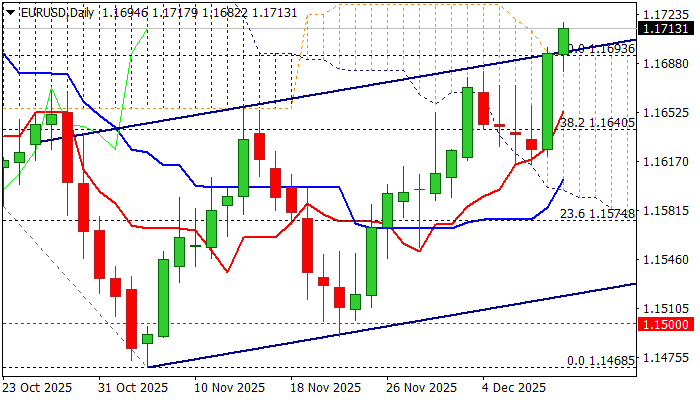
          The Euro remains firm and rises to the highest in seven weeks on Thursday, in extension of Wednesday's 0.6% advance, mainly seen in post-Fed acceleration.

          The single currency benefited from Fed rate cut and more hawkish than expected monetary policy projections for 2026, which further deflated the US dollar.

          Rise above significant barriers at 1.1700 zone (psychological / near 50% retracement of 1.1918/1.1468 / daily Ichimoku cloud top) generated bullish signal which need to be verified on sustained break above these levels and keep bullish structure for attack at 1.1746 (Fibo 61.8%) and potential extension towards 1.1800.

          Daily studies in full bullish setup (daily Tenkan/Kijun-sen in steep ascend and diverging after formation of bull-cross /strong bullish momentum, with thick daily cloud underpinning the action) contribute to positive fundamentals and keep the door open for further advance.

          Broken top of daily Ichimoku cloud (1.1693, also broken bull-channel upper boundary) reverted to strong support, which should contain dips and keep fresh bulls in play.

          Res: 1.1746; 1.1778; 1.1812; 1.1830
          Sup: 1.1693; 1.1680; 1.1653; 1.1603
          Source: ACTIONFOREX

          Risk Warnings and Disclaimers
          You understand and acknowledge that there is a high degree of risk involved in trading. Following any strategies or investment methods may lead to potential losses. The content on the site is provided by our contributors and analysts for information purposes only. You are solely responsible for determining whether any trading assets, securities, strategy, or any other product is suitable for investing based on your own investment objectives and financial situation.
          Add to Favorites
          Share
          FastBull
          Copyright © 2025 FastBull Ltd

          728 RM B 7/F GEE LOK IND BLDG NO 34 HUNG TO RD KWUN TONG KLN HONG KONG

          TelegramInstagramTwitterfacebooklinkedin
          App Store Google Play Google Play
          Products
          Charts

          Chats

          Q&A with Experts
          Screeners
          Economic Calendar
          Data
          Tools
          Membership
          Features
          Function
          Markets
          Copy Trading
          Latest Signals
          Contests
          News
          Analysis
          24/7
          Columns
          Education
          Company
          Careers
          About Us
          Contact Us
          Advertising
          Help Center
          Feedback
          User Agreement
          Privacy Policy
          Business

          White Label

          Data API

          Web Plug-ins

          Poster Maker

          Affiliate Program

          Risk Disclosure

          The risk of loss in trading financial instruments such as stocks, FX, commodities, futures, bonds, ETFs and crypto can be substantial. You may sustain a total loss of the funds that you deposit with your broker. Therefore, you should carefully consider whether such trading is suitable for you in light of your circumstances and financial resources.

          No decision to invest should be made without thoroughly conducting due diligence by yourself or consulting with your financial advisors. Our web content might not suit you since we don't know your financial conditions and investment needs. Our financial information might have latency or contain inaccuracy, so you should be fully responsible for any of your trading and investment decisions. The company will not be responsible for your capital loss.

          Without getting permission from the website, you are not allowed to copy the website's graphics, texts, or trademarks. Intellectual property rights in the content or data incorporated into this website belong to its providers and exchange merchants.

          Not Logged In

          Log in to access more features

          FastBull Membership

          Not yet

          Purchase

          Become a signal provider
          Help Center
          Customer Service
          Dark Mode
          Price Up/Down Colors

          Log In

          Sign Up

          Position
          Layout
          Fullscreen
          Default to Chart
          The chart page opens by default when you visit fastbull.com
