• Trade
  • Markets
  • Copy
  • Contests
  • News
  • 24/7
  • Calendar
  • Q&A
  • Chats
Trending
Screeners
SYMBOL
LAST
BID
ASK
HIGH
LOW
NET CHG.
%CHG.
SPREAD
SPX
S&P 500 Index
6857.13
6857.13
6857.13
6865.94
6827.13
+7.41
+ 0.11%
--
DJI
Dow Jones Industrial Average
47850.93
47850.93
47850.93
48049.72
47692.96
-31.96
-0.07%
--
IXIC
NASDAQ Composite Index
23505.13
23505.13
23505.13
23528.53
23372.33
+51.04
+ 0.22%
--
USDX
US Dollar Index
98.900
98.980
98.900
99.000
98.740
-0.080
-0.08%
--
EURUSD
Euro / US Dollar
1.16503
1.16510
1.16503
1.16715
1.16408
+0.00058
+ 0.05%
--
GBPUSD
Pound Sterling / US Dollar
1.33484
1.33492
1.33484
1.33622
1.33165
+0.00213
+ 0.16%
--
XAUUSD
Gold / US Dollar
4235.20
4235.61
4235.20
4236.58
4194.54
+28.03
+ 0.67%
--
WTI
Light Sweet Crude Oil
59.327
59.357
59.327
59.543
59.187
-0.056
-0.09%
--

Community Accounts

Signal Accounts
--
Profit Accounts
--
Loss Accounts
--
View More

Become a signal provider

Sell trading signals to earn additional income

View More

Guide to Copy Trading

Get started with ease and confidence

View More

Signal Accounts for Members

All Signal Accounts

Best Return
  • Best Return
  • Best P/L
  • Best MDD
Past 1W
  • Past 1W
  • Past 1M
  • Past 1Y

All Contests

  • All
  • Trump Updates
  • Recommend
  • Stocks
  • Cryptocurrencies
  • Central Banks
  • Featured News
Top News Only
Share

US Strategy Document Says Europe Risks 'Civilisational Erasure'

Share

The USD/CAD Pair Fell More Than 20 Points In The Short Term, Currently Trading At 1.3913

Share

Canada Nov Average Hourly Wage Of Permanent Employees +4.0% Year-On-Year Versus Oct +4.0%

Share

Canada Nov Unemployment Falls To 6.5%, Forecast Was 7.0%

Share

Canada Nov Participation Rate 65.1%, Oct Was 65.3%

Share

Canada Nov Full-Time -9.4K, Part-Time +63.0K

Share

Canada's Employment Increased By 53,600 In November, Compared With An Expected Decrease Of 5,000 And A Previous Increase Of 66,600

Share

Canada Goods Sector +11.0K Jobs In Nov, Services Sector +42.8K Jobs

Share

Swiss Government: Swiss-EU Package Expected To Go To Swiss Parliament In March 2026

Share

White House National Economic Council Director Hassett: Supports Treasury Secretary Bessant's Views On The Federal Reserve Chairman

Share

White House National Economic Council Director Hassett: No Discussion With US President Trump Regarding The Federal Reserve Chair (selection)

Share

Croatia Adopts 2026 Budget Foreseeing Deficit Of 2.9% Of GDP

Share

Nine German Conservative Lawmakers Voted Against Or Abstained In Pensions Vote - Parliament Tally

Share

Reuters Poll - Brazil Central Bank To Hold Benchmark Interest Rate At 15% On December 10, Say All 41 Economists

Share

Reuters Poll - 19 Of 36 Economists See Rate Cut In March, 14 In January, Three In April

Share

Meta Said It Has Struck Several Commercial Ai Data Agreements With News Publishers Ranging From USA Today, People Inc., Cnn, Fox News, The Daily Caller, Washington Examiner And Le Monde

Share

Monetary Policy Committee Members Said That The November Projection Shows That Inflation Outlook Should Be Better In The Next Few Quarters

Share

Monetary Policy Committee Members Said That The Projected Rate Of Inflation Is Subject To Uncertainty, Particularily Due To Energy Prices

Share

Monetary Policy Committee Members Said High Budget Deficit Planned For 2026 Limits Scope For Cutting Interest Rates

Share

Monetary Policy Committee Members Said That The Central Bank's November Projection Shows Wage Grows Will Slow, Which May Limit Demand Pressure - November Minutes

TIME
ACT
FCST
PREV
U.S. Non-Defense Capital Durable Goods Orders Revised MoM (Excl. Aircraft) (SA) (Sept)

A:--

F: --

P: --
U.S. Factory Orders MoM (Excl. Transport) (Sept)

A:--

F: --

P: --

U.S. Factory Orders MoM (Excl. Defense) (Sept)

A:--

F: --

P: --

U.S. EIA Weekly Natural Gas Stocks Change

A:--

F: --

P: --

Saudi Arabia Crude Oil Production

A:--

F: --

P: --

U.S. Weekly Treasuries Held by Foreign Central Banks

A:--

F: --

P: --

Japan Foreign Exchange Reserves (Nov)

A:--

F: --

P: --

India Repo Rate

A:--

F: --

P: --

India Benchmark Interest Rate

A:--

F: --

P: --

India Reverse Repo Rate

A:--

F: --

P: --

India Cash Reserve Ratio

A:--

F: --

P: --

Japan Leading Indicators Prelim (Oct)

A:--

F: --

P: --

U.K. Halifax House Price Index YoY (SA) (Nov)

A:--

F: --

P: --

U.K. Halifax House Price Index MoM (SA) (Nov)

A:--

F: --

P: --

France Current Account (Not SA) (Oct)

A:--

F: --

P: --

France Trade Balance (SA) (Oct)

A:--

F: --

P: --

France Industrial Output MoM (SA) (Oct)

A:--

F: --

P: --

Italy Retail Sales MoM (SA) (Oct)

A:--

F: --

P: --

Euro Zone Employment YoY (SA) (Q3)

A:--

F: --

P: --

Euro Zone GDP Final YoY (Q3)

A:--

F: --

P: --

Euro Zone GDP Final QoQ (Q3)

A:--

F: --

P: --

Euro Zone Employment Final QoQ (SA) (Q3)

A:--

F: --

P: --

Euro Zone Employment Final (SA) (Q3)

A:--

F: --

P: --
Brazil PPI MoM (Oct)

A:--

F: --

P: --

Mexico Consumer Confidence Index (Nov)

A:--

F: --

P: --

Canada Unemployment Rate (SA) (Nov)

A:--

F: --

P: --

Canada Labor Force Participation Rate (SA) (Nov)

A:--

F: --

P: --

Canada Employment (SA) (Nov)

A:--

F: --

P: --

Canada Part-Time Employment (SA) (Nov)

A:--

F: --

P: --

Canada Full-time Employment (SA) (Nov)

A:--

F: --

P: --

U.S. Personal Income MoM (Sept)

--

F: --

P: --

U.S. Dallas Fed PCE Price Index YoY (Sept)

--

F: --

P: --

U.S. PCE Price Index YoY (SA) (Sept)

--

F: --

P: --

U.S. PCE Price Index MoM (Sept)

--

F: --

P: --

U.S. Personal Outlays MoM (SA) (Sept)

--

F: --

P: --

U.S. Core PCE Price Index MoM (Sept)

--

F: --

P: --

U.S. UMich 5-Year-Ahead Inflation Expectations Prelim YoY (Dec)

--

F: --

P: --

U.S. Core PCE Price Index YoY (Sept)

--

F: --

P: --

U.S. Real Personal Consumption Expenditures MoM (Sept)

--

F: --

P: --

U.S. 5-10 Year-Ahead Inflation Expectations (Dec)

--

F: --

P: --

U.S. UMich Current Economic Conditions Index Prelim (Dec)

--

F: --

P: --

U.S. UMich Consumer Sentiment Index Prelim (Dec)

--

F: --

P: --

U.S. UMich 1-Year-Ahead Inflation Expectations Prelim (Dec)

--

F: --

P: --

U.S. UMich Consumer Expectations Index Prelim (Dec)

--

F: --

P: --

U.S. Weekly Total Rig Count

--

F: --

P: --

U.S. Weekly Total Oil Rig Count

--

F: --

P: --

U.S. Consumer Credit (SA) (Oct)

--

F: --

P: --

China, Mainland Foreign Exchange Reserves (Nov)

--

F: --

P: --

China, Mainland Exports YoY (USD) (Nov)

--

F: --

P: --

China, Mainland Imports YoY (CNH) (Nov)

--

F: --

P: --

China, Mainland Imports YoY (USD) (Nov)

--

F: --

P: --

China, Mainland Imports (CNH) (Nov)

--

F: --

P: --

China, Mainland Trade Balance (CNH) (Nov)

--

F: --

P: --

China, Mainland Exports (Nov)

--

F: --

P: --

Japan Wages MoM (Oct)

--

F: --

P: --

Japan Trade Balance (Oct)

--

F: --

P: --

Q&A with Experts
    • All
    • Chatrooms
    • Groups
    • Friends
    Connecting
    .
    .
    .
    Type here...
    Add Symbol or Code

      No matching data

      All
      Trump Updates
      Recommend
      Stocks
      Cryptocurrencies
      Central Banks
      Featured News
      • All
      • Russia-Ukraine Conflict
      • Middle East Flashpoint
      • All
      • Russia-Ukraine Conflict
      • Middle East Flashpoint
      Search
      Products

      Charts Free Forever

      Chats Q&A with Experts
      Screeners Economic Calendar Data Tools
      Membership Features
      Data Warehouse Market Trends Institutional Data Policy Rates Macro

      Market Trends

      Market Sentiment Order Book Forex Correlations

      Top Indicators

      Charts Free Forever
      Markets

      News

      News Analysis 24/7 Columns Education
      From Institutions From Analysts
      Topics Columnists

      Latest Views

      Latest Views

      Trending Topics

      Top Columnists

      Latest Update

      Signals

      Copy Rankings Latest Signals Become a signal provider AI Rating
      Contests
      Brokers

      Overview Brokers Assessment Rankings Regulators News Claims
      Broker listing Forex Brokers Comparison Tool Live Spread Comparison Scam
      Q&A Complaint Scam Alert Videos Tips to Detect Scam
      More

      Business
      Events
      Careers About Us Advertising Help Center

      White Label

      Data API

      Web Plug-ins

      Affiliate Program

      Awards Institution Evaluation IB Seminar Salon Event Exhibition
      Vietnam Thailand Singapore Dubai
      Fans Party Investment Sharing Session
      FastBull Summit BrokersView Expo
      Recent Searches
        Top Searches
          Markets
          News
          Analysis
          User
          24/7
          Economic Calendar
          Education
          Data
          • Names
          • Latest
          • Prev

          View All

          No data

          Scan to Download

          Faster Charts, Chat Faster!

          Download App
          English
          • English
          • Español
          • العربية
          • Bahasa Indonesia
          • Bahasa Melayu
          • Tiếng Việt
          • ภาษาไทย
          • Français
          • Italiano
          • Türkçe
          • Русский язык
          • 简中
          • 繁中
          Open Account
          Search
          Products
          Charts Free Forever
          Markets
          News
          Signals

          Copy Rankings Latest Signals Become a signal provider AI Rating
          Contests
          Brokers

          Overview Brokers Assessment Rankings Regulators News Claims
          Broker listing Forex Brokers Comparison Tool Live Spread Comparison Scam
          Q&A Complaint Scam Alert Videos Tips to Detect Scam
          More

          Business
          Events
          Careers About Us Advertising Help Center

          White Label

          Data API

          Web Plug-ins

          Affiliate Program

          Awards Institution Evaluation IB Seminar Salon Event Exhibition
          Vietnam Thailand Singapore Dubai
          Fans Party Investment Sharing Session
          FastBull Summit BrokersView Expo

          Oil Declines With Gaza Peace Plan and Risk-Off Mood in Focus

          Manuel

          Commodity

          Palestinian-Israeli conflict

          Summary:

          Israel and Hamas reached a deal for a truce and the release of hostages held by the militant group, a major step toward ending a two-year war that’s loomed over flows from the Middle East
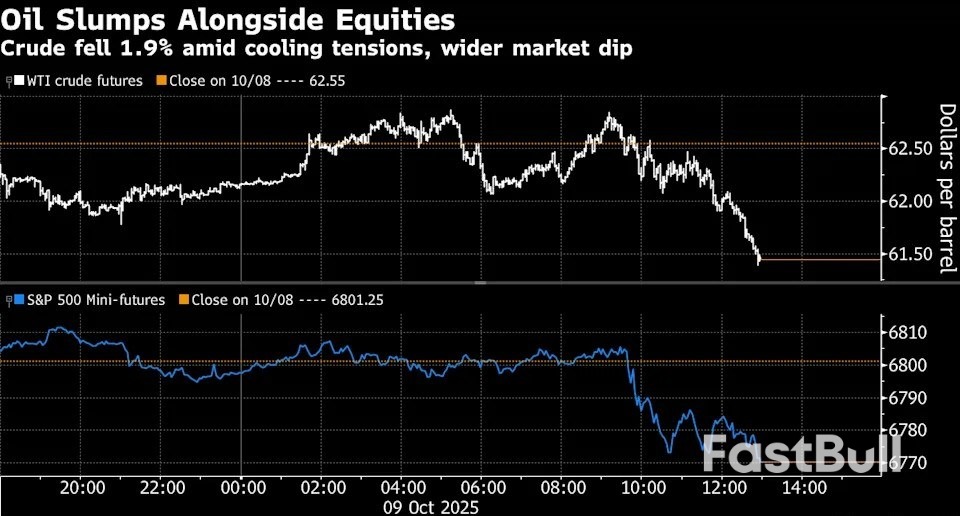
          Oil edged lower as traders focused on cooling tensions in the Middle East and broader markets struck a more cautious tone.
          West Texas Intermediate fell as much as 1.9% to trade below $62 a barrel while Brent was near $65. Israel and Hamas reached a deal for a truce and the release of hostages held by the militant group, a major step toward ending a two-year war that’s loomed over flows from the Middle East, the source of a third of the world’s crude.
          “Sentiment remains subdued, weighed down by concerns over a sizable fourth-quarter surplus and fears that Chinese crude buying is slowing,” said Rebecca Babin, a senior energy trader at CIBC Private Wealth Group. “Trading likely stays rangebound with a mild downside bias, particularly if broader risk assets come under pressure.”Oil Declines With Gaza Peace Plan and Risk-Off Mood in Focus_1
          The commodity also moved lower in tandem with wider markets without any strong new indicators on supply and demand. The dollar strengthened, making commodities priced in the currency less attractive.
          Offering a floor to prices, the US Treasury Department sanctioned more than 50 individuals, entities and vessels that “facilitate” Iranian oil and liquefied petroleum gas sales and shipments from the country. Traders will be following whether an end to fighting in Gaza will impact the status of restrictions against Iran, which backs Hamas.
          After a dip lower at the start of the month, crude has edged back toward the $65 to $70 band in which it traded for weeks at the end of the summer. The Organization of the Petroleum Exporting Countries and its allies are ramping up supplies, but so far the impact on prices has been limited by China hoarding barrels.
          Many Wall Street banks and other observers including the International Energy Agency have predicted the market will move into a major surplus in the coming months. Among them, Goldman Sachs Group Inc. expects Brent to average $56 next year as global production runs ahead of demand.
          While consensus remains bearish given expectations for a surplus, “conviction differs on the depth of downside,” Citigroup Inc. analysts including Francesco Martoccia said in a note. Slower non-OPEC+ growth and greater OPEC+ optionality, along with geopolitical risks looming for large producers such as Russia and Iran, could temper the pace of price adjustment, they said.

          Source: Bloomberg

          Risk Warnings and Disclaimers
          You understand and acknowledge that there is a high degree of risk involved in trading. Following any strategies or investment methods may lead to potential losses. The content on the site is provided by our contributors and analysts for information purposes only. You are solely responsible for determining whether any trading assets, securities, strategy, or any other product is suitable for investing based on your own investment objectives and financial situation.
          Add to Favorites
          Share

          Fed’s Barr Urges Caution On Rate Cuts Amid Inflation Concerns

          Owen Li

          Central Bank

          Federal Reserve Governor Michael Barr called for a cautious approach to further interest rate cuts on Thursday, emphasizing inflation risks while acknowledging vulnerabilities in the labor market.

          "The FOMC should be cautious about adjusting policy so that we can gather further data, update our forecasts, and better assess the balance of risks," Barr said in a speech to the Economic Club of Minnesota, his first monetary policy remarks since June.

          Barr described the Fed as being in a "challenging position" with no risk-free path forward, borrowing language from Fed Chair Jerome Powell. While he supported September’s quarter-percentage-point rate cut, much of his speech focused on inflation concerns, particularly those related to tariffs.

          The Fed governor forecasts that core Personal Consumption Expenditures Price Index will rise above 3% by year-end, and noted that Fed officials don’t expect headline inflation to reach the 2% target until the end of 2027. This would mark the longest stretch of PCE inflation above 2% since a seven-year period ending in 1993.

          "After the high inflation Americans have endured, two more years would be a long time to wait for a return to our target, and that possibility weighs on my judgment for appropriate monetary policy," Barr stated.

          He expressed skepticism about the Fed’s ability to "completely look through tariff-driven inflation" and suggested the current policy rate remains "modestly restrictive." Barr also noted that since the Fed’s September meeting, consumer spending has remained strong, PCE inflation has strengthened, and new tariffs have been announced.

          Regarding the labor market, Barr indicated that low payroll growth could signal worse conditions ahead, but also acknowledged that continued economic resilience could lead to stronger hiring. He described the current labor market as "roughly balanced" but potentially vulnerable to shocks.

          Barr added that recent spending data suggests GDP growth remained strong in the third quarter, while noting it’s difficult to judge whether the federal government shutdown will significantly impact the overall economy.

          Source: Yahoo Finance

          Risk Warnings and Disclaimers
          You understand and acknowledge that there is a high degree of risk involved in trading. Following any strategies or investment methods may lead to potential losses. The content on the site is provided by our contributors and analysts for information purposes only. You are solely responsible for determining whether any trading assets, securities, strategy, or any other product is suitable for investing based on your own investment objectives and financial situation.
          Add to Favorites
          Share

          Gold Just Hit $4,000—here's How Much Experts Say To Own

          Devin

          Economic

          Commodity

          With the price of gold topping $4,000 an ounce for the first time Tuesday, you might be wondering whether the precious metal should be a bigger part of your investment strategy.

          Prices have soared by 54% so far this year, putting it on track for its best yearly performance since 1979.

          Investors often turn to gold when they lose confidence in other assets, typically in periods of economic uncertainty or market stress, because it's seen as a store of value that holds its worth.

          And when the U.S. dollar declines, gold becomes cheaper for international buyers, boosting demand. That's helped push prices higher this year, with China's central bank stockpiling gold as it moves away from U.S. securities, says Rob Haworth, senior investment strategy director at U.S. Bank Wealth Management.

          The run-up in prices is also reflected in demand for gold-backed exchange-traded funds, or ETFs — which you can buy in a brokerage account and trade like a stock — making them one of the easiest ways to invest in gold. These funds recorded their biggest month ever for investor buying in September, according to the World Gold Council.

          "Gold can play a role in portfolios, providing diversification from traditional stocks and bonds," says Haworth.

          How much of your investments should be in gold

          Investors can get exposure to gold either by buying physical gold such as bars or coins, investing in gold-backed ETFs, or owning shares of mining companies.

          But the most accessible way to invest is probably through gold-backed ETFs, which hold physical gold in vaults and generally track the metal's price.

          These are "the most liquid, tax-efficient and low-cost way to invest in gold," Blair duQuesnay, a chartered financial analyst and certified financial planner, tells CNBC.

          Most advisers suggest keeping gold to 5% or less of a portfolio, but Bridgewater founder Ray Dalio has been far more bullish — arguing for as much as 15% in times of market stress.

          Dalio has long viewed gold as a hedge against declining trust in money and markets. He says that gold stands apart because it's "the only asset that somebody can hold and you don't have to depend on somebody else to pay you money for."

          However, most advisors don't see gold as a core investment so much as a useful hedge in turbulent times. That's because it doesn't produce income or profits, and its value depends entirely on investor demand. The risk is that if prices stop climbing, investors are "stuck with a zero-earning asset," says Haworth.

          The weak U.S. dollar is another factor to consider: Historically, gold and the dollar tend to move in opposite directions, with a weaker dollar making gold more attractive to global buyers. If the U.S. economy remains resilient, a stronger dollar could limit further gains in gold prices, he says.

          "Given those risks, gold is at best a supporting player — perhaps 0% to 5% of a portfolio," says Haworth.

          While gold has its place, "allocating too much of your portfolio to gold could come back to bite you," says Bill Shafransky, a CFP at Moneco Advisors. That said, "I don't find anything wrong with 2% to 5%, especially if that helps you sleep better at night."Want to be your own boss? Sign up for CNBC's new online course, How To Start A Business: For First-Time Founders. Find step-by-step guidance for launching your first business, from testing your idea to growing your revenue.

          Source: CNBC

          To stay updated on all economic events of today, please check out our Economic calendar
          Risk Warnings and Disclaimers
          You understand and acknowledge that there is a high degree of risk involved in trading. Following any strategies or investment methods may lead to potential losses. The content on the site is provided by our contributors and analysts for information purposes only. You are solely responsible for determining whether any trading assets, securities, strategy, or any other product is suitable for investing based on your own investment objectives and financial situation.
          Add to Favorites
          Share

          The flip side of gold's massive year

          Adam

          Commodity

          Nothing has displaced the US dollar as the world's favored reserve currency. But gold (GC=F) investors are giving it a shot.
          The safe-haven asset is welcoming with open arms the money flowing out of team greenback as political instability, government debt, and the whims of central banks gnaw at the power and influence of fiat currencies.
          Gold’s epic run-up coincides with threats of financial turmoil. Instead of competing alongside the dollar and longer-term bonds as places to park your money until trouble passes, gold's rise lays bare the downgrade of other financial shelters. If gold has taken its eponymous medal, there are losers who have lost the competition.
          What’s been dubbed the “debasement trade” underscores not just a loss of faith in fiat currencies but a rebalancing of risks and a reorientation of policy solutions to rising government debt.
          The US dollar index (DX.Y.NYB) has declined nearly 9% year to date, reflecting those trust issues.
          If gold crossing the $4,000-per-ounce mark for the first time signifies a major flight, it echoes earlier periods of heightened inflation and economic instability.
          The flight to safe havens is also a peculiar one this go around. As this newsletter has noted, stocks are at record highs, and investors are flocking to what looks like an impervious profit machine from corporate America.
          Crypto is enjoying its moment in the sun too. Bitcoin (BTC-USD) breached a new record high this week, performing like its devoted backers have long said it would — as a hedge and a preservation of value. While analysts don't have the historical parallels to draw from, bitcoin in this moment is (finally) behaving like gold.
          Only this time, gold is also behaving like gold — and conceptually stealing bitcoin's thunder in the process by being a store of value without all the fuss, volatility, or baggage. All it does is shine.
          Still, picking at the differences among this season's winners is a lesser point to what they are beating out. Investors are running at hard assets and crypto as an answer to what's perceived as unsustainable government spending and the mounting debts that follow as a consequence.
          Economic growth is one way out of the debt quagmire. That's in part fueling the gold rush, as expected lower rates tend to lead to higher gold prices. But there are broader forces at play.
          Analysts have pointed to President Trump's calls for the Federal Reserve to lower rates and, in turn, lower the government's interest costs as a potential economic shift.
          In a world where the Fed strives to make servicing the debt cheaper, gold will continue to rise. The erosion of public trust has been and can be a lucrative trade. It's also a warning.

          Source: finance.yahoo

          Risk Warnings and Disclaimers
          You understand and acknowledge that there is a high degree of risk involved in trading. Following any strategies or investment methods may lead to potential losses. The content on the site is provided by our contributors and analysts for information purposes only. You are solely responsible for determining whether any trading assets, securities, strategy, or any other product is suitable for investing based on your own investment objectives and financial situation.
          Add to Favorites
          Share

          Russia is waging ‘hybrid warfare’ against Europe, officials say. What does that mean?

          Adam

          Economic

          Europe has to confront the reality of the “hybrid warfare” being waged against it, according to European Commission President Ursula von der Leyen, telling EU lawmakers that a series of incidents was “not random harassment” but part of a concerted campaign to unsettle and weaken the bloc.
          Recent drone and airspace incursions, cyberattacks and election interference were just a few incidents that von der Leyen cited as instances of hybrid warfare against Europe.
          “In just the past two weeks, MiG fighters have violated Estonia’s airspace, and drones have flown over critical sites in Belgium, Poland, Romania, Denmark and Germany. Flights have been grounded, jets scrambled, and countermeasures deployed to ensure the safety of our citizens,” von der Leyen said Wednesday during a speech to the European Parliament in Strasbourg, France.
          “Make no mistake. This is part of a worrying pattern of growing threats. Across our Union, undersea cables have been cut, airports and logistics hubs paralysed by cyberattacks, and elections targeted by malign influence campaigns,” von der Leyen said, adding emphatically: “This is hybrid warfare, and we have to take it very seriously.”
          While she did not blame all those incidents directly on Moscow, von der Leyen said it was evident that “Russia wants to sow division.”
          Moscow has long been accused of being behind a multitude of “hybrid” attacks against its European neighbors but has repeatedly denied those accusations. CNBC contacted the Kremlin for a response to von der Leyen’s latest remarks and is awaiting a response.
          What is hybrid warfare?
          So what is a hybrid war, or warfare? Put simply, it’s a way to wage a type of warfare without appearing to be doing so.
          There is no set definition for hybrid warfare but defense, military and security experts agree that, fundamentally, it blends conventional military methods with more subversive or irregular tactics designed to disrupt, distract and undermine adversaries.
          European countries on the periphery of the EU, or those on the frontier with Russia, like the Baltic states Estonia, Latvia and Lithuania, or those in Eastern Europe such as Romania and Poland, have been increasingly exposed to hybrid warfare attacks.
          These incidents have ranged from energy and telecommunications infrastructure, such as undersea cables, being sabotaged, to Russian jets or submarines venturing into NATO airspace or waters for short periods of time.
          Russia has denied being behind many of these incidents, although it tends not to comment on its jets entering NATO airspace or drone incidents that led to Danish airports being closed and flights disrupted. A number of European officials accused Russia of being behind the disruption but national authorities often say it’s difficult to find solid evidence of Russian involvement.
          That’s one of the hallmarks of hybrid warfare, the EU’s von der Leyen said, with such incidents “calculated to linger in the twilight of deniability.”
          Russia’s campaign of hybrid activities in Europe has expanded significantly since Moscow’s full-scale invasion of Ukraine began over three years ago, according to a report published earlier this year from geopolitical and security intelligence service, Dragonfly.
          It documented 219 incidents of suspected Russian hybrid warfare in Europe since 2014, including sabotage, assassinations and electromagnetic attacks, such as GPS jamming. Of these incidents, 86% have taken place since early 2022 and almost half (46%) occurred in 2024 alone.
          The Baltic states, Finland, Germany, Norway, Poland and the U.K. will probably remain the primary targets, the report noted, due to their strong support for Ukraine.
          Europe says it’s ready to act
          European officials are under no illusion that the time to act to bolster regional security and defenses against malign activities is now.
          NATO members earlier this year pledged to increase defense spending to 5% of gross domestic product and Europe has vowed to mobilize its defense sector to meet the “permanent threat to European security” that’s posed by Russia, as Luxembourg Prime Minister Luc Frieden told CNBC last week.
          Member states discussed last week the creation of “flagship” defense projects such as the Eastern Flank Watch initiative, which proposes the creation of a “drone wall” network that would protect against airspace violations by unmanned aerial vehicles (UAVs). There is some ambivalence over the drone wall, however, with Germany’s defense minister appearing to pour cold water on the idea.
          Luxembourg’s Frieden said the EU did not want a conflict with Russia, but needed to protect itself.
          “Hybrid attacks are obviously something that can happen anywhere — the cables in the Baltic Sea, the attacks on our IT systems, the drones that can fly over some of our countries, that shows that there is a certain kind of provocation that we have to take seriously,” Frieden said, adding: “I don’t want us to be at war with Russia ... but we need to take threats seriously” he told CNBC’s Silvia Amaro.
          “We want to tell Russia, don’t try, stop it, go back ... [and that it has] no chance in conquering the Europe.”

          Source: cnbc

          To stay updated on all economic events of today, please check out our Economic calendar
          Risk Warnings and Disclaimers
          You understand and acknowledge that there is a high degree of risk involved in trading. Following any strategies or investment methods may lead to potential losses. The content on the site is provided by our contributors and analysts for information purposes only. You are solely responsible for determining whether any trading assets, securities, strategy, or any other product is suitable for investing based on your own investment objectives and financial situation.
          Add to Favorites
          Share

          Wall Street's bull market nears three years old; history shows it may still have life

          Adam

          Economic

          The U.S. stock market's bull run is almost three years old, but if history is a guide, that would make it only middle-aged.
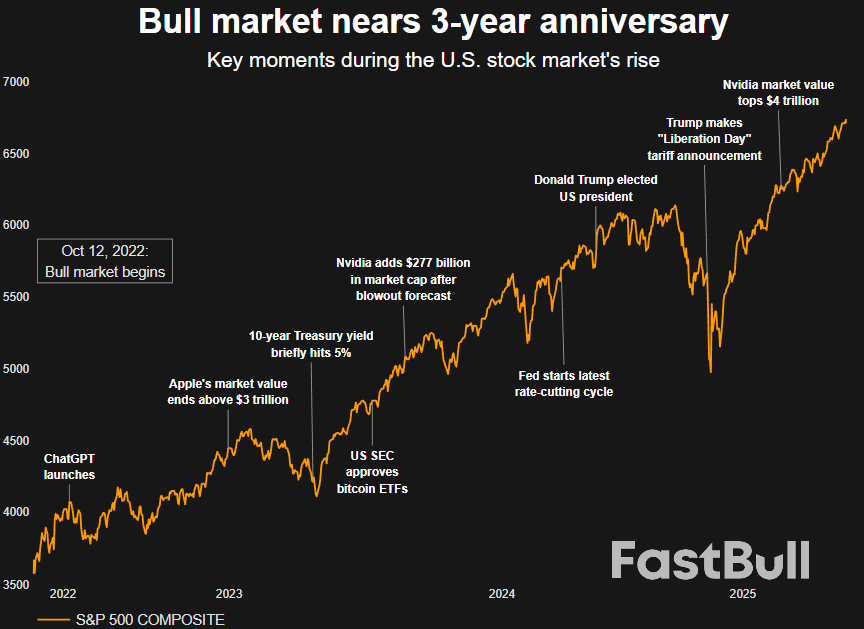
          The S&P 500 (.SPX) , has set a series of record highs in the lead-up to Sunday's anniversary of the start of the bull market on October 12, 2022. On that date three years ago, the benchmark U.S. stock index marked its lowest close for the current market cycle following a bout of monetary tightening by the Federal Reserve.
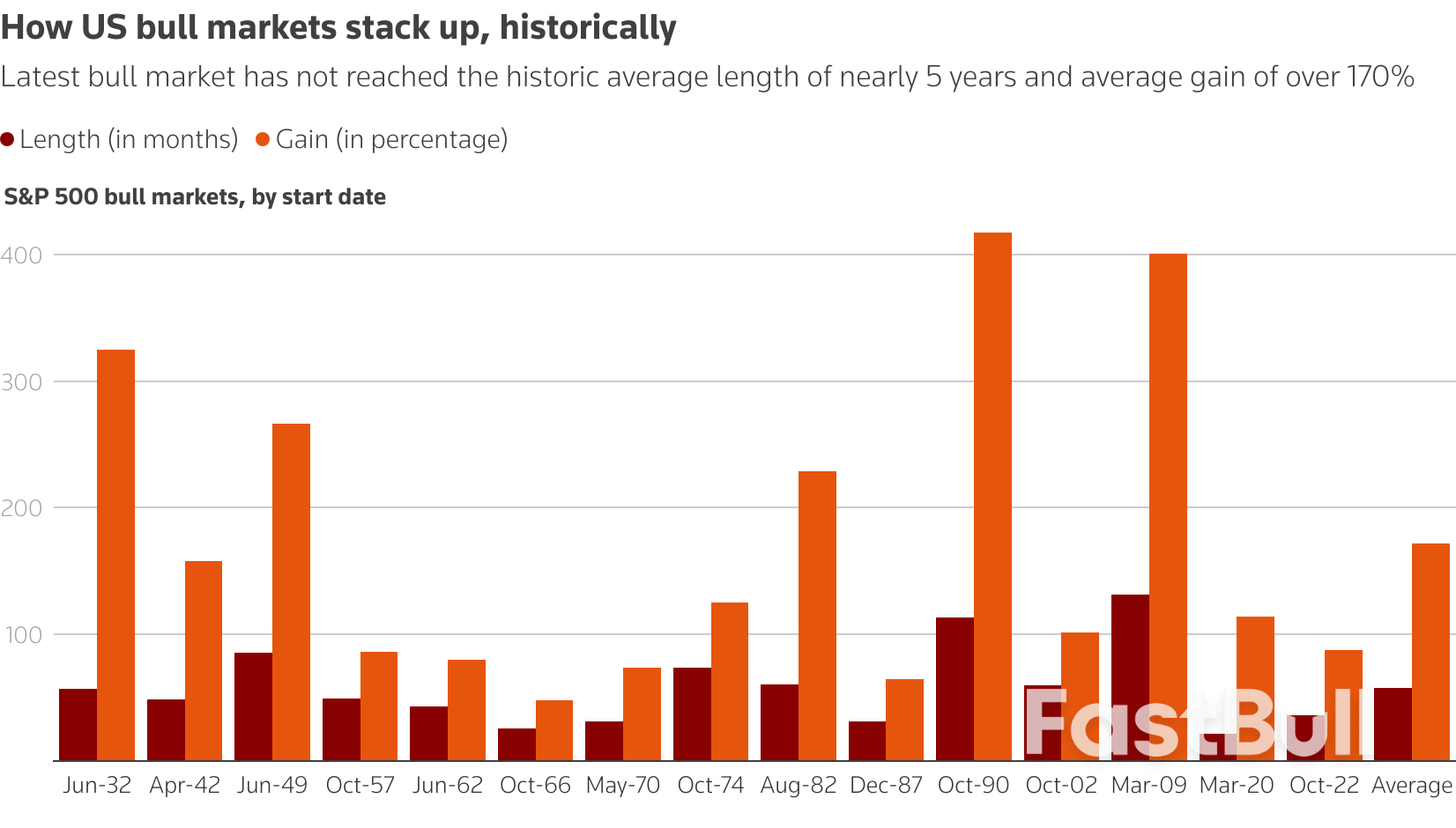
          Since then, a surge in technology and other megacap stocks has propelled the index up nearly 90%. That gain is still shy of the average rise of over 170% among 14 prior bull markets since 1932, according to data from Howard Silverblatt, senior index analyst at S&P Dow Jones Indices. Those bull markets lasted an average of about five years.
          "This isn't an old bull, and history says once they get to this point, they tend to last longer," said Ryan Detrick, chief market strategist at Carson Group.
          Wall Street's bull market nears three years old; history shows it may still have life_1

          S&P 500 bull markets, historically

          Optimism over the profit potential of artificial intelligence has been a major theme of the bull market, driving tech stocks such as Nvidia (NVDA.O), to stratospheric heights over the past three years. Another factor has been the resilience of the economy, with investors shaking off worries about a recession that helped valuations recover after 2022, said Angelo Kourkafas, senior global investment strategist at Edward Jones.
          "Economic growth is the key determinant of the length of bull markets," said Jeffrey Buchbinder, chief equity strategist at LPL Financial. "If a recession doesn’t end a bull market, it tends to run for five years or more."
          As inflation has eased, the U.S. Federal Reserve has pivoted to lowering interest rates over the past year, as opposed to three years ago, when the central bank's rate increases implemented to bring down inflation also pressured equities.
          "There's the saying that bull markets don't die of old age, it's the Fed that kills them," Kourkafas said.
          Now, however, he said, "when we look at what the Fed is doing, it's definitely not looking to go back into rate hikes, at least not within the next year or two."
          Wall Street's bull market nears three years old; history shows it may still have life_2

          S&P 500 bull market timeline

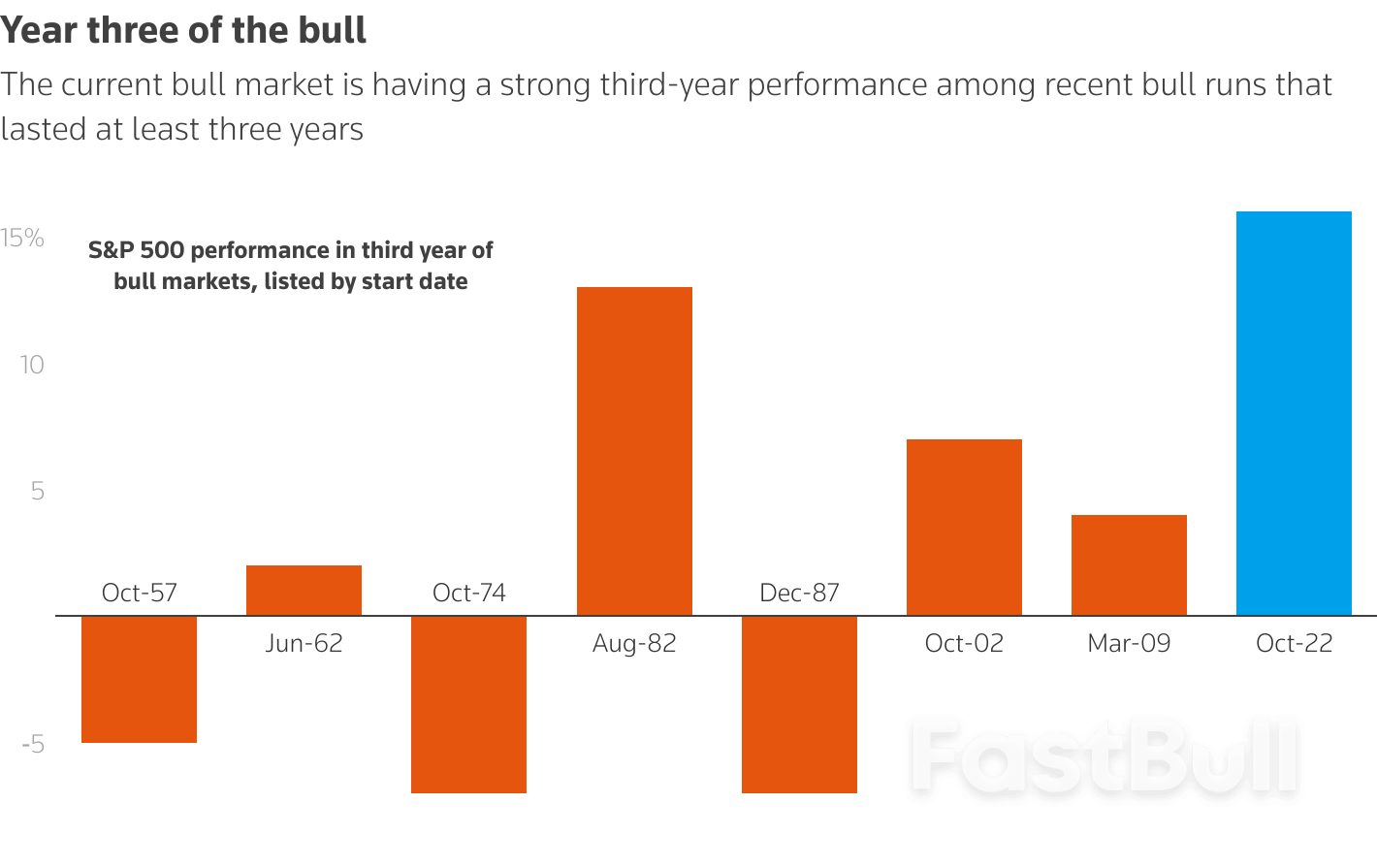
          The S&P 500 has climbed more than 15% since October 2024, the third year of the current bull market. That is the strongest third-year performance of the bull markets since 1957 that lasted this long, with the third year often being a period of mixed performance during bull runs, said Keith Lerner, chief investment officer at Truist Advisory Services.
          "Year 4 tends to be good, but the one caveat is you've had stronger-than-normal returns in Year 3," Lerner said. "The open question is, does that take away from the Year 4 returns?"
          Wall Street's bull market nears three years old; history shows it may still have life_3

          S&P 500 performance in third year of bull markets

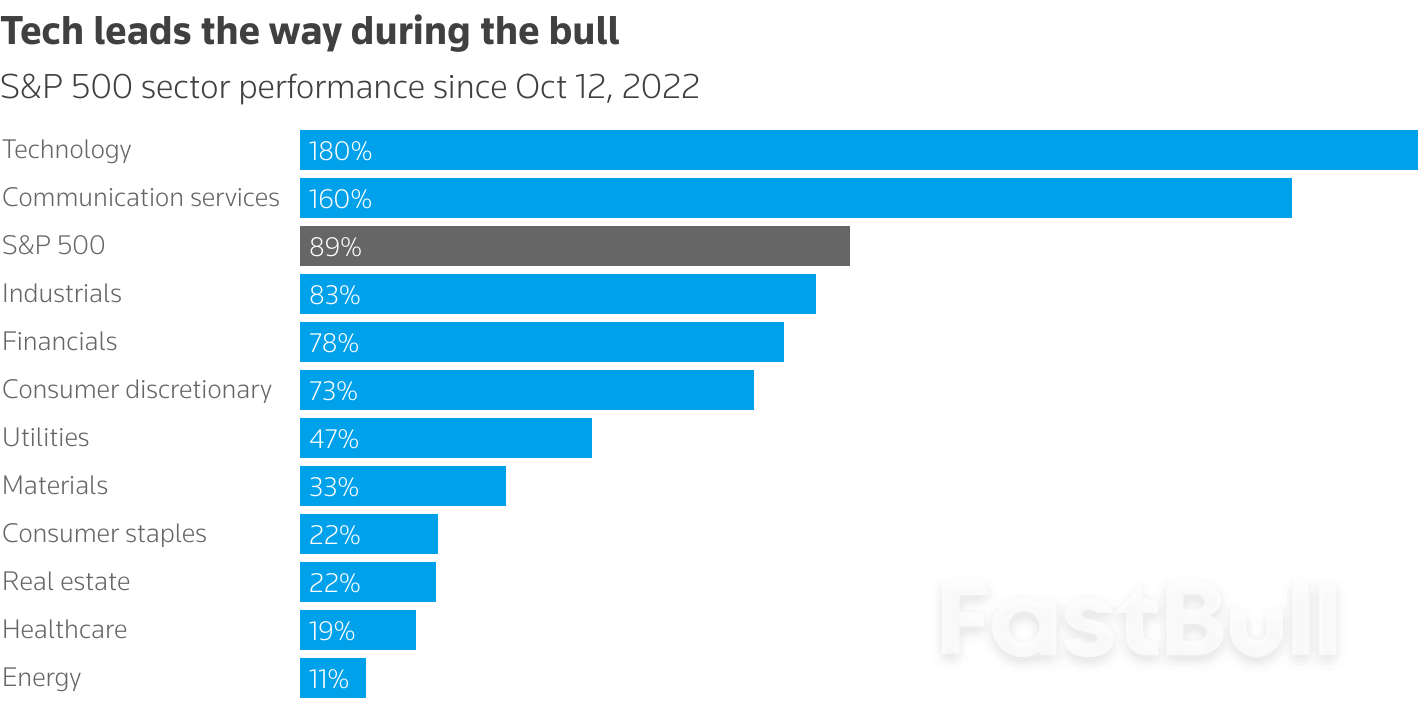
          During the latest bull run, the best-performing S&P 500 sectors by far have been information technology (.SPLRCT), and communication services (.SPLRCL), up about 180% and 160% respectively. Along with Nvidia, the tech sector is loaded with AI-exposed stocks that have surged, including Microsoft (MSFT.O), Broadcom (AVGO.O), and Palantir (PLTR.O) . Communication services includes big gainers over the past three years such as Google parent Alphabet (GOOGL.O), Facebook owner Meta Platforms (META.O) and Netflix (NFLX.O).
          Investors have gravitated toward megacap stocks during the bull run, symbolized by the strong performance of the "Magnificent Seven," which comprises Apple (AAPL.O), Amazon (AMZN.O), Tesla (TSLA.O), Nvidia, Microsoft, Alphabet, and Meta.
          Some investors are hopeful the Fed's move to cut interest rates will pave the way for broader stock market leadership. The equal-weight S&P 500 (.SPXEW) - which is a proxy for the performance of the average stock in the index - has gained just 49% since the October 2022 low, significantly trailing the standard S&P 500, which is more heavily influenced by stocks with larger market values.
          Wall Street's bull market nears three years old; history shows it may still have life_4

          Sector performance since Oct 12, 2022 market cycle low

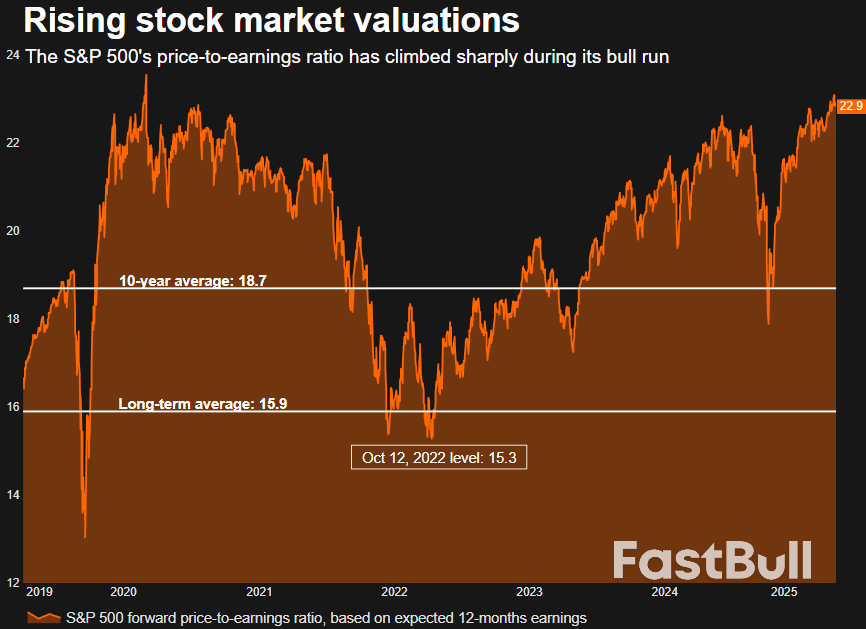
          The bull run has led to lofty valuations. The S&P 500's price-to-earnings ratio has climbed to about 23 times, based on 12-month earnings estimates for its constituents, around its highest level in five years and well above its 10-year average of 18.7, according to LSEG Datastream.
          The index's P/E ratio stood at 15.3 when it hit its cycle low on October 12, 2022.
          "Valuation is also a function of interest rates," Kourkafas said. "If, for whatever reason, inflation is sticky and we're not talking about the same level of expectations for rate cuts, maybe that changes the story."
          Wall Street's bull market nears three years old; history shows it may still have life_5

          S&P 500 forward P/E ratio chart

          Source: reuters

          To stay updated on all economic events of today, please check out our Economic calendar
          Risk Warnings and Disclaimers
          You understand and acknowledge that there is a high degree of risk involved in trading. Following any strategies or investment methods may lead to potential losses. The content on the site is provided by our contributors and analysts for information purposes only. You are solely responsible for determining whether any trading assets, securities, strategy, or any other product is suitable for investing based on your own investment objectives and financial situation.
          Add to Favorites
          Share

          US Job Market Is Rebalancing Not Weakening, Dallas Fed Blog Says

          Thomas

          Central Bank

          The slowdown in immigration means the US doesn’t need such robust job gains to keep the unemployment rate stable, suggesting the recent slide in payrolls may not be so worrisome, according to new research from the Federal Reserve Bank of Dallas.

          The so-called break-even employment rate has declined dramatically to about 30,000 as of the middle of this year, down from a peak of approximately 250,000 in 2023, the analysis found. That coincided with ebbs and flows in immigration, which surged in 2022 and 2023 in the wake of the pandemic and began to reverse in mid-2024, the research showed.

          “This recalibration suggests that today’s more modest payroll gains don’t signal weakness but are consistent with a balanced labor market,” Anton Cheremukhin, principal research economist at the Dallas Fed, said in a blog post Thursday.

          Cheremukhin writes that the unemployment rate is a more “reliable signal” of the health of the labor market because, compared to payrolls, it’s not as swayed by changes in demographics. The jobless rate has held between 4.0% to 4.3% since the middle of last year, even as monthly job growth slowed.

          It was last recorded at the upper end of that range in August. The September jobs report, originally due last week, has been delayed by the government shutdown.

          Fed officials lowered their benchmark interest rate last month, a move that Chair Jerome Powell framed as a “risk-management cut” to support the labor market from growing risks. However, he’s repeatedly acknowledged the slowdown in immigration, saying the job market is in a “curious kind of balance” as both demand and supply of workers come down at the same time.

          The Fed chief has emphasized that policymakers will face difficult choices as they weigh the risk of elevated and potentially rising inflation against the possibility of a deterioration in the labor market. And while the decision to cut interest rates last month was nearly unanimous, several policymakers, including Dallas Fed President Lorie Logan, are pushing for a cautious approach for further reductions to stay on guard against stubborn inflation.

          Source: Bloomberg Europe

          Risk Warnings and Disclaimers
          You understand and acknowledge that there is a high degree of risk involved in trading. Following any strategies or investment methods may lead to potential losses. The content on the site is provided by our contributors and analysts for information purposes only. You are solely responsible for determining whether any trading assets, securities, strategy, or any other product is suitable for investing based on your own investment objectives and financial situation.
          Add to Favorites
          Share
          FastBull
          Copyright © 2025 FastBull Ltd

          728 RM B 7/F GEE LOK IND BLDG NO 34 HUNG TO RD KWUN TONG KLN HONG KONG

          TelegramInstagramTwitterfacebooklinkedin
          App Store Google Play Google Play
          Products
          Charts

          Chats

          Q&A with Experts
          Screeners
          Economic Calendar
          Data
          Tools
          Membership
          Features
          Function
          Markets
          Copy Trading
          Latest Signals
          Contests
          News
          Analysis
          24/7
          Columns
          Education
          Company
          Careers
          About Us
          Contact Us
          Advertising
          Help Center
          Feedback
          User Agreement
          Privacy Policy
          Business

          White Label

          Data API

          Web Plug-ins

          Poster Maker

          Affiliate Program

          Risk Disclosure

          The risk of loss in trading financial instruments such as stocks, FX, commodities, futures, bonds, ETFs and crypto can be substantial. You may sustain a total loss of the funds that you deposit with your broker. Therefore, you should carefully consider whether such trading is suitable for you in light of your circumstances and financial resources.

          No decision to invest should be made without thoroughly conducting due diligence by yourself or consulting with your financial advisors. Our web content might not suit you since we don't know your financial conditions and investment needs. Our financial information might have latency or contain inaccuracy, so you should be fully responsible for any of your trading and investment decisions. The company will not be responsible for your capital loss.

          Without getting permission from the website, you are not allowed to copy the website's graphics, texts, or trademarks. Intellectual property rights in the content or data incorporated into this website belong to its providers and exchange merchants.

          Not Logged In

          Log in to access more features

          FastBull Membership

          Not yet

          Purchase

          Become a signal provider
          Help Center
          Customer Service
          Dark Mode
          Price Up/Down Colors

          Log In

          Sign Up

          Position
          Layout
          Fullscreen
          Default to Chart
          The chart page opens by default when you visit fastbull.com