Markets
News
Analysis
User
24/7
Economic Calendar
Education
Data
- Names
- Latest
- Prev



Signal Accounts for Members
All Signal Accounts
All Contests


U.S. PPI MoM (SA) (Nov)A:--
F: --
U.S. Current Account (Q3)A:--
F: --
U.S. Retail Sales YoY (Nov)A:--
F: --
P: --
U.S. Retail Sales (Nov)A:--
F: --
P: --
U.S. Core Retail Sales MoM (Nov)A:--
F: --
U.S. Retail Sales MoM (Excl. Automobile) (SA) (Nov)A:--
F: --
U.S. Core Retail Sales (Nov)A:--
F: --
P: --
U.S. Retail Sales MoM (Excl. Gas Stations & Vehicle Dealers) (SA) (Nov)A:--
F: --
U.S. Retail Sales MoM (Nov)A:--
F: --
U.S. Core PPI MoM (SA) (Nov)A:--
F: --
Philadelphia Fed President Henry Paulson delivers a speech
U.S. Commercial Inventory MoM (Oct)A:--
F: --
U.S. Existing Home Sales Annualized Total (Dec)A:--
F: --
U.S. Existing Home Sales Annualized MoM (Dec)A:--
F: --
U.S. EIA Weekly Cushing, Oklahoma Crude Oil Stocks ChangeA:--
F: --
P: --
U.S. EIA Weekly Crude Stocks ChangeA:--
F: --
P: --
U.S. EIA Weekly Gasoline Stocks ChangeA:--
F: --
P: --
U.S. EIA Weekly Crude Demand Projected by ProductionA:--
F: --
P: --
U.S. EIA Weekly Crude Oil Imports ChangesA:--
F: --
P: --
U.S. EIA Weekly Heating Oil Stock ChangesA:--
F: --
P: --
U.S. Refinitiv/Ipsos Primary Consumer Sentiment Index (PCSI) (Jan)A:--
F: --
P: --
China, Mainland M2 Money Supply YoY (Dec)--
F: --
P: --
China, Mainland M0 Money Supply YoY (Dec)--
F: --
P: --
China, Mainland M1 Money Supply YoY (Dec)--
F: --
P: --
Japan Domestic Enterprise Commodity Price Index YoY (Dec)A:--
F: --
P: --
Japan PPI MoM (Dec)A:--
F: --
P: --
Japan Domestic Enterprise Commodity Price Index MoM (Dec)A:--
F: --
P: --
Australia Consumer Inflation Expectations (Jan)A:--
F: --
P: --
U.K. 3-Month RICS House Price Balance (Dec)A:--
F: --
South Korea Benchmark Interest RateA:--
F: --
P: --
Saudi Arabia CPI YoY (Dec)--
F: --
P: --
U.K. Services Index MoM (SA) (Nov)--
F: --
P: --
U.K. Services Index YoY (Nov)--
F: --
P: --
U.K. Manufacturing Output MoM (Nov)--
F: --
P: --
U.K. Trade Balance (Nov)--
F: --
P: --
U.K. Monthly GDP 3M/3M Change (Nov)--
F: --
P: --
U.K. GDP MoM (Nov)--
F: --
P: --
U.K. Industrial Output MoM (Nov)--
F: --
P: --
U.K. Trade Balance Non-EU (SA) (Nov)--
F: --
P: --
U.K. Trade Balance (SA) (Nov)--
F: --
P: --
U.K. Manufacturing Output YoY (Nov)--
F: --
P: --
U.K. Construction Output MoM (SA) (Nov)--
F: --
P: --
U.K. Industrial Output YoY (Nov)--
F: --
P: --
U.K. Services Index MoM--
F: --
P: --
U.K. Construction Output YoY (Nov)--
F: --
P: --
U.K. GDP YoY (SA) (Nov)--
F: --
P: --
U.K. Trade Balance EU (SA) (Nov)--
F: --
P: --
France HICP Final MoM (Dec)--
F: --
P: --
Germany Annual GDP Growth--
F: --
Italy Industrial Output YoY (SA) (Nov)--
F: --
P: --
Canada Existing Home Sales MoM (Dec)--
F: --
P: --
Euro Zone Industrial Output MoM (Nov)--
F: --
P: --
Euro Zone Trade Balance (SA) (Nov)--
F: --
P: --
Euro Zone Trade Balance (Not SA) (Nov)--
F: --
P: --
Euro Zone Industrial Output YoY (Nov)--
F: --
P: --
South Africa Refinitiv/Ipsos Primary Consumer Sentiment Index (PCSI) (Jan)--
F: --
P: --
U.K. Refinitiv/Ipsos Primary Consumer Sentiment Index (PCSI) (Jan)--
F: --
P: --
China, Mainland Outstanding Loans Growth YoY (Dec)--
F: --
P: --
Brazil Retail Sales MoM (Nov)--
F: --
P: --
Canada Wholesale Sales MoM (SA) (Nov)--
F: --
P: --


No matching data
Latest Views
Latest Views
Trending Topics
Top Columnists
Latest Update
White Label
Data API
Web Plug-ins
Affiliate Program
View All

No data
Reports of a delayed US strike on Iran, amid White House indecision and logistical hurdles, sent oil and silver prices tumbling.
Global traders anxiously awaiting news of military action in Iran were met with reports suggesting that a US strike is not imminent and could be days away, if it happens at all. An NBC report, citing multiple US officials and sources familiar with White House discussions, has cooled expectations of immediate conflict.
This uncertainty has sent ripples through commodity markets, with both crude oil and precious metals falling sharply as the geopolitical risk premium evaporates.
According to sources, President Trump has made his conditions for military action clear to his national security team. He reportedly wants any strike against Iran to be a "swift and decisive blow" that avoids dragging the US into a sustained conflict lasting weeks or months.
"If he does something, he wants it to be definitive," one person familiar with the discussions noted.
However, a key obstacle has emerged: Trump's advisers have been unable to guarantee that a US military strike would lead to a quick collapse of the Iranian regime. Officials are also concerned that the US may not have sufficient assets in the region to counter what they anticipate would be an aggressive Iranian response.
This logistical challenge is highlighted by the position of US aircraft carriers, which are still days away from the gulf, delaying the timeline for any potential large-scale operation.
The current situation could push Trump toward a more limited initial offensive, while keeping options open for escalation. As of Wednesday afternoon, sources confirmed that no final decisions had been made in the fast-evolving scenario.
Adding to the military and logistical challenges are political concerns about what would follow a potential regime change in Iran. In a separate interview with Reuters, Trump expressed uncertainty about whether Iranian opposition figure Reza Pahlavi could rally enough support within the country to take power.
Pahlavi is the son of the late shah of Iran, who was ousted in 1979. While Trump described him as seeming "very nice," he questioned his political viability.
"I don't know how he'd play within his own country," Trump said. "I don't know whether or not his country would accept his leadership, and certainly if they would, that would be fine with me."
These comments suggest a lack of a clear succession plan, raising the risk of a power vacuum in a post-strike scenario. While Trump acknowledged that the current government in Tehran could fall due to internal protests, he stated that "any regime can fail."
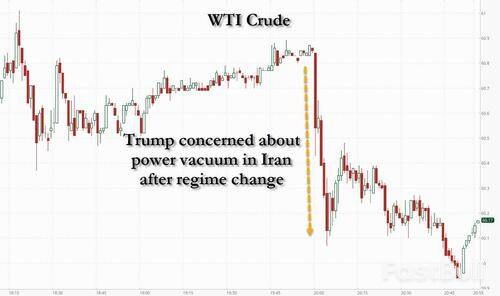
The combined reports from NBC and Reuters effectively reduced the probability of an imminent US strike, triggering a sharp reversal in commodity markets.
Crude oil, which had been rising on geopolitical tensions, tumbled. WTI crude was set to dip below $60 a barrel after trading above that level for the entire day.
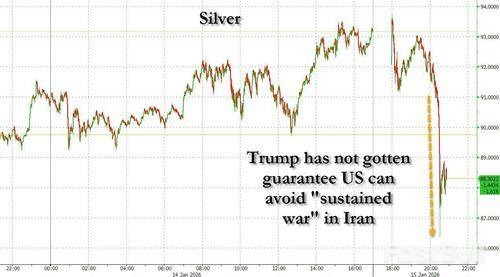
Precious metals also saw a significant sell-off. Silver plunged as much as $6 in seconds, falling from $92 to $86 as stop-loss orders were triggered. The rapid decline offered a preview of how quickly the recent rally could unwind as geopolitical fears subside.
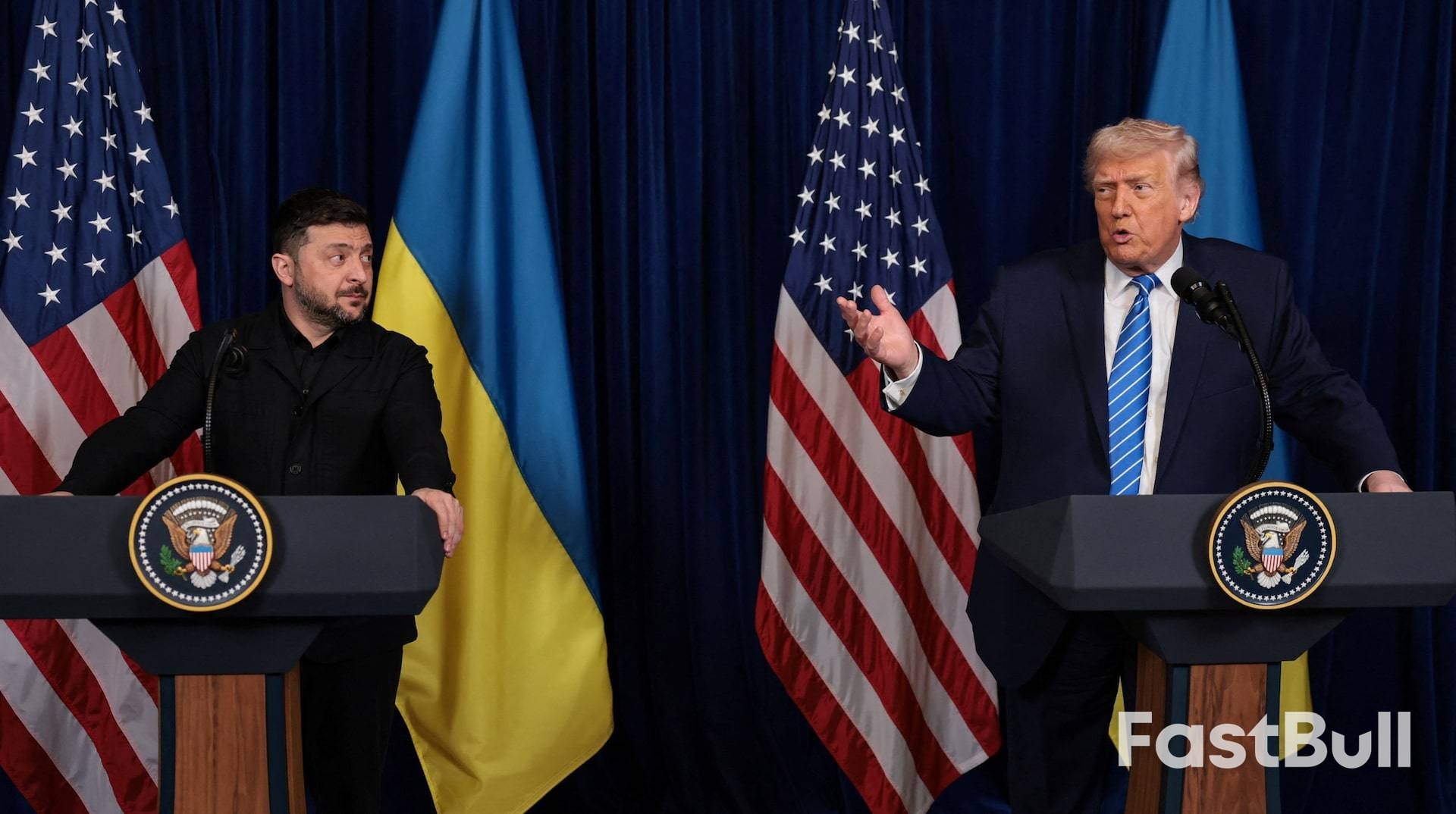
U.S. President Donald Trump has asserted that Ukraine, not Russia, is the primary party holding up a potential peace agreement. In a sharp departure from the position held by European allies, Trump suggested Moscow is prepared to end the conflict while Kyiv remains reluctant.

During an exclusive interview in the Oval Office on Wednesday, Trump told Reuters that Russian President Vladimir Putin is ready to conclude the nearly four-year-long invasion. The U.S. president claimed his Ukrainian counterpart, Volodymyr Zelenskiy, was the one showing reticence.
"I think he's ready to make a deal," Trump said of Putin, adding, "I think Ukraine is less ready to make a deal."
When asked why U.S.-led negotiations have failed to resolve Europe's largest land war since World War Two, Trump gave a one-word answer: "Zelenskiy."
Trump's comments suggest renewed frustration with the Ukrainian leader, with whom he has maintained a famously volatile relationship. While interactions appeared to improve during Trump's first year back in office, this latest statement highlights underlying friction.
Historically, Trump has sometimes appeared more willing to accept Putin's assurances at face value than those from U.S. allies, a stance that has previously frustrated officials in Kyiv, European capitals, and even some Republican lawmakers in Washington.
This perspective contrasts with U.S. intelligence reports from December, which warned that Putin had not abandoned his goal of capturing all of Ukraine and reclaiming territory from the former Soviet empire. At the time, Director of National Intelligence Tulsi Gabbard disputed that assessment.
Recent U.S.-led negotiations have reportedly centered on providing security guarantees for a post-war Ukraine, designed to prevent a future Russian invasion. As part of a potential accord, American negotiators have pushed Ukraine to consider abandoning its eastern Donbas region.
Ukrainian officials have been deeply involved in these talks, which are being spearheaded on the U.S. side by special envoy Steve Witkoff and Trump's son-in-law, Jared Kushner. However, some European officials have expressed skepticism about whether Putin would agree to the terms being discussed by Kyiv, Washington, and European leaders.
Trump told Reuters he was not aware of a potential trip to Moscow by Witkoff and Kushner, a possibility reported earlier on Wednesday by Bloomberg.
Looking ahead, a meeting between the two leaders could be imminent. When asked if he would meet with Zelenskiy at the World Economic Forum in Davos, Switzerland, next week, Trump confirmed he would if the Ukrainian president attends.
"I would—if he's there," Trump said. "I'm going to be there."
Trump did not offer further specifics on why he believes Zelenskiy is holding back on a deal, stating only, "I just think he's, you know, having a hard time getting there."
For his part, Zelenskiy has publicly and consistently ruled out any territorial concessions to Moscow, citing that the country's constitution does not permit giving up any of its land.
President Donald Trump says he has no immediate plans to fire Federal Reserve Chair Jerome Powell but noted it was "too early" to determine his ultimate fate, leaving the central bank chief's future in a state of uncertainty.
In a recent interview, Trump addressed whether he would remove Powell from his post, stating, "I don't have any plan to do that." However, when asked if an ongoing Justice Department investigation provides grounds for dismissal, the president remained noncommittal.
"Right now, we're in a little bit of a holding pattern with him, and we're going to determine what to do," Trump said. "But I can't get into it. It's too soon. Too early."
While Powell's term as Fed Chair concludes in May, his appointment to the Board of Governors extends until 2028, meaning he is not required to leave the institution.
The uncertainty surrounding Powell's position is amplified by a criminal investigation recently opened by the Trump administration. The probe focuses on cost overruns related to a $2.5 billion project to renovate two historic buildings at the Federal Reserve's headquarters.
Powell, who disclosed the investigation, has denied any wrongdoing. He argues the unprecedented action is a pretext to pressure him for not cutting interest rates as aggressively as Trump has demanded.
This pressure campaign has intensified as midterm congressional elections approach, with voters citing cost-of-living issues as a major concern and giving Trump low marks on his handling of the economy.
Trump indicated he is already considering replacements for Powell, highlighting former Fed Governor Kevin Warsh and National Economic Council Director Kevin Hassett as leading candidates. "The two Kevins are very good," he commented, adding that U.S. Treasury Secretary Scott Bessent was not in the running because "he wants to stay where he is."
The administration's move against Powell has drawn sharp criticism from key Republicans in the Senate, foreign economic officials, and investors. Critics argue the investigation politicizes sensitive monetary policy and undermines the Fed's independence, a cornerstone of global economic stability.
Trump, however, dismissed these concerns outright. When challenged on the backlash, including from lawmakers whose support he needs for a new nominee, he responded, "I don't care. They should be loyal. That's what I say."
He similarly brushed off the widely held view that eroding central bank independence could weaken the U.S. dollar and spark inflation, simply repeating, "I don't care."
The conflict with Powell is part of a broader effort by Trump to assert influence over the traditionally independent central bank. The administration has also attempted to fire another Fed official, Governor Lisa Cook, who is now challenging her termination in a case that will be argued before the Supreme Court.
Trump believes his business background gives him a superior grasp of economic policy. "A president should have something to say" about the Fed, he told Reuters. "I made a lot of money with business, so I think I have a better understanding of it than Too Late Jerome Powell."
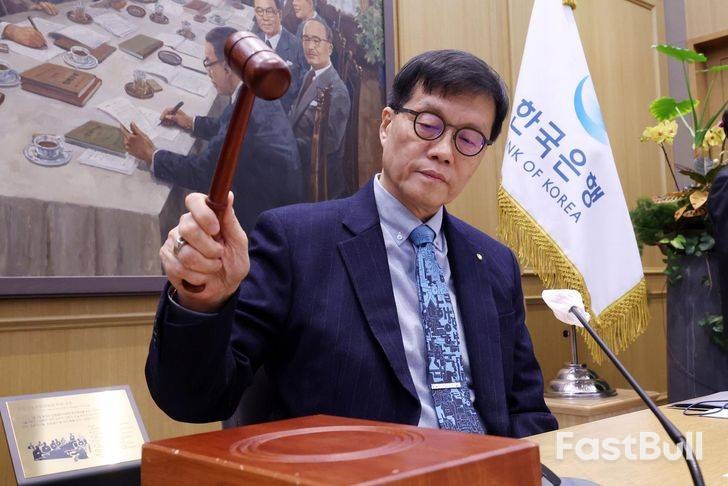
South Korea's central bank held its benchmark interest rate steady at 2.50% in its first policy meeting of the year, signaling a clear focus on financial stability as the Korean won trades near 16-year lows.
The decision by the Bank of Korea's monetary policy board was widely anticipated, meeting the expectations of all 34 economists surveyed by Reuters.
This move follows a period of easing that saw 100 basis points in cumulative cuts since October 2024. However, Governor Rhee Chang-yong has recently indicated that the central bank will now maintain a prolonged pause, citing geopolitical uncertainties and the persistent risk of capital outflows.
Governor Rhee is scheduled to provide further details in a press conference at 0210 GMT.
Analysts expect Governor Rhee to adopt a cautious tone, emphasizing external risks while firmly dismissing the possibility of a rate hike in the first half of the year.
"Bank of Korea Governor Rhee is likely to express his concerns on external financial instability," said Citigroup analyst Kim Jin-wook. He added that Rhee may also signal that "Korean FX authorities are ready to implement decisive policy measures for FX stabilization if necessary, as seen in late December 2025."
The central bank's goal appears to be a gradual re-balancing of structural capital flows to support the currency.
Policymakers have so far struggled to stabilize the won, which was one of Asia's worst-performing currencies in the second half of last year. A key factor driving its weakness has been strong demand for U.S. equities among South Korean retail investors.
Reflecting these unfavorable external conditions and the authorities' focus on currency stability, analysts have significantly pushed back their timeline for the next rate cut. The consensus now points to the first quarter of 2027, a major shift from previous expectations of a cut in the first quarter of this year.
Meanwhile, headline inflation is forecast to average 1.9% this year, running just slightly below the central bank's 2% target.

Political

Remarks of Officials

Economic

Central Bank

Russia-Ukraine Conflict

Middle East Situation

Daily News
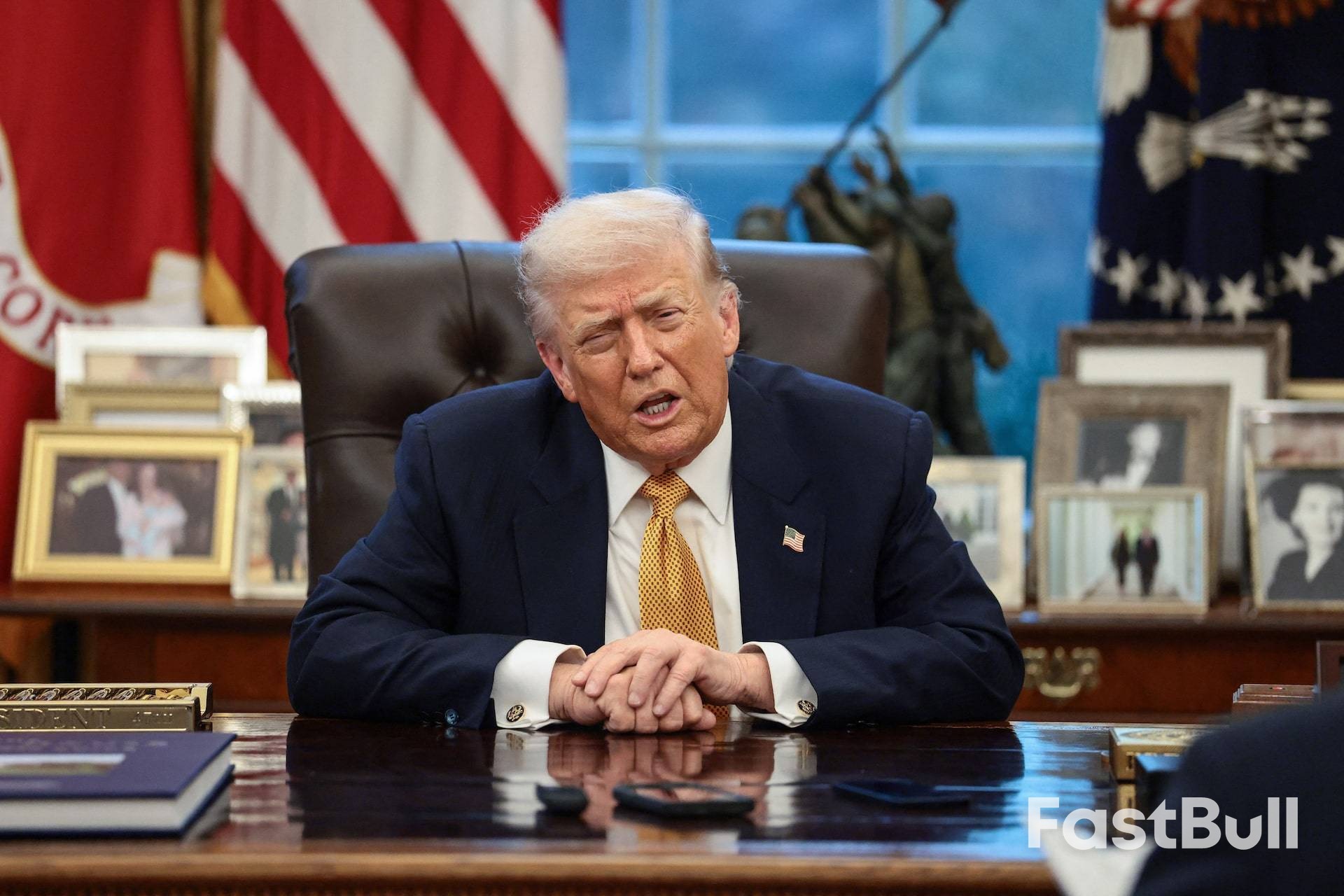
In an exclusive Oval Office interview on Wednesday, U.S. President Donald Trump weighed in on critical foreign and domestic issues, expressing doubts about Iranian opposition figure Reza Pahlavi's leadership potential, blaming Ukrainian President Volodymyr Zelenskiy for the stalemate in peace talks with Russia, and dismissing Republican criticism of a Justice Department probe into Federal Reserve Chairman Jerome Powell.

During the 30-minute interview, Trump offered his perspective while closing out the first year of his second term, which began on January 20, 2025.
While acknowledging that Iranian opposition figure Reza Pahlavi "seems very nice," President Trump voiced uncertainty about whether Pahlavi could rally enough internal support to lead Iran. This marks a more direct questioning of Pahlavi's viability, following a statement last week that Trump had no plans to meet with him.
"I don't know how he'd play within his own country," Trump stated. "And we really aren't up to that point yet." He added, "I don't know whether or not his country would accept his leadership, and certainly if they would, that would be fine with me."
Pahlavi, 65, is the U.S.-based son of Iran's late shah, who was overthrown in the 1979 Islamic Revolution. He has become a prominent voice amid ongoing protests against Iran's clerical rule, but the opposition remains fragmented across various factions, including monarchists who support him.
While Trump has previously threatened to intervene in support of protesters, he acknowledged the uncertainty of the situation. He said it is possible the government in Tehran could fall but noted that "any regime can fail."
"Whether or not it falls or not, it's going to be an interesting period of time," he said.
President Trump identified Ukrainian President Volodymyr Zelenskiy as the primary obstacle to resolving the four-year-old war between Russia and Ukraine. Despite campaign promises to end the conflict in a day, Trump has struggled to broker a peace deal.
While he has criticized both Russian President Vladimir Putin and Zelenskiy, his comments suggested a greater frustration with the Ukrainian leader. Trump claimed that Putin is "ready to make a deal." When asked what was causing the delay, Trump responded simply: "Zelenskiy."
"We have to get President Zelenskiy to go along with it," he explained.
On the domestic front, Trump brushed off concerns from Senate Republicans regarding the Justice Department's investigation into Federal Reserve Chairman Jerome Powell. Some lawmakers in his own party have threatened to block his Fed nominees, citing fears of interference with the central bank's independence.
"I don't care. There's nothing to say. They should be loyal," Trump said of the Republican lawmakers.
He also rejected criticism from JPMorgan CEO Jamie Dimon, who warned that meddling with the Fed could fuel inflation. "I don't care what he says," Trump stated.
Managing Midterm Expectations
Looking ahead to the November congressional midterm elections, Trump sought to manage expectations. He noted the historical trend of the president's party losing seats two years into a term.
"When you win the presidency, you don't win the midterms," he said. "But we're going to try very hard to win the midterms."
President Trump confirmed he is scheduled to meet with Venezuelan opposition leader Maria Corina Machado at the White House on Thursday. This will be their first in-person meeting since Trump directed the arrest of Venezuelan President Nicolas Maduro and seized control of the country earlier this month.
"She's a very nice woman," Trump said of Machado. "I've seen her on television. I think we're just going to talk basics."
Machado was awarded the Nobel Peace Prize last year and dedicated it to Trump, even offering to give him the prize, though the Nobel committee stated it cannot be transferred.
Trump also praised Venezuela's acting president, Delcy Rodriguez, who was Maduro's vice president. He described a "fascinating talk" with Rodriguez earlier on Wednesday, adding that "she's been very good to deal with."
South Korea's central bank has kept its benchmark interest rate unchanged, holding the line as concerns over a weakening currency and rising inflation limit its options for further monetary easing.

At its latest rate-setting meeting in Seoul, the Monetary Policy Board of the Bank of Korea (BOK) decided to maintain the key rate at 2.5 percent. This marks the fifth consecutive meeting since July that the board has opted to hold rates steady.
The decision to pause comes even as the BOK remains in a broader monetary easing cycle. Since October 2024, the central bank has cut its benchmark rate by a total of 100 basis points, down from 3.5 percent. These earlier cuts were implemented in an effort to stimulate economic growth.
The Bank of England's recent decision to lower capital requirements for banks is facing sharp criticism from two former senior officials who helped design the UK's post-crisis financial rules. They argue the policy will primarily enrich shareholders instead of boosting the wider economy.
David Aikman and John Vickers warn that the move to ease regulations comes at a time of growing financial risk, making the policy shift both poorly timed and ill-advised.
In an article for the Centre for Economic Policy Research, the two experts stated that the change will do little to increase lending where it's needed most.
"The most likely practical effect of this weakening of resilience will be higher payouts to bank shareholders, rather than increased lending to the real economy," they wrote. "We see no compelling economic reason for the Financial Policy Committee's loosening of bank capital policy."
This critique directly challenges the rationale behind the first reduction in bank capital estimates in a decade, a move that aligns with a global deregulation trend.
Last month, the Bank of England's Financial Policy Committee (FPC) announced it was lowering its benchmark for how much capital UK banks should hold. The committee said Tier 1 capital should equal around 13% of risk-weighted assets, down from the previous 14% requirement.
Governor Andrew Bailey defended the decision, calling it the "sensible thing to do" and a "reflection of conditions of the health of the banking system." The move also comes as the Labour government pressures regulators to prioritize growth. The BoE now has a secondary mandate to support the competitiveness of the UK's domestic industry.
Despite the official justification, Aikman and Vickers argue that macroeconomic conditions call for the opposite approach. They assert that economic and financial risks have "clearly increased" since the last major review of capital requirements.
"Higher macro-financial risk and sharply reduced fiscal capacity point to a need for higher rather than lower bank capital requirements," they stated, adding, "we believe that the FPC has got it wrong."
The duo pointed to the Bank of England's own analysis to support their claim. The BoE's research noted that its "updated benchmark is within, albeit towards the lower end of, the range of capital requirements that are likely to maximise expected long-term growth."
Aikman and Vickers seized on this point, questioning the regulator's judgment. "It is unclear why a financial stability regulator should choose the lower, and hence riskier, end of its own range," they concluded.
The debate over capital levels has been intense. Ahead of the FPC's decision in December, the banking lobby group UK Finance argued that the country's rules were out of step with international peers. The group claimed the UK's capital requirements "have become misaligned with international peers pursuing the same stability goals, resulting in the highest headline requirements across the G7."
White Label
Data API
Web Plug-ins
Poster Maker
Affiliate Program
The risk of loss in trading financial instruments such as stocks, FX, commodities, futures, bonds, ETFs and crypto can be substantial. You may sustain a total loss of the funds that you deposit with your broker. Therefore, you should carefully consider whether such trading is suitable for you in light of your circumstances and financial resources.
No decision to invest should be made without thoroughly conducting due diligence by yourself or consulting with your financial advisors. Our web content might not suit you since we don't know your financial conditions and investment needs. Our financial information might have latency or contain inaccuracy, so you should be fully responsible for any of your trading and investment decisions. The company will not be responsible for your capital loss.
Without getting permission from the website, you are not allowed to copy the website's graphics, texts, or trademarks. Intellectual property rights in the content or data incorporated into this website belong to its providers and exchange merchants.
Not Logged In
Log in to access more features

FastBull Membership
Not yet
Purchase
Log In
Sign Up