• Trade
  • Markets
  • Copy
  • Contests
  • News
  • 24/7
  • Calendar
  • Q&A
  • Chats
Trending
Screeners
SYMBOL
LAST
BID
ASK
HIGH
LOW
NET CHG.
%CHG.
SPREAD
SPX
S&P 500 Index
6800.25
6800.25
6800.25
6819.26
6759.73
-16.26
-0.24%
--
DJI
Dow Jones Industrial Average
48114.25
48114.25
48114.25
48452.17
47946.25
-302.30
-0.62%
--
IXIC
NASDAQ Composite Index
23111.45
23111.45
23111.45
23162.60
22920.66
+54.05
+ 0.23%
--
USDX
US Dollar Index
97.910
97.990
97.910
97.940
97.790
+0.010
+ 0.01%
--
EURUSD
Euro / US Dollar
1.17381
1.17389
1.17381
1.17520
1.17366
-0.00086
-0.07%
--
GBPUSD
Pound Sterling / US Dollar
1.34094
1.34103
1.34094
1.34265
1.34061
-0.00113
-0.08%
--
XAUUSD
Gold / US Dollar
4323.64
4324.02
4323.64
4327.70
4301.37
+21.35
+ 0.50%
--
WTI
Light Sweet Crude Oil
55.781
55.818
55.781
55.966
54.927
+0.842
+ 1.53%
--

Community Accounts

Signal Accounts
--
Profit Accounts
--
Loss Accounts
--
View More

Become a signal provider

Sell trading signals to earn additional income

View More

Guide to Copy Trading

Get started with ease and confidence

View More

Signal Accounts for Members

All Signal Accounts

Best Return
  • Best Return
  • Best P/L
  • Best MDD
Past 1W
  • Past 1W
  • Past 1M
  • Past 1Y

All Contests

  • All
  • Trump Updates
  • Recommend
  • Stocks
  • Cryptocurrencies
  • Central Banks
  • Featured News
Top News Only
Share

Indian Rupee Last Up 0.4% At 90.54

Share

India's Nifty Bank Futures Down 0.01% In Pre-Open Trade

Share

India's Nifty 50 Futures Down 0.06% In Pre-Open Trade

Share

India's Nifty 50 Index Up 0.16% In Pre-Open Trade

Share

Singapore Nov Petrochemical Exports Fall 26.6% Even With Nodx Surge

Share

[On Polymarket, The Probability Of "Bank Of Japan 25 Basis Point Rate Hike In December" Is Currently At 98%.] December 17Th, According To A Related Page, The Probability Of "Bank Of Japan 25 Basis Point Rate Hike In December" On Polymarket Is Currently Reported As 98%, While The Probability Of No Rate Change Is 2%.According To Publicly Available Information, The Bank Of Japan Plans To Announce Its Interest Rate Decision On December 19Th

Share

The USD/KRW Exchange Rate Rose Above 1480 For The First Time In Eight Months

Share

HK Budget Consultation Begins: Paul Chan Sees Expanding Economic Development, Creating Jobs As Key Tasks

Share

The Main Shanghai Silver Futures Contract Rose Nearly 5% To 15,475 Yuan/kg, Setting A New Historical High, And Has Risen More Than 106% Year-to-date

Share

New South Wales Premier Chris Minns: Looking At Reforms To Not Accept Applications For Protests After Terror Events

Share

New South Wales Premier Chris Minns: To Recall State Parliament To Discuss Urgent Legislation On Firearms

Share

Russia - China Far Eastern Gas Route Construction Progressing, China Ambassador To Russia Tells RIA

Share

Spot Silver Rose 3.00% On The Day, Currently Trading At $65.64 Per Ounce

Share

South Korean Won Falls As Much As 0.6% To 1482.10 Per USA Dollar, Lowest Since April 9

Share

South Korea Forex Authority: Resumes Currency Swap With Bank Of Korea

Share

Wsj's Timiraos: Latest US Employment Data May Not Prompt Further Rate Cuts By Fed Next Month

Share

Robinhood: Introduces Next Generation Of Robinhood Cortex, To Roll Out In Q1 Of Next Year To Robinhood Gold Subscribers

Share

Trump Blockade Is "Absolutely Irrational", Violates Free Commerce And Navigability-Venezuela Government

Share

India's Central Bank Governor Sanjay Malhotra Signals Rates To Stay Low For 'Long Period'

Share

India Central Bank Governor: Impact Of US Trade Deal Could Be As Much As About Half A Percentage Point

TIME
ACT
FCST
PREV
U.S. Average Hourly Wage MoM (SA) (Oct)

A:--

F: --

P: --

U.S. Average Hourly Wage YoY (Oct)

A:--

F: --

P: --

U.S. Retail Sales (Oct)

A:--

F: --

P: --

U.S. Core Retail Sales MoM (Oct)

A:--

F: --

P: --
U.S. Core Retail Sales (Oct)

A:--

F: --

P: --

U.S. Retail Sales MoM (Oct)

A:--

F: --

P: --
U.S. Private Nonfarm Payrolls (SA) (Oct)

A:--

F: --

P: --
U.S. Average Weekly Working Hours (SA) (Oct)

A:--

F: --

P: --

U.S. Labor Force Participation Rate (SA) (Nov)

A:--

F: --

P: --

U.S. Retail Sales YoY (Oct)

A:--

F: --

P: --

U.S. Manufacturing Employment (SA) (Oct)

A:--

F: --

P: --
U.S. Government Employment (Nov)

A:--

F: --

P: --

U.S. Weekly Redbook Index YoY

A:--

F: --

P: --

U.S. IHS Markit Manufacturing PMI Prelim (SA) (Dec)

A:--

F: --

P: --

U.S. IHS Markit Composite PMI Prelim (SA) (Dec)

A:--

F: --

P: --

U.S. IHS Markit Services PMI Prelim (SA) (Dec)

A:--

F: --

P: --

U.S. Commercial Inventory MoM (Sept)

A:--

F: --

P: --

BOC Gov Macklem Speaks
Argentina GDP YoY (Constant Prices) (Q3)

A:--

F: --

P: --

U.S. API Weekly Gasoline Stocks

A:--

F: --

P: --

U.S. API Weekly Cushing Crude Oil Stocks

A:--

F: --

P: --

U.S. API Weekly Refined Oil Stocks

A:--

F: --

P: --

U.S. API Weekly Crude Oil Stocks

A:--

F: --

P: --

Australia Westpac Leading Index MoM (Nov)

A:--

F: --

P: --
Japan Trade Balance (Not SA) (Nov)

A:--

F: --

P: --

Japan Goods Trade Balance (SA) (Nov)

A:--

F: --

P: --

Japan Imports YoY (Nov)

A:--

F: --

P: --

Japan Exports YoY (Nov)

A:--

F: --

P: --

Japan Core Machinery Orders YoY (Oct)

A:--

F: --

P: --

Japan Core Machinery Orders MoM (Oct)

A:--

F: --

P: --

U.K. Core CPI MoM (Nov)

--

F: --

P: --

U.K. Inflation Rate Expectations

--

F: --

P: --

U.K. Core Retail Prices Index YoY (Nov)

--

F: --

P: --

U.K. Core CPI YoY (Nov)

--

F: --

P: --

U.K. Output PPI MoM (Not SA) (Nov)

--

F: --

P: --

U.K. Output PPI YoY (Not SA) (Nov)

--

F: --

P: --

U.K. Input PPI YoY (Not SA) (Nov)

--

F: --

P: --

U.K. CPI YoY (Nov)

--

F: --

P: --

U.K. Retail Prices Index MoM (Nov)

--

F: --

P: --

U.K. CPI MoM (Nov)

--

F: --

P: --

U.K. Input PPI MoM (Not SA) (Nov)

--

F: --

P: --

U.K. Retail Prices Index YoY (Nov)

--

F: --

P: --

Indonesia 7-Day Reverse Repo Rate

--

F: --

P: --

Indonesia Deposit Facility Rate (Dec)

--

F: --

P: --

Indonesia Lending Facility Rate (Dec)

--

F: --

P: --

Indonesia Loan Growth YoY (Nov)

--

F: --

P: --

South Africa Core CPI YoY (Nov)

--

F: --

P: --

South Africa CPI YoY (Nov)

--

F: --

P: --

Germany Ifo Business Expectations Index (SA) (Dec)

--

F: --

P: --

Germany Ifo Current Business Situation Index (SA) (Dec)

--

F: --

P: --

Germany IFO Business Climate Index (SA) (Dec)

--

F: --

P: --

Euro Zone Core CPI Final MoM (Nov)

--

F: --

P: --

Euro Zone Labor Cost YoY (Q3)

--

F: --

P: --

Euro Zone Core HICP Final YoY (Nov)

--

F: --

P: --

Euro Zone Core HICP Final MoM (Nov)

A:--

F: --

P: --

Euro Zone Core CPI Final YoY (Nov)

--

F: --

P: --

Euro Zone HICP MoM (Excl. Food & Energy) (Nov)

--

F: --

P: --

Euro Zone CPI YoY (Excl. Tobacco) (Nov)

--

F: --

P: --

Euro Zone HICP Final YoY (Nov)

--

F: --

P: --

Euro Zone HICP Final MoM (Nov)

--

F: --

P: --

Q&A with Experts
    • All
    • Chatrooms
    • Groups
    • Friends
    Connecting
    .
    .
    .
    Type here...
    Add Symbol or Code

      No matching data

      All
      Trump Updates
      Recommend
      Stocks
      Cryptocurrencies
      Central Banks
      Featured News
      • All
      • Russia-Ukraine Conflict
      • Middle East Flashpoint
      • All
      • Russia-Ukraine Conflict
      • Middle East Flashpoint
      Search
      Products

      Charts Free Forever

      Chats Q&A with Experts
      Screeners Economic Calendar Data Tools
      Membership Features
      Data Warehouse Market Trends Institutional Data Policy Rates Macro

      Market Trends

      Market Sentiment Order Book Forex Correlations

      Top Indicators

      Charts Free Forever
      Markets

      News

      News Analysis 24/7 Columns Education
      From Institutions From Analysts
      Topics Columnists

      Latest Views

      Latest Views

      Trending Topics

      Top Columnists

      Latest Update

      Signals

      Copy Rankings Latest Signals Become a signal provider AI Rating
      Contests
      Brokers

      Overview Brokers Assessment Rankings Regulators News Claims
      Broker listing Forex Brokers Comparison Tool Live Spread Comparison Scam
      Q&A Complaint Scam Alert Videos Tips to Detect Scam
      More

      Business
      Events
      Careers About Us Advertising Help Center

      White Label

      Data API

      Web Plug-ins

      Affiliate Program

      Awards Institution Evaluation IB Seminar Salon Event Exhibition
      Vietnam Thailand Singapore Dubai
      Fans Party Investment Sharing Session
      FastBull Summit BrokersView Expo
      Recent Searches
        Top Searches
          Markets
          News
          Analysis
          User
          24/7
          Economic Calendar
          Education
          Data
          • Names
          • Latest
          • Prev

          View All

          No data

          Scan to Download

          Faster Charts, Chat Faster!

          Download App
          English
          • English
          • Español
          • العربية
          • Bahasa Indonesia
          • Bahasa Melayu
          • Tiếng Việt
          • ภาษาไทย
          • Français
          • Italiano
          • Türkçe
          • Русский язык
          • 简中
          • 繁中
          Open Account
          Search
          Products
          Charts Free Forever
          Markets
          News
          Signals

          Copy Rankings Latest Signals Become a signal provider AI Rating
          Contests
          Brokers

          Overview Brokers Assessment Rankings Regulators News Claims
          Broker listing Forex Brokers Comparison Tool Live Spread Comparison Scam
          Q&A Complaint Scam Alert Videos Tips to Detect Scam
          More

          Business
          Events
          Careers About Us Advertising Help Center

          White Label

          Data API

          Web Plug-ins

          Affiliate Program

          Awards Institution Evaluation IB Seminar Salon Event Exhibition
          Vietnam Thailand Singapore Dubai
          Fans Party Investment Sharing Session
          FastBull Summit BrokersView Expo

          North Korea Warns Of Reprisal Against South Korea-US Drills Despite Signs Of Tensions Easing

          Samantha Luan

          Political

          Economic

          Summary:

          North Korea has denounced a major joint exercise planned by the South Korean and U.S. militaries as "direct military provocation" and warned of counteraction, despite signs of easing tension across the border under a new leader in Seoul.

          North Korea has denounced a major joint exercise planned by the South Korean and U.S. militaries as "direct military provocation" and warned of counteraction, despite signs of easing tension across the border under a new leader in Seoul.North Korea's Defence Minister No Kwang Chol said its military has an "absolute mission" to defend national security against the large-scale 11-day drills by South Korea and the United States, which he said posed a real and dangerous threat.

          "The armed forces of the DPRK will cope with the war drills of the U.S. and the (South) with thoroughgoing and resolute counteraction posture and strictly exercise the sovereign right," No said in a statement issued via the KCNA state news agency on Monday.DPRK is short for the Democratic People's Republic of Korea, North Korea's official name.

          No said the drills staged under the pretext of defence against threats were additional proof of the confrontational intent by the two countries that raises hostility and further destabilises regional security.North Korea routinely denounces military drills by the South and the United States, having called some previous exercises "a rehearsal" for nuclear war on the Korean peninsula, even as Pyongyang conducted a range of missile tests and live fire artillery exercises.

          South Korea and the United States said last week the annual exercise would begin on August 18 to test command control and troop mobilisation under an upgraded security strategy against a heightened threat of nuclear warfare by North Korea.However, the allies said a major part of the field exercise would be postponed and conducted separately next month, citing weather conditions. The postponement was widely seen as prompted by South Korea's liberal President Lee Jae Myung, who won a snap election in June, to ease tension with Pyongyang.

          Ties between the rival Koreas had plunged to some of the most hostile points in recent years, as the North pressed on with developing nuclear attack capabilities and dramatically boosted military ties with Russia.While Pyongyang has publicly rebuffed renewed outreach by Lee and Washington for dialogue, it was making moves seen as reciprocating some South Korean actions to ease tensions.

          South Korea said on Saturday it had detected the North's military removing some loudspeakers at the border, days after the South began dismantling similar equipment that had blared propaganda across the border.North Korea also seemed to have used a more restrained tone in criticisms about the U.S.-South Korea joint exercises, said an official at Seoul's Unification Ministry, which oversees ties between the Koreas.Pyongyang "appears to focus on expressing its position on the drills, rather than making military threats," ministry spokesperson Koo Byoungsam said at a briefing on Monday.

          Source: Reuters

          To stay updated on all economic events of today, please check out our Economic calendar
          Risk Warnings and Disclaimers
          You understand and acknowledge that there is a high degree of risk involved in trading. Following any strategies or investment methods may lead to potential losses. The content on the site is provided by our contributors and analysts for information purposes only. You are solely responsible for determining whether any trading assets, securities, strategy, or any other product is suitable for investing based on your own investment objectives and financial situation.
          Add to Favorites
          Share

          U.S.-China high-stakes tariff truce extension hangs in the balance as deadline looms

          Adam

          Economic

          China–U.S. Trade War

          The U.S. and China have yet to announce an extension to their tariff deadline, with tensions over several thorny issues flaring up again just as a fragile truce nears its expiry.
          Following the latest bilateral meeting in Stockholm in July, Beijing had struck an optimistic tone, saying that both sides would work toward extending the tariff truce by another 90 days.
          U.S. negotiators, however, had put the ball in President Donald Trump’s court on prolonging the tariff truce. Trump, so far, has offered little indication on whether he will go for an extension, stoking concerns that tensions between the world’s two largest economies could rise again.
          In May, the two sides agreed to a 90-day tariff truce that reduced duties the prohibitive 145% in April while also pausing a series of punitive measures, allowing room for further negotiation to reach a lasting deal. That agreement is set to expire Tuesday.
          China’s U.S.-bound shipments currently face a 20% tariff related to the country’s alleged role in the flow of fentanyl into the U.S. and a 10% baseline tariff, stacked on top of a 25% duty on certain goods imposed during Trump’s first term. American goods to China are subject to over 32.6% tariffs, according to the Peterson Institute for International Economics.
          The Office of the United States Trade Representative and Ministry of Foreign Affairs of China did not respond to CNBC’s requests for comments.
          While an official tariff extension still hangs in the balance, experts widely expect a summit between Trump and Xi to take place in Beijing in the coming months.
          “That implies a more stable U.S.-China relationship ... but by no means a friendlier one,” said Ian Bremmer, president and founder of Eurasia Group, noting that both sides are “structurally heading more toward decoupling as a consequence of the new global trade and geopolitical environment.”

          Purchase agreement, transshipment

          Despite the tariff truce, trade between the Washington and Beijing has been hit substantially.
          China’s July trade data showed its exports to the U.S. shrank for a fourth consecutive month, falling 21.7% from a year earlier. Shipments in May had sunk by the most since the start of the pandemic, according to data from the Wind Information.
          A potential trade deal could involve China committing to ramp up purchases of U.S. goods, particularly energy, agricultural goods, and if the U.S. allowed it, semiconductors and chipmaking equipment, said Julian Evans-Pritchard, head of China economics at Capital Economics.
          China’s overall imports from the U.S. dropped 10.3% in the January to July period.
          The final deal could take various forms, said Evans-Pritchard, noting that one of the most probable outcome would be a “sequel” to the phase-one agreement signed in January 2020.
          At that time, China had agreed to a $200 billion increase in annual purchases of U.S. goods and services relative to the 2017 levels, a target that Beijing eventually failed to meet as the pandemic disrupted trade.
          “It is plausible that Trump may treat the Phase One deal as unfinished business, revamping it with even higher purchase targets,” added Evans-Pritchard.
          In a post on Truth Social Sunday night stateside, Trump said he hoped China to “quickly quadruple its soybean orders.” China has ramped up soybean purchases in recent months, with imports volumes growing 36.2%, 10.4% and 18.4% in May, June and July, respectively, according to Wind Information.
          China’s total exports to the U.S. have dropped 12.6% this year as of July. That has, however, been largely offset by a 13.5% export growth to Southeast Asian nations, drawing scrutiny over the so-called “transshipment” of goods.
          Trade experts have warned that exports — a critical growth driver for China’s economy — could slow down in the coming months as Trump levies a blanket 40% tariff on goods routed through third-party countries, although providing little clarity over how those shipments would be defined.

          Semiconductor export controls

          Tensions between the U.S. and China on semiconductor export controls have also escalated in recent weeks, even as Nvidia plans to resume sales of its H20 chip to China, reversing export controls on H20 sales imposed by Trump in April.
          The H20 resumption signaled a “modest course correction rather than a strategic shift,” said Gabriel Wildau, managing director at political consultancy Teneo, noting that substantial export-control loosening will not occur.
          That said, Trump may consider offering concessions on export controls that others in his administration consider “excessive” in order to conclude a deal with Beijing, Wildau added.
          The resumption of H20 sales comes as national security hawks in the Trump administration warn that U.S. chips and other technology could strengthen China’s AI sector and its military. Others argue that further restrictions risk backfiring, and could prompt Beijing to accelerate efforts to develop domestic alternatives and reduce reliance on American suppliers.
          Chinese officials have pushed for the U.S. to ease export controls on high-bandwidth memory chips — whose shipments to China were banned by former President Joe Biden in 2024 — the Financial Times reported Sunday. Nvidia and AMD
          have agreed to give the U.S. government 15% of their revenues from chip sales to China in order to secure export licenses, Financial Times reported.
          “What we are seeing is in effect the monetization of U.S. trade policy in which American companies must pay the US government for permission to export. If that’s the case, we’ve entered into a new and dangerous world,” said Stephen Olson, senior visiting fellow at ISEAS-Yusof Ishak Institute and a former U.S. trade negotiator.

          Rare-earth exports

          The leverage that Beijing wields through its dominance of rare earths could be an additional factor pushing Trump to offer concessions — and a card that Beijing will almost certainly use, according to experts.
          Beijing agreed to relax its export ban on rare-earth metals and magnets to the U.S. in June and moved to expedite licensing process following a series of negotiations, although few details were made available about its commitment to speed up shipments of the critical minerals.
          In June, the country’s rare-earth exports globally surged 60% to 7,742 metric tons, highest since January 2012, according to data on Wind Information, before dropping to 5,994.3 metric tons in July.
          China’s exports of rare-earth magnets to the U.S. in June jumped more than seven times from the prior month, with American firms receiving about 353 metric tons of the permanent magnets in June, according to official customs data. A similar country-specific breakdown will be released on Aug. 20.

          Secondary tariffs over Russian crude

          Another thorny issue in the U.S.-China negotiation is Trump’s threat of punishing Beijing with additional tariffs over its purchases of Russian oil.
          China has been the largest purchaser of Russian oil, followed by India, which saw U.S. tariffs doubled to 50% last week.
          Answering a question on whether he would consider penalizing China for the same reason, Trump said: “I can’t tell you yet. But I can — we did it with — we did it with India. We’re doing it probably with a couple of others. One of them could be China.”
          China’s overall imports from Russia edged higher in July to $10.06 billion, the highest level since March, although down 7.7% overall this year from the same period in 2024, according to the latest customs data.
          Xi held a phone call with President Vladimir Putin on Friday ahead of the Russian leader’s meeting with Trump over the Russia-Ukraine that is now in its fourth year.
          The phone call with Putin appeared “urgent” as it took place during Xi’s scheduled annual summer vacation, said Neo Wang, lead China economist at Evercore ISI.
          “Both Xi and Putin would want to leverage their close ties in negotiations with Trump by making him guess what was actually talked about or even agreed on during their call,” Wang added.

          Source: cnbc

          To stay updated on all economic events of today, please check out our Economic calendar
          Risk Warnings and Disclaimers
          You understand and acknowledge that there is a high degree of risk involved in trading. Following any strategies or investment methods may lead to potential losses. The content on the site is provided by our contributors and analysts for information purposes only. You are solely responsible for determining whether any trading assets, securities, strategy, or any other product is suitable for investing based on your own investment objectives and financial situation.
          Add to Favorites
          Share

          Oil Holds Near $67 as Traders Look Ahead to Trump-Putin Meet

          Adam

          Commodity

          Oil steadied after its biggest weekly drop since end-June, as US President Donald Trump’s push to end the war in Ukraine eases concerns about supplies from top producer Russia.
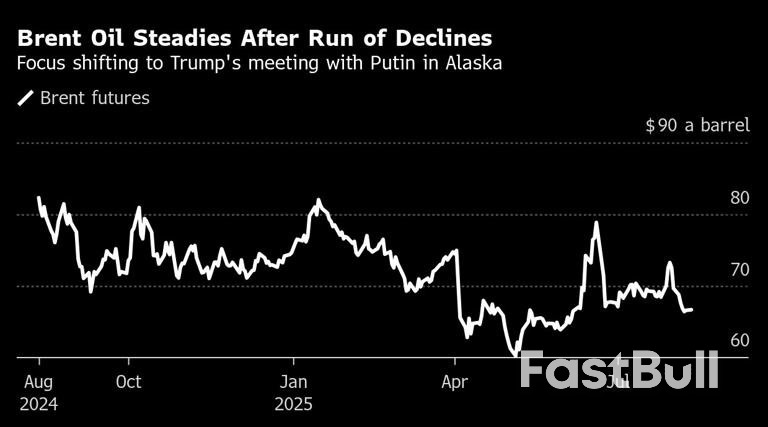
          Brent traded near $67 a barrel, after sliding 4.4% last week. On Friday, Trump didn’t reveal additional measures against Moscow or buyers of its crude as he announced a summit with Russian President Vladimir Putin in Alaska. He had earlier declared an Aug. 8 deadline for the Kremlin to reach a ceasefire.
          US and Russian officials are working toward an agreement that would lock in Moscow’s occupation of territory seized during its military invasion, according to people familiar with the matter. The US is working to get buy-in from Ukraine and its European allies on the deal, which is far from certain, they said.
          Oil Holds Near $67 as Traders Look Ahead to Trump-Putin Meet_1

          Brent Oil Steadies After Run of Declines | Focus shifting to Trump's meeting with Putin in Alaska

          Oil has lost more than 10% this year as OPEC+ brings back production faster than initially planned, ending curbs made in 2023, even as slowing economic growth threatens to cut consumption. A peace deal with Ukraine could see an end to sanctions on supply from Russia, removing the risk of disruption to Moscow’s flows after Trump’s comments in recent weeks that he would put measures in place against its biggest buyers.
          “This is not a deal which will be closed on Friday, but rather the start of a process,” said Bjarne Schieldrop, chief commodities analyst at SEB AB. “Trump is very, very unlikely to slap sanctions on Russian oil while this process is ongoing, i.e. no disruption of Russian oil in sight.”
          Investors may get further insight into the supply-demand balance later this week, with the Organization of the Petroleum Exporting Countries set to release its monthly market analysis and the US Energy Information Administration its Short-Term Energy Outlook on Tuesday. The International Energy Agency is due to publish its monthly report on Wednesday.

          Source: Bloomberg

          Risk Warnings and Disclaimers
          You understand and acknowledge that there is a high degree of risk involved in trading. Following any strategies or investment methods may lead to potential losses. The content on the site is provided by our contributors and analysts for information purposes only. You are solely responsible for determining whether any trading assets, securities, strategy, or any other product is suitable for investing based on your own investment objectives and financial situation.
          Add to Favorites
          Share

          Futures higher; data wave incoming this week - what’s moving markets

          Adam

          Stocks

          U.S. stock futures climb ahead of week of major economic data releases that could help determine the trajectory of interest rates in the coming months. Meanwhile, artificial intelligence remains front of mind for investors, contributing to a spike in the tech-heavy Nasdaq Composite to a new record closing high last week. AI-darling Nvidia promises to give the U.S. government a cut of its sales in China, media reports say, while enterprise AI application software group C3.ai unveils a preliminary earnings statement that falls short analysts’ expectations.

          Futures higher

          U.S. stock futures rose on Monday, as investors geared up for a week filled with key economic data points and assessed the staying power of a boom in enthusiasm around artificial intelligence.
          By 03:00 ET (07:00 GMT), the Dow futures contract had risen by 108 points, or 0.2%, S&P 500 futures had gained 12 points, or 0.2%, and Nasdaq 100 futures had advanced by 37 points, or 0.2%.
          The tech-heavy Nasdaq Composite jumped in the prior session, closing at a fresh all-time high, while other major averages also climbed.
          Underpinning the Nasdaq’s new peak was a rally in Apple, with the iPhone-maker’s stock price surging by more than 13% last week -- its largest weekly gain since 2020 -- thanks in part to hopes that the company’s vow to plug additional investment into the U.S. will allow it to evade much of President Donald Trump’s sweeping tariffs. The benchmark S&P 500’s tech and communication services indices also ended at fresh highs.
          Meanwhile, expectations that recent signs of slowing in the U.S. labor market will lead the Federal Reserve to cut interest rates at its next gathering in September offered further support to equities (more below).

          Nvidia promises to give cut of China AI chip sales to U.S. government - reports

          Nvidia is reportedly set to pay the U.S. government 15% of the returns it makes from the sale of its artificial intelligence to China, according to several media reports.
          Citing people familiar with the matter, the reports said Nvidia CEO Jensen Huang met with President Trump at the White House last week and agreed to grant Washington a cut of the money it rakes in from its business in the large -- and lucrative -- Chinese market.
          Peer Advanced Micro Devices has also agreed to the same deal, the reports said.
          Nvidia was reportedly given licenses by the Commerce Department to begin sales of its China-specialized H20 AI chip two days after the meeting, even though the White House said one month ago it had granted the company a green light to sell the processors in the country.

          C3.ai shares plummet

          Shares of C3.ai (NYSE:AI) were sharply lower in extended hours trading after the enterprise AI application software group issued a disappointing preliminary earnings announcement.
          The statement, released after the close of markets on Friday, showed that the firm now anticipates total revenue for its fiscal first quarter will between $70.2 million to $70.4 million, while its adjusted loss would be $57.7 million to $57.9 million.
          Analysts had been anticipating quarterly revenue of $104 million and an operating loss of $27.3 million. C3.ai added that it is also completing a restructuring of its sales and services organization.
          The Redwood, California-based firm will release its complete results for the period on September 3.

          Data ahead this week

          On the economic calendar, traders will be keeping particularly close tabs on the release of U.S. consumer price data for July on Tuesday.
          A separate gauge of producer prices for final demand is due out on Thursday, while a metric of American retail sales and a survey of consumer sentiment are expected to be published on Friday.
          Along with the labor market, inflation remains the other crucial pillar of the Federal Reserve’s two-pronged mandate. The outlook for rates has been complicated by data earlier this month which showed weak job growth in July and a sharp downward revision to the numbers for June and May -- all indications of a cooling labor market which may bolster the case for rate cuts that could fuel investment and spending.
          Yet, at the same time, inflation has remained stubbornly elevated above the Fed’s stated 2% target, driving worries that a reduction in borrowing costs could spur inflationary pressures.

          Fed’s Bowman backs rate cuts

          Against this backdrop, the Fed has largely adopted a "wait-and-see" attitude to rate decisions, opting instead for more clarity to emerge around the impact of Trump’s tariffs on the broader economy.
          However, cracks have started to appear amongst Fed policymakers, with media reports suggesting that many officials are becoming more open to the idea of impending cuts. This after two Fed rate-setters dissented from the majority at the Fed’s July gathering, arguing instead for reductions.
          One of those dissenters, Fed Governor Michelle Bowman, reiterated this stance in a speech on Saturday, saying the July jobs report had underscored her worries around the state of the labor market. In effect, she argued, the softness in the jobs picture has outweighed any fears around spiking price gains.
          The comments come as Trump has been frequently calling on the Fed to quickly ratchet down rates -- a campaign that has made Fed Chair Jerome Powell a particular recipient of the president’s ire and raised doubts around the longstanding independence of the central bank.

          Source: investing

          Risk Warnings and Disclaimers
          You understand and acknowledge that there is a high degree of risk involved in trading. Following any strategies or investment methods may lead to potential losses. The content on the site is provided by our contributors and analysts for information purposes only. You are solely responsible for determining whether any trading assets, securities, strategy, or any other product is suitable for investing based on your own investment objectives and financial situation.
          Add to Favorites
          Share

          Dollar Steady Before US Inflation Report, US-China Tariff Deadline

          Thomas

          Economic

          The U.S. dollar was consolidating on Monday before Tuesday's deadline for Washington and Beijing to strike a tariff deal and a key U.S. inflation report that could help determine whether the Federal Reserve lowers borrowing costs next month.

          The dollar index was up less than 0.1% to 98.30 after last week's 0.4% fall. Against the yen, the U.S. currency traded at 147.87 , up 0.1%. Japanese markets were closed on Monday for the Mountain Day holiday.The euro was down less than 0.1% at $1.1636, while sterling was down 0.2% at $1.3435.

          The dollar softened last week as investors adjusted their expectations for interest rate cuts from the Fed after soft data on U.S. jobs and manufacturing.

          Fed officials have sounded increasingly uneasy about the labour market, signalling their openness to a rate cut as soon as September.Cooling inflation could cement bets for a cut next month, but if signs emerge that U.S. President Donald Trump's tariffs are fuelling price rises, that might keep the Fed on hold for now.

          "It's important to note ahead of tomorrow's data that the bar for a hawkish surprise is higher," said Francesco Pesole, FX strategist at ING.

          Pesole added that a 0.3% monthly rise in core CPI would give the Fed room to lower interest rates, given the deterioration in the labour market.

          Economists polled by Reuters expect core CPI to have risen 0.3% in July, pushing the annual rate higher to 3%.

          Money market traders are pricing in around a 90% chance of a rate cut next month, while 58 basis points of easing are priced in by year-end, implying two quarter-point cuts and around a one-in-three chance of a third.

          Personnel moves at the Fed have also weighed on the dollar recently. Trump is preparing to install rate-setters that support his dovish views on monetary policy, including a new chair for when Jerome Powell's term ends in May.

          Trade talks were also in focus as Trump's August 12 deadline for a deal between the U.S. and China neared, particularly on chip policy."The market has fully priced in the idea that we're going to get an extension," said Chris Weston, head of research at Pepperstone Group Ltd in Melbourne, adding that another 90-day truce was most likely.

          With the U.S. and China seeking to close a deal averting triple-digit goods tariffs, a U.S. official told Reuters that chip makers Nvidia (NVDA.O), opens new tab and AMD (AMD.O), opens new tab had agreed to allocate 15% of China sales revenues to the U.S. government, aiming to secure export licences for semiconductors. "I don't know if that's going to be a good thing or a bad thing, but if it puts closure on the matter, it's not a bad outcome," Weston said.

          "If this is Trump saying 15% and we'll call it a day, that may not be too bad."

          The offshore yuan fluctuated between gains and losses, trading at 7.1913 to the dollar, after weekend data showed China's producer prices fell more than expected in July, while consumer prices were unchanged. The Australian dollar fetched $0.6514 , trading down 0.2% ahead of a rate decision on Tuesday, in which it is widely expected that the Reserve Bank of Australia will cut rates by 25 bps to 3.60%, after second-quarter inflation came in weaker than expected and the jobless rate hit a 3-1/2-year high.

          Cryptocurrencies jumped, with bitcoin rising as high as $122,308, not far from its July 14 record of $123,153.22, after Trump's executive order on Thursday freed up cryptocurrency holdings in U.S. retirement accounts.

          Ether rose as high as $4,346.01, its highest since December 2021.

          Source: Kitco

          To stay updated on all economic events of today, please check out our Economic calendar
          Risk Warnings and Disclaimers
          You understand and acknowledge that there is a high degree of risk involved in trading. Following any strategies or investment methods may lead to potential losses. The content on the site is provided by our contributors and analysts for information purposes only. You are solely responsible for determining whether any trading assets, securities, strategy, or any other product is suitable for investing based on your own investment objectives and financial situation.
          Add to Favorites
          Share

          Norges Bank Preview: No Surprises This Time

          ING

          Economic

          Forex

          Political

          Inflation endorses pause expectations

          In June, we made the case for Norges Bank to start cutting rates, but defaulted to the consensus call for a hold as we had doubts that policymakers would go against market pricing. Markets were taken entirely by surprise by the June cut.

          The implied chance of a cut at the 14 August meeting is also close to zero, but this time the chances of a surprise are also much lower, in our view. The main reason is underlying inflation, which had moderated to 2.8% in May but then jumped back to 3.1% in June and July. Swings in headline CPI appear less relevant for Norges Bank, but the acceleration to 3.3% in July further endorses the case for a hold.

          NOK is also being watched quite closely by the central bank, and the 4% trade-weighted decline since June is a hawkish argument. One final reason for a pause is the vicinity to the 8 September parliamentary vote in Norway, where the latest polls place a centre-left coalition slightly ahead. Central banks often tend to tread a bit more carefully before electoral events. Thursday’s meeting is an interim one, with only a short statement published and no economic projection update.

          NOK has room to recover

          Markets are fully pricing in a September cut and an 80% chance of a follow-up reduction in December. This is in line with our forecast, but we admit that the risks are becoming more skewed to just one cut by year-end, as inflation has surprised on the upside and the krone’s underperformance both warrant caution with rate cuts.

          EUR/NOK has re-approached 12.00, with the euro’s idiosyncratic strength and oil price declines both contributing to keeping the pair supported. Rallies beyond 12.00 generally prove unsustainable in the pair, and given markets are largely pricing in the Norges Bank easing cycle, we don’t see major downside risks for NOK. We also think Norges Bank might deliver a slightly more hawkish tone at this meeting.The economic and rate fundamentals underpinning a lower EUR/NOK call remain intact, in our view, and we still expect a return to 11.60-11.70 by year-end.

          Source: ING

          To stay updated on all economic events of today, please check out our Economic calendar
          Risk Warnings and Disclaimers
          You understand and acknowledge that there is a high degree of risk involved in trading. Following any strategies or investment methods may lead to potential losses. The content on the site is provided by our contributors and analysts for information purposes only. You are solely responsible for determining whether any trading assets, securities, strategy, or any other product is suitable for investing based on your own investment objectives and financial situation.
          Add to Favorites
          Share

          Europe Midday: Stocks Mostly Weaker; Oersted Tumbles on Rights Issue Ask ChatGPT

          Warren Takunda

          Economic

          London stocks were still in the black by midday on Monday amid hopes of an end to the Ukraine conflict, but gains were muted as investors eyed key UK jobs and GDP data and the latest US inflation print this week.
          The FTSE 100 was up 0.3% at 9,122.04 .
          Sentiment was boosted after US President Donald Trump said on Friday that he will meet Russian president Vladimir Putin in Alaska at the end of this week to negotiate an end to the war.
          On the macro front, there were no releases of note due on Monday, but Tuesday brings the latest UK jobs numbers, while in the US, consumer price inflation figures for July are due.
          Commenting on the UK jobs data, Richard Hunter, head of markets at Interactive Investor, said that on the one hand, low expectations for the numbers could serve both to vindicate the Bank of England’s knife-edge decision to cut interest rates last week and to provide some room for manoeuvre in beating these estimates.
          "By the same token, the interest rate decision has brought the likelihood of further cuts into question given the stickiness of inflation, despite the economy showing few signs of meaningful progress as it continues to reel from previous Budget moves," he said.
          "More broadly, the meeting between Trump and Putin later in the week has been taken as a sign that the Ukraine conflict could be nearing an end. The oil price has drifted further as a result on the back of potentially increased supply, bringing its decline so far this year to 11% and putting some slight pressure on the oil majors.
          "The defence sector has also taken a hit on the basis of a lesser need for spending, although the measures already announced are unlikely to be dialled back."
          As far as Tuesday’s US CPI is concerned, Hunter said that if it comes in hotter than expected, there could be some "violent adverse reaction, not least of which because it could bring the Federal Reserve’s apparently obvious decision to cut next month into question".
          In equity markets, Marks & Spencer jumped to the top of the FTSE 100 after announcing over the weekend that its click & collect service has been restored following the recent cyber attack.
          Diversified Energy rallied after solid second-quarter results.
          On the downside, fintech business Plus500 tumbled even as it posted an uptick in first-half profit and revenue and said customer deposits more than doubled year-on-year.
          Marshalls slumped as it posted a drop in first-half profit, slashed its dividend and said it does not expect any improvement in market activity levels through the remainder of 2025.
          Oxford Nanopore fell as it said chief executive officer Gordon Sanghera plans to step down after more than 20 years in the role.
          Outside the FTSE 350, Martin Sorrell’s S4 Capital shot up as it confirmed it has received a proposal from MSQ, a creative and technology agency owned by One Equity Partners, about a possible combination.
          Responding to media speculation, the ad agency said discussions are at a "very preliminary" stage and there can be no certainty that a transaction will be forthcoming.
          Gemfields also rose agreeing to sell iconic luxury brand Fabergé to SMG Capital LLC for $50m. SMG Capital is a US-based investment company owned by tech entrepreneur and venture capital Sergei Mosunov.

          Source: Sharecast

          To stay updated on all economic events of today, please check out our Economic calendar
          Risk Warnings and Disclaimers
          You understand and acknowledge that there is a high degree of risk involved in trading. Following any strategies or investment methods may lead to potential losses. The content on the site is provided by our contributors and analysts for information purposes only. You are solely responsible for determining whether any trading assets, securities, strategy, or any other product is suitable for investing based on your own investment objectives and financial situation.
          Add to Favorites
          Share
          FastBull
          Copyright © 2025 FastBull Ltd

          728 RM B 7/F GEE LOK IND BLDG NO 34 HUNG TO RD KWUN TONG KLN HONG KONG

          TelegramInstagramTwitterfacebooklinkedin
          App Store Google Play Google Play
          Products
          Charts

          Chats

          Q&A with Experts
          Screeners
          Economic Calendar
          Data
          Tools
          Membership
          Features
          Function
          Markets
          Copy Trading
          Latest Signals
          Contests
          News
          Analysis
          24/7
          Columns
          Education
          Company
          Careers
          About Us
          Contact Us
          Advertising
          Help Center
          Feedback
          User Agreement
          Privacy Policy
          Personal Information Protection Statement
          Business

          White Label

          Data API

          Web Plug-ins

          Poster Maker

          Affiliate Program

          Risk Disclosure

          The risk of loss in trading financial instruments such as stocks, FX, commodities, futures, bonds, ETFs and crypto can be substantial. You may sustain a total loss of the funds that you deposit with your broker. Therefore, you should carefully consider whether such trading is suitable for you in light of your circumstances and financial resources.

          No decision to invest should be made without thoroughly conducting due diligence by yourself or consulting with your financial advisors. Our web content might not suit you since we don't know your financial conditions and investment needs. Our financial information might have latency or contain inaccuracy, so you should be fully responsible for any of your trading and investment decisions. The company will not be responsible for your capital loss.

          Without getting permission from the website, you are not allowed to copy the website's graphics, texts, or trademarks. Intellectual property rights in the content or data incorporated into this website belong to its providers and exchange merchants.

          Not Logged In

          Log in to access more features

          FastBull Membership

          Not yet

          Purchase

          Become a signal provider
          Help Center
          Customer Service
          Dark Mode
          Price Up/Down Colors

          Log In

          Sign Up

          Position
          Layout
          Fullscreen
          Default to Chart
          The chart page opens by default when you visit fastbull.com