• Trade
  • Markets
  • Copy
  • Contests
  • News
  • 24/7
  • Calendar
  • Q&A
  • Chats
Trending
Screeners
SYMBOL
LAST
BID
ASK
HIGH
LOW
NET CHG.
%CHG.
SPREAD
SPX
S&P 500 Index
6827.42
6827.42
6827.42
6899.86
6801.80
-73.58
-1.07%
--
DJI
Dow Jones Industrial Average
48458.04
48458.04
48458.04
48886.86
48334.10
-245.98
-0.51%
--
IXIC
NASDAQ Composite Index
23195.16
23195.16
23195.16
23554.89
23094.51
-398.69
-1.69%
--
USDX
US Dollar Index
97.950
98.030
97.950
98.500
97.950
-0.370
-0.38%
--
EURUSD
Euro / US Dollar
1.17394
1.17409
1.17394
1.17496
1.17192
+0.00011
+ 0.01%
--
GBPUSD
Pound Sterling / US Dollar
1.33707
1.33732
1.33707
1.33997
1.33419
-0.00148
-0.11%
--
XAUUSD
Gold / US Dollar
4299.39
4299.39
4299.39
4353.41
4257.10
+20.10
+ 0.47%
--
WTI
Light Sweet Crude Oil
57.233
57.485
57.233
58.011
56.969
-0.408
-0.71%
--

Community Accounts

Signal Accounts
--
Profit Accounts
--
Loss Accounts
--
View More

Become a signal provider

Sell trading signals to earn additional income

View More

Guide to Copy Trading

Get started with ease and confidence

View More

Signal Accounts for Members

All Signal Accounts

Best Return
  • Best Return
  • Best P/L
  • Best MDD
Past 1W
  • Past 1W
  • Past 1M
  • Past 1Y

All Contests

  • All
  • Trump Updates
  • Recommend
  • Stocks
  • Cryptocurrencies
  • Central Banks
  • Featured News
Top News Only
Share

USA Embassy In Lithuania: Maria Kalesnikava Is Not Going To Vilnius

Share

USA Embassy In Lithuania: Other Prisoners Are Being Sent From Belarus To Ukraine

Share

Ukraine President Zelenskiy: Five Ukrainians Released By Belarus In US-Brokered Deal

Share

USA Vilnius Embassy: USA Stands Ready For "Additional Engagement With Belarus That Advances USA Interests"

Share

USA Vilnius Embassy: Belarus, USA, Other Citizens Among The Prisoners Released Into Lithuania

Share

USA Vilnius Embassy: USA Will Continue Diplomatic Efforts To Free The Remaining Political Prisoners In Belarus

Share

USA Vilnius Embassy: Belarus Releases 123 Prisoners Following Meeting Of President Trump's Envoy Coale And Belarus President Lukashenko

Share

USA Vilnius Embassy: Masatoshi Nakanishi, Aliaksandr Syrytsa Are Among The Prisoners Released By Belarus

Share

USA Vilnius Embassy: Maria Kalesnikava And Viktor Babaryka Are Among The Prisoners Released By Belarus

Share

USA Vilnius Embassy: Nobel Peace Prize Laureate Ales Bialiatski Is Among The Prisoners Released By Belarus

Share

Belarusian Presidential Administration Telegram Channel: Lukashenko Has Pardoned 123 Prisoners As Part Of Deal With US

Share

Two Local Syrian Officials: Joint US-Syrian Military Patrol In Central Syria Came Under Fire From Unknown Assailants

Share

Israeli Military Says It Targeted 'Key Hamas Terrorist' In Gaza City

Share

Rwanda's Actions In Eastern Drc Are A Clear Violation Of Washington Accords Signed By President Trump - Secretary Of State Rubio

Share

Israeli Military Issues Evacuation Warning In Southern Lebanon Village Ahead Of Strike - Spokesperson On X

Share

Belarusian State Media Cites US Envoy Coale As Saying He Discussed Ukraine And Venezuela With Lukashenko

Share

Belarusian State Media Cites US Envoy Coale As Saying That US Removes Sanctions On Belarusian Potassium

Share

Thai Prime Minister: No Ceasefire Agreement With Cambodia

Share

US, Ukraine To Discuss Ceasefire In Berlin Ahead Of European Summit

Share

Incoming Czech Prime Minister Babis: Czech Republic Will Not Take On Guarantees For Ukraine Financing, European Commission Must Find Alternatives

TIME
ACT
FCST
PREV
U.K. Trade Balance Non-EU (SA) (Oct)

A:--

F: --

P: --

U.K. Trade Balance (Oct)

A:--

F: --

P: --

U.K. Services Index MoM

A:--

F: --

P: --

U.K. Construction Output MoM (SA) (Oct)

A:--

F: --

P: --

U.K. Industrial Output YoY (Oct)

A:--

F: --

P: --

U.K. Trade Balance (SA) (Oct)

A:--

F: --

P: --

U.K. Trade Balance EU (SA) (Oct)

A:--

F: --

P: --

U.K. Manufacturing Output YoY (Oct)

A:--

F: --

P: --

U.K. GDP MoM (Oct)

A:--

F: --

P: --

U.K. GDP YoY (SA) (Oct)

A:--

F: --

P: --

U.K. Industrial Output MoM (Oct)

A:--

F: --

P: --

U.K. Construction Output YoY (Oct)

A:--

F: --

P: --

France HICP Final MoM (Nov)

A:--

F: --

P: --

China, Mainland Outstanding Loans Growth YoY (Nov)

A:--

F: --

P: --

China, Mainland M2 Money Supply YoY (Nov)

A:--

F: --

P: --

China, Mainland M0 Money Supply YoY (Nov)

A:--

F: --

P: --

China, Mainland M1 Money Supply YoY (Nov)

A:--

F: --

P: --

India CPI YoY (Nov)

A:--

F: --

P: --

India Deposit Gowth YoY

A:--

F: --

P: --

Brazil Services Growth YoY (Oct)

A:--

F: --

P: --

Mexico Industrial Output YoY (Oct)

A:--

F: --

P: --

Russia Trade Balance (Oct)

A:--

F: --

P: --

Philadelphia Fed President Henry Paulson delivers a speech
Canada Building Permits MoM (SA) (Oct)

A:--

F: --

P: --

Canada Wholesale Sales YoY (Oct)

A:--

F: --

P: --

Canada Wholesale Inventory MoM (Oct)

A:--

F: --

P: --

Canada Wholesale Inventory YoY (Oct)

A:--

F: --

P: --

Canada Wholesale Sales MoM (SA) (Oct)

A:--

F: --

P: --

Germany Current Account (Not SA) (Oct)

A:--

F: --

P: --

U.S. Weekly Total Rig Count

A:--

F: --

P: --

U.S. Weekly Total Oil Rig Count

A:--

F: --

P: --

Japan Tankan Large Non-Manufacturing Diffusion Index (Q4)

--

F: --

P: --

Japan Tankan Small Manufacturing Outlook Index (Q4)

--

F: --

P: --

Japan Tankan Large Non-Manufacturing Outlook Index (Q4)

--

F: --

P: --

Japan Tankan Large Manufacturing Outlook Index (Q4)

--

F: --

P: --

Japan Tankan Small Manufacturing Diffusion Index (Q4)

--

F: --

P: --

Japan Tankan Large Manufacturing Diffusion Index (Q4)

--

F: --

P: --

Japan Tankan Large-Enterprise Capital Expenditure YoY (Q4)

--

F: --

P: --

U.K. Rightmove House Price Index YoY (Dec)

--

F: --

P: --

China, Mainland Industrial Output YoY (YTD) (Nov)

--

F: --

P: --

China, Mainland Urban Area Unemployment Rate (Nov)

--

F: --

P: --

Saudi Arabia CPI YoY (Nov)

--

F: --

P: --

Euro Zone Industrial Output YoY (Oct)

--

F: --

P: --

Euro Zone Industrial Output MoM (Oct)

--

F: --

P: --

Canada Existing Home Sales MoM (Nov)

--

F: --

P: --

Euro Zone Total Reserve Assets (Nov)

--

F: --

P: --

U.K. Inflation Rate Expectations

--

F: --

P: --

Canada National Economic Confidence Index

--

F: --

P: --

Canada New Housing Starts (Nov)

--

F: --

P: --

U.S. NY Fed Manufacturing Employment Index (Dec)

--

F: --

P: --

U.S. NY Fed Manufacturing Index (Dec)

--

F: --

P: --

Canada Core CPI YoY (Nov)

--

F: --

P: --

Canada Manufacturing Unfilled Orders MoM (Oct)

--

F: --

P: --

Canada Manufacturing New Orders MoM (Oct)

--

F: --

P: --

Canada Core CPI MoM (Nov)

--

F: --

P: --

Canada Manufacturing Inventory MoM (Oct)

--

F: --

P: --

Canada CPI YoY (Nov)

--

F: --

P: --

Canada CPI MoM (Nov)

--

F: --

P: --

Canada CPI YoY (SA) (Nov)

--

F: --

P: --

Canada Core CPI MoM (SA) (Nov)

--

F: --

P: --

Q&A with Experts
    • All
    • Chatrooms
    • Groups
    • Friends
    Connecting
    .
    .
    .
    Type here...
    Add Symbol or Code

      No matching data

      All
      Trump Updates
      Recommend
      Stocks
      Cryptocurrencies
      Central Banks
      Featured News
      • All
      • Russia-Ukraine Conflict
      • Middle East Flashpoint
      • All
      • Russia-Ukraine Conflict
      • Middle East Flashpoint
      Search
      Products

      Charts Free Forever

      Chats Q&A with Experts
      Screeners Economic Calendar Data Tools
      Membership Features
      Data Warehouse Market Trends Institutional Data Policy Rates Macro

      Market Trends

      Market Sentiment Order Book Forex Correlations

      Top Indicators

      Charts Free Forever
      Markets

      News

      News Analysis 24/7 Columns Education
      From Institutions From Analysts
      Topics Columnists

      Latest Views

      Latest Views

      Trending Topics

      Top Columnists

      Latest Update

      Signals

      Copy Rankings Latest Signals Become a signal provider AI Rating
      Contests
      Brokers

      Overview Brokers Assessment Rankings Regulators News Claims
      Broker listing Forex Brokers Comparison Tool Live Spread Comparison Scam
      Q&A Complaint Scam Alert Videos Tips to Detect Scam
      More

      Business
      Events
      Careers About Us Advertising Help Center

      White Label

      Data API

      Web Plug-ins

      Affiliate Program

      Awards Institution Evaluation IB Seminar Salon Event Exhibition
      Vietnam Thailand Singapore Dubai
      Fans Party Investment Sharing Session
      FastBull Summit BrokersView Expo
      Recent Searches
        Top Searches
          Markets
          News
          Analysis
          User
          24/7
          Economic Calendar
          Education
          Data
          • Names
          • Latest
          • Prev

          View All

          No data

          Scan to Download

          Faster Charts, Chat Faster!

          Download App
          English
          • English
          • Español
          • العربية
          • Bahasa Indonesia
          • Bahasa Melayu
          • Tiếng Việt
          • ภาษาไทย
          • Français
          • Italiano
          • Türkçe
          • Русский язык
          • 简中
          • 繁中
          Open Account
          Search
          Products
          Charts Free Forever
          Markets
          News
          Signals

          Copy Rankings Latest Signals Become a signal provider AI Rating
          Contests
          Brokers

          Overview Brokers Assessment Rankings Regulators News Claims
          Broker listing Forex Brokers Comparison Tool Live Spread Comparison Scam
          Q&A Complaint Scam Alert Videos Tips to Detect Scam
          More

          Business
          Events
          Careers About Us Advertising Help Center

          White Label

          Data API

          Web Plug-ins

          Affiliate Program

          Awards Institution Evaluation IB Seminar Salon Event Exhibition
          Vietnam Thailand Singapore Dubai
          Fans Party Investment Sharing Session
          FastBull Summit BrokersView Expo

          Modi Is $20 Trillion Short On His Grand Plan For India's Economy

          Samantha Luan

          Economic

          Summary:

          To reach developed status by 2047, the country would need a sixfold increase in GDP.

          In an August 2022 speech delivered at the historic Red Fort in New Delhi, Prime Minister Narendra Modi made a bold pledge: India will be a developed country by 2047.
          The annual Independence Day address is often big on promises and grand visions, so the pronouncement didn’t stand out at the time. Yet more than a year later, the phrase Viksit Bharat—or Developed India—has come to define Modi’s economic vision for a likely third term in office in national elections that began on April 19 and run through June 1.
          The phrase has cropped up in at least 23 of the 29 official speeches Modi has made since March. His Bharatiya Janata Party highlights the goal prominently on the first page of its 76-page election manifesto and goes on to mention it 11 more times. It also regularly surfaces in presentations by government ministers and has filtered into policy documents. Central bank staff members have published their own road map for reaching it.
          “This decade is crucial for fulfilling the dreams of a Viksit Bharat,” Modi said at an event in March. “This decade is about fulfilling those aspirations that once seemed impossible to the people.”
          There’s no standard definition of a developed country and Modi hasn’t announced any specific targets, making it difficult for economists to assess India’s chances of meeting his goal.
          The World Bank ranks countries from low to high income. Analysts at Oxford Economics crunched the numbers and concluded that India would need to raise per capita income levels from $2,434 last year to $13,845, based on 2023 prices, to attain high-income status by the centenary of its independence from Britain. This would require boosting gross domestic product more than sixfold, to about $23 trillion, which would necessitate economic growth of at least 8% a year for the next quarter century.
          Modi’s target “is highly ambitious,” says Alexandra Hermann, Oxford Economics’ lead economist, in an email. “Never say never, but our own forecasts are for the economy to grow by 6.6% per year on average over the next five years, with the pace of expansion slowing over the medium term as the economy develops further.”
          Modi Is $20 Trillion Short On His Grand Plan For India's Economy_1
          Even though India’s economy grew more than 7% in the fiscal year that ended in March and is expected to match that in the current one, achieving a consistent 8% pace would be extremely difficult. China was one of the few countries to manage it—growing an average of 10% a year for about three decades after it initiated economic reforms in the late 1970s—yet the World Bank still classes it as an upper-middle-income country.
          “Given that India has never consistently achieved 8% growth per year, I think it’s pie in the sky,” says Tom Miller, a senior analyst at Gavekal Research, in an email. “India is more financially constrained than China was, and nor is its economy structured to grow through massive China-style investments.”
          That doesn’t mean India can’t grow fairly rapidly and “develop successfully over the next quarter century, which is what actually matters,” rather than meeting some arbitrary target, he says.
          China’s per capita income stood at $12,720 as of 2022, according to the World Bank. President Xi Jinping’s target is to make China a “medium-developed country” by 2035—a goal that is also not clearly defined but which economists say implies a doubling in the size of GDP from 2020 levels.
          The United Nations’ Human Development Index, which takes into account health and education metrics, along with other measures of quality of life, is often used as a yardstick to measure a country’s prosperity beyond income levels. By that gauge, India currently ranks as medium level, with an index level of 0.64. A country is generally considered developed with an index above 0.8.
          Modi Is $20 Trillion Short On His Grand Plan For India's Economy_2
          Among India’s biggest challenges will be improving its education system and providing more jobs for the millions of young people who enter the labor market every year. Research from the International Labour Organization shows that almost a third of university graduates in India are unemployed, a level almost nine times higher than for those who can’t read or write. More than half of the population of 1.4 billion is below the age of 30.
          Raghuram Rajan, India’s former central bank governor and now a professor at the University of Chicago Booth School of Business, has said it’s “nonsense” to talk about being a developed economy without improving the quality of education and addressing high dropout rates. Modi’s supporters and government officials roundly criticized Rajan on social media for his views.
          Viksit Bharat is less about hard targets and more about tapping into the aspirational spirit of Indians who see their country growing in stature globally, says Milan Vaishnav, director and senior fellow of the South Asia Program at the Carnegie Endowment for International Peace.
          “Modi has cast himself as a transformational leader and, as a result, he requires a transformational ambition,” he says. “Even if India does not achieve the benchmarks Modi has laid out, few will fault him for setting a marker down.”
          In his close to 10 years as prime minister, Modi has rolled out several campaigns to boost India’s stature. His administration’s Make in India program, which aims to turn the country into a world-class manufacturing hub to rival China, is credited with helping increase annual foreign direct investment by more than 40% since 2014. Besides lobbying US businesses such as Apple Inc. and Tesla Inc. to expand or open factories in India, his government also has courted investors in the Middle East. As chair of the Group of 20 countries last year, Modi positioned India as the voice of the so-called Global South of developing countries.
          While officials have not publicized economic targets to reach the 2047 goal, internal estimates by the Finance Ministry project the economy will reach $6.69 trillion by 2030 and $29.02 trillion by 2047, before adjusting for inflation, according to people familiar with the figures. In the next six years, Modi’s goal is to double per capita income, to $4,418, they said, asking not to be identified because the discussions are private.
          “Leaders like Modi love coming up with grand development targets, especially when they are lapped up by domestic audiences,” says Miller of Gavekal Research. “Yes, it’s good to be ambitious—and China, for one, has used targets to direct policymaking. But I don’t put much store in the target date itself.”

          Source:Bloomberg

          To stay updated on all economic events of today, please check out our Economic calendar
          Risk Warnings and Disclaimers
          You understand and acknowledge that there is a high degree of risk involved in trading. Following any strategies or investment methods may lead to potential losses. The content on the site is provided by our contributors and analysts for information purposes only. You are solely responsible for determining whether any trading assets, securities, strategy, or any other product is suitable for investing based on your own investment objectives and financial situation.
          Add to Favorites
          Share

          [U.S.] March PCE: Services Inflation Is the Largest Driver of "Stubborn" Headline Inflation

          FastBull Featured

          Data Interpretation

          On April 26, local time, the U.S. Bureau of Economic Analysis (BEA) released its latest PCE report:
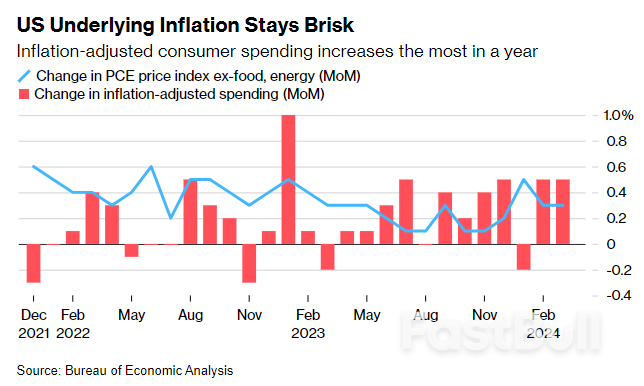
          The U.S. core PCE price index for March came in at an annual rate of 2.8%, compared to the expected 2.7% and the previous 2.8%.
          The U.S. core PCE price index for March came in at a monthly rate of 0.3%, compared to the expected 0.3% and the previous 0.3%.
          The U.S. PCE price index for March came in at an annual rate of 2.7%, compared to the expected 2.6% and the previous 2.5%.
          The U.S. PCE price index for March came in at a monthly rate of 0.3%, compared to the expected 0.3% and the previous 0.3%.
          The spending increased by US$160.9 billion in March, reflecting higher spending on services and goods.
          Within services, the largest contributors to the increase were health care (both outpatient and hospital services) and housing and utilities (led by housing). The largest contributors to growth in goods inflation were gasoline and other energy goods (led by motor vehicle fuels, lubricants, and fluids); followed by nondurable goods, which were led by recreational goods; and food and beverages.
          Compared to the previous month, the PCE price index rose 0.3% in March. Service prices rose 0.4%, and goods prices rose 0.1%. Food prices fell less than 0.1% and energy prices rose 1.2%. After that, the core PCE price (excluding food and energy) index rose 0.3%.
          Compared with the same month last year, the PCE price index rose 2.7% in March. Service prices rose 4.0% and goods prices rose 0.1%. Food prices rose 1.5% and energy prices rose 2.6%. Excluding food and energy, the PCE price index is up 2.8% from a year ago.
          Inflation data, which has been stronger than expected since the beginning of the year, has been weighing on inflation expectations. Fed Chairman Jerome Powell also recently changed his remarks. He "acknowledged that his way of thinking about inflation has limitations, and stronger inflation in March could delay a rate cut for a few months." And this higher-than-expected PCE inflation increases the likelihood of a delay again.
          After the latest PCE data, traders increased bets that the Fed will make its first rate cut in September, with a probability of 65%, up from 60% before the data was released.
          Seemingly, private domestic demand and inflation were strong in the first quarter, and the Fed will have reason to continue keeping rates unchanged. Looking ahead, however, more pronounced signs of weaker growth could still cause the Fed to cut rates before inflation continues to slow, due to the contradiction of economic activity and labor market data.
          That said, while the inflation report has once again dampened expectations for a rate cut, it would be a mistake to completely downplay the pricing of a rate cut for the rest of the year.

          U.S. PCE Report for March

          Risk Warnings and Disclaimers
          You understand and acknowledge that there is a high degree of risk involved in trading. Following any strategies or investment methods may lead to potential losses. The content on the site is provided by our contributors and analysts for information purposes only. You are solely responsible for determining whether any trading assets, securities, strategy, or any other product is suitable for investing based on your own investment objectives and financial situation.
          Add to Favorites
          Share

          Hong Kong Stocks Continue Upward Surge as Yen Sees Recovery

          Ukadike Micheal

          Economic

          Stocks

          Hong Kong's equity market surprised investors with its unexpected rally on Monday afternoon, marking a rare display of optimism in the city's financial landscape. The Hang Seng index, a key barometer of the Hong Kong stock market, surged by 0.8%, extending its gains for April to an impressive 7.6%. This performance solidified its position as the strongest performing major index for the second quarter of the year.
          The rally was driven by several factors, including positive sentiment surrounding Chinese property management and real estate development. Notably, companies like Country Garden Services and Longfor Group led the gains, reflecting investor confidence in these sectors. Additionally, insurance giant AIA witnessed a notable increase following reports of robust growth in new business, particularly in mainland China and Hong Kong.
          The resilience of Hong Kong's equity market amid global economic uncertainties underscores its attractiveness to investors seeking opportunities in the region. Despite geopolitical tensions and market volatility in other parts of the world, Hong Kong's stock market has demonstrated resilience, buoyed by strong fundamentals and investor confidence.
          In contrast, the Japanese yen experienced significant fluctuations in currency markets, reflecting broader uncertainties and speculation surrounding central bank interventions. The yen initially weakened past the ¥160 per dollar mark before rebounding, highlighting the challenges faced by currency traders amid shifting market dynamics.
          Looking beyond Hong Kong, other major stock markets in Asia also saw mixed performances. While the CSI 300 index in China posted a solid 1.2% gain for the day, maintaining its strong year-to-date performance of 5.7%, South Korea's Kospi index recorded a 1.1% increase, with a more modest YTD performance of 1.2%. In India, the Nifty 50 index saw a 0.5% daily change, reflecting a YTD performance of 3.7%.
          From a technical standpoint, the continuation of the equity rally in Hong Kong suggests underlying strength in the market, supported by positive earnings reports and economic indicators. However, investors remain vigilant amidst ongoing uncertainties, including the evolving COVID-19 situation, geopolitical tensions, and central bank policies.
          Hong Kong's unexpected equity rally underscores its resilience and attractiveness to investors, despite challenges in the global economic landscape. The market's performance reflects underlying optimism and confidence in the region's economic prospects. However, investors must remain cautious and adaptive in navigating the evolving market conditions, with a focus on prudent risk management and strategic decision-making.

          Source: Financial Times

          To stay updated on all economic events of today, please check out our Economic calendar
          Risk Warnings and Disclaimers
          You understand and acknowledge that there is a high degree of risk involved in trading. Following any strategies or investment methods may lead to potential losses. The content on the site is provided by our contributors and analysts for information purposes only. You are solely responsible for determining whether any trading assets, securities, strategy, or any other product is suitable for investing based on your own investment objectives and financial situation.
          Add to Favorites
          Share

          Spanish Inflation Picks Up Speed as Government Energy Assistance Expires

          Ukadike Micheal

          Economic

          Forex

          Spanish inflation accelerated for a second consecutive month in April, reaching a 3.4% rise from a year earlier, aligning with economists' expectations. This surge was attributed to the government's gradual withdrawal of support measures aimed at curbing surging energy costs. Core inflation, excluding energy and certain food items, experienced a sharper decline than anticipated, dropping to 2.9%, marking its lowest level since early 2022.
          The release of Spanish inflation figures initiates a wave of data releases across the eurozone. Later on Monday, German inflation is also projected to experience a slight uptick, while the overall eurozone inflation is anticipated to hold steady at 2.4%, marking the first time this year it hasn't seen an increase.
          The European Central Bank (ECB) has cautioned that inflation metrics are likely to fluctuate in the upcoming months due to base effects. Despite this, it is expected that policymakers will proceed with interest rate cuts at their June meeting. However, the trajectory beyond that remains uncertain. In April, the annual change in the flash estimate of the Consumer Price Index (CPI) stood at 3.3%, a slight increase from March's figure. Meanwhile, the annual rate of the flash indicator of underlying inflation experienced a decrease of four tenths, falling to 2.9%. Additionally, the annual rate of the flash indicator of the Harmonized Consumer Price Index (HCPI) reached 3.4%.
          From a technical perspective, the acceleration in Spanish inflation highlights the ongoing challenge posed by rising energy costs and the government's efforts to navigate through this economic landscape. This scenario not only affects consumer purchasing power but also raises concerns about potential spillover effects into other sectors of the economy. Investors are closely monitoring these developments as they assess the broader implications for market dynamics and investment strategies moving forward.
          In Spain, the removal of government support measures aimed at alleviating energy costs is particularly significant. These measures had previously acted as a buffer against the full impact of rising energy prices on consumers. However, as the government gradually withdraws this support, consumers are likely to feel the strain of higher energy bills more acutely, potentially leading to adjustments in spending habits and overall consumption patterns.
          Moreover, the dynamics of inflation in Spain are closely intertwined with broader economic trends within the eurozone. As one of the largest economies in the region, developments in Spain's inflationary environment can have ripple effects across the eurozone as a whole. Therefore, policymakers at both the national and supranational levels are closely monitoring these trends and adjusting their strategies accordingly.
          In addition to its immediate impact on consumer spending and economic activity, the acceleration in Spanish inflation also has implications for monetary policy. The ECB, tasked with maintaining price stability within the eurozone, faces the challenge of balancing its inflation objectives with broader economic considerations. The recent uptick in inflationary pressures may prompt the ECB to reassess its policy stance and consider additional measures to support economic recovery while keeping inflation in check.
          From an investor standpoint, the evolving inflationary environment in Spain and the eurozone at large introduces uncertainty into financial markets. Asset prices, including stocks, bonds, and currencies, may experience heightened volatility as market participants digest incoming data and adjust their expectations accordingly. Moreover, the prospect of changes in monetary policy by the ECB could further impact market sentiment and asset valuations.
          The latest data on Spanish inflation underscores the complexities facing policymakers and investors amid evolving economic conditions. While the government's measures to address soaring energy costs have influenced inflation dynamics, uncertainties loom over the sustainability of these efforts and their broader impact on the economy. As markets continue to digest this information, the path forward remains uncertain, requiring a nuanced approach to navigate through these uncertain times.

          Source: Bloomberg

          To stay updated on all economic events of today, please check out our Economic calendar
          Risk Warnings and Disclaimers
          You understand and acknowledge that there is a high degree of risk involved in trading. Following any strategies or investment methods may lead to potential losses. The content on the site is provided by our contributors and analysts for information purposes only. You are solely responsible for determining whether any trading assets, securities, strategy, or any other product is suitable for investing based on your own investment objectives and financial situation.
          Add to Favorites
          Share

          Natural Gas and Oil Forecast: Adjustments Amid 2.7% US Inflation; Time to Buy?

          Owen Li

          Commodity

          Economic

          Market Overview

          Oil prices declined in early Asian trading on Monday, undoing Friday’s gains as peace talks in Cairo between Israel and Hamas eased Middle East tensions and U.S. inflation data reduced hopes for near-term interest rate cuts. Potential cease-fire developments had an impact on this subdued market opening by easing geopolitical tensions, which typically drive up oil prices.
          High U.S. inflation rates at 2.7% for March, surpassing the Federal Reserve’s target, suggest persistently high interest rates, strengthening the U.S. dollar, and exerting downward pressure on commodity prices, including oil and natural gas.
          Moreover, slowing industrial profit growth in China indicates weaker domestic demand in a key market, potentially dampening energy demand further. However, fluctuations in U.S. inventory levels and China’s manufacturing activity could still drive oil prices up later in the week.

          Natural Gas Price Forecast

          Natural Gas and Oil Forecast: Adjustments Amid 2.7% US Inflation; Time to Buy?_1
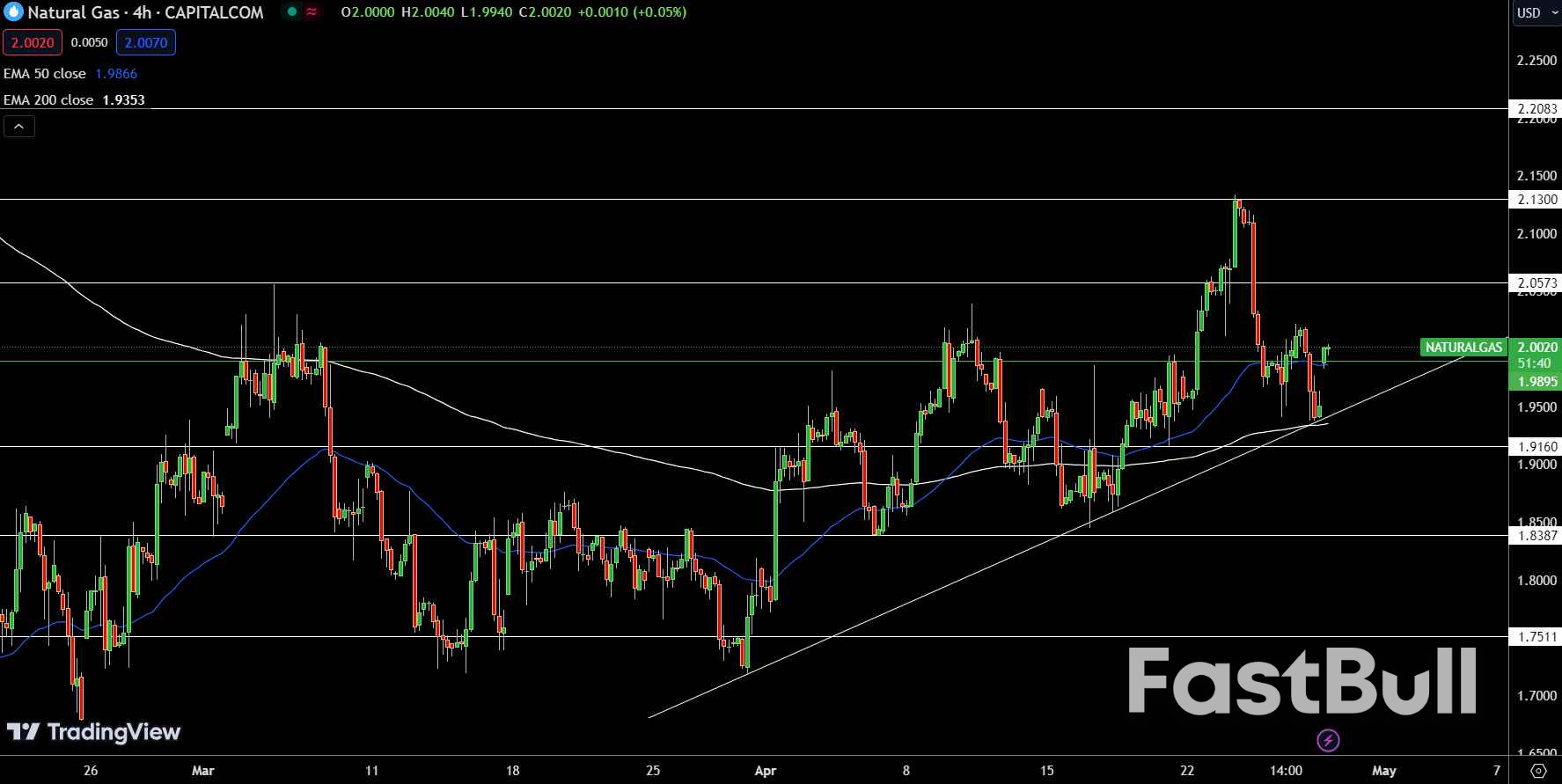
          Natural Gas (NG) is trading at $2.00 per MMBtu, marking a gain of 2.61% for the day. The commodity has surpassed its pivot point at $1.99, suggesting a potential continuation of the bullish trend. Resistance levels are staged at $2.06, $2.13, and $2.21.
          Should the price retreat, NG could find support at $1.92, with further potential pullbacks to $1.84 and $1.75. The technical setup is further supported by the 50-day Exponential Moving Average (EMA) exactly at the pivot point and the 200-day EMA at $1.94, both reinforcing the strength around these levels.
          Given this configuration, NG remains bullish above $1.99, but slipping below this threshold could precipitate a sharp decline, underscoring a volatile market prone to rapid shifts in sentiment.

          WTI Oil Price Forecast

          Natural Gas and Oil Forecast: Adjustments Amid 2.7% US Inflation; Time to Buy?_2
          USOIL is currently priced at $83.15, reflecting a decrease of 0.61%. The commodity is trading near the pivot point of $83.20, which is critical for determining its next directional move. If it sustains above this level, USOIL could encounter resistance at $84.85, followed by higher thresholds at $86.14 and $87.59.
          Conversely, a drop below the pivot could see the price testing support levels at $81.93, with further potential declines to $80.75 and $79.35.
          Technical indicators like the 50-day EMA at $83.28 and the 200-day EMA at $82.64 provide additional context, suggesting a slight bullish bias but cautioning that a break below $83.20 could initiate a sharper selling trend.

          Brent Oil Price Forecast

          Natural Gas and Oil Forecast: Adjustments Amid 2.7% US Inflation; Time to Buy?_3
          UKOIL is currently trading at $87.49, marking a decrease of 0.68%. The commodity is just below its pivot point of $87.59, a critical juncture that could dictate the next move in market dynamics. Should UKOIL climb above this level, it faces upward resistance at $89.27, with further barriers at $90.86 and a potential misprint that should likely be higher, not $82.15.
          If it remains below the pivot point, initial support lies at $86.16, with subsequent supports at $84.63 and $83.17. The 50-day EMA and 200-day EMA, at $87.98 and $87.19 respectively, suggest that the market sentiment is somewhat mixed, with a close watch needed as prices hover near these important moving averages.
          For a look at all of today’s economic events, check out our economic calendar.

          Source: FX Empire

          To stay updated on all economic events of today, please check out our Economic calendar
          Risk Warnings and Disclaimers
          You understand and acknowledge that there is a high degree of risk involved in trading. Following any strategies or investment methods may lead to potential losses. The content on the site is provided by our contributors and analysts for information purposes only. You are solely responsible for determining whether any trading assets, securities, strategy, or any other product is suitable for investing based on your own investment objectives and financial situation.
          Add to Favorites
          Share

          Soft EZ Inflation Can Catapult Pound to Euro Rate to Range Highs: The Week Ahead Forecast

          Warren Takunda

          Economic

          Last week we said the selloff in Pound Sterling was overdone and, like a moth to a flame, it would recover back into the 2024 range.
          That call was on the money and speaks of how well-behaved the Pound to Euro exchange rate has become from a forecasting perspective.
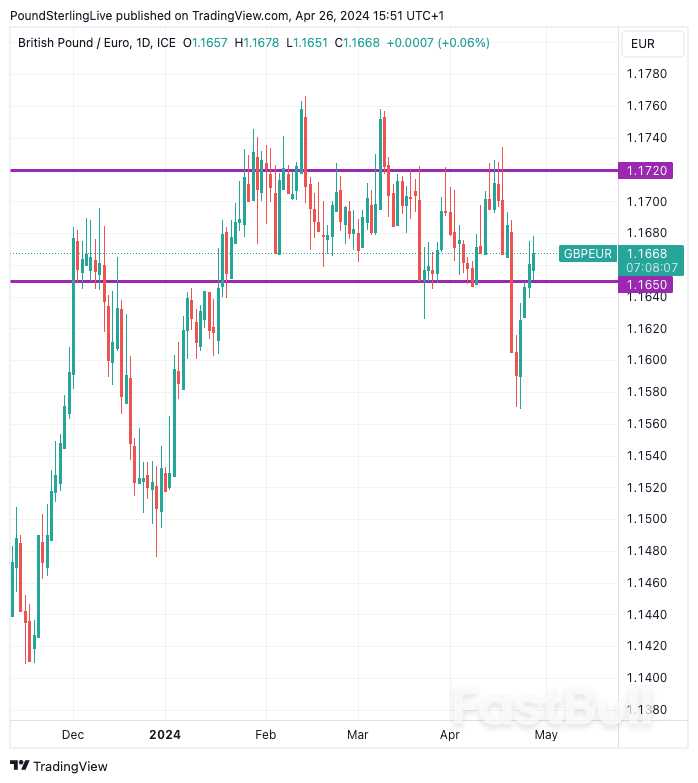
          In the coming days we look for the recovery to consolidate above 1.1650 with the potential for a retest of the 1.17-1.1720 a possibility if the Eurozone inflation print due comes in lower than expected.
          Soft EZ Inflation Can Catapult Pound to Euro Rate to Range Highs: The Week Ahead Forecast_1

          Above: GBP/EUR at daily intervals with the 2024 range indicated.

          From a technical perspective, there is little to consider beyond the 1.1650-1.1720 range owing to the clear preference for the exchange rate to trade within these boundaries.
          The pair tends to do something akin to a random dance within the area, touching either side depending on whether the Eurozone or UK have had a good spell of data or experienced 'hawkish' central bank developments.
          These data are based on the spread surveyed in a recent survey conducted for Pound Sterling Live by The Money Cloud.
          The truth is, though, both the Eurozone and UK economies are subject to similar fortunes, which means the central banks are likely to cut rates more or less in tandem. This diminishes the odds of a significant shift in trend in the near term.
          Anything above 1.17 is considered a strong level for euro buyers, while anything below 1.1680 is considered decent value for Pound buyers.
          There are no market-moving events due out of the UK this week, but we have some important Eurozone inflation numbers to look forward to.
          German inflation figures form the initial focus with state-level releases starting in the European morning Monday, with the final all-Germany release due at 13:00 BST (expected: 2.3% y/y, previous: 2.2%).
          French CPI inflation is due Tuesday at 07:45 BST (expected: 2.1%, previous: 2.3%). Between the German and French figures we could get a good steer as to where the Eurozone release is heading.
          Eurozone CPI is released at 10:00 BST on Tuesday with the market expecting 2.4% y/y, unchanged on March. The core CPI is expected at 2.8%, down from 2.9%.
          Any undershoots will raise the odds that the European Central Bank cuts interest rates again in July, having already done so in June. It is the timing of the second ECB cut that matters for markets, given a June move is well telegraphed.
          But, should inflation figures beat expectations, expect the Euro to rally against the Pound and Dollar, as markets would see a low likelihood of a July rate cut.
          Indeed, a strong print would raise questions as to whether a June cut is at all appropriate, which would support the Euro.

          Source: Poundsterlinglive

          To stay updated on all economic events of today, please check out our Economic calendar
          Risk Warnings and Disclaimers
          You understand and acknowledge that there is a high degree of risk involved in trading. Following any strategies or investment methods may lead to potential losses. The content on the site is provided by our contributors and analysts for information purposes only. You are solely responsible for determining whether any trading assets, securities, strategy, or any other product is suitable for investing based on your own investment objectives and financial situation.
          Add to Favorites
          Share

          Yen Rebounds Strongly, Asian Equities Rally

          Alex

          Economic

          Forex

          Stocks

          The yen rebounded sharply after dropping to its lowest in 34 years, spurring speculation that authorities may have intervened. Asian stocks climbed.
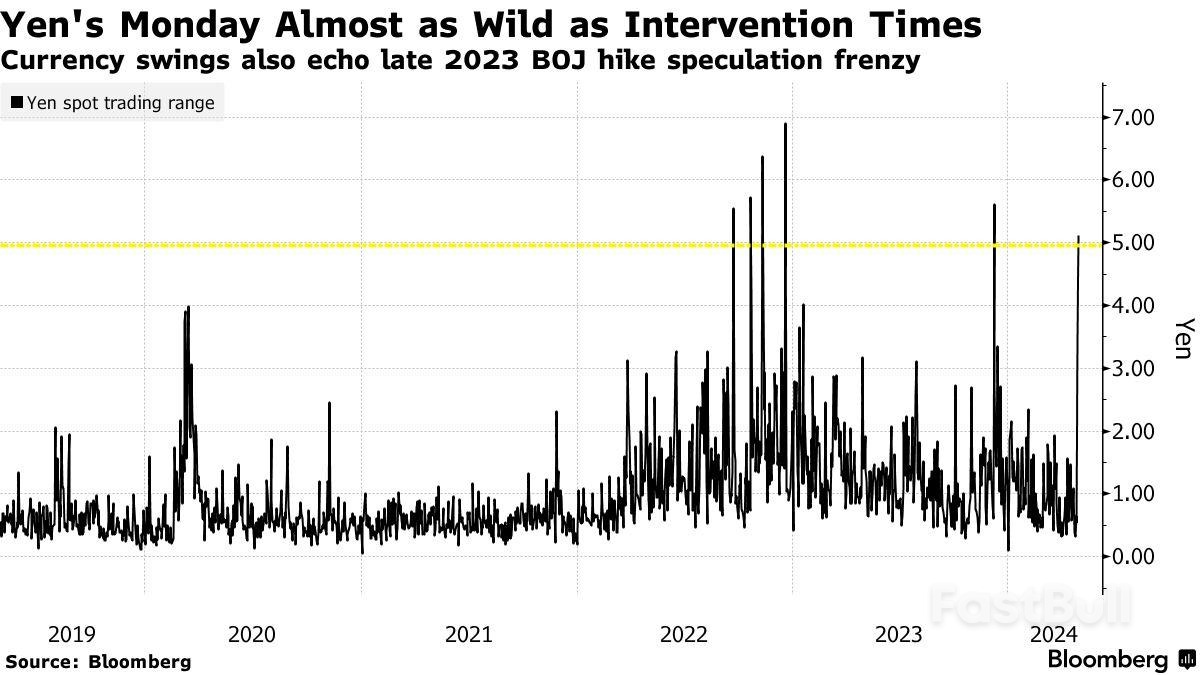
          The Japanese currency extended gains to 2% after earlier falling past 160 per dollar for the first time since 1990. Thin liquidity due to a public holiday in the country was also cited as a reason for the volatile moves. The yen’s weakness has gathered pace since late last week as Bank of Japan Governor Kazuo Ueda played down the impact of the soft currency on fueling inflation.
          “The market is very jumpy and with not a lot of liquidity, the yen becomes a sharp toy to play with,” said Rodrigo Catril, a strategist at National Australia Bank. “The risk of intervention is an added factor.”
          Chinese stocks led the region’s rally, adding to signs of a revival in the once-battered market amid a return in foreign money and an improvement in earnings. The Hang Seng Index trimmed gains after rallying toward a technical bull market. Property shares surged after major developer CIFI Holdings Group Co. reached a solution with bondholders on its liquidity issues.
          Yen Rebounds Strongly, Asian Equities Rally_1
          US equity futures also edged higher, bolstering Friday gains of more than 1% for the S&P 500 and Nasdaq 100.
          Australian and New Zealand bond yields fell. An index of the dollar declined Monday. US government debt will not trade in Asian hours given the holiday in Japan.
          Traders will also be focusing on the Federal Reserve’s policy meeting on Wednesday after the central bank’s preferred measure of inflation rose at a brisk pace in March, though roughly in line with estimates. With officials likely to hold rates steady at a more than two-decade high, interest will be on any pivot in the tone of the post-meeting statement and Chair Jerome Powell’s press conference.
          “With all measures of US consumer prices showing a steep acceleration over the past three to four months, the FOMC is bound to row back hard from its earlier predictions of meaningful policy easing this year,” Societe Generale economists including Klaus Baader wrote in a note to clients. “That said, markets have already scaled back pricing of rate cuts drastically, so unless Chair Powell plays up the possibility of rate hikes, the market damage is likely to be modest.”
          A gauge of US Treasury returns has slumped 2.3% this month, set for the biggest monthly drop since February last year, as hawkish Fedspeak and strong economic data pushed back rate-cut bets. Swaps traders now see only one Fed reduction for all of 2024, well below the roughly six quarter-point cuts they expected at the start of 2024.
          Yen Rebounds Strongly, Asian Equities Rally_2
          Oil fell and gold edged lower in Asian trading as US Secretary of State Antony Blinken steps up efforts to secure a truce in Gaza in meetings in the Middle East on Monday, in what could be a final chance to persuade Israel to call off an attack on Rafah.
          In corporate news, Elon Musk made an unannounced trip to China on Sunday. The surprise visit appears to have paid immediate dividends, with Tesla Inc. clearing two key hurdles to introduce its driver-assistance system to the world’s biggest auto market.
          Separately, L’Occitane International SA’s billionaire owner Reinold Geiger is close to making an offer to take the skin-care company private, according to people familiar with the matter.

          Source:Bloomberg

          To stay updated on all economic events of today, please check out our Economic calendar
          Risk Warnings and Disclaimers
          You understand and acknowledge that there is a high degree of risk involved in trading. Following any strategies or investment methods may lead to potential losses. The content on the site is provided by our contributors and analysts for information purposes only. You are solely responsible for determining whether any trading assets, securities, strategy, or any other product is suitable for investing based on your own investment objectives and financial situation.
          Add to Favorites
          Share
          FastBull
          Copyright © 2025 FastBull Ltd

          728 RM B 7/F GEE LOK IND BLDG NO 34 HUNG TO RD KWUN TONG KLN HONG KONG

          TelegramInstagramTwitterfacebooklinkedin
          App Store Google Play Google Play
          Products
          Charts

          Chats

          Q&A with Experts
          Screeners
          Economic Calendar
          Data
          Tools
          Membership
          Features
          Function
          Markets
          Copy Trading
          Latest Signals
          Contests
          News
          Analysis
          24/7
          Columns
          Education
          Company
          Careers
          About Us
          Contact Us
          Advertising
          Help Center
          Feedback
          User Agreement
          Privacy Policy
          Business

          White Label

          Data API

          Web Plug-ins

          Poster Maker

          Affiliate Program

          Risk Disclosure

          The risk of loss in trading financial instruments such as stocks, FX, commodities, futures, bonds, ETFs and crypto can be substantial. You may sustain a total loss of the funds that you deposit with your broker. Therefore, you should carefully consider whether such trading is suitable for you in light of your circumstances and financial resources.

          No decision to invest should be made without thoroughly conducting due diligence by yourself or consulting with your financial advisors. Our web content might not suit you since we don't know your financial conditions and investment needs. Our financial information might have latency or contain inaccuracy, so you should be fully responsible for any of your trading and investment decisions. The company will not be responsible for your capital loss.

          Without getting permission from the website, you are not allowed to copy the website's graphics, texts, or trademarks. Intellectual property rights in the content or data incorporated into this website belong to its providers and exchange merchants.

          Not Logged In

          Log in to access more features

          FastBull Membership

          Not yet

          Purchase

          Become a signal provider
          Help Center
          Customer Service
          Dark Mode
          Price Up/Down Colors

          Log In

          Sign Up
          Position
          Layout
          Fullscreen
          Default to Chart
          The chart page opens by default when you visit fastbull.com