Markets
News
Analysis
User
24/7
Economic Calendar
Education
Data
- Names
- Latest
- Prev


Signal Accounts for Members
All Signal Accounts
All Contests


France Trade Balance (SA) (Oct)A:--
F: --
Euro Zone Employment YoY (SA) (Q3)A:--
F: --
Canada Part-Time Employment (SA) (Nov)A:--
F: --
P: --
Canada Unemployment Rate (SA) (Nov)A:--
F: --
P: --
Canada Full-time Employment (SA) (Nov)A:--
F: --
P: --
Canada Labor Force Participation Rate (SA) (Nov)A:--
F: --
P: --
Canada Employment (SA) (Nov)A:--
F: --
P: --
U.S. PCE Price Index MoM (Sept)A:--
F: --
P: --
U.S. Personal Income MoM (Sept)A:--
F: --
P: --
U.S. Core PCE Price Index MoM (Sept)A:--
F: --
P: --
U.S. PCE Price Index YoY (SA) (Sept)A:--
F: --
P: --
U.S. Core PCE Price Index YoY (Sept)A:--
F: --
P: --
U.S. Personal Outlays MoM (SA) (Sept)A:--
F: --
U.S. 5-10 Year-Ahead Inflation Expectations (Dec)A:--
F: --
P: --
U.S. Real Personal Consumption Expenditures MoM (Sept)A:--
F: --
U.S. Weekly Total Rig CountA:--
F: --
P: --
U.S. Weekly Total Oil Rig CountA:--
F: --
P: --
U.S. Consumer Credit (SA) (Oct)A:--
F: --
China, Mainland Foreign Exchange Reserves (Nov)A:--
F: --
P: --
Japan Trade Balance (Oct)A:--
F: --
P: --
Japan Nominal GDP Revised QoQ (Q3)A:--
F: --
P: --
China, Mainland Imports YoY (CNH) (Nov)A:--
F: --
P: --
China, Mainland Exports (Nov)A:--
F: --
P: --
China, Mainland Imports (CNH) (Nov)A:--
F: --
P: --
China, Mainland Trade Balance (CNH) (Nov)A:--
F: --
P: --
China, Mainland Exports YoY (USD) (Nov)A:--
F: --
P: --
China, Mainland Imports YoY (USD) (Nov)A:--
F: --
P: --
Germany Industrial Output MoM (SA) (Oct)A:--
F: --
Euro Zone Sentix Investor Confidence Index (Dec)A:--
F: --
P: --
Canada National Economic Confidence IndexA:--
F: --
P: --
U.K. BRC Like-For-Like Retail Sales YoY (Nov)--
F: --
P: --
U.K. BRC Overall Retail Sales YoY (Nov)--
F: --
P: --
Australia Overnight (Borrowing) Key Rate--
F: --
P: --
RBA Rate Statement
RBA Press Conference
Germany Exports MoM (SA) (Oct)--
F: --
P: --
U.S. NFIB Small Business Optimism Index (SA) (Nov)--
F: --
P: --
Mexico 12-Month Inflation (CPI) (Nov)--
F: --
P: --
Mexico Core CPI YoY (Nov)--
F: --
P: --
Mexico PPI YoY (Nov)--
F: --
P: --
U.S. Weekly Redbook Index YoY--
F: --
P: --
U.S. JOLTS Job Openings (SA) (Oct)--
F: --
P: --
China, Mainland M1 Money Supply YoY (Nov)--
F: --
P: --
China, Mainland M0 Money Supply YoY (Nov)--
F: --
P: --
China, Mainland M2 Money Supply YoY (Nov)--
F: --
P: --
U.S. EIA Short-Term Crude Production Forecast For The Year (Dec)--
F: --
P: --
U.S. EIA Natural Gas Production Forecast For The Next Year (Dec)--
F: --
P: --
U.S. EIA Short-Term Crude Production Forecast For The Next Year (Dec)--
F: --
P: --
EIA Monthly Short-Term Energy Outlook
U.S. API Weekly Gasoline Stocks--
F: --
P: --
U.S. API Weekly Cushing Crude Oil Stocks--
F: --
P: --
U.S. API Weekly Crude Oil Stocks--
F: --
P: --
U.S. API Weekly Refined Oil Stocks--
F: --
P: --
South Korea Unemployment Rate (SA) (Nov)--
F: --
P: --
Japan Reuters Tankan Non-Manufacturers Index (Dec)--
F: --
P: --
Japan Reuters Tankan Manufacturers Index (Dec)--
F: --
P: --
Japan Domestic Enterprise Commodity Price Index MoM (Nov)--
F: --
P: --
Japan Domestic Enterprise Commodity Price Index YoY (Nov)--
F: --
P: --
China, Mainland PPI YoY (Nov)--
F: --
P: --
China, Mainland CPI MoM (Nov)--
F: --
P: --
Italy Industrial Output YoY (SA) (Oct)--
F: --
P: --


No matching data
Latest Views
Latest Views
Trending Topics
Top Columnists
Latest Update
White Label
Data API
Web Plug-ins
Affiliate Program
View All

No data
Nvidia’s strong earnings boosted global equities, lifting Asian and European tech stocks. Meanwhile, a stronger US dollar, softer yen, and rising oil shaped markets as investors awaited the delayed US jobs report.
The Bank of Japan (BOJ) must continue to normalise monetary policy by raising real interest rates to "a state of equilibrium" to avoid creating unintended distortions in the future, board member Junko Koeda said on Thursday.
The remarks suggest Koeda, an academic who joined the central bank's board in March, will vote in favour of an interest rate increase if proposed by BOJ governor Kazuo Ueda in the coming months.
Corporate profits remain high, the economy is resilient and prices have been "relatively strong," Koeda said, adding that the recent surge in food prices could affect inflation expectations.
The output gap has been around 0%, while conditions in the job market have been tight due to labour shortages, she said.
"In this situation, the BOJ must continue to raise the policy interest rate and adjust the degree of monetary accommodation in accordance with improvement in economic activity and prices," Koeda said in a speech.
Last year, the BOJ exited a decade-long, massive stimulus programme and raised interest rates twice — including in January. It has kept its policy rate steady at 0.5% since then, even as consumer inflation has remained above its 2% target for more than three years.
With real interest rates "clearly low" compared with other countries, the BOJ can keep stimulating consumption and investment, even if it raises nominal rates slightly, she said.
"The BOJ needs to proceed with interest rate normalisation, that is, to return real interest rates to a state of equilibrium, to avoid creating unintended distortions in the future," Koeda said.
Markets are closely watching BOJ policy signals as Prime Minister Sanae Takaichi has voiced displeasure over the idea of another rate rise in the near term, while urging the central bank to cooperate with government efforts to reflate the economy.
With prospects of prolonged low rates fuelling unwelcome yen declines, however, Finance Minister Satsuki Katayama said on Wednesday that she had no objection to the BOJ's moderate rate-hike path.
The BOJ is scheduled to hold its next policy-setting meeting on Dec 18 and 19, followed by a meeting in January. Many market participants expect the central bank to raise rates to 0.75% either in December or January.
Two of the BOJ's nine members unsuccessfully proposed a rate increase to 0.75% in September and October, in a sign of the bank's increasing attention to inflationary pressure.
Rates still near low end of neutral
At a press conference held after the speech, Koeda said the BOJ's policy rate was still near the lower end of what the central bank views as neutral to the economy.
When asked how soon the BOJ should raise interest rates, Koeda said: "That's a decision to be made by scrutinising underlying economic and price developments."
"With overseas uncertainty remaining, we must look at how this would affect companies' wage-setting behaviour," she said.
Ueda has said that the BOJ will continue to raise interest rates if it is convinced that underlying inflation will stabilise around the 2% target.
"I believe that underlying inflation is about 2%," Koeda said. "But in order to achieve our price target, it is important to examine the extent to which underlying inflation has remained stable or been anchored."
It is also important to scrutinise whether inflation expectations would be stable and look at factors that affect prices, such as the strength of the economy, Koeda said.
While Ueda has said that the BOJ needs more clarity on the outlook for next year's wage negotiations, Koeda said she was also focusing on developments in Japan's minimum wage, winter bonus payments and how increasing job mobility might affect pay.
UBS has raised its mid-year 2026 gold price forecast, arguing that the drivers behind this year's surge remain firmly in place as the market heads into another period of heavy investor and central-bank demand.
Gold has held above $4,000 an ounce after a steep climb in 2025 that left it as the year's strongest major asset. UBS strategists said the consolidation has not altered their outlook and now see the metal reaching $4,500 an ounce by June 2026, up from the previous $4,200 call.
"The gold price has stabilized above USD 4,000/oz after a phenomenal run in 2025," strategists led by Wayne Gordon wrote, and despite the pause, they forecast "even higher prices in 2026," prompting their forecast hike.
The strategists point to a combination of further Federal Reserve rate cuts, lower real yields, geopolitical tensions, and rising fiscal concerns in the U.S., all of which they believe should sustain demand from both financial investors and reserve managers.
They also flag increased political noise ahead of the midterm elections as another support for safe-haven buying.
Position early for the next phase of the gold trade by upgrading to InvestingPro - get 55% off today.
UBS maintains an Attractive stance on gold and continues to recommend long exposure in its asset allocation. The strategists believe gold "remains an effective portfolio hedge (even at current levels)."
A key part of the bank's bullishness is a rebound in exchange-traded fund (ETF) inflows next year, supported by easier monetary conditions.
UBS forecasts around 750 metric tons of ETF buying in 2026, which would still be more than double the average annual pace seen in the decade after 2010.
The bank also expects persistent central-bank and sovereign wealth demand, projecting purchases of 900 metric tons next year, a moderation from 2025 but far above long-term norms.
"Material underreporting (versus monthly IMF reported purchases) and recent anecdotal conversations with reserve managers signal to us a strong appetite for adding to existingreserves in 2026," strategists noted.
UBS has also raised its upside case to $4,900 an ounce, citing a potential spike in political and financial risks. The bank expects some consolidation around $4,300 an ounce after U.S. political events in late 2026, but sees the overall demand profile as strong.
Israel's Prime Minister Benjamin Netanyahu visited Israeli troops deployed in southern Syria, drawing strong condemnation from the government in Damascus, which denounced the trip as a violation of sovereignty.
Israel expanded its military presence in southern Syria after the ousting of Bashar al-Assad last December, seizing positions east of a U.N.-patrolled buffer zone that separates the Israeli-occupied Golan Heights from Syrian territory.
Wearing a flak jacket and helmet, Netanyahu on Wednesday visited troops on Syrian territory, according to photographs published by his office. He reiterated Israel's commitment to protect Syria's Druze minority, whose community straddles the border into northern Israel.
"We attach immense importance to our capability here, both defensive and offensive, safeguarding our Druze allies, and especially safeguarding the State of Israel and its northern border opposite the Golan Heights," Netanyahu told the troops, according to a statement from his office.
"This is a mission that can develop at any moment, but we are counting on you," he said.
The Islamist-led government in Damascus said Netanyahu's visit was "a dangerous violation of Syrian sovereignty and unity," and called it an attempt to "impose a fait accompli."
There was no immediate comment from the Israeli government.
Israel captured the Golan Heights from Syria in a 1967 war and later annexed it, a move not recognised by most countries. Syria has demanded that Israel returns to the original buffer zone, but senior Israeli officials have said they will not relinquish the new posts.
For months, Syria has been in U.S.-brokered talks with Israel to reach a security pact that Damascus hopes will reverse Israel's recent seizures of its land but that would fall far short of a full peace treaty.
The talks have faltered since Israel introduced a new demand, opens new tab to allow the opening of a "humanitarian corridor" to Syria's southern province of Sweida. Syria rejected the request as a breach of its sovereignty.
A Syrian military official said the visit showed Israel was not willing to relinquish any territory.
"Netanyahu's visit sends a message: we won't withdraw from the areas we entered after December 8... Regardless of the security deal, its future or its fate, this is the message they're sending Syria - that Israel is not willing to give up these outposts," the official told Reuters.
The two countries have technically been at war since the creation of Israel in 1948, despite periodic armistices. Syria does not recognise the state of Israel.
Since Assad's ousting, Israel has carried out unprecedented strikes on Syrian military assets including the defence ministry, sent troops into its south and lobbied the U.S. to keep Syria weak and decentralised.
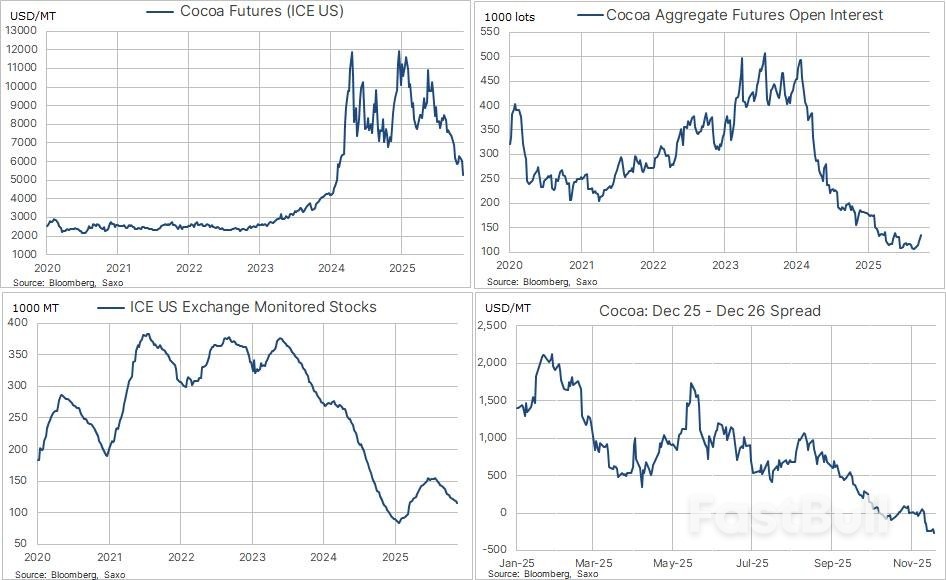
The retreat reflects a classic case of "the best cure for high prices is high prices." After several years of weather disruptions, disease pressure and ageing trees in Ivory Coast and Ghana, the world's two dominant producers, the 2023–24 deficit pushed physical supply to breaking point. Crucially, farmgate prices lagged the futures spike, leaving farmers unable to invest just as climate volatility was intensifying. This mismatch created the conditions for the parabolic rise.
That dynamic is now reversing. Improved rainfall, better fertiliser use and rising producer-country prices have encouraged farmers to rehabilitate plantations, prune more aggressively and replant high-yielding varieties. Beyond West Africa, elevated returns have sparked investment in Latin America and Southeast Asia, gradually broadening the global supply base.
This transition is visible in the forward curve. One year ago, the Dec-24 futures contract traded in New York held a 23% premium over Dec-25, an extreme backwardation that highlighted acute nearby scarcity. Today, Dec-25 trades at a USD 270/t or 5.5% discount to Dec-26, reflecting a return to contango and a market that is no longer scrambling for prompt supply. Producers are again willing to hedge, inventories are starting to recover and traders are no longer paying panic-level premiums to secure beans.
Demand has also played an essential role in normalising the balance. Record-high raw material costs forced chocolate manufacturers into a series of unpopular choices: shrinkflation, price increases and the quiet dilution of cocoa content. The latter has become sufficiently widespread that some UK biscuits and bars can no longer legally be labelled "chocolate," instead qualifying only as "chocolate flavour" coatings dominated by palm and shea oils. This is classic demand destruction — the point at which consumers either trade down or manufacturers reformulate to protect margins.
Lower cocoa prices will not immediately reverse shrinkflation or dilution. Recipe reformulations tend to stick, at least for a while. Reversing them requires either competitive pressure or a sustained period of lower input costs. But the potential is now there. Cocoa at USD 5,000/t is still expensive by past standards but far more manageable for manufacturers than USD 12,000/t.
Seasonality adds a timely twist. The current slump arrives far too late to affect Christmas assortments already produced and priced months ago. The supply shock hit during the production cycle for 2024 holiday products, meaning consumers will still face high prices and—depending on the brand—lighter bars with more palm oil than they might expect. But if the market stabilises around current levels, the impact could show up in 2026's Easter eggs and bunnies. In a market where humour is often in short supply, it is tempting to say that while the cocoa slump won't save Christmas, it may soften the blow for Easter.
From a trading perspective, the picture now looks considerably more balanced than it did a few months ago. The froth that characterised the peak has largely evaporated, evident in the sharp contraction in aggregate open interest as speculative positions were unwound. The recent stabilisation and modest uptick in open interest likely reflect a mix of fresh speculative selling and renewed producer hedging as prices return to more workable levels. With the parabolic phase behind us, price action should increasingly be driven by more conventional fundamentals: West African weather patterns, disease management, the pace of replanting and political risk in key producer nations. On the demand side, global growth trends, consumer sentiment and the extent to which manufacturers restore cocoa content will shape the recovery profile.
The next key question is sustainability. Can the new supply momentum be maintained? West Africa remains vulnerable to climate variability, and gains in new origins may be too small to offset problems if a serious weather event hits the region again. Meanwhile, if manufacturers do not reverse shrinkflation or dilution, demand may not rebound as quickly thereby keeping a ceiling on prices.
Overall, cocoa's downturn marks the start of normalisation after a once-in-a-generation shock. The slump has stabilised the market, given farmers breathing room and eased pressure on buyers. For consumers, the benefits are coming — just not in time to salvage this year's Christmas stockings. But Easter? That might finally bring a bit more real chocolate and a bit less "chocolate-flavoured" improvisation.
Cocoa chartsWhite Label
Data API
Web Plug-ins
Poster Maker
Affiliate Program
The risk of loss in trading financial instruments such as stocks, FX, commodities, futures, bonds, ETFs and crypto can be substantial. You may sustain a total loss of the funds that you deposit with your broker. Therefore, you should carefully consider whether such trading is suitable for you in light of your circumstances and financial resources.
No decision to invest should be made without thoroughly conducting due diligence by yourself or consulting with your financial advisors. Our web content might not suit you since we don't know your financial conditions and investment needs. Our financial information might have latency or contain inaccuracy, so you should be fully responsible for any of your trading and investment decisions. The company will not be responsible for your capital loss.
Without getting permission from the website, you are not allowed to copy the website's graphics, texts, or trademarks. Intellectual property rights in the content or data incorporated into this website belong to its providers and exchange merchants.
Not Logged In
Log in to access more features

FastBull Membership
Not yet
Purchase
Log In
Sign Up