• Trade
  • Markets
  • Copy
  • Contests
  • News
  • 24/7
  • Calendar
  • Q&A
  • Chats
Trending
Screeners
SYMBOL
LAST
BID
ASK
HIGH
LOW
NET CHG.
%CHG.
SPREAD
SPX
S&P 500 Index
6896.25
6896.25
6896.25
6913.26
6893.48
-9.49
-0.14%
--
DJI
Dow Jones Industrial Average
48367.05
48367.05
48367.05
48471.70
48297.26
-94.87
-0.20%
--
IXIC
NASDAQ Composite Index
23419.07
23419.07
23419.07
23521.05
23414.83
-55.27
-0.24%
--
USDX
US Dollar Index
98.000
98.080
98.000
98.010
97.870
+0.120
+ 0.12%
--
EURUSD
Euro / US Dollar
1.17344
1.17352
1.17344
1.17488
1.17328
-0.00130
-0.11%
--
GBPUSD
Pound Sterling / US Dollar
1.34579
1.34588
1.34579
1.34674
1.34569
-0.00096
-0.07%
--
XAUUSD
Gold / US Dollar
4291.76
4292.17
4291.76
4373.05
4274.29
-47.35
-1.09%
--
WTI
Light Sweet Crude Oil
57.754
57.784
57.754
58.113
57.663
-0.099
-0.17%
--

Community Accounts

Signal Accounts
--
Profit Accounts
--
Loss Accounts
--
View More

Become a signal provider

Sell trading signals to earn additional income

View More

Guide to Copy Trading

Get started with ease and confidence

View More

Signal Accounts for Members

All Signal Accounts

Best Return
  • Best Return
  • Best P/L
  • Best MDD
Past 1W
  • Past 1W
  • Past 1M
  • Past 1Y

All Contests

  • All
  • Trump Updates
  • Recommend
  • Stocks
  • Cryptocurrencies
  • Central Banks
  • Featured News
Top News Only
Share

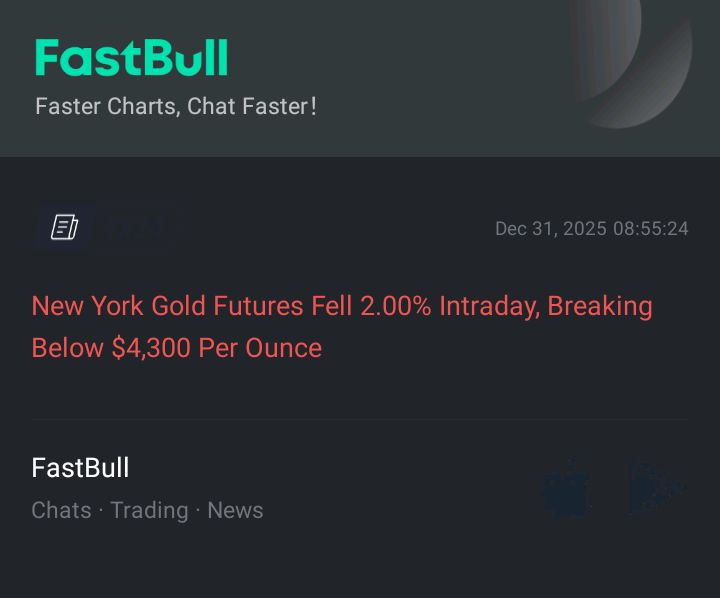
New York Gold Futures Fell 2.00% Intraday, Breaking Below $4,300 Per Ounce

Share

[Spot Gold Falls Below Key $4300/Oz Level] December 31, Spot Gold Accelerated Its Decline, Breaking Through The Key $4300/Oz Level, Marking Its First Drop Since December 16, Down 0.8% Intraday.

Share

[CME Group's "Heavy Blow" Causes Precious Metals To Plunge] Affected By The CME Group's Further Increase In Margin Requirements For Precious Metal Futures, Precious Metals Suffered A Sharp Decline Across The Board During The Day. New York Silver Futures Fell More Than 9%, Breaking Below $71/oz. Spot Silver Plunged $5 To $71.14/oz. Spot Gold Fell $50 From Its Daily High To $4323/oz. Spot Palladium Dropped 7% To $1507/oz, And Spot Platinum Once Fell More Than 12% To $1962/oz

Share

The Main Palladium Futures Contract Fell Nearly 13%, Currently Trading At 392 Yuan/gram

Share

The Main Shanghai Silver Futures Contract Fell By More Than 3%, Currently Trading At 17,289 Yuan/kg

Share

The Main Platinum Contract Fell 12.00% During The Day, Currently Trading At 525.35 Yuan/gram

Share

India's Nifty 50 Index Last Up 0.4%

Share

Xi: China Will Push More Proactive Macro Policies In 2026

Share

[The National Committee Of The Chinese People's Political Consultative Conference (CPPCC) Holds New Year Tea Party; Xi Jinping Delivers Important Speech] The National Committee Of The CPPCC Held A New Year Tea Party On The Morning Of December 31st At The CPPCC Auditorium. Party And State Leaders Xi Jinping, Li Qiang, Zhao Leji, Wang Huning, Cai Qi, Ding Xuexiang, Li Xi, And Han Zheng, Along With Leaders Of The Central Committees Of Various Democratic Parties, The All-China Federation Of Industry And Commerce, Representatives Of Non-party Figures, Officials From Relevant Central And State Organs, And Representatives From All Ethnic Groups And Sectors Of Society In The Capital, Gathered To Celebrate The New Year Of 2026. Xi Jinping, General Secretary Of The CPC Central Committee, President Of The People's Republic Of China, And Chairman Of The Central Military Commission, Delivered An Important Speech. He Emphasized That The Blueprint Has Been Drawn, And The Time For Progress Is Now. The Entire Party And The People Of All Ethnic Groups Across The Country Must Unite More Closely, Work Together With One Heart And One Mind, Strive For Progress, Achieve Great Things Through Hard Work, Win The Future Through Innovation, And Continuously Create A New Situation In China's Modernization Drive

Share

Spot Platinum Falls Over 9% To $1988.75/Oz

Share

Chinese President Xi: Maintain Social Harmony And Stability

Share

Chinese President Xi: To Implement More Proactive Macroeconomic Policies

Share

[Market Update] Spot Silver Plunged 6.00% Intraday, Currently Trading At $71.56 Per Ounce. New York Silver Futures Plunged 8.00% Intraday, Currently Trading At $71.68 Per Ounce

Share

Indonesia Nickel Smelters Association: 2026 Nickel Ore Demand For Domestic Smelting Industry Seen At Around 340 Million-350 Million Metric Tons

Share

Myanmar Junta Says Voter Turnout At 52% In First Phase Of Election

Share

Hsi Closes Midday At 25630, Down 224 Pts, Hsti Closes Midday At 5515, Down 62 Pts, Innovent Bio Down Over 3%, Jiangxi Copper Hit New Highs

Share

Russia's Gerasimov Inspects 'North' Force Grouping Of Russian Armed Forces, RIA Reports

Share

Russia's Chief Of General Staff Gerasimov Says President Putin Has Ordered That Expansion Of A Security Buffer Zone In Ukraine's Sumy And Kharkiv Regions Continue In 2026, Interfax Reports

Share

Russia's Chief Of The General Staff Valery Gerasimov Says Russian Troops Are Advancing Confidently Deeper Into Ukrainian Defences, Interfax Reports

Share

Ukraine: Four Injured, Including Three Children In Russian Attack On Odesa

TIME
ACT
FCST
PREV
South Korea Industrial Output MoM (SA) (Nov)

A:--

F: --

P: --
South Korea Retail Sales MoM (Nov)

A:--

F: --

P: --

South Korea Services Output MoM (Nov)

A:--

F: --

P: --

Russia IHS Markit Services PMI (Dec)

A:--

F: --

P: --

Turkey Economic Sentiment Indicator (Dec)

A:--

F: --

P: --

Brazil Unemployment Rate (Nov)

A:--

F: --

P: --

U.S. Weekly Redbook Index YoY

A:--

F: --

P: --

U.S. S&P/CS 10-City Home Price Index YoY (Oct)

A:--

F: --

P: --

U.S. S&P/CS 10-City Home Price Index MoM (Not SA) (Oct)

A:--

F: --

P: --

U.S. S&P/CS 20-City Home Price Index (Not SA) (Oct)

A:--

F: --

P: --

U.S. S&P/CS 20-City Home Price Index MoM (Not SA) (Oct)

A:--

F: --

P: --

U.S. FHFA House Price Index YoY (Oct)

A:--

F: --

P: --
U.S. S&P/CS 20-City Home Price Index YoY (Not SA) (Oct)

A:--

F: --

P: --

U.S. S&P/CS 20-City Home Price Index MoM (SA) (Oct)

A:--

F: --

P: --
U.S. FHFA House Price Index (Oct)

A:--

F: --

P: --

U.S. FHFA House Price Index MoM (Oct)

A:--

F: --

P: --
U.S. Chicago PMI (Dec)

A:--

F: --

P: --

Brazil CAGED Net Payroll Jobs (Nov)

A:--

F: --

P: --

U.S. Weekly Total Oil Rig Count

A:--

F: --

P: --

U.S. Weekly Total Rig Count

A:--

F: --

P: --

FOMC Meeting Minutes
U.S. API Weekly Refined Oil Stocks

A:--

F: --

P: --

U.S. API Weekly Crude Oil Stocks

A:--

F: --

P: --

U.S. API Weekly Cushing Crude Oil Stocks

A:--

F: --

P: --

U.S. API Weekly Gasoline Stocks

A:--

F: --

P: --

South Korea CPI YoY (Dec)

A:--

F: --

P: --

China, Mainland NBS Manufacturing PMI (Dec)

A:--

F: --

P: --

China, Mainland Composite PMI (Dec)

A:--

F: --

P: --

China, Mainland NBS Non-manufacturing PMI (Dec)

A:--

F: --

P: --

China, Mainland Caixin Manufacturing PMI (SA) (Dec)

A:--

F: --

P: --

Turkey Trade Balance (Nov)

--

F: --

P: --

Russia CPI YoY (Dec)

--

F: --

P: --

U.S. MBA Mortgage Application Activity Index WoW

--

F: --

P: --

South Africa Trade Balance (Nov)

--

F: --

P: --

U.S. Initial Jobless Claims 4-Week Avg. (SA)

--

F: --

P: --

U.S. Weekly Continued Jobless Claims (SA)

--

F: --

P: --

U.S. Weekly Initial Jobless Claims (SA)

--

F: --

P: --

U.S. EIA Weekly Cushing, Oklahoma Crude Oil Stocks Change

--

F: --

P: --

U.S. EIA Weekly Crude Demand Projected by Production

--

F: --

P: --

U.S. EIA Weekly Gasoline Stocks Change

--

F: --

P: --

U.S. EIA Weekly Crude Stocks Change

--

F: --

P: --

U.S. EIA Weekly Heating Oil Stock Changes

--

F: --

P: --

U.S. EIA Weekly Crude Oil Imports Changes

--

F: --

P: --

U.S. EIA Weekly Natural Gas Stocks Change

--

F: --

P: --

South Korea Trade Balance Prelim (Dec)

--

F: --

P: --

Indonesia Core Inflation YoY (Dec)

--

F: --

P: --

Indonesia Inflation Rate YoY (Dec)

--

F: --

P: --

Turkey Manufacturing PMI (Dec)

--

F: --

P: --

Brazil IHS Markit Manufacturing PMI (Dec)

--

F: --

P: --

Mexico Manufacturing PMI (Dec)

--

F: --

P: --

South Korea IHS Markit Manufacturing PMI (SA) (Dec)

--

F: --

P: --

Indonesia IHS Markit Manufacturing PMI (Dec)

--

F: --

P: --

India HSBC Manufacturing PMI Final (Dec)

--

F: --

P: --

Russia IHS Markit Manufacturing PMI (Dec)

--

F: --

P: --

U.K. Nationwide House Price Index MoM (Dec)

--

F: --

P: --

U.K. Nationwide House Price Index YoY (Dec)

--

F: --

P: --

Turkey Manufacturing PMI (Dec)

--

F: --

P: --

Italy Manufacturing PMI (SA) (Dec)

--

F: --

P: --

Euro Zone M3 Money Supply (SA) (Nov)

--

F: --

P: --

Euro Zone M3 Money Supply YoY (Nov)

--

F: --

P: --

Q&A with Experts
    • All
    • Chatrooms
    • Groups
    • Friends
    SlowBear ⛅ flag
    ifan afian
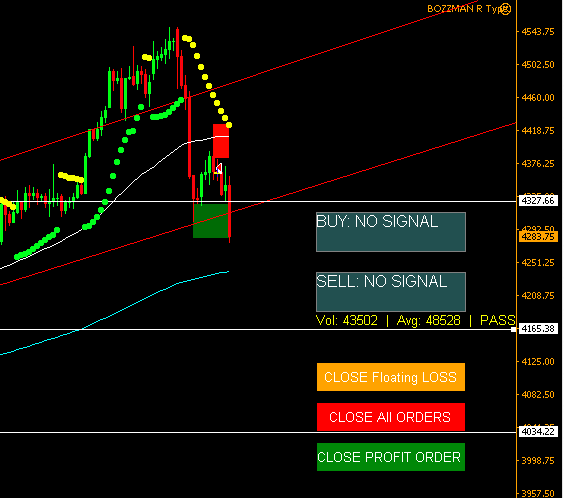
    @ifan afianThe volume is still place at 4503, what does that mean?
    SlowBear ⛅ flag
    ifan afian
    @ifan afianOh that will be a very terrible thing at this point, holding a buy from the top!
    ifan afian flag
    43k bro
    ifan afian flag
    if it moves with high volume it will become zero
    P4J3str4d3s flag
    who buy gold
    SlowBear ⛅ flag
    ifan afian
    43k bro
    @ifan afian Sorry bro, 4302, still i wish to know, does that mean, that is the region for a buy possiblity?
    ifan afian flag
    at that point i can put another buy or sell position.. becoz the momentum are done
    SlowBear ⛅ flag
    ifan afian
    if it moves with high volume it will become zero
    @ifan afianOh interesting i thinknk this is a really fine indicator if you ask me
    SlowBear ⛅ flag
    P4J3str4d3s
    who buy gold
    @P4J3str4d3sLol i guess some people bough gold
    john flag
    ifan afian
    @ifan afianthey should have tight stop loss in place because the market can stay irrational more than they can stay liquid
    ifan afian flag
    the white line its where i put the buy limits
    SlowBear ⛅ flag
    ifan afian
    at that point i can put another buy or sell position.. becoz the momentum are done
    @ifan afian I see, so it measures the momentum by keeping tabs o the volume
    john flag
    ifan afian
    43k bro
    @ifan afianwhat about 43k bro ?
    ifan afian flag
    SlowBear ⛅
    @SlowBear ⛅ exactly
    P4J3str4d3s flag
    SlowBear ⛅
    @SlowBear ⛅Can you send me the file from last night?
    SlowBear ⛅ flag
    ifan afian
    the white line its where i put the buy limits
    @ifan afianYou mean the white line with the incription of PASS? right??
    SlowBear ⛅ flag
    ifan afian
    @ifan afianWell i am becoming a big fan of thisindicator small small bro!
    ifan afian flag
    43k is total volume that inside the trade acumulative..
    john flag
    we might see the market heading towards 4000 into 2026 so let's proceed carefully
    john flag
    Type here...
    Add Symbol or Code

      No matching data

      All
      Trump Updates
      Recommend
      Stocks
      Cryptocurrencies
      Central Banks
      Featured News
      • All
      • Russia-Ukraine Conflict
      • Middle East Flashpoint
      • All
      • Russia-Ukraine Conflict
      • Middle East Flashpoint
      Search
      Products

      Charts Free Forever

      Chats Q&A with Experts
      Screeners Economic Calendar Data Tools
      Membership Features
      Data Warehouse Market Trends Institutional Data Policy Rates Macro

      Market Trends

      Market Sentiment Order Book Forex Correlations

      Top Indicators

      Charts Free Forever
      Markets

      News

      News Analysis 24/7 Columns Education
      From Institutions From Analysts
      Topics Columnists

      Latest Views

      Latest Views

      Trending Topics

      Top Columnists

      Latest Update

      Signals

      Copy Rankings Latest Signals Become a signal provider AI Rating
      Contests
      Brokers

      Overview Brokers Assessment Rankings Regulators News Claims
      Broker listing Forex Brokers Comparison Tool Live Spread Comparison Scam
      Q&A Complaint Scam Alert Videos Tips to Detect Scam
      More

      Business
      Events
      Careers About Us Advertising Help Center

      White Label

      Data API

      Web Plug-ins

      Affiliate Program

      Awards Institution Evaluation IB Seminar Salon Event Exhibition
      Vietnam Thailand Singapore Dubai
      Fans Party Investment Sharing Session
      FastBull Summit BrokersView Expo
      Recent Searches
        Top Searches
          Markets
          News
          Analysis
          User
          24/7
          Economic Calendar
          Education
          Data
          • Names
          • Latest
          • Prev

          View All

          No data

          Scan to Download

          Faster Charts, Chat Faster!

          Download App
          English
          • English
          • Español
          • العربية
          • Bahasa Indonesia
          • Bahasa Melayu
          • Tiếng Việt
          • ภาษาไทย
          • Français
          • Italiano
          • Türkçe
          • Русский язык
          • 简中
          • 繁中
          Open Account
          Search
          Products
          Charts Free Forever
          Markets
          News
          Signals

          Copy Rankings Latest Signals Become a signal provider AI Rating
          Contests
          Brokers

          Overview Brokers Assessment Rankings Regulators News Claims
          Broker listing Forex Brokers Comparison Tool Live Spread Comparison Scam
          Q&A Complaint Scam Alert Videos Tips to Detect Scam
          More

          Business
          Events
          Careers About Us Advertising Help Center

          White Label

          Data API

          Web Plug-ins

          Affiliate Program

          Awards Institution Evaluation IB Seminar Salon Event Exhibition
          Vietnam Thailand Singapore Dubai
          Fans Party Investment Sharing Session
          FastBull Summit BrokersView Expo

          Markets Lose Altitude as Data Delays and AI Valuation Fears Shake Investor Confidence

          Gerik

          Economic

          Stocks

          Summary:

          U.S. stocks recorded their steepest decline since October 10, driven by AI sector sell-offs and uncertainty over a potential December rate cut due to missing economic data following the government shutdown....

          Markets tumble as AI exuberance fades

          The U.S. stock market suffered a sharp downturn on November 13, 2025, with the Dow Jones Industrial Average plummeting 797 points, or 1.65%, closing at 47,457.22 after having briefly surpassed 48,000 the day before. The S&P 500 fell 1.66%, while the Nasdaq Composite, heavily weighted in technology stocks, dropped 2.29%. These were the worst single-day losses for all three indexes since early October.
          The reversal in investor sentiment was largely triggered by a cooling enthusiasm for artificial intelligence stocks. Once the darlings of Wall Street, major AI players like Nvidia, Broadcom, and particularly Oracle experienced heavy losses. Oracle, which had surged 36% in September on cloud infrastructure optimism, has now seen more than a third of its market capitalization wiped out. The shift underscores growing investor skepticism about sky-high valuations and the financial strain created by massive capital expenditures many companies are now incurring debt to maintain their AI expansion strategies.
          This market behavior points to a deeper concern that investor expectations may have outpaced the near-term profitability or sustainability of AI buildouts. As speculative optimism fades, the correction appears to be driven by a reevaluation of risk rather than a change in underlying fundamentals, signaling a correlation between liquidity pressures and tech performance in a high-rate environment.

          Data vacuum clouds the Federal Reserve’s next move

          Compounding the market unease is the Federal Reserve’s diminished visibility on economic trends due to the delayed release of October’s employment and inflation data, following the recent government shutdown. With no clear picture of the labor market or inflationary pressures, the Fed is now navigating without critical information, a reality likened by analysts to “flying blind.”
          This lack of data has significantly reduced market confidence in a December interest rate cut. While traders previously assigned a 95.5% probability to a policy easing, the odds have now fallen to near 50-50, according to CME’s FedWatch tool. Fed official Susan Collins hinted that maintaining current rates could remain appropriate, a stance that would dampen hopes for an end-of-year boost to equity valuations.
          The uncertainty surrounding monetary policy introduces a causal layer to recent market turbulence. Investors are not only reacting to earnings forecasts or AI sentiment but are also adjusting portfolios based on a changing policy outlook that lacks the usual macroeconomic guideposts.

          Global signals add to risk recalibration

          On the global stage, China's Singles’ Day shopping festival reported a year-on-year sales growth of 14.2%, down sharply from 26.6% in 2024. This slowdown reflects broader concerns about weakening consumer demand in the world’s second-largest economy and introduces further caution into global equity markets.
          In the private capital space, Elon Musk’s xAI was reported to be raising $15 billion, mainly for high-cost GPU infrastructure. Although Musk denied the claim, such massive funding rounds spotlight the scale of capital being funneled into unproven AI ventures, a dynamic that some analysts believe is contributing to frothy valuations across the tech sector. Oracle, for instance, has been promised $300 billion in business over five years from OpenAI, but skepticism now surrounds whether that figure will materialize in real earnings or just add to debt burdens.

          Investors question sustainability of AI-linked growth

          Oracle’s dramatic swing in valuation illustrates the volatility now associated with AI-exposed firms. Initially propelled by bullish cloud infrastructure forecasts, the company’s stock has now reversed course due to growing doubt over free cash flow generation and long-term viability. Analysts, such as Jackson Ader of KeyBanc Capital Markets, argue that Oracle stands to generate the least free cash flow among major GPU-involved cloud firms, a red flag for investors seeking stable returns amid broader economic ambiguity.
          The Oracle case underscores a growing causative link between investor sentiment and structural financial indicators such as debt levels and cash flow forecasts. As investors recalibrate based on these fundamentals rather than purely narrative-driven momentum, the market correction may deepen or broaden to other overleveraged sectors.
          The combination of waning AI enthusiasm, a data-deprived Federal Reserve, and rising concern over corporate debt levels has created a fragile market environment. Investors are facing uncertainty on multiple fronts from central bank decisions to tech sector profitability and are increasingly cautious about placing bets without visibility. Until clearer macroeconomic data emerges and companies demonstrate real earnings strength, the market may continue to navigate this turbulence with limited instruments, making sudden shifts and volatility more likely in the weeks ahead.

          Source: CNBC

          To stay updated on all economic events of today, please check out our Economic calendar
          Risk Warnings and Disclaimers
          You understand and acknowledge that there is a high degree of risk involved in trading. Following any strategies or investment methods may lead to potential losses. The content on the site is provided by our contributors and analysts for information purposes only. You are solely responsible for determining whether any trading assets, securities, strategy, or any other product is suitable for investing based on your own investment objectives and financial situation.
          Add to Favorites
          Share

          U.S. Shutdown Over but Economic Scars Remain, Fed December Cut Expectations Fade

          FastBull Featured

          Daily News

          [Quick Facts]

          1. Six-week U.S. government shutdown ends, with over $10 billion in permanent economic losses.
          2. Interest rate derivatives show less than 50% chance of a Fed rate cut in December.
          3. IEA raises global oil supply surplus forecast for the sixth consecutive month.
          4. UK government drops plan to increase income tax rates.
          5. The U.S. reaches Trade Deals with several countries, cutting tariffs on Latin American coffee and other products.
          6. The Trump Administration plans to expand food tariff exemptions to ease inflation pressures.
          7. Kashkari: December policy path still hinges on data.
          8. Mussalem: Policy is nearing neutral, limited room for easing.
          9. Hammack: Monetary policy must remain restrictive to curb inflation.
          10. IEA raises global oil supply surplus forecast for the sixth consecutive month.

          [News Details]

          Six-week U.S. government shutdown ends, with over $10 billion in permanent economic losses
          The six-week-long U.S. government shutdown officially ended late Wednesday local time. Although the political standoff has been temporarily resolved, its drag on the already challenged U.S. economy will persist, with full effects potentially taking months to materialize. According to estimates by the Congressional Budget Office (CBO), the shutdown is expected to reduce GDP growth in the fourth quarter of this year by approximately 1.5 percentage points—effectively halving the growth rate. While a rebound of around 2.2 percentage points may occur in the first quarter of next year after government operations resume, about $11 billion in economic activity is expected to be permanently lost. For comparison, the longest government shutdown in history, which lasted 35 days during 2018–2019 (affecting only some agencies), had a negligible impact of just 0.02% on GDP—far less severe than the current episode.
          Interest rate derivatives show less than 50% chance of a Fed rate cut in December
          Short-term U.S. interest rate derivative contracts indicate that markets now see less than a 50% chance of a 25-basis-point rate cut by the Federal Reserve in December. Contracts linked to the Fed's December 9–10 meeting, including federal funds futures and overnight indexed swaps (OIS), suggest the probability of a 25-basis-point reduction is slightly below 50%.
          IEA raises global oil supply surplus forecast for the sixth consecutive month
          As OPEC+ continues to restore supply and global demand growth remains weak, the International Energy Agency (IEA) has raised its forecast for the global oil supply surplus in 2026 for the sixth straight month. The report states that global oil supply will exceed demand by about 4 million barrels per day next year, a slight increase from last month's projection. The IEA noted that the global oil supply-demand status is becoming increasingly imbalanced, with the agency raising its surplus forecasts every month since June. Toril Bosoni, head of the IEA's Oil Industry and Markets Division, told Bloomberg TV, that the IEA sees global crude supply rising, while demand growth remains relatively modest.
          UK government drops plan to increase income tax rates
          According to the Financial Times, UK Prime Minister Keir Starmer and Chancellor of the Exchequer Rachel Reeves decided to abandon previously proposed plans to raise income tax rates in the budget. This marks a significant shift in the UK government's direction on tax policy.
          The U.S. reaches Trade Deals with several countries, cutting tariffs on Latin American coffee and other products
          Senior U.S. officials said on Thursday that trade agreements have been signed with several Latin American countries to reduce tariffs on certain imports, including coffee and fruits. In the current economic climate, coffee has become a symbol of affordability challenges for consumers evaluating the Trump administration's economic policies—much like eggs did during the Biden administration. Data shows that coffee prices saw the largest increase among all categories tracked by the Consumer Price Index (CPI) in September. Treasury Secretary Scott Bessent promised earlier this week that pressure on coffee prices would soon ease. The agreements cover countries such as Argentina, Ecuador, El Salvador, and Guatemala, with the U.S. offering tariff reductions on certain non-domestically produced goods, such as Ecuadorian coffee and bananas.
          The Trump Administration plans to expand food tariff exemptions to ease inflation pressures
          According to The New York Times, three insiders revealed that the Trump administration is planning to significantly broaden exemptions from food tariffs in an effort to address growing consumer anxiety over persistently high food prices. These exemptions would apply to certain imported goods subject to reciprocal tariffs imposed in April of this year, targeting products from countries without trade agreements with the U.S., with beef and citrus products likely to be included.
          If approved, this move would mark the latest sign of a policy reversal on a key economic issue under Trump. The scope of exemptions may go beyond the limits set in the September executive order, which was restricted to non-U.S.-produced goods covered by trade agreements. It is reported that Commerce Secretary Howard Lutnick has been actively pushing for a series of food-related tariff exemptions due to high prices, whereas the September order mandated that he and U.S. Trade Representative Jamieson Lee Greer review tariff exemptions for over a thousand product categories, including agricultural goods.
          Kashkari: December policy path still hinges on data
          Minneapolis Fed President Neel Kashkari said in a speech on Thursday that, based on the fragmented evidence and data available, the underlying resilience of economic activity appears stronger than he had expected. Given the information at the time, the Fed should have opted to hold off on a rate cut in October, which was also the main reason for his dissent against the rate reduction last month.
          Data since October suggests the overall economic situation has remained largely stable. As the December rate decision approaches, both arguments for a rate cut and for holding rates steady could be made, depending on how the data evolves.
          Mussalem: Policy is nearing neutral, limited room for easing
          St. Louis Fed President Alberto Mussalem said in a speech on Thursday that "Current policy is between neutral and restrictive" rather than moderately tight, and that there is limited room to ease policy further without risking excessive accommodation. Looking ahead, "additional rate cuts should be approached cautiously."
          Inflation remains high at around 3%, significantly above the Fed's long-term target of 2%, so continued pressure on above-target inflation is necessary, while also supporting the labor market.
          With the economy showing considerable resilience, policymakers must balance inflation control with employment stability. The labor market is expected to remain near full employment, possibly with slight moderation, while the fourth quarter may see some economic softness—but a rebound is anticipated in the first quarter of next year, reaching or exceeding potential output. With appropriate monetary policy, inflation is expected to begin declining in the second half of next year. He also noted that tariff-driven price pressures are expected to ease during the same period.
          Hammack: Monetary policy must remain restrictive to curb inflation
          Beth M. Hammack, President of the Cleveland Fed, said while there has been much discussion this year about the U.S. dollar and its weakening, much of this year's decline has simply brought the dollar closer to its theoretical fair value. This made it more aligned with other currencies.
          Hammack proposed a restrictive policy path to maintain downward pressure on inflation. "This is a difficult time for monetary policy," given challenges to the Fed's inflation and job mandates, Hammack said in an appearance before the Pittsburgh Economic Club. "But when I look at both of those things, on balance, I think we need to remain somewhat restrictive to continue putting pressure to bring inflation down towards our target."
          IEA raises global oil supply surplus forecast for the sixth consecutive month
          As OPEC+ continues to restore supply and global demand growth remains weak, the International Energy Agency (IEA) has raised its forecast for the global oil supply surplus in 2026 for the sixth straight month. The report states that global oil supply will exceed demand by about 4 million barrels per day next year, a slight increase from last month's projection. The IEA noted that the global oil supply-demand status is becoming increasingly imbalanced, with the agency raising its surplus forecasts every month since June. Toril Bosoni, head of the IEA's Oil Industry and Markets Division, told Bloomberg TV, that the IEA sees global crude supply rising, while demand growth remains relatively modest.

          [Today's Focus]

          UTC+8 18:30 Speech by European Central Bank Executive Board Member Frank Elderson
          UTC+8 22:20 Speech by Atlanta Fed President Raphael Bostic
          UTC+8 23:00 Speech by ECB Chief Economist Philip Lane
          UTC+8 23:05 Speech by Kansas City Fed President Jeffrey Schmid on economic outlook and monetary policy
          TBD U.S. October Retail Sales MoM
          TBD U.S. October PPI
          Risk Warnings and Disclaimers
          You understand and acknowledge that there is a high degree of risk involved in trading. Following any strategies or investment methods may lead to potential losses. The content on the site is provided by our contributors and analysts for information purposes only. You are solely responsible for determining whether any trading assets, securities, strategy, or any other product is suitable for investing based on your own investment objectives and financial situation.
          Add to Favorites
          Share

          GOP Faces Political Turmoil as ACA Premiums Surge After Shutdown Standoff

          Gerik

          Economic

          Premium spike exposes post-shutdown political risks

          In the aftermath of a lengthy government shutdown, Republican lawmakers have succeeded in blocking the renewal of key tax credits under the Affordable Care Act (ACA), a decision expected to save billions in federal spending. However, this fiscal victory has triggered a sharp rise in health care premiums for ACA participants with 24 million Americans facing average increases of 114%, and some individuals seeing costs double or triple by early 2026.
          This development has shifted the political narrative. Democrats, seizing the opportunity, are framing the GOP as responsible for rising living costs, undermining Donald Trump’s 2024 campaign promises to reduce everyday expenses for American households. Although Republicans have long criticized Obamacare as fiscally unsustainable, the immediate financial pain felt by millions could become a potent mobilizing force for Democratic voters.

          From legislative maneuver to electoral liability

          While the GOP's refusal to include ACA subsidy extensions in the shutdown resolution may appeal to budget-conscious constituents, the broader political consequences are becoming apparent. History suggests that attacking health care protections can backfire. In 2017, a similar Republican-led attempt to weaken the ACA contributed to the party’s loss of the House in 2018. Now, with the “big beautiful bill” reducing Medicaid and the expiration of ACA tax credits, a similar pattern may emerge, particularly as the midterms loom.
          Senator Thom Tillis, who benefited from early anti-ACA sentiment in his 2014 win, is now sounding the alarm from within the party. Warning that the House is “absolutely in play,” Tillis argues that Republicans must act to mitigate the political damage by extending subsidies or reconsidering cuts to Medicaid.
          This suggests a potentially causal relationship between GOP health policy decisions and voter backlash, as prior midterm trends and current polling reinforce expectations of electoral volatility.

          Health care becomes the core campaign issue

          Rising costs are dominating the political discourse. House Democratic Leader Hakeem Jeffries linked surging premiums with broader inflation, highlighting a narrative that paints Republican governance as economically detrimental to everyday Americans. With food, housing, and energy costs already elevated, health care sticker shock is likely to intensify voter discontent.
          For Democrats, this offers a strategic advantage. They are now positioning themselves as the defenders of affordability and health access, framing the GOP’s resistance as both ideologically rigid and practically harmful. The premium surge is a particularly damaging development for Republican incumbents in competitive states and districts, where many voters rely on ACA coverage.

          Fragmentation within the Republican response

          While Senate Majority Leader John Thune has signaled willingness to revisit the subsidy issue in December, House Speaker Mike Johnson remains opposed, reflecting a wider GOP divide. Some Republicans favor health savings accounts or a broader restructuring of the ACA, including narrowing mandated benefits and restricting abortion coverage. However, these alternatives lack consensus and fail to address the immediate affordability crisis.
          The absence of a unified, feasible replacement plan is increasingly problematic. Fifteen years after Obamacare’s enactment, the GOP still struggles to coalesce around a substitute. This long-standing failure, repeatedly criticized by Democrats like Representative Adelita Grijalva, undermines Republican credibility on the issue.

          Battleground states and moderate voices signal concern

          In politically sensitive states like Maine, Ohio, Florida, and Alaska, several Republican senators and representatives are confronting the real-world consequences of their party’s health policy. Senator Susan Collins has proposed a phased subsidy extension for wealthier recipients while continuing support for low- and middle-income enrollees. Other incumbents, including Jon Husted and Ashley Moody, face reelection challenges in areas with high ACA enrollment, where premium hikes could cost them votes.
          Notably, some premiums in Alaska are rising as much as $4,000 a month, particularly affecting older adults not yet eligible for Medicare. These disproportionate impacts underscore the direct voter harm and further reinforce the electoral risk to Republicans.
          While Republicans may have succeeded in trimming ACA-related expenditures, the backlash from soaring premiums is reshaping the political landscape. Voter sentiment appears to be tilting against the GOP, echoing prior episodes where aggressive attempts to dismantle health coverage resulted in electoral defeat. Without a credible alternative or immediate relief for those facing financial strain, the GOP risks ceding ground to Democrats in both chambers come 2026. The situation illustrates a pattern where fiscal decisions, while ideologically driven, produce tangible consequences that ripple through electoral dynamics.

          Source: Bloomberg

          To stay updated on all economic events of today, please check out our Economic calendar
          Risk Warnings and Disclaimers
          You understand and acknowledge that there is a high degree of risk involved in trading. Following any strategies or investment methods may lead to potential losses. The content on the site is provided by our contributors and analysts for information purposes only. You are solely responsible for determining whether any trading assets, securities, strategy, or any other product is suitable for investing based on your own investment objectives and financial situation.
          Add to Favorites
          Share

          Gold Heads Toward Monthly Peak as Data Delays Stir Market Sentiment

          Gerik

          Economic

          Commodity

          Gold rallies on uncertainty and delayed data flows

          As the United States emerged from its longest-ever six-week government shutdown, gold surged toward its best weekly performance in a month. Trading near $4,190 per ounce, the metal has regained almost all of its prior losses and is on pace for a 5% weekly increase. This rise reflects a growing sense of market uncertainty, as the backlog of unreleased economic data is expected to cloud visibility on the true state of the US economy.
          While the possibility of another Federal Reserve rate cut initially lifted gold’s prospects given that gold does not yield interest and becomes relatively more attractive in lower-rate environments momentum for a cut cooled midweek. Fed officials signaled a lack of urgency in reducing borrowing costs, weakening some of the earlier enthusiasm. However, the underlying question remains whether the flood of upcoming data will reflect sufficient economic softness to reignite dovish monetary policy expectations.
          This reflects a correlation rather than a firm causation at this stage: the market is reacting not necessarily to confirmed economic weakness, but to uncertainty and the potential implications of unreleased figures. In other words, investor anxiety is amplifying gold’s safe-haven appeal, even before hard evidence emerges.

          Central banks and fiscal risks drive long-term demand

          Another significant support for bullion prices comes from central banks and long-term investors. Gold is up nearly 60% this year, on track for its strongest annual performance since 1979. Much of this surge is attributed to increased central bank buying, driven by a need for portfolio diversification and a reliable store of value amidst widespread fiscal stress. These purchases indicate a deeper, more structural confidence in gold beyond short-term market swings, suggesting a causative relationship between sovereign asset allocation trends and sustained price elevation.
          Liquidity policies from the Federal Reserve are also supporting gold’s ascent. Roberto Perli, who oversees the System Open Market Account at the New York Fed, emphasized the importance of ensuring liquidity through asset purchases. Starting December 1, the Fed will halt the shrinking of its balance sheet—a move that injects liquidity into the system. While this is not an explicit stimulus, it signals accommodation, reinforcing gold’s bullish trajectory.
          As of 9:03 a.m. Singapore time, gold rose 0.4% to $4,187 per ounce. The Bloomberg Dollar Spot Index held steady, and other precious metals such as silver, platinum, and palladium also posted gains. With investor sentiment teetering between data-driven caution and monetary policy speculation, gold remains at the center of the market's flight-to-safety strategies.
          Whether upcoming economic reports will justify or dispel the current rally remains to be seen, but for now, gold is benefitting from a perfect storm of fiscal concerns, policy uncertainty, and strategic demand from central banks.

          Source: Bloomberg

          To stay updated on all economic events of today, please check out our Economic calendar
          Risk Warnings and Disclaimers
          You understand and acknowledge that there is a high degree of risk involved in trading. Following any strategies or investment methods may lead to potential losses. The content on the site is provided by our contributors and analysts for information purposes only. You are solely responsible for determining whether any trading assets, securities, strategy, or any other product is suitable for investing based on your own investment objectives and financial situation.
          Add to Favorites
          Share

          The Commodities Feed: US Crude Oil Stocks Jump

          ING

          Forex

          Commodity

          Economic

          Energy- IEA continues to see very well-supplied oil market

          Oil prices moved higher yesterday, settling just shy of 0.5% higher, despite a bearish weekly Energy Information Administration (EIA) inventory report. Also, a monthly International Energy Agency (IEA) release again highlighted expectations for a sizable oil surplus in 2026.

          The EIA's report showed that US crude oil inventories increased by 6.4m barrels over the last week, larger than expected and more than the 1.3m barrel increase the API reported the previous day. This leaves crude stocks at their highest level since June. Seasonally, they are at their lowest level since 2014. The increase was largely driven by weaker exports, which declined by 1.55m b/d week on week. For refined products, gasoline and distillate stocks fell by 945k barrels and 637k barrels, respectively. These inventory declines come despite refiners increasing utilisation rates by 3.4 percentage points, week on week, to 89.4%. Run rates are expected to increase as refinery maintenance concludes, while healthy refinery margins are likely to also support higher refinery run rates.

          The IEA's monthly report continues to indicate a well-supplied market. The agency estimates that global oil supply will grow by 3.1m b/d and 2.5m b/d in 2025 and 2026, respectively. Meanwhile, demand growth is forecast to be more modest, with the IEA expecting it to increase by just 790k per day (b/d) in 2025 and a further 770k b/d in 2026. In terms of oil inventories, the IEA estimates that global observed stocks surged by 77.7m barrels in September, with a large increase in floating storage. Meanwhile, preliminary data shows that global stocks increased further in October, driven once again by floating storage.

          While the ICE gasoil crack has fallen from its recent highs over the past couple of days, it remains at elevated levels, above $30/bbl. As we head deeper into the Northern hemisphere winter, refinery maintenance season, a number of unplanned refinery outages, Russian sanction uncertainty and low stocks have kept the middle distillate market well-supported. The latest inventory data from Enterprise Singapore shows that onshore middle distillate stocks in the nation fell by 119k barrels over the last week. In the Amsterdam-Rotterdam-Antwerp (ARA) region, gasoil stocks increased by 87kt WoW to 2.29mt, according to Insights Global.

          Source: ING

          To stay updated on all economic events of today, please check out our Economic calendar
          Risk Warnings and Disclaimers
          You understand and acknowledge that there is a high degree of risk involved in trading. Following any strategies or investment methods may lead to potential losses. The content on the site is provided by our contributors and analysts for information purposes only. You are solely responsible for determining whether any trading assets, securities, strategy, or any other product is suitable for investing based on your own investment objectives and financial situation.
          Add to Favorites
          Share

          Thai Markets Face A One-two Punch Of Low Demand, Ample Supply

          Samantha Luan

          Forex

          Economic

          Key points:

          · Thai prices hit lowest since October 2007
          · Farmers to grow less rice due to persisting low prices- Thai trader
          · New season crop starting to push local prices down- Indian dealer
          · Bangladesh to import 50,000 tons parboiled rice through tender

          The Asian rice export markets were subdued this week, with rates in Thailand at their lowest level in 18 years due to subdued demand and ample supply from the new season's crop, with fears emerging that the persistent low prices might lead farmers to grow less rice.

          Thailand's 5% broken rice (RI-THBKN5-P1) was quoted at $335 per tonnes on Thursday, slightly down from $338 quoted last week, to its lowest since October 2007.

          "Buyers have been purchasing only little amount due to news that India will be releasing more rice that is cheaper than Thai variety," a Bangkok-based trader said, adding that farmers are now going to grow less rice due to the persisting low prices.

          The supply situation also offers little relief in Thailand with more rice entering the market as the rainy season winds down.

          India's 5% broken parboiled variety (RI-INBKN5-P1) was quoted this week at $344-$350 per ton, unchanged from the last week, while its 5% broken white rice was priced at $350 to $360 per ton.

          "Supplies from the new season's crop are starting to push local prices down, though the government's been buying up stocks pretty aggressively," said a New Delhi-based dealer with a trade house.

          Vietnam's 5% broken rice (RI-VNBKN5-P1) was offered at $415-$430 per ton, unchanged from a week ago, according to the Vietnam Food Association.

          Sales are very slow due to weak demand, despite offering lower prices, said a trader based in Ho Chi Minh City.

          Vietnam's rice exports are forecast to be 8.8 million tons this year, state media on Thursday cited the association chairman Do Ha Nam as saying.

          Meanwhile, Bangladesh has approved a proposal to import 50,000 metric tons of parboiled rice at $355.59 per tonne through a tender. The move aims to strengthen food security and ensure sufficient stock as the government struggles to control rising prices of rice.

          Source: TradingView

          To stay updated on all economic events of today, please check out our Economic calendar
          Risk Warnings and Disclaimers
          You understand and acknowledge that there is a high degree of risk involved in trading. Following any strategies or investment methods may lead to potential losses. The content on the site is provided by our contributors and analysts for information purposes only. You are solely responsible for determining whether any trading assets, securities, strategy, or any other product is suitable for investing based on your own investment objectives and financial situation.
          Add to Favorites
          Share

          Ethereum Drops Another 3% Below $3,500 – Time For Panic Or Opportunity?

          MarketPulse by OANDA Group

          Cryptocurrency

          Forex

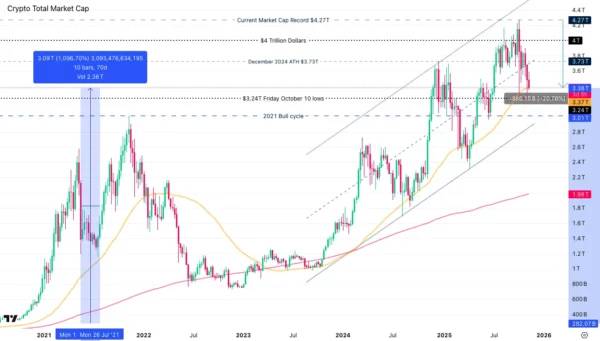
          Risk assets have been yo-yoing since mid-October, with fundamentals turning increasingly obscure amid the absence of US data, leaving investors hesitant to take on new risk.

          Cryptocurrencies have also been flashing mixed signals following the early-October rallies in Bitcoin, Solana, and Ethereum.

          Despite ongoing market cap outflows, the crypto space has made solid progress this year.Screenshot 2025-11-13 at 11.15.59 AM

          Ethereum Drops Another 3% Below $3,500 – Time For Panic Or Opportunity?_1

          Crypto Total Market Cap Weekly Chart, November 13, 2025 – Source: TradingView

          Still, with prices now down roughly 32% from the $4,950 August peak, the hype in ETH has cooled substantially.

          Yet, it's often when fewer people are watching that true opportunities emerge—though the question remains: is this a dip to buy or a reason to panic?

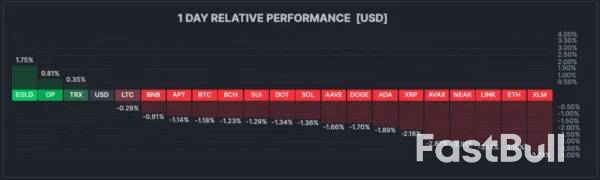
          Overstretched tech valuations continue to weigh on markets, as reflected in today's weakness across stock indices, and crypto is facing similar pressure.

          From an investment standpoint, the long term will reveal its truth—but for those without a crystal ball, a prudent approach is Dollar-Cost Averaging (DCA), which involves gradually building positions over time.

          For traders, the focus should stay on support and resistance levels—spotting trends between them and reacting when those levels break.

          Let's now look these levels through a multi-timeframe Ethereum analysis.

          Ethereum Drops Another 3% Below $3,500 – Time For Panic Or Opportunity?_2

          Daily overview of the Crypto Market, November 13, 2025 – Source: Finviz

          Ethereum (ETH) Multi-timeframe technical analysis

          Ethereum Drops Another 3% Below $3,500 – Time For Panic Or Opportunity?_3

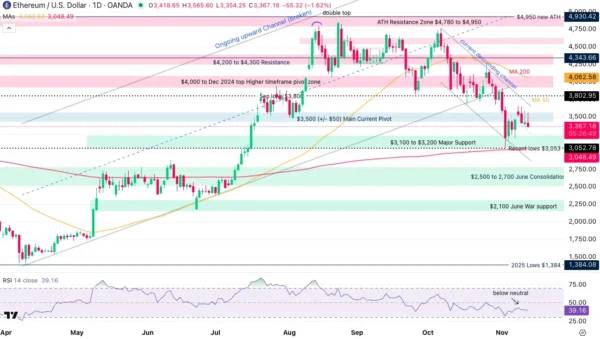
          Ethereum (ETH) Daily Chart, November 13, 2025 – Source: TradingView

          Having broken its April 2025 explosive upward channel, the picture for ETH is tilting more bearish, as strong flows have brought the second-Crypto below its $3,500 momentum pivot.

          Multiple attempts to break resistances have been met with consequent selloffs, leading to the formation of lower-highs.

          A balancing rebound last Tuesday (Nov 4) marked a temporary bottom at $3,053 – the rest will be to see if the bottom holds in an eventual double bottom or if its breaks, but for now these prices are still 8% from here (But never underestimate Crypto volatility!).

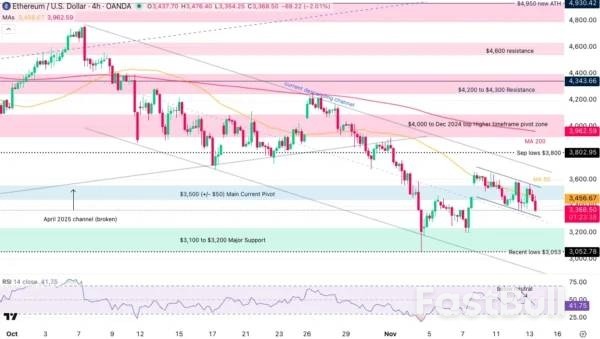
          4H Chart and levels

          Ethereum Drops Another 3% Below $3,500 – Time For Panic Or Opportunity?_4

          Ethereum (ETH) 4H Chart, November 13, 2025 – Source: TradingView

          Levels of interest for ETH trading:

          Support Levels:

          · $2,100 June War support
          · $2,500 to 2,700 June Consolidation
          · Recent lows $3,053
          · $3,500 (+/- $50) Main Current Pivot

          Resistance Levels:

          · $3,500 (+/- $50) Main Current Pivot
          · $3,650 Descending channel highs
          · $3,800 September lows
          · $4,000 to Dec 2024 top Higher timeframe pivot zone
          · $4,950 Current new All-time highs

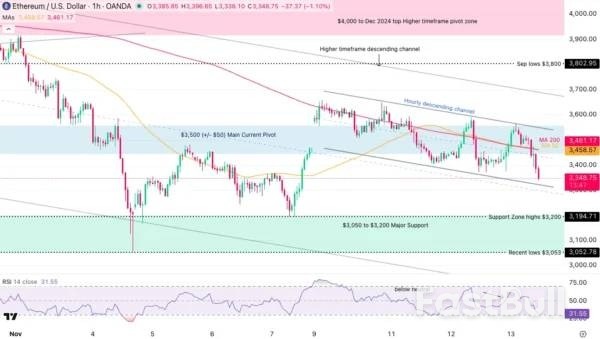
          1H Chart

          Ethereum Drops Another 3% Below $3,500 – Time For Panic Or Opportunity?_5

          Ethereum (ETH) 1H Chart, November 13, 2025 – Source: TradingView

          ETH is oscillating in a shorter timeframe descending channel which serves as immediate momentum indicator:

          Breaking below its support line ($3,300 to $3,330) points at more aggressive selling

          Bouncing at the lows of the channel points to a short-term revisit of the $3,500 Pivot Zone.

          Further upwards, a break above $3,700 (with preferably a session/weekly close), points to a more stable rebound that may serve for future rallies.

          Source: MarketPulse by OANDA Group

          Risk Warnings and Disclaimers
          You understand and acknowledge that there is a high degree of risk involved in trading. Following any strategies or investment methods may lead to potential losses. The content on the site is provided by our contributors and analysts for information purposes only. You are solely responsible for determining whether any trading assets, securities, strategy, or any other product is suitable for investing based on your own investment objectives and financial situation.
          Add to Favorites
          Share
          FastBull
          Copyright © 2025 FastBull Ltd

          728 RM B 7/F GEE LOK IND BLDG NO 34 HUNG TO RD KWUN TONG KLN HONG KONG

          TelegramInstagramTwitterfacebooklinkedin
          App Store Google Play Google Play
          Products
          Charts

          Chats

          Q&A with Experts
          Screeners
          Economic Calendar
          Data
          Tools
          Membership
          Features
          Function
          Markets
          Copy Trading
          Latest Signals
          Contests
          News
          Analysis
          24/7
          Columns
          Education
          Company
          Careers
          About Us
          Contact Us
          Advertising
          Help Center
          Feedback
          User Agreement
          Privacy Policy
          Personal Information Protection Statement
          Business

          White Label

          Data API

          Web Plug-ins

          Poster Maker

          Affiliate Program

          Risk Disclosure

          The risk of loss in trading financial instruments such as stocks, FX, commodities, futures, bonds, ETFs and crypto can be substantial. You may sustain a total loss of the funds that you deposit with your broker. Therefore, you should carefully consider whether such trading is suitable for you in light of your circumstances and financial resources.

          No decision to invest should be made without thoroughly conducting due diligence by yourself or consulting with your financial advisors. Our web content might not suit you since we don't know your financial conditions and investment needs. Our financial information might have latency or contain inaccuracy, so you should be fully responsible for any of your trading and investment decisions. The company will not be responsible for your capital loss.

          Without getting permission from the website, you are not allowed to copy the website's graphics, texts, or trademarks. Intellectual property rights in the content or data incorporated into this website belong to its providers and exchange merchants.

          Not Logged In

          Log in to access more features

          FastBull Membership

          Not yet

          Purchase

          Become a signal provider
          Help Center
          Customer Service
          Dark Mode
          Price Up/Down Colors

          Log In

          Sign Up
          Position
          Layout
          Fullscreen
          Default to Chart
          The chart page opens by default when you visit fastbull.com