• Trade
  • Markets
  • Copy
  • Contests
  • News
  • 24/7
  • Calendar
  • Q&A
  • Chats
Trending
Screeners
SYMBOL
LAST
BID
ASK
HIGH
LOW
NET CHG.
%CHG.
SPREAD
SPX
S&P 500 Index
6827.42
6827.42
6827.42
6899.86
6801.80
-73.58
-1.07%
--
DJI
Dow Jones Industrial Average
48458.04
48458.04
48458.04
48886.86
48334.10
-245.98
-0.51%
--
IXIC
NASDAQ Composite Index
23195.16
23195.16
23195.16
23554.89
23094.51
-398.69
-1.69%
--
USDX
US Dollar Index
97.950
98.030
97.950
98.500
97.950
-0.370
-0.38%
--
EURUSD
Euro / US Dollar
1.17394
1.17409
1.17394
1.17496
1.17192
+0.00011
+ 0.01%
--
GBPUSD
Pound Sterling / US Dollar
1.33707
1.33732
1.33707
1.33997
1.33419
-0.00148
-0.11%
--
XAUUSD
Gold / US Dollar
4299.39
4299.39
4299.39
4353.41
4257.10
+20.10
+ 0.47%
--
WTI
Light Sweet Crude Oil
57.233
57.485
57.233
58.011
56.969
-0.408
-0.71%
--

Community Accounts

Signal Accounts
--
Profit Accounts
--
Loss Accounts
--
View More

Become a signal provider

Sell trading signals to earn additional income

View More

Guide to Copy Trading

Get started with ease and confidence

View More

Signal Accounts for Members

All Signal Accounts

Best Return
  • Best Return
  • Best P/L
  • Best MDD
Past 1W
  • Past 1W
  • Past 1M
  • Past 1Y

All Contests

  • All
  • Trump Updates
  • Recommend
  • Stocks
  • Cryptocurrencies
  • Central Banks
  • Featured News
Top News Only
Share

Ukraine Says It Received 114 Prisoners From Belarus

Share

USA Embassy In Lithuania: Maria Kalesnikava Is Not Going To Vilnius

Share

USA Embassy In Lithuania: Other Prisoners Are Being Sent From Belarus To Ukraine

Share

Ukraine President Zelenskiy: Five Ukrainians Released By Belarus In US-Brokered Deal

Share

USA Vilnius Embassy: USA Stands Ready For "Additional Engagement With Belarus That Advances USA Interests"

Share

USA Vilnius Embassy: Belarus, USA, Other Citizens Among The Prisoners Released Into Lithuania

Share

USA Vilnius Embassy: USA Will Continue Diplomatic Efforts To Free The Remaining Political Prisoners In Belarus

Share

USA Vilnius Embassy: Belarus Releases 123 Prisoners Following Meeting Of President Trump's Envoy Coale And Belarus President Lukashenko

Share

USA Vilnius Embassy: Masatoshi Nakanishi, Aliaksandr Syrytsa Are Among The Prisoners Released By Belarus

Share

USA Vilnius Embassy: Maria Kalesnikava And Viktor Babaryka Are Among The Prisoners Released By Belarus

Share

USA Vilnius Embassy: Nobel Peace Prize Laureate Ales Bialiatski Is Among The Prisoners Released By Belarus

Share

Belarusian Presidential Administration Telegram Channel: Lukashenko Has Pardoned 123 Prisoners As Part Of Deal With US

Share

Two Local Syrian Officials: Joint US-Syrian Military Patrol In Central Syria Came Under Fire From Unknown Assailants

Share

Israeli Military Says It Targeted 'Key Hamas Terrorist' In Gaza City

Share

Rwanda's Actions In Eastern Drc Are A Clear Violation Of Washington Accords Signed By President Trump - Secretary Of State Rubio

Share

Israeli Military Issues Evacuation Warning In Southern Lebanon Village Ahead Of Strike - Spokesperson On X

Share

Belarusian State Media Cites US Envoy Coale As Saying He Discussed Ukraine And Venezuela With Lukashenko

Share

Belarusian State Media Cites US Envoy Coale As Saying That US Removes Sanctions On Belarusian Potassium

Share

Thai Prime Minister: No Ceasefire Agreement With Cambodia

Share

US, Ukraine To Discuss Ceasefire In Berlin Ahead Of European Summit

TIME
ACT
FCST
PREV
U.K. Trade Balance Non-EU (SA) (Oct)

A:--

F: --

P: --

U.K. Trade Balance (Oct)

A:--

F: --

P: --

U.K. Services Index MoM

A:--

F: --

P: --

U.K. Construction Output MoM (SA) (Oct)

A:--

F: --

P: --

U.K. Industrial Output YoY (Oct)

A:--

F: --

P: --

U.K. Trade Balance (SA) (Oct)

A:--

F: --

P: --

U.K. Trade Balance EU (SA) (Oct)

A:--

F: --

P: --

U.K. Manufacturing Output YoY (Oct)

A:--

F: --

P: --

U.K. GDP MoM (Oct)

A:--

F: --

P: --

U.K. GDP YoY (SA) (Oct)

A:--

F: --

P: --

U.K. Industrial Output MoM (Oct)

A:--

F: --

P: --

U.K. Construction Output YoY (Oct)

A:--

F: --

P: --

France HICP Final MoM (Nov)

A:--

F: --

P: --

China, Mainland Outstanding Loans Growth YoY (Nov)

A:--

F: --

P: --

China, Mainland M2 Money Supply YoY (Nov)

A:--

F: --

P: --

China, Mainland M0 Money Supply YoY (Nov)

A:--

F: --

P: --

China, Mainland M1 Money Supply YoY (Nov)

A:--

F: --

P: --

India CPI YoY (Nov)

A:--

F: --

P: --

India Deposit Gowth YoY

A:--

F: --

P: --

Brazil Services Growth YoY (Oct)

A:--

F: --

P: --

Mexico Industrial Output YoY (Oct)

A:--

F: --

P: --

Russia Trade Balance (Oct)

A:--

F: --

P: --

Philadelphia Fed President Henry Paulson delivers a speech
Canada Building Permits MoM (SA) (Oct)

A:--

F: --

P: --

Canada Wholesale Sales YoY (Oct)

A:--

F: --

P: --

Canada Wholesale Inventory MoM (Oct)

A:--

F: --

P: --

Canada Wholesale Inventory YoY (Oct)

A:--

F: --

P: --

Canada Wholesale Sales MoM (SA) (Oct)

A:--

F: --

P: --

Germany Current Account (Not SA) (Oct)

A:--

F: --

P: --

U.S. Weekly Total Rig Count

A:--

F: --

P: --

U.S. Weekly Total Oil Rig Count

A:--

F: --

P: --

Japan Tankan Large Non-Manufacturing Diffusion Index (Q4)

--

F: --

P: --

Japan Tankan Small Manufacturing Outlook Index (Q4)

--

F: --

P: --

Japan Tankan Large Non-Manufacturing Outlook Index (Q4)

--

F: --

P: --

Japan Tankan Large Manufacturing Outlook Index (Q4)

--

F: --

P: --

Japan Tankan Small Manufacturing Diffusion Index (Q4)

--

F: --

P: --

Japan Tankan Large Manufacturing Diffusion Index (Q4)

--

F: --

P: --

Japan Tankan Large-Enterprise Capital Expenditure YoY (Q4)

--

F: --

P: --

U.K. Rightmove House Price Index YoY (Dec)

--

F: --

P: --

China, Mainland Industrial Output YoY (YTD) (Nov)

--

F: --

P: --

China, Mainland Urban Area Unemployment Rate (Nov)

--

F: --

P: --

Saudi Arabia CPI YoY (Nov)

--

F: --

P: --

Euro Zone Industrial Output YoY (Oct)

--

F: --

P: --

Euro Zone Industrial Output MoM (Oct)

--

F: --

P: --

Canada Existing Home Sales MoM (Nov)

--

F: --

P: --

Euro Zone Total Reserve Assets (Nov)

--

F: --

P: --

U.K. Inflation Rate Expectations

--

F: --

P: --

Canada National Economic Confidence Index

--

F: --

P: --

Canada New Housing Starts (Nov)

--

F: --

P: --

U.S. NY Fed Manufacturing Employment Index (Dec)

--

F: --

P: --

U.S. NY Fed Manufacturing Index (Dec)

--

F: --

P: --

Canada Core CPI YoY (Nov)

--

F: --

P: --

Canada Manufacturing Unfilled Orders MoM (Oct)

--

F: --

P: --

Canada Manufacturing New Orders MoM (Oct)

--

F: --

P: --

Canada Core CPI MoM (Nov)

--

F: --

P: --

Canada Manufacturing Inventory MoM (Oct)

--

F: --

P: --

Canada CPI YoY (Nov)

--

F: --

P: --

Canada CPI MoM (Nov)

--

F: --

P: --

Canada CPI YoY (SA) (Nov)

--

F: --

P: --

Canada Core CPI MoM (SA) (Nov)

--

F: --

P: --

Q&A with Experts
    • All
    • Chatrooms
    • Groups
    • Friends
    Connecting
    .
    .
    .
    Type here...
    Add Symbol or Code

      No matching data

      All
      Trump Updates
      Recommend
      Stocks
      Cryptocurrencies
      Central Banks
      Featured News
      • All
      • Russia-Ukraine Conflict
      • Middle East Flashpoint
      • All
      • Russia-Ukraine Conflict
      • Middle East Flashpoint
      Search
      Products

      Charts Free Forever

      Chats Q&A with Experts
      Screeners Economic Calendar Data Tools
      Membership Features
      Data Warehouse Market Trends Institutional Data Policy Rates Macro

      Market Trends

      Market Sentiment Order Book Forex Correlations

      Top Indicators

      Charts Free Forever
      Markets

      News

      News Analysis 24/7 Columns Education
      From Institutions From Analysts
      Topics Columnists

      Latest Views

      Latest Views

      Trending Topics

      Top Columnists

      Latest Update

      Signals

      Copy Rankings Latest Signals Become a signal provider AI Rating
      Contests
      Brokers

      Overview Brokers Assessment Rankings Regulators News Claims
      Broker listing Forex Brokers Comparison Tool Live Spread Comparison Scam
      Q&A Complaint Scam Alert Videos Tips to Detect Scam
      More

      Business
      Events
      Careers About Us Advertising Help Center

      White Label

      Data API

      Web Plug-ins

      Affiliate Program

      Awards Institution Evaluation IB Seminar Salon Event Exhibition
      Vietnam Thailand Singapore Dubai
      Fans Party Investment Sharing Session
      FastBull Summit BrokersView Expo
      Recent Searches
        Top Searches
          Markets
          News
          Analysis
          User
          24/7
          Economic Calendar
          Education
          Data
          • Names
          • Latest
          • Prev

          View All

          No data

          Scan to Download

          Faster Charts, Chat Faster!

          Download App
          English
          • English
          • Español
          • العربية
          • Bahasa Indonesia
          • Bahasa Melayu
          • Tiếng Việt
          • ภาษาไทย
          • Français
          • Italiano
          • Türkçe
          • Русский язык
          • 简中
          • 繁中
          Open Account
          Search
          Products
          Charts Free Forever
          Markets
          News
          Signals

          Copy Rankings Latest Signals Become a signal provider AI Rating
          Contests
          Brokers

          Overview Brokers Assessment Rankings Regulators News Claims
          Broker listing Forex Brokers Comparison Tool Live Spread Comparison Scam
          Q&A Complaint Scam Alert Videos Tips to Detect Scam
          More

          Business
          Events
          Careers About Us Advertising Help Center

          White Label

          Data API

          Web Plug-ins

          Affiliate Program

          Awards Institution Evaluation IB Seminar Salon Event Exhibition
          Vietnam Thailand Singapore Dubai
          Fans Party Investment Sharing Session
          FastBull Summit BrokersView Expo

          Markets Brace for One-two U.S. Credit Conditions Punch

          Alex

          Economic

          Summary:

          The gulf between financial markets' and Federal Reserve Chair Jerome Powell's view of the U.S. economy could not be wider, but two national credit conditions and lending surveys within 24 hours of each other could narrow the chasm.

          The gulf between financial markets' and Federal Reserve Chair Jerome Powell's view of the U.S. economy could not be wider, but two national credit conditions and lending surveys within 24 hours of each other could narrow the chasm.
          The Fed releases its quarterly Senior Loan Officer Opinion Survey, or 'SLOOS', on Monday May 8, and the National Federation of Independent Business's April survey of small businesses will be released the following day.
          They come at a critical time - after 500 basis points of interest rates hikes in little over a year, turmoil in the regional U.S. banking sector is intensifying and claiming more victims.
          Lending standards, which were already at levels consistent with past recessions, according to several indicators in the most recent 'SLOOS' and NFIB surveys, will only tighten further.
          The question is how much more - enough to actually tip the economy into recession and force the Fed to cut rates in the second half of the year, as futures markets are aggressively pricing? Or not?
          Powell and his colleagues have seen the 'SLOOS' report. Speaking to reporters after the Fed raised rates to a 16-year high on Wednesday, Powell said it is "broadly consistent" with the recent tightening in lending standards, and will show that "lending has continued to grow but the pace has been slowing since the second half of last year."
          Although tighter credit conditions will weigh on economic activity, hiring and inflation, recession can still be avoided. "It's possible that this time is really different. The case of avoiding a recession is, in my view, more likely than having a recession," Powell said.
          Markets Brace for One-two U.S. Credit Conditions Punch_1California screamin'
          If U.S. rates futures are the barometer, however, financial markets could not disagree more. Secured Overnight Financing Rate (SOFR) futures on Thursday priced in as much as 100 basis points of easing by year-end, and Fed funds futures indicated the first cut could be as early as July.
          That would be a quick pivot to rate cuts from hikes, but not unusual. In fact, it would be in line with historical trends - according to Joe Lavorgna at SMBC Nikko Securities, the median pivot over the last 18 tightening cycles going back to the 1950s is two months, and the average is three.
          It remains to be seen if the Fed will turn tail so quickly this time. As Powell stressed, inflation remains well above its 2% goal and the labor market is surprisingly resilient.
          But weaker lending and banking conditions will take their toll.
          "We are in the midst of a full-fledged California bank crisis," Phil Suttle, founder of consultancy Suttle Economics, wrote on Thursday. "The resulting national headwind from bank lending ... will push the economy into recession by year end," allowing the Fed to cut rates to 3% by the end of next year, he said.
          Recession Watch
          The Fed's last SLOOS in February showed that the net percentage of banks reporting tightening standards for commercial and industrial loans in the fourth quarter jumped above 40%.
          That is consistent with levels reached before or during the last four recessions - 1990-91, 2001, 2007-09 and early 2020. Similarly, demand for these loans also slumped to previous recession levels.
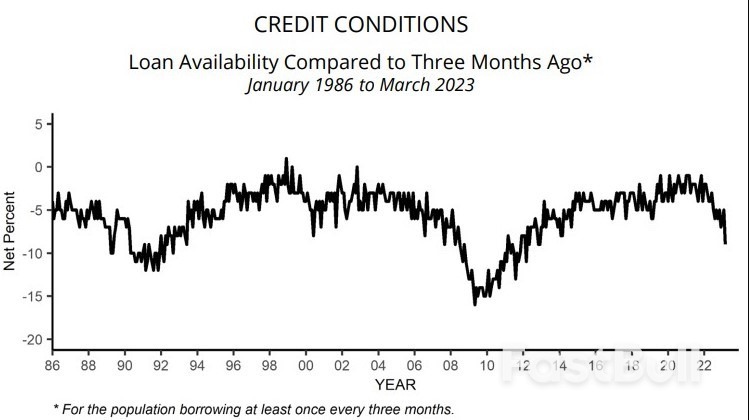
          Markets Brace for One-two U.S. Credit Conditions Punch_2The NFIB's last survey, meanwhile, showed that credit conditions for small firms measured by the Loan Availability Compared to Three Months Ago index deteriorated sharply to the worst in over a decade.
          This index's four-point increase to 9 from February - a higher print means credit is harder to access - was the biggest month-on-month rise in over 20 years. It will be closely watched on Tuesday.
          A separate NFIB banking survey published this week shows small business owners are not hitting the panic button just yet, but concern is growing.
          Asked last month how concerned they are about the health of the bank they use for business purposes in light of the recent bank failures, 19% said very concerned, 23% said moderately concerned and 28% slightly concerned.
          "Small business owners are, not surprisingly, concerned about the stability of the banking system. A strong small business banking system is essential for small business owners to operate and grow their business," Holly Wade, executive director of NFIB's Research Center said.
          Perhaps the most ominous signal from the NFIB's banking survey published this week was more than half of small business owners - 55% - reckon the United States is already in a recession.
          That's certainly not what Jerome Powell thinks.

          Source: Reuters

          To stay updated on all economic events of today, please check out our Economic calendar
          Risk Warnings and Disclaimers
          You understand and acknowledge that there is a high degree of risk involved in trading. Following any strategies or investment methods may lead to potential losses. The content on the site is provided by our contributors and analysts for information purposes only. You are solely responsible for determining whether any trading assets, securities, strategy, or any other product is suitable for investing based on your own investment objectives and financial situation.
          Comments
          Add to Favorites
          Share

          China Forex Reserves Largest in 14 Months: What Does This Mean for the Global Economy?

          Warren Takunda

          Traders' Opinions

          China's foreign exchange reserves have reached their highest level in 14 months, according to recent data. This news is significant because China is the world's largest holder of foreign exchange reserves, and the size of its reserves can have a significant impact on the global economy. In this article, we will explore what this means for the global economy and why China's foreign exchange reserves are important.
          What are foreign exchange reserves?
          Foreign exchange reserves are assets held by a central bank in foreign currencies, gold, and other assets. They are used to manage the value of a country's currency and to ensure that the country can meet its international financial obligations. Foreign exchange reserves can also be used to support the value of a country's currency in the foreign exchange market.
          Why are China's foreign exchange reserves important?
          China is the world's largest holder of foreign exchange reserves, with a total of USD 3.205 trillion at the end of April 2023. This is significant because China's foreign exchange reserves have a significant impact on the global economy. China's foreign exchange reserves are used to manage the value of the yuan and to ensure that China can meet its international financial obligations.
          China's foreign exchange reserves are also important because they give China a significant amount of financial power. China can use its foreign exchange reserves to invest in other countries or to support its own currency in the foreign exchange market. China's foreign exchange reserves also give it a significant amount of leverage in international negotiations, as other countries may be hesitant to challenge China's economic power.
          What does the increase in China's foreign exchange reserves mean for the global economy?
          The increase in China's foreign exchange reserves is a positive sign for the global economy. It indicates that China's economy is strong and that China is continuing to invest in other countries. China's investment in other countries can help to stimulate economic growth and create jobs.
          The increase in China's foreign exchange reserves is also a sign that China is managing its currency effectively. By managing the value of the yuan, China can avoid currency fluctuations that can disrupt international trade and investment. This can help to create a stable environment for businesses to operate in and can promote economic growth.
          In addition, the increase in China's foreign exchange reserves can help to boost confidence in the global economy. China's financial power can help to stabilize the international financial system and prevent financial crises from occurring. This can help to promote investment and growth in other countries.
          China's foreign exchange reserves are an important indicator of the health of the global economy. The recent increase in China's foreign exchange reserves is a positive sign for the global economy, indicating that China's economy is strong and that China is continuing to invest in other countries. China's foreign exchange reserves also give it significant financial power, which can be used to stabilize the international financial system and promote economic growth. As such, the increase in China's foreign exchange reserves is good news for the global economy.
          Risk Warnings and Disclaimers
          You understand and acknowledge that there is a high degree of risk involved in trading. Following any strategies or investment methods may lead to potential losses. The content on the site is provided by our contributors and analysts for information purposes only. You are solely responsible for determining whether any trading assets, securities, strategy, or any other product is suitable for investing based on your own investment objectives and financial situation.
          Comments
          Add to Favorites
          Share

          Binance Temporarily Halts Bitcoin Withdrawals

          Kevin Du

          Cryptocurrency

          Binance, the world's biggest cryptocurrency exchange by trading volume, has temporarily closed Bitcoin withdrawals because its network is suffering a "congestion" issue, the company said in a tweet on Sunday.
          "Our team is currently working on a fix until the network is stabilised and will reopen $BTC withdrawals as soon as possible", the tweet said.
          "Rest assured, funds are SAFU."
          SAFU refers to Binance's Secure Asset Fund for Users, an emergency fund the platform set up in July 2018 to protect users' investments. While the fund fluctuates based on the market, it is valued at about $1 billion, according to the Binance website.
          The term also means "safe" in the cryptocurrency world.
          However, shortly before 9pm UAE time on Sunday, Binance said the issue had been resolved in a follow-up tweet.
          "$BTC withdrawals are now resumed on #Binance. Thank you for your patience and we apologise for any inconvenience," the company said on Twitter.
          It is not the first time that Binance has temporarily halted Bitcoin withdrawals. In June last year, Binance founder and chief executive Changpeng Zhou tweeted that the platform had temporarily "paused Bitcoin withdrawals due to a stuck transaction causing a backlog".
          "Should be fixed in ~30 minutes. Will update. Funds are SAFU." Mr Zhou added.
          It has been a tumultuous 12 months for the global cryptocurrency sector, which is only now emerging from a "crypto winter" after the collapse of a number of large platforms including Celsius, Three Arrows Capital and Sam Bankman-Fried's FTX, which filed for bankruptcy in the US on November 11.
          The collapse of FTX, once valued at $32 billion, is the highest-profile cryptocurrency exchange failure to date, after traders pulled $6 billion from the platform in three days and rival exchange Binance abandoned a rescue deal, Reuters reported at the time.
          Bitcoin is currently up 1.12 per cent at $28,981.48 as of 7.50pm UAE time on Sunday.
          Last month, Bitcoin climbed above the key $30,000 mark for the first time since June 2022, but is still down more than 50 per cent from its record high of more than $68,000 in November 2021.
          In February, Binance admitted that it had "gaps" in its compliance with US regulations and said the company was likely to pay a fine to settle investigations.
          The gaps, however, had been closed and the company co-ordinated with US authorities to iron out any issues, Bloomberg reported at the time, quoting Binance's chief strategy officer Patrick Hillmann.

          Source: The National News

          Risk Warnings and Disclaimers
          You understand and acknowledge that there is a high degree of risk involved in trading. Following any strategies or investment methods may lead to potential losses. The content on the site is provided by our contributors and analysts for information purposes only. You are solely responsible for determining whether any trading assets, securities, strategy, or any other product is suitable for investing based on your own investment objectives and financial situation.
          Comments
          Add to Favorites
          Share

          Saudi Arabia's Q1 GDP Growth Slows Down: Weakest in 7 Quarters

          Warren Takunda

          Traders' Opinions

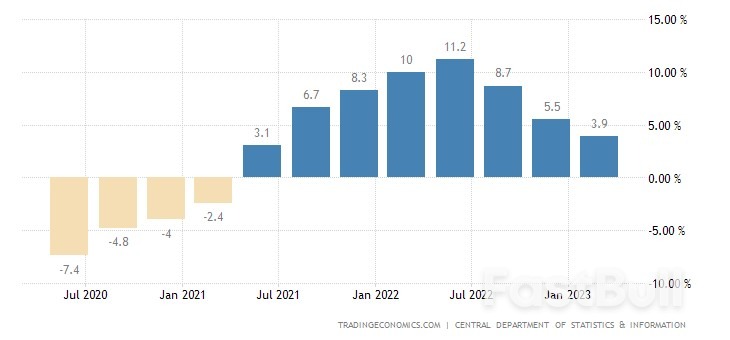
          The Saudi Arabian economy saw a slower growth rate of 3.9% from the previous year in the first quarter of 2023, according to preliminary estimates. This marked the eighth consecutive quarter of economic expansion, but it was also the slowest pace of growth since Q2 2021. The Q1 2023 figure was significantly lower than the previous quarter's 5.5% rise, indicating a possible slowdown in the economy.

          Factors Driving the SlowdownSaudi Arabia's Q1 GDP Growth Slows Down: Weakest in 7 Quarters_1

          The slowdown was driven by both non-oil and oil activities, which expanded at softer paces compared to the previous quarter. Non-oil activities grew by 5.8%, down from 6.2% in Q4 2022, while oil activities increased by only 1.3%, a significant drop from the 6.1% growth in the previous quarter. However, government services continued to increase, with a growth rate of 4.9%, up from 2.9% in the previous quarter.

          Quarterly Seasonally Adjusted Data

          Furthermore, on quarterly seasonally adjusted data, the Saudi GDP contracted by 1.3%. This was the first contraction since Q1 2021, reversing from a 1.3% expansion in Q4 2022. The contraction in Q1 2023 could indicate a potential slowdown in economic activity.

          Positive Outlook

          Despite the weaker first quarter performance, the overall picture for the Saudi Arabian economy remains positive. In 2022, the economy grew by 8.7%, a significant acceleration from the 3.9% gain in 2021. The strong growth in 2022 was largely driven by the recovery in oil prices, which boosted government revenue and allowed for increased public spending.

          The Future of the Saudi Arabian Economy

          Looking ahead, the outlook for the Saudi Arabian economy is positive, with the government continuing to implement its ambitious Vision 2030 plan. The plan aims to diversify the economy away from oil, create jobs for Saudi citizens, and increase foreign investment. Moreover, the country's large-scale infrastructure projects, such as the NEOM smart city and the Red Sea Project, are expected to boost economic growth in the coming years.
          Risk Warnings and Disclaimers
          You understand and acknowledge that there is a high degree of risk involved in trading. Following any strategies or investment methods may lead to potential losses. The content on the site is provided by our contributors and analysts for information purposes only. You are solely responsible for determining whether any trading assets, securities, strategy, or any other product is suitable for investing based on your own investment objectives and financial situation.
          Comments
          Add to Favorites
          Share

          May 8th Financial News

          FastBull Featured

          Daily News

          【Quick Facts】
          1. Non-farm payrolls is bad for the Fed interest rate cut expectations.
          2. Bullard: Recent reports show not much progress on inflation.
          3. The debt ceiling problem reappears.
          4. Bank of Canada is expected to raise interest rates.
          【News Details】
          1. Non-farm payrolls is bad for the Fed interest rate cut expectations.
          Non-farm payrolls increased by 253,000 in April, beating the market consensus of 185,000 (the previous was revised down from 236,000 to 165,000). In terms of sub-items, the rebound of the commodity manufacturing may be related to weather factors. In private services, health and social assistance are still filling the gap, and other key sectors driving employment are growing at different rates.
          Average hourly earnings rose to 4.4% (Prev: 4.3%, Fcst: 4.2%). The characteristic of salaries in various industries is wages in industries with high wages and low employment rising more, and wages in industries with low wages and more employment rising less than the overall average. Although the unemployment rate slowed down to 3.4% (Prev: 3.5,%, Fcst: 3.6%), due to the re-increase of non-farm payrolls, the Fed’s interest rate cut expectations after the decision were suppressed.
          The good news is if we consider that the new non-farm payrolls in the past two months have been revised downward by a total of 149,000, so although the non-farm payrolls this month exceeded expectations, the three-month moving average of non-farm payrolls still maintains a downtrend. The increase in employment in a single month does not necessarily mean that the labor market's demand in a downtrend has reversed again.
          2. Bullard: Recent reports show not much progress on inflation.
          Bullard will update his views on the Summary of Economic Projections (SEP) at the June monetary policy meeting. The Fed's restrictive policy may not be enough, we are waiting for the data. Wall Street is "fixed" by temporary inflation. If inflation persists, the Fed will have to take more interest rate measures, but Wall Street is not ready. The recent drop in market interest rates may have "swamped out" the impact of a credit crunch caused by bank stress.
          Consumption will remain strong, according to the jobs report. There is now enough room to fight inflation. The aggressive policy has curbed higher inflation, but it's unclear whether it has put inflation on a downward path. I feel that policy is at the "lower end" of the restrictive territory, but it's unclear whether the restrictive territory is enough to keep inflation on a downward path. Today's jobs report was "impressive" on job growth, but was still a long way to be a balanced labor market.
          3. The debt ceiling problem reappears.
          U.S. President Joe Biden has asked Congress to unconditionally raise the debt ceiling. The House of Representatives passed a bill last month that would raise the government's $31.4 trillion debt ceiling, but it also included sweeping spending cuts over the next decade, which Biden and his fellow Democrats opposed. Biden was adamant that he will not negotiate an increase in the debt ceiling, but will discuss budget cuts after the new ceiling is passed.
          Forty-three Senate Republicans said Saturday they opposed a vote on a bill that would only raise the debt ceiling without addressing other priorities, indicating that they could block such a plan from Democrats.
          The bill needs 60 votes in the 100-seat Senate to pass. With Democrats holding 51 votes a little higher than Republicans 49 votes. Senate Democratic leader Chuck Schumer needs the support of at least nine Republicans to reach 60 votes to push through the legislation.
          House Democratic leader Hakeem Jeffries said the responsible action would be to raise the debt ceiling, "We must ensure that America pays its bills to avoid a dangerous default on our debt that would destroy the U.S. economy."
          4. Bank of Canada is expected to raise interest rates.
          The latest figures from Statistics Canada show the economy added 41,000 jobs last month, mostly part-time jobs. The unemployment rate remained steady at 5.0% for the fifth straight month, according to its latest labor force survey. This is slightly higher than the record low of 4.9% last summer.
          Most of the job gains in April came from wholesale and retail trade, while the biggest losses were in business, construction, and other support services. With the labor market still relatively tight, average hourly earnings rose 5.2% from a year ago, faster than inflation. The Bank of Canada has been warning that a tight labor market will make it harder for inflation to return to 2%, as higher wages could put upward pressure on prices.
          Bank of Canada Governor Macklem said in a speech last Thursday that he was "ready to raise rates further" if inflation was significantly higher than 2%, and partly blamed strong wage growth for its role in underpinning inflation.
          【Focus of the Day】
          UTC+8 22:00 Speech by ECB Chief Economist Lane
          UTC+8 04:00 The Fed Releases Financial Stability Report
          Risk Warnings and Disclaimers
          You understand and acknowledge that there is a high degree of risk involved in trading. Following any strategies or investment methods may lead to potential losses. The content on the site is provided by our contributors and analysts for information purposes only. You are solely responsible for determining whether any trading assets, securities, strategy, or any other product is suitable for investing based on your own investment objectives and financial situation.
          Comments
          Add to Favorites
          Share

          A Busy Week Ahead for Global Finance: Key Economic Indicators to Watch

          Warren Takunda

          Economic

          Traders' Opinions

          The upcoming week in the world of finance is expected to be action-packed, with a plethora of crucial economic indicators scheduled for release worldwide. A diverse range of data will be scrutinized closely by investors and analysts, including inflation rates, producer prices, and consumer confidence measures.
          In the United States, the focus will be on prices, as several key indicators are set to be published. The inflation rate, producer prices, and export and import prices will be closely watched, as will the Michigan consumer confidence CPI gauge. These figures will provide crucial insights into the state of the US economy and could impact market sentiment.
          Besides these US indicators, CPI data will also be released in several other countries, including China, Mexico, Brazil, India, and Russia. These measures of inflation will offer significant information about the economic conditions in these countries and could be utilized by policymakers to make decisions regarding interest rates and other economic policies.
          In the United Kingdom, investors will eagerly await the Q1 GDP growth data release. This figure will provide insights into the UK economy's health and may have a bearing on the value of the pound. Additionally, the Bank of England's latest interest rate decision will be announced, and this is expected to be scrutinized closely by investors and analysts.
          In other parts of the world, China is set to publish external trade data, which will provide insights into its trading relationships with other nations. Australia will also report on consumer and business confidence, which could give clues about the Australian economy's state.
          Overall, the week ahead promises to be a hectic one for investors and analysts, with a broad range of economic indicators slated for release worldwide. These figures will provide crucial insights into the global economy's health and could have an impact on market sentiment and investment decisions.
          To stay updated on all economic events of today, please check out our Economic calendar
          Risk Warnings and Disclaimers
          You understand and acknowledge that there is a high degree of risk involved in trading. Following any strategies or investment methods may lead to potential losses. The content on the site is provided by our contributors and analysts for information purposes only. You are solely responsible for determining whether any trading assets, securities, strategy, or any other product is suitable for investing based on your own investment objectives and financial situation.
          Comments
          Add to Favorites
          Share

          Following Friday's Feel-Good Factor

          Samantha Luan

          Economic

          Asian markets are set for a positive start to the week on Monday after strong U.S. jobs data on Friday soothed recession and banking sector fears, and sparked the best day for world equities in five months.
          The regional economic data calendar on Monday is light, with the final reading of Japanese purchasing managers index and Taiwanese trade for April the main releases.
          Following Friday's Feel-Good Factor_1Monday's market tone will probably be set by the U.S. feel-good factor, boosted by surprisingly strong corporate earnings, and whether investors think the U.S. really will defy the odds and head for a soft landing.
          Federal Reserve Chair Jerome Powell, for one, is very optimistic: "It's possible that this time is really different. The case of avoiding a recession is, in my view, more likely than having a recession," he said on Wednesday after raising the benchmark overnight interest rate by a quarter of a percentage point to a 16-year high.
          Two reports on U.S. credit conditions and loan demand on Monday and Tuesday will be more closely watched than usual, in light of the cumulative effect of the Fed's rate hikes and recent stress in the regional banking system.
          Asian market sentiment later in the week could be molded by a batch of Chinese economic indicators: trade, lending and money supply figures for April on Tuesday, and CPI inflation on Thursday.
          These reports will give investors a clearer insight into how well the region's largest economy is doing after abandoning its COVID-19 lockdown restrictions.
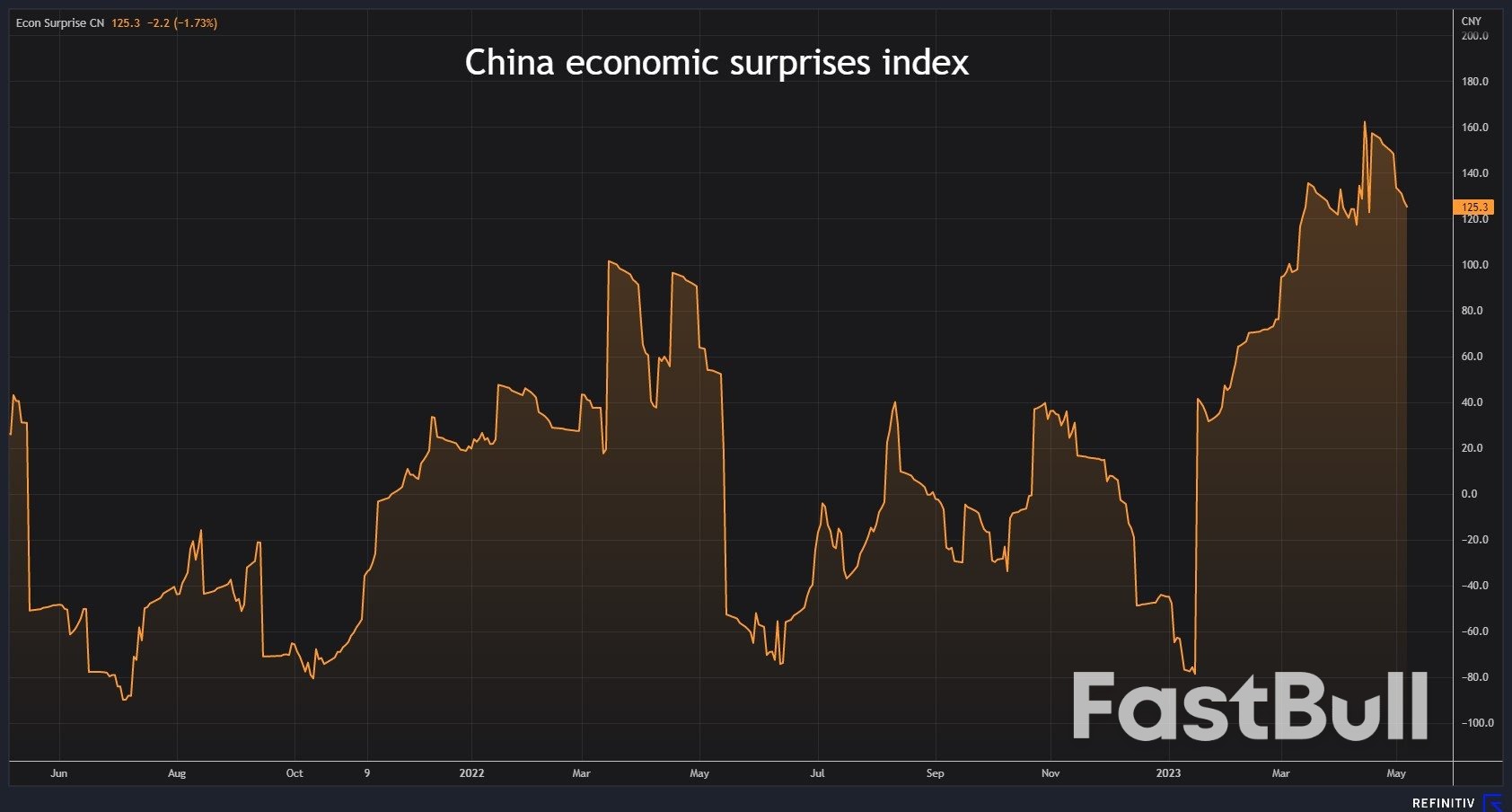
          The signs are mixed at best. The heavily indebted property sector remains under severe stress, April's PMI reports were soft, and the economic surprises index - at a 17-year high a few weeks ago - has now declined 13 days in a row.
          Economic momentum is clearly slowing.Following Friday's Feel-Good Factor_2
          Technology giant JD.com and China's largest chip foundry Semiconductor Manufacturing International Corp both releases first-quarter earnings on Thursday.
          Figures on Sunday, meanwhile, showed that China FX reserves rose $21 billion in April to $3.205 trillion, higher than expected and the highest since February last year.
          Potentially market-moving events later in the week include: G7 finance ministers meeting in Niigata, Japan from Thursday through Saturday, Bank of Japan minutes of its April 27-28 policy meeting on Wednesday, and the Bank of England's policy meeting on Thursday.
          Here are three key developments that could provide more direction to markets on Monday:
          - Japan services, composite PMI (April, final)
          - Australia business conditions index (April)

          Source: Reuters

          To stay updated on all economic events of today, please check out our Economic calendar
          Risk Warnings and Disclaimers
          You understand and acknowledge that there is a high degree of risk involved in trading. Following any strategies or investment methods may lead to potential losses. The content on the site is provided by our contributors and analysts for information purposes only. You are solely responsible for determining whether any trading assets, securities, strategy, or any other product is suitable for investing based on your own investment objectives and financial situation.
          Comments
          Add to Favorites
          Share
          FastBull
          Copyright © 2025 FastBull Ltd

          728 RM B 7/F GEE LOK IND BLDG NO 34 HUNG TO RD KWUN TONG KLN HONG KONG

          TelegramInstagramTwitterfacebooklinkedin
          App Store Google Play Google Play
          Products
          Charts

          Chats

          Q&A with Experts
          Screeners
          Economic Calendar
          Data
          Tools
          Membership
          Features
          Function
          Markets
          Copy Trading
          Latest Signals
          Contests
          News
          Analysis
          24/7
          Columns
          Education
          Company
          Careers
          About Us
          Contact Us
          Advertising
          Help Center
          Feedback
          User Agreement
          Privacy Policy
          Business

          White Label

          Data API

          Web Plug-ins

          Poster Maker

          Affiliate Program

          Risk Disclosure

          The risk of loss in trading financial instruments such as stocks, FX, commodities, futures, bonds, ETFs and crypto can be substantial. You may sustain a total loss of the funds that you deposit with your broker. Therefore, you should carefully consider whether such trading is suitable for you in light of your circumstances and financial resources.

          No decision to invest should be made without thoroughly conducting due diligence by yourself or consulting with your financial advisors. Our web content might not suit you since we don't know your financial conditions and investment needs. Our financial information might have latency or contain inaccuracy, so you should be fully responsible for any of your trading and investment decisions. The company will not be responsible for your capital loss.

          Without getting permission from the website, you are not allowed to copy the website's graphics, texts, or trademarks. Intellectual property rights in the content or data incorporated into this website belong to its providers and exchange merchants.

          Not Logged In

          Log in to access more features

          FastBull Membership

          Not yet

          Purchase

          Become a signal provider
          Help Center
          Customer Service
          Dark Mode
          Price Up/Down Colors

          Log In

          Sign Up

          Position
          Layout
          Fullscreen
          Default to Chart
          The chart page opens by default when you visit fastbull.com