• Trade
  • Markets
  • Copy
  • Contests
  • News
  • 24/7
  • Calendar
  • Q&A
  • Chats
Trending
Screeners
SYMBOL
LAST
BID
ASK
HIGH
LOW
NET CHG.
%CHG.
SPREAD
SPX
S&P 500 Index
6827.42
6827.42
6827.42
6899.86
6801.80
-73.58
-1.07%
--
DJI
Dow Jones Industrial Average
48458.04
48458.04
48458.04
48886.86
48334.10
-245.98
-0.51%
--
IXIC
NASDAQ Composite Index
23195.16
23195.16
23195.16
23554.89
23094.51
-398.69
-1.69%
--
USDX
US Dollar Index
97.950
98.030
97.950
98.500
97.950
-0.370
-0.38%
--
EURUSD
Euro / US Dollar
1.17394
1.17409
1.17394
1.17496
1.17192
+0.00011
+ 0.01%
--
GBPUSD
Pound Sterling / US Dollar
1.33707
1.33732
1.33707
1.33997
1.33419
-0.00148
-0.11%
--
XAUUSD
Gold / US Dollar
4299.39
4299.39
4299.39
4353.41
4257.10
+20.10
+ 0.47%
--
WTI
Light Sweet Crude Oil
57.233
57.485
57.233
58.011
56.969
-0.408
-0.71%
--

Community Accounts

Signal Accounts
--
Profit Accounts
--
Loss Accounts
--
View More

Become a signal provider

Sell trading signals to earn additional income

View More

Guide to Copy Trading

Get started with ease and confidence

View More

Signal Accounts for Members

All Signal Accounts

Best Return
  • Best Return
  • Best P/L
  • Best MDD
Past 1W
  • Past 1W
  • Past 1M
  • Past 1Y

All Contests

  • All
  • Trump Updates
  • Recommend
  • Stocks
  • Cryptocurrencies
  • Central Banks
  • Featured News
Top News Only
Share

Ukraine Says It Received 114 Prisoners From Belarus

Share

USA Embassy In Lithuania: Maria Kalesnikava Is Not Going To Vilnius

Share

USA Embassy In Lithuania: Other Prisoners Are Being Sent From Belarus To Ukraine

Share

Ukraine President Zelenskiy: Five Ukrainians Released By Belarus In US-Brokered Deal

Share

USA Vilnius Embassy: USA Stands Ready For "Additional Engagement With Belarus That Advances USA Interests"

Share

USA Vilnius Embassy: Belarus, USA, Other Citizens Among The Prisoners Released Into Lithuania

Share

USA Vilnius Embassy: USA Will Continue Diplomatic Efforts To Free The Remaining Political Prisoners In Belarus

Share

USA Vilnius Embassy: Belarus Releases 123 Prisoners Following Meeting Of President Trump's Envoy Coale And Belarus President Lukashenko

Share

USA Vilnius Embassy: Masatoshi Nakanishi, Aliaksandr Syrytsa Are Among The Prisoners Released By Belarus

Share

USA Vilnius Embassy: Maria Kalesnikava And Viktor Babaryka Are Among The Prisoners Released By Belarus

Share

USA Vilnius Embassy: Nobel Peace Prize Laureate Ales Bialiatski Is Among The Prisoners Released By Belarus

Share

Belarusian Presidential Administration Telegram Channel: Lukashenko Has Pardoned 123 Prisoners As Part Of Deal With US

Share

Two Local Syrian Officials: Joint US-Syrian Military Patrol In Central Syria Came Under Fire From Unknown Assailants

Share

Israeli Military Says It Targeted 'Key Hamas Terrorist' In Gaza City

Share

Rwanda's Actions In Eastern Drc Are A Clear Violation Of Washington Accords Signed By President Trump - Secretary Of State Rubio

Share

Israeli Military Issues Evacuation Warning In Southern Lebanon Village Ahead Of Strike - Spokesperson On X

Share

Belarusian State Media Cites US Envoy Coale As Saying He Discussed Ukraine And Venezuela With Lukashenko

Share

Belarusian State Media Cites US Envoy Coale As Saying That US Removes Sanctions On Belarusian Potassium

Share

Thai Prime Minister: No Ceasefire Agreement With Cambodia

Share

US, Ukraine To Discuss Ceasefire In Berlin Ahead Of European Summit

TIME
ACT
FCST
PREV
U.K. Trade Balance Non-EU (SA) (Oct)

A:--

F: --

P: --

U.K. Trade Balance (Oct)

A:--

F: --

P: --

U.K. Services Index MoM

A:--

F: --

P: --

U.K. Construction Output MoM (SA) (Oct)

A:--

F: --

P: --

U.K. Industrial Output YoY (Oct)

A:--

F: --

P: --

U.K. Trade Balance (SA) (Oct)

A:--

F: --

P: --

U.K. Trade Balance EU (SA) (Oct)

A:--

F: --

P: --

U.K. Manufacturing Output YoY (Oct)

A:--

F: --

P: --

U.K. GDP MoM (Oct)

A:--

F: --

P: --

U.K. GDP YoY (SA) (Oct)

A:--

F: --

P: --

U.K. Industrial Output MoM (Oct)

A:--

F: --

P: --

U.K. Construction Output YoY (Oct)

A:--

F: --

P: --

France HICP Final MoM (Nov)

A:--

F: --

P: --

China, Mainland Outstanding Loans Growth YoY (Nov)

A:--

F: --

P: --

China, Mainland M2 Money Supply YoY (Nov)

A:--

F: --

P: --

China, Mainland M0 Money Supply YoY (Nov)

A:--

F: --

P: --

China, Mainland M1 Money Supply YoY (Nov)

A:--

F: --

P: --

India CPI YoY (Nov)

A:--

F: --

P: --

India Deposit Gowth YoY

A:--

F: --

P: --

Brazil Services Growth YoY (Oct)

A:--

F: --

P: --

Mexico Industrial Output YoY (Oct)

A:--

F: --

P: --

Russia Trade Balance (Oct)

A:--

F: --

P: --

Philadelphia Fed President Henry Paulson delivers a speech
Canada Building Permits MoM (SA) (Oct)

A:--

F: --

P: --

Canada Wholesale Sales YoY (Oct)

A:--

F: --

P: --

Canada Wholesale Inventory MoM (Oct)

A:--

F: --

P: --

Canada Wholesale Inventory YoY (Oct)

A:--

F: --

P: --

Canada Wholesale Sales MoM (SA) (Oct)

A:--

F: --

P: --

Germany Current Account (Not SA) (Oct)

A:--

F: --

P: --

U.S. Weekly Total Rig Count

A:--

F: --

P: --

U.S. Weekly Total Oil Rig Count

A:--

F: --

P: --

Japan Tankan Large Non-Manufacturing Diffusion Index (Q4)

--

F: --

P: --

Japan Tankan Small Manufacturing Outlook Index (Q4)

--

F: --

P: --

Japan Tankan Large Non-Manufacturing Outlook Index (Q4)

--

F: --

P: --

Japan Tankan Large Manufacturing Outlook Index (Q4)

--

F: --

P: --

Japan Tankan Small Manufacturing Diffusion Index (Q4)

--

F: --

P: --

Japan Tankan Large Manufacturing Diffusion Index (Q4)

--

F: --

P: --

Japan Tankan Large-Enterprise Capital Expenditure YoY (Q4)

--

F: --

P: --

U.K. Rightmove House Price Index YoY (Dec)

--

F: --

P: --

China, Mainland Industrial Output YoY (YTD) (Nov)

--

F: --

P: --

China, Mainland Urban Area Unemployment Rate (Nov)

--

F: --

P: --

Saudi Arabia CPI YoY (Nov)

--

F: --

P: --

Euro Zone Industrial Output YoY (Oct)

--

F: --

P: --

Euro Zone Industrial Output MoM (Oct)

--

F: --

P: --

Canada Existing Home Sales MoM (Nov)

--

F: --

P: --

Euro Zone Total Reserve Assets (Nov)

--

F: --

P: --

U.K. Inflation Rate Expectations

--

F: --

P: --

Canada National Economic Confidence Index

--

F: --

P: --

Canada New Housing Starts (Nov)

--

F: --

P: --

U.S. NY Fed Manufacturing Employment Index (Dec)

--

F: --

P: --

U.S. NY Fed Manufacturing Index (Dec)

--

F: --

P: --

Canada Core CPI YoY (Nov)

--

F: --

P: --

Canada Manufacturing Unfilled Orders MoM (Oct)

--

F: --

P: --

Canada Manufacturing New Orders MoM (Oct)

--

F: --

P: --

Canada Core CPI MoM (Nov)

--

F: --

P: --

Canada Manufacturing Inventory MoM (Oct)

--

F: --

P: --

Canada CPI YoY (Nov)

--

F: --

P: --

Canada CPI MoM (Nov)

--

F: --

P: --

Canada CPI YoY (SA) (Nov)

--

F: --

P: --

Canada Core CPI MoM (SA) (Nov)

--

F: --

P: --

Q&A with Experts
    • All
    • Chatrooms
    • Groups
    • Friends
    Connecting
    .
    .
    .
    Type here...
    Add Symbol or Code

      No matching data

      All
      Trump Updates
      Recommend
      Stocks
      Cryptocurrencies
      Central Banks
      Featured News
      • All
      • Russia-Ukraine Conflict
      • Middle East Flashpoint
      • All
      • Russia-Ukraine Conflict
      • Middle East Flashpoint
      Search
      Products

      Charts Free Forever

      Chats Q&A with Experts
      Screeners Economic Calendar Data Tools
      Membership Features
      Data Warehouse Market Trends Institutional Data Policy Rates Macro

      Market Trends

      Market Sentiment Order Book Forex Correlations

      Top Indicators

      Charts Free Forever
      Markets

      News

      News Analysis 24/7 Columns Education
      From Institutions From Analysts
      Topics Columnists

      Latest Views

      Latest Views

      Trending Topics

      Top Columnists

      Latest Update

      Signals

      Copy Rankings Latest Signals Become a signal provider AI Rating
      Contests
      Brokers

      Overview Brokers Assessment Rankings Regulators News Claims
      Broker listing Forex Brokers Comparison Tool Live Spread Comparison Scam
      Q&A Complaint Scam Alert Videos Tips to Detect Scam
      More

      Business
      Events
      Careers About Us Advertising Help Center

      White Label

      Data API

      Web Plug-ins

      Affiliate Program

      Awards Institution Evaluation IB Seminar Salon Event Exhibition
      Vietnam Thailand Singapore Dubai
      Fans Party Investment Sharing Session
      FastBull Summit BrokersView Expo
      Recent Searches
        Top Searches
          Markets
          News
          Analysis
          User
          24/7
          Economic Calendar
          Education
          Data
          • Names
          • Latest
          • Prev

          View All

          No data

          Scan to Download

          Faster Charts, Chat Faster!

          Download App
          English
          • English
          • Español
          • العربية
          • Bahasa Indonesia
          • Bahasa Melayu
          • Tiếng Việt
          • ภาษาไทย
          • Français
          • Italiano
          • Türkçe
          • Русский язык
          • 简中
          • 繁中
          Open Account
          Search
          Products
          Charts Free Forever
          Markets
          News
          Signals

          Copy Rankings Latest Signals Become a signal provider AI Rating
          Contests
          Brokers

          Overview Brokers Assessment Rankings Regulators News Claims
          Broker listing Forex Brokers Comparison Tool Live Spread Comparison Scam
          Q&A Complaint Scam Alert Videos Tips to Detect Scam
          More

          Business
          Events
          Careers About Us Advertising Help Center

          White Label

          Data API

          Web Plug-ins

          Affiliate Program

          Awards Institution Evaluation IB Seminar Salon Event Exhibition
          Vietnam Thailand Singapore Dubai
          Fans Party Investment Sharing Session
          FastBull Summit BrokersView Expo

          March 16th Financial News

          FastBull Featured

          Daily News

          Summary:

          Credit Suisse will either raise money or face disintegration; Market bets on the ECB to raise rates sharply quickly disappear; A Rare meltdown occurs in the U.S. interest rate futures market...

          【Quick Facts】

          1. Credit Suisse will either raise funds or will face dissolution.
          2. Credit Suisse will borrow up to 50 billion Swiss francs from the Swiss National Bank (SNB).
          3. Market bets on the ECB to raise interest rates sharply have rapidly disappeared.
          4. Nick Timiraos: Bank turmoil may cause the Fed to suspend interest rate hikes.
          5. A rare meltdown in the U.S. interest rate futures market.
          6. Former Fed official Eric Rosengren: The Fed should suspend interest rate hikes.

          【News Details】

          1. Credit Suisse will either raise funds or will face dissolution.
          Credit Suisse's financing costs are already too high. The company either needs to raise more capital or will face dissolution. Credit Suisse's losses are expected to increase enough in 2023 to put its capital adequacy at risk. Another share placement may be needed. Another option would be to "break up" the bank, with various businesses such as its Swiss subsidiary, asset management and wealth management units, which could be "sold or listed separately. Credit Suisse has enough liquidity to cope with deposit outflows and should also be able to use its bond portfolio to obtain emergency liquidity from the Swiss central bank. However, this does not address Credit Suisse's profitability challenges, nor does it address the concerns of the capital markets.
          2. Credit Suisse will borrow up to 50 billion Swiss francs from the Swiss National Bank (SNB).
          Credit Suisse said it plans to borrow up to 50 billion Swiss francs from the Swiss central bank through a secured loan program. Credit Suisse also announced that Credit Suisse International intends to repurchase certain OpCo senior debt securities for up to 3 billion Swiss francs in cash. This additional liquidity will support Credit Suisse's core business and customers, said Credit Suisse in a statement. Credit Suisse will take the necessary steps to create a simpler, more customer-focused bank. Credit Suisse also made a cash offer for 10 U.S. dollar-denominated senior debt securities for total consideration of up to $2.5 billion, and announced another cash offer for four euro-denominated senior debt securities for total consideration of up to €500 million. Both offers are subject to various conditions contained in the offer memorandum, which expires on March 22.
          On Wednesday afternoon, March 15, CMAQ quotes showed that one-year credit default swaps (CDS) on Credit Suisse bonds soared to nearly 1,000 points from 835.9 basis points quoted at the end of business on Tuesday, about 20 times the price of one-year CDS against UBS and 10 times that of Deutsche Bank. The cost of providing default protection for Credit Suisse Group's bonds approached 1,000 points, indicating an explosion of investor fear. The Swiss central bank and the country's financial regulator issued a joint statement saying Credit Suisse would receive liquidity support if necessary. After the statement, Credit Suisse's American Depositary Receipts (ADRs) closed down to 14%, after having plunged 30% during the day.
          3. Market bets on the ECB to raise interest rates sharply have rapidly disappeared.
          Concerns about the health of Europe's banking sector were sparked by a plunge in Credit Suisse shares after its largest investor said it could not provide more financial assistance to this Swiss bank, prolonging the bond market turmoil that followed the sudden collapse of the U.S. Silicon Valley Bank. Traders' bets on a sharp rate hike by the ECB this week quickly disappeared on Wednesday.
          Two regulatory sources said the ECB had contacted banks under its supervision to ask about their exposure to troubled Credit Suisse.
          Money market pricing shows traders now consider the possibility of a 50 bps rate hike at Thursday's ECB meeting to drop sharply from 90 percent to less than 20 percent.
          This instability raises doubts about whether the ECB will raise rates by 50 bps tomorrow as originally planned. However, many analysts still expect the bank to go ahead with a larger rate hike. That's because the risk of a 25 bps hike (or no hike) is not zero, but low, as that would send a terrible signal to the markets. Instead, the ECB is likely to communicate on the support measures and tools they may take to ensure that banks have full access to liquidity at all times.
          4. Nick Timiraos: Bank turmoil may cause the Fed to suspend interest rate hikes.
          Nick Timiraos, a Wall Street Journal reporter who is known as the "Fed's mouthpiece" wrote that more investors now expect the Fed's rate hike cycle to be over as the past week's two regional bank failures sparked broader financial turmoil. Michael, the chief U.S. analyst at JPMorgan Chase, said suspending rate hikes now would send the wrong signal about the Fed's seriousness in addressing inflation, which could also fuel concerns that the Fed is hesitant to raise rates. On Wednesday, the market saw close to a 70 percent chance that the Fed would cut rates below 4 percent by the end of the year. Fed officials said their policies are mainly implemented by tightening the financial environment, such as rising borrowing costs, falling stock prices and a stronger dollar. But the effect of these policies will not be immediately apparent, the most important thing is that they do not want to tighten the financial situation to the extent of out of control. If there is a more serious collapse in the financing market, including the purchase and sale of U.S. Treasuries, it may make the Fed's future decisions more difficult. In short, the Fed is facing a tricky task, but at the same time needs to tighten policy to fight inflation.
          5. A rare meltdown in the U.S. interest rate futures market.
          The U.S. interest rate futures market saw a brief trading halt on Wednesday as a spike in futures prices triggered a meltdown. The suspension of trading in interest rate futures affected the June, July, and August futures related to the secured overnight financing rate (SOFR), as well as the August and September federal funds rate futures. A spokesman for the Chicago Mercantile Exchange (CME) confirmed that a meltdown did occur and said the system was operating as designed. Meltdowns in the interest rate market are not common. According to the CME regulations manual chapter 460, the 3-month SOFR futures volatility of 50 bps will trigger a trading pause. Earlier, U.S. 2-year Treasury yields fell more than 50 bps intra-day as the banking crisis triggered a sharp turnaround in market sentiment. Last week also showed the Fed's policy meeting this month will raise rates by 50 bps market baseline expectations. The current has changed to the Fed will stay put, which also directly makes the interest rate futures movement followed by a huge shock.
          6. Former Fed official Eric Rosengren: The Fed should suspend interest rate hikes.
          Former Boston Fed President Eric Rosengren said the Fed should suspend rate hikes next week to understand how much the market turmoil is affecting demand, adding that time will tell whether a rate hike or cut is appropriate. Rosengren said financial problems bring two-way risks to the economy, which could eventually force the Fed to cut interest rates or let officials raise rates again. He said: "We will need a few weeks to see whether the financial markets stabilize without causing significant demand damage, if the situation proves to be quickly stabilized and the real economy does not slow down significantly, then the Fed is likely to need to raise rates again in the future. If this situation continues to expand next week, I think they will likely have to respond with a rate cut."

          【Focus of the Day】

          UTC+8 20:30 U.S. Preliminary Monthly Rate of Construction Permits (Feb)
          UTC+8 20:30 U.S. New Housing Starts Annualized Monthly Rate (Feb)
          UTC+8 20:30 U.S. Initial Jobless Claims
          UTC+8 20:30 U.S. Continuing Jobless Claims
          UTC+8 21:15 European Central Bank Interest Rate Resolution
          UTC+8 21:45 Lagarde speaks
          Risk Warnings and Disclaimers
          You understand and acknowledge that there is a high degree of risk involved in trading. Following any strategies or investment methods may lead to potential losses. The content on the site is provided by our contributors and analysts for information purposes only. You are solely responsible for determining whether any trading assets, securities, strategy, or any other product is suitable for investing based on your own investment objectives and financial situation.
          Comments
          Add to Favorites
          Share

          Classic Safe Havens the Winners as Crisis Goes Global

          Samantha Luan

          Economic

          There's no doubting it now - Credit Suisse has made the banking crisis global and, in classic financial crisis mode, investors are rushing for the global safe havens of the U.S. dollar, U.S. Treasuries and Japanese yen.
          There are major economic data releases from Asia on Thursday - New Zealand GDP, Japanese trade, Australian unemployment and an Indonesian rate decision - but all that will be subsumed by the ferocious volatility sweeping through world markets.
          Indeed, the most important driver for Asian markets on Thursday may come from Frankfurt. The European Central Bank (ECB) was on track to raise rates by 50 basis points, but can it be so aggressive - can it tighten at all - in light of Wednesday's tumultuous events?
          A cynic might point out that the ECB has form for failing to grasp the enormity of an unfolding financial crisis and raising interest rates. Not once, but twice.
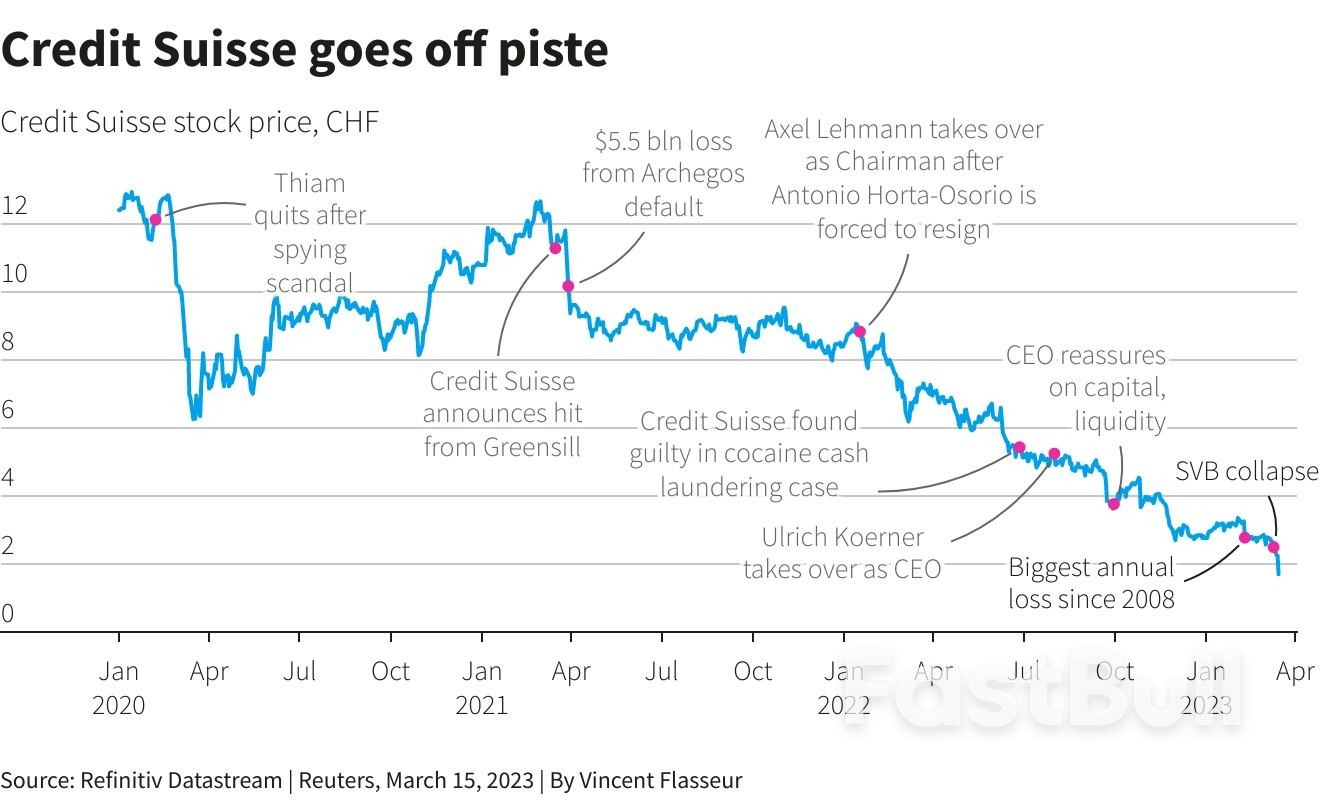
          Classic Safe Havens the Winners as Crisis Goes Global_1Asian markets are likely to open under severe pressure on Thursday, even though Wall Street closed off its lows - the Nasdaq even ended up slightly - after the Swiss National Bank said it would provide Credit Suisse liquidity "if necessary."
          Even if a full resolution for Credit Suisse is announced and markets surge in a relief rally on Thursday, financial crises are not resolved in a few days. Remember, Bear Stearns was rescued in March 2008, oil rose to a record high and the ECB raised rates that July, and Lehman wasn't until September.
          Debate is intensifying on the roots of the banking crisis - solvency, liquidity or asset quality? - regulatory blind spots, the U.S. and Swiss response so far, what more regulators need to do, and the impact on growth and monetary policy going forward.
          But ultimately, the banking system and markets rely on confidence. If that goes - and it can disappear very quickly - it can take a long time to recover.
          Amid so much uncertainty, investors won't stray too far from the safety of the dollar, Treasuries and the yen, and the top-rated collateral of U.S. bills. The aforementioned Asian economic indicators could offer brief distraction, but it will likely be just that - brief.
          Classic Safe Havens the Winners as Crisis Goes Global_2Here are three key developments that could provide more direction to markets on Thursday:
          - ECB policy meeting
          - Indonesia interest rate decision
          - Japan trade (February)

          Source: CNA

          To stay updated on all economic events of today, please check out our Economic calendar
          Risk Warnings and Disclaimers
          You understand and acknowledge that there is a high degree of risk involved in trading. Following any strategies or investment methods may lead to potential losses. The content on the site is provided by our contributors and analysts for information purposes only. You are solely responsible for determining whether any trading assets, securities, strategy, or any other product is suitable for investing based on your own investment objectives and financial situation.
          Comments
          Add to Favorites
          Share

          Credit Suisse Secures $54 Bln Lifeline as Authorities Rush to Prevent Global Bank Crisis

          Devin
          Credit Suisse on Thursday said it would borrow up to $54 billion from the Swiss central bank to shore up its liquidity and investor confidence after a slump in its shares intensified fears about a global financial crisis.
          The Swiss bank's announcement helped stem heavy selling in financial markets in Asian morning trade on Thursday, following torrid sessions in Europe and the United States overnight as investors fretted about a run-on global bank deposits.
          In its statement early Thursday, Credit Suisse said it would exercise its option to borrow from the Swiss National Bank up to 50 billion Swiss francs ($54 billion). That followed assurances from authorities in the private banking hub on Wednesday that Credit Suisse met "the capital and liquidity requirements imposed on systemically important banks" and that it could access central bank liquidity if needed.
          Credit Suisse is the first major global bank to be given such a lifeline since the 2008 financial crisis - though central banks have extended liquidity more generally to banks during times of market stress including the coronavirus pandemic.
          Asian stocks were hit by Wall Street's tumble on Thursday and investors bought gold, bonds and the dollar. While the bank's announcement helped trim some of those losses, trade was volatile and sentiment fragile.
          "It does help. It removes an immediate risk. But it confronts us with another choice. The more we do this, the more we blunt monetary policy, the more we have to live with higher inflation -- and what is it going to be?" said Damien Boey, Chief Equity Strategist at Barrenjoey in Sydney.
          "Do bailouts make things better? On the one hand, you are removing a source of risk to the markets which is a clear and present danger. On the other hand we are feeding into this paradigm of monetary policy bucking within itself."
          The Swiss bank's problems have shifted the focus for investors and regulators from the United States to Europe, where Credit Suisse led a selloff in bank shares after its largest investor said it could not provide more financial assistance because of regulatory constraints.
          The concerns about Credit Suisse added to broader banking sector fears sparked by last week's collapse of Silicon Valley Bank and Signature Bank, two U.S. mid-size firms.
          Credit Suisse's borrowing will be made under the covered loan facility and a short-term liquidity facility, fully collateralised by high quality assets. It also announced offers for senior debt securities for cash of up to 3 billion francs.
          "This additional liquidity would support Credit Suisse’s core businesses and clients as Credit Suisse takes the necessary steps to create a simpler and more focused bank built around client needs," the bank said.
          Investor focus is also on any action by central banks and other regulators elsewhere to restore confidence in the banking system as well as any exposure businesses may have to Credit Suisse.
          SVP's demise last week, followed by that of Signature Bank two days later, sent global bank stocks on a roller-coaster ride this week, with investors discounting assurances from U.S. President Joe Biden and emergency steps giving banks access to more funding.
          FINMA and the Swiss central bank said there were no indications of a direct risk of contagion for Swiss institutions from U.S. banking market turmoil.
          On Wednesday, Credit Suisse shares led a 7% fall in the European banking index, while five-year credit default swaps (CADS) for the flagship Swiss bank hit a new record high.
          The investor exit for the doors prompted fears of a broader threat to the financial system, and two supervisory sources told Reuters that the European Central Bank had contacted banks on its watch to quiz them about their exposures to Credit Suisse.
          The U.S. Treasury also said it is monitoring the situation around Credit Suisse and is in touch with global counterparts, a Treasury spokesperson said.
          Credit Suisse Secures $54 Bln Lifeline as Authorities Rush to Prevent Global Bank Crisis_1'Flight to safety'
          Rapid rises in interest rates have made it harder for some businesses to pay back or service loans, increasing the chances of losses for lenders who are also worried about a recession.
          Traders are now betting that the Federal Reserve, which just last week was expected to accelerate its interest-rate-hike campaign in the face of persistent inflation, may be forced to hit pause and even reverse course.
          Bets on a large European Central Bank interest-rate hike at Thursday's meeting also evaporated quickly as the Credit Suisse rout fanned fears about the health of Europe's banking sector. Money market pricing suggested traders now saw less than a 20% chance of a 50-basis point rate hike at the ECB meeting.
          Unease sparked by SVP's demise has also prompted depositors to seek out new homes for their cash.
          Ralph Hammers, CEO of Credit Suisse rival UBS said market turmoil has steered more money its way and Deutsche Bank CEO Christian Sewing said that the German lender has also seen incoming deposits.

          Source: Reuters

          Risk Warnings and Disclaimers
          You understand and acknowledge that there is a high degree of risk involved in trading. Following any strategies or investment methods may lead to potential losses. The content on the site is provided by our contributors and analysts for information purposes only. You are solely responsible for determining whether any trading assets, securities, strategy, or any other product is suitable for investing based on your own investment objectives and financial situation.
          Comments
          Add to Favorites
          Share

          Banking Crisis Adds Fuel to Gold's Engines

          Samantha Luan

          Central Bank

          Commodity

          The collapse of the Silicon Valley Bank (SVB) on Friday brought chaos in the markets, with equity indices and government bond yields around the globe coming under strong pressure. This appeared to be the recipe of an elixir potion for gold, which rebounded strongly from near the $1,810 zone and skyrocketed. Is the metal poised to continue flying and what should its traders watch out for?

          SVB collapse spreads panic

          Markets were thrown into tailspin last Friday and on Monday this week, after a US lender, the Silicon Valley Bank (SVB), collapsed and spread panic among investors. Even after the prompt response of the Fed and the US Treasury to announce contingency plans, investors continued seeking shelter to safe-haven assets, something that allowed gold to shine again.
          Another beneficiary this flight to safety was the US bond market, something that pushed Treasury yields off the cliff as market participants began scaling back their Fed hike bets in a panicked manner. Jitters eased somehow on Tuesday, but that appeared to be just a calm before another storm, which broke today on headlines that Credit's Suisse's largest investors, Saudi National Bank, will stop providing the bank with funds for capital. From expecting a terminal rate of around 5.65% after Fed Chair Powell's remarks before Congress, investors are now split on whether the Fed will proceed with pressing the hike button next week, and more shockingly, they are seeing interest rates ending 2023 below 4% from their current 4.50-4.75% target range.

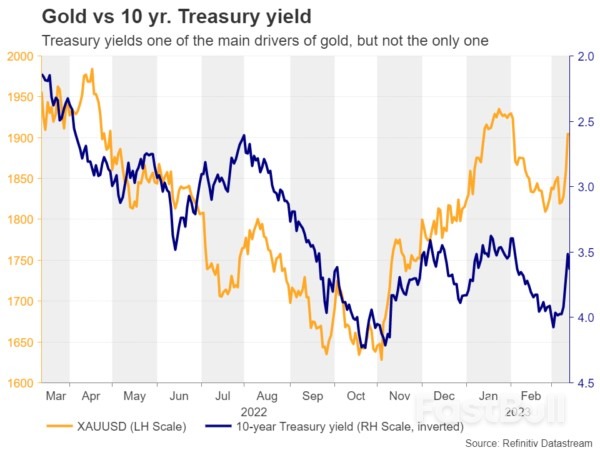
          Banking Crisis Adds Fuel to Gold's Engines_1All eyes on the Fed

          Ergo, at next week's FOMC gathering, investors will be eager to find out, not only whether policymakers will deliver another quarter-point hike or not, but also how officials' view and forecasts have been affected by the new crisis. That said, with Powell appearing in a hawkish suit just last week, and data just yesterday showing that underlying inflation accelerated in monthly terms during the month of February, it is very hard to envision that the new dot plot will match the market's implied rate path and signal so many basis points worth of rate cuts. Therefore, the risks surrounding next week's meeting may be tilted to the upside.
          An outcome less dovish than expected could allow Treasury yields to rise, which may result in a retreat in gold, but one that may not be enough to erase all the SVB related gains, especially if the Fed's projections are not as high as were expected before the turbulence. On top of that, there are more factors that could keep gold bulls in the game.

          Banking Crisis Adds Fuel to Gold's Engines_2Chinese and Indian demand also important

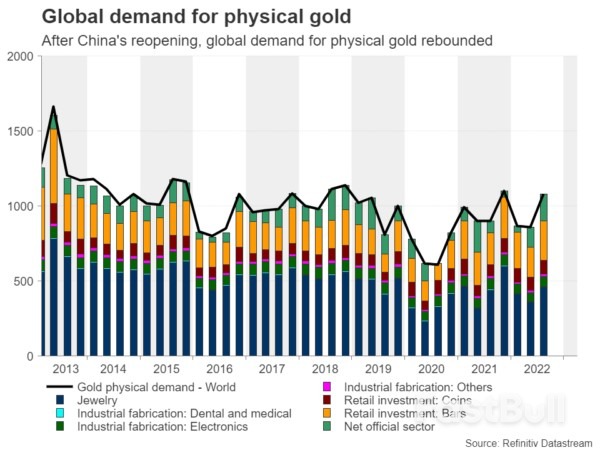
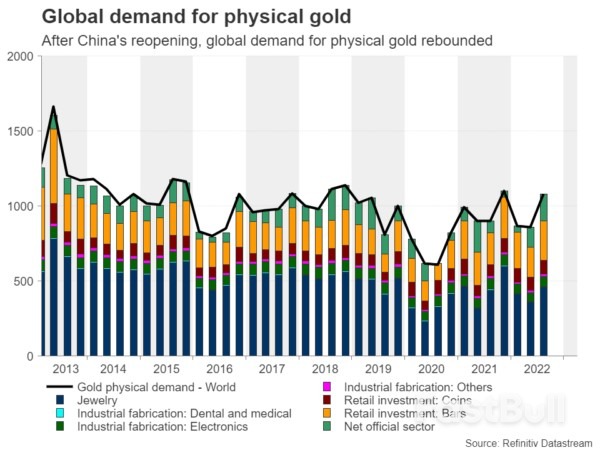
          One very important factor may be China's reopening. Traditionally, China has been the world's largest consumer of gold, with its jewelry demand falling below that of India during 2022 for the first time since 2011. This suggests that there may be ample room for recovery should the engines of the Chinese economy continue to speed up. Jewelry is the largest component of physical demand for the yellow metal, and thus, a strong boost by Chinese consumers could be of major importance. India is the world's second largest nation in terms of consumption, seeing economic growth of almost 7% in 2022 and nearly 9% the year before. Thus, if economic activity continues to flourish there as well, demand for gold could substantially increase.

          Banking Crisis Adds Fuel to Gold's Engines_3Risks seem tilted to the upside

          Putting everything together, it may be very difficult to form a convincing long-term view on gold in such a dynamic environment where sentiment is switching from one extreme to the other within a few hours, but it seems that the risks may be skewed to the upside.
          From a technical standpoint, gold emerged above Monday's peak of $1,915 today, a move that may allow the bulls to put the high of February 2 at $1,960 zone on their radar. If they are strong enough to overcome that zone, they may extend their rally towards the psychological round figure of $2,000, also marked by the peak of March 8, 2022.Banking Crisis Adds Fuel to Gold's Engines_4
          On the downside, the move signaling that the bears have stolen all the bulls' swords may be a clear dip below $1,805, which is currently coinciding with the 200-day EMA. Such a move would confirm a lower low on the bigger timeframes and may see scope for declines all the way down to the low of November 23 at $1,725.
          That said, for the bigger picture to turn back bearish, the Fed may need to appear nearly as hawkish as the market was expecting it last week, a scenario that may not be that likely considering that the Fed has pledged to assist in stabilizing the banking sector.

          Source: XM.COM

          Risk Warnings and Disclaimers
          You understand and acknowledge that there is a high degree of risk involved in trading. Following any strategies or investment methods may lead to potential losses. The content on the site is provided by our contributors and analysts for information purposes only. You are solely responsible for determining whether any trading assets, securities, strategy, or any other product is suitable for investing based on your own investment objectives and financial situation.
          Comments
          Add to Favorites
          Share

          Silicon Valley Bank Collapse Throws up Uncertainty for a European Central Bank Hoping to Hike Rates

          Justin

          Central Bank

          Economic

          The European Central Bank is expected to still hike rates by another 50 basis points on Thursday despite financial stability concerns being firmly back on the table with the collapse of Silicon Valley Bank in the U.S.
          European markets closed sharply lower Monday amid the fallout from the SVB crisis. On Friday, SVB was taken over by regulators after massive withdrawals a day earlier effectively created a bank run. HSBC
          then on Monday agreed to buy the British arm of the troubled U.S. tech startup-focused lender for £1.
          Concerns of contagion and increased regulation and just some general profit-taking caused European banks to post their worst day in more than a year on Monday. Regional banks fell 5.65%, their worst day since March 4, 2022.
          But the turmoil is not expected to derail President Christine Lagarde and her Governing Council's hike this week, according to analysts, with Sylvain Broyer, chief economist for EMEA at S&P Global Ratings, saying in a note Tuesday that the ECB still "has to fight an inflation problem that is becoming increasingly homegrown."
          Inflation in the euro area remains much higher than the ECB's 2% target. February headline inflation came in at 8.5%, higher than the medium estimate and only slightly lower than January's 8.6% reading.
          Core inflation — the key focus right now for policymakers — accelerated to 5.6% from 5.3%. That is reinforcing expectations that the European Central Bank will have to push borrowing costs ever higher.
          "We recently raised our terminal rate forecast to 3.75% (50bp hikes in March and May and 25bp in June) and lifted the main landing zone for terminal to 3.50-4.00%," said Mark Wall with Deutsche Bank in a note to clients. The ECB's key rate currently stands at 2.5%.
          "Beyond the near-term evolution of core and underlying inflation, which has yet to peak, the key determinants of the terminal rate – the level of the terminal rate, when it will be reached and how long it will be maintained – are wage growth, the fiscal stance and financial conditions," he said.
          Elsewhere, ECB watchers are also monitoring a lack of unity at the Frankfurt institution when it comes to what level its benchmark rate will peak at.
          "We think the ECB will lack the consensus to explicitly commit to another 50bp move in May, given the visible divisions within the Governing Council on next steps," said Paul Hollingsworth, chief European economist at BNP Paribas, in a research note. "Recent comments from council members suggest substantial differences over the extent and pace of future tightening."
          That division is again split down the classic core vs. periphery line within the 20 nations that share the euro. The Austrian central bank governor, Robert Holzmann, recently stepped out and said that policy rates are not restrictive until they pass the 4% mark.
          That was not received well by his more dovish Italian counterpart, Ignazio Visco, who said that he doesn't "appreciate statements by my colleagues about future and prolonged interest rate hikes."
          On Thursday, the European Central Bank will also reveal an updated version of its staff projections for growth and inflation.
          “In its new staff forecasts, we expect the ECB to possibly raise its growth projections slightly for this year (weaker energy prices) and reduce it for 2024-25 (due to the policy tightening), while raising its core inflation forecast for this year and lowering its headline inflation forecast for this year and next (on the back of weaker energy prices),” said Anatoli Annenkov, an ECB watcher with Societe Generale, in a note.

          Source:CNBC

          To stay updated on all economic events of today, please check out our Economic calendar
          Risk Warnings and Disclaimers
          You understand and acknowledge that there is a high degree of risk involved in trading. Following any strategies or investment methods may lead to potential losses. The content on the site is provided by our contributors and analysts for information purposes only. You are solely responsible for determining whether any trading assets, securities, strategy, or any other product is suitable for investing based on your own investment objectives and financial situation.
          Comments
          Add to Favorites
          Share

          Bank Failures and the Fed

          Justin

          Central Bank

          One could consider the Federal Reserve’s monetary tightening policy strategy as akin to the apologue of boiling a frog – or slowly turning up the heat until it’s too late. Last week, during his semiannual Humphrey-Hawkins testimony, FOMC Chair Jerome Powell turned up the heat by signaling that the Fed could once again increase its fed funds overnight benchmark rate by 50 basis points (bps), and this coincided with a run on Silicon Valley Bank (SVB).
          SVB was a midsize bank with heavy exposure to tech startups, including a large concentration of deposit funding through institutional deposit accounts, and significant unrealized losses on a portfolio of government and agency mortgage-backed securities, which it was forced to realize as it sold assets to fund deposit outflows. Unrealized losses on SVB’s securities holdings were greater than its Common Equity Tier 1 capital, and depositors lost confidence in the bank’s ability to repay its $175 billion in deposits (as of 31 Dec. 2022), the vast majority of which were not covered by FDIC insurance. As a result, depositors withdrew $42 billion in deposits last Thursday and on Friday the bank was taken over by California state regulators, who appointed the FDIC (Federal Deposit Insurance Corporation) as receiver.
          The failure of SVB has contributed to a broader sell-off in bank equity share prices, especially those of other U.S. regional banks. We have to imagine that deposit outflows across all the regional banks over the ensuing hours and days after the SVB failure were enough for decisive action from policymakers to try to stem the contagion over the weekend. On Sunday the U.S. Treasury, FDIC, and Federal Reserve jointly announced that the FDIC would guarantee the deposits of SVB and Signature Bank – a separate bank that was having similar issues – and that the Fed would set up a new bank lending facility with very favorable lending terms to give banks some additional time to shore up their balance sheets. The Fed agreed to lend money to banks collateralized by their high quality asset holdings marked at par (not the current market value).
          To be sure, SVB was in many respects a unique bank. Other similar-sized regional banks do not have similar concentrations of uninsured institutional investor deposits, which has meant that their “deposit betas” – the increase in the interest rate that they are forced to pay on deposits as the Fed raises rates – have been lower. They also don’t have similar concentrations of unrealized losses in their securities portfolios relative to their Common Equity Tier 1 capital. As a result, if they are forced to sell securities to fund deposit outflows, they have larger capital buffers to weather any forced realization of losses. In addition, we view the large systemically important banks (U.S. SIBs) that must comply with the Dodd-Frank Act and are subject to regular liquidity and capital stress tests as financially sound and less vulnerable to a deposit run. In fact, several of the largest banks have been receiving net deposit inflows in recent days.
          Nevertheless, these events can very well lead to a recession. Indeed, a 2008-like deleveraging event isn’t essential for the economy to fall into recession. Slowing credit growth alone can be a meaningful headwind to GDP growth. Since economy-wide credit outstanding is a stock variable and GDP is a flow variable, it’s the flow of credit that matters for GDP. Changes in the flow of credit – what economists call the credit impulse – are what matters for real GDP growth. There are very good reasons to believe that credit growth, which was already slowing, will slow more as a direct result of these recent events, despite the steps taken by government officials and the Fed.
          First, regional banks, whose stock prices were down substantially at the time of this writing, are likely to be more risk averse, at least in the near term until the situation becomes clearer and the volatility subsides. Many of these banks are still at risk of deposit outflows to the larger banks. The FDIC announcements over the weekend importantly just guaranteed all unsecured deposits at SVB and Signature Bank; it did not guarantee all uninsured deposits across the banking system. The sheer size of an explicit guarantee of all uninsured deposits would take an act of Congress. Furthermore, according to the Fed, small banks make up around half of total domestic bank assets, a third of commercial and industrial loans outstanding, and half of real estate loans. It’s hard to believe that these banks, fearing a potential abrupt deposit outflow, won’t tighten their lending standards and slow credit origination as a direct result.
          Second, and related, bank regulation for regionals has the potential to become more stringent. In 2018 a bill (S. 2155) was passed on a bipartisan basis that rolled back many of the Dodd-Frank requirements for smaller and midsize banks in terms of liquidity and capital. The regulatory rollback cannot be blamed for everything. The Fed had some leeway in specific implementation, and supervision probably played a role. As a result, the Fed is likely to tighten regulatory standards on the large regional banks where it can (specifically for those banks that have assets of more than $100 billion), reducing their ability and willingness to make some of the riskier loans that larger banks who had to comply with Dodd-Frank did not want.
          Third, assuming the policy response is enough to stabilize confidence and regional bank deposit bases in the near term, policies announced to date do not address the central issue that investors can get higher yields in a lower risk investment vehicle with a government securities money fund, which has access to the Fed’s Reverse Repo Facility (RRP). Taking a step back, bank deposit rates have lagged the increase in the fed funds rate, making money fund investments higher yielding than bank deposits. However, increasing the interest paid on deposits isn’t without costs. In the base case, it will lower net interest margin and contribute to equity share price volatility. In a worst case, increasing deposit rates could render some banks unprofitable, as they pay more for deposits than the yield they are getting on securities and loan holdings accumulated over the last two to three years. Some banks could try to defend their net interest margins by increasing the rate they charge on loans. Or if banks are price-takers in the loan market, they may have reduced appetite to make loans that are now less profitable for taking on the same credit risk. Either way, this should slow loan growth.
          Fourth, even before this, bank credit standards were tightening and loan growth was slowing as a result of tighter monetary conditions. Monetary policy works through lags, and the lagged effects of the Fed’s material financial conditions tightening last year were at the same time having a larger effect on the economy and financial conditions. What the SVB episode revealed was that the economy is, indeed, interest rate sensitive, and monetary policy conditions are indeed tight and having an effect on riskier segments of the market.
          Fifth, with recession risks rising, it’s hard to believe that there won’t be implications for the broader private debt markets, including less money flowing into this space. A lot of financing left public markets in the last decade as tougher large-bank regulation made the business less attractive. Private debt markets have exploded as a percentage of GDP in recent years – going from roughly 5% of GDP in 2016 to roughly 10% now (around $2.5 trillion) – with economic and financial market linkages that are much more opaque. While the venture capital companies that held their operational deposits at SVB will be made whole to fund working capital needs, the event raises questions about the other kinds of risks that may be lurking in these markets. Most of the private market debt structures are floating rates with limited interest rate hedges, and tend to be used by companies that have elevated leverage and are more sensitive to economic cycles. While public financial markets may be dominated by large-market-capitalization companies, the small and medium-sized enterprises that tend to borrow from banks and in private markets dominate the real economy, accounting for about half of total U.S. employment.
          What’s the bottom line? Even though SVB had unique features that resulted in this revealed vulnerability, its failure will likely tighten financial conditions and slow lending growth despite government efforts to shore up confidence over the weekend. Banks in general may be well capitalized, but deposit runs are still a risk as banks must compete with money funds with higher yields and access to the Fed’s RRP. As a result, it’s difficult to imagine how banks won’t tighten lending standards and slow loan growth. For economic growth and inflation, it is credit growth that matters for real growth.
          All of this means the Fed needs to do less of the heavy lifting to get to the same result – tight financial conditions are slowing credit creation and will eventually slow inflation. As a result, the question is not whether the Fed hikes 50 bps or 25 bps at the March meeting. Rather it’s, is the Fed’s rate-hiking cycle over? Obviously this will depend on how fast and how much financial conditions tighten in the days and weeks ahead. With inflation high (despite slight easing in recent months) and labor markets strong, it’s possible that government officials’ response to the bank failures will smooth financial stability risks enough for the Fed to hike again next week. However, with policy already restrictive, credit growth likely to slow, and a potential recession looming, the frog may already have boiled.

          Source:Tiffany Wilding

          Risk Warnings and Disclaimers
          You understand and acknowledge that there is a high degree of risk involved in trading. Following any strategies or investment methods may lead to potential losses. The content on the site is provided by our contributors and analysts for information purposes only. You are solely responsible for determining whether any trading assets, securities, strategy, or any other product is suitable for investing based on your own investment objectives and financial situation.
          Comments
          Add to Favorites
          Share

          US Retail Sales Soften in February, Meeting Consensus Expectations

          Justin

          Central Bank

          Economic

          Disinflation theme remains in place

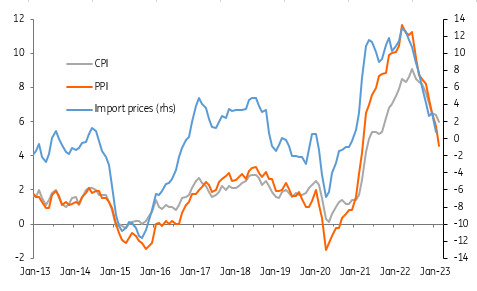
          Headline producer prices fell 0.1% month-on-month in February versus expectations of a 0.3% rise, while prices were flat on the month for ex food and energy versus a consensus forecast of 0.4%. This means the year-on-year rates drop to 4.6% from 5.7% for headline and 4.4% from 5% for core. This means we have more evidence of pipeline price pressures easing, which should help keep the disinflationary trend in place regarding the consumer prices story, as the chart below shows.

          Inflation rates are slowing across all areas

          US Retail Sales Soften in February, Meeting Consensus Expectations_1
          Within the details, the key story is the 0.8% MoM drop in 'trade services', following a 1.1% MoM decline in January. This picks up supply chain strains and can be taken as a proxy for the direction of travel on profit margins. With competitive pressures intensifying as the growth outlook darkens this component is going to be a key story that contributes to a rapid slowdown in consumer price inflation through the second half of this year and into 2024.

          Mixed retail sales picture after weather boosted January

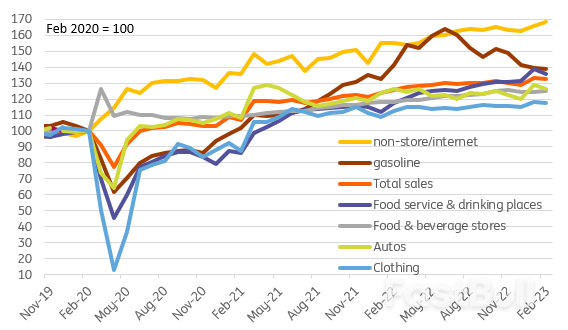
          Meanwhile, retail sales fell 0.4% as expected, dragged lower by a 1.8% drop in auto sales, a 2.5% decline in furniture, 4% drop in department store sales and a 2.2% fall in eating/drinking out. Nonetheless, this follows from a very strong January – remember that January was lifted by really warm weather after wintery conditions depressed activity in December – which was revised up to show headline growth of 3.2% MoM.
          Interestingly, the core 'control' measure that excludes volatile components such as building materials, gasoline, autos and food service was actually up 0.5% MoM. This is important seeing as it typically better matches movements in broader consumer spending. It is almost entirely down to a 1.6% rise in non-store sales.

          Retail sales levelsUS Retail Sales Soften in February, Meeting Consensus Expectations_2

          The case for rate hikes keeps weakening

          The PPI story is quite rightly attracting most of the attention so the market pricing for a potential Federal reserve rate hike next week has slipped to 11bp. We are of the view that there is no need to hike – the Fed can easily say it is pausing and looking to potentially restart once markets have calmed – but there are plenty of inflation hawks on the Federal Open Market Committee, which is why they opened the door to 50bp in Chair Powell's testimony to Congress last week. Tomorrow’s European Central Bank meeting will play an important role in this. If the ECB hikes and markets react badly then the no change Fed outcome will gain greater momentum. Likewise if markets take it in their stride, then a Fed 25bp move will look more likely.
          US lending conditions remain our major concern with banks already pulling back on lending before last week as highlighted by the Fed's Senior Loan Officer survey. Lending conditions are only going to get worse given recent events as banks and regulators become far more cautious. Therefore, the combination of higher borrowing costs and reduced access to credit are going to weigh heavily, which we argue removes the need for further hikes.

          Source:ING

          To stay updated on all economic events of today, please check out our Economic calendar
          Risk Warnings and Disclaimers
          You understand and acknowledge that there is a high degree of risk involved in trading. Following any strategies or investment methods may lead to potential losses. The content on the site is provided by our contributors and analysts for information purposes only. You are solely responsible for determining whether any trading assets, securities, strategy, or any other product is suitable for investing based on your own investment objectives and financial situation.
          Comments
          Add to Favorites
          Share
          FastBull
          Copyright © 2025 FastBull Ltd

          728 RM B 7/F GEE LOK IND BLDG NO 34 HUNG TO RD KWUN TONG KLN HONG KONG

          TelegramInstagramTwitterfacebooklinkedin
          App Store Google Play Google Play
          Products
          Charts

          Chats

          Q&A with Experts
          Screeners
          Economic Calendar
          Data
          Tools
          Membership
          Features
          Function
          Markets
          Copy Trading
          Latest Signals
          Contests
          News
          Analysis
          24/7
          Columns
          Education
          Company
          Careers
          About Us
          Contact Us
          Advertising
          Help Center
          Feedback
          User Agreement
          Privacy Policy
          Business

          White Label

          Data API

          Web Plug-ins

          Poster Maker

          Affiliate Program

          Risk Disclosure

          The risk of loss in trading financial instruments such as stocks, FX, commodities, futures, bonds, ETFs and crypto can be substantial. You may sustain a total loss of the funds that you deposit with your broker. Therefore, you should carefully consider whether such trading is suitable for you in light of your circumstances and financial resources.

          No decision to invest should be made without thoroughly conducting due diligence by yourself or consulting with your financial advisors. Our web content might not suit you since we don't know your financial conditions and investment needs. Our financial information might have latency or contain inaccuracy, so you should be fully responsible for any of your trading and investment decisions. The company will not be responsible for your capital loss.

          Without getting permission from the website, you are not allowed to copy the website's graphics, texts, or trademarks. Intellectual property rights in the content or data incorporated into this website belong to its providers and exchange merchants.

          Not Logged In

          Log in to access more features

          FastBull Membership

          Not yet

          Purchase

          Become a signal provider
          Help Center
          Customer Service
          Dark Mode
          Price Up/Down Colors

          Log In

          Sign Up

          Position
          Layout
          Fullscreen
          Default to Chart
          The chart page opens by default when you visit fastbull.com