• Trade
  • Markets
  • Copy
  • Contests
  • News
  • 24/7
  • Calendar
  • Q&A
  • Chats
Trending
Screeners
SYMBOL
LAST
BID
ASK
HIGH
LOW
NET CHG.
%CHG.
SPREAD
SPX
S&P 500 Index
6827.42
6827.42
6827.42
6899.86
6801.80
-73.58
-1.07%
--
DJI
Dow Jones Industrial Average
48458.04
48458.04
48458.04
48886.86
48334.10
-245.98
-0.51%
--
IXIC
NASDAQ Composite Index
23195.16
23195.16
23195.16
23554.89
23094.51
-398.69
-1.69%
--
USDX
US Dollar Index
97.950
98.030
97.950
98.500
97.950
-0.370
-0.38%
--
EURUSD
Euro / US Dollar
1.17394
1.17409
1.17394
1.17496
1.17192
+0.00011
+ 0.01%
--
GBPUSD
Pound Sterling / US Dollar
1.33707
1.33732
1.33707
1.33997
1.33419
-0.00148
-0.11%
--
XAUUSD
Gold / US Dollar
4299.39
4299.39
4299.39
4353.41
4257.10
+20.10
+ 0.47%
--
WTI
Light Sweet Crude Oil
57.233
57.485
57.233
58.011
56.969
-0.408
-0.71%
--

Community Accounts

Signal Accounts
--
Profit Accounts
--
Loss Accounts
--
View More

Become a signal provider

Sell trading signals to earn additional income

View More

Guide to Copy Trading

Get started with ease and confidence

View More

Signal Accounts for Members

All Signal Accounts

Best Return
  • Best Return
  • Best P/L
  • Best MDD
Past 1W
  • Past 1W
  • Past 1M
  • Past 1Y

All Contests

  • All
  • Trump Updates
  • Recommend
  • Stocks
  • Cryptocurrencies
  • Central Banks
  • Featured News
Top News Only
Share

Trump Isn't Certain His Economic Policies Will Translate To Midterm Wins

Share

The United States And Mexico Have Reached An Agreement On How To Resolve The Water Dispute In The Rio Grande Basin (which Borders Texas). Starting December 15, Mexico Will Supply The U.S. With An Additional 20.2 Acre-feet (a Unit Of Volume For Irrigation). The Agreement Seeks To “strengthen Water Management In The Rio Grande Basin” Within The Framework Of The 1944 Water Treaty

Share

U.S. Transportation Secretary Duffy: The Engine Of United Airlines Flight 803 That Malfunctioned Caught Fire

Share

Ukraine President Zelenskiy: He Will Meet US, European Representatives About Peace

Share

UK Prime Minister Office: Prime Minister Starmer Spoke To The President Of The European Commission Ursula Von Der Leyen This Evening - Downing Street Spokesperson

Share

Trump: We Will Retaliate Against ISIS

Share

Trump Says We Mourn The Loss Of Three Great Patriots In Syria In An Ambush

Share

Syrian Interior Ministry Spokesperson Confirms Attacker Was Member Of Security Forces With Extremist Ideology

Share

Syrian Interior Ministry Says Attacker Did Not Have Leadership Role In Security Forces, Did Not Say If He Was Junior Member

Share

Man Who Attacked Syrian, US Military Was Member Of Syrian Security Forces -Three Local Syrian Officials

Share

US Envoy Coale Says Belarus President Lukashenko Agreed To Do All He Can To Stop Weather Balloons Flying Into Lithuania

Share

Ukraine Says Russian Drone Attack Hit Civilian Turkish Vessel

Share

Islamic State Attacker In Syria Was Lone Gunman, Who Was Killed -USA Central Command

Share

US Envoy John Coale Says Around 1000 Remaining Political Prisoners In Belarus Could Be Released In Coming Months

Share

US Defense Secretary Hegseth: Attacker Was Killed By Partner Forces

Share

Pentagon Says Two USA Army Soldiers And One Civilian USA Interpreter Were Killed, And Three Were Wounded In Syria

Share

Israel Says It Kills Senior Hamas Commander Raed Saed In Gaza

Share

Ukraine's Navy Says Russian Drone Attack Hit Civilian Turkish Vessel Carrying Sunflower Oil To Egypt On Saturday

Share

Israeli Military Says It Put Planned Strike On South Lebanon Site On Hold After Lebanese Army Requested Access

Share

Norwegian Nobel Committee: Calls On The Belarusian Authorities To Release All Political Prisoners

TIME
ACT
FCST
PREV
U.K. Trade Balance (Oct)

A:--

F: --

P: --

U.K. Services Index MoM

A:--

F: --

P: --

U.K. Construction Output MoM (SA) (Oct)

A:--

F: --

P: --

U.K. Industrial Output YoY (Oct)

A:--

F: --

P: --

U.K. Trade Balance (SA) (Oct)

A:--

F: --

P: --

U.K. Trade Balance EU (SA) (Oct)

A:--

F: --

P: --

U.K. Manufacturing Output YoY (Oct)

A:--

F: --

P: --

U.K. GDP MoM (Oct)

A:--

F: --

P: --

U.K. GDP YoY (SA) (Oct)

A:--

F: --

P: --

U.K. Industrial Output MoM (Oct)

A:--

F: --

P: --

U.K. Construction Output YoY (Oct)

A:--

F: --

P: --

France HICP Final MoM (Nov)

A:--

F: --

P: --

China, Mainland Outstanding Loans Growth YoY (Nov)

A:--

F: --

P: --

China, Mainland M2 Money Supply YoY (Nov)

A:--

F: --

P: --

China, Mainland M0 Money Supply YoY (Nov)

A:--

F: --

P: --

China, Mainland M1 Money Supply YoY (Nov)

A:--

F: --

P: --

India CPI YoY (Nov)

A:--

F: --

P: --

India Deposit Gowth YoY

A:--

F: --

P: --

Brazil Services Growth YoY (Oct)

A:--

F: --

P: --

Mexico Industrial Output YoY (Oct)

A:--

F: --

P: --

Russia Trade Balance (Oct)

A:--

F: --

P: --

Philadelphia Fed President Henry Paulson delivers a speech
Canada Building Permits MoM (SA) (Oct)

A:--

F: --

P: --

Canada Wholesale Sales YoY (Oct)

A:--

F: --

P: --

Canada Wholesale Inventory MoM (Oct)

A:--

F: --

P: --

Canada Wholesale Inventory YoY (Oct)

A:--

F: --

P: --

Canada Wholesale Sales MoM (SA) (Oct)

A:--

F: --

P: --

Germany Current Account (Not SA) (Oct)

A:--

F: --

P: --

U.S. Weekly Total Rig Count

A:--

F: --

P: --

U.S. Weekly Total Oil Rig Count

A:--

F: --

P: --

Japan Tankan Large Non-Manufacturing Diffusion Index (Q4)

--

F: --

P: --

Japan Tankan Small Manufacturing Outlook Index (Q4)

--

F: --

P: --

Japan Tankan Large Non-Manufacturing Outlook Index (Q4)

--

F: --

P: --

Japan Tankan Large Manufacturing Outlook Index (Q4)

--

F: --

P: --

Japan Tankan Small Manufacturing Diffusion Index (Q4)

--

F: --

P: --

Japan Tankan Large Manufacturing Diffusion Index (Q4)

--

F: --

P: --

Japan Tankan Large-Enterprise Capital Expenditure YoY (Q4)

--

F: --

P: --

U.K. Rightmove House Price Index YoY (Dec)

--

F: --

P: --

China, Mainland Industrial Output YoY (YTD) (Nov)

--

F: --

P: --

China, Mainland Urban Area Unemployment Rate (Nov)

--

F: --

P: --

Saudi Arabia CPI YoY (Nov)

--

F: --

P: --

Euro Zone Industrial Output YoY (Oct)

--

F: --

P: --

Euro Zone Industrial Output MoM (Oct)

--

F: --

P: --

Canada Existing Home Sales MoM (Nov)

--

F: --

P: --

Euro Zone Total Reserve Assets (Nov)

--

F: --

P: --

U.K. Inflation Rate Expectations

--

F: --

P: --

Canada National Economic Confidence Index

--

F: --

P: --

Canada New Housing Starts (Nov)

--

F: --

P: --

U.S. NY Fed Manufacturing Employment Index (Dec)

--

F: --

P: --

U.S. NY Fed Manufacturing Index (Dec)

--

F: --

P: --

Canada Core CPI YoY (Nov)

--

F: --

P: --

Canada Manufacturing Unfilled Orders MoM (Oct)

--

F: --

P: --

Canada Manufacturing New Orders MoM (Oct)

--

F: --

P: --

Canada Core CPI MoM (Nov)

--

F: --

P: --

Canada Manufacturing Inventory MoM (Oct)

--

F: --

P: --

Canada CPI YoY (Nov)

--

F: --

P: --

Canada CPI MoM (Nov)

--

F: --

P: --

Canada CPI YoY (SA) (Nov)

--

F: --

P: --

Canada Core CPI MoM (SA) (Nov)

--

F: --

P: --

Canada CPI MoM (SA) (Nov)

--

F: --

P: --

Q&A with Experts
    • All
    • Chatrooms
    • Groups
    • Friends
    Connecting
    .
    .
    .
    Type here...
    Add Symbol or Code

      No matching data

      All
      Trump Updates
      Recommend
      Stocks
      Cryptocurrencies
      Central Banks
      Featured News
      • All
      • Russia-Ukraine Conflict
      • Middle East Flashpoint
      • All
      • Russia-Ukraine Conflict
      • Middle East Flashpoint
      Search
      Products

      Charts Free Forever

      Chats Q&A with Experts
      Screeners Economic Calendar Data Tools
      Membership Features
      Data Warehouse Market Trends Institutional Data Policy Rates Macro

      Market Trends

      Market Sentiment Order Book Forex Correlations

      Top Indicators

      Charts Free Forever
      Markets

      News

      News Analysis 24/7 Columns Education
      From Institutions From Analysts
      Topics Columnists

      Latest Views

      Latest Views

      Trending Topics

      Top Columnists

      Latest Update

      Signals

      Copy Rankings Latest Signals Become a signal provider AI Rating
      Contests
      Brokers

      Overview Brokers Assessment Rankings Regulators News Claims
      Broker listing Forex Brokers Comparison Tool Live Spread Comparison Scam
      Q&A Complaint Scam Alert Videos Tips to Detect Scam
      More

      Business
      Events
      Careers About Us Advertising Help Center

      White Label

      Data API

      Web Plug-ins

      Affiliate Program

      Awards Institution Evaluation IB Seminar Salon Event Exhibition
      Vietnam Thailand Singapore Dubai
      Fans Party Investment Sharing Session
      FastBull Summit BrokersView Expo
      Recent Searches
        Top Searches
          Markets
          News
          Analysis
          User
          24/7
          Economic Calendar
          Education
          Data
          • Names
          • Latest
          • Prev

          View All

          No data

          Scan to Download

          Faster Charts, Chat Faster!

          Download App
          English
          • English
          • Español
          • العربية
          • Bahasa Indonesia
          • Bahasa Melayu
          • Tiếng Việt
          • ภาษาไทย
          • Français
          • Italiano
          • Türkçe
          • Русский язык
          • 简中
          • 繁中
          Open Account
          Search
          Products
          Charts Free Forever
          Markets
          News
          Signals

          Copy Rankings Latest Signals Become a signal provider AI Rating
          Contests
          Brokers

          Overview Brokers Assessment Rankings Regulators News Claims
          Broker listing Forex Brokers Comparison Tool Live Spread Comparison Scam
          Q&A Complaint Scam Alert Videos Tips to Detect Scam
          More

          Business
          Events
          Careers About Us Advertising Help Center

          White Label

          Data API

          Web Plug-ins

          Affiliate Program

          Awards Institution Evaluation IB Seminar Salon Event Exhibition
          Vietnam Thailand Singapore Dubai
          Fans Party Investment Sharing Session
          FastBull Summit BrokersView Expo

          MAGA Doesn’t Mean Making Profits Great Again

          Kevin Du

          Economic

          Summary:

          Corporate America’s profits are slipping. Last week, the Bureau of Economic Analysis confirmed that corporate post-tax profits dropped in the first quarter by 3.3% — by far their biggest fall since the pandemic.

          Corporate America’s profits are slipping. Last week, the Bureau of Economic Analysis confirmed that corporate post-tax profits dropped in the first quarter by 3.3% — by far their biggest fall since the pandemic.

          When companies make less money, it’s often a harbinger of an economic slowdown. In this case, it also raises the more profound question of whether the Trump 2.0 agenda is deliberately aimed at companies’ bottom line.

          This sounds outlandish. The stock market is on the brink of an all-time high, so Corporate USA is worth more than ever. But it makes sense. After-tax profits account for an unprecedented 10.7% of gross domestic product, when in the last 50 years of the 20th century, they never exceeded 8%. The only time approaching their current share of the economy was in 1929 on the eve of the Great Crash. If the nation is to deal with inequality, money must be redistributed from somewhere; corporate profits are an obvious source of funds.

          Republicans Turn on the Corporation

          Elements in the Trump coalition have long held an anti-corporate agenda. A few months ago, Adrian Wooldridge argued in this space that MAGA wanted to “end capitalism as we know it.” Specifically, he contended that many leaders in the Trump coalition wanted to “deconstruct the great workhorse of American capitalism: the publicly owned and professionally managed corporation.”

          These are strong words, but sound understated compared to the writings of Kevin Roberts, head of the Heritage Foundation and a lead creator of Project 2025, an ambitious and radical agenda for Trump 2.0. He argues that BlackRock, the world’s largest fund manager and a pillar of contemporary US capitalism, is “decadent and rootless” and should be burned to the ground — a fate it should share with the Boy Scouts of America and the Chinese Communist Party.

          For Marjorie Taylor Greene, an outspoken Trump supporter in Congress, “the way corporations have conducted themselves, I’ve always called it corporate communism.” She has urged government investigations of companies that stopped donations to Republicans after the Jan. 6, 2021, attack on Congress.

          Steve Bannon, Trump’s campaign chief in 2016, complained to Semafor that only $500 billion of the US government’s $4.5 trillion came from corporate taxes. “Since 2008, $200 billion has gone into stock repurchases. If that had gone into plants and equipment, think what that would have done for the country.”

          He advocated a “dramatic increase” in taxes on corporations and the wealthy. “For getting our guys’ taxes cut, we’ve got to cut spending, which they’re gonna resist. Where does the tax revenue come from? Corporations and the wealthy.”

          MAGA Versus Companies

          Several current policies are not explicitly anti-corporate, but more or less guaranteed to have that effect.

          Michel Lerner, head of the HOLT analytical service at UBS, points out that in data going back to 1870, the correlation between tariffs and companies’ earnings yield (a measure of their core profitability) has been consistent. Tariffs hurt companies. Looking at the cash flow return on investment since 1950, it has risen (meaning companies grew more profitable) directly in line with rises in imports as a proportion of GDP.

          Research done jointly by Societe Generale Cross-Asset and Bernstein demonstrates that globalization has benefited US companies not only through international sales (40% of revenues for S&P 500 companies) but also through lower costs. In 2001, when China joined the World Trade Organization, the S&P’s cost of goods sold accounted for 70% of the revenues generated by selling them. It had been around this level for many years. That has now dropped to 63% — a massive improvement of 7 percentage points in this basic margin. Technology, consumer and industrial firms have gained the most — and stand to lose the most from deglobalization.

          Trump 2.0 policies so far have redistributed from shareholders to workers. Vincent Deluard, macro strategist at StoneX Financial, points out that the only tax not cut by the One Big Beautiful Bill currently before Congress is corporate income tax. “The grand bargain of the Big Beautiful Bill is to compensate for the tariffs’ inflationary shock with personal income tax cuts,” he says. “If exchange-rate adjustments, foreigners, and consumers do not pay for tariffs, corporate profits will.”

          Beyond that, eliminating illegal immigration and restricting foreign students raises labor costs. Threats to tax foreign investments in section 899 of the bill — which now appear likely to be withdrawn — risked reducing capital inflows and make it harder to raise finance.

          The Case Corporates Must Answer

          Corporations’ own behavior has contributed to these trends. Over history, their share of GDP has tended to oscillate with the economy, rising when labor organizations’ negotiating power is weak. But in this century, their profits grew less susceptible to the economic cycle, surging higher after the pandemic.

          Albert Edwards, a macro strategist for SocGen, argues that they pushed through margin-expanding price increases “under the cover of two key events, namely 1) supply constraints in the aftermath of the Covid pandemic, and 2) commodity cost-push pressures after Russia’s invasion of Ukraine.”

          Margins matter more in an environment where people are conscious of the damage inflation can do to their standard of living. That gave rise to the concept of “greedflation” — which Edwards thinks is deserved. Politicians have increasingly felt emboldened to intervene in companies’ pricing decisions, something that’s been off-limits since Richard Nixon’s ill-fated price controls in the early 1970s. Kamala Harris proposed “anti-gouging” policies in her unsuccessful presidential campaign; more recently, Trump forced a climbdown by companies like Amazon that proposed to itemize the impact of tariffs on the prices they charged.

          Rising to the top of a company never used to be a ladder to mega-wealth. That was reserved for entrepreneurs who founded their own firms. Modern executive pay has changed that and allowed CEOs to become billionaires by meeting unchallenging targets for their share price. The gulf between their pay and workers’ wages shrieks of injustice; according to the Economic Policy Institute, the CEO-to-worker compensation ratio reached 399-1 in 2021; in 1965, it was only 20-1. From 2019 to 2021, CEO pay rose 30.3% while those workers who kept their jobs through the pandemic got a raise of 3.9%.

          This can easily be dismissed as the politics of envy, but executive compensation now arguably skews the entire economy. Andrew Smithers, a veteran London-based fund manager and economist, and nobody’s idea of a leftist, has long inveighed against the bonus culture, which he holds responsible for a disastrous misallocation of capital.

          Smithers argued that America’s problem was “two decades of underinvestment”:

          He argues that companies increased their investment in response to corporate tax cuts in earlier generations, but stopped doing this once executives were paid to prioritize their share price. That led them to cut back on investment, spending money on acquisitions and share buybacks. That dampened growth, but also ensured better returns in the short run for shareholders.

          As investing in stocks is still primarily a game for those who are already wealthy, this stoked inequality still further. Opposition to high executive pay is often couched as a populist class-warrior position, but there is far more to it than that.

          The Politics of Profits

          The Trump coalition always had anti-corporate elements, but this didn’t stop his first administration from delivering for the private sector in a big way. In 2024, Trump added the support of Silicon Valley, and took the oath of office for the second time in front of a serried rank of billionaires. But he’s also losing old corporate supporters.

          Charles Koch, the industrialist hated by Democrats as the architect of libertarian Republican policies, has lost patience. After funding Nikki Haley’s run against Trump in last year’s Republican primaries, he told the Cato Institute earlier this year that too many institutions had lost their libertarian principles, and “people have forgotten that when principles are lost, so are freedoms.” How will people like Koch respond if the administration clamps down on companies?

          America’s key political developments tend to happen within parties, not between them. The current Republican coalition is no stranger in concept than Lyndon Johnson’s Democratic Party of the 1960s, the New Deal coalition that combined multi-racial liberals from the North and West with pro-segregationist whites from the South. Once Johnson decided to choose one wing over the other, with his civil rights acts, that alliance disintegrated.

          For now, the MAGA coalition includes both America’s largest corporations and their most trenchant critics. The policy choices of the next few months, and their effects, will determine whether that can continue.

          Source: Bloomberg Europe

          To stay updated on all economic events of today, please check out our Economic calendar
          Risk Warnings and Disclaimers
          You understand and acknowledge that there is a high degree of risk involved in trading. Following any strategies or investment methods may lead to potential losses. The content on the site is provided by our contributors and analysts for information purposes only. You are solely responsible for determining whether any trading assets, securities, strategy, or any other product is suitable for investing based on your own investment objectives and financial situation.
          Add to Favorites
          Share

          How Will Trump’s Budget Plans Impact The U.S. Deficit? ING Weighs In

          Devin Jason

          Economic

          Tariffs and an effort to reduce federal expenditures should help offset increases to the U.S. deficit pile stemming from President Donald Trump’s massive tax-and-spending bill, according to analysts at ING.

          In a note to clients, the analysts argued that the Trump-backed "One Big Beautiful Bill Act," which would extend tax cuts from 2017 while raising expenditures on defense and border security, is "on the face of it, [...] a huge fiscal giveaway."

          They noted that the Congressional Budget Office has estimated that the package will lower tax revenues by $3.7 trillion over the next 10 years, while its proposed spending cuts to some programs would save just $1.3 trillion, "leaving the primary deficit $2.4 trillion wider than would otherwise have been the case."However, the analysts noted that Trump’s aggressive tariff agenda is already generating tax revenues that are separate from the fiscal package, adding on to a little under $200 billion in savings already registered by reduction measures carried out by the Department of Government Efficiency.

          Yet "while these initiatives may fill the financial hole created by ’One Big Beautiful Bill Act,’ U.S. deficits will remain wide and debt levels will continue to grow, especially when we consider the continuous 0.1-0.2 percentage point GDP increase in demography-related spending and how that will feed into the U.S.’s fiscal position," the ING analysts said.

          "Moreover, the combination of these policies is likely to be detrimental to economic growth in the near term, which runs the risk of official deficit and debt projections being too optimistic."

          The Trump administration has touted the bill as a means to boost small businesses, families and American workers. Among a myriad of measures, the legislation includes a push to put Medicaid on a more sustainable footing and efforts to promote growth and entrepreneurship.

          Republicans in Congress are currently aiming to pass the massive legislation and have it on Trump’s desk for signing by a self-imposed July 4 deadline.

          Source: Investing

          To stay updated on all economic events of today, please check out our Economic calendar
          Risk Warnings and Disclaimers
          You understand and acknowledge that there is a high degree of risk involved in trading. Following any strategies or investment methods may lead to potential losses. The content on the site is provided by our contributors and analysts for information purposes only. You are solely responsible for determining whether any trading assets, securities, strategy, or any other product is suitable for investing based on your own investment objectives and financial situation.
          Add to Favorites
          Share

          The UK's Governance Is Looking Vulnerable Again

          Devin

          Economic

          Welcome to the award-winning Money Distilled newsletter. I’m John Stepek. Every week day I look at the biggest stories in markets and economics, and explain what it all means for your money.

          Just a quick favour, if you’ve got time this lunchtime — it’s the last time I’ll ask, I promise — please help us out by filling in this questionnaire. Gloriously happy or deeply frustrated, we’d love to know how you feel your personal financial situation has changed in the last year.

          Finished? OK, let’s turn to something that may well affect the personal financial situation of the UK dwellers among us.

          A couple of days ago, I pointed out that the UK’s coalition government was heading for a split. When I used the term “coalition,” I was trying to convey the point — particularly for non-UK readers — that despite the Labour government’s landslide election victory last summer, it’s actually quite divided and that makes it harder to get certain things done.

          It now seems that events have come to a head. Prime minister Keir Starmer has backed down on the disability benefit reforms that were meant to save the country £5 billion a year by 2030.

          Instead, it seems that the new rules will only apply to new applicants. That raises questions and criticisms of its own (eg if the rules are unfair to existing claimants, in what way are they fair to new ones?) but so far reports suggest that it’ll win over enough rebels to help the government avoid a very damaging defeat Tuesday. (No guarantee though).

          Now, there is a perfectly reasonable argument to be made that these reforms were poorly thought out. A more considered approach and a more detailed review of what’s going on might have revealed ways to save just as much money (or more) while avoiding cutting benefits from those who really do need them.

          That appears to be a side-effect of the “more haste, less speed” approach to cuts that chancellor Rachel Reeves appears to have taken in her budget last year. So far that’s not worked out as she would have hoped. It’s resulted in not only this U-turn, but also a previous U-turn on winter fuel payments, and quite possibly a pending shift on non-dom taxation.

          This presents the government with several problems. Firstly, the reason for taking these “tough” decisions was to stick to Reeves’s self-imposed fiscal rules. These actions were deemed necessary by the chancellor to avoid a repeat of the “Liz Truss” fiasco of October 2022.

          The disability benefit reforms specifically were meant to save around £5 billion by 2030. Not a huge sum in the context of the government’s annual spending, but larger than the annual tax raised by stamp duty on shares, for example. And certainly significant in the context of a “£22 billion black hole”.

          With the new changes, they won’t save as much. Ruth Curtice of the Resolution Foundation think tank reckons they’ll now save less than half of that.

          That leads us to the second problem — the one of political authority. Basically, both Starmer and Reeves expended a great deal of political capital to push these changes past an uncomfortable back bench team. They’ve now been forced to change direction on both — winter fuel by the electorate, and disability payments by their own MPs.

          In short, their “political trust” bank account is now overdrawn, which makes future “tough” decisions very difficult indeed. It also means that backbench wish list items — most notably the lifting of the two-child benefit cap — also become much harder to deny.

          Where’s The Money Going To Come From?

          Which takes us to the third problem. If the fiscal rules need to be met (and that would probably be a U-turn too far, certainly if Reeves is to stay in post), then the government needs to find a way to plug the hole left by these and future demands.

          As Paul Johnson, director at the Institute of Fiscal Studies, points out on X/Twitter, the big problem is that the U-turns and rebellions suggest that the the government simply can't make any cuts to spending. And in the absence of fiscal headroom, that “leaves taxes as only margin of adjustment.”

          But that’s not easy either. In terms of the tax take as a percentage of GDP, the UK’s tax burden is already at a post-war high. So there is a question mark over how much higher it can realistically go, particularly if one wants to have a hope of carrying voters along.

          (You can argue that it’s still relatively low compared to other nations, but this comparison is made somewhat trickier by differences in the way in which university education and also pensions are funded in other nations — this is something I hope to return to in a future letter — it’s an interesting subject).

          The classic Jean-Baptiste Colbert line is that “the art of taxation consists in so plucking the goose as to obtain the largest possible amount of feathers with the least possible amount of hissing.” But we’re past that point. You’ve got a baldy, angry goose and whichever feather you pluck next, you have to expect to get your fingers pecked.

          For example, if you really want to raise significant sums of money at this point — and if we’re now unable to cut Britain’s spending, then we’re going to need to — then you can’t just do it by soaking “the rich”. As my colleague Merryn points out, you need to broaden the tax base — perhaps by cutting the personal allowance, or raising the basic rate of income tax.

          (This incidentally, is why populist party Reform UK’s promise to raise the personal allowance to £20,000 so that no one earning less than that pays tax, is so highly improbable).

          Those really are tough choices. They won’t go down well on the doorstep. But the closer we get to autumn budget day, the more the state of the UK gilts market will loom large in the minds of investors.

          It’s not that the “bond vigilantes” will suddenly materialise with baseball bats in hand, or anything so formal. But if Reeves can’t make her policies stick, and we return to the point where the UK is viewed as ungovernable, then the pressure will continue to build and the risk of a doom loop — and maybe another “Truss moment” — grows.

          Source: Bloomberg Europe

          To stay updated on all economic events of today, please check out our Economic calendar
          Risk Warnings and Disclaimers
          You understand and acknowledge that there is a high degree of risk involved in trading. Following any strategies or investment methods may lead to potential losses. The content on the site is provided by our contributors and analysts for information purposes only. You are solely responsible for determining whether any trading assets, securities, strategy, or any other product is suitable for investing based on your own investment objectives and financial situation.
          Add to Favorites
          Share

          The Fed’s ’Transitory’ Mistake Is Affecting Its Outlook

          Thomas

          Central Bank

          In 2023 and 2024, the Fed was under intense public and media scrutiny for calling the post-pandemic surge in inflation “transitory.” Critics argued that the Fed’s failure to anticipate the persistence and severity of rising prices undermined its credibility. Yet, with the benefit of hindsight and historical context, the Fed’s position wasn’t entirely misguided. Inflation proved temporary in a broader economic sense, and by 2025, the data confirmed a significant cooling of price pressures.

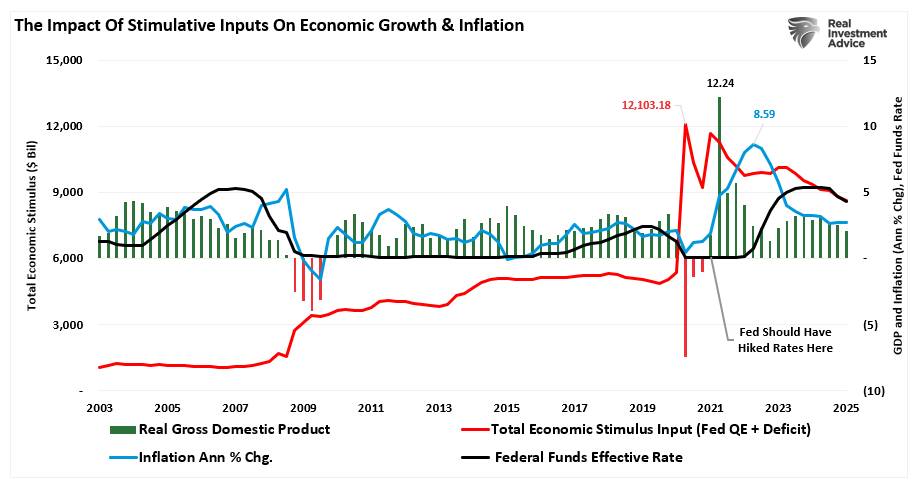
          However, the Fed’s mistake wasn’t the “transitory” label—it was the Fed’s late response to raising interest rates and halting quantitative easing. As shown, the combined impact of the massive surge in the Government’s deficit spending (stimulus checks and infrastructure bills) and the Fed’s $120 billion monthly “quantitative easing” campaign caused a massive jump in economic growth and inflation.

          However, instead of cutting back on stimulus when the economy rebounded, the Fed’s mistake was keeping its “foot on the gas” for too long. These delays allowed the inflationary fire to burn hotter and longer than necessary, exacerbated by an overlooked driver: excessive government spending.

          Despite the elevated levels of total economic stimulus, inflation and economic growth have subsided as the economy continues normalizing. However, to understand the Fed’s current policy risks, particularly in light of its recent warnings about tariffs, it’s essential to look back at past inflation spikes

          Historical Inflation Spikes and Their Resolution

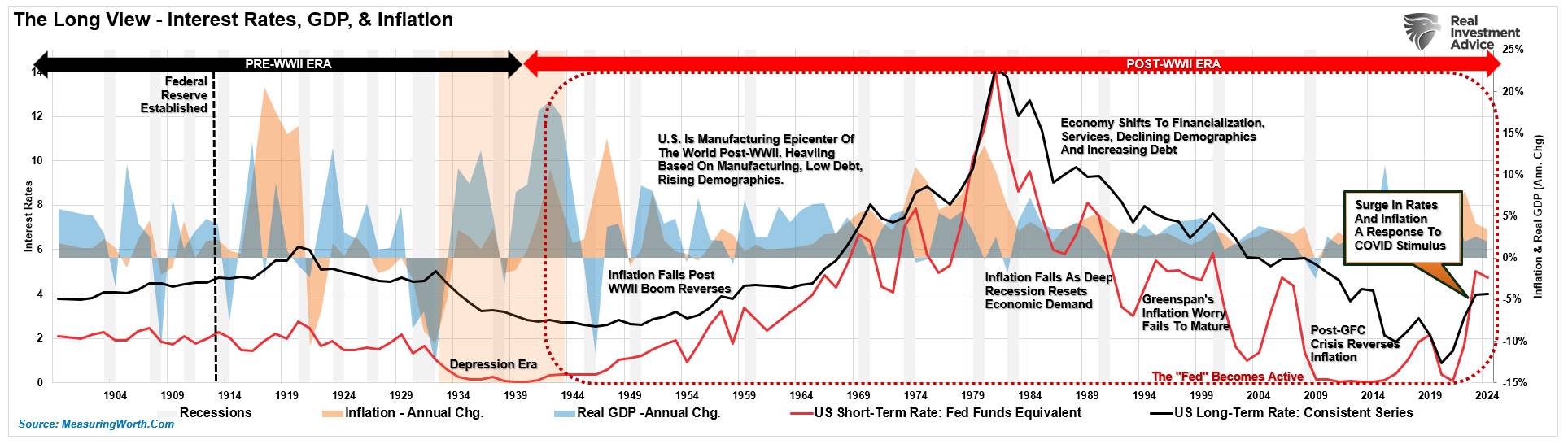
          U.S. economic history offers several instructive examples of inflationary episodes and how they eventually resolved.

          • Post-WWII Inflation (1946–1948): After World War II, inflation surged to nearly 20% as price controls ended and pent-up consumer demand met constrained supply. But this spike was short-lived. As production normalized and demand stabilized, inflation quickly receded. The Fed did not need any drastic monetary tightening.
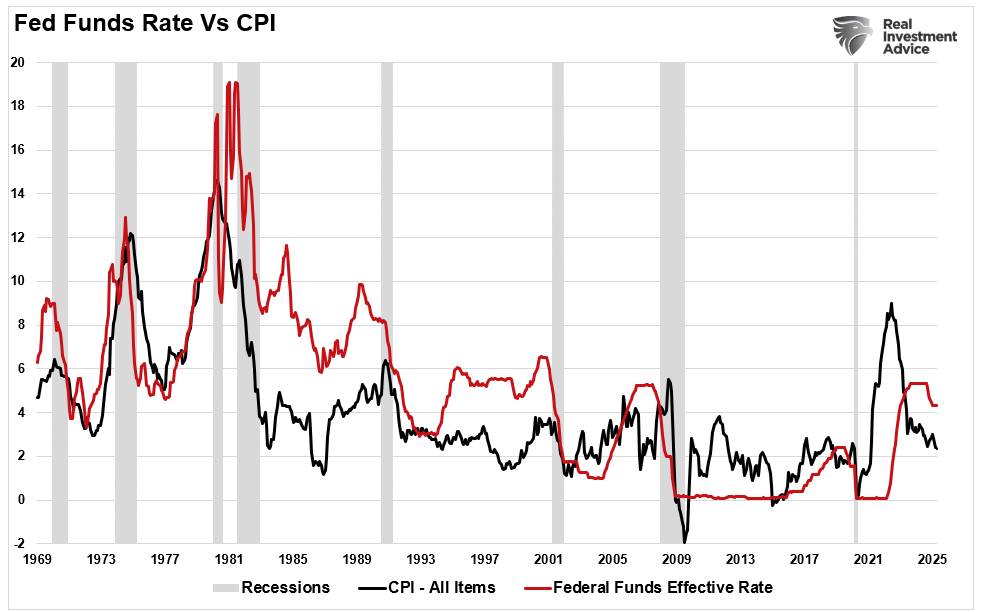
          • The 1970s Stagflation: The most notorious inflation era came during the 1970s, driven by oil shocks, wage-price spirals, and loose monetary policy. Inflation remained high for nearly a decade. It wasn’t until Paul Volcker’s aggressive interest rate hikes in the early 1980s, pushing the federal funds rate above 15%, that inflation fell, though at the cost of a deep recession.
          • Greenspan’s “Inflation Boogyman:” In the late 90s, Alan Greenspan worried that an inflation surge was coming and aggressively began to hike rates into that anticipation. The further tightening of money policy contributed to the blowup of numerous “dot.com” companies that were heavily leveraged with no revenues. Instead of rising, inflation collapsed as the “Dot.com” crash devastated the economy.
          • Post-GFC Disinflation: After the 2008 Global Financial Crisis, many feared stimulus and Fed intervention would trigger inflation. Instead, the opposite occurred. Inflation remained stubbornly low for over a decade, highlighting how debt overhangs and weak demand can suppress prices even amid central bank easing.

          Compared to these episodes, the COVID-driven inflation surge stands out for its rapid onset and similarly swift decline. Prices surged due to supply chain disruptions, labor shortages, and historic stimulus. But by 2025, inflation is back to near-target levels. The duration of elevated inflation, from early 2021 through late 2023, was short by historical standards, and it faded as supply chains normalized and stimulus effects waned.

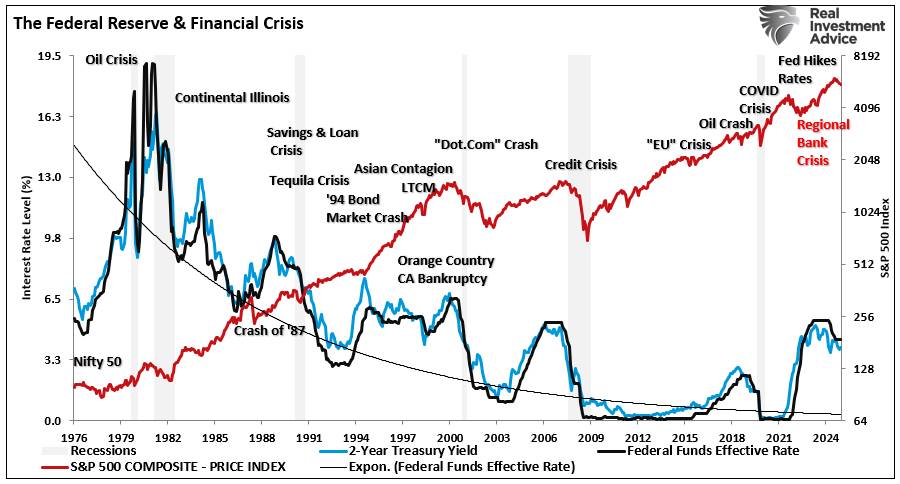
          The historical shortcomings of the Fed’s actions, repeated policy mistakes, and flawed outlooks are clearly evident. The Fed hikes rates, creates an economic or credit-related event, and then cuts rates to fix it.

          As such, investors should ask themselves why they are confident in the Fed’s current assessment of tariff-induced inflation risks.

          The Fed’s Tariff Fears: Misreading the Present Through the Lens of the Past?

          At the June 18, 2025, press conference, Fed Chair Jerome Powell expressed concern that rising tariffs could reignite inflation. With trade policy becoming increasingly protectionist, particularly toward China and Mexico, the Fed is wary that tariffs could push up import prices and thus overall inflation.

          However, there’s an important distinction: inflation data from the last four months has shown no measurable impact from recent tariff actions. The Consumer Price Index (CPI) has remained stable or declined, while core inflation has softened. Meanwhile, job growth has slowed, and wage gains have moderated. All classic signs of a cooling economy.

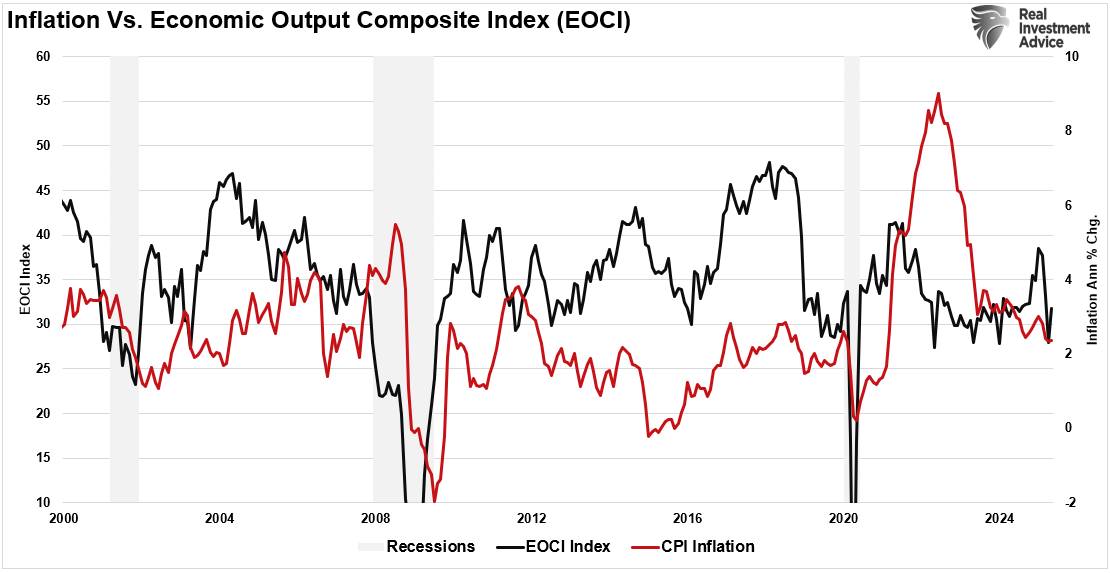
          This link between the economy and inflation is evident from the Economic Composite Index, which comprises nearly 100 hard and soft data points. Following the spike in economic activity post-pandemic, economic growth continues to decline. Given that inflation is solely a function of economic supply and demand, it is unsurprising that it continues to cool.

          This raises a critical policy question: Is the Fed now over-compensating on the cautious side because of its past missteps with “transitory” inflation?

          If so, the risk is that the Fed may once again make another policy mistake, as has repeatedly been the case in the past. After keeping rates too low for too long post-pandemic, policymakers might be too hesitant to cut rates, fearing another inflation flare-up that may never materialize. This fear-based approach risks undermining an already slowing economy.

          The Risk of Being Wrong Again: What If Tariff Inflation Never Arrives

          Tariffs are designed to make foreign goods more expensive. However, supply chains and pricing are far more flexible in today’s globalized economy. If importers can shift production to tariff-free countries, renegotiate supplier contracts, or absorb costs to maintain market share, the inflationary effects of tariffs can be muted or even nonexistent. They are already doing this, as noted recently by CNN.

          “The bonded warehouse route takes the opposite approach. Rather than mess with a good’s contents or move production elsewhere, businesses can import products from across the world without paying any tariffs when they enter the US — as long as they remain locked up in a special customs-regulated warehouse. Businesses can keep goods in these warehouses for up to five years without paying a tariff. They only pay the current tariff rate when they take goods out of storage. It’s a bet that tariff rates will go down in the short or medium term.”

          Furthermore, companies are “reclassifying and redesigning” products to get lower tariff treatments.

          “In other words, companies try to say their article or their good is something that gets low tariff treatment relative to what it might be, in essence. For example, Marvel successfully argued in court in 2003 that X-Men action figures are non-human toys (despite the premise of the franchise) rather than dolls, nearly halving their tax rate.” – NPR

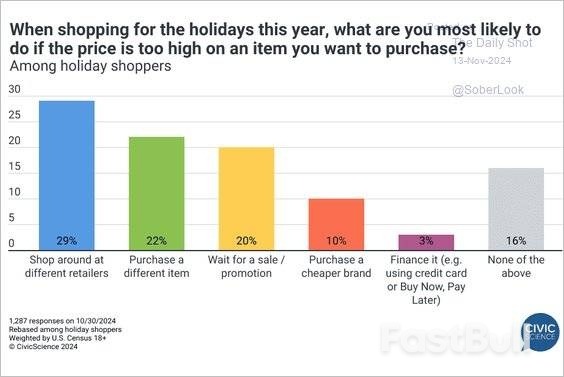
          Lastly, as discussed in “Tariff Risk Isn’t Inflation,” economists always forget the importance of consumer choice. The only payee of tariffs is the producers. Consumers can purchase less, delay, or exclude certain products from their consumption. To wit:

          “Today, globalization and technology give consumers vast choices in the products they buy. While instituting a tariff on a set of products from China may indeed raise the prices of those specific products, consumers have easy choices for substitution. A recent survey by Civic Science showed an excellent example of why tariffs won’t increase prices (always a function of supply and demand).”

          Of course, if demand drops for products with tariffs, prices will fall, reducing inflationary pressures.

          Recent economic data suggests exactly that. Despite new levies on Chinese electric vehicles and Mexican steel, consumer durables and core goods prices have not moved materially higher. Businesses appear to be adapting quickly, with many shifting sourcing to Vietnam, India, or reshoring certain elements of production.

          This raises the danger of a policy mismatch: If the Fed waits for inflation that doesn’t arrive, it may keep real interest rates excessively high for too long, just as it kept them too low following the pandemic. The consequences could be severe:

          • Slower Economic Growth: Elevated rates in a disinflationary environment slow investment and consumption, slowing GDP growth.
          • Labor Market Weakness: As rate-sensitive sectors (like housing and manufacturing) continue to weaken, layoffs may rise, further pressuring employment.
          • Financial Instability: Prolonged tight monetary policy increases the risk of credit defaults, especially among small businesses and lower-income households with floating-rate debt.

          If the Fed is fighting a phantom threat, as Alan Greenspan did in the late 90s, and tariff-driven inflation never arrives, it could inadvertently engineer a downturn. And much like in 2021 and 2022, this would be a policy failure driven not by bad data, but by misjudging the economic environment.,

          Conclusion: Learning the Right Lesson from “Transitory”

          The Fed’s credibility rests not on never being wrong, but on being adaptive and forward-looking. Inflation has cooled, wage growth has moderated, and economic momentum is slowing. Now is the time for the Fed to focus not on headline fears, but on real-time data.

          If tariffs have not yet translated into price increases, and employment indicators suggest slack is growing, the Fed should not delay necessary rate cuts to defend its credibility. Doing so risks repeating the mistake it made during the pandemic: ignoring the lagging effects of previous decisions.

          Cutting rates too late would be just as damaging as hiking them too slowly.

          The media mocked the Fed’s “transitory” narrative, but inflation was short-lived in the grand scheme. What mattered more was how long the Fed waited to act. With tariffs yet to trigger a real inflationary response and the economy showing signs of deceleration, the greater risk may be inaction, not inflation.

          Investors should be alert to the Fed’s tendency to overcorrect past mistakes. Just as policy stayed too loose after COVID, it may now stay too tight for too long in 2025. Recognizing that monetary policy must adapt, not just react, will be key for policymakers and market participants navigating the road ahead.

          Source: Investing

          Risk Warnings and Disclaimers
          You understand and acknowledge that there is a high degree of risk involved in trading. Following any strategies or investment methods may lead to potential losses. The content on the site is provided by our contributors and analysts for information purposes only. You are solely responsible for determining whether any trading assets, securities, strategy, or any other product is suitable for investing based on your own investment objectives and financial situation.
          Add to Favorites
          Share

          India Posts Current Account Surplus As Trade Gap Narrows

          Damon

          Economic

          India’s current account returned a better than expected surplus in the January-March quarter as trade deficit narrowed following the revision of gold import data.

          The surplus in the broadest measure of trade in goods and services was $13.5 billion, or 1.3% of gross domestic product in the period, according to Reserve Bank of India data released Friday.

          That compares with a median forecast of a $8.9 billion surplus by analysts in a Bloomberg survey, and a deficit of $11.3 billion in the October-December period.

          The trade deficit for the quarter was at $59.5 billion, narrower than $79.3 billion in the October-December period. However, it was higher than the $52 billion in the year ago quarter.

          The current account benefited from revisions in gold import data, but non-trade components, such as lower payments of investment income was a surprise, said Madhavi Arora, economist with Emkay Global Financial Services Ltd.

          A current account surplus will ease pressure on the rupee that has been volatile in the past few weeks following rise in geopolitical conflicts.

          Services exports increased year-on-year in major categories such as business services and computer services.

          For the full fiscal year 2024-25, India’s current account deficit was $23.3 billion, or 0.6% of GDP, lower than $26 billion seen during fiscal 2023-24.

          Source: Bloomberg Europe

          To stay updated on all economic events of today, please check out our Economic calendar
          Risk Warnings and Disclaimers
          You understand and acknowledge that there is a high degree of risk involved in trading. Following any strategies or investment methods may lead to potential losses. The content on the site is provided by our contributors and analysts for information purposes only. You are solely responsible for determining whether any trading assets, securities, strategy, or any other product is suitable for investing based on your own investment objectives and financial situation.
          Add to Favorites
          Share

          Exclusive: Danish General Says He Is Not Losing Sleep Over US Plans For Greenland

          Thomas

          Economic

          The head of Denmark's Arctic command said the prospect of a U.S. takeover of Greenland was not keeping him up at night after talks with a senior U.S. general last week but that more must be done to deter any Russian attack on the Arctic island.

          U.S. President Donald Trump has repeatedly suggested the United States might acquire Greenland, a vast semi-autonomous Danish territory on the shortest route between North America and Europe vital for the U.S. ballistic missile warning system.

          Trump has not ruled out taking the territory by force and, at a congressional hearing this month, Defence Secretary Pete Hegseth did not deny that such contingency plans exist.

          Such a scenario "is absolutely not on my mind," Soren Andersen, head of Denmark's Joint Arctic Command, told Reuters in an interview, days after what he said was his first meeting with the general overseeing U.S. defence of the area.

          "I sleep perfectly well at night," Anderson said. "Militarily, we work together, as we always have."

          U.S. General Gregory Guillot visited the U.S. Pituffik Space Base in Greenland on June 19-20 for the first time since the U.S. moved Greenland oversight to the Northern command from its European command, the Northern Command said on Tuesday.

          Andersen's interview with Reuters on Wednesday were his first detailed comments to media since his talks with Guillot, which coincided with Danish military exercises on Greenland involving one of its largest military presences since the Cold War.

          Russian and Chinese state vessels have appeared unexpectedly around Greenland in the past and the Trump administration has accused Denmark of failing to keep it safe from potential incursions. Both countries have denied any such plans.

          Andersen said the threat level to Greenland had not increased this year. "We don't see Russian or Chinese state ships up here," he said.

          DOG SLED PATROLS

          Denmark's permanent presence consists of four ageing inspection vessels, a small surveillance plane, and dog sled patrols tasked with monitoring an area four times the size of France.

          Previously focused on demonstrating its presence and civilian tasks like search and rescue, and fishing inspection, the Joint Arctic Command is now shifting more towards territorial defence, Andersen said.

          "In reality, Greenland is not that difficult to defend," he said. "Relatively few points need defending, and of course, we have a plan for that. NATO has a plan for that."

          As part of the military exercises this month, Denmark has deployed a frigate, F-16s, special forces and extra troops, and increased surveillance around critical infrastructure. They would leave next week when the exercises end, Andersen said, adding that he would like to repeat them in the coming months.

          "To keep this area conflict-free, we have to do more, we need to have a credible deterrent," he said. "If Russia starts to change its behaviour around Greenland, I have to be able to act on it."

          In January, Denmark pledged over $2 billion to strengthen its Arctic defence, including new Arctic navy vessels, long-range drones, and satellite coverage. France offered to deploy troops to Greenland and EU's top military official said it made sense to station troops from EU countries there.

          Around 20,000 people live in the capital Nuuk, with the rest of Greenland's 57,000 population spread across 71 towns, mostly on the west coast. The lack of infrastructure elsewhere is a deterrent in itself, Andersen said.

          "If, for example, there were to be a Russian naval landing on the east coast, I think it wouldn't be long before such a military operation would turn into a rescue mission," he said.

          Source: Reuters

          To stay updated on all economic events of today, please check out our Economic calendar
          Risk Warnings and Disclaimers
          You understand and acknowledge that there is a high degree of risk involved in trading. Following any strategies or investment methods may lead to potential losses. The content on the site is provided by our contributors and analysts for information purposes only. You are solely responsible for determining whether any trading assets, securities, strategy, or any other product is suitable for investing based on your own investment objectives and financial situation.
          Add to Favorites
          Share

          Germany Considers Tighter Investment Rules Amid Nord Stream 2 Rumors

          Damon

          Economic

          The German government is examining measures that could help it stop a potential sale of the Nord Stream 2 pipeline after speculation emerged earlier this year over reviving pipeline gas deliveries from Russia.

          Berlin is considering amending the legal basis for investment screening, the economy ministry said in response to a parliamentary inquiry from Green party lawmakers including Michael Kellner, which was first reported by Der Spiegel magazine on Friday.

          Germany’s Foreign Trade and Payments Act wouldn’t currently allow Germany to block a sale of struggling Nord Stream 2 AG as it’s a Swiss-based company, it said. Under the regulation, an investment screening is only triggered when it concerns a company that is not part of the European Union or the European Free Trade Association, which Switzerland is a member of.

          Speculation about the future of the pipelines started swirling after US President Donald Trump began to push for an end to the war between Russia and Ukraine earlier this year, with some industry officials in east Germany openly supporting the country’s return to the cheaper pipeline gas. Earlier media reports pointed to interest from a US investor in the pipeline assets.

          The government has pushed back against calls to revive the pipeline project that links Germany and Russia, with Chancellor Friedrich Merz recently supporting European Union efforts to include the partially damaged links in sanctions against Russia.

          Source: Bloomberg Europe

          To stay updated on all economic events of today, please check out our Economic calendar
          Risk Warnings and Disclaimers
          You understand and acknowledge that there is a high degree of risk involved in trading. Following any strategies or investment methods may lead to potential losses. The content on the site is provided by our contributors and analysts for information purposes only. You are solely responsible for determining whether any trading assets, securities, strategy, or any other product is suitable for investing based on your own investment objectives and financial situation.
          Add to Favorites
          Share
          FastBull
          Copyright © 2025 FastBull Ltd

          728 RM B 7/F GEE LOK IND BLDG NO 34 HUNG TO RD KWUN TONG KLN HONG KONG

          TelegramInstagramTwitterfacebooklinkedin
          App Store Google Play Google Play
          Products
          Charts

          Chats

          Q&A with Experts
          Screeners
          Economic Calendar
          Data
          Tools
          Membership
          Features
          Function
          Markets
          Copy Trading
          Latest Signals
          Contests
          News
          Analysis
          24/7
          Columns
          Education
          Company
          Careers
          About Us
          Contact Us
          Advertising
          Help Center
          Feedback
          User Agreement
          Privacy Policy
          Business

          White Label

          Data API

          Web Plug-ins

          Poster Maker

          Affiliate Program

          Risk Disclosure

          The risk of loss in trading financial instruments such as stocks, FX, commodities, futures, bonds, ETFs and crypto can be substantial. You may sustain a total loss of the funds that you deposit with your broker. Therefore, you should carefully consider whether such trading is suitable for you in light of your circumstances and financial resources.

          No decision to invest should be made without thoroughly conducting due diligence by yourself or consulting with your financial advisors. Our web content might not suit you since we don't know your financial conditions and investment needs. Our financial information might have latency or contain inaccuracy, so you should be fully responsible for any of your trading and investment decisions. The company will not be responsible for your capital loss.

          Without getting permission from the website, you are not allowed to copy the website's graphics, texts, or trademarks. Intellectual property rights in the content or data incorporated into this website belong to its providers and exchange merchants.

          Not Logged In

          Log in to access more features

          FastBull Membership

          Not yet

          Purchase

          Become a signal provider
          Help Center
          Customer Service
          Dark Mode
          Price Up/Down Colors

          Log In

          Sign Up

          Position
          Layout
          Fullscreen
          Default to Chart
          The chart page opens by default when you visit fastbull.com