• Trade
  • Markets
  • Copy
  • Contests
  • News
  • 24/7
  • Calendar
  • Q&A
  • Chats
Trending
Screeners
SYMBOL
LAST
BID
ASK
HIGH
LOW
NET CHG.
%CHG.
SPREAD
SPX
S&P 500 Index
6870.39
6870.39
6870.39
6895.79
6858.28
+13.27
+ 0.19%
--
DJI
Dow Jones Industrial Average
47954.98
47954.98
47954.98
48133.54
47871.51
+104.05
+ 0.22%
--
IXIC
NASDAQ Composite Index
23578.12
23578.12
23578.12
23680.03
23506.00
+72.99
+ 0.31%
--
USDX
US Dollar Index
98.890
98.970
98.890
98.960
98.730
-0.060
-0.06%
--
EURUSD
Euro / US Dollar
1.16508
1.16515
1.16508
1.16717
1.16341
+0.00082
+ 0.07%
--
GBPUSD
Pound Sterling / US Dollar
1.33266
1.33276
1.33266
1.33462
1.33136
-0.00046
-0.03%
--
XAUUSD
Gold / US Dollar
4203.68
4204.09
4203.68
4218.85
4190.61
+5.77
+ 0.14%
--
WTI
Light Sweet Crude Oil
59.352
59.382
59.352
60.084
59.291
-0.457
-0.76%
--

Community Accounts

Signal Accounts
--
Profit Accounts
--
Loss Accounts
--
View More

Become a signal provider

Sell trading signals to earn additional income

View More

Guide to Copy Trading

Get started with ease and confidence

View More

Signal Accounts for Members

All Signal Accounts

Best Return
  • Best Return
  • Best P/L
  • Best MDD
Past 1W
  • Past 1W
  • Past 1M
  • Past 1Y

All Contests

  • All
  • Trump Updates
  • Recommend
  • Stocks
  • Cryptocurrencies
  • Central Banks
  • Featured News
Top News Only
Share

GFZ Revises Magnitude Of Earthquake In Turkey To 4.9 From 5.45

Share

EU To Delay Proposals For Automotive Sector, Including Co2 Emissions, To Dec 16, Draft EU Commission Document Shows

Share

Kremlin: India Buys Energy Where It Is Profitable To And As Far As We Understand They Will Continue To Do That

Share

Turkey's Main Banking Index Up 2.5%

Share

Turkey's Main BIST-100 Index Up 1.9%

Share

Hungary's Preliminary November Budget Balance Huf -403 Billion

Share

Indian Rupee Down 0.1% At 90.07 Per USA Dollar As Of 3:30 P.M. Ist, Previous Close 89.98

Share

India's Nifty 50 Index Provisionally Ends 0.96% Lower

Share

[JPMorgan: US Stock Rally May Stagnate Following Fed Rate Cut] JPMorgan Strategists Say The Recent Rally In US Stocks May Stall As Investors Take Profits Following The Anticipated Fed Rate Cut. The Market Currently Predicts A 92% Probability Of The Fed Lowering Borrowing Costs On Wednesday. Expectations Of A Rate Cut Have Continued To Rise, Fueled By Positive Signals From Policymakers In Recent Weeks. "Investors May Be More Inclined To Lock In Gains At The End Of The Year Rather Than Increase Directional Exposure," Mislav Matejka's Team Wrote In A Report

Share

Russian Defence Ministry: Russian Forces Take Control Of Novodanylivka In Ukraine's Zaporizhzhia Region

Share

Russian Defence Ministry: Russian Forces Take Control Of Chervone In Ukraine's Donetsk Region

Share

French Finance Ministry: Government Started Process To Block Temporarily Shein Platform

Share

Finance Minister: Indonesia To Impose Coal Export Tax Of Up To 5% Next Year

Share

[Trump Considering Fired Homeland Security Secretary Noem? White House Denies] According To Reports From US Media Outlets Such As The Daily Beast And The UK's Independent, The White House Has Denied Reports That US President Trump Is Considering Firing Homeland Security Secretary Noem. White House Spokesperson Abigail Jackson Posted On Social Media On The 7th Local Time, Calling The Claims "fake News" And Stating That "Secretary Noem Has Done An Excellent Job Implementing The President's Agenda And 'making America Safe Again'."

Share

HKEX: Standard Chartered Bought Back 571604 Total Shares On Other Exchanges For Gbp9.5 Million On Dec 5

Share

Morgan Stanley Reiterates Bullish Outlook On US Stocks Due To Fed Rate Cut Expectations. Morgan Stanley Strategists Believe That The US Stock Market Faces A "bullish Outlook" Given Improved Earnings Expectations And Anticipated Fed Rate Cuts. They Expect Strong Corporate Earnings By 2026, And Anticipate The Fed Will Cut Rates Based On Lagging Or Mildly Weak Labor Markets. They Expect The US Consumer Discretionary Sector And Small-cap Stocks To Continue To Outperform

Share

China's National Development And Reform Commission Announced That Starting From 24:00 On December 8, The Retail Price Limit For Gasoline And Diesel In China Will Be Reduced By 55 Yuan Per Ton, Which Translates To A Reduction Of 0.04 Yuan Per Liter For 92-octane Gasoline, 0.05 Yuan Per Liter For 95-octane Gasoline, And 0.05 Yuan Per Liter For 0# Diesel

Share

Tkms CEO: US Security Strategy Highlights Need For Europe To Take Care Of Its Own Defences

Share

USA S&P 500 E-Mini Futures Up 0.1%, NASDAQ 100 Futures Up 0.18%, Dow Futures Down 0.02%

Share

London Metal Exchange (LME): Copper Inventories Increased By 2,000 Tons, Aluminum Inventories Decreased By 2,500 Tons, Nickel Inventories Increased By 228 Tons, Zinc Inventories Increased By 2,375 Tons, Lead Inventories Decreased By 3,725 Tons, And Tin Inventories Decreased By 10 Tons

TIME
ACT
FCST
PREV
France Industrial Output MoM (SA) (Oct)

A:--

F: --

P: --
France Trade Balance (SA) (Oct)

A:--

F: --

P: --
Euro Zone Employment YoY (SA) (Q3)

A:--

F: --

P: --
Canada Part-Time Employment (SA) (Nov)

A:--

F: --

P: --

Canada Unemployment Rate (SA) (Nov)

A:--

F: --

P: --

Canada Full-time Employment (SA) (Nov)

A:--

F: --

P: --

Canada Labor Force Participation Rate (SA) (Nov)

A:--

F: --

P: --

Canada Employment (SA) (Nov)

A:--

F: --

P: --

U.S. PCE Price Index MoM (Sept)

A:--

F: --

P: --

U.S. Personal Income MoM (Sept)

A:--

F: --

P: --

U.S. Core PCE Price Index MoM (Sept)

A:--

F: --

P: --

U.S. PCE Price Index YoY (SA) (Sept)

A:--

F: --

P: --

U.S. Core PCE Price Index YoY (Sept)

A:--

F: --

P: --

U.S. Personal Outlays MoM (SA) (Sept)

A:--

F: --

P: --
U.S. 5-10 Year-Ahead Inflation Expectations (Dec)

A:--

F: --

P: --

U.S. Real Personal Consumption Expenditures MoM (Sept)

A:--

F: --

P: --
U.S. Weekly Total Rig Count

A:--

F: --

P: --

U.S. Weekly Total Oil Rig Count

A:--

F: --

P: --

U.S. Consumer Credit (SA) (Oct)

A:--

F: --

P: --
China, Mainland Foreign Exchange Reserves (Nov)

A:--

F: --

P: --

Japan Trade Balance (Oct)

A:--

F: --

P: --

Japan Nominal GDP Revised QoQ (Q3)

A:--

F: --

P: --

China, Mainland Imports YoY (CNH) (Nov)

A:--

F: --

P: --

China, Mainland Exports (Nov)

A:--

F: --

P: --

China, Mainland Imports (CNH) (Nov)

A:--

F: --

P: --

China, Mainland Trade Balance (CNH) (Nov)

A:--

F: --

P: --

China, Mainland Exports YoY (USD) (Nov)

A:--

F: --

P: --

China, Mainland Imports YoY (USD) (Nov)

A:--

F: --

P: --

Germany Industrial Output MoM (SA) (Oct)

A:--

F: --

P: --
Euro Zone Sentix Investor Confidence Index (Dec)

A:--

F: --

P: --

Canada National Economic Confidence Index

--

F: --

P: --

U.K. BRC Like-For-Like Retail Sales YoY (Nov)

--

F: --

P: --

U.K. BRC Overall Retail Sales YoY (Nov)

--

F: --

P: --

Australia Overnight (Borrowing) Key Rate

--

F: --

P: --

RBA Rate Statement
RBA Press Conference
Germany Exports MoM (SA) (Oct)

--

F: --

P: --

U.S. NFIB Small Business Optimism Index (SA) (Nov)

--

F: --

P: --

Mexico 12-Month Inflation (CPI) (Nov)

--

F: --

P: --

Mexico Core CPI YoY (Nov)

--

F: --

P: --

Mexico PPI YoY (Nov)

--

F: --

P: --

U.S. Weekly Redbook Index YoY

--

F: --

P: --

U.S. JOLTS Job Openings (SA) (Oct)

--

F: --

P: --

China, Mainland M1 Money Supply YoY (Nov)

--

F: --

P: --

China, Mainland M0 Money Supply YoY (Nov)

--

F: --

P: --

China, Mainland M2 Money Supply YoY (Nov)

--

F: --

P: --

U.S. EIA Short-Term Crude Production Forecast For The Year (Dec)

--

F: --

P: --

U.S. EIA Natural Gas Production Forecast For The Next Year (Dec)

--

F: --

P: --

U.S. EIA Short-Term Crude Production Forecast For The Next Year (Dec)

--

F: --

P: --

EIA Monthly Short-Term Energy Outlook
U.S. API Weekly Gasoline Stocks

--

F: --

P: --

U.S. API Weekly Cushing Crude Oil Stocks

--

F: --

P: --

U.S. API Weekly Crude Oil Stocks

--

F: --

P: --

U.S. API Weekly Refined Oil Stocks

--

F: --

P: --

South Korea Unemployment Rate (SA) (Nov)

--

F: --

P: --

Japan Reuters Tankan Non-Manufacturers Index (Dec)

--

F: --

P: --

Japan Reuters Tankan Manufacturers Index (Dec)

--

F: --

P: --

Japan Domestic Enterprise Commodity Price Index MoM (Nov)

--

F: --

P: --

Japan Domestic Enterprise Commodity Price Index YoY (Nov)

--

F: --

P: --

China, Mainland PPI YoY (Nov)

--

F: --

P: --

Q&A with Experts
    • All
    • Chatrooms
    • Groups
    • Friends
    Connecting
    .
    .
    .
    Type here...
    Add Symbol or Code

      No matching data

      All
      Trump Updates
      Recommend
      Stocks
      Cryptocurrencies
      Central Banks
      Featured News
      • All
      • Russia-Ukraine Conflict
      • Middle East Flashpoint
      • All
      • Russia-Ukraine Conflict
      • Middle East Flashpoint
      Search
      Products

      Charts Free Forever

      Chats Q&A with Experts
      Screeners Economic Calendar Data Tools
      Membership Features
      Data Warehouse Market Trends Institutional Data Policy Rates Macro

      Market Trends

      Market Sentiment Order Book Forex Correlations

      Top Indicators

      Charts Free Forever
      Markets

      News

      News Analysis 24/7 Columns Education
      From Institutions From Analysts
      Topics Columnists

      Latest Views

      Latest Views

      Trending Topics

      Top Columnists

      Latest Update

      Signals

      Copy Rankings Latest Signals Become a signal provider AI Rating
      Contests
      Brokers

      Overview Brokers Assessment Rankings Regulators News Claims
      Broker listing Forex Brokers Comparison Tool Live Spread Comparison Scam
      Q&A Complaint Scam Alert Videos Tips to Detect Scam
      More

      Business
      Events
      Careers About Us Advertising Help Center

      White Label

      Data API

      Web Plug-ins

      Affiliate Program

      Awards Institution Evaluation IB Seminar Salon Event Exhibition
      Vietnam Thailand Singapore Dubai
      Fans Party Investment Sharing Session
      FastBull Summit BrokersView Expo
      Recent Searches
        Top Searches
          Markets
          News
          Analysis
          User
          24/7
          Economic Calendar
          Education
          Data
          • Names
          • Latest
          • Prev

          View All

          No data

          Scan to Download

          Faster Charts, Chat Faster!

          Download App
          English
          • English
          • Español
          • العربية
          • Bahasa Indonesia
          • Bahasa Melayu
          • Tiếng Việt
          • ภาษาไทย
          • Français
          • Italiano
          • Türkçe
          • Русский язык
          • 简中
          • 繁中
          Open Account
          Search
          Products
          Charts Free Forever
          Markets
          News
          Signals

          Copy Rankings Latest Signals Become a signal provider AI Rating
          Contests
          Brokers

          Overview Brokers Assessment Rankings Regulators News Claims
          Broker listing Forex Brokers Comparison Tool Live Spread Comparison Scam
          Q&A Complaint Scam Alert Videos Tips to Detect Scam
          More

          Business
          Events
          Careers About Us Advertising Help Center

          White Label

          Data API

          Web Plug-ins

          Affiliate Program

          Awards Institution Evaluation IB Seminar Salon Event Exhibition
          Vietnam Thailand Singapore Dubai
          Fans Party Investment Sharing Session
          FastBull Summit BrokersView Expo

          June Inflation Data Reaffirms Fed Pause as Tariff Uncertainty Grows

          Manuel

          Economic

          Central Bank

          Summary:

          Minutes from its June policy meeting revealed a split committee, with "most" officials supporting at least one rate cut this year while "a couple" signaled they'd be open to moving as early as July.
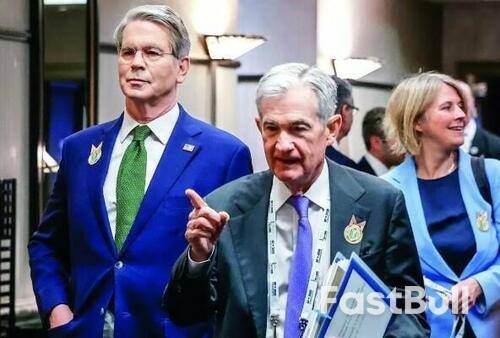
          June's Consumer Price Index (CPI) report likely gives the Federal Reserve room to continue its wait-and-see approach to cutting rates amid uncertainty over how President Trump's tariffs will impact inflation.
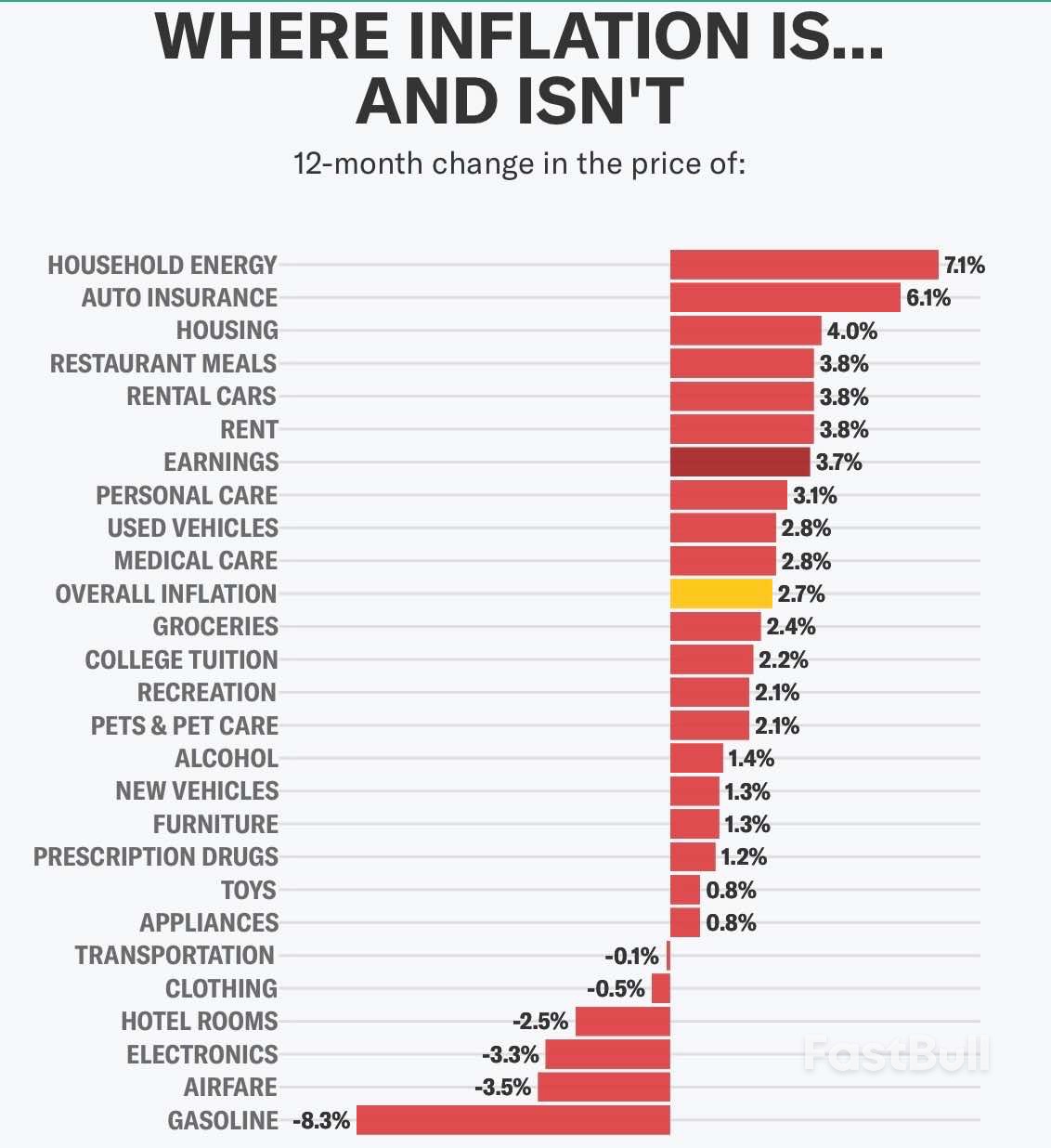
          On a "core" basis, which excludes volatile food and energy costs, CPI increased 0.2% from the previous month, slightly lower than economists' expectations but ahead of May's 0.1% gain.
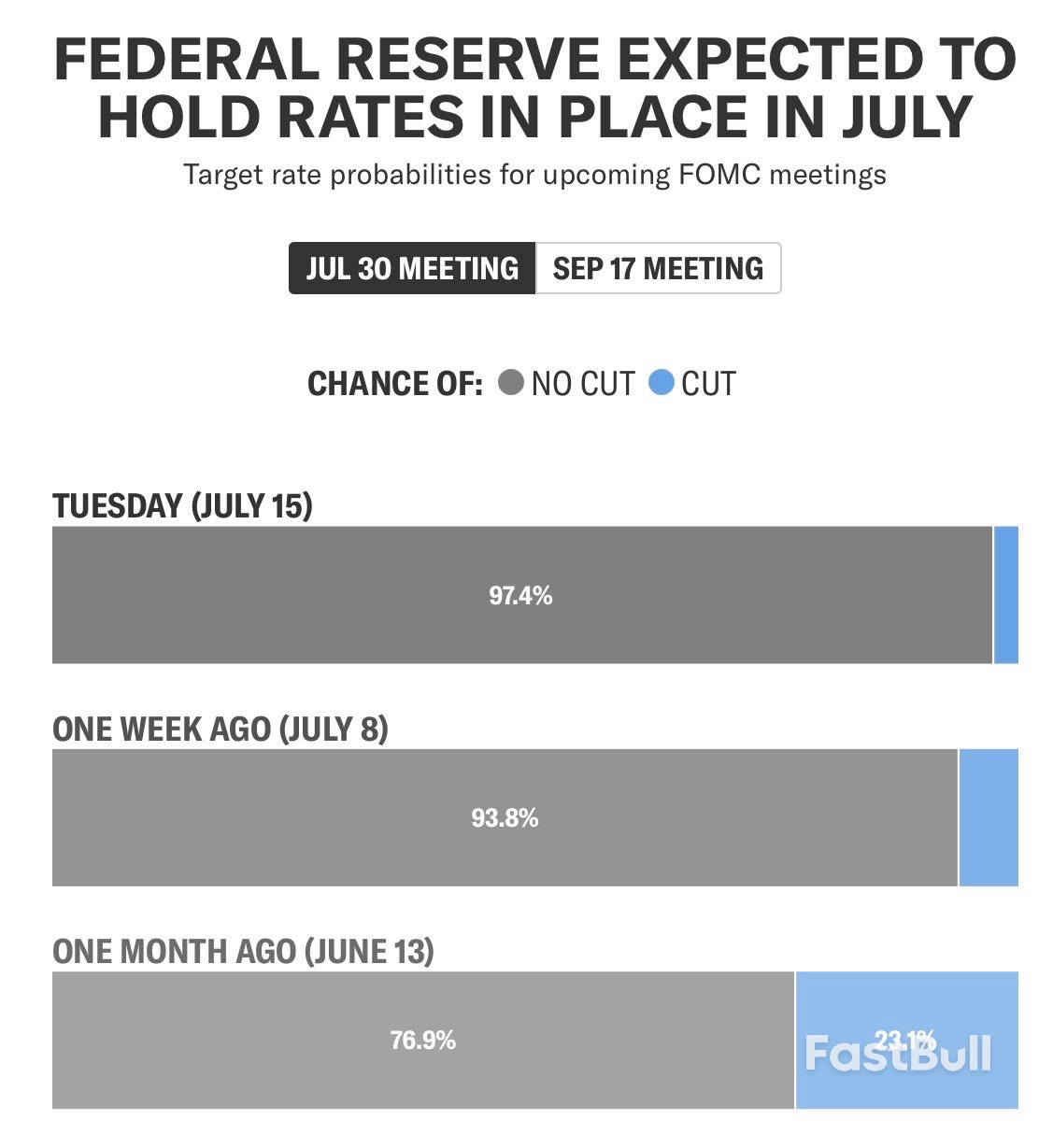
          Following the report, investors were placing a 97% probability on the Fed holding rates steady at its July meeting, up from 93% on Monday, according to the CME FedWatch Tool. Meanwhile, the chance of a September rate cut dropped sharply after the release, falling below 60% initially and inching closer to 50% as markets digested the data.June Inflation Data Reaffirms Fed Pause as Tariff Uncertainty Grows_1
          "The Fed’s ability to cut rates was resting heavily on today’s inflation print," Seema Shah, chief global strategist at Principal Asset Management, wrote following Tuesday's release.
          "With inflation coming in softer than expected for the fifth month in a row, it may initially seem like there is still little sign of the tariff-induced boost to inflation that the Fed has been expecting," she continued, referring to the slower-than-expected monthly gain in core prices. "However, with increases in categories like household furnishings, recreation, and apparel, import levies are slowly filtering through to core goods prices."
          Indeed, apparel prices rose 0.4% in June, and footwear jumped 0.7% after several months of declines. Furniture and bedding prices also climbed 0.4%, reversing the 0.8% drop recorded in May, a potential indication that tariff-related cost pressures are beginning to reach consumers.
          Shah noted that the full inflationary impact of tariffs will take time to materialize, particularly as many goods were front-loaded ahead of the latest rollouts.
          "With higher tariffs being announced, it would be wise for the Fed to remain on the sidelines for a few more months at least," she added.June Inflation Data Reaffirms Fed Pause as Tariff Uncertainty Grows_2
          Greg Daco, chief economist at EY, echoed that view, noting that the full effects of tariffs have yet to unveil themselves. He believes any resulting price increases will likely be short-lived.
          "A lot of businesses are talking about rapidly passing on the higher tariff shock from these higher duties. So we're anticipating a rather swift pass-through," he told Yahoo Finance. "But if we are in an environment where there are staggered tariffs over the next year, then there is a risk of more inflation persistence. And I think that's the key risk for the US economy right now."
          The Fed itself has appeared divided on when to lower interest rates. Minutes from its June policy meeting revealed a split committee, with "most" officials supporting at least one rate cut this year while "a couple" signaled they'd be open to moving as early as July. Others preferred to hold rates steady through year-end.
          Meanwhile, President Trump has continued his public campaign for significantly lower rates, writing on Truth Social: "Fed should cut Rates by 3 Points. Very Low Inflation. One Trillion Dollars a year would be saved!!!"
          The next major inflation test for the Fed comes Wednesday, with the release of the Producer Price Index (PPI), a measure of how much prices are changing for what businesses sell. Later this month, investors will shift focus to the Fed's preferred inflation gauge, the Personal Consumption Expenditures (PCE) index.
          But as Wall Street has consistently been reminded, the Fed’s cautious stance is being driven not just by recent inflation data but also by lingering uncertainty around President Trump's evolving tariff policy.
          Ryan Sweet, chief US economist at Oxford Economics, said that if Trump's proposed Aug. 1 tariffs go into effect, the inflationary impact on goods prices could take several months to appear.
          Sweet, who is currently forecasting the next rate cut in December, said this would likely keep the Fed on hold unless the labor market weakens significantly.
          "The new tariffs, if implemented, could tilt the risks toward the next rate cut occurring later than in the baseline," the economist said. "The Fed could be comfortable waiting a little too long and then trying to catch up with more aggressive cuts because of the uncertainty around tariffs."

          Source: Yahoo Finance

          To stay updated on all economic events of today, please check out our Economic calendar
          Risk Warnings and Disclaimers
          You understand and acknowledge that there is a high degree of risk involved in trading. Following any strategies or investment methods may lead to potential losses. The content on the site is provided by our contributors and analysts for information purposes only. You are solely responsible for determining whether any trading assets, securities, strategy, or any other product is suitable for investing based on your own investment objectives and financial situation.
          Add to Favorites
          Share

          Bessent Says "Formal Process" To Find Successor To Jerome Powell Has Begun

          Devin

          Central Bank

          U.S. Treasury Secretary Scott Bessent confirmed on Tuesday that a "formal process" is underway to find a potential successor to Federal Reserve Chairman Jerome Powell.

          In an interview with Bloomberg Surveillance, Bessent remarked, "There are a lot of great candidates, and we’ll see how rapidly it progresses."

          He also noted that it would be confusing for Powell to stay on at the Federal Reserve after his term as chair concludes.

          Since last month President Donald Trump has intensified his criticism of Federal Reserve Chairman Jerome Powell, repeatedly accusing him of mismanaging monetary policy and calling for aggressive interest rate cuts.

          Trump has argued that Powell is acting too slowly to respond to economic conditions and said, “Maybe I should go to the Fed… Am I allowed to appoint myself at the Fed? I'd do a much better job than these people.”

          He has labeled Powell with a series of insults, calling him “stupid,” “too late,” “a numbskull,” and demanding the Fed slash rates by a full percentage point to stimulate the economy.

          Trump’s attacks continued into July, growing even sharper. On July 8, he declared that Powell “should resign immediately.” A few days later, he criticized Powell over cost overruns tied to a $2.5 billion renovation project at the Federal Reserve, referring to him as a “knucklehead” and “stupid guy.”

          Last week, Office of Management and Budget Director Russell Vought also criticized Federal Reserve Chair Jerome Powell for a renovation project he called “too lavish,” referring to it as “Versailles on the National Mall.”

          On CNBC, Vought cited “fundamental mismanagement” at the Fed.

          Meanwhile, National Economic Council Director Kevin Hassett, a potential successor to Powell, added, “If there is cause to fire Powell, Trump has the authority to do so.” The criticism appeared coordinated, with other figures like Fed candidate Kevin Warsh and Vice President J.D. Vance joining in.

          Trump also reiterated his demand for rates to be cut to around 1%. Members of his team suggested they might review the renovation project as a possible justification to remove Powell “for cause.”

          Source: Zero Hedge

          Risk Warnings and Disclaimers
          You understand and acknowledge that there is a high degree of risk involved in trading. Following any strategies or investment methods may lead to potential losses. The content on the site is provided by our contributors and analysts for information purposes only. You are solely responsible for determining whether any trading assets, securities, strategy, or any other product is suitable for investing based on your own investment objectives and financial situation.
          Add to Favorites
          Share

          Trump's "Major Statement" On Russia Is A Clumsy Attempt To Thread The Needle

          Damon

          Economic

          Commodity

          The “major statement” on Russia that Trump earlier hyped up turned out to be a clumsy attempt to thread the needle between radically escalating US involvement in the Ukrainian Conflict and walking away from it. His new three-pronged approach includes:

          1) the rapid dispatch of up to 17 Patriot missile systems to Ukraine;

          2) more arms sales to NATO countries who’ll in turn transfer them to Ukraine; and

          3) up to 100% secondary sanctions on Russia’s trading partners if a peace deal isn’t reached in 50 days.

          In the order that they were mentioned, each corresponding move is aimed at:

          1) bolstering Ukraine’s air defenses in order to decelerate the pace of Russia’s continual on-the-ground gains;

          2) helping Ukraine reconquer some of its lost land; and

          3) coercing China and India into pressuring Russia into a ceasefire.

          The first two goals are self-explanatory, with the second being unrealistic given the failure of Ukraine’s much more heavily armed counteroffensive in summer 2023, while the third requires some elaboration.

          China and India’s large-scale imports of discounted Russian oil have served as crucial valves from Western sanctions pressure by helping to stabilize the ruble and thus Russia’s economy in general. Even though these imports also help their own economies, Trump is wagering that they’ll at the very least curtail them in order to avoid his threatened 100% secondary sanctions. He might make an exception for the Europeans and Turks, who also purchase Russian resources, on the pretext of them arming Ukraine.

          By focusing on Russia’s two largest energy importers, Trump is trying to greatly reduce the budgetary revenue that the Kremlin receives from these sales while sowing further divisions within the RIC core of BRICS and the SCO, expecting as he is that at least China or India will partially comply at minimum. Prior to his deadline, he envisages that their leaders – who are years-long close friends with Putin – will try to pressure him into the ceasefire that the West wants, though it’s unknown whether they’d succeed.

          In any case, Trump is poised to place himself in a dilemma entirely of his own making if one of them doesn’t comply with his demand to stop trading with Russia, or if one or both only do so in part. He’d either have to delay the imposition of his threatened 100% secondary sanctions on all their imports, lower the level, or reduce the scale to only apply to their companies that still trade with Russia otherwise there could be serious blowback, especially if China is the one that doesn’t fully comply.

          His preliminary trade agreement with China, which he described in early May as a “total reset” in their ties, could collapse and thus raise prices across the board for Americans. As regards India, their ongoing trade talks could collapse too, which could create an opening for advancing the nascent Sino-Indo rapprochement whose existence was cautiously confirmed by its top diplomat on Monday. Each case of blowback, let alone both of them at the same time, could be very detrimental to American interests.

          Trump’s attempt to thread the needle therefore isn’t just clumsy, but it could also majorly backfire, thus raising the question of why he agreed to do so.

          It looks like he was misled into thinking that Putin would agree to a ceasefire that doesn’t resolve the root security-related causes of the conflict in exchange for a resource-centric strategic partnership.

          When Putin declined, Trump took it personally and imagined that Putin was playing him, which led to Trump’s advisors manipulating him into this escalation as vengeance.

          Source: Zero Hedge

          To stay updated on all economic events of today, please check out our Economic calendar
          Risk Warnings and Disclaimers
          You understand and acknowledge that there is a high degree of risk involved in trading. Following any strategies or investment methods may lead to potential losses. The content on the site is provided by our contributors and analysts for information purposes only. You are solely responsible for determining whether any trading assets, securities, strategy, or any other product is suitable for investing based on your own investment objectives and financial situation.
          Add to Favorites
          Share

          JPMorgan's Dimon warns against 'playing around with the Fed' as Powell pressure mounts

          Adam

          Economic

          JPMorgan Chase (JPM) CEO Jamie Dimon said Tuesday that the independence of the Federal Reserve is "absolutely critical” for Jerome Powell and whoever succeeds him as chairman of the central bank.
          “Playing around with the Fed can often have adverse consequences,” Dimon told reporters after JPMorgan reported its first-quarter earnings, and can produce “the absolute opposite of what may be hoping for.”
          Wall Street is paying close attention to the drama unfolding in Washington, D.C. as President Trump and other White House officials intensify their pressure on Powell to lower interest rates and conduct a search for his replacement. Powell’s term as chair ends in May.
          Trump has hammered Powell for months over what Trump viewed as a refusal to ease monetary policy for political and personal reasons. At one point he mused publicly about removing him, before assuring that he wouldn’t do so.
          Trump’s allies in recent weeks have also used another tactic to turn up the pressure on Powell: They have invoked a $2.5 billion renovation of the Fed’s headquarters as a way to question the chair’s management of the institution and whether he told Congress the truth about the project.
          Different administration officials are sending mixed messages about how far they may be willing to go with Powell.
          National Economic Council Director Kevin Hassett said Sunday on ABC News's "This Week" that whether the president has the legal authority to fire Powell before his term is up next May "is being looked into" and that "certainly, if there's cause, he does."
          But Treasury Secretary Scott Bessent told Bloomberg Tuesday that the president “said numerous times he's not going to fire Jay Powell” and compared Trump’s public pressure to former college basketball coach Bobby Knight “working the refs.”
          “President Trump seems to prefer the Bobby Knight school,” he said.
          Bessent also said Tuesday central bank independence is important and noted that “there's a formal process that's already starting” to find Powell’s replacement and that he hopes Powell also decides to leave the Fed board when his term as chair is up.
          "Traditionally, the Fed chair also steps down as a governor, and there's been a lot of talk of a shadow Fed chair causing confusion in advance of his or her nomination, and I can tell you I think it would be very confusing for the market for a former Fed chair to stay on also."
          Bessent is considered among the possible successors to Powell, along with Hassett, former Fed governor Kevin Warsh, and Fed governor Christopher Waller.
          “There are a lot of great candidates, and we'll see how rapidly it progresses,” Bessent said, without confirming if he was in fact under consideration. “It's President Trump's decision, and it will move at his speed."
          As far as who the next pick will be, Dimon said "Let's just see who the president picks, and you'll be the judge of that when you see the choice…But I would say it is important they be independent."
          Dimon also noted the president has said he “is not going to remove Jay Powell.”
          Another big bank executive, Wells Fargo (WFC) CFO Mike Santomassimo, was also asked Tuesday about the market risk of recent Fed pressure.
          He rebuffed concerns. "I think you haven't really seen that'd be a major factor at this point relative to what we're seeing from a risk perspective," Santomassimo told reporters.

          Source: finance.yahoo

          To stay updated on all economic events of today, please check out our Economic calendar
          Risk Warnings and Disclaimers
          You understand and acknowledge that there is a high degree of risk involved in trading. Following any strategies or investment methods may lead to potential losses. The content on the site is provided by our contributors and analysts for information purposes only. You are solely responsible for determining whether any trading assets, securities, strategy, or any other product is suitable for investing based on your own investment objectives and financial situation.
          Add to Favorites
          Share

          US Treasury yield forecasts anchored despite rising debt load and inflation concerns

          Adam

          Bond

          U.S. Treasury yields will trade in a tight range over the coming months, with a strong majority of bond strategists surveyed by Reuters predicting demand for Treasuries lagging an expected deluge of new supply.
          President Donald Trump's sweeping tax-cut and spending bill, which cleared its final hurdle in the U.S. Congress earlier this month, is expected to add $3.4 trillion to the nation's $36.2 trillion debt pile, according to the nonpartisan Congressional Budget Office.
          Inflation risks from a renewed U.S.-led trade war, which includes Trump threatening a 30% tariff on imports from Mexico and the European Union starting August 1, has also pushed the U.S. "term premium" - the compensation investors demand for holding longer-term bonds - higher.
          With net Treasury issuance expected to approach nearly half a trillion dollars this quarter a rising risk premium makes it considerably harder to finance those expenses at higher interest rates.
          Nearly 77% of bond strategists, 23 of 30, responding to a July 10-15 Reuters survey said demand for U.S. Treasuries would lag supply slightly both this quarter and the next.
          Those respondents generally held a higher yield view than the wider monthly panel of 71 bond yield forecasters. Most bond strategists in Reuters surveys over the past year have repeatedly overestimated declining yields.
          "I think rates will over time structurally drift higher until either they're too restrictive in the real economy or the administration...has to rein in spending in order to right-size the budget," said Connor Fitzgerald, fixed income portfolio manager at Wellington Management.
          "While the government will be fine financing all the supply they need it will, over time, come at a slightly higher risk premium or cost."
          Sustained expectations the U.S. Federal Reserve will cut interest rates is one main reason strategists expect the benchmark 10-year Treasury yield , currently 4.42%, to roughly hold that level in coming months, falling a bit to 4.40% by end-September and 4.30% by year-end.
          "We think we're going to be in a range-trade for the next few months, maybe a marginal drop by year-end - not a huge move. There's a limit to the sell-off in the long end, but then there's a limit to a rally and lower yields too," said Jason Williams, director of U.S. rates research at Citi.
          "There are certainly risks the unemployment rate can go higher and though we haven't seen much tariff-led inflation yet there are definitely risks tariffs will cause a one-time price shift and that really complicates the Fed's reaction function."
          U.S. consumer prices likely rose sharply in June, potentially signaling the start of a long-anticipated tariff-driven rise that could limit how much the Fed can cut rates.
          That would further strain the already-tense relationship between Trump and Fed Chair Jerome Powell.
          "A key risk is the impact inflation will have on consumer spending and the extent to which firms will pass that on. If firms are unable to absorb the cost pressures and pass them off to consumers...that would be a major factor in driving an economic slowdown," said Matthew Vegari, head of research at Clearwater Analytics.
          The interest-rate-sensitive 2-year Treasury yield , currently 3.90%, will decline 27 basis points to 3.63% at year-end, survey medians showed.
          If realized, that would steepen the yield curve, widening the spread with the 10-year yield to 67bps from around 50bps.

          Source: Reuters

          Risk Warnings and Disclaimers
          You understand and acknowledge that there is a high degree of risk involved in trading. Following any strategies or investment methods may lead to potential losses. The content on the site is provided by our contributors and analysts for information purposes only. You are solely responsible for determining whether any trading assets, securities, strategy, or any other product is suitable for investing based on your own investment objectives and financial situation.
          Add to Favorites
          Share

          Pound under pressure ahead of US, UK inflation reports

          Adam

          Forex

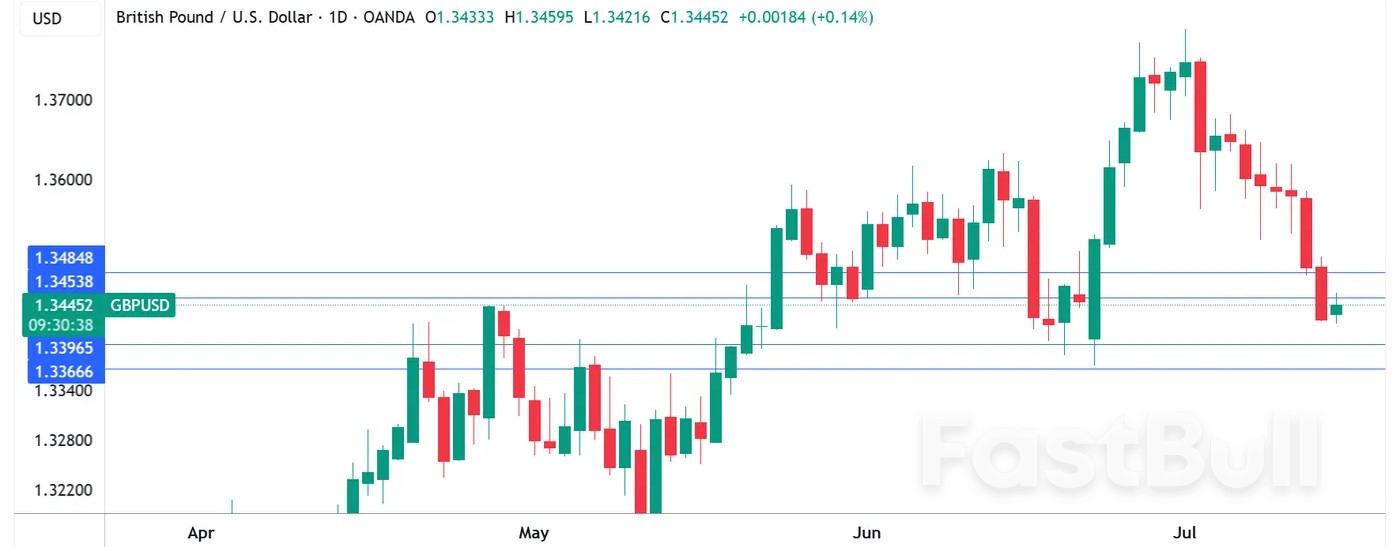
          The British pound has edged up higher on Tuesday. In the European session, GBP/USD is trading at 1.3453, up 0.21% on the day. Earlier, GBP/USD touched a low of 1.3416, its lowest level since June 23.

          UK inflation expected at 3.4%

          All eyes will be on the UK inflation report for June, which will be released on Wednesday. Headline CPI is expected to remain unchanged at 3.4% y/y, as is core CPI at 3.5%. Monthly, both the headline rates are expected to stay steady at 0.2%.
          Has the BoE's battle to lower inflation stalled? The BoE was looking good in March, when inflation eased to 2.6%, but CPI has rebounded to 3.4%, well above the BoE's inflation target of 2%. Services data has been especially sticky, although it dropped to 4.7% in May, down from 5.4% a month earlier.
          At 3.4%, inflation is stuck at its highest level since February 2024 and that will complicate plans at the BoE to renew interest rate cuts in order to kick-start the weak UK economy. The central bank has lowered rates twice this year and would like to continue trimming the current cash rate of 4.25%. The Bank meets next on Aug. 7 and Wednesday's inflation data could be a significant factor in the rate decision.

          US CPI expected to accelerate

          In the US, if June inflation data rises as is expected, fingers will quickly point to President Trump's tariffs as finally having an impact. Recent inflation reports have not shown a significant spike higher due to the tariffs, which were first imposed in April. However, the tariffs may have needed time to filter throughout the economy and could be felt for the first time in the June inflation reading.
          The Fed meets next on July 30, with the markets pricing in a 95% chance of a hold, according to CME's FedWatch. For September, the odds of a rate cut stand at 59%. Today's inflation report could cause a shift in these numbers.

          GBPUSD Technical

          GBP/USD tested resistance at 1.3454 earlier. Above, there is resistance at 1.3484
          1.3396 and 1.3366 are the next support levels
          Pound under pressure ahead of US, UK inflation reports_1

          Source : marketpulse

          Risk Warnings and Disclaimers
          You understand and acknowledge that there is a high degree of risk involved in trading. Following any strategies or investment methods may lead to potential losses. The content on the site is provided by our contributors and analysts for information purposes only. You are solely responsible for determining whether any trading assets, securities, strategy, or any other product is suitable for investing based on your own investment objectives and financial situation.
          Add to Favorites
          Share

          Powell’s Caution On Tariff-Driven Inflation Is Right

          Jason

          Central Bank

          President Donald Trump has taken to routinely maligning Federal Reserve Chair Jerome Powell as “too late” because interest rates have been on hold at 4.25%-4.5% since he took office. On Tuesday alone, he characteristically took to social media to demand three percentage points of rate cuts — something that is never going to happen outside of a recession. Trump’s needling aside, the latest inflation data show that Powell’s wait-and-see approach is the exact right tack for today’s economic outlook.

          The Bureau of Labor Statistics said Tuesday that the core consumer price index rose 0.2% in June from a month earlier, a slightly encouraging surprise that leaves the year-over-year rate at 2.9%. But the reading remains well above the Fed’s 2% target, and the details of the report show that tariffs are starting to fan higher prices and that larger effects might start to feed through over the next couple of months.

          More specifically, core goods rose 0.2% in June from a month earlier, the most brisk pace since February, driven in large part by a jump in household furnishings and supplies — a telltale sign of tariff passthrough. That category (think appliances, rugs, housekeeping supplies, etc.) jumped by 1% from the prior month, the biggest such increase since January 2022. Also notching the biggest month-on-month jump since 2022 were recreation commodities (sporting goods, toys, video equipment, etc.). Not only were tariff impacts undeniable this month, they appeared to be broadening out from what had been a very light and scattered influence in previous months’ data.

          Still, this was neither a month to panic nor celebrate. With the backdrop of a steady unemployment rate, it’s time to do as the embattled Fed chair — whom Trump has committed to replacing when his term is up next year — has been advising all along: Wait for more data.

          Among Fed policymakers and private sector economists, the general view of tariffs has been that they would hit sometime over the summer. For starters, Trump’s biggest and broadest tariff salvo didn’t come until April. Goldman Sachs Group Inc. economists estimate that it takes about a month for many imports to reach US shores, and goods were exempt if they were already on the ship at the time of the “Liberation Day” duties. What’s more, businesses stockpiled inventory in advance of the deadline and Customs and Border Protection allows many importers to delay payments for up to a month and a half. Hence, many forecasters expected June to be the start of a tariff-impact story that could become more evident in July and August.

          Powell has been broadly in that camp. At the post-decision press conference in June, he said that he expected to learn more “over the summer” about tariffs. “We hadn’t expected them to show up much by now, and they haven’t,” he said. “And we will see the extent to which they do over coming months.” In markets, his comments have been broadly interpreted to mean that further rate cuts were possible (though hardly guaranteed) as soon September, and that still feels appropriate. By that time, the committee will have additional inflation data in hand for the months of July and August.

          Unfortunately, Trump has used his social media platform to advocate for more immediate cuts, and his Council of Economic Advisers recently published an analysis that found no evidence that tariffs have caused “any economically meaningful inflation.” Inflation Insights President Omair Sharif wrote Monday that the CEA had gotten ahead of itself. “Setting aside the methodology for a moment, if the main point of the CEA’s analysis is to suggest that tariffs are not impacting inflation, then I think they’ve spiked the ball at the 50-yard line,” he said.

          It’s entirely possible, of course, that tariff impacts could spread further and that the Fed will still lower policy rates. The central bank doesn’t have to wait for inflation to return to 2% to start lowering rates again; rates are clearly at a level that the median Fed policymaker would deem restrictive. Powell and his colleagues just need to gain confidence that it remains on the right trajectory.

          Furthermore, tariffs are generally seen as a one-off increase in prices — the sort of supply shock that monetary policy orthodoxy would tell you to “look through.” The ultimate question as it pertains to trade policy is whether tariffs will shock expectations to such an extent that inflation gets back into the bones of the economy. That may depend on both the magnitude of the tariff impacts and their duration. And all of those variables depend, in turn, on whether Trump decides to temper the policies — as he’s occasionally proved willing to do, especially when financial markets react badly.

          To some extent, monetary policy will also depend on what happens with other key categories in the inflation basket. Among major imported goods, the auto sector is a big question mark. While tariffs are driving up car prices and threatening profit margins, the government data showed that prices of both new and used vehicles fell in June from May — a reminder that the duties aren’t the only consideration. Dealers are also contending with high borrowing costs and a general affordability crunch that’s weighing on demand. Many are uncertain about whether they can increase prices without hitting customer traffic and market share.

          What’s more, it’s important to remember that core services — which aren’t directly impacted by the tariffs — still constitute about three quarters of core CPI and about two thirds of inflation overall. As such, it’s plausible that services disinflation could mitigate the jumps in certain core goods prices, especially if shelter inflation remains as tame as it’s been for the better part of 2025. With all the crosscurrents, the responsible solution is for policymakers to wait for more evidence, and that’s exactly what the Fed is doing under Powell’s stewardship. No matter what the partisans around the White House say, the chairman is handling tariff uncertainty about as well as you could ask for.

          Source: Bloomberg Europe

          Risk Warnings and Disclaimers
          You understand and acknowledge that there is a high degree of risk involved in trading. Following any strategies or investment methods may lead to potential losses. The content on the site is provided by our contributors and analysts for information purposes only. You are solely responsible for determining whether any trading assets, securities, strategy, or any other product is suitable for investing based on your own investment objectives and financial situation.
          Add to Favorites
          Share
          FastBull
          Copyright © 2025 FastBull Ltd

          728 RM B 7/F GEE LOK IND BLDG NO 34 HUNG TO RD KWUN TONG KLN HONG KONG

          TelegramInstagramTwitterfacebooklinkedin
          App Store Google Play Google Play
          Products
          Charts

          Chats

          Q&A with Experts
          Screeners
          Economic Calendar
          Data
          Tools
          Membership
          Features
          Function
          Markets
          Copy Trading
          Latest Signals
          Contests
          News
          Analysis
          24/7
          Columns
          Education
          Company
          Careers
          About Us
          Contact Us
          Advertising
          Help Center
          Feedback
          User Agreement
          Privacy Policy
          Business

          White Label

          Data API

          Web Plug-ins

          Poster Maker

          Affiliate Program

          Risk Disclosure

          The risk of loss in trading financial instruments such as stocks, FX, commodities, futures, bonds, ETFs and crypto can be substantial. You may sustain a total loss of the funds that you deposit with your broker. Therefore, you should carefully consider whether such trading is suitable for you in light of your circumstances and financial resources.

          No decision to invest should be made without thoroughly conducting due diligence by yourself or consulting with your financial advisors. Our web content might not suit you since we don't know your financial conditions and investment needs. Our financial information might have latency or contain inaccuracy, so you should be fully responsible for any of your trading and investment decisions. The company will not be responsible for your capital loss.

          Without getting permission from the website, you are not allowed to copy the website's graphics, texts, or trademarks. Intellectual property rights in the content or data incorporated into this website belong to its providers and exchange merchants.

          Not Logged In

          Log in to access more features

          FastBull Membership

          Not yet

          Purchase

          Become a signal provider
          Help Center
          Customer Service
          Dark Mode
          Price Up/Down Colors

          Log In

          Sign Up

          Position
          Layout
          Fullscreen
          Default to Chart
          The chart page opens by default when you visit fastbull.com