• Trade
  • Markets
  • Copy
  • Contests
  • News
  • 24/7
  • Calendar
  • Q&A
  • Chats
Trending
Screeners
SYMBOL
LAST
BID
ASK
HIGH
LOW
NET CHG.
%CHG.
SPREAD
SPX
S&P 500 Index
6827.42
6827.42
6827.42
6899.86
6801.80
-73.58
-1.07%
--
DJI
Dow Jones Industrial Average
48458.04
48458.04
48458.04
48886.86
48334.10
-245.98
-0.51%
--
IXIC
NASDAQ Composite Index
23195.16
23195.16
23195.16
23554.89
23094.51
-398.69
-1.69%
--
USDX
US Dollar Index
97.950
98.030
97.950
98.500
97.950
-0.370
-0.38%
--
EURUSD
Euro / US Dollar
1.17394
1.17409
1.17394
1.17496
1.17192
+0.00011
+ 0.01%
--
GBPUSD
Pound Sterling / US Dollar
1.33707
1.33732
1.33707
1.33997
1.33419
-0.00148
-0.11%
--
XAUUSD
Gold / US Dollar
4299.39
4299.39
4299.39
4353.41
4257.10
+20.10
+ 0.47%
--
WTI
Light Sweet Crude Oil
57.233
57.485
57.233
58.011
56.969
-0.408
-0.71%
--

Community Accounts

Signal Accounts
--
Profit Accounts
--
Loss Accounts
--
View More

Become a signal provider

Sell trading signals to earn additional income

View More

Guide to Copy Trading

Get started with ease and confidence

View More

Signal Accounts for Members

All Signal Accounts

Best Return
  • Best Return
  • Best P/L
  • Best MDD
Past 1W
  • Past 1W
  • Past 1M
  • Past 1Y

All Contests

  • All
  • Trump Updates
  • Recommend
  • Stocks
  • Cryptocurrencies
  • Central Banks
  • Featured News
Top News Only
Share

Kuwait's Oil Minister Says: We Expected Prices To Remain At Least As They Were, If Not Better, But We Were Surprised By Their Drop

Share

Kuwait Sees Fair Oil Price At $60-$68 A Barrel Under Current Conditions

Share

Syria Produces About 100000 Barrels/Day And Aims To Boost Output If Issues East Of The Euphrates Are Resolved

Share

Australia Intelligence Official: National Terrorism Threat Level Remains At Probable

Share

Australia Intelligence Official: We're Looking To See If There Are Anyone In The Community That Has Similar Intent

Share

Australia Intelligence Official: We Are Looking At The Identities Of The Attackers

Share

Australia Prime Minister: Tells Jews We Will Dedicate Every Resource Required To Making Sure You Are Safe And Protected

Share

Australia Prime Minister: Police And Security Agencies Are Working To Determine Anyone Associated With This Outrage

Share

Australia Police: Police Bomb Disposal Unit Currently Working On Several Suspected Improvised Explosive Devices

Share

Syria's Oil Ministry Forecasts Country's Gas Production To Increase To 15 Million Cubic Meters By End Of 2026

Share

His Office: Ukraine's President Zelenskiy Landed In Germany

Share

Australia Police: This Is Not A Time For Retribution. This Is A Time To Allow The Police To Do Their Duty

Share

Australia Police: We Know That We Have Two Definite Offenders, But We Want To Make Sure The Community Is Safe

Share

Australia Police: Our Counter-Terrorism Command Will Lead This Investigation With Investigators From The State Crime Command. No Stone Will Be Left Unturned

Share

Australia Police: This Is A Terrorist Incident

Share

Ukraine President Zelenskiy: Ukraine-Russia Ceasefire Along The Current Frontlines Would Be A Fair Option

Share

New South Wales Premier Chris Minns: This Is A Massive, Complex And Just Beginning Investigation

Share

New South Wales Premier Chris Minns: 12 Killed In Bondi Shooting

Share

Ukraine President Zelenskiy: Security Guarantees Should Be Legally Binding

Share

Ukraine President Zelenskiy: US, European Security Guarantees Instead Of NATO Membership Is Compromise From Ukraine's Side

TIME
ACT
FCST
PREV
U.K. Trade Balance (Oct)

A:--

F: --

P: --

U.K. Services Index MoM

A:--

F: --

P: --

U.K. Construction Output MoM (SA) (Oct)

A:--

F: --

P: --

U.K. Industrial Output YoY (Oct)

A:--

F: --

P: --

U.K. Trade Balance (SA) (Oct)

A:--

F: --

P: --

U.K. Trade Balance EU (SA) (Oct)

A:--

F: --

P: --

U.K. Manufacturing Output YoY (Oct)

A:--

F: --

P: --

U.K. GDP MoM (Oct)

A:--

F: --

P: --

U.K. GDP YoY (SA) (Oct)

A:--

F: --

P: --

U.K. Industrial Output MoM (Oct)

A:--

F: --

P: --

U.K. Construction Output YoY (Oct)

A:--

F: --

P: --

France HICP Final MoM (Nov)

A:--

F: --

P: --

China, Mainland Outstanding Loans Growth YoY (Nov)

A:--

F: --

P: --

China, Mainland M2 Money Supply YoY (Nov)

A:--

F: --

P: --

China, Mainland M0 Money Supply YoY (Nov)

A:--

F: --

P: --

China, Mainland M1 Money Supply YoY (Nov)

A:--

F: --

P: --

India CPI YoY (Nov)

A:--

F: --

P: --

India Deposit Gowth YoY

A:--

F: --

P: --

Brazil Services Growth YoY (Oct)

A:--

F: --

P: --

Mexico Industrial Output YoY (Oct)

A:--

F: --

P: --

Russia Trade Balance (Oct)

A:--

F: --

P: --

Philadelphia Fed President Henry Paulson delivers a speech
Canada Building Permits MoM (SA) (Oct)

A:--

F: --

P: --

Canada Wholesale Sales YoY (Oct)

A:--

F: --

P: --

Canada Wholesale Inventory MoM (Oct)

A:--

F: --

P: --

Canada Wholesale Inventory YoY (Oct)

A:--

F: --

P: --

Canada Wholesale Sales MoM (SA) (Oct)

A:--

F: --

P: --

Germany Current Account (Not SA) (Oct)

A:--

F: --

P: --

U.S. Weekly Total Rig Count

A:--

F: --

P: --

U.S. Weekly Total Oil Rig Count

A:--

F: --

P: --

Japan Tankan Large Non-Manufacturing Diffusion Index (Q4)

--

F: --

P: --

Japan Tankan Small Manufacturing Outlook Index (Q4)

--

F: --

P: --

Japan Tankan Large Non-Manufacturing Outlook Index (Q4)

--

F: --

P: --

Japan Tankan Large Manufacturing Outlook Index (Q4)

--

F: --

P: --

Japan Tankan Small Manufacturing Diffusion Index (Q4)

--

F: --

P: --

Japan Tankan Large Manufacturing Diffusion Index (Q4)

--

F: --

P: --

Japan Tankan Large-Enterprise Capital Expenditure YoY (Q4)

--

F: --

P: --

U.K. Rightmove House Price Index YoY (Dec)

--

F: --

P: --

China, Mainland Industrial Output YoY (YTD) (Nov)

--

F: --

P: --

China, Mainland Urban Area Unemployment Rate (Nov)

--

F: --

P: --

Saudi Arabia CPI YoY (Nov)

--

F: --

P: --

Euro Zone Industrial Output YoY (Oct)

--

F: --

P: --

Euro Zone Industrial Output MoM (Oct)

--

F: --

P: --

Canada Existing Home Sales MoM (Nov)

--

F: --

P: --

Euro Zone Total Reserve Assets (Nov)

--

F: --

P: --

U.K. Inflation Rate Expectations

--

F: --

P: --

Canada National Economic Confidence Index

--

F: --

P: --

Canada New Housing Starts (Nov)

--

F: --

P: --

U.S. NY Fed Manufacturing Employment Index (Dec)

--

F: --

P: --

U.S. NY Fed Manufacturing Index (Dec)

--

F: --

P: --

Canada Core CPI YoY (Nov)

--

F: --

P: --

Canada Manufacturing Unfilled Orders MoM (Oct)

--

F: --

P: --

Canada Manufacturing New Orders MoM (Oct)

--

F: --

P: --

Canada Core CPI MoM (Nov)

--

F: --

P: --

Canada Manufacturing Inventory MoM (Oct)

--

F: --

P: --

Canada CPI YoY (Nov)

--

F: --

P: --

Canada CPI MoM (Nov)

--

F: --

P: --

Canada CPI YoY (SA) (Nov)

--

F: --

P: --

Canada Core CPI MoM (SA) (Nov)

--

F: --

P: --

Canada CPI MoM (SA) (Nov)

--

F: --

P: --

Q&A with Experts
    • All
    • Chatrooms
    • Groups
    • Friends
    Connecting
    .
    .
    .
    Type here...
    Add Symbol or Code

      No matching data

      All
      Trump Updates
      Recommend
      Stocks
      Cryptocurrencies
      Central Banks
      Featured News
      • All
      • Russia-Ukraine Conflict
      • Middle East Flashpoint
      • All
      • Russia-Ukraine Conflict
      • Middle East Flashpoint
      Search
      Products

      Charts Free Forever

      Chats Q&A with Experts
      Screeners Economic Calendar Data Tools
      Membership Features
      Data Warehouse Market Trends Institutional Data Policy Rates Macro

      Market Trends

      Market Sentiment Order Book Forex Correlations

      Top Indicators

      Charts Free Forever
      Markets

      News

      News Analysis 24/7 Columns Education
      From Institutions From Analysts
      Topics Columnists

      Latest Views

      Latest Views

      Trending Topics

      Top Columnists

      Latest Update

      Signals

      Copy Rankings Latest Signals Become a signal provider AI Rating
      Contests
      Brokers

      Overview Brokers Assessment Rankings Regulators News Claims
      Broker listing Forex Brokers Comparison Tool Live Spread Comparison Scam
      Q&A Complaint Scam Alert Videos Tips to Detect Scam
      More

      Business
      Events
      Careers About Us Advertising Help Center

      White Label

      Data API

      Web Plug-ins

      Affiliate Program

      Awards Institution Evaluation IB Seminar Salon Event Exhibition
      Vietnam Thailand Singapore Dubai
      Fans Party Investment Sharing Session
      FastBull Summit BrokersView Expo
      Recent Searches
        Top Searches
          Markets
          News
          Analysis
          User
          24/7
          Economic Calendar
          Education
          Data
          • Names
          • Latest
          • Prev

          View All

          No data

          Scan to Download

          Faster Charts, Chat Faster!

          Download App
          English
          • English
          • Español
          • العربية
          • Bahasa Indonesia
          • Bahasa Melayu
          • Tiếng Việt
          • ภาษาไทย
          • Français
          • Italiano
          • Türkçe
          • Русский язык
          • 简中
          • 繁中
          Open Account
          Search
          Products
          Charts Free Forever
          Markets
          News
          Signals

          Copy Rankings Latest Signals Become a signal provider AI Rating
          Contests
          Brokers

          Overview Brokers Assessment Rankings Regulators News Claims
          Broker listing Forex Brokers Comparison Tool Live Spread Comparison Scam
          Q&A Complaint Scam Alert Videos Tips to Detect Scam
          More

          Business
          Events
          Careers About Us Advertising Help Center

          White Label

          Data API

          Web Plug-ins

          Affiliate Program

          Awards Institution Evaluation IB Seminar Salon Event Exhibition
          Vietnam Thailand Singapore Dubai
          Fans Party Investment Sharing Session
          FastBull Summit BrokersView Expo

          JPMorgan Opens Bitcoin Purchases For Clients, Excludes Custody

          Daniel Carter

          Cryptocurrency

          Summary:

          JPMorgan allows Bitcoin purchases but excludes custody, affecting market sentiment. Client demand drives JPMorgan's partial entry into Bitcoin. Institutional interest may boost Bitcoin and related assets.
          Key Points:
          ● JPMorgan allows Bitcoin purchases but excludes custody, affecting market sentiment.
          ● Client demand drives JPMorgan's partial entry into Bitcoin.
          ● Institutional interest may boost Bitcoin and related assets.

          JPMorgan Enables Bitcoin Purchases, Stops Short of Custody Services

          JPMorgan Chase, under CEO Jamie Dimon, will allow clients to purchase Bitcoin, though custody services remain off the table. This measure addresses client demands as reported by Jin10. The bank's shifted stance signifies increased institutional recognition of cryptocurrency, with Dimon stating, "Will allow clients to purchase Bitcoin, but will not provide custody."
          JPMorgan's client-only offering opens new market interest, emphasizing crypto's growing importance in traditional finance.
          While the lack of custody services may limit immediate impact, the move highlights Bitcoin's demand among institutional clients and may foster broader acceptance.
          Reactions are mixed; market observers note the strategic decision to separate purchase and custody. No direct response from major regulators or industry leaders is cited, though similar past announcements have typically buoyed market sentiments temporarily.
          JPMorgan Chase offers clients the ability to purchase Bitcoin, a development confirmed by CEO Jamie Dimon's recent statements. The bank, one of the largest in the world, however, refrains from offering custody services. Clients seeking Bitcoin will need to look elsewhere for storage, reflecting a balance between recognizing crypto demand and managing associated risks.
          While the move is incremental, it suggests a shift within institutional finance toward cryptocurrency engagement. By permitting Bitcoin purchases, JPMorgan acknowledges evolving client interests amid a robust digital asset environment, potentially influencing other financial institutions to consider similar approaches.
          Despite lack of custody, the market views this as JPMorgan aligning with rising institutional interest in cryptocurrencies. These developments may inspire sentiments akin to when banks like Goldman Sachs introduced trading services, often resulting in short-term positive market movements for Bitcoin, driven by increased legitimacy and potential institutional inflows.

          Historical Context, Price Data, and Expert Analysis

          Did you know? Following Goldman Sachs' decision to offer Bitcoin trading services, Bitcoin prices notably rose, reflecting how institutional interest spurs market activity.
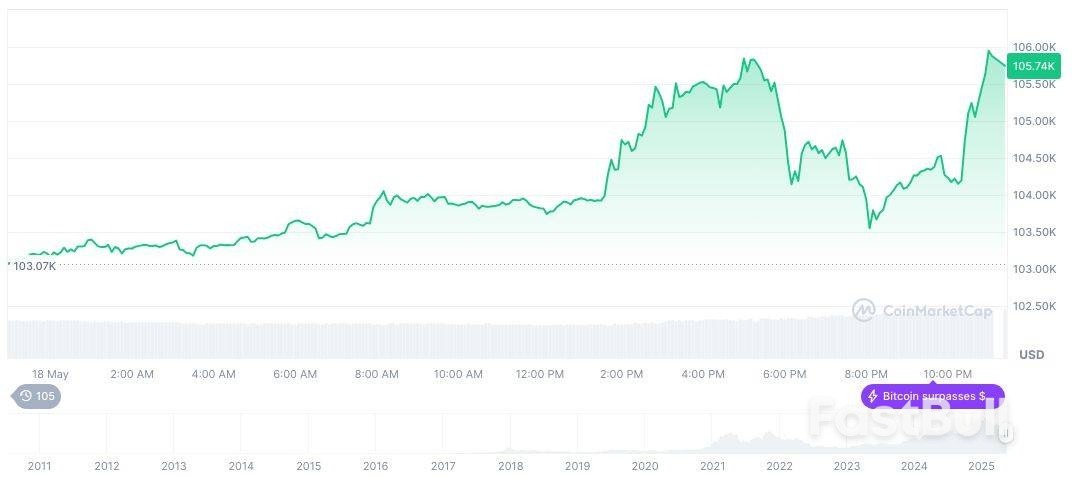
          Bitcoin's current price is $104,887.79 with a market cap of $2.08 trillion, according to CoinMarketCap. It dominates 63.03% of the market, with a trading volume of $66.41 billion, despite a recent 0.57% decrease. Recent trends indicate a 23.16% surge over 30 days as institutional interest increases.

          Bitcoin(BTC), daily chart, screenshot at 15:50 UTC on May 19, 2025.

          Experts suggest JPMorgan's steps could signify a cautious but meaningful stride in crypto mainstreaming. While regulatory clarity is paramount, the bank's selective engagement shows an adaptive approach to crypto integration, possibly influencing similar moves by competitors, aware of the sector's potential growth and risks.

          Source: CryptoSlate

          Risk Warnings and Disclaimers
          You understand and acknowledge that there is a high degree of risk involved in trading. Following any strategies or investment methods may lead to potential losses. The content on the site is provided by our contributors and analysts for information purposes only. You are solely responsible for determining whether any trading assets, securities, strategy, or any other product is suitable for investing based on your own investment objectives and financial situation.
          Add to Favorites
          Share

          Global M&A Volume Plunges to 20-Year Low Amid Tariff Uncertainty and U.S. Policy Tensions

          Gerik

          Economic

          Global M&A Activity Stalls Despite Value Surge in Q1

          According to new data from Dealogic, only 2,482 M&A deals were announced globally in March 2025—marking the lowest monthly total since May 2005. April showed a modest rebound to 2,513 transactions but still significantly trails the 2024 monthly average of 3,457. The drop is particularly stark when compared to previous crises, including the 2008 financial crash and the COVID-19 pandemic.
          While deal volume has collapsed, the total value of global M&A surged in Q1 2025 to $1.5 trillion—up 24% year-over-year—driven by a handful of massive transactions. These include xAI’s $33 billion acquisition of X, Google’s $32 billion deal for Wiz, Constellation Energy’s $30 billion takeover of Calpine, and SoftBank’s $40 billion investment in OpenAI. These “mega deals” reflect long-gestating strategic moves rather than broader market momentum.
          Still, total deal count in Q1 dropped over 36%, falling from about 11,000 deals in Q1 2024 to just 6,955—a striking divergence that underscores how a few high-profile deals are masking wider stagnation.

          Retaliatory Tariffs Disrupt Confidence and U.S. Deal Flow

          Much of the decline in deal activity—particularly in the U.S.—can be traced to retaliatory tariffs introduced by President Trump on April 2. The shock announcement roiled equity markets, triggered fears of a global slowdown, and undermined valuation stability critical for M&A dealmaking. According to investment bank Moelis & Co., these measures introduced a “new wave of volatility” that has deterred both buyers and sellers from executing cross-border transactions.
          In March and April, U.S.-related M&A transactions fell below 600 per month—the lowest two-month level in 15 years. Protectionist rhetoric has also made foreign investors increasingly cautious. While Trump has encouraged direct investment like factory construction, regulatory scrutiny—particularly through the Committee on Foreign Investment in the United States (CFIUS)—has intensified. Japan’s Nippon Steel, for example, has faced prolonged delays in its bid to acquire U.S. Steel, with uncertainty surrounding national security review deadlines.
          According to Japanese trade lawyer Hideaki Umetsu, many Japanese firms now view U.S. M&A deals as “high-risk,” especially in sectors viewed as strategically sensitive. Even with solid operating fundamentals, heightened political risk is reshaping corporate strategy.

          Strategic Planning and Deal Forecasts Strain Under Policy Volatility

          Global investment planning has become increasingly difficult under these conditions. Dealmakers and private equity funds are struggling to value target firms due to uncertainties in cash flow forecasting and long-term economic assumptions. A U.S.-based banking analyst noted that recent tariff talks with China and the UK have offered only “short-term relief” and cannot substitute for robust long-term policy clarity.
          EY-Parthenon expects the number of private equity transactions over $100 million in 2025 to remain flat compared to 2024, citing persistent deal uncertainty. Meanwhile, a shift toward public-to-private buyouts is gaining traction. The volatility in public equity markets is making delistings more attractive, especially for firms looking to escape quarterly scrutiny.
          Private equity firms have already executed multibillion-dollar buyouts of companies like Walgreens Boots Alliance and Skechers, with each deal valued around $10 billion.

          U.S. Corporates Lean on Buybacks Amid Investment Paralysis

          Despite strong earnings—78% of S&P 500 firms beat earnings expectations in Q1—American companies are growing hesitant to deploy capital into growth initiatives. Instead, they are increasingly returning surplus cash to shareholders through record-setting stock buybacks.
          According to Deutsche Bank, announced buybacks among S&P 500 firms reached approximately $500 billion over the past three months—a historic high. Firms like Advanced Micro Devices recently committed $6 billion to repurchase shares. JPMorgan analysts note that companies tend to buy back stock aggressively during periods of valuation correction, using buybacks as a flexible capital deployment tool.
          Yet the capital allocation dilemma persists. Faced with uncertain policy directions and volatile equity markets, executives are delaying strategic investments, M&A, and even certain R&D programs. The choice between growth capex, debt reduction, acquisitions, and shareholder returns has become more complex in an environment where long-term forecasting is fraught with political unpredictability.
          While headline M&A deal values may appear robust due to outsized transactions, the collapse in global deal count reflects a much more cautious market. The chilling effect of retaliatory tariffs, heightened regulatory scrutiny, and erratic U.S. policy shifts has fundamentally altered the M&A landscape. Until more consistent and cooperative trade and investment frameworks are restored, companies are likely to favor defensive strategies—delaying strategic mergers, favoring share buybacks, and avoiding high-risk cross-border expansion. Without this stability, a sustained rebound in M&A activity remains elusive.

          Source: Nikkei Asia

          To stay updated on all economic events of today, please check out our Economic calendar
          Risk Warnings and Disclaimers
          You understand and acknowledge that there is a high degree of risk involved in trading. Following any strategies or investment methods may lead to potential losses. The content on the site is provided by our contributors and analysts for information purposes only. You are solely responsible for determining whether any trading assets, securities, strategy, or any other product is suitable for investing based on your own investment objectives and financial situation.
          Add to Favorites
          Share

          Wall St drops, Treasury yields rise after Moody's downgrade

          Adam

          Stocks

          Bond

          Wall Street's main indexes slipped on Monday, with technology stocks falling as Treasury yields spiked after Moody's downgraded the U.S. sovereign rating, sharpening focus on its mounting debt.
          Moody's cut the United States' sovereign credit rating to "Aa1" from "Aaa" late on Friday owing to concerns about its ballooning $36-trillion debt, becoming the last of the three major credit rating agencies to downgrade the country. It had first given the U.S. its pristine "Aaa" rating in 1919.
          "Nothing new, but it's putting a lot of things that the market has worried about rightfully back into focus," said Ross Mayfield, investment strategist at Baird.
          "The trade headwinds keep markets volatile, but this morning in particular, it's about the Moody's downgrade."
          Worries about the ever-increasing U.S. deficit were front and center as U.S. President Donald Trump's sweeping tax-cut bill - which Republican infighting over spending cuts had stalled for days - won approval from a key congressional committee on Sunday.
          At 09:35 a.m. ET, the Dow Jones Industrial Average fell 222.40 points, or 0.52%, to 42,432.34, the S&P 500 lost 55.42 points, or 0.93%, to 5,902.96, and the Nasdaq Composite lost 257.49 points, or 1.34%, to 18,953.61.
          Ten of the 11 S&P sub-sectors fell, with consumer discretionary and energy being the worst performers.
          Highly valued technology stocks took a hit as rising rates tend to discount the present value of future profits. Tesla led losses among megacap and growth stocks with a 4.1% fall.
          Chip stocks also sold off. Nvidia was down 1.4% and a gauge for semiconductor stocks shed 1.9%.
          Yields on U.S. government bonds - which move inversely to prices - ticked higher, with the 10-year note rising 9 basis points to 4.526% and the 30-year note touching 4.998%.
          The S&P 500 had registered its fifth straight day of gains on Friday, closing out the week with firm gains as markets took heart from a temporary tariff truce between the U.S. and China along with tame inflation data.
          U.S. Treasury Secretary Scott Bessent said in television interviews over the weekend that Trump would impose tariffs at the rates he had threatened last month on trading partners that do not negotiate deals in "good faith".
          The U.S. Federal Reserve might only be able to cut interest rates by a quarter point through the rest of the year, Atlanta Fed president Raphael Bostic said, while New York Fed President John Williams said that the interest-rate policy was in the right place to deal with an uncertain economic outlook.
          In other moves, Netflix fell almost 1% after J.P.Morgan removed the stock from its U.S. analyst focus list.
          TXNM Energy jumped 7.6% after the utility said it would be acquired by the infrastructure unit of Blackstone in an $11.5-billion deal.
          Declining issues outnumbered advancers by a 5.98-to-1 ratio on the NYSE, and by a 2.91-to-1 ratio on the Nasdaq.
          The S&P 500 posted three new 52-week highs and no new lows, while the Nasdaq Composite recorded 10 new highs and 23 new lows.

          source :Reuters

          Risk Warnings and Disclaimers
          You understand and acknowledge that there is a high degree of risk involved in trading. Following any strategies or investment methods may lead to potential losses. The content on the site is provided by our contributors and analysts for information purposes only. You are solely responsible for determining whether any trading assets, securities, strategy, or any other product is suitable for investing based on your own investment objectives and financial situation.
          Add to Favorites
          Share

          Trump Engages Putin in High-Stakes Call as U.S. Signals Impatience Over Ukraine War Impasse

          Gerik

          Political

          Renewed Dialogue Amid Stalled Peace Prospects

          In a high-profile development, President Trump and President Putin spoke on Monday for the first time in months, aiming to break what Washington described as an “impasse” in efforts to end the war in Ukraine. The call comes after Trump's administration pushed for renewed diplomacy, with U.S. Vice President JD Vance cautioning that continued American involvement was not guaranteed if no meaningful progress was made.
          Speaking from Sochi, Putin engaged with Trump, who was in Washington, in a conversation confirmed by the White House. The call follows Trump’s push to be remembered as a “peacemaker,” framing the Ukraine conflict as a prolonged proxy war between Russia and the West—a view that has increasingly shaped his foreign policy narrative.

          Washington Considers Limits to Its Role

          Vice President Vance, ahead of the call, acknowledged growing frustration within the U.S. administration. He stated bluntly that “if Russia is not willing to engage, then we’re eventually going to say this is not our war.” His comments reflect an emerging shift in Washington's posture—where the focus may pivot from long-term military support to pressuring both parties toward ceasefire negotiations.
          The remarks hint at a conditional U.S. stance: diplomatic engagement is being offered, but not indefinitely. This introduces a clear message to Moscow—negotiate sincerely or face increased isolation and the potential loss of diplomatic channels.

          Putin Holds Ground Despite Escalation and Global Pressure

          The outreach comes just a day after Russia launched its largest drone strike against Ukraine since the invasion began in 2022. Ukrainian intelligence also accused Moscow of preparing an intercontinental ballistic missile test, though that claim remains unconfirmed. Putin, maintaining a firm stance, has reiterated demands that Ukraine abandon its NATO aspirations and withdraw from the four Russian-claimed regions—conditions Kyiv considers unacceptable.
          Despite mounting military and political costs, Russia continues its operations, currently holding about 20% of Ukrainian territory. These entrenched battlefield dynamics have made a negotiated settlement difficult, with both sides showing minimal flexibility.

          Trump’s Balancing Act: Diplomacy, Sanctions, and Political Optics

          While Trump has expressed interest in ending the war, his administration has not ruled out punitive measures. The White House has signaled the possibility of more sanctions should Russia fail to engage constructively. Trump's planned discussions with Ukrainian President Volodymyr Zelenskiy and NATO leaders later this week suggest he is also seeking to manage transatlantic unity, amid European concerns about U.S. disengagement.
          The situation presents a diplomatic test for Trump, who faces domestic scrutiny over rising global instability and economic volatility driven by U.S. fiscal and trade policies. How the administration balances pressure on Moscow with support for Ukraine will shape not only the trajectory of the war, but broader perceptions of U.S. global leadership.

          Europe’s Unease and Political Stakes

          European leaders remain closely aligned in their support for Ukraine, but diverging views on negotiation strategy persist. Over the weekend, British Prime Minister Keir Starmer conferred with leaders from the U.S., Germany, France, and Italy to reinforce NATO’s shared stance. Still, the Trump administration’s shift toward conditional engagement and the possibility of withdrawal raise concerns about the consistency of Western resolve.
          Any signal of U.S. hesitation may embolden Moscow or increase political pressure on Kyiv to consider concessions, complicating Europe's coordinated approach. The fragility of Western consensus could further unravel if Trump’s outreach fails to produce results and the U.S. begins distancing itself from the conflict.
          Trump’s call with Putin reflects a renewed but fragile attempt to shift the Ukraine war narrative from entrenched conflict to political settlement. However, the fundamental positions of both Russia and Ukraine remain unchanged, and the United States appears increasingly unwilling to act as the war’s guarantor indefinitely. Whether this dialogue marks the beginning of genuine progress—or a prelude to U.S. disengagement—will depend on how both Moscow and Kyiv respond in the coming days. The stakes, both for Ukraine’s sovereignty and for America’s credibility, could not be higher.

          Source: Reuters

          Risk Warnings and Disclaimers
          You understand and acknowledge that there is a high degree of risk involved in trading. Following any strategies or investment methods may lead to potential losses. The content on the site is provided by our contributors and analysts for information purposes only. You are solely responsible for determining whether any trading assets, securities, strategy, or any other product is suitable for investing based on your own investment objectives and financial situation.
          Add to Favorites
          Share

          Weekly Data for Oil and Gold: Price Review for the Week Ahead

          Adam

          Commodity

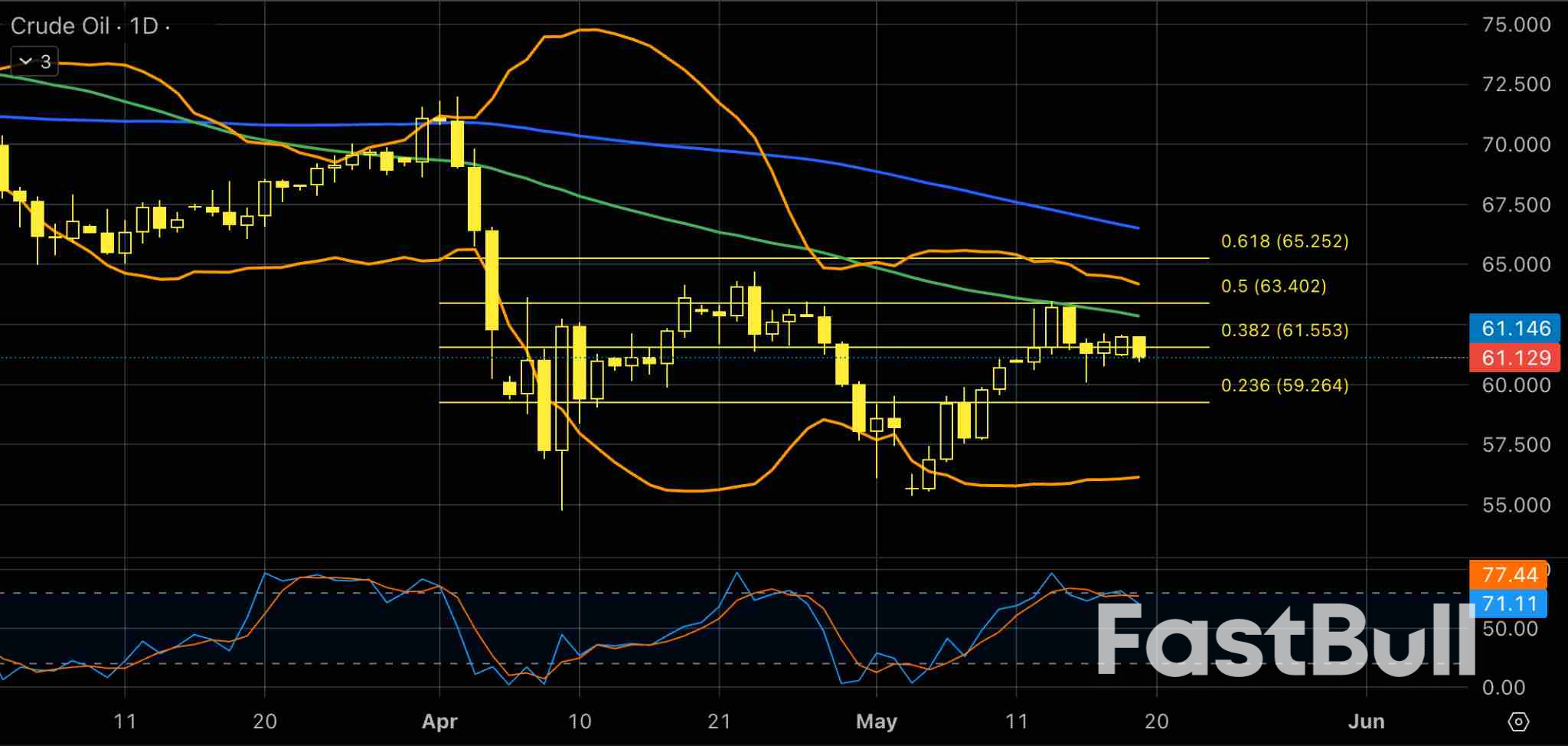
          USOIL, Daily

          Weekly Data for Oil and Gold: Price Review for the Week Ahead_1
          Oil prices held steady on Monday as markets awaited the outcome of Iran-U.S. nuclear talks and key Chinese economic data that could impact commodity demand. Brent crude was at $65.36 and WTI at $62.52 per barrel, with the more active July WTI contract slightly lower. Last week, prices rose over 1% after the U.S. and China paused their trade war, while analysts warned that weak Chinese data could dampen market sentiment.
          Chinese industrial production data came out at 6.1% down from the previous reading of 7.7% but higher than the anticipated 5.5%. Uncertainty around the Iran deal, particularly U.S. demands on uranium enrichment, also lent some support to prices.
          On the technical side, the price found sufficient resistance in an area of the chart combining the 50-day moving average and the 50% of the daily Fibonacci retracement and has since corrected to the downside. The Stochastic oscillator is in the extreme overbought levels, hinting at a potential continuation of the bearish momentum, and also the moving averages are validating the overall bearish trend as well, therefore supporting the selling narrative.
          If the crude oil does continue to lose value then the first area of possible technical support might be found around $60 which is the psychological support of the round number and just above the 23.6% of the daily Fibonacci retracement level.

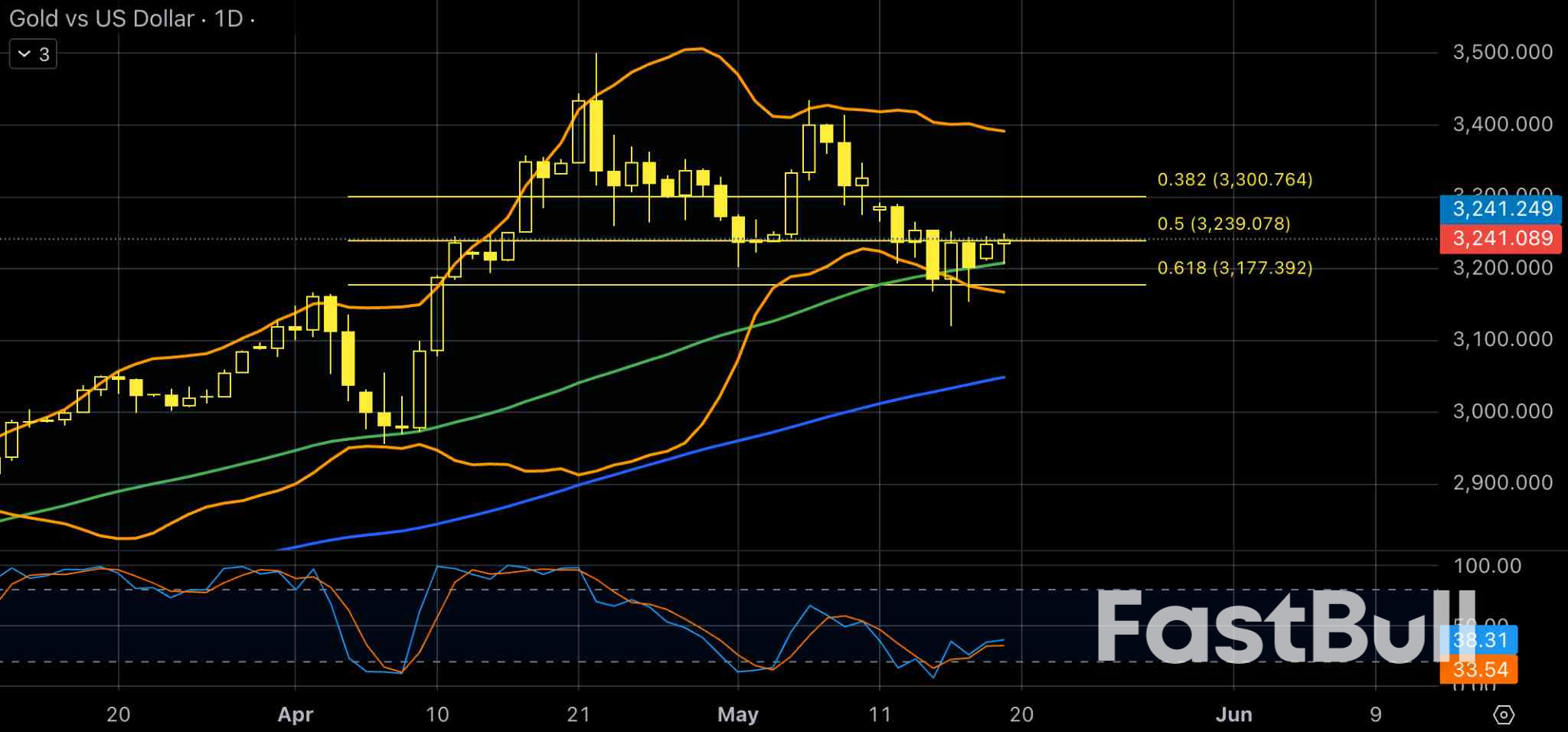
          Gold-dollar, Daily

          Weekly Data for Oil and Gold: Price Review for the Week Ahead_2
          Gold prices rose following Moody’s downgrade of the U.S. credit rating, triggering a risk-off shift in markets. However, growing investor skepticism is emerging, with 45% now viewing gold as overvalued. Despite safe-haven demand, gold may have peaked for now, as positioning is overcrowded and the outlook remains cautiously bullish long-term, but near-term gains may be limited unless geopolitical tensions escalate further. Treasury rhetoric on tariffs added to uncertainty, supporting gold for the time being..
          From a technical point of view, the price of gold has rebounded at a major technical support level on the chart, consisting of the lower band of the Bollinger bands, the 50-day moving average, and the 61.8% of the Fibonacci retracement level. Currently, it is testing the resistance of the 50% of the daily Fibonacci retracement level while the Stochastic oscillator is at neutral levels.
          The moving averages are confirming the overall bullish trend despite the recent sell-off; therefore, it is possible to see a minor bullish run in the upcoming sessions. If this happens, then the first area of potential resistance might be seen around $3,300, which is the psychological resistance of the round number as well as the 38.2% of the daily Fibonacci retracement level.

          Source: fxempire

          Risk Warnings and Disclaimers
          You understand and acknowledge that there is a high degree of risk involved in trading. Following any strategies or investment methods may lead to potential losses. The content on the site is provided by our contributors and analysts for information purposes only. You are solely responsible for determining whether any trading assets, securities, strategy, or any other product is suitable for investing based on your own investment objectives and financial situation.
          Add to Favorites
          Share

          What Moody’s Downgrade Of U.S. Credit Rating Means For Your Money

          Thomas

          Economic

          Moody's decision to downgrade the U.S. credit rating may have consequences for your money, experts say.

          The debt downgrade put immediate pressure on bond prices, sending yields higher on Monday morning. The 30-year U.S. bond yield traded above 5% and the 10-year yield topped 4.5%, hitting key levels at a time when the economy is already showing signs of strain from President Donald Trump's unfolding tariff policy.

          Treasury bonds influence rates for a wide range of consumer loans like 30-year fixed mortgages, and to some extent also affect products including auto loans and credit cards.

          "It's really hard to avoid the impact on consumers," said Brian Rehling, head of global fixed income strategy at Wells Fargo Investment Institute.

          Moody's lowers U.S. credit rating

          The major credit rating agency cut the United States' sovereign credit rating on Friday by one notch to Aa1 from Aaa, the highest possible.

          In doing so, it cited the increasing burden of the federal government's budget deficit. Republicans' attempts to make President Donald Trump's 2017 tax cuts permanent as part of the reconciliation package threaten to increase the federal debt by trillions of dollars.

          More from FA Playbook:

          Here's a look at other stories impacting the financial advisor business.

          • There’s a new ‘super funding’ limit for some 401(k) savers in 2025. Here’s who qualifies
          • This factor can get your mortgage application denied — even if you’re a high earner
          • Americans believe real estate, gold are the best long-term investments

          "When our credit rating goes down, the expectation is that the cost of borrowing will increase," said Ivory Johnson, a certified financial planner and founder of Delancey Wealth Management in Washington, D.C.

          That's because when "a country represents a bigger credit risk, the creditors will demand to be compensated with higher interest rates," said Johnson, a member of CNBC's Financial Advisor council.

          'Downgrades can raise borrowing costs over time'

          Americans struggling to keep up with sky-high interest charges aren't likely to get much relief any time soon amid Moody's downgrade.

          "Economic uncertainty, especially regarding tariff policy, has the Fed — and a lot of businesses — on hold," said Ted Rossman, a senior industry analyst at Bankrate.

          Atlanta Fed President Raphael Bostic said on CNBC's "Squawk Box" Monday that he now sees only one rate cut this year as the central bank tries to balance inflationary pressures with worries of a potential recession. Federal Reserve Chair Jerome Powell also recently noted that tariffs may slow growth and boost inflation, making it harder to lower the central bank's benchmark as previously expected.

          Douglas Boneparth, another CFP and the president of Bone Fide Wealth in New York, agreed that the downgrade could translate to higher interest rates on consumer loans.

          "Downgrades can raise borrowing costs over time," said Boneparth, who is also on CNBC's FA council.

          "Think higher rates on mortgages, credit cards, and personal loans, especially if confidence in U.S. credit weakens further," he said.

          Which consumer loans could see higher rates

          Some loans could see more direct impacts because their rates are tied to bond prices.

          Since mortgage rates are largely tied to Treasury yields and the economy, "30-year mortgages are going to be most closely correlated, and longer-term rates are already moving higher," Rehling said.

          The average rate for a 30-year, fixed-rate mortgage was 6.92% as of May 16, while the 15-year, fixed-rate is 6.26%, according to Mortgage News Daily.

          Although credit cards and auto loan rates more directly track the federal funds rate, the nation's financial challenges also play a key role in the Federal Reserve's stance on interest rates. "The fed funds rate is higher than it would be if the U.S. was in a better fiscal situation," Rehling said.

          Since December 2024, the overnight lending rate has been in a range between 4.25%-4.5%. As a result, the average credit card rate is currently 20.12%, down only slightly from a record 20.79% set last summer, according to Ted Rossman, a senior industry analyst at Bankrate.

          Credit card rates tend to mirror Fed actions, so "higher for longer" would keep the average credit card rate around 20% through the rest of the year, Rossman said.

          'We've been through this before'

          Before its downgrade, Moody's was the last of the major credit rating agencies to have the U.S. at the highest possible rating.

          Standard & Poor's downgraded the nation's credit rating in August 2011, and Fitch Ratings cut it in August 2023. "We've been through this before," Rehling said.

          Still, the move highlights the country's fiscal challenges, Rehling said: "The U.S. still maintains its dominance as the safe haven economy of the world, but it puts some chinks in the armor."

          Source: CNBC

          To stay updated on all economic events of today, please check out our Economic calendar
          Risk Warnings and Disclaimers
          You understand and acknowledge that there is a high degree of risk involved in trading. Following any strategies or investment methods may lead to potential losses. The content on the site is provided by our contributors and analysts for information purposes only. You are solely responsible for determining whether any trading assets, securities, strategy, or any other product is suitable for investing based on your own investment objectives and financial situation.
          Add to Favorites
          Share

          Euro jumps as Eurozone core CPI rises

          Adam

          Forex

          Euro CPI and core CPI unchanged in final reading

          Eurozone headline inflation was confirmed at 2.2% y/y and 0.6% m/m in April, unchanged from the preliminary estimates. The core rate was also confirmed at 2.7% y/y and 1% m/m. Services inflation rose to 3.9% from 3.5%.
          The European Central Bank will be pleased that inflation was unchanged in the final April release but remains concerned about services inflation, which remains persistently high. The ECB trimmed its key rate by a quarter point to 2.25% last month and meets next on June 5. The markets have priced in another rate cut, as the ECB looks to take advantage of stable inflation and lower rates in order to boost economic growth.

          ECB and Fed remain cautious due to Trump's tariffs

          The ECB can be expected to be cautious with its rate path and continue its data-driven approach. There is much uncertainty surrounding President Trump's tariffs, which has made it difficult for the ECB to make inflation and growth projections. What is clear is that eurozone growth has taken a hit from the tariffs and the outlook and the outlook for global growth has been revised downwards. The damage from the tariffs could be mitigated if the US and China can reach an agreement which removes the tariffs between them.
          The uncertainty surrounding US trade policy has also pushed the Federal Reserve into a wait-and-see stance, despite Trump's loud calls for a rate cut. The Fed held rates at this month's meeting and is widely expected to stay on the sidelines again in June. The Fed is waiting for more clarity on the tariff front, but any surprises from inflation or employment data could have a significant impact on rate policy.

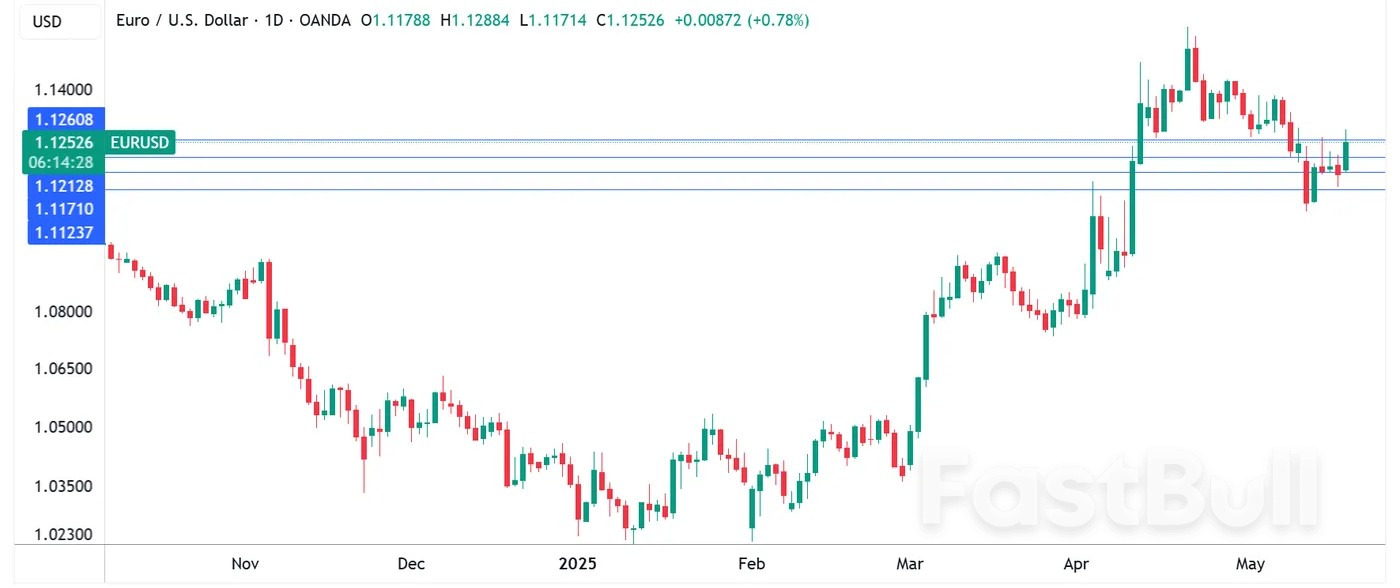
          EUR/USD Technical

          EUR/USD has pushed above resistance at 1.1212. Above, there is resistance at 1.1260
          There is resistance at 1.1171 and 1.1123
          Euro jumps as Eurozone core CPI rises_1

          EUR/USD 1-Day Chart, May 19, 2025

          Source: marketpulse

          Risk Warnings and Disclaimers
          You understand and acknowledge that there is a high degree of risk involved in trading. Following any strategies or investment methods may lead to potential losses. The content on the site is provided by our contributors and analysts for information purposes only. You are solely responsible for determining whether any trading assets, securities, strategy, or any other product is suitable for investing based on your own investment objectives and financial situation.
          Add to Favorites
          Share
          FastBull
          Copyright © 2025 FastBull Ltd

          728 RM B 7/F GEE LOK IND BLDG NO 34 HUNG TO RD KWUN TONG KLN HONG KONG

          TelegramInstagramTwitterfacebooklinkedin
          App Store Google Play Google Play
          Products
          Charts

          Chats

          Q&A with Experts
          Screeners
          Economic Calendar
          Data
          Tools
          Membership
          Features
          Function
          Markets
          Copy Trading
          Latest Signals
          Contests
          News
          Analysis
          24/7
          Columns
          Education
          Company
          Careers
          About Us
          Contact Us
          Advertising
          Help Center
          Feedback
          User Agreement
          Privacy Policy
          Business

          White Label

          Data API

          Web Plug-ins

          Poster Maker

          Affiliate Program

          Risk Disclosure

          The risk of loss in trading financial instruments such as stocks, FX, commodities, futures, bonds, ETFs and crypto can be substantial. You may sustain a total loss of the funds that you deposit with your broker. Therefore, you should carefully consider whether such trading is suitable for you in light of your circumstances and financial resources.

          No decision to invest should be made without thoroughly conducting due diligence by yourself or consulting with your financial advisors. Our web content might not suit you since we don't know your financial conditions and investment needs. Our financial information might have latency or contain inaccuracy, so you should be fully responsible for any of your trading and investment decisions. The company will not be responsible for your capital loss.

          Without getting permission from the website, you are not allowed to copy the website's graphics, texts, or trademarks. Intellectual property rights in the content or data incorporated into this website belong to its providers and exchange merchants.

          Not Logged In

          Log in to access more features

          FastBull Membership

          Not yet

          Purchase

          Become a signal provider
          Help Center
          Customer Service
          Dark Mode
          Price Up/Down Colors

          Log In

          Sign Up
          Position
          Layout
          Fullscreen
          Default to Chart
          The chart page opens by default when you visit fastbull.com