• Trade
  • Markets
  • Copy
  • Contests
  • News
  • 24/7
  • Calendar
  • Q&A
  • Chats
Trending
Screeners
SYMBOL
LAST
BID
ASK
HIGH
LOW
NET CHG.
%CHG.
SPREAD
SPX
S&P 500 Index
6855.97
6855.97
6855.97
6878.28
6855.97
-14.43
-0.21%
--
DJI
Dow Jones Industrial Average
47831.01
47831.01
47831.01
47971.51
47771.72
-123.97
-0.26%
--
IXIC
NASDAQ Composite Index
23558.36
23558.36
23558.36
23698.93
23558.36
-19.75
-0.08%
--
USDX
US Dollar Index
99.070
99.150
99.070
99.110
98.730
+0.120
+ 0.12%
--
EURUSD
Euro / US Dollar
1.16286
1.16293
1.16286
1.16717
1.16245
-0.00140
-0.12%
--
GBPUSD
Pound Sterling / US Dollar
1.33174
1.33182
1.33174
1.33462
1.33087
-0.00138
-0.10%
--
XAUUSD
Gold / US Dollar
4191.12
4191.46
4191.12
4218.85
4175.92
-6.79
-0.16%
--
WTI
Light Sweet Crude Oil
59.027
59.057
59.027
60.084
58.892
-0.782
-1.31%
--

Community Accounts

Signal Accounts
--
Profit Accounts
--
Loss Accounts
--
View More

Become a signal provider

Sell trading signals to earn additional income

View More

Guide to Copy Trading

Get started with ease and confidence

View More

Signal Accounts for Members

All Signal Accounts

Best Return
  • Best Return
  • Best P/L
  • Best MDD
Past 1W
  • Past 1W
  • Past 1M
  • Past 1Y

All Contests

  • All
  • Trump Updates
  • Recommend
  • Stocks
  • Cryptocurrencies
  • Central Banks
  • Featured News
Top News Only
Share

The S&P 500 Opened 4.80 Points Higher, Or 0.07%, At 6875.20; The Dow Jones Industrial Average Opened 16.52 Points Higher, Or 0.03%, At 47971.51; And The Nasdaq Composite Opened 60.09 Points Higher, Or 0.25%, At 23638.22

Share

Reuters Poll - Swiss National Bank Policy Rate To Be 0.00% At End-2026, Said 21 Of 25 Economists, Four Said It Would Be Cut To -0.25%

Share

USGS - Magnitude 7.6 Earthquake Strikes Misawa, Japan

Share

Reuters Poll - Swiss National Bank To Hold Policy Rate At 0.00% On December 11, Said 38 Of 40 Economists, Two Said Cut To -0.25%

Share

Traders Believe There Is A 20% Chance That The European Central Bank Will Raise Interest Rates Before The End Of 2026

Share

Toronto Stock Index .GSPTSE Rises 11.99 Points, Or 0.04 Percent, To 31323.40 At Open

Share

Japan Meteorological Agency: A Tsunami With A Maximum Height Of Three Meters Is Expected Following The Earthquake In Japan

Share

Japan Meteorological Agency: A 7.2-magnitude Earthquake Struck Off The Coast Of Northern Japan, And A Tsunami Warning Has Been Issued

Share

Japan Finance Minister Katayama: G7 Expected To Hold Another Meeting By The End Of This Year

Share

The Japan Meteorological Agency Reported That An Earthquake Occurred In The Sea Near Aomori

Share

Japan Finance Minister Katayama: The G7 Finance Ministers' Meeting Discussed The Critical Mineral Supply Chain And Support For Ukraine

Share

Japan Finance Minister Katayama: Held Onlinemeeting With G7 Finance Ministers

Share

Fed Data - USA Effective Federal Funds Rate At 3.89 Percent On 05 December On $88 Billion In Trades Versus 3.89 Percent On $87 Billion On 04 December

Share

Chinese Foreign Minister Wang Yi: One-China Principle Is An Important Political Foundation For China-Germany Relations, And There Is No Room For Ambiguity

Share

Chinese Foreign Minister Wang Yi: Hopes Germany To Understand, Support China's Position Regarding Japan Prime Minister's Remark On Taiwan

Share

Chinese Foreign Minister Wang Yi: Hopes Germany Will View China More Objectively And Rationally, Adhere To The Positioning Of China-Germany Partnership

Share

China Foreign Ministry: China's Foreign Minister Wang Yi Meets German Counterpart

Share

Israeli Government Spokesperson: Netanyahu Will Meet Trump On December 29

Share

Stc Did Not Ask Internationally-Government To Leave Aden - Senior Stc Official To Reuters

Share

Members Of Internationally-Recognised Government, Opposed To Northern Houthis, Have Left Aden - Senior Stc Official To Reuters

TIME
ACT
FCST
PREV
France Trade Balance (SA) (Oct)

A:--

F: --

P: --
Euro Zone Employment YoY (SA) (Q3)

A:--

F: --

P: --
Canada Part-Time Employment (SA) (Nov)

A:--

F: --

P: --

Canada Unemployment Rate (SA) (Nov)

A:--

F: --

P: --

Canada Full-time Employment (SA) (Nov)

A:--

F: --

P: --

Canada Labor Force Participation Rate (SA) (Nov)

A:--

F: --

P: --

Canada Employment (SA) (Nov)

A:--

F: --

P: --

U.S. PCE Price Index MoM (Sept)

A:--

F: --

P: --

U.S. Personal Income MoM (Sept)

A:--

F: --

P: --

U.S. Core PCE Price Index MoM (Sept)

A:--

F: --

P: --

U.S. PCE Price Index YoY (SA) (Sept)

A:--

F: --

P: --

U.S. Core PCE Price Index YoY (Sept)

A:--

F: --

P: --

U.S. Personal Outlays MoM (SA) (Sept)

A:--

F: --

P: --
U.S. 5-10 Year-Ahead Inflation Expectations (Dec)

A:--

F: --

P: --

U.S. Real Personal Consumption Expenditures MoM (Sept)

A:--

F: --

P: --
U.S. Weekly Total Rig Count

A:--

F: --

P: --

U.S. Weekly Total Oil Rig Count

A:--

F: --

P: --

U.S. Consumer Credit (SA) (Oct)

A:--

F: --

P: --
China, Mainland Foreign Exchange Reserves (Nov)

A:--

F: --

P: --

Japan Trade Balance (Oct)

A:--

F: --

P: --

Japan Nominal GDP Revised QoQ (Q3)

A:--

F: --

P: --

China, Mainland Imports YoY (CNH) (Nov)

A:--

F: --

P: --

China, Mainland Exports (Nov)

A:--

F: --

P: --

China, Mainland Imports (CNH) (Nov)

A:--

F: --

P: --

China, Mainland Trade Balance (CNH) (Nov)

A:--

F: --

P: --

China, Mainland Exports YoY (USD) (Nov)

A:--

F: --

P: --

China, Mainland Imports YoY (USD) (Nov)

A:--

F: --

P: --

Germany Industrial Output MoM (SA) (Oct)

A:--

F: --

P: --
Euro Zone Sentix Investor Confidence Index (Dec)

A:--

F: --

P: --

Canada National Economic Confidence Index

A:--

F: --

P: --

U.K. BRC Like-For-Like Retail Sales YoY (Nov)

--

F: --

P: --

U.K. BRC Overall Retail Sales YoY (Nov)

--

F: --

P: --

Australia Overnight (Borrowing) Key Rate

--

F: --

P: --

RBA Rate Statement
RBA Press Conference
Germany Exports MoM (SA) (Oct)

--

F: --

P: --

U.S. NFIB Small Business Optimism Index (SA) (Nov)

--

F: --

P: --

Mexico 12-Month Inflation (CPI) (Nov)

--

F: --

P: --

Mexico Core CPI YoY (Nov)

--

F: --

P: --

Mexico PPI YoY (Nov)

--

F: --

P: --

U.S. Weekly Redbook Index YoY

--

F: --

P: --

U.S. JOLTS Job Openings (SA) (Oct)

--

F: --

P: --

China, Mainland M1 Money Supply YoY (Nov)

--

F: --

P: --

China, Mainland M0 Money Supply YoY (Nov)

--

F: --

P: --

China, Mainland M2 Money Supply YoY (Nov)

--

F: --

P: --

U.S. EIA Short-Term Crude Production Forecast For The Year (Dec)

--

F: --

P: --

U.S. EIA Natural Gas Production Forecast For The Next Year (Dec)

--

F: --

P: --

U.S. EIA Short-Term Crude Production Forecast For The Next Year (Dec)

--

F: --

P: --

EIA Monthly Short-Term Energy Outlook
U.S. API Weekly Gasoline Stocks

--

F: --

P: --

U.S. API Weekly Cushing Crude Oil Stocks

--

F: --

P: --

U.S. API Weekly Crude Oil Stocks

--

F: --

P: --

U.S. API Weekly Refined Oil Stocks

--

F: --

P: --

South Korea Unemployment Rate (SA) (Nov)

--

F: --

P: --

Japan Reuters Tankan Non-Manufacturers Index (Dec)

--

F: --

P: --

Japan Reuters Tankan Manufacturers Index (Dec)

--

F: --

P: --

Japan Domestic Enterprise Commodity Price Index MoM (Nov)

--

F: --

P: --

Japan Domestic Enterprise Commodity Price Index YoY (Nov)

--

F: --

P: --

China, Mainland PPI YoY (Nov)

--

F: --

P: --

China, Mainland CPI MoM (Nov)

--

F: --

P: --

Q&A with Experts
    • All
    • Chatrooms
    • Groups
    • Friends
    Connecting
    .
    .
    .
    Type here...
    Add Symbol or Code

      No matching data

      All
      Trump Updates
      Recommend
      Stocks
      Cryptocurrencies
      Central Banks
      Featured News
      • All
      • Russia-Ukraine Conflict
      • Middle East Flashpoint
      • All
      • Russia-Ukraine Conflict
      • Middle East Flashpoint
      Search
      Products

      Charts Free Forever

      Chats Q&A with Experts
      Screeners Economic Calendar Data Tools
      Membership Features
      Data Warehouse Market Trends Institutional Data Policy Rates Macro

      Market Trends

      Market Sentiment Order Book Forex Correlations

      Top Indicators

      Charts Free Forever
      Markets

      News

      News Analysis 24/7 Columns Education
      From Institutions From Analysts
      Topics Columnists

      Latest Views

      Latest Views

      Trending Topics

      Top Columnists

      Latest Update

      Signals

      Copy Rankings Latest Signals Become a signal provider AI Rating
      Contests
      Brokers

      Overview Brokers Assessment Rankings Regulators News Claims
      Broker listing Forex Brokers Comparison Tool Live Spread Comparison Scam
      Q&A Complaint Scam Alert Videos Tips to Detect Scam
      More

      Business
      Events
      Careers About Us Advertising Help Center

      White Label

      Data API

      Web Plug-ins

      Affiliate Program

      Awards Institution Evaluation IB Seminar Salon Event Exhibition
      Vietnam Thailand Singapore Dubai
      Fans Party Investment Sharing Session
      FastBull Summit BrokersView Expo
      Recent Searches
        Top Searches
          Markets
          News
          Analysis
          User
          24/7
          Economic Calendar
          Education
          Data
          • Names
          • Latest
          • Prev

          View All

          No data

          Scan to Download

          Faster Charts, Chat Faster!

          Download App
          English
          • English
          • Español
          • العربية
          • Bahasa Indonesia
          • Bahasa Melayu
          • Tiếng Việt
          • ภาษาไทย
          • Français
          • Italiano
          • Türkçe
          • Русский язык
          • 简中
          • 繁中
          Open Account
          Search
          Products
          Charts Free Forever
          Markets
          News
          Signals

          Copy Rankings Latest Signals Become a signal provider AI Rating
          Contests
          Brokers

          Overview Brokers Assessment Rankings Regulators News Claims
          Broker listing Forex Brokers Comparison Tool Live Spread Comparison Scam
          Q&A Complaint Scam Alert Videos Tips to Detect Scam
          More

          Business
          Events
          Careers About Us Advertising Help Center

          White Label

          Data API

          Web Plug-ins

          Affiliate Program

          Awards Institution Evaluation IB Seminar Salon Event Exhibition
          Vietnam Thailand Singapore Dubai
          Fans Party Investment Sharing Session
          FastBull Summit BrokersView Expo

          Japanese Yen Forecast: Sticky Tokyo Inflation Clash With Fed Cut Bets

          Winkelmann

          Forex

          Economic

          Summary:

          USD/JPY took the spotlight in early trading on Friday, November 28. Japanese inflation figures fueled speculation about a Bank of Japan rate hike.

          Key Points:
          · Tokyo inflation, strong retail sales, and rising wage expectations intensify bets on a December BoJ rate hike, influencing USD/JPY direction.
          · Sticky core-core inflation at 2.8% and firm consumer spending strengthen the case for tighter BoJ policy as markets reassess yen risks.
          · Diverging BoJ and Fed policy paths heighten volatility, with Fed cut expectations clashing with BoJ tightening signals for USD/JPY.

          USD/JPY took the spotlight in early trading on Friday, November 28. Japanese inflation figures fueled speculation about a Bank of Japan rate hike. The sticky inflation figures coincided with reports of another solid wage rise in 2026, two key considerations for policymakers.

          A weaker Japanese yen may also pressure the BoJ to raise interest rates, given the upward pressure on import prices. Higher import prices erode household purchasing power, weighing on private consumption.

          Crucially, rising expectations of a BoJ rate hike clash with bets on a December Fed rate cut, signaling a reversal of USD/JPY's November gains.

          Tokyo Inflation and Retail Sales Spotlight the BoJ

          Headline inflation for Tokyo increased 2.7% year-on-year in November, easing from 2.8% in October. However, the so-called core-core inflation rate held steady at 2.8%, well above the BoJ's 2% target.

          November's data supported economists' predictions for a December rate hike. In the November Reuters poll, conducted between November 11 and 18, 43 of 81 economists expected the BoJ to raise interest rates by 25 basis points to 0.75% on December 19.

          Meanwhile, consumers opened their purse strings in October, indicating an economic recovery in the fourth quarter. Retail sales rose by 1.7% year-on-year, up sharply from a 0.2% increase in September. Rising consumer spending may fuel demand-driven inflation, bolstering the case for tighter monetary policy, given that inflation remains well above the BoJ's target.

          Wage Growth Trends Strengthen the Policy Narrative

          Friday's data followed updates from wage negotiations, with Japanese labor unions calling for another hefty wage hike in the spring of 2026. Notably, early signs of strong wage growth would ease the BoJ's concerns over US tariffs having a longer-term impact on the Japanese economy. Higher wages could boost private consumption, which accounts for around 55% of GDP.

          For context, the Japanese economy contracted by 0.4% quarter-on-quarter in the third quarter after expanding by 0.6% the previous quarter. Private consumption increased just 0.1% in the quarter, down from 0.4% in the second quarter.

          Policy Risks: The Carry Trade Curveball

          One potential curveball for USD/JPY could be the BoJ's concerns about market disruption. In July 2024, the BoJ cut the purchases of Japanese Government Bonds (JGBs) and raised interest rates, sending USD/JPY below 140. The stronger yen triggered a carry trade unwind, leading to heavy losses across global equity and crypto markets. A BoJ rate hike, coupled with a Fed rate cut, may lead to another yen carry trade unwind, something policymakers may wish to avoid.

          USD/JPY edged higher after the inflation and retail sales figures, despite a potential narrowing of US-Japan interest rate differentials in favor of the yen.
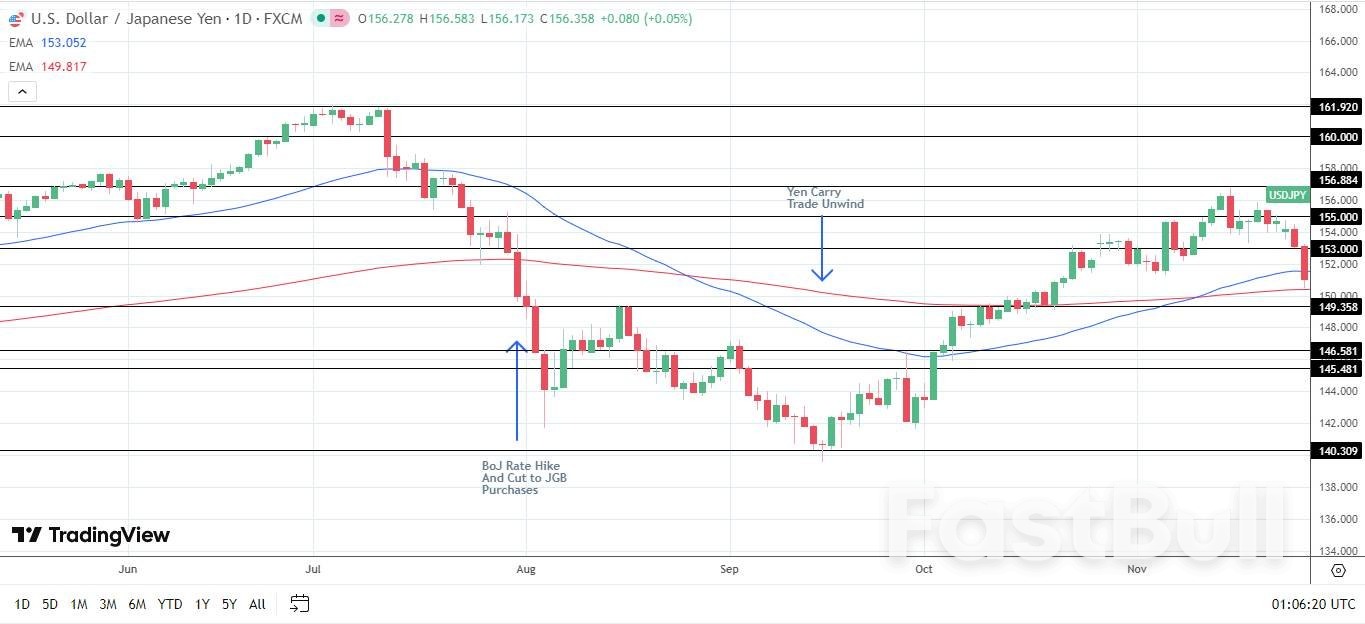
          USDJPY – Daily Chart – 281125 – Yen Carry Trade Unwind

          Fed Speakers in the Spotlight

          While speculation about a BoJ rate hike intensifies, traders should closely monitor FOMC member speeches. Ahead of the Thanksgiving holiday, policymakers raised expectations of a December Fed rate cut.

          Growing calls for further monetary policy easing next month could lead markets to fully price in a policy adjustment. A more hawkish BoJ and more dovish Fed may send USD/JPY toward 150.

          According to the CME FedWatch Tool, the probability of a December cut has soared from 39.1% on November 20 to 86.9% on November 28.
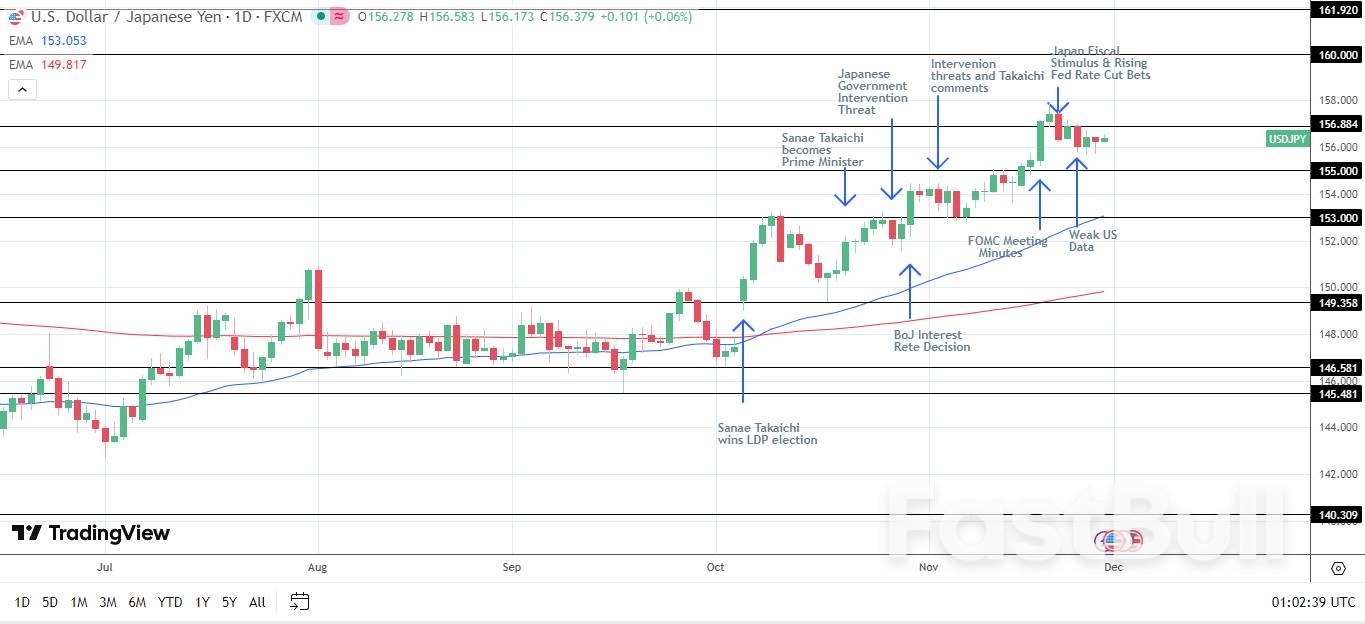
          USD/JPY Scenarios: Diverging Monetary Policies

          · Bearish USD/JPY Scenario: Hawkish BoJ rhetoric or dovish Fed rhetoric could push USD/JPY toward 150.
          · Bullish USD/JPY Scenario: Dovish BoJ comments or hawkish Fed signals could send USD/JPY toward 160.

          USDJPY – Daily Chart – 281125

          Key Market Drivers to Watch Today:

          · Bank of Japan commentary.
          · Fed speakers.

          Source: FX Empire

          To stay updated on all economic events of today, please check out our Economic calendar
          Risk Warnings and Disclaimers
          You understand and acknowledge that there is a high degree of risk involved in trading. Following any strategies or investment methods may lead to potential losses. The content on the site is provided by our contributors and analysts for information purposes only. You are solely responsible for determining whether any trading assets, securities, strategy, or any other product is suitable for investing based on your own investment objectives and financial situation.
          Add to Favorites
          Share

          Huawei, ZTE Seal 5G Deals In Vietnam After US Tariffs, As Ties With China Warm​

          Samantha Luan

          Stocks

          Forex

          Huawei, ZTE Seal 5G Deals In Vietnam After US Tariffs, As Ties With China Warm​_1

          Huawei, ZTE Seal 5G Deals In Vietnam After US Tariffs, As Ties With China Warm​_2
          · Vietnam embraces Chinese tech amid strained US relations
          · ZTE, Huawei win major contracts as Vietnam shifts approach
          · Western officials cast doubts on tech cooperation with Hanoi, sources say

          China's leading telecommunication firms Huawei and ZTE,have won a string of contracts this year to supply 5G equipment in Vietnam, in another sign of Hanoi's strengthening bonds with Beijing, stirring concern among Western officials, seven people with direct knowledge of the situation told Reuters.

          For years, Vietnam was seen as reluctant to use Chinese technology in sensitive infrastructure, but in recent months it has embraced Chinese tech companies as sometimes frosty relations with its northern neighbour have warmed while ties with Washington have soured over tariffs on Vietnamese goods.

          While Sweden's Ericsson (ERICb.ST), opens new tab and Finland's Nokia (NOKIA.HE), opens new tab secured contracts for Vietnam's 5G core infrastructure, with U.S. chipmaker Qualcomm (QCOM.O), opens new tab providing network equipment, Chinese companies have begun winning smaller tenders with state-owned operators, so far unreported public procurement data shows.

          A consortium including Huawei was awarded a $23 million contract for 5G equipment in April, weeks after the White House announced tariffs on Vietnamese goods. ZTE has won at least two contracts, one last week, totalling more than $20 million for 5G antennas. The first publicly disclosed deal came in September, a month after U.S. tariffs took effect.

          Reuters could not establish whether the timing of these wins was linked to U.S. tariffs, but the deals raised concerns among Western officials.

          The exclusion of Chinese contractors from Vietnam's digital infrastructure, including undersea fibre-optic cables, has long been identified by Washington as a key condition for support in advanced technologies.

          Huawei and ZTE are banned from U.S. telecom networks as an "unacceptable risk" to national security. Sweden and other European countries have similar restrictions.

          Ericsson declined to comment on Chinese companies, but said it was "fully committed to support its customers in Vietnam."

          Huawei, ZTE, Nokia, Qualcomm, the U.S. embassy in Vietnam, China's embassy, Sweden's foreign ministry or Vietnam's tech ministry responded to requests for comment.

          VIETNAM-CHINA TIES WARM

          The unaligned Southeast Asian nation is a crucial battleground in the competition for global influence. Its proximity to China has made it a major industrial hub for multinationals such as Apple, Samsung and Nike, which rely on Chinese components and Western consumers.

          Under Western pressure, Vietnam long took "a wait-and-see approach" to Chinese technology, said Nguyen Hung, a specialist in supply chains at RMIT University Vietnam. But "Vietnam has its own priorities," he added, noting the new deals could spur deeper economic integration with China.

          Hanoi and Beijing have made progress recently on other sensitive projects, including cross-border rail links and special economic zones close to the Chinese border, which Vietnam had previously discarded as security risks.

          Huawei lost multiple bids this year on 5G equipment in Vietnam, according to tender data. But it has cooperated on technical services, and signed an agreement in June on 5G technology transfers with Viettel, Vietnam's army-owned main telecom operator, according to Vietnam's defence ministry.

          Viettel did not respond to a request for comment. One person at the company said Chinese technology was cheaper. The sources declined to be named because the information they shared was not public.

          WESTERN CONCERNS

          The Chinese contracts have been discussed in at least two meetings of senior Western officials in Hanoi in recent weeks, diplomatic sources said. In one meeting, a U.S. official warned they could undermine trust in Vietnam's networks and jeopardise access to U.S. advanced technology.

          In a meeting this month officials explored whether areas using Chinese technology could be sealed off from the rest of the network to prevent data leaks, one of the sources said.

          But suppliers of antennas and equipment could still gain access to network data, said Innocenzo Genna, a telecommunications lawyer, noting "Western contractors may face the awkward prospect of working alongside firms they do not trust."

          Source: Reuters

          Risk Warnings and Disclaimers
          You understand and acknowledge that there is a high degree of risk involved in trading. Following any strategies or investment methods may lead to potential losses. The content on the site is provided by our contributors and analysts for information purposes only. You are solely responsible for determining whether any trading assets, securities, strategy, or any other product is suitable for investing based on your own investment objectives and financial situation.
          Add to Favorites
          Share

          US Ramps Up Green Card Reviews After Washington DC Shooting

          Justin

          Political

          Economic

          The Trump administration is reviewing permanent residency status of immigrants from 19 countries

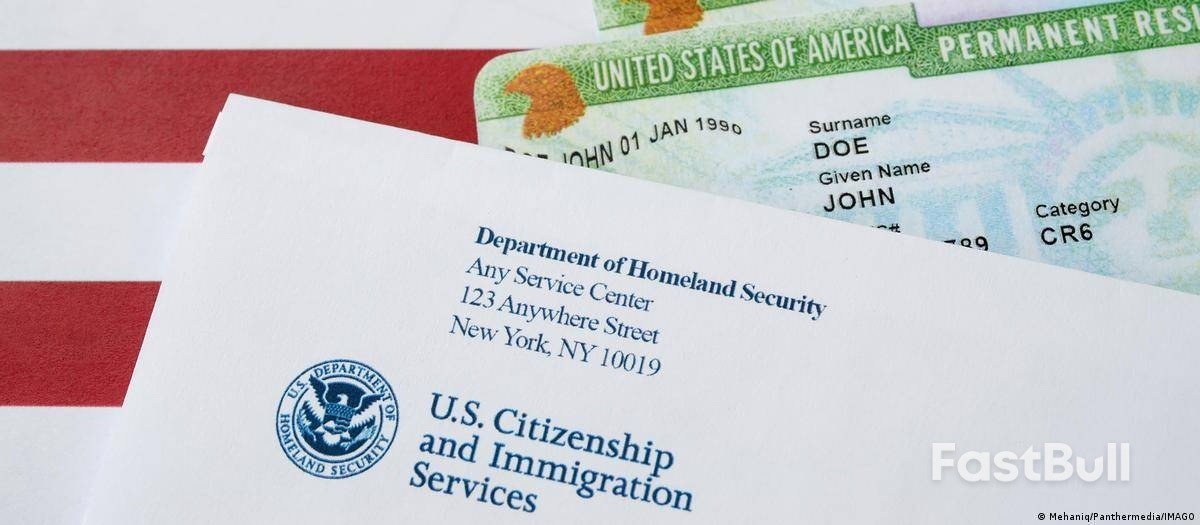
          The Trump administration has ordered a full review of permanent residency status — so-called "Green Cards" — of immigrants from 19 countries, in the wake of the attack on two US National Guard personnel in Washington, DC.

          An Afghan national who entered the US in 2021 after working with American military and intelligence services in Afghanistan has been arrested in connection with Wednesday's shooting near the White House.

          On Thursday, US President Donald Trump confirmed the death of one of the two National Guard members who was shot.

          In response to the shooting, Joseph Edlow, director of the US Citizenship and Immigration Services (USCIS), said on X: "I have directed a full scale, rigorous reexamination of every Green Card for every alien from every country of concern."

          Afghanistan, Iran, Somalia, Libya, Yemen, Cuba, Venezuela among countries listed

          The full-scale review of residency status, at the behest of President Donald Trump and carried out by the USCIS, comes after the suspect from Wednesday's shooting was identified as Afghan national Rahmanullah L.

          The 19 countries under scrutiny were named in a June proclamation, which had initially imposed entry restrictions on nationals from states deemed deficient in screening and vetting protocols.

          Among the countries listed are Afghanistan, Iran, Somalia, Libya and Yemen, as well as Cuba, Venezuela, Chad, and Eritrea.

          Critics warn the policy risks penalizing hundreds of thousands of lawful permanent residents based solely on nationality.

          Whether the review will lead to revocations or deportations remains unclear.

          For now, the administration frames it as a protective measure aimed at national security in light of the DC attack.

          Source: DW

          To stay updated on all economic events of today, please check out our Economic calendar
          Risk Warnings and Disclaimers
          You understand and acknowledge that there is a high degree of risk involved in trading. Following any strategies or investment methods may lead to potential losses. The content on the site is provided by our contributors and analysts for information purposes only. You are solely responsible for determining whether any trading assets, securities, strategy, or any other product is suitable for investing based on your own investment objectives and financial situation.
          Add to Favorites
          Share

          Core Consumer Prices In Japan’s Capital Rise 2.8% Yr/yr In November

          Olivia Brooks

          Economic

          Core consumer prices in Japan's capital rose 2.8% in November from a year earlier, data showed on Friday, exceeding the central bank's 2% target and keeping alive market expectations for a near-term interest rate hike.

          The increase in the Tokyo core consumer price index (CPI), which excludes volatile fresh food costs, compared with a median market forecast for a 2.7% rise. It followed a 2.8% gain in October.

          A separate index for Tokyo that strips away both fresh food and fuel costs - closely watched by the Bank of Japan as a measure of demand-driven prices - rose 2.8% in November from a year earlier after a 2.8% increase in October.

          The BOJ exited a decade-long, radical stimulus programme last year and raised short-term interest rates to 0.5% in January on the view Japan was on the cusp of sustainably hitting its 2% inflation target.

          While consumer inflation has exceeded the BOJ's 2% target for well over three years, Governor Kazuo Ueda has stressed the need to tread cautiously in further rate hikes on uncertainty over the impact of U.S. tariffs on Japan's economy.

          Source: Investing

          To stay updated on all economic events of today, please check out our Economic calendar
          Risk Warnings and Disclaimers
          You understand and acknowledge that there is a high degree of risk involved in trading. Following any strategies or investment methods may lead to potential losses. The content on the site is provided by our contributors and analysts for information purposes only. You are solely responsible for determining whether any trading assets, securities, strategy, or any other product is suitable for investing based on your own investment objectives and financial situation.
          Add to Favorites
          Share

          Tokyo CPI Inflation Remains Steady In Nov, Slightly Ahead Of Forecasts

          Olivia Brooks

          Economic

          Tokyo consumer price index inflation remained unexpectedly steady in November amid high food prices, with underlying inflation also remaining well ahead of the Bank of Japan's annual target.

          Tokyo core CPI, which excludes volatile fresh food prices, grew 2.8% year-on-year in November, government data showed on Friday. The print was slightly above expectations of 2.7% and remained steady from the prior month's reading.

          A core CPI reading that excludes both fresh food and energy prices remained steady at 2.8% in November, above the BOJ's 2% annual target. The print is closely watched as a gauge of underlying inflation by the central bank.

          Headline Tokyo CPI inflation read flat at 2.7%.

          Friday's print showed Japanese food price inflation remained mostly upbeat, with rice prices continuing to increase at an outsized pace. Dairy prices also increased sharply in the month.

          The country is grappling with a prolonged rice shortage due to a mix of poor harvests, an aging farming population, and some policies against importing the grain, which pushed up food prices. Higher food prices were in turn a major driver of CPI inflation this year.

          Tokyo CPI inflation usually acts as a bellwether for national inflation, with November's print indicating that Japanese inflation is likely to remain sticky. It also comes after a series of firm inflation prints through the second half of 2025.

          Sticky inflation gives the BOJ more impetus to hike interest rates, with the central bank having recently signaled it will consider raising rates in its December meeting.

          But rate hikes by the BOJ put it at odds with Prime Minister Sanae Takaichi's government, which has broadly called for looser monetary conditions and more fiscal spending to support economic growth.

          Source: Investing

          To stay updated on all economic events of today, please check out our Economic calendar
          Risk Warnings and Disclaimers
          You understand and acknowledge that there is a high degree of risk involved in trading. Following any strategies or investment methods may lead to potential losses. The content on the site is provided by our contributors and analysts for information purposes only. You are solely responsible for determining whether any trading assets, securities, strategy, or any other product is suitable for investing based on your own investment objectives and financial situation.
          Add to Favorites
          Share

          Why Gold Loves Trump as Much as Trump Loves Gold

          Adam

          Commodity

          Gold has had a banner year in 2025, gaining more than 58% and outperforming the market by leaps and bounds. For context, the S&P 500 is up about 14%, while Bitcoin has lost around 6% (with Bitcoin-leveraged stocks performing far worse than the crypto itself).
          Among precious metals, silver has outshone gold with a 78% year-to-date (YTD) gain. Still, gold appears well-positioned to sustain its rally into 2026—fueled in part by President Donald Trump’s return to power and the market’s reaction to his policies.

          Volatility Is Once Again on the Rise

          Precious metals enjoy strong runs during stretches of heightened volatility. That’s because volatility causes investors to engage in flights to safety, reallocating capital from riskier asset classes like stocks to safe-haven assets like gold.
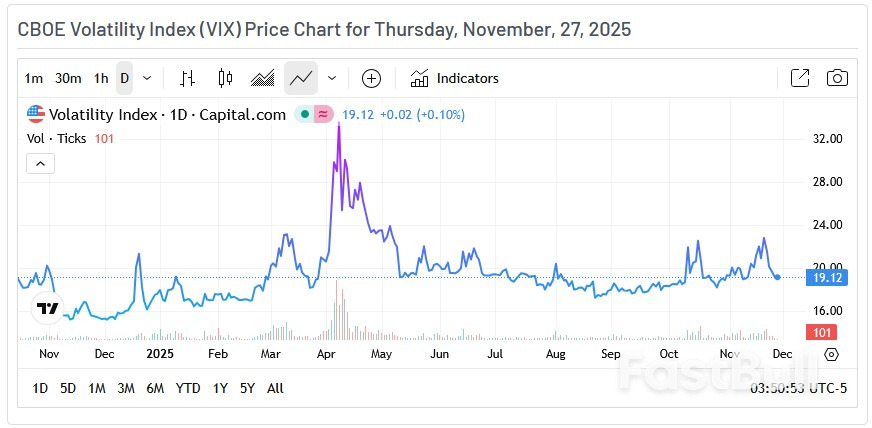
          And volatility has been a hallmark of Trump’s second administration. From Inauguration Day to March 10, volatility—as measured by the Chicago Board Options Exchange’s CBOE Volatility Index CBOE: VIX—increased by 85% as rumors of the president’s tariff plans began to emerge.
          The VIX then pulled back 20% by the end of March, before skyrocketing to a five-year high during the market’s so-called tariff tantrum in April, when the index jumped 135% the first week of April.
          Why Gold Loves Trump as Much as Trump Loves Gold_1
          The index settled down by 70% by the end of September after the president walked back tariffs against numerous countries. But since then, it has increased 35%, raising concerns about another bout of heightened volatility through the end of the year.

          The SCOTUS Tariff Decision Looms

          A critical legal development could further impact gold’s trajectory: the U.S. Supreme Court is currently reviewing whether Trump has the authority to impose tariffs without Congressional approval.
          If the Supreme Court rules in favor of Trump, tariffs—with or without congressional approval—remain, which would have the potential to further erode the purchasing power of the US dollar and drive gold prices higher as a result.
          But if the court rules against Trump’s trade policies and the administration is forced to reverse its tariffs, that too could be a boon for gold. On Sunday, Fortune reported: “President Donald Trump’s administration is working behind the scenes on fallback options if the Supreme Court strikes down one of his major tariff authorities.” Any such moves are likely to sustain investor anxiety and, in turn, demand for safe-haven assets.

          Foreign Policy and Geopolitical Instability Drive Gold Prices

          Despite campaign pledges to reduce global conflict, Trump’s second term has not delivered meaningful geopolitical de-escalation. The Russia-Ukraine war, now entering its fourth year, continues with no end in sight.
          Additionally, despite Trump brokering a ceasefire between Israel and Hamas in early October, warfare in that corner of the world hasn’t ceased, with near-daily strikes continuing in the Gaza Strip. Since the Hamas attack on Oct. 7, 2023, the price of gold has risen more than 125%.
          More recently, the Trump administration has ramped up military activity in the Caribbean, signaling potential intervention in Venezuela. The USS Gerald R. Ford aircraft carrier is already positioned near the South American nation, and approximately 15,000 U.S. troops are in the region, with B-52 and B-1 bombers conducting simulated bombing exercises near Venezuela’s airspace—a significant escalation.
          Geopolitical instability has historically boosted demand for gold, and the current environment shows no signs of reversing that trend.

          Dollar Weakness and Rate Cuts Are Strengthening Gold’s Bull Case

          Two more price drivers for gold are currency devaluation and interest rate cuts. The US Dollar Index is down nearly 8% from its YTD high, which it hit a week before Trump’s inauguration.
          Trump’s tariff announcements, which fueled the first stage of the USD’s decline this year, have raised inflation expectations.
          At the same time, soft economic data—including rising unemployment, increasing layoffs, and weak nonfarm payrolls—have already resulted in the Federal Reserve cutting rates twice this year.
          If current Fed Chairman Jerome Powell is replaced with a dovish Trump ally when his term ends in May 2026, more interest rate cuts could be in store next year.
          Lower interest rates would appeal to gold bugs, since interest rates and gold prices have a historically inverse relationship. When the former decreases, the latter tends to increase since yield-producing assets lose their luster in a lower-rate environment.
          In those cases, investors traditionally turn to gold for the precious metal’s upside potential. Both of those outcomes are likely if the Fed continues down a path of looser monetary policy.

          Source: investing

          Risk Warnings and Disclaimers
          You understand and acknowledge that there is a high degree of risk involved in trading. Following any strategies or investment methods may lead to potential losses. The content on the site is provided by our contributors and analysts for information purposes only. You are solely responsible for determining whether any trading assets, securities, strategy, or any other product is suitable for investing based on your own investment objectives and financial situation.
          Add to Favorites
          Share

          Crude Oil Faces Stiff Resistance Near $60 With Downtrend Poised to Resume

          Adam

          Commodity

          Oil prices have steadied in the last couple of days following Tuesday’s news-driven drop when reports of a peace deal between Ukraine and Russia hit the wires. The recovery comes despite a larger-than-expected build in US oil inventories. Price action, therefore, suggests that most of the bearish news might already be factored in.
          But so long as there is no compelling reason for prices to rally, the longer-term outlook on oil remains negative. Indeed, a potential peace deal between Ukraine and Russia—whenever that arrives – could mean more supplies hitting a market already saturated. Negotiations are trundling along between Kyiv, Moscow, and Washington, and that might take a while.
          So, nothing is signed yet, and that explains why prices have stopped falling for now. Mind you, even if a peace doesn’t come to fruition, crude’s upside still looks capped. Between excessive supply and flimsy demand growth, the prices remain tilted to the bearish side.
          Russia-Ukraine Potential Peace Could Hurt Oil Prices Further
          Markets have been slow in pre-pricing peace because of the nature of the uncertainty, but peace could eventually mean eased sanctions on Russia. And if sanctions are relaxed, we might see more Russian barrels sloshing back onto a global market that’s already awash with crude.
          Thus, any real progress towards peace this week could add pressure to oil prices, as investors price in larger supply into a market that frankly doesn’t need it. The simple arithmetic of crude markets is this: more oil + steady or falling demand = lower prices. And the sums right now aren’t flattering.
          The Supply Problem
          Let’s rewind to before the diplomatic chatter took centre stage this week regarding the Ukraine war. West Texas Intermediate (WTI) had already been on a multi-week losing streak, languishing below the psychologically important $60.00 mark. The OPEC+ has been releasing previously withheld output, producing more oil when demand is hardly crying out for it.
          Meanwhile, American oil producers have been pumping too. The result is oversupply, and it is this concern dominating headlines and pressuring prices.
          So, with the OPEC+ loosening the taps and US shale adding to the flow, prices will be finding it difficult to stage anything more than brief relief bounces – like the ones we have seen repeatedly in the past. Until something changes fundamentally, this supply pressure should keep prices under pressure.
          Demand: Not So Great Either
          Now, supply is very much the elephant in the room, but we can’t ignore demand entirely. The US economy has been sending mixed signals, with recent economic prints coming through a tad soft. Investors are squinting at the data, wondering if oil consumption will hold up into next year. The global demand picture isn’t exactly inspiring confidence either.
          Should demand weaken further whilst supply continues its upward march, we may well see the market slide deeper into disequilibrium. Crude prices would therefore need to adjust lower to find new equilibrium. Until the world economy shows signs of picking up pace—or supply meaningfully pulls back—the demand story may add incremental pressure to an already fragile price environment.
          WTI Technical Analysis and Trade Ideas
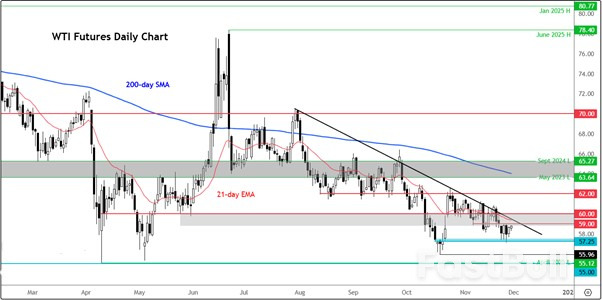
          The chart of crude oil has been painting a textbook downtrend: lower highs, lower lows. The main moving averages and the trend lines all have negative slopes. The recovery off the lows should therefore be taken with a pinch of salt until we see a clear bullish reversal – and some positive oil news to go with it.
          Crude Oil Faces Stiff Resistance Near $60 With Downtrend Poised to Resume_1
          So, where are the key levels on WTI futures?
          $59.00 is the initial level of resistance, with a bearish trend line coming in slightly above it
          $60.00 per barrel remains the big psychological resistance level for WTI
          Clear these two levels and $62.00 would come into focus next
          Support is seen around $57.25 area initially
          Most recent low was around $56.00 in October, making it the next logical target for the bears
          April low at $55.12 is the April low and the main downside objective as it comes in just ahead of the next psychological level of $55.00.
          Unless fundamentals shift sharply, and there’s no major evidence of that just yet, the continuation of this downtrend in the weeks ahead wouldn’t be a shock to the system.

          Source: investing

          Risk Warnings and Disclaimers
          You understand and acknowledge that there is a high degree of risk involved in trading. Following any strategies or investment methods may lead to potential losses. The content on the site is provided by our contributors and analysts for information purposes only. You are solely responsible for determining whether any trading assets, securities, strategy, or any other product is suitable for investing based on your own investment objectives and financial situation.
          Add to Favorites
          Share
          FastBull
          Copyright © 2025 FastBull Ltd

          728 RM B 7/F GEE LOK IND BLDG NO 34 HUNG TO RD KWUN TONG KLN HONG KONG

          TelegramInstagramTwitterfacebooklinkedin
          App Store Google Play Google Play
          Products
          Charts

          Chats

          Q&A with Experts
          Screeners
          Economic Calendar
          Data
          Tools
          Membership
          Features
          Function
          Markets
          Copy Trading
          Latest Signals
          Contests
          News
          Analysis
          24/7
          Columns
          Education
          Company
          Careers
          About Us
          Contact Us
          Advertising
          Help Center
          Feedback
          User Agreement
          Privacy Policy
          Business

          White Label

          Data API

          Web Plug-ins

          Poster Maker

          Affiliate Program

          Risk Disclosure

          The risk of loss in trading financial instruments such as stocks, FX, commodities, futures, bonds, ETFs and crypto can be substantial. You may sustain a total loss of the funds that you deposit with your broker. Therefore, you should carefully consider whether such trading is suitable for you in light of your circumstances and financial resources.

          No decision to invest should be made without thoroughly conducting due diligence by yourself or consulting with your financial advisors. Our web content might not suit you since we don't know your financial conditions and investment needs. Our financial information might have latency or contain inaccuracy, so you should be fully responsible for any of your trading and investment decisions. The company will not be responsible for your capital loss.

          Without getting permission from the website, you are not allowed to copy the website's graphics, texts, or trademarks. Intellectual property rights in the content or data incorporated into this website belong to its providers and exchange merchants.

          Not Logged In

          Log in to access more features

          FastBull Membership

          Not yet

          Purchase

          Become a signal provider
          Help Center
          Customer Service
          Dark Mode
          Price Up/Down Colors

          Log In

          Sign Up

          Position
          Layout
          Fullscreen
          Default to Chart
          The chart page opens by default when you visit fastbull.com