• Trade
  • Markets
  • Copy
  • Contests
  • News
  • 24/7
  • Calendar
  • Q&A
  • Chats
Trending
Screeners
SYMBOL
LAST
BID
ASK
HIGH
LOW
NET CHG.
%CHG.
SPREAD
SPX
S&P 500 Index
6858.03
6858.03
6858.03
6878.28
6858.03
-12.37
-0.18%
--
DJI
Dow Jones Industrial Average
47851.84
47851.84
47851.84
47971.51
47771.72
-103.14
-0.22%
--
IXIC
NASDAQ Composite Index
23565.54
23565.54
23565.54
23698.93
23565.41
-12.58
-0.05%
--
USDX
US Dollar Index
99.070
99.150
99.070
99.110
98.730
+0.120
+ 0.12%
--
EURUSD
Euro / US Dollar
1.16287
1.16294
1.16287
1.16717
1.16245
-0.00139
-0.12%
--
GBPUSD
Pound Sterling / US Dollar
1.33168
1.33178
1.33168
1.33462
1.33087
-0.00144
-0.11%
--
XAUUSD
Gold / US Dollar
4192.47
4192.90
4192.47
4218.85
4175.92
-5.44
-0.13%
--
WTI
Light Sweet Crude Oil
59.018
59.048
59.018
60.084
58.892
-0.791
-1.32%
--

Community Accounts

Signal Accounts
--
Profit Accounts
--
Loss Accounts
--
View More

Become a signal provider

Sell trading signals to earn additional income

View More

Guide to Copy Trading

Get started with ease and confidence

View More

Signal Accounts for Members

All Signal Accounts

Best Return
  • Best Return
  • Best P/L
  • Best MDD
Past 1W
  • Past 1W
  • Past 1M
  • Past 1Y

All Contests

  • All
  • Trump Updates
  • Recommend
  • Stocks
  • Cryptocurrencies
  • Central Banks
  • Featured News
Top News Only
Share

The S&P 500 Opened 4.80 Points Higher, Or 0.07%, At 6875.20; The Dow Jones Industrial Average Opened 16.52 Points Higher, Or 0.03%, At 47971.51; And The Nasdaq Composite Opened 60.09 Points Higher, Or 0.25%, At 23638.22

Share

Reuters Poll - Swiss National Bank Policy Rate To Be 0.00% At End-2026, Said 21 Of 25 Economists, Four Said It Would Be Cut To -0.25%

Share

USGS - Magnitude 7.6 Earthquake Strikes Misawa, Japan

Share

Reuters Poll - Swiss National Bank To Hold Policy Rate At 0.00% On December 11, Said 38 Of 40 Economists, Two Said Cut To -0.25%

Share

Traders Believe There Is A 20% Chance That The European Central Bank Will Raise Interest Rates Before The End Of 2026

Share

Toronto Stock Index .GSPTSE Rises 11.99 Points, Or 0.04 Percent, To 31323.40 At Open

Share

Japan Meteorological Agency: A Tsunami With A Maximum Height Of Three Meters Is Expected Following The Earthquake In Japan

Share

Japan Meteorological Agency: A 7.2-magnitude Earthquake Struck Off The Coast Of Northern Japan, And A Tsunami Warning Has Been Issued

Share

Japan Finance Minister Katayama: G7 Expected To Hold Another Meeting By The End Of This Year

Share

The Japan Meteorological Agency Reported That An Earthquake Occurred In The Sea Near Aomori

Share

Japan Finance Minister Katayama: The G7 Finance Ministers' Meeting Discussed The Critical Mineral Supply Chain And Support For Ukraine

Share

Japan Finance Minister Katayama: Held Onlinemeeting With G7 Finance Ministers

Share

Fed Data - USA Effective Federal Funds Rate At 3.89 Percent On 05 December On $88 Billion In Trades Versus 3.89 Percent On $87 Billion On 04 December

Share

Chinese Foreign Minister Wang Yi: One-China Principle Is An Important Political Foundation For China-Germany Relations, And There Is No Room For Ambiguity

Share

Chinese Foreign Minister Wang Yi: Hopes Germany To Understand, Support China's Position Regarding Japan Prime Minister's Remark On Taiwan

Share

Chinese Foreign Minister Wang Yi: Hopes Germany Will View China More Objectively And Rationally, Adhere To The Positioning Of China-Germany Partnership

Share

China Foreign Ministry: China's Foreign Minister Wang Yi Meets German Counterpart

Share

Israeli Government Spokesperson: Netanyahu Will Meet Trump On December 29

Share

Stc Did Not Ask Internationally-Government To Leave Aden - Senior Stc Official To Reuters

Share

Members Of Internationally-Recognised Government, Opposed To Northern Houthis, Have Left Aden - Senior Stc Official To Reuters

TIME
ACT
FCST
PREV
France Trade Balance (SA) (Oct)

A:--

F: --

P: --
Euro Zone Employment YoY (SA) (Q3)

A:--

F: --

P: --
Canada Part-Time Employment (SA) (Nov)

A:--

F: --

P: --

Canada Unemployment Rate (SA) (Nov)

A:--

F: --

P: --

Canada Full-time Employment (SA) (Nov)

A:--

F: --

P: --

Canada Labor Force Participation Rate (SA) (Nov)

A:--

F: --

P: --

Canada Employment (SA) (Nov)

A:--

F: --

P: --

U.S. PCE Price Index MoM (Sept)

A:--

F: --

P: --

U.S. Personal Income MoM (Sept)

A:--

F: --

P: --

U.S. Core PCE Price Index MoM (Sept)

A:--

F: --

P: --

U.S. PCE Price Index YoY (SA) (Sept)

A:--

F: --

P: --

U.S. Core PCE Price Index YoY (Sept)

A:--

F: --

P: --

U.S. Personal Outlays MoM (SA) (Sept)

A:--

F: --

P: --
U.S. 5-10 Year-Ahead Inflation Expectations (Dec)

A:--

F: --

P: --

U.S. Real Personal Consumption Expenditures MoM (Sept)

A:--

F: --

P: --
U.S. Weekly Total Rig Count

A:--

F: --

P: --

U.S. Weekly Total Oil Rig Count

A:--

F: --

P: --

U.S. Consumer Credit (SA) (Oct)

A:--

F: --

P: --
China, Mainland Foreign Exchange Reserves (Nov)

A:--

F: --

P: --

Japan Trade Balance (Oct)

A:--

F: --

P: --

Japan Nominal GDP Revised QoQ (Q3)

A:--

F: --

P: --

China, Mainland Imports YoY (CNH) (Nov)

A:--

F: --

P: --

China, Mainland Exports (Nov)

A:--

F: --

P: --

China, Mainland Imports (CNH) (Nov)

A:--

F: --

P: --

China, Mainland Trade Balance (CNH) (Nov)

A:--

F: --

P: --

China, Mainland Exports YoY (USD) (Nov)

A:--

F: --

P: --

China, Mainland Imports YoY (USD) (Nov)

A:--

F: --

P: --

Germany Industrial Output MoM (SA) (Oct)

A:--

F: --

P: --
Euro Zone Sentix Investor Confidence Index (Dec)

A:--

F: --

P: --

Canada National Economic Confidence Index

A:--

F: --

P: --

U.K. BRC Like-For-Like Retail Sales YoY (Nov)

--

F: --

P: --

U.K. BRC Overall Retail Sales YoY (Nov)

--

F: --

P: --

Australia Overnight (Borrowing) Key Rate

--

F: --

P: --

RBA Rate Statement
RBA Press Conference
Germany Exports MoM (SA) (Oct)

--

F: --

P: --

U.S. NFIB Small Business Optimism Index (SA) (Nov)

--

F: --

P: --

Mexico 12-Month Inflation (CPI) (Nov)

--

F: --

P: --

Mexico Core CPI YoY (Nov)

--

F: --

P: --

Mexico PPI YoY (Nov)

--

F: --

P: --

U.S. Weekly Redbook Index YoY

--

F: --

P: --

U.S. JOLTS Job Openings (SA) (Oct)

--

F: --

P: --

China, Mainland M1 Money Supply YoY (Nov)

--

F: --

P: --

China, Mainland M0 Money Supply YoY (Nov)

--

F: --

P: --

China, Mainland M2 Money Supply YoY (Nov)

--

F: --

P: --

U.S. EIA Short-Term Crude Production Forecast For The Year (Dec)

--

F: --

P: --

U.S. EIA Natural Gas Production Forecast For The Next Year (Dec)

--

F: --

P: --

U.S. EIA Short-Term Crude Production Forecast For The Next Year (Dec)

--

F: --

P: --

EIA Monthly Short-Term Energy Outlook
U.S. API Weekly Gasoline Stocks

--

F: --

P: --

U.S. API Weekly Cushing Crude Oil Stocks

--

F: --

P: --

U.S. API Weekly Crude Oil Stocks

--

F: --

P: --

U.S. API Weekly Refined Oil Stocks

--

F: --

P: --

South Korea Unemployment Rate (SA) (Nov)

--

F: --

P: --

Japan Reuters Tankan Non-Manufacturers Index (Dec)

--

F: --

P: --

Japan Reuters Tankan Manufacturers Index (Dec)

--

F: --

P: --

Japan Domestic Enterprise Commodity Price Index MoM (Nov)

--

F: --

P: --

Japan Domestic Enterprise Commodity Price Index YoY (Nov)

--

F: --

P: --

China, Mainland PPI YoY (Nov)

--

F: --

P: --

China, Mainland CPI MoM (Nov)

--

F: --

P: --

Q&A with Experts
    • All
    • Chatrooms
    • Groups
    • Friends
    Connecting
    .
    .
    .
    Type here...
    Add Symbol or Code

      No matching data

      All
      Trump Updates
      Recommend
      Stocks
      Cryptocurrencies
      Central Banks
      Featured News
      • All
      • Russia-Ukraine Conflict
      • Middle East Flashpoint
      • All
      • Russia-Ukraine Conflict
      • Middle East Flashpoint
      Search
      Products

      Charts Free Forever

      Chats Q&A with Experts
      Screeners Economic Calendar Data Tools
      Membership Features
      Data Warehouse Market Trends Institutional Data Policy Rates Macro

      Market Trends

      Market Sentiment Order Book Forex Correlations

      Top Indicators

      Charts Free Forever
      Markets

      News

      News Analysis 24/7 Columns Education
      From Institutions From Analysts
      Topics Columnists

      Latest Views

      Latest Views

      Trending Topics

      Top Columnists

      Latest Update

      Signals

      Copy Rankings Latest Signals Become a signal provider AI Rating
      Contests
      Brokers

      Overview Brokers Assessment Rankings Regulators News Claims
      Broker listing Forex Brokers Comparison Tool Live Spread Comparison Scam
      Q&A Complaint Scam Alert Videos Tips to Detect Scam
      More

      Business
      Events
      Careers About Us Advertising Help Center

      White Label

      Data API

      Web Plug-ins

      Affiliate Program

      Awards Institution Evaluation IB Seminar Salon Event Exhibition
      Vietnam Thailand Singapore Dubai
      Fans Party Investment Sharing Session
      FastBull Summit BrokersView Expo
      Recent Searches
        Top Searches
          Markets
          News
          Analysis
          User
          24/7
          Economic Calendar
          Education
          Data
          • Names
          • Latest
          • Prev

          View All

          No data

          Scan to Download

          Faster Charts, Chat Faster!

          Download App
          English
          • English
          • Español
          • العربية
          • Bahasa Indonesia
          • Bahasa Melayu
          • Tiếng Việt
          • ภาษาไทย
          • Français
          • Italiano
          • Türkçe
          • Русский язык
          • 简中
          • 繁中
          Open Account
          Search
          Products
          Charts Free Forever
          Markets
          News
          Signals

          Copy Rankings Latest Signals Become a signal provider AI Rating
          Contests
          Brokers

          Overview Brokers Assessment Rankings Regulators News Claims
          Broker listing Forex Brokers Comparison Tool Live Spread Comparison Scam
          Q&A Complaint Scam Alert Videos Tips to Detect Scam
          More

          Business
          Events
          Careers About Us Advertising Help Center

          White Label

          Data API

          Web Plug-ins

          Affiliate Program

          Awards Institution Evaluation IB Seminar Salon Event Exhibition
          Vietnam Thailand Singapore Dubai
          Fans Party Investment Sharing Session
          FastBull Summit BrokersView Expo

          Japan Will Allow Digital Salaries Starting 2023, but Crypto Is Excluded

          Damon

          Cryptocurrency

          Summary:

          Japan will allow companies to send salaries to money transfer fund providers. However, it will not allow this for cryptocurrency.

          Japan will allow companies to send salaries to money transfer fund providers. However, it will not allow this for cryptocurrency.
          The Ministry of Health, Labor, and Welfare in Japan has approved a revision to its Labor Standards Act, barring the use of virtual currencies in digital salary payments. The new rules' revision will come into effect in April 2023.
          The rules' revision focuses on digital salary payments. Specifically, it allows payment of wages to the accounts of money transfer service providers. This includes forex services if certain requirements are met. The government has revised the law because there has been a spread of "cashless payments and the diversification of remittance services" in the country.
          The rule change, however, excludes crypto assets. Salaries cannot be transferred to fund transfer companies in the form of crypto. Only those currencies that can be directly converted into cash can.
          This isn't an outright ban on crypto as a means of salary payment in Japan. The country may yet change the rules in the future, perhaps when there is more regulation for the crypto market. Meanwhile, other countries are crypto in salary payments.

          Crypto, a Popular Option for Salary Payments

          Individuals in developing countries have been taking to cryptocurrencies for their salary payments. Argentina, Brazil, and Turkey, as well as nations in Africa, are seeing their citizens accept Bitcoin or stablecoins because it is faster and cheaper for international money transfers.
          International transfers have been one of the biggest selling points of crypto, as there is only a marginal loss for a crypto transfer. With traditional bank transfers, international transitions often cost 2–5% of the total sum transferred.
          As remote work becomes more popular, those in developing countries may see even greater adoption of crypto payments. The volatility remains popular, but this has also been dropping in the crypto market, at least in recent weeks.

          Japan Opening Up More to Crypto

          While crypto for salaries may not yet be a reality in Japan, the government has been making progress in other areas. Regulators in the country recently relaxed laws related to the crypto market, allowing crypto exchanges to list digital currencies more easily.
          It has also toughened rules related to money laundering. The country will monitor remittances that use crypto to prevent money laundering, mandating the sharing of customer information. Authorities can now also seize assets. Japan aims to boost the economy by making the regulatory landscape more welcoming to startups.

          Source: beincrypto

          Risk Warnings and Disclaimers
          You understand and acknowledge that there is a high degree of risk involved in trading. Following any strategies or investment methods may lead to potential losses. The content on the site is provided by our contributors and analysts for information purposes only. You are solely responsible for determining whether any trading assets, securities, strategy, or any other product is suitable for investing based on your own investment objectives and financial situation.
          Comments
          Add to Favorites
          Share

          LNG Ships Play Waiting Game off Spain's Coast as Higher Prices Eyed

          Kevin Du

          Energy

          Several ships carrying liquefied natural gas (LNG) anchored off Spain's Bay of Cadiz are likely to stay there until late November in anticipation of a rise in European gas prices, industry sources said.
          Dozens of ships have been circling off the Iberian coast and in the Mediterranean sea for weeks, unable to secure slots to unload their LNG cargoes as plants that convert the superchilled fuel back to gas are operating at maximum capacity.
          The high volume of LNG in floating storage exposes Europe's lack of "regasification" capacity just as the continent stocks up for a winter of substantially less Russian pipeline gas.
          But industry sources say some of the waiting ships are part of a trading strategy from their respective companies, anticipating higher prices.
          "They are waiting for higher prices. If one single idling vessel discharges its cargo, the price will immediately collapse by affecting the other cargoes on the queue and this domino effect is so painful in terms of opportunity cost," one of the sources said.
          European natural gas prices are at their lowest since June, dropping 28% in a week, partly due to high inventory levels and above-normal temperatures, according to Rystad Energy.
          "For those floating storage cargoes sold on a DES (delivery ex ship) basis, we're expecting most of these to be delivered in early November, though some firms may push deliveries yet further into winter,"said Samuel Good, head of LNG pricing at commodity pricing agency Argus.
          Out of nine vessels anchored off Cadiz by Wednesday noon, three belong to Spain's Naturgy NTGY.MC: Castillo De Caldelas, Rioja Knutsen and Iberia Knutsen, two industry sources said.
          One of the other ships belongs to BP BP.L, three to commodity trader Trafigura [RIC:RIC:TRAFGF.UL] and one to U.S. Cheniere LNG.A and the last one is empty, the sources said, adding that vessels are sometimes subleased by other companies.
          A Naturgy spokesperson said that its ships have assigned discharge slots in Spain and are waiting for those dates to unload.
          BP, Cheniere and Trafigura declined to comment on regular cargo operations.
          Spanish port authorities said that some ships had been waiting since mid-September.
          One industry player said there were no problems with the slots allocated in September in Spain.
          "Currently, prices are declining pretty fast and paradoxically, these cargoes will seize less value than in September or early October," he said.
          Toby Copson, global head of trading and advisory at Trident LNG said cargoes were unlikely to be redirected to Asia, given soaring freight costs and as prices are lower than in Europe. European LNG cargo prices for December remain competitive versus Asia for U.S. origin LNG.
          Prices between November and December remain in contango, where the futures price of a commodity is higher than spot levels.
          Meanwhile, some tankers that had been waiting in the Mediterranean since September recently moved, heading to Northwest Europe and UK terminals, data intelligence firm ICIS said.
          While some spare slots are available at Britain's Isle of Grain and Dragon in late October and early November, daily gas prices at onshore hubs will be under bearish pressure as terminal tanks clear space to tackle the LNG backlog, said Alex Froley, LNG analyst at ICIS.
          "However, gas prices remain much higher than in first half 2021 and prices for winter next year aren't falling back as much as the month-ahead," he added.

          Source: reuters

          Risk Warnings and Disclaimers
          You understand and acknowledge that there is a high degree of risk involved in trading. Following any strategies or investment methods may lead to potential losses. The content on the site is provided by our contributors and analysts for information purposes only. You are solely responsible for determining whether any trading assets, securities, strategy, or any other product is suitable for investing based on your own investment objectives and financial situation.
          Comments
          Add to Favorites
          Share

          South Korea: GDP Growth Decelerated in 3Q22

          Ukadike Micheal

          Growth supported by domestic demand while net export contribution contracted even further

          In 3Q22, GDP growth was led by domestic demand, as expected. Household consumption rose 1.9% - a slower pace than the previous quarter (2.9% in 2Q22) mainly due to the increased debt service burden and higher inflation. Investment components were particularly strong. Construction and facility investment rose by 0.4% and 5.0% respectively. Investment in the IT sector expanded despite the recent semiconductor downturn cycle, and transportation equipment investment also increased as mobility restrictions were relaxed around the world and supply bottlenecks in the auto industry eased.
          Exports rebounded 1.0% in 3Q22 (vs -3.1% in 2Q) on the back of gains in auto and service exports. But, imports rose even faster than exports, rising 5.8% (vs -1.0%) with high commodity prices and increases in capital goods imports. As a result, the net exports contribution to GDP was a drag of 1.8pp more even than the 1.0pp drag in 2Q22.
          By industry, manufacturing fell for the second consecutive quarter, while construction and services gained strongly.

          3QGDP was led by domestic demandSouth Korea: GDP Growth Decelerated in 3Q22_1

          GDP outlook : 2.6% in 2022, 0.7% in 2023

          The latest data show the reopening boost starting to fade, and we expect this trend to accelerate in the current quarter. We think consumer spending will decline in the near term due to debt deleveraging and the debt service burden. Regarding investment, we expect IT equipment investment to continue to rise but other components of investment to weaken. The recent credit market squeeze will likely negatively impact investment due to high funding costs and increased uncertainty, with the construction sector being the hardest hit. Exports are also likely to turn weak again, due to the economic slowdown in major trade partners such as the US, EU, and China and sluggish semiconductor exports. Thus, we maintain our view that the economy will experience a moderate recession early next year.

          The Bank of Korea's policy outlook

          With consumer price inflation back above 5%, the BoK is expected to raise its policy rate by 25bp in November instead of a 50bp hike. By doing so, the BoK's commitment to price stability can continue to be communicated to the market, while the BoK also needs to calm down the market's anxiety about the recent credit market squeeze to some extent. Although there is still a risk of inflation, an aggressive 50bp hike will probably be avoided as prices are expected to stabilize after a temporary rise in October.
          The BoK's MPC will meet today. This is a regular meeting and the BoK will discuss policy response to the recent credit market issue. We believe that the BoK will not inject liquidity directly into the market as this would work against their current tightening policy stance. But, the BoK will likely adjust its micro-policy tools. Thus, we expect that options like reactivating Special Purpose Vehicles (SVPS) to purchase corporate bonds and CP and unlimited RP are not going to be delivered at this time. Instead, it is possible that the BoK will expand its purchases of bonds from commercial banks.

          Source: think.ing

          Risk Warnings and Disclaimers
          You understand and acknowledge that there is a high degree of risk involved in trading. Following any strategies or investment methods may lead to potential losses. The content on the site is provided by our contributors and analysts for information purposes only. You are solely responsible for determining whether any trading assets, securities, strategy, or any other product is suitable for investing based on your own investment objectives and financial situation.
          Comments
          Add to Favorites
          Share

          The Battle to Defend the CNY

          King Ten

          Forex

          Taking Advantage of the Situation

          In the past few weeks, global investors have suddenly traded up the "Fed Pause", that is, betting on the Fed at the end of the year or slow down the rate of interest rate hikes or even a temporary hike, the dollar index continued to fall, the U.S. stock market rose for three days, as the saying goes, flies do not bite the crackless eggs, so they just take advantage of the momentum.The Battle to Defend the CNY_1
          Follow the trend, take advantage of it, create momentum, and seize the opportunities to advance. Japan has finally learned from the great wisdom of the ancients; no longer like the last brute force, BOJ has picked an excellent time to ultimately rescue the JPY standing at the 152 mark when the dollar is weakening, and now it seems that it has received some success.The Battle to Defend the CNY_2
          However, they still need to learn from China in this aspect, using the best material at the critical point. As in war, one has to use minor sacrifices to get the most significant achievement, and it is the best policy to knock the other side down in one hit. The war to resist U.S. aggression and aid Korea in exchange for the current peace and development, the petty fights can only fuel the other side's anger.
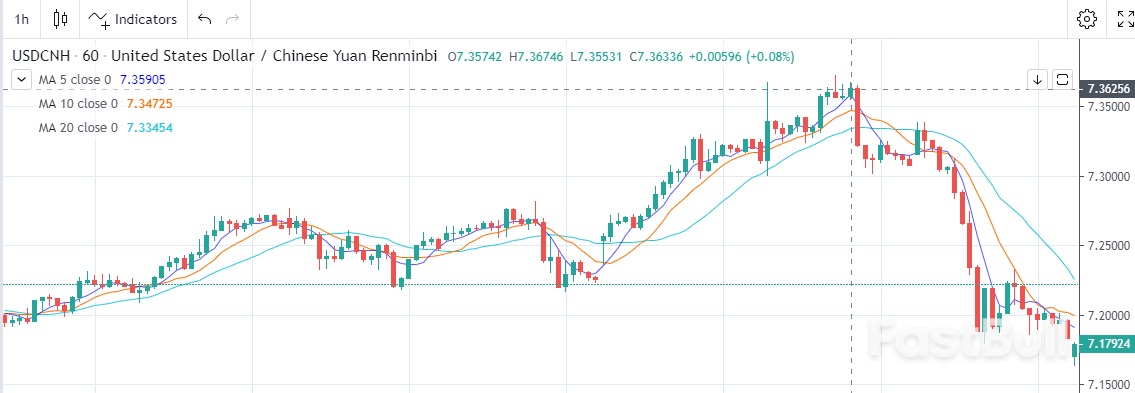
          The US dollar has declined in the past few days, but Wall Street speculators have committed a crime despite a law-enforcement campaign; they have wantonly pulled up the offshore CNY to above 7.37, which is very rampant; But, they do not understand the pattern of hiding the sharp in the blunt, and a man of great wisdom pretending to be slow-witted. When the US dollar is weak, they were supposed to save their strength. However, the overseas short-selling speculators want to be militaristic, probably because the Euro, the British pound, and the Japanese yen cannot be dealt with anymore, so they turn their attention to the CNY, but they have neglected that China is the more ruthless player. The Chinese central bank has stepped forward to snipe the offshore CNY.
          The giant state-owned banks continued to sell dollars at high levels to support the CNY on Tuesday evening, which also had the effect of accomplishing a fantastic task with little effort by clever maneuvers, along with many overseas hedge funds quickly adjusting their CNY trading strategies and stopping out of their original long positions, causing the USDCNH to plummet by over 1,300 basis points in one day, from a high of 7.3720 to a low of 7.1640, the significant reduction in the history of the day, and probably the biggest drop in the history of the currency. The only way to know the sweetness and sourness of this is to be in the middle of it. But if you have had a reverse position in the past two days, the taste is certainly not pleasant, and some aggressive speculators may have burst their positions or even worn out their positions.The Battle to Defend the CNY_3

          Hidden Blade in Bluntness

          The Central Bank has taken three steps in this round of rapid depreciation of the CNY, the first of which was to lower the foreign exchange deposit reserve ratio of financial institutions by two percentage points, i.e. the foreign exchange deposit reserve ratio was reduced from the current 8% to 6%; the second was to raise the foreign exchange risk reserve ratio for forward exchange sales business from 0 to 20%, and the third was to increase the macro-prudential adjustment parameter for cross-border financing of enterprises and financial institutions from 1 to 1.25.
          From the effect of the first and second time, the depreciation trend of CNY has not changed under the mighty USD, which has successively broken 7.0, 7.1, and 7.2. Even the 7.25 ceiling painstakingly suppressed by the mid-price has been broken, while the third time is to strike to hurt speculators against the background of USDCHN approaching 7.4 seriously, but what will happen next? After this haemorrhage, perhaps overseas speculators should not look for trouble in the CNY in the short term. China has always hidden its sharp edges in bluntness. If the CNY continues to depreciate sharply in the next few days, it will only be a matter before the Chinese central bank adjusts the counter-cyclical factor.
          Risk Warnings and Disclaimers
          You understand and acknowledge that there is a high degree of risk involved in trading. Following any strategies or investment methods may lead to potential losses. The content on the site is provided by our contributors and analysts for information purposes only. You are solely responsible for determining whether any trading assets, securities, strategy, or any other product is suitable for investing based on your own investment objectives and financial situation.
          Comments
          Add to Favorites
          Share

          Hong Kong Could be Key for China's Crypto Comeback: Arthur Hayes

          Michelle
          Hayes says the next crypto bull run will be tied to when China embraces the crypto market again, and Hong Kong could be the gateway for this to happen.
          Arthur Hayes, the former CEO of crypto derivatives giant BitMEX, believes the next crypto bull run will start when China moves back into the market, and Hong Kong has a vital part to play in this process.
          In his Oct. 26 blog post titled "Comeback," Hayes outlined why he thinks the Hong Kong government's announcement about introducing a bill to regulate crypto is a sign China is trying to ease its way back into the market. This could be because Hong Kong acts as "the proxy through which China interacts with the world:"
          "When China loves crypto, the bull market will come back. It will be a slow process, but the red shoots are budding."
          Hayes argued that Hong Kong may become the testing ground for Beijing to experiment with crypto markets and act as a hub for Chinese capital to find its way into the global crypto markets:
          "If these flows actually materialize in the way I imagine, they will be a strong supporting pillar of the next bull market."
          According to Hayes, Hong Kong's "reorientation as a pro-crypto location" is a prong in Beijing's strategy to reduce its position in a way that won't destabilize its internal financial system.
          Hong Kong was ranked the best-prepared country for widespread crypto adoption in a study by Forex Suggest published in July 2022. It considered several factors like crypto ATM installations, pro-crypto regulations and startup culture.
          China has one of the largest economies in the world but has been mostly hostile toward the crypto industry. The country's first ban came way back in 2013 when it prohibited banks from handling Bitcoin transactions.
          Beijing ramped up its crypto crackdown efforts in 2021 when it carried out multiple regulatory operations to eradicate Bitcoin mining from the country and deemed all crypto transactions illegal.
          However, Hayes says, "China has not left crypto — it has just been dormant."
          Related: Possession of Bitcoin still legal in China despite the ban, lawyer says
          China did resume BTC mining operations in September 2022, and Chainalysis noted in its 2022 Global Crypto Adoption Index that China re-entered the top ten this year after placing 13th in 2021.
          The authors of the Global Crypto Adoption Index said they found the development "especially interesting" given the Chinese government's crackdown on crypto, but according to their data, "the ban has either been ineffective or loosely enforced."

          Source: cointelegraph

          Risk Warnings and Disclaimers
          You understand and acknowledge that there is a high degree of risk involved in trading. Following any strategies or investment methods may lead to potential losses. The content on the site is provided by our contributors and analysts for information purposes only. You are solely responsible for determining whether any trading assets, securities, strategy, or any other product is suitable for investing based on your own investment objectives and financial situation.
          Comments
          Add to Favorites
          Share

          KEPCO Bonds Aggravate Fears of Corporate Credit Crunch

          Cohen
          A massive volume of bonds issued by the Korea Electric Power Corporation (KEPCO) throughout this year has been jolting local corporate bonds market, becoming a source of stress on already strained corporate bonds and commercial paper (CP) markets in the country.
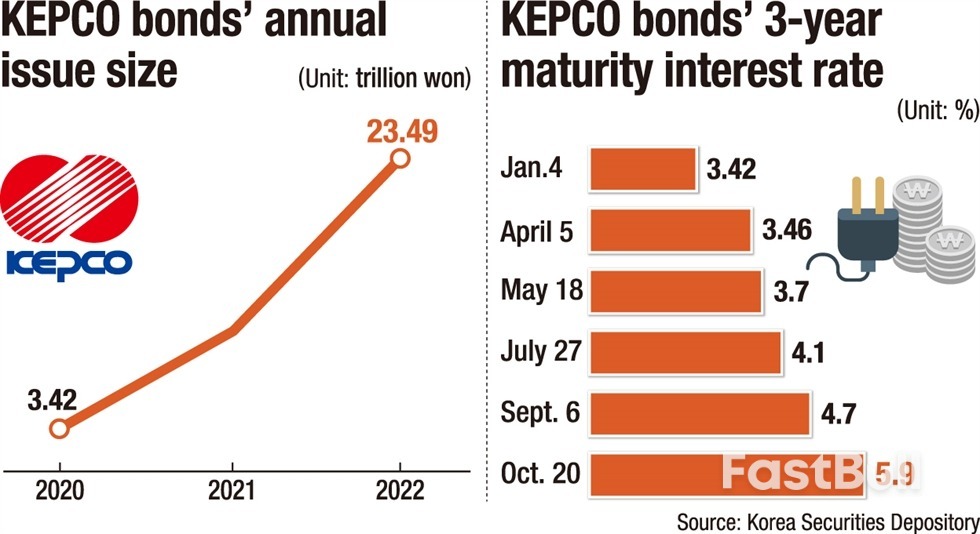
          According to data by the Korea Securities Depository (KSD) Thursday, KEPCO has so far issued bonds worth 23.49 trillion won ($16.57 billion) this year. The amount is already more than double of the entire size of KEPCO bonds issued last year. On average, it means the state-run electric power company has been providing two to three trillion won worth of top-notched credit bonds every month this year; this month alone, the power company has issued over 1.73 trillion won worth of bonds.
          The excess supply of top-rated KEPCO bonds every month into the local corporate bonds market, amidst globally soaring interest rates and tightening monetary policies, resulted in a further rise of corporate bond interest rates. As the three-year maturity interest rate for KEPCO bonds rose to more than 5.9 percent in late October ― the highest level in 14 years ― other corporate bonds also face a higher burden of increasing additional interest rates for their corporate bonds to attract creditors.
          As a consequence, KEPCO bonds are sucking in market liquidity and demand like a giant black hole with their top-rated stable status as well as near six percent interest rates, crowding out other companies' bonds in the credit market. Now corporations that are in need of borrowing money find it harder than ever to sell their bonds.KEPCO Bonds Aggravate Fears of Corporate Credit Crunch_1
          Market experts agree that the massive supply of KEPCO bonds every month has been one of the factors aggravating current credit crunch concerns in the local corporate bonds market.
          "The supply of top-rated bonds, including KEPCO bonds and bank notes, has played a part in the recent credit market deterioration, creating a crowding-out effect; bonds that are rated less than triple A credit status has been somewhat driven down from the market," Baek Doo-san, analyst at Korea Investment & Securities, said.
          "The increased issuance of special bonds like KEPCO bonds delays the recovery of corporate bonds market," Chung Dae-ho, another credit market analyst from KB Securities, pointed out, adding that the state-run electric power company is expected to continue bond issuance until next year.

          Gov't faces dilemma over KEPCO

          The real problem is that the government is facing a huge dilemma in their next moves over KEPCO's massive deficit. Due to global energy price hikes, the state-run power company suffered an operational loss of 14.3 trillion won during the first half of this year, and it is expected to post an annual deficit of around 30 trillion won this year. It is nearly six times from last year's annual deficit of 5.86 trillion won. The key to solve the deficit lies in raising the country's electricity bills, but it's not an available option for the government, considering the inflation rate.
          Given the mounting deficits, KEPCO might have a liquidity problem if it stops issuing bonds every month. However, concerns in the local corporate bonds market are also growing, following a defaulting of 205 billion won asset-backed commercial paper (ABCP) issued by Gangwon Province-led Legoland Korea developer earlier this month.
          Even KEPCO bonds cannot find enough creditors to buy the entirety of its bonds in the local market, despite the top-rated credit status and high interest rates. The continual issuance of KEPCO bonds could contribute to making other corporations' short-term funding harder.
          Some market insiders suggest selling KEPCO bonds in overseas market, rather than in local markets. Some other experts urge the government to take a more proactive approach in stabilizing the short-term funding market.
          "While the government is drawing up a series of measures, such as immediate implementation of bond market stabilization funds and the delay of banks' LCR normalization, stronger measures aimed at stabilizing the market seem necessary to turn back the overall market sentiment," Lee Kyoung-rok, analyst at Shinyoung Securities, said.
          In response to such calls, the Bank of Korea (BOK) announced Thursday afternoon that it adds KEPCO bonds along with bank bonds to the BOK's list of qualified securities, aiming to reduce financial companies' liquidity burden. Currently, various government-issued bonds and Korea Housing Finance Corporation's mortgage-backed security are listed as BOK's qualified securities.
          Meanwhile, the aggregate amount of bonds issued by local corporations in September stood at 16.4 trillion won, a 19.8 percent decrease from the previous month and a 6.5 percent fall year-on-year.

          Source: TheKoreaTimes

          Risk Warnings and Disclaimers
          You understand and acknowledge that there is a high degree of risk involved in trading. Following any strategies or investment methods may lead to potential losses. The content on the site is provided by our contributors and analysts for information purposes only. You are solely responsible for determining whether any trading assets, securities, strategy, or any other product is suitable for investing based on your own investment objectives and financial situation.
          Comments
          Add to Favorites
          Share

          European Stocks Hover Below Five-Week High Ahead of ECB Meeting

          Alex
          European shares fell in early trading on Thursday, as disappointing earnings soured the mood in global markets and traders were cautious ahead of an expected 75 basis point from the European Central Bank.
          World stocks were knocked off a five-week high during the Wall Street session on Wednesday after U.S. heavyweights including Microsoft Corp MSFT.O and Alphabet inc GOOGL.O reported worse-than-expected earnings.
          But Asian markets benefited from speculation among investors that major central banks are considering slowing their aggressive interest hikes, given signs of an economic slowdown.
          The Bank of Canada delivered a smaller-than-expected rate hike late on Wednesday.
          At 0757 GMT, the MSCI world equity index .MIWD00000PUS, which tracks shares in 47 countries, was little changed, holding just below Wednesday's five-week high.
          Europe's STOXX 600 was down 0.3% on the day, having also been knocked off a five-week high .STOXX.
          London's FTSE 100 was up 0.3% .FTSE while Germany's DAX was down 0.4% .GDAXI.
          "Earnings have been better in Europe than they have in the U.S. mainly because of that mix of old economy, new economy," said Patrick Spencer, vice chairman of equities at Baird, referring to the dominance of technology companies in the United States compared to oil and materials companies in Europe.
          The euro slipped 0.2% against the dollar at $1.0063 ahead of the European Central Bank's policy announcement.
          Eurozone government bond yields were up, with the benchmark German 10-year yield up 5 bps on the day at 2.167% DE10YT=RR.
          Investors will be looking out for signs ECB President Christine Lagarde is softening her tone around future interest rate increases, Baird's Spencer said.
          Growing speculation that major central banks will start to slow their rate hikes has put euro zone bonds on track for the biggest weekly rally in eight months, even though euro zone inflation remains close to 10%.
          The Federal Reserve is expected to deliver a 75 bps hike in November, but speculation that it may be less aggressive afterwards has led the dollar to decline 1.8% so far this week.
          The dollar index was up 0.2% on the day in early European trading, at around 109.81 =USD, having touched a five-week low of 109.53 earlier in the session.
          The Japanese yen strengthened ahead of Friday's Bank of Japan meeting, even though most analysts expect the central bank to maintain its ultra-low interest rates JPY=EBS.
          Oil prices dropped on expectations of a reduction in demand from China.
          Cryptocurrency prices have benefited from the weaker dollar so far this week, with bitcoin at around $20,726 BTC=BTSP and ether at $1,554.9 ETH=BTSP, having broken above $1,500 for the first time since September on Tuesday.
          Meanwhile, shares in Credit Suisse hit a two-week low after it outlined an overhaul that plans to raise 4 billion Swiss francs ($4.06 billion) and separate out its investment bank CSGN.S.

          Source:reuters

          Risk Warnings and Disclaimers
          You understand and acknowledge that there is a high degree of risk involved in trading. Following any strategies or investment methods may lead to potential losses. The content on the site is provided by our contributors and analysts for information purposes only. You are solely responsible for determining whether any trading assets, securities, strategy, or any other product is suitable for investing based on your own investment objectives and financial situation.
          Comments
          Add to Favorites
          Share
          FastBull
          Copyright © 2025 FastBull Ltd

          728 RM B 7/F GEE LOK IND BLDG NO 34 HUNG TO RD KWUN TONG KLN HONG KONG

          TelegramInstagramTwitterfacebooklinkedin
          App Store Google Play Google Play
          Products
          Charts

          Chats

          Q&A with Experts
          Screeners
          Economic Calendar
          Data
          Tools
          Membership
          Features
          Function
          Markets
          Copy Trading
          Latest Signals
          Contests
          News
          Analysis
          24/7
          Columns
          Education
          Company
          Careers
          About Us
          Contact Us
          Advertising
          Help Center
          Feedback
          User Agreement
          Privacy Policy
          Business

          White Label

          Data API

          Web Plug-ins

          Poster Maker

          Affiliate Program

          Risk Disclosure

          The risk of loss in trading financial instruments such as stocks, FX, commodities, futures, bonds, ETFs and crypto can be substantial. You may sustain a total loss of the funds that you deposit with your broker. Therefore, you should carefully consider whether such trading is suitable for you in light of your circumstances and financial resources.

          No decision to invest should be made without thoroughly conducting due diligence by yourself or consulting with your financial advisors. Our web content might not suit you since we don't know your financial conditions and investment needs. Our financial information might have latency or contain inaccuracy, so you should be fully responsible for any of your trading and investment decisions. The company will not be responsible for your capital loss.

          Without getting permission from the website, you are not allowed to copy the website's graphics, texts, or trademarks. Intellectual property rights in the content or data incorporated into this website belong to its providers and exchange merchants.

          Not Logged In

          Log in to access more features

          FastBull Membership

          Not yet

          Purchase

          Become a signal provider
          Help Center
          Customer Service
          Dark Mode
          Price Up/Down Colors

          Log In

          Sign Up

          Position
          Layout
          Fullscreen
          Default to Chart
          The chart page opens by default when you visit fastbull.com