• Trade
  • Markets
  • Copy
  • Contests
  • News
  • 24/7
  • Calendar
  • Q&A
  • Chats
Trending
Screeners
SYMBOL
LAST
BID
ASK
HIGH
LOW
NET CHG.
%CHG.
SPREAD
SPX
S&P 500 Index
6819.08
6819.08
6819.08
6861.30
6801.50
-8.33
-0.12%
--
DJI
Dow Jones Industrial Average
48386.58
48386.58
48386.58
48679.14
48285.67
-71.46
-0.15%
--
IXIC
NASDAQ Composite Index
23109.35
23109.35
23109.35
23345.56
23012.00
-85.81
-0.37%
--
USDX
US Dollar Index
97.960
98.040
97.960
98.070
97.740
+0.010
+ 0.01%
--
EURUSD
Euro / US Dollar
1.17440
1.17449
1.17440
1.17686
1.17262
+0.00046
+ 0.04%
--
GBPUSD
Pound Sterling / US Dollar
1.33702
1.33709
1.33702
1.34014
1.33546
-0.00005
0.00%
--
XAUUSD
Gold / US Dollar
4303.04
4303.45
4303.04
4350.16
4285.08
+3.65
+ 0.08%
--
WTI
Light Sweet Crude Oil
56.384
56.414
56.384
57.601
56.233
-0.849
-1.48%
--

Community Accounts

Signal Accounts
--
Profit Accounts
--
Loss Accounts
--
View More

Become a signal provider

Sell trading signals to earn additional income

View More

Guide to Copy Trading

Get started with ease and confidence

View More

Signal Accounts for Members

All Signal Accounts

Best Return
  • Best Return
  • Best P/L
  • Best MDD
Past 1W
  • Past 1W
  • Past 1M
  • Past 1Y

All Contests

  • All
  • Trump Updates
  • Recommend
  • Stocks
  • Cryptocurrencies
  • Central Banks
  • Featured News
Top News Only
Share

New York Fed Accepts $2.601 Billion Of $2.601 Billion Submitted To Reverse Repo Facility On Dec 15

Share

Turkey: Shoots Down A Drone In The Black Sea Using F-16 Fighter Jets

Share

Goldman Sachs Says They Believe That The Copper Price Is Vulnerable To An Ai-Linked Price Correction

Share

Goldman Sachs Upgrades 2026 Copper Price Forecast To $11400 From $10,650

Share

Attempts By Ukrainian Troops To Advance From The South-West To Outskirts Of Kupiansk Are Being Thwarted

Share

Russian Troops Control All Of Kupiansk - IFX Cites Russian Military

Share

On Monday (December 15), The South Korean Won Ultimately Rose 0.60% Against The US Dollar, Closing At 1468.91 Won. The Won Was On An Upward Trend Throughout The Day, Rising Significantly At 17:00 Beijing Time And Reaching A Daily High Of 1463.04 Won At 17:36

Share

Health Ministry: Israeli Forces Kill Palestinian Teen In West Bank

Share

New York Federal Reserve President Williams: Over Time, The Size Of Reserves Could Grow From $2.9 Trillion

Share

New York Fed President Williams: AI Valuations Are High, But There Is A Real Driving Factor

Share

New York Federal Reserve President Williams: The Job Market Is In Very Good Shape

Share

New York Fed President Williams: 'Very Supportive' Of USA Central Bank's Decision To Cut Interest Rates Last Week

Share

New York Fed President Williams: 'Too Early To Say' What Central Bank Should Do At January Meeting

Share

New York Fed President Williams: Strong Markets Part Of Reason Why Economy Will Grow Robustly In 2026

Share

New York Fed President Williams: What Constitutes Ample Reserves Will Change Over Time

Share

New York Fed President Williams: Market Valuations 'Elevated,' But There Are Reasons For Pricing

Share

New York Fed President Williams: Ample Reserves System Working Very Well

Share

New York Fed President Williams: Some Signs That Parts Of Underlying Economy Not As Strong As GDP Data Suggests

Share

New York Fed President Williams: Expects Coming Job Data Will Show Gradual Cooling

Share

Ukraine President Zelenskiy: Monitoring Of Ceasefire Should Be Part Of Security Guarantees

TIME
ACT
FCST
PREV
Japan Tankan Small Manufacturing Outlook Index (Q4)

A:--

F: --

P: --

Japan Tankan Large Non-Manufacturing Outlook Index (Q4)

A:--

F: --

P: --

Japan Tankan Large Manufacturing Outlook Index (Q4)

A:--

F: --

P: --

Japan Tankan Small Manufacturing Diffusion Index (Q4)

A:--

F: --

P: --

Japan Tankan Large-Enterprise Capital Expenditure YoY (Q4)

A:--

F: --

P: --

U.K. Rightmove House Price Index YoY (Dec)

A:--

F: --

P: --

China, Mainland Industrial Output YoY (YTD) (Nov)

A:--

F: --

P: --

China, Mainland Urban Area Unemployment Rate (Nov)

A:--

F: --

P: --

Saudi Arabia CPI YoY (Nov)

A:--

F: --

P: --

Euro Zone Industrial Output YoY (Oct)

A:--

F: --

P: --

Euro Zone Industrial Output MoM (Oct)

A:--

F: --

P: --

Canada Existing Home Sales MoM (Nov)

A:--

F: --

P: --

Canada National Economic Confidence Index

A:--

F: --

P: --

Canada New Housing Starts (Nov)

A:--

F: --

P: --
U.S. NY Fed Manufacturing Employment Index (Dec)

A:--

F: --

P: --

U.S. NY Fed Manufacturing Index (Dec)

A:--

F: --

P: --

Canada Core CPI YoY (Nov)

A:--

F: --

P: --

Canada Manufacturing Unfilled Orders MoM (Oct)

A:--

F: --

P: --

U.S. NY Fed Manufacturing Prices Received Index (Dec)

A:--

F: --

P: --

U.S. NY Fed Manufacturing New Orders Index (Dec)

A:--

F: --

P: --

Canada Manufacturing New Orders MoM (Oct)

A:--

F: --

P: --

Canada Core CPI MoM (Nov)

A:--

F: --

P: --

Canada Trimmed CPI YoY (SA) (Nov)

A:--

F: --

P: --

Canada Manufacturing Inventory MoM (Oct)

A:--

F: --

P: --

Canada CPI YoY (Nov)

A:--

F: --

P: --

Canada CPI MoM (Nov)

A:--

F: --

P: --

Canada CPI YoY (SA) (Nov)

A:--

F: --

P: --

Canada Core CPI MoM (SA) (Nov)

A:--

F: --

P: --

Canada CPI MoM (SA) (Nov)

A:--

F: --

P: --

Federal Reserve Board Governor Milan delivered a speech
U.S. NAHB Housing Market Index (Dec)

A:--

F: --

P: --

Australia Composite PMI Prelim (Dec)

--

F: --

P: --

Australia Services PMI Prelim (Dec)

--

F: --

P: --

Australia Manufacturing PMI Prelim (Dec)

--

F: --

P: --

Japan Manufacturing PMI Prelim (SA) (Dec)

--

F: --

P: --

U.K. 3-Month ILO Employment Change (Oct)

--

F: --

P: --

U.K. Unemployment Claimant Count (Nov)

--

F: --

P: --

U.K. Unemployment Rate (Nov)

--

F: --

P: --

U.K. 3-Month ILO Unemployment Rate (Oct)

--

F: --

P: --

U.K. Average Weekly Earnings (3-Month Average, Including Bonuses) YoY (Oct)

--

F: --

P: --

U.K. Average Weekly Earnings (3-Month Average, Excluding Bonuses) YoY (Oct)

--

F: --

P: --

France Services PMI Prelim (Dec)

--

F: --

P: --

France Composite PMI Prelim (SA) (Dec)

--

F: --

P: --

France Manufacturing PMI Prelim (Dec)

--

F: --

P: --

Germany Services PMI Prelim (SA) (Dec)

--

F: --

P: --

Germany Manufacturing PMI Prelim (SA) (Dec)

--

F: --

P: --

Germany Composite PMI Prelim (SA) (Dec)

--

F: --

P: --

Euro Zone Composite PMI Prelim (SA) (Dec)

--

F: --

P: --

Euro Zone Services PMI Prelim (SA) (Dec)

--

F: --

P: --

Euro Zone Manufacturing PMI Prelim (SA) (Dec)

--

F: --

P: --

U.K. Services PMI Prelim (Dec)

--

F: --

P: --

U.K. Manufacturing PMI Prelim (Dec)

--

F: --

P: --

U.K. Composite PMI Prelim (Dec)

--

F: --

P: --

Euro Zone ZEW Economic Sentiment Index (Dec)

--

F: --

P: --

Germany ZEW Current Conditions Index (Dec)

--

F: --

P: --

Germany ZEW Economic Sentiment Index (Dec)

--

F: --

P: --

Euro Zone Trade Balance (Not SA) (Oct)

--

F: --

P: --

Euro Zone ZEW Current Conditions Index (Dec)

--

F: --

P: --

Euro Zone Trade Balance (SA) (Oct)

--

F: --

P: --

Euro Zone Total Reserve Assets (Nov)

--

F: --

P: --

U.K. Inflation Rate Expectations

--

F: --

P: --

Q&A with Experts
    • All
    • Chatrooms
    • Groups
    • Friends
    Connecting
    .
    .
    .
    Type here...
    Add Symbol or Code

      No matching data

      All
      Trump Updates
      Recommend
      Stocks
      Cryptocurrencies
      Central Banks
      Featured News
      • All
      • Russia-Ukraine Conflict
      • Middle East Flashpoint
      • All
      • Russia-Ukraine Conflict
      • Middle East Flashpoint
      Search
      Products

      Charts Free Forever

      Chats Q&A with Experts
      Screeners Economic Calendar Data Tools
      Membership Features
      Data Warehouse Market Trends Institutional Data Policy Rates Macro

      Market Trends

      Market Sentiment Order Book Forex Correlations

      Top Indicators

      Charts Free Forever
      Markets

      News

      News Analysis 24/7 Columns Education
      From Institutions From Analysts
      Topics Columnists

      Latest Views

      Latest Views

      Trending Topics

      Top Columnists

      Latest Update

      Signals

      Copy Rankings Latest Signals Become a signal provider AI Rating
      Contests
      Brokers

      Overview Brokers Assessment Rankings Regulators News Claims
      Broker listing Forex Brokers Comparison Tool Live Spread Comparison Scam
      Q&A Complaint Scam Alert Videos Tips to Detect Scam
      More

      Business
      Events
      Careers About Us Advertising Help Center

      White Label

      Data API

      Web Plug-ins

      Affiliate Program

      Awards Institution Evaluation IB Seminar Salon Event Exhibition
      Vietnam Thailand Singapore Dubai
      Fans Party Investment Sharing Session
      FastBull Summit BrokersView Expo
      Recent Searches
        Top Searches
          Markets
          News
          Analysis
          User
          24/7
          Economic Calendar
          Education
          Data
          • Names
          • Latest
          • Prev

          View All

          No data

          Scan to Download

          Faster Charts, Chat Faster!

          Download App
          English
          • English
          • Español
          • العربية
          • Bahasa Indonesia
          • Bahasa Melayu
          • Tiếng Việt
          • ภาษาไทย
          • Français
          • Italiano
          • Türkçe
          • Русский язык
          • 简中
          • 繁中
          Open Account
          Search
          Products
          Charts Free Forever
          Markets
          News
          Signals

          Copy Rankings Latest Signals Become a signal provider AI Rating
          Contests
          Brokers

          Overview Brokers Assessment Rankings Regulators News Claims
          Broker listing Forex Brokers Comparison Tool Live Spread Comparison Scam
          Q&A Complaint Scam Alert Videos Tips to Detect Scam
          More

          Business
          Events
          Careers About Us Advertising Help Center

          White Label

          Data API

          Web Plug-ins

          Affiliate Program

          Awards Institution Evaluation IB Seminar Salon Event Exhibition
          Vietnam Thailand Singapore Dubai
          Fans Party Investment Sharing Session
          FastBull Summit BrokersView Expo

          Japan Union Group Seeks At Least 6% Pay Raise In Bid To Push BOJ Policy

          Alex

          Economic

          Summary:

          UA Zensen chief Matsuura believes 4% wage hikes not enough.Will fight for 6%, but hurdles remain for smaller-sized firms.

          One of Japan’s biggest unions plans to push for pay gains above 6% in a bid to kickstart a virtuous wage-price cycle that would enable the Bank of Japan to raise interest rates and strengthen the yen.
          “The yen’s depreciation has gone too far, and I would like to see the BOJ take some policy steps to correct the situation,” said Akihiko Matsuura, president of UA Zensen, a labor union consisting of over 1.8 million members from sectors such as retail and restaurants. “I think we have to raise wages enough for the BOJ to be able to make a decision on that.”
          Matsuura’s comments come as Japanese union leaders step up pressure on companies to boost pay during annual wage talks. BOJ Governor Kazuo Ueda is looking for signs that wage increases, including those at smaller firms, will spur demand-led price gains, allowing Japan to exit from the world’s last negative rate regime.
          Yen weakness puts pressure on profit margins at smaller companies that rely on imported goods or raw materials, leaving them less money to raise pay. It also feeds into higher inflation that drives up the cost of living for Matsuura’s members. A BOJ rate hike would likely support the yen by narrowing rate differentials with other countries including the US.
          UA Zensen, which represents workers mostly at small and medium-sized firms, is calling for a standard 6% increase in total wages. This is a slight upgrade from last year’s stance, when the union aimed for gains of “around 6%.” That demand helped lower the hurdle for other unions to ask for 6% or more this year, Matsuura said.
          “By setting a 6% standard, we can be more proactive,” said Matsuura. “Even if we demand 7%, we can say to labor and management that this is within the scope of industry policy.”
          UA Zensen’s demands compare with the 3.85% average wage hike that big firms are planning to offer, according to a survey of 37 economists conducted Dec. 25-Jan. 9 by the Japan Center for Economic Research.
          Rengo, Japan’s largest union, is aiming for “5% or more” in this year’s wage talks. Initial results are due on March 15, just before the BOJ’s next policy meeting.
          Rengo’s chief, Tomoko Yoshino, said Thursday that after early discussions she believes unions and employers are on the same page on the need for higher wages.
          “I felt again that we are heading in the same direction as management in this year’s wage negotiation,” Yoshino said after meeting with Masakazu Tokura, head of business lobby Keidanren.
          Tokura added that wage gains must include non-regular workers, with momentum spreading to smaller firms, and he’s fairly optimistic in the early stages of talks.
          Matsuura said his group will help influence the whole process.
          “We are the largest industrial labor union in Rengo, so of course, our wage increases will have a big impact on the Rengo results,” he said.
          Prime Minister Fumio Kishida is also pushing for wage gains after increases last year failed to keep up with inflation, putting a burden on household budgets. The premier said it’s essential to raise wages at small and medium-sized companies.
          “At the very least, we are aiming to turn real wages positive. So unless wage gains are in the upper 4% range or higher, we won’t be able to achieve that,” he said.
          UA Zensen faces some obstacles. Around 35% of 832 small and medium-sized firms surveyed by Johnan Shinkin Bank and Tokyo Shimbun in January are not planning a wage hike at this point, with a majority citing a lack of funds to do so.
          “Major companies are clearly raising wages more than the increase in prices this year,” said Matsuura. “We will have to see how much the small and medium-sized companies can catch up with them.”
          — With assistance from Momoka Yokoyama

          Source:Bloomberg

          To stay updated on all economic events of today, please check out our Economic calendar
          Risk Warnings and Disclaimers
          You understand and acknowledge that there is a high degree of risk involved in trading. Following any strategies or investment methods may lead to potential losses. The content on the site is provided by our contributors and analysts for information purposes only. You are solely responsible for determining whether any trading assets, securities, strategy, or any other product is suitable for investing based on your own investment objectives and financial situation.
          Comments
          Add to Favorites
          Share

          Brazil Central Bank Cuts Rates By 50 Bps, Signals More Of The Same Ahead

          XM

          Economic

          The bank's rate-setting committee, known as Copom, unanimously reduced its Selic benchmark interest rate to 11.25%, as forecast by all 44 economists surveyed by Reuters.
          "If the scenario evolves as expected, the Committee members unanimously anticipate further reductions of the same magnitude in the next meetings, and judge that this pace is appropriate to keep the necessary contractionary monetary policy for the disinflationary process," the bank said in its statement.
          The bank's decision came shortly after the U.S. Federal Reserve left interest rates unchanged on Wednesday, with Fed Chair Jerome Powell declaring "we still have a way to go" in the battle to tame inflation. The Federal Open Market Committee's statement language and Powell's comments were a blow to investors who were expecting U.S. cuts as early as March.
          In its statement, Brazil's central bank noted that the external scenario remains volatile, and dropped a previous reference to a "less adverse" external backdrop, citing ongoing debates about when major economies could begin the easing cycle.
          In December, central bank Governor Roberto Campos Neto had made clear that by signaling further 50 basis point rate cuts, policymakers envisaged keeping the strategy for the committee's next two meetings.
          By adhering to the same tone in Wednesday's statement, policymakers are now flagging half-percentage cuts through May, sustaining a robust easing cycle initiated in August that brought borrowing costs down from a six-year high of 13.75%.
          "Even while keeping the statement virtually unchanged, it provided relevant information, indicating that it will maintain a 50-basis-point interest rate cut until at least May," said Luis Otavio Leal, chief economist at G5 Partners.
          He predicts that this easing pace will slow down to 25 basis points starting from June, with the Selic ending the year at 9%.
          The 13.75% rate, which plateaued for nearly a year as the central bank fought a tough battle against inflation, drew sharp criticism from leftist President Luiz Inacio Lula da Silva.
          Brazilian policymakers reiterated that consumer prices remain on a path of disinflation, with various measures of underlying inflation closer to the official target. They made no changes to inflation projections, which remain at 3.5% for 2024 and 3.2% for 2025, above the 3% target.
          Consumer prices in Latin America's largest economy rose 4.47% in the 12 months until mid-January, below market expectations.
          The bank's monetary policy has in recent months been conducted against a challenging fiscal backdrop, as well as an unusually tight labor market.
          To stay updated on all economic events of today, please check out our Economic calendar
          Risk Warnings and Disclaimers
          You understand and acknowledge that there is a high degree of risk involved in trading. Following any strategies or investment methods may lead to potential losses. The content on the site is provided by our contributors and analysts for information purposes only. You are solely responsible for determining whether any trading assets, securities, strategy, or any other product is suitable for investing based on your own investment objectives and financial situation.
          Comments
          Add to Favorites
          Share

          Federal Reserve Maintains Interest Rates, Market Awaits Clarity on Timing of 2024 Reductions

          Ukadike Micheal

          Economic

          Forex

          The US Federal Reserve chose to maintain interest rates at a 23-year high during Wednesday's meeting, but it refrained from offering immediate signals regarding the initiation of borrowing cost reductions later this year. The Federal Open Market Committee unanimously decided to keep the benchmark federal funds target within the range of 5.25% to 5.5%, as stated in the released announcement. Additionally, the statement indicated a removal of the bias towards raising rates, signifying the belief among rate-setters that the next interest rate move is likely to be a cut. The decision was in line with market expectations, and attention shifted to clues about the future interest rate trajectory during the post-meeting press conference with Fed Chair Jay Powell.
          In a significant change of language, the committee mentioned, "The committee judges the risks to achieving its employment and inflation goals are moving into better balance." This adjustment confirmed the perception that rate-setters are leaning towards a rate cut. However, they emphasized the need for more time before deciding to lower borrowing costs, stating that it won't be appropriate to reduce the target range until they gain greater confidence that inflation is moving sustainably toward 2%.
          Market participants were keen on understanding the Fed's perspective on interest rate paths during Powell's post-meeting press conference. Rate-setters signaled that they do not anticipate an immediate reduction in rates in March, highlighting a cautious approach. Officials project making 75 basis points worth of cuts throughout 2024 as inflation shows further signs of moving towards their 2% goal.
          As the Fed awaits additional readings on inflation, including January and February CPI numbers and January PCE data (its preferred gauge), the annual revision to the past five years of CPI data on February 9th will be crucial. A potential upward revision in recent inflation figures could pose challenges to the Fed's envisioned rate-cutting trajectory. The decision to maintain rates underscores the central bank's vigilance in balancing economic stability amid evolving inflationary dynamics.

          Source: Bloomberg, Financial Times

          To stay updated on all economic events of today, please check out our Economic calendar
          Risk Warnings and Disclaimers
          You understand and acknowledge that there is a high degree of risk involved in trading. Following any strategies or investment methods may lead to potential losses. The content on the site is provided by our contributors and analysts for information purposes only. You are solely responsible for determining whether any trading assets, securities, strategy, or any other product is suitable for investing based on your own investment objectives and financial situation.
          Comments
          Add to Favorites
          Share

          Another Burst Higher? Investors Ponder Positives

          Alex

          Stocks

          Economic

          After two years of catastrophizing about inflation, credit squeezes, debt, recession and conflict, investors have been blindsided by a serene U.S. expansion and record high stock indexes.
          And some are now pondering whether they may even have been hedged the wrong way for the past year.
          To be sure, 2022 was indeed a dire year for Wall Street as central banks appeared late in reining in a post-pandemic, post-Ukraine inflation spike with some of the most brutal interest rate rises in decades. There was a running assumption in most circles that defaults, distress and recession would follow.
          Instead, the biggest economy in the world clocked a full-year inflation-adjusted expansion of 2.5% - more than 6% in nominal dollar terms and at least as fast as China on that basis in the final three months.
          As AXA Investment Managers point out, the U.S. economy is now 28% bigger in dollar terms than it was at the end of 2020.
          Far from slowing, annualised real growth raced at more than 4% through the second half of 2023, inflation fell back to the Federal Reserve's 2% target on many measures and interest rate cuts are now widely expected through 2024.
          The last hurrah of a heady, overheated boom? Not so it seems.
          The International Monetary Fund, flagging on Tuesday growing confidence in the historically elusive 'soft landing' for the world economy at large, raised its 2024 forecast for U.S. growth rate by more than half a point to 2.1%.
          At that pace, the U.S. economy would be the fastest growing of the Group of Seven wealthy countries, expanding at more than twice the rate of the euro zone and even faster than the expected pace this year of major emerging economies such as Brazil or South Africa.
          And even though we're still deep in the weeds of the latest U.S. corporate earnings season, the annual profit expansion of S&P500 firms for the quarter just gone is coming in at about 5.5% - with expectations full-year growth this year will be at twice that rate, even running at triple that in the final quarter, according to LSEG estimates.
          It's little surprise then the S&P500 index's latest surge to within 1% of the 5,000-point milestone for the first time ever is starting to broaden out to mid- and small-cap stocks too. That's significant as it comes after a year in which index gains were routinely dismissed as an overly-narrow, artificial intelligence-skewed outperformance of just a handful of mega tech firms.
          'Fantastical upside'?
          AXA IM's chief investment officer for core investments, Chris Iggo, feels upside surprises for U.S. markets now need to be at least entertained.
          "The downside is feared, rightly so, more than any fantastical upside scenarios," Iggo told clients in his weekly note. "But it's nice to indulge in fantasies now and again."
          Iggo throws out a series of possible additional spurs to the year - including the possibility of a significant undershoot in global inflation that sees interest rates cut faster and deeper than central banks now plan, in turn forcing holders of trillions of dollars of cash to scramble to invest in more risk.
          Another 'fantasy' was a possible switch of the Democrat Presidential candidate from Joe Biden to someone with a better chance of preventing Republican favourite Donald Trump returning to the White House - and likely disrupting international alliances or stoking global economic tensions even more.
          "The chances of any of this happening are slim. But we cannot rule out non-linearities on the positive side as well as the downside," he said. He added that a put option on the S&P500 at a strike of 3,800 in one-year's time currently costs more than three times the cost of a call option at a strike of 6,000.
          The prospect for another leg higher is dawning on many.
          BlackRock Investment Institute (BII) on Monday upgraded its broad recommendation on U.S. stocks to 'overweight' from neutral on a 'tactical' six- to 12-month view.
          "The rally can run for now – and broaden out," it said.
          "Markets are pricing a soft economic landing where inflation falls to 2% without a recession," BII said. "With markets tending to focus on one theme at a time, this narrative can support the rally over our tactical horizon and allow it to expand beyond tech. So we go overweight overall U.S. stocks."
          Invesco strategist Kristina Hooper also contrasts the dire geopolitical backdrop to the new year with the relative strength of U.S. financial markets.
          "I'm fielding a lot of questions about the state of the economy given these global events," wrote Hooper, and pointed instead to positives of still-robust growth, disinflation, rate cut hopes, Japanese optimism and even hopes China will move to more significant stimulus soon.
          Is it time to be more wary of the boom than the bust? A glass half full at least?
          Not everyone is in that frame of mind yet.
          Solita Marcelli, UBS Global Wealth Management's chief investment officer for the Americas, thinks risks remain to the new year optimism and cautions about getting carried away.
          "While no form of protection works for all risks, we see a range of strategies that can help mitigate volatility or drawdowns for portfolios," she said. "These include seeking quality in both equity and bond holdings as well as defensive structured strategies, alternative investments or positions in oil and gold."
          One thing clear from this January anxiety among many asset managers is how chastening 2023 was for many of them - when an early year consensus for recession, dour equity index performance and a bond boom that all proved wide of the mark.
          Perhaps the sensible thing is to just not rule anything out.

          Source: Yahoo

          To stay updated on all economic events of today, please check out our Economic calendar
          Risk Warnings and Disclaimers
          You understand and acknowledge that there is a high degree of risk involved in trading. Following any strategies or investment methods may lead to potential losses. The content on the site is provided by our contributors and analysts for information purposes only. You are solely responsible for determining whether any trading assets, securities, strategy, or any other product is suitable for investing based on your own investment objectives and financial situation.
          Comments
          Add to Favorites
          Share

          World-Beating Growth? Not for India's Rural Majority

          Thomas

          Economic

          Jakir Khan, an Indian farm worker, says he has cut down on food as his income has halved. There are fewer and fewer opportunities, he says, for employment in his small village in Uttar Pradesh state.
          Khan says his monthly income has come down to 5,000 Indian rupees ($60.17) from 10,000 Indian rupees before the pandemic, while his weekly expenses on food have gone up 60%. In November, he took a 100,000 rupees loan from relatives.
          Khan, like millions of others, is struggling with the economic slowdown in rural India, home to 60% of its 1.4 billion people, which is painting a starkly different picture to the country's spectacular economic growth and the prosperity of its urban population.
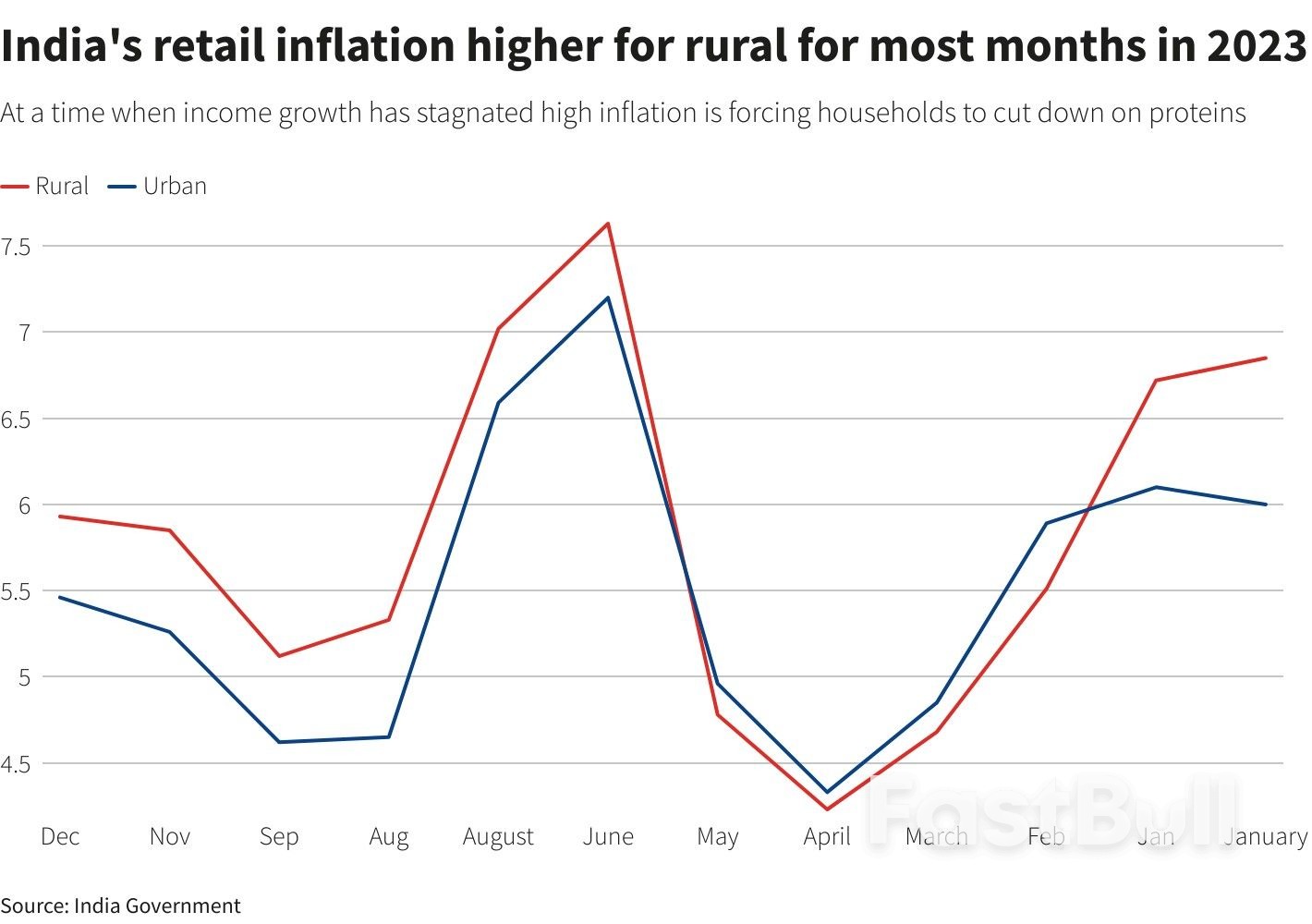
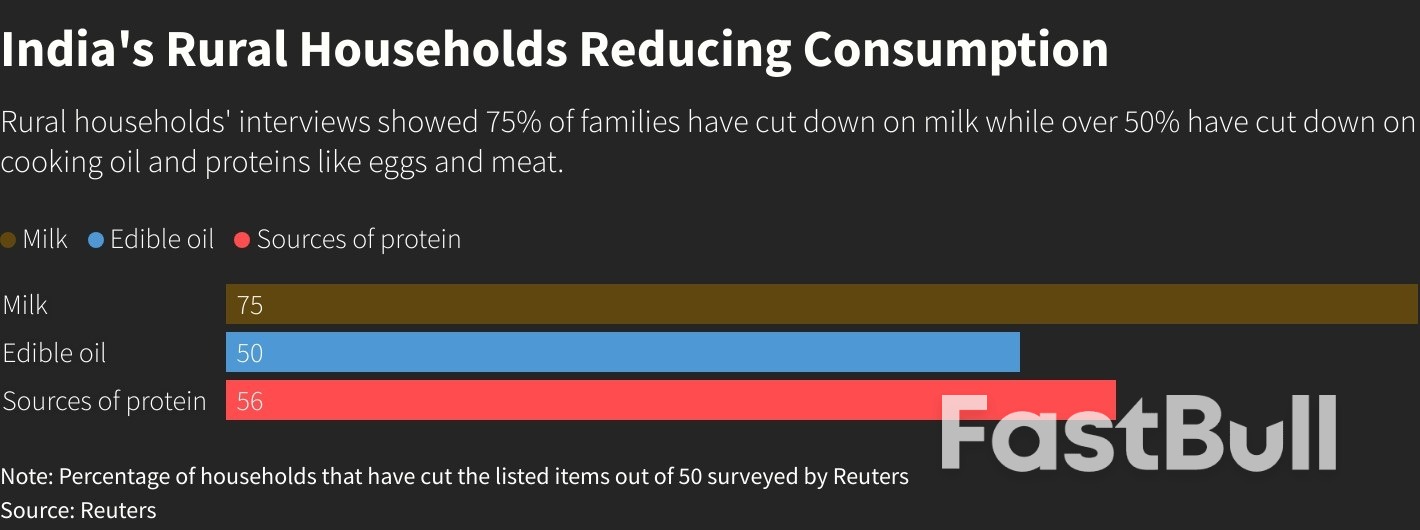
          Reuters interviewed nearly 50 families in rural areas such as Khan's in three Indian states - Uttar Pradesh, Odisha and West Bengal - and 85% of them reported stagnant or lower incomes compared to the years before the pandemic. They said inflation was high and was forcing them to borrow money to sustain already reduced consumption.
          The families attributed the lower incomes to fewer jobs, more people vying for the same work leading to lesser pay and lower farm output, which reduces the demand for farm labour.
          While there have been some indicative data points that show rural recovery has been slow, there is no recent, publicly available survey on incomes and consumption in India's vast rural hinterland.
          "Who doesn't want to eat meat? But times are hard and I cannot afford it. I eat meat only in marriage functions of others," Khan said, speaking in Bahboliya Mahada, a village surrounded by sugarcane fields and banana plantations.World-Beating Growth? Not for India's Rural Majority_1
          India's statistics office has forecast overall annual growth of 7.3%, the highest among major global economies, for the current fiscal year ending in March, fuelled by sectors like construction and financial services.
          But growth in farm output, which contributes about 15% of GDP and employs more than 40% of the workforce, was seen slowing to 1.8% in the current fiscal year, from 4% a year ago.
          "I am a bit concerned. A host of indicators is not painting a great picture," Dhiraj Nim, an economist at ANZ, told Reuters. These included an increase in seasonally adjusted demand for the government's minimum job guarantee scheme for rural areas, low agriculture growth in the September quarter and rising inflation in the hinterland, he said.
          "Industries that tend to be more...rurally focused in terms of employment are also not doing well," he said.
          Prime Minister Narendra Modi is seeking a third term in elections due by May this year, and economists say the government might have to spend more on rural subsidies to ease the distress.
          Asked for comment, the government's economic policy body, NITI Aayog, said multi-dimensional poverty was estimated to have declined to 11.28% of the population from 29.17% between 2013-14 and 2022-23, or by around 250 million people.
          "Of these (114.3 million) belong to Uttar Pradesh, West Bengal and Odisha, the states in which Reuters has conducted this survey," it said in a statement.
          "The whole programme of Mr Modi's government has been about inclusion and inclusive growth," NITI Aayog vice chairman Suman Bery told reporters on a visit to Singapore earlier this month.
          "To focus on short-term agricultural performance is to neglect all that has happened in providing a whole range of safety nets during COVID and after COVID," he added.
          "There is a lot to be done on the structural side but I don't think one can reasonably argue that the overall programme has not been inclusive."
          Lower Farm Incomes
          The rural economy has been hurt by a drop in the output of some key crops, such as wheat, in the past three years due to a rise in temperatures, patchy monsoon rains and falling reservoir levels.
          On top of that, higher food inflation has forced the government to ban exports of wheat, some grades of rice and onions to contain prices, but this has hurt farm incomes even more.
          Over 44% of the families that Reuters interviewed said they were earning less than before the pandemic years, while about 41% reported the same income levels as before and the rest reported an increase in their incomes.
          Brokerage house Motilal Oswal said rural non-agricultural wages have contracted for the second consecutive year, while agricultural wages grew just 0.2%, the lowest growth in 3 years.
          It estimates rural spending fell 0.5% in the July-September period.
          World-Beating Growth? Not for India's Rural Majority_2Arun Kumar, an economist and former professor at New Delhi's Jawaharlal Nehru University, said the gap in incomes between the mostly urban organised sector and the mostly rural unorganized sector "can be anything like a factor of 5".
          He said it was hard to quantify the gap as the government has not released detailed consumption data for years.
          Higher food inflation is leading to most rural households cutting down on key sources of protein like chicken, lentils, eggs and milk, which are more expensive than cereals and vegetables.
          The cut down in food is despite the government providing free foodgrain to 800 million Indians since 2020.
          ANZ said in a report that a slow recovery in indicators such as railway passenger traffic while demand for air travel has surged is indicative of the widened consumption inequality.
          World-Beating Growth? Not for India's Rural Majority_3Nearly 30 families that Reuters spoke to had taken additional debt in the last few months from either commercial banks, local lenders or relatives. Most of this debt was to service their earlier debts or to meet food expenses.
          Tilottama Pradhan, a housewife in a small village called Tarada in Odisha, said she had taken a third round of loans of 60,000 rupees from a local lender. She has cut down on meat and fish, and buys locally produced cheaper vegetables.
          "We are very cautious with our spending because our income is not increasing .. We have taken a new loan to pay back old loan instalments," Pradhan said.
          The Reserve Bank of India (RBI) in a report published last month said 42.7% of customers availing consumption loans already had three live loans at the time of origination and 30.4% of customers have availed more than three loans in the last six months. The report did not specify if the risk build up in consumer loans was seen in rural areas or urban.
          Urban Contrast
          While rural incomes stagnated in the last few years, median salaries in companies have increased 10% in 2023, following annual increases of 7.5%-9.8% between 2020 to 2022, according to WTW, an advisory and broking company.
          That has meant strong demand in urban consumption as seen in sales of items such as smartphones, television and cars.
          For instance, SUVs sales rose 22% in 2023, firmly above the pre-pandemic figures, a data point seen as a proxy for strong urban consumer demand. But two-wheeler sales, seen as a proxy for rural consumption, remain lower than pandemic levels despite a 9% rise in 2023.
          "India is such a huge country that even if say 100 million do well, that's bigger than most of the European countries," Kumar, the economist, said.
          "So the outside people may only see this, what's happening to the 100 million, not what's happening to the 1.3 billion other people. But at some point or the other it will impinge on India's story."
          ($1 = 83.0950 Indian rupees)

          Source: Reuters

          To stay updated on all economic events of today, please check out our Economic calendar
          Risk Warnings and Disclaimers
          You understand and acknowledge that there is a high degree of risk involved in trading. Following any strategies or investment methods may lead to potential losses. The content on the site is provided by our contributors and analysts for information purposes only. You are solely responsible for determining whether any trading assets, securities, strategy, or any other product is suitable for investing based on your own investment objectives and financial situation.
          Comments
          Add to Favorites
          Share

          Fed Expected To Hold Rates Once Again

          Zi Cheng

          Traders' Opinions

          Economic

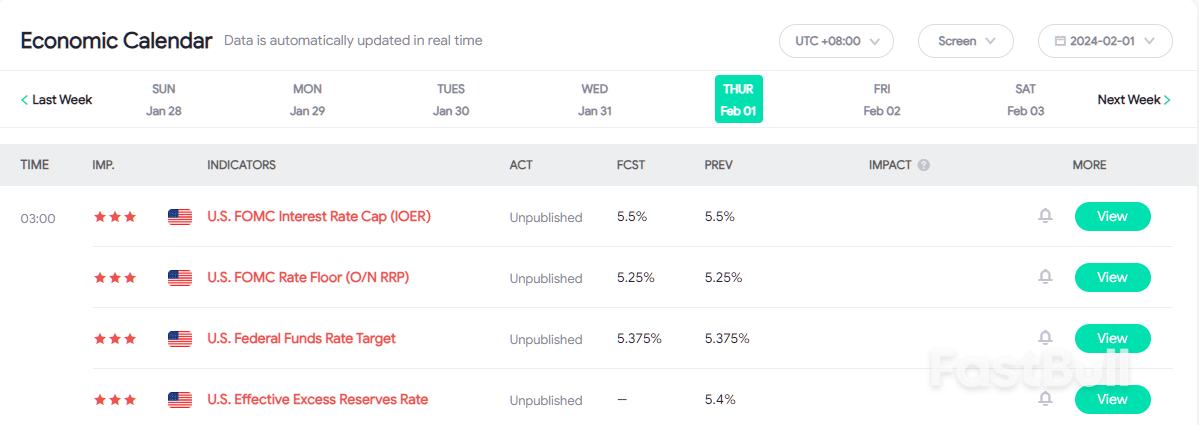
          Scheduled for announcement at 2:00 p.m. ET on Wednesday afternoon, the Federal Open Market Committee of the central bank is expected to reveal its decision, potentially keeping the federal funds rate steady at 5.375%.
          Fed Expected To Hold Rates Once Again_1
          Leading up to the announcement, certain Federal Reserve officials have been indicating that the current rate has been effective in moderating inflation toward the central bank's 2% target. The federal funds target rate has remained within the range of 5.25% to 5.5% since the summer, following a series of 11 increases initiated in March 2022.
          These rate hikes have elevated borrowing costs across the economy, contributing to a reduction in inflation, consequently restoring some consumer confidence. In December, the 12-month consumer price index reading held at 3.3%, showing minimal change from the previous month's 3.1%. The Fed's preferred inflation metric, the personal consumption expenditures price index, registered even lower at 2.6%.
          Earlier this month, Fed governor Christopher Waller remarked that the combination of slowing inflation and consistent employment gains has created an economic environment that is "almost as good as it gets." Waller expressed confidence that inflation is on a trajectory toward 2%, a sentiment reinforced by current economic and financial conditions.
          Simultaneously, two indicators of consumer confidence reflect a more positive outlook among Americans regarding the economy. The Conference Board's consumer confidence index reached a two-year high on Tuesday, citing "surging views of current conditions" and "declining pessimism about the future." Additionally, the University of Michigan's consumer confidence survey earlier this month recorded its highest level since 2021.
          Despite this, traders maintain confidence in the strength of the economy, with the likelihood of the Fed's initial rate cut in March currently estimated at 41%—a notable decrease from the 73% probability recorded a month earlier. Should the Fed proceed with an interest rate reduction in March, it would mark two years since the commencement of its initial rate hikes aimed at combating inflation.
          Nevertheless, the U.S. economy continues to surpass its international counterparts. In the October-December quarter, the 20 nations utilizing the euro currency narrowly averted a recession, showing almost negligible growth. Similar to the United States, the euro area experiences low unemployment, and inflation has decelerated to a 2.9% annual rate. While there is speculation that the European Central Bank might lower rates as early as April, some economists believe such a move may be more likely to occur in June.
          To stay updated on all economic events of today, please check out our Economic calendar
          Risk Warnings and Disclaimers
          You understand and acknowledge that there is a high degree of risk involved in trading. Following any strategies or investment methods may lead to potential losses. The content on the site is provided by our contributors and analysts for information purposes only. You are solely responsible for determining whether any trading assets, securities, strategy, or any other product is suitable for investing based on your own investment objectives and financial situation.
          Comments
          Add to Favorites
          Share

          Malaysia Welcomes New King in Unique Rotating Monarchy

          Thomas

          Political

          Sultan Ibrahim, the wealthy and outspoken ruler of Malaysia's southern Johor state, was sworn in as the country's new king in a ceremony on Wednesday.
          Malaysia practices a unique rotational form of monarchy, in which the heads of the country's nine royal families take turns to be king for a five-year reign.
          The monarchy plays a largely ceremonial role, but has become more influential in recent years due to prolonged political instability during which the king has wielded rarely used discretionary powers.
          How is the king installed?
          Nine of Malaysia's 13 states are headed by a traditional ethnic Malay ruler, mostly known as the sultan, in one of the world's largest monarchy systems.
          The constitutional monarchy was established after Malaysia's independence from Britain. Every five years, the nine rulers elect one among themselves to be Malaysia's king through a secret ballot.
          The order of rotation among the sultans was originally determined by seniority, based on how long they had been ruling.
          But that rule was dropped after all the royal families completed a term each and they now take turns based on the initial order.
          Who is Malaysia's new king?
          Sultan Ibrahim, 65, hails from the southern state of Johor whose sultanate can be traced back to the 16th century.
          While the monarchy is largely seen as above politics, Sultan Ibrahim is known for his views on governance and has said he has a good relationship with the prime minister.
          He owns a large collection of luxury cars and motorbikes and has wide-ranging business interests from real estate to mining. A company he has a stake in has a joint venture with struggling Chinese property developer Country Garden to develop a $100-billion project called Forest City in Johor.
          The sultan has publicly advocated establishing a special economic zone between Johor and neighbouring Singapore to strengthen ties and last year said he planned to revive a stalled high-speed rail project between Malaysia and the city-state.
          Johor is also the only sultanate allowed to maintain its own private army, as part of a deal for the state to join the Federation of Malaya before the country's independence in 1957.
          What are the king's powers?
          The monarch plays a largely ceremonial role and acts as custodian of Islam in the Muslim-majority country.
          The federal constitution requires the monarch to act upon the advice of the prime minister and cabinet with few exceptions.
          The king is allowed to appoint a prime minister who he believes has a parliamentary majority, a power never utilised until 2020 as the premier is typically picked through an election.
          But a series of political shocks in recent years has forced the monarchy to play a greater role, particularly during the reign of Sultan Ibrahim's predecessor, Al-Sultan Abdullah from Pahang state.
          Al-Sultan Abdullah has appointed the last three prime ministers - the first two after successive governments collapsed and most recently, in 2022, when he chose Anwar to be premier after an election that saw a hung parliament.
          The king also has the power to pardon convicted people. In 2018, the then-monarch Sultan Muhammad V pardoned Anwar, who was imprisoned on sodomy and corruption charges that he says were politically motivated.
          Former Prime Minister Najib Razak, who was jailed last year after a graft conviction linked to state fund 1MDB, has applied for a royal pardon. It is not known whether Najib's request will be reviewed by the new king.

          Source: The Hindu

          Risk Warnings and Disclaimers
          You understand and acknowledge that there is a high degree of risk involved in trading. Following any strategies or investment methods may lead to potential losses. The content on the site is provided by our contributors and analysts for information purposes only. You are solely responsible for determining whether any trading assets, securities, strategy, or any other product is suitable for investing based on your own investment objectives and financial situation.
          Comments
          Add to Favorites
          Share
          FastBull
          Copyright © 2025 FastBull Ltd

          728 RM B 7/F GEE LOK IND BLDG NO 34 HUNG TO RD KWUN TONG KLN HONG KONG

          TelegramInstagramTwitterfacebooklinkedin
          App Store Google Play Google Play
          Products
          Charts

          Chats

          Q&A with Experts
          Screeners
          Economic Calendar
          Data
          Tools
          Membership
          Features
          Function
          Markets
          Copy Trading
          Latest Signals
          Contests
          News
          Analysis
          24/7
          Columns
          Education
          Company
          Careers
          About Us
          Contact Us
          Advertising
          Help Center
          Feedback
          User Agreement
          Privacy Policy
          Business

          White Label

          Data API

          Web Plug-ins

          Poster Maker

          Affiliate Program

          Risk Disclosure

          The risk of loss in trading financial instruments such as stocks, FX, commodities, futures, bonds, ETFs and crypto can be substantial. You may sustain a total loss of the funds that you deposit with your broker. Therefore, you should carefully consider whether such trading is suitable for you in light of your circumstances and financial resources.

          No decision to invest should be made without thoroughly conducting due diligence by yourself or consulting with your financial advisors. Our web content might not suit you since we don't know your financial conditions and investment needs. Our financial information might have latency or contain inaccuracy, so you should be fully responsible for any of your trading and investment decisions. The company will not be responsible for your capital loss.

          Without getting permission from the website, you are not allowed to copy the website's graphics, texts, or trademarks. Intellectual property rights in the content or data incorporated into this website belong to its providers and exchange merchants.

          Not Logged In

          Log in to access more features

          FastBull Membership

          Not yet

          Purchase

          Become a signal provider
          Help Center
          Customer Service
          Dark Mode
          Price Up/Down Colors

          Log In

          Sign Up

          Position
          Layout
          Fullscreen
          Default to Chart
          The chart page opens by default when you visit fastbull.com