• Trade
  • Markets
  • Copy
  • Contests
  • News
  • 24/7
  • Calendar
  • Q&A
  • Chats
Trending
Screeners
SYMBOL
LAST
BID
ASK
HIGH
LOW
NET CHG.
%CHG.
SPREAD
SPX
S&P 500 Index
6846.50
6846.50
6846.50
6878.28
6827.18
-23.90
-0.35%
--
DJI
Dow Jones Industrial Average
47739.31
47739.31
47739.31
47971.51
47611.93
-215.67
-0.45%
--
IXIC
NASDAQ Composite Index
23545.89
23545.89
23545.89
23698.93
23455.05
-32.22
-0.14%
--
USDX
US Dollar Index
99.000
99.080
99.000
99.000
99.000
+0.050
+ 0.05%
--
EURUSD
Euro / US Dollar
1.16371
1.16379
1.16371
1.16388
1.16322
+0.00007
+ 0.01%
--
GBPUSD
Pound Sterling / US Dollar
1.33215
1.33227
1.33215
1.33220
1.33140
+0.00010
+ 0.01%
--
XAUUSD
Gold / US Dollar
4191.65
4192.09
4191.65
4193.27
4189.64
+1.95
+ 0.05%
--
WTI
Light Sweet Crude Oil
58.660
58.702
58.660
58.676
58.543
+0.105
+ 0.18%
--

Community Accounts

Signal Accounts
--
Profit Accounts
--
Loss Accounts
--
View More

Become a signal provider

Sell trading signals to earn additional income

View More

Guide to Copy Trading

Get started with ease and confidence

View More

Signal Accounts for Members

All Signal Accounts

Best Return
  • Best Return
  • Best P/L
  • Best MDD
Past 1W
  • Past 1W
  • Past 1M
  • Past 1Y

All Contests

  • All
  • Trump Updates
  • Recommend
  • Stocks
  • Cryptocurrencies
  • Central Banks
  • Featured News
Top News Only
Share

Japan Prime Minister Takaichi: 30 Injuries Reported So Far From Monday Earthquake

Share

USA Senate Committee Votes To Advance Nomination Of Jared Isaacman To Head Nasa

Share

Singapore Post - New Rate For Standard Regular Mail & Standard Large Mail Will Be S$0.62 And S$0.90 Respectively

Share

Australia's S&P/ASX 200 Index Down 0.27% At 8601.10 Points In Early Trade

Share

Trump: The USA Needs Mexico To Release 200000 Acre-Feet Of Water Before December 31St, And The Rest Must Come Soon After

Share

Trump: I Have Authorized Documentation To Impose A 5% Tariff On Mexico If This Water Isn't Released

Share

Brazil's Sao Paulo State Governor Tarcisio De Freitas Says Flavio Bolsonaro Will Have His Support - Cnn Brasil

Share

Ukraine's Security Must Be Guaranteed, In The Long Term, As A First Line Of Defence For Our Union, Says European Commission President

Share

Ukraine's Sovereignty Must Be Respected, Says European Commission President

Share

The Goal Is A Strong Ukraine, On The Battlefield And At The Negotiating Table, Says European Commission President

Share

As Peace Talks Are Ongoing, The EU Remains Ironclad In Its Support For Ukraine, Says European Commission President

Share

Pepsico: Asking USA-Based Pepna Employees As Well As Pbus Division Offices And Pfus Region Offices To Work Remotely This Week

Share

A U.S. Judge Ruled That President Trump’s Ban On Several Wind Power Projects Was Illegal

Share

Senior USA Administration Official: We Continue To Monitor Drc-Rwanda Situation Closely, Continue To Work With All Sides To Ensure Commitments Are Honored

Share

Israeli Military Says It Has Struck Infrastructure Belonging To Hezbollah In Several Areas In Southern Lebanon

Share

SPDR Gold Holdings Down 0.11%, Or 1.14 Tonnes

Share

On Monday (December 8), In Late New York Trading, S&P 500 Futures Fell 0.21%, Dow Jones Futures Fell 0.43%, NASDAQ 100 Futures Fell 0.08%, And Russell 2000 Futures Fell 0.04%

Share

Morgan Stanley: Data Center ABS Spreads Are Expected To Widen In 2026

Share

(US Stocks) The Philadelphia Gold And Silver Index Closed Down 2.34% At 311.01 Points. (Global Session) The NYSE Arca Gold Miners Index Closed Down 2.17%, Hitting A Daily Low Of 2235.45 Points; US Stocks Remained Slightly Down Before The Opening Bell—holding Steady Around 2280 Points—before Briefly Rising Slightly

Share

IMF: IMF Executive Board Approves Extension Of The Extended Credit Facility Arrangement With Nepal

TIME
ACT
FCST
PREV
France Trade Balance (SA) (Oct)

A:--

F: --

P: --
Euro Zone Employment YoY (SA) (Q3)

A:--

F: --

P: --
Canada Part-Time Employment (SA) (Nov)

A:--

F: --

P: --

Canada Unemployment Rate (SA) (Nov)

A:--

F: --

P: --

Canada Full-time Employment (SA) (Nov)

A:--

F: --

P: --

Canada Labor Force Participation Rate (SA) (Nov)

A:--

F: --

P: --

Canada Employment (SA) (Nov)

A:--

F: --

P: --

U.S. PCE Price Index MoM (Sept)

A:--

F: --

P: --

U.S. Personal Income MoM (Sept)

A:--

F: --

P: --

U.S. Core PCE Price Index MoM (Sept)

A:--

F: --

P: --

U.S. PCE Price Index YoY (SA) (Sept)

A:--

F: --

P: --

U.S. Core PCE Price Index YoY (Sept)

A:--

F: --

P: --

U.S. Personal Outlays MoM (SA) (Sept)

A:--

F: --

P: --
U.S. 5-10 Year-Ahead Inflation Expectations (Dec)

A:--

F: --

P: --

U.S. Real Personal Consumption Expenditures MoM (Sept)

A:--

F: --

P: --
U.S. Weekly Total Rig Count

A:--

F: --

P: --

U.S. Weekly Total Oil Rig Count

A:--

F: --

P: --

U.S. Consumer Credit (SA) (Oct)

A:--

F: --

P: --
China, Mainland Foreign Exchange Reserves (Nov)

A:--

F: --

P: --

Japan Trade Balance (Oct)

A:--

F: --

P: --

Japan Nominal GDP Revised QoQ (Q3)

A:--

F: --

P: --

China, Mainland Imports YoY (CNH) (Nov)

A:--

F: --

P: --

China, Mainland Exports (Nov)

A:--

F: --

P: --

China, Mainland Imports (CNH) (Nov)

A:--

F: --

P: --

China, Mainland Trade Balance (CNH) (Nov)

A:--

F: --

P: --

China, Mainland Exports YoY (USD) (Nov)

A:--

F: --

P: --

China, Mainland Imports YoY (USD) (Nov)

A:--

F: --

P: --

Germany Industrial Output MoM (SA) (Oct)

A:--

F: --

P: --
Euro Zone Sentix Investor Confidence Index (Dec)

A:--

F: --

P: --

Canada National Economic Confidence Index

A:--

F: --

P: --

U.K. BRC Like-For-Like Retail Sales YoY (Nov)

--

F: --

P: --

U.K. BRC Overall Retail Sales YoY (Nov)

--

F: --

P: --

Australia Overnight (Borrowing) Key Rate

--

F: --

P: --

RBA Rate Statement
RBA Press Conference
Germany Exports MoM (SA) (Oct)

--

F: --

P: --

U.S. NFIB Small Business Optimism Index (SA) (Nov)

--

F: --

P: --

Mexico 12-Month Inflation (CPI) (Nov)

--

F: --

P: --

Mexico Core CPI YoY (Nov)

--

F: --

P: --

Mexico PPI YoY (Nov)

--

F: --

P: --

U.S. Weekly Redbook Index YoY

--

F: --

P: --

U.S. JOLTS Job Openings (SA) (Oct)

--

F: --

P: --

China, Mainland M1 Money Supply YoY (Nov)

--

F: --

P: --

China, Mainland M0 Money Supply YoY (Nov)

--

F: --

P: --

China, Mainland M2 Money Supply YoY (Nov)

--

F: --

P: --

U.S. EIA Short-Term Crude Production Forecast For The Year (Dec)

--

F: --

P: --

U.S. EIA Natural Gas Production Forecast For The Next Year (Dec)

--

F: --

P: --

U.S. EIA Short-Term Crude Production Forecast For The Next Year (Dec)

--

F: --

P: --

EIA Monthly Short-Term Energy Outlook
U.S. API Weekly Gasoline Stocks

--

F: --

P: --

U.S. API Weekly Cushing Crude Oil Stocks

--

F: --

P: --

U.S. API Weekly Crude Oil Stocks

--

F: --

P: --

U.S. API Weekly Refined Oil Stocks

--

F: --

P: --

South Korea Unemployment Rate (SA) (Nov)

--

F: --

P: --

Japan Reuters Tankan Non-Manufacturers Index (Dec)

--

F: --

P: --

Japan Reuters Tankan Manufacturers Index (Dec)

--

F: --

P: --

Japan Domestic Enterprise Commodity Price Index MoM (Nov)

--

F: --

P: --

Japan Domestic Enterprise Commodity Price Index YoY (Nov)

--

F: --

P: --

China, Mainland PPI YoY (Nov)

--

F: --

P: --

China, Mainland CPI MoM (Nov)

--

F: --

P: --

Italy Industrial Output YoY (SA) (Oct)

--

F: --

P: --

Q&A with Experts
    • All
    • Chatrooms
    • Groups
    • Friends
    Connecting
    .
    .
    .
    Type here...
    Add Symbol or Code

      No matching data

      All
      Trump Updates
      Recommend
      Stocks
      Cryptocurrencies
      Central Banks
      Featured News
      • All
      • Russia-Ukraine Conflict
      • Middle East Flashpoint
      • All
      • Russia-Ukraine Conflict
      • Middle East Flashpoint
      Search
      Products

      Charts Free Forever

      Chats Q&A with Experts
      Screeners Economic Calendar Data Tools
      Membership Features
      Data Warehouse Market Trends Institutional Data Policy Rates Macro

      Market Trends

      Market Sentiment Order Book Forex Correlations

      Top Indicators

      Charts Free Forever
      Markets

      News

      News Analysis 24/7 Columns Education
      From Institutions From Analysts
      Topics Columnists

      Latest Views

      Latest Views

      Trending Topics

      Top Columnists

      Latest Update

      Signals

      Copy Rankings Latest Signals Become a signal provider AI Rating
      Contests
      Brokers

      Overview Brokers Assessment Rankings Regulators News Claims
      Broker listing Forex Brokers Comparison Tool Live Spread Comparison Scam
      Q&A Complaint Scam Alert Videos Tips to Detect Scam
      More

      Business
      Events
      Careers About Us Advertising Help Center

      White Label

      Data API

      Web Plug-ins

      Affiliate Program

      Awards Institution Evaluation IB Seminar Salon Event Exhibition
      Vietnam Thailand Singapore Dubai
      Fans Party Investment Sharing Session
      FastBull Summit BrokersView Expo
      Recent Searches
        Top Searches
          Markets
          News
          Analysis
          User
          24/7
          Economic Calendar
          Education
          Data
          • Names
          • Latest
          • Prev

          View All

          No data

          Scan to Download

          Faster Charts, Chat Faster!

          Download App
          English
          • English
          • Español
          • العربية
          • Bahasa Indonesia
          • Bahasa Melayu
          • Tiếng Việt
          • ภาษาไทย
          • Français
          • Italiano
          • Türkçe
          • Русский язык
          • 简中
          • 繁中
          Open Account
          Search
          Products
          Charts Free Forever
          Markets
          News
          Signals

          Copy Rankings Latest Signals Become a signal provider AI Rating
          Contests
          Brokers

          Overview Brokers Assessment Rankings Regulators News Claims
          Broker listing Forex Brokers Comparison Tool Live Spread Comparison Scam
          Q&A Complaint Scam Alert Videos Tips to Detect Scam
          More

          Business
          Events
          Careers About Us Advertising Help Center

          White Label

          Data API

          Web Plug-ins

          Affiliate Program

          Awards Institution Evaluation IB Seminar Salon Event Exhibition
          Vietnam Thailand Singapore Dubai
          Fans Party Investment Sharing Session
          FastBull Summit BrokersView Expo

          Investors Reprice AI Ambitions as Data Center Growth Outruns Monetization

          Adam

          Stocks

          Summary:

          AI stocks stumble as data-center spending outruns revenue, valuations stretch, and funding jitters grow — hitting smaller players first while megacaps and chipmakers remain better positioned.

          There’s a fine line between a bubble and a market simply tripping over its own shoelaces when too many risk events collide at once. Right now, global equities feel less like 1999 mania and more like a high-speed convoy hitting a patch of converging hazards — AI funding math coming due, data-center capex that refuses to stay in its lane, geopolitics flaring, and bond markets twitching under the weight of the Fed’s hawkish recalibration. In this kind of traffic, even normal corrections look like smoke on the horizon.
          But let’s start with the so-called AI bubble — the narrative du jour that refuses to die. You can practically hear the old-school market sages muttering that you only recognize a bubble in the rear-view mirror. And yet, the chatter today isn’t coming from the usual cranks; it’s bubbling up because expectations have sprinted well ahead of reality.
          That alone doesn’t make this a ticking time bomb. It makes it what the early innings of every transformative tech cycle look like: investors pricing futures that haven’t been built yet.
          The real fracture zone isn’t mystical; it’s steel, concrete, transformers, and debt. The data-center buildout remains the beating heart of the AI capex surge, and the industry is laying track faster than the revenue trains can realistically run on it. The OpenAI–Nvidia (NASDAQ:NVDA) $100bn blueprint is a perfect example — only a tenth of that is actually committed, the other nine-tenths is vapor until demand proves itself and someone coughs up the financing.
          For now, capacity is tight, not excessive. But plotted forward on any reasonable trajectory, supply catches up long before the monetization curve does.
          Sam Altman practically admitted as much by pinning future revenue on products that don’t exist yet — enterprise expansions, cloud forays, robotics detours. That isn’t delusion; it’s the classic “we’ll grow into it” mantra that every capex-heavy revolution chants. But it also underscores the gulf between the cost of the buildout and the revenues needed to justify it. That’s the gap critics keep poking at — and they aren’t wrong to keep poking.
          Still, handicapping growth is very different from claiming the technology will never pay its way. The deeper bubble risk lies not in the cranes and fiber lines but in the LLMs themselves: hallucinations, latency, and cost-to-run economics that, if left unresolved, could render wide swathes of AI chronically uneconomic. If that turns structural, then the capex overhang becomes a millstone. We just don’t know yet.
          What we do know is that markets don’t wait patiently for clarity. If investors get spooked first — if the funding wheels wobble, if the AI debt machine hesitates — the selloff becomes its own self-fulfilling prophecy. That’s where the real correction risk lives: not in an implosion, but in a capital-rationing reset that forces weaker players to tap out.
          OpenAI, Palantir (NASDAQ:PLTR), the single-product darlings with extreme multiples? They’d feel the blade first. Google (NASDAQ:GOOGL) and Microsoft (NASDAQ:MSFT), sitting on Fort Knox balance sheets and distribution dominance, would simply absorb the oxygen that others can’t afford.
          And that’s the nuance missing from the “AI bubble” hot takes. Yes, some names are hanging on P/E ratios that assume everything breaks right. Palantir at 250x is expecting a hero’s journey with no bad chapters. Some will require years — maybe a decade — to grow into those skins. But the megacaps? Their multiples aren’t even nosebleed by the standards of this decade. If anything, the concentration risk has masked how un-bubbly the broader tech complex actually looks.
          Meanwhile, the picks-and-shovels trade — the chips — is still running flat-out. AMD (NASDAQ:AMD) flagging a $1tn annual AI silicon market by 2030, with Nvidia set to reprise its earnings blowtorch next week. Yes, chip stocks are brutally cyclical, and yes, a data-center slowdown would bite hard. But no one sees that slowdown in the windshield right now.
          So are we living through bubble trouble, or just a garden-variety correction amplified by too many risk wires crossing at once? The truth sits somewhere in the middle. Parts of the AI complex are priced for perfection. Parts are priced as industrials-in-disguise. And parts — the data-center landlords, the chip vendors, the hyperscaler balance-sheet giants — are behaving nothing like a speculative bubble.
          Call it what it is: a crowded runway with far too many planes trying to take off at once. The turbulence isn’t proof of a crash. It’s the predictable shake when the air currents of rate risk, capex math, valuation gravity, and AI ambition finally converge in the same pocket of sky.

          Source: investing

          Risk Warnings and Disclaimers
          You understand and acknowledge that there is a high degree of risk involved in trading. Following any strategies or investment methods may lead to potential losses. The content on the site is provided by our contributors and analysts for information purposes only. You are solely responsible for determining whether any trading assets, securities, strategy, or any other product is suitable for investing based on your own investment objectives and financial situation.
          Add to Favorites
          Share

          Japan's fight with yen bears dulled by Takaichi's doves

          Adam

          Economic

          As Japanese authorities once again battle a slide in the yen, their efforts this time are struggling for traction, undermined by new prime minister Sanae Takaichi's promotion of advocates of big fiscal and monetary stimulus to key posts.
          While Tokyo officials this week warned against sharp downward moves in the currency, maintaining the jawboning of previous administrations, their voices are increasingly competing with calls by new policy advisers preaching the benefits of a weak yen.
          A proponent of expansionary fiscal and monetary policy, Takaichi filled seats in key government panels with advocates of big spending backed by low interest rates - policies that work to depreciate the yen's value.
          For one, Takuji Aida, an economist who joined a panel on the government's growth strategy, stressed the benefits of a weak yen such as easing the blow to manufacturers from U.S. tariffs.
          The reflationists' sanguine view on the weak yen contrasts with the concerns of previous administrations, who primarily focused on cost of living pressures caused by the currency's impact on imported inflation.
          "The Takaichi administration hasn't escalated its warning, which suggests it is tolerating a weak yen," said Masafumi Yamamoto, chief currency strategist at Mizuho Securities.
          "Given the administration doesn't seem to prioritise combatting a weak yen, it would take a slide below 155 per dollar for it to escalate verbal warnings and a fall below 160 to contemplate direct intervention in the market," he said.
          To be sure, Finance Minister Satsuki Katayama warned on Wednesday that authorities were vigilant to "one-sided, sharp moves" in the exchange-rate market, adding the negative aspects of a weak yen have become more pronounced than the positives.
          But the remarks failed to prop up the yen as they were short of more direct threats of currency intervention, such as that authorities were ready to take "decisive action."
          Underscoring a lack of consensus within the administration, economic revitalisation minister, Minoru Kiuchi, said last month the weak yen had benefits to growth. On Tuesday, he said the boost to import costs from a weak yen was fading.
          Such views have also helped fuel market expectations the Bank of Japan will be forced to go slow in raising interest rates, pushing the yen to a record low against the euro and a nine-month trough versus the U.S. dollar.
          The dollar has risen about 5% against the yen since Takaichi won the ruling party's leadership race on October 4. It stood around 154.50 yen on Friday, after breaking a key milestone of 155 earlier this week.
          INTERVENTION HURDLE HIGH
          Japan last intervened in the currency market in July 2024 when the yen fell to a 38-year low of around 161.96 to the dollar. The BOJ also raised interest rates to 0.25% that month, causing the yen to strengthen to around 150 per dollar.
          Such concerted action highlighted the concern then-premier Fumio Kishida had about a weak yen.
          By contrast, Takaichi and her reflationist aides are fans of "Abenomics," a mix of big spending and bold monetary easing deployed in 2013. The policies helped reverse sharp yen rises blamed for prolonging deflation and economic stagnation.
          Now, a weak yen has become a pain point for an economy that relies heavily on fuel and food imports. Yen declines have kept inflation above the BOJ's 2% target for well over three years, causing grumblings from households hit by rising living costs.
          Mindful of broadening inflationary pressures, BOJ Governor Kazuo Ueda signaled the chance of a hike as soon as next month.
          But Takaichi and her finance minister both made clear their displeasure over a near-term rate hike, saying Japan has yet to see inflation durably achieve the BOJ's target.
          Almost a year since its last rate hike in January, investors have taken comfort in selling yen on prospects the BOJ is unlikely to hike steadily at a set pace.
          "There's a higher chance than initially thought that Takaichi's administration would favour reflationary policies," said Ryutaro Kono, chief Japan economist at BNP Paribas.
          "Given the administration's policy stance as suggested by the recent personnel appointments, it's hard to project the BOJ accelerating its pace of rate hikes," said Kono, who now expects the bank to hike twice next year instead of three times.
          If BOJ rate hikes were put on hold, the only remaining tool to counter yen falls would be currency intervention.
          But getting consent from Washington may be tough as U.S. Treasury Secretary Scott Bessent has repeatedly signaled that rate hikes are the best way to prop up the yen.
          Former BOJ official Toru Sasaki expects Japan to hold off intervening unless the yen falls below 165 to the dollar.
          "Conducting yen-buying intervention at a time Japan's real interest rates remain deeply negative would be wasting foreign reserves."

          Source: reuters

          To stay updated on all economic events of today, please check out our Economic calendar
          Risk Warnings and Disclaimers
          You understand and acknowledge that there is a high degree of risk involved in trading. Following any strategies or investment methods may lead to potential losses. The content on the site is provided by our contributors and analysts for information purposes only. You are solely responsible for determining whether any trading assets, securities, strategy, or any other product is suitable for investing based on your own investment objectives and financial situation.
          Add to Favorites
          Share

          Switzerland Wins Tariff Rate Cut To 15% In US Trade Deal

          Devin

          Economic

          The United States will slash its tariffs on goods from Switzerland to 15% from a crippling 39% under a new framework trade agreement, the Swiss government said on Friday.

          The announcement followed U.S. Trade Representative Jamieson Greer saying a deal between the two countries had been reached, adding that details would be announced later on Friday.

          Richemont Chair Johann Rupert, who met President Donald Trump in the White House last week as part of a delegation of Swiss business executives, earlier had said he thought the punitive tariffs imposed by Washington were the result of a "misunderstanding" that would be cleared up quickly.

          "The Swiss and the Americans are very much the same -- independent, don't like big government etc. etc., so I think this misunderstanding will be cleared up this week," Rupert told reporters after Richemont reported its latest results.

          "I think we will hear more, from what I've gathered, we'll hear something today," Rupert said.

          Swiss Economy Minister Guy Parmelin returned home on Friday after talks with Greer in Washington, saying: "We clarified virtually everything."

          Parmelin declined to provide details of the discussions but said there would be further communication when everything is "finally clear."

          The government gave no new details on Friday.

          A Swiss source, speaking on condition of anonymity, said after the Thursday meeting that a deal had effectively been reached.

          A senior U.S. official said the meeting was "very positive."

          Richemont's Rupert met Trump last week to discuss the impact of tariffs, along with executives from MSC, Rolex, Partners Group, Mercuria, and MKS.

          The meeting helped thaw relations with Washington, Swiss media reported, and Trump said earlier this week he was working on a deal to lower the tariffs on goods from Switzerland.

          Rupert said it could be months before a deal is signed.

          "It's dependent on President Trump, who's a very busy man. Our situation in Switzerland is one of the things he has to deal with," he said.

          Swiss industry on Friday reported a 14% fall in exports to the U.S. during the three months to the end of September, technology industry association Swissmem said, while machine tool makers saw shipments slump 43%.

          A potential reduction in tariffs to 15% would stabilise the Swiss economy, Rupert said, and prevent job losses caused by the higher duty.

          "It's not only us," he added. "It's potentially devastating for the whole of Switzerland."

          Source: Asia_Nikkei

          To stay updated on all economic events of today, please check out our Economic calendar
          Risk Warnings and Disclaimers
          You understand and acknowledge that there is a high degree of risk involved in trading. Following any strategies or investment methods may lead to potential losses. The content on the site is provided by our contributors and analysts for information purposes only. You are solely responsible for determining whether any trading assets, securities, strategy, or any other product is suitable for investing based on your own investment objectives and financial situation.
          Add to Favorites
          Share

          Crash Victims' Families Appeal US Judge's Decision To Dismiss Boeing Criminal Case

          Winkelmann

          Stocks

          Economic

          Key points:

          · Case involves fatal crashes in 2018 and 2019 that killed 346 people
          · Boeing had agreed to plead guilty during Biden administration
          · Judge said he had no authority to reject deal struck under Trump administration

          Families of some victims of two Boeing737 MAX plane crashes that killed 346 people asked a U.S. appeals court on Thursday to reverse a judge's decision to approve the Justice Department's request to dismiss a criminal case against the planemaker.

          Judge Reed O'Connor, of U.S. District Court in Fort Worth, Texas, last week approved the request by the Trump administration's Justice Department, but harshly criticized the government's decision.

          He said he did not agree that dismissing the case, which had been pursued under the Biden administration and initially resulted in an admission of guilt, was in the public interest.

          The families asked the 5th Circuit Court to reverse his decision. They said the Justice Department violated their rights as crime victims when it negotiated a deferred prosecution deal with Boeing over a fraud charge stemming from false representations the planemaker made to the Federal Aviation Administration.

          "We believe that the courts don't have to stand silently by while an injustice is perpetrated," said Paul Cassell, a lawyer for some of the families. "The charges against Boeing cannot simply be dropped."

          Boeing did not immediately respond to a request for comment on Thursday. The Justice Department last week rejected the judge's criticism and said it believed the deal was "the most just outcome."

          O'Connor said in 2023 that "Boeing's crime may properly be considered the deadliest corporate crime in U.S. history."

          He said he had no authority to reject the government's decision to make a deal with Boeing, even though it "fails to secure the necessary accountability to ensure the safety of the flying public."

          Boeing last year had agreed to plead guilty to a criminal fraud conspiracy charge after the fatal 737 MAX crashes in Indonesia and Ethiopia in 2018 and 2019.

          After U.S. PresidentDonald Trumptook office, the Justice Department reversed course in May and dropped the demand for a guilty plea.

          Under the deal, Boeing agreed to pay an additional $444.5 million into a crash victims' fund to be divided evenly per victim of the two fatal 737 MAX crashes, on top of a new $243.6 million fine and more than $455 million to strengthen the company's compliance, safety, and quality programs.

          In September, the FAA proposed fining Boeing $3.1 million for a series of safety violations, including actions tied to a January 2024 Alaska Airlines 737 MAX 9 mid-air emergency, and for interfering with safety officials' independence.

          Separately, a jury in Chicago on Wednesday ordered Boeing to pay more than $28 million to the family of Shikha Garg, a United Nations environmental worker who was killed in the crash in Ethiopia. Under a deal between the parties, the family will receive $35.85 million - the full verdict amount plus 26% interest - and Boeing will not appeal.

          Source: TradingView

          To stay updated on all economic events of today, please check out our Economic calendar
          Risk Warnings and Disclaimers
          You understand and acknowledge that there is a high degree of risk involved in trading. Following any strategies or investment methods may lead to potential losses. The content on the site is provided by our contributors and analysts for information purposes only. You are solely responsible for determining whether any trading assets, securities, strategy, or any other product is suitable for investing based on your own investment objectives and financial situation.
          Add to Favorites
          Share

          U.S. debt fears replace shutdown drama as gold trades around $4,200

          Adam

          Commodity

          After 43 days, the U.S. government is back in business, and while the end of the longest government shutdown in history has improved geopolitical sentiment, it has done little to stifle gold’s bullish momentum.
          The yellow metal continues to see a solid recovery from last month’s sharp selloff. Spot gold is holding new support at $4,200 an ounce.
          Although geopolitical uncertainty has diminished slightly, one analyst expects the focus to shift to a much bigger problem: the U.S. government’s unsustainable debt, which continues to rise as President Donald Trump shows himself to be another spendthrift politician.
          Trump has once again made headlines as he promises to send Americans $2,000 checks using money raised from elevated tariffs. He has also promised $10,000 bonuses for “patriot” air traffic controllers. Trump has further floated the idea of creating 50-year mortgages.
          Nicky Shiels, Head of Research and Metals Strategy at MKS PAMP, said this fiscal environment is positive for hard assets like gold and silver.
          “All this is simply bringing forward stimulus to the broader economy, because the administration understands parts of the economy are slowing; it’s a preview of what's to come (stimulus) into midterms. Trump is going to run the U.S. hot at the expense of deficits & the US’ fiscal state into Nov ’26, because they must pivot more populist following recent election results,” she said in a note.
          The U.S. government already has difficulty selling its debt. This week, the U.S. Treasury saw weaker-than-expected participation in both 10-year and 30-year bond auctions. Analysts note that 30-year bond sales have been soft for most of this year.
          Shiels said that Trump’s 50-year mortgage idea could be the most problematic. While American consumers would have lower monthly housing costs, the interest on a 50-year mortgage would be nearly double.
          “Essentially, it's just an IOM, effectively just renting a place from the bank, and importantly, it might be a path to the 50yr Treasury bond and terming out the debt,” she said.
          Looking ahead, Shiels said that all this financial market uncertainty could continue to support gold and silver prices, and investors might even see a Santa Claus rally into the new year.

          Source: kitco

          Risk Warnings and Disclaimers
          You understand and acknowledge that there is a high degree of risk involved in trading. Following any strategies or investment methods may lead to potential losses. The content on the site is provided by our contributors and analysts for information purposes only. You are solely responsible for determining whether any trading assets, securities, strategy, or any other product is suitable for investing based on your own investment objectives and financial situation.
          Add to Favorites
          Share

          Fed’s Schmid Unsure Of December Cut, Says Policy Where ’it Should Be’

          Olivia Brooks

          Political

          Economic

          Kansas City Federal Reserve President Jeffrey Schmid indicated Friday that he might dissent again at the Fed's December meeting if policymakers decide to cut interest rates further, citing persistent inflation concerns that extend beyond tariff impacts.

          Schmid was one of two officials who opposed the Fed's October decision to lower the policy rate by a quarter percentage point to the 3.75%-4.00% range. In his remarks at an energy conference in Denver co-hosted by the Dallas and Kansas City Fed banks, he explained his position.

          "I view the current stance of monetary policy as being only modestly restrictive, which is about where I think it should be," Schmid said, reiterating his belief that cooling in the U.S. job market stems from structural changes that lower interest rates cannot address.

          The Kansas City Fed president expressed concern that additional rate cuts could undermine the Fed's 2% inflation target. "This was my rationale for dissenting against the rate cut at the last meeting and one that continues to guide my thoughts as I head into the meeting in December," he stated, while noting his final decision would depend on upcoming economic data.

          Schmid emphasized that his inflation worries go beyond tariffs. "Though tariffs are likely contributing to higher prices, my concerns are much broader than tariffs alone," he said, pointing to uncertainty about when and how businesses will pass higher costs to consumers.

          Several Fed policymakers have voiced similar inflation concerns since the October meeting, creating tension with those who fear the labor market could deteriorate without further rate cuts. This division suggests the December 9-10 meeting will involve intense debate.

          Schmid also warned about inflation expectations, saying the Fed has "no room to be complacent" and that "persistent inflation can shift the psychology around price-setting, and inflation can become ingrained." He cautioned, "It is unlikely that we will still be talking about soft landings in that situation."

          Source: Investing

          To stay updated on all economic events of today, please check out our Economic calendar
          Risk Warnings and Disclaimers
          You understand and acknowledge that there is a high degree of risk involved in trading. Following any strategies or investment methods may lead to potential losses. The content on the site is provided by our contributors and analysts for information purposes only. You are solely responsible for determining whether any trading assets, securities, strategy, or any other product is suitable for investing based on your own investment objectives and financial situation.
          Add to Favorites
          Share

          The Bearish Bond Narrative Fades

          Adam

          Bond

          Not that long ago, bond yields were rising as concerns over deficits, inflation, and a series of bad Treasury auctions were paraded through the media. We bring this to your attention as the 10-year Treasury auction on Wednesday was on the weaker side, yet the bond market reaction was minimal.
          Additionally, government deficits are just as problematic today as they were in May when the 30-year Treasury bond hit 5.15%. In May, when yields were peaking and bond market narratives, such as the bearish bond sentiment, were spreading fear of much higher yields, year-over-year CPI was 2.37%. Today it’s a touch over 3%.
          Since May, bond yields have fallen by about half a percentage point, yet inflation has moved higher, and there doesn’t seem to be an end to excessive government spending. Furthermore, the Fed has been conducting QT, which drains liquidity and leaves the supply of Treasury bonds higher than it would otherwise be. What this tells us is that the bearish bond narrative has lost its steam. As we wrote in January:
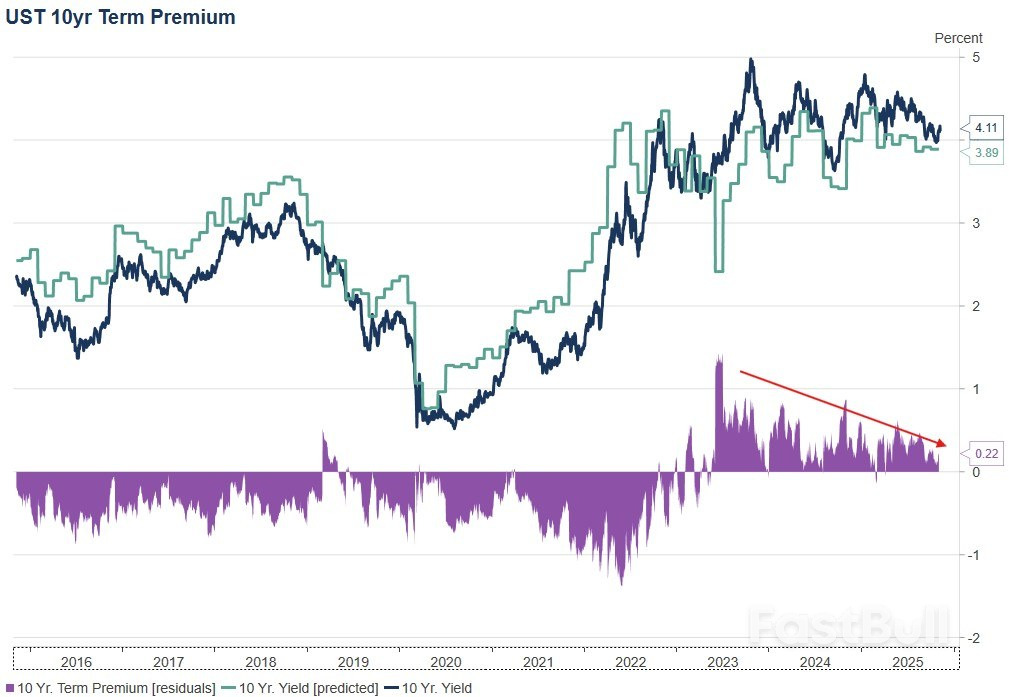
          Bond investor sentiment does impact yields and can be relatively accurately quantified, unlike the stock market. In bond market parlance sentiment is called the “term premium or discount.”Quantifying the term premium or discount and, equally important, understanding the market narratives responsible for the premium or discount is valuable.
          With such knowledge, one can assess whether the narratives make sense. Thus, is the premium or discount likely to be sustained? If the narrative(s) are illogical, there could be an opportunity to profit when the premium or discount normalizes.
          The graph below shows that the term premium (purple) has steadily declined, suggesting the narrative, particularly the bearish bond sentiment, is less impactful than it was.
          The Bearish Bond Narrative Fades_1
          The Big Short Shuts Down
          Michael Burry, famed for predicting the 2008 housing/subprime crash and his likeness played a lead role in Michael Lewis’s book and movie The Big Short, is exiting his hedge fund, Scion Asset Management. Recently, he deregistered with the SEC and sent the letter below to his clients.
          Scion only managed $155 million as of their last reporting date. While his hedge fund was small, his social media presence was significant. Recently, Burry has been pointing out that the depreciation periods some of Nvidia’s (NASDAQ:NVDA) clients are taking for their chips are much longer than the chips’ useful lives.
          Doing so inflates earnings by decreasing expenses. Per Benzinga, he estimates that Oracle’s (NYSE:ORCL) profits could be overstated by 26.9% and Meta’s (NASDAQ:META) by 20.8%. Furthermore, he recently hinted at more details in a forthcoming disclosure on November 25 amid his broader bearish bets, including short positions on Nvidia and Palantir (NASDAQ:PLTR) and a discussion of bond issuance by Meta and Google (NASDAQ:GOOGL).
          The Bearish Bond Narrative Fades_2
          Healthcare Stocks Rebound: Which Sector Is Next?
          For a good chunk of this year, healthcare stocks lagged the broader S&P 500. In fact, on July 22, we wrote a Commentary titled Will The Healthcare Sector Be The Next Rotation? In that article, we wrote:
          As shown below, the P/E ratio of the healthcare sector compared to the S&P 500 is the lowest it has been in the last 30 years. Moreover, its absolute P/E is in the lower third of readings over the past 30 years. The sector is also very cheap and very oversold on a shorter-term technical basis.
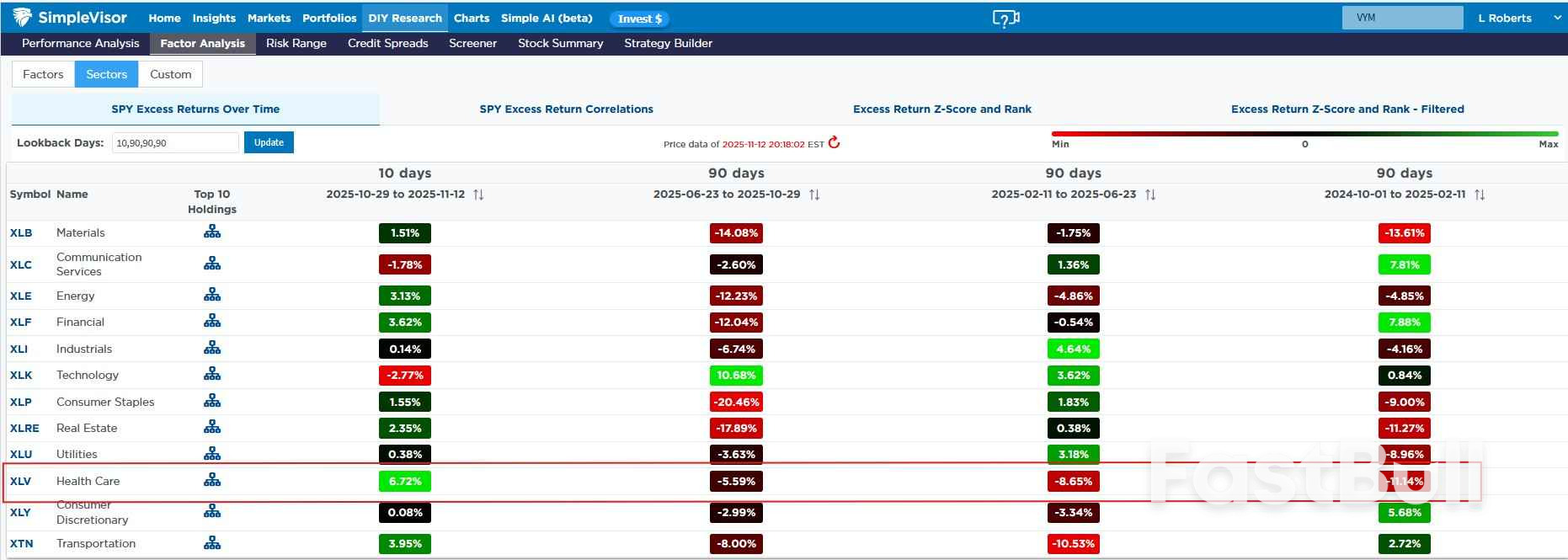
          The answer to our article is yes, healthcare stocks have recently rotated into favor. The table below shows the relative performance of each sector versus the S&P 500 over the last 10 days and in 90-day increments going back to late 2024. As shown, healthcare stocks have outperformed the market by 6.72% over the last 10 days.
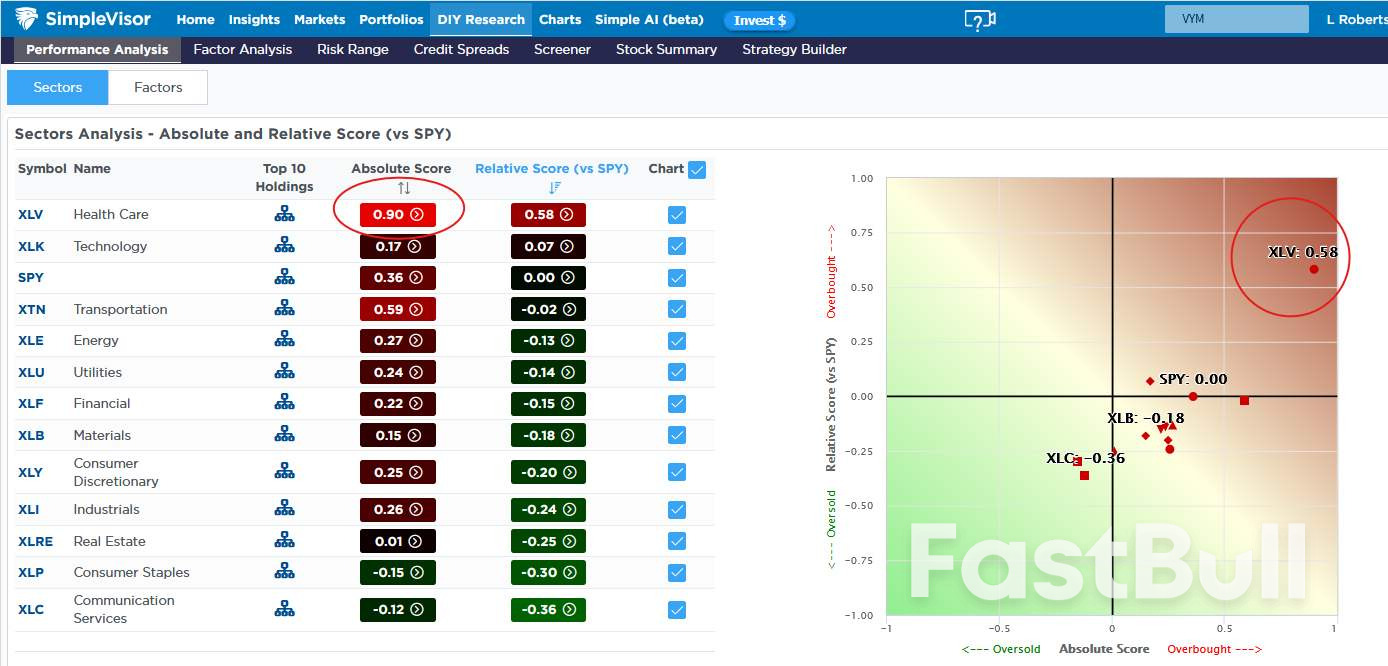
          Further, the graphic below the table shows that recent buying in healthcare has brought its absolute score to .90, which is a very overbought level. While the sector may consolidate on both relative and absolute terms, it still has significant room to catch up with the broader market. Compare the recent 10-day returns in the table to the prior three sets of 90-day returns for context.
          Are the staples, financial, or energy sector next to follow the healthcare lead and play catch-up?
          The Bearish Bond Narrative Fades_3The Bearish Bond Narrative Fades_4

          Source: investing

          Risk Warnings and Disclaimers
          You understand and acknowledge that there is a high degree of risk involved in trading. Following any strategies or investment methods may lead to potential losses. The content on the site is provided by our contributors and analysts for information purposes only. You are solely responsible for determining whether any trading assets, securities, strategy, or any other product is suitable for investing based on your own investment objectives and financial situation.
          Add to Favorites
          Share
          FastBull
          Copyright © 2025 FastBull Ltd

          728 RM B 7/F GEE LOK IND BLDG NO 34 HUNG TO RD KWUN TONG KLN HONG KONG

          TelegramInstagramTwitterfacebooklinkedin
          App Store Google Play Google Play
          Products
          Charts

          Chats

          Q&A with Experts
          Screeners
          Economic Calendar
          Data
          Tools
          Membership
          Features
          Function
          Markets
          Copy Trading
          Latest Signals
          Contests
          News
          Analysis
          24/7
          Columns
          Education
          Company
          Careers
          About Us
          Contact Us
          Advertising
          Help Center
          Feedback
          User Agreement
          Privacy Policy
          Business

          White Label

          Data API

          Web Plug-ins

          Poster Maker

          Affiliate Program

          Risk Disclosure

          The risk of loss in trading financial instruments such as stocks, FX, commodities, futures, bonds, ETFs and crypto can be substantial. You may sustain a total loss of the funds that you deposit with your broker. Therefore, you should carefully consider whether such trading is suitable for you in light of your circumstances and financial resources.

          No decision to invest should be made without thoroughly conducting due diligence by yourself or consulting with your financial advisors. Our web content might not suit you since we don't know your financial conditions and investment needs. Our financial information might have latency or contain inaccuracy, so you should be fully responsible for any of your trading and investment decisions. The company will not be responsible for your capital loss.

          Without getting permission from the website, you are not allowed to copy the website's graphics, texts, or trademarks. Intellectual property rights in the content or data incorporated into this website belong to its providers and exchange merchants.

          Not Logged In

          Log in to access more features

          FastBull Membership

          Not yet

          Purchase

          Become a signal provider
          Help Center
          Customer Service
          Dark Mode
          Price Up/Down Colors

          Log In

          Sign Up

          Position
          Layout
          Fullscreen
          Default to Chart
          The chart page opens by default when you visit fastbull.com