Markets
News
Analysis
User
24/7
Economic Calendar
Education
Data
- Names
- Latest
- Prev



Signal Accounts for Members
All Signal Accounts
All Contests


France Trade Balance (SA) (Nov)A:--
F: --
France Current Account (Not SA) (Nov)A:--
F: --
P: --
South Africa Manufacturing PMI (Dec)A:--
F: --
P: --
Italy Unemployment Rate (SA) (Nov)A:--
F: --
P: --
France 10-Year OAT Auction Avg. YieldA:--
F: --
P: --
Euro Zone Consumer Inflation Expectations (Dec)A:--
F: --
P: --
Euro Zone Unemployment Rate (Nov)A:--
F: --
P: --
Euro Zone PPI MoM (Nov)A:--
F: --
P: --
Euro Zone Selling Price Expectations (Dec)A:--
F: --
P: --
Euro Zone PPI YoY (Nov)A:--
F: --
P: --
Euro Zone Industrial Climate Index (Dec)A:--
F: --
P: --
Euro Zone Economic Sentiment Indicator (Dec)A:--
F: --
Euro Zone Services Sentiment Index (Dec)A:--
F: --
Euro Zone Consumer Confidence Index Final (Dec)A:--
F: --
P: --
Mexico 12-Month Inflation (CPI) (Dec)A:--
F: --
P: --
Mexico Core CPI YoY (Dec)A:--
F: --
P: --
Mexico PPI YoY (Dec)A:--
F: --
P: --
Mexico CPI YoY (Dec)A:--
F: --
P: --
U.S. Challenger Job Cuts MoM (Dec)A:--
F: --
P: --
U.S. Challenger Job Cuts (Dec)A:--
F: --
P: --
U.S. Challenger Job Cuts YoY (Dec)A:--
F: --
P: --
U.S. Exports (Oct)A:--
F: --
P: --
U.S. Trade Balance (Oct)A:--
F: --
U.S. Initial Jobless Claims 4-Week Avg. (SA)A:--
F: --
Canada Imports (SA) (Oct)A:--
F: --
U.S. Weekly Initial Jobless Claims (SA)A:--
F: --
U.S. Weekly Continued Jobless Claims (SA)A:--
F: --
Canada Exports (SA) (Oct)A:--
F: --
Canada Trade Balance (SA) (Oct)A:--
F: --
U.S. Unit Labor Cost Prelim (SA) (Q3)A:--
F: --
P: --
U.S. Wholesale Sales MoM (SA) (Oct)--
F: --
P: --
U.S. EIA Weekly Natural Gas Stocks Change--
F: --
P: --
U.S. Consumer Credit (SA) (Nov)--
F: --
P: --
U.S. Weekly Treasuries Held by Foreign Central Banks--
F: --
P: --
China, Mainland CPI YoY (Dec)--
F: --
P: --
China, Mainland PPI YoY (Dec)--
F: --
P: --
China, Mainland CPI MoM (Dec)--
F: --
P: --
Indonesia Retail Sales YoY (Nov)--
F: --
P: --
Japan Leading Indicators Prelim (Nov)--
F: --
P: --
Germany Industrial Output MoM (SA) (Nov)--
F: --
P: --
Germany Exports MoM (SA) (Nov)--
F: --
France Industrial Output MoM (SA) (Nov)--
F: --
P: --
Italy Retail Sales MoM (SA) (Nov)--
F: --
P: --
Euro Zone Retail Sales MoM (Nov)--
F: --
P: --
Euro Zone Retail Sales YoY (Nov)--
F: --
P: --
Italy 12-Month BOT Auction Avg. Yield--
F: --
P: --
India Deposit Gowth YoY--
F: --
P: --
Brazil IPCA Inflation Index YoY (Dec)--
F: --
P: --
Mexico Industrial Output YoY (Nov)--
F: --
P: --
Brazil CPI YoY (Dec)--
F: --
P: --
U.S. Building Permits Revised MoM (SA) (Sept)--
F: --
P: --
U.S. Building Permits Revised YoY (SA) (Sept)--
F: --
P: --
U.S. Unemployment Rate (SA) (Dec)--
F: --
P: --
U.S. Nonfarm Payrolls (SA) (Dec)--
F: --
P: --
U.S. Average Hourly Wage YoY (Dec)--
F: --
P: --
Canada Full-time Employment (SA) (Dec)--
F: --
P: --
Canada Part-Time Employment (SA) (Dec)--
F: --
P: --
Canada Unemployment Rate (SA) (Dec)--
F: --
P: --
Canada Labor Force Participation Rate (SA) (Dec)--
F: --
P: --
Canada Employment (SA) (Dec)--
F: --
P: --


No matching data
Latest Views
Latest Views
Trending Topics
Top Columnists
Latest Update
White Label
Data API
Web Plug-ins
Affiliate Program
View All

No data
Despite mounting pressure from Washington, India’s state-owned refiners continue importing Russian crude oil, reflecting a shift in procurement strategy rather than an overall drop in demand...
Experts are advising Malaysia to adopt a cautious and pragmatic approach to its upcoming carbon tax, recommending a starting rate similar to Singapore's initial S$5 per tonne to avoid stifling business activity while still curbing emissions.
The guidance comes as the country finalizes the details of a policy first announced in Budget 2025 and reiterated in Budget 2026. The critical challenge lies in setting a price that is both effective and economically sustainable.
CGS International Securities Malaysia's head of research, Prem Jearajasingam, suggested that Malaysia should benchmark its initial carbon tax against Singapore's starting price of S$5 per tonne of carbon dioxide equivalent (tCO₂e).
Singapore introduced its tax at this level before embarking on a clear and aggressive escalation path:
• 2024: Raised to S$25/tCO₂e
• 2026-2027: Set to increase to S$45/tCO₂e
• 2030: A target range of S$50 to S$80/tCO₂e
This model provides a template for a gradual, predictable ramp-up that allows industries to adapt over time.
PwC Malaysia director Richard Baker emphasized the "very fine balancing act" the government must perform. Speaking at CGS International's 18th Annual Malaysia Corporate Day 2026, he outlined the two key risks of a miscalibrated tax rate.
"If you set the tax too high, it becomes a burden and businesses may relocate, as we have seen happen in Singapore," Baker warned. Conversely, a rate that is too low would fail to achieve its primary goal of reducing greenhouse gas emissions.
A carbon tax requires companies to pay a levy based on their emissions. To comply, firms must measure, report, and verify their output. The policy is designed to incentivize investment in cleaner technologies and energy efficiency over high-emission processes.
Baker urged companies to view the carbon tax not as a simple cost but as a catalyst for strategic investment. He recommended that businesses proactively adopt emissions-reduction measures, such as:
• Transitioning to renewable energy sources.
• Implementing energy efficiency upgrades.
• Upskilling employees for sustainability-focused roles.
To ease this transition, various government incentives are already available. These include capital allowances, tax deductions for green assets, and grants for sustainability training and compliance-related consultancy.
While key details like pricing and implementation timelines are still pending, the foundational legal framework is expected in the upcoming Climate Change Bill. The bill, set to be tabled during the first parliamentary session of 2026, will provide the legal basis for Malaysia's low-carbon transition, including provisions for emissions monitoring and reporting.
The legislation is expected to be introduced by the newly appointed Natural Resources and Environmental Sustainability Minister, Datuk Seri Arthur Joseph Kurup.
The government has indicated that the carbon tax will initially target the iron, steel, and energy sectors starting from the 2026 assessment year. Baker noted that the scope could later expand to include other emissions-intensive industries like fertilisers, cement, and aluminium.
French construction activity continued its steep decline in December, extending the sector's downturn to over three-and-a-half years, according to the latest HCOB PMI survey.
The headline HCOB France Construction PMI Total Activity Index registered 43.4 in December, slightly below November's 43.6, indicating a marginally sharper contraction. Any reading below 50 signals a decline in activity.
Unlike November, when housing and commercial activity drove the overall contraction, December's downturn was primarily fueled by the civil engineering sub-sector, which saw its steepest decline since February. Residential building work fell at its softest rate since August 2022, while commercial construction posted its slowest drop in four months.
New orders decreased rapidly as companies reported weak demand conditions and fewer calls for tender. This slump in new business led French constructors to become increasingly pessimistic about the future, with sentiment reaching its lowest level since October 2014.
Approximately 35% of surveyed firms expect activity levels to be lower by the end of 2026, while only 6% anticipate growth.
In response to weak conditions, construction companies continued to reduce purchasing activity, though the pace of decline was the slowest in seven months. Employment in the sector has fallen continuously since May 2024, with December showing the weakest drop in seven months.
Cost pressures intensified for the third consecutive month, with input price inflation reaching its highest level in almost a year, though still below the survey's historical average.
Jonas Feldhusen, Junior Economist at Hamburg Commercial Bank, noted that the construction recession, which began alongside the ECB's rate-hiking cycle in summer 2022, remains deep and persistent. He added that while there are "tentative signs of recovery in residential construction," civil engineering activity "collapsed in December."
Feldhusen pointed to several factors weighing on the sector's outlook, including weak order books, limited room for further ECB rate cuts, France's ongoing fiscal concerns, and political uncertainty.
Following US attacks on Venezuela and the capture of President Nicolás Maduro, President Donald Trump declared that American companies would move in to develop the nation's vast oil sector. His announcement framed Venezuela's resources as a source of "tremendous amount of wealth" ripe for extraction.
This move marks a stark departure from an international system based on rules, suggesting a new era where military power dictates economic rights. For President Trump, however, it's a clear economic opportunity. Venezuela holds the world's largest proven crude oil reserves, accounting for 19.4% of the global total in 2024. Yet, it's currently a minor player, producing just 960,000 barrels per day (b/d) in 2024—a fraction of its 3.3 million b/d peak in 2006.
Reviving this dormant giant is the goal, but the price tag is staggering.
Years of underinvestment, corruption, and sanctions have left Venezuela's oil infrastructure in ruins. According to an estimate from Rystad Energy, simply tripling the country's output from 1 million to 3 million b/d by 2040 would require an investment of $183 billion.
The underlying economics are just as challenging. Most of Venezuela's reserves consist of a viscous, heavy crude that is difficult and expensive to produce. It requires specialized techniques like steam injection for extraction and must be mixed with diluents to flow through pipelines.
This heavy crude also sells at a discount because it demands complex refining to be turned into consumer products like gasoline and diesel. While the sheer scale of the reserves could justify the cost in a high-priced market, global trends are pointing in the opposite direction.
The world consumed roughly 104 million barrels of oil per day in 2025, but a market flooded with supply is putting downward pressure on prices. Since the highs of mid-2022, which were driven by post-lockdown demand and Russia's invasion of Ukraine, the price of Brent crude has been in a gradual decline.
This trend was officially acknowledged by the US Energy Information Administration in a January 5 bulletin titled: "Crude oil prices fell in 2025 amid oversupply."
Since the shale revolution of the 2010s, American oil and gas firms have focused on shareholder returns rather than major upstream investments. Persistently low prices give them little incentive to pour billions into a high-risk venture like Venezuela.
Weak global economic growth is partly to blame for falling oil prices, but a more permanent structural shift is underway. The rise of low-carbon technologies, especially electric vehicles (EVs), is steadily eroding demand for fossil fuels.
This transition is visible across major economies:
• Europe: Wind, solar, and battery storage are increasingly displacing natural gas for electricity generation.
• China: An explosive boom in EVs—including cars, buses, and trucks—is cutting into oil consumption in the world's second-largest market.
In China, the share of electric and hybrid vehicles in all new vehicle sales hit 50% between January and September 2025, a massive jump from just 6.5% during the same period in 2020. As a result, oil demand in China's transport sector has likely already peaked, with a peak in the country's overall oil demand expected to follow.
China may be a frontrunner, but EV adoption is accelerating globally. Cars are becoming more affordable, battery capacity is improving, and charging infrastructure is expanding, all of which reduces "range anxiety" for consumers. For policymakers in oil-importing nations, EVs offer a path to greater energy security by reducing reliance on foreign suppliers, volatile prices, and the US dollar.
As the electrification of transport—the single largest consumer of oil—dampens demand, global supply continues to rise with new production coming from Argentina, Brazil, Guyana, and the United States itself. This dynamic suggests prices are set to fall further, making large-scale investment in new oil projects a questionable bet.
The oil bonanza promised by President Trump has so far been met with a muted public response from America's energy majors. The president has even suggested that if profits fail to materialize, the government could reimburse corporate losses—a move that would amount to a massive public subsidy for some of the world's most profitable companies.
Whether this offer is enough to incentivize investment remains uncertain, especially given the political instability in both post-intervention Venezuela and the US.
However, other strategic motives may be at play:
• Energy Security: Many US refineries are designed to process heavy crude, like Venezuela's. Securing a new source would reduce dependence on Canadian tar sands.
• Market Influence: Controlling one of the world's largest oil reserves provides leverage over global prices, a classic energy strategy.
• Geopolitical Leverage: China is currently the primary buyer of Venezuelan oil and has companies operating there. US control would be a direct challenge to a key rival.
• Historical "Compensation": President Trump has framed the move as payback for past actions by the Venezuelan government, like the 1976 nationalization of its oil industry, which harmed American corporate interests.
Regardless of the motive, attempting to exploit Venezuela's oil reserves is a risky economic gambit. It is a bet that the global transition to electric vehicles will stall—a bet against the future of energy.
Despite being encircled by Israeli forces and facing threats of annihilation under a US peace plan, Hamas is methodically rebuilding its governance in the parts of Gaza it still holds. The defiant Islamist group is re-establishing a semblance of its pre-war authority, creating a direct challenge to international efforts to secure a lasting peace.
Surviving civil servants are returning to their posts, and tax collection has resumed—even from Palestinians now living in tents. Courts are reopening for those who can afford legal action, while Hamas functionaries, some of whom were recently fighting Israeli troops, now patrol street corners to maintain order.
This resurgence highlights Hamas's rejection of the disarmament mandated by President Donald Trump's peace proposal, which is currently stalled in a fragile ceasefire. While the group can no longer deploy the large force that invaded southern Israel on October 7, 2023, its remaining armed presence is enough to give any foreign intervention force serious pause.
"Hamas is taking advantage of delaying the second phase of Trump's plan by rebuilding its political and security control," says Mkhaimar Abusada, a political science professor from Gaza's Al-Azhar University, now at Northwestern University in Chicago.
For many Palestinians who remain in Gaza, Hamas's authority is the only system they have known for two decades. However, private conversations and social media posts reveal growing frustration with the group's increasingly firm methods.
Hamas claims it is simply trying to restore order amid the chaos of a two-year war, ongoing Israeli airstrikes, and humanitarian aid shortages. Since the ceasefire began on October 10, Israel has killed more than 400 Palestinians in strikes it says target Hamas attacks or military threats. In turn, Hamas has accused Israel of violating the truce, cracked down on rival militias, and held public shootings of individuals accused of looting or insurrection.
The group's control extends deep into daily life. A Hamas-formed "Petroleum Commission" has seized control over cooking gas, a critical resource for heating. Families now receive half-full cylinders in a stated effort to distribute limited supplies more widely. However, this nationalization of a previously private market has drawn criticism. Ahmed Shaldan, a restaurant owner, claims businesses like his are forced to pay high prices to "middlemen" to secure the gas needed to operate. The commission denies selling gas directly to restaurants.
In Gaza City's once-thriving Remal shopping district, vendors whose stores were destroyed have set up tents along main roads. The Hamas-run city hall is now demanding rent from them, classifying their makeshift stalls as municipal property.
One resident, Maisara Mohammed, posted a screenshot of a message from the Hamas-run Land Authority demanding two years of back-fees within a week. "This is after my house, my apartment and the building I had were destroyed," he wrote. Another vendor reported receiving a demand for 4,200 shekels ($1,320) for the last three months. "Our livelihoods are shattered," he said. "Why aren't they letting us make a living?"
The Land Authority later claimed the messages were a "software error."
Hamas is working to rebuild its internal structure. A spokesman confirmed that government departments have resumed operations with "flexible work plans based on crisis management."
Before the war, the group employed 50,000 Palestinians. That number has been reduced by a third due to casualties, detentions, and displacement. Still, the basic monthly wage of 800 shekels is a powerful incentive in a population heavily dependent on aid.
Militarily, Hamas has been severely weakened. The loss of senior commanders has crippled its armed wing, and Israel estimates its fighting force is now around 20,000—half its pre-war strength and bolstered by teenage recruits and field-promoted junior operatives.
Despite these losses, the organization remains defiant. "Hamas will never give up its arms as long as the occupation continues, and will never surrender even if it has to fight with its nails," a spokesman stated.
Three Hamas members confirmed the group is streamlining its command structure and selecting a replacement for its politburo head, Ismail Haniyeh, who was assassinated by Israel in Iran in 2024.
The core of the Trump plan hinges on the complete demilitarization of Gaza, a condition Israel insists upon. Hamas has indicated it might relinquish its remaining rockets and explosives but refuses to give up its small arms. The group also demands a full Israeli withdrawal from the territory.
Progress is further complicated by other issues, such as Hamas's failure to return the body of the last hostage from the October 7 attack, which it claims it cannot locate.
Under the current ceasefire, Israeli forces have redeployed to eastern Gaza. The peace plan calls for them to hand over control to an International Stabilization Force (ISF), which would facilitate a transition to non-Hamas Palestinian rule. However, Israel wants assurances the ISF will control the entire Gaza Strip. With contributing countries for the ISF yet to be decided and none likely willing to fight Hamas, the situation is heading toward a stalemate.
This deadlock could ultimately lead to a renewed Israeli offensive. As Professor Abusada noted, Hamas's actions are providing a rationale for continued Israeli presence. "Hamas will give Netanyahu the justification to delay Israeli withdrawal from Gaza," he said.
Yen recovered modestly during the Asian session as Japanese equities edged lower, but both moves lacked conviction. The pullback in the Nikkei 225 was mild, and the corresponding FX response suggests investors see little reason to reassess the broader trend.
Geopolitical developments are weighing on Japanese sentiment after China imposed export curbs on selected dual-use items destined for Japan. The measures cover goods and technologies with both civilian and military applications, including rare earths essential for chipmaking and drone production. The restrictions appear linked to comments by Prime Minister Sanae Takaichi last November on Taiwan. Beijing reacted strongly after Takaichi warned that a Chinese attack on the island could represent an existential threat to Japan, further straining already fragile ties.
Japan's dependence on China remains significant, with around 60% of rare-earth imports sourced from country. Still, the lack of clarity on which items are affected makes it difficult to gauge the real economic impact for now. Meanwhile, some observers argue the move may be largely symbolic. China has historically avoided actions that would severely disrupt Japanese industry, and the latest step may be intended to stir domestic criticism of Takaichi rather than materially damage bilateral trade.
In contrast, Australian Dollar stayed well bid after extending gains earlier in the day, even as inflation data surprised slightly to the downside. The softer CPI reduced pressure for an immediate February hike by the RBA, but did little to derail the broader tightening narrative. Even with the softer headline outcome today, disinflation in underlying pressures remains modest. That persistence keeps the door open for rate hikes later in the year, even if February proves too soon.
Markets currently price around a two-thirds chance of a February hold, with a hike expected by June and a strong probability of a second before year-end. Nevertheless, RBA policymakers are expected to place greater weight on the full Q4 inflation report later this month. A 0.9% quarter-on-quarter or higher rise in core inflation could still push the RBA toward tightening in February.
In FX performance terms this week so far, Aussie continues to lead, followed by Sterling and Yen. Loonie sits at the bottom, with Swiss Franc and Euro also under pressure. Dollar and Kiwi are trading d in the middle. Focus now shifts to US ADP jobs and ISM Services PMI later today, though the decisive catalyst is expected to be Friday's non-farm payrolls.
In Asia, Nikkei fell -1.06%. Hong Kong HSI is down -1.12%. China Shanghai SSE rose 0.05%. Singapore Strait Times is flat. Japan 10-year JGB yield fell -0.008 to 2.122. Overnight, DOW rose 0.99%. S&P 500 rose 0.62%. NASDAQ rose 0.65%. 10-year yield rose 0.014 to 4.179.
Australia's inflation cooled more than expected in November, offering some relief after months of intensifying price pressure. Headline CPI slowed from 3.8% yoy to 3.4%, undershooting expectations of 3.6%. Trimmed mean inflation eased modestly from 3.3% yoy to 3.2%, pointing to a gradual moderation in underlying pressures.
The slowdown was broad-based. Annual goods inflation fell to 3.3% yoy from 3.8%, driven largely by a sharp deceleration in electricity prices, which rose 19.7% over the year compared with 37.1% previously. Services inflation also eased, slowing to 3.6% yoy from 3.9%, helped by a pullback in domestic holiday travel costs after October's school-holiday and major sporting-event surge.
Despite the moderation, price pressures remain elevated in key areas. Housing inflation stayed firm at 5.2% yoy, while rents and medical services continued to rise at a solid pace. The data ease immediate pressure on the RBA for rate hike. But with inflation still well above target range, policymakers are likely to remain cautious about declaring victory too early.
Japan's service sector lost some momentum at the end of 2025, with Services PMI finalized at 51.6 in December, down from 53.2 in November. Composite PMI eased to 51.1 from 52.0, marking a seven-month low.
According to S&P Global Market Intelligence Economics Associate Director Annabel Fiddes, services firms reported slower growth in activity and new orders, while manufacturing showed relative improvement. Despite softer demand signals, business confidence across Japan's private sector remained firm, supporting a "solid and accelerated rise in employment".
Cost pressures, however, remain a key challenge. Input prices rose at the fastest pace since April, driven by higher costs, prompting firms to lift selling prices at a solid rate. With demand conditions softening slightly, companies face a "difficult balance" between passing on higher costs to protect margins and maintaining competitiveness.
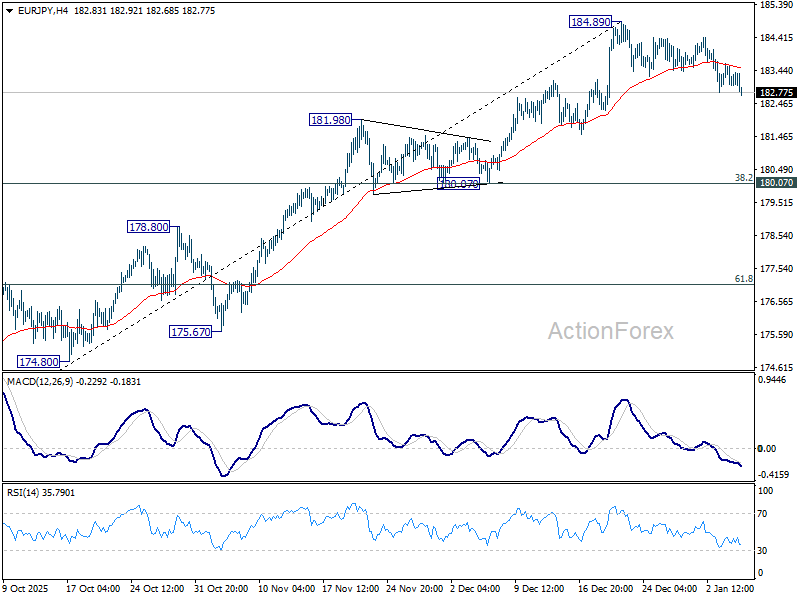
Daily Pivots: (S1) 182.87; (P) 183.26; (R1) 183.53;
EUR/JPY edges lower today and the sustained trading below 55 4H EMA (now at 183.45) argues that fall from 184.89 short term top is already correcting the rally from 172.24. Intraday bias is mildly on the downside for 55 D EMA (now at 180.74). But strong support should emerge from 180.07 cluster (38.2% retracement of 172.24 to 184.89 at 180.05) to bring rebound. ON the upside, firm break of 184.89 will resume larger up trend to 186.31 fibonacci level.
In the bigger picture, up trend from 114.42 (2020 low) is in progress and should target 61.8% projection of 124.37 to 175.41 from 154.77 at 186.31. Considering bearish divergence condition in D MACD, upside could be capped by 186.31 on first attempt. Still, outlook will stay bullish as long as 55 W EMA (now at 172.16) holds, even in case of deep pullback. Sustained break of 186.31 will pave the way to 100% projection at 205.81 next.
| GMT | CCY | EVENTS | ACT | F/C | PP | REV |
|---|---|---|---|---|---|---|
| 00:30 | JPY | Services PMI Dec F | 51.6 | 52.5 | 52.5 | |
| 00:30 | AUD | CPI M/M Nov | 0.00% | 0.10% | 0.00% | |
| 00:30 | AUD | CPI Y/Y Nov | 3.40% | 3.60% | 3.80% | |
| 00:30 | AUD | Trimmed Mean CPI M/M Nov | 0.30% | 0.20% | 0.30% | 0.40% |
| 00:30 | AUD | Trimmed Mean CPI Y/Y Nov | 3.20% | 3.30% | ||
| 00:30 | AUD | Building Permits M/M Nov | 20.20% | 2.10% | -6.40% | -6.10% |
| 07:00 | EUR | Germany Retail Sales M/M Nov | -0.60% | 0.20% | -0.30% | |
| 08:55 | EUR | Germany Unemployment Rate Nov | 6.30% | 6.30% | ||
| 08:55 | EUR | Germany Unemployment Change Nov | 5K | 1K | ||
| 09:30 | GBP | Construction PMI Dec | 42.4 | 39.4 | ||
| 10:00 | EUR | Eurozone CPI Y/Y Dec P | 2.10% | 2.10% | ||
| 10:00 | EUR | Eurozone Core CPI Y/Y Dec P | 2.40% | 2.40% | ||
| 13:15 | USD | ADP Employment Change Dec | 50K | -32K | ||
| 15:00 | USD | ISM Services PMI Dec | 52.3 | 52.6 | ||
| 15:00 | USD | Factory Orders M/M Oct | -1.00% | 0.20% | ||
| 15:00 | CAD | Ivey PMI Dec | 49.5 | 48.4 | ||
| 15:30 | USD | Crude Oil Inventories (Jan 2) | -1.2M | -1.9M |
White Label
Data API
Web Plug-ins
Poster Maker
Affiliate Program
The risk of loss in trading financial instruments such as stocks, FX, commodities, futures, bonds, ETFs and crypto can be substantial. You may sustain a total loss of the funds that you deposit with your broker. Therefore, you should carefully consider whether such trading is suitable for you in light of your circumstances and financial resources.
No decision to invest should be made without thoroughly conducting due diligence by yourself or consulting with your financial advisors. Our web content might not suit you since we don't know your financial conditions and investment needs. Our financial information might have latency or contain inaccuracy, so you should be fully responsible for any of your trading and investment decisions. The company will not be responsible for your capital loss.
Without getting permission from the website, you are not allowed to copy the website's graphics, texts, or trademarks. Intellectual property rights in the content or data incorporated into this website belong to its providers and exchange merchants.
Not Logged In
Log in to access more features

FastBull Membership
Not yet
Purchase
Log In
Sign Up