• Trade
  • Markets
  • Copy
  • Contests
  • News
  • 24/7
  • Calendar
  • Q&A
  • Chats
Trending
Screeners
SYMBOL
LAST
BID
ASK
HIGH
LOW
NET CHG.
%CHG.
SPREAD
SPX
S&P 500 Index
6923.70
6923.70
6923.70
6945.76
6923.32
-8.35
-0.12%
--
DJI
Dow Jones Industrial Average
48628.06
48628.06
48628.06
48782.00
48624.84
-103.11
-0.21%
--
IXIC
NASDAQ Composite Index
23595.84
23595.84
23595.84
23665.15
23567.85
-17.47
-0.07%
--
USDX
US Dollar Index
97.720
97.800
97.720
97.760
97.500
+0.110
+ 0.11%
--
EURUSD
Euro / US Dollar
1.17675
1.17683
1.17675
1.17965
1.17619
-0.00086
-0.07%
--
GBPUSD
Pound Sterling / US Dollar
1.34891
1.34903
1.34891
1.35267
1.34768
-0.00106
-0.08%
--
XAUUSD
Gold / US Dollar
4535.23
4535.64
4535.23
4549.79
4502.79
+55.25
+ 1.23%
--
WTI
Light Sweet Crude Oil
57.224
57.254
57.224
58.765
57.121
-0.994
-1.71%
--

Community Accounts

Signal Accounts
--
Profit Accounts
--
Loss Accounts
--
View More

Become a signal provider

Sell trading signals to earn additional income

View More

Guide to Copy Trading

Get started with ease and confidence

View More

Signal Accounts for Members

All Signal Accounts

Best Return
  • Best Return
  • Best P/L
  • Best MDD
Past 1W
  • Past 1W
  • Past 1M
  • Past 1Y

All Contests

  • All
  • Trump Updates
  • Recommend
  • Stocks
  • Cryptocurrencies
  • Central Banks
  • Featured News
Top News Only
Share

Japan Will Allocate $46 Billion To Support Investments In The United States

Share

Zelensky "Ready" To Call Referendum On Trump Plan With Ceasefire

Share

USA State Dept: Secretary Rubio Spoke With With Honduras President-Elect Asfura Friday

Share

In The Past 24 Hours, The Marketvector Digital Asset 100 Small Cap Index Fell 1.74%, Currently At 3478.23 Points, Having Previously Fallen To 3440.26 Points At 08:49 Beijing Time. The Marketvector Digital Asset 100 Index Fell 1.39%, Currently At 17739.79 Points, Having Briefly Plunged To A Daily Low Of 17686.04 Points At 23:15

Share

[Russian Deputy Foreign Minister: No Deadline For Resolving Russia-Ukraine Conflict At Present] Russian Deputy Foreign Minister Sergei Ryabkov Stated On The 26th That Setting A Specific Date For Resolving The Russia-Ukraine Conflict Is Incorrect, And No Deadline Should Be Given At Present. Ryabkov Also Believes That The Risk Of Nuclear Conflict Has Not Been Eliminated, And Russia Is Sending A Signal To The United States That Genuine Negotiations Are Necessary

Share

Novabio: Sugarcane Crush In Brazil's Northern Regions Down 9.4% Through November 30

Share

[Venezuelan Port Refineries Operating Normally, Port Operations Generally Normal] The US Blockade Of Venezuelan Oil Tankers Has Caused Continued Tension In The Caribbean Sea. On The 25th Local Time, A Reporter From CCTV Visited The Port Of Cabello In Northern Venezuela. Several Oil Tankers Were Moored Near The Docks, And The Refining Facilities Were Operating Normally. Local Resident Carlos Vidal Stated, "I Know People Who Work For Companies That Produce Oil Derivatives Like PVC. The Current Blockade Makes It Difficult To Purchase Some Raw Materials, But The Companies Are Operating Normally. They Are Also Looking For Other Channels To Purchase Raw Materials."

Share

Spot Silver Rose 6.0% On The Day, Reaching $76.20 Per Ounce

Share

Monex Inc. Forex Trader Andrew Hazlett: This Week's Weak Liquidity Did Little To Help The Already Relatively Weak Dollar. Looking Ahead, Our Focus Will Be On Inflation Data As A Guide For The Fed's Next Rate Cut

Share

The Bloomberg Dollar Index Is On Track For Its Worst Weekly Performance Since June, With Treasury Prices Rising As Markets Focus On Data To Be Released Early Next Year. Traders Are Watching Data Released Early Next Year To Confirm Expectations Of Further Interest Rate Cuts By The Federal Reserve In 2026. The Bloomberg Dollar Spot Index Has Fallen About 8% This Year, And If It Continues, It Will Mark Its Biggest Annual Drop Since 2017 And Could Close At Its Lowest Level Since September. Currently, Traders See About A 90% Probability That The Fed Will Keep Rates Unchanged Next Month, But They Are Betting On Another 25 Basis Point Cut By Mid-year And Another Cut Several Months Later

Share

Russia Real Wages +6.1% Year-On-Year In October Versus+4.7% Year-On-Year In Previous Month (Rtrs Poll +3.3% Year-On-Year)

Share

Russia November Jobless Rate At 2.1% Versus 2.2% In Previous Month (Rtrs Poll 2.2 Percent)

Share

Russia Retail Sales +3.3% Year-On-Year In November Versus+4.8% Year-On-Year In Previous Month (Rtrs Poll +1.8% Year-On-Year)

Share

WTI Crude Oil Fell 1.5% To $57.47 A Barrel. Brent Crude Oil Fell 1.5% To $60.87 A Barrel

Share

The USD/JPY Pair Rose 0.5% On The Day, Reaching 156.5208

Share

Spot Palladium Extends Gains, Last Up Over 12% At $1901.74/Oz

Share

The Nasdaq Golden Dragon China Index Rose Sharply, Extending Its Gains To 0.8%. Popular Chinese Concept Stocks Saw Gains, With XPeng Rising 7.5%, Li Auto Rising 3.1%, NIO Rising 3.2%, Pinduoduo Rising 2.1%, And Alibaba Rising 1.7%

Share

Spot Platinum Extends Gains, Last Up Over 10% At Record High Of $2452.95/Oz

Share

Foreign Ministers Of Egypt, Somalia And Turkey Condemn Israel's Recognition Of Somaliland - Egypt's Foreign Ministry

Share

All Three Major U.S. Stock Indexes Fell

TIME
ACT
FCST
PREV
U.S. 5-Year Note Auction Avg. Yield

A:--

F: --

P: --

U.S. Weekly Total Rig Count

A:--

F: --

P: --

U.S. API Weekly Cushing Crude Oil Stocks

A:--

F: --

P: --

U.S. API Weekly Crude Oil Stocks

A:--

F: --

P: --

U.S. API Weekly Refined Oil Stocks

A:--

F: --

P: --

U.S. API Weekly Gasoline Stocks

A:--

F: --

P: --

Mexico Unemployment Rate (Not SA) (Nov)

A:--

F: --

P: --

U.S. MBA Mortgage Application Activity Index WoW

A:--

F: --

P: --

U.S. Weekly Continued Jobless Claims (SA)

A:--

F: --

P: --
U.S. Weekly Initial Jobless Claims (SA)

A:--

F: --

P: --

U.S. Initial Jobless Claims 4-Week Avg. (SA)

A:--

F: --

P: --

Japan Construction Orders YoY (Nov)

A:--

F: --

P: --

Japan New Housing Starts YoY (Nov)

A:--

F: --

P: --

Turkey Capacity Utilization (Dec)

A:--

F: --

P: --

Japan Tokyo CPI YoY (Excl. Food & Energy) (Dec)

A:--

F: --

P: --

Japan Unemployment Rate (Nov)

A:--

F: --

P: --

Japan Tokyo Core CPI YoY (Dec)

A:--

F: --

P: --

Japan Tokyo CPI YoY (Dec)

A:--

F: --

P: --

Japan Jobs to Applicants Ratio (Nov)

A:--

F: --

P: --

Japan Tokyo CPI MoM (Dec)

A:--

F: --

P: --

Japan Tokyo CPI MoM (Excl. Food & Energy) (Dec)

A:--

F: --

P: --

Japan Industrial Inventory MoM (Nov)

A:--

F: --

P: --

Japan Retail Sales (Nov)

A:--

F: --

P: --

Japan Industrial Output Prelim MoM (Nov)

A:--

F: --

P: --

Japan Large-Scale Retail Sales YoY (Nov)

A:--

F: --

P: --

Japan Industrial Output Prelim YoY (Nov)

A:--

F: --

P: --

Japan Retail Sales MoM (SA) (Nov)

A:--

F: --

P: --

Japan Retail Sales YoY (Nov)

A:--

F: --

P: --

Russia Retail Sales YoY (Nov)

A:--

F: --

P: --

Russia Unemployment Rate (Nov)

A:--

F: --

P: --

Argentina Retail Sales YoY (Oct)

--

F: --

P: --

U.S. Weekly Treasuries Held by Foreign Central Banks

--

F: --

P: --

China, Mainland Industrial Profit YoY (YTD) (Nov)

--

F: --

P: --

Russia IHS Markit Manufacturing PMI (Dec)

--

F: --

P: --

India Manufacturing Output MoM (Nov)

--

F: --

P: --

India Industrial Production Index YoY (Nov)

--

F: --

P: --

France Unemployment Class-A (Nov)

--

F: --

P: --

Euro Zone Total Reserve Assets (Nov)

--

F: --

P: --

Canada National Economic Confidence Index

--

F: --

P: --

U.S. Pending Home Sales Index (Nov)

--

F: --

P: --

U.S. Pending Home Sales Index MoM (SA) (Nov)

--

F: --

P: --

U.S. Pending Home Sales Index YoY (Nov)

--

F: --

P: --

U.S. EIA Weekly Crude Oil Imports Changes

--

F: --

P: --

U.S. EIA Weekly Cushing, Oklahoma Crude Oil Stocks Change

--

F: --

P: --

U.S. EIA Weekly Crude Demand Projected by Production

--

F: --

P: --

U.S. EIA Weekly Gasoline Stocks Change

--

F: --

P: --

U.S. Dallas Fed General Business Activity Index (Dec)

--

F: --

P: --

U.S. EIA Weekly Heating Oil Stock Changes

--

F: --

P: --

U.S. EIA Weekly Crude Stocks Change

--

F: --

P: --

U.S. Dallas Fed New Orders Index (Dec)

--

F: --

P: --

Russia CPI YoY (Dec)

--

F: --

P: --

U.S. EIA Weekly Natural Gas Stocks Change

--

F: --

P: --

Brazil CAGED Net Payroll Jobs (Nov)

--

F: --

P: --

South Korea Industrial Output MoM (SA) (Nov)

--

F: --

P: --

South Korea Retail Sales MoM (Nov)

--

F: --

P: --

South Korea Services Output MoM (Nov)

--

F: --

P: --

Russia IHS Markit Services PMI (Dec)

--

F: --

P: --

Turkey Economic Sentiment Indicator (Dec)

--

F: --

P: --

Brazil Unemployment Rate (Nov)

--

F: --

P: --

Q&A with Experts
    • All
    • Chatrooms
    • Groups
    • Friends
    Dhan ki Ba flag
    @Brendonera ok
    SlowBear ⛅ flag
    HOÀNG LÊ
    m3
    @HOÀNG LÊOh i thought as much then, we see hoe it goes dor sure
    SlowBear ⛅ flag
    Brendonera
    Xauusd Buy 4532/4530 target 4536 target 4540 target 4545 target 4550 stop loss 4524
    @BrendoneraWow, a buy already on gold, this has to be on the 1min bar for sure
    rawa ronte flag
    as expected.. close h1 and above 12 o'clock.. candle down... I like it.. I like it...🤑🤑🤑🤑
    Dhan ki Ba flag
    so in 5 min not close in green candel i not buy gold
    Dhan ki Ba flag
    in that area i see for long but again i took a trade when 5 min timeframe candel close in bullish
    rawa ronte flag
    You guys bought it at too high a price, it's like committing suicide🤣🤣
    Dhan ki Ba flag
    no brother we do only scalping not intrday or swing trade
    Dhan ki Ba flag
    so we also check premium and discout
    Brendonera flag
    Brendonera
    Xauusd Buy 4532/4530 target 4536 target 4540 target 4545 target 4550 stop loss 4524
    Xauusd Buy Tp¹ 4536 hit Successfully ✅ running Profits +40 Pip's pro Entry Clean Execution ❤️‍🔥💯 Brendon Trade
    Brendonera flag
    SlowBear ⛅ flag
    Dhan ki Ba
    so in 5 min not close in green candel i not buy gold
    @Dhan ki BaLol yes i agree with you on this one mate
    SlowBear ⛅ flag
    Dhan ki Ba
    so in 5 min not close in green candel i not buy gold
    @Dhan ki BaA ullish close of the next 5min bar should initiate a clean bullish run
    Brendonera flag
    Dhan ki Ba
    so we also check premium and discout
    @Dhan ki BaRequest me friend I'll give daily good trades
    SlowBear ⛅ flag
    Dhan ki Ba
    so we also check premium and discout
    @Dhan ki BaWhat price level would you potential discount level be before you look for a buy?
    Dhan ki Ba flag
    yes brother@Brendonera
    Brendonera flag
    I'll give good trades
    SlowBear ⛅ flag
    Dhan ki Ba
    no brother we do only scalping not intrday or swing trade
    @Dhan ki BaThat is awesome i also only intraday or just swing. - but mostly i swing
    Dhan ki Ba flag
    4512
    Dhan ki Ba flag
    @SlowBear ⛅great
    Type here...
    Add Symbol or Code

      No matching data

      All
      Trump Updates
      Recommend
      Stocks
      Cryptocurrencies
      Central Banks
      Featured News
      • All
      • Russia-Ukraine Conflict
      • Middle East Flashpoint
      • All
      • Russia-Ukraine Conflict
      • Middle East Flashpoint
      Search
      Products

      Charts Free Forever

      Chats Q&A with Experts
      Screeners Economic Calendar Data Tools
      Membership Features
      Data Warehouse Market Trends Institutional Data Policy Rates Macro

      Market Trends

      Market Sentiment Order Book Forex Correlations

      Top Indicators

      Charts Free Forever
      Markets

      News

      News Analysis 24/7 Columns Education
      From Institutions From Analysts
      Topics Columnists

      Latest Views

      Latest Views

      Trending Topics

      Top Columnists

      Latest Update

      Signals

      Copy Rankings Latest Signals Become a signal provider AI Rating
      Contests
      Brokers

      Overview Brokers Assessment Rankings Regulators News Claims
      Broker listing Forex Brokers Comparison Tool Live Spread Comparison Scam
      Q&A Complaint Scam Alert Videos Tips to Detect Scam
      More

      Business
      Events
      Careers About Us Advertising Help Center

      White Label

      Data API

      Web Plug-ins

      Affiliate Program

      Awards Institution Evaluation IB Seminar Salon Event Exhibition
      Vietnam Thailand Singapore Dubai
      Fans Party Investment Sharing Session
      FastBull Summit BrokersView Expo
      Recent Searches
        Top Searches
          Markets
          News
          Analysis
          User
          24/7
          Economic Calendar
          Education
          Data
          • Names
          • Latest
          • Prev

          View All

          No data

          Scan to Download

          Faster Charts, Chat Faster!

          Download App
          English
          • English
          • Español
          • العربية
          • Bahasa Indonesia
          • Bahasa Melayu
          • Tiếng Việt
          • ภาษาไทย
          • Français
          • Italiano
          • Türkçe
          • Русский язык
          • 简中
          • 繁中
          Open Account
          Search
          Products
          Charts Free Forever
          Markets
          News
          Signals

          Copy Rankings Latest Signals Become a signal provider AI Rating
          Contests
          Brokers

          Overview Brokers Assessment Rankings Regulators News Claims
          Broker listing Forex Brokers Comparison Tool Live Spread Comparison Scam
          Q&A Complaint Scam Alert Videos Tips to Detect Scam
          More

          Business
          Events
          Careers About Us Advertising Help Center

          White Label

          Data API

          Web Plug-ins

          Affiliate Program

          Awards Institution Evaluation IB Seminar Salon Event Exhibition
          Vietnam Thailand Singapore Dubai
          Fans Party Investment Sharing Session
          FastBull Summit BrokersView Expo

          Gold’S Multi-Year Rally Toward $5,000: Wave Structure, Psychological Barriers, And What Comes Next

          Forex kids 101

          Commodity

          Traders' Opinions

          Summary:

          This article breaks down the wave-based progression of Gold’s rally, evaluates whether the market is entering a terminal phase or another expansion leg, and outlines key levels and behaviours traders should monitor going forward.
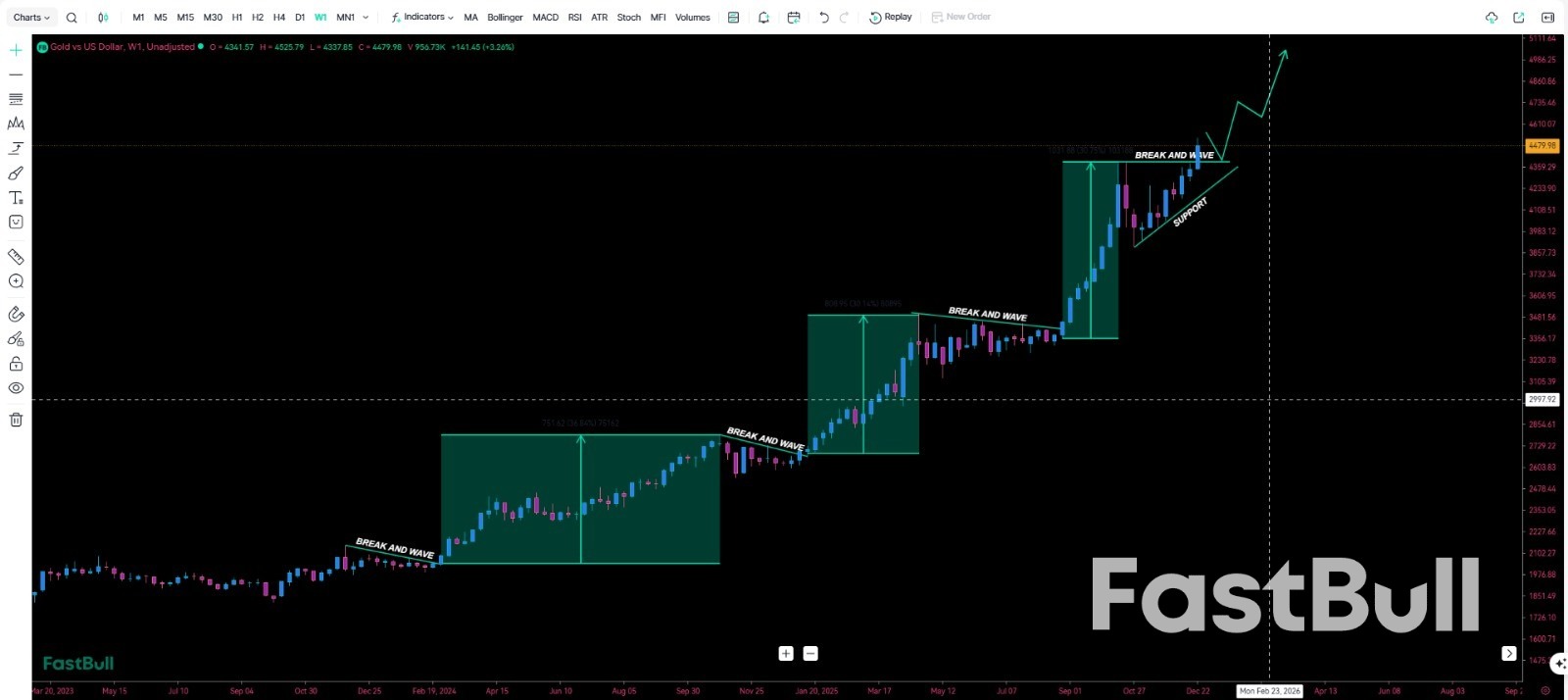
          Since early 2024, Gold has transitioned from a traditionally defensive asset into a structurally bullish, momentum-driven market. The rally has not been random or emotional; it has unfolded in distinct, impulsive waves, each followed by necessary consolidation phases. Understanding where we currently stand in this structure is critical—not only for directional bias, but for risk management and expectation setting as we move toward 2026.
          This article breaks down the wave-based progression of Gold’s rally, evaluates whether the market is entering a terminal phase or another expansion leg, and outlines key levels and behaviours traders should monitor going forward.

          Wave 1: The Structural Break That Changed Everything (February–October 2024)

          The first strong impulse wave of the current Gold super-cycle began on 26 February 2024. This was not merely another bullish attempt—it was a structural regime shift.
          · Key breakout level: 2034.08
          · Wave 1 high: 2792.07 (28 October 2024)
          Gold’s decisive break above the 2034.08 resistance confirmed a long-term bullish continuation and invalidated years of range-bound behaviour. This move established:
          · A clear Break-and-Hold structure
          · Higher highs and higher lows on the weekly timeframe
          · Institutional participation rather than speculative noise
          By late October 2024, Gold had expanded nearly 760 points before entering its first meaningful pause. This consolidation during November–December 2024 was healthy, controlled, and characteristic of a market preparing for continuation—not exhaustion.
          Conclusion: Wave 1 set the foundation. Without this break, the $5,000 narrative would not exist.

          Wave 2: Controlled Expansion and Institutional Re-Accumulation (January–April 2025)

          The second wave of the rally began on 13 January 2025 at 2683.79, following two months of compression and liquidity absorption.
          · Wave 2 high: 3504.74 (27 April 2025)
          · Post-wave consolidation: Approximately 4 months
          This phase was notable for its orderly structure. Price respected support, pullbacks were shallow, and volatility expanded gradually. The rally stalled near 3500—not due to weakness, but due to the market needing time to rebalance after a strong extension.
          The four-month consolidation that followed reinforced an important insight:
          Gold was no longer reacting to short-term catalysts; it was being repriced structurally.

          Wave 3: Momentum Expansion and Trend Acceleration (August–October 2025)

          After months of digestion, the third impulse wave began on 24 August 2025 at 3355.79.
          · Wave 3 high: 4387.67 (12 October 2025)
          This was the most aggressive and emotional leg of the rally so far. Characteristics included:
          · Strong bullish displacement
          · Minimal retracements
          · Broad participation across timeframes
          Wave 3 confirmed that Gold had entered a momentum-driven phase, often associated with late-cycle trend acceleration. However, as expected, price once again paused after a sharp expansion, respecting the natural rhythm of trending markets.
          At this stage, the $5,000 target entered mainstream discussion—but this is precisely where disciplined traders must slow down.

          Where Are We Now? Wave 4 or Structural Pause?

          As we approach the end of 2025, Gold is once again consolidating below major highs. The critical question is:
          Are we beginning Wave 4 toward $5,000—or are we forming a deeper corrective phase first?
          Key Considerations:
          1、Psychological Resistance Zone
          · The 4000–4400 region is not just technical resistance; it is psychological and narrative-driven
          · Markets often pause, retrace, or form complex structures near such levels.
          2、Structural Risk Zone
          · A controlled dip below 3990, or even a deeper retracement toward prior wave support, would not invalidate the $5,000 thesis.
          · Instead, it could represent a final rebalancing phase before the next major expansion.
          3、Time vs. Price
          · Gold has moved aggressively in price over a relatively short period.
          · Markets often compensate for rapid price expansion with time-based consolidation, not immediate continuation.

          What to Watch Going Into 2026

          Rather than predicting outcomes, traders should focus on behavioural confirmation. Here are the key signals to monitor:
          Bullish Continuation Scenario:
          · Higher lows holding above prior wave supports
          · Clean break-and-hold above 4400
          · Strong bullish displacement with shallow pullbacks
          · Acceptance above psychological resistance zones
          Deeper Correction Scenario:
          · Failure to hold above 4000
          · Increased volatility without directional follow-through
          · Price dipping below the previous impulse base without immediate recovery
          Importantly, a retracement does not negate the macro bullish structure unless long-term supports are decisively broken.

          Final Perspective: Is $5,000 Too Early—or Still Ahead?

          Gold’S Multi-Year Rally Toward $5,000: Wave Structure, Psychological Barriers, And What Comes Next_1Gold’s rally since 2024 has followed a textbook expansion–consolidation rhythm. Each impulse wave has been respected by the market, and each pause has strengthened the overall structure.
          Whether the next leg toward $5,000 begins immediately or after a deeper reset, the broader narrative remains intact:
          Gold is in a long-term repricing phase, not a speculative spike.
          For traders and investors alike, the focus should not be on calling the exact top or bottom—but on aligning with structure, respecting psychological zones, and allowing the market to confirm its next intent.
          Risk Warnings and Disclaimers
          You understand and acknowledge that there is a high degree of risk involved in trading. Following any strategies or investment methods may lead to potential losses. The content on the site is provided by our contributors and analysts for information purposes only. You are solely responsible for determining whether any trading assets, securities, strategy, or any other product is suitable for investing based on your own investment objectives and financial situation.
          Add to Favorites
          Share

          China Launches Over $21 Billion in VC Funds to Boost ‘Hard Tech’ Sectors

          Gerik

          Economic

          Strategic Shift Toward Foundational Tech Innovation

          In a move signaling China’s intensified focus on technological self-reliance, state broadcaster CCTV reported that three major venture capital funds have been officially launched with finalized capital plans. Each fund exceeds 50 billion yuan in size, bringing the total investment pool to over 150 billion yuan ($21.4 billion). These funds are explicitly targeted at “hard technology” sectors a category that includes semiconductors, advanced manufacturing, new energy technologies, aerospace, and other deep tech industries critical to China’s long-term strategic ambitions.
          This development reflects a deliberate departure from previous investment models that favored “soft tech” such as consumer apps and internet services. The emphasis on hardware-based innovation suggests a causal response to escalating global tech competition, export controls, and national security concerns particularly in the semiconductor domain where China seeks to close the gap with the United States and its allies.

          Navigating U.S. Sanctions and Technological Decoupling

          The launch of these hard tech VC funds comes against the backdrop of ongoing geopolitical tensions, especially Washington’s increasingly restrictive stance on chip exports to China. The venture capital initiative appears to be part of a broader industrial policy aimed at insulating China's innovation ecosystem from external shocks.
          By mobilizing state capital and guiding private investors into strategic sectors, Beijing aims to create a domestically integrated supply chain for core technologies. The scale of funding announced with each fund exceeding $7 billion indicates not only the central government’s financial capacity but also its urgency in responding to external pressures. The causal link between U.S. export bans and China's focus on semiconductor autonomy is direct and pronounced.

          Implications for Global Supply Chains and Tech Competition

          China's push into hard tech has major implications for global supply chains and international tech competition. With vast amounts of capital now flowing into chip design, fabrication equipment, and other hardware capabilities, domestic firms are likely to accelerate R&D and reduce dependence on foreign inputs. If successful, this could result in a shift in the global technology landscape either by strengthening China’s self-reliant tech base or by triggering retaliatory moves in the U.S.-led tech alliances.
          This wave of investment is also likely to attract and retain top talent within China’s borders, reversing previous trends where engineers and researchers sought opportunities abroad. Moreover, such policy-driven capital deployment may generate faster scaling of local startups, potentially increasing domestic innovation output even in the face of external restrictions.
          The launch of over $21 billion in hard tech venture capital by China marks a critical moment in the country’s pursuit of technological sovereignty. As the divide between hardware and software investment deepens, and as the global race for semiconductor dominance intensifies, these funds represent a direct and strategic attempt to reshape the core of China's innovation economy. Whether this capital infusion leads to technological breakthroughs or broader economic decoupling, its impact on global tech dynamics is likely to be profound and enduring.

          Source: Bloomberg

          To stay updated on all economic events of today, please check out our Economic calendar
          Risk Warnings and Disclaimers
          You understand and acknowledge that there is a high degree of risk involved in trading. Following any strategies or investment methods may lead to potential losses. The content on the site is provided by our contributors and analysts for information purposes only. You are solely responsible for determining whether any trading assets, securities, strategy, or any other product is suitable for investing based on your own investment objectives and financial situation.
          Add to Favorites
          Share

          China Signals Goal Of Slow Yuan Gain Via Fix Well Below Estimate

          Samantha Luan

          Forex

          Political

          Economic

          China set the yuan's daily reference rate at a level that was below market estimates by a record margin, in the latest sign of policymakers' intention to slow the currency's appreciation.

          The People's Bank of China set the yuan's so-called fixing at 7.0358 per dollar, 301 pips weaker than the average estimate of traders and analysts in a Bloomberg survey. The gap between the reference rate — which limits the onshore yuan's moves by 2% on either side — and the forecast was the largest since the survey was initiated in 2018.

          The move came after the offshore yuan advanced past the key psychological level of 7 per dollar on Thursday for the first time since September 2024. The PBOC has been using the reference rate to guide the yuan stronger at a measured pace as it tries to appease Beijing's trading partners while protecting its exporters. A rapid rally risks triggering a surge of hot-money inflows that may destabilize China's financial markets.

          While the fixing was weaker than the market estimate, it's still stronger than where it was in the previous session. The offshore yuan was little changed at 7.0042.

          The PBOC's cautious approach has come on the back of a growing chorus among Wall Street Banks including Goldman Sachs Group Inc. and Bank of America Corp. which expect the Chinese currency to strengthen well beyond 7 in 2026. Even within China, a rising number of local economists and former central bank officials have called for a stronger currency to help rebalance the economy away from exports and reduce trade tensions.

          Source: Bloomberg Europe

          To stay updated on all economic events of today, please check out our Economic calendar
          Risk Warnings and Disclaimers
          You understand and acknowledge that there is a high degree of risk involved in trading. Following any strategies or investment methods may lead to potential losses. The content on the site is provided by our contributors and analysts for information purposes only. You are solely responsible for determining whether any trading assets, securities, strategy, or any other product is suitable for investing based on your own investment objectives and financial situation.
          Add to Favorites
          Share

          North Korea’s Kim Orders Arms Modernization Before Congress: KCNA

          Justin

          Political

          Economic

          North Korean leader Kim Jong Un ordered the modernization of his country's missile and artillery production, indicating Pyongyang is moving toward expanded output of both nuclear and conventional weapons ahead of its next ruling party congress.

          Kim inspected key military-industrial enterprises to review fourth-quarter production of missiles and artillery shells, and approved draft modernization plans to be submitted to the ninth congress of the Workers' Party, the Korean Central News Agency reported Friday.

          Pyongyang is expected to hold its next party congress, a key gathering for setting policy goals, early in 2026.

          The visit followed Pyongyang's release a day earlier of photos showing progress in the construction of an 8,700-ton nuclear-powered submarine, as well as the testing of a new high-altitude, long-range missile that KCNA said accurately hit a mock target at an altitude of 200 kilometers (124 miles). The moves have heightened tensions on the peninsula after a US nuclear-powered submarine arrived in the South Korean port of Busan earlier this week.

          Kim's recent inspections amount to a "carefully choreographed sequence of moves," said Lim Eul-chul, a professor at Kyungnam University's Institute for Far Eastern Studies in Seoul. "While the nuclear-powered submarine symbolizes strategic nuclear deterrence aimed at the US mainland, missiles and artillery shells represent tactical strike capabilities intended for use on the Korean peninsula and in actual combat."

          Kim was accompanied by senior officials from the ruling party, missile authority and defense science sector as he received briefings on output and capacity, KCNA said. He called for expanding production plans for next year in line with projected operational needs and for strengthening the technological base of factories to expand capacity in a balanced manner.

          Looking ahead, Kim also urged newly planned military-industrial enterprises to proceed on schedule after the party congress and said existing plants should continue upgrading production structures to improve efficiency and practicality.

          North Korea could use technological know-how acquired in exchange for supplying Russia with artillery shells, missiles and troops to overhaul its aging arms factories into digitized and automated facilities, a shift that points to ambitions to evolve beyond nuclear deterrence toward a more technology-driven defense industry, Lim said.

          Source: Bloomberg Europe

          To stay updated on all economic events of today, please check out our Economic calendar
          Risk Warnings and Disclaimers
          You understand and acknowledge that there is a high degree of risk involved in trading. Following any strategies or investment methods may lead to potential losses. The content on the site is provided by our contributors and analysts for information purposes only. You are solely responsible for determining whether any trading assets, securities, strategy, or any other product is suitable for investing based on your own investment objectives and financial situation.
          Add to Favorites
          Share

          Bearish Outlook Intensifies as Yen Faces Prolonged Weakness into 2026

          Gerik

          Economic

          Forex

          Yen's Modest 2025 Gains Mask Deeper Structural Fragility

          As 2025 draws to a close, the Japanese yen has barely managed to hold onto marginal gains, rising less than 1% against the U.S. dollar after four years of consistent losses. This muted performance underscores the deeper imbalance in Japan’s monetary positioning. Despite the Bank of Japan (BOJ) initiating a cautious normalization path, including interest rate hikes, the yen has failed to build sustained momentum. It currently trades around 155.70, significantly weaker than the April high below 140, reflecting a clear divergence between policy action and currency performance.
          The failure of modest rate increases to strengthen the yen reveals a persistent causal disconnect. Market forces are overriding central bank moves as long as real interest rates remain negative and external conditions favor capital flight from Japan.

          Strategist Projections Signal Deepening Bearish Sentiment

          Market strategists from leading global financial institutions project a further weakening trajectory for the yen. JPMorgan’s Junya Tanase offers one of the most pessimistic forecasts, expecting the dollar-yen pair to reach 164 by the end of 2026. BNP Paribas anticipates the exchange rate climbing to 160 under a combination of carry trade strength and BOJ’s slow policy shifts.
          These projections are not merely speculative. They are grounded in concrete financial mechanics: wide U.S.-Japan yield spreads, delayed BOJ rate hikes (with the next move not priced in until September), and Japan’s enduring fiscal risks. In particular, the PCE inflation measure in Japan remains above the 2% target, but real rates are still deeply negative weakening the yen’s investment appeal.

          Carry Trade Resurgence Adds Further Pressure

          A significant driver of the yen’s weakness is the revival of global carry trades. Investors have increasingly borrowed low-yielding yen to invest in higher-yielding assets in emerging markets like Brazil and Turkey. This financial strategy creates direct capital outflows from Japan, further undermining the yen’s position.
          Commodity Futures Trading Commission (CFTC) data confirms a growing bearish positioning by leveraged funds, with short-yen bets reaching levels last seen in mid-2024. This alignment of speculative interest with structural yield disadvantages points to a reinforcing causal loop: the more the yen weakens, the more attractive it becomes for carry trades which in turn accelerates further depreciation.

          Capital Outflows from Retail and Corporates Sustain Downward Pressure

          Retail investors in Japan continue to show strong appetite for overseas equities, with net purchases through investment trusts remaining close to last year’s record ¥9.4 trillion. Analysts suggest this behavior is likely to persist into 2026, reflecting a long-term shift in household investment preferences. These retail flows, combined with significant foreign direct investment (FDI) by Japanese corporations, amount to a structurally consistent capital outflow.
          Outward M&A activity is also accelerating. According to BofA Securities, Japanese firms have ramped up cross-border acquisitions in 2025, unaffected by cyclical trends. This steady stream of corporate capital outflows removes natural support for the yen and exemplifies the long-term drivers of currency depreciation beyond monetary policy alone.

          BOJ Policy Caution Limits Upside Potential

          The BOJ’s reluctance to aggressively raise rates remains a central theme. While inflation is above target, the bank has signaled that it prefers gradual tightening. As a result, investors discount the likelihood of a dramatic shift in Japan’s rate environment. Without a more assertive policy stance, real interest rates will remain in negative territory a condition that undermines demand for the yen.
          Fukuoka Financial Group’s chief strategist Tohru Sasaki projects the yen could slide to 165 per dollar by the end of 2026, especially if the Fed halts its rate-cut cycle earlier than expected. In this scenario, interest rate differentials would widen again, exacerbating the yen’s vulnerability.

          Speculation of Intervention and Long-Term Divergence

          Japanese authorities, including Finance Minister Satsuki Katayama, have issued verbal warnings to markets about potential intervention should yen moves become "excessive" or "speculative." But market participants remain skeptical about the impact of such actions. As noted by BNY’s Wee Khoon Chong, intervention without structural change is unlikely to reverse the broader depreciation trend.
          Interestingly, not all forecasts are bearish in the long term. Goldman Sachs expects the yen to appreciate toward 100 per dollar over the next decade, assuming that BOJ continues its policy normalization. However, this projection is contingent on macroeconomic rebalancing that appears distant in the current environment.
          The Japanese yen faces a confluence of negative forces heading into 2026. From wide yield differentials and capital outflows to slow policy tightening and revived carry trades, structural headwinds are reinforcing a bearish narrative. While official intervention or a sudden shift in Fed policy could offer temporary relief, the broader market consensus points to continued depreciation potentially pushing the dollar-yen rate to 160 or beyond by the end of 2026. Without a significant real interest rate adjustment or a reversal in outbound investment trends, the yen's weakness may remain a defining feature of global currency markets for the foreseeable future.

          Source: CNBC

          To stay updated on all economic events of today, please check out our Economic calendar
          Risk Warnings and Disclaimers
          You understand and acknowledge that there is a high degree of risk involved in trading. Following any strategies or investment methods may lead to potential losses. The content on the site is provided by our contributors and analysts for information purposes only. You are solely responsible for determining whether any trading assets, securities, strategy, or any other product is suitable for investing based on your own investment objectives and financial situation.
          Add to Favorites
          Share

          Japanese Yen Forecast: USD/JPY Rises As Tokyo Inflation Hits BoJ Target

          Winkelmann

          Forex

          Economic

          Key Points:

          · USD/JPY climbed after Tokyo inflation cooled to the BoJ's 2% target, signaling fewer rate hikes and a less hawkish policy path.
          · Cooling inflation clashed with yen intervention warnings, capping USD/JPY upside despite softer Japanese price pressures.
          · Markets remain focused on the BoJ's neutral rate debate, a key factor influencing USD/JPY direction into 2026.

          Cooling Japanese inflation indicators sent USD/JPY higher on Friday, December 26, countering Japanese government efforts to strengthen the yen through intervention warnings.

          Headline inflation dropped to the Bank of Japan's 2% target, supporting a lower neutral interest rate and fewer rate hikes to achieve policy normalization. The softer inflation numbers come after Japan's Finance Minister Satsuki Katayama warned of yen interventions earlier this week. A more dovish BoJ on cooling inflation will increase the threat of a yen intervention, capping USD/JPY gains.

          Cooling Japanese inflation and fading bets on a March Fed rate cut challenged the bearish medium- to longer-term outlook for USD/JPY. Nevertheless, monetary policy divergence continues to favor the yen, given the prospect of an incoming Fed Chair favoring lower rates.

          Below, I'll discuss the macro backdrop, the near-term price catalysts, and technical levels traders should closely watch.

          Tokyo Inflation Dips, Yen Weakens

          Tokyo's annual inflation rate fell from 2.7% in November to 2.0% in December, while the so-called core-core inflation rate eased to 2.6% (November: 2.8%). Despite headline inflation dropping to the BoJ's 2% target, the more influential core-core inflation rate remained above the target, supporting further rate hikes.

          However, the lower inflation rate suggested fewer rate hikes to achieve price stability, aligning with last week's dovish rate hike. USD/JPY reacted to the inflation numbers, rising from 155.751 to a post-data high of 156.271.

          USDJPY – Five Minute Chart – 261225

          Retail Sales and Labor Market Data Keep BoJ Hawks in Play

          December's inflation data was the key USD/JPY driver in early trading on Friday. Meanwhile, consumer spending cooled in November, supporting a softer national inflation outlook. Retail sales increased 1% year-on-year in November, down from 1.7% in October.

          Crucially, a pullback in spending will also dampen economic momentum, given that private consumption contributes roughly 55% to Japan's GDP.

          While inflation and retail sales data weakened demand for the yen, labor market data limited the pullback. Japan's unemployment rate remained steady at 2.6% in November, supporting higher wages. An upswing in wages could boost consumer spending and fuel demand-driven inflation.

          However, policymakers would need to see higher wages translate into consumption to raise rates further. While a more dovish BoJ rate path would weaken the yen and send USD/JPY higher, government yen intervention threats would continue to push the pair lower, supporting the cautiously bearish short- to medium-term USD/JPY price outlook.

          For the short-term, USD/JPY trends will hinge on the Japanese government's pain threshold for yen weakness, currently at 158, given the recent communication. With USD/JPY sitting around the 156 level, the pair would likely return to 157 before another pullback to 155 levels, given recent price trends. On this basis, the short-term outlook remains cautiously bearish.

          USDJPY – Daily Chart – Intervention Warnings

          Fed Speakers in Focus

          While USD/JPY advanced on softer retail sales and inflation data, Fed chatter will influence US dollar demand later on Friday.

          This week's US GDP and deflator price data tempered bets on a March Fed rate cut, strengthening the US dollar. However, a cooling labor market and November's CPI report continue to support further Fed rate cuts, signaling a bearish short- to medium-term USD/JPY price outlook.

          Dovish Fed rhetoric would revive expectations of a March rate cut, weighing on the US dollar.

          According to the CME FedWatch Tool, the probability of a March Fed rate cut fell from 58.3% on December 19 to 47.0% on December 26. The sharp drop reflected the influence of the Q3 US GDP report on sentiment.

          Technical Outlook: USD/JPY on a Downward Trajectory

          With markets monitoring technical indicators and fundamentals, they will provide crucial insights into potential USD/JPY price trends.

          Looking at the daily chart, USD/JPY traded above its 50-day and 200-day Exponential Moving Averages (EMAs), indicating a bullish bias. While technicals remained bullish, fundamentals are increasingly outweighing the technical structure, suggesting a bearish outlook.

          A break below the 155 support level would expose the 50-day EMA. If breached, the 200-day EMA would be the next key technical support level. Importantly, a sustained drop below the EMAs would signal a bearish near-term trend reversal, bringing sub-150 into play.

          USDJPY – Daily Chart – 261225 – EMAs

          Position and Upside Risk

          In my view, intervention threats will continue to cap USD/JPY upside at 158. Meanwhile, JGB yields would likely bolster yen demand, indicating a negative price outlook. However, the BoJ's neutral interest rate will be pivotal, given recent concerns about sticky US inflation.

          A higher neutral interest rate level, neither accommodative nor restrictive, would indicate a more hawkish BoJ rate path and a narrower US-Japan rate differential. A narrower rate differential would make yen carry trades into US assets less profitable, reversing yen carry trades, sending USD/JPY toward 140 over the longer term.

          However, upside risks to the bearish outlook include:

          · Dovish BoJ chatter and a 1% neutral interest rate.
          · Strong US data.
          · Hawkish Fed rhetoric.

          These scenarios would weaken the yen and boost demand for the US dollar, sending USD/JPY higher. However, yen intervention warnings are likely to cap the upside at around the 158 level, based on the latest communication.

          Conclusion: Focus on the BoJ Neutral Rate

          In summary, USD/JPY trends reflect the Japanese government's focus on forex markets and changing sentiment toward narrowing rate differentials. Market focus will remain on BoJ Governor Ueda and the Fed's outlook on monetary policy and the BoJ's view on the neutral interest rate.

          A 1.5% to 2.5% neutral rate would indicate more aggressive BoJ rate hikes, supporting the bearish short- to medium-term outlook for USD/JPY. Furthermore, dovish Fed rhetoric will likely send USD/JPY toward 140 in the 6-12 month time horizon.

          Source: FX Empire

          To stay updated on all economic events of today, please check out our Economic calendar
          Risk Warnings and Disclaimers
          You understand and acknowledge that there is a high degree of risk involved in trading. Following any strategies or investment methods may lead to potential losses. The content on the site is provided by our contributors and analysts for information purposes only. You are solely responsible for determining whether any trading assets, securities, strategy, or any other product is suitable for investing based on your own investment objectives and financial situation.
          Add to Favorites
          Share

          Japan Cabinet OKs Record Draft Budget Under PM's Expansionary Drive

          Samantha Luan

          Political

          Economic

          Japan's cabinet on Friday approved a record 122.31 trillion yen ($785 billion) draft initial budget for fiscal 2026 as Prime Minister Sanae Takaichi pursues expansionary fiscal policies to support the economy while boosting defense spending to accelerate a military buildup.

          The general-account budget plan is a record high for the second straight year, exceeding the initial 115.20 trillion yen budget for fiscal 2025, as rising prices are pushing up personnel and other fixed costs and the aging population is inflating welfare expenditure.

          Under the draft budget for the next fiscal year starting in April, the government plans to issue 29.58 trillion yen in new bonds to cover a revenue shortfall -- nearly a quarter of the total, underscoring Japan's heavy dependence on debt and fueling concerns about a further strain on the state's fiscal health, which is the worst among major economies.

          Marking the first full-year spending plan since Takaichi took office in October, the budget bill is expected to clear the Diet by the end of the current fiscal year.

          Takaichi's aggressive spending policy has pressured the yen against major currencies in the foreign exchange market, boding ill for a country that relies heavily on imported energy sources.

          The debt-servicing costs, including redemption and interest payments, reached a fresh record of 31.28 trillion yen, reflecting the recent rise in long-term yields.

          The Finance Ministry set the assumed interest rate used to calculate interest payments at 3.0%, up sharply from the 2.0% for fiscal 2025.

          Long-term borrowing costs have been trending higher on market expectations that the Bank of Japan will continue raising interest rates following its latest hike this month, compounded by concerns over Japan's fiscal sustainability.

          Among other major items, 39.06 trillion yen has been set aside for social welfare, which typically accounts for the largest share of Japan's national budget and reflects an upward revision to medical fees that serve as a key revenue source for hospitals.

          A record 9.04 trillion yen has been earmarked for defense-related purposes, while 1.00 trillion yen has been allocated for reserve funds for emergencies.

          On the revenue side, tax receipts are projected to reach 83.74 trillion yen, marking a record high for the seventh consecutive year, partly supported by solid corporate earnings.

          Under a slogan of "responsible and proactive public finances," Takaichi has vowed to achieve a strong economy through stimulus measures, including investment in semiconductors and other strategically important sectors.

          The size of the draft budget was also influenced by political concessions, as Takaichi's ruling bloc, which has slight majority in the House of Representatives but remains a minority in the House of Councillors, accepted some requests from opposition parties.

          Among them, the rising Democratic Party for the People has said it will support the budget in exchange for agreement on its signature policy to raise the nontaxable income threshold, aimed at boosting workers' disposable income.

          Earlier this week, the Cabinet Office said that Japan's economy is projected to grow a real 1.3% in fiscal 2026, compared with an estimated 1.1% expansion in the current fiscal year. The forecast was used as the basis for estimating tax revenue for the fiscal year.

          Source: Asia_Nikkei

          To stay updated on all economic events of today, please check out our Economic calendar
          Risk Warnings and Disclaimers
          You understand and acknowledge that there is a high degree of risk involved in trading. Following any strategies or investment methods may lead to potential losses. The content on the site is provided by our contributors and analysts for information purposes only. You are solely responsible for determining whether any trading assets, securities, strategy, or any other product is suitable for investing based on your own investment objectives and financial situation.
          Add to Favorites
          Share
          FastBull
          Copyright © 2025 FastBull Ltd

          728 RM B 7/F GEE LOK IND BLDG NO 34 HUNG TO RD KWUN TONG KLN HONG KONG

          TelegramInstagramTwitterfacebooklinkedin
          App Store Google Play Google Play
          Products
          Charts

          Chats

          Q&A with Experts
          Screeners
          Economic Calendar
          Data
          Tools
          Membership
          Features
          Function
          Markets
          Copy Trading
          Latest Signals
          Contests
          News
          Analysis
          24/7
          Columns
          Education
          Company
          Careers
          About Us
          Contact Us
          Advertising
          Help Center
          Feedback
          User Agreement
          Privacy Policy
          Personal Information Protection Statement
          Business

          White Label

          Data API

          Web Plug-ins

          Poster Maker

          Affiliate Program

          Risk Disclosure

          The risk of loss in trading financial instruments such as stocks, FX, commodities, futures, bonds, ETFs and crypto can be substantial. You may sustain a total loss of the funds that you deposit with your broker. Therefore, you should carefully consider whether such trading is suitable for you in light of your circumstances and financial resources.

          No decision to invest should be made without thoroughly conducting due diligence by yourself or consulting with your financial advisors. Our web content might not suit you since we don't know your financial conditions and investment needs. Our financial information might have latency or contain inaccuracy, so you should be fully responsible for any of your trading and investment decisions. The company will not be responsible for your capital loss.

          Without getting permission from the website, you are not allowed to copy the website's graphics, texts, or trademarks. Intellectual property rights in the content or data incorporated into this website belong to its providers and exchange merchants.

          Not Logged In

          Log in to access more features

          FastBull Membership

          Not yet

          Purchase

          Become a signal provider
          Help Center
          Customer Service
          Dark Mode
          Price Up/Down Colors

          Log In

          Sign Up

          Position
          Layout
          Fullscreen
          Default to Chart
          The chart page opens by default when you visit fastbull.com