Markets
News
Analysis
User
24/7
Economic Calendar
Education
Data
- Names
- Latest
- Prev


Signal Accounts for Members
All Signal Accounts
All Contests


U.K. Trade Balance Non-EU (SA) (Oct)A:--
F: --
P: --
U.K. Trade Balance (Oct)A:--
F: --
P: --
U.K. Services Index MoMA:--
F: --
P: --
U.K. Construction Output MoM (SA) (Oct)A:--
F: --
P: --
U.K. Industrial Output YoY (Oct)A:--
F: --
P: --
U.K. Trade Balance (SA) (Oct)A:--
F: --
P: --
U.K. Trade Balance EU (SA) (Oct)A:--
F: --
P: --
U.K. Manufacturing Output YoY (Oct)A:--
F: --
P: --
U.K. GDP MoM (Oct)A:--
F: --
P: --
U.K. GDP YoY (SA) (Oct)A:--
F: --
P: --
U.K. Industrial Output MoM (Oct)A:--
F: --
P: --
U.K. Construction Output YoY (Oct)A:--
F: --
P: --
France HICP Final MoM (Nov)A:--
F: --
P: --
China, Mainland Outstanding Loans Growth YoY (Nov)A:--
F: --
P: --
China, Mainland M2 Money Supply YoY (Nov)A:--
F: --
P: --
China, Mainland M0 Money Supply YoY (Nov)A:--
F: --
P: --
China, Mainland M1 Money Supply YoY (Nov)A:--
F: --
P: --
India CPI YoY (Nov)A:--
F: --
P: --
India Deposit Gowth YoYA:--
F: --
P: --
Brazil Services Growth YoY (Oct)A:--
F: --
P: --
Mexico Industrial Output YoY (Oct)A:--
F: --
P: --
Russia Trade Balance (Oct)A:--
F: --
P: --
Philadelphia Fed President Henry Paulson delivers a speech
Canada Building Permits MoM (SA) (Oct)A:--
F: --
P: --
Canada Wholesale Sales YoY (Oct)A:--
F: --
P: --
Canada Wholesale Inventory MoM (Oct)A:--
F: --
P: --
Canada Wholesale Inventory YoY (Oct)A:--
F: --
P: --
Canada Wholesale Sales MoM (SA) (Oct)A:--
F: --
P: --
Germany Current Account (Not SA) (Oct)A:--
F: --
P: --
U.S. Weekly Total Rig CountA:--
F: --
P: --
U.S. Weekly Total Oil Rig CountA:--
F: --
P: --
Japan Tankan Large Non-Manufacturing Diffusion Index (Q4)--
F: --
P: --
Japan Tankan Small Manufacturing Outlook Index (Q4)--
F: --
P: --
Japan Tankan Large Non-Manufacturing Outlook Index (Q4)--
F: --
P: --
Japan Tankan Large Manufacturing Outlook Index (Q4)--
F: --
P: --
Japan Tankan Small Manufacturing Diffusion Index (Q4)--
F: --
P: --
Japan Tankan Large Manufacturing Diffusion Index (Q4)--
F: --
P: --
Japan Tankan Large-Enterprise Capital Expenditure YoY (Q4)--
F: --
P: --
U.K. Rightmove House Price Index YoY (Dec)--
F: --
P: --
China, Mainland Industrial Output YoY (YTD) (Nov)--
F: --
P: --
China, Mainland Urban Area Unemployment Rate (Nov)--
F: --
P: --
Saudi Arabia CPI YoY (Nov)--
F: --
P: --
Euro Zone Industrial Output YoY (Oct)--
F: --
P: --
Euro Zone Industrial Output MoM (Oct)--
F: --
P: --
Canada Existing Home Sales MoM (Nov)--
F: --
P: --
Euro Zone Total Reserve Assets (Nov)--
F: --
P: --
U.K. Inflation Rate Expectations--
F: --
P: --
Canada National Economic Confidence Index--
F: --
P: --
Canada New Housing Starts (Nov)--
F: --
P: --
U.S. NY Fed Manufacturing Employment Index (Dec)--
F: --
P: --
U.S. NY Fed Manufacturing Index (Dec)--
F: --
P: --
Canada Core CPI YoY (Nov)--
F: --
P: --
Canada Manufacturing Unfilled Orders MoM (Oct)--
F: --
P: --
Canada Manufacturing New Orders MoM (Oct)--
F: --
P: --
Canada Core CPI MoM (Nov)--
F: --
P: --
Canada Manufacturing Inventory MoM (Oct)--
F: --
P: --
Canada CPI YoY (Nov)--
F: --
P: --
Canada CPI MoM (Nov)--
F: --
P: --
Canada CPI YoY (SA) (Nov)--
F: --
P: --
Canada Core CPI MoM (SA) (Nov)--
F: --
P: --


No matching data
Latest Views
Latest Views
Trending Topics
Top Columnists
Latest Update
White Label
Data API
Web Plug-ins
Affiliate Program
View All

No data
Goldman Sachs predicts rate cuts, altering their previous forecast. Three rate cuts expected in September, October, and December. Weak tariff impacts and soft labor market drive changes.
Goldman Sachs predicts the Federal Reserve will cut interest rates three times in 2025, starting September, due to weaker tariff impacts and a softening labor market.
This forecast could enhance risk sentiment and potentially buoy cryptocurrency markets, affecting assets like Bitcoin and Ethereum with anticipation of Federal Reserve policy easing.
Goldman Sachs has revised its forecast, anticipating the Federal Reserve will cut interest rates three times in 2025. The decision comes as part of an accelerated timeline due to weaker-than-expected impacts of tariffs on inflation.
Goldman Sachs has revised its forecast, anticipating the Federal Reserve will cut interest rates three times in 2025 due to weaker-than-expected impacts of tariffs on inflation. Led by chief economist Jan Hatzius, the Goldman Sachs research team projects rate cuts of 25 basis points, scheduled for September, October, and December. The revised forecast highlights softening labor market indicators.
Market impacts of these rate cuts could be substantial, notably for cryptocurrency markets. Historically, such monetary actions improve risk sentiment, leading to increased demand for assets like Bitcoin and Ethereum. The broader financial implications include anticipated shifts in asset allocation. Lower interest rates generally foster increased investment in riskier assets as investors seek higher returns. This has been seen in previous easing cycles.
The financial community may perceive these cuts as a response to macroeconomic conditions. They could stimulate investment and lending activity. Similar policy moves in past cycles led to increased crypto valuations, highlighting potential benefits. Insights from past cycles suggest that rate cuts often lead to improved liquidity conditions. Cryptocurrency markets, including Bitcoin and Ethereum, might experience price increases and heightened trading activity as investors react to market conditions.
Political pressure, changing personnel and a complex mix of macroeconomic data in recent weeks have renewed the focus on the Federal Reserve and its policy direction. Compared to the bond markets, equity markets seem to be taking these developments in stride.The past few weeks have been captivating for Federal Reserve watchers. The resignation of board governor Adriana Kugler and temporary replacement by President Trump appointee Stephen Miran has coincided with the emergence of an expanding list of possible successors to chair Jay Powell and the release of a swath of policy-influencing macroeconomic data.
Taken together, this has renewed the focus on the Fed and future policy direction, which the market still currently expects to head lower even though the path is being made more complex by a mix of positive and negative employment and inflation prints.The hot Producer Price Index data—showing wholesale inflation rising 0.9% from a month earlier and 3.3% from a year ago—provided a fresh example last week, overshadowing the earlier broadly benign Consumer Price Index data and unsettling the U.S. equity and bond markets.
After equities had rallied to fresh highs earlier in the week on the CPI data (core CPI year-over-year was in line with expectations at 3.1% in July) and expectations the Fed would cut rates in September, the PPI print halted the march higher and in parallel pushed up Treasury yields, especially at the short end.As a result of last week’s data—including broadly resilient July retail sales reported on Friday—the market is still pricing in a rate cut next month. It’s just no longer fully pricing in a quarter-point cut, as it did at the start of the week.
Such a reaction to the PPI data broadly reflects two views: equity investors see the threat inflation poses to their bet of a soft landing and a more accommodative policy environment, while bond investors see a longer period of above-target inflation, higher economic growth prospects and continued deficit concerns.
A more accurate reading of what the equity and bond markets are signalling is complicated. Combined with multiple exogenous factors influencing the shape of the yield curve, bond investors are clearly preoccupied by the impact of sticky inflation and any weakening in the labor market on monetary easing.Yet many equity investors are instead more focused on the Fed and continued easing, which would accelerate business and consumer investment, and, through lower financing costs, support smaller companies, especially those in more interest-rate sensitive cyclical industries.
The move higher in the Russell 2000 small cap index in recent weeks—extending a stronger performance overall and especially lower-quality parts of the market over the past few months—gives some support to this, indicating investors are beginning to price in a more accommodative monetary environment as the U.S. economy potentially begins to accelerate out of the current slowdown.When that may happen is uncertain, but we believe that muted economic growth in the next few quarters is unlikely to approach recessionary levels, and that the economy will continue to demonstrate resilience, particularly to the impact of tariffs and the extent they are being absorbed by companies and consumers.
Further fortifying this resilience and boosting the prospects for growth over the medium term is the administration’s deregulation drive and the passing of the U.S. tax and spending bill. As well as helping to bolster disposable income and sustaining consumer demand, the bill will more significantly benefit small and medium-sized companies by introducing several pro-growth measures aimed at stimulating innovation, investment and domestic production.
Looking ahead, the focus now turns to three more major data releases—July Personal Consumption Expenditures, August CPI and August non-farm payrolls—in the coming days as well as the Jackson Hole symposium.
Much of the focus will likely fall on the August jobs report, but the relative strength or weakness of the overall economy will also be a driving factor in the Fed’s messaging coming into and out of Jackson Hole and the September meeting.In our view, there is likely little to disrupt the near-term path to lower rates, but any evidence showing that services prices are reversing their downward trend could jeopardize rate cuts slated for 2026 and keep the Fed above the 3.5% mark moving into middle of next year.
In addition, evidence of continued political pressure on the Fed could also push yields higher and disrupt efforts to effect more accommodative policy.History tells us that August and September can bring market volatility, and to some extent we are already seeing this. However, looking through these periods, our medium-term outlook remains constructive.What’s more, we believe the combination of lower rates to come, deregulation and the pro-growth measures of the tax and spending bill continue to create an attractive case for small and mid-caps, which is why the Asset Allocation Committee is overweight the sector.

Gold price edged higher in early Monday, as uncertainty grows ahead of today’s meeting between President Trump and leaders of Ukraine and some European countries.
The US President sent a strong signal that the US wants to end war in Ukraine, following Friday’s Trump-Putin summit in Alaska, which many analysts described as the most significant political event in 21st century.
Although Trump’s rhetoric is still rough in some cases and includes threats to both sides, it looks that the story may accelerate towards the peace agreement as Trump sees restoring of ties with Russia and new business deals as better solution than to continue to confront them.
The Europe and Ukraine’s space to maneuver has narrowed further, mainly due to their high dependence of US help, which could be reduced or stopped in case they reject Trump’s suggestions.
However, we may see a clearer picture probably by Tuesday morning, when results of top-level meeting (due later today) come out.
Gold price would come under pressure if the outcome of today’s meeting signals a peace deal on horizon, while prevailing hawkish tones would likely boost safe-haven demand and lift metal’s price.
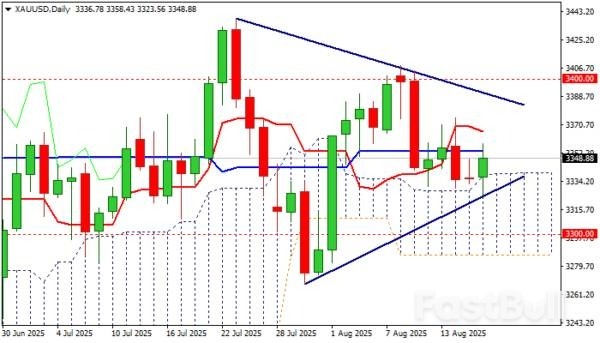
Technical picture on daily chart remains bullishly aligned as near-term price action continues to float above the top of daily Ichimoku cloud ($3337), also supported by ascending trendline lower boundary ($3327).
Momentum indicator is in positive territory and adds to bullish bias, although near term action needs to see lift above $3365/74 zone (daily Tenkan-sen / Friday’s peak) to strengthen bulls for attack at $3391 (upper triangle boundary) and unmask upper breakpoint at $3400 zone (psychological / Aug 8 high).
Conversely, penetration and closing within daily cloud (below triangle support line) would weaken near term structure and bring in focus key supports at $3300 (psychological) and $3286 (daily cloud top).
Interesting situation could be also seen on monthly chart, where three consecutive long-legged monthly Dojis and four strong upside rejections generate signals of high uncertainty, but also warn that larger bulls might be running out of steam.
Markets will be also focusing on Jackson Hole symposium which starts later this week and look for more signals about Fed’s interest rate path.
Res: 3353; 3366; 3375; 3391.Sup: 3337; 3327; 3321; 3307.

The U.S. Energy Information Administration (EIA) cut its West Texas Intermediate (WTI) average spot crude oil price forecast in its latest short term energy outlook (STEO), which was released on August 12.
According to this STEO, the EIA sees the WTI spot price averaging $63.58 per barrel in 2025 and $47.77 per barrel in 2026. In its previous STEO, which was released in July, the EIA projected that the WTI spot price would average $65.22 per barrel this year and $54.82 per barrel in 2026.
Both STEOs highlighted that the WTI spot price averaged $76.60 per barrel in 2024.
A quarterly breakdown included in the EIA’s August STEO showed that the organization expects the WTI spot price to come in at $64.20 per barrel in the third quarter of 2025, $54.05 per barrel in the fourth quarter, $45.97 per barrel in the first quarter of next year, $46.33 per barrel in the second quarter, $48.68 per barrel in the third quarter, and $50.00 per barrel in the fourth quarter.
In its previous July STEO, the EIA projected that the WTI spot price would average $64.69 per barrel in the third quarter of 2025, $60.02 per barrel in the fourth quarter, $56.00 per barrel in the first quarter of next year, $55.67 per barrel in the second quarter, $54.68 per barrel in the third quarter, and $53.00 per barrel in the fourth quarter.
The EIA’s August STEO highlighted that the WTI spot price came in at $71.85 per barrel in the first quarter and $64.63 per barrel in the second quarter. The EIA’s July STEO also highlighted that the WTI spot price averaged $71.85 per barrel in the first quarter. It projected that the second quarter WTI spot price would average $64.69 per barrel.
A report sent to Rigzone by the Standard Chartered team late Tuesday showed that Standard Chartered was forecasting that the NYMEX WTI basis nearby future crude oil price would average $58 per barrel in 2025 and $75 per barrel in 2026.
In that report, Standard Chartered saw the commodity averaging $62 per barrel in the fourth quarter of this year, $68 per barrel in the first quarter of 2026, $73 per barrel in the second quarter, $78 per barrel in the third quarter, and $80 per barrel in the fourth quarter.
In a report sent to Rigzone by the Standard Chartered team on July 8, the company had identical forecasts for the NYMEX WTI basis nearby future crude oil price.
A J.P. Morgan research note sent to Rigzone by the JPM Commodities Research team on August 11 showed that J.P. Morgan expected the WTI crude price to average $63 per barrel this year and $54 per barrel next year.
In that research note, J.P. Morgan projected that the WTI crude price would come in at $59 per barrel in the third quarter of 2025, $57 per barrel in the fourth quarter, $51 per barrel in the first quarter of next year, $53 per barrel across the second and third quarters of 2026, and $56 per barrel in the fourth quarter of next year.
A J.P. Morgan research note sent to Rigzone by the JPM Commodities Research team on July 14 had identical forecasts for the WTI crude price.
In a BMI report sent to Rigzone by the Fitch Group on August 8, BMI projected that the front month WTI crude price would average $65 per barrel in 2025 and $64 per barrel in 2026. A BMI report sent to Rigzone by the Fitch Group on July 11 had identical forecasts for the front month WTI crude price.
Washington faces mounting pressure from global trade partners to deliver long-promised tariff relief. Cuts to steel, aluminum, and auto duties, announced months ago, remain unfulfilled, leaving European, Asian, and UK firms struggling under US trade restrictions.British PM Keir Starmer at a Jaguar Land Rover plant in May, at that time, welcomed the “world-leading” agreement with US President Donald Trump. The deal would eliminate US tariffs on British steel, he said.
And yet, three months later, nothing has changed. That duty remains 25% for UK steel. UK Steel’s director of trade and economic policy, Peter Brennan, said orders from the US had “fallen off a cliff.” He claims that some firms will not outlast this crisis. On the other hand, a rival producer is even more negative and claims could be forced out of business without assistance before the end of the year.The delay stems from US “melt and pour” rules, which only allow tariff cuts on steel produced entirely within the UK. Since Tata Steel UK shut down its blast furnaces last year, the company cannot meet this requirement until new electric arc facilities are operational in 2027. London has been pushing Washington to grant waivers, but progress on those talks has been slow.
Tim Rutter of Tata Steel said it was not due to a lack of effort from the UK government but because US departments were overwhelmed. He noted that although billions in potential opportunities for British exporters were at stake, they remained unrealized. London officials maintained that they were working to finalize the deal as quickly as possible, but industry voices warned that the ongoing delays risked deterring unilateral action.
The EU is stuck in a very similar bind. Deal or no deal: Ursula von der Leyen, European Commission President, shook Trump’s hand on a 15% tariff cap in Scotland last July, and Brussels recognised that the cap would shrink cars too.Yet the reality looks different. However, US tariffs of 50% on EU steel and 25% on autos remain. German carmakers are sounding alarms. So far, the agreement has brought no clarity or relief to the German car makers, said Hildegard Müller, president of Germany’s auto trade body VDA. It’s costing them, she said, billions.
Japan and Korea signed with Washington in July. Auto tariffs will be reduced to 15% , and steel duties will be cut, it was said. Cars get different treatment, with a 25% auto tariff still hitting Japanese and Korean automakers.Japan’s top trade negotiator, Ryosei Akazawa, said: “We’re still seeing an impact; the bleeding has not stopped. Freed said he believes one Japanese automaker is taking the hit to nearly ¥100 million ($680,000) per hour due to the tariff weight.
South Korea is among those pushing for relief. Bloomberg Intelligence estimates that Hyundai and Kia could incur up to $5 billion in additional expenses this year. The squeeze on margins and weakening global demand have also made the 15% tariff bite.
Instead of easing duties, Washington has been trending in the opposite direction; rather than lifting duties, the latest moves slap additional tariffs on Chinese imports. The move came just weeks after Washington expanded the list of tariffs to nearly 300 new steel and aluminum product codes, covering 50% US tariffs, on August 15. That expansion took effect immediately.The shake-up has angered partners who are hoping for concessions. EU officials have blamed disagreements over digital trade rules for a hold-up in the promised joint statement with Washington. Those countries, Japan and South Korea, have been waiting for executive orders to seal the tariff relief.
Critics have begun to question Washington’s commitment. Cecilia Malmström, the EU’s former trade commissioner, said that permanent delays must be avoided to prevent the process from becoming endless negotiations and excessive filibustering.
White Label
Data API
Web Plug-ins
Poster Maker
Affiliate Program
The risk of loss in trading financial instruments such as stocks, FX, commodities, futures, bonds, ETFs and crypto can be substantial. You may sustain a total loss of the funds that you deposit with your broker. Therefore, you should carefully consider whether such trading is suitable for you in light of your circumstances and financial resources.
No decision to invest should be made without thoroughly conducting due diligence by yourself or consulting with your financial advisors. Our web content might not suit you since we don't know your financial conditions and investment needs. Our financial information might have latency or contain inaccuracy, so you should be fully responsible for any of your trading and investment decisions. The company will not be responsible for your capital loss.
Without getting permission from the website, you are not allowed to copy the website's graphics, texts, or trademarks. Intellectual property rights in the content or data incorporated into this website belong to its providers and exchange merchants.
Not Logged In
Log in to access more features

FastBull Membership
Not yet
Purchase
Log In
Sign Up