Markets
News
Analysis
User
24/7
Economic Calendar
Education
Data
- Names
- Latest
- Prev


Signal Accounts for Members
All Signal Accounts
All Contests


U.K. Trade Balance (Oct)A:--
F: --
P: --
U.K. Services Index MoMA:--
F: --
P: --
U.K. Construction Output MoM (SA) (Oct)A:--
F: --
P: --
U.K. Industrial Output YoY (Oct)A:--
F: --
P: --
U.K. Trade Balance (SA) (Oct)A:--
F: --
P: --
U.K. Trade Balance EU (SA) (Oct)A:--
F: --
P: --
U.K. Manufacturing Output YoY (Oct)A:--
F: --
P: --
U.K. GDP MoM (Oct)A:--
F: --
P: --
U.K. GDP YoY (SA) (Oct)A:--
F: --
P: --
U.K. Industrial Output MoM (Oct)A:--
F: --
P: --
U.K. Construction Output YoY (Oct)A:--
F: --
P: --
France HICP Final MoM (Nov)A:--
F: --
P: --
China, Mainland Outstanding Loans Growth YoY (Nov)A:--
F: --
P: --
China, Mainland M2 Money Supply YoY (Nov)A:--
F: --
P: --
China, Mainland M0 Money Supply YoY (Nov)A:--
F: --
P: --
China, Mainland M1 Money Supply YoY (Nov)A:--
F: --
P: --
India CPI YoY (Nov)A:--
F: --
P: --
India Deposit Gowth YoYA:--
F: --
P: --
Brazil Services Growth YoY (Oct)A:--
F: --
P: --
Mexico Industrial Output YoY (Oct)A:--
F: --
P: --
Russia Trade Balance (Oct)A:--
F: --
P: --
Philadelphia Fed President Henry Paulson delivers a speech
Canada Building Permits MoM (SA) (Oct)A:--
F: --
P: --
Canada Wholesale Sales YoY (Oct)A:--
F: --
P: --
Canada Wholesale Inventory MoM (Oct)A:--
F: --
P: --
Canada Wholesale Inventory YoY (Oct)A:--
F: --
P: --
Canada Wholesale Sales MoM (SA) (Oct)A:--
F: --
P: --
Germany Current Account (Not SA) (Oct)A:--
F: --
P: --
U.S. Weekly Total Rig CountA:--
F: --
P: --
U.S. Weekly Total Oil Rig CountA:--
F: --
P: --
Japan Tankan Large Non-Manufacturing Diffusion Index (Q4)--
F: --
P: --
Japan Tankan Small Manufacturing Outlook Index (Q4)--
F: --
P: --
Japan Tankan Large Non-Manufacturing Outlook Index (Q4)--
F: --
P: --
Japan Tankan Large Manufacturing Outlook Index (Q4)--
F: --
P: --
Japan Tankan Small Manufacturing Diffusion Index (Q4)--
F: --
P: --
Japan Tankan Large Manufacturing Diffusion Index (Q4)--
F: --
P: --
Japan Tankan Large-Enterprise Capital Expenditure YoY (Q4)--
F: --
P: --
U.K. Rightmove House Price Index YoY (Dec)--
F: --
P: --
China, Mainland Industrial Output YoY (YTD) (Nov)--
F: --
P: --
China, Mainland Urban Area Unemployment Rate (Nov)--
F: --
P: --
Saudi Arabia CPI YoY (Nov)--
F: --
P: --
Euro Zone Industrial Output YoY (Oct)--
F: --
P: --
Euro Zone Industrial Output MoM (Oct)--
F: --
P: --
Canada Existing Home Sales MoM (Nov)--
F: --
P: --
Euro Zone Total Reserve Assets (Nov)--
F: --
P: --
U.K. Inflation Rate Expectations--
F: --
P: --
Canada National Economic Confidence Index--
F: --
P: --
Canada New Housing Starts (Nov)--
F: --
P: --
U.S. NY Fed Manufacturing Employment Index (Dec)--
F: --
P: --
U.S. NY Fed Manufacturing Index (Dec)--
F: --
P: --
Canada Core CPI YoY (Nov)--
F: --
P: --
Canada Manufacturing Unfilled Orders MoM (Oct)--
F: --
P: --
Canada Manufacturing New Orders MoM (Oct)--
F: --
P: --
Canada Core CPI MoM (Nov)--
F: --
P: --
Canada Manufacturing Inventory MoM (Oct)--
F: --
P: --
Canada CPI YoY (Nov)--
F: --
P: --
Canada CPI MoM (Nov)--
F: --
P: --
Canada CPI YoY (SA) (Nov)--
F: --
P: --
Canada Core CPI MoM (SA) (Nov)--
F: --
P: --
Canada CPI MoM (SA) (Nov)--
F: --
P: --


No matching data
Latest Views
Latest Views
Trending Topics
Top Columnists
Latest Update
White Label
Data API
Web Plug-ins
Affiliate Program
View All

No data
Gold reached a new high of $3,674.27 per ounce in September, surpassing its inflation-adjusted peak from 1980, amidst concerns about U.S. economic stability and dollar weakness.
Key Points:
Gold reached a new high of $3,674.27 per ounce in September, surpassing its inflation-adjusted peak from 1980, amidst concerns about U.S. economic stability and dollar weakness.
The rise strengthens gold's role as a hedge against inflation and currency depreciation, influencing investor behavior and potentially impacting related crypto assets like gold-backed tokens.
Gold has reached a historic high, with spot prices hitting $3,674.27 per ounce. Central banks, specifically the People’s Bank of China, have boosted holdings due to currency risks. The event emphasizes gold's safe-haven appeal amidst uncertainty in US economic outlook.
The increasing concerns about US economic stability have driven this surge, with anticipated Federal Reserve rate cuts adding to the appeal of gold. The weakening dollar and rising demand for stability are key factors in this development.
Market reaction has been significant, with analysts predicting further gains. Natasha Kaneva from J.P. Morgan highlights continued bullish prospects for gold. Despite no direct statements from major crypto influencers, the indirect effects are apparent as investors seek refuge in stable assets like gold.
Did you know? In 1980, gold's previous inflation-adjusted peak was $3,590, making the current $3,674.27 an unprecedented high.
PAX Gold (PAXG) is currently priced at $3,635.71, with a market cap of around $1.05 billion as of September 11, 2025, reflecting a minor decrease of 0.26% over 24 hours per CoinMarketCap. Trading volumes have seen a 7.31% change, underscoring gold's bullish trend.
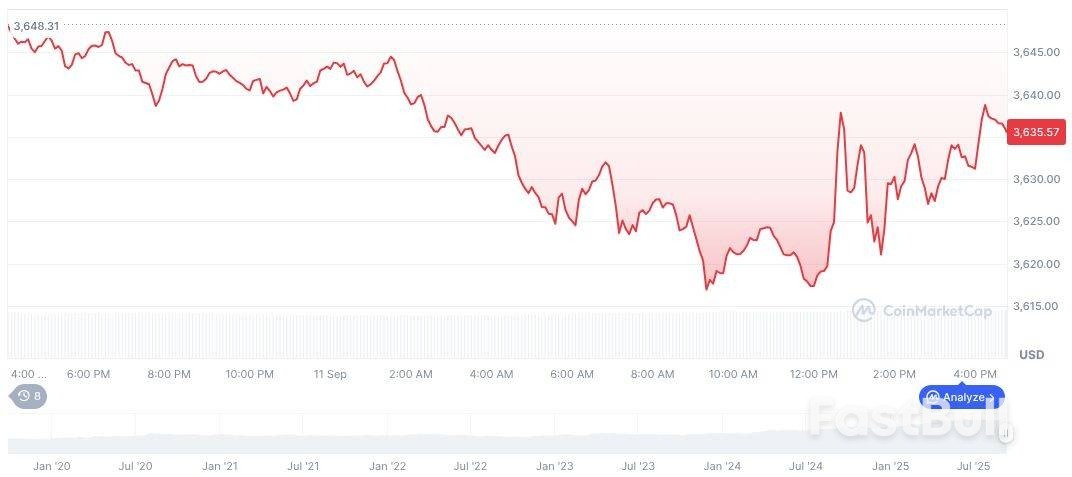
Source: CoinMarketCapCoincu's research team notes that continued central bank accumulation and geopolitical uncertainty could further bolster gold prices. The potential implications for gold-backed tokens highlight a trend towards diversification and stability, emphasizing gold's role as an enduring store of value.
The International Monetary Fund on Thursday said the Federal Reserve has scope to lower interest rates because of the weakening U.S. labor market, but the central bank should move cautiously with a close eye on emerging economic data.
"Our overall sense is that, given the downside risks to full employment, there is scope for the Fed to begin to lower policy rates," IMF spokeswoman Julie Kozack said in a regular briefing."We also would say that the Fed should proceed cautiously, of course in a data-dependent way, in the coming months."
The Fed is expected to lower its benchmark interest rate by a quarter of a percentage point at a policy meeting next week.
European Central Bank policymakers see their December meeting as the most realistic time frame to debate whether an another interest rate cut is needed to buffer the euro zone economy from the impact of U.S. tariffs, three sources told Reuters.
The ECB left rates unchanged on Thursday and maintained an upbeat view on growth and inflation, dampening expectations for any further cut in borrowing costs.
But sources on the ECB's Governing Council said the debate on a rate cut was not over just yet, although policymakers probably won't have enough information by their next meeting in October 29 to make a proper assessment.
This meant that the December 18 meeting was seen as the more likely date to discuss a reduction in borrowing costs, also in light of incoming inflation and growth data and the next batch of projections.
An ECB spokesperson declined to comment.
Hydrogen is often thought to be linchpin of a future 100% renewable economy. To make up for wind and solar's deal-breaking intermittency and to rid industry of energy-dense fossil fuels, the surplus cheap electricity that renewables produce during times of abundance would need to be channeled into electrolyzers that split water molecules into hydrogen and oxygen. The hydrogen could then be collected, stored, transported, and eventually combusted for on-demand energy.

But is this scenario really the most cost-effective and environmentally-friendly option? Would it make more sense, for instance, to produce hydrogen from another carbon-free source – nuclear power?
A trio of scientists in the Department of Civil and Industrial Engineering at the University of Pisa in Italy explored that question. Utilizing data from the International Atomic Energy Agency Hydrogen Economic Evaluation Programme, the group performed a feasibility assessment to compare various methods of producing hydrogen from futuristic Gen IV nuclear reactors. Their findings are published in the journal energies.
Two methods of producing hydrogen from nuclear power rose to the top. First, engineers could construct an attached electrolyzer system just like with renewable energy. Since a nuclear reactor is almost constantly running as "baseload" power, plant operators could simply divert power to the electrolyzers when grid demand wanes. The researchers estimate the cost of hydrogen with this setup would be 2.71 USD/kg with paltry carbon emissions of 0.3 kgCO2e/kgH2.
Second, the authors envisioned a system where futuristic Gen IV reactors operating at high temperatures (between 550 and 1000 °C) can produce hydrogen through the hot steam they emit. This high-temperature steam electrolysis is similar to how hydrogen is produced from steam reforming via natural gas. They predict costs here to be 3.57 USD/kg with slightly higher emissions of 0.8 kgCO2e/kgH2. Costs are higher because it a more novel system, even though it is "the most efficient coupling since it better exploits the electrical and thermal energy resources produced by the reactor," the researchers write.
Costs and carbon emissions for both methods compare favorably with current costs of hydrogen produced from fossil fuels and renewables. In Europe in 2023, hydrogen made via methane reforming cost 3.76 EUR/kg (4.39 USD) and produced emissions of at least 11.6 kgCO2e/kgH2. Hydrogen made from a direct connection to renewables cost 6.61 EUR/kg (7.71 USD) with emissions similar to production from nuclear.
The researchers' assessment is highly preliminary, of course. There's only one commercial nuclear reactor in operation today that matches the reactor they modeled. It's in China. Their cost estimates could also be overly rosy, and it's likely that the cost to produce hydrogen with renewables will come down over time as solar panels grow more efficient.
The world currently produces 52.6 million tons of hydrogen per year, used mostly to make ammonia for fertilizer. The process of making this hydrogen accounts for two percent of the world's total energy consumption and contributes roughly the same proportion of global carbon dioxide emissions. Even if hydrogen doesn't find wider use in industry, transportation, and grid storage, we still need a lot of it to feed the world, preferably produced in a far cleaner manner than it is currently. Nuclear energy could provide it in abundance.
White Label
Data API
Web Plug-ins
Poster Maker
Affiliate Program
The risk of loss in trading financial instruments such as stocks, FX, commodities, futures, bonds, ETFs and crypto can be substantial. You may sustain a total loss of the funds that you deposit with your broker. Therefore, you should carefully consider whether such trading is suitable for you in light of your circumstances and financial resources.
No decision to invest should be made without thoroughly conducting due diligence by yourself or consulting with your financial advisors. Our web content might not suit you since we don't know your financial conditions and investment needs. Our financial information might have latency or contain inaccuracy, so you should be fully responsible for any of your trading and investment decisions. The company will not be responsible for your capital loss.
Without getting permission from the website, you are not allowed to copy the website's graphics, texts, or trademarks. Intellectual property rights in the content or data incorporated into this website belong to its providers and exchange merchants.
Not Logged In
Log in to access more features

FastBull Membership
Not yet
Purchase
Log In
Sign Up