Markets
News
Analysis
User
24/7
Economic Calendar
Education
Data
- Names
- Latest
- Prev


Signal Accounts for Members
All Signal Accounts
All Contests


U.K. Trade Balance Non-EU (SA) (Oct)A:--
F: --
P: --
U.K. Trade Balance (Oct)A:--
F: --
P: --
U.K. Services Index MoMA:--
F: --
P: --
U.K. Construction Output MoM (SA) (Oct)A:--
F: --
P: --
U.K. Industrial Output YoY (Oct)A:--
F: --
P: --
U.K. Trade Balance (SA) (Oct)A:--
F: --
P: --
U.K. Trade Balance EU (SA) (Oct)A:--
F: --
P: --
U.K. Manufacturing Output YoY (Oct)A:--
F: --
P: --
U.K. GDP MoM (Oct)A:--
F: --
P: --
U.K. GDP YoY (SA) (Oct)A:--
F: --
P: --
U.K. Industrial Output MoM (Oct)A:--
F: --
P: --
U.K. Construction Output YoY (Oct)A:--
F: --
P: --
France HICP Final MoM (Nov)A:--
F: --
P: --
China, Mainland Outstanding Loans Growth YoY (Nov)A:--
F: --
P: --
China, Mainland M2 Money Supply YoY (Nov)A:--
F: --
P: --
China, Mainland M0 Money Supply YoY (Nov)A:--
F: --
P: --
China, Mainland M1 Money Supply YoY (Nov)A:--
F: --
P: --
India CPI YoY (Nov)A:--
F: --
P: --
India Deposit Gowth YoYA:--
F: --
P: --
Brazil Services Growth YoY (Oct)A:--
F: --
P: --
Mexico Industrial Output YoY (Oct)A:--
F: --
P: --
Russia Trade Balance (Oct)A:--
F: --
P: --
Philadelphia Fed President Henry Paulson delivers a speech
Canada Building Permits MoM (SA) (Oct)A:--
F: --
P: --
Canada Wholesale Sales YoY (Oct)A:--
F: --
P: --
Canada Wholesale Inventory MoM (Oct)A:--
F: --
P: --
Canada Wholesale Inventory YoY (Oct)A:--
F: --
P: --
Canada Wholesale Sales MoM (SA) (Oct)A:--
F: --
P: --
Germany Current Account (Not SA) (Oct)A:--
F: --
P: --
U.S. Weekly Total Rig CountA:--
F: --
P: --
U.S. Weekly Total Oil Rig CountA:--
F: --
P: --
Japan Tankan Large Non-Manufacturing Diffusion Index (Q4)--
F: --
P: --
Japan Tankan Small Manufacturing Outlook Index (Q4)--
F: --
P: --
Japan Tankan Large Non-Manufacturing Outlook Index (Q4)--
F: --
P: --
Japan Tankan Large Manufacturing Outlook Index (Q4)--
F: --
P: --
Japan Tankan Small Manufacturing Diffusion Index (Q4)--
F: --
P: --
Japan Tankan Large Manufacturing Diffusion Index (Q4)--
F: --
P: --
Japan Tankan Large-Enterprise Capital Expenditure YoY (Q4)--
F: --
P: --
U.K. Rightmove House Price Index YoY (Dec)--
F: --
P: --
China, Mainland Industrial Output YoY (YTD) (Nov)--
F: --
P: --
China, Mainland Urban Area Unemployment Rate (Nov)--
F: --
P: --
Saudi Arabia CPI YoY (Nov)--
F: --
P: --
Euro Zone Industrial Output YoY (Oct)--
F: --
P: --
Euro Zone Industrial Output MoM (Oct)--
F: --
P: --
Canada Existing Home Sales MoM (Nov)--
F: --
P: --
Euro Zone Total Reserve Assets (Nov)--
F: --
P: --
U.K. Inflation Rate Expectations--
F: --
P: --
Canada National Economic Confidence Index--
F: --
P: --
Canada New Housing Starts (Nov)--
F: --
P: --
U.S. NY Fed Manufacturing Employment Index (Dec)--
F: --
P: --
U.S. NY Fed Manufacturing Index (Dec)--
F: --
P: --
Canada Core CPI YoY (Nov)--
F: --
P: --
Canada Manufacturing Unfilled Orders MoM (Oct)--
F: --
P: --
Canada Manufacturing New Orders MoM (Oct)--
F: --
P: --
Canada Core CPI MoM (Nov)--
F: --
P: --
Canada Manufacturing Inventory MoM (Oct)--
F: --
P: --
Canada CPI YoY (Nov)--
F: --
P: --
Canada CPI MoM (Nov)--
F: --
P: --
Canada CPI YoY (SA) (Nov)--
F: --
P: --
Canada Core CPI MoM (SA) (Nov)--
F: --
P: --


No matching data
Latest Views
Latest Views
Trending Topics
Top Columnists
Latest Update
White Label
Data API
Web Plug-ins
Affiliate Program
View All

No data
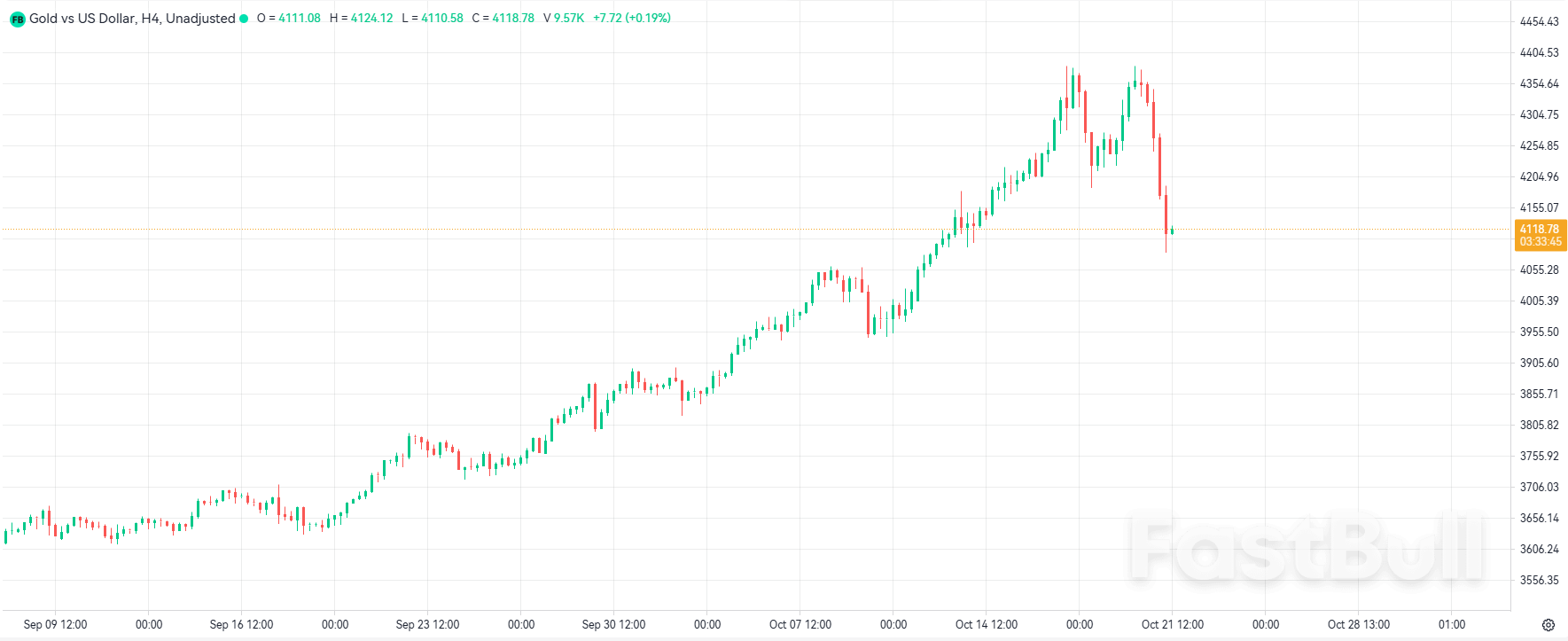
The move came amid easing trade tensions between Washington and Beijing, a rise in the US dollar, and technical indicators flashing overbought conditions.
President Donald Trump has no plans to meet President Vladimir Putin in the immediate future, a White House official said, offering a more downbeat tone after the two sides suggested earlier that a second summit between the two leaders would happen soon.
The official, who asked not to be identified discussing private deliberations, said a call between Secretary of State Marco Rubio and Russian Foreign Minister Sergei Lavrov on Monday had been productive, and a meeting between the two officials also wasn’t necessary.
The statement, while lacking in detail, contrasted with remarks Trump made after speaking with Putin by phone last week. At the time he said he would meet Putin “within two weeks or so” and that Rubio and Lavrov would meet “pretty soon.”
The shift fit with similar remarks out of Russia, where the Kremlin also sought to tamp down expectations for a quick summit. Putin spokesman Dmitry Peskov said “the work ahead will be challenging,” according to the Interfax news service. “Preparation, serious preparation, is needed.”
Trump has ratcheted up his calls to end the war in recent days, urging the two sides to stop the war “at the battle line.” On Monday, he cast doubt on Ukraine’s ability to defeat Russian forces, and he’s also equivocated over military aid to Ukraine and the threat of new sanctions on Russia.
Ukraine President Volodymyr Zelenskiy was in Washington last Friday to try to persuade Trump to send Ukraine Tomahawk missiles and other support. But Putin got to Trump with a phone call the day before that meeting, and the two leaders agreed to meet in Budapest, Hungary.
At the time, Trump acknowledged that the prospect of a Budapest summit might be part of an effort by Putin to stall for time, especially after an August summit between the two men made no progress on ending the conflict. But Trump shrugged off concerns that Putin may be manipulating him and insisted the Kremlin wants to end the conflict that’s well into its fourth year.
Gold (XAU/USD) is testing the important $4,200 support level associated with prior demand zones having previously triggered rebounds in the past. Current price action suggests possible upside momentum if price holds above this support level at $4,200.

Gold’s 1-hour chart shows the market approaching the lower boundary of the recent trading range around $4,200. Historical data indicates this zone has consistently acted as a strong demand base. Sellers have shown reduced strength near $4,217–$4,200, signaling possible defensive buying.
According to Ali _charts, “If gold holds $4,200 as support, a rebound to $4,300 or even $4,380 could follow.” This tweet reflects the market’s focus on defending the support level. Price structure suggests a potential “V-shaped” recovery, where buyers may step in aggressively.
Momentum indicators imply the recent drop has been contained within a short-term range. Sharp declines often precede mean reversion when demand enters the market, which could support a rebound toward higher levels.
If $4,200 holds, the first recovery target is $4,300, aligning with mid-range resistance from prior consolidations. This level could act as an initial zone for profit-taking by traders.
The second target stands at $4,380, representing the upper boundary of the current trading range. This area often serves as a liquidity zone where larger market participants may adjust positions. A bounce toward this level would signal a short-term recovery in price action.
A move back below $4,200 would likely open lower supports near $4,170, and draw additional defensive settlements into the market focus. Traders are eyeing this point for a potential shift in short-term trend and future buying reaction.
For now, the market’s direction largely depends on the defense of the $4,200 support. Holding this zone could allow gold to regain upward momentum and challenge the $4,300–$4,380 range efficiently.
The Bank of England warned of parallels between the $1.7 trillion private credit boom and the subprime debt crisis, as UK officials confirmed plans to subject the market to stress tests.
BOE Governor Andrew Bailey told a Parliament committee on Tuesday that “alarm bells” were ringing in the sector. He cited conversations with industry figures who assured him that “everything was fine in their world, apart from the role of the rating agencies,” in an echo of the confusion over the quality of debt in subprime debt securitizations almost two decades ago.
“I said, ‘Well, we’re not playing that movie again, are we?’” Bailey told a hearing of the House of Lords’ Financial Services Regulation Committee in London. “If you were involved before the financial crisis and during it, alarm bells start going off at that point.”
The comments by the British central bank chief, who also chairs the Basel, Switzerland,-based Financial Stability Board, are the latest warning about the world’s private credit market. Sarah Breeden, the BOE’s deputy governor for financial stability, pointed to the market’s opacity, leverage and its links with banks as some of the industry’s risks.
The sector has ballooned since the great financial crisis, driven in part by governments’ efforts to tighten regulation on commercial lenders and reduce risks. It’s also awash with cash from insurance firms, which require ratings for regulatory purposes. Firms are building more complex structures such as collateralized fund obligations with investment grade ratings, in part to accommodate insurance capital.
Concerns are mounting that any problems that emerge in the sector and the broader leveraged credit markets could quickly spread to banks and the wider economy after the recent collapse of US firms First Brands and Tricolor. Those cases prompted JP Morgan Chase & Co. Chief Executive Officer Jamie Dimon to warn that “when you see one cockroach, there are probably more.”
Private credit executives have hit back, saying the issue was in loans that banks led and shouldn’t be held up as evidence of growing risks enabled by newer players muscling into lending. Still, Bailey said it was still an “open question” whether cases like First Brands were a “canary in the coal mine.”
In the run up to the financial crisis, creative packaging of loans led to groups of risky credits rebranded as collectively safe securities. The result was hundreds of billions of losses, the collapse of Lehman Brothers and Bear Stearns and a global financial crisis that weighed on growth for more than a decade.
Bailey, who helped oversee the BOE’s efforts to rescue the banks during the financial crisis, specifically mentioned the “slicing and dicing and tranching of loan structures” among the trends the bank was scrutinizing. The BOE has been exploring the issue for several months, amid escalating fears about the standalone risks from private credit and the potential for those to spill over into the mainstream banking sector.
Bailey and Breeden confirmed a Bloomberg News report earlier on Friday that the central bank was speaking with firms about conducting a “system-wide exploratory scenario” to find vulnerabilities in the broad private credit market. The so-called stress test would use a similar model to last year’s review of risks to core UK financial markets.
“We can see parallels with the GFC,” said Breeden. “What we don’t know is how macro significant those issues are.”
The scrutiny comes as President Donald Trump in the US and Chancellor of the Exchequer Rachel Reeves in the UK encourage pension funds and others to invest in private markets. The US Government Accountability Office is also assessing the risks posed by private credit is expected to report back in the spring.
“Precisely how close to a tipping point we are it is hard to say,” said David Blake, director of Bayes Business School’s Pensions Institute. “This wall of money will create a bubble that will eventually burst.”
The BOE doesn’t have direct regulatory oversight of private credit markets and will need cooperation from firms to probe the risks contained within the sector. The political hurdle for new regulation would likely also be high, given the UK government’s push for fewer burdens on businesses and a global wave of deregulation.
Bailey told the Lords committee that he would seek other avenues before new rules. “Transparency is the first, in a sense, disinfectant.”
“We have to have a system that encourages risk to be taken and investment to be made,” he said. “My first reaction is, how can we improve that? I wouldn’t go to regulation as the first answer to that.”


White Label
Data API
Web Plug-ins
Poster Maker
Affiliate Program
The risk of loss in trading financial instruments such as stocks, FX, commodities, futures, bonds, ETFs and crypto can be substantial. You may sustain a total loss of the funds that you deposit with your broker. Therefore, you should carefully consider whether such trading is suitable for you in light of your circumstances and financial resources.
No decision to invest should be made without thoroughly conducting due diligence by yourself or consulting with your financial advisors. Our web content might not suit you since we don't know your financial conditions and investment needs. Our financial information might have latency or contain inaccuracy, so you should be fully responsible for any of your trading and investment decisions. The company will not be responsible for your capital loss.
Without getting permission from the website, you are not allowed to copy the website's graphics, texts, or trademarks. Intellectual property rights in the content or data incorporated into this website belong to its providers and exchange merchants.
Not Logged In
Log in to access more features

FastBull Membership
Not yet
Purchase
Log In
Sign Up