• Trade
  • Markets
  • Copy
  • Contests
  • News
  • 24/7
  • Calendar
  • Q&A
  • Chats
Trending
Screeners
SYMBOL
LAST
BID
ASK
HIGH
LOW
NET CHG.
%CHG.
SPREAD
SPX
S&P 500 Index
6827.42
6827.42
6827.42
6899.86
6801.80
-73.58
-1.07%
--
DJI
Dow Jones Industrial Average
48458.04
48458.04
48458.04
48886.86
48334.10
-245.98
-0.51%
--
IXIC
NASDAQ Composite Index
23195.16
23195.16
23195.16
23554.89
23094.51
-398.69
-1.69%
--
USDX
US Dollar Index
97.950
98.030
97.950
98.500
97.950
-0.370
-0.38%
--
EURUSD
Euro / US Dollar
1.17394
1.17409
1.17394
1.17496
1.17192
+0.00011
+ 0.01%
--
GBPUSD
Pound Sterling / US Dollar
1.33707
1.33732
1.33707
1.33997
1.33419
-0.00148
-0.11%
--
XAUUSD
Gold / US Dollar
4299.39
4299.39
4299.39
4353.41
4257.10
+20.10
+ 0.47%
--
WTI
Light Sweet Crude Oil
57.233
57.485
57.233
58.011
56.969
-0.408
-0.71%
--

Community Accounts

Signal Accounts
--
Profit Accounts
--
Loss Accounts
--
View More

Become a signal provider

Sell trading signals to earn additional income

View More

Guide to Copy Trading

Get started with ease and confidence

View More

Signal Accounts for Members

All Signal Accounts

Best Return
  • Best Return
  • Best P/L
  • Best MDD
Past 1W
  • Past 1W
  • Past 1M
  • Past 1Y

All Contests

  • All
  • Trump Updates
  • Recommend
  • Stocks
  • Cryptocurrencies
  • Central Banks
  • Featured News
Top News Only
Share

Thai Leader Anutin: Landmine Blast That Killed Thai Soldiers 'Not A Roadside Accident'

Share

Thai Leader Anutin: Thailand To Continue Military Action Until 'We Feel No More Harm'

Share

Cambodian Prime Minister Hun Manet Says He Had Phone Calls With Trump And Malaysian Leader Anwar About Ceasefire

Share

Cambodia's Hun Manet Says USA, Malaysia Should Verify 'Which Side Fired First' In Latest Conflict

Share

Cambodia's Hun Manet: Cambodia Maintains Its Stance In Seeking Peaceful Resolution Of Disputes

Share

Nasdaq Companies: Allergan, Ferrovia, Insmed, Monolithic Power Systems, Seagate Technology, And Western Digital Will Be Added To The NASDAQ 100 Index. Biogen, CdW, GlobalFoundries, Lululemon, ON Semiconductor, And Tradedesk Will Be Removed From The NASDAQ 100 Index

Share

Witkoff Headed To Berlin This Weekend To Meet With Zelenskiy, European Leaders -Wsj Reporter On X

Share

Russia Attacks Two Ukrainian Ports, Damaging Three Turkish-Owned Vessels

Share

[Historic Flooding Occurs In At Least Four Rivers In Washington State Due To Days Of Torrential Rains] Multiple Areas In Washington State Have Been Hit By Severe Flooding Due To Days Of Torrential Rains, With At Least Four Rivers Experiencing Historic Flooding. Reporters Learned On The 12th That The Floods Caused By The Torrential Rains In Washington State Have Destroyed Homes And Closed Several Highways. Experts Warn That Even More Severe Flooding May Occur In The Future. A State Of Emergency Has Been Declared In Washington State

Share

Trump Says Proposed Free Economic Zone In Donbas Would Work

Share

Trump: I Think My Voice Should Be Heard

Share

Trump Says Will Be Choosing New Fed Chair In Near Future

Share

Trump Says Proposed Free Economic Zone In Donbas Complex But Would Work

Share

Trump Says Land Strikes In Venezuela Will Start Happening

Share

US President Trump: Thailand And Cambodia Are In A Good Situation

Share

State Media: North Korean Leader Kim Hails Troops Returning From Russia Mission

Share

The 10-year Treasury Yield Rose About 5 Basis Points During The "Fed Rate Cut Week," And The 2/10-year Yield Spread Widened By About 9 Basis Points. On Friday (December 12), In Late New York Trading, The Yield On The Benchmark 10-year US Treasury Note Rose 2.75 Basis Points To 4.1841%, A Cumulative Increase Of 4.90 Basis Points For The Week, Trading Within A Range Of 4.1002%-4.2074%. It Rose Steadily From Monday To Wednesday (before The Fed Announced Its Rate Cut And Treasury Bill Purchase Program), Subsequently Exhibiting A V-shaped Recovery. The 2-year Treasury Yield Fell 1.82 Basis Points To 3.5222%, A Cumulative Decrease Of 3.81 Basis Points For The Week, Trading Within A Range Of 3.6253%-3.4989%

Share

Trump: Lots Of Progress Being Made On Russia-Ukraine

Share

NOPA November US Soybean Crush Estimated At 220.285 Million Bushels

Share

SPDR Gold Trust Reports Holdings Up 0.22%, Or 2.28 Tonnes, To 1053.11 Tonnes By Dec 12

TIME
ACT
FCST
PREV
U.K. Trade Balance Non-EU (SA) (Oct)

A:--

F: --

P: --

U.K. Trade Balance (Oct)

A:--

F: --

P: --

U.K. Services Index MoM

A:--

F: --

P: --

U.K. Construction Output MoM (SA) (Oct)

A:--

F: --

P: --

U.K. Industrial Output YoY (Oct)

A:--

F: --

P: --

U.K. Trade Balance (SA) (Oct)

A:--

F: --

P: --

U.K. Trade Balance EU (SA) (Oct)

A:--

F: --

P: --

U.K. Manufacturing Output YoY (Oct)

A:--

F: --

P: --

U.K. GDP MoM (Oct)

A:--

F: --

P: --

U.K. GDP YoY (SA) (Oct)

A:--

F: --

P: --

U.K. Industrial Output MoM (Oct)

A:--

F: --

P: --

U.K. Construction Output YoY (Oct)

A:--

F: --

P: --

France HICP Final MoM (Nov)

A:--

F: --

P: --

China, Mainland Outstanding Loans Growth YoY (Nov)

A:--

F: --

P: --

China, Mainland M2 Money Supply YoY (Nov)

A:--

F: --

P: --

China, Mainland M0 Money Supply YoY (Nov)

A:--

F: --

P: --

China, Mainland M1 Money Supply YoY (Nov)

A:--

F: --

P: --

India CPI YoY (Nov)

A:--

F: --

P: --

India Deposit Gowth YoY

A:--

F: --

P: --

Brazil Services Growth YoY (Oct)

A:--

F: --

P: --

Mexico Industrial Output YoY (Oct)

A:--

F: --

P: --

Russia Trade Balance (Oct)

A:--

F: --

P: --

Philadelphia Fed President Henry Paulson delivers a speech
Canada Building Permits MoM (SA) (Oct)

A:--

F: --

P: --

Canada Wholesale Sales YoY (Oct)

A:--

F: --

P: --

Canada Wholesale Inventory MoM (Oct)

A:--

F: --

P: --

Canada Wholesale Inventory YoY (Oct)

A:--

F: --

P: --

Canada Wholesale Sales MoM (SA) (Oct)

A:--

F: --

P: --

Germany Current Account (Not SA) (Oct)

A:--

F: --

P: --

U.S. Weekly Total Rig Count

A:--

F: --

P: --

U.S. Weekly Total Oil Rig Count

A:--

F: --

P: --

Japan Tankan Large Non-Manufacturing Diffusion Index (Q4)

--

F: --

P: --

Japan Tankan Small Manufacturing Outlook Index (Q4)

--

F: --

P: --

Japan Tankan Large Non-Manufacturing Outlook Index (Q4)

--

F: --

P: --

Japan Tankan Large Manufacturing Outlook Index (Q4)

--

F: --

P: --

Japan Tankan Small Manufacturing Diffusion Index (Q4)

--

F: --

P: --

Japan Tankan Large Manufacturing Diffusion Index (Q4)

--

F: --

P: --

Japan Tankan Large-Enterprise Capital Expenditure YoY (Q4)

--

F: --

P: --

U.K. Rightmove House Price Index YoY (Dec)

--

F: --

P: --

China, Mainland Industrial Output YoY (YTD) (Nov)

--

F: --

P: --

China, Mainland Urban Area Unemployment Rate (Nov)

--

F: --

P: --

Saudi Arabia CPI YoY (Nov)

--

F: --

P: --

Euro Zone Industrial Output YoY (Oct)

--

F: --

P: --

Euro Zone Industrial Output MoM (Oct)

--

F: --

P: --

Canada Existing Home Sales MoM (Nov)

--

F: --

P: --

Euro Zone Total Reserve Assets (Nov)

--

F: --

P: --

U.K. Inflation Rate Expectations

--

F: --

P: --

Canada National Economic Confidence Index

--

F: --

P: --

Canada New Housing Starts (Nov)

--

F: --

P: --

U.S. NY Fed Manufacturing Employment Index (Dec)

--

F: --

P: --

U.S. NY Fed Manufacturing Index (Dec)

--

F: --

P: --

Canada Core CPI YoY (Nov)

--

F: --

P: --

Canada Manufacturing Unfilled Orders MoM (Oct)

--

F: --

P: --

Canada Manufacturing New Orders MoM (Oct)

--

F: --

P: --

Canada Core CPI MoM (Nov)

--

F: --

P: --

Canada Manufacturing Inventory MoM (Oct)

--

F: --

P: --

Canada CPI YoY (Nov)

--

F: --

P: --

Canada CPI MoM (Nov)

--

F: --

P: --

Canada CPI YoY (SA) (Nov)

--

F: --

P: --

Canada Core CPI MoM (SA) (Nov)

--

F: --

P: --

Q&A with Experts
    • All
    • Chatrooms
    • Groups
    • Friends
    Connecting
    .
    .
    .
    Type here...
    Add Symbol or Code

      No matching data

      All
      Trump Updates
      Recommend
      Stocks
      Cryptocurrencies
      Central Banks
      Featured News
      • All
      • Russia-Ukraine Conflict
      • Middle East Flashpoint
      • All
      • Russia-Ukraine Conflict
      • Middle East Flashpoint
      Search
      Products

      Charts Free Forever

      Chats Q&A with Experts
      Screeners Economic Calendar Data Tools
      Membership Features
      Data Warehouse Market Trends Institutional Data Policy Rates Macro

      Market Trends

      Market Sentiment Order Book Forex Correlations

      Top Indicators

      Charts Free Forever
      Markets

      News

      News Analysis 24/7 Columns Education
      From Institutions From Analysts
      Topics Columnists

      Latest Views

      Latest Views

      Trending Topics

      Top Columnists

      Latest Update

      Signals

      Copy Rankings Latest Signals Become a signal provider AI Rating
      Contests
      Brokers

      Overview Brokers Assessment Rankings Regulators News Claims
      Broker listing Forex Brokers Comparison Tool Live Spread Comparison Scam
      Q&A Complaint Scam Alert Videos Tips to Detect Scam
      More

      Business
      Events
      Careers About Us Advertising Help Center

      White Label

      Data API

      Web Plug-ins

      Affiliate Program

      Awards Institution Evaluation IB Seminar Salon Event Exhibition
      Vietnam Thailand Singapore Dubai
      Fans Party Investment Sharing Session
      FastBull Summit BrokersView Expo
      Recent Searches
        Top Searches
          Markets
          News
          Analysis
          User
          24/7
          Economic Calendar
          Education
          Data
          • Names
          • Latest
          • Prev

          View All

          No data

          Scan to Download

          Faster Charts, Chat Faster!

          Download App
          English
          • English
          • Español
          • العربية
          • Bahasa Indonesia
          • Bahasa Melayu
          • Tiếng Việt
          • ภาษาไทย
          • Français
          • Italiano
          • Türkçe
          • Русский язык
          • 简中
          • 繁中
          Open Account
          Search
          Products
          Charts Free Forever
          Markets
          News
          Signals

          Copy Rankings Latest Signals Become a signal provider AI Rating
          Contests
          Brokers

          Overview Brokers Assessment Rankings Regulators News Claims
          Broker listing Forex Brokers Comparison Tool Live Spread Comparison Scam
          Q&A Complaint Scam Alert Videos Tips to Detect Scam
          More

          Business
          Events
          Careers About Us Advertising Help Center

          White Label

          Data API

          Web Plug-ins

          Affiliate Program

          Awards Institution Evaluation IB Seminar Salon Event Exhibition
          Vietnam Thailand Singapore Dubai
          Fans Party Investment Sharing Session
          FastBull Summit BrokersView Expo

          Gold Prices Forecast: Will Strong Dollar and High Yields Spark Bearish Trend?

          Alex

          Commodity

          Economic

          Summary:

          Next week, gold traders will eye Fed speeches for rate cut and economic health insights that could influence XAU/USD’s direction.
          Analyzing Last Week’s Key Influences and Predicting Future Trends

          Last week, gold prices experienced notable fluctuations due to several critical economic developments. These included Federal Reserve Chair Jerome Powell’s assertive comments, an unexpectedly strong U.S. Non-Farm Payrolls report, increasing Treasury yields, and a strengthening U.S. Dollar.

          U.S. Jobs Data and Dollar Strength Impact Gold

          The increase in gold prices was hindered by a surge in the dollar and yields, following a robust U.S. nonfarm payrolls report. This report showed the addition of 353,000 jobs in January, well above the forecasted 180,000. This robust job growth reduced the probability of the Federal Reserve cutting interest rates soon, leading to a decrease in gold’s appeal.The dollar index rose by 0.47% last week, making gold more expensive for international buyers.
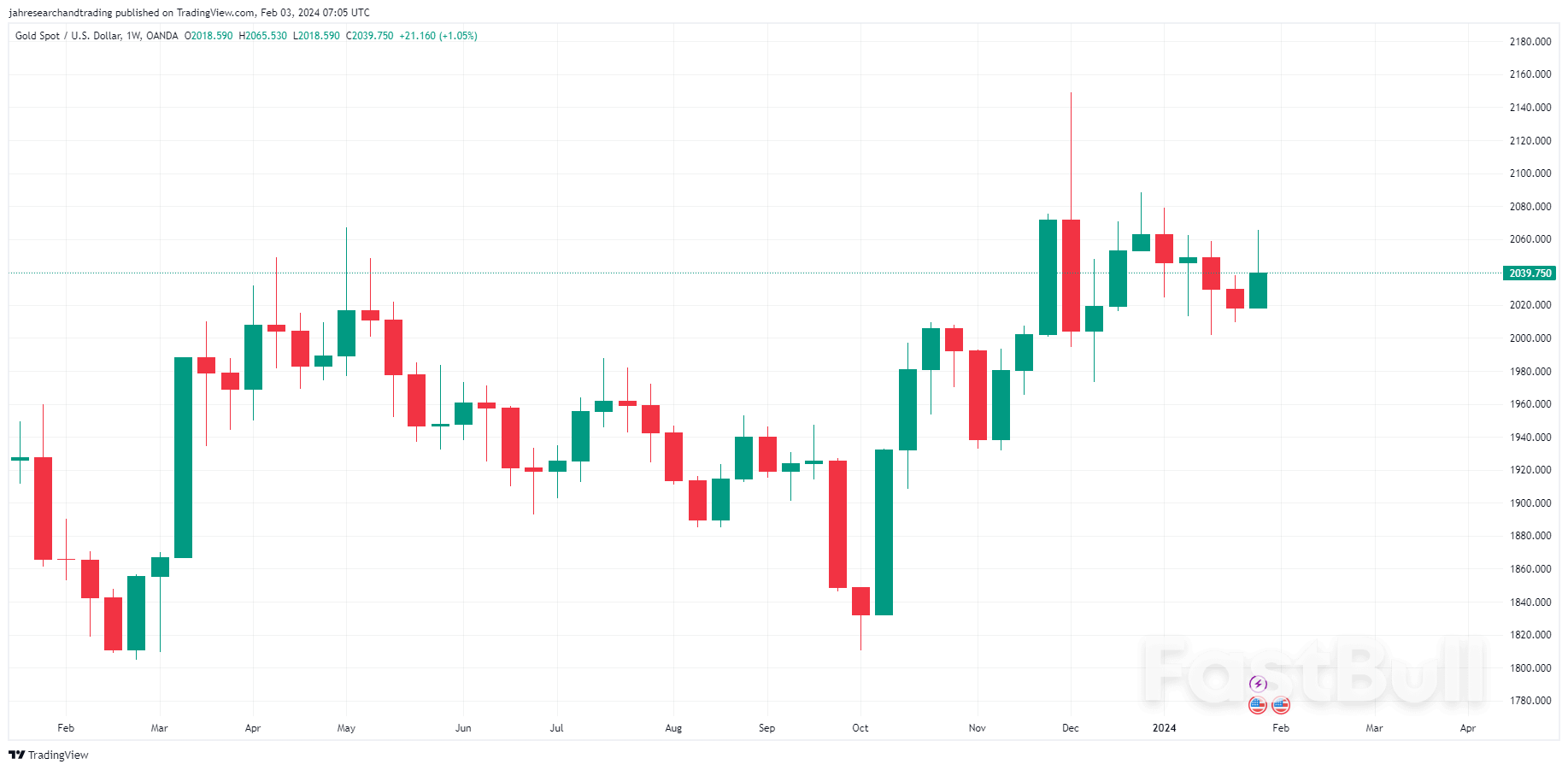
          XAUUSD settled sharply lower on Friday, but was able to finish the week at $2039.75, up $21.16 or +1.05%.Gold Prices Forecast: Will Strong Dollar and High Yields Spark Bearish Trend?_1

          Fed’s Position and Treasury Yield Rise

          Chairman Powell’s stance against reducing interest rates in the near future, coupled with his confidence in reaching the 2% inflation target, significantly influenced the gold market. Following his remarks, the yield on the 10-year Treasury note exceeded 4%, a factor that typically reduces the attractiveness of gold, a non-yielding asset.

          Dollar’s Rally and Market Sentiment

          The surge to a seven-week high in the U.S. dollar index further reflected the market’s reaction to the strong employment data. This increase in the dollar, alongside the changes in Treasury yields, indicated a shift in market expectations, especially regarding the timing of any potential rate cuts by the Federal Reserve.

          Gold Price Forecast for the Upcoming Week

          Looking ahead, the focus will be on upcoming speeches from Fed Chair Jerome Powell and other Federal Open Market Committee members. Their comments on the impact of the strong jobs report on the prospects of rate adjustments in the near term will be crucial.
          Given the current market conditions, including the strong dollar, rising yields, and the Fed’s current stance, the forecast for gold prices in the upcoming week leans towards a bearish outlook.
          The prevailing economic indicators suggest that gold may continue to face downward pressure, especially if upcoming speeches reinforce the perception of a resilient U.S. economy and a delayed timeline for rate cuts. Investors and traders in the gold market should prepare for potential further declines in gold prices in the short term.

          Source:FXEMPIRE

          To stay updated on all economic events of today, please check out our Economic calendar
          Risk Warnings and Disclaimers
          You understand and acknowledge that there is a high degree of risk involved in trading. Following any strategies or investment methods may lead to potential losses. The content on the site is provided by our contributors and analysts for information purposes only. You are solely responsible for determining whether any trading assets, securities, strategy, or any other product is suitable for investing based on your own investment objectives and financial situation.
          Comments
          Add to Favorites
          Share

          [Fed] Goolsbee: A March Rate Cut Cannot Be Ruled Out

          FastBull Featured

          Remarks of Officials

          Chicago Fed President Austan Goolsbee said in a speech on February 2, local time, as follows:
          Inflation is better than expected, but the price level is still high. If you're trying to get the price level back to what it was some years ago, you would really have to just crank down on the economy to do that, so that's not in our card deck.
          So far, the economy has been going pretty well, and the year 2023 by that dual mandate goal went quite well.
          Non-farm payrolls increased by 353,000 jobs in January. If the labor market stays strong, it will ease concerns about the Fed's employment mandate. The weakness in total hours worked, however, indicates that the jobs report may not be as strong as the data suggests. The headline data can not reflect the full picture. We need to see more progress on inflation and employment, to boost our confidence to achieve the target.
          There are still weeks or even months of data to be seen. We would like to see more evidence that the Fed is moving towards its 2% inflation target before the FOMC cuts rates. We should make our decision based on the actual data, but we don't rule out the possibility of a rate cut in March. If there is a supply shock in the system, the Fed must adopt a proactive monetary policy instead of waiting.
          Risk Warnings and Disclaimers
          You understand and acknowledge that there is a high degree of risk involved in trading. Following any strategies or investment methods may lead to potential losses. The content on the site is provided by our contributors and analysts for information purposes only. You are solely responsible for determining whether any trading assets, securities, strategy, or any other product is suitable for investing based on your own investment objectives and financial situation.
          Comments
          Add to Favorites
          Share

          Red Sea Danger Is Spurring Global Oil Buyers To Go Local

          Alex

          Economic

          Commodity

          A slump in tanker traffic through the Suez Canal is spurring the beginnings of a split, with one trading region centered around the Atlantic Basin and including the North Sea and the Mediterranean, and another encompassing the Persian Gulf, the Indian Ocean and East Asia. There’s still crude moving between these areas — via the longer and costlier journey around the southern tip of Africa — but recent buying patterns point to disconnection.
          Across Europe, some refiners skipped purchases of Iraqi Basrah crude last month, according to traders, while buyers from the continent are snapping up cargoes from the North Sea and Guyana. in Asia, a jump in demand for Abu Dhabi’s Murban crude led to a spike in spot prices in mid-January, and flows from Kazakhstan to Asia are down sharply.
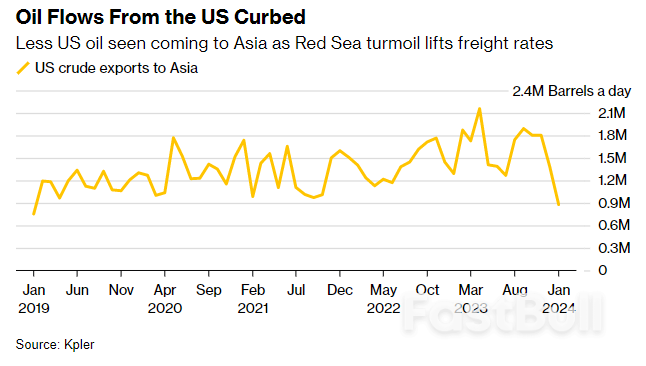
          Crude loadings from the US to Asia, meanwhile, plunged by more than a third last month from December, ship-tracking data from Kpler show.
          The fragmentation will not be permanent, but for now it’s making it tougher for import-dependent nations like India and South Korea to diversify their sources of oil supply. For refiners, it limits their flexibility to respond to rapidly changing market dynamics and could eventually eat into margins.
          “The pivot toward logistically easier cargoes makes commercial sense, and that will be the case for as long as the Red Sea disruptions keep freight rates elevated,” said Viktor Katona, lead crude analyst at data analytics firm Kpler. “It’s a tough balancing act choosing between security of supply and maximizing profits.”
          Red Sea Danger Is Spurring Global Oil Buyers To Go Local_1
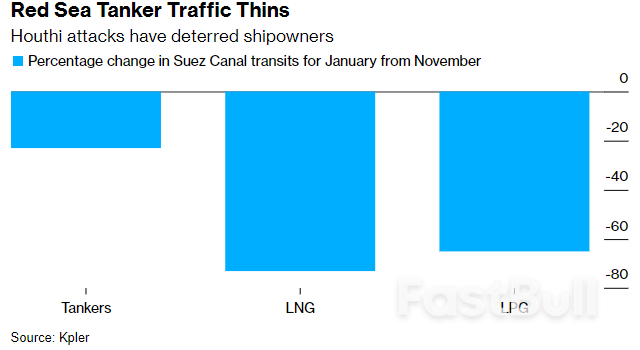
          Oil tanker transits through the Suez Canal were down 23% last month compared with November, Kpler said in a note released Jan. 30. The drop was even more pronounced for liquefied petroleum gas and liquefied natural gas, which fell 65% and 73%, respectively.
          In product markets, flows of diesel and jet fuel from India and the Middle East to Europe, and European fuel oil and naphtha heading to Asia have been most affected. Asian prices of naphtha, a petrochemicals feedstock, hit the highest in almost two years last week on fears it would become tougher to source it from Europe.
          The impact of the Red Sea attacks is feeding through to oil prices via higher transport costs, which is encouraging refiners to go local where they can. Rates for Suezmax crude tankers from the Middle East to Northwest Europe have jumped by around half since mid-December, Kpler said. Global benchmark Brent crude is up around 8% over the same period.
          Meanwhile, the delivered cost of oil to Asia from the US, where production is surging, rose by more than $2 a barrel over a three-week period in January, according to traders involved in the market.
          Red Sea Danger Is Spurring Global Oil Buyers To Go Local_2
          “Diversification is still possible, but it comes at a higher price,” said Giovanni Staunovo, a commodity analyst at UBS Group AG. “Unless it can be passed onto the end consumer, it would cut into the margins of refineries.”
          The situation in the Red Sea isn’t expected to lead to a long-term rearrangement of oil flows, but it’s also difficult to see a resolution of the conflict in the near term. Instead, there’s a significant risk of more disruptions, particularly after the Houthi strike on a tanker carrying Russian fuel late last month. That attack was noteworthy as the Iranian-backed militant group had previously indicated that Russian and Chinese ships wouldn’t be targeted.
          “Geopolitics are not good for trade,” said Adi Imsirovic, director of consultancy Surrey Clean Energy. “If I was a buyer, I would be on my toes. It’s a hard time for refiners, especially Asian refiners, who need to be more flexible.”

          Source:Bloomberg

          To stay updated on all economic events of today, please check out our Economic calendar
          Risk Warnings and Disclaimers
          You understand and acknowledge that there is a high degree of risk involved in trading. Following any strategies or investment methods may lead to potential losses. The content on the site is provided by our contributors and analysts for information purposes only. You are solely responsible for determining whether any trading assets, securities, strategy, or any other product is suitable for investing based on your own investment objectives and financial situation.
          Comments
          Add to Favorites
          Share

          February 4th Financial News

          FastBull Featured

          Daily News

          [Quick Facts]

          1. Markets are betting the Fed is going to make a mistake with rate cuts.
          2. Goolsbee: The Fed has weeks and months of data to help decide when to cut rates.
          3. Strong January non-farm payrolls cool rate cut expectations sharply.
          4. Forex traders are betting the Bank of Japan will tighten policy in April.

          [News Details]

          Markets are betting the Fed is going to make a mistake with rate cuts
          Powell's statement lowered expectations for a rate cut in March, but the market still expects about six rate cuts this year. This suggests the market is pricing in a policy mistake.
          It is more important for the Fed to push back against market pricing of the speed of rate cuts rather than the timing of the first cut. However, the Fed is doing the opposite. If the Fed wants to cut rates at a quarterly pace, it has a lot of work to do in terms of moving market pricing, and it runs the risk of inducing meaningful financial tightening.
          Goolsbee: The Fed has weeks and months of data to help decide when to cut rates
          Chicago Fed President Austan Goolsbee said last Friday that the Federal Reserve would not seek to restore prices to the level before the inflation "crisis". "If you're trying to get the price level back to what it was some years ago, you would really have to just crank down on the economy to do that, so that's not in our card deck."
          The performance of January non-farm payrolls is amazing, but I think the labor market may not be as strong as the data show.
          More progress needs to be seen at this point, such as on the inflation and employment front, so that we can feel more confident that inflation is coming down materially.
          There are still "weeks and months" of U.S. economic data that will help the Fed decide when to cut interest rates.
          Strong January non-farm payrolls cool rate cut expectations sharply
          U.S. January non-farm payrolls published last Friday surged unexpectedly by 353,000, marking the largest increase since January 2023, almost twice the expected increase of 185,000, and the December non-farm payrolls were revised from 216,000 to 333,000.
          In addition, the unemployment rate was unchanged from the previous month and was at 3.7% for the third consecutive month, lower than the market's expectation of 3.8%, which strongly dampened speculation about a recession in the U.S. Meanwhile, the U.S. average hourly wage grew at 4.5% year-on-year in January, the highest since March 2022, higher than the expected 4.1%. The wage growth rate in December was also upwardly revised from 4.1% to 4.3%, and the month-on-month growth rate reached 0.6%, twice the expected 0.3%.
          All in all, the market was surprised by the soaring non-farm payrolls data. The employment data overall reflected a high demand in the economy, promoting further expectation adjustments in overseas markets for the path of the Fed's rate cuts in 2024, and boosting confidence in the continued resilience of the economy in the first quarter.
          After the release of the data, overseas markets adjusted their expectations for the Fed's rate cut path, and they have became more optimistic about the outlook for the U.S. economic fundamentals in 2024. Powell also said at the latest policy meeting that they are unlikely to cut interest rates in March. The probability of a rate cut in March declined to less than 20%, according to the CME Group's FedWatch Tool.
          Forex traders are betting the Bank of Japan will tighten policy in April
          Forex traders are increasing their bets that the Bank of Japan will tighten policy in April, which will help drive a sustained decline in the USD/JPY pair. Currently, the gap between two- and three-month implied volatility is widening, while the absolute level is also rising. This suggests greater confidence that the central bank will exit negative interest rates in April (rather than March).
          That said, if U.S. interest rates continue to soften in anticipation of the Fed's first rate cut, the downside in USD/JPY could accelerate earlier. Powell's TV appearance on Sunday could be a turning point when a rate cut will be supported.

          [Focus of the Day]

          None
          Risk Warnings and Disclaimers
          You understand and acknowledge that there is a high degree of risk involved in trading. Following any strategies or investment methods may lead to potential losses. The content on the site is provided by our contributors and analysts for information purposes only. You are solely responsible for determining whether any trading assets, securities, strategy, or any other product is suitable for investing based on your own investment objectives and financial situation.
          Comments
          Add to Favorites
          Share

          The Weekly Bottom Line: Resilient Labor Demand and A Patient Fed

          TD Securities

          Economic

          U.S. – Resilient Labor Demand and A Patient Fed
          January ended with a big week for economic data, including the first Federal Reserve decision of the year and the first employment data reading. While the Fed's statement dropped any tightening bias, Chair Powell's press conference curtailed market hopes for a near-term pivot to less restrictive monetary policy. This saw Treasury yields fall steeply after the meeting. However, this descent was ultimately short-lived, as much stronger than expected employment data on Friday sent yields higher. At time of writing, the ten-year Treasury yield was 12 basis-points lower on the week.
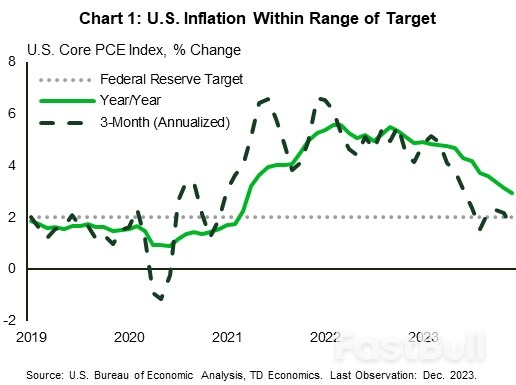
          Overall, the messaging from the Federal Reserve on Wednesday was positive. Chair Powell stated that the committee was pleased by the progress made thus far on returning inflation to their 2% target, but noted that they would require more time to assess the sustainability of current disinflation trends (Chart 1). With economic growth accelerating last year on the back of strong consumption growth, the labor market remaining solid, and geopolitical tensions posing challenges to supply chains (and hence inflation), caution is likely wise. Chair Powell also stated that he viewed it as unlikely that the FOMC would possess the confidence to reduce interest rates by the March meeting in six week's time.The Weekly Bottom Line: Resilient Labor Demand and A Patient Fed_1
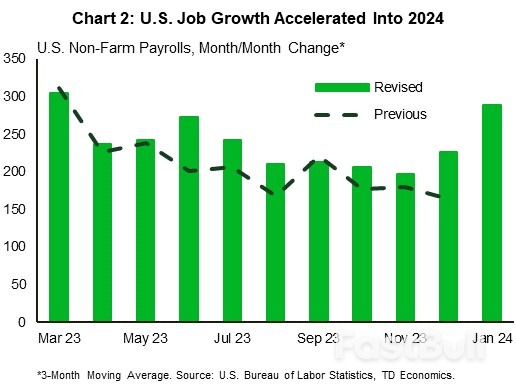
          Powell's caution was further validated when we received the January employment data on Friday. Not only did we see a very strong 353k jobs added in the first month of the year, but last year's total job gains were also revised up to 3.1 million, well above the prior reading for 2.7 million, with much of the revised strength coming through the second half of the year (Chart 2). Furthermore, wage growth appears to be accelerating, with the three-month annualized change in average hourly wages rising to a twenty-month high in January. Although near-term strength in the labor market is expected to recede over the coming months, sustained imbalances in the labor market is a risk that the Fed is acutely aware of.The Weekly Bottom Line: Resilient Labor Demand and A Patient Fed_2
          Elsewhere this week, the ISM Manufacturing Purchasing Managers' Index (PMI) showed that industrial activity continued to contract in January, but by less than expected. Elevated interest rates continue to weigh on the sector, but demand has begun to show signs of improvement, which has stabilized aggregate production output. Forward pricing in financial markets for the eventual decline in interest rates expected this year will likely provide relief to the manufacturing sector moving forward as the demand for goods improves.
          The lingering question, however, is when will the Federal Reserve begin to drawdown interest rates? Markets have broadly abandoned their hopes for a March cut after this week, with May now being the expected timeline with about 80% probability as of the time of writing. Upcoming data will likely provide greater clarity on the timing of the introduction of less restrictive monetary policy, including a 60 Minutes interview with Chair Powell on Sunday and the Federal Reserve Senior Loan Officer Opinion Survey on Monday.

          Canada – Welcome Back Growth

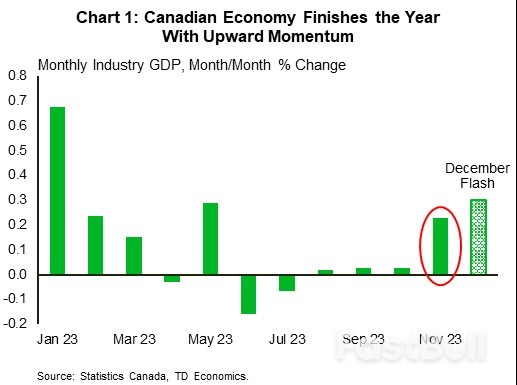
          Canadian markets likely took their cue from events south of the border this week, with a light domestic data calendar. The 2-Year Canada yield finished the week flat while the 10-Year yield slipped around 10 bps. The Loonie's early-week gains were erased on Friday, finishing the week flat at 0.7420. On the data front, the lone GDP update for November printed at 0.2% month-on-month (m/m), exceeding Statistics Canada's initial guidance and market expectations. What's more, the flash estimate for December GDP growth was a sturdy 0.3% m/m, which would mark the hottest growth reading since May.
          It has been several months since Canada's economy has recorded any meaningful growth. In fact, between Jun.–Oct. 2023, real GDP flatlined (Chart 1). Not a bad outcome given the current interest rate environment, but still evidence that output was hitting a wall. This week's update poured cold water on the idea that the economy is completely out of steam. We are hesitant to call this a newly emerging growth trend, but it would be remiss to ignore it.The Weekly Bottom Line: Resilient Labor Demand and A Patient Fed_3
          There is clearly some degree of underlying strength in Canada's economy despite the turbulent second and third quarter this year. Strength in this sense is relative. GDP for Q4-2023 is tracking above expectations, around 1.2% quarter-on-quarter (q/q) annualized, but still below trend-growth. A range of indicators however, namely housing sales, retail spending and manufacturing, have showed a pulse in recent months. These fresh GDP readings also introduce upside risk to the BoC's growth projection in last week's Monetary Policy Report (MPR), which now pegs fourth quarter growth at 0%, down from their 0.8% projection in October.
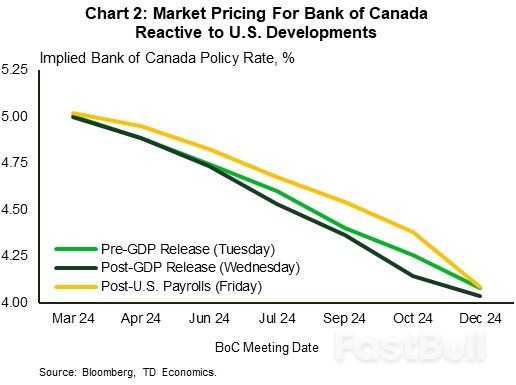
          The BoC is now forced to divert some attention back to growth while trying to manage underlying inflation pressures. The ultimate focus for the BoC is to get inflation back to their 2% target, and they have reiterated that they believe trends in growth–and inflation– are headed in the right direction. The GDP release alone didn't move the needle on the market's expectations for a first Bank of Canada rate cut, but it appears hawkish data stateside did (Chart 2). At the time of writing, markets are pricing a 30% chance of a rate cut in April and an 80% probability assigned to June. Prior to U.S. payrolls, market expectations for a June cut were fully priced in.The Weekly Bottom Line: Resilient Labor Demand and A Patient Fed_4
          Next week's main focus is job market updates for January. Encouragingly, the labour market is cooling and looks positioned to avoid a worst-case scenario. The pace of monthly job gains, notably in the private sector, has retreated in recent months while the unemployment rate grinds higher. Expect a modest gain in January employment to be met with stronger labour force growth, a theme that has been playing out for several months.
          To stay updated on all economic events of today, please check out our Economic calendar
          Risk Warnings and Disclaimers
          You understand and acknowledge that there is a high degree of risk involved in trading. Following any strategies or investment methods may lead to potential losses. The content on the site is provided by our contributors and analysts for information purposes only. You are solely responsible for determining whether any trading assets, securities, strategy, or any other product is suitable for investing based on your own investment objectives and financial situation.
          Comments
          Add to Favorites
          Share

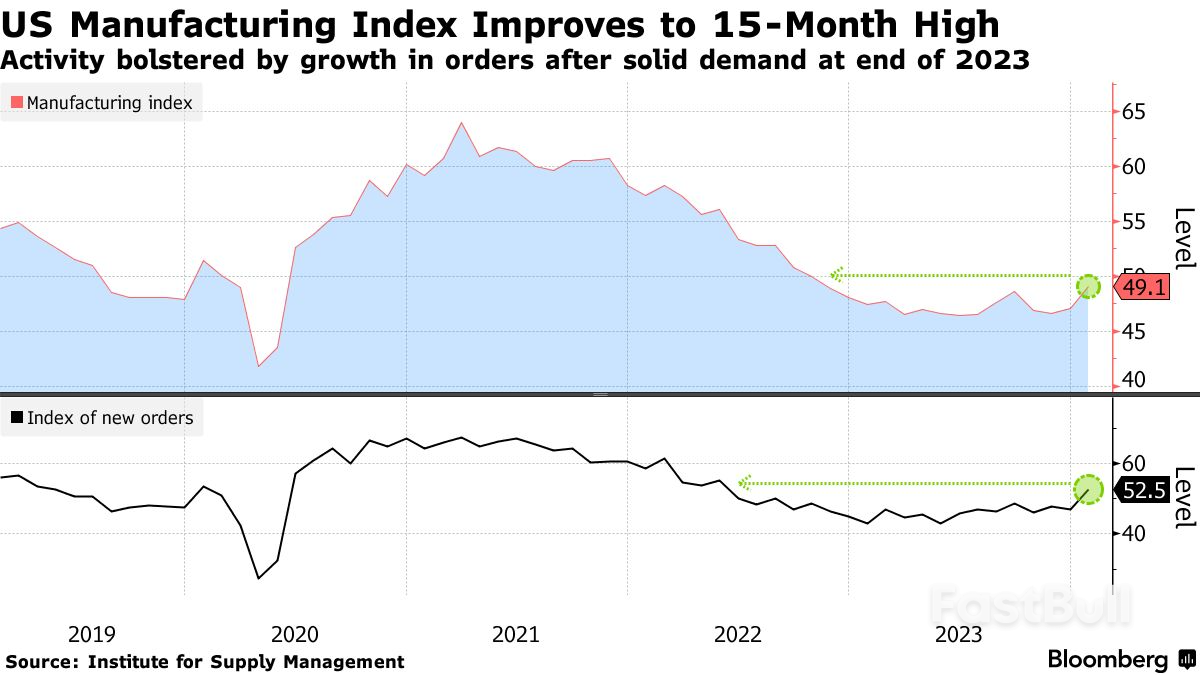
          US Factory Gauge Climbs To Highest Since 2022 On Orders Growth

          Cohen

          Economic

          A measure of US factory activity climbed to a 15-month high at the start of the year, fueled by the strongest orders growth since May 2022 and suggesting manufacturing is starting to stabilize.
          The Institute for Supply Management’s manufacturing gauge rose 2 points to 49.1 last month, according to data released Thursday. While still below the level of 50 that indicates shrinking activity, the figure exceeded all but one estimate in a Bloomberg survey of economists.
          The 5.5-point increase in the orders index marked the largest monthly advance in more than three years, helped by robust demand in the last half of 2023. Production expanded for the first time in four months, while a gauge of customer inventories showed the leanest stockpiles since October 2022.US Factory Gauge Climbs To Highest Since 2022 On Orders Growth_1
          “This could be the beginnings of growth,” Timothy Fiore, chair of the ISM manufacturing survey committee, said on a call with reporters. “We’ve been waiting for this, and I think we need to get through the quarter to really see it.”
          The nation’s purchasing and supply management executives are optimistic about the economy’s prospects as the Federal Reserve has signaled it will lower interest rates this year.
          Four industries reported growth in January, including apparel and transportation equipment, while 13 indicated contracting activity.
          Fed policymakers on Wednesday left their benchmark rate unchanged for a fourth-straight meeting and signaled an openness to cutting it. After the meeting, Fed Chair Jerome Powell dashed investors’ hopes that reductions would begin in March.
          The ISM’s survey pointed to remaining hurdles for a recovery in US manufacturing. While domestic demand has been steady, the group’s export orders gauge showed overseas customers are pulling back. The index fell 4.7 points to 45.2 in January, marking the fastest rate of contraction since May 2020.
          Price pressures also bubbled up in January. The ISM’s prices-paid index showed materials costs rose for the first time since April.

          Select ISM Industry Comments

          “The start of 2024 looks good. Sales are above expectations, and costs are mostly stable. A few commodities are up in cost due to supply shortages. Many previously short commodities market positions have corrected themselves.” — Chemical Products
          “The commercial vehicle market appears to be retracting a bit in 2024 compared to last year.” — Transportation Equipment
          “Business continues to stabilize. Cash flow will be tight in 2024.” — Food, Beverages & Tobacco Products
          “US economic outlook is affecting customer orders, and the current backlog is quite low compared to past quarters. Waiting on potential improvements from the CHIPS and Science Act.” — Computer & Electronic Products
          “December sales were very strong but slower for the first part of January, as was expected. We expect to see steady sales going forward, if the (Fed) continues to hold rates and suggests a rate cut in the future.” — Machinery
          “Good start to the year. We had budgeted a 3.5-percent increase over 2023. We expect it to be a challenging year. Currently, orders are positive in our automotive OEM and automotive aftermarket business. Our industrial business sector is looking weak at the moment.” Fabricated Metals
          “Demand continues to be slow. Reduction from the second half of 2023 has continued into this year. We are adjusting production to match demand.” — Electrical Equipment & Appliances
          “Current industry conditions are positive; however, a note of caution as we see potential headwinds with downward price movements in the coming months.” Primary Metals
          “Remarkable slowdown in business in December. January has picked up, but not to previous-year levels.” — Textile Mills

          Source:Bloomberg

          To stay updated on all economic events of today, please check out our Economic calendar
          Risk Warnings and Disclaimers
          You understand and acknowledge that there is a high degree of risk involved in trading. Following any strategies or investment methods may lead to potential losses. The content on the site is provided by our contributors and analysts for information purposes only. You are solely responsible for determining whether any trading assets, securities, strategy, or any other product is suitable for investing based on your own investment objectives and financial situation.
          Comments
          Add to Favorites
          Share

          How Sectors Perform Under Republicans vs. Democrats

          JPMorgan

          Political

          Economic

          Elections are a time of great uncertainty in which investors often want to prepare their portfolios for increased volatility. While reallocating to cash can be a risky strategy as the opportunity cost is high and markets tend to rebound very quickly after the election ends, many investors wonder if they can tweak their existing exposures to be either more defensive against volatility or more opportunistic if certain sectors face future policy tailwinds.
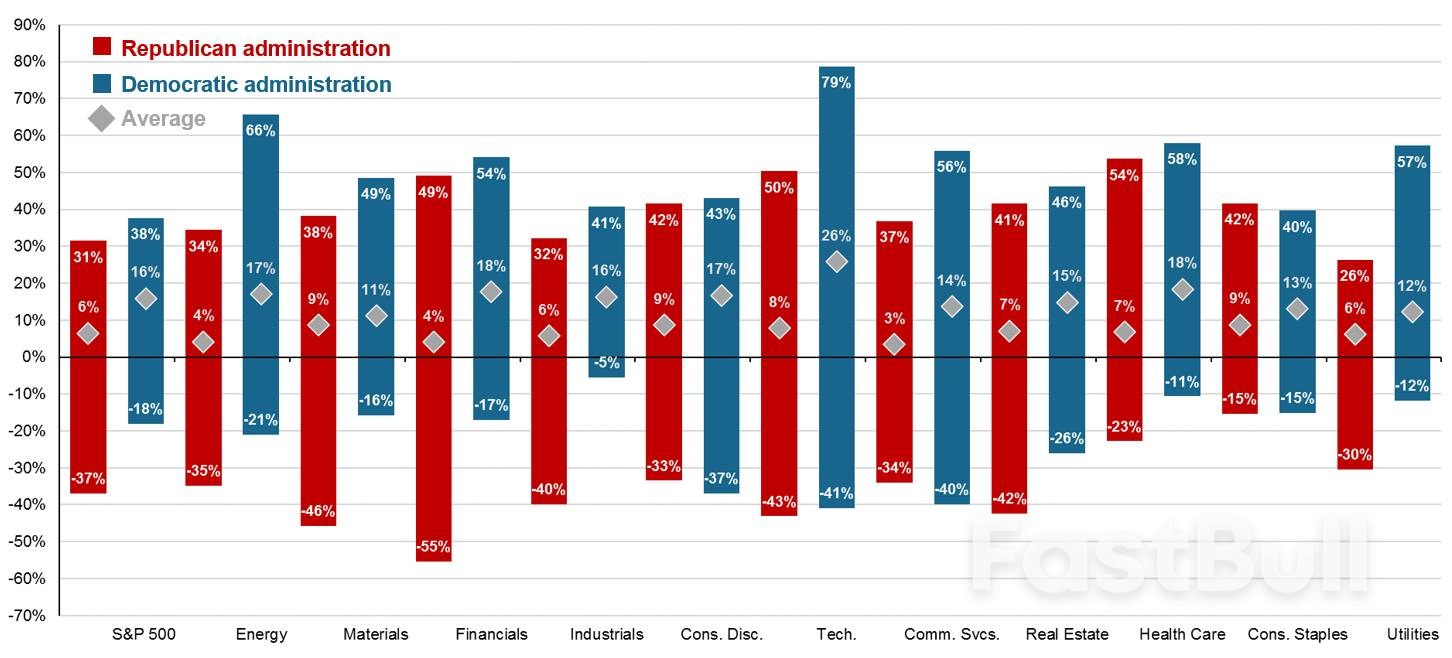
          Analysis shows that it can be difficult to devise a sector investing strategy based on who is or could be in the White House. The chart below looks at S&P 500 sector dispersion and average performance since 1990 under Democratic presidents (19 years) and Republican presidents (15 years). It shows that average returns were higher in all 11 sectors during Democratic administrations than Republican administrations.
          However, this analysis is skewed by 2008, which was the worst performance year since 1990 for 8 of the 11 sectors. The only three sectors that didn’t have their worst years in 2008 were consumer discretionary and communication services, which had their worst years in 2022 under a Democratic administration, and utilities which had its worst year in 2001 under a Republican administration after rallying a whopping 57% the prior year. Without 2008, Republicans preside over the worst years for only 5 of the 11 sectors, the best year for consumer staples in 1991, and outperform on average in materials.
          Democrats presided over the best years for 10 out of the 11 sectors but without much consistency on when that occurred: financials and health care (1995), technology (1999), utilities (2000), materials (2009), industrials and consumer discretionary (2013), real estate (2021), energy (2022), and communication services (2023).
          However, just as a Republican administration can hardly be blamed for presiding over the onset of the financial crisis in 2008, a Democratic administration cannot be celebrated for outsized returns in technology during the tech bubble. Therefore, it is very difficult to discern sector performance patterns under different administrations that could reliably repeat themselves in the future, even if a party is relatively consistent over time on policies they strive to implement in different industries.
          Furthermore, even if there were discernable patterns investors could act on, there is a difference between who investors think will win a future election vs. who eventually wins. Even if one could accurately predict the next president, the configuration of Congress is critical to enable the president to enact their agenda. Even with a one-party sweep, increasing political polarization doesn’t guarantee harmony and agreement within a party. Finally, the economic climate could easily derail a party’s agenda or non-economic issues could become more pressing.
          Therefore, repositioning portfolios based on past sector performance may be futile. Instead, investors should focus on the fundamentals in the economy and markets and practice a disciplined approach.

          S&P 500 and sector performance dispersion by Presidential Administration

          1990-2023, calendar year total returns, maximum, minimum and average returnsHow Sectors Perform Under Republicans vs. Democrats_1
          To stay updated on all economic events of today, please check out our Economic calendar
          Risk Warnings and Disclaimers
          You understand and acknowledge that there is a high degree of risk involved in trading. Following any strategies or investment methods may lead to potential losses. The content on the site is provided by our contributors and analysts for information purposes only. You are solely responsible for determining whether any trading assets, securities, strategy, or any other product is suitable for investing based on your own investment objectives and financial situation.
          Comments
          Add to Favorites
          Share
          FastBull
          Copyright © 2025 FastBull Ltd

          728 RM B 7/F GEE LOK IND BLDG NO 34 HUNG TO RD KWUN TONG KLN HONG KONG

          TelegramInstagramTwitterfacebooklinkedin
          App Store Google Play Google Play
          Products
          Charts

          Chats

          Q&A with Experts
          Screeners
          Economic Calendar
          Data
          Tools
          Membership
          Features
          Function
          Markets
          Copy Trading
          Latest Signals
          Contests
          News
          Analysis
          24/7
          Columns
          Education
          Company
          Careers
          About Us
          Contact Us
          Advertising
          Help Center
          Feedback
          User Agreement
          Privacy Policy
          Business

          White Label

          Data API

          Web Plug-ins

          Poster Maker

          Affiliate Program

          Risk Disclosure

          The risk of loss in trading financial instruments such as stocks, FX, commodities, futures, bonds, ETFs and crypto can be substantial. You may sustain a total loss of the funds that you deposit with your broker. Therefore, you should carefully consider whether such trading is suitable for you in light of your circumstances and financial resources.

          No decision to invest should be made without thoroughly conducting due diligence by yourself or consulting with your financial advisors. Our web content might not suit you since we don't know your financial conditions and investment needs. Our financial information might have latency or contain inaccuracy, so you should be fully responsible for any of your trading and investment decisions. The company will not be responsible for your capital loss.

          Without getting permission from the website, you are not allowed to copy the website's graphics, texts, or trademarks. Intellectual property rights in the content or data incorporated into this website belong to its providers and exchange merchants.

          Not Logged In

          Log in to access more features

          FastBull Membership

          Not yet

          Purchase

          Become a signal provider
          Help Center
          Customer Service
          Dark Mode
          Price Up/Down Colors

          Log In

          Sign Up
          Position
          Layout
          Fullscreen
          Default to Chart
          The chart page opens by default when you visit fastbull.com